“New Miserable Experience” by Robert Fieseler

Europa Hides an Ocean cropped
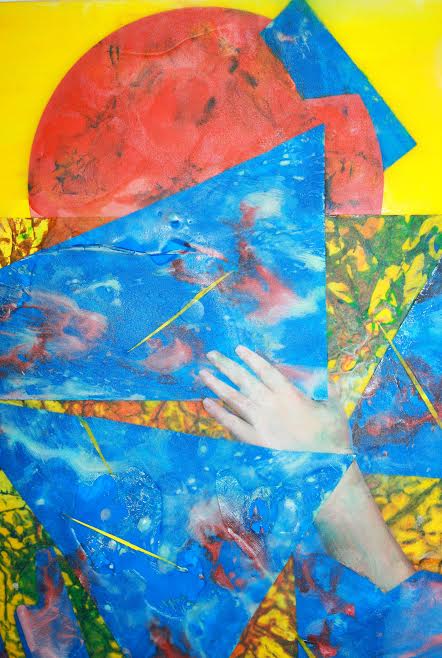
“Rainfall” by Mia Avramut, wax on paper, 5.8 x 8.2 in.

I.

Bobby

I made my brother’s list. That’s what I was hearing. Billy wrote a list and included me on it—not at the top of the list but near. I smiled. He frowned. He readjusted his position on our mother’s couch, the leather squeaking. “Bobby,” he said, “that’s not a good thing.”

But I loved succeeding in the eyes of others, and Billy understood this: Second Place ribbon in backstroke at Maplebrook Elementary, lead in the high school musical, vice-president of my college fraternity. Billy knew I lined up these facts in my head like a trophy case. We shared a bedroom for 10 years, and he’d stand back as a kid and marvel at my wall of accomplishments. He never could catch me, first because he was four years younger and then because he seemed to “live a bit less.” That’s how he put it. My eyes drifted across our family room as my brother tried to speak.

I looked at Billy. He usually smiled right through you, like a homeless man might smile into the glare of a storefront window. But, here, my brother’s face reflected calmness, presence. His nose hooked to the left. The “Fieseler Schnoz” had always been our defining feature, and, though he’d broken his so many times, we still looked alike. Billy slid his cap backwards, which revealed the golden letters “W.F.”—honoring both Wake Forest University and, as a joke, his initials (William Fieseler). Not your school, I thought. You never went.

I knew from our sister, Annie, that November 2012 marked Billy’s first month of sobriety. We were nearing two months from that milestone. Three months, and he got a pin , maybe. “What I have to do as part of my program,” he began, and I felt trapped on the couch beside him. He talked some more, and my eyes floated to my mother’s Christmas Village by the window. Starting in 2009, when Billy fell apart, my mother would set up a miniature world on the triangle coffee table. Her fantasy became like a three-tiered cake. On the topmost pane of glass were the largest porcelain mansions, which included a Santa’s Workshop. On the second pane, a layer beneath, sat a smaller subdivision of homes and streetlamps. On the final pane, furthest below, dwelt a town ringed by a railroad.

“Part of these steps is I have to make amends,” I heard him say.

My mother took days assembling this village. She’d crack open bottles of white wine, sip and examine and reexamine. Each house lit up from within. When the arrangement pleased her, she’d lie on the couch and watch home remodeling shows and polish the bottle. Simultaneously, she’d project herself into the miniatures. Who knows what she found inside there. Her village was something children would adore, only there were no grandkids. My eyes sank to the lowest layer.

Two trains circled the same track, sometimes bumping each other like butt-sex. We’d be gods, I thought, to those people. Past the Christmas Village was a different universe entirely: our own. A tall bookshelf connected to the mantle where a boxy TV once sat. Beneath it was an air duct that blew heat on your feet straight up from the basement furnace. Billy and I used to fight for that spot. Winters, when we scooted up to the Super Nintendo, the winner got the heat.

We’d duel in a futuristic racing game called F-Zero. The fastest ride was a pink space pod, which sputtered from the gates but accelerated to the highest speed, so long as you drove her perfectly. She was my “pink gorgeous.” With her, I secured the record time on every track, writ with my initials: RWF. Then one day I caught Billy with my gorgeous about to shatter my time on the fastest track, and I kicked him to the window blinds, and she crashed. Instead of crying, he laughed as he pulled himself up, his shoulder bleeding. He laughed because he got me, found the thing that cracked the mask.

“Where the fuck are you, Bobby?” my brother asked.

“Jesus, man, I’m sorry.”


II.

Billy

Pulled into Mom and Dad’s driveway and sat there for a second. The engine cut out, and the car settled into the purr of the electric battery. This was a rich man’s vehicle: Dad’s Toyota Hybrid. He’d lent it in June, when I started back at work. That was nice of him. Seven months later, he still hadn’t asked for the keys back.

Grey, cloudy, Sunday. Neighbors’ houses loomed around me, some of them taller than three stories. I pictured the old wives inside with their phones and pictures of pathetic kids: Mrs. A., Mrs. Green. They’d watched me grow up into what? Their sons left Chicago, not me. 27 years old, and here I was still borrowing Dad’s things. I saw the shadow of Bobby waiting in the kitchen, the overhead light catching his head. His shape stretched towards me. 20 minutes ago, he’d sent a text saying, “Getting some food.” The garage stood open. Outside, wind blew cold.

I’d meant to do this sooner. But Bobby said he didn’t want to talk about anything serious. I let six weeks pass, and now I had to pounce before he hit the escape hatch. Tomorrow, he headed back to Columbia University and New York City, where he lived. He’d been out of town for three years, and I hadn’t even paid him a visit.

My hang-up had been the “spiritual affliction” thing. A long road to respect the concept, bouncing in and out of centers, learning not so much to stop drinking as to live spiritually—the alcohol a symptom of deeper stuff. It’s a hard realization to grab with both hands: we are not just our own person. Growing up, Christianity was a thing I did on Sundays. To say I never felt the touch of God doesn’t quite capture the sham. I looked for God at my first communion, ate the bread and nothing happened. When I kneeled before that Catholic pervert bishop at confirmation, Grandma cried, and I waited for my imaginary friend. “He’s pretend,” I told Dad when we finally had the fight about Jesus. Now, I studied Chapter 4 in the “Big Book” of Alcoholics Anonymous. Titled “We Agonistics,” it made the argument that only a spiritual life conquers alcoholism. Dogs started barking inside. Two white bichons appeared in the front window. They dove at the glass repeatedly, though never – in their combined years of living – breaking through to freedom.

Bobby prolly guessed I was here. Those fucking animals. My favorite reference manual from last year had been: “Alcoholics Anonymous: Cult or Cure?” That one did a fuck ton of good. I’d pop yellow Adderalls and tear through the pages. Few studies could explain how A.A. worked, and this book manipulated the fuzziness. It bought me time to drink. That book was my best defense. A.A. boasted more than a million people going to meetings, and I fended it away. Bill W., the former Wall Street trader and founder of A.A., had invented the idea of a “12-step program” based on the 12 Apostles. I knew this. My mind jumped to every 12-step program built on this happenstance: Gambler’s Anonymous (G.A.), Overeaters Anonymous (O.A.), Workaholics Anonymous (W.A), D.A., P.A., M.A., all based on what? Faith? Why not 10 steps or six? But I’d learned to stop calling bullshit.

Step 1 meant admitting I was powerless. Step 4 was my personal and “fearless moral inventory.” I kept my journal in the trunk. Across its pages, I catalogued every busted relationship in my life—past and present. I could recite it by heart. In the subsection marked October 9, 2013, which represented my Sobriety Day, I’d laid out three columns. The first column read “Resentful At” and beneath it “Bobby (Brother).” In the second column, I listed “Causes” of resentment in our relationship: “More successful,” “Judges me,” “Takes vacations,” and “Doesn’t want to talk about my life.” In column three, I tallied where each “Cause” cut into me: “Self-esteem,” “Relationship with others,” and “Relationship with self.” Then, if you flipped the page, you’d see three more columns. Here began my analysis of how I treated him. In the first column, titled “Selfish,” I’d written, “Blamed for starting my drug use,” “Made him buy me booze,” “Constantly drunk dialing,” and “Called him a fag.” These pages were why I was sitting in the driveway—to finish my Step 9, where I attempted to make amends for everything I wrote in Step 4. Hell, I’d made the list and one hell of a promise to my sponsor, and Bobby meant finishing it. Each step worked like an ego trap, grinding your face into the psychic crap of your past.

If I didn’t move ahead, I’d drink again. Progress meant embarrassment.

“No credibility,” I muttered. The time between January, this month, and October wasn’t much. But my sponsor and I decided, after my last slipup, that I needed to try something else. Family dogged me, we agreed, especially the thing with Bobby. My knuckles throbbed. I forgot I did his inventory on my first day back at meetings. Facing Bobby made my Step 9 with Dad and Mom feel easy. I took the keys from the ignition, stashed them in my hoodie. “God?” I asked, having taught myself to pray again and somewhat believing. “Give me help on what to say or how this should go.”


III.

Bobby

His voice shook me out of the village. “I was in there,” I wanted to tell him, but I wasn’t sure if he’d get the joke. Why drag up old shit? “Mom drinks because you did,” I almost said but stopped myself short. “I’m here to say that I was wrong in my behavior for a long time,” he said, his eyes unblinking. He locked onto me, drilling in sincerely.

I gazed at the Nutcrackers above the mantle and examined the iron tree, the one with the Hallmark ornaments my mother bought in June. On the bay window hovered a life-size sticker of a robin to keep birds from battering into the glass. “It wasn’t ok,” he said. The force of impact on double-paned glass was enough to kill finches from internal injuries. For some reason, the sticker (an image of a flattened bird) served as adequate warning. “I want you to know that I know that the wrong I did to you can never be undone and that I wasn’t a good brother.”

Some creatures ignored the warnings. I noticed how he avoided “sorry,” maybe on the advice of his sponsor. I’d seen him posting and seeking advice on online message boards like SoberRecovery.com. I’d done my research. Social media had sucked the mysteries out of A.A. Maybe all the addicts had held a symposium and agreed that they’d said “sorry” enough to strip the meaning. Maybe I could save that one to sting him, I debated, for saying it or for not saying it. But Billy knew I diagnosed situations to gain advantages. “And want to know how you felt about it,” he said.

And I couldn’t hurt him. This was my chance to tear open his brain and take out the broken pieces. Start with his childhood security blanket, pivot to his night terrors, crescendo with that crack-hole of a woman he met in Rehab Round 2. I could string events into a chain and use it to hang him from the ceiling. And I just couldn’t. I remembered my bedtime prayer as a kid, the one I’d say in front of him. “God bless Mommy and Daddy and me and Lauren and me.” I said me twice. I forced our eyes to meet.

He said, “This is me acknowledging the wrong that I did.” In his place, I wouldn’t say the same. His goatee looked trimmed. His arms bulged; he’d clearly been lifting for the past few months. Ever the competitor, I stifled my tendency to get jealous when Billy got buff.

“You remember the text?” I asked.

“Yes,” he said. “That summer.”

“I’m sorry I meant it.”

He’d called me late, when the light at my desk was the only light in the office. The Chicago Brown Line, which curled around my building, sat dark—done with all the commuters. My phone buzzed to life, emitting a glow that scared me because I was alone, and empty offices are creepy. It flashed “Billy” “Billy.” I guessed, by the hour, that he was smashed, and I felt stranded with his dilemmas. I couldn’t be distracted. The London office needed files by start of business, and I needed a job transfer to London. The need to keep working, keep working. I let him go to voicemail, deleted the message without listening and texted: “Billy, I’m really busy right now, and I don’t want to talk about your life with you.”


IV.

Billy

Why stare in the corner? Could he guess this was hard? I was saying what I was saying, and I’d practiced saying it with my sponsor, in front of the dogs, with my fiancée. Get your words right. Don’t say sorry, say apologize. Don’t make excuses if he throws it back at you.

He sat looking off and not wanting a drink, and I sat wanting a drink like always. Thoughts ran ahead of me. It was work to sit, work to talk. Work to rearrange myself on the couch instead of getting up and walking to Mom’s cabinet with the lock undone.

My voice droned. There went the part about being wrong. He mentioned the text message. Ok, he meant it, enough. I was working my way through the minute to talk and not get up. People worked for it, the ones I knew. Some worked forever and never saw the fruits. Can’t last the minute. That’s the bitch of things, and I’ve never been okay with it for one day in my life.


V.

Bobby

We went 21 months without speaking, during which he attempted suicide by overdosing on phenobarbital, an anti-seizure medication. I’d pass addicts begging for change on the way to the train and wonder if it was my brother. He changed his cell number, and I didn’t notice until I tried texting him six months later. I avoided mom and dad’s house for three Christmases to escape the situation that made me saddest: that Billy lost at everything, including his addiction. I want to say that I thought he would manipulate me if I tried to help, that he’d try to sink me. But the truth was I purged him easily. I couldn’t be bothered because I was too busy grasping for promotions, which I received. I wanted to tell him that he was always better than me, that, even as a kid, he saw through the playacting we do to manufacture worth. How a human was not singular in this world but the product of a family. And how that was unfair, because we don’t choose our families, but that was the truth of it, and in the truth we all become losers.

It sounded flat. It felt flat. I decided it was flat. Instead I said, “I lost my best friend,” hoping it meant something.

His head jolted back, registering surprise. He took time nodding and then replied, “It’s tough for me to even, kind of, recall what you mean by that. I’ve been so far gone that I can’t remember it, Bobby, and that makes me sad.”

I closed the garage after he ducked past the outside light. The metal door trimmed him away until he vanished. I heard the purr of the battery and the groan of my father’s engine as he sped away. I wasn’t sure where he lived, and I started crying, realizing I should have let him win something. I turned back to the family room and saw the furniture rearrange itself in my brain. I was alone, and I remembered when I used to babysit all of them: Billy, Annie and Lauren, my other sister. The couch sat in front of the bay window back then. My parents kept a stereo in a cabinet opposite the sofa. We’d listen for the sound of the van receding and then blast our ‘90s grunge rock. Billy and I reveled in those songs.

My favorite word as an 11-year-old, and thus my brother’s favorite word, was “rebel.” We planned to tear down society by buying the right CDs. In the fall of 1992, Mom wouldn’t let us buy Nirvana “Nevermind” because she hated the baby’s penis on the album cover. So we settled for the Gin Blossoms’ “New Miserable Experience,” not for the music but because the title summed up everything we believed in. Plus, their lead singer died of an overdose and that seemed to lend the band credibility.

The song “Found Out About You” commenced with airy, strumming guitars. “All last summer, in case you don’t recall…” I grooved beneath the ceiling lights on my parents’ coffee table. “I was yours, and you were mine… ” The girls pounded down the staircase in time to sing, “Forget it all! I leapt onto the sofa. “The things you said and did to me…” Billy took my place in lights. “The love I thought I’d won, you give for freeeeee…”

He mimed a solo. “Whispers at the bus stop…” We clapped. He kicked and sneered. “Nights out in the school yard…” We clapped together. “I found out about you…” This is reverie. “I found out about you…” I stole his voice. I’m stealing it. He did it with booze, I did it with winning. We didn’t know about siblings competing or anyone losing big, but he was seven years old, and that was the last time I could picture all of us clapping for him.


Robert Fieseler grew up in Chicago and graduated co-valedictorian from the Columbia Journalism School. He is the proud older brother of William (Billy) Fieseler, who also appears in this essay. Robert’s journalism has appeared in Narratively and The Big Roundtable; W.W. Norton will be publishing his debut book of nonfiction. Tweet him @wordbobby

Read an interview with Robert here.

“Fulfillment” by Avital Gad-Cykman

Fulfilled
“Womb” by Mia Avramut, wax on paper, 5.8 x 8.2 in.
(See also “Indian Remedies for Tereusitis” by Sabyasachi Nag.)

The magazine “This World” proclaimed Cassit Café an upscale Bohemia where poets and journalists drank together, and writers and singers shared stories. The article was embellished with photographs of models and air-hostesses, however, it must have been a crock.

All she saw was a half-empty darkened place with an intimidating aged waiter in black and white, standing at the entrance and staring at her until she dropped her eyes and withdrew toward the edge of the sidewalk. She didn’t want to enter anyway. A two-hour bus drive away from home, and the pavement almost danced under her feet.

Instead she was determined to find another restaurant where people ate chicken and French fries with their hands, no table manners or polite conversation, only a full mouth and oily fingers. She’d find that perfect place.

Walking tentatively toward the north, she stopped when a masculine voice called, “Hey, hello, want me to read your palm?” As expected, the man, unkempt and in his thirties, wearing an oversized jacket, leaning against a rare robust tree, was looking at her. People always thought she was easy prey. She shook her head, able to sense the rough surface of his blackened hand rubbing against the palm of her hand, and what good future could come out of that?

Despite the electric pleasure of the city, it became harder to speak with people as the hours advanced. She coughed, to hear her own voice without appearing to be crazy. She didn’t have to talk with anyone, anyway. Being a stranger made her an explorer, a magician, anything except just a girl. Back in her home town everybody knew whose daughter she was, whose friend, where she lived, where she studied, her grades, her hobbies, and who had left her for another. She really wanted French fries. The chicken must be pretty special too. Everyone assumed the other girl had something she didn’t, which was probably true. The chickens, she hoped, did not go through a slaughterhouse, like the one oddly located not far from the city center, back at home. She went there, once, out of curiosity, and despite the jutting blood she didn’t become a vegetarian, because, as her boyfriend used to say, “that’s life.” If you didn’t have what it took to survive, you didn’t.

She had thought she was pregnant, and wondered if she’d still grow up to be an air-hostess, or, if nothing else worked, a poet. She could never tell what she was or what she might be the way others could. She believed she was pregnant, though babies should happen with maturity, and not because you see a bleeding featherless chicken. Either way, he would never take her back with a baby. She was so certain, she stole money from his wallet and her father’s, and also from her mother’s purse, and though she wasn’t sure how much she needed, she assumed she had enough.

Above all, she believed it would be easier to find a doctor in the city. But now, walking down Dizengof Street, she knew that her growing belly didn’t house a baby, just the way the café didn’t house poets and writers and air-hostesses, despite its potential. She simply needed a lot to eat because nothing filled her up.

The busy street with its food stalls, clothing stores, graying three-story buildings and a ramp with a tub aspiring to be a fountain stood on the verge of greatness, like a superhero still wearing an office suit. She recognized the restaurant thanks to the large sign announcing liberation from silverware. The young waiter in a red t-shirt offered a bib and rubber gloves, which she declined. He smiled at her, he did, and as she chose a stool at the counter, he served her a large metal plate full of French fries and half a chicken.

Her face shimmered, and her eyes released dragonflies to the air. She sighed in relief and ripped the food with her bare hands.


Avital Gad-Cykman‘s book, the flash collection LIFE IN, LIFE OUT was published by Matter Press in 2014. Her stories have been published in The Literary Review, CALYX Journal, Glimmer Train, McSweeney’s, Prism International, Michigan Quarterly Review and elsewhere. They have also been featured in anthologies such as W.W. Norton’s International Flash Anthology, Sex for America, Politically Inspired Fiction, Stumbling and Raging, Politically Inspired Fiction Anthology, The Flash, and The Best of Gigantic. She won the Margaret Atwood Society Magazine Prize, placed first in The Hawthorne Citation Short Story Contest, and was a finalist for the Iowa Fiction Award for story collections. She lives in Brazil.

Read an interview with Avital here.

“Good Will” by Beverly Lucey

Good Will
“Remembrance” by Mia Avramut, acrylic and paper collage on canvas, 8 x 8 in.

Will might have to kill Candace who works across the aisle from him. She crunches on hard butterscotch sticks whenever she gets an assignment she hates. She grinds them up like a beaver with a #2 pencil.

Still, he’s got to “roll up the sleeves and get to work another day another dollar if a job is worth doing it is worth doing well.” That’s what they say. Except one of the rollers on his ergonomic chair disappeared somewhere between yesterday and today. Will tilts. Will thinks someone on the night shift took his wheel away. He can’t roll up his sleeves to focus on the spreadsheets splayed in front of him because he’s wearing a scratchy-feeling golf shirt from J.C. Penney his wife picked out. Also, working from a tilt makes his eyes focus funny. He should find something in his cubicle that matches the thickness of the wheel.  A deck of cards is as close as he can get.

Some acoustical flaw about the sound-muffling panels in the room amplifies and deposits grotesque noises from odd corners of the large office and funnels them to Will. Hard to tell who is using the Emory board, who has the sound turned up for email alerts, who is trying but failing to suppress farts. On top of the spreadsheets, Will thinks he sees candy-stick  wrappers, fingernail dust, multiplying Betty Boop dolls, and a cloud of flatulence. Will suspects that others in the office add his name to newsletter lists with regularity. He doesn’t want vitamins or discount thongs, or news from Guam. But at 10:00 a.m. with a plunking sound, his inbox receives #082, “Small Comfort.” It’s the poem-of-the day sent from yet another practical joker, the gods, or Billy Collins*…and it saves him. At least from killing Candace.


Beverly Lucey, a winner of the 9th Glass Woman Prize for Fiction (2011), moved back to western Massachusetts after dallying in the South for a decade. While in Georgia, she learned that “Bless your heart” is not necessarily meant to comfort, and while in Arkansas she learned that every politician must make an appearance at the January Gillett Coon Supper, where deep-fried raccoon is indeed on the menu. She has an extensive fiction presence online in e-zines (in Zoetrope, All Story Extra, Feathered Flounder, Absinthe Review and others), and her short fiction has been published in  print: Flint River Review, Moxie, Quality Women’s Fiction (UK), Wild Strawberries and, most recently in, Twisted Tales. Four of her stories are anthologized in We Teach Them All (Stenhouse).


“Walking on the Effing Moon” by Roy Bentley

Life Saver
“We Are Butterflies” by Mia Avramut, encaustic collage, 5.8 x 8.2 in..

The summer night Mark Chapman sat in the parking lot
of the L & K in Heath, Ohio, Tom Kozlowski whispered
that it might be best to leave Mark alone in the car. We
were tripping and Mark had asked to be left in the car.
We nodded. Collected ourselves. Went into the L & K
and ordered coffee. A couple of cheeseburgers. Ate slow.
We were in the restaurant for about an hour. Maybe longer.
And now you need a word: englottogaster. It means to speak
from the belly or the gut. Like a ventriloquist. Why that word?
When Tom and I got back to the Ford and we opened the door:
Guess where the fuck I’ve been? No, not just in the car? I’ve
been to the moon—the fucking moon—and I walked around.
Even tripping, if you hear a friend mention the Earth’s single
satellite as a place he’s very recently visited sans rocketship,
as if the moon is much like late-summer dark, and no biggee,
then you tend to discount what you hear. However, if what
you hear doesn’t seem to be coming from the person you
know to be someone left in a blue Ford Fairlane in Ohio
because he was experiencing some difficulty keeping
himself in check—“maintaining” it was called then—
if the voice sounds disembodied or like it originates
from a blackness dissimilar to the one in the throat,
then you hup-two-three-four back and listen carefully.
Sure, you may recall that Neil Armstrong is from Ohio
and so an American left a set of footprints in that dust.
You don’t need a tab of Blue Microdot to hear assertions
as astonishing, or the voice in which they may be offered
as of unknown or exotic origin, but it helps. It can’t hurt.


Roy Bentley has received fellowships from the NEA, the Florida Division of Cultural Affairs, and the Ohio Arts Council. Poems have appeared in The Southern Review, Shenandoah, Pleiades, Blackbird, North American Review, Prairie Schooner and elsewhere. Books include Boy in a Boat (University of Alabama, 1986), Any One Man (Bottom Dog, 1992), The Trouble with a Short Horse in Montana (White Pine, 2006), and Starlight Taxi (Lynx House 2013). He has taught creative writing throughout the Midwest and south Florida. These days, he teaches at Georgian Court University and lives in Lakewood, New Jersey with his wife Gloria.


Announcing our October Illustrator, Mia Avramut

Out of the NestI’m so thrilled to announce that our October illustrator will be the very talented (and generous) Mia Avramut! She has graciously agreed to adopt this issue and has provided us with some lovely images. It’s going to be a stunning issue. Mia is a Romanian-American writer, artist, and physician, who worked in laboratories and autopsy rooms from Pittsburgh to San Francisco.

You Belong


Her artwork has recently appeared or is upcoming in Prick of the Spindle, saltfront, The Knicknackery, The Bookends Review Best of 2014 Anthology (cover), Up the Staircase Quarterly, Buffalo Almanack, and Sliver of Stone. She lives in Essen, Germany.

Stay tuned!

“at goodwill (radiation, day 32)” by B.J. Best

radiation day
“Pathways in the Sea” by Mia Avramut, encaustic and gouache on wood, 8.5 x 11.5 in.

we wield our squealing cart, ready to rifle
through the detritus of other people’s lives:
the fritzy stereo, the german bible,
baskets, scarves, puzzles, bent butter knives.

our son wants to visit the toys, buried
like a graveyard of childhood. broken parts,
electronics no longer batteried:
o birthday, o christmas, what callous heart

would want to be bereft of you? it is my wife
who finds the vintage cat pitcher made in japan.
we will take it home, let it purr in our life,
now a little brighter than when the day began.

thrift stores, like cancer, serve to remind:
you never know what’s hidden. what you’ll find.


B.J. Best is the author of three books of poetry: But Our Princess Is in Another Castle (Rose Metal Press, 2013), Birds of Wisconsin (New Rivers Press, 2010), and State Sonnets (sunnyoutside, 2009). I got off the train at Ash Lake, a verse novella, is forthcoming from sunnyoutside.  He lives in Wisconsin.

Read an interview with B.J. here.

Kathy Fish and Joan Wilking Talk About Writing

Joan Wilking

Joan Wilking: Both my SOS piece (At Risk) and yours (Grip) were inspired (or triggered) by five word prompts posted in an online flash fiction workshop we’ve participated in for years. What has the use of such prompts and membership in the workshop meant to your writing?


Kathy FishKathy Fish: Great question, Joan. I saw someone recently decrying the use of prompts in writing, saying they resulted in inauthentic writing. Nonsense. To me, writing prompts such as the ones you and I get in our flash workshop, are simply kindling. It’s up to each writer to set the sticks and twigs aflame. And what we do to start the fire comes wholly from within us and is therefore completely authentic.

I’m often struck by how, given the same five words to work with, we in the workshop create such utterly different and unique stories. The prompt words just get things going. I’m so grateful for Kim Chinquee and you and everyone in our Hot Pants workshop!

You all have meant everything to my writing life. I doubt I would still be at it today without you. There’s such huge value to having a longstanding group with whom to work. We all know each other well, know our quirks, and strengths. We’ve taught ourselves over the years how to relate to each other in a way that brings out the best in our work.

I’m interested in how it is for you, Joan. I know you have recently been using the workshop and prompt words to create a memoir. Can you talk a little about your process in putting that together?

waverly-beach-docks-At Risk

JW: I love the kindling analogy. Because I was a graphic designer long before I ever tried to write, my work pretty much always begins with an image. The prompt words, more often than not, force me to think beyond the imagery. They light a fire, as you said, that quite often changes how the piece eventually evolves, sometimes by adding a twist that enhances the story, sometimes by enriching or challenging the language.

As for my process, when I’m writing fiction I tend to take familiar situations and “awfulize” them. Years ago I read a Joyce Carol Oates novel and thought to myself, ‘She must have the best time taking her characters and putting them through more misery and heartbreak than any non-fictional character could survive and then manipulating them to enable them to come out the other side.’ Manipulation of character is a good term for how I see fiction.

Memoir is something else. For me it’s about mining the feelings attached to remembrance without straying from the truth. On my 70th birthday, this May, I started writing seventy pieces, seventy words each, for seventy days, alternating the past and present. I used the Hot Pants prompts in many of them. That was a very personal journey and I don’t think I could have completed it without the sense of safety the Hot Pants workshop provides.

That’s a true tribute to Kim who has been so passionate about keeping it going, and of course to everyone else who shares there.

You are known as a flash fiction aficionado. I often end up using my flash as a steppingstone to my longer fictions. I’m wondering, after the work you share on Hot Pants has been critiqued, how much of it remains flash and how much, if any, becomes part of longer works, which all begs the question, what role does flash fiction play in the ongoing panorama of literary history?


KF: Wow, I really love the notion of taking a familiar situation and “awful-izing” it! Yes, putting one’s characters through hell. I’ve heard variations on this idea. It really does make for potent fiction and is a great way to approach flash fiction.

You know, my flash pieces from Hot Pants very rarely turn into longer works. They almost never go beyond flash length. I do remember one time posting a really odd paragraph in there and one of our group, I think it was Gail Siegel, responded with such unexpected enthusiasm, I just wrote and wrote and wrote and ended up with 3000 words, which to me is a tome, ha. It ended up being one of my favorite (of my own) stories. And there again is the huge value of that group.

But no, usually my stories remain flash. I honestly don’t know what role flash fiction will ultimately play in the literary canon. Those of us who write it are so passionate about it! My sense is that is ought to remain a fluid form, that it’s too early to lock it down. I get so excited when I see people doing different things with it. I say as long as it’s fewer than 1000 words, it’s flash. Well, maybe a 1000 word grocery list doesn’t qualify, but you know what I mean. I rather like the idea of flash being the rebellious teenager of the literary world.

I wonder if visual artists, actors, directors, musicians approach writing differently. It has to inform the work. As you said, you nearly always begin with an image and then you move beyond image to story. Lately, I’ve been trying to take a very cinematic approach to writing, though I have no background in film. Do you do this as well? Would you like to see any of your work committed to film or stage?

auburn-ca-poppies-Grip

JW: A couple of years ago I was in Mexico with a bunch of writers and J. Ryan Stradal, author of the new best seller, Kitchens of the Midwest, read a story that was a series of grocery lists, which was hilarious. Each list was a little flash story.

I used to participate in a group called Writers & Actors INK. We met once a month is a black box theater. Writers brought short scripts or stories and actors came to read from them. It was amazing how differently some of my stories played out in front of an audience. What I thought was funny actually had people in tears and vice versa; people saw humor in what I’d written as tragedy. I’d love to see my work on stage or screen where the visuals have parity with the words. I hadn’t thought of my work as cinematic, at least not consciously. You may have just changed the way I perceive it.

We haven’t talked about our stories in r.kv.r.y. yet. Can you speak to the origins of your story?


KF: Oh yes. Can you imagine a series of short films or plays based on Hot Pants stories? That would be so great. I can see how all of us would write to that idea, you know? Not changing our flashes to screenplays or stage plays, but keeping in mind that they may be seen.

My story, “Grip,” is only slightly fictionalized. In March, my brother died of multiple sclerosis. I’d gone home to Iowa when he was in hospice. It was one of the most profound experiences of my entire life. I came back feeling incredibly sad, of course, but also just…dazed. And for a time, every single thing I wrote stemmed from watching my brother die, watching my family watch him die.

As you know, we take turns in Hot Pants providing the prompt words. When it was my turn, I gave five words in honor of my brother. I don’t remember exactly what they were, but I know I used them in the story. The title, “Grip” came from one of those beautiful moments, one of those gifts you get in the midst of tragedy, when—weak and depleted as he was—he squeezed my younger brother’s hand very tight (for story purposes I made it my own hand). It spoke to so many things, that moment, and I knew I’d eventually write about it. I’m glad I did.

Now, please tell me a little about your story, “At Risk,” Joan. I love the opening sentence: “I think a lot about ghosts these days.”


JW: I think many writers, including you and me, use writing as a way to process pain.

Other than ad copy, I never wrote until I was well into my fifties, never thought of myself as a writer. I never had the undeniable passion to write that some writers do. As a result, when I started, I felt like a freshman. Now I read the work of young and younger writers, and workshop with them, and feel like I fit in better with them than with many of my age-wise peers. That has led me to do a lot of thinking about how we marginalize groups of people according to age. Google me and my age is apparent. I wonder how that influences how other writers, agents, publishers and editors view someone like me.

At Risk” is based on observations that keep piling up as one enters old age. So many losses offset by the smell of lilacs and fog on the Bay, and the young, always the young, around to envy and be a reminder, when they look at you a certain way, that the end is a hell of a lot closer now than the beginning.

And one last question, if there was only one more thing you could accomplish in your writing career, what would it be?


KF: Oh man, I could NOT relate more to what you’ve said here. I, too, came late to writing. I, too, feel I have more in common with younger writers. And I also wonder at the marginalization of “older” writers and artists. Can only young people “emerge” for instance?

And I relate, keenly, to your story, to those feelings. Ah, but we keep those feelings at bay by just living and creating all we can. I guess. Ha.

Wow, your question is a good one! I can tell you, that I used to think in terms of awards and honors and recognition. Now, for some reason, I find myself pining for those things quite a bit less. I think it’s realizing that the “good stuff” is in the writing itself. And what we ultimately manage to leave behind. I’ve recently discovered a love of teaching. I think if some new writer I’d had the pleasure of teaching or inspiring went on to do great things that would be a wonderful accomplishment. But hey, if I could get TWO more accomplishments, a short story in BASS would be thrilling!

I’ll volley your question back to you, Joan. One more accomplishment. What would you pick?

JW: I’m greedy. Publication of one of my as yet unpublished novels, which will land on the New York Times bestseller list, be optioned for film and made into a major motion picture that grosses a huge amount of money. Short of that, just a good chunk of time left to keep on writing.

KF: Okay, I want that for you so you can invite me for an afternoon of wine and sunshine on your yacht with all your fancy friends. You’d do that, right?

JW: Absolutely!

“Life Saver” by Mary McCluskey

City Morning
“City Morning” by Mia Avramut, wax on paper, 5.8 x 8.2 in.

The thing about living with a guy who’s just out, who’s done his time and just hasn’t settled back in yet, he jumps and twitches and doesn’t sleep, and his eyes dart left and right and he’s always turning in the street, looking behind him. The thing about living with this guy is that even when his voice is soft, a whisper, the razor blade edge of it seeps through. When he’s saying oh, you’re so hot, you’re special you are, there’s something else.

I hear it, this thing in his voice, but I think – he’d never hurt me. He just wouldn’t.

We’re watching TV late on Friday afternoon when he kicks the wall and says – let’s go out. I jump up and we walk fast, him five yards ahead of me, and right there in town there’s a charity fair. Stalls with hand-made sweaters and jams and pickles and booths with goofy games. He laughs at the old ladies and he has a go at the shooting range, just for the hell of it, and moves the gun to the right trying to whip it around as if he wants to wave it all over the place but the guy looks at him hard, and it’s chained anyway, so he can’t budge it. He wins two goldfish. One boy, one girl. Well, that’s what the old gal said. I name them after him and me – Ted and Jackie, because Jackie has this streaky bit on top, like my hair.

I buy a proper bowl for them. He says it’s waste of money. He says they’ll be dead before you get home. Turns out he’s right. Half right. Jackie dies the next day. All her colors just vanish. She’s fine at first, then there she is, floating on top of the water, her gold bleached out. The boy fish doesn’t seem to notice. Keeps swimming round her.

In the pub when I tell Ted that his fish is still swimming but mine is dead, he gives me a look, picks up his drink and drains it, his eyes all funny and contorted through the bottom of the glass.

At home, I wait until I hear the TV go on, then I pull Jackie out of the bin, flatten her out on the kitchen counter, looking for some deliberate injury. I know he killed her. Then he’s there behind me and I scramble about hiding Jackie’s body in kitchen towel, throwing her in the trash and he wants to fuck now, and he says – you’re different, nobody gets me like you do. And when he says that, as if I’m the only one in the world who does, I give in. I can’t help it. In bed, afterwards, when he seems calm, I ask him, I say – tell me what happened with that girl. Not what you told the jury. The truth.

I expect him to yell at me, say shut the fuck up but no, he wants to tell me.

Saw her in the club, he says. She was hot. Really hot. And gagging for it. I was just fooling around. I push her up against the car and she yells something and then she’s got this thing in her hand, some kind of spike and I grab it, and push it towards her neck, just to shut her up but she moves and – He stops then, turns away from me. Stupid bitch, he says.

It’s when I think of her there, all her colors bleeding out, that something goes click in my head. My body cools. I don’t want him touching me. He doesn’t notice, he’s limp now, relaxed. I want to get up and run. Run away, like she should have done.

And the next night, when he’s gone to the liquor store, I pack my bag so fast and I think – that goldfish saved my life. I don’t know how, but she did.


Mary McCluskey’s prizewinning short stories have been published in The Atlantic, The London Magazine, StoryQuarterly, London’s Litro Magazine, on Salon.com, and in literary journals in the United States, the United Kingdom, Australia and Hong Kong.  Her novel, INTRUSION, is scheduled for publication by Little A in March 2016. She divides her time between Stratford-upon-Avon, in England, and Los Angeles.

Read an interview with Mary here.


“You Belong” by Tina Pocha

You Belong
“Wax becomes fire” by Mia Avramut, wax on masonite board, 6 x 6 in.

She gave me a gift
her disclosure
her addiction
She laid it out
as if to say
here
warm your feet on this
And I do
each time I feel
the world rise up
to swallow me
I remember
I am not alone
on that cold tile floor


Tina Pocha was born and raised in Bombay, India. She is a scientist by training and a writer by avocation. She currently works as an academic in the field of language and literacy, and is a new and emerging poet with publications in Cadence Collective and Eunoia Review and more publications forthcoming in Hyacinth Press and East Jasmine Review. You can find more of her writing at www.tinapocha.com


“A Taste of Peppermint” by K.A. Wisniewski

Taste of Peppermint
“Forest of Red Birds” by Mia Avramut, wax on paper, 5.8 x 8.2 in.

Peppermint Harris never walked too far from home; he didn’t like things he didn’t know. Still had his ’72 Gibson standing up in the corner of his daughter’s living room and only changed its strings when its rust and grunge cut through his calloused fingers. He nicked his face that morning shaving and dabbed some peroxide over the cut. He didn’t wash before he left and, as he waited for the light to change at the street corner, he smelled his hands. His black suit and cowboy hat hid a tired, aching body, the purple splotches on his legs, the red in his eyes, the beaten skin hanging onto its face.

And when he crossed the street, nobody knew who he was. None of the neighborhood kids called out Hey Peppermint, how ya doin? No one tapped him on the shoulder and asked for an autograph or sang one of his songs back to him. Not a soul even asked him for a light. After he picked up the pack of Camels, he’d stop at the bar next door for his usual: no famous imported beers, just two Buds and a double whiskey. He’d strike a match from the bar stool and he’d smile, remembering how he once enjoyed being recognized.


K. A. Wisniewski is a PhD candidate at the University of Maryland, the Managing Editor of Roving Eye Press, and an editor at Calypso Editions.  His creative work has most recently appeared in Toad Suck, the Tule Review, Third Wednesday, the Chiron Review, Genre, the Sierra Nevada Review, and basalt.  He lives in Baltimore.

Read an interview with K.A. here.