Interview with Ashaki M. Jackson

Ashaki Jackson

Ashaki M. Jackson is a poet and social psychologist residing in Los Angeles. Her poem “An American Paratrooper” appears in our April 2014 issue. Noted authors and Ashaki confidants Khadijah Queen (www.khadijahqueen.com) and Kima Jones (www.thenotoriouskima.com) recently pitched a few questions to her about her work – an ongoing reflection on grief, coping, and defunct mortuary rites grounded in her grandmother’s death.


Khadijah Queen (KQ) begins a little late but gracefully: Snap! I got distracted by YouTube and middle school homework and cake and hot dogs… ​What distracts you most from your creative work, and how do you overcome said distraction(s) and/or use them to your advantage?

Ashaki Jackson (AJ): This day-to-day thing. I’m responding from bed while deep-conditioning my hair and jotting a To Do list for the next four hours.

Chicken is marinating. Dishes still aren’t going to wash themselves. This basket of clean laundry is giving me the side-eye. It is 5:30 PM.

Being swallowed by the mundane is very comforting to me. My writing revolves around personal loss — mainly that of my grandmother. I still reside in her memory and fold into my grief when I evoke her in poems. The feelings are oppressive even when I write about my broader reflection on loss as I did with An American Paratrooper. Inundating myself with a Big Bang Theory-spring cleaning-pedicure session or reading books in a loud restaurant gives me respite. It gives me spaces to tuck my grief until I’m ready to see it again.


KQ: Talk about the bodied-ness of your poems. How central, tangential, and/or inextricable are the physical and the linguistic?

AJ: I have bodies. Many bodies. Other peoples’ bodies. Loved ones’ bodies.

Sometimes it is the thought of the last state in which I saw a late loved one that pops into my mind.

This is a painful but helpful entry into my drafts. I also spent quite a bit of time studying anthropologists’ articles about mortuary rites. Cecilia McCallum, Ph.D., is a lasting favorite. She documents the care with which certain South American tribe members once treated their deceased family members’ bodies before consuming them.

I learned that mourning isn’t merely psychological; it is a ceremony, a meal, something that lingers on the palate. The language of consumption in relation to the lingering sense of loss underpins many of my pieces—devouring, preservation, and that sense of never being sate. Some of my poems read as if words are falling out of the mouth haphazardly. Others read as if I’m choking on the grief. I’m not able to articulate the craft, but thematically I might refer to it as written keening.


Kima Jones (KJ): Essentially, form is choosing skin, so I want to revisit Khadijah’s question on bodied-ness: Which form, which body do you like to take on most? And for your grandmother? 

AJ: My good friend, Noah, mentioned that some of us “like to wear each other’s bodies.” We were speaking about recent travesties — Malaysian Flight 370, MV Sewol in South Korea, the Chibok girls. For all of those bodies lost, families only received apologies from officials — the emptiest gesture. Like gristle.

I think you crave a body — living or dead — particularly when you do not have one.

Bodies are tangible and to be cared for. That care is some kind of ritual.

My work doesn’t have a particular body. Forms are rare in my work. However, I allow my lines to occupy the page in non-traditional ways. One poem is written in the choppiness of a choking cry. In a different piece, the words collide at the bottom of the page – a visual homage to hopelessness in grief. The reader should want to gather words from these pieces, scrape them from the ground, and comfort them.

I spend a good amount of time thinking on my late grandmother’s passing. It aides my coping to wade through the memories, but it also gives me access to a dialect of grief that others might make use of in the future. In my manuscript, I write about her transition in various forms with the same sentiment about the body. She should be home, with us, and cared for. I don’t know if it’s the best I can do to evoke her in my pages as if my manuscript is her portable body. It is a start for me.


KJ: There is always something hiding, even in the uncovering and undoing. I am wondering how Ashaki keeps the secret things hidden during the excavation, the mining of all those graves?

AJ: I’m of the mind that the reader does not need to know me to enter, understand, experience, or relate to the work. Few books would ever be read with this requirement. What I need from the reader: trust. I might not hand you my articulated grief or reveal everything I’ve had to unearth to write a piece, but I’ll share work that will resonate in some way with the reader–that will rub the reader’s bruises just as my ache is continually touched.


KJ: It’s a question I’m turning over more and more in my head in regard to my own heart and my own good feeling, so I ask you, what is the use of the love poem?

AJ: Use of the love poem: praise for a body; idolatry; celebration of the mind’s fire; a method of serenading; to fully taste; to build a word altar to a moment; to sustain a beautiful feeling; to tuck a piece of candy in my pillowcase for later; to be reckless in my selfishness by flaunting; to maintain my warmth; to serve me.

I think that’s broad enough to comfortably fit my poems on grief and loss and loose enough to include the poems I have yet to write for the loves I have yet to know.

 The Body of a Soldier

KQ: Truth & honesty– where on the spectrum when dealing with loss/grief do these consciously figure? Are they seeds or threads? Both? How much gives way to metaphor or story or construct? 

AJ: I think Kima’s question about the use of a love poem is relevant here. If I were to write a love poem — let’s say “romantic” in some way — my approach could be seen as dishonest because I haven’t known love. I’d tell you that in the poem. I’m pretty forthcoming with what I don’t know. But, it would still be a decent poem because lies are often the most interesting genre.

When dealing with loss, I am more honest about what I have experienced than what I have not. I think my feelings are evident and even resounding when I write about personal loss because I know its labyrinth. I become the omniscient tour guide. When writing others’ losses: my empathy might seem insufficient. My feelings about documenting grief are still true and perhaps a projection of my mourning. But, I don’t know others’ specific pains, which are rooted in long relationships, family, home, and hopes for the future.

The lyric fills in those hollows. The poem becomes indigenous to its characters — not me. I am honest until my imagination converts a paratrooper’s body being retrieved from Cambodia into a native stork.


For more indigenous birds, endocannibalism, and loss, find Ashaki M. Jackson’s work in the newly released VONA anthology Dismantle from Thread Makes Blanket and the forthcoming Read Women from Locked Horn Press. Her work is also in the publications Eleven Eleven, Suisun Valley Review, Generations, The Drunken Boat, and Cave Canem anthologies among others.

Interview with Carrie Krucinski

Carrie Krucinski
Read Carrie’s wonderful poem “Scar Tissue” in the Spring 2014 issue.

Kristin Distel: You’ve stated that you admire the work of Glück, Plath, and Trethewey. In what ways have these and other poets influenced your work?

Carrie Krucinski: As you can see, they’re all women. It’s not that I don’t enjoy the poetry of men like Robert Lowell, Bruce Weigl, and Charles Simic, because I do. But I feel such a kinship with female poets, especially those that have had any trouble with mental illness. When I was first diagnosed with Borderline Personality Disorder, I had to have an outlet for what was going on inside my head. These women understand me, and I understand them. Even if the poetess has not had a problem with mental illness, there seems to be so much they are trying to work out in their poetry. This past March, I had the opportunity to attend a lecture by Trethewey. Listening to her explain that she communicates with her father about issues of race through her poetry was beautiful and familiar. I think I try to explain myself to the world through my poetry, as well. The one overwhelming influence these women have had on me is to be honest. I think they’ve influenced me to write as though no one will ever read what I write, and if they do, who cares?


K.D. You’ve mentioned that Plath has motivated your work from your earliest efforts as a poet. What techniques or stylistic choices have you observed in her work that you most try to recreate in your own?

C.K. My favorite poem by Plath is, “The Moon and the Yew Tree.” Plath is simply describing her home in Devon. She doesn’t come out and say, “Hey! I’m depressed!” She describes her world in such a way that by the end you feel this weight on your chest. Most times, Plath is a study in subtlety, if you don’t include “Daddy” and “Lady Lazarus.” When I read her work, I don’t feel as though she is being heavy handed. She is delicate, intelligent, sneaky. When I started to write in earnest, I lacked subtlety. It wasn’t pretty. That’s why it is so important to read widely and deeply; I learned from Plath how to structure a poem. She also has this lovely thing she does with repeating words. In quite a few poems she will repeat a word three times. The repeating of a word isn’t a big revelation, but I really find it interesting. Also, the woman knew how to create a metaphor! The poem, “Scar Tissue,” might not be a work in subtlety, but I also don’t think it is as distraught as it could have been.


K.D. Your poems are forthright in examining mental health issues, self-harm, and other very private concerns. Have you ever questioned whether you wanted to divulge such personal matters in your writing?

C. K. I question myself about content all the time! The thing about mental illness is that no one wants to admit to having it. I spent so many years hiding my struggle. I couldn’t work for ten years. I had to live with my parents and be taken care of by them. I found that I didn’t want to have friends or let anyone really know me. When I met my husband eight years ago, all that began to change. On our third date, I rolled up my sleeves, let him see my scars, and waited for him to run for the door. He didn’t. I felt such relief when I was honest about where I was in life. In 2007, I took a poetry writing class with Bruce Weigl; he was amazing. He was so open about his struggle coping with the Vietnam War and a brain surgery that he went through. I think that planted the thought that I could be honest, as well.

Once I started my MFA, I knew I had to write openly about what my life looked like, and people didn’t judge me! Let’s face it; everyone in an MFA program is a little off anyway. I felt right at home. It was a revelation. I think writing about the cutting, medications, and therapy appointments helps me to connect with other human beings. I can come off as defensive when I first meet people because I overthink everything. In my mind, I craft what I am going to say next because I try to “sound normal.” Now that I have had poems, essays, and my blog out for public consumption, I am myself.

Scar Tissue (Krucinski)

K.D. What do you think writers gain by being open about personal troubles and trauma in their work?

C.K. I think writers gain personal insight when they are open and honest. I really don’t think it is about the reader at that point, but the writer is trying to purge or exorcise something. I think that dealing with these issues makes for good writing.


K.D. Let’s turn back to Plath for a moment. Much has been written in recent scholarship regarding the two versions of Ariel—Plath’s original manuscript versus the edition that Ted Hughes revised and edited. Which version of Ariel most speaks to you as a writer and a reader?

C.K. This is a sticky subject for me. I empathize with Plath in a very personal way. For years I hated Ted Hughes and refused to read his work because of what he supposedly did to Plath. Now that I am older and married I feel that Hughes was in a horrible situation no matter what he did. His wife was dealing with a mental illness that made her suicidal. I think of my husband and how he would react if he were in the same situation. I feel, as a writer, that Plath was not in the best state of mind to decide what went into a book and how that book should be ordered. On the other hand, as a reader, I wish he would have let her have her final say. However, he had children to protect, and he had himself to worry about.


K.D. Much of your work is entrenched in your great-great grandmother’s experience with mental illness. To what extent do you feel your writing can or should provide a “voice” for those (like your grandmother) who have been silenced or ignored?

C.K. I feel a huge amount of responsibility to tell my great-great grandmother’s story. I also feel as though I have a duty to all of the women she lived with in the asylum. Their story, which took place at the turn of the 19th century, is so miserable and sad. The first nine people who were committed to the Trans-Allegheny Lunatic Asylum were women. Their husband’s dropped them off because they weren’t able to control them. If I had been a contemporary of these women, we would have shared a room. Because they cannot speak for themselves, I feel I must memorize their stories.


K.D. You’ve identified yourself as a religious poet. To what extent and in what way does religion influence your poems?

C.K. I was raised in a fundamentalist /evangelical home. For me to even admit to having a mental illness means, in that community, that I have sinned and am being punished. That upbringing stays with you in a palpable way. Last month I joined my husband’s church, which is Lutheran. It is so different from how I was raised. They ordain women! They allow gay pastors! It’s really the most excited I’ve been about church in a long time. I would have to say that I really abhor religion, but I believe in God. So much of my poetry comes back to religious imagery because of my childhood. I just can’t seem to escape it!


K.D. Could you describe your writing process? How does an idea for a poem generally come to you?

C.K. Many times I mishear things. I will be half listening to a song or not paying attention to a television show, and I will “hear” a first line. Also, the more I read or research a subject the more likely it is that I will find a first line. Reading is so important! My husband can also attest to the fact that I often get up in the middle of the night because I have a first line or idea come to me as I drift off to sleep.


K.D. Can you comment on the significance of the title “Scar Tissue”? I’m particularly interested in the connection between the title and the poem’s final line.

C.K. One of the things that I will always have are my scars. They cover my upper arms like sleeves. The idea that Nirvana isn’t eternal has always fascinated me. I took a religion class in my undergrad program, and we learned about Buddhism. When the Buddha was dying he said that nothing was eternal. I asked the professor if this applied to Nirvana, and she told me, “yes.” That was mind-blowing to me. I grew up being told that you do everything right on earth, you die, and you go to heaven forever. While I was severely ill, people kept telling me that I should give it time; everything would eventually be okay. So, I guess my response is, “Oh yeah? Well, your heaven isn’t eternal, either.”


K.D. Paul Valery said that a poem is never finished; only abandoned. How do you personally determine when a poem like “Scar Tissue” is complete?

C.K. Poems that are filled with tension or emotion seem to have their own way of telling me to stop. I get to a certain point where I don’t know how to explain this topic, in this form, any further. The poem tells me when it’s finished. When I wrote the last line, “Nirvana isn’t eternal.” There isn’t really anymore to say after that. I tried a couple of lines after that, but they didn’t belong in the poem. I think poems are little beings, and they let us know when they are complete.


Kristin Distel is a graduate student in Ashland University’s Master of Fine Arts program. She will begin doctoral studies at Ohio University in August 2014. She has recently presented papers at The University of Oxford, The Sorbonne/École des Mines—Paris, The University of Manchester, the South Central Society for Eighteenth-Century Studies, and many other conferences. Her poems have been published in DIN Magazine and Coldnoon. Cambridge University Press published her essay, “Gendered Travel and Quiescence in Toni Morrison’s Paradise,” in Women’s Utopian and Dystopian Fiction. Her article entitled “The Red Death and Romeo: Poe’s ‘Magnificent Revels’ as a Re-vision of the Capulet Masquerade” will appear in Perspectives on Edgar Allan Poe: Collected Essays. Additional articles on Natasha Trethewey and Larry Levis, Phillis Wheatley and Mather Byles, and Theodore Roethke are all forthcoming.

Interview with Wiley Quixote

Wiley headshot

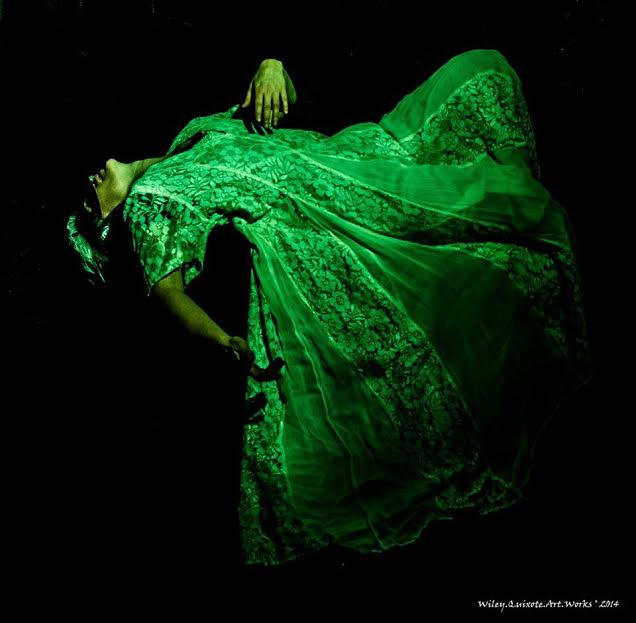
Mary Akers: First off, thanks so much for agreeing to adopt our GRAVITY issue and supply your wonderful images to pair with our poems, essays, and fiction. I’m so pleased with how the issue came together. And since I’m starting off with that, I think I’ll go ahead and make my first question on a related topic. How do you feel about pairing images with writing? I ask this, because I’m of two minds. On the positive side, I love connections anywhere I find them. And I love bringing different genres of art together; I feel like the combination of two art forms takes us more places than either one can take us separately. That, said, there is also a danger of one art form informing the other in a way that neither artist intended. Where do you come down on this spectrum?

Wiley Quixote: Thank you – I was happy to be asked and felt ready for the challenge, the timing was good for me.

Pairing images with writing is a welcome challenge. Happily, you offered me two choices – to tailor the images to each piece or to explore the idea of gravity on my own and let you do the pairing from the available shots. My first impulse was to do the former, but really, I had my own ideas and time constraints so I ultimately opted for the latter hoping for the best. I was happy with the results.

I think that the all art is (or should be) by nature dangerous and risky and you have to take the chance that it might fail. That’s part of what makes it pleasing when it works. Pairing an image with writing seems pretty tricky to me – it’s not a script for a movie where little is left to the imagination with the intent of telling that story through images, you’re providing a companion piece to another piece of work, where each has its own merit and form of expression. Given that there were 14 pieces from 14 different authors, I found that challenge on a one-to-one basis too intimidating an approach and it would have felt hubristic to have tried. The beauty of this collection to me was great diversity of expression around a particular theme and I felt like I wanted to be a participant and add to that conversation. In a conversation, the connections happen on their own.


MA: Yes, I agree. Maybe that idea is similar to what you say about art–it might fail, that conversation. But when it works, it’s a boon to both sides.

I have another, somewhat related question. Who do you think “owns” the interpretation of art? Do we, as artists, make our art and then simply surrender our creations to the viewer who then is free to take whatever meaning he or she wants from our creation? This being the “collaborative” notion of art, where the viewer is as important as the creator. Or do you think we, as artists can (and maybe should) expect viewers to recognize and appreciate the meaning with which we imbue our art? How do you think either viewpoint affects the “interpretive ownership” of art?

WQ: On the one hand, I really want the ideas I’m trying to communicate  – explicit and implicit – to be executed well enough that they are witnessed, recognized, and appreciated. On the other hand, I only want to take responsibility for communicating it well enough to get the message across but not to fencing in someone’s imagination or hindering an interpretive response. I’m happy to disagree with someone’s interpretation that does not suit my intent, as long as they’re provoked or inspired to make use of their imagination. To me, that’s the dynamism of an otherwise static representation.

I’m inclined to return again and again to the idea of arrest and provocation. We can shape and channel with intention, we can qualify, manipulate, suggest and critique with expression, but we cannot command and dictate impression. What is art without an audience? What is expression without impression? It’s got be both things, and a matter of degrees as to which is the predominant factor in each instance.

“Ownership” implies ego to me. Artists, critics, and viewers can fall into that trap, but art is a living force that rises up from the spring of the muses and seeks a channel and a form of expression for an audience – even if you’re the only audience. We – the artist AND the audience – are the channel and receptacle and, at best, can collaboratively midwife an idea and give it an opportunity for form – it takes both expression to come into being and impression to achieve meaning.

What I Know (Einstein)

MA: I like that answer. I struggle a lot with owning my old work versus letting my completed work go, so it’s nice to have that feeling articulated.

I love your pseudonym, but I’ve got to ask–and I know readers are curious, too. You’ve given your nom de photog a lot of thought, so I’m looking forward to your answer. Why the pseudonym? Is it for the sake of anonymity? Is it a statement against the NSA? Is it just for fun? Is it a way to say that the creator of art isn’t as important at the art created? Do tell!

WQ: I’m happy you’ve asked this question because I’d like to give the idea some public expression. I do so like to chase roadrunners and fight windmills.

My pseudonym is a compound of the trickster and the fool, and being crafty with your approach is implicit in the name “Wiley.” Obviously, the name is foremost a pun on the familiar character of Wile E. Coyote. The coyote is a trickster figure in Native American mythology and plays a role in their creation mythology. As I recall, roughly, in the beginning there was only water. Coyote and fox where in a boat together. Coyote slept while fox rowed and created the world. Once it was created, coyote woke up and devoured it all. That is the essence of creativity to me. There is a creative aspect and a destructive aspect and the process is one lead by the ambivalent figure bearing those two faces: the trickster and the clever creator – foolish in retrospect, but ultimately the benefactor of all the innovations we come to take for granted.  If I have a personal psychopomp for creative expression it is the trickster figure who always makes an appearance for better or for worse.

Then, there’s Don Quixote.  Perhaps a tragic and foolish character, but a divine one – the archetypal dreamer: so detached from reality, and so noble in vision. His is the personification of the vivid and creative imagination that performs great deeds in lands far away.

To me the figure of this pseudonym is a personal gnostic demiurge.

The name actually arose as a consequence of being called quixotic and foolish for taking a principled stand years ago about something I felt strongly about (involving contemporary ideas of privacy and corporate and government transgressions against the fourth amendment – long before the Snowden revelations). In that regard, hyperbolic as it may sound, I’ve become accustomed to feeling like a kind of “Kassandra” – a mythological figure who was given the gift of prophecy but cursed to having no one ever believe her. It suits my intuitive nature, my anima. However, it’s not solely about that, indeed, that’s a small part of it, only an impetus. It quickly became part of a larger set of realizations about character and expression and identity – public and private.

I like to think that we are all “Horatios” and “Percevals”, fools everyone. And wisdom is the currency that rewards us for accepting it and living it honestly, sincerely. There’s great humility in that, and great reward – especially, I think, as an artist. You’re performing a service to the muse, not to the ego.

As someone who has long known the experience of the creative personality, but only recently, at a later stage in life, found opportunity for the expression of it, I am constantly hounded by my naiveté, my inexperience, my lack of academic training, and am subject to countless self-criticisms that stultify and smother progress and expression.  All this is wrapped up in a dubious identity and self-image. It can be a prison, a poison, a windmill, a coyote.

The pseudonym gives me freedom from all that, and the opportunity to fail forward. I belong to the pseudonym, it doesn’t belong to me.  It’s a way of surrendering my ego to the divine character of creation without the trappings of trying to own it. That doesn’t absolve me of responsibility; it’s just taking it on in a specific role distinct from whoever and however I may otherwise see myself. I cannot stress how important and freeing that has been for me as a burgeoning artist these past several years.

Old Colony (Hillegonds)

MA: I can see that. A sort of freedom from expectations–expectations that come from the world at large, but that also come from within. I like it. It seems very wise–a trickster even unto the self, if tricking is what it takes to create art unselfconsciously (and I think it is for most of us).

What is it about photography that draws you to it? Your images are so expressive. They are like stories all on their own. I know you’ve explored many art forms over the years. How did you arrive at photography?

WQ: I arrived at it by mistake. I bought a DSLR to take quality photographs of my drawings and pastel paintings and to photograph subject matter – I work from photographs. However, I took to photography like no other form of expression I’d taken to prior. To me it contains all the elements of painting, poetry, music, imagination – it’s so cinematic and so expressive of feeling. It can communicate so many ideas around a particular subject in just one click of the shutter. I continue to be amazed by it. It’s like a snapshot of the imagination.

Every photographer wants to tell a story. I find that, for the most part, the photojournalistic approach is too much like prose; I prefer poetry. So I’ve settled on the poetic narrative as my preferred form. Hopefully, it will continue to evolve in both style and expression.


MA: The poetic narrative. Nicely put.

Every artist I’ve ever met has a “second choice” option for their professional pursuit, creative or otherwise. What would you be doing if you were not doing photography?

WQ: Currently, photography is not a professional pursuit for me – I pay the bills with a full-time corporate job. However, my creative pursuits are dominated by photography right now. What would I be doing if not for photography? I don’t know, sulking? Is that a career path? 😉

I think outside of artistic expression it’d either be something in the humanities/people sciences or something without responsibility so that I could travel and experience life, living and the environment.  I never want to live for my job; I want a job so that I can live. If I could have both, that’d be great, but I’m not sure it’s possible for me.


MA: Oh, I feel like I’ve known a few professional sulkers over the years.

And speaking of professional sulkers, who are your favorite writers?

WQ: In no particular order, for fiction, Mark Twain, Kurt Vonnegut, Tom Robbins, Umberto Eco, Philip K.Dick, Edgar Allan Poe. For nonfiction, Carl Jung and several of the 1st, 2nd, and 3rd generation Jungians; Joseph Campbell, Alan Watts, Mircea Eliade. And for poetry, Galway Kinnell, Rainer Maria Rilke, Adrienne Rich, Denise Levertov, Mary Oliver, Pablo Neruda.

And just about any set of myths and fairytales I can come across.

Seeds (Matt Thompson)

MA: Oh, me, too. Myths and fairytales are wonderful sources of inspiration.

I’ve really enjoyed this interview, Wiley Quixote. Thanks for taking the time to share your thoughts with our readers. I’d like to close us out with one final question, if you don’t mind. What does “recovery” mean to you?

WQ: My experience has been one of self-discovery, determination, self-reliance, and the search for meaning; consciously and conscientiously accepting the path of Individuation; becoming; being; continually sloughing off old skins; adapting, creating.

Interview with Kim Church

Kim Church

Mary Akers: Kim, I loved your short piece “Breezeway” in this issue. I feel like I read it and accepted it very quickly (if I didn’t, please let me keep my fantasy of the good, timely editor). I love the feeling of flying and freedom that I get from reading it, even though it’s a story about an unhappy marriage, those final lines feel like redemption. How do you feel about “redemption” in stories? Do you like it in the work of others? Do you strive for it in your own work?

Kim Church: Mary, you did accept the story quickly—it was a breeze! About redemption: When I was young I romanticized darkness. I lived on a steady diet of writers like Kosiński and Kafka. As I’ve gotten older, I’ve become more mothlike. I want a flame, a flicker of hope in whatever I read or write, or at least a little levity. I’m done with unrelenting bleakness. The last unrelentingly bleak book I read, I threw out the window. (Okay, not really, but I wanted to.)


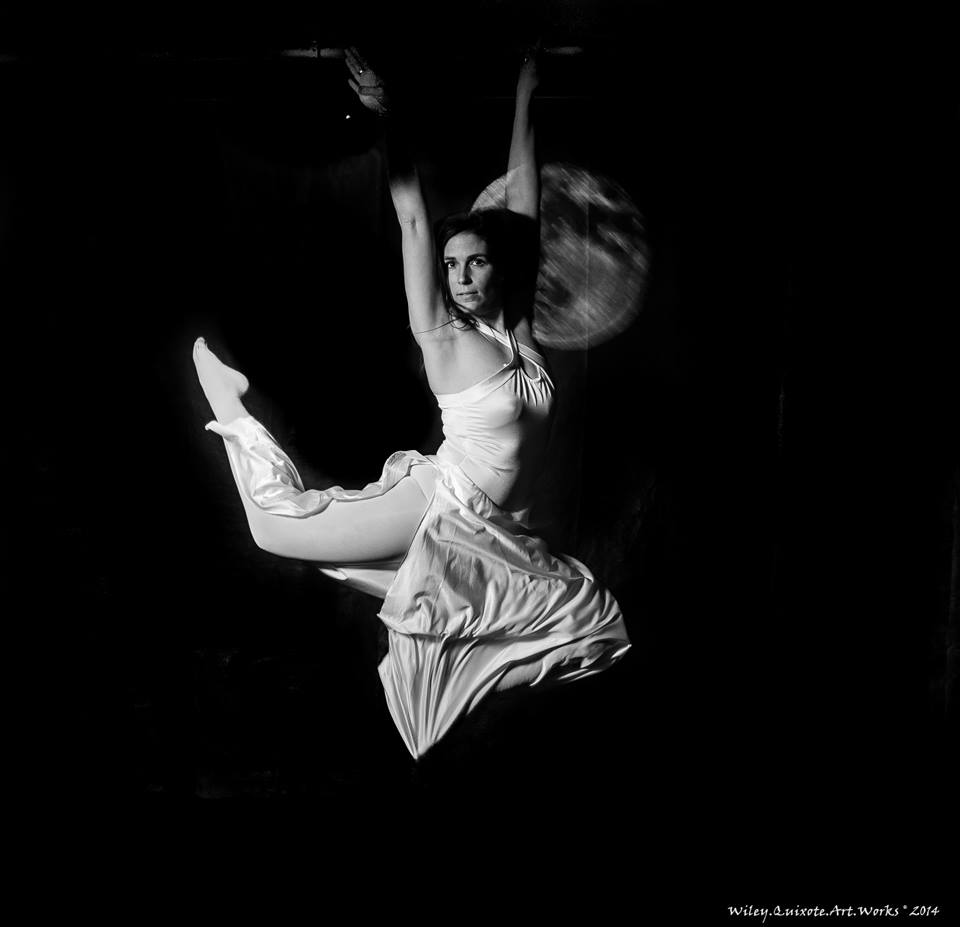
MA: “Mothlike.” That’s a great description. The picture that accompanies “Breezeway” helps me have that flying feeling about the piece. I’m always fascinated by the way written work and images can complement and influence the viewers’/readers’ perception of each form—a conversation, or inter-genre dialogue, if you will, and the person who chooses the image starts that conversation. In this case, that person was me. So…no pressure, but what did you think of the illustration? Did it have any special meaning for you that I couldn’t have known? (I’m amazed by how often that turns out to be the case.)

KC: My reaction was, wheeeee! The dancer’s leap illustrates the sense of weightlessness and release a child feels on a bicycle—a feeling the wife in the story remembers from her childhood. At the same time, the dancer’s discipline is evident in the photograph. Here’s a professional executing a difficult move she’s practiced and prepared for—much as the wife is preparing for her own difficult letting-go.

Breezeway (Kim Church)

MA: In addition to this great SOS piece in r.kv.r.y., I’ve just had the pleasure of finishing your wonderful novel BYRD. (For some reason, I like typing the title in all caps. Or… maybe I’m just shouting the title because I loved BYRD so much!) This book has a lot of epistolary elements, but I wouldn’t call it an epistolary novel. Still, the biggest plot twist of all comes from a letter that only gets to its intended reader in a very roundabout and tragic way. Was that particular ending always a part of the book? If not, how did it evolve throughout the process of writing and editing?

KC: I’m thrilled you liked the book, Mary. The plot twist you’re referring to wasn’t in the original draft. Originally I wrote the novel as a first-person narrative from Addie’s—the birth mother’s—point of view, since the book is largely her story. When I began to revise, I realized that Addie doesn’t know enough to tell her whole story. She makes decisions for reasons she doesn’t understand, and they affect others in ways she can’t see. To get at those parts of the story, I needed different points of view. So I started over, adding new characters. And as new characters often do, they took the story in a whole new direction. The plot twist you mention was part of that new direction. It surprised me as I was writing but felt inevitable once I’d written it.

MA: I like it when characters surprise me. Makes everything just a little better–a little more fraught. And speaking of letters, that last one from the adoptive parents. Whoa. What a killer final line. Letters always seem voyeuristic to me—in a good way. I’m reading someone else’s mail! I think that’s why I like them. Also, they are telling for what they don’t say, like in Lee Smith’s marvelous book The Christmas Letters. What is it about letters that drew you to them as an aid in telling this story?

KC: I wanted the book to have the intimacy of a confession, which is why I initially wrote it in first person. I didn’t want to lose that intimacy when I changed the structure of the book. Addie’s letters to her son were a way of keeping her voice. There are other letters too, from the adoptive mother and others; I thought of these as little points of contact, or almost-contact, between characters who, though connected by circumstances, were unable to connect in person.


MA: You succeeded! The whole thing feels very intimate. Like Addie and Roland’s friendship, which is interesting and wonderful. And complex. You manage to cover many years of Addie’s life and their changing relationship. What challenges did you encounter in writing a story that spans many years?

KC: The book spans 45 years in under 250 pages. In my notes and early drafts, I tried to connect all the dots, to account for everything that happened with all the characters. As author, I needed to know. The trick (isn’t this always the trick?) was figuring out how much to include in the book and how much to leave out. I did a lot of compressing and distilling, and when my agent submitted the manuscript to Dzanc it was pretty lean. But it still needed some shaping. I was blessed with a brilliant editor, Guy Intoci. He not only helped me trim and arrange, but he also showed me where the book was too elliptical, where it needed more. More Addie, more letters.


MA: Yes, how much to include of all the hard work we do is always the trick.

BYRD has a great sense of place. Which makes me curious: do you consider yourself a southern writer? And what do you think the term “southern writer” implies?

KC: I don’t label myself, but I’ve lived all my life in the South, and that’s bound to affect my writing. I try to create a strong sense of place in my work, which is largely set in the South. And I write a lot about family, a perennial Southern theme, even though my approach is unconventional.


MA: I thought one of the themes was about following your dreams…or maybe even learning to recognize your dreams. Would you care to comment on that?

KC: I think “learning to recognize your dreams” comes close. I might add, “learning to accept that you’re worthy of your dreams.”


MA: Yes! Definitely a theme and a recurring struggle for many of us. I also felt like another theme was exploring identity and the idea of how we know WHO we are. Also how we are shaped by our choices and the choices of others. Addie and Byrd are most directly affected by Addie’s choice, but Roland is, too—tangentially at first, and then hugely and directly by the end of the book. Were you consciously thinking about choices and their consequences when you were writing?

KC: Absolutely. That’s what motivated me to write the book. Years ago, a friend told me that his 30-some-year-old girlfriend had given up their baby for adoption. I didn’t know the girlfriend, but I couldn’t stop thinking about her—a grown, capable woman choosing to surrender her child, then having to live with the knowledge that he was in the world somewhere, a stranger. How would that feel? The idea haunted me. I felt a deep, inexplicable empathy for this birth mother. I tried to find a character like her in a book. There wasn’t one. The only stories I could find were about young unwed mothers whose babies had been taken from them or women who had otherwise been victimized—compelling stories, but not what I was after. I wanted a book about a woman who makes and has to live with her own hard choices. So I wrote one.


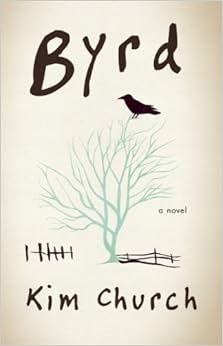
MA: Wow. Fascinating. I love how the things that initially shock us can turn into art. Speaking of art, I love the cover of the book. Could you talk a bit about the process of cover design and selection? Have readers given you any interesting feedback regarding the cover?

KC: Thanks! I love the cover, too, and it’s had great response from readers. The Ackland Museum Store in Chapel Hill is carrying the book—partly, I’m sure, because of the cover. One reviewer, Trina Hayes, wrote: “I rarely comment on book covers but this one is special. The striking title font and the solid bird perched on a leafless tree pull the reader into a story that shows how a child can rise like a bird and impact those left behind. [The designers] deserve an award for capturing the book’s essence.” Steven Seighman of Dzanc designed the cover and incorporated art by Ilsa Brink, who also designed my website. I agree with the reviewer—they both deserve an award.


MA: Wonderful. I agree. And thank you so much for speaking with me today, Kim. I really enjoyed it.

Interview with Tim Hillegonds

Tim Hillegonds

Mary Akers: Hi, Tim. Thanks for agreeing to speak with me today. I just loved your essay “Old Colony” in this issue. You do such a nice job, right from the start of grounding us and giving us a wonderful picture of The Old Colony Building with the perfect use of strong sensory details. It’s almost as if you are building a foundation for this essay to come. Preparing us to enter this marvelous old building. Was that by design?

Tim Hillegonds: Yeah, it definitely was. I knew that I wanted to write about the experience with that old man, about how he impacted the room that day, but I just couldn’t figure out a way into the piece. It was so raw when it happened that I think my brain had a hard time putting it into perspective. It wasn’t until I’d started to focus on the building—on the history and the aesthetic details—that I realized the building was the way into the material. Once I shifted my perspective, it started to fall into place.


MA: There is a great paragraph where you write about people reaching back in their minds and then coming forward again. You end that paragraph with the perfect line: “The truth, it seemed, stung us all.” I really like how that hangs in the air. Truth about truth. In the course of telling curious people what our journal is about, I often say, “We’re all recovering from something.” I think your sentence speaks to that same idea. Would you agree?

TH: Absolutely. At the core of recovery—regardless of what that recovery is from—lies the very scary, yet very real, idea of accepting the truth of one’s situation. The old man in Old Colony was faced with the truth of what seems to me to be a pretty rough predicament—he could potentially die before he had a chance to rectify his wrongs. But somehow he found freedom by accepting the truth of his situation. It seems to me that acceptance of truth is one way to mitigate the fear of the unknown, to take away the power that fear can sometimes have over us.


MA: Yes. Acceptance of truth to mitigate fear. I like that. And another one of the things I really like about this essay is how it all turns halfway through. I feel like life is full of these amazing turning points. Sometimes we pretend they didn’t happen and go on as usual, stubbornly refusing to be shaken. But other times we allow them in and they take up this crazy place of importance in our lives–they divide everything we know in a before-and-after way. Would you care to comment on that idea?

TH: This particular situation was definitely one of those turning points for me. When I left Old Colony that day and walked across Chicago’s Loop, my head studying the cracks in the sidewalk while taxicabs honked past me, I remember feeling a profound sense of responsibility. To myself. To my loved ones. To that man. If he could be so noble as to face his mortality in a room full of strangers, and do so with such humility and dignity, then who was I to complain about my life, or to not do all I could to live with intention? My entire worldview took a spin on its axis that day.

Old Colony (Hillegonds)

MA: Brilliant. I wonder if he had any idea of the long-term effect his words would have. I like to think so.

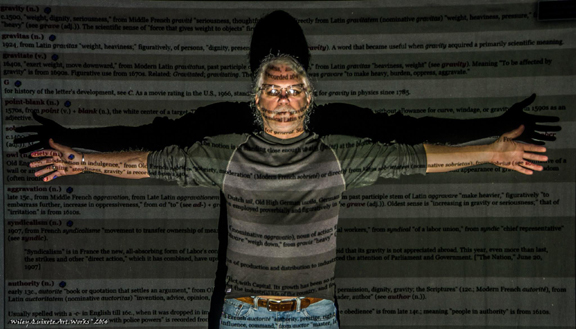
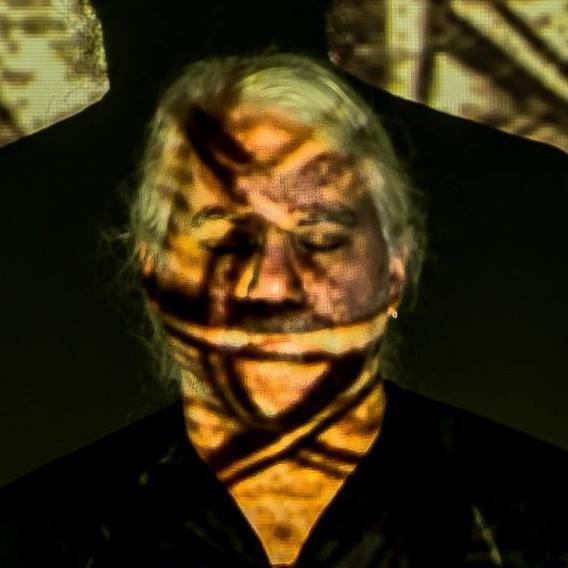
I was responsible for picking the art for this issue, selecting from Wiley Quixote’s wonderful body of work. And many times in the selection process, there isn’t a logical choice of image to illustrate a particular piece of writing, but at those times my gut usually steps forward and says THAT ONE in a way that I can’t ignore. Such was the case with the image I chose for your essay. It spoke to me. And I’m amazed at how often an image I select will have some special resonance with the author, too–something I couldn’t have known. What did you think of the artwork used to illustrate Old Colony?

TH: It’s a haunting image to me. The words projected across the man’s body, arms outstretched—it reminded me a lot of what addictions do to people. So many folks, before they find recovery, lose all the components of their identity except for whatever is afflicting them. The image actually has the definitions of the words “aggravation” and “authority” in there. Pretty fitting for me since those two words came up plenty of times in my own recovery.


MA: Nice. I love learning about these serendipitous connections. And finally, since we are a recovery-themed journal, what does “recovery” mean to you?

TH: I heard a guy once say, “Direction, not intention, determines destination.” “Recovery” for me means that I’m finally facing the direction I’ve wanted to be facing for a long time. And I have to say, it feel pretty damn good.

“Reassurance” by G. Evelyn Lampart

Reassurance
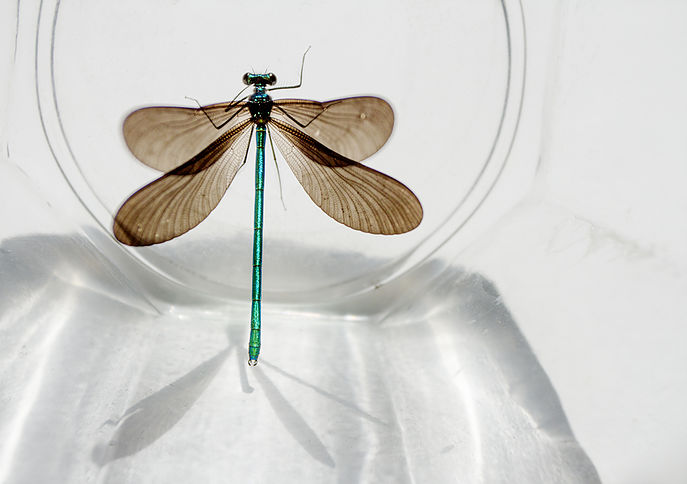
Damselfly, Chromogenic Print by Karen Bell

The Q train arrives. I get on. I am headed to Brighton Beach for my yearly pilgrimage. My bathing suit is at home. My hands lie folded in my lap as if I am seated on a wooden pew in synagogue on a Sabbath morning. It is Saturday. I feel lucky; I have a window seat. The ocean looms ahead in my mind, replete with acres of water. It will be there, as always, every summer that I return.

I make this trip to pay for mercy with my presence. Eighteen years ago, I emerged from the fathomless waters alive. Now, there is no purpose for me on the beach but to bear witness, as there is nothing left in Poland for Jews after the holocaust. My grandfather’s bones were left behind, but I keep him alive. Every year I make this trip in gratitude.

* * *

The water was liquid of course, but my body did not feel wet. I was aware of people on the beach far away and the bright colors of their bathing suits. It was a sun-filled Saturday morning in August and my plan was to drown.

I stopped swimming and treaded water as I reached the deeper depths, aware of the hectic activity on Brighton Beach, Bay One, far away. It had nothing to do with me. I met the cold ocean waters according to plan. The sky surrounded me, something I had not expected. The water below and the sky above, two bodies with ultimate force. They held me as I had not been held for a long time. The waters calmed me, the heavens breathed into me. I felt an ease, a letting go.

The depression making me relinquish my body was as strong as the tide pulling in. It could swallow me whole. The bridge scared me, neither sleeping pills nor aspirins killed me, and the razor hurt. The ocean was simpler. As I relaxed, I began to consider the possibility of hope. I searched for a reprieve.

My grandfather was a beautiful Jew. He studied the Talmud seriously. He knew Polish and Russian, and translated letters. He was a cripple and had a general store in his shtetel. Even the Polacken, the gentiles, liked him. He didn’t hit his children. He didn’t hit my father. He died of malnutrition during the war. He would not eat horsemeat.

My grandfather, my zaydeh, was more familiar even than my father. I studied his face, and the letter he once wrote to his sister-in-law in Brooklyn, asking for five dollars to make Passover. I read and was comforted by the swirls of his Yiddish letters. A meaningful kindness emanated from the man with his generous black beard, his one photograph sent to America before the war.

I felt him near me in the ocean. As death approached, I knew my zaydeh understood what it meant to give up. Could my treasured and immaculate grandfather sanction me to weather that August, and other months, other years to come? Maybe the merit of his faith could grant my life meaning again. He starved to death with complete and utter faith. I prayed to him then. I told him how much I wanted to live.

A sliver, a smidgen of a chance began to grow. Hope was permission granted to take that chance and to swim back to shore. I relinquished my need for finality. The handbag I had left on the sand with my keys and my money lay undisturbed, as if I had gone in for a dip in the ocean, and refreshed, was headed home.

* * *

Except today, sitting on the Q Train, I feel inexplicably sad. I don’t want to disturb my grandfather’s sprit. I buried him peacefully the morning he gave me permission to go on. My life is at ground level. The summers that followed that fateful swim were a retribution with my full heart. This morning is hollow.

I visualize the last stop on the Brighton local train as a cemetery. I get off at the next express stop. I am free to do so. No one stops me from crossing over the tracks to go home. It is not a cattle car.

I emerge onto the street and buy a hot cup of coffee. The beverage is a benediction in my hands. A benediction for a life, mine, that goes on living. At the front door of the building that I live in, I check for my keys. They are just where I left them, in a concealed pocket.


G. Evelyne Lampart lived to become a clinical social worker and had clients in hospitals where she was a patient at one time. After 20 years in the field, she happily retired, and now runs an art workshop in the mental health clinic that served to help her heal so many years ago. Her life has turned one hundred and eighty degrees more than once.

“Scar Tissue” by Carrie Krucinski

Scar Tissue (Krucinski)

It’s been 8 years since
I’ve been down aisle 5
at Walgreens. Shaving Cream/
Razors/Aftershave. I don’t need
a soothsayer to tell me
Gem razor blades cut
my skin like butter.
The pharmacist looks
at my prescription.
I don’t look her in the eye.
My mind meanders to
bacitracin, bandages,
sewing kits. I just have
to pay for my meds
and make it out the door.
Addiction is addiction,
mine is rooted in blood,
stitches, scar tissue that
will never leave me.
My arms tell of a thousand
year sadness; 40 years may
be left in this life;
Nirvana isn’t eternal.


Carrie L. Krucinski lives in Elyria, Ohio with her husband, Steven, and bulldog, Watson. She earned her MFA in Creative Writing from Ashland University and teaches English at Lorain County Community College.

Read an interview with Carrie here.

Homepage Spring 2014

Cover Image1

Dear Readers,

Welcome to our Spring 2014 “GRAVITY” issue. We’re incredibly proud to present to you the wonderful and diverse array of voices in this issue, all complimented by the illustrative photography of the marvelously multi-talented Wiley Quixote and his team at Wiley Quixote Artworks.

Here at r.kv.r.y., we love words. We love to play with and explore words, and we took to the theme of GRAVITY in all its forms. A force of nature. A state of being. Seriousness. Importance. A universal force exercised by two bodies onto each other. We even mined the etymology and explored gravity’s relationship to heaviness, to the grave. You should find a lot to enjoy in this issue. I hope that you will take the time to explore it.

Our final themes for 2014 will be ENDANGERED (July) and APPALACHIA (October). Our January 2015 issue will be themed CAREGIVERS. And (a quick reminder) we will be closed to submissions during June, July, and August.

Yours in Recovery,

Mary Akers
Editor-in-chief

“What I Know of Madness” by Sarah Einstein

What I Know (Einstein)

The Trans-Allegheny Lunatic Asylum

The minute we turn off Meathouse Fork Road, the Appalachian mountain roads go all one-lane and twisty.  My night vision isn’t good, there are deer around every turn and switch-back, and locals who could drive this stretch of road blind are impatient behind me.  But my friend Brad is kind.  He just laughs a little when I say that this might be the scariest part of our planned ghost-hunting adventure.

By the time we arrive in Weston, WV it is good and truly dark and I can’t see far enough beyond the gleam of headlights to get my bearings, so Brad takes over as navigator.

“Which way should I turn?” I ask.

“Left,” he answers.

“And now?” I ask.

“And now?”

He guides us to a CVS, though how I don’t know.  Something about the way the streets lay out makes sense to him in a way it doesn’t to me.  I buy flashlights, because it’s only just now dawned on me that the old state hospital in which we’re about to spend the night probably doesn’t have electricity.  We’ll be glad for them later, because—except for a break room and two bathrooms—it doesn’t.

The guy at the counter is in his mid-fifties, with the lilting accent of central West Virginia, and so I tell him where we’re going because I hope he’ll have stories.

“You’re doing the ghost hunting tour at the old hospital?” he asks, after I’ve just said we are.  He doesn’t say asylum, like the website does, or mental hospital, the colloquialism with which I grew up in hills not far from here.  The hospital—first, the old one we’re going to visit, and then the new one which took its place a little more than a decade ago only a few miles away—has always been the lifeblood of this little Appalachian town, and so the locals afford it as much dignity as they can.

“I remember when I was about fifteen or sixteen,” he tells us, “walking down the sidewalk beside the fence at the hospital when I should have been at school.  There was this lady there, one of the patients, and she kept pulling up her skirt and her stockings.”  He pantomimes a woman lifting her skirt up above her hips and showing off the tops of her stockings seductively.  “I said, ‘Lady, I’m only about fifteen years old.  You ought not to be doing that’.”  He laughs.  “But I remembered it all these years.  Yes sir, I never did forget it.”

This may be the only true story we’ll hear tonight about the patients at the Weston State Hospital, now a “historic” and “paranormal” tourist destination operating under its original name: The Trans-Allegheny Lunatic Asylum.


Arriving

Copperhead, a man with long red-grey hair in faded jeans, boots, and lots of faux-pagan jewelry, calls everybody out into the main hallway when it’s time for the tour to begin. “We got a few rules we need to go over first,” he says, his thumbs hooked into his belt loops. The rules are simple. Don’t take food out of the break room, because they’re tired of having to clean up after people. Don’t smoke except in the two designated areas; outside through the doors behind us or on the second-floor balcony just off the old doctor’s quarters. No drugs or alcohol, even if you brought enough to share. He explains that we’ll be split into two groups of twelve. One group will start on the first two floors, the second on floors three and four. After an hour or so with our guide, we’ll be free to split up and explore those floors of the hospital on our own. After four hours, at 1am, we’ll switch floors. The tour lasts from 9pm to 5am. “And be respectful,” he says. “These ghosts were people. Are still people. Don’t provoke them.” Then he smiles a carvnival-barker smile and says, “If you want to know what I mean by provoke ‘em, I mean don’t act like Zak.” Everyone else in the crowd laughs. Brad and I look at each other. Neither of us has any idea who Zak is.


The Guide

Sarah, a short middle-aged woman in sweatpants and an OK Kitty scarf, tells us she drove for more than an hour to be our tour guide, spending pretty much all of the sixty dollars she’ll be paid for the night in gas to get here. When I ask her why she’d do that, she says she loves the building. And it is an amazing building, nearly a quarter mile long, with beautiful hand carved woodwork and unexpected beaux-arts touches. Sarah says it’s the largest hand-cut stone building in North America. Even this claim, when I try to verify it, proves illusive. It all comes down to how one defines largest.

“I read that the workers who broke ground on the hospital were ‘Negro convict labor’ (I make air quotes because I’m incapable of using the word Negro without them), slaves who’d been set free when West Virginia broke with Virginia, but who were then immediately arrested for being vagrants and put to work by the new state,” I tell her. “Is that true?”

“Oh, God, I never heard that,” she says, shaking her head. “It could be. We don’t like to talk about the more unpleasant parts of the hospital’s history.”


Floors 1 and 2

The first ghosts Sarah introduces to us are Lilly, Ruth, and Emily. Lilly and Emily are both little girls, and both—they say—will come out to play with lucky ghost hunters. Ruth is an old woman, and the only impairment we’re told about is that she was confined to a feeding chair, a sort of wheelchair with a tray attached to the front. The guide suggests that sometimes visitors hear the sound of it going up and down the halls. We’re told she’s protective of the child-ghosts. A domestic haunting. There are music boxes in the rooms both girls are said to haunt; the cheap reproductions every little girl has with the plastic ballerina en pointe twirling in the middle. In Lilly’s room, there is also a toy box full of cheap plastic toys, which our guide tells us have been brought and left for the girl-ghost by visitors. Someone in our crowd says, “Like she’d even know what to do with toys from the twentieth century.” I want to answer, “There were children here until 1994, as patients,” but I’m still trying to behave, to blend in, so I don’t. Instead, I ask Sarah, “Were these real patients here? Do you know when and why they were here?”

“We don’t talk about patient history,” Sarah tells me. “That’s not what people come here for. Even on the historical tour, we stick to talking about the building, about the treatments, and about some of the notable staff.”

The only other named ghost on the first two floors is Jacob, an alcoholic who responds well to being offered whiskey. Which, of course, we’ve been told it is against the rules for us to have. And maybe it really is, because although there are many moldering and melted pieces of candy on the windowsills of the girl ghost’s rooms, there are no half-full whiskey bottles in Jacob’s.

After about an hour of this, Sarah lets us loose on our own, allowing us to wander the entire building—save for a few rooms whose doors are locked because the floors have become unsafe—unescorted. The building is 242,000 square-feet; most of the time we are too far away from the other ghost hunters to even hear them.

“This is the part that feels really transgressive,” I say to Brad as we wander alone down a dark corridor. “It doesn’t seem like we should be allowed to do this.” I open the door to a large bathroom with several toilet stalls, baths, and sinks.

“Yeah,” Brad says. “But I guess there isn’t much we could do to the place.” He shines his flashlight into a pile of debris in the far corner of the hallway.

I step into the bathroom. “You know, I was always too afraid to do this as a kid,” I say and then look into the mirror. “Bloody Mary,” I say and then spin around. “Bloody Mary.” Spin.  “Bloody Mary.” Spin. No apparition appears in the mirror. I knew it wouldn’t, but for a moment there had been a frisson of fear in my belly, an echo of a younger me who was capable of believing in ghosts.


What I Know of Madness 1

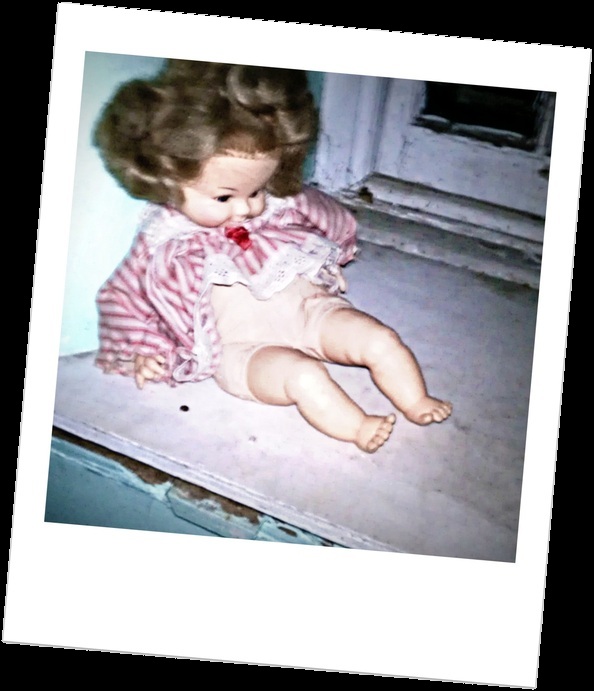
I am in an unlit room, sitting on a rocking chair in front of a barred window, looking out over a darkened lawn. I wear a white cotton nightgown with flocking around the banded collar, and hold my mother’s old porcelain doll—the one she named Baby Brother—in my arms. His skull is bald and crazed with age, the paint that gave detail to his face long ago rubbed away. I have wrapped him in a white blanket, and I am singing tunelessly to him while I rock.

In this dream, one I’ve had now and again for twenty years, a series of doctors come into the room and insist Baby Brother isn’t a real baby, that I must put him down and come away, and I will be locked in this room until I do. I both know and don’t know the doll is not a real baby. That it is not my baby. It doesn’t matter. The idea of letting him go is a searing pain across my chest. Each time they try to pry him from my arms, I want to scream, the pain so strong it takes my breath away. It is unbearable and I turn my head to look out into the starless night.

I want to say, “I know he isn’t real, and it doesn’t matter.” I want to say, “This isn’t something you could understand.” But I can’t, because every time they walk into the room they reach for the doll, and then I have no breath for words.
Einstein doll
Asylum Visitors Leave Dolls for Lilly and Emily


What Lingers

For the first hour of the tour, I think that the most abject thing about the old hospital is that it still stinks of stale sweat and filthy bodies. But then we’re allowed to go off by ourselves, and the smell dies. When we get back together, I realize it’s one of the other tourists…a big guy in unwashed jeans who has been here before and who believes not only that there are ghosts here, but that he has a special ability to find with them. He calls himself a ghost hunter with pride, not irony.


The Lobotomy Recovery Ward

The lobotomy recovery ward is not on the walk-through of the first two floors that Sarah lead us on, but neither is it off limits, so we ask Copperhead to tell us how to find it. “I’ll walk you down,” he says.  I try to ask him questions, but he’s got a salesman’s heavy handed way of answering that always turns the question back around to his own prowess as a ghost hunter. “We find the ghosts from talking to them, interacting with them, not by reading the records. But often, we can match the ghosts we find with someone in the actual patient registry. Like Jacob,” he says, referring to the one male ghost in the first two levels. “We found that there was in fact a Jacob here being treated for alcoholism, and that he was obsessed with talking about whiskey.” This is rural Appalachia. If there had never been a drunk named Jacob in treatment here during the more than 100 years the hospital operated, that would be the coincidence worth noting.

Lobotomies at Weston Hospital were most often performed by Dr. Walter Freeman, the doctor who “pioneered” the ice pick lobotomy. He traveled around the country in his personal van, which he called the lobotomobile, performing procedures at a number of institutions.

“When did they stop doing lobotomies here?” I ask Copperhead. A few yards ahead, he points to a plaque about Dr. Freeman, which says he performed his last lobotomy at Weston in 1967. “There, see, it says. 1967.” But I know this sign elides a more difficult truth. Dr. Freeman’s last lobotomy procedure at Weston was in 1967, but a I know a woman who was the lead nurse in the lobotomy recovery ward in the 1980s. I tell Copperhead this.

“That can’t be true,” he says, turning his back to me and walking on. “The sign says right there, the last one was done in 1967.”

Freeman was no longer performing the surgeries, but other physicians were. I don’t think Copperhead is lying, I just don’t think he knows very much about the actual history of the hospital. Or cares, and that troubles me more.

Brad and I have borrowed something called a “k2,” a meter that’s supposed to read electro-magnetic energy and thus identify the presence of ghosts. It looks like a television remote with no buttons; just a row of five lights: green, light green, yellow, orange, and red.  Just what these lights mean is vague, except that the more of them that are lit up, the more it suggests the presence of a spirit. The whole time we’re in the lobotomy ward, all five of the lights on ours stay lit.

“What kind of activity do you get down here? Do the ghosts speak to you?” Brad asks Copperhead.

“No.  I mean, these guys were pretty much brain-dead, so we don’t get much from them,” Copperhead says.
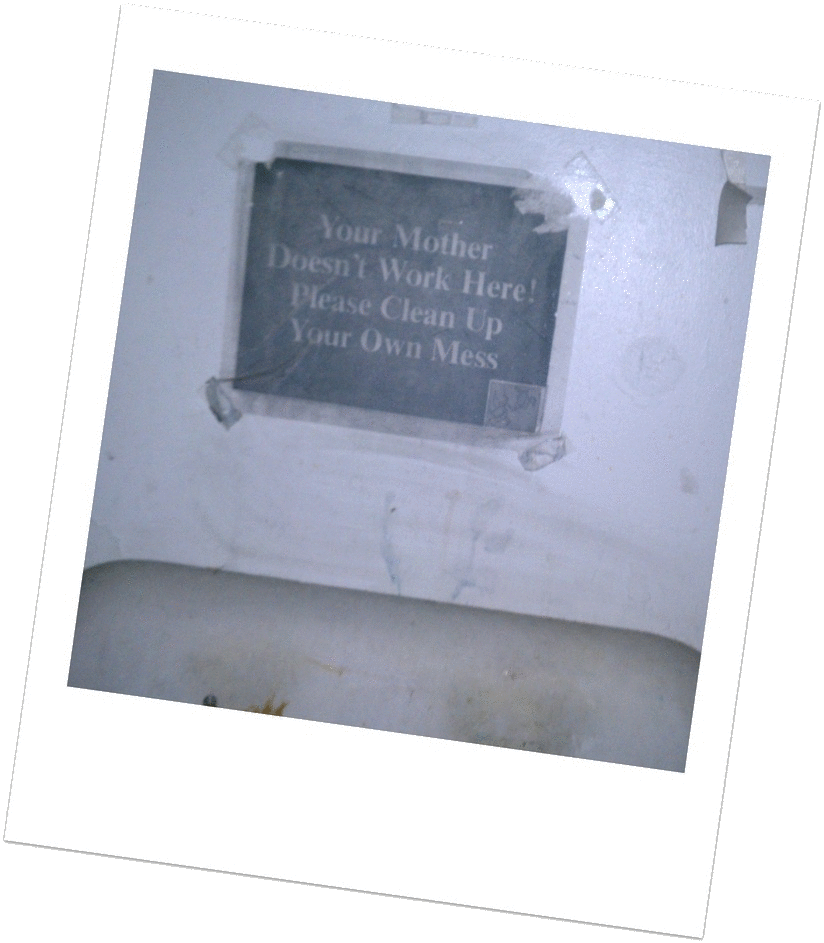
 

Einstein note
A Heart-Breaking Sign Over A Sink In the Children’s Ward


What I Know of Madness 2

In my dream, the bars on the window blur, and I stare beyond the darkened lawn to a row of Bald Cypress trees. These twisted giants shielded my childhood. I remember playing in their towering ranks, hiding with Felicity when we were still small enough to stand among their knees and not be seen.

I am not at Cypress Manor, although these are my grandfather’s trees and not simply the same kind. I don’t know how they have come to line the lawn of this sterile place, with its white blankets, white paint, and doctors in quiet white shoes. I’m not sure if the trees are meant to keep me safely here or mark the border to the place I could go if I would just put down the doll. It doesn’t matter.

I hold Baby Brother in my lap and stare out over the darkened lawn at the silhouettes of these magnificent trees until the doctors give up and leave the room. In the quiet, I weep at the sweetness of being among the cypress again, and now it’s the pain of their beauty that takes my breath away. I can’t imagine wanting to leave this place, to ever again live beyond the reach of their long shadows. I laugh at the doctors for threatening to keep me locked in. If they want the doll, they should threaten to throw the door open wide.

I rock the doll, my lips against the warm, downy skin of his scalp. He smells of sweet milk and talc. I hum the song of the wind in the boughs of the trees, rocking back and forth in rhythm with their gentle sway.


The One Story They Claim is True

“Dean,” Sarah says, “was a mute. This story, we can document. This one, we know is true. His roommates hung him from the ceiling with a bed sheet and beat him, beat him real bad. One of them realized that they were going to get in big trouble, so they decided they better kill him. Dean was unconscious, so they laid him on the floor and put the leg of one of the beds on his head. Then they jumped up and down on the bed until they had pulverized his skull.” She pauses for effect. “Then one of his two roommates ran down the hall to the nurse’s station and said that the ghost in this room had killed Dean. One of the men who did it, a man named Myers, just died at the new Sharpe state hospital a couple of weeks ago.

“When we first started coming through here, Dean was real friendly. He’d play with us and joke around. But over time, he got quieter and quieter until finally he just stopped interacting with us at all. We asked him if we’d hurt his feelings, or offended him. It took Copperhead a while to get him to talk to us, but finally he said no, we hadn’t hurt his feelings or anything. It was just hard for him to listen to us tell his story over and over again. So we asked if he wanted us to stop telling people his story. ‘No,’ he said. ‘I think it’s important for people to know my story. But could you tell it in the hallway so I don’t have to listen to it?’ And that,” says our guide, “is why we’re standing out here instead of in the room.”

Brad asks, “Does he communicate any differently with you than the other ghosts, since he couldn’t speak?”

“No, I don’t think so. What do you mean?” Sarah asks.

“Well, because he wasn’t able to talk in life. Like, how did he let you know that he didn’t want to listen to you tell his story anymore?”

Sarah is visibly flustered. “Well, Dean has never spoken directly to me. But I’m pretty sure Copperhead and some of the other ghost hunters were able to get his voice on EVP.” She explains that it’s a sort of tape recorder that can capture ghostly voices and make them audible to us.

I ask Sarah for the full name of Dean’s killer, the one who has just died, but she doesn’t know.  Later, I ask Copperhead. “Michael David Myers,” he says. This is the name of the non-speaking serial killer who escapes from a psychiatric hospital to find and kill his sister (and a lot of other people) in the movie Halloween and its nine sequels.


Ghost Adventures

Zak, it turns out, is Zak Bagans, one of the hosts of the show Ghost Adventures. I find parts of a seven hour live broadcast they did on Halloween, 2009 on YouTube. A former employee of Weston Hospital talks about Ruth, remembers her as a violent old woman who would bang on the tray of her feeding chair whenever a man walked past.

Sarah had shown us the seclusion cells, told us that anyone could have a patient put in one, that patients sometimes stayed locked inside for months at a time. That some of them died. Near midnight, Zak locks three volunteers in the seclusion cells and then starts yelling at a ghost he believes has said “fuck you” to the ghost hunters. Nothing much happens. One girl says she felt something brush her hair, tug on her jacket. Zak calls out to the ghost he imagines is there, offering to keep the girl locked up in the seclusion cell for the rest of the night if he will only show himself.

I do a web search. Although fans have requested it, none of the many ghost hunting shows have ever gone to a concentration camp.

Einstein orb
According to the Ghost Hunters, the “Orb” in this Photo I Took is a Spirit 


What I know of Madness 3

A Story I Believe My Father Told Me Once, But That He Says I Made Up:

“I was in high school,” my father said, “and working in the afternoons, driving the truck to make deliveries for Dad.”

My grandfather was a grocery wholesaler. Not the grandfather whose cypress trees guarded my childhood, but my father’s father, who was the worst sort of bastard; mean and bigoted and dumb. Who never guarded anyone’s childhood.

“And I remember coming home from school. Mom was passed out drunk, and when Dad got home, he said, ‘I’m not doing it this time. Johnny, you’re going to have to take your mother up to the State Hospital. Just pull up and tell ‘em you’ve got Bonnie Einstein, they’ll know what to do with her. Lord knows they’ve seen her enough times before.’ And then Dad and I put her in the back of the truck, with all the empty pallets from the day’s delivery, and Dad went off to play golf.”

I think my father was drunk himself when he told me this story, in the first years of a decade-long bender that would end only when we, his adult children, committed him to a rehab facility. “I also had to go pick her up. Had to take her something to wear, because they just dumped the patients in these big wards, men and women together, and after not too long the clothes they were wearing when they were admitted would rot off their bodies. They didn’t give them hospital gowns or anything. Just left them in those big rooms, naked.”

Years later, when he tells me that I’ve made up this story, I don’t question him. I hated my grandmother—a mean old drunk with a sharp tongue and filthy mouth—and by then she’d been dead long enough that he’d taken to calling her my sainted mother. And he’s haunted enough without my insisting on seeing ghosts he doesn’t believe are there.


Sarah Einstein lives in Athens, OH where she is a PhD student in Creative Nonfiction at Ohio University. Her work has previously appeared in Ninth Letter, Fringe Magazine, PANK, and other journals, and has been awarded a Pushcart Prize. Her micro-collectionRemnants of Passion, is upcoming from Shebooks.

Read our interview with Sarah here.

“Old Colony” by Tim Hillegonds

Old Colony (Hillegonds)

The building was erected one year after Chicago hosted the World’s Fair, and it stretches seventeen stories into the finicky midwestern sky. It sits on the corner of Dearborn Street and Van Buren, where the El rattles the glass inside its panes every few minutes, where commuters and residents walk through its shadow in hurried, deliberate steps. The corners of the structure are rounded by bay windows that set it distinctly apart from its neighbors, and about a hundred feet south on Dearborn Street, it nestles up comfortably against the Plymouth Building next door. Across the street sit a convenience store, a sandwich shop, and a barber.

Built by a Boston lawyer, the Old Colony Building was named in honor of the first English colony in America at Plymouth, Massachusetts. The first three floors are sheathed in Bedford limestone, which give it a markedly regal look, and the upper floors are finished with grey Gainesboro brick and porous terracotta. Both entrances to the building are adorned with the seal of the Plymouth Colony—a design choice of the once-prestigious architectural firm, Holabird & Roche. The year it was built, it was the tallest building in Chicago.

As with most of the structures in the City of Chicago, years of unforgiving winters eventually took their toll and it began to deteriorate. Once filled to capacity with engineers and lawyers and architects, the tenants of Old Colony finally got tired of heat that didn’t warm and air conditioning that didn’t cool, and slowly, as the years dragged on, they began to move out. By the mid-2000s, the building was only around sixty percent full. The antiquated elevators strained themselves to get from one floor to the next and were frequently out of service. Entire floors were empty. The fate of the building’s future was in jeopardy.

Sometime in 2005 or 2006, I began to frequent an Alcoholics Anonymous meeting that met, fittingly, on the 12th floor of the Old Colony Building. The building’s uncertain fate had caused lease space to become unusually cheap, and an AA group had decided to move from a nearby space when its lease expired. Because it met during the chaotic Chicago lunch hour, the meeting was called “Nooners,” and it was a liquor soaked amalgamation of businessmen, janitors, construction workers, and the occasional homeless person. Meetings were held in a timeworn room that smelled of mildew, mothballs, and stubbed out cigarettes, and its walls were plastered with crudely constructed homemade posters—most of them yellowed and curling at the corners from age. Written on them were the tired sayings of AA—ever present in sobriety: It works if you work it. Your misery is refundable; see nearest bartender. It’s alcohol-ISm, not alcohol-WASm.

Being new to sobriety, there were a lot of days that I simply didn’t want to go to meetings at all—a lot of days when the monotony and repetition of AA weighed me down and made me yearn for something different, something more exciting, something less like sobriety. I got tired of working the steps and reading the Big Book and hearing about drinking and drugs and the repetitive ruining of lives. I got tired of “identifying,” and saying over and over again that my name was Tim and that I was an alcoholic. And, sometimes, I even grew tired of the people that I saw in those meetings. I often spent too much time focusing on the differences I observed in people and not enough time recognizing the similarities. I often wanted to deny that, even though we all came from different places and did different things and destroyed our lives in different ways, we were all, somehow, the same. We had all hurt people. We had all been hurt by people. We had all suffered at the hands of an addiction that we ourselves had fed.

The meetings that I spent cramped inside that rundown little room on the 12th floor of the Old Colony Building were often filled with tears and pain and remorse. Having lived within the confines of our drug and alcohol addictions, we had essentially subsisted on the periphery of a normal existence. Our lives, once fractured, were now on the verge of being fixed, but the road to redemption was a painful one. I bared my soul in that room.  We all did. I talked about my daughter, Haley, and the agony I felt for spending money on cocaine or vodka instead of her birthday presents. I talked about all the people I’d let down, about the disappointment I felt, about the aching inadequacy that settled down on me the minute I awoke in the morning. I told complete strangers that I was scared of failing, even more scared of succeeding, and confused by the changing face that I saw in the mirror every morning. I told them these things and they listened, and when I was done, I felt purged—my demons exorcised—if only for the moment.

But on days when sobriety silenced me, days when my ongoing metamorphosis stilled my tongue, I would listen. I would hear about broken hearts and broken families and pending divorces and rich men who now found themselves poor. I’d watch the eyes of the people talking glaze over as they reached deep into their pasts to retrieve memories of happier times—recollections lost within days not yet ruined. And then I’d watch them return from those places, those dusty rooms in their minds, holding back tears as they again realized what they’d become. The truth, it seemed, stung us all.

The progress that happened inside of Old Colony was painful to watch and feel, but that pain was part of a necessary process. It was a time to face the truth about who we had been and who we hoped to become. It was also a respite from the façade that the world demanded we put up—a time to face the brokenness of our own humanity for the greater purpose of our individual evolutions.

During one of those meetings at Old Colony, as the summer breeze found its way from Lake Michigan to the room’s open window, I sat in my chair and listened as an old man began to talk. I hadn’t seen him before. His hair was gray and white, and the wrinkles on his face suggested a life lived the hard way. He had a gentle voice, one filled with sincerity, and he seemed to be speaking from a deep place—one only accessed through the doorway of honest appraisal. He spoke of a ruined marriage and a lost job and a lost home. He described a fragmented relationship with a child who was now grown and only saw him as a drunkard. He talked about his estranged grandkids, about not being able to face them, and he talked about a doctor’s appointment he’d just returned from.

“It was just a regular appointment—one my wife used to call ‘an old guy visit.’” His eyes grew moist as he spoke. He took a deep breath, exhaled, and looked at the floor. “I was sitting on top of the exam table, you know, the one with that white wrinkly paper, and the doctor came in the room to give me the result of my blood work.” He paused for a minute, steadied himself. His voice was softer when he started speaking again. “The doc told me they had found cancer markers in my blood. He said they couldn’t say for sure, but things didn’t look good. Six months, he said. A year would be a gift.”

The room was quiet as it took in what the old man was saying. Through the window we could hear the sounds of the city below—the El train roaring, voices of commuters passing, an ambulance in the distance, its siren echoing off the buildings around us. The sounds of living people living their lives. But in that room on the 12th floor of Old Colony, a dozen floors away from the thriving city below, a man was dying. A man was accepting the fact that he was dying.

The old man went on to tell the room—all of us folks that he hardly knew—that he wished he hadn’t spent his life being a drunk. “I just wish I could change things,” he admitted, his voice trembling. “It all seems so important when you’re going through it. But one day a doctor tells you it’s all coming to an end and you realize you were worried about the wrong shit.” A tear slipped from his eye and traced one of the many wrinkles in his cheek before falling into his shirt’s collar. A woman in the back of the room coughed. I leaned forward and put my head in my hands, trying to comprehend what was happening, what I was witnessing. I knew that, cognitively, we were all aware that one day we would die, but this guy was dealing with it right then, at that moment. Regardless of the fact that he was sober, he was still paying the ultimate price. And it all just seemed so ridiculous. Where was his happy ending? Where was the affirmation that he had done the right thing? Where was the point in sobriety for him?

The guy sitting next to the old man reached over and put his hand on his shoulder. I lifted my head and caught the old man’s eye for a second. He looked away, spoke again. “There’s a big part of me that wants to say ‘screw it,’ hit the liquor store downstairs, and drink until I can’t feel anymore. But the other part of me, the part that recognizes that I’ve got six months of sobriety under my belt, that part of me knows that I’ve done the right thing. I might be dying, but I get to die sober. And I’m going to make amends with as many people as I can before I go.”

As I listened to the old man speak that day, I felt an incredible sadness creep up from somewhere within my soul. My chest tightened and my breathing quickened. My palms became sticky. My seat suddenly felt uncomfortable, and it dawned on me that I wanted to run. I wanted to bolt from my chair and barrel down twelve floors of stairs and crash through the doors onto Dearborn Street. I wanted to run to the shores of Lake Michigan and shout to the heavens that I was sorry, and that I wouldn’t do it again, and that I would no longer waste my life. I wanted to scream to God that it was finally beginning to make sense to me. I wouldn’t hurt people anymore. I wouldn’t squander my opportunities anymore. I would no longer take for granted all that I had.

When the old man finished speaking that day, the room was still and Old Colony seemed silent. There was a heaviness that pushed on each of our hearts, and it appeared that there was nothing adequate to say. A man had wasted his life and he was going to die. And that meant that we all had to suddenly face a similar reality. Because we could have all just as easily been him. We all sort of were him. His time had literally run out, and someday ours would, too. I could only hope to face the ending of my life with the same courage that he had. He’d lived as a drunk, but he would die sober. And while there was sadness in that, there was hope, as well.

Although I wish I did, I don’t know when that man died or what happened with all the relationships he was trying to rectify. I don’t know if he was able to fix a lifetime of pain in a few short weeks or months. I don’t know if his heart was still broken when he finally said his last “I’m sorry” and traded in this life for the next. But I do, however, know this: he impacted a room full of people that day in a way that few have the power to do. In a rundown room in a rundown high-rise, a rundown old man changed my life. And because of the things I heard in that room that day, felt in that room that day, I was able to find a sort of inner peace with my own struggle for sobriety.

The group that the Old Colony Building was named after, Plymouth Colony, later became known by a much more familiar name—the Pilgrims. Initially arriving in Massachusetts after fleeing religious persecution, it only seems fitting that a building named in their honor would host a group of men and women looking to escape the persecutions of addiction.

If there’s a lesson to be learned from the realities faced in that 12th floor room, it’s that we need to live as that old man did in his final days—with intention. We need to live with purpose. With meaning. With the knowledge that one day it will all be over, and we will only exist in the memories that other people have of us. We need to ask ourselves–with the same conviction we live–exactly what those memories will be.


Tim Hillegonds is a graduate student pursuing a master of arts degree in writing and publishing (MAWP) from DePaul University in Chicago. His work is forthcoming in RHINO and Brevity, and he was recently awarded an Honorable Mention for nonfiction in the New Millennium Award 36. He is currently working on a memoir about recovery.

Read our interview with Tim here.