Discussion with Alexa Mergen

Alexa Mergen

I live with journalist Matt Weiser. We talk about books and writing a lot of the time. Lately we’ve been comparing notes on how the process of writing straight news contrasts with composing poems and essays. Below is a piece of the conversation from Sunday, February 2, 2014. 
~Alexa Mergen, author of Cells of Solitude

Alexa: It’s Sunday morning and news broke on your beat. You spent much of the day writing a story for The Sacramento Bee. What’s it like as a writer to turn an event into a story within hours?


Matt: Even though I have a deadline, I have to forget about that. Worrying about how little time I have will just be a preoccupation and get in the way of everything I have to do.

What’s it like for you to work without an event, and produce a poem without a deadline?


Alexa: Events for me occur in a moment: an image of a neighbor looking at a bird, or a line that lands from nowhere in my ear. I have to allow these things to ripen in their own time. Some poems, the rare ones, are written in hours. Others have taken me decades.

In a decade, you write thousands of news stories reaching millions of people. What’s it like to have so many readers? We poets are fortunate if a few see our words.


Matt: Sometimes it feels like a big responsibility. It’s also a privilege. But it also feels very anonymous at times. That’s because with the kind of writing I do I don’t really form a personal bond with the readers. Instead we bond around these news events that affect us all but are often kind of fleeting.

When you’re writing a poem, how do you come up with images that are lasting, and how do you make them resonate for your readers?

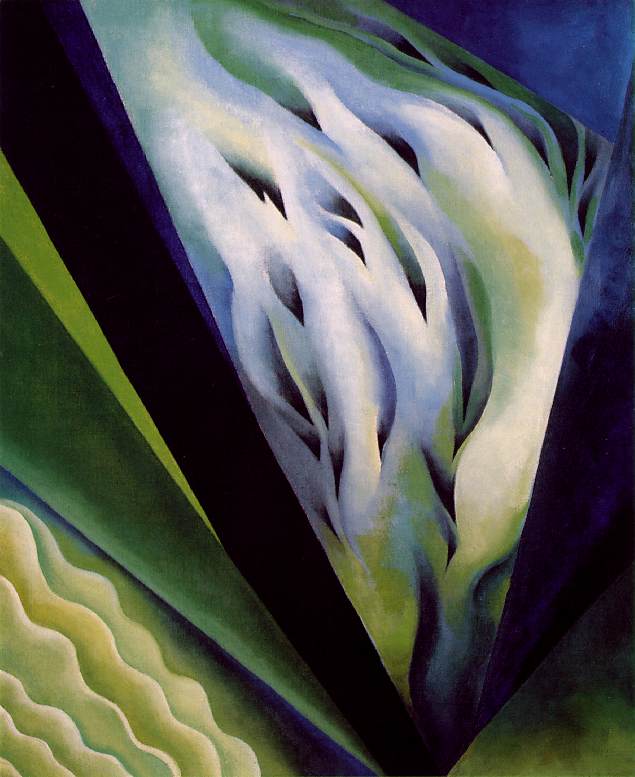
blue-and-green-music-(Cells of Solitude)

Alexa: Actually writing a poem is a tiny part of the process of making a poem. Most of the work is preparation. I intentionally make myself permeable so that my senses are heightened. The images end up being both particular and universal, hopefully lasting, because of this willingness to feel. Through practice, you learn the skill of how far to stretch an image in the poem and how images work together.

How do you make a news story lyrical so that the writing flows even as you are conveying facts ordered logically?


Matt: I remind myself to include details that can be felt by the senses. That means how something looked, what the weather was like or something about a person’s behavior. And I also use direct quotes from the people I interview to convey emotion and convey the fact that these are real people speaking.

You are a heavy reader of news stories. What is it about writing essays and poetry that makes them different lyrically from journalism?


Alexa: In writing essays and poems, I’m not at all bound by linear time. Both essays and poems can occur as spirals of recursive ideas or, as in this r.kv.r.y essay, “Cells of Solitude,” like strung beads. Sound, rhythm, pattern, images and connotation link ideas together in poems. Whereas when I read a news story, I want all the information to be firmly grounded in the present of current events and situated in a historical context.

Featuring Ann Hillesland

Ann Hillesland

“Singing is like meditation—you breathe in and out, you have to be in the here and now.  And yet performing is something more.  I think of it as projecting my energy outward to the audience.  Here is my love of this music, the emotion it brings out in me.  Please share in it too.

Writing is like both of these aspects.  When you are in the zone, writing is like singing, the eternal present.  But it is also projection to the audience.  In fiction, I’m hoping that people will understand and care about the characters as much as I do.  In nonfiction, I’m putting myself and my emotions out there and hoping that people understand me and that they won’t be bored.

Because this piece, “Wunnerful, Wunnerful, Fabulous,” combines these two interests, singing and writing, it possesses a kind of duality—doubly in the moment, doubly projecting outward—that’s strange for me, like out-of-alignment binoculars.

If you’ve already read the essay, you may have formed an idea of what the singing group, the JewelTones, is like.  Now you too can experience a duality—your vision of the JewelTones can come up against the real thing.  The following short video was produced by a local public access video group about the JewelTones.  The videographers filmed us mostly at typical gig: a 90th birthday party in a carport on a hot day.  We are costumed for the 40s (not in our fabulous long red dresses as in the essay) and singing songs from the 40s and 50s.  Here are the real JewelTones, sweating on a makeshift stage.  Here is our love of this music.  I hope you enjoy it.”

–Ann Hillesland

“Two Variations on the Theme of Goodbye” by Christine Aletti

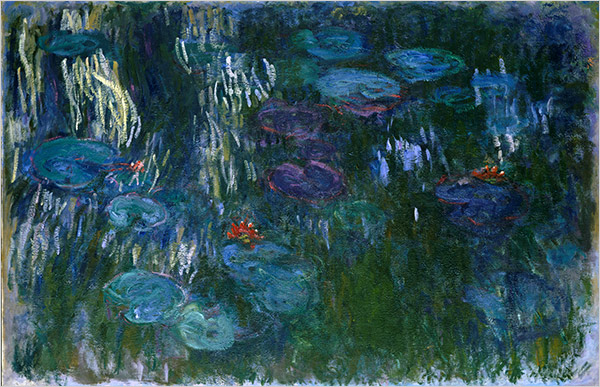
Monet_water lillies (Two Variations On)
Water Lilies, a study by Claude Monet, circa 1920

1.

The night needing left, bromeliads broke
from trees.  I hung my belly on the line to
dry in the moonlight and admired its shine.

Just at the edge of shadow, I waited,
patiently, for your voice.  Nothing came.
All was silent.  The palms stood solitary

as guards.  Cranes settled down, indifferent
to air.  The ponds blackened in disregard
and below, the trout denied swimming.

All was silent.  I should’ve known:
without needing, there’d be no noise, no
cacophony of please, I love you, let’s

have dinner.  I should’ve known:
my belly would twist and dry on the line
and emptiness would feel, simply, like nothing.

I grew to miss our arguing— the way
your words spiked inside me like
those broken flowers— the way

arguing leaves sloped and sighed, allowed
for the speckle of cream.  Out the door:
coffee-bean grinders and night-time tremors,

I think I lost a tooth in your mug—
Can you swallow my agenda?  Or,
even better, yesterday’s phrases?

There’s no need to utter them now.


2.

And forgetting, forgetting never came.
Sundays it rained and I never made it
to the beach.  Little dogs fell in the pool

while the oak held toads, fucking.
Their bellows pulsed alien and dank.
Summer wouldn’t leave; I sat outside

only at 6 am, when it was simply thick
air and gnats ignorant to flesh. Listened
in piss yellow patio lights to trucks rattle

down the road beyond the lake, airplanes
echo, soar and flash red and I forgot nothing
of New York City on a Monday; how when

it was finally quiet— the cologne and beer
disgusted, the handbills disheartened— fruit
trucks started down Broadway, tin-tailed,

stumbling into every little piece of broken
asphalt.  I never slept.  And how, when
you finally answered what lingered—

the cellphone’s throb and the question’s
swallow—salamanders didn’t stop
creeping up concrete. Gnats still attacked.

Even in the heat, forgetting never came;
Florida remained a yeast infection
that yearned for my body’s niches, but

I was not ready to give myself over
to invasion and forget everything, you.


Christine Aletti has an M.F.A. from Sarah Lawrence College. Her poems have been published in Two Hawks Quarterly and Tattoo Highway. Christine lives in New Jersey, where she teaches writing to unruly youths and yoga to disciplined yuppies.

“Short Prayer” by Michelle Olney

1792-103774
Jacob Wrestling with the Angel by Eugene Delacroix, 1861

I unearth the grey siddur
given me as a child.

I creak its cover open
to the short prayer for healing.
Ayl na, refa na la.

I do not need a prayer book
to recall this meager necklace of words,

nor your body in reach to feel the hollow
severity of your frame.

The spine balances in my hand.
I know you will not be healed.

I know you will not be healed because
you lean into your illness

as one does a strong wind: carelessly.
Death accelerates toward you.  Listen.

My prayer is a means of talking to you.
I read the words to myself.
Ayl na, refa na la.


Michelle Olney studied Creative Writing at Brandeis University, where she received the American Poets Honorary Prize (2009). She was recently hired as Poetry Editor for the speculative genre magazine Isotropic Fiction. She lives and works in Portland, ME.

“Like Juliet and Romeo” by Kevin Winchester

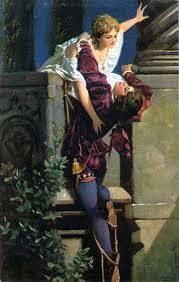
Rome and Juliet
Romeo and Juliet by Hans Makart, circa 1870

In the fall, I smell the leaves as they begin to turn. The yellows, tart as a lemon wedge. The reds, sharp as cinnamon. The oranges, heavy with the bitter muskiness of saffron. These leaves—even their dying holds a promise.

I could see the coming of the season in you, then. A crispness in the way you walked, a calm in your smile, an easing in the touch of your fingertips against my cheek. I could see it in the few weeks before the first stab of color showed itself on the slight ridge beyond the house, before the thin smoke telling of the hunter’s fire ribboned above the trees, before the first glazing of frost. Do you think somehow that has changed?

Remember that evening at Carlita’s Grill, sitting on the patio, the July air heavy and thick as wool? We were drinking Mexican beers. Flossie and Bill were there. Crutch and that weird girl from Tuscaloosa he dated for a while. Amy and Sean. Mando Dave, too.  Planning the trip to the Keys, laughing. Everything as it should be, the way we imagined it would always be. More beers and the meal came, slowing the conversation. The hot air moved just so as the sun went down and offered a hint of coolness. Remember? I loved the way the buttery light of dusk filtered through the fake palms, the way it settled, not on you, but gathered around you.

You are angry with me still.

On your first trip to Europe, you viewed everything through the harsh, new lens of this country. Soon enough, that disappeared and you drank it in, the aged aloofness, the weary determination, everything. After the sunset on the Arno, walking back to the hotel, we discovered that little basement bar where the German band played American rock and roll. They let you sing “Blue Suede Shoes” and I watched everyone watching you, but you looked only at me. The next afternoon, with the red tiled roofs of Florence slanted below us, snapping pictures from the Duomo’s campinale, I moved near the railing. The wind lifted my hair, I could smell bread baking below, and my weightless stomach felt tethered to the breeze. I could feel it pulling me away from the safety of the Basilica, teasing me, daring me.  “Let’s jump,” I said. “We’ll be famous, like Juliet and Romeo,” I said. You laughed and kissed me. “Easier than all those stairs back down,” you said, “but Romeo and Juliet were stupid kids, they didn’t know what it means to love, not really. Let’s avoid the cliché and buy a bottle of wine.” That bottle of chianti survived three moves, the little apartment on Sutton, the duplex on Ash, and finally, when we moved into our house, we opened it. It was better suited for salad dressing than celebration by then. Remember?

You’ve taken the pictures from the wall, but now the empty space frames your guilt.

We came home that day and your sullenness strained to mask your frustration—with me, with yourself, with the doctors, with things you could not control no matter how desperately you wanted to. I had no words to improve your silence. The screen door slammed when you went out to the porch, sudden and sharp as a surgeon’s knife. From the window, I watched you there. You looked skyward, I followed. There, on the tip of a pine at the far edge of the yard, the red-tail hawk perched, her head tilted downward and fixed, scanning the hedge row on the far side of the road. In an instant, she rifled toward the earth, quiet as a shadow, and disappeared into the thick of the hedge row before rising, a rabbit kicking in her talons. The rabbit squealed and you flinched. The animal shrieked once more, once more you flinched, but you never looked away. I could have gone to you, touched the soft lines around your eyes, told you that I, too, was afraid, that we are all afraid, and I could have asked you to hold me, but I didn’t. It was enough that I knew you’d never look away.

I was angry, too.

I never told you this, never told anyone, but one night, my grandmother came to me in a dream. She sat on the end of the bed, playing the old Maybelle Carter song, “Wildwood Flower,” on her guitar. Her fingers didn’t move across the strings, but the notes rang true and confident. She appeared with such physical certitude—her weight creased and slanted the mattress, she carried the scent of a pound cake baking with her—that I questioned, not the mystery of her appearing, but the how of it. In that moment of forming the question, I sensed a spooling back through time that did not begin or end with me and her. Rather, it threaded beyond that, beyond the world I knew of her, of the world she knew before me, of this place before the trees grew and the rains fell and the mountains pushed up from the seas. Before, and before that, a vastness so deep, so complete it was too much to transcend, to even imagine, and yet there she was. Through it all, Granny Jenkins had come to me. I tried to speak, but had no words. Again the question, how? And then I knew. You were right. Romeo and Juliet didn’t know what it means to love.

Hold fast to those pictures and soon I will come to you. I will come to you.


Kevin Winchester is a North Carolina native and author of the short story collection, Everybody’s Gotta Eat. His work has appeared in Gulf Coast, Tin House, Barrel House, Storysouth, and the anthology Everything But the Baby. In 2005, the Bread Loaf Writers’ Conference awarded Kevin their Work Study Scholarship. He is currently the Director of the Writing Center at Wingate University where he also teaches Creative Writing. Winchester recently won the 2013 Thomas Wolfe Fiction Award.

Read an interview with Kevin here.

“The Lightning Continued” by Monica Wendel

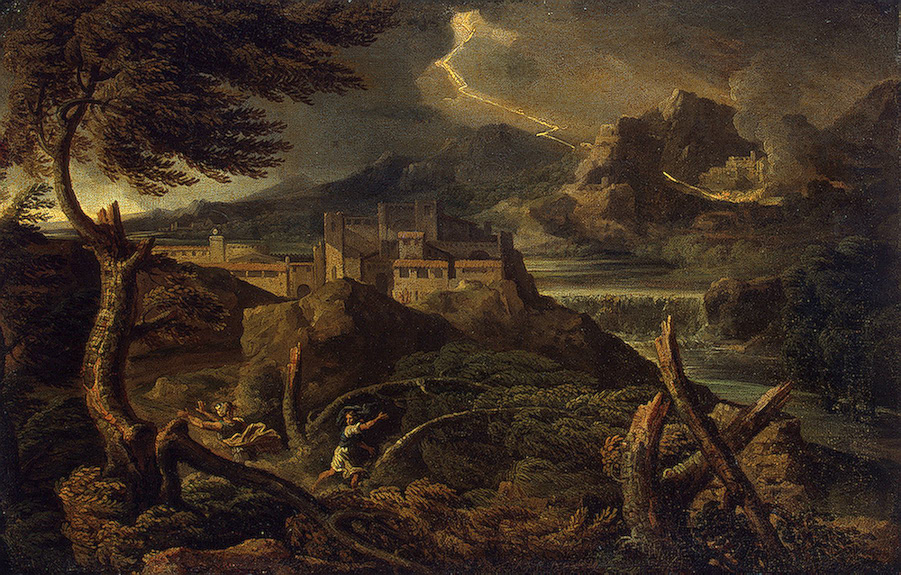
Dughet Gaspard (Gaspard Poussin)-xx-Landscape with Lightning-xx-Late 1660s
Landscape with Lightning by Dughet Gaspard, circa 1660

II. The Lightning Continued

To make this state God took a great carpet of sod and unrolled it unsteadily over the ocean and then didn’t bother leaving. So now His name appears on signs with metal legs, stuck into grass, and on highway billboards next to pictures of tiny translucent fetus hands. Not to say there isn’t joy. This morning the thunder smelled like wet rope, I said, Dear God, if You love me, let me live. And He did.


IV. Hotel Pilgrim

The waterslide was listed on the website of God’s miracles. And billboards along the drive counted down miles until, until … Still, the Hilton barely banked off it. You could even say they pretended it wasn’t God’s Slide of the Drowning Child and Twelve Apostle’s Face. I made my two hands a cross but it wasn’t the right sign. Flipped it over and a waitress came over — do you need anything hun? Lifeguards watched the pool through grey filtered cameras, counting silences.


V. Old Sport

How quickly a hotel room becomes “home” as in, I’m frightened, I’m going home. Smoke rises against the sky like skin on skin. Lightning jumps back and forth between clouds without jumping down. I washed the ashes out of my hair, washed sugar from fingers. Who knew that I would wake up eagle-stretched in a warm bed. Who knew that I would dream of the subway painted yellow passing miles underground. A seam of peat underground smolders overnight and the television expects sinkholes to collapse above it. The fingers of Spanish moss are too damp to catch, too full of insects to be brought indoors. I watch it brush against the window, breaking into grey-green spores.


Monica Wendel is the author of No Apocalypse (Georgetown Review Press, 2013) and the chapbooks Call it a Window (Midwest Writing Center, 2012) and Pioneer (forthcoming, Thrush Press). These poems were composed at the Jack Kerouac Project of Orlando, Florida, where she was the Spring 2013 writer-in-residence. Currently, Monica lives in Brooklyn and is assistant professor of composition and creative writing at St. Thomas Aquinas College.

“lullaby” by Kiik A.K.

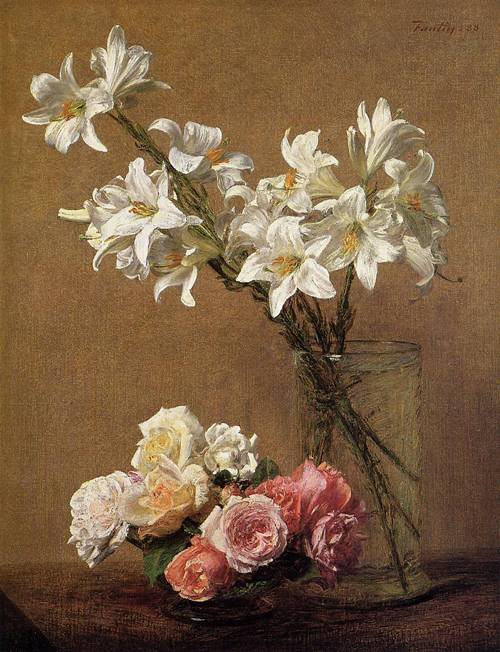
Henri Fantin-Latour (French Realist Painter, 1836-1904) Roses and Lilies 1888
Roses and Lilies by Henri Fantin-Latour, 1888

If I fold the page into a single
white glove I’m saying goodbye

If I fold it into a cricket
you will know the lullaby
seals itself between your dreaming
eye and the unsteady dream

A lantern calls to you
and I past a solitary dream
to meet in the shared tunnel
of your remembering

Six paper lilies means
I have fallen through the tunnel
and cannot rise, I am singing to you
from the shoulders of crickets
at your window

If I fold the page into a bowl
you will know I am out
collecting rain

Though you dream of thirst
and wake to the dry perfume of lilies


Kiik A.K. previously studied poetics at Santa Clara University and UC Davis and is a current graduate student of creative writing at UC San Diego. His work has appeared or is forthcoming in the journals iO, Scythe, Washington Square, Barge Press, The Brooklyner, Alligator Juniper, CutBank and Alice Blue Review. “lullaby” was written for Kane and Peggy Araki.

“Benefits of Anticipatory Grief” by Janet Frishberg

Henri Regnault (Benefits of Anticipatory Grief)
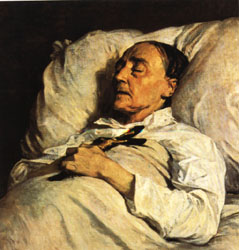
Mme. Mazois (The Artist’s Great Aunt on Her Deathbed) by Henri Regnault, 1886

I’ve forgotten my voice waiting for her to die. I came to say goodbye but I don’t believe it’s time yet and neither does she.

Six days ago in San Francisco, my friend Audra invited me over to eat chili. She stirred the soup in her narrow, steamy kitchen. I told her my grandma was sick but I didn’t have a way to get to her in LA. Saying it out loud to Audra, it didn’t feel real. It just felt like a story I was telling while we waited for the beans to soften and the spices to soak in.

“Take my car,” she said.

“No…” It was too generous, easy.

“Yeah. If the only reason you’re not going is because of a car, you should take mine.”

“How’ll you get to work?”

“I’ll take the train; I’ll figure it out. This is important.”

“Okay. How about…I’ll let you know if I can’t find anything else.” I leaned on her counter top. “Thank you so much for even offering.”

“You should take it. This is really important.”

Which is how I came to understand it was actually happening, and came to be driving Audra’s white Jetta down to West Hollywood. How I came to be standing in the doorway of my grandma’s room.

Almost all her furniture had been removed or rearranged. The master bedroom looked huge without their king-sized bed. As a child, I’d wake up in the guest room from nightmares about people trying to murder me. I’d tiptoe into their room and crawl into bed between them so I could fall asleep again among their snoring, squishy bodies.

It’s been almost three months since she’s stopped eating—claiming nausea and that nothing tastes good. Now, I sit beside her new hospital-style bed, while she drifts in and out of sleep all day. I try to stay busy while she sleeps; I knit or write or read. I catch up on This American Life.

Once it’s dark outside, she wakes up and we talk. She says things like, “You make my heart sing,” and when she has the strength, she likes to yell, “Ah!” and then shout, almost angrily, “You are so beautiful!” She complains about which appliances in her life are breaking, and who isn’t calling her the way she wants them to, and she likes to gossip about our family.

We’re the same people as before. Nothing about her or me has gotten inherently wiser just because she’s dying.

So instead, we discuss the green and golden afghan she’s not sure she can finish. She teaches me the stitch: knit two pearl two in a row with a number of stitches that’s divisible by two but not by four. She cries and covers her face with her wrinkled-skin hands, and I lean over the bars of the bed and drape my arms over her lap and say, “I don’t care that we’re just sitting here. That’s all I want to do. This is all I came down here to do.”

In early morning, I sort her pills for her, rolling their smooth gel casings between my fingertips, and when I crack eggs for lunch later, wonder if traces of morphine remain, and lick my skin just in case.

After approximately sixty-three hours in the house, I stand in the bathroom. There’s a three-foot long mirror on the wall that I’ve been looking in since I was a little girl and stayed with her for weeks at a time. It’s possible I haven’t showered since I got here. I pull off my smelly gray sweatshirt, stare at my naked chest, yellow in the mirror. I’m trying to remember how to breathe fully into it.

This is not the first death. There was my namesake grandma before I was born, and the grandpas, one in high school and the other in college. There was the sudden death at 17 that sent me to the bathroom floor sobbing: a boy I loved who jumped into the water. These deaths were important and also different—they were a phone call. They were a surprise, a punch in the stomach. Sometimes they’ve taken me years to believe in—he’s actually gone. I am glad now for the slow build of her dying. Her dying has been in the background for months now, like putting the teakettle on the electric burner and listening for its steam to build to a whistle.

But, nobody instructed me: when sitting with the dying, you must be very careful not to get caught inside the land of the dying.

I walk down the wooden hallway to the kitchen, telling myself to stop sneaking slices of banana bread covered in butter. My uncle, who lives with her, or she lives with him they like to say, gets home from his girlfriend’s place. He makes me leave the house with him to pick up sushi from around the corner. We walk through the streets, along with the gays and tourists. This is part of what she loves about the neighborhood. I carry the meal home in its Russian nesting dolls of plastic inside plastic.

I sit at what we call the “real” table, drawing thick slabs of pink sashimi into my mouth. I’m afraid of concentrating too hard on this raw fish flesh. I don’t want to remember the lamp light on her emaciated cheeks three minutes ago, when I fed her a bite of hamachi, the first food she’d accepted all day.

I felt triumphant, watching her swallow, and thought, that should solve it. She used to tell me, when I untangled a necklace or fixed her phone, “You’re magic, Janet.” I picked up a second bite with the chopsticks but she closed her mouth and shook her head at me, like a contrary toddler. She’s getting more beautiful in her starvation, except for the sunken places where her dentures and right-breast prosthesis should sit.

While eating, I try instead to see what’s physically real: the living room in front of me, where I sleep when visiting. White couches, masks from countries they visited all over the walls, my stuff an explosion of clothes in one corner. Not knowing what to bring, I brought too much.

I want to get farther away than the living room—for this, a car is needed. I drive down Sunset and turn left, towards the canyon, leaving the crowds behind me like an exhale. The flammable beige and green plants on each side of my car are familiar. The windows are up. I like the closed container of the car.

I connect my phone to the sound system and turn on music, try singing, just to hear my own voice. I almost lost it from all the yelling to be heard through her hearing aids, or worse, without her hearing aids.

I don’t want to think about ten minutes ago when I stood by her bedside, my shadow falling sideways in the lamp light, and told her, “I’m leaving for a few hours.”

“Where? Where are you going?” she protested.

“I’m going to yoga with Sonia.” She loves Sonia, my friend from college, because Sonia is beautiful and talented and listens.

“Sonia? Now?”

“Yes.”

She started crying, moaning, “I guess I have no choice do I?”

I can, in the car’s silence, scream words I gulped down—because I didn’t want a fight, because all day I checked to make sure she was still breathing, like a baby—which were: this is why it’s so hard to visit you, and: you make me want to lie to you.

I once thought this city was soulless but I know now, the green, the canyon; I was wrong. Here is just anywhere, but with more expensive cars.

I thought I should move my body into downward dog or maybe warrior one, but I got lost in the canyon’s turns, in not-thinking about what if she dies while I’m gone out of spite.

Five minutes late, they’ve locked the studio door on me. Sonia arrived on time and is inside, without her phone. I climb back into the car, waiting for the class to end so Sonia, her boyfriend, and I can have dinner. Trying to remember what else people do besides sit and watch the wheezing inhales of the person who probably loves them most.

I turn up the music, skipping through songs that feel wrong right now. Nothing too sad, or too happy. I want purgatory music. I roll the windows down. When my phone rings with an unknown number, I answer, hopefully, wishing it’s either God or an old friend calling to say, “I was thinking of you.”

It’s a volunteer: “Phone banking for the Dems, just making sure you’ll vote no on Prop 32!”

She did things like this for the Democratic Party when she was younger, better at using the phone.

“I already sent in my absentee ballot. I voted no. Thank you. Thank you for what you’re doing. Okay. Okay, bye.”

That twice thank you—I wanted her to like me. I wanted the phone banker to be a sage and stop her script to transmit wisdom, or maybe comfort me. To say, “Are you okay, Janet? You sound sad,” and, on the phone with her, I’d be able to cry, the way I haven’t been able to by myself yet, but this isn’t a movie, so we just hung up.

It’s becoming early evening. I watch the middle-aged women taking walks around the block with their dogs, jealous of their commitment and consistency.

I drove forty-five minutes here for some spiritual guidance and all there is now are car sounds coming in through the open windows: a screech of tires, honk of horn, smell of cigarettes and flash of expired parking meter. There’s nothing for me to do but sit and wait for the yoga class to end. After a brief gap of silence in the music, I’m shuffled my dead friend’s song, recorded for me in high school—next month he will have been dead seven years—and I let it play, resting my dry hands on the bottom of the steering wheel, and I listen.


Janet Frishberg lives and writes in a light blue room in San Francisco. She’s currently editing her first book, a memoir. You can find her work in Literary Orphans, Cease, Cows, sparkle & blink, the SF Chronicle, and soon in The Rufous City Review and Black Heart Magazine. You can find her @jfrishberg

This essay first appeared in Verity La.

“Wunnerful, Wunnerful, Fabulous” by Ann Hillesland

renoir (Wunnerful)
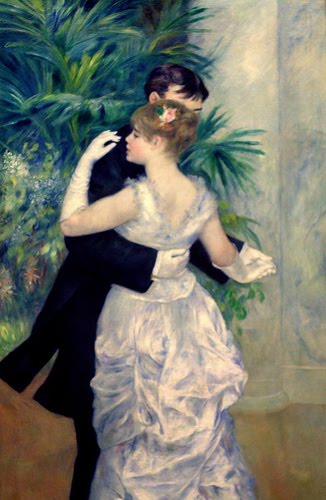
Dance in the City by Pierre Auguste Renoir, 1883

When I was seven, I dreamed of being on The Lawrence Welk Show.  Every Saturday night, my family would eat dinner around the television, the only night we were allowed to have it on during dinner. I’d be riveted, watching Myron Florin’s accordion flash, the imperviously smiling Bobby and Cissy twirl across the dance floor, and Norma Zimmer, blonde hair artistically poofed, warble “When the Swallows Come Back to Capistrano.”  As the youngest of six, I never rated a spot on the couch. Instead I sat on the floor with my taco or slice of homemade pizza and a Pepsi instead of the usual milk.  Dapper Lawrence Welk would wave his conductor’s baton as the orchestra played amid a swirl of bubbles, declaring his trademark “Wunnerful, wunnerful!”

I had no idea that I was idolizing the squarest show on television in 1972. Though I enjoyed the antics of Laugh In, I always felt hyper and drained afterwards. And though I watched Sonny & Cher and loved belting out “Gypsies, Tramps & Thieves” I could never imagine wearing Cher’s navel-baring outfits, nor did I want to be as mean as she was, always putting down Sonny. In contrast, everyone was smiling on the The Lawrence Welk Show.  The women’s wide-collared shirts, puff-sleeved dresses, and pleated jumpers could have come out of my own closet. I could see myself kicking down a prop fence during “Don’t Fence Me In” and singing “Hot Diggity (Dog Ziggity Boom)” without embarrassment.

The one cast member I emulated above all was Sandi. I envied her marvelous cheekbones and flowing red hair. I was round-faced, my dirty blonde hair always ragged because I habitually fell asleep with gum in my mouth and my mother had to cut out the hardened blobs. Sandi looked perfect, smiling, calm. She mostly sang as part of a trio:  Sandi, Gail, and Mary Lou. Together they harmonized to “Swinging on a Star,” dressing up in flowing-sleeved evening gowns and leaning together close as sisters as their voices blended sweetly.

My family sang together, especially when we were camping and had no TV or other music (my parents forbade radios and cassette players during camping). We sang folk songs, John Denver, songs from musicals. The older kids harmonized, but I always sang melody, too young to sing a part and too convinced that I should be the star and have the melody anyway. After all, someday I was going to be on television, singing in front of the orchestra while gossamer bubbles floated behind me.

Eventually I outgrew The Lawrence Welk Show. He was an old man in white shoes, and no matter how flashy the silver was, an accordion was not hip. Even the ads were awful, touting Geritol and Rose Milk, the hand lotion my grandmother used. By high school I worshiped Deborah Harry and Pat Benatar. But I never pictured myself in a catsuit in front of a rock band. Instead, I sang in the school chorale and the chorus of “Oklahoma,” and tried—and failed, due to my terrible dancing—to make it into the school singing and dancing group, the Thor Throats (the school mascot was the Vikings).

After I graduated from college, I stopped singing except in the car or shower. I got a job, got married. A few years ago, though, deciding I missed singing, I joined the JewelTones, ten women who dress up in wide-shouldered 40’s outfits or glamorous long dresses and harmonize on songs from the 40’s and 50’s. Our official name is the JewelTones, but we call ourselves the Fabulous JewelTones because, well, why not?

Recently, we sang for a 50th wedding anniversary party in a Methodist church social hall, which had a stage at one end and a basketball hoop at the other. The woman’s wedding dress, displayed on a mannequin and smelling of mothballs, crowded us on stage left. In the unseasonably hot night, all the doors were thrown open, and people scooted their chairs to see us better from the round tables. The audience was mostly elderly, with a few bored-looking grandchildren thrown in. We started the show with “If I Knew You Were Comin’ I’d’ve Baked a Cake,” which features many short solos, and when I stepped forward to sing my solo, I concentrated on a white-haired lady near the back who was mouthing the words. Every 90th birthday party, retirement home, or “fun after 50” group has a few people who know all the words, maybe singers themselves who idolized Doris Day or Bing Crosby. The crowd laughed at our schtick, at the silly hula dance in “Makin’ Love Ukulele Style,” at the moment when our (male) pianist donned a dress and added his baritone to “Sisters.”

As I was swinging my arm in our synchronized train motions during “Chattanooga Choo Choo,” it struck me—I was in the Lawrence Welk show. I was wearing a long red dress, on stage with other women in long red dresses. Our emcee bantered between songs as we got props: a suitcase for a train ride, a feather boa for vamping it up. No prop fences or haystacks, but we do our best with what we can carry. We smile all the time and sound as sweet together as Sandi, Gail, and Mary Lou. Who cares if we’re not hip? Who cares if our most fervent supporters take Centrum Silver? We weren’t on television, but when the anniversary couple came back stage and said our show was everything they’d hoped it would be, I felt as good as Sandi must have felt.

One of the JewelTones has a bubble machine she wants us to use as a prop. Her idea is a silly version of “I’m Forever Blowing Bubbles,” but maybe I should propose that old Lawrence Welk closer “Adios, Au Revior, Auf Wiedersehen.” We could sing “Here’s a wish and prayer that every dream comes true” while the bubbles cascade behind us and the lights dazzle our rhinestones into diamonds.


Ann Hillesland’s work has been published or is forthcoming in literary journals including Fourth Genre, The Los Angeles Review, Monkeybicycle, Open City, Prick of the Spindle, and SmokeLong Quarterly, and has been selected for the Wigleaf Top 50 Very Short Fictions 2012. She is a graduate of the MFA program at Queen’s University of Charlotte.

“The Tuesday Evening Meditation Group Breaks to Pee” by Richard Bader

Rinpoche (Meditation Group)
Detail from Vision of Yeshe Tsogyal by Chögyam Trungpa Rinpoche

The five members of the Tuesday Evening Meditation Group are flat on their backs in the upstairs classroom of the Unitarian church where they meet. The room is warm, its temperature set for people who don’t move around much. Eyes closed, they are tuned in to Conrad’s voice: “Feel the pressure on your pelvis as you relax into any tension there. Feel your shoulders where they sink into the carpet.” He is bringing them back from twenty minutes of acute body awareness visualization, horizontal variation. The thin gray carpet is stained and smells faintly of the collective dross of many years of church potlucks, and visualizing your shoulders sinking into it is not an altogether pleasant image, so they are grateful to be nearing the end of this exercise. This brings to a close an hour of marginally successful work to empty minds—earlier twenty-minute installments included simple sitting meditation and sensory breath-awareness meditation—and now another part of their anatomy needs emptying.

“And… back,” Conrad says, working the segment to a close. He tries to be soft and soothing, but his voice is naturally nasal and off-putting to some, and he speaks with an awkward cadence. “Now [pause] open your eyes [pause] slowly [pause] and come back into the space [pause] with everyone else.” He inhales deeply and loudly, then exhales with a whoosh. “Good. Let’s take a ten-minute break.”

Jennifer wishes he would have said slowly open your eyes instead of open your eyes slowly, because she’s suggestive by nature, and when he said open your eyes she just went ahead and opened them, quickly, and then when he said slowly it was too late to go back and do it that way, so the effect was jarring. The last thing Jennifer needs in her life right now is jarring. She is a short, stylish, forty-something human resources director with short, soccer mom-ish auburn hair who is fond of tight turtlenecks, and during lying-down meditation Conrad likes to watch her chest rise and fall as she breathes. Having peeked, Jennifer is aware of this, and even though she isn’t attracted to Conrad, it makes her wistful. She has a well of resilient good humor that she draws on as a defense against the torrent of personal misfortune she is undergoing: the recently fired husband who spends his days looking at Internet porn instead of searching for a job. The 93-pound teenage daughter in an inpatient program for anorexics. And the very recent news that the tiny lump she discovered in the shower a month ago is a big enough deal that her left breast will have to be removed. How interested would Conrad be if he knew that? Just yesterday, after her husband forgot to clear the search history on his laptop, Jennifer found a link to a website of women with mastectomies who had gotten tattoos to cover their breast scars. Some of them were quite beautiful.

It was Jennifer who several weeks ago suggested that they refer to their mid-session bathroom break as “achieving flow,” and everybody had laughed. Everybody except Conrad, who thought her glibness bordered on sacrilege, but said nothing. Conrad is tall and gaunt and has a braided black ponytail flecked with gray. He majored in Tibetan poetics and culture at a quirky but accredited college out west and wants the class to call him “rinpoche,” but as none of them are familiar with that term and Conrad himself seldom speaks unless he’s directing a meditation exercise, it’s unlikely that this will happen all by itself. Conrad has prostate cancer, but he doesn’t know it yet. This explains the pain he sometimes feels during sitting meditation. He has started to sit on a cushion, and this helps some. The cancer is the rarer, fast-moving kind. His reliance on homeopathic remedies won’t help him much, and in eleven months he will be dead.

Willow and Alex roll up in unison like it’s some kind of dance move they’ve practiced and then take turns massaging each other’s shoulders before they stand and stretch. They are young lesbian lovers from the college who are there because they saw a flyer outside their Religions of the Eastern World classroom. They are also there because they read on a blog that Sting meditates, and who doesn’t think Sting is cool, even if he is sixty. They hold hands when they meditate, aiming for a shared mystical union. This is kind of lovebird cute, but it also royally pisses George off, because while Willow is dark and scrawny and heavily pierced, Alex is an Amazon, lithe and bronze from time outdoors with the college soccer team, so when George sees her holding hands with Willow all he can think is, What a waste.

Ron has a crush on Jennifer but he hasn’t done anything about it. He is a single forty-seven-year-old librarian with a blondish comb-over. One Tuesday during a break Jennifer asked him what he did for a living and the top of his head went crimson as he tried to explain his job, where he wasn’t the head librarian, but after a recent promotion was number two. Jennifer, who asked Ron this question on a night when her husband was entrenched in front of the computer and her daughter was in the hospital and she herself ended up staying at a friend’s, found his shyness kind of charming. But since then Ron has avoided her. It was as if that one brief conversation succeeded in making him think that Jennifer might actually like him back, and breathing the rare air of that possibility was enough.

Ron also has a sort of crush on George, who joined the group just a few weeks ago. Not a romantic crush, but a man-crush, the kind of crush men felt about Sean Connery during his peak Bond years, a wanting-to-be-like-him crush. Not that George was anything like Sean Connery, to say nothing of James Bond, but he did exude a robust masculinity that Ron himself lacked. George was short and solid where Ron was tall and wispy. George was loud and boisterous where Ron was shy and nervous. George bellowed when he laughed and Ron did this sniffly thing that came out his nose. George has farted loudly and unapologetically during sessions, while Ron has endured stomach cramps. George arrives from work on Tuesdays in wrinkled grey suits from his job selling something—kitchen appliances, Ron thinks—his tie pulled loose at the collar. George smokes cigars and has high cholesterol. Ron is a near-vegan on a gluten-free diet. George is also, Ron thinks, the last person in the world you would expect to find in a meditation group.

George is at a urinal, so Ron steps to the single toilet stall. George pees like a Clydesdale, and Ron is envious of this, too. “Whatever inspired you to start meditating?” Ron asks, to relieve the awkwardness of just listening to pee.

George uncorks a bellow laugh as he tucks himself back in. “Shhhh,” he says, looking at Ron with a broad smile on his face and a thick index finger on his lips. “I’m not doing meditation.” Ron gives him a puzzled look. George winks, then explains. His wife thinks he has a drinking problem and has said she will leave him if he doesn’t get help. George did some research and found an AA group that met Tuesdays at the church. He went once and hated it. No one was any fun, and their stories were depressing. On his second visit, he discovered the meditation class meeting at the same time. “So,” he says to Ron, “here I am.”

Ron flushes and fixes George with an admiring grin. “You’re kidding,” he says.

“No, seriously. Tell you the truth, I like it. Worst-case scenario, I get a little nap.”

“And your wife thinks you’re at AA.”

“Yeah. But I don’t need AA. I’m not…” His voice trails off and he does a gesture of helplessness with his hands. His wife says that whenever he says he’s not an alcoholic it just proves he is, but is in denial. She learned this from something she Googled. He finds the logic absurd. “It’s perfect, right?”

“Amazing.”

“And you know the best part?  She’s thrilled by how well it’s working. Says she’s so glad I’m so committed to it. Can’t believe the progress I’m making.” Then with a stroke of ironic self-awareness, George reaches into his jacket pocket and withdraws a slim silver flask. He unscrews the top and extends it toward Ron, who laughs a real laugh, not his usual sniffly laugh.

“No thanks.”

“Jack Daniels,” George says by way of persuasion, but Ron shakes his head. “Suit yourself,” George says, and takes a swig.

“Oh, what the hell,” Ron concedes. As he feels the burn in his throat, Ron wonders what George will think of single-nostril breathing when Conrad gets to it.

Jennifer is standing at one of the sinks in the women’s room. There are two toilet stalls, which is more than sufficient given the church’s flagging membership. A flush comes from one and Willow emerges and goes to the sink next to Jennifer’s to wash her hands. Their eyes meet in the mirror, where Jennifer is drawn to the tiny silver stud in Willow’s right nostril.

“How many do you have?” Jennifer asks, touching the side of her own nose to indicate to Willow that she means piercings. Between the nose stud and the eyebrow hoop and the assortment in Willow’s ears, Jennifer counts nine.  She herself sports a very conventional two, one per earlobe, and she’s partial to gold dangly things.

Willow thinks for a few seconds, her head bobbing slightly as she counts to herself. “Fourteen. I think.” Three more head bobs, left-right-left. “Yeah. Fourteen.”

“Wow,” Jennifer says, reaching for a paper towel to dry her hands. Then, risking a level of intimacy she has no right to risk with this young girl, but newly intrigued by the concept of unconventional body ornamentation, she asks, “Where?”

Willow pauses for a second, then grins into the mirror and sticks out her tongue, displaying a round silver stud the size of a BB. Jennifer laughs. Then Willow lifts her black T-shirt at the waist to show Jennifer the tiny silver hoop in her belly button. The second toilet flushes, and it startles Jennifer, who turns to see Alex. Alex glances at her, expressionless, then locks eyes with Willow in the mirror. Her eyebrows arch questioningly. Jennifer feels her face redden. She looks down at the sink, then back at the mirror, missing the slight nods that Alex and Willow have exchanged. Then Willow lifts her shirt higher, then higher still, and pulls up her sports-bra with it. Her breasts are small and round and taut. Two silver hoops pierce her left nipple. The right nipple is un-pierced. Willow is grinning, though with the shirt lifted up Jennifer can’t tell.

Jennifer’s eyes fill with tears and she starts to cry.

Willow quickly covers herself back up. “What’s wrong?”

Jennifer waves her hand as if to say, nothing. Alex puts an arm around her. “You OK?” she asks.

“I have cancer,” Jennifer manages, then musters a brave smile and goes on to explain.

“Oh my God.” Willow sounds stricken. “I am so sorry. I didn’t mean…”

“No,” Jennifer says. “It’s OK. Really. I asked, didn’t I?” She looks carefully at Willow, who is only a few years older than her own daughter. She feels a rush of desire to comfort the girl, and starts to reach up to touch Willow’s face but pulls back. “I’m grateful. Really. Thank you.” She wipes her eyes with a Kleenex, then smiles and says, “You’re beautiful.”

“Do you want to just hang out down here for a while?” Alex asks. “We can stay with you.”

The generosity of these two girls moves Jennifer. She hopes her daughter will be like Willow when she is her age, then realizes that she has just wished for her daughter to become a heavily perforated lesbian and laughs. Willow and Alex laugh with her. Jennifer wants her daughter to meet them, thinking that maybe that would help, though from the look of Willow, Jennifer can’t rule out the possibility that she has food issues too.

“I’m fine,” Jennifer says. “Let’s go back up.” They are halfway up the stairs when Jennifer stops and grabs Willow’s arm. “Wait,” she says. “That’s only thirteen. Where’s the last one?” Willow and Alex exchange glances and burst out laughing, and Jennifer delights in joining them.

Conrad is sitting cross-legged on his cushion as they reassemble. He hears rain on the roof, and decides that tonight they will skip walking the labyrinth in the yard behind the church. Ron twists himself into a full lotus that will go from mildly uncomfortable to full-on knee pain in about two more minutes. The meniscus in his right knee is torn—an orthopedist has confirmed this—but neither that knowledge nor the pain will motivate him to abandon his lotus. Emboldened by George’s whiskey, he plans to talk to Jennifer after tonight’s class, and decides to use this final meditation exercise to think about what he will say. George, as always, pulls up a chair, and Conrad silently judges him for not trying harder. Alex and Willow sit with Jennifer between them. The sight of Jennifer giggling with the two lesbians produces in Conrad an emotion he might call rage if not for the fact that he has worked so hard to eliminate rage from his emotional vocabulary. He worries that they are mocking him. He has troubling thoughts about what might have gone on in the women’s room. “What’s funny?” he says with cool nasality, and Jennifer half-expects him to do the admonishing third-grade-teacher thing and add, Is it something you’d like to share with the group? But he doesn’t.

“It’s nothing,” Jennifer says, struggling for composure.

“Humble apologies, sensei,” Willow says, head-bowing with prayer hands, and the three women fall into each other, laughing hysterically.


Richard Bader‘s fiction has been (or is about to be) published by the Burningword Literary Journal, SN Review, and National Public Radio. This is his second story for r.kv.ry. He lives and writes in Towson, Maryland.