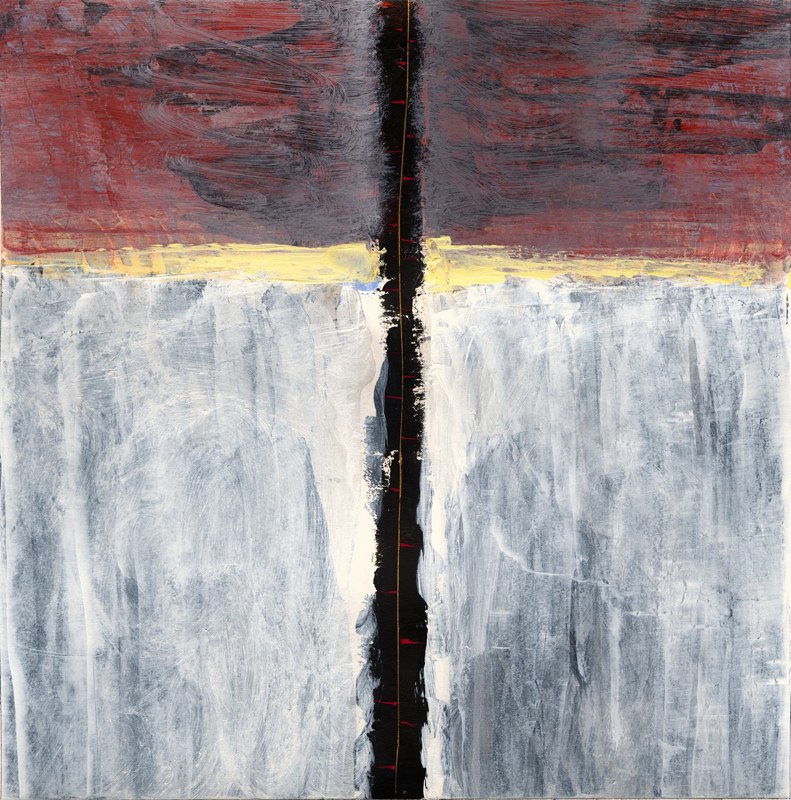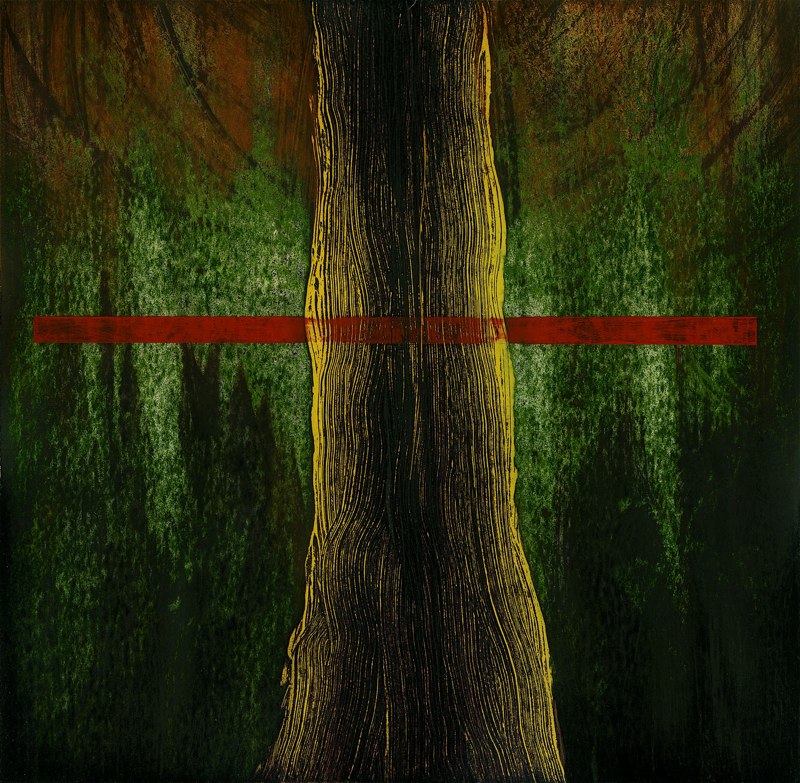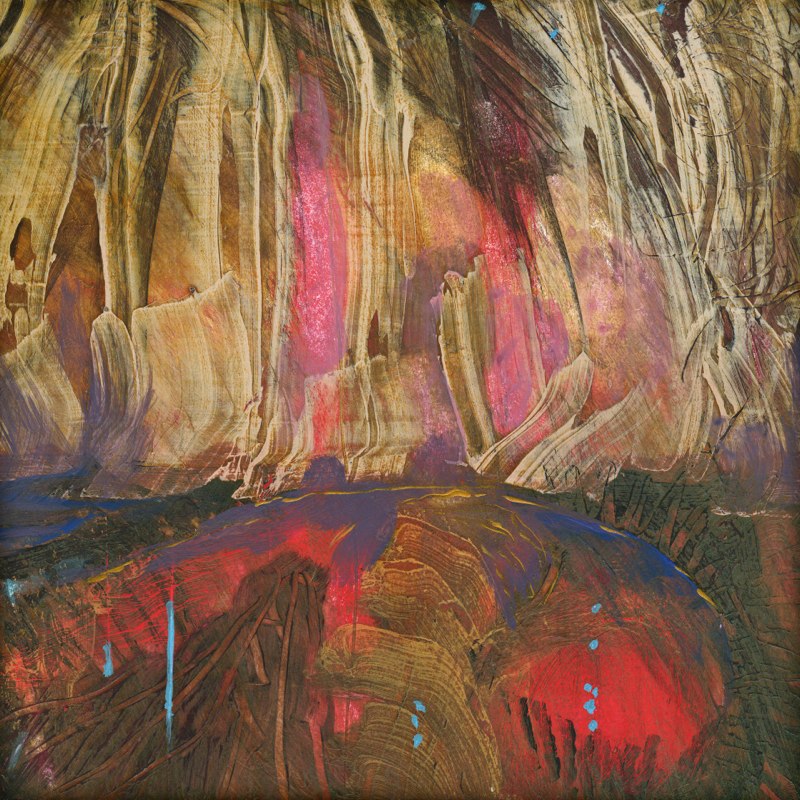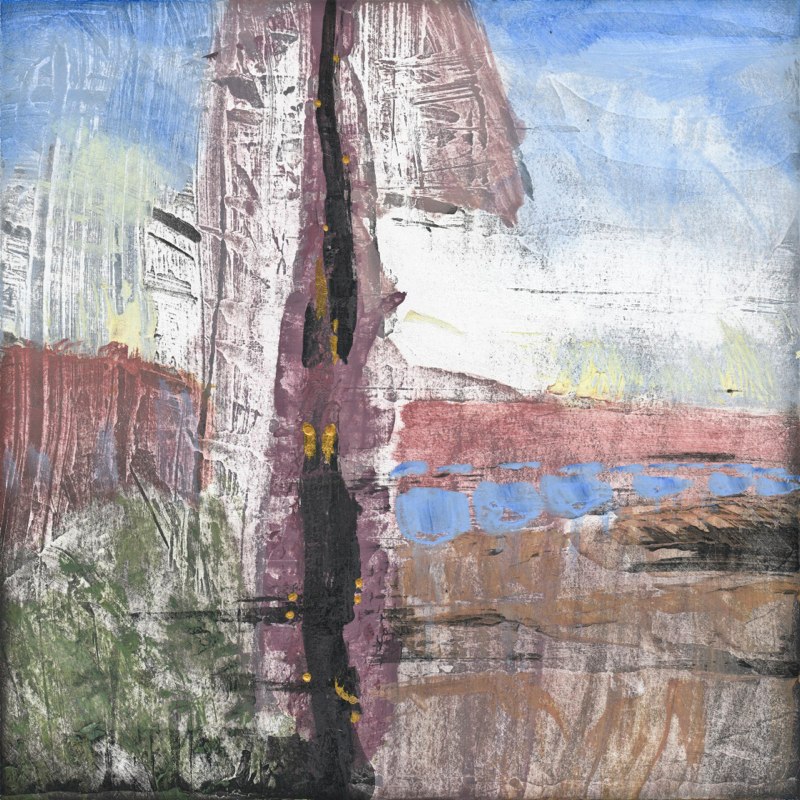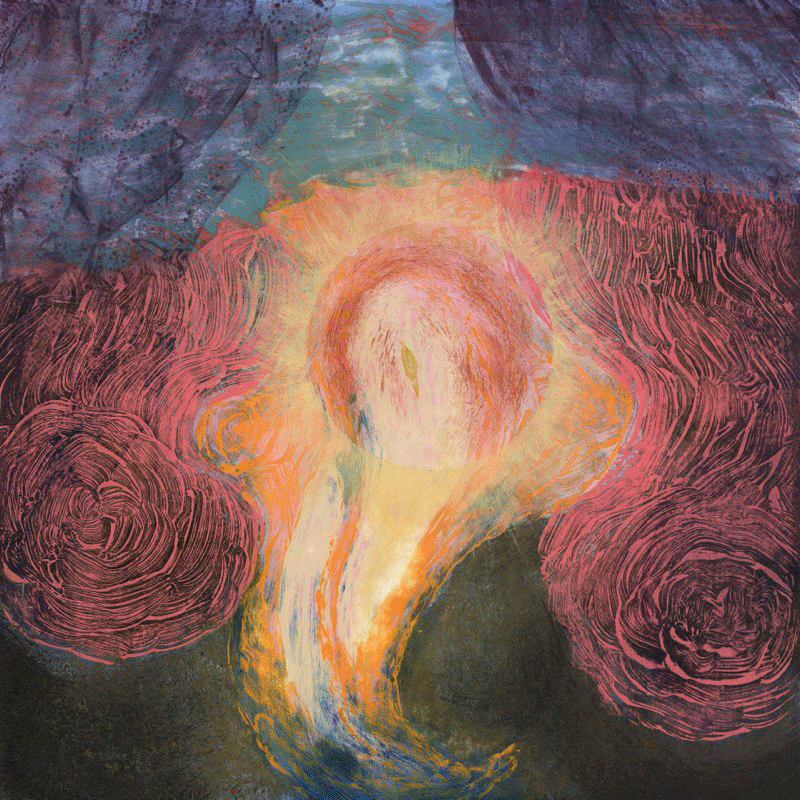
“The Stick in the Big Boy’s Hand” by Jacqueline Jules

the path of pain (Stick in Big Boys hand)
“The Path to Pain” by Peter Groesbeck

I saw my little sister go next door
with the neighbor boy.
White sandals on her small feet,
short pink socks with frilly lace cuffs,
and blue flowered shorts
matching a cotton button-down shirt.
Mama always dressed us nice, even to play outside
on a slick June morning, two days into summer vacation.

Wet blades squeaked beneath my shoes
as I followed up the hill. Reaching the crest,
I thought, at first, she’d slipped,
seeing her prone in the dew,
her cheek pressed into the long grass
until I saw the stick in the big boy’s hand
and her bare bottom, pink as her lacy socks.
Only a naive nine myself,
I didn’t know what to do, who to tell, or how to stop
the stick in the big boy’s hand.

Forty years later, my little sister lies
with her cheek against the pillow,
her bottom still pink and bare, as she mumbles why
she can’t get dressed for the fourth day in a row.
“Too dangerous to go outside,” she insists. “The grass is slick.”
I watch from the doorway, not knowing what to do, who to tell,
or how to stop the stick, still in the big boy’s hands.


Jacqueline Jules is a Northern Virginia author and poet who writes for children and adults. Her books for young readers include Zapato Power, No English, and Unite or Die: How Thirteen States Became a Nation. Her poetry has appeared in numerous publications including The Broome Review, Sow’s Ear Poetry Review, Christian Science Monitor, Chaminade Literary Review, Sunstone, Imitation Fruit, Potomac Review, and Minimus. She won the Arlington Arts Moving Words Contest in 2007, Best Original Poetry from the Catholic Press Association in 2008, and the SCBWI Magazine Merit Poetry Award in 2009. Visit www.jacquelinejules.com

Read an interview with Jacqueline here.

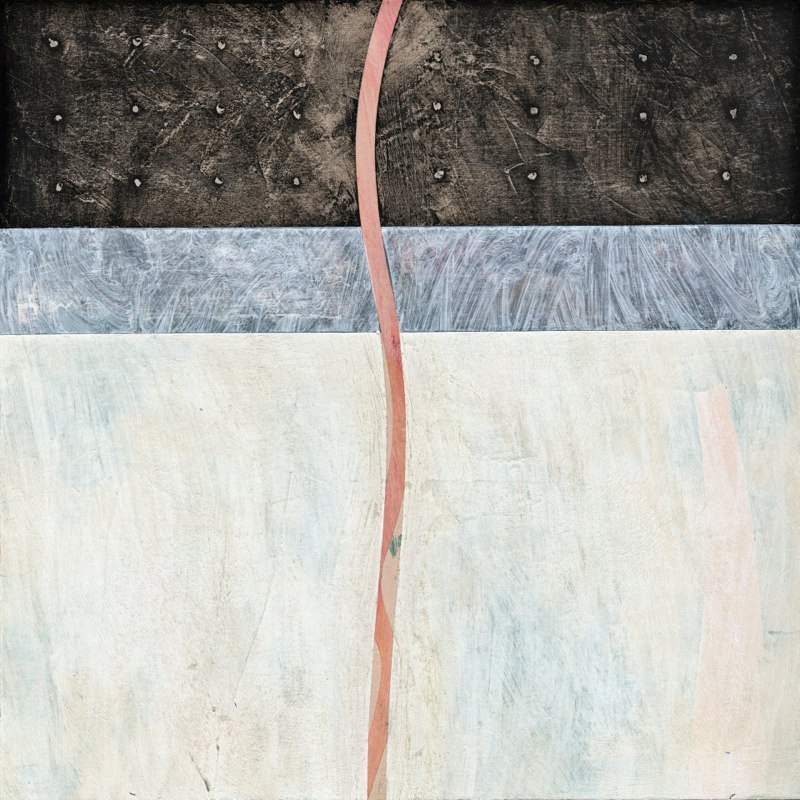
“Grimoire” by Kristin Camitta Zimet

plea(Cover Image)
“Plea” by Peter Groesbeck

don’t/ can’t/ should/ never/ bad:
These are the spells to bind
her ballerina feet to stubs,
stiffen her hips, seal her breasts
and snap her waist in two.
A sister’s or a mother’s mouth
babbles them behind her, so as fast
as they braid up her hair and zip
her dress, they disassemble her
into limp strings and gaps.
A toad tied to her headboard
shrills them, shredding her dreams.

The counter-spells cannot be hissed
but crooned. Words stuttered like a comb
through broken ends, then sidling higher,
stroking from the crown. Words slipping
silver baby spoons between her lips,
trickling half-heard chimes
into her ears, piecing her mirror
like a crazy quilt. Spells she has to say
herself, in chorus, every splintered bit
hunting its cricket voice into a crack,
say them for years, before they take:
do/ can/ may/ this time/ good.


Kristin Camitta Zimet is Editor of The Sow’s Ear Poetry Review and author of the full collection Take in My Arms the Dark. Her poems are in journals including Poet Lore and Bellevue Literary Review. She is a photographer and nature guide in the Shenandoah Valley of Virginia.

Read an interview with Kristin here.

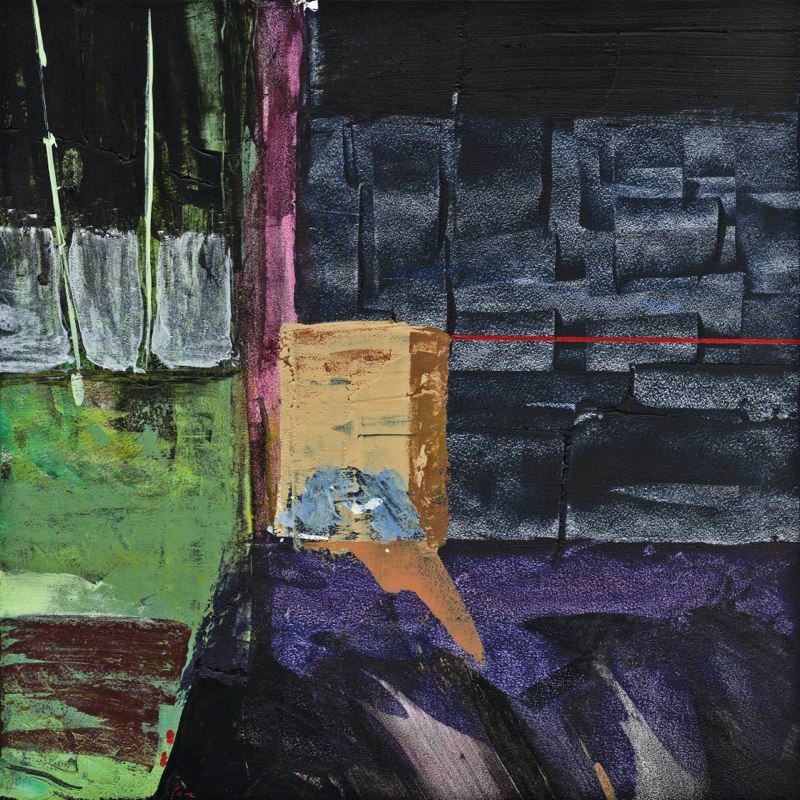
“Scars” by Anne Dyer Stuart

raking over our souls (Scars)
“Raking Over Our Souls” by Peter Groesbeck

Bumped up tracks
redder than the rest of you.
Rivers of corduroy worn like scarves.
Your little hurts.

Inside: sleek, unblemished.
Inside: the same you God stitched
together—hastily, in Heaven,
then threw down like a stone.


Anne Dyer Stuart holds an MFA from Columbia University and a PhD from the Center for Writers at the University of Southern Mississippi. Her lyric nonfiction won New South journal’s 2012 prose prize, and her fiction received the Henfield/Transatlantic Prize from the Joseph F. McCrindle Foundation. Her work has appeared or is forthcoming in Pembroke Magazine, Sakura Review, The Midwest Quarterly, Poet Lore, The Louisville Review, Third Coast, Midway Journal, Best of the Web, storySouth and elsewhere. She teaches at Bloomsburg University in Pennsylvania.

Anne is featured here.

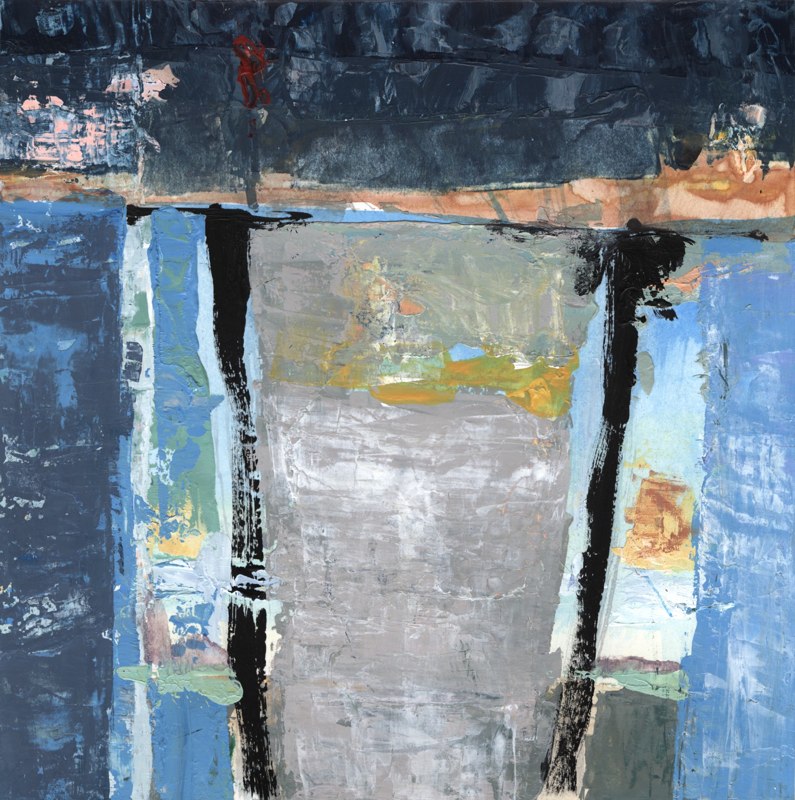
“After Philip Marries Mildred” by Behlor Santi

missed connection After Philip Marries)
“Missed Connection” by Peter Groesbeck

Strawberry-scented lotion. It cost $10.83 at Sephora — money that could have bought steak, a bag of shrimp, or a box of chocolate. I knew better, yet here I was in the bedroom, slathering lotion on my legs. It felt like cold kisses. My skin became softer. I scolded myself for breaking my budget.

What would my husband say?

As the late-autumn sun lowered into the horizon, my husband came home. He entered the kitchen, his gas-station uniform smelling strong. He kissed me on my cheek, his lips raw, and he held my hips.

“You smell like a strawberry tart,” he said. “Making anything special?”

I pulled away and I stated that I was serving chicken stir-fry tonight. The kitchen’s light contrasted with the darkness of the living room. Since we had no TV, the house remained quiet — except for a car rolling down the street.

“Nope,” I replied. “Just homemade Chinese. Takeout is bad for you.” I laughed. “How was your day?”

“Pumping gas into car after car,” my husband said. “Forgetting that I want to be a writer.”

“Everybody wants to write,” I replied as I tossed cut-up chicken and veggies in the wok. “Publishers like to be choosy.” I looked at my husband’s blue eyes. They were so brilliant when I first met him, but tears and crow’s feet had overtaken their beauty. I urged him to get an MFA. However, my husband knew college friends who earned MFAs and worked at Starbucks and Target. He decided to write about working at a gas station. I had to stay on a strict budget.

My husband would eventually realize the truth.

After dinner, I retired to the living room with my copy of W. Somerset Maugham’s Of Human Bondage. Philip Carey’s failed quest to be an artist led me to my situation. I still smelled the expensive lotion on my body. In the back of our one-story house, I heard the shower run. Hot water and soap washed grime off my husband’s strong and finely muscled body. I wanted another night with him, even if he couldn’t make it in New York City, London, or Paris.

I slipped in a bookmark and closed the pages. Water continued to peal on the tiles of the shower. I left the dimness of the living room. In the bedroom, I took my clothes off, reminding myself to be more frugal — for my husband’s sake. I walked into the bathroom. It was misty, like a spring morning. As I slipped into the shower, my husband smiled at me, his blue eyes bright again. He held me. He kissed me with his softened lips. With Castile soap, my husband washed the day off my breasts, my stomach, my cunt. In that moment, I wanted him to clean me until I was perfect.

I didn’t smell like a strawberry tart anymore.


Behlor Santi lives in New York City and works as a freelance writer. She’s published fiction and poetry in such magazines as Cortland Review, The Dead Mule, and The Sidewalk’s End.

Read an interview with Behlor here.

“Ecdysis” by A. M. Rose

at-last-(Ecdysis)
“At Last” by Peter Groesbeck

I’ve told a lot of stories about my very brief career in stripping.

I tell my female friends that it was a social experiment and I was doing some late-blooming rebellion. I tell them that it wasn’t very glamorous, most of the customers were awkward but the bartenders were nice.

I never tell my male friends.

To retired and working strippers I tell them that I wasn’t in it long, just to make some money after a living situation went south. Then I change the subject.

I tell the man that I date immediately afterwards that I was trying to prove something and trying to get rid of something. I tell him that I’m not ashamed of it, but it didn’t give me what I needed and it took too much, so I got out. I tell him that a strip club was one of the most depressing places I’ve ever worked in, and I’ve worked retail during the holidays.

I tell myself that I worked longer than I did, that I was better at it than I was, and that I was in control the whole time.

I know that if you tell a story enough times, you start to believe. I wait for that to happen.

While I wait, I keep the shoes in the back of my closet, a sort of insurance I never talk about. If it ever gets too bad, if I am really desperate, I can go back.

Part of me wants to go back. I don’t like how the story ended, it didn’t fit the narrative that I particularly like, in which I play Scheherazade in a T-back. That story takes on a dream-like quality when I tell it to myself, and I do, about a thousand and one times.  Hear, oh king, of a young woman who was always good at telling tales. She felt constrained by the stories that were told about her by lovers and her family. She finds temporary liberation in telling stories to men who pay her for the temporary fantasy she gives them.  She may not have been the prettiest, or the most experienced, but she was the cleverest and she knew the power of a well told lie. But, time passes and the young woman grows disillusioned with the doublespeak and puts her clothes back on, now wiser and with a wad of cash in her pocket. Finit. There is no room in that story for doubt.

But I do doubt. When I quit, I tell myself it is because I am scared after I see a customer snapping photos with his cell. I also tell myself that I am scared of it keeping me from ever getting a different job. Two years later, I tell myself that if I was really strong, if I really didn’t care what other people thought, I would have kept on going.  I had given in.

This is not a good story. I want to rewrite it.

Instead, I write papers towards a degree and cover letters towards a job and credit my success to the fact that I am very, very good at telling professors and interviewers what they want to hear. I treat the whole process like an investigative report—what can I tell them to make them tell me what I need to know to get what I want from them? In between my collection of part time jobs, I start a story about an anthropologist with the super-power to blend into whatever group she is studying. It is a sort of reverse participant-observation—she is observed, and therefore can participate.  One day, she looks in the mirror and sees nothing because there is no one there to tell her who she is. I don’t finish the story because I never finish stories.

My unfinished stories are always perfect, just like my unfinished undertakings. I know that I fear mediocrity more than I fear badness. One can be the baddest bad girl, or the worst writer, but to be somewhere in the middle? To try and then fail, not out of lack of effort but simply because when you dragged your sled up the bell curve it teetered then stopped on the hump—that is unacceptable.

One day in a class on research methods the professor makes a joke about going to a strip club, and I wince. I am not ashamed of having done it; I am ashamed of not doing it now.  I think, I have given away my chance to be really good at being really bad. I’ve always known that I’m not a good girl; I just play one for the sake of convenience. But I’ve been playing one for so long, I’m starting to forget.  Or maybe I believe it. Or maybe it was all a story after all. No—it can’t be a story, it’s needs to be real, it has to be real. I am Scheherazade and all of this is a just a framing narrative mistranslated.  The unfinished stories are only a preface, that’s not my real life.

So, a week later when a shiny new friend asks me to pose nude for a performance art piece I say yesyesyes and drag out the scary platform heels and body make-up. I rejoin the stripper forums on the web—I’ve forgotten my old handle so I make up a new one. I make up a whole new set of stories for the occasion that I recite to myself on my way to work. I remember some of the lies I told customers, how I felt like I was a puppet master pulling their sad strings. There is still something dark and jagged fossilized there, but I tell myself it is just a nasty side effect of working in a misunderstood industry and maybe some internalized sexism.  A very small voice tells me that this is my chance to prove that I am strong after all. I will tell a story that someone desperately wants to hear. I will finally finish my own character sketch. I will feel whole and real and complete.

I am fitted for the costume that is not clothes. I will wear see through panniers, the type wore by Marie Antoinette before her life went to shit. My hair will be piled up in a style reminiscent of Antoinette also, and I will control a peacock puppet. I’ll wear feathered pasties and a pair of very small feathered knickers. I’m supposed to represent bound womanhood, oppression…perhaps something about class and revolution. I joke and laugh with the artists and feel terribly proud of myself. I have to learn how to attach pasties. At the club we used to get around the tangle of nudity laws by painting fingernail polish on our nipples or sticking pieces of Band-Aid on them. At home, I practice standing very still in the shoes and paint my toenails peacock green to match the new pasties.  I will feel beautiful; I chant to myself, I will feel powerful. I will show them all that I am not what I am and that there are so many stories inside of me. I cannot wait.

The performance is at an annual gala for a theatre company. It is at well known bar in a trendy neighborhood, the type that sells cheap beer and microbrews so that customers can affect poverty or patronage, depending on their inclination.  The theme of the night is Revolution. In the dressing room a stylist winds my hair through wire pieces, then I take off my clothes and put on my feathers.

One of the artists escorts me to the stage.  There is a placard with the title of the piece and my new stage name. There is some confusion when it is discovered that the raised stage I was supposed to stand on is very close to the door. It is an icy spring night and the cold air blows in each time someone goes out to smoke. The artists, trying to be kind, decide that it is too cold for me, and they move the performance space to the floor, near the speakers.

I don’t like being on the floor. It feels too close. I need to be above everyone. But I don’t feel important enough to explain this, it’s not my piece and the move is for my own good. This is a change I didn’t expect; when I stripped I was an independent contractor. I could leave the stage, I could leave the floor any time I wanted.  Too much drama would get me in trouble with the manager and wouldn’t make me any friends, but that was up to me. I set the scene. Now I’m a set in someone else’s play. That never occurred to me.

People begin to trickle in. I cock my hip and tug the strings of the puppet. The party-goers walk by. Some stop to stare, some look away. I want them to look, I want to see a reaction.  I study their faces, but they are curiously slack. Is it on purpose, out of embarrassment? Or am I just not reaching them?  I’m not used to this. In a club, everyone knows what they are getting into, I saw some nervousness, some appreciation, some disgust, but I almost always saw something. When I did figure modeling, the art students always had furrowed brows and pursed lips. Some of the people take out cameras. I wince. I don’t like that. The artists and I never discussed how to deal with photos. I should have thought of that. Cameras make me feel numb, I’m no longer telling a story, someone is taking down an illustration and will write the caption later.

I watch the people watching me, I watch the people not watching me and I don’t feel anything. I rotate the handle of the puppet strings and make the peacock preen and stretch its neck. The motions feel pathetic and small. I’m supposed to tell some grand narrative, what was I going to tell? I can’t remember exactly. This was going to be a revolution but I’m not moving anything.

The room fills. More people, mostly men, take photos. I’m not giving the audience anything, they’re just taking. There is nothing between us but empty space, cameras and an imaginary bird. My feet hurt.

This is all wrong. Not morally wrong, but incorrect, inaccurate. This character, this girl standing so still covered in feathers and other people’s ideas, she is not my story. I agreed to tell someone else’s story, a story about gender and clothing and 18th century class politics but I never really understood the implications of being a character in another’s narrative.

In 1935, Gypsy Rose Lee’s manager coined the term ecdysiast to describe her client’s profession. It comes from the Greek word “to molt,” used to describe invertebrates that shed their outer layer. I wanted to take off my clothes and discover that I was someone better, braver, more talented and beautiful the whole time. If I could just scrub off this layer of mediocrity and failure my life would be better. But here, I just feel naked. Not better or prettier or more interesting. I’m entirely myself from the particular shape of my breasts to the insecurity that clings to me like a birthmark. I haven’t shed anything but my illusions and I am naked as Eve.

I struggle to bring it all back together in my head, to pull the threads of this moment together into some kind of fabric to cover myself. How can I make this moment mine again? I am not supposed to be Eve post-fruit-snack, I am supposed to be Scheherazade on her wedding night and they are supposed to be the king. But how can I be Scheherazade when I can’t finish a story and start a new one? None of my stories are finished. I’m not an artist or a writer or a queen, just a naked girl. That is all that Scheherazade would have been without her stories, a naked girl, then a dead one.

The more strangers tell me how beautiful and daring and “so brave” I am the more ugly and cowardly and I feel.  I am facing my naked insect self and I know that this girl isn’t posing nude because she is brave, she is doing it because she is scared shitless.

I stumble home after the event feeling numb and bewildered. I can’t stand to sleep in the same bed as my fiancé, so instead I sleep on our disintegrating couch with an itchy afghan. While I wait to fall asleep, I tell myself the story of what happened. I am ashamed of how horrible I felt. This should have been fine. It was Art and I was surrounded by Artists in thrift store cardigans in a rather well-liked bar while a rather well-known indie band played. I used to strip to bad pop music in a place with sticky floors, surrounded by corn-fed frat boys. I try to find a corner on this puzzle, so I can piece the whole thing together. I need to control the way it is shaping itself in my mind. Every night, I find a version that I can, well, maybe not live with, but one I can tell. It is my bedtime story; I fall asleep repeating it like a mnemonic device. But by the next evening it has fallen apart again, like a book left in the rain.

After several nights of this I call my shiny new friend, bawl her out angrily and incoherently, then sink even more deeply into shame. For God’s sake, if I can’t emotionally deal with something so small and trivial, something I agreed to, then I should at least have the grace not to talk about it. I hate being so exposed; I hate the rawness of it all. I don’t do intimate conversations that I can’t control. I need to write the script, but it is all nasty improvisation.

Before I can pull together a suitable plot, life takes the driving wheel for a while. My fiancé’s stepmother dies, we get married, we move apartments, my sister-in-law gives birth and I start a new job. There’s one thing you can say for death, marriage, birth and work—it fills up your calendar and you forsake navel-gazing for filling other people’s bellies with casseroles.

I take the radio station playing all that noise, pack it up with my spoons and wedding dress and try to just swim through the next few months. When I break through the other side, I still can’t think about it, so I leave it, like the box of photos and old blankets. I mention it to a therapist, and then refuse to talk about it. She continues to bring it up gently, because she’s a bitch that way.

Strange little things begin to happen while I’m not thinking about it. I start telling people no a lot more, which is weird. I find that by truthfully saying no, I can truthfully say yes.  And when I tell the truth, writing down things that are true becomes easier. I join a writing group. The writers are awkward as hell but the barista is nice. A few months after writing regularly with strangers, I sign up for some workshops and begin writing more regularly with more strangers. When I read my unfinished pieces I feel ugly and insectile, letting them see the twisty wormholes of my mind, the imperfect cocoons I am spinning. Everyone is very honest and very, very kind. I go home and write more.

I gain 10 lbs. and care more out of habit than hatred. I get rid of about a third of my clothes. I throw away the bottle of perfume someone gave me that smells terrible on my skin. My body still feels like a rental property but now I am building a rickety fence and considering buying a fierce little dog to patrol the yard. I write about the little dog.

And then, on an extremely ordinary day, I finish a story.  I am so surprised that I hide it in a file folder that I look at suspiciously for months, expecting it to disappear or catch on fire.

It doesn’t.

When I take out of the file folder, put it in an envelope addressed to a literary magazine and drop it in the mailbox, I am surprised by how little I care. I had read the magazine and it seemed like a good fit, but I didn’t write it for them. The story is mine regardless of whether they choose to publish it.

I tell myself, that was all I wanted in the end, a story that was mine.


A. M. Rose is a writer in Chicago, IL, where she lives with her husband and their bookshelves. She holds a master’s degree in social sciences and spends her days doing research and writing for non-profits and her nights chasing down plots.

Read an interview with A.M. Rose here.

“If Only the Rain Would Come” by Natalie Sypolt

no escape (If Only the Rains)
“No Escape” by Peter Groesbeck

The little motel room smelled pink–fruity and warm from the soap, shampoo, all that woman stuff that Sam didn’t understand, but sometimes wanted to use when he was over at Hazel’s in the afternoon.

It was the twentieth day in a row without rain; too hot for May. Hazel’d left the bathroom door ajar as she showered and the wet steamy heat had pushed the fragrance of her out into the room where it hung like a cloud. Sam left the door to the outside open and lay down on the bed.  The air was thick and sticky, but the weatherman called for severe thunderstorms to roll in overnight.

He’d come right from work and just wanted to be still for a while, lay there with his arm tight over his eyes, pressed hard so he’d see dark spots. She knew he’d come, even though he’d told her no more. He’d told her to go find some undamaged man who didn’t have a wife, a kid, who could see her all the time in the light of day. She didn’t try to argue or convince him—just got that thoughtful look on her face and said, “I’ll see you on Thursday.”

The shower was sputtering and he heard Hazel cuss the slow stream and the cooling water. He hated having to bring her here because the Tallyho-tel was not such a nice place and he worried that it made Hazel feel like a whore. She never complained, though.

It was better when she could get away from her teaching job in the afternoon and they could meet at her neat little house out on Back Road. It was out a ways where no one was around to see his truck parked in front, and she had that little crick that ran back behind. After it rained hard, that thing would rage like it thought it was a river and Sam liked to just sit on Hazel’s back porch and listen and think about how this might be how it could have always been. If he’d paid attention to Hazel in high school the way she’d paid attention to him, maybe he would have married her instead of Kelly and maybe Hazel wouldn’t have let him join up, wouldn’t have watched him with a tear in her eye and a baby on her hip as he left for Afghanistan, wouldn’t have been so scared and skittish a creature when he came home. Likely, though, it would have all been the same, just with a different woman, and a baby with springy red hair instead of hair so white it almost made his eyes hurt to look at it. And he would have ruined Hazel just like he ruined Kelly.

Right then, Kelly was probably getting ready to go to work. She worked late shift at the hospital in the next county. She was the woman who came around and woke people up just when they got to sleep to stick needles in their arms. She’d taken the classes at the career college and got the job while he was deployed. She’d lived on the base for a while after he’d left, but then said she couldn’t stand it anymore, the community of women sitting around just waiting to hear who’d been killed. She took the baby, only a few months old, and went home to her mama, enrolled in school, and started figuring out how life would be without him.

He thought it was good at first, before the explosion that ripped off pieces of him, left the skin on his back a patchwork and thick scars on his neck that everybody stared at. Before his blood had seeped into the dirt and sand so a part of him would always be over there. Now the smell of hospitals and the sight of needles made his stomach clench.

Every money problem was his because he refused to go work in the mines. He was healed enough, sure, on the outside, and his daddy could have probably gotten him on. He was retired now, but still had friends. Sam would have had to take classes and get certified, but the military would have likely paid for some of that. He just wouldn’t do it. He’d seen enough devastation. Seen houses and cars and people turned to piles of unrecognizable trash. Craters and holes, bloody earth. In his head, he knew that coal mining wasn’t the same, but inside, it still felt like it was. He would not be part of that tearing down again.

He kept his hard, low paying job on the little asphalt crew in Morgantown, patching potholes and paving parking lots and driveways. From now on, he was only going to fix things that were already there instead of trying to ruin and destroy to make something new that was almost never better.

Kelly was right, though, in thinking some things would have been a little easier if Sam had come home more like the boy who had left and more like what they all expected. If he got a job that paid better money, for instance, they maybe wouldn’t be living right in back of his folks in a singlewide trailer, having to know what every other Crystal in the holler was doing. Having always to do just what his daddy and mama wanted. Having to look over at his brother’s place across the road and know he’s not there, that while Sam was in Afghanistan walking with death every day, it was his brother, his twin, who was dying in West Virginia from a cancer that moved so quick and ugly that by the time Sam found out and put in to come home and visit on a hardship, it was too late. All he could have come home to was a funeral, so he stayed because he couldn’t stand to see Walker laid into the ground, a wasted piece of himself.

Walker left those two boys, Andy and Solomon, and Sam did try the best he could with them. At first they’d felt like strangers. Sam and Kelly’d been gone since Andy was eight and Solomon was four. Now Andy was sixteen, just one year younger than his daddy and Sam had been when he was born. Sam didn’t know a thing to do for them, and when he looked at them he saw only the ugly parts of himself reflected back. Fear and anger and confusion. That feeling of being hemmed in and wanting to run.

Lisa, the boys’ mother, wasn’t of much account, hadn’t been even before Walker died, but now left the boys home alone more often than not.  Twice in the past two months Sam had been called by Tom Swentan, a friend from high school who now worked as a town cop, to come down and scrape his sister-in-law up from the Nowhere Bar and Grill where she’d passed out cold. Sam knew Tom thought he was doing the Crystals a favor by not running her in, but Sam wished he just would. He had enough of his own problems without having to worry about his dead brother’s drunk wife. And every time Sam took her home, she thought he was Walker and would try to kiss him or put her hand down the front of his jeans. The worst part, once he’d kissed her back, and thought for a minute about how it might be easier just to let himself be his brother for a while to see how that’d turn out.

Walker was always happy to stay here and work hard, party harder, be a Crystal through and through. It was Sam who was itching to figure out any way he could to go, until he did, until he went so far that all of him never could get back.

He knew that Andy and Solomon were heading for trouble. Hazel had told him how they both skipped school and then just yesterday, Chris Johnson had come and told him that Solomon had flicked a lit cigarette at his wife, Rachel’s, leg at the school house. Rachel was a new teacher, a friend of Hazel’s, and Chris said he wasn’t mad, really, but just thought Sam should know before those boys got too out of control.

Chris had come out to the job site, pulled up in his truck while Sam was shoveling down a pile of hot asphalt. They’d been good friends in school, him and Chris, but hadn’t talked much since they’d both been back. Sam knew from letters his mother had sent when he was oversees that Chris’ parents had died not too long before Walker, and that Chris had moved back to take care of his daddy’s lumber company. “It’s a sad time,” Sam’s mother had written. “A dying year.”

Sam also knew that Chris had visited Walker in the hospital right before he died, and then had been a pallbearer at Walker’s funeral. Of those things that Sam could never forgive, one was Chris for being there, and another was himself for not.

“I was just going to give you a call, but I come into town to get some things and saw you over here,” Chris said from the window of his shiny black truck. He looked just like always, just like he hadn’t aged a day. He was wearing those mirrored sunglasses and when Sam got closer, he could see tiny versions of himself reflected in the lenses.

“Glad you did,” Sam said. “I’ll take care of it.” Chris nodded and looked out the windshield. He seemed so easy there, his arm casual on the steering wheel. Sam couldn’t remember the last time he’d felt so gentle in his own skin, so cool. Usually these days he felt like fire ants were crawling all over him.

Chris made some small talk then about the job, the parking lot of the new AutoZone they were getting ready to be paved next week. He asked after Sam’s mom and daddy. “And how are things with you?” he said finally, looking over at Sam with those damn bug eye glasses, and Sam knew that behind those lenses were soft, pitying eyes. “How are you doing?”

“Some good days, some bad,” Sam said and shrugged, as if it didn’t matter.  Chris nodded and stared out the windshield again.

“We should get a beer sometime,” he said. “Like the old days. Remember them?”

“I try not to so much,” Sam said and tried to laugh, but it came out wrong, not like a laugh at all, but a gagging sound or a strangle.

“Yeah, well,” Chris said and started up his truck. “I guess I better get back. You come by the house sometime, huh? Rachel’s a terrible cook, but we’d still like to see you.”

“Sure,” Sam said, though they both knew that Sam would never show up on Chris’ front porch. Hazel had told him that Rachel was expecting a baby, but Chris never mentioned it. They weren’t friends who shared good things anymore.

After he left, that whole day, Sam felt the fire building up in him. He didn’t even ask Solomon what he’d done, just grabbed him in the front yard and pulled him by the arm over to the old stump behind his daddy’s house.

“What’d I do? What’d I do?” Solomon was crying and trying to pull away, and Andy was coming up behind them, hollering at Sam to stop, but nothing could have stopped him then.

Out back was the stump from a big old maple tree that had been cut down when Sam and Walker were just kids. It was the perfect size to sit on while you leaned a boy over your knee for a whipping. Sam had been taken to that stump plenty of times, but not as many as Walker. Solomon was a big kid, but Sam was bigger, and stronger too, and full of rage and embarrassment.

“Chris Johnson had to come out to my work and tell me about you,” Sam said, spitting the words, hot and ugly. “You know how that felt? Having him out there?”

“I didn’t! I didn’t,” Solomon was gasping for air.

“You ain’t so big now, huh?” Sam had him over his knee and for the first few hits, Solomon still squirmed and tried to pull away, but then went limp and just whimpered. Sam didn’t know how hard he hit, or how many times. He didn’t know anything but how Chris Johnson looked in that big truck, that shame he felt when he saw himself in Chris’ mirrored glasses.

“That’s enough,” someone close to Sam said, but Sam didn’t stop until his daddy grabbed his wrist as he raised his arm up in the air for another smack. “I did say that is enough.”

Solomon sort of rolled off his knee then and crawled over to where Andy helped him up. Andy’s face told Sam that he’d kill him if he got half a chance, and probably Sam deserved it.

The commotion had brought both Sam’s parents out, and his Uncle Clarke and Aunt Ginny, too. Kelly was standing on their porch, holding their kid tight to her hip. She had such a look on her face, some fear but mostly disgust, and Sam wanted to bend her over his knee, too. And his daddy. He wanted to bend the whole wide world over his tired knee and whip it until he felt better.

“Well, Jesus H., Sam. You ’bout gave me a heart attack.” Hazel was standing in the doorway of the bathroom, a dingy looking towel around her and another wound turban style on her head. “How long you been here?”

“I don’t know,” he said, looking at her askance from under his arm. “A little while. I shouldn’t of come.” He could see her eyes going over him, taking in his dirty clothes and no doubt thinking of the dusty outline he was leaving on the bed. She didn’t say a thing, though.

“It’s hot. I think it’s really going to storm,” she said, standing at the open door and looking out for just a minute before going to the dresser. She got a big comb and he watched as she unwound the towel, rubbed her hair vigorously a few times, and then began pulling the comb through the wet strands. She had thick, curly hair, dark copper. Sam had some vague memory of her from high school, her hair a wild frizzy mess, but since then she’d decided not to fight her hair’s nature, or her own, anymore. “I am what I am, I guess,” she’d said. “No use trying to change it.” Most days her hair hung in bouncy coils. Sam liked to wind each finger up in one, coating his fingers in silky bits of her.

“Come here,” he said. “Please.”

“Hey,” she said, leaning over to kiss him. Her wet hair dripped onto his face, like balm to a burn.  “You’re burning up. You’re always so hot. It’s like you just keep all that heat from the day bottled up in you somehow.” She kissed him, her lips like fleshy fruit against his dry, sandpaper ones. He wanted her to say to him then, “What will you do for me, Sam? What can I ask?” because it would have been anything. He would have given her anything to just soothe him like that, for a little while. He wanted to agree to anything she asked then, when he couldn’t think about it. If she’d ask him to leave Kelly, to forget about her, his family, to quit his job and lie on her back porch all day, to just be still, he’d do it. He could do it then.

Hazel moved from him, and he reached after her, catching only the edge of the old towel. When she came back, she was holding a few pieces of ice from the ice bucket. She held them to his face, slipping the ice around his hot skin, over his eyelids and lips. Around his chin, down his throat and then to the scars on his neck, down into the collar of his shirt. “This is something Mary Magdalene would have done for Jesus,” he thought, and the feeling in his chest grew and swelled up into his throat like a choking sob or an ecstatic scream.

Hazel straddled him. She said his name close to his ear, said it again and again as if trying to remind him of who he was. He moved his hands up her calves, and then smoothing over her shoulders, his skin dark from the sun and hers so pale and freckled; her all soft, round curves. She let the towel fall to the floor. She, nothing rough or hard. The magic in Hazel’s glowing skin, her copper hair, the way she remembered the old Sam and believed him to still be somewhere inside. If she just would, she could make him forget what it felt like to hit Solomon out of control, to see himself in Chris Johnson’s eyes, to feel like the best part of himself was left behind or buried. She could pull his teetering body back from the edge, keep him from turning finally into ash. If only she would.

“Ask me,” he whispered. “Please, just ask me.” She laughed a little against his neck where she’d been kissing the soft spot beneath his chin.

“I didn’t know I had to ask,” Hazel said and moved her hand to the buckle at his waist.

Sam turned his face into the comforter as Hazel undid his belt. How could she ask if she never even knew?

He heard a low rumble of thunder from outside, the storm moving closer, and the pressure in the room was building as if to spark. If only the rain would come to push down the dust and wash it all clean. Or strong winds to blow it all down. A flood. A tornado. Some excuse to start again.


Natalie Sypolt’s work has previously appeared in Willow Springs Review, Kenyon Review Online, Queen City Review, Potomac Review, Oklahoma Review, and Kestrel. She’s had book reviews appear in Mid-American Review and Shenandoah. She is also the 2009 winner of the Betty Gabehart Prize, sponsored by the Kentucky Women’s Writers Conference and was shortlisted for a Pushcart Prize in 2010.

Read an interview with Natalie here.

“Be Still” by Deb Moore

bartok's bed (Be Still)
“Bartok’s Bed” by Peter Groesbeck

I feel him slide into bed behind me.

The expanse of bed on the other side is normally a broad, smooth landscape, like the Salt Flats of Bolivia or the I-355 toward Wichita. Unless I throw a leg out over the covers on a sweltering summer night, the span of sheet, blanket, and comforter on the left remain unbroken and undisturbed. The saleswoman had called it a California King, but I use only the merest sliver of real estate; I crowd the outside edge of what would be the Nevada border.

This new presence next to me has altered the landscape, his weight causing my body to slide downslope toward the center of the bed, away from the edge, and into the valley where my hip meets his.


When I was 11, my grandmother Smith told me that she believed every woman eventually reached a point when she realized she would be sleeping alone for the rest of her life.

“And when it happens to you, you’ll be glad,” she said.

I had asked why she and my grandfather had their own beds, instead of sharing a bed like my mother and father. When I grew older, I just accepted that the arrangement was probably a nod to an old-fashioned form of birth control that had outlived its usefulness. As a child, though, it made sense to me that my grandmother could rest only if she was alone in the bed.

This was because Grandma Smith suffered from bad nerves. It was a family affliction, and Grandma’s older sister, Weimer, never left home without a travel bag full of prescription tranquillizers. Unlike Weimer, though, my grandmother was Pentecostal; Grandma Smith and the Lord didn’t approve of anything more powerful than the occasional Bayer aspirin.

“Weimer has turned into a pill-head,” my grandma would say.

Although she spoke often of the state of her nerves, I never understood the nature of my grandmother’s affliction. I knew, though, that even if my brother Butch and I were not the cause, we were almost certainly an irritant. My grandmother believed in children being seen but not heard, and she preferred to see them when they were out in the yard.

“You kids are on my nerves,” she would say. “Go outside.”

My grandmother lived in the last house at the end of East B Street, where the asphalt ended abruptly in a grassy field, and where, in midsummer, switch grass grew hip-high to the adults. Full of snakes, ticks, and chiggers, it served as well as any fence.

Across the street from Grandma’s house, a young couple moved into a mobile home smaller than a school bus. He worked nights at the shoe factory. His wife slept alone, without so much as a tiny dog for company. With the great stretch of overgrown field on the one side and a phalanx of neighbors on the other, she slept sound and unconcerned. Then one early morning, the husband returned home from work to find the door to the trailer hanging open. Alarmed, he leapt up the steps and into the darkened trailer, calling out for his wife. Other than being startled by his shouts, she was unharmed. She had been sleeping peacefully in a bedroom in the back.

He chastised her for being so careless and for frightening him so.

“But I locked the door,” she said. “I remember.”

She was just as certain when the young man found the door open a second time, a few days later.

“Have you seen anything suspicious?” he asked my grandparents.

“We’ll keep an eye out,” Grandpa Smith said. “She’ll be fine.”

After the young man walked back to his trailer across the street, though, my grandparents seemed less sure.

“There ain’t no reason for anybody to be coming up into the house like that unless they’re up to something,” my grandmother said. “Raymond, maybe you should load a gun, just in case.”

And so my grandparents left their porch light on all that night and the night after, and both kept a sort of watch through the diamond-shaped window set high into the front door. Three mornings later, the young man came home to find the door once more swinging back and forth in the morning breeze. Inside, his wife had been waked by the squeal of the hinges and sat upright and stock-still in the bed, too afraid to climb out to see if she was still alone in the house.


Sometimes, when we were between places to live and there was nowhere else to go, my family stayed at Grandma and Grandpa Smith’s house. Grandma might have been short-tempered, but my brother Butch and I loved staying there. All my good feelings about Grandma’s house, though, vanished at bedtime. Without enough beds to go around, when we stayed over, I slept with my grandmother.

Grandma’s nerves were especially sensitive at bedtime. Even my blinking while sharing her bed was enough to cause her pain. She was disturbed by my every movement, no matter how small—every eye-roll, every deep and burdened sigh that her request for quiet compelled me to make. Sleeping with Grandma was an exercise in pretending to be dead.

“Sister, BE STILL,” she would whisper.

And I would lie motionless, unable to tell in the absolute darkness if the ceiling was six feet or six inches from my face. For all I knew, the man who had been breaking into the little trailer across the street might at that very moment be standing at the foot of the bed, watching me as I tried not to wiggle my grandmother awake.


The dread of the young couple living in the tiny trailer traveled up one side of East B Street and back down again. The police were called, and although they gathered fingerprints and interviewed the neighbors, they had no leads.

“Maybe the wife is doing it,” someone said.

Porch lights shone through the night at every house, and these—along with the street lights and natural gas yard lamps, lit the neighborhood like a carnival fairway.


It was my grandmother who suggested that the young woman sprinkle the floor of the trailer with flour when she went to bed. They were sitting together on the porch, my grandmother peeling apples, the young woman sitting, anxious and exhausted, beside her.  On the step below, Butch and I gnawed the apple skins, eyes on our little metal cars and the pocked concrete.

“Just spread a thin dusting on the floor, like you would on the bottom of a cake pan,” Grandma said.

I looked up at her, shocked at the thought of purposely tossing flour onto the floor.

“Then maybe you can tell by the footprints who it is,” she said, “but probably not. You can sure tell what he’s up to, though.”


For a few mornings after that, the wife’s first chore every day was to sweep the undisturbed flour up off the floor. Then, just after daybreak on the fourth morning, my grandmother drew the curtains of the big picture window. She could plainly see, even from across the street, the open trailer door and the absence of the young husband’s car in the drive.

“Raymond! Come quick!”

They hurried across the street and stopped at the stoop, confused to find that the flour was undisturbed. Grandma called out for the young woman.

“This beats all I ever seen,” my grandmother said, and reached for the knob to climb up the wooden steps and into the darkened kitchen.

She stopped with one foot on the bottom step and one still on the ground.

“Why, look here,” she said. “This door is still locked.”

The young woman appeared in the doorway.

“Girl! Have you not been pulling this door to at night? You’ve got to pull it shut until it closes tight or you might as well leave it wide open.”


The night my husband Carroll left me, he threw open the door with force enough to make it bounce back on its hinges. He leapt off the porch and onto the stoop, taking the last two steps in one great gazelle-legged stride. I watched him sprint across the yard to the road where his truck was parked and as he ran, a car cruised slowly by. When the car on the street was positioned in line with Carroll, I lost his every detail. The headlights cast him, instead, in inky silhouette. For the briefest moment, while poised mid-stride and mid-air, he was stock still. Time stopped, and I couldn’t have said for sure if he was running away or toward me.

For a while after he left, I didn’t sleep. Hannah, who was ten, started sleeping in the bed with me. My aunt had given us a kitten who liked to nap in the crook of my knee, and I brought the dog into the house and up into the bed with us. Girl, cat, and dog stayed in my bed for two years, but it seemed to be a great many more than that before I was able to sleep again.


I dreamed that Carroll came to my bed. I felt him spooned up behind me, just as I have in the past been aware of a sleeping kiss or a caress before waking. I reached for the lamp and rolled over in bed, surprised to find him there.

He squinted against the light, and after a few seconds rolled over and brought one arm up to lay it over his eyes, palm up, fingers open.

I give, he seemed to say.

“What are you doing here?” I asked, sitting up. “How did you get in?”

He sighed and sat upright, swinging his feet onto the floor. He rubbed his head briskly with both hands and I watched his back—freckled and smooth, wide between the shoulders and narrow at the waist—ripple with the motion.

“Carroll?

He stood and stepped into his jeans, zipping them, but neglecting the button. Then he walked around and sat at the foot of the bed. He reached out and placed his hand on my ankle.

“Try not to be afraid,” he said. “It’s only me.”

There was a phone in my hand and so I dialed 911, feeling as I did that I was the one who must have done something wrong.


When the police arrived, they found him still sitting at the foot of the bed. He stood when they asked him to, and he placed both hands behind his back so that they could fasten the handcuffs. Then they led him, barefooted, down the stairs and out into the street.

“I don’t understand,” I said to their backs. “Why is he here? Ask him how he got in!”

Carroll didn’t look at me as they loaded him into the back of the cruiser. I watched the police car turn around in the parking lot, and kept watching as it turned onto the street and disappeared over the rise.

When I turned to go back inside I saw Carroll, standing barefoot in the living room.

“I came because you let me,” he said.

“You let me in.”


Deb Moore‘s work has appeared in AY Magazine, Harvest, Nebo, Mundane Jane, Nuclear Fiction, Recession Fabulous, The ATU Writer, and Tales of the South, in addition to contributions to titles from the lifestyle and instructional publisher, Leisure Arts. She teaches writing at the University of Central Arkansas.


“Sex Studies” by Christopher James

I couldn't.wait (Sex Studies)jpg
“I Can’t Wait” by Peter Groesbeck

I met Nina when I was twenty-one and she was sixteen. Nowadays, that would be borderline illegal, but then it was okay.  I was at university, thinking about dropping out, and she was finishing school. She was French, from France, her parents had moved to London only a year earlier. They made me have dinner with them, and sent Nina to her room to do homework while we ‘talked.’ They were okay with my age, they said. Nina’s mother thought it was good for girls to have a sexual relationship with older men, she said. I didn’t say we’d not had sex, in order not to disappoint her. I spent half the dinner blushing.

“If you ask me,” said Nina’s father, “schools should teach you much more about sex. One of the most important things in life, and schools don’t teach you anything.”

“We watched a video,” I said. I don’t think I was really ready for this conversation, like a Sunday driver being dropped into a Grand Prix. “They were playing volleyball on a nudist beach. Miss Jones taught the class. I think she was a virgin.”

“That’s not sex,” said Nina’s father. “That’s only mechanics. This video, what did it teach? That the penis becomes hard when it fills with blood, that you grow hair in puberty, that sperm pierces the wall of the womb? That’s not sex. What do you do if you want to make a woman come? If you suffer from impotence? How do you eat a woman out? How do you talk frankly with your lover? What do you do if she bleeds? If you bleed? How do you introduce a discussion of anal sex? How do you ask for oral sex? School, all it teaches is the Pythagorean theorems of sex. Where do you go when you want to learn the art, not just the science? Hmm? Meanwhile, I spent half my life not knowing how to get a woman, half my life not knowing what to do with her once I had her. I thought there was something wrong with me. The first time I had sex I thought I’d broken my penis. Why hadn’t school prepared me for that?”

I definitely wasn’t ready for this conversation. I think I’d had sex with maybe four girls before I met Nina, none of them for very long. I wasn’t a virgin, but certainly not fluent. Nina’s mother and father probably had more sex before breakfast than I had had my entire life. They were talking to me as if I were an equal, but I wasn’t. Perhaps, on reflection, they knew that. Perhaps that’s why they talked to me so.

“Because school didn’t prepare you, darling,” said Nina’s mother. I couldn’t imagine a school preparing anyone for thinking they had a broken penis. I got the idea they’d shared this discussion before. I wanted to feel mature for being part of a conversation about sex with proper grown-ups, but my maturity was undermined somewhat by my blushing hot pink throughout. Yes, definitely Nina’s mother and father knew what they were doing, embarrassing their young daughter’s boyfriend so mortifyingly. That must be where Nina got it, later on. To this day I can’t imagine their casual conversation about unsheathed penises and anal sex etiquette was accidental.

Nina and I didn’t have sex together, as it happened, until she was eighteen and I was twenty-three. I understood. I had a friend whose parents were alcoholic; he’s never wanted to drink his whole life. She wanted to wait, and I was comfortable with that. If we had sex, there was a feeling we’d have to discuss it over dinner with her folks. We got married when she was nineteen. She was young and innocent and I used to write her long poems full of words I pulled from Roget’s thesaurus. I stayed away from her parents as often as possible. It was hard to reconcile their frankness with Nina, a shy virgin bride.

Then Nina sold a Freddie Mercury-signed condom in the wake of his death, made a lot of money, and almost overnight she changed. The dark side of commercialism unearthed a hard-core bitch within her psyche. She grew a lot harsher, a lot less innocent. A lot more like her parents, in fact. She developed a Bettie Page fixation, had her hair cut like the 1950s bondage porn star. She pushed me to have rougher and rougher sex. She liked nipple clamps and being punched in the tits and tying my wrists behind my back to my ankle.

I lost my mojo, frightened of the new Nina. For ten years we stayed married, but we had sex less and less often. She became harder and harder. I didn’t.

For example: She had an impersonation of Whitney Houston she liked to do. She’d throw her hands in the air and say “Not in the face, Bobby, not in the face.” When Rihanna was in the news for being battered she updated her impersonation. “Not in the face, Chris, not in the face.” When Whitney died, while the rest of the world watched Kevin Costner and Alicia Keys at her funeral, Nina pulled out her Bobby line again.

She got angry with me at the drop of a hat. Nina’s father and mother were right about at least one thing. Nothing in school had ever prepared me for sex and women. Most of this happened in the days before Google was a verb. I didn’t know who to turn to for advice. The two of us tried to sort our problems out on our own, and we made a big fuck-up of it.

We stayed partners in the shop, but had papers made and signed to turn our informal co-ownership into one contractually bound. I think we were both afraid of losing out to the other one in the inevitable break-up. We felt safer behind a piece of paper. Nina arranged a schedule that guaranteed we were never both present in the same place at the same time, pinned it proudly on the notice-board in the shop’s office. Another piece of paper to feel safe behind. This was before we even separated. We took our prompts on marriage guidance counselling from TV shows, from magazine articles, from self-help books. We mished and mashed conflicting ideas together and hoped that we could somehow muddle our way back to being a happy couple. It never happened.

Nina started wearing bondage gear as part of her everyday wardrobe. She began talking about how a person went through different stages in life, how it was difficult to find somebody ready to go through the stages at the same time as you. Is the man you want to fall in love with the same as the man you want to have children with? She didn’t even want children, she’d heard the argument on Oprah or something similar. A realization – she turned into her parents, perhaps. She took another man to bed, a tattoo artist who’d cultivated two-inch diameter holes in the sides of his nose. I saw the two of them, the two holes in his nose, yes, but also Nina and this man, their bodies wrapped around each other in my bed. Nina must’ve started yoga. Her ankles were behind her ears. She knew I’d be in the house on that day, at that time, it was part of her schedule, so presumably she wanted me to see her infidelity. Even so, I was ready to forgive her, to let it go. It was Nina who finally suggested divorce.

After such an adversarial marriage, our divorce was surprisingly gentle. Neither one of us wanted to give up half the shop, so we didn’t. The schedule set up to avoid seeing each other formed the backbone of our divorce. It was the most successful arrangement in our time together, something Nina’s lawyer told me she was photocopying to pass on to other clients. Some couples are proud of their children. Nina was proud of an excel spreadsheet that made sure we never had to see each other.

Helen, my girlfriend now, thinks I tell the story of my divorce all wrong. “You only concentrate on the beginning and the end. It’s all you ever care about, beginnings and endings. The whole way you describe your marriage is centered on its failing. You don’t talk about any of the middle parts. There must have been good bits in the middle, that’s the way to remember a marriage.”

“Even a failed marriage?”

“Especially a failed marriage. In fact, that’s the only way to remember anything. The ending and the beginning are all men ever concentrate on. For example – you told me about World War Two. You talked for twenty minutes about why it started, you talked about why England won for twenty minutes. Anytime you talked about what happened in the middle of the war it was only so that I’d understand the ending.”

“I told you about the football match. That was in the middle.”

“Right! That’s what you should tell me. That’s what you should think about. The soccer matches. That’s much more important.”

“Football, honey. Not soccer.”

“If you ever wrote your biography it would have ten chapters on birth, ten chapters on death and photos of your wedding and your divorce.”

A story from the middle of my marriage, long before our divorce

Nina took the tube at rush hour, which meant that she hated it. She queued to get through the gates and listed people who deserved cancer. The man with the wheely-case in front of her should get brain cancer. The woman who’d brought her children with her should get ovarian cancer, serve her right for procreating. The old man afraid to hop on the escalator, so slow, should get lung cancer, or liver cancer, or bowel cancer. Old people always deserved cancer. There was a reason why old people had free travel outside of peak times.

She was behind the old man all the way down the moving stairs. He stood on the left instead of the right. At rush hour everybody did that. HIV from bad blood transfusions for all of them. She got past him at the bottom of the stairs, on the way to the platform. She turned left, walked to the end, where it wasn’t so busy. The train was late. The train driver should get ebola for Christmas, bleed through his skin, his eyeballs should fall out.  She bumped somebody pushing through the crowd. “Mind it,” said the bumpee.

“Fuck your mother!” said Nina. She took a minute to berate the bumpee. “Talk to me again and I’ll stick my hand down your throat, grab your pea-sized testicles and rip them up through your esophagus, leave them hanging out your mouth like your senile grandmother dribbling because she’s lost her tiny mind. I’ll staple your lips together so you can’t swallow your testicles back into place, for the rest of your life you’ll have balls banging against your chin, you’ll know never again to speak when you’re not wanted. You fucking ballchindangler.”

Nina stared for long enough to make her point, then carried on heading left. She kept an ear open, hoping the bumpee would dare to say anything. She hoped he would challenge her understanding of human anatomy. She’d never stuck her hands down anybody’s throat before. She reached the end of the platform and the old man was there. She watched him stumble forward, watched him fall to his knees, watched him slide off the platform and onto the rails.

“You stupid old man,” she said to him. “You’re going to make the train late.”

“Help me, please,” said the old man. He looked scared. He was small. Standing on the rails his nose didn’t even reach the platform. He was just a pair of frightened eyes hovering over the G in MIND THE GAP. Nobody else noticed him, they were wrapped up in iPods and free newspapers and Harry Potter books.

“Help yourself. Don’t you watch TV? Didn’t you read Seven Habits of Highly Successful People? You don’t get anywhere in this world relying on others. If you want something to happen you’ve got to go out there and make it happen. Take me, for example. If I waited for my husband to make a success of our business I’d die poor and failing. My husband doesn’t have what it takes. My husband is a loser.”

Helen: In this story, does she talk about you often? Is this a true story, or did you make it up? It feels like a fairly biased interpretation of events.

Me: Shh. It’s a true story. Let me tell it.

The old man wrenched his arthritic fingers up to the edge of the platform, where they clawed above the H and P of MIND THE GAP, tensed and white, like he was hanging off a cliff in the movie remake of  a popular Western TV series, having been thrown from a runaway stagecoach.

“I’m going to die if you don’t pull me up. The train will hit me.”

“Pah!” said Nina. “I have problems of my own, I don’t need to deal with yours.”

So Nina left the old man and he was hit by the train. Nina watched the eyes of the train driver for as long as she could. It was a woman, a larger woman, who looked too big to fit into the tiny train driver’s cabin at the front of the train. Nina saw her from the tunnel, concentrating on stopping the train in the right place on the platform. This is one of the train driver’s greatest responsibilities, to stop the train in the right place. She didn’t see the old man until she’d hit him, and then his blood flew up over the windscreen.

The old man saw the train a few seconds before he felt the train. He had time to think about his life. In that second, Nina saw what he saw. She saw him in the thirties, not even in double figures yet, playing amongst bombed out estates in the East End. She saw him in the forties, learning to dance to the American dances, quite a ladies man, leaving buttons undone on his shirt. She saw him in the fifties, taking his son to the park to feed the ducks, taking his son to the cinema to see the latest thing, a feature length animated movie, taking his son bowling, helping his son push the ball down the aisle. All of it a waste of time, Nina thought, his son had problems with his brain and didn’t understand ducks or cartoon princesses or the rule that says you can’t cross the line on the bowling aisle. She saw him in the sixties, when his son died, and he went to the funeral in a black leather jacket like the Rolling Stones wore. Later, when his wife died, and he went to her funeral in the same jacket. She saw him in the seventies, and the eighties, and the nineties, and the noughties. He changed with the fashions, a little slower each year, until he stopped changing and started wondering what was happening to the rest of the world, wishing he could keep up, and finally not even noticing that the rest of the world was changing around him.

Some people on the platform saw him, some didn’t. There was a jumble as information was passed from the observant to the unobservant, and then a pause. The train doors stayed closed. The people stayed where they were, waiting for something to happen. Waiting for someone to tell them what to do. The train doors opened, people were asked to leave. A voice from above told people this train would not be leaving this station. It advised passengers to seek alternative routes to their destination. Nina was ahead of the crowd, already on the way to the Piccadilly line.

She spent exactly five minutes thinking about the old man’s death, wondering if she should take the rest of the day off work. She decided not. She remembered that the old man had been wearing an old leather jacket, wondered if it was the same one he’d worn to funerals in the sixties. She didn’t think his death was a loss. When you stop changing, you’re already dead.

THE END

Helen: What’s interesting to me is not whether that story is true or not, maybe it is, maybe it isn’t. But I know that you and Nina are getting close again. I’ve heard you talking to her on the phone recently, getting ready for the new store. I’ve heard you laughing. I’ve heard the pauses. So what’s interesting is that of all the stories you could’ve chosen to tell me from the middle of your marriage you choose to tell me one that reassures me you think Nina is a cold heartless bitch.

Me: Helen, honey, there’s nothing happening between Nina and me.

Helen: I know there’s not. It’s just nice that you wanted to reassure me. It shows that you care.

Saying I do care, emphasising the do, suggests I’m contradicting something Helen has said, rather than agreeing with it. Helen told me once that emphasis and excessive adjectives are sure signs a person’s lying.

Me: At my age, honey, you have to care.

Suggests I’m getting old. Shifts attention from one sensitive area to another. Helen seems to accept it, or maybe she’s just putting this conversation aside – we can revisit it later if I want.

Do I want to revisit it later? Am I getting closer to Nina again? We were in love once, that doesn’t all just go away. But how could I want anything from Nina now that I have Helen, lovely, wonderful, beautiful, smart, perfect Helen?


Christopher James lives and writes in Jakarta, Indonesia. His stories are found or forthcoming in Tin House Online, Camera Obscura Online, the Times and the Smokelong Ten Year Anthology. He is always but always failing to work on a novel.

Read an interview with Christopher here.

A Conversation with Kevin McIlvoy

Mc McIlvoy

Mary Akers: Hey, Mc. Thanks for agreeing to talk with me today–I’ve really been looking forward to this conversation. Thanks also for sharing your marvelous story One Day a Year with us. We’re so honored to have it as part of this issue. Even before I read your piece, I had the thought that it might fit our Faith & Doubt issue, just because of what I know about your marvelous body of work, which Andrea Barret has described as “…brilliantly lit by hard-won faith.” I love that description.  In preparation for our discussion, I’ve spent the last several hours immersed in your work and your singing sentences.

And I want to start by referencing an interview in which you likened the process of writing to liquid. There was a fascinating discussion of spilling-pouring and pouring-spilling. If it’s all right with you, could we get right down to it with a metaphysical question? Namely, how would you describe the place from which all these rolling, pouring, spilling, singing, poem-songs of yours originate? What, in other words, is the wellspring, as you understand it?

Kevin McIlvoy: Thanks for this question, Mary.

The starting place for me as a writer was the luck of growing up hearing truly marvelous oral storytellers in my father’s large family, particularly the oldest women in his family. Their rambling, chaotic stories were spellbinding to me. They were a form of singing that shifted in register and expressiveness according to what the storyteller was feeling in her body.

The story had not been planned (as a self-conscious design), it was not thought out and, so, poured out; it was unplanned (as an unselfconscious wreckage) and, so, spilled out. The story was not driven by a compelling plot or theme regarding our ways of becoming; it was driven by the sensations and the enigmatic vulnerabilities of the body and its ways of being.

Themes and plots arose in the story only as happy accidents. At no point was the story constructing an experience of comprehension for the listener’s mind; it was, instead, creating a way to listen with the body. This kind of story left me with the impression that storytelling existed above all else in order to give us new ways to be fully present — in all our senses, in our skin and flesh, in our noses, on our tongues, and always in our sensitive ears — to the world before us.

I became a reader who wished to read stories first with my body, then my mind. I became a writer who wished for language to bring new terms of engagement and estrangement to my body, and a writer more than a little restless with language primarily dedicated to cerebral clarity and concision.

In other words, I have never moved very far from being the childlike reader. As far as I can tell, when I am writing at my best I am the childlike writer. I am sixty years old. It would be accurate to describe me as “immature.” I acknowledge that the adult reader for my work must have the child body fully alive in her/him or my work will simply cause disappointment. I can live with that.


MA:  Beautiful. I love that.

I definitely feel your stories more than read them.  And cover /images can be felt and absorbed the same way, don’t you think? I’ve been working recently with my publisher on choosing a cover image for my forthcoming book. When an image we thought we were going to use abruptly became unavailable, it turned out that we loved the newer design even more. And as a result of that new image, we rethought the whole book in a very exciting way. We added an 11th-hour story to the collection, based entirely on the change in cover /images. In fact, the right book cover can be so critical that it seems odd how late in the process the designing happens–the very last step. Everything is written, everything already imagined and assembled. I’ve even heard it said that, “The inside of the book is for the author. The outside of the book is for the reader.” Do you agree or disagree with that statement?

Mc:The cover of a book matters to the author and it matters to the publisher — and it matters to the bookstore owner and the book buyer.  The stakes regarding this are very high for an author who does not have name recognition and who, therefore, will not get treated preferentially in the precious cover-facing-out space in the big and in the independent bookstores. An amateurish cover hurts the book, and I have no doubt about that because I’ve directly asked the acquisitions people in bookstores about this matter.

On the other hand, authors can sure be unforgiving of a cover that is marvelously striking but does not exactly suit their individual vision of what they felt would have been “just right.” I’ve learned that it’s important to remember the many goals good publishers have for the cover; among those goals are two crucial ones: they must offer a design — on the outside and on the inside — that represents the tone (not the themes, not the specific central dramas) of that particular book; they must preserve a sense of design continuity that is relevant to the publisher’s general literary values. If you’re lucky enough to publish with great publishers like Four Way Books or Engine Books you notice that your book borrows prestige from the company it keeps, and the design standards of that company embody that unique prestige.

I do have my own obnoxious biases about book covers. I do not like a cover that obscures the book’s title. The title, after all, was both a composing decision and a kind of design decision made by the author, and I believe the cover design should respect that authorial decision. I do not like a cover that gives no attention to the clarity of type on the spine, since the result is that the book — particularly a thin volume (as in poetry) — will be invisible on the shelf at the bookstore and in the reader’s home.

One Day a Year. green_evolution

MA: You have a wonderful lecture on the topic of “somatic writing.” It inspired me when I first heard you give it, and it still inspires me today. It seems so basic–FEEL the writing!–and yet so much of what is out there pushes towards the dry, the intellectual, the cerebral–comprehension vs. prehension, as you put it. But I love writing that makes me feel–something, anything–in my bones, in my heart, in the marrow where my blood begins. The best stories do that. They creep inside you and make a home. They make a little pearled brain scar of proxy-experience that will be there forever. What are some of your favorite “somatic” stories? Are there any that you return to regularly, to read again, to re-feel?

Mc:I believe we’re lucky that contemporary American literature welcomes so many different sensibilities. I appreciate that a cerebral writer like William Gass has been as available to us as a viscerally powerful writer like Angela Carter, that writers as detached and controlled as John Updike and Alice Munro have been as available to us as writers quite the opposite like Jane Smiley and Junot Diaz and Toni Morrison and Herta Muller and Karen Brennan. I do sometimes wish that the bold work existing in that middle distance between somatic fullness and cerebral completeness would be given more attention by American literary publishing, but I’m happy that the best in that middle distance (Charles Baxter, Melanie Rae Thon, Patrick Somerville, Stacey D’Erasmo, Tom Perotta, to name a few) have found a loyal following.

As for me, I return always to Willa Cather, Katherine Anne Porter, Tillie Olsen, Clarice Lispector, Andre Dubus, James Baldwin, and Jane Smiley when I want to remind myself of writing that invites the reader to the experiences of the wisdom tradition. In the literature of the wisdom tradition, the reader is invited to feel what she/he knows inside the work. Wisdom offers the feeling-knowing response, which is quite different than the knowing-knowing reaction. I also firmly believe that the best experimental literary work (Beckett and Woolf and Nin; Lydia Davis and Steven Millhauser and Jim Crace, for example) consistently originates from the writers who are most radically committed to wisdom.


MA: Margaret Atwood has called writing a “brain transfer,” which I love. The author begins something that the reader finishes. And it all happens through the use of simple hashmarks on a page. Symbols that stand for sounds that make up words that convey emotions, experience, time, space, tragedy, love. Sometimes when I think of the mixed-up magnitude of this fact it just blows me away. We do all of this–we reach the world–with these codified symbols that we’ve all agreed to assign meaning to. Do you ever think about it this way? Does it inspire you? Or feel like a burden?

Mc: I’m happy there are so many different kinds of work thriving in the contemporary world literary tradition. By my reckoning, the fiction receiving the most attention from American publishers concentrates upon offering completeness: a story with a well-constructed shape or arc; a defined beginning, middle, and end; a crystalline sense of irony (the recognition of human duality); a balanced treatment of dramatic elements; an imaginative regulation of language serving content.

Sadly, in the U.S. we have so many writers with amazing book manuscripts in hand who cannot find publishers only because their books offer fullness instead of completeness: a story with centrifugal force that resists finding a center; a story that is marvelous in its disproportionality; a story that gives irony its due without giving it primacy; a story that allows dynamic balance (unstable terms of engagement) to override balance; a story in which the transformative (sensation-generating, playful, pleasure-making) language is allowed, at certain moments, to overwhelm the transactive (meaning-making, plot-preserving) language.

The literature of completeness confirms for the reader the mind’s recognition of an always-emerging order in human experience. Over and over again, I return with a genuine sense of excitement to that literature, which includes Tolstoy (with the exception of War & Peace), Fitzgerald, O’Connor, Ishiguro, Carver, Salter, etc. The literature of fullness confirms for the reader the always-emerging chaos of human experience. With a great love for the palaces of the literature of completeness, I prefer the ruined palaces of the literature of fullness, which includes Dostoevsky, Faulkner, Cather, Carter, Muller, Winton, Crace, Lispector, etc. I find my body responds more fully to the body of the ruined palace: where entry and exit are no longer perfectly clear; where the original purpose for the structure is a compelling riddle, where the large and small structures are only barely evident and, as a result, the body responds to many rooms at once and the mind must relent its will to compartmentalize.


MA: And finally, what does “recovery” mean to you?

Mc:I ask for your forgiveness if the thoughts I offer about this topic sound preposterous.

I really do believe this: the luck of the writing life is that one is always in remission; the habits of presence that make it possible to create also tend to kill the many constructions of self that get between the artist and the art.

If it was a good writing day for me today, it is one from which I shall not recover.


MA: Fascinating. I don’t think I’ve ever heard quite that recovery perspective expressed. I’m so grateful for it, and for you, and for your marvelous writing. Thank you again, for sharing your time and your heart and your insights with us. May all who have read this be changed by the reading and never “recover” from what you’ve shared with us today.

A Conversation with Matt Hart

Matt Hart

Mary Akers: Hi, Matt. I’ve been thinking a lot about about your essay On Hauntedness–you might even say it has haunted me. I think most people attach a negative emotion to the things that are said to haunt us. We’re haunted, after all, by the things we can’t let go, yes? (Or by the things that won’t let go of us.) So here’s my question: Do you think we are as often haunted by the good things–the good experiences, the windfalls, the out-of-the-blue fortune bursts–as we are by the sad, the poignant, and the regret-filled?

Matt Hart: This seems like a really dynamite place to start, Mary! I think what you’ve brought up here gets at how slippery what we’re talking about is—both in the sense of its being difficult to define and in the sense of its being potentially a sort of slippery slope into doubt, faithlessness, and despair. And yet, weirdly, I think hauntedness in all its forms can be artistically generative and substantial, because it makes us think about (and give form/ shape to) what’s not present, the possibilities of presence, life as it once was or might be, rather than as it is. This is why hauntedness is so important to poetry (and art generally). To address, explore, investigate the things that haunt us requires reveling in and wrestling with the unsayable, ineffable, irrational, contradictory mess of human being.

As for the idea of being haunted by good experiences and “fortune bursts” (I’m stealing the latter for the title of a poem by the way), this is something I’ve thought about quite a bit, but I’m still not sure I’m really all that clear about it. The short answer is that I don’t think we’re really haunted by the joys in the same way we’re haunted by trauma and loss, because the former are about presence while the latter are about absence. This is part of the reason that I ultimately defined hauntedness in the essay as “the perceptible presence of an absence.” One is haunted by shadows, gaps, blank spots, memory, desire, not the life one occupies, and is occupied with, now. We aren’t haunted by the sensible, apprehendable, knowable present, but by the inexplicable, ungraspable, and contingent periphery, the margins and what ifs of what used to be.

To be haunted, then, is to be revisited and/or nagged by something one once had and/or would (still) like to have, but can’t, OR to be repeatedly, unpredictably, and uncontrollably made cognizant of something one never wanted to experience in the first place. The first of these covers losses of various kinds—funny enough, usually nouns—people, places, and things. Whereas the other sort of hauntedness has to do with traumatic or intensely negative experiences that one would like to forget (or quit), but can’t. Both are connected intrinsically to memory, a remembered past (or a possible one), either that one desires to have again (that one misses, or missed out on) or that one would prefer to erase entirely from one’s consciousness.

One question I still have about all of this is whether one can be haunted by the future, by the mere possibility of the occurrence of something one fears or desires. Can one be haunted, for example, by the threat of nuclear war or global warming or the death of a loved one at some time yet to come—how about the thought of one’s own death to come? Or, are such anxieties about the future always based on previous experiences? By my lights, there’s almost nothing more irrational than the future, because it’s largely unpredictable and unknown. In other words, it’s both out of our control and always a surprise. And since hauntedness is often a symptom of irrational desire or irrational fear— complicated by unpredictability—shouldn’t we be haunted by the future as much as the past? Maybe it’s no wonder that in mythology the Fates were three witchy weirdos who designated whether a person would be good or evil and how long he or she would live. The idea of fate is creepy. It makes me think about the phrases, “The future’s bright” and “Things are looking up,” but also The Sex Pistol’s “No Future” and the so-called Doomsday Clock. With DNA mapping we can find out if we have certain genes that make various genetic diseases more likely. Can one be haunted by the knowledge that she has the gene that makes Huntington’s disease possible? And in a literary context how would one make the giant blank of its increased possibility an affecting presence? Historically speaking hasn’t fortune telling and soothsaying always been about alleviating a hauntedness re: what’s to come—or, as Wallace Stevens might put it, “How to live and what to do”?


Mary Akers: The possibility of future haunting–that’s a good question. And if the haunting future is only one of many possible futures, then chances are good you are always going to be haunted by a certain number of things that NEVER COME TO PASS. So, in that case, it isn’t really a future haunting, it’s an alternate universe haunting.

And along those lines, I’ve been reading a book that talks about and analyzes something called the “imposter syndrome.” Basically, it talks about how so many people (creative types especially) feel like imposters. As if we’re just skating along, waiting to be found out. As if, with the next book, someone will come along and shout, “Aha! Here is proof! I knew it all along. You are NOT a writer!” And I’m not talking about posers here, not ACTUAL imposters, I’m talking about talented, successful people with accomplishments and awards and accolades who feel like imposters.It’s really fascinating stuff. Are you haunted by the shadow of success(es)?

Matt Hart: Maybe the “imposter syndrome” is related to the idea of being haunted by the future. Isn’t worrying that we’ll be “found out” and declared a fraud (I first typed “afraid”) a fear of the future, since it projects into the realm of “what if”? And isn’t there also inherent in this the further anxiety that to be “discovered” as talentless by some authority at some time in the future will be an irreversible and damningly forever retroactive value judgment about our personal worth in the world (notice that positive judgments to the contrary don’t carry the same kind of defining force for most of us)?

Perhaps the creative fear of being an imposter is really a matter of our knowing that as artists we hide more than we reveal, even though we’re in the business of making the internal external, the unsayable said, the ineffable sensible. We know that everybody has secrets. But this is a problem, because a lot of creative risk-taking involves bringing the darkness out into the light, making our private selves in various ways more public—if only fictionally. I should note that when I talk about making the private self more public, I don’t mean this in some obviously confessional sense, but rather merely in the sense that art-making is always a matter of deliberately taking something hidden—thoughts, emotions, ideas, memories—and expressing them in contexts where they become vulnerable

Somehow it feels like I’ve wandered a long way from the topic in the meadow, but also sort of not… After publishing five books of poems and lots of reviews, essays and interviews, I’m still worried that I will spill too much the beans (which could be content based, but also a matter of formal ineptitude, myopia, or sheer stupidity), and in them will be the definitive proof of my fraudulence—that I am my doppleganger’s doppleganger, a debacle debacle, both fuck-up and flood…or in Plato’s lingo, an imitation of an imitation of an imitation— which ironically was, for him, art. How’s that for haunted circularity?


Mary Akers: Fortune Bursts and Haunted Circularity. Brilliant.

When my first (ever!) short story was accepted for publication, I was thrilled and excited…until I went to sleep that night. Then I was plagued with imposter dreams. I dreamed that I projectile vomited all over my writing group. I dreamed that my husband had accidentally married the wrong woman. When I emailed a writer friend about it the next morning (someone who has published two books and dozens of short stories), she said, “Yeah. Those never really go away.” I was shocked to my core that someone I perceived as so successful could feel that way, but I’ve since learned how common it is. Have you ever had imposter dreams?

Matt Hart: I (used to?) have a recurring dream of walking down a dirt road in the woods in the middle of the night, and up on the left is an old gray house made of boards, and inside there’s a brightness, like a lantern light burning. The house is ominous, even evil. It radiates hostility and madness, something terribly gone-wrong and utterly sad— a big black negative negative. I know in the dream that whatever’s in there is going to be incredibly painful to me, that it might even kill me. And yet, I’m compelled to go to it, so I keep walking. There are some steps and a little porch. It feels like Tennessee for some reason (where my mother’s family’s from). When I get to the door, my fear is overwhelming, and that’s when I wake up.

In the broad light of day, the dream seems like a goofy Evil Dead type horror movie set, something more to laugh about than to be afraid of. About a year ago, I described it to a friend, and he immediately said that the next time I have the dream I need to make myself stay asleep and open the door—that I need to go inside the house. And when I asked him why he thought this he said simply, “Because it’s home.” I haven’t had the dream since, but before that I was having it four or five times a year. I think the dream is now haunted by me, and of course “haunt” comes from an old Norse word meaning “home.” Anyway, I will open that door the next chance I get.


MA: You totally should open the door. But…now that your psyche knows you are planning to go into the house, I think the need and fear and compulsion to dream it are perhaps gone. The irony of haunting, yes? Once we recognize/accept/stare down the haunting, the haunting stops. (Maybe.)

I used to have a recurring dream in which I was chased by a three-legged dog. I would run and jump and do everything I could to get away, but as soon as I stopped, there he would be, like a Droopy-the-dog cartoon character (but less benign). The thing that was so awful (both in the dream and out) was that the dog wanted and needed me to help him…but there was nothing I could do. And so it was this chasing need of another creature that I couldn’t escape, that was always with me–haunting me. I’ve come to believe that the dream was related to my father’s alcoholism. I wanted to help him so bad. But even as a kid I knew it was beyond the scope of my abilities. After my father died, the one-legged dog dreams went away to haunt someone else.

Matt Hart: That three-legged dog dream is intense, and what might be even more intense is that you figured out a more than plausible interpretation for how it was functioning in your psyche. I also love the notion that the three-legged dog dreams went away to haunt someone else, as if an explanation doesn’t dis/solve hauntedness, but only cures us of the pang that made it haunting to us. The haunting thing is still haunting to someone, so skulks off to find them. Whatever the effects, explanations in some way ruin hauntedness, as it requires for its effectiveness that we “pay no attention to the man behind the curtain.” Once we see hauntedness for what it is, what we thought we saw—misunderstanding—is replaced by understanding and reason. A possibility, a shadow, a question, a stranger is replaced with something clear and familiar, an answer. Questions—especially unanswerable ones—seem more haunted and haunting to me than answers ever are. It’s the chronic unanswerable, un-squarable, and unthinkable things that haunt us.

Mary Akers: I love your description of fraudulent feelings and especially the bit about fear of being a debacle debacle…which, incidentally (or not so incidentally) is the title of your forthcoming poetry book. Very exciting! Can readers expect to find some haunted poems in there? Would you share a poem from it to whet our readers’ appetites? And would you say a bit about the haunting behind the poem?

Debacle Debacle is my new full-length collection of poems that just came out from H_NGM_N Books in May. I don’t know if the poems in it are haunting or not. That’s probably more a thing for others to judge. So much of what poetry is for me has to do with making sense of my experience, of finding a way to deal with something that’s gripped me (and won’t let go) in the first place. Maybe it would be better to say that the poems themselves are a way of taking something inexplicable and giving it a shape I can live with and that fits in with some larger worldview. In that way, poems for me are definitely like your three-legged dog going off to haunt someone else who needs it. My response to a haunted world, a haunting life, is poetry. I think if I wanted answers, I’d have been an engineer or an accountant. Writing poems is a way of containing more or less beautifully the terrors and joys and contradictions of living.

The urge and urgency (and emergency) of what we feel is a kind of noise to sense—an interruption or interference—that plays against and sometimes undermines the mind’s explanation apparatus. The Ka-Blam, the felt need part of being human—which is of necessity connected to the imaginative and empathic parts of who we are—will never align perfectly with the rational, problem-solving part. That’s the part of being human that poetry deals with best. If everything was explicable, unambiguous, and orderly, we wouldn’t need poetry in the first place…

Here’s a poem from Debacle Debacle:

POEM

Now in my infinite.
Now in my fall.  Of course,
I mean autumn and the leaves,
mostly the red and brown and orange-gold

leaves.  Remember last year?
You raked into mountains.  I raked
and I raked, and my tongue was a dog’s.
You laughed and you jumped.

You ran down the driveway, breath steaming visibly
the cold after air.  I the sky and you the nerve,
and life a crashing ladder.  The apple tree
pinker and weirder than ever.  Now beer with black pepper.

Catalytic converter.  I love it when the first line
and last line weave together; I think I should read you
a thousand more books.  In all other matters,
I am barking and happy.  What matters, we get up.

We brush ourselves off.


I chose this poem, because it’s one I’m haunted by. It gives shape to some joys and anxieties that even now remain at the forefront of my mind, having to do with parenting and my daughter growing up a little more everyday—so I’m losing her a little more everyday as I’m getting to know a new version of her a little more everyday—and sometimes I just wanna freeze the frame, and yet we go on. We have to…into the unknown. It’s all very sentimental when I put it this way, but there it is. And sentimentality is another thing that haunts me.


Mary Akers: I’ll be teaching a fiction workshop later this summer and I decided to talk about HOW TO HAUNT YOUR READER because I’ve been so inspired by your thoughts and ideas on this subject. I have yet to write out my lesson plans, but I’ve been thinking about the topic and also asking other authors what they think makes a work “haunting.” I asked Ann Pancake recently, and she said that for her it’s the musicality of (and within) the language. It feels true, that the rhythm and sound of words play a part in a piece feeling “haunting.” The Lydia Davis piece you used in your essay shows words haunted by their arrangement and etymology. Are there other poems you might think of as being “musically” haunting?

Matt Hart: I definitely think music can be haunting. That Lydia Davis piece is a good example, but it can also be as simple as a catchy melody that gets stuck in your head. This morning I woke up with the song “Safer in the Forest/Love Song for Poor Michigan” by La Dispute at the forefront of my mind. I don’t know why. And it wasn’t the whole song that I woke up with, of course, just this little piece of it, “I’ve been watching a slow thaw come around./I’ve been waiting in the cold and hazy blue./I’ve been driving alone out to the edge of town./I’ve been thinking too much of you.” I love the desolation this suggests, the loneliness, the absence of the “you”…that the rhyme is the glue… the thing we get stuck in… Maybe since you only have the words, here, and not the music it doesn’t have the same effect. Maybe it just sounds like song lyrics, i.e. it’s missing something essential, so it doesn’t sound like much of anything. That essential thing might be the actual music, the guitars and drums that go with it, or it might be something I bring to it, a personal, associative landscape of feeling, memory, and imagery that makes it haunting. In contrast to songs, one of the great things about poems is that they are simultaneously the lyrics and the music— no backing band necessary—what they say and how they say it are made of exactly the same words.


Mary Akers: Any famous examples of musically haunting poems you can think of?

Matt Hart: There’s a very famous and, I think, haunting bit from John Berryman’s “Dream Song #29″:

There sat down, once, a thing on Henry’s heart
so heavy, if he had a hundred years
& more, & weeping, sleepless, in all them time
Henry could not make good.

Part of what makes this opening of the poem so musically memorable and haunting is the way the disrupted, distorted syntax, “There sat down, once, a thing on Henry’s heart” and “in all them time” create both surprise and a forcefully awkward cadence that makes Henry’s not being able to “make good” all the more heartbreaking. The Dream Songs are full of these very deliberate syntactical “errors,” interference with ordinary speech to create song. The language is ornamental, textural, antiquated and wildly contemporary all at once—it’s also often melancholy in its grand dishevelment, its drunkenness. One thing the Dream Songs aren’t, however, is ordinary speech. It’s dis-arrangement is its music; it’s disarrangement is a kind of aural derangement. It trades in the prosaic (and even sentimental), “Once there was a thing that sat down on Henry’s heart, and it was so heavy” for something strange and strangely catchy, even a little disturbing as is the case in the poem’s final stanza:

But never did Henry, as he thought he did,
end anyone and hacks her body up
and hide the pieces, where they may be found.
He knows: he went over everyone, & nobody’s missing.
Often he reckons, in the dawn, them up.
Nobody is ever missing.

The hooks in the music of these poems are very often syntactical, grammatical and word choice “problems” of the sort that a writing teacher would encourage a student to fix, “Often he reckons, in the dawn, them up.” It’s kind of intoxicating. Frightening. Even still, what the Dream Songs and a lot of poems are haunted by as much or more than anything else is “plain speech”—saying something clearly for a practical purpose.

Another favorite example of haunting music in a poem for me comes from Ted Berrigan’s “Old Fashioned Air,” which is dedicated to Lee Crabtree, a friend of the author’s, and it’s full of plain speech, but a lot else as well. The poem is a description, almost a litany, of the texture and fabric of one day in the life of Ted Berrigan. It moves from walking through London’s “Battersea Park” to changing “a diaper” to reading “a small poem” to writing a line of poetry. In this way, the poem is a kind of “here’s what I did today” letter to Crabtree, a seemingly ordinary and very simple thing, a continuing conversation with an old friend who’s far away. As it turns out, however, the poem is anything but simple. It begins like this:

I’m living in Battersea, July, 12
1973, not sleeping, reading
Jet noise throbs building fading
Into baby talking, no, “speechifying”
“Ah wob chuk sh’guh!” Glee.

Berrigan’s opening is concrete. First person. He gives us the place, the date, a run together sound and image (“Jet noise throbs building fading,/Into baby talk”) and a feeling of “Glee.” I love all the long “e” sounds here, the constant rhyming and chiming with “Lee Crabtree.” Hard to believe that beyond these first five lines they intensify even more, as Berrigan begins describing a walk he took earlier in the day:

Across there is
Battersea Park
I walked across this morning toward
A truly gorgeous radiant flush;
Sun; fumes of the Battersea
Power Station; London Air;
I walked down long avenues of trees
That leant not ungracefully
Over the concrete walk. Wet green lawn
Open Spaciously
Out on either side of me. I saw
A great flock of geese taking their morning walk
Unhurriedly.
I didn’t hurry either, Lee.

All these long “e”s make for a kind of “ease,” an atmosphere both relaxed and familiar,” which culminates here both in the direct address to Crabtree—Berrigan’s old friend—and in that flock of geese “taking their morning walk/Unhurriedly.” Lee Crabtree is everywhere in the air with the speaker.

A few lines later the poet describes stopping to smoke a cigarette and watch those same geese, now in the water, “As they swam past me in a long dumb graceful cluttered line”— itself a long dumb graceful cluttered line. From there (and oh so leisurely!) he makes his way out of the park, but finding the gate locked he has jump the fence. Then finally, after stopping to pick up a London Times, he makes his way home, where he finds his infant son awake “in his bed” and “Alice asleep in mine.”

I changed
A diaper, read a small poem I’d had
In mind, then thought to write this line:
“Now is Monday morning so, that’s a garbage truck I hear,
not bells”…
And we are back where we started from, Lee, you
& me, alive & well!

Thus, the poem begins and ends with life, “I’m living/ alive & well”—but the poem’s bookends belie its real subject (never explicitly mentioned in the poem), Lee Crabtree’s untimely death by suicide. The poem rambles as the mind rambles, talking talking talking. It uses the direct address and the ordinary rhythms of a particular existence, including deliberate nonsense, awkwardnesses and word play as a way to undo the past and resurrect the dead—or at the very least simply distract the mind from the presence of the absence at hand. The poem’s old-fashioned and sonically beautiful air subtly creates an elegiac atmosphere of mourning and nostalgia that’s so breathless and energetic it’s almost hard to breathe. The repetition of the long “e” sounds throughout the poem, echo the long “e”s in “Lee Crabtree,” who is quite literally now music in the air. That is, until line 20, when, after singing with “ease,” the sound suddenly disappears—the “easiness” disappears—returning only briefly in the final line to rhyme “Lee” with “me,” joining sonically the poem’s speaker to its subject and occasion—the presence to its absence, and the present to the old fashioned air of the past, “here we are back where we started from, Lee, you & me, alive & well. The poet protests too much. The whole poem is Berrigan talking to himself, and thus talking to a ghost, nostalgically singing his friend Lee Crabtree back among the living. And just like the “long dumb graceful cluttered line” of geese in Battersea park, the poem seems to suggest that life too is “a long dumb graceful cluttered line” of other such days, beginning and ending, singing and working, writing and walking.
On Hauntedness (image)

Mary Akers: Ruth Stone often talked about poems that came across the landscape toward her. She could feel them coming and know that she had to run to get to a pen and paper fast and catch the poem before it moved off and found another poet who could capture it. How do you feel about this description of her process? Do you think that is a sort of haunting?

Matt Hart: Honestly, I can’t say I’ve ever experienced the kind of thing that Stone seems to be suggesting, but I like it. It reminds me of Jack Spicer’s idea of the poet as a conduit, where the writer’s job is to tune into the atmosphere and take dictation. If I ever actually experienced something along those lines, I would feel great pressure to get those messages down. To miss even one of them would be to allow a presence perceived (as fleeting as it might be) to become an irreversible absence. How awful to have to consider in the wake of such an experience that perhaps that was the poem one was supposed to write, but blew it by not being quick enough. Perhaps this is a little of what happened with Coleridge’s “Kubla Khan” when he was interrupted by the man from Porlock and lost two thirds of his vision in a dream. That poem is certainly haunted by what’s not in it—what the fragment of it points to, but doesn’t manifest. It’s haunted by Coleridge as well, his opium addiction, his ruin. Nevertheless, it’s one of the most imaginative poems written in English, super witch-crafty:

And all should cry, Beware! Beware!
His flashing eyes, his floating hair!
Weave a circle round him thrice!

My own sense of process, in contrast to what Stone describes—and what Coleridge’s opium fever dream demonstrates—is probably more deliberately a matter sitting down repeatedly to write poems, and there, having nothing in particular to write about, attending to the world as I find it, usually initially via description. Describing things in words is really a way of filtering experience, memory, impressions through one’s own internal mechanism. It never comes out as it is, but as we see it. The world gets made inside us and translated into words. It’s also the one hope any of us has of being original, since each one of us is strange. We all have our own unique way of seeing and re-imagining the world. When that personal weirdness (which to each of us is just normal) comes through in a poem, that’s when we really have something alive…

But I realize that’s all pretty philosophical, and as I hear myself saying it, it sounds pretty silly. The truth is I don’t know where poems come from, how they get written and made, and that’s as haunting to me as anything. It’s unpredictable, and that’s scary if one defines oneself in terms of what one writes and feels at some point in the process compelled to say. I never wait around to be struck—to be inspirited, for poems to come to me—I get to work. I’ve been writing poems long enough now that I trust that paying attention and describing what I attend to will result in more poems. Poetry is a way of being in the world, a human activity that makes the world anew every time we sit down to write it. But there’s also a snowball effect inherent in the language. Words lead to more words. That’s why the dictionary’s so cool. Each and every word leads, via definition, to every other word in the language—but also to ones we haven’t invented yet. And now we’re back to the hauntedness of etymology and the future…


Mary Akers: Yes, the hauntedness of etymology. This is one of the aspects of hauntedness that is so compelling to me. In a way, it’s about not denying the origins of things and the way words and language and our own work develops.

In every poem, the ghost of the first draft poem is still there. And this is what I want to talk about for our final question. In any creation, there are a lot of steps to get to a finished product. These steps used to be an obvious part of the finished product, not hidden from the consumer–like the ribs on the spines of books that showed where they’d been hand-sewn, for instance, or the uneven finger-rings in a hand-thrown piece of pottery. After the industrial revolution, though, it became all about the gleaming finished product, or at least the efficiency of a mechanized process. Then, interestingly enough, craftsmanship and process came back in style, a sort of handmade backlash to industrial impersonalization.

If you were to look at the history of American poetry, can you see a similar shift away from “perfect,” and in favor of “process?”

Matt Hart: Mary, this is a barn-burner of a final question, so bear with me a minute here. I need to untangle some things for myself.

Obviously you’re right that etymology points to process, maybe especially in the way that Hegel talked about history—a sort of historical progression that moves along from thesis to antithesis and finally synthesis, which then becomes a new thesis, etc. But the important part of all that for our purposes is the historical progression jag. Etymology is the study of word origins and the development of words/language over time. In the essay I talked about this a bit, so I won’t re-hash it here, but there does seem to be a sense in which things (including words) are haunted by their origins, histories, and the baggage—both associative and otherwise—that they carry with them from being alive. Words contain remnants of all they once were (e.g. current spellings point back to older ones and other languages) and all they’ve ever meant (definitions accumulate and expand and shift with use). I’m writing an essay on Noise in poetry at the moment, so I looked that word up a few weeks ago. Turns out that it comes from the Latin word (via Old French and Middle English) nausea, meaning seasickness. Isn’t that wild? Noise is about disorientation by sound (which we now know consists of waves), interference, disruption, etc. There’s something woozy-making about intensified experiences with noise. Suddenly MobyDick makes so much more sense. That book is one narrative disruption after another, and both Ishmael and Ahab could be said to be “seasick” in different ways—both are haunted by the sea, even in the midst of it. Ishmael’s seasickness manifests itself as Romance, lovesickness, obsession, and (perhaps) unwarranted nostalgia, while Ahab’s manifests as monomania, the brutality of blankness, the nausea of human being … Even reading the book could be said to make one a little seasick. The whale-sized sentences. The waves and waves and waves of language. The graphic depictions of the hunt and slaughter and butchery of the whales. The gossip between both seaman and ships at sea. The sound of the sea in a shell. Noise and noise and noise. Sorry for the fragments there. I’m a little woozy myself. Anyway, yes, words point to the process of their own histories and that’s tangled up in the history of language itself, not to mention culture and value and human development… It gets huge so fast. That’s terrifying. I’m haunted by that.

I don’t know about the whole ideal business in poetry. Certainly poets have tried to make things of ideal Truth and Beauty, but even those truly great poems, like Keats’ “Ode to a Nightingale” are alive because they aren’t perfect in so many ways; Keats’ messy humanity shines through, the irresolvability, the lily on his brow. Do I wake or sleep? There have always been formalists, of course, but any good formalist will tell you that the formal parameters of a sonnet, for example, aren’t meant to be filled in perfectly. Even the people who we think of as the great sonnet writers, like Shakespeare, we’re constantly breaking, if only subtly, the given formal rules. The goal is to make a poem that has a blood stream. That has a ghost, something that cannot be reduced and that we perceive as both there and not there simultaneously.

I do think it’s interesting that this word processing age of ours has in some ways obliterated the rough draft. It’s so easy to “revise as one goes.” I type a few words, and then delete them. They disappear forever. We should be more haunted by this than we are. How many amazing, potentially generative “mistakes” have been turned immediately into ghosts in our writing, since the moment that many of us stopped using typewriters and handwriting drafts of things? How many accidents that could’ve been a breakthrough have been ghosted in the name of proper craft and our own expectations about what a poem is and should be? Sadly, these ghost aren’t perceivable. They never existed at all. How many words have I deleted to write these? I actually often draft poems on an old Remington Noiseless for the very reason that I can’t revise as I go. I can XXXXX things out, but I still have to live with the fact that I did that and the words peak through anyway, still mostly readable and asserting themselves as a constant challenge to my decision to release them from duty.

I think it’s important to remember that craft is essentially a description of everything that’s already been done. It is the set of rules and expectations that have been shown to work and produce results in the past. The problem with this for us as artists in the present is that we revere the great artists of the past not for the ways that they followed the rules, but for the ways they established them. How much revision/editing in the name of craft kills the very alive, very messy, very human poem by making it try and fit some ridiculous ideal of what’s already been done? With the plethora of “craft” that’s being taught I worry that we all start to think that if we learn these rules we’ll be able to make great art. Art history suggests otherwise. One size does not fit all. Certainly craft is hugely important, a foundation, a set of parameters to work with and against, but NEVER within. To work within them is to be ghosting oneself in the image of something already dead. To follow those rules is to be working from inside a coffin. I think it’s good every once in while to be reminded of the ineffable, of the fact that what we’re after is always a territory uncharted, an elusive something, a vague shape in the periphery. As artists, we bring it out into the light, but only partially. At the heart of poetry is something so totally giving and radiant and defiant, both at once, something totally uncontainable, but that every so often, if we’re lucky, we come face to face with, and then it’s gone. The poem hangs around after to remind us.


Mary Akers: Yes, wonderful. Thanks so much, Matt!! This has been great, great fun.