A Conversation with Randon Billings Noble

Randon Billings Noble detail

Mary Akers: Hi, Randon. Thanks for agreeing to talk to me today. I loved your essay “Advent” in this issue. It spoke to me and stayed with me, which I think is a fine testament to any piece of writing. And actually, this may be our “Faith & Doubt” issue, but as I was assembling it, I realized it could just have easily had a theme of…oh, something like “Haunted.” We have a full-length essay On Hauntedness (in poetry), and in the first line of your piece, you say your grandmother “haunted our house like a pink ghost.” Then again, maybe anything that touches on the idea of “recovery” by its very nature involves some sort of haunting. It occurs to me that authors can be haunted–as evidenced by our repeating themes–but a particular work can also be “haunting.” What themes do you think “haunt” your work? And what do you think makes a piece of writing read as haunting?


Randon Noble: Hi, Mary. Thanks for your kind words about “Advent” and for asking such a provocative first set of questions!

I actually think “hauntedness” is a theme that haunts my work. I usually wind up writing about things that have grabbed me and won’t let me go: a near-death experience, a lost love, an unpreventable tragedy, a time in my past that I can remember but never return to. In each of these cases something was alive, died in some way, and came back – but not entirely comfortably. Hauntedness feels different from something like nostalgia. Nostalgia may be bittersweet but there’s a pleasure to the pain. When you’re haunted it’s not pleasurable – you may feel curiosity, passion, longing – even companionship – but there an uneasiness to the relationship, which is what makes me feel so compelled to write about it, whatever “it” is.

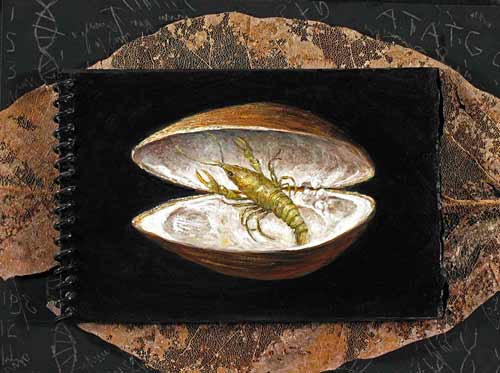
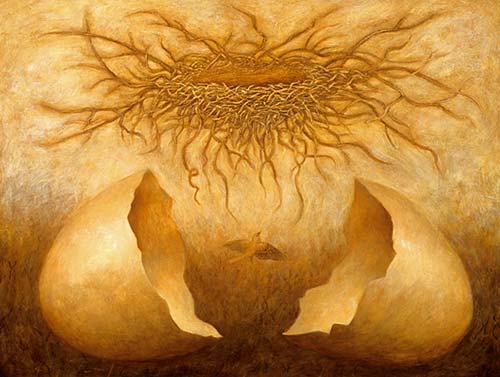
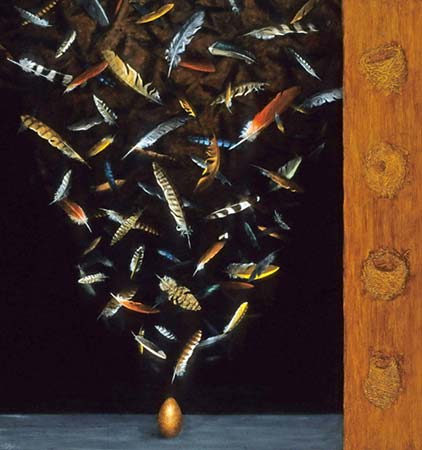
Advent. Private Devotion

MA: Of course. That makes perfect sense–hauntedness as a theme. Why didn’t I think of that?

I’m interested in the ways that authors respond to the work chosen to illustrate their pieces–especially how often they find a personal meaning in the image that I couldn’t have known about when pairing illustration and written word. What did you think of the painting selected to illustrate your piece? Did it have any special meaning for you?

RN: I love it! When I was in graduate school one of my teachers, Chuck Wachtel, told us, “I am an ornithologist but also a bird.” He was reminding us that even though he was our teacher, he was also a writer. When I was teaching I tried to remind myself of that same fact and wrote “Also a bird” on an index card and tacked it above my office desk. Birds continue to feel resonant in my work – using Aesop’s “The Bat, the Beasts and the Birds” to figure out what kind of writer I am, seeing the image of my writing “fluttering” at the margins of my life as a mother, and, in more recent work, thinking about ravens and doves as messengers and birds in general as a source of augury. “Private Devotion” seems the perfect image to accompany “Advent” in particular as well as my writing in general.


MA: Also a bird. I love that. And speaking of what we are and how we define ourselves, in your bio, you use the term “essayist” to describe what you do. I really like that. I think it’s good to be specific. To tell people what you do, and how you want to be known, right up front. It also occurs to me, that in the French sense of the word “essay” (essayer: to try), all writers are essayists, as we are all trying to convey meaning or emotion or time, distance, space, etc, with words. On the best days, this seems like a wonderful, lofty, possible thing. On the worst days, it seems like such folly. I mean, really. Symbols on a page? Who are we kidding? There’s no emotion in hash marks. And yet….we still manage to somehow make this amazing brain transfer every time we write and someone else reads it. Could you talk a little bit about that brain transfer, and also about your decision to go with “essayist” rather than “writer” or “non-fiction” writer, or some other term?

RN: When I was in graduate school a classmate once said that calling yourself a writer was like knighting yourself: you can’t do it; someone else has to do it for you. Publication was the sword on your shoulder, the seat at the round table. Once I was published I felt like I could call myself a writer more comfortably. But becoming a self-proclaimed essayist was a little more complicated.

One of my first published essays got the attention of an agent. She read the manuscript of the collection I had put together, took me to lunch at Nobu, and signed me. I was over the moon! Here it was – the dream come true. But then the dream dissolved. My agent wanted me to rewrite my collection of essays into a memoir and I couldn’t do it. It felt like filleting all the lovely skeletons I had worked so hard to craft and leaving 250 pages of meat and tissue. I said no, and we broke up. For a while I was crushed. But I kept thinking about what I really wanted to write – toyed with the idea of memoir, and of biography – and kept coming back to essays. So I decided to declare it and live it: I am an essayist.


MA: You write a lot about relationships in your work. Past and present love relationships, family relationships, the joys and trials of motherhood. Having written a few personal essays myself, I know that there is often (always?) a small (huge?) frisson of anxiety associated with “putting oneself out there.” How do you push past that and write what you need to write anyway?

RN: I usually write without self-censoring and then see what I have. There are essays I have written and put away. There are essays I’m glad were rejected because now (a few months or years later) I’d rather keep them to myself. (George Saunders once said at a reading that he was grateful for every rejection because it kept him from publishing work that was not his best – what a wonderful way to think about it!) I also have a few trusted readers, including a friend who is about ten years older than I am and very wise; she helps me see obstacles and objections that I might not.


MA: And a related question, how do you balance, as a parent…okay, I’ll say it, I’ll bite, how do you balance as a MOTHER (that sacred title that everyone calls into question when we write honestly about our human lives) knowing that what you share with the world your children will one day grow up and read. They will see what you have written and possibly feel exposed themselves, or embarrassed, or proud, of course, or they will look for pieces of themselves, as my children do, even when it’s fiction–and they’ll find it, too. How do you balance that with your need/desire/commitment to tell the honest truth?

RN: So far I’ve only had to think about this for two years – that’s how old the twins are. Whatever I wrote before they were born, before I had any idea they might be born, well, that ship has sailed and there’s nothing I can do about it. But there’s also nothing I want to do about it. Eventually I want to the twins to see me as a whole person – not just their mother. And part of being a whole person is not knowing how to make eye contact with a stranger you’ve seen naked, or being reluctant to let a love affair go, or being a little cavalier with your life when you’re young. I don’t want to set myself up as a perfect image they feel they have to emulate. I’d rather show at least a little of the seams, the work, and the ache that sometimes comes with living. Maybe it’s naïve to think this way, but sometimes naivety and stubbornness can force a whole new way of living in and looking at the world.


MA: Rereading that last question of mine, those words, “the honest truth,” seem like such a silly choice. Isn’t all truth honest? But maybe not. I can’t bring myself to edit those words, so maybe they are the honest truth themselves. How about the hard truth? The naked truth? Or we could go even farther and say the God’s honest truth? Did you ever notice how many people throw a qualifier at the word truth? Shouldn’t the truth (like the cheese) stand alone? What’s that about?

RN: I love your invocation of the cheese that stands alone! But maybe the truth is like Swiss cheese. There are always holes in it because of our human perceptions. And the holes in Swiss cheese are caused by a certain bacteria that eats the lactic acid and “burps” out carbon dioxide that leaves the holes. Even cheese holes are part of a living biological process – as is the truth.

But I think that truth-telling in essays is essential. I want essays to spin meaningful gold from the straw of real life. Anything else feels like cheating. (Although I will confess that I find myself intrigued by others’ thinking about the truth – David Shield’s Reality Hunger really challenged me, his How Literature Saved My Life knocked my socks off, and Pam Houston’s writing, fiction or non-, completely engages me – in part because she once said that 80% of everything she writes is true.)


MA: Whose work do you read when you want to read the God’s honest truth?

RN: Tolstoy’s Anna Karenina, Cheryl Strayed’s “The Love of My Live,” Terry Tempest Williams’ Refuge and When Women Were Birds, Pam Houston’s Contents May Have Shifted, Paul Crenshaw’s “After the Ice,” William Manchester’s A World Lit Only By Fire.

When I want to see the truth: Life at Home in the Twenty-First Century, the photographs of Diane Arbus, Rembrandt’s late self-portraits.

When I want God in there I might look to Thomas Merton’s journals or The Rule of St. Benedict. Or Rembrandt.


MA: What are you working on now? Do you have a full-length manuscript in the works?

RN: I am currently working on a new collection of essays – trying to find a theme and a shape for it. This conversation has helped a great deal!


MA: And finally, what does “recovery” mean to you?

RN: The first thing that comes to mind is a passage from The Faerie Queen (which I always hear in Alan Rickman’s voice as Colonel Brandon in Sense and Sensibility when he reads to Marianne near the end of the film):

What though the Sea with Waves continual
Do eat the Earth, it is no more at all;
Ne is the Earth the less, or loseth ought:
For whatsoever from one place doth fall,
Is with the Tide unto another brought:
For there is nothing lost, that may be found, if sought.

I think of recovery as the return of something lost. And now I feel like we’ve made a full circle back to “hauntedness.” Maybe recovery is its opposite.


MA: I think you’re right. And what a great place to conclude our discussion. Thanks again, Randon. It’s been delightful talking with you.

Introducing Peter Groesbeck

http://petergroesbeck.com/petergroesbeck.com/Paintings_I/Pages/Paintings_files/Media/006%20copy/006%20copy.jpg?disposition=download

We are thrilled to announce that the painter and photographer Peter Groesbeck will be illustrating our July “Sexuality” issue!

Peter won the Toppan Drawing Prize, the Cecilia Beaux Portrait Prize, and the Cresson Traveling Scholarship at the Pennsylvania Academy of Fine Arts.

He is currently employed by Drexel University and maintains a freelance photography business. His work has been most recently displayed at the Pentimenti Gallery, Philadelphia, and the JMS Gallery in Chestnut Hill, PA

http://petergroesbeck.com/petergroesbeck.com/Paintings_I/Pages/Paintings_files/Media/calico%20rising%202/calico%20rising%202.jpg?disposition=download

His photography has appeared in Darkroom PhotographyCollector’s PhotographyPopular Photography, and has been published in several books, including Graphis Nude and Sensual Photography.


We are delighted and honored to pair Peter’s fine visual art with our wonderful literary work. It’s going to be a marvelous issue!

Interview with Jacob Fons

Jacob Fons

Asha Gupta: What is your background in writing?

Jacob Fons: Well, I don’t have any “formal” training if that’s what you’re asking. I’ve spent most of my life as a singer/songwriter traveling the country, living in parking lots, trying to simply make it day by day, you know all the glorious stuff that comes along with the music industry. I finally gave all that up a few years ago or so and I guess just kind of went into creative limbo for the past two years. When the creative voices began talking to me again, I knew I had to do something so I began telling stories on paper instead of through music.


AG: Your SOS piece, Sushi at Midnight, introduces an interesting perspective, where did the inspiration for that piece come from?

JF: I guess I wanted to take the simplest emotion, place it in the most extreme circumstance, and see where it led me. You know what’s kind of funny, when I began pitching this piece to publications, editors told me it wasn’t right for their magazine (which I expected), or, I got a handful of editors upset with me for writing this piece, or should I say, “not finishing this piece” as they said. I kid you not; I got long emails, which I still have from truly upset editors who told me that Sushi at Midnight was not finished. They were also kind enough to tell me how to finish it. I had to laugh. They thought it had no meat to it, it should have gone deeper, into Jeremiahs story, why he was in prison, where was his wife, the relationship between the priest and Jeremiah, you know that kind of stuff.


AG: Talk about Jeremiah, who is he to you?

JF: I think Jeremiah is much more of an emotion, than he is a person. I believe with Flash-fiction, at least for me, my job is to simply illustrate an emotion. I try to express the feeling on your drive to work on a Monday morning, how you’re feeling before a first date or an inmate’s last meal. I put myself there as best I can, and put it on paper.

Sushi at Midnight.WorldEnough

AG: Is most of your work Flash-fiction?

No not everything. I seem to go through phases with my writing, between short stories, and flash-fiction. I think I have about an even number of published short stories as I do published flash-fiction. I guess it matters which day you catch me on.


AG: Where can readers find some of your other works?

JF: You can find a link to all my stories on my LinkedIn page


AG: Can you talk about any other projects that you’re currently working on?

Well I’m working on a book of short stories called Stories from 32nd Street. It’s mostly fictional pieces, but there are a few creative non-fictional stories as well. It’s where I grew up, on 32 nd street, in the inner city of Milwaukee, so I have a lot of experiences to choose from. I have stories ranging from getting in trouble with the law as a teenager, to drug addiction, to block parties, to swimming in flooded sewage rivers. There was never a dull moment. I’m talking with a few publishers.

An Interview with Lori A. May

 lori-a-may
Dawn Leas: Your poem, Tuesday a.m., has a definitive feel, an economy of words that is beautiful and telling. Can you describe the genesis of it?

Lori A. May: I was working on a small series of poems that was observational, I guess you could say, in that I spent some time thinking about ‘the other’ in a voyeuristic sort of way. This led to thinking about how we fill personal voids, how we cope with disappointments or emotional injuries.

Retail therapy is a tactic passed down to me from my mother, sure, but it’s also a familiar one; and while men use this form of coping mechanism, too, I’ve noticed this poem touches a nerve with women, in particular, when I read it in front of an audience. There’s something about making a purchase that gives control to the buyer, even if it’s an emotional and spontaneous experience that results in regret or buyer’s remorse. There is, after all, only so much that money can buy. All of these thoughts combined informed this poem and, in turn, my upcoming collection, Square Feet, which zeros in on the emotional and psychological spaces in a challenging domestic space.


DL: You write in multiple genres—fiction, poetry, non-fiction—in what ways does your work in each speak to and influence one another?

LAM: On a good day, my appreciation of poetry—the use of language, image, and sound—influences my prose. My drafts are always very loose, but when I go in to finesse and revise I do like to consider syntax and form in my literary prose. I enjoy playing with language and subtext, particularly in creative nonfiction. For poetry, I most often tell a story and so characterization and setting feeds my verse. When working on a collection of poems, those elements of prose work toward creating a narrative arc, too, where each poem leads to another turning point or chapter, if you will.


DL: You travel, a lot. Will you discuss how a few themes that you have found on highways or in airspace have made their way into your work?

LAM: I do travel quite a bit. I’m usually on the road about 30,000 miles per year, not including flights, which means I get to experience all kinds of places and all kinds of people. I really do enjoy people-watching and I’m always asking questions, which has naturally led to some creative prompts. While on the road, I’ll draft a poem about a scenario I come across—whether it’s in a restaurant, along the shore, or driving through a ghost town, for example. More often, my travel results in essays.

Right now, I’m working on the final round of editing for a book-length collection of linked, mostly lyric essays. I’m a bit of a newcomer to the US and my immigration experience combines well with my curiosity of American towns, exploring the country, and getting to know the people and landscape of my new home. My collection, American Drive, parallels my personal experiences with those I observe from around the country, and I hope readers will discover little known facts and curiosities through my exploration and exposition.


DL: Are there certain topics that you know you must write as poetry? Some that must be in essay form? Fiction? What factors lead to your decision?

LAM: Poems, for me, often stem from a seed of an idea, usually from an image that comes to mind. I’ll be doing some mundane task, like the dishes or laundry, and an abstract image will reveal itself to me, perhaps in a tiny little phrase that piques my curiosity. That’s the beauty of mundane tasks; I think there’s a state of mindfulness in completing chores around the house that lets the creative mind work while our hands perform tactile busywork. When those phrases or /images come to mind, I’ll usually turn to verse, but if the questions linger, and if the idea turns into another idea, then another, I probably have the beginnings of an essay on my hands.

I’d say most of my projects stem from some organic discovery, rather than an intentional direction to write a story, essay, or poem. My fictional ideas often come while behind the wheel, when I’m stuck in the car and on the road for a few hours, when my mind can play with what-ifs and possibilities. I have one piece of short fiction, in particular, that was basically written in my mind during a two-hour drive home. It’s still one of my favorite short stories as it’s so woven with poetic devices—allegory, alliteration, figurative language, symbolism, and rhythm—and I have no idea where it came from, apart from listening to my mind wander while in the car.


DL: You wear many hats as a self-employed person—writer, editor, reviewer, social media maven, marketer—how do you balance time for each?

LAM: I long ago gave up the idea that multi-tasking works for me. Yes, I am often working on multiple projects, but I have come to understand that in order for any of them to be completed with some dignity—let alone enjoyment—I need to focus on one thing at a time. It’s easy to get carried away with to-dos, but my brain needs quiet time and balance more than anything else. I think, and hope, that we’re gradually recognizing the madness in the glorification of busy, and giving some thought to what that really means to us as individuals, and as a society.

Although I am self-employed and thus have to manage multiple projects, I don’t like feeling overwhelmed. So, I break my day into workable sections to channel my focus and give each task its own schedule. In the mornings (and after naps) I use that time to create new work, as that’s when my mind is the most fresh and free of other demands. I tend to external assignments—editing, revising, reviewing, and marketing—in the afternoon. More and more, though, I am cutting myself off earlier in the day. I used to work until 8 or 9pm and then have only a few hours to relax, but I want to enjoy what I do and also feel like my life exists away from my desk. Writing is so much a part of me, but it’s not everything. I enjoy travel and food and watching movies with my spouse. I love our walks around the neighborhood and catching up on good books. That’s living. That’s balance for me. Creating a low-stress environment, particularly when working from home, is important and within my power. And, when I’m free to unwind and recharge, I’ll be that much better for it the next day at my writing desk.


Dawn Leas‘s chapbook, I Know When to Keep Quiet, was released in 2010 by Finishing Line Press. She earned an M.F.A. in Creative Writing from Wilkes University. Her work has appeared in goldwakepress.org, Literary Mama, Willows Wept Review, Southern Women’s Review, Interstice and elsewhere. In past lives she was a copywriter, freelancer, admissions director and middle-school English teacher. Currently, she is the associate director of the Wilkes University M.A./M.F.A. Creative Writing programs and a contributing editor at Poets’ Quarterly. For more information, please visit www.dawnleas.com.

Interview with Len Joy

Len Joy

Andrew Stancek: Len, your essay “Jury Duty” in the current issue of r.kv.r.y immediately gripped me. I admire your fiction but this was my first opportunity to admire your non-fiction as well. I love the tone, the vivid characterization, the narrative drive. As a fiction writer I see events unfolding around me as prompts for fiction. Why did you decide to fashion an essay out of this material, rather than a story? For me the atmosphere is crackling with writing prompts, each calling out for a treatment, and my role is that of a shaper. How do you approach writing and what do you see your role to be?

Len Joy: The piece that ended up being “Jury Duty” I originally wrote with the idea I would use it in my blog, Do Not Go Gentle… .I started the blog just before I turned sixty, to chronicle the challenges of trying to become a writer and an age-group competitive triathlete at what I guess could be called an advanced age. Or old. Not young anyway.

I try to keep the blog pieces short (under 300 words) and this story ended up being much longer so I decided to find a more appropriate home for it. I was thrilled to have it published in r.kv.r.y. (although I still struggle to spell it correctly).

For fifteen years my brother-in-law and I owned and operated an engine remanufacturing
company with factories in Arizona and Missouri. We wound the business down in 2004 and that was when I took my first writing course. The company was not a huge financial success – it was a struggle from beginning to end – but it has provided a wealth of writing material.

The first short stories I attempted to write were just fictionalized accounts of things that we
experienced in that business. They were not good stories, because, as I eventually learned, life isn’t a novel. It’s messier and it often doesn’t come to a nice neat ending. Oh. And too much happens in real life, some of it not that interesting.

It took me awhile to grasp that writing fiction meant I could cut out characters and scenes and rearrange stuff and just make up a lot of shit. It was very liberating. In my novel, “American Jukebox,” which will be published this year (yay!), I have several chapters that take place in a factory. I’ve drawn on my work experiences to make that experience feel authentic. (I hope).

I like writing both fiction and non-fiction. If I were, say, forty, or younger, I would have a
different approach. I think I might try to write more non-fiction – I see a lot of interesting stuff related to triathlon competitions and the people who are pursuing those events. But I have to be realistic – I started writing late in life and I probably won’t live forever, so my plan is to focus on fiction.


Andrew Stancek: This certainly resonates with me. Sixty is close to the horizon for me and I, too, have started writing late and recently, reluctantly, I have begun to realize I probably won’t live forever and I’d better prioritize. (Laughs.)

Let me briefly continue to pursue this idea of artistic genesis. I am forever fascinated by how and why a writer chooses to write a particular piece. I return time and time again to Faulkner, who famously said that The Sound and the Fury began for him as an image of Caddy’s muddy drawers seen from below as she clambers up the tree outside the Compson house in order to see what is happening. Can you speak generally about the origins of some of your short stories and of this particular essay? Is it an image that begins the process for you, a character, a line of dialog imagined or overheard, a theme….?

Len Joy: I think that usually the initial inspiration for a story will be some scene or event I
witness or imagine. For instance, I wrote a story a few years back called, “My Father’s Ice,” which was inspired by a trip I made to the Whitney Museum with my wife. We toured an exhibit of a somewhat obscure performance artist of the 1970s named Gordon Matta-Clark.

As is usual when we go to museums, I finished the walk-through in about a half hour and my wife took well over an hour. While I was waiting for her, I imagined a story about someone who might have left school to go to work with this artist. And then I thought, what if his daughter discovered him 30 years later, captured on one of the videos that were part of the exhibit. So for that story I had an interesting experience/event and then I created a character. I can’t go anywhere with a story until I have a character. For me the stories are always about the people.

In the “Jury Duty” essay, I noticed a young woman who was having difficulty dealing with the coffee machine in the juror’s waiting room. Later I encountered her in the cafeteria where she didn’t have enough money for the food she had purchased. And then in the afternoon, when we went to jury selection she was unable to answer the basic questions the judge asked her about her previous experience. At the end of the day, she was selected for the jury and I was sent home.

The novel I have been writing for the last four years was originally inspired when I was driving back from the Iowa Writers Festival at the University of Iowa. I was headed to Chicago and there was a huge traffic jam in the opposite direction for those cars headed toward Iowa. I passed miles and miles of cars going nowhere. A few minutes after I had driven beyond the traffic jam I saw a guy in a convertible racing along, not a care in the world. He didn’t know that in a few minutes he was going to be stuck in that traffic jam for the next several hours.

The name Clayton Stonemason just popped into my head. I decided he was sort of a screw-up and that he was headed to the wedding of his niece. And he was supposed to give a toast. I wrote a short story from that scene and from that story I ended up writing the novel. As it turns out the whole novel takes place years before this incident and so that story is not even in the novel. But it got me started. From that one traffic jam I created a whole fictional world.


Andrew Stancek: I have had the good fortune to study writing with a number of wonderful teachers and hope to study with a great many more. Have you taken workshops or courses with teachers you’d recommend? In an ideal world, if you could study with anyone in the world, who would it be? Are there writers who have influenced you?

Len Joy I think one of the areas where athletic pursuits like triathlons have some similarities to the writing profession is in the area of training. Even if you have an abundance of natural athletic talent it is difficult to become proficient at something like swimming without training.

Because I didn’t come to the writing field until later in life, I decided it wouldn’t be a
particularly good use of my time or money to pursue an MFA. However I knew that if I wanted to improve I would need some kind of professional training.

I took a sequence of writing courses at the University of Chicago’s Graham School. The
introductory courses with Barbara Croft (“Moon’s Crossing) and Eileen Favorite (“The
Heroines”) were excellent. Both writers provided me with a solid base in the fundamentals while offering reasonable encouragement. I took a sequence of novel writing courses there which were taught by Patrick Somerville (“The Cradle,” “The Bright River”). He was an excellent teacher, very generous with his time and his advice was always practical. He was a compassionate critiquer, but didn’t hesitate to point out when something didn’t work.

In addition to the Graham School, I have tried to go to a summer workshop program every
year, which I look at as summer camp for adults. For several summers I attended the Iowa
Writers Festival in Iowa City. I thoroughly enjoyed the wide variety of craft-based workshops they offered. The first instructor I had there was Sands Hall, (“Catching Heaven”). She too, stressed fundamentals such as point of view, when to show and when to tell, and probably most important, making sure that your story maintains a “sense of place.” Don’t let the reader get lost.

In our one on one conference when I expressed some concern that my writing seemed sort of thin (what I meant to say was that it didn’t seem very “writerly”), Sands assured me that my voice and writing style were fine and that I should check out Raymond Carver. I thought she meant Raymond Chandler, but once I got on board I read everything he wrote and that probably has been an important influence on me.

Because of Sands Hall, I attended Squaw Valley for two years (her family runs that workshop). That was also a great experience in a beautiful location and because in their workshop, the leaders rotate every day, I got to meet agents, editors and publishers, as well as writers. That experienced really helped me to better see the breadth of the publishing industry.

Three years ago I went to the New York State Summer Institute at Skidmore. My workshop
leader was Joe O’Neill (“Netherland”). He shared with us some of the techniques he used for shaping his novel through the revision process. He would go through text with colored markers identifying certain themes. Then with that visual aid he would rewrite to emphasize or de-emphasize important themes and symbols.

A couple years ago I made it into Sewanee. I wasn’t sure if I would like the caste system where half the workshop is Fellows or some other grand poobah designation and the rest of us are just plebes. But in reality that was not an issue. I was very impressed by the skill level of the attendees – many of the writers in my workshop had already published novels and collections.

My workshop was run by John Casey and Christine Schutt. They made a great team and both of them are older than me, which was a nice change of pace. They had a great sense of perspective and humor, which is helpful because some of those poobahs can be pretty harsh in their critiques. It gave me an inkling of what an MFA program would be like and it reaffirmed for me the wisdom of not going in that direction.

I recently had a chance to read a Ray Carver story in its original draft and then the version that was marked up by Gordon Lish. It was, of course, Lish’s edited version which was ultimately published. I thought Lish’s editing was brilliant. And it was so educational to see all the words that weren’t needed to tell the story. I guess I am sort of a minimalist (notwithstanding these long-winded answers) and that editing skill impressed me.

So if I could study with anyone in the world it would be Gordon Lish.

As for writers who influence me, when I grow up I want to be Elmore Leonard. That might be because I’m a huge fan of the TV series “Justified,” which was inspired by Leonard’s novella, “Fire in the Hole.”


Andrew Stancek Len, I am fascinated by your reaction to the Lish editing of Carver, and then your admiration of Leonard. Lish’s editing has received a fair bit of criticism recently and there are those who feel he was much too intrusive and frequently just wrong in his editing. But of course it is his versions of Carver which we know and love. And one of the hallmarks of Elmore Leonard, whom I also admire enormously, is his spare style. So let’s bring this more directly to you, your style, your hopes and ambitions. Where do you hope to be in your writing in five, ten, twenty, pick a number years? Do you see yourself as a short story writer with stories in the New Yorker and Ploughshares and Tin House? A literary novelist? A popular bestselling novelist? A genre writer? What do you hope for?

Len Joy With respect to Carver and Lish, I guess what fascinated me was the opportunity to see the before and after texts. It is a great example – at least it was for me – as to how fewer words – can make something more powerful. I welcome editing. It is so easy to get stuck and not see that there might be a better path to the finish line.

I hope I am still writing in twenty years. The direction my writing “career” takes will depend on what happens with my novel. If the book achieves some measure of success (critical acceptance and/or decent sales) then I will most likely finish the sequel. I already I have a “draft” completed (I cut the timeframe of the original novel from 50 years to 20 years so I have all that excess material I can use). I enjoy the world I’ve created and it has a lot of potential so that’s a likely possibility. I also enjoy writing flash fiction and short stories. I will continue to work on both of those while also working on a novel (whether it is a sequel or something new). Most of all, I want to continue to improve as a writer and I really want to be read.

It would be nice to have readers willing to pay to read my stuff as that would be a tangible
measure of success. Plus, I like money. I don’t anticipate or count on huge financial rewards, but I could handle it, if it happened. I think my stories are commercially viable, so you never know.

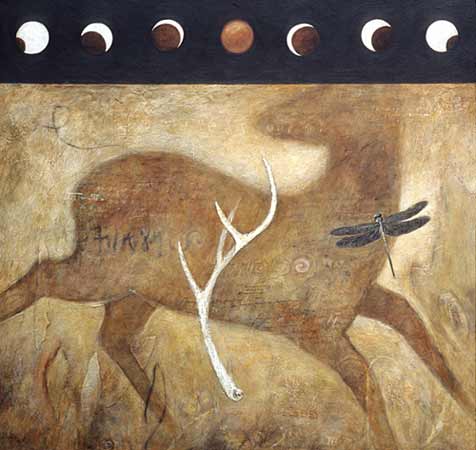
Jury Duty Eclipse 1998

Andrew Stancek: Can you comment on the illustration that appeared with your essay?

Len Joy: I really like the idea of having artwork “introduce” the story. And all of the artwork
provided by Suzanne Stryk for this issue of r.kv.r.y is very compelling. I think that the visual
aspect of reading is often overlooked by prose writers. Clearly, poems have a visual aspect – with stanzas and line breaks – but so does prose. I definitely have a different mindset when I am reading a page that is wall-to-wall words than when I’m reading a page with lots of white space.

Similarly, when I walk into a book store, I am immediately influenced by bookcovers. Even
if there is no picture or scene on the cover, the typeface, the color the font, all effect my initial attitude and/or expectation for the book.

With the stories in r.kv.r.y the artwork is the “cover.” There may not be a clear connection
apparent between the artwork and the story, but the art still influences how the reader approaches the story.

I really like the painting, “Eclipse,” which accompanies “Jury Duty.” I sense flight. Fear and
some sort of a controlled chaos. The disembodied antlers are enigmatic and intriguing. I think the emotions stirred by “Eclipse” are appropriate as an inducement and as a frame for someone who is about to read the essay.


Andrew Stancek: What does “recovery” mean to you? Are you recovered?

Len Joy: I am glad this question was asked and that I took some time to think about it. To me recovery means not giving up. It’s hard not to respond with clichés but I see it as staying in the ring after you get knocked down. Or maybe to stretch the metaphor, finding a new game to play.

As I mentioned earlier, for over fifteen years my brother-in-law and I operated an engine
remanufacturing company. It was a monumental challenge for someone who hadn’t grown up in that business, but I was convinced we would ultimately prevail. We did not. A lot of companies failed and, ultimately, we were one of them.

When I exited the business in 2004 I was financially strapped and had to deal with the realization that I was in some sense a failure. I decided that experience would only be the defining moment of my life if I allowed it to be. If I didn’t keep going. If I didn’t write another chapter.

I almost immediately developed another business opportunity and I pursued a writing career. The business I developed allowed me to restore my retirement plan and helped heal my bruised ego. But writing – producing something I was proud of that was good enough that other people would actually read it and enjoy it – that restored my spirit.

I’ve really enjoyed this interview. It’s made me think about what I’m doing. Sometimes we all get caught up in the process, so it’s nice to stop for a moment and reflect. Thank you, Andrew and Mary for the opportunity.

Interview with Kirie Pedersen

kirie pederson

T.L. Sherwood: Kirie, in your story, Sex for Groceries, the narrator migrates from the East Coast to return to her dying parents in Portland while the introduction references how hatchlings are left alone during storms. I loved that juxtaposition. Did the quote from the National Audubon Society Field Guide to North American Birds prompt you to write this story, or did you come across it afterwards?

Kirie Pedersen: A few years ago, I decided to learn, or re-learn in some cases, the natural history of the Pacific Northwest. Every day, I read a page of Daniel Mathew’s Cascade-Olympic Natural History, and one bird from the National Audubon Society Field Guide to North American Birds. Then I’d set off into the wilderness to see if I’d learned anything, or could learn something more. I was captured by the poetry of the descriptions. As I finished the final draft of “Sex for Groceries,” the description of the Black Swift (Cypseloides niger) came back to me. Don’t you think it sums it all up?


TLS: I do–and very well. I’ve noticed this in my own life, but I want to ask you why you think siblings can come together at the death of a parent and seemingly forgive past harms, but are quick to return to their resentments and pettiness after the interment.

KP: Did that happen for you?


TLS: Yes, and to many people I’ve met. I think the only person I know who didn’t have something similar happen to them was an only child.

I keep hearing that story or experience. For me, the “coming together” was a brief illusion. My fantasy was “after a courageous battle, she died surrounded by family and friends,” and everyone joins hands and sings Amazing Grace. I had /images of the family gathering, telling jokes and sharing fond memories as we went through our parent’s home.

When I was five or six, the phone rang very early one morning. My parents were still in bed, so I picked it up. It was Dan, one of my father’s friends, demanding to speak with my father, who refused to come to the phone. “Tell him Jack is dead,” Dan said, and hung up. I knocked on my parent’s bedroom door. “Jack’s dead.” And shockingly, for a few days, maybe even a week, my father became kind. Tender. It happened again when another close friend died. So even then, I guess I knew that death could render even the hardest man temporarily tender.

Kirie Pederson.FactsofLife

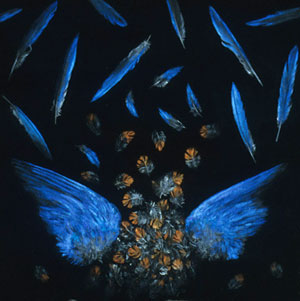
TLS: What did you think of Suzanne Stryk’s “Facts of Life” when you saw it was chosen as the illustration for your story?” 

KP: I love the blue feathers. It reminds me of a design by Lise Solvang, the Norwegian fabric artist whose designs are based on mythical creatures. It also reminds me of another story I recently finished, “Hawk Strike, with Feathers,” about how some accipiters can strike prey at over a hundred miles per hour. This is, indeed, a “fact of life.”


TLS: What–or who–inspires you to write?

KP: I love the physical feeling of writing. I love writing with freshly-sharpened  Palamino Blackwing pencils. I love writing with fountain pens. I sort of love to type, though I can’t quite associate that with story. Sometimes, although I’m pretty shy socially, I like telling stories aloud in some formal venue, every eye and face in a group gazing back into my eyes, faces and bodies open and expressive.  Even before I could write, I drew what I called picture stories, endless frames of girls with horses, usually. And before I could draw, I told dream stories. “That little voice talks  to me, Mother, and gives me the dream.” Or so it says in my baby book.


TLS: What is your biggest doubt? And if you could give your sixth-grade self a piece of advice, what would it be?

KP: One “biggest doubt” is too abstract a concept for me. I awaken filled with doubt, and gradually find my way into the day through tangible, physical activity, what I can see or hear or smell or taste or sense.

My sixth-grade self was pretty squished. Once during a session of neurolinguistic programming, the therapists had me meet that self, and I saw her sitting on a chair, frozen. “She’s dead,” I cried, and was so convulsed they brought me out of the session and asked if I wanted to be held.

That little girl hadn’t yet discovered alcohol or drugs or boys or any way to quell her pain. Not that any of that does much for pain. Not for long.

Which is to say I have gradually coaxed that sixth grade self out of hiding. I talk to her and other squished selves of childhood. I ask how she’s doing. What does she need today? Does she trust this person or that? Does she like this story? Is this story helping her?

To start with, the main piece of advice was that it was okay to stay alive. When I was about that age, there was a story in the newspaper about a ten-year old, eldest of five siblings. She heard her parents fret and fight about being poor, about not having enough money. She took her brothers and sisters by the hand and they walked in front of a train. I understood that girl then, and I understand her now. I promise daily to care for her, and I do.


TLS: Kirie, I just want to say it has been a pleasure to talk with you. Thank you so much for your time and insightful answers.

An Interview with Michael Sarnowski

Michael Sarnowski

Carrie Causey:  In your poem, “A Sudden Tilt of the Head,” your speaker inevitably must “explore connections at the synapse/ that abstract the direct/ blur…” Could you describe your writing process a bit? Specifically, how do you take advantage of and navigate that moment when the muse visits? 

Michael Sarnowski: My poems tend to begin in a position of not knowing. I’ll often start with a single image, phrase, or conflict, and then build until unforeseen turns provide a sense of direction. There’s usually a secondary conflict that is revealed, and the complexion created with this minefield approach is what I find intriguing. “A Sudden Tilt of the Head” pivots around the idea of reading into a situation, and the tendency to magnify or memorialize events in our lives. By interrogating this instinct alongside an inherently dramatic image, there are competing interests in the poem. How the poem is interpreted from there is out of my hands, which is usually for the better.

Once a draft is relatively complete, revision is a crucial part of the process. The decision to make “A Sudden Tilt of the Head” one sentence (an atypical choice for me) and to focus on a single moment in time directed the revision towards brevity, concision.


CC: Is there a question about the world that overarches your work? What historical, social, or personal question do you seem to respond to or follow the most?

MS: I have an irrepressible desire to better understand the world. I wouldn’t say there’s a specific question I’m attempting to answer, nor do I think I can resolve the unknowns that intrigue me, but rather I hope to more clearly understand individual circumstances.

I’ve always found small scale interaction to be much more meaningful, and similarly, each poem is an opportunity to explore how a concept impacts the individual. If the individual experience is dealt with honestly it will become universal.

M. Sarnowski. LivesoftheBirds

CC: You are a musician as well as a poet. Do you find that your style of music parallels your style of writing in any way?

MS: I don’t think I’ve ever viewed the two mediums in the same light, but now that you bring
it up, to some degree they have mirrored one another over time. Through my teens and early twenties both my writing and music veered towards the brash, dense, and loud. In recent years, there’s been a shift towards simplifying and trying to make impactful moments through more relatable, even domestic, scenes. Instead of veiling an idea in ambiguity or complexity, my poems are now more likely to occur in grocery stores, the doctor’s office, or in the case of “A Sudden Tilt of the Head,” at the bedside.


CC: Where do you go for inspiration when you need it? What writers or activities can you rely on to renew your creative process?

MS: Seemingly, the most common sources of inspiration, or at least the prompts that tend to be most fruitful, tend to come from research, travel, or a moment that forces me to reevaluate who I think I am or some facet of human interaction. I suppose the relationship between those sources is that they allow me to step outside of myself or my comfort zone, ask questions, and perhaps most importantly, listen. I’ve always been quiet, and though that presents its own complications, I think listening, observing, and trying to understand the worldview of others is far more important than being the loudest in an attempt to get my point across.

So as not to ramble on catalysts for creativity, I’ll limit myself to five active examples. I’ve
really gravitated towards the poets B.H. Fairchild and Kim Addonizio, the fiction writer Alan
Heathcock, the films of Jeff Nichols (Take Shelter, Shotgun Stories), and Mad Men. There is an addictive honesty to each of these, and in most of them, that which goes unsaid only amplifies the conflicts rumbling in the undercurrent.


CC: How has your writing evolved since finishing the MFA program at Vanderbilt? Any advice for beginning writers in the process of evolving/ honing their craft?

MS: My time in Vanderbilt’s MFA program was fantastic because there was community of
great student writers and faculty like Mark Jarman and Rick Hilles who helped shape my work towards clarity and purpose. I’d like to imagine that that trajectory has continued, but with a wider range of subject matter that comes with each passing year.

For beginning writers: read, write, become proficient in dealing with rejection letters, then keep reading and writing. The world isn’t going to run out of beauty or confusion.


CC: What projects are you working on now?

MS: My top priority is to keep writing poetry while I find a home for my first full-length
collection, which has the working title A Map to the Catacombs. The manuscript is complete, but will continually be revised until a deadline tells me it’s done. Developing more gradually is a collection of short stories, a collection of tour journals, and some critical work on literature of trauma and displacement.


Carrie Causey is the author of the chapbook, Ear to the Wall, newly released from Ampersand Books. She has appeared in Plume, Ploughshares, and Sycamore Review and was named First Runner-Up for the 2011 Wabash Prize for Poetry. She is a native of Baton Rouge, Louisiana, where she teaches Literature, Composition, and Humanities at Baton Rouge Community College. Currently, she is working on a full-length collection.

A Crowdsource Interview with Stacy Lawson

Stacy Lawson

For this interview, I turned to my friends from my writing class and groups whom I have been working with for over 10 years.  They are the ones who have helped me become the writer that I am.  It should be noted that Priscilla Long could easily have kicked me out of class that first quarter when she discovered that I could not write a sentence much less a cogent paragraph.  But, she was kind and pushed me hard.  


1.  How did you arrive at the form for this essay?  Did you use it on your first try?  What’s it good for?  Have you used it for any other pieces?  Are there disadvantages to this form?  (Questions from Priscilla Long, author of the Writer’s Portable Mentor and many many other works including Genome Tomb, her prize winning essay, and her fantastic column in the American Scholar, Science Frictions)

My writing teacher, you, Priscilla Long, have pushed the issue of finding a form that matches the content of what we are working with.  In my many attempts to write on serious topics like depression, marriage, environmental destruction, food production, and the slow death of modern (non-orthodox) Judaism, I have not wanted to write a straight essay, one that would push information in one direction, from me to my audience.  Instead, I want to engage the reader and hope that he or she will be motivated to take my work in their own direction.

My natural style is the collage or title/theme because it allows me to weave the threads of the personal with the larger world, trivia, science, the present time and place, my culture, the facts as I know them now, and so on.  I am an associative thinker.  If you want a straight answer from me, ask a yes or no question.

I want the reader to have time to ponder my words and his/her personal experience.  So, I find that the titled-theme structure helps to open up a topic and organize disparate threads.


2.  Is “hiding” a theme you have explored before? Do you see any connection between writing and recovery? What pushes you to write your words?  (Questions from Geri Gale author of some of the most sublime poetry and prose that I’ve ever read.)

Hiding is not usually something that I am interested in.  Hiding is passive and I am pathologically active as are many Jews regardless of the generation.  Hiding makes me think of Anne Frank and the numerous atrocities committed by hideously damaged and insecure people who take power and use it against those whom they believe have no voice or power to object.

I started losing friends when I was in my late 20’s due to bad luck and odd circumstances.  But, when I lost my friend Patti to breast cancer as I was nursing my second son, I became intensely aware of how much breast cancer was out there.

I should also admit that I started writing the piece under the title, Waiting for Breast Cancer.  But, the traditional Jew in me became frightened that this might call cancer fourth.  Also, I didn’t want to offend anyone.

I am very interested in making the invisible, visible.


3.  Are you interested in health issues? Are you writing about other women’s health concerns? Is there an overriding thread throughout your work?  (Questions from Susan Knox author of Financial Basics and many terrific essays and stories which often speak softly and, yet, make a huge impression.)

I am interested in health issues and afraid of them.  As a Jew, there’s always the risk of becoming preoccupied with health and medicine.  (My grandfather punished my father financially for not going to med. school.)

I am also interested in the discussion of healthcare, healthcare reform, how many dollars go into promoting wellness instead of curing illness.  How we dole out healthcare?  And, what in the long run is the most compassionate and strategic approach to healthcare and the growth of health sciences for the future.

Hiding from Breast Cancer. Little Wing


4.  As a writer, how do you get from a place of hiding from something difficult to exploring it so thoroughly?  (Question from Linda Breneman author of many many fabulous essays, stories, and new forms of work.)

Hiding in my piece is meant to be ironic.  I generally dislike secrets and hiding.  I think hiding is a kids’ game.  Have you ever seen a toddler cover her eyes to play peek-a-boo?  The game is if she can’t see you, you can’t see her.

For the most part, I believe that knowing is always better than fearing or guessing.  Once I know something, I can act.  Sometimes ‘the act’ is just accepting something and then deciding if there’s anything to be done.

When I was studying Patanjali’s Yoga Sutras, an ancient yoga text, my teacher pointed out that sometimes knowing something can scare the shit out of us and take us way off path.  Not-knowing can keep us from going into the fear-reaction loop.  She cited the case of someone who saw something and misunderstood what it was and prevented panic in the moment.  It was a snake and not a rope.

In the end, I fall on the side of wanting ‘to know’, and I try to manage my reactions.


5.  How does this essay fit into your collected works? Is there an overarching theme guiding you? How are you guided in your work? Yoga? Meditation? How did you become so fearless in your approach to this material? How much Vitamin D do you take? (Questions from Janet Yoder, author of many works that touch the deep parts of us.)

I take 1000 IU of D3 a day, which is the recommended dose.  My first real job was at Fred Huchinson Cancer Research Center working on the 13th International Cancer Congress.  As a high school student, I visited kids undergoing cancer treatment and/or kids whose parents or siblings were in treatment. My sister Terrie was an early bone marrow transplant nurses at the Hutch.  I grew into the material.  I saw kids lose their parents, parents lose their children, siblings lose siblings, husbands and wives lose each other.  As a result, I got ‘real’ very quickly.  I am a doer, so my response to fear is to do.

I have practiced yoga since I was in my mid-twenties.  I got into yoga before it was the ‘it’ thing.  I had teachers who were spiritual seekers and others who came to the practice due to injury. Meditation followed shortly after, but I admit to falling off the cushion regularly and for long periods of time.  My practices have given me the ability to sit and think and muse for long periods of time.  I crave clarity.

My overarching theme is what makes us real.  What motivates us to show up in the world?  What motivates us to seek truth?  What motivates us to do the work at hand?  I want to say clearly that I don’t look to suffer, I look to have fun.  My sense of humor is my main tool.  I am married to a very funny man, and my kids have great senses of humor.


6. What in your personal and family history/ heritage informs your writing? (Question by Wilhemina Condon author of the truly great Walnut & Vine in the current issue of North Dakota Quarterly.)

Hmmmm–Everything I do is influenced by my family and my Jewish heritage/religion/culture/pathology/creativity…  While I don’t consider myself to be a religious Jew, I am submerged in the ritual and culture.  I meditate and practice yoga more than I pray.  

Many of my characters are Jewish or are married to Jews or are the children of Jews. Many of my characters try to run away from Judaism only to find that it sticks like gum on the bottom of a shoe.  

I think writing is one of the key places that I try and work out my Jewish identity in a world that is increasingly more assimilated unless you are an orthodox Jew, which I haven’t been for a very long time.

Interview with Leah Kaminsky

Leah Kaminsky

Paul Zakrzewski: Your story Keep Smiling Mary K is a conversation, but one in the form of an internal dialogue between the narrator and a fitness instructor she sees on the TV. Meanwhile, her husband is absent, and the narrator may or may not have once spotted the fitness instructor in a Lebanese Café. But no conversation ensued. Can you say why your narrator seems so isolated?

Leah Kaminsky: I am interested in the idea of immigration being a sort of mini-death, a giving up of the self, of all that is known and comfortable and safe. The narrator is an ex-pat, who has transposed herself not only geographically and culturally, but has also left the sanctuary of a peaceful country and entered into a war-zone. In Australia she would have been free to be friends with Mary K from Lebanon, but now, she can only connect with her through the fitness instructor on the TV screen. She knows there is a like-minded woman across the border, a mother of children, in a hostile country, who she will never meet.


PZ: r.kv.r.y. is a journal dedicated to stories on the theme of recovery. Ostensibly, your narrator wants to “recover” her pre-pregnancy body…but clearly her heart’s not in it. To your mind, what’s the real thing she can’t or doesn’t want to recover from?

LK: She can’t recover from loss. The loss of security, self, home. She has crossed into the territory not only of war, but of marriage, immigration, motherhood – and she has never before had so much to lose. She has changed intrinsically because of all these experiences and can’t recover her innocence or naivete. So, the loss of weight, recovering who she was, is almost impossible now, as it is perhaps for those traumatized by war to recover from such a heavy burden of their collective past.


PZ: Leah, I’ve had the great pleasure both of reading a draft of your nearly completed novel, about a terrible day in the life of a physician in Israel. I’ve also heard you speak in public about “pain in literature.” In Keep Smiling Mary K, the voice of a TV aerobics instructor wants to be helping viewers. What is it about the uses (or abuses) of health professionals that interests you?

LK: Health professionals, like the fitness instructor in this story, can be proscriptive and reductionist in their approach to illness and well being. If you don’t listen to the narratives behind a patient’s concerns, you cannot hope to empathize or help in any meaningful way. You risk coming into the consultation with a preformed idea of how to conduct the interview and have the patent’s symptoms fit into a certain pro-forma.

Language is the first thing to be lost when it comes to pain and often you need to look for non-verbal clues. This is equally important when it comes to helping a patient express physical or emotional pain. Literature often uses fresh metaphors and narrative to help give voice and expression to pain. The truth is often in the subtext of what’s being said inside the consultation room.

Keep Smiling Mary K (Still Life with Anole)

PZ: Can you talk to me about how this particular story evolved for you? Was it always a “short” short story?

LK: Yes. It fell out onto the page just like this when I was living in Haifa, not long after the Gulf War. I had just moved there and was nursing my first child while watching TV. At the time the best shows were broadcast from Cyprus and I stumbled across a show called ‘Christian Aerobics’ – the idea for the story was born.


PZ: When I read your last line I thought of all those wonderful last lines I love in literature. The tricky switch of the pronouns in the last line of Virginia Woolf’s Death of the Moth”: “O yes, he seemed to say, death is stronger than I am.” Then there’s the echoes of “weight” at the end of your story. Talk to me about last lines, what they’re supposed to do, what they can do.

LK: Perhaps they need to be like the final chord in a symphony, leaving the reader with the echo of the words in her head, long after the orchestra has left the stage and gone home. Some last lines are narrative crescendos, but I prefer stories that leave the reader with a diminuendo, that resonate long after she has closed the book.


PZ: I’m planning to launch a new blog where I interview writers I like on their “brilliant mistakes.” So you get to be my inaugural interview. Can you tell me about a particular mistake that led to an important insight, approach, or subject matter? A mistake that had a big positive impact on the way you approach your writing?

LK: Soon after I met my husband he introduced me to Israeli author David Grossman. We met in a café in Jerusalem and I told him I was nervous about moving to Israel because I was a writer and didn’t know any Hebrew. I asked him if I was making a career mistake. He told me there is no better place on earth for a writer to live – you just need to step outside your front door and there is always a story waiting there for you.

What I didn’t know then is that for the next ten years my writing career would be on hold, even though I’d learn the language, work and bring up children in Israel. But I couldn’t write creatively in Hebrew and there were very few opportunities to publish in English there – I think it was even frowned upon as a sign of not wanting to integrate into Israeli society in those days. I kept a journal all that time, but really thought my career as a writer was over.

When I moved back to Australia with my family after ten years, the words started to flow again and the experiences of living in Israel deeply informed my writing. David Grossman had been right about what he said; perhaps he wasn’t aware that the opportunities for writers in English when I lived there were narrow. At the time I thought moving to Israel would mean I could no longer be a professional writer, but I can see now how it fueled my muse in so many ways. Was it a mistake? No. I wouldn’t be the writer I am now if I hadn’t lived in such an edgy and colorful place for so long.


Paul Zakrzewski is a writer, teacher and literary curator who specializes in helping others to shape life stories in essays and memoir. He is the editor of Lost Tribe: Jewish Fiction from the Edge (Harper Perennial) and his essays, features and reviews have appeared in the New York Times, Boston Globe, Washington Post and elsewhere. He’s currently earning his MFA in Writing at the Vermont College of Fine Arts, where he is at work on an essay collection about second generation Holocaust identity, secrets, and hiding.

A “Crowdsource Interview” with Lisa Cihlar

Lisa Cihlar

Lisa Cihlar: I belong to a lovely online poetry group on Zoetrope.com. We write poetry together every Sunday and do 30 poems in 30 days quite a few months of the year. I asked them to give me some questions for this interview. Many thanks to these wonderful poets for taking the time.

*************

GC Smith: Your poetry seems rooted in the land. Was your youth and nurturing in rural Wisconsin, or are you a transplanted city girl?

Lisa: I grew up in rural Wisconsin. Most of that time was spent on a four acre farmette in Door County which is the thumb of Wisconsin that sticks out into Lake Michigan. We lived in the middle of a cedar, cattail, and willow swamp. My chapbook “The Insomniac’s House” is very rooted in that landscape. We had little red-bellied snakes and blue spotted salamanders show up in the basement now and then. I was a tadpole collector from a very young age. I also climbed a lot of trees and tucked into their crooks because I loved that view. Trees feel very safe to me.


Marie Lynam Fitzpatrick: How old were you when you wrote your first poem and did you always want to write?

Lisa: In the fourth grade I won a poetry contest with a poem that I remember began: Flutter flutter butterfly. The rest is lost, but I do suspect it was not very good.

I really wanted to be a novelist from a very young age. I wrote so many false starts over the
years that it makes me cringe. In 2007 a friend of mine suggested I write a poem for some sort of challenge and the blocks fell into place. I quit trying to write a novel (a thing I was not good at) and began writing poetry with some serious intent. I had an early acceptance by an online zine called Wicked Alice and I have never looked back.


Paul W. Murray: I can’t ask one single question. Sorry. There’s a complexity that makes your stuff wed joy and darkness; astral bewilderment with the baser elements of our earth, and yet, they constantly connect (often in webs.) In over half a decade here (on Zoetrope), you have merrily forced me out of the analyst’s booth.I’m just a fan.

Lisa: Thanks Paul! There may not be a question here, but there is an answer. A mentor of mine—Terri Brown Davidson—told me to take two disparate things and put them together in a poem. That sounds simple, but it makes for some weird /images. I have been known to ramble on a bit before getting to the point. If there is a point really. The poems I write are strongly based on /images. I have a tendency to study things closely. When I was a kid we always drove the same route into town. I challenged myself to notice one new thing that I had never seen before along that route on every trip. I must have been a weird kid! Still, I bet if I was challenged, I could tell you about almost every house along that drive and probably get many of the trees right.

Skunk Stroll. the collectors secret

Marty Lopez: Why is the chicken your favorite farm animal? If not what is? No, only kidding. In terms of wedding surrealism with nature, can you discuss your vision, how it compares to other poets who have similar outlooks?

Lisa: Marty is joking here about chickens because whenever I do a month of prompts I always include a chicken prompt. They make me laugh. And you would be surprised at the creative chicken poems my poet pals have come up with.

As to surrealism—I never liked anthropomorphism. Then I started doing it. But my talking animals are not meant to be taken literally. They are stand-ins for people I suppose. I love talking bears and wolves. In the poem r.kv.r.y. published in this issue, a girl climbs a tree and starts to become part of the tree. Obviously not going to happen in real life, but the idea charms me. In the yard of the house where I live now there is a little wooded area. Some of the trees have pieces of rusted barbed wire grown into them. (The land here used to be cow pasture.) I am fascinated by that. I like that trees are that malleable. In my darkest hours when I suppose that humans are going to become extinct due to our own foolishness, I am cheered by that fact that in the end I think the earth will be fine without us and nature will fill the vacuum. It will begin with the trees.

I read a lot of prose poems and poets who write in this form are attracted to surrealism. Not always, but the form seems to give them permission to experiment with it. I think they are surprising and fun to read.


John C. Mannone: I noticed your prose poem style (and length) is ubiquitous. I too like this form. Tell us how you have settled on this as apparently your favorite form. And how do you resist a good line break? LOL

Lisa: Sometime late in 2010 I got a copy of The Rose Metal Press Field Guide to Writing Prose Poetry. It sparked something in me. I think I like the shape of prose poems as little boxes filled with wonderful things. I still write lined poetry once in a while, but not often. (Here comes the most sacrilegious thing I will say.) I think line breaks in free verse are so arbitrary that they are often meaningless. If you are working meter or end rhyme poems, that is not the case, but free verse? I don’t know—I am probably wrong, but when I read lined poems aloud, and prose poems aloud, they sound the same to me, and wasn’t poetry originally an oral art? (I feel as if I am going to get hate mail for saying that.)


Linda Manning: What inspires you?

Lisa: Obviously nature is number one, but also people. My second chapbook, This is How She Fails, is all about an unnamed character—she—who is losing parts of herself. I happen to have MS and I’m in a wheelchair fulltime, so I never really wanted to look at the psychology of that theme too closely, but I like the character I created. Swampy Woman is the main character in the other chapbook and I love her over-the-top, take no prisoners, style. She is sexy and opinionated and unapologetic. I am also inspired by other poems and poets.


Carlene Grimshaw: Out of all the poets, past and present, who has inspired you on your poetry journey? Which poet, do you think, inspired you the most? And why?

Lisa: Traci Brimhall has written an amazing book titled Rookery. I have a platonic crush on her and she has no idea I exist. Isn’t that the way of the world? LOL! Brigit Pegeen Kelly makes me so jealous with Song that I turn green whenever I read her book. But there is a poem, “Testy Pony” by Zachary Schomburg, that breaks my heart every time I read it. If you want a good cry, search it out. In fact here is a link. I read it again while looking up the link and I still get gooseflesh. What a masterful use of language. Darn him. Now I feel inadequate again. Then there is “A Story About the Body” by Robert Hass. Wow! From the past, I can never get Yeats and T.S. Elliot out of my head. You have to read poetry to write poetry, I think, and I read a lot of it.


A final general question—Where can someone find more about your work?

Lisa: I should put together an author’s website. Since I have yet to do that, here are the links to the two publishers where you can get my current chapbooks: http://dulcetshop.ecrater.com/p/13370012/the-insomniacs-house-lisa-cihlar and http://press.crisischronicles.com/

Also, if you google my name you will find dozens of my poems that were published in different online zines.