Interview with Catherine Owen

 Catherine Owen

Joan Hanna: We were so happy to have your poem, “The Crackhead’s Palindrome” appear in our MEN issue. This poem seemed rooted in personal experience. Can you give our readers a little history about the poem? 

Catherine Owen: In 2007, my partner became a crack addict while I was away in Europe. When I returned and realized with deepening horror what had occurred, I began to write about his addiction while we were dealing with his recovery. He went away to his parents’ home for six weeks and in that time I wrote a whole manuscript of different form poems all dealing with crack in an attempt to purge and heal. The Crackhead’s Palindrome was one of these pieces formed by my desire to comprehend his addiction from the inside. The poem is now in my book of commemorative poems of him called Designated Mourner (for Chris Matzigkeit, 1981-2010).


JH: I loved this perspective of seeing it from the outside and understanding both the “he” and the “she” can you elaborate on this perspective?

CO: In every addiction, multiple relationships are usually at stake. In this case, I am engaged by the churning, whirling, and recursive mental processes in his brain as he hungers towards the solution to his addiction which ironically is “just another hit.” He was very close to me and so I think there was a part of him always believing I would be able to heal him, make these “demons” go away and by finding out, save him from himself. But the pronouns are deceptive. Is the she able to cure him or does she make things worse? It’s hard to say in an addicted state of being. I would say neither.

JH: I am fascinated that this poem takes us to so many places but seems to end where it begins. Can you discuss the construction of the poem?

CO: The palindrome is a form perfectly suited to expressing an addicted brain’s “thought” processes. It actually reverses in the middle and repeats itself backwards, making slight changes in syntax and meaning but regardless, ending up with the same “solution” to the problem: “Just one more hit.” The “Superman” or “Hercules” created by the addiction is elusive and damaging. And so the form is organic in how it takes the reader into that dead-end movement towards what has no real possibility of resolution.


JH:  Please share with our readers any links to your website and/or other publications.

CO: I have a website at www.catherineowen.org. I have published nine collections of poetry to date and one of essays/memoirs. My blog is: blackcrow2@wordpress.com.

One of mine & Chris’s metal bands, Inhuman, can be listened to at http://inhuman2.bandcamp.com/album/eden.


JH:  Thank you so much for taking the time to share these links and discuss your poetry and the more personal aspects of your writing with r.kv.r.y. Just one final question: What does recovery mean to you?

CO: I used to have deep hope for my partner’s recovery and spent much time doing research on addiction and healing. Unfortunately, he wasn’t one of the ones who “made it.” Since his death in 2010, I have worked on my own recovery and that now means patience and the knowledge that whether it’s moving towards being clean or being free from constant grief, the path is not straightforward and sometimes it has to move through the darkness.

Interview with James Damiani

James Damiani

Carol O’Dell: I enjoyed reading your excellent, Pushcart Prize nominated essay Smoke Break. You are a practicing psychiatrist and you’re working on a creative nonfiction manuscript based on your experiences as a doctor. Do you find that you feel a responsibility to tell the stories of individuals who are so marginalized in our society—or is there another reason to feel compelled to write about them?

James Damiani: My mother suffered from depression, and I have always had a special spot in my heart for people who suffer from mental illness. People with mental illness often lack the ability to access the things they need to heal. For example it is often difficult for them to connect to others and to live in a supportive environment. So yes, I do feel a need to be a voice for them in that sense. But at another level, I also discovered telling their story was telling my story. Many of the problems they experience are mine magnified. Protecting them is protecting me, understanding them shows me how to understand myself, and ultimately helping them helps me. I would add one more thing, I believe we are all at least a little mentally ill and that’s okay.

 
CO’D: You write stories about elderly men who have lived their whole lives in the mental health system.  In one sense, there is no recovery for them. How do you offer the men—and the reader—a sense of hope, or do you?

JD: Recovery is a hot topic in mental health circles right now. Some people do fully recover from mental illness, some individuals might say they have even grown from the experience. When that happens, sharing hope is easy. But you are right, my patients are in a group who generally never return to their full functioning. In fact their story is most often a progressive decline in abilities and health. What I have learned is that there is still hope within that journey and also so much life. I have seen the men experience joy and perform spontaneous acts of kindness. When a person can give in some way, it is good for his soul, good for the soul of the world and cause for hope.

 
CO’D: In the midst of this rather bleak world, there are surprising and refreshing humorous stories, like Smoke Break (Your line, “Is that your urine?”). I also understand that in a story/scenario such as this it has to be handled with, let’s say, a certain amount of delicacy/diplomacy. I would think that humor becomes a shield to protect yourself. Do you grapple with cynicism or apathy (two of my favorite coping mechanisms)? Or do you grapple with that fine line of creating a story your readers will engage with and knowing how far to take it?

JD: Great questions.  I do use humor to help soften the stark painfulness reality hands us, and in that sense it shields me.  I believe humor can be used to reveal our pain in a tolerable way. Ironically I have found the more I am able to bear the pain of life the more I can laugh, and the more I laugh,  the more pain I am able to bear.  One thing I don’t want is for the humor to be gratuitous.  I want any funny thing I write to have a purpose, to soften the ugliness.  But I would not want my humor to come at the expense of another’s pain. One litmus test I use is to ask myself if I am laughing at or with.  When I am laughing with others it’s usually a good thing. When I am laughing at others I have to be careful. As far as crossing the line or going too far, my family would say I do that a lot. But my motivation is to help,  and it is done with a spirit of acceptance and joy. I count on that to cover me when I go too far.  I belong to a writer’s group and they also help let me know when things are too raw or off the mark.


CO’D: You seem to spend a good amount of your day with individuals who have various types of delusions, fits of rage, confusion, probably outright belligerence. Does that ever get to you? Do you have a way/a ritual that allows you to emotionally separate (in a good way) while still preserving a sense of balance ? What does—get to you—and how do you deal?

JD: In a way, because these people are so ill, it is easier to forgive them than say someone close to me who I see as having at least some control of their choices.  But I can’t deny that their words still hurt and they have frightened me at times. I believe the angry psychotic man is often actually frightened, either of me or themselves. On my better days I am able to let the patient know that I can handle their anger, and that he or she is safe and does not have to be afraid of me.  My ritual, if I have one, is to look on the person with affection and tell them I want them to be safe and peaceful.  At the state hospital it is a very controlled environment and though no place is 100% secure we have a lot of tools to keep individuals from causing or receiving harm. Still I have to admit there have been times where being taller, faster and younger than my older patients has been handy.  What does get to me, on some days more than others, is the unending parade of inane problems my work can produce.  Also, although there is hope there is also a large dose of futility when working with geriatric patients who do not get better. The frustration can add up, especially when there aren’t some tangible successes.

CO’D: I loved the line, “Taking care of the mentally ill seemed to be where I fit best,” but of all the jobs in the healthcare field for a practicing psychiatrist—many are far more glamorous than the one you’ve chosen—what drew you–and sustained you to do this work?

JD: Yes we at the state hospital are not at the top of the heap. In fact, we are more like the dungeon of psychiatry, maybe of society.  I never planned to come and stay at the state hospital. I ended up here because of my own spiritual and emotional crises.  But I am grateful I came. Was there a God directing me here, or was it sheer dumb luck?  Who really knows? I am sustained here because it is good work and gives me a way to connect with others. This job maximizes what I do well and minimizes my flaws and weaknesses. It also pays the bills.


CO’D: I loved that smoking is what bonded you with your patients and perhaps one of the few motivators you and the staff have, but I’m guessing that with the current changes in the law that smoking at a government building is no longer an option. I’ve noticed that it’s helpful to step down (if that’s the proper term), when it comes to addictions, (drinking, drugs, etc.) and that smoking has a calming effect and may be the lesser of evils, to use a cliché. Do you think we should have some medical considerations?

JD: I went from being completely anti smoking, to seeing the benefits of it in our setting, to surrendering to the realities of the situation.  For example we are now smoke free and it is logical that the state cannot be purchasing cigarettes, which cause cancer, for people whose health they are responsible for. As for how smoking fits in with stepping down and rehab for addictions I can’t really tease all that out in a paragraph.  And there is the broader question of mood altering agents for our patients.  Should our patients be given Caffeine? Sugar? Alcohol? Marijuana? For what reason and where do we draw the line on our restrictions?  This much I do know, my smoke breaks with the men were a place of sharing, a time for normal interaction, and often served as a way to affirm and support one another.  The patients and I needed those times of communion and having a mildly mood altering agent seemed to help, especially in appropriate amounts.

 
CO’D: There’s one line that seems to capture the essence of this story and that’s when you wrote, “It did me good to value him.” How did you come to this place, of knowing and honoring each soul that comes your way–however angry, delusional, or incontinent they may be?

JD: I came from a place of woundedness and fragmentation where I could not value myself or others.  It has been a long journey leaving that place. Being able to do a good work and finding love were essential pieces to finding my way out.  Eventually there came a point in my life where I understood how precious life and people are.  It isn’t really an achievement as much as it was my being able to keep my eyes open without my own pains and fears blinding me. The more whole and healed I become, the more natural I have found it is to see the value of others. The chance to honor the life my patient’s have been given and the lives they have lead, is a gift.


CO’D: Are there some patients you simply cannot reach? I guess I’m asking, are some folks…unreachable? How do you reconcile yourself to that?

JD: If by unreachable we mean a situation when an interaction produces no effect on the other, especially no visible benefit, then there are plenty of those times. But I believe in the invisible.  I know something always happens in human interchanges, even with my patients.  I try to embody openness and acceptance. Usually the small exchanges accumulate and produce effects, in the other person and in me.  It is like water on rock.  But I have to admit, I have seen the light go out before anything healed or moved.  I have been rejected and felt quite impotent to help some people.  The folks with rampant psychosis and progressive dementia in particular come to mind, but still I believe even at those times nothing is ever wasted.  The attempt to connect at least moves me, and who knows maybe it even reaches across time and death sometimes.  So, no, I do not see anyone as unreachable, though some people are not reached in any way I can discern.


Carol O’Dell is the author of Mothering Mother: A Daughter’s Humorous and Heartbreaking Memoir. Carol is a professional blogger, contributing editor at Caring.com, a Pushcart Prize nominee, and the founder of Chats Noir Writers Circles. Carol’s fiction and non-fiction have appeared in Deep South, Atlanta Magazine, and the International Short Story Collection. Visit her on the web at www.caroldodell.com.

Interview with Jon Pershing

Joan Hanna: We were so excited to have your story Lovin’ You’s a Man’s Man’s Job in our October (Men) issue. Can you give our readers a little background for the story?

Jon Pershing: Instead of background, I think your readers might be more interested in knowing what happened next. I wrote this essay back in 2009, not long after the events told in it took place. Soon lawyers got involved, and, with them, of course, the courts. It was one thing for this angry and confused guy to bully a woman and a child, but another thing entirely for him to try to do the same with attorneys, law enforcement, a judge, etc. Things have, thankfully, settled down tremendously. The woman became my wife last year; the child is now my stepson. His father still has his problems, but hopefully the measures we’ve taken over the past couple years will keep the impact of those problems on his son to a minimum.


JH: What I loved so much about this piece was your unique point of view. We rarely get to hear about this from a male perspective. Can you talk a little about this?

JP: Guys like my wife’s ex-husband give the rest of us men a bad name. I was appalled by his behavior and wanted to write something about what it was like to be a man watching another man treat a woman and child the way he was. If he was giving men a bad name, I wanted to write something that tried to counteract that a bit.


JH: Yes, that’s brilliant. You requested that we publish this story under a pseudonym, which is common for many reasons, can you explain why you chose to do this for this particular piece?

JP: As I’ve said, the five-year-old in the essay is now my nine-year-old stepson, and he’s quite good at googling. ome day he’ll be old enough to understand why his mother and father are no longer married and what kind of guy his father was/is and all the shit that guy put us through, but that day isn’t today or any day in the near future. I didn’t want him googling my name and finding this essay before he was ready to read it and know the truth.

 
JH. Ah, yes, that makes sense. That’s a very sensitive approach. I understand you recently received a Pushcart Prize nomination. Can you tell us about that nomination?

JP: I received a Pushcart nomination for a short story of mine that appeared in Artichoke Haircut.  It was my first published piece of fiction. I’d provide a link to it and other works of mine, but then my real name would be linked to my r.kv.r.y. essay and little googling eyes might find them and put the pieces together.


JH: And finally, would you care to share with our readers what recovery means to you?

JP: In an old notebook of mine, I have a quote written down of Alanis Morrisette’s from, I think, a 2002 Rolling Stone interview that goes: “I think I’m in recovery for everything.  We all are for the rest of our lives.” I didn’t write down the interviewer’s question, so I have no idea now of the context of her words, but I don’t think knowing why she said what she did is necessary in understanding what she was saying. And what she was saying, I believe, is essentially this: Every day has the potential to fuck you up in some way, but every day also has the potential to help you get over or through what happened to you on some other day. Maybe you don’t ever fully recover from anything, but, then again, you don’t ever fully get fucked up from anything either. In a word, recovery means life.

“The Physics of Memory and Death” by Curtis Smith

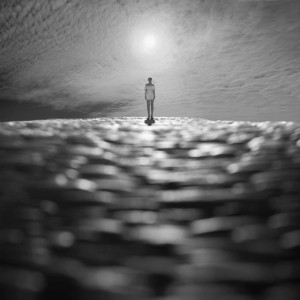
Physics (Who Am I)
“Who Am I?” by Marilyn Sears Bourbon

Sara wakes after midnight. The moon is bright, the room lit in indigo and bone. The lacy curtains billow. On the breeze, the scent of salt, the waves’ ceaseless crash. Sara’s shoulders are sore to the touch. She smells of lotion. She lights a cigarette and, with lips pressed to the window screen, blows a smoky plume. Her parents had fought earlier—too much bourbon and too many cigarettes. Now another sound, a rhythm like the surf. Soft moans. Sara rises from her bed and lays a hand on the thin wall.

A conch shell rests atop the dresser. Sara lifts the shell from its wooden stand. The shell’s shape reminds her of her brother’s old football. She runs a finger along the bony ridges, wipes dust from the opening’s shellac-glistening tongue. Using two hands, she raises the shell to her ear.

Of course Sara does not hear the ocean. The low-frequency hiss is born from the fact that the shell acts as a closed-pipe resonator. Its wave-mimicking song is white noise, the blank slate upon which all recognizable sounds are etched. In a bit of Mobius logic, its gentle purr is also the washed-out resultant of all sounds, a tone which gravitates more than any other toward purity and which also contains almost every audible frequency.


Hot the next day, the air thick with haze and a fishy odor. Sara lies in the umbrella’s shade but soon grows restless. She is annoyed by the stink. Annoyed by the radio station the boys beside them play. She tries to focus on the sounds of waves and gulls, on the call of children’s voices. From behind her sunglasses, she considers her parents. There are all coping with memories, with silences and empty spaces. She goes for a walk. The seagulls hover, the shoreline thick with their calls and the too-close beating of their wings. There are no swimmers in the water, the surf overtaken by wave-nudged jellyfish, dozens, maybe hundreds of them. In the wet sand, a boy pokes one with a stick. The texture and thoughtless cruelty of the scene make Sara ill.

She lies back on her towel. Sand bristles the nook of her upper thigh. She pulls the elastic aside and brushes out the granules. Turning, she catches the boys with the horrible music looking her way. The boys smirk. One leans over and whispers into a friend’s ear. Sara rises and shakes out her towel, ensuring the boys are hit in the fallout. She repositions the towel on the other side of her parents and lets the sun beat upon her face.

Friction is the rub of this world. Friction wears on a body from without and within. The smoothest surfaces are rough at the microscopic level, imperfect despite their machined polish. Mu is the measure of the coefficient of friction. The higher the mu, the greater the frictional force. Mu is equal to the force applied divided by the force perpendicular. Both forces are measured in Newtons, which, upon calculation, cancel, leaving mu as that rare phenomenon of physics, a number unclaimed by a unit’s measure.

Last year, Sara’s science teacher introduced her class to mu in a lab involving sliding blocks. Calculating the frictional coefficient was simple enough, but despite her teacher’s words and diagrams, Sara struggled with the notion of mu. She found its lack of a proper unit vexing, the unshackled numbers threatening to flutter off like a summer butterfly, but today, on the sun-baked beach, she feels a previously unappreciated force all around her—in her mother’s crinkling page turns, in the boys’ music and banter, in the breeze that stinks of rot and death. Here, perhaps, lies the crux of her consciousness, the most telling confirmation she exists registered in the rub between herself and the world.


That night, they go to the boardwalk funhouse. There is always a hitch at times like these, the memory of her brother, dead these eight months. A car accident, a night of bad decisions. Gone. The funhouse would be his kind of thing. Spooky, silly, stupid. Sara is not the type to scream—yet she does, her hands clutching her father’s arm when a knife-wielding woman bursts through a curtain.

They enter a room of mirrors. A dozen reflections surround her, fragmented views, distortions fat and thin. Sara grows disoriented. She reaches for her father, but she is fooled, her hand grasping air. “Daddy?” she calls.

In physics, /images are divided into the real and the virtual. A real image’s rays converge at a focal point, which in turn can be observed on a screen or sheet of paper. A virtual image does not exist in these terms; rather, it is a trick of the eye and the properties of light, the plaything of magicians and the subterfuge-filled origin of the phrase “done with mirrors.”

Upon exiting the funhouse, Sara thinks again of her brother. Recently she’s been distressed by his fading image, another abandonment, leaving her nothing more than memories and photographs, /images both real and not.


Sara sits atop the sloping shoreline. The late-day sun strikes her back, her shadow stabbing far into the foaming surf. Nearby, a little boy dips a bucket into the lapping waves and empties the water over his sister’s feet. A bigger wave rolls in. The boy tumbles but the girl pulls him from the water. The children yell and laugh. Seagulls hover on the breeze. The lifeguards are gone, and most of the day’s crowd has left. The light is warm and yellow and rich.

A complex wave is formed by two frequencies separated by more than 7Hz. The world is awash in dissonance, two waves that mesh in an unpleasing manner. But if the resultant sound is pleasant, consonance is achieved and a chord is formed. Cultural and experiential influences surely affect the judgment of consonance and dissonance. The symphonies of John Cage and other avant-garde composers raise the question of whether our values of consonance can be altered by experience. Traditional music of the Far East, with its pentatonic scales and lack of quantitative rhythms, often registers as odd, even unpleasant, to the Western ear. Thus, unlike most of the hard-set rules of physics, the values of consonance and dissonance appear to be flexible and open to interpretation.

Sara listens to the children. What a deceptively simple magic, their voices able take the surf’s crumble, the caw of gulls, and elevate them into chords. Sara closes her eyes. She hears her brother’s voice and hers, arguing, laughing, teasing. In this echo, her brother lives. She will keep this chord in her heart.


Curtis Smith’s stories and essays have appeared in over seventy literary journals and have been cited by The Best American Short Stories, The Best American Mystery Stories, and The Best American Spiritual Writing. Press 53 published two recent story collections Bad Monkey and The Species Crown. Casperian Books published the novels Sound + Noise and Truth or Something Like It. Sunnyoutside Press recently released his latest book, Witness, an essay collection.

Read our feature of Curt (including the author’s own words about his work) here.

“The Sequined Shawl” by Simone Davy

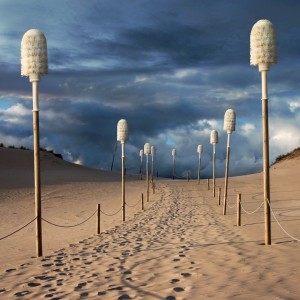
The Sequined Shawl (Survivor)
“Survivor” by Marilyn Sears Bourbon

There were three women. They all had dry skin, good nails, an ability to gossip and husbands who didn’t know what to say. Marge and Angela wore curlers at night and hair lacquer during the day. They both said that Sabrina should dye her hair a chestnut colour and put on a bit more make-up. Marge was the mother of Angela and Angela was the mother of Sabrina.


Marge

I was twenty two; it was 1938, just before the war. It was a smashing time for dancing; I wanted to be Ginger Rogers. I didn’t know much about men, only what I’d learnt from Joan, my brother’s wife. She said marriage wasn’t all it was cracked up to be. The wedding dress was as good as it got, it was all downhill after that. Especially once the baby arrived. Boiling nappies up in a large saucepan was what you had to be getting on with, oh and making the hubby’s bread and butter pudding. But we had a nice house, better than most, a proper front garden with a row of standard roses that flowered yellow and red in the summer. I’d been married just over a year the first time. I’d missed a couple of months – I guessed one must be on the way. I was upstairs brushing my teeth when I felt it. Sharp as anything it was. I shouted for Harold, Mrs Bell next door must have heard me.

‘I’m bleedin’ to death,’ I said, as he came up the stairs two at a time.

I grabbed his arm and squeezed so tight it left marks on his skin.

‘You better get me an ambulance fast, I’ve not got much time left,’ I was bent over with the toothbrush still in my hand.

‘Get a grip, Marge. You’re gonna be alright.’

He left me on the stairs and ran down the road to phone for an ambulance. There was only one phone in the street. I bet there would be a queue, being it was Sunday morning. I couldn’t get to that hospital fast enough. Once I was there I wished I was back at home.

The doctor was a bit curt. He stood looking down, with the metal bed guard between us. Acted like he’d catch something if he got too close.

‘You’re probably losing your baby Mrs Dearing. Only twelve weeks so it won’t be too bad. A few days in bed should sort it out one way or the other.’

‘Will it hurt Doctor?’ I wondered what he was like with his wife.

My mam always said having a baby was the worst pain ever. She’d put me off sex telling me that. Even when I married Harold I was a bit reluctant. It took a good year before I got up the courage. Harold was quite patient but even he’d had enough. Everyone kept asking if we’d had any luck. If a baby wasn’t on the way within a year they thought you were having troubles.

‘It’ll hurt a bit, Mrs Dearing, but you’ll be right as rain in a week or two.’ He wrote something on his clip board, nodded at Harold and then went off in a hurry. I lay on the bed and looked at the cracks on the ceiling and took deep breaths as the pains came and went. I felt like I was on a rough sea without any travel sickness pills.

The doctor didn’t tell me I’d bleed for a month, not see the curse until January and that I’d be crying into the washing. He missed out the bit about it hurting like hell too. I didn’t tell anyone about it, not even my sister Nelly.

Angela arrived in the end, after another few goes. She was the bonniest lass, golden curls with blue eyes. I felt like I was right back home looking at her. We’d sit together and imagine we were up in the mountains looking over the lochs. Naughty at times mind, but we had a laugh. I just had the one girl. It never worked out again; though I did my best to try. On the mantel piece I’ve got a picture of the three of us on the beach down at Southend. I’ve got my hair all long and curly, nice dress too, stripes always looked good on me. Just the three of us.


Angela

My mother made such a fuss about those sorts of things. She spent all my teens lying down. I was listening to The Beatles in my room and she was listening to The Stones in hers.

‘Where’s Mum?’ I’d ask Dad when I got in from school.

‘She’s got one of her heads,’ he’d shout from the kitchen, where he’d be trying to cook kidneys in tomato sauce. Smelt like someone’s intestines.

She didn’t tell me much and definitely not the facts of life. I found most of it out from books, especially Lady Chatterley’s Lover, everyone got that one. I used to work in a boutique along Oxford Street, as a window-dresser. We had all sorts in our shop, so there wasn’t much I didn’t know when I met Don. Still no one told me you could get pregnant and then it could all go wrong. I knew my great-grandmother had died in childbirth but that was a long time ago – before the NHS.

I was in there for about two months, Bushy Maternity Hospital. It was a small hospital, just forty beds. I’d wake up at six to the smell of porridge and the sound of the nurses pushing round their trolleys. A whole row of us not allowed to move. We woke up in the morning and the first thing we’d do was put on our make-up. I liked to look nice for Don when he came in. Foundation, black eyeliner and lipstick, of course. We’d wait for the doctor to come round. The young nurses would sit on the edge of the bed and watch. They said I was just like Twiggy, thick eyeliner sweeping upwards.

‘I don’t want my ward smelling like the perfume counter at Selfridges,’ the staff nurse would moan, pulling her starched collar up around her loose neck.

We’d all had a few misses and they preferred to keep an eye on us for the last bit. Don visited in the evenings, escaped from Mum who seemed to be delivering a constant stream of steak and kidney pies; even though it was summer and too hot to eat anything but a chicken salad.

I spent most of the time crocheting lurex gloves. The feel of the wool on the hook, calmed me. I’d rather count stitches than weeks.

‘I reckon you’re carrying a girl, you’re carrying low,’ said Eileen, in the bed opposite.

‘I’d like three boys – Don doesn’t mind.’

‘Sounds like hard work.’

‘I’d call them Anthony, David and Michael.’

I had a girl and I called her Sabrina after a French woman that used to come in our shop. The last time I tried I was in my forties. I got to about ten weeks. I was out shopping with Don’s mum and Aunt Lil. We’d just been in Debenhams for a coffee and cake. I felt it start. I didn’t tell them. I left them all having their tea and rushed to the ladies. It was everywhere, I almost fainted it was so hot in there. No windows, just bright red lino and white tiles to look at. So that was it, it wasn’t fair on Sabrina to keep trying, she was getting older. She wouldn’t have wanted a baby in the house.


Sabrina

The waiting room was full of women, large and cheerful, stroking bumps of various sizes. You’d think they would separate us out. There were posters on the wall showing breast-feeding mothers and immunisation dates. A video was playing; you could choose a ‘normal’ birth or one in a giant pool with an inflatable ball. On the table in front of me was a pile of magazines all called ‘Mother and Baby’. Nick put his bag on top, to cover them up.

‘Miscarriages are very common, Mrs Wilson. One in three embryos are lost before twelve weeks. Most women even after three miscarriages are very likely to take home a healthy baby.’

‘My Mum and Nan had one girl each and at least sixteen miscarriages between them.’

The consultant paused and wrote it down in my nice new set of notes.

‘We don’t usually run any tests until a woman has had three miscarriages but……’.

“Well, I better get on with it then.”

I fitted three in within the year. Had lots of tests and eventually got to take aspirin every day until 36 weeks. This one was going to stick.

It was two am on the 29th January 2003, they said heavy snow was due. But there was no snow yet and in the room it was so hot that there was a fan on to thin the air. The bed was high enough that I could watch the night bus taking nurses home to their beds.

I hadn’t expected it to be like this. I couldn’t feel my legs. I’d left them behind hours ago. I was so relieved when the epidural delivered a numbness that meant I could actually concentrate on breathing. It seemed impossible that when I looked down something small and new lay there. I had heard a midwife tell Nick that this helps the bonding process. All those magazines I’d been reading talked about those marvelous first few moments with your baby. All I could think of was numbness, stitches and the fact that my face looked like Tyson had done a good job. I didn’t realise that I’d need any help bonding. Her eyes were so tightly shut, so determined not to let in the light. I couldn’t recognise anyone in that face, not yet. I kept seeing ribbons floating above my head. They were beautiful, multicoloured shimmering slips. They were so far up I couldn’t reach them. Nick stroked my bare arm, talking to me about how I needed to feed the baby.

The room was heaving in its usual way. Women queuing with urine sample bottles in front of the tank of fish. Toddlers being sick in the play area, fathers trying not to look at the woman whose bump was so large, she could hardly fit in a chair. They were playing Take That on the radio.

‘I’m back again.’

‘Everyone comes back. They say they won’t but a few years later I get to see them all over again. Early scans, tests, aspirin, heparin injections, women will do it all. Over and over.’

‘Shall we take some blood then?’ I stuck my arm out willingly. That needle was like sucking treacle from a spoon.

‘I can’t imagine what it’s like to be a sister. I can’t imagine what it will be like for my daughter to be one.’

‘What do you think it’ll be like?’

‘I think it will be like having a sequined shawl when your shoulders are cold.’ She laughed at me, I bet she had lots of siblings.

‘You’re in for a shock then, it’s more like wearing a coat with holes in it.’

‘Shall we check for a heart beat at seven weeks?’

There were two sisters one curly and blonde, the other straight and dark. As they grew up they dressed up in scarves, hats and rows of plastic beads. Amber and Grace argued about who should plant the sunflower seeds in the vegetable patch. Their mother told them stories about girls who got locked up in towers and women who fell asleep for a hundred years. She made sure that when they crossed the road they held hands so tightly there would be no chance of them letting go.


Simone Davy has had her work published in What the Dickens? Magazine and her story Cockle Shells is to be published in the anthology ‘You, Me and a Bit of We,’ Chuffed Buff Books. She aims to create imaginative fiction that explores ordinary life events. She is currently working on a novel set in 1930s Epsom, England, where she lives with her family. As well as writing, she also works as a Social Science tutor with the Open University. You can read her blog here.

Read an interview with Simone here.

“The Light Keeper (For Sonya)” by Ashley Young

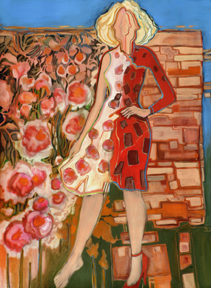
The Light Keeper (Island Woman)
“Island Woman” by Marilyn Sears Bourbon

The children betrayed her.

Giovanni tells me his mother fed the children in every country they lived in. She worked for Doctor’s Across Borders and moved him and his sisters regularly – Guatemala, Peru – hot countries with brown faces and poverty. She would make big pots of rice and beans and feed all the children in their neighborhood. He never told me what she looked like but I imagine her with Donna Summer hair, her face thick with sweat, standing over a pot in a hot kitchen dimly lit with sunlight. She is spooning heaping pills of rice and beans in bowls for the children. I imagine Giovanni close to her, 5-years-old with stiff legs and a half moon smile watching his mother like a saint. He tells me there were always children in his house and his mother filled them full with food. I imagine they forget about hunger for as long as it takes for them to swallow a hot meal.

He says his mother was always his friend and he could always feel her love. She danced with him, placed his tiny body on tabletops and shook his hips to the slow rhythms of Billie Holiday or some other woman aching with the blues. She told him to cheer for himself because it was never guaranteed anyone else would. She built him into a strong, brave boy and gave him confidence in tight, long embraces. She is unconsciously preparing him for blindness.

In his teens, Giovanni told his mother he was gay. She threw parties for his out teenaged friends, those with no place to go but the internet for companionship. She gathered them in her home for PG meet-ups so they would know they weren’t coming out alone. He tells me she would put on disco music and watch them dance. She’d laugh that this was like being back in the 70s. He called the refuge her “underground homo railroad.” I imagine her smiling among the awkward 16-year-old boys who are just learning to sit still in their sex and skin. She is handing them drinks and food and encouraging their laughter. I imagine Giovanni, a slim teenager with dark cooper hair atop a soft developing body, gently touching the forearm of another boy as he laughs, knowing his mother is not far from view.

The children beat him until he lost his sight.

He tells me the attack was like the beating from the Quentin Tarantino movie, Kill Bill. I loved the film – the violence, the gore, the endless references to Japanese culture, Uma Thurman in a tight yellow cat suit. I remember her wielding a Samurai sword—one she had just been taught to fight with—determined to kill Bill. But she was no match for a tribe of fighters with years of experience. I can’t remember the scene where they nearly beat her to death and I could not seem to imagine Giovanni taking her place. Maybe it is hard to think of a human being beat like that – his 24 year-old-body bending at the end of lightning-swift kicks, a head filled with memories of his dancing mother  hitting the pavement, the moment where sight got lost in blood and bone and hate.

He tells me he is still speculating on the motives of the boys who beat him, even after he published a memoir on the incident. They were friends, people he knew, people his mother had loved and fed and laughed with. She probably knew their parents, probably called them after they left her house to check and make sure they got home safely. These attackers were his childhood friends. Giovanni says they must have been angry that he was going off to college, making a future for himself. I’ve seen this happen to groups of brown boys; like crabs in a barrel, they’d rather have company in their sorrows than see one another succeed. He says he can tell when his book reviewers are white because they don’t understand his reasoning.

The children left him in the dark.

After Giovanni became blind, his mother came to live with him. She never gave him false hope. She told him blindness would be hard but he would be okay.

I imagine she is the light keeper guiding him through their house. He is a grown man learning to re-adjust his dead eyes to light. To remember her face, he takes in the smells of her and tastes every country they ever lived in. He learns to trace her age with his fingertips and listens to her breathe in order to calculate the distance between them.

I imagine her tucking him in at night. He is leaning his head against her as she leads him to his bedside.  When she has folded him safely under the covers, she pushes her cheek to his before she turns out the lights to join him in the dark. I imagine Giovanni feeling her face push into a gentle smile. She is reminding him of laughter.


Ashley Young is a black feminist queer dyke; poet, non-fiction writer and teaching artist. She is a non-fiction 2011 Lambda Literary Foundation Fellow and a 2010 Poetry Fellow for Voices of Our Nations Arts Foundation Retreat for Writers of Color.  She is the author of a chapter in Hot and Heavy: Fierce Fat Girls on Life, Love and Fashion edited by Virgie Tovar (Seal Press 2012)  and is currently working on her first novel “Girl With The Unicorn Earrings”.   Ashley is a freelance writer and works as an editorial assistant.  She lives in New York City with her partner and family, including a pride of four cats.

Read an interview with Ashley here.

“Still Shining” by Leslie Nielsen

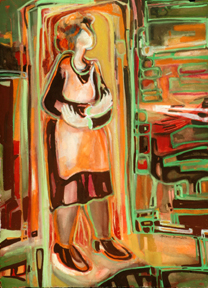
Still Shining (Housebound)
“Housebound” by Marilyn Sears Bourbon”

Long from now you will remember nighttime too light
for sleeping when springtime came.  You will

remember feathery guitar from downstairs,
the dish, splash, laugh of evening a lullaby

with no hurried rhythm, a drift, a chord,
a slipdown of sounds.  You

will remember birdcall and footsteps, voices and soft
dragonfly fabric over your west window, the green

scarf with tassels and fish on the north
window.  You will remember your sister

calling “Mom” for water out of the waking
silence, the dawning dark—

You will remember our calico cat on the foot
of your bed, her purr a current

pulling you down into the moment
you won’t remember—when sleep becomes

deep green and lavender, when the song
you didn’t know you were humming becomes breath.


Leslie Nielsen has lived and made art in Ohio and Denmark. As a founding member of Living Fountain Dance Company and founding director of The Art of Worship conferences, Leslie has led classes and workshops in many art forms, always with the goal of enriching participants’ inspiration, creativity, and awareness. She holds an MA in Literature and an MFA in Poetry Writing, teaches part-time at Kent State University, and works actively in words, music, and visual art.

Read an interview with Leslie here.

“Crustacean” by Katherine Russell

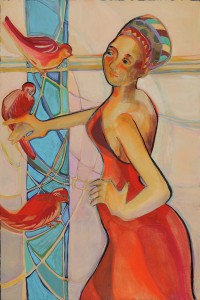
Crustacean (Four-Red-Birds)
“Four Red Birds” by Marilyn Sears Bourbon

Roshani is going to be an oceanographer. Her mother tries to make sense of this career choice by telling relatives her daughter is going to college to be a scientist, and oh, look at the BP oil spill in the Gulf of Mexico and how useful scientists are in that situation. It’s impressive enough that she managed to raise a child in war-torn Nepal – but to bring her to America and put her through college? That deserves some sort of Nobel Prize.

For the most part, Roshani lets her mother brag when the mood strikes because it doesn’t happen often. Usually she’s agonizing over how Roshani recently dyed her pitch-black hair with the slightest hue of red, or making wary comments about Roshani becoming “just another cushy, entitled American.” When they came to the US a few years ago, a school counselor recommended Roshani take anti-depressants for Post Traumatic Stress Disorder, and of course, when her mother saw the prescription in the medicine cabinet, she flared into laughter. “Are you serious? You don’t need drugs. These Americans just like to diagnose things.” Roshani watched as she flushed them down the toilet.

At the same time, her mother seems to have left their past in Nepal. She discourages talking about the day at the market when they saw those dead men, or the long bouts of depression her mother has suddenly shown since Roshani’s father left six months ago. Her black hair has grown unkempt, her body sagging like a frayed tapestry, her oval face—which once resembled Roshani’s—has thinned. The closest she ever came to explaining her overwhelming lethargy was, “Your father, he was usually the one I talked to.” Which leaves Roshani in some position of being the new source of comfort, a job she’s not even sure how to do for herself.

After her mother curls into bed tonight, Roshani slips into her tightest jeans and a shirt that shows just enough cleavage. She pokes her head in her mother’s doorway to wave goodbye and sees her swallowed by the striped comforter, her tulip eyes staring at the ceiling fan. She secretly wants her mother to order her to cover up some of that skin – anything that will indicate she’s seeing the world in front of her.

“I just have a little headache,” she says instead, but Roshani knows it’s something fiercer, more insidious, eating away at her. She’s too afraid to offer her company because she knows she’ll likely take her up on that offer.

“Sleep should help,” she offers. To her, sleep is the act of hushing all thoughts. She and her mother could dangle in nothingness like specks near the deepest ocean shelf. There, sunlight won’t penetrate and life forms numbly float, hoping to crash into an ally or a predator, anything that reminds them that they’re not alone down there.

Outside, Roshani’s date-of-the-week has been patiently waiting to take her to the other side of the Bronx where a small-time street race is happening. She slinks through the heavy summer night humidity to his Dodge Charger, and a burst of air conditioning hits her when she opens the door.

“Hey, Marcus,” she says. He looks slightly different than she remembers from when she gave him her number – more confident, perhaps. His face is strong, with a firm jaw and straight teeth. His eyes are a dark shade of brown, verging on black, and his hair is just long enough for her to let her fingers disappear into it. He’s listening to heavy Caribbean rap, the kind she likes to hear in clubs because the syncopated beat gets everyone moving as one glimmering mass, as if they’re all part of one big flock of birds.

“Damn, about time,” he says. His teasing has a biting undercurrent of impatience. “You ready now?”

“If you’re so tired of waiting, why are you talking instead of moving?” she returns with a smile, slightly taken aback by how unfiltered his tone is. She fingers the side of her seatbelt for a second then opts to leave it off. Speeding without it feels like freedom.

Marcus shrugs away her joke and pulls the car from the curb. Roshani takes a moment to convince herself she doesn’t like guys with a sense of humor anyway, that his impatience indicates a measure of depth and complexity. They met only a week ago at a mutual friend’s party, and they had exchanged looks – then a dance – then a kiss – then phone numbers. Despite their quick connection that night, the excitement of finally being alone together feels stale.

She tries to warm things up. “Are we stopping to grab some drinks?”

“Na, don’t have time,” he says, the irritation blatant this time. He then throws a smile in her direction as if to salvage the mood. “But after?”

“Sure.” She relaxes into the fat leather of the passenger seat. Her arms are folded against the blasting vents, her shirt too small to offer much warmth.

Marcus reaches to the stereo and turns the volume knob down. “So what do you want to talk about?”

The candid question is endearing, in a way. Roshani catches herself stroking the side of her cheek to keep from giggling uncomfortably, her fingers grazing the raised skin of a two-inch scar. She wants to say the right thing. Something interesting but not too personal. Something that will make him remember her when this night is over. Her mind scrambles desperately but comes back with nothing.

“I’ll talk about anything,” she replies, though this isn’t completely true. Thought after thought is discarded: her mother, following the hypnotizing circles of the ceiling fan. Her father, off with another woman, probably someone with soft curves and contagious laughter. Her old friends, still in Nepal, who have fallen completely out of touch.

She could talk about Nepal. About how she used to hide under her covers at night when the rebels spat out bullets or how her mother used to drive her to the market when curfew was lifted for a couple hours each day. One day her mother told Roshani to cover her eyes at the military checkpoint in the road, but she didn’t listen. Roshani opened her eyes too wide and saw men preparing to torch bodies with bloody pinholes punched through, the skin drained to the faded color of shale. It smelled like spoiled lamb and ash, and the hot acid of vomit had burned her throat while she tried to swallow it back down.

“Do you party a lot?” Marcus asks this halfheartedly.

Her mind snaps back to the cold car, Marcus’s indifferent silence. She wonders why his mood is so heavy, if it was something she said. “Once in a while. Do you?”

“Same.”

She fidgets with her hands, tries to find something to keep the silence from becoming too noticeable. Nothing. When she thinks of partying, she’s only brought back to a time before she came to America five years ago. Lately, as she fills out college applications and eats silent dinners with her mother, those are the only memories that matter. She thinks of how when she was twelve in Nepal, she and her neighborhood friends used to line up on a break wall and sip bottles of stolen malt liquor. They’d play balance games: try to walk the narrow strip of crumbling concrete without falling off. She’s not sure why she suddenly recognizes this memory with worry. They were only twelve years old; no one even suspected that alcohol would be on their breaths. Even though those moments already passed without injury, she fears that the children in those memories will unexpectedly stumble and fall off the wall, break the growing bones in their bodies, disfigure themselves.

Marcus and Roshani don’t speak until they get to the barricaded street, where several cars are lined up, their drivers clustering behind them. Marcus pulls up to a starting line of sorts and gets out. The goosebumps on Roshani’s body melt off when she exits the car, and she’s reminded that it’s summer.

Marcus tells her to “hang on” while he steps over to his friends. She leans against his car door as they greet each other, slap bets into firm palms, check out one guy’s new rims. They audibly tease him about being late – to which Marcus clicks his tongue apologetically, jerks his head in Roshani’s direction, and the other guys perceptively go, “Ohh.” It’s only a few minutes before he gets back, but by then, she has thought of something to say.

“How often do you race?”

“Every other week about,” he says.

She smiles. “Then I’m safe with you,” she says lightly.

“Safe?”

His look makes her feel like she’s chock-full of naïveté. She’s bothered for only a passing moment, and then she realizes she’d rather him think that than have her explain why she’s not naïve.

“The cops could bust this at any moment, and you call it safe?”

She shrugs casually and looks down at her shirt as she straightens the neckline. Marcus doesn’t watch; he goes to the other side of the Dodge and gets in to start it. His car purrs like a jungle cat, and Roshani gets in timidly.

She finds the courage to ask, “Something wrong?”

He throws her a look that seems to laugh at her. “I’m just focused on the race. You not enjoying yourself?”

“No, I’m good,” she says. “This is cool.”

Their surroundings are shaken by revving engines. Spectators are sprinkling the sidewalks. Some glance around nervously for flashing police lights, while others quietly study the drivers. Roshani feels misplaced in the passenger seat, as if she’s not supposed to be there. But isn’t this feeling familiar? Hasn’t she felt this way since leaving Nepal? No one ever told her where to be – she just ended up somewhere far away, where the only way to avoid danger is to keep moving, keep occupying herself. She doesn’t want to become like her mother, counting ceiling fan rotations. She wants Marcus to like her. She always wants her dates to like her, but something usually seems to be amiss. She’s narrowed the explanation down to this: she either shows too little or too much of herself.

Marcus is focusing on the road and moving his hands along the steering wheel as if rehearsing every turn. Roshani wonders why he brought her here. To impress her? To see how she’d react to this setting?

Someone waves a flag, Marcus punches the gas, and the car lurches forward. The streets have been scouted out and barricaded, and the four cars take full reign of the four open lanes. Their noses line up for a while, then one after another pulls ahead or drops behind.

Roshani can’t take her eyes off the speed limit. 70…75…80…85…90… The borough is blurring along East Fordham Road: away with abandoned apartment complexes, dimly-lit tattoo parlors, auto repair shops with faded signs. The street lights strobe in and out of the windows; the sheer force of velocity presses her back, wills her to be calm. She thinks of nothing but movement.

In a way, she expects the race to take her somewhere – a beautiful destination, perhaps. Something more than a finish line. But they pass another flag several minutes later, and it’s over. They come in third. Marcus slaps the dashboard but doesn’t say anything. He slows the car, and they’re soon like any other driver on the road. They have to clear out of the scene fast, settle their bets in a parking lot ten blocks away. Again, Roshani waits in the car as things are worked out between the racers.

When the lot clears, Marcus’s mood has changed. He turns to Roshani with new interest, a sudden focus. She can smell the ginger in his cologne. Something inside tells her this is the moment he’s ready to pretend he is interested in what she has to say. She is ready to let him.

“You smoke?” Marcus asks.

“Sometimes.”

Marcus immediately produces a small plastic film case containing weed and a square piece of paper. He rolls the joint like an expert. They light up, and her thoughts ping pong between fast and slow.

She finds herself leaning toward the windshield and looking up at the sky. In Nepal, the stars would stick out like a billion pin pricks in large, sweeping clusters. The Bronx is different. Everything is clouded, smogged-up, bloated with light so that she often forgets there are stars at all.

“What are you thinking about?” Marcus asks, studying her thin face, her wide-set eyes. As she avoids his gaze, she catches the sight of a stray cat creeping from house to house.

For a second, she lets herself sink into another memory of Nepal, of being five years old and watching her mom crack the neck of a chicken. She helped her pluck the feathers in fistfuls. She never imagined being here, with chickens already dead and plucked and stacked in grocery store refrigerators.

Marcus realizes she is clamming up, and he urges kindly, though in a somewhat jocular way, “You can tell me.”

Maybe it’s the weed, but she wants to trust him. She wants to tell him about her future in oceanography, about how she’s finally found something she understands. It comforts her about death, about how they are all just floating crustaceans suspended in slate-black depths of the ocean, and dying is like knocking into an anglerfish’s bioluminescent lantern. There is a magnificent wash of relief at finding a lambent orb of light, the type of relief that devastates the heart with too much happiness. Everyone feels this right before the giant jaws clamp over them, back into darkness, and truth is, in the scheme of things, barely anyone will notice they are gone.

Instead of saying this, she surprises herself. “Just this weird memory, something back in Nepal, where I’m from.”

“Tell me,” he says, though she feels he wouldn’t care either way.

Still, it’s been so long since she’s talked about Nepal with anyone. Her mother treats those memories like garage clutter she prefers to neither examine nor throw out. “I’m just remembering slaughtering a chicken,” she says, almost as if she’s confessing it.

Marcus scrunches his nose. “Why?”

Immediately, she’s angry she said this. She tries to shrug it off, but she doesn’t want to leave without an explanation. “Strange, right?” she tries to laugh, but it sounds unnatural. “I guess I’m just trying to find something beautiful in things.”

“There are plenty of beautiful things about you,” he says, not understanding. He smiles as if to charm her. “You have the prettiest smile I’ve seen in a long time.”

My smile? she wonders. The one with the two-inch scar curling up the side, the one she got from a piece of shrapnel in a bomb blast?

Marcus is just twisting words, but still she gives him credit for being there with her. She knows what he actually wants, so she gives it to him. She lets her dimples show and runs her hand up his thigh to his pants’ zipper, and he smiles back. She goes down on him with her eyes open, but she does not see, like sleepwalking. Being noticed in this moment is the farthest from being alone that she can be; it is the closest to healing she can imagine. Every time he sighs, he acknowledges her, that she’s giving him something perfect in this moment. She’s a frigid, floating crustacean, grasping for something warm to hold onto in metallic water.

When he finishes, Marcus offers to take her home. After giving him directions, she turns up the stereo to make the silence less noticeable. The car rips recklessly through the Bronx, hitting the staccato of potholes, speeding up for yellow lights. This night has given them all it has to offer; in that, she senses an undercurrent of urgency to end it.

When they pull up to her house, Marcus says, “See you around.”

“Yea,” she says, knowing the noncommittal insinuation of that statement.

When she gets inside, she goes to the sink and washes out her mouth with cold water. She wonders if her mother is still in bed. She goes to her to see if her headache has gone away or if she needs ibuprofen.

Her mother is curled up but not sleeping, her arms wrapping around her body to keep the world out or her soul in. The room has the deadweight heaviness of fatigue but the restless feeling of insomnia. Roshani forgets what she came to ask her and just stands in the doorway, adjacent to the dimmed lamp and the tissue-littered nightstand.

Her eyes are open, but she is not seeing. Roshani can tell she is still thinking, still churning her marriage over exhaustively like turning over couch cushions to find missing keys. Nothing was missing from you, she wants to say.

“Roshani.” Her voice is achy from crying. “What is this loneliness?”

The feeling she gets is bare-boned, as if something has been slowly scraping her raw for days, months, years. The man who helped raise her is gone, but it is worse for her mother. The man she loves, the man who held her during the hardest times, has left.

Roshani crawls onto the bed and lies down next to her, cradling her back into her chest like a shell. Her mother’s sobs crescendo, and Roshani squeezes her tighter to let her know she is there to take care of her, still love her. And together, they float into sleep.


Katherine Russell is a freelance writer and editor residing in Buffalo, NY. She’s currently working on finding an agent and publisher for her novel, Without Shame, which looks at the interactions between an American English teacher and pre-independent Bangladesh. She recently came out with a poetry chapbook called Shapes of Water, which chronicles “coming of age” with cystic fibrosis, a genetic lung disease. She maintains a blog for cystic fibrosis patients at www.lifewitheverybreath.com.

Read our interview with Katherine here.

“Horizon” by Cary Waterman

Horizon (Househunting)
“Househunting” by Marilyn Sears Bourbon

“Pursuing the horizon without interruption inevitably
prohibits landfall, harbor, home…”

~Angus Fletcher, A New Theory for American Poetry

I go to the apartment roof alone and always look west, inland toward the lime-green hills of the Connecticut valley in spring and summer, and the burnt colors of fall. I could have looked east – over the tenements and factories of Bridgeport to Long Island Sound and Seaside Park with its bathhouse and rocky beaches. I could have looked to the sunrise, but didn’t. I looked west, the horizon unreachable, enclosing and not enclosing. What was beyond those hills? And what was I really seeking, up on the roof of the four-storey apartment building alone, walking boards laid down over black tar?

~

I am a fat, fingernail-biting girl—bloody nails, flabby arms, thick unruly hair that will not lie flat. I go to the edge, look down, imagine falling, then flying. It is not impossible. I would jump. And I would fly. Or at least somersault and land on my feet. There are pigeons, roosting. Slate-grey birds with feathers the color of an oil slick. One day in third grade, the boy behind me taps my back and when I turn he holds out the severed pigeon head he has made into a finger puppet on his dirty hand.

I wear the apartment key on a string around my neck. Once I lost the key and my mother was sure someone would find their way to our apartment door even though there were hundreds of doors, each one identical to the next. After that, I would go to another apartment after school one floor up where ‘Aunt’ Maude lived and wait there for my mother. Aunt Maude had a life-sized statue of the Virgin Mary in her bedroom. The Virgin, hands outspread, stood on the earth, her feet crushing the snake. I wanted a statue like that. Aunt Maude also had a bright red kitchen and Victorian loveseats and chairs. It was all so neat. Once I arrived at her door, legs crossed, needing to pee. I ran to the bathroom, leaving a trail of mud I would have to get on hands and knees later to clean up.

~

I was not afraid on the roof and to this day I’m not sure why I didn’t jump. I was surrounded by other brick apartment buildings, each one a colossus along Washington Avenue. The Sanford, where one-eyed Peter’s father was the Super. And the Fleetwood, where Joe Black’s mother worked. He was older than most of us kids and had dark eyes and black hair. One day he offered to ride me on his bike all the way to Seaside Park but I was afraid of him and ran away. He was taken away one night after he chased his mother up and down the halls with a butcher knife and was sent to Newtown, the hospital for the insane where my mother threatened she would end up if I didn’t behave.

My mother told people we were Cliff Dwellers, hoping to evoke /images of Manhattan’s Riverside Drive, not the ruins of the Anasazi. She said this to give an air of luxury to the fact that four people (mother, father, brother, and me), one collie, one parakeet, and, for a few months, two rabbits that ate the kitchen linoleum were crammed into a one-bedroom apartment. This was the same apartment my parents had moved to as newlyweds, and the apartment in which my brother and I (and our stillborn sister) were conceived, and the apartment our father returned to after his Marine glory days stationed in Honolulu during WW II, eligible for the GI Bill providing low-cost home mortgages with no down payment. But we did not buy a house. We looked at houses. We spent decades of afternoons and weekends driving around with realtors. But my mother would not choose. Something was always wrong. A hill in the backyard where there could be mud slides. Not enough windows. Too many windows. Way out in the suburbs. Too close to the city. Not a colonial. Not this…not that. No, no, no, no. I begged and pleaded. I cried for my own room. No. No. No. Finally I gave up. The apartment became my mother’s (and my) particular hell where I would live until I was eighteen and left for college. This was also the year my parents would finally buy a house.

~

Our building was U-shaped, two gargoyle wings jutting from the entryway. It had once been fancy with brass railings and a lighted foyer with a bank of mailboxes, each with its own little key. But the building was beginning to run down. The white subway tiled floors weren’t washed as often. The Super spent most days in the basement by the coal furnace with his cronies sitting around and drinking beer. He had cordoned off a little clubroom with a card table and chairs and hung girlie calendars on the walls. Everything was dirty and when I went to the basement to get my bike, if he was there I’d look away as I passed the pinups. If he wasn’t, I’d stop and stare, titillated by the fleshy women, breasts and buttocks spilling out into coal dust.

In our apartment, the first room off the hall was the bedroom where my brother and I slept opposite each other in twin beds we had to sidle around. My mother slept on the couch and my father on a roll-away in the living room. For a long time there was a crib in the bedroom with a mesh top that could be latched to keep a child in. It was used for clothes storage. There was also a baby carriage jammed up against my bed. It too was filled with outgrown stuff. Every spring my mother would drive a load to the Little Sisters of the Poor but the piles continued to grow and consume the room. The closet was packed and had over-the-door hangers on both sides for more clothes to hang.

The bathroom was the only room with a lock. I spent a lot of time in there, protected by the lock on one side and the bubbled window on the other. I would stand on the edge of the bathtub and look at my breasts in the mirror over the sink. Compare myself to the pin-ups Mr. Haskell had in the basement.

The living room had a couch, two tiered maple end tables, assorted chairs, a dining room table, the old black telephone, a high chair and playpen when my brother was little, a black and white TV, and the folded-up bed where my father slept. My mother would paint this room several times when my father was gone for the weekend skiing, always making it darker and darker from tan to hunter green to finally, maroon.

At Christmas, my father and brother would lay down a big piece of plywood in the middle of the living room for my brother’s American Flyer train. He had boxcars and coal cars and a log dump car and a red caboose and a station that lit up and an engine with a horn and a headlight that could blow smoke. I can’t remember how we navigated the living room at Christmas, the four of us and the dog, the decorated tree, the train going around and around.

~

Perhaps my mother, a petite redhead, enjoyed the attention of the realtors. This idea that only occurs to me now makes my mother’s inability to buy a house more acceptable. These men were obsequious, if frustrated with her. She was lonely, and, as she often told me, felt unappreciated. There was power in being the potential buyer, even though she never bought. Her favorite was Mr. Ryan. She drove around with him looking at houses for twenty years. I remember one of the hundreds we looked at. It was a brand new split-level and had wall-to-wall carpet, a mudroom, and a balcony in the living room where you could look down when you came out of your bedroom. But there was a hill in the backyard, not too close to the house. What was over that hill? My father, who rarely came with us, liked this house and he and my mother fought about it. She said who would want to come into a house through a mudroom. And what about mudslides from that hill? For some reason I have forgotten, I took my mother’s side in the argument and can still see the disgusted I-give-up look on my father’s face. I remember it because I knew at the time I was wrong, that the argument was not about the house. It was about power and I was playing sides and the side I wanted to be on was my mother’s. But why? Or was I just arguing for the sake of argument? Arguing to see if I could win. My father used to say I would make a good lawyer. But really, it was all about losing.

~

The U-shaped apartment roof was covered with a boardwalk that led to laundry lines. Cold December afternoons, my mother, her hands angry-red, would ride the elevator carrying her wicker basket of wet laundry, then climb the last flight of stairs to the roof to hang our clothes, sheets, and towels. She would curse coming back later to find the laundry covered with black dots of soot from the big chimneys that heated the building and made the radiators clang. She cursed about a lot of things—my father’s drinking, my ungratefulness, my loud voice, my taking up too much space. Judas Priest was her favored expression and one that, attending Catholic school as I did, confused me. When she was really angry she’d threaten to leave and take my brother but leave me with my father. We were alike, she said. We deserved each other.

~

I never had friends come home with me. Through high school, I met my dates outside on the street and kissed them goodbye in their cars. I never invited anyone to the roof. There was a shelter up there with a bench facing predictably east, sunrise, new day. I sat there one night with my father after another violent argument with my mother, perhaps the one when I kicked out the glass of a mirror that was propped up against the cramped bedroom wall. I stormed (or fled) the stifling apartment, ran down the dirty hallway to the elevator, pushed the button and rose up before climbing the last flight of stairs to the roof. My father came up later and sat with me. He said my mother was changing. I don’t know if he actually called it the change of life. I wouldn’t have known what that was. But I was changing, too. My mother would dry up as I was beginning to bleed every month into possibility, my poor father in-between us, a fulcrum of sorts, except that he would become more and more absent to Ski Club meetings or bowling at the Algonquin Club before adjourning to the bar.

I could not be patient. I loved my mother. And, I hated her. I was surrounded and adrift. After my father and I looked out to the sea and he tried to reason with me, he left and I turned to look west. What was out there, all those miles and miles of fields and hills, all that landscape? And finally, all that horizon which did not seem a limiting thing, the curve of a bowl, the furthest circumference. It seemed instead possibility, freedom, escape.


Cary Waterman is a poet and creative nonfiction writer. Her published books
include The Salamander Migration (University of Pittsburgh Press), When I Looked
Back You Were Gone (finalist for the Minnesota Book Award), and, most recently,
Book of Fire (finalist for the Midwest Book Award). Her work appears in many
anthologies including A Geography of Poets, Poets Against the War, The Logan House
Anthology of 21st Century American Poetry and 150 Years of Minnesota Poetry. She
has won awards from the Bush Foundation, the McKnight Foundation and the
Minnesota State Arts Board. She has had residencies and the Tyrone Guthrie Centre
in Ireland and the MacDowell Colony. She teaches in the Augsburg College MFA
Program.

“Mindlessly” by Randall Brown


“Vortex” by Marilyn Sears Bourbon

She checked all 57 windows, the 114 locks. She twirled her way through the house, over and through things. She’d taken over this ritual of her father’s without thinking much about it, as a way to get to school on time.

As she pulled on the top half of the final window to be checked, she saw the black funnel, two, three neighborhoods away. It twisted the world, said to her it didn’t matter what windows got checked, which ones didn’t. She saw herself through that eye, a tiny thing caught in the windowpane, a bug beneath glass.

She stood still, the growl of it rattling the windows and locks. It felt strange to be unmoving, like a memory of a past life when she sat in the car while her father flew from window to window, lock to lock.

Somewhere he cried out, like one of those people under the white tents in the park on Sundays. She imagined the twister picking them up and taking them away. That’s what they wanted, her father had told her. That’s what they dreamed about.

But this she hadn’t dreamed of. Not at all. It wasn’t just to save time, her taking over the windows; it was really to make it hers instead of his, until one day he might forget. The twister said otherwise.

Things flew into its cone. Parts of houses and lawns. Porch swings and picnic tables. It moved as coins did, spinning on their sides.

She found herself, a tiny bit of herself, wanting it. She hadn’t thought of an ending until that storm blew outside. She hadn’t thought of day after day of checking and how he now needed the car windows checked, and she saw him looking at neighbor’s houses, eying their windows, wondering, that need to know flickering over his face.

It came and she closed her eyes. She was snatched up, pushed her against her father’s chest. She shook uncontrollably. In the windows behind him, she saw the funnel swerve toward trees, the roof of a shed bent in half, then broken into two.

He shifted her to his right arm. All the windows bounced in their frames, unnerved. How could he have let her become this—she didn’t know the missing word. Twisted. Sick. Crazy.

“Oh honey,” he said. “It’s okay. It’s okay.”

The okays kept coming, one after another, each one wanting to be the answer, until they all swirled together and she watched them spin out of his mouth, dance in front of her, like a top.

She reached out for it. Stopped herself. She could do that. Stop herself.

“I’m scared,” she told him. “Super scared.” She stretched her arms as he had when he’d read that book, about the bunnies, telling each other how much they loved each other. “This much,” she said. “I’m scared this much.”

He didn’t seem to have heard. He set her down. He looked past her, to where the twister had disappeared. The windows finally settled. And he moved to check them.

She grabbed his pant leg.

“Don’t.”

He smiled at her. “Hey,” he said. “I thought we were on the same team.”

She shook her head.

He kneeled down. “It’s not that easy. You know that.”

“Don’t.” She held firm.

Later, in bed, she heard him downstairs, rattling things. She thought of how tight she held, with all her might, and how easily he kicked her loose. She thought of how nothing she wished for mattered. She thought of that twister, its endless rotations. She was finished with checking windows and locks, finished playing this silly game of pretend. She’d find a ride to school and back. She’d let her father have it, whatever it was.

She was done. She whispered it to herself. Done. Done. Done. She repeated it until everything else disappeared, until she could say it in her sleep, until she was certain.


Randall Brown teaches at Rosemont College’s MFA in Creative Writing Program. He is the author of the award-winning collection Mad to Live (Flume Press, 2008), his essay on (very) short fiction appears in The Rose Metal Press Field Guide to Writing Flash Fiction: Tips from Editors, Teachers, and Writers in the Field, and he appears in the Norton Anthology of Hint Fiction (W.W. Norton, 2010). He blogs regularly at FlashFiction.net and has been published widely, both online and in print, including American Short Fiction, Tin House, Mississippi Review, Cream City Review, Lake Effect, and Harpur Palate.

Check out Randall’s feature here.