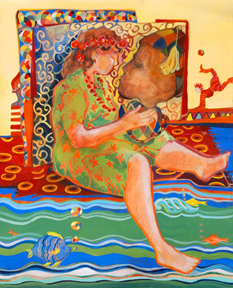
“The Dead Ritual” by Jonathan Vanzant Stevens

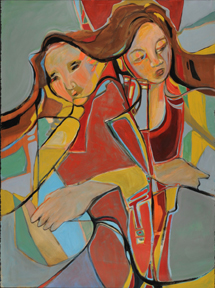
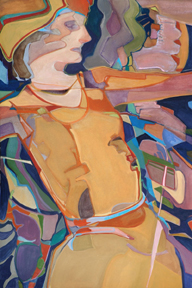
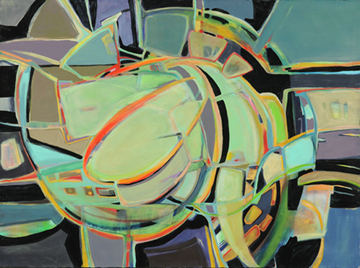
The Dead Ritual (Green Chair)
“The Green Chair” by Marilyn Sears Bourbon

This game is not new. It certainly isn’t one we can call ours, either. But it’s one my brother and I have played every time an occasion calls for it: when our mother died, our sister, my brother’s best friend, Mike, and so on. Though I have to admit, it feels less and less like a game the more we play it.

The first time—when Ma died—we were in our basement. I was sixteen and John was eighteen. We sat opposite each other on stools at an old fold-up poker table. A bottle of Crown Royal was the centerpiece. I hadn’t had very much, but John was about six shots deep. I could smell him. I sensed the stupor he’d fallen into, like a kid slipping off the end of a dock into deep, dark water. The whiff of his breath just about caused the boot in my stomach to kick up anything and everything I’d eaten that day.

“You ready?” he stammered. The sound of his shot glass coming down on hard plastic snapped my brain like a slingshot. I considered for a long, hard moment what my answer should be. After all, this was the first time we’d played.

“Yeah,” I said, steeling myself, “I am.”

I saw the quick glint of silver as John slid the gun off the table—our father’s .357 Magnum. Smith and Wesson. Hell of a gun. Dad only let us fire it a handful of times out on the shooting range in Albion.

“Cameron,” my Dad would say to me, “hold that thing tighter. It’s got a kickback. Don’t fuck around.”

I’d look back at him to affirm with a “badass” sneer. “Okay,” I’d say.

When John first proposed that we get shitfaced and play Russian roulette, to “commemorate the dead”, Dad’s voice ricocheted off the walls of my skull. “Don’t fuck around.” The words lingered like wisps of smoke, dissipated, and I told John I was ready. Ready to twist the cylinder, to rest my teeth gently on the barrel, for that rush of adrenaline as the hammer either ends you, or frees you. I was ready to fuck around.

Since there were just two of us, and the gun could hold seven rounds, our rules were this; one bullet, two turns each. The rules haven’t changed.

The first time we played was nine years ago. After John took the bullet out of the gun, I was pretty pleased with myself that I’d beaten the odds. I was happy for John, too, of course, but as we’ve lost people, the odds have increased. And they’ve only increased because the people we’ve lost aren’t as close to us. They aren’t family or friends. Sometimes they’re just people that John has read about in the obits. If I’m in town and John’s in the mood to get really drunk—which he usually is—somehow he’ll convince me to play.

But this evening we’re not in a basement. We’re outside at Colby’s campus, up on one of the hills behind the track field, tucked out of sight. This is a popular spot for immigrant girls with glamorized perceptions of American boys to smoke weed and take risks. A popular spot to gamble.

John is taking swigs off a small flask full of something, probably rum or whiskey.

“Cam?” He offers me the drink.

“No thanks,” I say.

I look up at the clouds rolling by before us. Little tufts, like acid pink cotton balls are sweeping out in rows. I don’t think John notices them.

~

We sit there for a few hours, not saying much, as the sky turns ink black. No one will see us up here. John is sitting a little ways away from me, fiddling with the gun and probably loading its one solemn bullet.

I hear the snap of the cylinder locking into place. A pause. Then the click of the trigger, the hammer. I hear John exhale.

“You didn’t even say we were starting,” I say, agitated.

He takes another swig off the flask and hands me the gun. “Your turn.”

I spin the cylinder and pull the trigger. Click. My exhalation of relief isn’t as smooth as John’s—it shudders a little as I hand him back the revolver. He immediately starts his turn, but I stop him.

“John, why do we still do this?” I’m not really expecting a solid answer. “We’re not stupid kids anymore. We didn’t even know this woman.”

He sips his drink. “I just like an excuse to play, I guess.”

Click.

“For fuck’s sake, John!” I look over at him, his silhouette in the thick night. He doesn’t say anything.

Click.

“John, stop, listen to me!”

Click.

My heart pounds against my ribcage as I hustle over to him on my knees, ready to wrestle the gun away from his hand. As I’m struggling to get hold of it, click, he manages to pull the trigger two more times. Click. I’m about to yell, when I realize he’s taken seven potential shots. But there are no shots. No blood. Nothing.

I hear him pop the cylinder open; he holds the gun out to me like an offering, catching his breath, and in the faint moonlight through the clouds I see its contents. It’s empty.

I roll off of him, exasperated, like I’ve just scaled a cliff. I breathe and stare up at all the darkness—all the stars, like hundreds of little pinholes that have been poked in black construction paper. They’re vast, glistening, and they’re as plentiful as all of our chances, our opportunities—our odds. I look over at John, and I think I hear him crying, softly.

I wonder if he started counting them all.


Jonathan Vanzant Stevens is a twenty-two-year-old writer and musician living in Maine, though he’d rather be in Australia. This is his first published story. Currently, he does many odd jobs and is also hard at work on a novel about disconnection.

“Cry Like My Wife” by Paul Austin

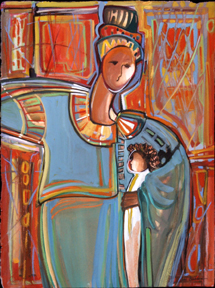
Cry Like My Wife (Flying Carpet)
“Flying Carpet” by Marilyn Sears Bourbon

The surgeon holds out a gloved hand, palm up, and says, “scalpel.” He makes a smooth, long, incision across my wife’s belly, below the umbilicus, and above the pubic hair. Skin spreads. The thin layer of fat glistens yellow. Small red dots appear along the edges of the skin. One spot blossoms larger, and blood trickles into the incision. The surgical assistant touches the spot with the electrocautery pen, and there’s a tiny blue buzz, and a small puff of smoke. The incense of burned blood.

The latex gloves have smears of red, but not enough to make them slippery. The exact and silent movements of the surgeon and assistant become more urgent. They dissect and tug. Grip and cut. Down through the muscles of the abdominal wall, grasping, stretching, and digging quickly, down to the hard purple muscle of the uterus. Then there’s a pause, followed by a low transverse cut, and a gush of clear fluid that sloshes out across table. The room is quiet, save the slurping sound of the surgeon’s hand plunging into the belly, up to the wrist.

The surgeon gropes around, blindly finds the head, and then pulls upwards, wrestling the baby out through the wound.

~

Sally is in a bed in the recovery room. I’m standing next to her. They’ve taken the baby somewhere. Dr. Gage[1] pulls the curtain open, and the guides in the aluminum track make a clicking, clattering sound. He’s taken off his OR hat, and his forehead has a red arc across it. His green scrubs have dark sweat stains under his arms.

“I checked on the baby,” he says “Congratulations. She’s beautiful. She seems healthy, had great APGAR scores.” He pauses. “She has two small heart murmurs – probably a small VSD and a patent ductus.”

Sally and I are both medical people, so we understand – two small holes in the heart.

I take a deep breath. Maybe it won’t be too bad. The VSD may close on its own. Same with a patent ductus.

Sally turns her head a few degrees to the side, keeping her eyes on Dr. Gage.

“We’ll get an ultrasound of the heart,” he says. “Make sure.” His voice is gentle and clear.

“And?” Sally says.

“She has Down syndrome.”

Sally shrieks. Fists at her side, neck veins bulging, she takes a big gasp of air, and screams again.

Sally’s wailing fills the room. Her face is ugly and red. Cracked lips open wide.

My heart beats fast. I lean down, and place my forehead next to hers, hairline to hairline.

She continues wailing.

I keep my head touching her head. Her screaming is full throttle.

Her gasps for air become more frequent.

I close my eyes.

~

A nurse brings the baby into the recovery room, to feed.

“Do you want to hold her?” the nurse says.

I shake my head.

Sally reaches out. “Hello, Sarah.” Sally’s voice is musical, and hoarse from the screaming.

Sally grabs the bottom edge of her gown, pulls it up, and tucks it under her chin. Her breasts are swollen and heavy, with faint blue veins visible through the pale skin. “Let’s see how we do,” she says.

The nurse watches as Sally grasps her breast.

“Farther back from the nipple,” the nurse says. “Sarah needs to get a big mouthful.”

Sally holds Sarah close, and brushes the baby’s cheek against her nipple.

Sarah opens her mouth wide, like she’s yawning, and Sally pulls her into her body.

Sally smiles.

“Like a pro,” the nurse says.

I let out a pent-up breath.

Sally looks down at Sarah. In oil paintings of the Madonna and Child, the light is soft, and the shadows softer, and breastfeeding looks peaceful and quiet; it suffuses a radiant calm. But surrounded by the pastel stripes of this too-bright cubicle, this meeting of saliva and skin, milk and tongue, is a slurping, grunting, air-whistling-through-the-nostrils affair. And it’s a cold bright light that shines down on this baby.

~

It will be twenty-two years before I cry for my daughter like Sally did. It happens while I’m at a writers’ conference working on this book. I’m in a workshop taught by Nick Flynn, a writer I have long admired. He assigns an exercise in which we cut our manuscript into chunks of text – actual paper and scissors – and rearrange them. The empty spaces are supposed to open up our minds. At first, it seems precious – gimmicky. But Nick’s writing is so brave and clear, I decide to give it a try: see if it works.

We’re at The Atlantic Center for the Arts, in New Smyrna Beach, Florida. About two miles inland, the Center is a small cluster of buildings, all redwood siding and angled rooflines jutting into the sky. The buildings seem to float in a sea of plant life – the spiky fans of palmetto palms, wild magnolias, scrub oaks and Spanish moss. The illusion is enhanced by the weathered wooden walkways between buildings. Without the waist-high railings one might expect, they look like piers, jutting into the lush green foliage.

Our workshop meets in a small and narrow library, with two walls of books, and two walls of windows. For this exercise Nick has arranged for us to use one of the artists’ studios. It’s a large open room with a concrete floor, natural light, and five long tables splattered with paint, giving the place a Jackson Pollock feel.

I start out calmly enough, laying out two rows of blank paper, stark and white against the reds and blues and yellows of my workspace. I glance around, and my classmates are all busy cutting and taping. I enjoy the summer-camp feel of the activity – the absorption of scissors and tape.

I cut several paragraphs free, and spread them out onto the pages. They look like chunky fortune cookie slips. So much white space and so few words. I glance at my classmates’ work. They have more pieces of text, and they are all busy moving the pieces around, rearranging them. My pages look bare. I turn to Nick, who is pinning pieces of a poem onto a wall. “Can we use pictures?”

He turns. “Sure. Whatever helps.” Turns back to his work.

I go to the computer center, and print off pictures of the things I’ve been writing about. Three portraits of John Langdon Down, the “father of Down syndrome.” He’s wearing a frock coat and a black bowtie. Two photographs of Jerome Lejeune, the scientist who first discovered the extra twenty-first chromosome that causes Down syndrome.

I print out the karyotype that Sarah’s geneticist gave me after she was born. It’s an eight-by-ten photograph of her chromosomes all lined up two-by-two, except for the twenty-first chromosome – it has three. I print a snapshot of Sarah, dressed up as a wicked princess for Halloween. Another photograph of Sarah, 22 years old, living in a group home. She’s sitting between two framed movie posters – one with Gene Kelly, Debbie Reynolds, and Donald O’Connor skipping forward in yellow slickers, umbrellas twirling – Singing in the Rain. In the other, Audrey Hepburn poses in a slinky black dress, neck encircled with diamonds and a tabby cat, black gloves all the way up to the elbows – Breakfast at Tiffany’s.

I place these pictures on the near-blank pages, and step back from the table. Stare at the pages. Try to let the process work. I lean forward to jot a note to myself in blue ink on the white page. Stare some more.

The picture of Sarah’s chromosomes entirely fills the page. I lean down and write, “This picture looks so big. So real.” I look over at a snapshot of Sarah. It looks so small there, askew in the corner of an empty page. It hits me that from the day she was born, I’ve seen a diagnosis instead of a daughter. This strikes me like a bolt of lightning splitting a tree. I feel as if something in my chest has been riven – my aorta torn away from my heart, or my trachea ripped free from my lungs. I do not know my daughter.

I feel tears coming. I leave, pushing thorough the door of the studio, and out into the sun. I make it partway down the unrailed walkway. But this feeling in my chest is too big to control. I jump down into the bushes, pushing alongside a building, the branches scratching my face, vines catching my feet, crying, and sobbing, till I come to deck, a bare platform without railings. I stop and wail. I am undone. Unhinged. Bereft. I hear my howls swirling out of my body and into the air. The shrieking finally slows to sobs. I become aware again of the sand under my feet, and the thicket I’ve stumbled into. I take a gulp of air. The breeze is soft against my face. The trees sway gently.

“Are you okay?” I hear someone call from the walkway, a disembodied voice coming through the tangle of plants.

“Yes,” I call back. I take a deep breath. “I’m fine.”

“You sure?”

“Yes,” I say. “Thanks.” I hold my breath. I don’t want anyone to see me.

I hear a few footsteps on the wooden pier, and then a door in the building I’m standing next to open, and then close. Fuck. I’ve been wailing right outside someone’s workshop.

I blow my nose on my fingers, and sling the snot into the bushes. I wipe my fingers on the cuffs of my jeans. Wipe my face and cheeks with my shirtsleeve. I feel empty inside. Clean.

I push through the bushes back to the walkway. No one is there. Good. I climb up onto the walkway. Find a bathroom. Splash my face. Dry it.

The studio is empty: they must’ve gone back to the library. At my table, I stare at the photograph of Sarah, and gently straighten it on its page, glad that it’s not too late. My daughter will forgive me. It’s the way she is.

I walk back to the library. The group is sitting around the table. Nick looks up.

Thought we’d lost you,” he says. “Did you go to make more copies?”

“No,” I say, gesturing outside. “I was needing to cry.”

He looks at me and nods, as to say, “that sometimes happens.”

I feel calm and expectant, like that glittering moment right after a thunderstorm, when the trees and sidewalks and streets have all been scoured clean, and new. I’ve been given a second chance.

At lunch, Nick walks up with his plate and silverware. “Can I join you?”

“Please.”

“Mary Gaitskill’s workshop heard you.”

I wince. “Sorry.”

Nick waves it away. “She thought it was an animal caught in a trap.”

“Not far off,” I say.

“You’re in the middle of it.” He takes my shoulder and gently shakes it. He smiles. I feel as if he is welcoming me into a new place.

“Yup,” I say. It’s Sarah’s shorthand way of summing up a complicated truth. I am eager to get home. Get to know my daughter.


Paul Austin’s first book, a memoir, came out in 2009 “Something For the Pain: One Doctor’s Account of Life and Death in the ER” (W.W. Norton) and received a starred review by Library Journal. The Boston Globe called it “a stunning account of the chaos of the emergency room.” He has attended the Bread Loaf Writer’s Conference as a contributor, a waiter, a scholar, and a fellow. His fiction and nonfiction have been published in Discover Magazine, The Florida Review, The Gettysburg Review, Creative Nonfiction, Ascent Magazine, The Southeast Review, and turnrow. “Cry Like My Wife” is an excerpt from Paul’s upcoming book, Beautiful Eyes, which will be published in late 2013 or early 2014, by W.W. Norton.


[1] The names of family members are unchanged. All other names are changed to protect their privacy. Dialogue is recreated as accurately as memory will allow.

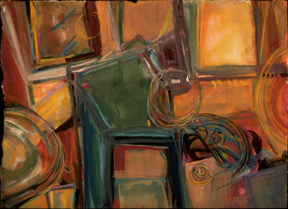
“If Ever You Decide You Should Go” by Elizabeth Dalton

If Ever You Decide (Spirit Sisters)
“Spirit Sisters” by Marilyn Sears Bourbon

The first question on late spring mornings is this: Can we go barefooted? We look out of the living room window. The porch and front yard are still shady, but spots of sun stipple the grass. An old woman across the street sweeps her sidewalk, but it’s early; there are no kids outside yet. Our mother calls us into the kitchen and tells us to sit and eat. The room fills with the rhythmic whoosh of percolating coffee. Down the hall, we hear our father shut the bathroom door and turn on the shower. While we chew and slurp from our cereal bowls, I try to get glimpses of the backyard as Mom moves between the table and the storm door. The yard is yellow with light. The grapevine curls around its arbor and the bush in the far corner is in full leaf. Can we go barefooted?

We are sent to our room to find clothes, as few as possible, which we pull on in a hurry. We are told to brush our teeth. When we return to the kitchen, the bowls have been cleared from the Formica dinette set to make room for Mom and Dad and their cups of coffee.  In the window framing their heads, the persimmon tree moves in what I hope is a warm morning breeze. Mom looks up and briefly inspects me. With a dishcloth she wipes the last of the toothpaste from the corners of my mouth, and, using a formula that seems to include thermometer readings, newspaper weather forecasts, and perhaps an actual field test, she determines that we can go barefooted today.

I push the metal door handle and burst out of the kitchen. Molly and I run tiptoe down the steps, dropping our rag dolls on the rough concrete, push off the sidewalk and land in the grass. We stand for a moment caught between horror and delight as the late spring soil embraces our feet, sending chills up our shins. Here we pause, feeling the last remnant of the winter’s cold and snow, then we run to the jungle gym and climb the ladder, our toes curling around the warm metal bars as we reach for the trapeze or the white plastic hand rings. We swing through the air, dew drying from our soles and the crevices between our toes.

We tire of the swings and brave the wet grass again. Our feet are light, more like wings than paddles and so we dash around the perimeter of our universe: along the alley in back of our property, along the side of our yard adjacent to the Dennys’ weather-stripped, haunted house, behind our garage, up past the back door again, around the persimmon tree where the roots punish our heels, and then the length of the old grape arbor that is too shaky for us to climb. We relearn our world, where we are likely to stumble or twist ankles, as well as where the dog’s bathroom is.  We find patches of clover and ugly crabgrass, and the occasional thistle. Here and there are bald spots where, later in the summer, we’ll find ants coming and going as purposefully as the fathers in our neighborhood.

We stand on the step for a moment, the soles of our feet making perfect wet prints on the concrete. Molly’s are almost the same size as mine, even though I am older, almost done with first kindergarten while she can’t even write her name yet. We sit down, pulling our dolls into our laps, and I scratch at my ankles, where my skin is crawly with dew and the itchy memory of grass blades. Sunlight the color of lemonade finds its way around the small persimmon leaves, leaving spots on the concrete and grass around us. A couple of birds tussle in a branch overhanging the pastor’s side of the fence. In his kitchen we can hear plates and silverware being placed on a table, and the occasional rush of water from the faucet. Across the alley, some neighbor kids run outside and stand blinking in the sunshine. The back door slams behind them. Down the alley, a dog barks and another answers. The day has begun.

Molly’s rag doll has blond yarn for hair while my doll’s hair is dark brown. Otherwise, they could be twins. Both have felt eyes and velvet dresses over white bloomers we almost never make them wear. They are big girl dolls with rosy cheeks. Mine is older, like me, and likes to fly because she is a superhero, and so does Molly’s. Simply running with them does not work, we’ve discovered, for they hang limp in our hands no matter how fast we can sprint, and we are fast. Instead, I hold mine by her hand and spin just like a tornado. She flies at the end of my outstretched arm, her pink legs kicking in the wind. Molly’s doll flies, too; I catch glimpses of her blonde yarn-hair as I turn. I yell encouragement to my doll, and Molly does, too. The house and tree and yard flash by my eyes over and over again until I give in to the urge to close my eyes and tilt my head to the side, which makes me feel like I’m being tickled from the inside out with a little sick thrown in.

I turn a few more times until my knees give and I tumble into the wet grass. Molly, our dolls, and I lie there, behind the garage, catching our breath and staring into the sky, which is a lot like staring into a lake. Instead of darting fish and rolling puffs of algae there is an occasional jet, as slim and silver as a minnow, and the clouds, big enough to make their own shadows on the yard. From where we lie we could simply push off and dive right in.

~

My sister gave her notice the day before she died. A dark stocking cap hugged her scalp and a white hospital blanket puddled around her body. Well-worn socks kept her feet warm in the seasonless hospital room. My short-sleeved yellow dress and the evaporating warmth of the sun on my arms were the only indicators of the spring day that had opened like the dandelions in our lawns that morning. I sat in a chair right next to her bed, but reaching her was like talking to someone through a closed door. She wiped at her eyes with a tissue and tugged the blankets up under her armpits with a hand so thin her wedding set slid up and down the length of bone between her palm and the first knuckle of her ring finger. This is no life, she said. If I can’t get better, I’d rather die.

No you don’t, I said. But I knew she was losing ground. Watching her walk through the house during the past month had been like watching an unsteady toddler. She struggled to negotiate the single step between her utility room and kitchen, sometimes clinging to the wall with both hands for support, after she started the laundry. Her long legs were emaciated and skin draped across her collarbones into the hollow of her neck. Worst of all, she had nearly dropped the baby a few weeks earlier as she carried him to his crib, and since that time she had been terrified of holding him while standing. Instead she had to content herself with watching from the depths of her recliner as the rest of us swayed with Jesse in our arms. Her eyes followed us until the morphine overpowered her, and her restless hands fell still in a pile of crochet thread.

She never left her home alone now, this thirty-year-old woman who, five years before, had hopped planes on a whim and pointed her rackety hatchback in any direction that looked interesting.  This girl who was as likely to be in Chicago as Muncie on any given weekend, letting none of us know about her journeys until well after her return. Her travels within Muncie were just as adventurous, at least as far as I was concerned: Drum circles, dim living rooms full of smoke and philosophy, alternative rocker venues with gypsy friends—people with long hair and antique jeans—who moved through a haze of patchouli. People who traveled lightly and often.

Later I learned how she wept when Dad drove her to the hospital earlier that day. Even now, I cannot bear to think about this home-leaving—the last look around the place, the last shallow breath full of the smell of her new family, a last touch of the doorknob marking an entrance to the familiar and safe. The instinct to die privately is one even animals understand. None of us chooses to begin or end a journey from a strange place.

When I returned to the hospital early the next morning, I found my parents in the oncology waiting room wearing the same clothes I had left them in the night before, and I discovered what it means when an official-sounding voice on the phone tells you a loved one has taken a turn for the worse. I sat down on one of the upholstered foam sofa cushions and tried to feel my way around the tinnitus that reverberates in my head when I am confused or distressed.  I watched my parents, helpless with grief and sleep deprivation, and saw the shape of my family shift.

I drifted down the hall to find a phone. It didn’t seem possible that the sun could shine in the windows of the rooms that I passed. It didn’t seem possible that other patients in that ward could still be talking, watching daytime television, or breathing while my sister was cut off. Her door was closed and a white notice was taped to it to keep hospital personnel from bumbling in on mourners such as my brother-in-law, whose heartbroken sobs brought me up short. I ducked my head and kept moving toward a bank of phones at the end of the hall. There was weeping elsewhere, too, and later I learned a counselor was brought in to work with the nurses, who were also horrified by my sister’s death.  I was gratified by this, glad that even the professionals recognized this death as one worth noting in a ward where death is far too commonplace.

I was the last of our family to sit with Molly that day. I pushed through the door and entered, frightened as a child. Sunlight streamed through the bank of windows highlighting the scene of a struggle. Chairs crowded against the scuffed wall and the wastebasket gaped in its corner. The bed was askew.

I took the chair next to my sister and rested my forearms against the bedrail. I looked at her for a long time and I said her name. There was the face I had always associated with her name, and the hands, slim and well cared for. There was her nose, thin as a knife-blade, and the thyroid scar in the hollow of her throat. How many times had I watched her sleeping during our childhood years? How many times had I sighed loudly or elbowed her to wakefulness just to ward off loneliness in the middle of the night?

In three days I would reach my 31st birthday, and after that would come the Fourth of July, and then Halloween, Thanksgiving, and Christmas. The whole merry-go-round would spin in its place as it always had, largely insensible to her absence.  Yet, in those few moments at my sister’s deathbed I became aware of a silent universe surrounding the spinning calendar of seasons, birthdays, obligations, and family gatherings. Sitting as I was in the center of the rush and noise, I couldn’t make out much but the blackness of this expanse. Still, I knew it was there, just as I had felt the vast Atlantic at my feet the first time our parents had taken us to see the ocean. We had arrived late at night but insisted on going to the beach. Rooted in the sand, the wind teasing my hair, I could see nothing but blackness, nothing to separate the sky from the sea, the sea from the land. Now, as then, I crouched at the edge, peering into that swirling darkness beyond and wondered about the brave and marvelous beings that moved there.

The muffled scrapings and shufflings of the hospital staff seeped beneath wide door. Dust motes drifted through the light streaming onto Molly’s bed. The business of the day was picking up. Everyone, including my parents, who, God help them, had arrangements to make, was waiting on me. I looked around the room one last time for some sign of my sister, but I could see her body was as empty as a pair of overalls she’d unfastened and dropped to the floor before stepping away.

~

Night trains sometimes drag me up from that deepest, unknowable stratum of dream into the realm of the half remembered. On those occasions, I am as much girl as woman, still sister to a sister. We drive along the flat, sun-parched roads—Molly and I—after a late band practice, roads that have become narrower and darker throughout the summer as the corn walls rise alongside. Now and then the corn drops back to reveal a tired farm spread out before us on both sides of the road: Harvestore, white barn and weathered farmhouse, cows knee-high in muck, two dogs dashing senselessly at our spinning tires. I bear down on these places like a plane, and swoop past them, honking at the windows’ watery reflection of our dust-streaming car. Windows down, we sing along to Top 40 songs written just for us—beautiful teenage girls, fresh and full of everything the rest of the world craves. But we are flying down the road so quickly nothing but the sun can keep up with us. Even the songs themselves are gone before they have time to play themselves out. As soon as we are bored with the lyrics, Molly turns the dial to find something else. Our tiny forearm hairs glisten against our skin. Gravel thunks along the undercarriage but I slow down only for stop signs and the occasional oncoming vehicle.

The grill parts the late summer air in front of us, and the evening sun nestles into the woods in the distance. Molly twists the radio dial, settling on the a cappella voices of the Eagles. “There are stars in the Southern sky,” we sing. “Southward as you go…” The old song, older than we know, streams past us and I think about a road with seven bridges, one in the country just like this, where moonlight pools in the fields and time seems to hang like dew gathering on a leaf. A place a child would run to, a place we might run to, if need be. So we sing, our voices serious and full of meaning we don’t really understand: “There are stars in the Southern sky—“  Molly pushes a strand of hair off of her sweat-spangled forehead and jumps up to the harmony line: “And if ever you decide you should go/ there is a taste of time sweet as honey/ Down the Seven Bridges Road.”

In this way, we make an angular spiral toward home, following the derelict country roads in an ever-narrowing square until we find ourselves bumping down our own sticky blacktopped road. The light is on in the kitchen and our mother’s silhouette moves from stove to table. Sun gilds the tops of the catalpas, but night is already growing beneath them. We taxi up to the garage and step out onto the warm driveway with our shoes in our hands.


Elizabeth Dalton’s work has appeared in a number of literary journals, including PMS: Poem/Memoir/Story, Earth’s Daughters, New Millennium Writings, River City, Sliver of Stone, and Clockhouse Review.

Read our interview with Elizabeth here.

“Harold” by Jonathan H. Scott

Harold (Eve with Cain)
“Eve with Cain” by Marilyn Sears Bourbon

I am born with my grandfather’s name,
A joy to break the fever
Of his death—
My mother’s mourning sweated
Out—labor
Of loss, delivery of me.

Me into the world of linens, a whiteness
Of nurses, of lilies, of sun-paled walls.

We are our tears—mother and me,
A weep, a wail,
At the first pang of a new death
In the distance, at the last expulsion
Of placenta.
Recovery is ours to begin.

She in sleep—replenishment.
Me in purple bouts of struggle.


Jonathan H. Scott lives in Birmingham, Alabama. His poetry and short-stories have been published in The Able Muse, Blood and Thunder, Hospital Drive, Measure, Muse and Stone, and others.

“Greenie” by Tessa Torgeson

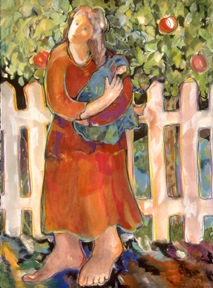
OLYMPUS DIGITAL CAMERA
“Mother and Child” by Marilyn Sears Bourbon

I am a terrible, obvious liar. My nose squiggles and my legs start to fidget. I feel like I’m about to implode. My cheeks are still chubby and rosy with childlike naiveté and sometimes older strangers pinch them.

So it is with truth I say I had been clean and sober for 89 days. But I let it all slip away from me. Because of my vulnerability, my thin skin and heavy heart, I felt the world’s pain as my own. In a flash of a moment, in a fraction of a fraction of a second, I forgot I cared about anything.

I left rehab that night in flames. My feet felt like phantom limbs. Floating on their own down seventh avenue, that pitch-black street with no streetlights even to illuminate or keep the street company. I knew better than to go down that street but I went anyway toward the seedy dive bar. The seedy dive bar alcoholic’s haven. People like us get looks at the bars normies hang out in. Normies are people that wait till after five to drink and enjoy the taste. At our joints, you feel no shame for dumping a bag of loose change on the counter with fingers crossed. You feel no shame if you just pawned your dead great grandmother’s sapphire engagement ring for booze money. You feel no shame if you tremble outside the storefront at 9:55 a.m., eagerly anticipating its opening. Shame vanishes after the first drop.

Vanishing. Next thing I knew, I was clutching a paper bag in that dark street. I hardly remembered if I paid. I’m sure the longhaired dude with a penchant for comic books was working. He stopped carding me long ago. I imagine my hands were shaking and he wondered why I hadn’t bought my medicine lately.

I floated on phantom limbs back to that alley. I ripped the fifth of Karkov because of the way it burned, because it ignited my throat like poison. I was trembling, barely able to hold my hands still. My fingers knew what to do but my body rejected it. I vomited bile. Goddammit, I wanted that blanket of intoxication to cover me. I chugged it. Then I was so consumed by crushing guilt, I swallowed a fistful of Ativans and Effexors. I took a razorblade to my wrists. My wrists became the canvas. My memory is in flashbulbs like the fluorescent lights with the whir of the ambulance whisking me off in the night. The ambulance is the stagecoach for alcoholics. We don’t lose a glass slipper. We lose our sanity.

The screeching sirens still burn in my nightmares and I wake up in a cold sweat, the blinding bright red and blue twisting and distorting into a fucked-up watercolor palate. My head spinning, brimming with chaos, I am in a stretcher again. A bright red wristband to warn others I was on a 72-hour hold for suicide watch.

~

In 403 B, I awake to the orchestral hums of the fluorescent lights and floor waxer. I expect a welcoming committee with clowns and fire-breathing dragons and balloons, but I roll over and realize by the cold sterility and lumps in the mattress that I’m lying in a hospital bed. They must have already given me Ativan because I feel like I’m tripping out of my mind. I think I see David Lee Roth over my bed shredding.

Instead I hear a soft, confident voice and feel the tightening of a blood pressure cuff like a noose to my arm.

“Hey, it’s Sandy I’ll be your C.N.A. tonight. Okay, I’m just gonna check your vitals and pump some more fluids into you.” Sandy looked to be a few years older than my mom. She had a weathered face with gentle blue eyes. I became aware of the acute stinging of the new IV in my hand.

“Your pulse is still 150, but the Ativan should help with your anxiety.”

I nodded. And tried to smile but then I remembered where I was (again) and couldn’t make my muscles move.

“It’ll be ok, just rest up. Anything I can get you?” Sandy asked.

I wanted to ask for my sanity back but my mouth was frozen. I really wanted home. I wanted home and it was impossible because I belonged nowhere. I asked her if my friends brought anything and she nodded. Before I could ask her to get it she was gone; she knew how much I needed home. She was gone like she knew where she was going. She held out my bright blue duffel bag. I found my blankie, greenie. In its shambles it was barely recognizable as a blanket. But it was my familiar. I reached for it.

“Sorry, but I can’t let you have that. It could be used in a way…” she trailed off. “Well in a way it shouldn’t be used here and it’s our policy.”

Tears rolled down my cheeks. I brushed them away with my sheet and offered a faint, “I understand.”

“I can cut you off a corner if you want,” she said. “Let me go do that for you.”

“Please? That’d be so…” I tried to let the words of gratitude come out but Sandy had already bustled down the hall. I clung to my greenie, my piece of home.


Tessa Torgeson lives in Fargo, North Dakota. She recently graduated with an English degree from NDSU and hopes to pursue her MFA in Creative Nonfiction. Her poetry has appeared in the Red Weather literary journal. Her blog can be found here.

Read an interview with Tessa here.

“I Dreamed Your Epic” by Gay Giordano

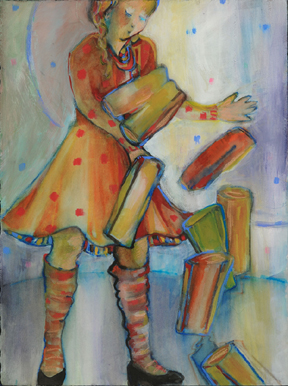
I Dreamed Your Epic (Whoops)
“Whoops” by Marilyn Sears Bourbon

Children roll out like oranges
from doorways,
you appear, neck slashed
by a red scarf.
Ugly matrons full of advice
yank their fleshy stockings by the band
then pour the principal’s coffee.

Your mother half expects you to have caught
your scarf in a wheel
garland of itchy regrets
her petticoats frozen
her hair stiff.
You retreat into your peel.
Poor little orange.

Your father comes home
throat stitched to his collar
gurgling into a martini
tossing olives at the dog.

That envelope in the attic, dust,
your father beating the days,
your dollhouse like ashes.
Everything is used, even the roses.

Your mother stares at the ceiling
listening to the house pleat.
She has only lent you her face,
yours is on tiptoe
waiting for an invitation.


Gay Giordano earned her BA from Carnegie Mellon University in creative writing and her MA in philosophy at The New School for Social Research. She has been published in Mudfish, Ghost Ocean Magazine, The Lullwater Review, Illya’s Honey, The South Carolina Review, The Oakland Review and other journals. She has been a resident at VCCA, The Martha’s Vineyard Writer’s Residency, the Banff Center for the Arts, Bennington College, and the Dorland Mountain Arts Colony. She lives in New York City with her husband, with whom she co- translates German-language plays and aphorisms.

Read our interview with Gay here.

“Heartbreaker” by Sue Staats

Heartbreaker (Let's Dance)
“Let’s Dance” by Marilyn Sears Bourbon

We stand on the sidewalk outside his house, watching his daughter, and my brother says every time I see her walking down the street it breaks my heart.

I can see why. It’s not a walk, really. It’s a lurch, a stagger, a shuffle.

His daughter is twenty-two. She broke his heart with joy when she was born and with fear when she was five days old and stopped breathing and again with terror when she had the surgery to fix that mis-made heart.

Since then, his own heart has been a construction zone: continuously broken and re-broken, patched together so many times it’s a bit misshapen. Yellow tape marked do not cross surrounds it: traffic cones warn of dangerous ground. Of holes. Of weakened areas.

She throws her long thin arms around me, cries when I arrive. She will cry when I leave. In her embrace, I watch my brother over her shoulder.  His light blue eyes are reflective, transparent, fractured in the sunlight.

My brother takes her to Pirates games. She loves baseball. He takes her to church. She stares into the high vaulted space with long-lashed brown eyes too far apart. Her mouth hangs open, her lips parted and loose, her teeth crowded.

He says close your mouth, sweetie and she does, pushing it shut with her long, lovely fingers.

There’s something I’d like to tell her about what she has done to her family. But she may already know. Or not. Who knows if it would matter.  Who knows what she knows of broken hearts, of disappointment. She doesn’t talk. It’s enough to break your heart.


Sue Staats recently received her MFA in Fiction from Pacific University. She’s currently revising her novella, The Mitchell Boys, and working on a collection of linked short stories. Her short story “No Hero, No Sharks” was runner-up for the 2011 Gulf Coast Prize in Fiction, a finalist for the 2011 Reynolds Price Fiction Award, and was published this past spring in The Farallon Review. Her fiction, non-fiction and poetry have also been published in Susurrus, the literary journal of Sacramento City College. Her poetry was featured in the 2012  Sacramento Poetry Anthology and her short story “Marshmallow Empire” was a finalist for the 2013 Nisqually Prize for Fiction.

Read an interview with Sue here.

“Umbrella Mouth Gulper Eel” by Jamie McGraw

Umbrella Mouth (Escargot)
“Escargot” by Marilyn Sears Bourbon

Two nights ago my father found me

dead. My body formed like a metal scrap
malformed by extreme heat.
A beat of him in an ocher grave.

Outside a starling grappled with a whore of a bee.
Inside a syringe containing cotton shreds,
coagulated blood, bacteria, and smack
hugged my left forearm.

*

At age five I called ants my friends,
showed them my baby teeth collection.
They grew so fond of me,
learned it’s okay to lose things,
you’ll go right on living.

*

The day I died I studied photographs of deep-sea creatures:
megamouth sharks, fangtooths, vampire squids.
The most frightful ones filled with light.

They care not who sees their crookedness,
their orthodontic atrocities.
God damned them to the deep,
because they’re so damned ugly.

Not so unkind, though,
to be so deep in something
that God grants you your very own light.

Just so you can recall your body.
Just so you can remember
you exist.


Jamie McGraw lives in and sometimes leaves North Carolina. She is currently enrolled in Queens University of Charlotte’s MFA program. Previous work has been published in APA journal Families, Systems, and Health, Red Fez, and Beatdom. Her spirit animal is a lobster. Don’t ask. (Actually, no. Do. Do ask.)

Read an interview with Jamie here.

Interview with Daniel Nathan Terry

Mary Akers: Hi, Daniel. Thanks so much for agreeing to talk with me today and for letting us have your wonderful poem, The 8th of May: A Vow. Could you talk a little bit about the inspiration for this poem? I mean, the poem gives us the genesis, but what I’m interested in hearing about is the process by which a video of a hateful act mutates into a beautiful and sensitive work of art.

Daniel Nathan Terry: My pleasure, Mary. Thank you. I love your journal. The act of writing this poem, making the video and posting it to YouTube happened like a brushfire. I mean that I saw the clip of the NC man firing his gun into the sign that opposed Amendment One (which amended the NC Constitution and banned same-sex marriage), and I caught fire. I had nowhere to put my anger, no way to salve my wounds, no way to assuage my fear. So I drafted the poem, revised it (I think), filmed it, and posted it all within a few hours. I had never written a poem this way before, and I doubt I will again. This is not my process (normally, I revise over a long period of time), but events seemed in control of its creation. My partner (now husband) and I had planned to get married in DC on May 7th. We didn’t know of the proposed amendment vote on May 8th when we set the date the year before, but we were locked in due to finances and our teaching schedules. We had been together for over 16 years, and we didn’t want our marriage to be about politics and religious doctrine. We certainly didn’t want to believe that our own neighbors would fire guns into signs that represented our union. It felt like being burned in effigy. It felt one step away from being lynched. I needed to find some way of assuring my fiancé, Ben, and, indeed, myself, that I would be able to put this surge of hatred from my fellow citizens behind me–at least for one day, one hour, while I married the man I had loved for nearly two decades. I needed some means of answering the gunman, addressing those who agreed with him, and, somehow, I also needed to surface from the hatred, to reclaim the joy and peace Ben and I had made with each other. Of course transformation is often the goal of art, but I had never felt the urge–the need, really–to do so this swiftly. It felt like, I imagine, casting a counter-curse would feel. Not just a warding off of negativity, but the creation of something opposite and equal to send back to the sender–if only symbolically. That probably sounds a bit nuts, but that’s how it felt, and that’s why I posted it immediately to a public outlet. I wanted it out there and not in here–you know, my head, my home. That said, we did return “home” to a state that voted against our union, returned to church signs celebrating a “moral” victory over our love. I have never felt at home since that day. We did what we could. We campaigned against it, voted against it, but the majority of NC voters supported the ban. It is hard to feel at home when the majority do not want you there. You wonder if you should stay and fight or simply go somewhere safe and affirming. But we are not rich enough to make a choice, so we are staying, and we continue to teach and make art. Some days, it seems like knowledge, poetry and art are all we have. Some days that’s enough to make us happy.


MA: A counter-curse. I love that. It doesn’t sound nuts at all–makes perfect sense to me. (But perhaps I am also nuts.) I first read your poem online (Facebook, I think) and loved it so much that I solicited it from you for our journal. That doesn’t happen that often, but perhaps our readers will be encouraged to know that it does happen. Good work has a way of getting noticed if we put it out there. You subsequently had another bit of good fortune come from sharing this poem. Could you describe that for our readers?

DNT: Yes, there was a surprising reaction to my posting the poem. “Scarecrow,” one of the poems from my new book,  Waxwings, which was due to be published July of that year, was about to be featured in print and video as poem of week on TheThe Poetry. One of the editors, Christopher Phelps, saw the video of “May 8th: A Vow,” and asked if he could switch the two poems. He felt that the new poem was timely and might do some good if it gained more exposure before the vote. This happened very quickly. I think the poem, from genesis to acceptance took just over 24 hours. A few days after it was posted by TheThe and various social media, you contacted me via Facebook and asked if r.kv.r.y. could reprint it in October. I was blown away. I have admired your journal and its mission for some time. And I was so grateful that this poem’s life was extended a bit longer–especially after Ben and I returned to NC and Amendment One was law. It was good to know that we were not alone in what felt like a very hostile world. And it was surprising to feel embraced after facing such hatred. It was unexpected. I never expected this poem to be written. I never expected it to be received by such fine journals. And I certainly never expected it to lead to my first Pushcart Nomination in poetry. I suppose that good can come from bad, beauty from ugliness, enlightenment from ignorance. I suppose that is something art can do–transmute. And I do think that good work gets noticed. Maybe not in the beginning, but eventually. More and more, I find editors requesting poems because they liked my work in another journal. I don’t expect that to continue indefinitely, but it has been a nice intermission from the un-solicited submission process, which is such a time-eater on both ends of publishing.


 MA: I love that beauty can come from ugliness. That’s one of the things I strive for in my own work. Sometimes I can’t let a particular awful or confusing thing go until I have changed it for the better or given the world another way to look at it. I’ve written about the Indonesian Tsunami, the Terri Shiavo case, and other high-profile news items that upset me. It helps me process, I think, or helps me to write a better ending. Is this what motivates you, too? Do you ever take stories from the news and write about them?

DNT: I do. It isn’t always what motivates me, but it often is. My first full-length book, Capturing the Dead, is a collection of poems about the photographers the American Civil War. It was a direct reaction to the “War on Terror” and the /images that were, except for color, so similar to those taken by Brady, O’Sullivan and others so long ago. Every war became the same in my head. Every dead man, woman, child, horse became the same dead body. Every ruined house, the same house. I couldn’t let go or make sense of this war which was the same war (to me) and therefore endless. The same happened with the Katrina poems I wrote in 2005 and 2006 (which became the chapbook Days of Dark Miracles  in 2011). The horror of Katrina wasn’t that some new monster had arisen–although I think the media tried that angle. The horror was that the same old monster had risen again–poverty, racism, greed, and the foolish notion that we have some control over this planet. Yes, I do find myself writing about the news–new and old. But I think the impulse behind this need to address public pain and transmute it or translate it into art is the same impulse that drives what some have called my confessional poems. I don’t know that I try to turn these events–public and personal–into beauty, but I often discover the beauty that is inherent in all things, and this discovery, this uncovering, is what, for me, makes life livable.

MA: I’m fascinated by the ways in which art and the written word combine to make an even greater collaborative object. What did you think of the photo collage chosen to illustrate your poem?

DNT: I loved it! His work is wonderful. The image of the lone man coming home to the house which was also a tree seemed so right for the poem. Sheltering but so alone. Beautiful. Haunted. I wish I had a print of it. Visual art is on my list of reasons to wake up in the morning. I often work in response to visual art (probably a result of being married to a painter and printmaker), and that process seems so comfortable and reflexive. But it is so invigorating when it is reversed or when an editor pairs my work with a visual artist’s work. It is a new way of seeing.


MA: Who are some of your favorite poets? Do you find that you gravitate towards work with similar sensibilities to your own? Or do you like to read very different work from what you write?

DNT: There are so many from such diverse traditions and sensibilities. I know that’s a standard response, but it is true. I tend to gravitate toward collections and poems, not poets, if that makes sense, and in that way my reading is all over the place. That said, there are poets whose work I go back to repeatedly and many them have directly influenced my poetry: Transtromer, Szymborska, Bishop, Wilfred Owen, Plath, Ted Hughes, Kenyon, Kinnell, Yeats, Millay, Tu Fu, Lorca, Whitman. And there are some contemporaries I adore: Trethewey, Lavonne J. Adams, Ed Madden, Nicole Cooley, Judy Jordan, Mark Wunderlich, Virgil Suarez, Jericho Brown, Kristin Bock, Malena Morling, A. Van Jordan, Linda Gregerson–way too many to name here. I had the good fortune of reading with Marcus Wicker at Devil’s Kitchen this year. His first book, Maybe the Saddest Thing, has become a favorite. His poetry is so different. I love his voice and his way of seeing.


MA: Those are wonderful poets, all. A personal favorite of mine from your list would be Jericho Brown. We were fortunate enough to publish his poem Like Father in my very first issue as Editor-in-chief. I so admire his work.
And I have one final question: what does “recovery” mean to you?

DNT: Can I get back to you on that? I’m sort of kidding. I think it means to be capable of growth again. The camellias in my garden are a good example. If one of them is seriously injured by a harsh winter or a falling tree, they may survive, cling on to life for years–but they often do not produce new growth. And so they linger from year to year, living, not dying, but not growing. Sometimes it is a mystery. I give them all the care they require, but some never grow again–or at least, have not yet. I did that for years, too. I was surviving, but I was not creating, not growing, not recovering. I like to think I can feel new growth with each poem I read and write. I like to think there are new branches just beneath the skin.


MA: Beautiful. Here’s to New Branches. (Sounds like a poem title…) New Branches all around!

To read more of Daniel’s fine work, check out his books:

Waxwings (2012)

Days of Dark Miracles (2011)

Capturing the Dead (2008)

Interview with David Mohan

http://www.rkvryquarterly.com/wp-content/uploads/2012/09/David-Mohan1.jpg

Mary Akers: Hey, David. Thanks for letting us have your wonderful Shorts On Survival piece, Gardening at Dusk. One of the first thing that strikes me about this piece is that it is told in second person. Could you give us a little insight into the decision to use a second-person voice to tell this story?

David Mohan: Hi Mary, thanks for including my piece in r.kv.r.y. It’s an honour.
I chose second-person for this piece because I wanted to emphasise the character’s distance from themself. The story is about grief and the second-person seemed the right choice to convey the peculiar numbness that goes with that experience. That was the main reason, but I think the second-person also allows the reader into a story in an unique way. It allows a sort of identification to occur.


MA: I know a lot of people who say they don’t like second-person, but I’m a big fan of it when it’s done well. I’ve always thought that it’s a nice way to blur the lines between first and third person narratives. Just the right mix of closeness and distance. You also tell the majority of this story in present tense. I’m curious: why present tense?

DM: I think you’re right. The second-person has to be handled carefully. It can be incredibly striking or, at its worst, mannered. I don’t use it that much, but I appreciate its value—particularly in flash pieces.

As for the present tense—I use it rarely. But I wanted a blend of immediacy and empathy in this piece—I think the second-person and the present tense can produce that.

MA: This piece strikes me as somewhat non-traditional (present tense, second person, flash fiction) and I mean that as a compliment. Do you enjoy taking stylistic risks as a writer?

DM: I don’t know about stylistic risks, but I do enjoy writing about characters and situations that are very far from my own experience. That is endlessly interesting. I don’t tend to play with tense or point-of-view that much to be honest, but I enjoy taking on the challenge of new voices.


MA: Who are some of your favorite authors? Do they take stylistic risks in their published work?

DM: A list of my favourite authors would include Angela Carter, Michael Ondaatje, Chimamanda Ngozi Adichie, Salman Rushdie and Anton Chekhov. I think they are all risk-takers in various ways. I suppose I like writers who have a maverick quality. Carter and Ondaatje are definitely stylistic risk-takers. Carter is particularly fearless.


MA: I like those writers, too. I’m a fan of writing that doesn’t play it safe. I work hard to push myself in that direction in my own work, even though it’s sometimes scary in an unmooring, exhilarating sort of way. How does that sort of writing make you feel?

DM: I’ve been writing flash pieces recently. I’ve discovered that I’m a fan of flash fiction, hybrid forms, prose poetry and poetic prose. Writing flash—for me at least—tends to lead towards experimentation, so I’m enjoying that aspect of it. I think most bad writing also happens to be conventional in some way. I know when I produce something that I’m unhappy with it’s usually because I feel it’s too safe, ‘nice’, simplistic or clichéd.


MA: And finally, what does “recovery” mean to you?

DM: For me, recovery means learning to trust the world again. I’ve experienced grief this year and as far as I can see recovery can only happen when you’re willing to surrender yourself to life despite the knowledge that it can hurt you.