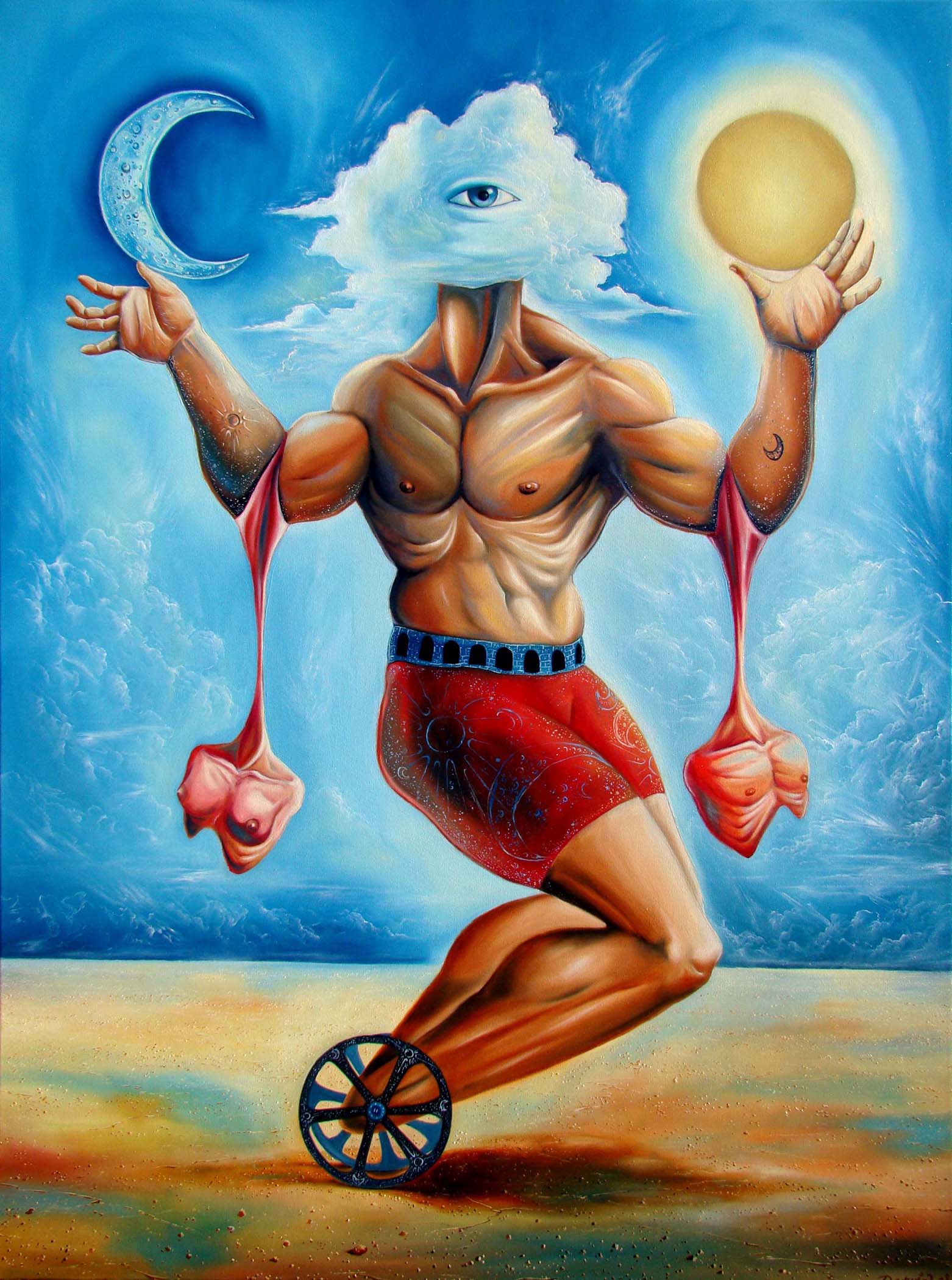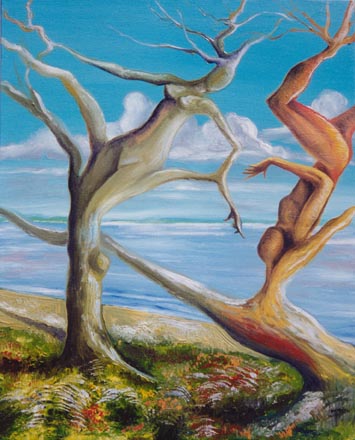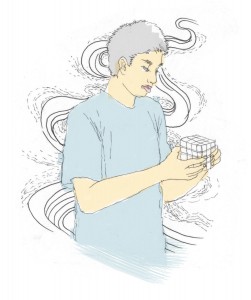
“Oranges” by Anthony Doerr

Doerr-Oranges1

He’s in 13C. She’s in 13B. He’s moving west to take a job teaching history to seventh graders. She’s heading home from a nursing conference. He’s gangly, earnest, and scared. She has brick-red hair and eyes shaped like daisy petals.

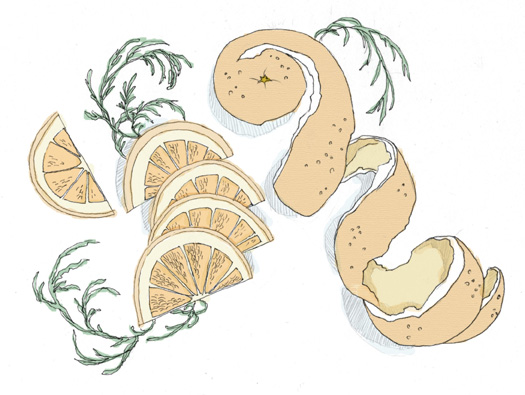
After takeoff she produces two oranges from a monstrous purple handbag and offers him one. He tears off the peel into a hundred tiny pieces. When he looks over she has somehow unzipped her orange and her peel sits on the tray table in a single, mesmerizing spiral.

“How did you—?”

“You’re cute,” she says.

She eats it as if it were an apple: huge bites. Threads of juice spill down her chin. The flight attendant brings napkins. The cabin lights dim. She leans across him to look out the window at stars and he smells cloves, ocean wind, orange blossoms.

Her name is Annie. She’s twenty-nine years old, a hospice nurse. Her voice is a quiet, serene thing, a voice like a pool of sweet, underground water. A voice he wants to listen to in the dark.


** The remainder of this archived story has been removed at the author’s request (after a gracious three-month loan for the July 2012 issue). When it becomes available in book form, we will happily provide a link for purchase.


Anthony Doerr is the author of four books, The Shell Collector, About Grace, Four Seasons in Rome, and, most recently, Memory Wall. Doerr’s short fiction has won four O. Henry Prizes and has been anthologized in The Best American Short Stories, The Anchor Book of New American Short Stories, and The Scribner Anthology of Contemporary Fiction. He has won the Barnes & Noble Discover Prize, the Rome Prize, the New York Public Library’s Young Lions Fiction Award, a Guggenheim Fellowship, an NEA Fellowship, the National Magazine Award for Fiction, two Pushcart Prizes, the Pacific Northwest Book Award, three Ohioana Book Awards, and the 2010 Story Prize. In 2007, the British literary magazine Granta placed Doerr on its list of 21 Best Young American novelists.

Read our interview with Tony here.

“My Kitchen, My Space” by Indira Chandrasekhar

Chandrasekhar-MyKitchen1

Mala’s lungs emptied as if a sudden pre-monsoon pressure-change had thrust itself densely into her diaphragm. She gasped and put the saucepan down on the stove with a sharp clatter.

With an effort, she turned, holding on to the counter. Her mother-in-law had entered the kitchen. Light from the dining room silhouetted the old lady, outlining the set of her body. But while her shoulders were held soft and she appeared to lean solicitously forward, her stance was territorial, legs planted firm. My kitchen, it screamed. My saucepan!

Mala wished she weren’t here, in this kitchen. She wished Saurav hadn’t had to bring them, her and the children, here to his mother’s place. “It is just for a few weeks,” he’d said despairingly when the boarding school offered him a teaching job with no accommodation. The salary was pitifully low, but he took the job, he had no choice. “Once I am there I’ll surely get housing, Mala,” he’d continued in a flat, yet hopeful voice. “Till then, why don’t you move in with my mother.”

“We’ll be fine by ourselves,” Mala tried to insist, “you don’t need to take us to your mother’s place, my family will help me.” Your sister is dead Mala, he’d replied. Or had he said your mother is mad, your father is gone, your brother doesn’t care. She couldn’t remember precisely what he had said nor what she had said. She only knew that on that day, neither of them could bear to acknowledge that they couldn’t afford to keep their home. In a few weeks they had emptied it out and sold most of their things.

And now, Mala thought, she didn’t have a home, nor a saucepan in which to heat milk for the children’s cocoa. She had to use Saurav’s mother saucepan. To, which Saurav’s mother was saying, “I’ve told you so many times that we take out the new, stainless steel saucepan only when we have guests. What don’t you understand about that? Use this one for everyday, see, this one.” She took out the grey, aluminum saucepan with the crêpey Teflon interior and held it up.

Not the Teflon coated pan, Mala wanted to say. The neutral flakes of the rubbery, indestructible polymer will enter my children’s bodies. The resinous, elastic scales, eternally non-reactive will lodge in my children’s organs and accumulate in unknown crevices making them obese and cancer-prone. Minute, non-stick bits, inorganic plankton, so small that they are invisible, will wash through my children’s tender internal filters and attach scrapings of their helpless, innocent cells to the swirling, giant sphere of plastic waste in the ocean.

 ~

 Saurav couldn’t visit till two months after they moved. Now we will be able to leave, Mala thought when he finally arrived, now I can go back to my own home. “It’s been awful here, it’s been awful without you,” she wanted to cry. But he looked so pale and tired that Mala had swallowed her list of complaints and served him his dinner. I’ll have him to myself afterwards, she thought.

The old lady talked non-stop through dinner. She bemoaned the disruption of her solitary life, something for which Mala felt a grudging sympathy. But then she began telling Saurav what was wrong with Mala, telling him that Mala never got the niceties of a superior household, telling him that contrary to what he had proclaimed when he decided to marry Mala, that class did matter, telling him that the children lacked discipline, telling Mala that she had to separate herself from her son, only three, or the boy would develop unnatural attachments.

“That’s going too far, Mother,” Saurav interjected. The old lady shifted in her chair, aggressively thrusting her neck forward and banged sharply on the table, palm flat. “Do you think I am blind, do you think I am lying when I say the children cling to her,” she asked shrilly? The children stopped playing and moved quickly towards their father, their eyes wide. “She’s their mother, they’ve been through a lot. Naturally they are close when the only other person around …,” his voice was beginning to rise but then he looked down at the children, and it died down with a low gravelly whir. He bent and held them close, mumbling, “Leave it now, not in front of them.”

“You don’t have to protect them, I won’t ever harm your children,” the old lady screamed. Saurav opened his mouth but didn’t say anything.

Mala remembered the first time she had heard him speak. It was at a seminar, how she had loved his voice, loved him, loved working alongside him. Why hadn’t she stayed on at University, why couldn’t she have managed the pregnancies and the research like other women did. She could at least have continued teaching, she was a good teacher. Maybe her job would have survived the cutbacks even when they stopped funding his.

“How many students do you have,” Saurav’s mother was asking? Before he could answer, she continued, “Fourteen year olds, That’s nice – what is your house like, do you wear a suit to class, much better than those scruffy research clothes, a suit.” Saurav tried to smile in response. Stop asking him about his job, Mala wanted to shout. Can’t you tell that he hates it, that he wants to go back to his lab, don’t you know that he can’t connect to those children, doesn’t know what to say to them, that every day is a humiliation. Her hand trembled and a spot of sambar plopped onto the white, plastic tablecloth with its elaborate pattern of pressed-in flowers and whorls and indents. They all stared at the splash of lentil stew. The old lady began to scold as Mala dabbed at the spot, only to spread the yellow of the turmeric powder, the brown of the ground coriander seeds and the red of dried chillies into an ugly stain. As their grandmother’s voice rose, the children disappeared upstairs. Saurav watched them go, then finished his dinner, head bent and shoulders drooping. Mala wanted to hug him and say, it’s not your fault, you didn’t spill the sambar, I did. But, when they finally were alone neither of them wanted to talk about the bad things so she hadn’t said anything.

 ~

 She would use her savings and get herself a saucepan tomorrow Mala thought, taking a deep breath to shake off the paralyzing band of tension. Then, ignoring the old lady, she put the stainless steel saucepan on the stove, turned it on, and dipped a ladle into the container of cold milk that she’d placed on the counter. But as she raised the ladle to pour the milk in, the old lady swooped towards her, once again waving the disintegrating non-stick surface at her face. Mala’s back vibrated and cords stood out on her neck. And just like on the day Saurav had visited, her hand shook. A drop of milk splashed onto the counter and another landed on the stove with a hiss. The singed smell of burnt milk entered her nostrils and settled there, an acrid coating over the cloying scent of the old lady’s perfume. Mala returned the ladle to the vessel of cold milk with its dewdrops of condensation and laid her tension-stiff fingers against the chilled, curved surface of the metal container watching how they destroyed the evenness of the clean, trembling frost.

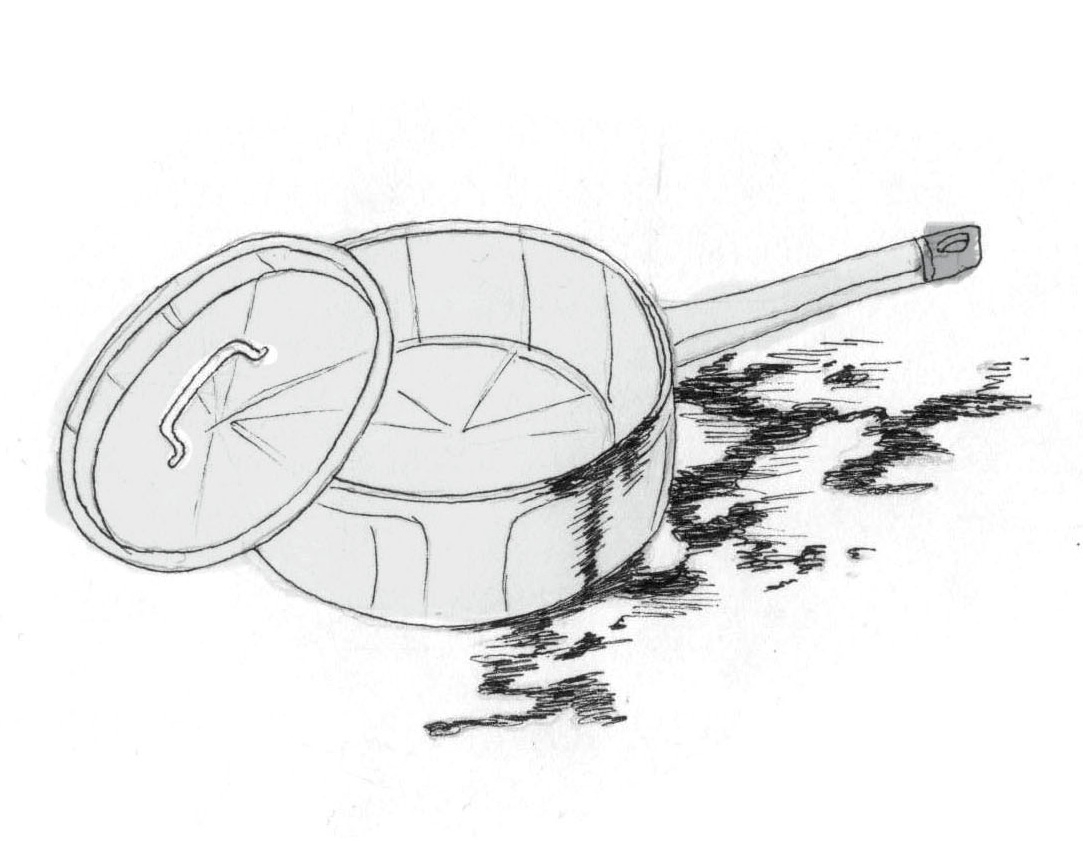
“Don’t use that,” the old lady repeated. And Mala lifted the shiny, stainless steel saucepan, still empty, and now red hot, and swung it towards the old lady ready to ram it into her face. But she smashed it instead onto the granite counter. The metal crumpled and the pan detached from its handle and landed at the old lady’s feet.

When the children scampered in for their cocoa, they found their mother on the floor, laughing with her head in her hands. They climbed on top of her and she rolled over on her back curving her spine to make herself into a boat for them. One day I am going to sail away with them, she thought, as she felt their breath warm on her face.


Indira Chandrasekhar is the founding editor of Out of Print, an online magazine for short fiction from the South Asian subcontinent. She has a Ph.D. in Biophysics and studied the dynamics of biological membranes at research institutes in India, the United States and Switzerland. Her work has appeared, among other places, in The Little MagazineEclectica Magazine, and Emprise ReviewPangea: An Anthology of Stories from Around the Globe that she edited with Rebecca Lloyd, will be published by Thames River Press in 2012. Links to her published stories are available on her blog.

Read an interview with Indira here.

“Don’t Tell Her” by Yu-Han (Eugenia) Chao

Chao-Don't Tell Her1

I don’t know how to tell my mother that my brother just died.

He fell off a stupid cliff while hiking somewhere in northern California. My mother had always called him long distance from Taiwan just to mutter at him about going hiking, she thought it was such a dangerous thing to do, since Americans don’t make their trails out of cement stairs and put bars on either side of the steps like Taiwanese mountain trails.

“What if you fall off?” she would ask. Maybe she jinxed him.

He was her favorite, baby son. Growing up, my older sister and I were always beaten and scolded for the slightest offense or disrespectfulness, but not the baby, not little Wei Wei. Wei was spoiled as anything because he was the youngest, the cutest, the smartest. Mom let him have his way all the time, despite Dad’s objections that he was becoming a momma’s boy.

“Pei! Be good to your child. Otherwise the gods will take him away from you,” she would say to Dad whenever he complained that she was being too lax with her youngest son.

But despite everything, despite the bottomless allowance account, despite the brand name sneakers, athletic gear, lack of punishment and expensive schools, Wei turned out all right. In fact, he turned out better than any of us. My sister studied music at Taipei Cultural University and I went to Mu Cha Vocational School on the outskirts of Taipei, while Wei went to the University of California, Irvine. He even got a scholarship. My parents were so proud. As soon as he graduated, both IBM and Intel wanted him; he chose IBM, which turned out to be an unfortunate choice because living in California was what got him into hiking–at least that’s what Mom always says.

What Taiwanese would be impressed by hiking in California–what do they have that we don’t? We have plenty of mountains right here surrounding Taipei basin, with nice Buddhist statues at the top, you can look down and see a sea of clouds floating by, and you’re up so high the water tastes especially sweet and the air is completely clear, damp, chillier, almost unearthly. I’d brought Wei hiking before, on Toad Mountain, he hated it and kept asking if we could go home now. That was ten years ago.

And now, my brother dies hiking in a foreign country at twentynine.

Our mother will never be the same again.

Maybe we don’t have to tell her.

The Taiwan Office in America called my older sister first. She said that the “in-case-of-emergency” number he had left with his insurance company was his sister, Jade Lin’s. Mom would have been heartbroken to know that his emergency phone number was not hers but Jade’s. But of course, Jade is the only family member who lives in America, in Dallas, Texas, to be precise. Jade teaches music students at home, in a large three-story rectangular house. She has a studio on the third floor where she makes Chinese looking ragbags out of scraps of fabric and ties, which she sells to American housewives for thirty dollars each.

Jade did not become hysterical upon hearing the news, because Jade only thinks of herself. She didn’t think of calling me in Taipei until five hours after she got the message.

“Hey, Allo, you’re not going to believe this, but Wei is dead. Our brother Wei. Mom’s Wei.” Her voice sounded like she had been drinking. Jade drinks. She claims her silent American husband drives her to drink, but as far as I know, she is the one who torments him. She has a silent little son, too, about eleven by now, an unhappy little runt, Nick, whose pictures she sends us every few months.

“How…are you sure? Wei? How can anyone die hiking? When? Who called you?”

“The Taiwan Representative Office. He went to the San something mountains with some friends, and he slipped and rolled down the edge. One guy watched him go down. They’re trying to find his body right now, and they think they can find it because the friends know the spot…”

“This is horrible. Couldn’t he be alive?”

“I asked that too. The officials said that we would be lucky to get the body back in one piece.”

“What are we going to do? I mean, what can we do now?”

“Well, I’m flying up to California tomorrow morning and leaving Nick with my next door neighbor. They have papers for me to sign, and I have to tell them what we want to do with the body.”

Our brother was already being referred to as “the body.” She could have at least said “Wei’s body,” or “our brother’s body,” but she had to say “the body.” It was too much for me to think about what we were going to do with Wei, how to get rid of him, to burn him or box him and bury him…

“Hello, Allo, you still there?” Jade’s voice was shrill all of a sudden.

“Yes, yes. I…I think we need more time. To think about…what to do. And what about Mom and Dad, what about Mom? Who will tell her?”

“You, naturally,” Jade said. “You live in Taiwan. Why should I make another long distance call to hear her weep over her baby for two hours?”

“That’s a nasty thing to say, Jade.”

“I’m sorry, it’s the gin speaking. Anyway, I’ll talk to you when I’m in California maybe. We might have to break it to Mom gently, if that’s even possible.”

“I know. She’s probably showing his pictures to one of the customers in her store right now and bragging about how successful he is in America.”

“I gotta go, Allo. It’s almost one in the morning here.”

“I can’t believe this happened.” As I say this, my drunken sister has already hung up on me with a loud click.

~

Mom lives about a twenty-five minute walk from my apartment, in our old house. Since she and Dad retired, she turned our first floor into a little grocer’s store like they used to have in old neighborhoods–places where you could buy a small handful of green or red beans, a cup of rice, dried goods, sauces, pickled vegetables, fresh spices, junk food and chewing gum. The store is kind of a hobby, we don’t know if she ever makes any money; she enjoys the company of local housewives when they come and chat over her counter in the afternoons. She gives away free fish tofu and little jars of pickled things to frequent customers and neighbors. Everyone knows her as Mrs. Lin, the old woman with a broad face, with a small round build and tiny eyes that squint into slits when she smiles, which is often, especially when she talks about her youngest son, Wei.

A little voice inside my head repeats over and over: don’t tell her, don’t tell her. Of course, keeping the disappearance of Wei a secret would be impossible since he, like a dutiful Taiwanese son, calls her every weekend. I could pretend to be him and call her, but that would be going too far, ghost-calling for my dead brother. I would have nothing to say.

I just wish I wasn’t the one to tell her. She would probably scream through a torrent of tears and beat me with her fists, screaming that I was lying. Me, the middle child, unsuccessful cram school teacher, renter of a small apartment at thirty-three telling her that her precious baby UCI graduate IBM developer patent-winning son has died. Hiking. She would be angry at me, she would act like it was my fault, just like we blame the weatherman when he tells us there will be thunderstorms when we have a picnic planned.

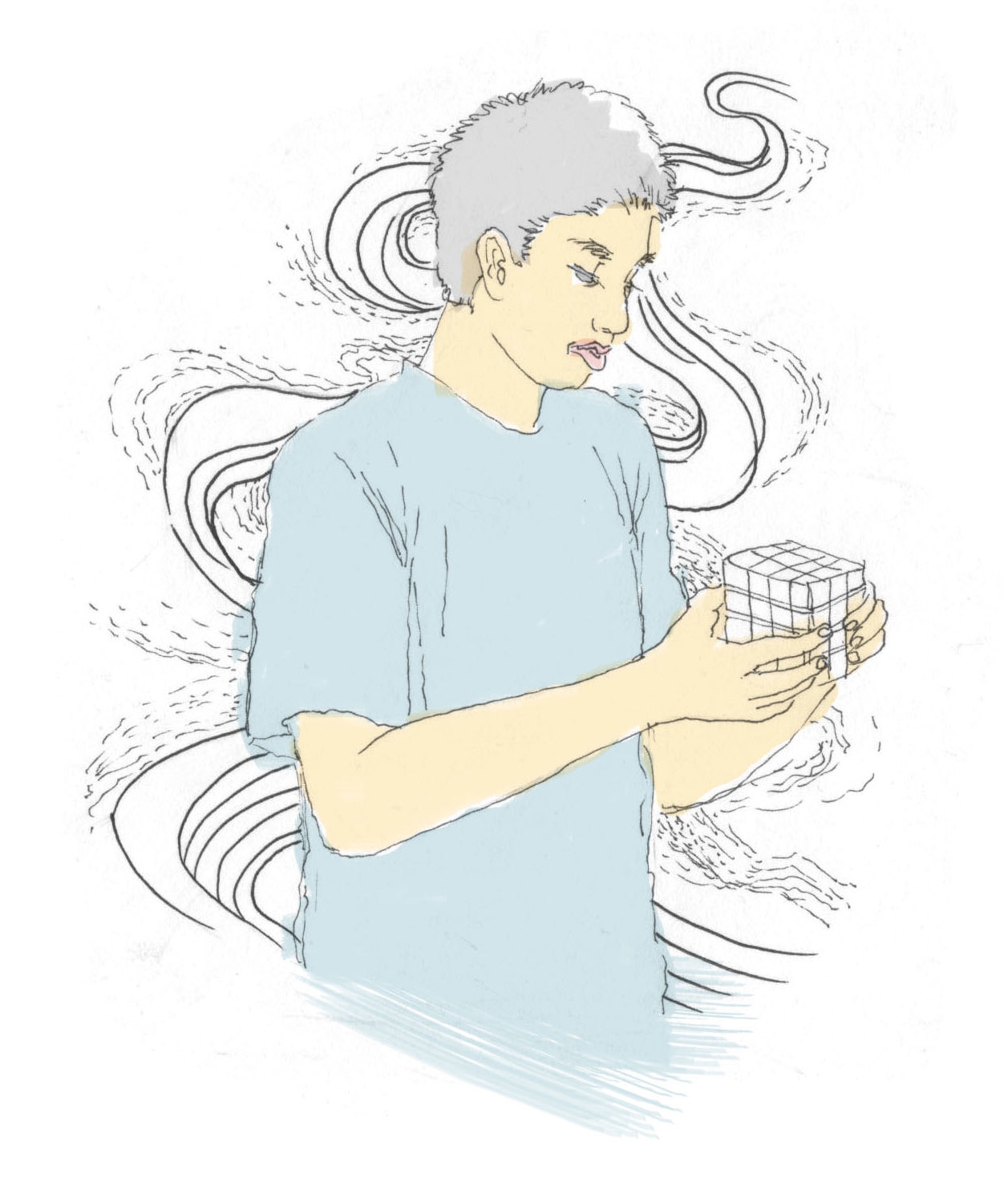
I should have been the one to die, not Wei. He wasn’t a bad brother. I will miss him, especially miss when we were children; lately I only see him for a few weeks at a time every year or two. I remember when Wei was addicted to computer games in junior high–I had to do all his math and science homework, Mom made me, saying it was my duty as an older brother. He also spent many hours discovering the secrets of the Rubik’s cube so that he had worn the stickers off two whole cubes and had to write the characters for red, blue, yellow, etc. on the white papery substance left on the cube. Even now (well, two days ago–not now, now he’s dead), give him a Rubik’s cube and he’ll turn it so fast you can’t see what he’s doing; in one minute he’ll have all six colors in their own matching positions on each facet of the cube.

Wei’s last year of junior high, he deleted all the files from his computer, threw out the floppy discs full of role-playing monster-slaying games, and studied for 7 months. It took only that for him to get into the best possible senior high, Jian Zon, then in his last year there get accepted to UCI in America out of the blue. We didn’t even know he applied; it was his English teacher’s idea.

I take the longest route possible through the nightmarket, taking my time walking to my parents’ house. It’s three in the afternoon so Mom will be behind the counter in her store. There couldn’t be a worse time to tell her, with customers coming and going, expecting her to work the cash register, weigh dried goods and tell them prices.

I pass the cleaner’s and look for Lucky, the Laundromat Dog (half the dogs in Taiwan are named Lucky). I always look for Lucky because he’s been around for so long that I’m afraid that one day I will pass the cleaner’s and there will be no Lucky because Lucky died. Who would have thought my little brother would go first. Peering into the cleaner’s, I see the brown and white, sweet-faced, pointy-nosed dog sitting under a clothes-folding table, eyes lazily following passersby. Lucky is old, no doubt. Though I’ve never played with him and he hardly knows me, I love him anyway. I don’t even know if Lucky is a boy or a girl, “he” could be an old grandmother dog. I wave at grandma Lucky and drag my feet into the nightmarket entrance.

The owners of stalls and stores and mats full of clothes and shoes are smiling, happy, enthusiastically trying to get customers to buy their wares. None of these people lost a son anytime recently, not a baby son who worked for IBM and got several patents, that’s for sure. I wonder if my mother will get over Wei’s death. She told me her mother never got over my uncle’s death–he was the only boy in a family of four children, and the smartest one, an excellent young surgeon in Tai Chung before he died in a car accident. I don’t remember my grandma much, but do recall that she burst into tears at any mention of my uncle and that before her death she trembled from something called Parkinson’s disease, and the medication made her slow, made her  call us kids by the wrong names, sometimes even by my dead uncle’s name. Maybe this was something that happened to women in our family, like a curse? If you love your son too much, he will die, and you will die heartbroken, trembling from a mild but incurable condition.

The streets look especially filthy today. Gum, blood-like stains of betel nut juice, scraps of paper, cigarette butts here and there on the bumpy asphalt and cement. A cockroach or two scurrying, some uncovered sewers with a dozen mosquitoes buzzing above them, children crying, toddlers falling down, men yelling and women screaming. Laughter. Chaos. The street smells like fish and smoked ham and fried chicken all at once. The unmistakable aroma of sweet roasted sausage assaults my face in its treacly heat; I’ve always hated sausage and the lemon, strawberry, and other inappropriate sausage flavors disgust me.

I am suddenly overwhelmed by everything, the odors, the noise, the crowded street, people brushing against me and thinking nothing of it. I am a bereft brother going to inform his parents that we are a bereft family; these people have no right to push someone who has the look that I have on my face, the look of someone who just lost a loved one far away. Several times I consider turning back.  My parents don’t have to know, if I just ignore the problem it might go away, my mother might forget she has a son in California, and everything will be okay, even if it feels like there’s something, someone missing.

I’m at the door of my mother’s store. You can’t see her when you first walk in because she deliberately designed the counter so it was to the left of the door, facing the back instead of the front door. Bad feng shui, I suddenly realized, I should have thought of this before and warned her. Do not work with your back to the door. A superstitious ex-girlfriend once told me that, and though I still think she’s nuts, I can’t help suspecting there’s some truth to the little sayings she repeated all the time. All Taiwanese are a bit superstitious at heart–even the most rational of us  think  there’s no harm in taking precautions–just in case. I need one of those lucky talismans my ex-girlfriend used to carry; I don’t know how to face Mom without one. Actually, Wei was the one who needed a lucky charm, or a tiny crystal Buddha figurine tied around his neck with a piece of red string–if he hadn’t died, our lives would still be normal.

I take a deep breath and walk in. Mom is not at the counter. Great, I can go now.

“Allo, what are you doing here? Shouldn’t you be getting ready for work?” It’s Mom, emerging from the condiments and rice aisle. I had completely forgotten about work, I’ll have to call the cram school and tell them I can’t be there.

“Uh, mom, I … I’m not teaching tonight,” is all I can say.

“Why not? What kind of expression is that? Did you lose your job? Did they fire you? I told you you should have gone to a real university. Didn’t I tell you?”

“Ma, I’m not fired. I just don’t feel well.”

“Where are you sick? I have medicine here in the drawer. Every kind of medicine.”

“Is Dad upstairs?” I ask, feeling like I need someone else here. The customers don’t count.

“I think he might be watching TV, I didn’t see him go out. You can go look for him.” She begins absentmindedly counting the change in her coin arranger and doesn’t look up. I don’t feel right going up to get Dad, but it also seems the wrong moment to be telling her about Wei; it would be catching her off guard.

“Ma, when was the last time you heard from Wei?”

“Ah,” her eyes light up and she finally looks at me. “Last Saturday I think. He said he was planning another one of those hikes soon, the silly boy. I tell him not to do it and he still does. He is too smart, nobody can tell him what to do, he never listens.”

“What if something happened to him, Ma?”

“Pei! What are you saying, it’s bad luck. Don’t say things like that. Are you cursing your younger brother?”

“No, Ma, I said if. What if.”

“There, you said it again! What is wrong with you, Allo?”

“It’s just, it’s just…” my voice trails off into a whisper, “something happened to Wei.”

“I told you to stop saying that!” she yells. “Are you on drugs?”

“No Ma, please listen to me. Wei went hiking. He fell off a cliff. He died.”

“Shut your mouth! You monster. You liar. Wei is fine, what are you saying? You are just saying this to make me crazy, you are jealous of your brother…” An elderly couple who had been putting green beans into a plastic bag quietly dump their beans back into the sack and walk out of our door, where they linger to eavesdrop. A baby at the back of the store starts crying in its mother’s arms at the sound of Mom’s shouting.

“I’m sorry, Ma. I’m really sorry. They told Jade in America and she called me this afternoon. So I came to tell you.”

“Where is he? Where is he? I want to see him,” she sobs.

“In California. Jade will tell us later tonight, when it is daytime there.”

She can no longer talk; she puts her head on her folded arms and weeps, like a girl who sat next to me in junior high used to do because her father beat her. My mother’s whole body convulses, she seems such a large, quivering bundle and a little old woman at the same time. I don’t know how to comfort her, we never hugged in our family, so I stand there, patting her back so lightly she probably can’t feel it.


Yu-Han (Eugenia) Chao was born and grew up in Taipei, Taiwan. She received her BA from National Taiwan University and MFA from Penn State. The Backwaters Press published her poetry book, We Grow Old, in 2008. To see more of her writing and artwork, please visit http://www.yuhanchao.com

Read an interview with Eugenia here.

Shame

shame

Shame is something like this:

The morning horror of mirror pinching and posing and propping your hair this way across your forehead so that the acne is covered and tilting far enough to one direction so that the reflection is false enough to please you. And then, it’s something like this, like every reflective surface at school today, every piece of glass, is a reason to contort and to pull and pull and pull at the corners of your shirt to cover your biscuit dough stomach. It’s pulling and pulling so maybe the cotton will stretch out enough, maybe the shirt will grow in size, maybe it will fit properly if you yank the threads and test the boundaries of a size Large. Hooking a finger around the back belt loop of your pants so the sliver of separation that starts low on your back won’t slide out of the pants three sizes too small.

Shame is leaving the dog’s leash coiled, too perfectly, in the center of the front room, so Mom comes home and thinks you’ve been outside today, outside this week. It’s when you quit the soccer team after the first practice because running the length of the field fills your lungs with sharp crystals and you can’t breathe but you can’t cough, either. It’s the six visits to the physical therapists for the ankles you keep cracking, twisting, pulling. The nurse says your name and points and you stare at the wall in front of your nose and you don’t look at the number she rights on the piece of paper and you step down and you don’t look at her either. The doctor, he draws a bell curve on a yellow pad and he points to the far right tail. Your ankles are too small to support your bigness.

Shame is not eating for seventeen, thirty-four hours, and then it’s the empty burn at the top of your throat and you open the fridge and the shining Kraft bag of shredded yellow cheese shocks your body into automatic consumption. And then it’s a bowl of ice cream with hardened, caramelized chocolate syrup dripping between the cleavage of three bulbous scoops; four slices of salami meat rolled around crushed Goldfish crackers and consumed in one bite; a miniature pizza, frozen at first and still frozen in the middle when it slides out of the toaster oven, stared with cubes of pepperoni, hot cheese hot enough to blister the roof of your mouth and cold dough in the center that tastes just like clay, like disastrous uncooked food that you eat anyway; and then its peanut butter on bread and honey from the spoon and handfuls of chocolate chips and coated pretzel bites and cups of raisins and a bag of grapes because finally fruit cools the cheek-burning insanity. Fruit makes you feel healthy and empowered. Fruit is good so you eat a pound of grapes and leave the browned stems in piles on the carpet.

Shame is the bowls and the napkins and the plates that take two trips to remove from your upstairs bedroom down to the kitchen, and it’s when you wash and dry and return every dish to the cabinet except for one — one dirty dish left on the countertop — so Mom knows you ate, but she doesn’t know how much.

Shame is something like this.


Allison Smith is a soon-to-be graduate of the Literature and Language program at the University of North Carolina at Asheville. She writes about recovery from Binge Eating Disorder here.

Interview with Kurt Mueller

Kurt Mueller

Israel Allen: First let’s talk about your Shorts On Survival piece Ontario, California. There are a lot of places that the journey in this piece could be going and a lot of places it could end. Why Ontario, California?

Kurt Mueller: I’m a midwesterner, and California has always seemed exotic. It feels like it’s a different world, and this story is really about leaving a world behind for a new one, and of all the places I know of in California, Ontario sounds the most exotic and foreign; although Ontario, Canada is probably more like Illinois or Wisconsin than Ontario, California is, just the word Ontario conjures up the idea of another country to me.


IA: The image of the photographs taped onto the inside of the vehicle is striking and strange (in a very good way). What was the genesis of that choice?

KM: The story, to me at least, is as much about leaving things behind as it is about going someplace new. In order for the narrator to let go, he has to take an inventory of what he’s leaving behind. When we get to the end of the story he has physically thrown his family out the window, and all the pictures prior to that build up to him dismissing his past life with that action. I’ve done some study of drama and playwriting, and on a stage a person’s internal world needs to be visible to the audience, and that’s sort of what I’m going for here: show the world what this guy is thinking and make him do something physical. It puts his history in his face, and it forces him to confront it with an action. Of course he could have remembered these incidents without the photographs, but that’s not this guy. He’s leaving, but struggling, and these photos show that.
IA: The objects the narrator describes seem to be more complex as the story evolves—the seeds, the insects, the raccoon, the family. I know that’s not a question; I’m just curious about the development of that progression.

KM: That progression goes along with the psychic progression within the narrator. Here’s a guy who’s low on sleep, and he goes from focusing so much on what’s around him to what’s going on inside him, and as the descriptions of what’s happening outside the car become more complex, I think those descriptions are more about the narrator than the world around him. He is struggling with disease and worried about dying and just so far within himself, that by the end, his thoughts are going pretty wild.

The Universal Acrobat

IA: This narrator, in the midst of a serious life event, is still vain enough to worry about his appearance, to worry about picking up girls. How important do you think libido is to the male psyche? Do you think literary fiction pays enough attention to that element of its characters?

KM: The libido is incredibly important to the male psyche, and it’s something that, you’re right, is often overlooked in literary fiction. For this guy, I think it’s a sign that his body is still working. Testosterone is still flowing, and if it came to it, no matter how decimated he may think he is, he would still try to get laid. He is, after all, a man, and whether it’s literary or not, men spend time and energy trying to get laid.


IA: Obviously, this narrator has been shaped by his childhood in a way that resonates as his journey progresses. How did your own childhood shape the way you tell stories?

KM: I imagine every writer could (and plenty have tried to) write a book on that. My childhood was good, and it lacked any major trauma, but I was then (and am now) big into popular culture. My writing is full of references and allusions to music, literature, art and film, probably because when I was a kid we watched lots of movies, I read lots of books, we went to museums, etc. My father did force me to read the Odyssey when I was really young and write a report on it, and it seems like most of my writing is in some way a road story about disconnecting or reconnecting with family, so maybe there’s something there.


IA: We’re both grads of the Southern Illinois University MFA program. How did that experience impact your work?

KM: It definitely made me better, I think. I would say the experience of working with different people in different genres was the best part it. The SIU grad program forces students to take classes outside of their genre, so while I studied fiction, I took a year of grad playwriting with students from the theater department, and I learned a ton about storytelling from that. Working with poets gave me a better idea of how to explore imagery and emotions. In addition to just getting three years to write and workshop, the idea of becoming better at writing fiction by exploring other genres and writing styles blew my mind. Also, all the faculty are great. It’s a fantastic place and program that should be at the top of anyone’s list of best MFA programs.
IA: What do you say to your current students who are interested in pursuing an MFA?

KM: Don’t. Really, though, I tell them what I was told by one of my favorite professors from my undergraduate days (David Wright – great writer and great man): Wait. Take at least a year and do something (in my case, I lived with my parents and made coffee and volunteered at a children’s museum), then see if you still want to go to MFA school, and if so, go work with people you haven’t worked with before at a new school. I think the perspective gained in a year or two outside of school can really help a young person when approaching graduate school.


IA: How would you define “recovery” and what does that mean for your fiction?

KM: I think recovery is the act of making progress, of coming back from something tough, of overcoming, and I think that it means a lot to my fiction. It’s in everything. I look at the list of short stories I’ve published, and they’re all about people recovering from some trauma, whether it be physical or psychological. I look at the novel I’ve just finished, and it’s about an entire family recovering. Recovery is one of the most universal themes, and it’s one I’m constantly exploring and will continue to explore for the rest of my career.


Israel Allen teaches English at Lander University. He is the author of two novels, Anachronistic in Asheville and Homecoming King, and two plays, Ask Me Anything and Stitches.

“Birth” by Millicent Borges Accardi

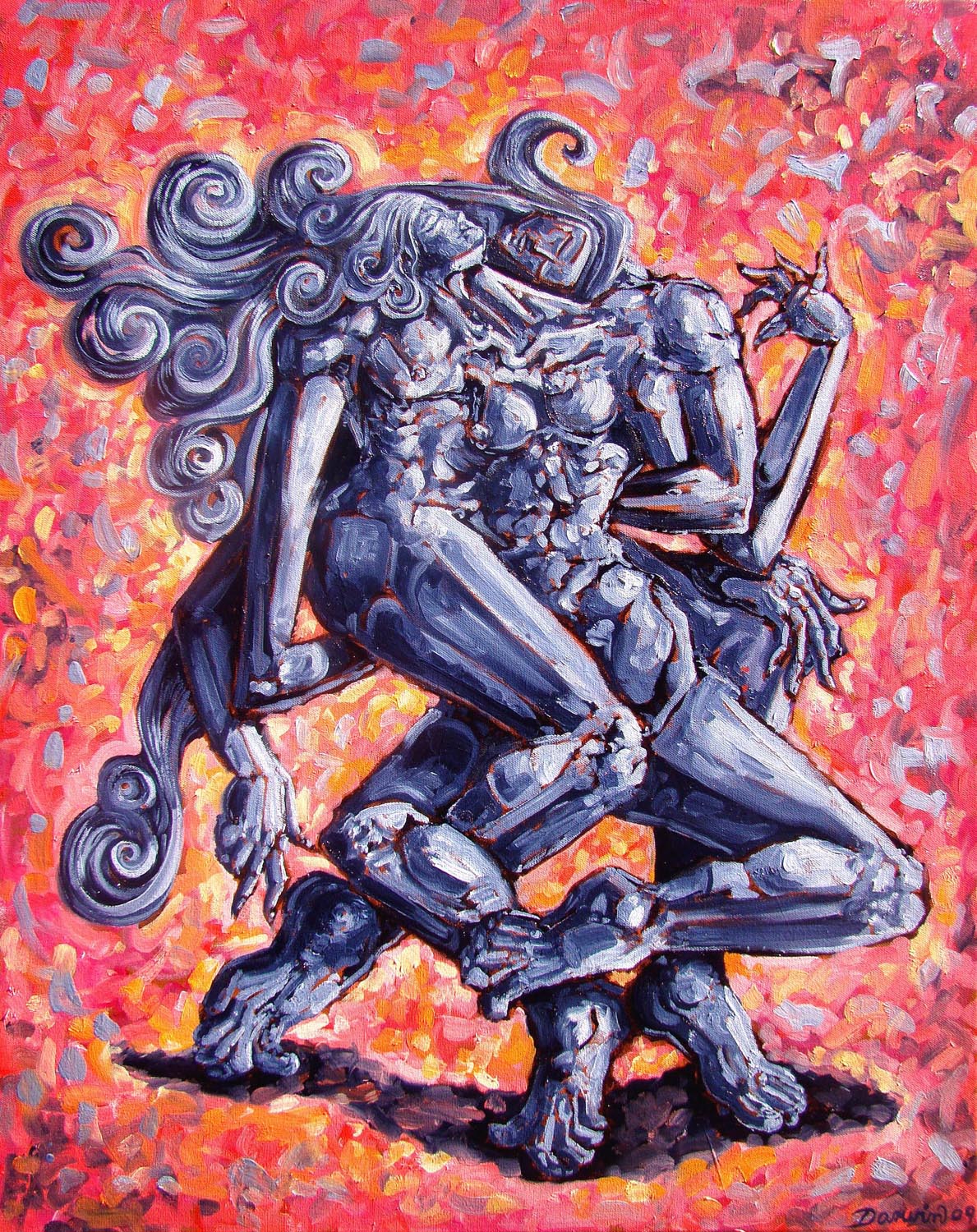
First Stage in a Lost Relationship (Millicent Accardi)
“First Stage in Lost Relationship,” oil on canvas, Darwin Leon

Not wanting to disturb the marriage,
my parents, or you: I enter backwards,
door through. The hallway strains
with my struggles: thick blooded pores enclose
my shoulders. If I can make it into the safety
of our bed without the angry walls screaming:
“Guilty, Jezebel, guilty,”
then I will be able to breathe.

In the living room, you my dear husband, my love,
you sleep: on the worn out sofa, like a child,
or a man who has given up. If my four legg’ed shadow
can crawl past you all will be well.

The Bible and the headstones will rest
with me, buried deep in trampled grass:
it is where they belong. You never gave me
any trouble, dear husband, but you never gave me
any encouragement, either.

Do not utter a word, sleeping man;
this life we have is not so safe.

Forced into this world with cold forceps,
I now bring myself back. Husband, husband
who is asleep, holding the umbilical cord
like a rubber band: You keep tugging on my body,
making me small.

I am your boomerang who must return;
dragged back like Circe with sperm in my hair;
it is a planned breach un-birth.

And so, tonight after tonight, I will carry
my purse, hide my cigarettes, and pray
that you do not awaken.

Never staying born is a crucifix that weighs
and digs into my bloody shoulders;
it happens every time I leave him to go home.

Not wanting to disturb the marriage,
my parents, or you:
I enter backwards, door through.


Millicent Borges Accardi is the author of two poetry books: Injuring Eternity and Woman on a Shaky Bridge. She received fellowships from the NEA, California Arts Council, Barbara Demming Foundation and Canto Mundo. A second full-length poetry collection Only More So is forthcoming from Salmon Press, Ireland in 2012.

Read an interview with Millicent here.

Interview with Pat Heim

Pat Heim

Mary Akers: I love the use of sensory details in your essay Watermark. You write them so well. Are these details that you consciously add to enhance your writing, or do you find your memories are tied up in sensory details?

Pat Heim: What comes to mind is a line from Longfellow’s poem “The Arrow and the Song,” which resonated with me the moment I first read it as a third or fourth grader in Catholic school: “For who has sight so keen and strong, that it can follow the flight of song?” I identify with the yearning in this question and the sense of searching for something as ephemeral as a song. But I’m definitely the sensing type, a hunter-gatherer, nourishing myself on what I scavenge through my sensory apparatus, clamoring to see, hear, smell, and touch anything and everything that captures my attention. In the fall, when I catch a whiff of someone burning leaves, I quickly lower the car windows and inhale deeply and blissfully. I’m easily over-stimulated, intoxicated by the elements in my sensory field. I never thought about this before, but I think maybe the memories are tied up in the sensory details. As a child, the caboose of seven children, I created a little bubble for myself, a parallel universe in which I could retreat from the rough-and-tumult of five noisy older brothers, a big sister, and parents who were busy and often distracted. During the week, when my dad was at work and my siblings, at school, it was just my mom and me at home.

She had a playful, easy-going way, but was often preoccupied. I appreciated that she was a warm body in the house yet open to my intermittent bouts of chatter. The sounds and smells generated just by her cleaning or making dinner were reassuring and comforting, and all of these sensations do remind me of her. Her quiet presence gave me a sense of security, and I think mine gave that to her. My earliest favorite pastimes were reciting poetry, singing, especially while swinging, and pretending I could speak French. I also liked sitting at a desk and scribbling in old composition books, as if I were taking notes. I loved the musicality of words and often felt elated in the presence of nature’s sights, sounds, textures, and smells. I became adept at using what I had and relying on myself, seeking and finding solace in the sensory world of the outdoors as well because it, too, transported me to a tranquil place that held me, like a mother does.

I begin almost every piece of writing by mentioning another person or by personifying something, and then I usually describe a thing or phenomenon in the environment with  whatever amount of exactitude I can garner. I’d say that I do this automatically, not conscious of why. I think I’m remembering the feeling of being held in order to prepare myself and my readers for the painful material to follow as in “Let me tell you something kind before delivering the bad news.” The leap into the unknown is anxiety provoking, so I might also be reaching out to someone or something beautiful and tangible because the internal world, where all the words, memories, and ideas reside is fraught with feelings, some of them threatening, perhaps even dangerous. Beauty holds my hand and keeps her eye on me.


MA: What type of things/occurrences/ sensory details take you back to this difficult time in your childhood that you’re writing about?

PH: Firstly, everything related to house and home because that is where I spent ninety percent of my time with my mother. I was recently paging through a book written by an architect, specializing in creating small spaces. I was struck by the psychology informing these theories of design. Spaces are essentially for shelter and containing and must provide a sense of organization, all the things mothers must do. I’d also have to say fabric. In the weeks and months after my mother died, I’d often retreat to her closet, fondling her clothes, slipping my feet into her shoes. I’d bury my face in her coats and dresses as if to extract the last remaining vestiges of her essence. Things that glitter, like jewelry, take me back as well. When she was sick, I snuck into her room and stole some of her necklaces and bracelets, a scene I depicted in the essay, whereupon she woke up and chastised me. I love wearing jewelry and sometimes pour over jewelry catalogues and then throw them away without ordering a single item. It’s as if I still feel a bit guilty for having surpassed my mother, who refused to grant me her permission.

Also, my mother got sick and died in late summer. I can recall several moments around that time, such as when my father brought her home from the hospital and I realized just how ill she was, that the world ground to a halt because I, myself, froze. Yet, the silence of nature that morning was profound; the sweltering heat and the scent of the still-green grass and overgrown summer foliage have stayed with me until this day. Sometimes, when the world outside grows that quiet, I experience a great void in my heart.

Any loss in my present life, at least to some extent, becomes imbued with feelings from that time. In fact, this is how I’ve been able to remember, because these feelings are often actual memories. What I’ve learned to do in analysis is to sort those pertaining to the past from those in the present, so that the here-and-now can be experienced for what it is; unencumbered by feelings from the past.


MA: This past Mother’s Day, I suddenly understood that many people have a very complex relationship with that day. What is your Mother’s day like?

PH: My initial reaction is to state that I’ve never been very affected by Mother’s Day. Yet, when I pause to think about it, this isn’t quite true. Perhaps this is because, shortly after my mother died, I began to detach myself from my feelings and memories of her, affording myself a sense of control over the randomness and chaos of life. The price I paid was to feel terribly guilty though I didn’t know why, as I’d carried out my solution unconsciously. And though I didn’t realize it, I’d cut myself off from myself as well. This must sound callous, but it’s how I held myself together. Trauma overwhelms and renders us helpless. The feelings are gargantuan; there is no way the mind can deal other than by recruiting such massive defenses. When all was chaos, even God sorted with a heavy hand.

My father was grief-stricken and, in a way, spiritually absent. My siblings had all left the nest, and I felt like a different person than I’d been before my mother died. I no longer knew
who I was. So, although I’ve felt blessed as an adult to be a mother on Mother’s Day, my experience of having had a mother feels distant, as if from another time. Yet, at the Hallmark store, when I read beautiful cards from daughters to mothers, a bitter, fleeting sorrow catches hold of me, because I haven’t seen or wished my mother a Happy Mother’s Day in forty-some years. I long to buy one of those cards and mail it to her. Little by little, however, I’ve been piecing myself back to my mother, but the memory of feeling as if I were falling apart keeps me, even today, from stepping too close to that flame.


MA: Did you find it difficult to write such a deeply personal essay? What techniques as a writer do you use to make it easier to approach a sensitive or personal subject?

PH: I never would have been able to write from such a feeling place, especially on this particular subject, had I not gone into analysis. I was reluctant to “elaborate,” as my writing mentor would say, to “flesh things out.” I didn’t want the word to be made flesh, which is a Christian metaphor. I preferred the abstract realm of ideas. Elaborating requires being in touch with oneself, of having access to a very deep and oft-times frightening place. One must sense a holding presence from within in order to take such a leap into the dark. My experience of losing my mother was extremely traumatic, disrupting my loving ties both to her and parts of myself. Although I didn’t know this consciously, the feelings emanating from that loss, although normal, were intolerable and numerous; tremendous sorrow, guilt, shame, rage, and even hate, to name a few. They overwhelmed me and disorganized my mind. A thirteen-year-old girl’s relationship with her mother is highly ambivalent. To hold such potent and disparate feelings together in order to mourn that loss is impossible without the help of a caring adult who can tolerate a child’s chaotic inner world. Most adults would like to believe that children have some sort of protective mechanism to shield them from agony.

The analysis has helped me to access these feelings and, over time, develop the ability to tolerate them. My internal world is no longer so frightening a place. My ego has been freed up to a considerable extent, and I continue to strive for even greater freedom, to grow more adept at roaming the creative realm, experiencing it as a safe playground of the mind as opposed to defensively retreating from it, as if it were a dungeon, haunted by the villainous creatures that populate our nightmares, our own unwanted feelings and memories.


MA: What sort of reading did you do as a child?

PH: This might sound provocative, flying in the face of what we tend to believe about the development of intelligence, but I don’t recall reading a lot as a child, or at least I didn’t read very many books. Yet, my father was an avid newspaper reader, my mother preferred women’s magazines, at least insofar as I remember, and the brother who was closest in age to me devoured comic books as if they were penny candy Before I learned to read, my mother would buy me Golden Books at the grocery store, usually when I was sick, and she or my father would read them to me. I also think she might have recited nursery rhymes to me. I didn’t attend kindergarten, and there were at least seventy students in my first-grade class. I could read a little by then as I’d enlisted two older girls in my neighborhood to school me in some basic reading, writing, and arithmetic. Learning to read was a joy, and I soon discovered that I could read aloud, seamlessly, feeling rather indignant toward my classmates who stumbled over pronunciation. I also enjoyed reading my school books to my mother, as I mentioned in my essay. Even now, when I discover something beautifully written, I often read it aloud to myself and commit part of it to memory. I could spend a few hours every day, if I had the time, reading aloud to some willing, appreciative listener.

In Catholic grade school, we were required to study poetry and memorize poems. I developed a ritual of coming home from school that first day, sitting down at the dining room table, and reading the poetry text cover to cover. Often I had the poems memorized long before they were assigned. Although I’m acrophobic, I’ve hiked and skied a few steep trails with my husband and children. When the anxiety and near-panic set in, I immediately fall back on reciting those poems.

When I hear my friends talking about all the Nancy Drew books they read when they were growing up, I feel estranged, as if I’d descended to earth from the planet of the illiterate. I wonder who I’d be or how I’d write today had I read more books as a child. In college, I majored in French and minored in English, and though I enjoy fiction I mostly read memoir. Every ten years, I re-read The Great Gatsby, my favorite book of all time. I once heard that F. Scott Fitzgerald had perfect pitch. I couldn’t agree more.


MA: And finally, what does “recovery” mean to you?

PH: For me, the process of recovery means reclaiming the parts of myself I lost, especially when my mother died but also when my father died four years later. In reclaiming my feelings, my memories, and the parts of myself that felt unacceptable to me as an adolescent, which are many for all of us when we’re honest about it, and by understanding them and welcoming them back into the fold of my identity, I’ve reclaimed the continuity of my sense of myself, enabling me to tell my story.

I’ve also reclaimed my adolescent development because, without a way to mourn and a healthy parent with whom to relate, that development got derailed in terms of my ability to become more separate and individuated, to deepen my capacity for intimacy, and to consolidate my identity, which requires being knowledgeable about and accepting enough of one’s self and one’s strong feelings, particularly competitiveness and aggression, to choose one’s life path and purpose with conviction.

This was particularly difficult for me because at the time I was separating from my mother and becoming a woman, competing with her as adolescent girls are programmed to do, she died. As I stated earlier, I feared I’d stolen her womanhood, the jewels of her capacity to procreate, and that my ambition to become a woman, my normal  competitiveness and aggression had destroyed her. Her disapproval and chastisement when she caught me stealing her jewelry affected me deeply. I had no right to become a woman. I’d distanced myself from my feelings for and memories of her, which felt destructive, though I hadn’t chosen this so much as it resulted from the trauma. Yet, the belief that I had done so afforded me a sense of power over fate and helped to organize my mind. What I’m celebrating now is how I’ve recovered and deepened my creativity because I’m no longer fearful of my mother’s retaliation, and I’m not defending myself so much against overwhelming, potentially disruptive feelings.

“Chance Reunion with Monsters” by Jesse Cheng

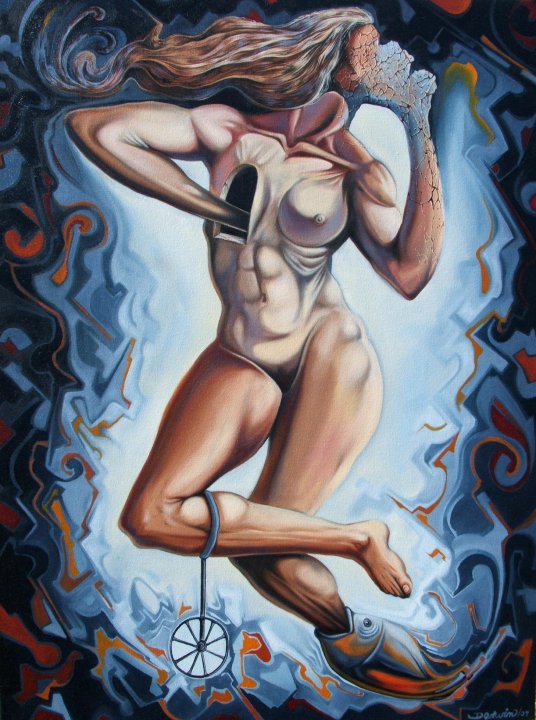
The Strangers (Jesse Chang)
“The Strangers,” oil on canvas by Darwin Leon

Some beastly friends from long ago have teeth that became the most luxurious pillows. As we start to reminisce they throw back their heads, roaring, then tongues unfurl as down comforters.

They beckon me in with gaping grins, though I can tell by the crinkles of their eyes: They still want to eat me. But how can I keep distant, they’re so terribly inviting. I dive in and kick off my shoes, sweeping angels into the cool linen. The monsters gurgle blah blah blah, their plush gullets, once muscular and hard, struggling to swallow. Not that they have reason to gripe. At the end of my stay how tenderly I’ll smooth the flat sheet over the bedcover’s top edge. What care I’ll take to palm wrinkles off the sham. My old friends pat my shoulder as I duck out, their tongues rolled up in compact bundles. Their smiles appear all delight, but I see it in the tight crease of their lips: Curses! I imagine them gnashing their teeth watching me saunter off—frustrated, natch, though I’m more thinking how good and fluffed those pillows will be should I ever come back to town.


Jesse Cheng is from Southern California. Works have appeared or are forthcoming in NANO Fiction, Pear Noir!, and Asian Pacific American Journal.  His website is jesse-cheng.com

“Watermark” by Patricia Heim

Watermark

I lie face down on the black leather couch. After three years of coming here, I am finally weeping.

I hear him rise from his black leather chair, feel the air swoop as the blanket falls over me. Gently, he smoothes it around my shoulder; I hadn’t expected such a gesture. He’s an analyst, after all. Yet, it feels right.

Back in his seat, I sense him leaning forward, head bowed, hands clasped between his knees. He is my witness.

My arm, sleeved in cashmere, covers my face. I am steeping in memory, forget how old I am, middle-aged I suppose, heart flash-frozen at thirteen.

The Sondheim song spins, round in my head. Last night, alone, I played it over and over. Ethereal and so sad, I never realized. The bid for clowns made me think of her, though I don’t know why. I cried inconsolably like the child I once was.

~

I see her in the kitchen. Springtime, she’s fixing supper, her gingham house dress hugging her form. I sit at the table, reading aloud my geography text. I’m content just to be in the room with her. The metal scent of screens mingles with the twilight air, marking the hour I educate her−tonight of watery places. Their names, all poetry to me: Isthmus of Panama, Straits of Gibraltar, Marianna Trench, Lake Meade; the pulsing cadence, soothing, incantatory.

Below us, in the basement, a turtle conch from the Philippines hums a chorus of the ocean. When I was small she held to my ear. I found it beautiful and then fascinating, how it cradled in its chamber the might of the sea.

The days lengthen. In the dining room, dust motes twirl in columns of sunlight. On my knees, I’m waxing the mahogany. She sits at the window sill, chatting on the phone with her sister. They are laughing like schoolgirls. She doodles in blue ink; cups and saucers in the curled margins of the yellow telephone directory. On the backs of torn envelopes she scribbles grocery lists, saves the loose-leaf for notes, sometimes to my teacher.

Seventh grade finally ends. I’ve wiggled my way into the popular group. My best friend and I make prank calls to strangers. We think this is funny. She invites me for dinner, so I dial my mom.

“Are you sure you don’t want to come home?” she asks, as if I’m the one who’s wavering.” I’ve made roast beef, one of your favorites.”

“That sounds good, Mom,” I say, hoping my warmth will tide her over. “Save me some leftovers? I won’t be too long.”

~

Midsummer, I’m off swimming at the pool, mastering the back dive. She sleeps in her bedroom, tangled up in the sheets, pale and incoherent. A week before, she was quarantined at the hospital, thrashing about, tied to the bedrails. We stood in the corridor, faces poked through the doorway, our words (“We’re here, Mom … getting better… home soon…miss you”) sailing across the room, straining to reach her.

“Meningitis,” they said, though they hadn’t a clue. Finally, they released her.

“Exhaustion,” they concluded.

The morning she returns, I race to the front porch at the sound of wheels, the engine cut to an eerie silence. Eternity passes. I can barely move or breathe. From the driver’s side, my father appears, then, circles to her door before craning to lift her. I don’t understand why she slumps into his frame, why he practically carries her.

I steady the door as they shuffle through, a rhyming couplet, a living pieta. He sets her down on the sofa, head flopping beneath the weight of the mass lurking in her brain, growing like a grapefruit. Only an autopsy will eventually reveal it.

Either she doesn’t know me or can’t say my name. “It’s Patsy” my dad exclaims.

“Patsy,” she repeats, as if learning to speak.

Stunned, I stumble through the downstairs before lurching onto the back porch where I’ve been known to dance and sing. I clutch my chest, because I can’t inhale, then crumple to the ground, choking and sobbing.

Days later, my friends and I are planning a funfair, my debut as gypsy fortune-teller. She’s not supposed to wake up, while I hold my breath and tiptoe toward her bureau.

“What are you doing?” I hear her say.

“Borrowing some jewelry for a fair we’re having,” I answer, not daring to face her. “I’m supposed to be the gypsy; I read palms and predict the future. I’ll bring them back as soon as it’s over.”

“You never help me,” she scolds, before drifting back off. I gaze out the window, fists  dripping with rhinestones, the green world calling.

“Help you?” I want to scream. “How am I supposed to help you? You’re always asleep. Most of the time, you don’t even make sense.”

Days later, she disappears.

“A seizure,” my father explains, hours after I’ve come home from the pool, darting up and down the stairs, yelping for her. He’d rushed her to the hospital. There wasn’t time to leave a note.

I wonder if she’ll ever come back, as I think about lilacs, how she gathered them in vases. At the hospital, she dreams of her dead mother. “I’m tired,” and, “Take care of Patsy,” she moans to anyone in sight, especially my father, seizing his arm, her gray eyes glaring.

The nurse phones at dawn on a Sunday morning, “Mr. Finn, your wife’s condition is very grave.”

A flock of dresses eyes me from the closet. What to wear poses the biggest question.

Am I a girl or a woman?

The minute hand won’t move. The wardrobe doesn’t answer.

We weren’t late. She died moments after we got the call. It wasn’t my fault, but still, I blamed myself all my life as if I had been selfish, as if I were a criminal. How could I have known, at thirteen, that my world had overturned and nothing could be done, that my need for control was perfectly normal?

Eighth grade, acorns thud into puddles of leaves. My mind fingers a stone, ponders it ceaselessly. Never, it reads. Never, I repeat, over and over. Once, the word had meaning, but in the reciting, it gets whittled down to nonsense. The unconscious fails in its attempt to represent absence.

Before long, I recite all manner of things, facts and formulas, stirring lines of literature, skeins of poetry, and litanies of prayer. I held onto my mind, but the girl that was me, I can’t seem to locate. Even beyond the closet, choosing is still difficult. Things often aren’t quite right. Almost always, something is missing.

In my mind, I open the door, while alone in the living room, she sits very still. Her face looks vacant, disapproving, I think.

Hot tears graze my cheeks, while a voice inside whispers, “You have to say, ‘good-bye.”

“Good-bye,” I say, sounding like I mean it.

It is necessary, sometimes, to be firm.


Patricia Heim is a psychotherapist in private practice in Philadelphia. She received both her B. A. and M.A. from Immaculata University and post-graduate training from the Psychoanalytic Center of Philadelphia. Pat lives with her husband on a farm in Chester County, Pennsylvania and writes with the Greater Philadelphia Wordshop studio.

Read an interview with Pat Heim here.

Interview with Kathryn Winograd

Kathryn Winograd

Joan Hanna: We were so excited to have “Afterward: a Draft” in our April issue of r.kv.r.y. This was a personal and intimate piece about a rape that took place in the early 70s. Can you share a little with our readers about how the passage of time factored into your perspective?

Kathryn Winograd: Of course it was the poet Wordsworth who said poetry is “emotion recollected in tranquility,” and I think the same can be said for creative nonfiction. The raw wound, that “spontaneous overflow of powerful emotions,” does not always allow language its transforming capacity for communion, for enlightenment, even transcendence, dark as that might translate itself. Now why it took me almost 40 years to reach a state of mind from which I could write this is something for me to ponder. When I was raped in the early 70s, I was a scared little girl, overwhelmed by the weight of familial, legal and societal expectations, and, to be honest, only half-veiled condemnations and ridicule, especially by my peer group. Despite the efforts and the progress made by women advocate groups at the time to shift legal scrutiny from the women rape victims themselves–states still required victims to prove that they had resisted “to the utmost” despite most certain physical imperilment and jurors were often instructed to give the victims’ testimony “special scrutiny,” a sobering 17th century residue from when women rape victims were referred to as the “never so innocent,”–publically, rape victims were still regarded as culpable or tainted and thus pressured, however unconsciously or well-meaning, into silence, into the acquiescence of shame. I think having my own daughters and seeing their fragile, beautiful innocence unfold before me gave me the distance I needed from that little silent girl I carried inside me to begin to understand the ramifications of an act of violence on all levels. I am not that little girl, but a woman of 52 years who can look upon her with the greatest of tenderness now, and maybe even look upon those who wounded her most with at least wisdom or clarity, or, more powerfully for me, with neither as I try to understand the great gaps, as the poet Natasha Trethewey might say, in this history.


JH: In your essay you make a very strong distinction about your attacker being a “boy” at the time of the attack and the feelings you had about your attacker spending 25 years in prison. How do you think that changes the perception of the attack from your present perspective? Do you think his age factored in at all for you at the time of the attack?

KW: At least for me at thirteen, a nineteen year old seemed very old. A grown up I had no understanding of.  My parents’ periodic “updates,” I barely registered–ashamed, embarrassed to be reminded of something I was trying so hard to bury. My view of him as a “boy” emerged, again, as a result of my daughters and their friendships with male friends who seemed sometimes so heartbreakingly clueless and immature despite their outward bravado. One of their friends did something, nothing even close on the scale of what my perpetuator did to me that could have affected him legally for the rest of his life. Despite his good upbringing, his manners, his intelligence, he committed a stupid act against a girl his age, done out of great immaturity for which he regretted and still regrets to this day. What if the authorities had not recognized his immaturity, his capacity for change? Of course even as I write this, I am thinking that perhaps this is the crux of the issue: this boy had a core of goodness from which change could come. Did my perpetuator (notice here I don’t even call him a “boy”)? He already had a long list of offenses, each more invasive, more violent. Is there no hope then? Right now in Colorado, the courts reconsider a law that allowed children under the age of 18 to be convicted as adults for felony crimes, convictions that include life in prison without parole. Even for 14 year olds. Yet children under 18 do kill. Even 14 year olds kill. And families grieve. In the Super Max prison located in Florence, Colorado, inmates are in isolation 23 hours a day. For life. And yet some or all would kill me, and a hundred others, without a thought. I have no answer here. I could call myself a “bleeding-heart liberal,” yet the thought of stepping into a prison to teach inmates creative writing as some of my colleagues do leaves me sickened. My present perspective? That is still a gap.


JH: How do you think the pressure of a young girl knowing she “had to be the one to stop him” affected recovery from such a vicious act?

KW: Now I see it differently, but back then I was my parents’ loving, obedient daughter, affectionately called “KeeKee” by my father. This is what they said I must do and so I did. They did not ask me to do this unkindly. I know now, as a parent myself, that it must have been agonizing to watch me, so awkwardly clueless, have to answer the questions I did, meet the people I did, testify on the sexual matters that I had to.  I think only the summer before my mother had taken me into her bedroom and presented me with a pink Kotex box and helped me read the instructions on how to use them and why. I still remember the little blue belt that fastened around my hips. And that year, our junior high phys ed/health classes were still showing us cautionary animations about light bulbs (boys) and irons (girls). My parents could have buried this, sheltered me, but they both had a fine sense of moral responsibility, which I respect. They wanted to protect other girls and so they hoped through the concept of altruism to give me strength. Traumatic as the court procedures and all that went before might have been (I remember so little of it), I think they had little effect, good or bad, on my recovery. But of course once more I am dealing with gaps.


JH: You quote some horrifying statistics including, 40 women raped a day in the Democratic Republic of Congo and 200,000 women raped during the Bangladesh Liberation War. Can you talk a little more about the use of sexual violence as a tactic of war?

KW: I don’t know when I first heard the reports that the whole concept of rape in war had changed. I still had the Hollywood version in my head: rape happened as a side-consequence of brutal men, renegades swept over by the primalness of war. Then I began to hear of women raped by the thousands in a systematic manner designed to destroy whole cultures through decimation of the family unit, the introduction of the enemy sperm into the very bloodlines of a civilization, the civilization usurped not just by death, but, by birth. When I thought I had finished my manuscript on my own rape, I realized that I needed another voice, another perspective; one that looked beyond the individual case into the spectrum of gender worldwide. Too long I had nursed this as something that happened only to me, not realizing that I was merely a statistic, not even a faint blimp on the world radar. I barely had to do any research before I began to be overwhelmed by the vastness of this sisterhood I had unwillingly and unknowingly joined, and the ferocity of the men who would maim and annihilate what birthed them. Start with the United Nations Human Rights website and look up “Rape: Weapon of War” and learn for yourself.


JH: I think that people may often have a strong reaction when presented with these types of statistics of sexual violence as tool a of war but do you think that they have as violent a reaction to rape when it occurs as yours did, in the everyday?

KW: No I don’t think so. I think there is still the residual of “she deserved it” or “she made some stupid mistake that I would not make.” Or “he must be sick.” Who wants to believe that, on a large scale, the men we love, that we are paired with biologically, could have such evil in them that they could knowingly, systematically, strategically rape innocent women, girls, children even as they woo, wed, make tender love to their women at home?


JH: One thing that I found interesting in your essay was your perception of perpetuating the crime through silence. But, to me, it seems as though you were anything but silent. You went the authorities, you identified the attacker, you testified and he was sentenced. So you did speak up in the legal sense but I began to see another psychological dimension emerge as a sort of social silence, which becomes significant in the aftermath of a rape. Can you embellish a little on this aspect for our readers?

KW: I still remember, and it’s in the first essay I ever wrote about being raped, “Speaking the Word,” this ugly little bald male poet (whoops, I guess I’m still a little bitter) basically slapping his hand across my mouth the first time I was able to write the word, “rape,” down in some kind of cathartic attempt to make sense of what had happened:  “I know what you are saying,” he wrote in a little note on a little poem. “Kick it in the teeth and don’t ever say it again.” How can you talk about it? Who can you talk about it to without exposing this vulnerability?


JH: These are uncomfortable issues to discuss in many ways, thank you for speaking so honestly not only from your very personal perspective but also for giving us a little more of a worldview. I know that you have much work that is not specific to this topic; can you share links to your website and other publications to give a broader sense of the your writing?

KW: My website is www.kathrynwinograd.com.

Perhaps a good view of me as NOT the rape victim can be read at Literary Mama: “Talismans of the Whirlpool”


JH: Thank you for sharing your essay, Afterword: a Draft and for taking the time to discuss your essay and your writing with our readers. Just one final question, can you tell us what “recovery” means to you?

KW: Perfect example:  I started a creative writing capstone project with a student who presented me with a cute little essay on adopting an abandoned dog. The woman is an excellent writer in terms of voice, style, and language. But her work was always on the glib and witty side, something she herself wanted to change. We talked about her essay on the little cowering sheltie and then she made the statement:

“Well, you know this is all about me. My fear of everything.” Really?

She drew connections for me. She wept and said, “I can’t write this.” Really?

Week after week, tissue after tissue, we drilled down to her fear of death beneath the trembling dog, her fear of abandonment beneath the peeing dog, her stint in a Scottish prison for a DUI where she, numbered, abandoned, unable to bear children herself, brought food to the women prisoners who had killed their infants. No dog there.

Some weeks, she could barely uncrumple herself from the chair.

“Don’t ever let anybody read this,” she made me swear.

“Don’t ever make me read this,” she said.

Really?

This week, the two of us bent over her newest draft, weighing it line by line, word by beautiful word.

“Cathartic,” she declared it and sat straight up in her chair.

“I’ll read it at the capstone reading if you want,” she said.

Dry-eyed.

Writing: that is recovery.