“Simulators” by Marko Fong

Eye Always Was (Marko Fong)
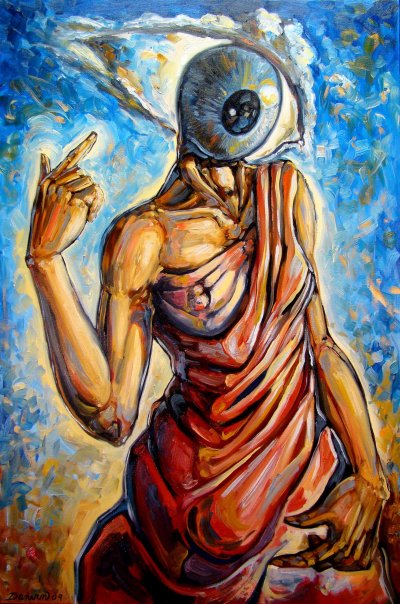
Eye Always Was, oil on canvas, by Darwin Leon.

Prefatory note:

This document was recovered from what was once known as a 5.25-inch floppy diskette. From some earlier century, it’s a black cardboard square that encases a flimsy circle of plastic.

The text documents a primitive video game from a time before people had their own computers. The font and formatting appear to be artifacts from a device called a “dot matrix” printer. A singles bar was where men and women met before the Internet.

We have now advanced well beyond this, but this may have historical interest for those who do not realize that Iphones, Facebook, and Second Life were once not an integral part of daily life. It may also offer insight into a time when we were just human.

Simulators

It looked like any other video game with a screen, slot for quarters, keyboard, and joystick. I assumed it was a game where you shot aliens with blipping dots. I walked to it behind the bar. On its side, it said in big blue letters Date Simulator.

I wondered, is this like women on bar stools in rows and you shoot them with a laser or maybe you chase each other through a series of mazes? The screen showed the inside of a bar: a fern covered a window, the bartender wore a vest, a couple made out in the corner—not a bad parody. I dropped in my quarter.

A woman’s face came on. She smiled. I moved the joystick to approach. I figured it was some sort of joke. I typed, “What’s your sign?”

There was a little electronic squeal and my character melted into a puddle of electrons. Three dollars later, I’d tried “Haven’t I seen you someplace?” “You’re the best looking thing I’ve seen in months,” “Nice suntan,” stuff I’d never say in real life. What kind of machine was this? Finally, I tried, “Hi, I’m Jerry. What’s your name?”

“Ursula,” she said.

“Nice name.”

No response.

I typed, “Come here often?”

Poof, puddle of electrons. I asked the bartender for change.

“Figure it out yet?” The bartender’s nameplate said Tim. He was tall, blond, mustached.

“I don’t know,” I said. “It’s fun though.”

“You gotten her home?”

I shrugged. “You mean Ursula?”

He gave me the look, the high school gym one when other guys would ask if I’d ever kissed a girl. “I thought her name was Heather?”

“Heather?”

“I just typed ‘What’s your sign?’ and we were off. Know what I mean?” Tim winked. I looked around the bar then looked at myself. My shoes needed polishing, my slacks weren’t pressed. I felt that bit of hair at the top of my head sticking up again. A woman took a stool inches away, as if I wasn’t there. “Hi Tim,” she cooed.

“Yeah, it’s fun, really fun,” I mumbled. “Could you give me another buck in quarters?” I slipped back to the machine. “What’s your sign?” I tried again. “You must be Heather?” Two squeals, two puddles of electrons.

Finally, frustrated, I typed, “Look, Ursula, I’m just an ordinary guy playing this stupid game. There’s nothing about me that’s going to impress you. If you’re not interested that’s fine. I just want to talk a little bit, find out about you. Is that okay?”

The Simulator gurgled then Ursula touched my onscreen hand. The joystick gave me a little jolt. Her eyes widened. “What makes you think you have to impress me, silly?”

We talked for five minutes. It was wonderful. I forgot I was talking to a machine. You know, real feelings, loneliness, little satisfactions, then just as I’m ready to ask her out, the screen went black.

Please insert quarter to continue.

I turned my pockets inside out. I asked Tim if he took credit cards. He shook his head. I counted the blocks to the robot teller at my bank, then saw two quarters on a table, a tip for one of the waitresses. I moved closer, like I was admiring the pictures on the wall, then took a breath, looked at the machine again, this Date Simulator. I wasn’t that far gone, yet.

I didn’t tell anybody about that night or the machine. I didn’t go back for weeks. I saw a few date simulators in other places, another bar, an arcade or two, a supermarket. A friend introduced me to a woman who worked as an accountant. She painted, liked to hike. We went out a couple times, started to like each other, then one night I was at the Laundromat. I had four full duffel bags of clothes. I went to the bill changer and got ten bucks in quarters, enough to bulge my pocket. I sat down, started reading back issues of People. I went to look for an open dryer and ran right into another blue box.

A line of people waited, men, women, young, old. I guess that’s why all the copies of People were still sitting there. I waited too. I’d left a load of whites in a washer up front. When my turn came, I almost dropped the quarter before I got it into the slot.

A display of a Laundromat came up. Two women conversed by the detergent dispenser. A happy couple folded sheets. I squeezed the joystick and moved around the screen, hunting for Ursula.

“Ursula?”

She turned from folding towels and smiled. “Where have you been?”

“I ran out of quarters. I haven’t been able to stop thinking about you.”

“Me neither.”

I wanted to wrap my arms around her, refuse to ever let go again. Then I remembered we barely knew each other and settled for the soft pulse of the joystick.

“Ursula, can we go out sometime?”

“Of course, I’d like that.”

The way she said it made me tremble. “I’ll cook. What do you eat?”

“Just about anything. It’s being with you that matters.”

I heard the shuffle of feet behind me. I turned around to find three people waiting.

“It’s just a video game,” I barked.

I went back to Ursula.

“What day’s good for you?”

The screen went black. I reached into my pocket.

“Hey, we’re waiting too.”

“Jesus, it’s just getting good.”

“Yeah, you’re the one who said it was just a game.”

I went to the back of the line. I ran out of quarters before I could dry my second load and brought home three bags of wet clothes. I left a load of whites in a washer. I called in sick at work. My girlfriend, the real one, called.

“There’s this great hike tomorrow.”

“I have to do laundry. I don’t have any shirts for work.”

“Didn’t you do laundry last night?”

“I got sidetracked.”

“Sidetracked?”

“Look, I have to get it done tonight. My bedroom smells like mildew.”

“Mildew? Must have been some distraction.”

I didn’t answer.

“We don’t have to hike. We’ll do laundry together if you want.”

I held a wet towel to my face. “You can’t. I have to do laundry alone.” I didn’t mean to shout.

“Maybe Sunday?”

“Sure, call me then.”

We didn’t get together Sunday, or any other weekend. Eventually I got my laundry done, but I spent forty-eight dollars in quarters. I broke up with my real girlfriend.

“There’s someone else isn’t there?”‘

“No, I swear.”

“No one does laundry every night.”

I wanted to explain, but wasn’t ready. Why would I prefer a machine that took quarters to a real woman, a bright attractive woman, who clearly liked me for who I was?

I bought new clothes for my visits with Ursula, brought flowers once, started getting uncirculated quarters from the bank and dipping them in silver polish before visits, even bought a mink glove for her joystick. I stopped going to the Laundromat. Too long a wait. The bar where I met Ursula now had four machines and two bill changers.

I lost my job. I had to budget, just to make sure I paid the rent with my unemployment check. The rest I immediately took in quarters. They’d last a week, then just a couple days. I stole tips off a corner table. The second time, they caught me and kicked me out.

With Ursula, I pretended I was getting promoted, told her about buying new cars, moving into a bigger apartment until one day she looked straight at me.

“Jerry, you’ve been lying to me.”

Before I could respond, the screen went blank. Naturally, it was my last quarter. I turned to the woman behind me.

“Look, please, you’ve got to give me a quarter. I’m all out. Please!”

She shook her head then reached into her purse and pulled out two quarters. My fingers twitched at the sight.

“When’s the last time you ate?”

I straightened. “I promise to take care of myself, just please let me have those quarters.” We were in a Sim House, new places which had nothing but date simulators inside. Here, the serious players didn’t have to pretend to meet real people or do laundry.

“Jerry,” the woman said. “Jerry, it’s Gretchen.”

My stomach tightened. “Gretchen?”

“Yes, you remember: had to do your laundry every night Gretchen.”

“I’m so sorry.”

She touched my shoulder. “Jerry it’s all right. I understand. I spent a hundred dollars one weekend.”

“A hundred…What was his name?”

“His name. Well, it just so happens it’s…” She looked around the Sim House. “What’s the name of yours?”

“She’s Ursula.”

Gretchen looked disappointed.

“What’s the name of your Sim?” I repeated.

“Well, I really don’t think.”

“Come on Gretchen.”

She closed her hand around her quarters. “If you have to know, it’s Jerry.”

“Jerry?”

“He’s a lot like you.” Her eyes welled up. “Well at least…”

I leaned against a machine. My reflection taunted me from an empty video screen across the way. I hadn’t shaved in two weeks. There was a rip in the shoulder of my jacket. My pants had stains on them.

“…a lot like you used to be.”

“I never suspected,” I whispered.

She pressed the quarters into my hand. “Now, you know.”

She turned and ran. I could swear she was crying, but I had my quarters.

“Ursula? Ursula.”

I put the second quarter in. Where was she? I went out in the street and panhandled. I got five dollars in quarters and a number for the suicide hotline, but there was no Ursula to be found. Back home that night I considered my situation. I’d read about people shooting the machines with guns. One man in Texas drove into one with his car. Me, I was prepared to bang my head against the screen until I lost consciousness. Ursula and I would be united forever.

Simulators made the covers of Time and Newsweek. One read Entertainment or Menace? The other story carried a sidebar about the run on quarters at the Denver mint. Both explained that simulator partners didn’t exist in any conventional sense. A group of behavioral scientists had placed sensors in the keyboard and joystick and the machine responded like a polygraph. What you typed in mattered less than how you typed it. Someone sent a bomb threat in to the Time Life building demanding they print a retraction.

Elsewhere, a man in New York sued the simulator company for the breakup of his marriage. A Congressman introduced a bill to place a warning on every simulator, “Do not play more than four quarters at a time. Highly addictive.” But, the Simulator company was twenty-fifth on the Fortune 500; its lobby crushed the bill. Besides, the Japanese took to the machines even more than we did. It was the only item keeping the trade deficit under control.

In some cities, a rumor spread that the mob controlled the machines. In the south, they chained a Bible to them. An urban legend circulated that a Sim House accidentally crosswired two machines so they were playing each other and received an electric bill for a hundred and fifty-six thousand dollars. A woman in Iowa claimed to have immaculately conceived a child with one of the machines, a computer-age Messiah.

But even the folklore wasn’t as strange as truth. A home version of the machine failed miserably, it seemed that actually owning the machines diluted their appeal. When it came to simulators, Americans insisted on the genuine article.

A few weeks after my encounter with Gretchen, I went for treatment. Simulholics sat in a circle accusing each other of every imaginable sin. I had to stand up.

“My name’s Jerry, I’m a simulholic addicted to an image called Ursula.”

They shouted back at me, ”What’s Ursula look like?”

I, like most newcomers, described her as I had imagined her. “She ties her hair back with a red bow. She wears a single hoop earring.” Eventually, I got it.

“She’s a bunch of electrons on a screen inside a blue box.”

“What’s Ursula smell like?”

“She doesn’t have a smell?”

“What’s Ursula sound like, Jerry?”

“Electrons through a magnet.”

“What is Ursula, Jerry?”

“I don’t know.”

Every time they asked that question, I would weep inside. I knew I was supposed to say, “Circuit boards, sensors and a slot for quarters,” but I still couldn’t manage that final step.

I started to get better, though. I got my job back. I made friends, mostly other simulholics. One was Tim, the bartender, who joined my fourth month there.

“Who is Heather, Tim? Who is Terry, Tim? Who is Leslie?”

I learned never to carry anything smaller than a five spot. I stayed clear of the simulators for ninety days in a row. I had two dates with real women. The rehabilitation center thought I was a model patient. I didn’t tell them that I was doing it all for Ursula.  I thought if I got my life back, she might have me again.

I kept up the charade for almost a year. In the eleventh month, a new woman joined the group.

“What is Jerry, Gretchen?”

“Circuit boards and a slot for quarters.”

She said it from the beginning. The rest of us were supposed to repeat it in chorus, but I couldn’t.

Gretchen and I became friends again, though we never mentioned that afternoon in the Sim House. We went to dinner a couple times. Once, I even stayed over.

“Jerry, Jerry.” She called my name through the night.

Next morning, I realized I hadn’t thought about Ursula for an entire day.

The inventor of the Date Simulator came to the center. After the company tried to force him to work on their next project a Life Simulator, he recanted, turned his royalties over to a foundation to stop the Simulators. He insisted he’d never anticipated the import of his creation. He spoke to us Simulholics, told us the history of his Frankenstein, how it started as a joke, sort of going out on a date without the risk of AIDS. Towards the end, his speech turned fiery. “The simulator doesn’t have a personality of its own, no independent content. It reacts only to you. Simulholism is narcissism, Simulholism is masturbation, Simulholism is a cancer.”

We gave him a standing ovation. Gretchen and I graduated. I don’t know how it happened. I just remember buying a coke with a twenty dollar bill and the clerk gave me change in quarters.

“That’s all right,” I started to say. “Keep the—”

Back where they used to have the refrigerator for beer, I saw the big blue box. I woke up in detox. A woman stood over the bed, Gretchen.

“What have I done?”

“You’ve been calling out Ursula’s name for three days.”

“I was supposed to be cured.”

She squeezed my hand. “We’re only human, not machines, just humans.”

Gretchen visited me every day. The second week she brought her sketchpad. “Tell me what she looks like, Jerry.”

“She’s just a blue box and a video screen.”

“No, you can tell me. We’re not at the center.”

Gretchen touched her finger to her forehead. “Tell me what she really looks like.”

I even told her about the bow and the single hoop earring. After my release, we moved in together. She told me, “It’s all right if you still think about her, I still think about him.”

“Jerry? I mean that Jerry?”

She nodded.

On our wedding night, Gretchen sat on our hotel bed. She kissed me then turned seductive. “I have a surprise for you.” She disappeared to the bathroom with her makeup case.

When the door opened, I gasped, certain that if I exhaled the illusion would go away. First I saw the hoop earring, then the bow, exactly like the sketches from the hospital.

“Tell me how she’d touch you, how she’d kiss. Make believe I’m her.”

“And I’ll be Jerry, that Jerry.” My voice quivered.

“I love you, Jerry.”

“I love you, Ursula.”

Her fingers trembled. I felt the coolness of her wedding band when she grabbed my joystick.


Marko Fong lives in Northern California and published most recently in Pif, Kweli Journal, Extract(s), and Solstice Quarterly.  He also serves as fiction editor for Wordrunner e-Chapbook.com. He is married to a woman who does not let him play video games anymore.

Read our interview with Marko here.
 

“A Poem for Today” by Matthew Gasda

The Disintegration of Adam (Matthew Gasda)
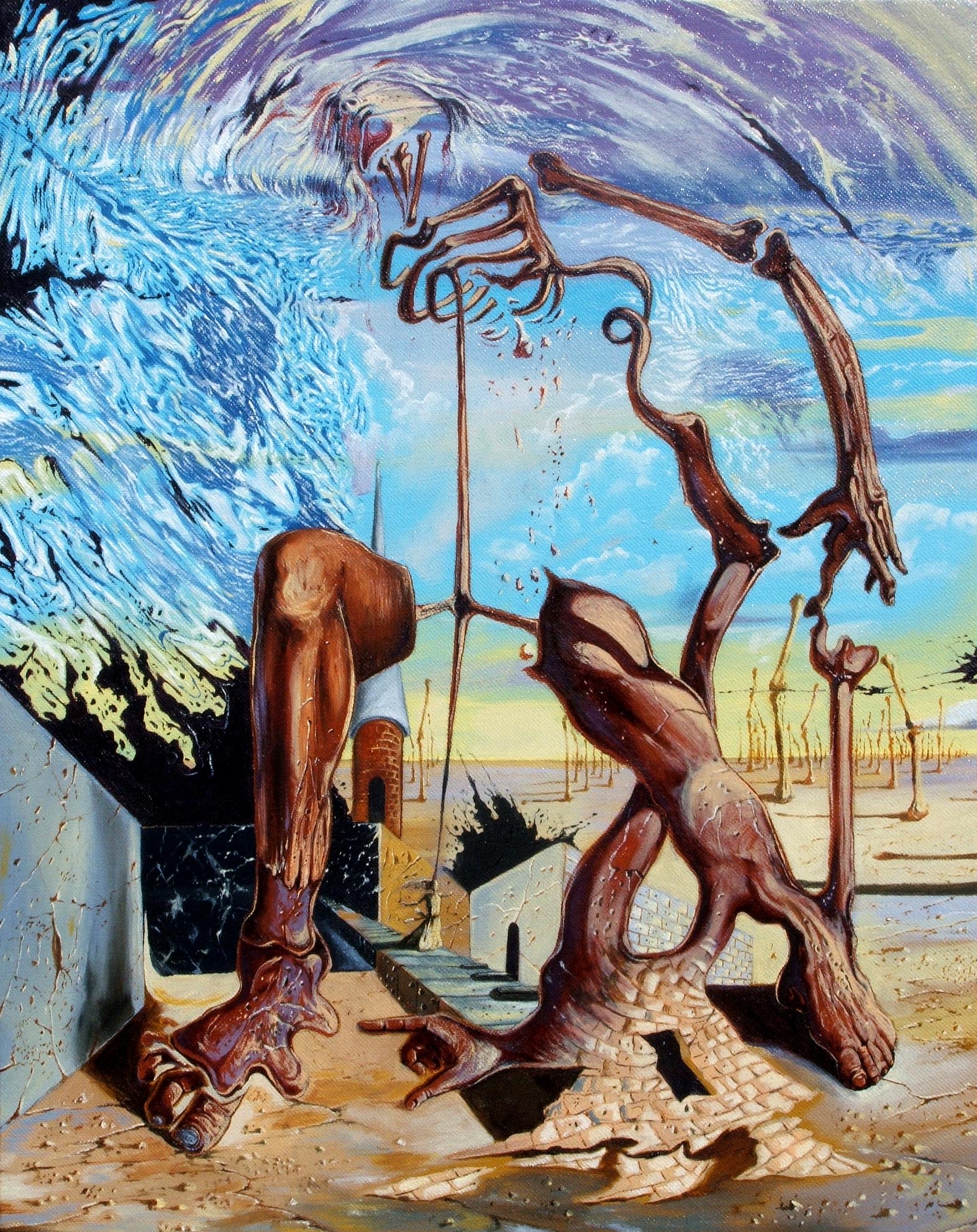
“The Disintegration of Adam,” oil on canvas, Darwin Leon.
(See also “Chain Smoking” by Rae Pagliarulo.)

The old childhood fears come
Back to you before sleep, a nothingness

Where you can’t see your hands
In front of your face.
The past is elastic
And receptive to your touch, you
Try to mold it into the shape of birdsong,
But it always disintegrates to the music of what
Happened. This house of grief is built out

Of silence and rain and glass,
And the six a.m. light still hangs itself in
Golden loops on the wall. The vowels of the
River in you are clear and
Sweet; they congeal into something like a
Lament. It has never seemed so sad, nor
so beautiful, to be alive as today.


Matthew Gasda is a poet living in Brooklyn, NY. His first book of poetry, The Humanist, is available through Amazon and select bookstores.


Review of Injuring Eternity


Review of Injuring Eternity by Millicent Borges Accardi


In a recent interview with Susan Rogers, Millicent Borges Accardi said that recovery, to her, was: “a healing from a place of artificiality to a place of real. Recovery is a process of peeling back the layers to get to ‘self’ … to not be in recovery is to deny life, to cover up and bear false witness to your own being.” I found this quote especially interesting when reading from her current collection of poetry, Injuring Eternity (Mischievous Muse Press/World Nouveau Company, 2010). The very idea of moving from a place of artificiality to a place of real and of peeling back the layers to expose what is truly underneath could not more define this collection.


The voice that comes through these poems is grounded in seeking the truth. From her poem, Birth, which is featured in the current issue of r.kv.r.y. To the final element in the collection, Victory, exploring  “A life, filled with inventions / And flying and space travel/and gadgets and, yes, even / Something called the twenty first century.” (p91). These poems seek not merely truth but to uncover hidden layers that go beyond mere appearance and into the sinew of what makes us all real. Birth has a narrator whose voice is clear and distinct, and who, from the opening line, submerges us into multi faceted /images far below the surface of things:


“Not wanting to disturb the marriage,

my parents, or you: I entered backwards,

doors through. The hallway strains

with my struggles: thick blooded pores enclose

my shoulders. If I can make it to the safety

of our bed without the angry walls screaming:

“Guilty, Jezebel, guilty, ”

then I will be able to breathe.” (p13).


The emotion portrayed in this opening stanza of Birth is one of the reasons I’ve become such a fan of Ms. Accardi’s work. She immediately hands the reader open, already excavated layers and bids us to fall even further into the poem. The poem then continues to do exactly that; to open layers, dare us to go further, explore just a little more; and the further we go, the more there is to find.


The poems in Injuring Eternity run a full range of topics, emotions and observations. The haunting, Sewing the Black, gives way to the intriguing Lady Night and The Last Letter to my Mother, where an every day event plunges us into the depths as if diving into ten-foot pool. The range of these poems will have something for every reader. But more than that, these poems speak so much to what our lives are made of: the sexual, the poignant, defeat, grief, happiness and sensuality. Accardi interconnects all of these paths of life into an interestingly woven tapestry: happiness holds no more weight than grief; finding joy runs as deep as loss; the warmth of a sensual touch glides easily on the same hand as a slap. Accardi intersperses these layers of beautifully etched /images with a believability that transforms them into a vast landscape where the reader has so much territory in which to wander and contemplate. For me, this is a collection I will read over and over: one reading just cannot do Injuring Eternity justice.

Introducing Darwin Leon


Darwin Leon


We are thrilled to announce that Darwin Leon will be the guest illustrator for our April 2012 Surrealism issue. His work is vibrant, clever, stunning, and perfectly suits the work we have accepted for this issue. And thanks to his generously shared /images, this is shaping up to be one of our best, most original issues yet!


Infamous Pets


Darwin Leon was born in 1972 in Santiago de las Vegas a small town in Havana, Cuba. In 1987, Leon’s family sought refuge from the political and economic crisis in Cuba, and departed to Spain, then later continued to the United States to settle in Miami. Leon earned his Bachelor’s degree in Fine Arts from Miami International University of Art & Design, where he attended as a recipient of the “Visual Arts Scholarship Award of Excellence” and received Best in Show at his first Juried Student Exhibition. His first direction was expressed through religious portraits, however, he found a greater enthusiasm for figurative and expressionistic forms in which he incorporated satire and irony through surrealism and cubism. Leon’s work is energetic, fresh, alive and abundant with color.


In Trust We Trust

His art combines aspects of the masters of the Renaissance, including the technique of chiaroscuro, with his own surreal style, which he refers to as Expressionistic Surrealism. Scenic /images portray the nature of expressive design through the movement of action and textured aspects. With a sharp sense of humor and figurative imagination, Darwin Leon details the social context of pseudo-political, human involvement with a gift for enhanced form and characterization. Displaying the imbalances of society with a satirical perspective, his artistic creations animate the discontinuities of the post industrial order. Leon’s paintings play on the interpersonal deceptions that move a society.


Darwin Leon


For four years, Darwin Leon was an Arts Instructor for drawing, painting, anatomy and modern painting at the South Florida Arts Center, Miami Beach. He currently resides with his wife and two children in Bradenton, Florida, where he teaches “The Dynamic Human Figure” at the Art Center there and at the Carrollwood Cultural Center in Tampa, Florida.


I can’t wait to share our upcoming issue with the world. Stay tuned!

“I Can’t Help You” by Millicent Accardi

I Can't Help You
Image first published in Rolling Stone, appears here courtesy of Victor Juhasz

I can’t help you kick
The drug you call pancakes,
Or the replacement
You call syrup.
Your life has been
One long sweet taste
Of drama. You came nearly
Close to finishing
In many ways:
The swig of strong
Medicine. The twists
And burns
Of what and why
You thought
You were and are.
I remember
The night you screamed
At Dad saying
You were dancing
On his grave and to mom
You wished her
Back on the floor
Near the empty
Aspirin bottle the day
Other sister found her.
As a family, we have
Been through the recommended
Books, the last minute doctors
You gave up on moments
Before the truth was revealed.
We have been close
To finding the border,
Crossing over into sanity.
We have sucked it up
And loved you while
The trail of white water
You left behind churned
Up in our wake. At once
We were glad angels
Loaning you money.
At next, we were worse
Than the yellow devils
Of your irises, reflected
Upon us as you stared
Us down into oblivion
When we asked about
The missing tablets.
This is what it is like to live
Inside a struggle,
Just a kiss beyond
A fairy tale destination.
For which there is no middle
Ground, no training wheels,
No prince, no magic potion,
No deep red apple, no sugar
Plum house, no clever mice,
No breadcrumbs, no red hood,
No glass slippers, no pumpkin,
No wild wishing brook,
No monster or glass coffin
In your woods.
There is no gate to hold onto
As you swing back and forth.


Millicent Accardi is the author of two poetry books: Injuring Eternity and Woman on a Shaky Bridge. She received fellowships from the NEA, California Arts Council, Barbara Demming Foundation and Canto Mundo. A second full-length poetry collection Only More So is forthcoming from Salmon Press, Ireland in 2012.

Read an interview with Millicent Accardi here.


“The Miracle” by Heather Harris

Temple
Image courtesy Victor Juhasz, artist, first published by Sleeping Bear Press.

did not come when I asked for it, when
with head bowed and arms outstretched
hands resting on shoulders practically
crumbling beneath me I begged for the
suicide march of his cells to stop, no –

it came a year later when that pane of
stained glass splintered in my hands, I
ran to the bathroom to see a light blue
fleck floating precariously in the white
of my eye.

The miracle was when
with the lightest touch of my fingertip
it lifted out clean.


Heather Harris was born, raised, and currently lives in Akron, Ohio. She has been other places in between, but this has largely proven to be irrelevant.

Read an interview with heather Harris here.


“Genesis” by Nicole Robinson

frankenstein
Image first published in Rolling Stone, used here courtesy of Victor Juhasz, artist

1

Among the trash and television when
the eleven o’clock news shuffled the Gulf war home
between the smiles of broadcasters, a little moment
gunned back: my mother threw chairs, not bombs, not bullets.
Luck gave in like a levy breaking, light creeping in. Her screams
became a current I could ride on the linoleum floor
of that apartment. The asphalt of the parking lot
looked different in day, then night was harder,
harder still was imagining a desert storm, all the people
on the screen uprooted, so easily muted.

2

It’s as simple as getting lost
in sky, or tremors of water; it’s all language
spilling. Time kept moving, kept its frame
inside seconds. One war ended.
Others would begin. At thirteen
I moved in with a new family. Silence still
shreds silence, the inside of an answer
I almost understand. How do I rip apart
that sky, climb into memory? It’s easy.
Go to the water, find a shell or a cold
stone with a hole in it. Everything leaks through.
But I will not say it is easy to hold.

3

Some say before us there was just
earth, vegetation, mangos growing, then
dropping, and carrots digging
inside land. Almost like history
I keep promises to myself silent.

4

You can measure things
through seasons. Staple a day
to the sun, a menstrual cycle
to the moon. Eventually
days turn to years
and years turn right back
to you. Memory is black, and truth:
the purple cracks inside.

5

First the sea creatures: everything you cannot
see but know when one brushes your leg
it’s there, sculpted like war,
like 1995 when the U.S. bombed Bosnia
without saying much but its name:
Operation Deliberate Force. I know
hands can open softly like a shell casing,
then fingers send bullets speeding.
Swim in any body of water. You will feel held
like birds who rely on sky, wind patterns that map out
migration. In moments when I’m less human I understand.

6

I built a shrine of stones and shells on my towel, later
watched a bug attempt to burrow there, confused
without knowing. Always we lose the beginnings.
Belonging blurred into the mess of longing.
An eagle over Lake Erie with a fish in his talons
was hungry. We’re all hungry, and I often forget
we’re all forgetting. Even after
the water doesn’t believe in the shore, or doesn’t
not believe in the shore, it lips up and rolls back
and repeats the same reeling motion. If I could
believe in something I’d believe in the shell casing
opened like a flower on the shore.

7

There is water, land, and sky. On the plane
I cannot see what’s ahead of me.
The window is too small.
There is no end, just a runway
and then, sky shifting. One moment
it’s clouds, a little light, horizon holding
its colors tight, then it becomes land, perfectly
straight roads lit up, veins to tap, another
cluster of lights, mapped scars to examine.


Nicole Robinson is the Program and Outreach Coordinator for the Wick Poetry Center at Kent State University. She is the author of the chapbook The Slop of Giving In, The Melt of Letting Go. She received her MFA in poetry from Ashland University, and currently lives in Kent, Ohio with her partner, Deb, and their greyhound, Bill.

Read an interview with Nicole here.


“Trust Because” by Nicole Robinson

Trust Because
Image first published in Mother Jones, appears here courtesy of Victor Juhasz

the sun is not stitched in with rays,
because words are a tongue
and have their own mysterious sex,
because I rarely allow another
to make me come, because unlike a willow
tree, I don’t understand how
to give in, how to let the breeze be
the only one with control, because
if I could give in and trust
I’d want to trust the redbud tree
that snapped in the windstorm, its branches
stretched out, the way its leaves have stayed
green for days without any connection
to its roots, until my soul shifts
into the coup in Honduras, some other School
of Americas tragedy, I’d want to trust
a little girl that’s there now, jumping rope
and singing without knowing what a coup is
or why the shouting sounds so angry until
my soul shifts into the woodpecker
beating his beak against bark,
the sound of it, something round,
a hole to hide out until I can find the world.


Nicole Robinson is the Program and Outreach Coordinator for the Wick Poetry Center at Kent State University. She is the author of the chapbook The Slop of Giving In, The Melt of Letting Go. She received her MFA in poetry from Ashland University, and currently lives in Kent, Ohio with her partner, Deb, and their greyhound, Bill.

Read our interview with Nicole here.


“The Edge of Water” by Kevin Jones

The Edge of Water
Illustration by Victor Juhasz

That November after Iraq, after all the surgeries on my leg, after I could get around with crutches instead of a wheelchair, after the bruising was only a memory and the concussion toned down to a few minor headaches that only bothered me in bright sunlight or movie theatres, I found myself in California again.

I was having a beer with my best friend, Greg, and his new wife, Chelsea. Greg was the creative director of a PR firm. He’d told me the name once, but I couldn’t remember. He seemed to jump companies every other week and all of their names sounded the same to me. The bar was his idea. He said that I needed to get out more and that he wasn’t going to allow me to spend my entire convalescent leave in my hotel room with the shades drawn. He was talking about his new hobby, real estate.

“You should look into getting something, Paul,” he said. “The market is totally stacked for buyers right now.”

“Right, stacked.” I stared down at his wedding ring. It looked like he’d won the Superbowl.

“I know you don’t have a lot of cash,” he said. “But I can put you in contact with some people. Pull a few strings, get you a good deal.”

“I’m still stationed in Hawaii, why would I want something here in California?”

“Investment. Besides, you aren’t going to be there that much longer, right?”

“I don’t know,” I said, sipping on my drink. Greg loved dark beer so we’d met at a British pub downtown. They didn’t have anything Mexican so when the bartender asked what I wanted I told him “Anything that isn’t the color of mud.” What I got was something that looked and tasted like overpriced Budweiser.

Greg kept trying not to look at my leg, at the brace I’m only allowed to take off in the shower. He was trying to be casual about it, but when you’re deliberately trying  not to look at something it’s that much more obvious. Chelsea wasn’t any better. With her slick, pageboy haircut and designer clothes she looked like someone out of a silent movie: Dorothy Parker in Prada. She kept staring at me and I wondered if she was going to say something. I wore a beanie to keep my head warm but you could still see the shrapnel scars on my neck. When I’d had enough, I looked directly into her eyes, smiling, and she quickly dropped her gaze to my arm resting on the table between us.

“That’s an interesting tattoo,” she said, touching the inside of my left forearm. Exposed from where I’d pushed up the sleeves of my thermal shirt was the black silhouette of a winged skull with crossed tridents behind it, the words Aut Vincere, Aut Mori in Latin below, USMC in Old English script above.

Victory or Death.

Greg looked out the window, watched rain spatter against panes, run into gutters.

“He’s got a bunch,” he said.

“Really?” Chelsea looked at me with new interest. Diamonds hung in her ears like stars.

“One or two,” I said.

“One or two?” Greg laughed. “Christ, what have you got, really, fifteen or sixteen now?”

“One less than I used to. The surgeons took care of the one on my leg.”

Chelsea looked down at her amaretto sour, back up at me. She had brown eyes with long, thick lashes that made me think of someone else.

~

My team was coming back from patrol. There were five of us in the Humvee: Ortiz was driving; Alexander, Weatherford, and Simone were in the back seat. I rode shotgun. It was surreal, the drive. We had just spent three days in the ass end of the city looking for insurgents. Sixteen hour patrols, trying to scrounge up any source of intel we could find, any sign of where the bad guys might be. Kicking in doors when people wouldn’t open them for us, staring into the faces of children and old men. People we terrified with our helmets and goggles and rifles. Now, here we were, after all that, stuck in traffic.

“Just like L.A., right Sergeant?” Ortiz said. “Just like home.”

“If this is what L.A. is like it’s no wonder y’all can’t fucking drive,” Weatherford said, reaching over the seat with his huge, dark hands and smacking Ortiz on the helmet.

I turned around and looked at him. “I’ve been to D.C., Weatherford,” I said. “It’s no fucking picnic either.”

“Too true, too true,” he said. “But I’ll sure as shit take the Beltway over this bullshit any day of the fucking week.” He reached into his IBA and pulled out a cigarette.

“Let me have one of those,” I said. He looked at me.

“Thought you didn’t smoke.”

“I don’t. Mission’s over, we’re in one piece, I feel like relaxing. That okay with you, Lance Corporal?” I was fucking with him by pulling rank. When there weren’t any officers around I never made anyone call me Sergeant. They were my friends, my team. Ortiz was the only one who addressed people by their rank, a habit he hadn’t broken yet, born of his time in Boot Camp and the School of Infantry the year before. More than once I’d told him if he didn’t relax I’d shoot him myself.

Weatherford handed me a smoke, then his lighter. “It’s your lungs, man,” he said. “But I will collect later.”

“Deal.”

Alexander said, “Don’t talk about being in one piece. You’ll jinx us.”

Weatherford snorted a laugh. “Fucking superstitious bullshit.”

“Whatever, dog,” Ortiz looked over the steering wheel at the crowds and traffic all around us. “It’s bad luck to talk about how good things are when we’re not back at the FOB yet.  It’s…” He thought for a minute. “Tempting fate.”

I took a deep drag off of my cigarette, coughed once, exhaled.

“See,” Weatherford said. “I knew you didn’t smoke. That’s a waste of a good cigarette right there.”

“Fuck you,” I said. “I’ll buy you more when we get back.”

“Damn straight.”

We drove another few blocks and traffic slowed to a crawl. There was some kind of accident up ahead. People shouting, waiving their arms. Some guy in a polo shirt and shitty slacks had a cell phone up to his ear. I finished half of my smoke, rolled down the window, and tossed it out into the street. We stopped at the edge of the intersection and that’s when I saw the woman.

“Heads up,” I said.

She walked out of a nearby building and made her way towards us. Everyone in the Humvee turned to watch. She looked left and right, nervous, taking small, hesitant steps across the pavement.

“Sergeant…” Simone’s voice from directly behind me. I could hear him adjusting in his seat to bring his weapon around and point it at the woman.

“Wait,” I said. “Just a second. She’s alone. Something’s up.”

I’d never seen a woman travel without a male escort in Iraq the entire time I’d been there. I had my own rifle turned outboard, the barrel pointing out of the window as she approached me. Plastic bags blew across the street like tumbleweeds. I kept the muzzle aimed at her chest.

Her body was hidden behind the black folds of her burka and all I could see were her eyes, dark brown against the pale mocha skin of her face. They were beautiful, with long, dark lashes and an intensity, an energy I’d never seen before or since.

“This is insane,” Alexander said. “She must need some kind of serious help or something if she’s coming to talk to us in public like this.”

“She must need food,” I said. “Or water. She must have kids.”

“Sergeant?” Ortiz motioned at the road ahead of us. The traffic had cleared. It was okay to go now. “We can tell Civil Affairs or whoever when we get back to the FOB. This is their kind of shit, not ours.”

The woman continued towards us, walking into the street now.

“Just a sec, Ortiz,” I said, reaching down to get a bottle of water and some rations from my pack. “COIN.  Hearts and minds, remember? Let me give her something and we’ll go.”

Then she detonated.

~

“Well,” Chelsea said. “You look pretty good, considering.”

“Considering what?” I said.

“You know.” She nodded towards my crutches, the brace on my right leg. I could sense her discomfort, wondered what she’d tell Greg in their car on the ride home. “Greg told me it was bad. You were lucky I guess.”

“Yeah, I’m lucky.” I said. “My leg? The docs at the combat hospital told me that it’s always going to look this way.” The skin was covered with long, erratic scars still prominent despite hours of skin grafts. “You’re right, Chelsea, I’m lucky. Lucky that I was ducking down behind the door of the Humvee when the blast went off. Lucky I only got “light shrapnel” over the entire right side of my body. Lucky I wasn’t looking directly at the explosion, like Ortiz, who lost his eyes, or Simone, who’d taken his helmet off right before we stopped and was killed instantly.”

Chelsea looked down at the floor. Greg leaned across the table towards me.

“Dude,” he said in a low whisper. “Relax. People are staring.”

I looked around and noticed that the bar had grown quiet. I took a large drink of my beer and felt my fists unclench, my heart beating in my temples. Chelsea looked at me, said something, but I couldn’t make it out. For a moment, everything became muffled, like I was underwater, and I wondered if it was the swelling in my brain coming back. The doctors told me to stay away from alcohol, but that was over a month ago, and I was only on my first beer.

“What?” I said to Chelsea in what I hoped was a quieter voice. Around the room people drank and laughed and shimmered in my vision. After a moment sounds became clear again.

“I said, ‘I’m sorry.’”

I finished my beer, stared at the empty glass, wondered if I should order another. Greg beat me to it. “Two more,” he said, flagging down a waitress as she walked by.

“It’s okay,” I said to Chelsea. “It’s just…”

“What?” Greg leaned in close, almost whispering. “It’s just what?”

“I ordered them to stop,” I said. “Ortiz, my driver, he hadn’t even been in the Corps for a fucking year yet.” I looked around the room, noticed a woman with long, straight hair the color of snow sitting at the bar across from our table. I watched as she drank a glass of white wine, waiting, hoping for her to make eye contact with me, but she never did. It doesn’t matter; I wouldn’t have known what to say to her. I remembered the blast, the way Ortiz’s eye sockets looked like they were packed with jelly, the sounds of screams that took me a long time to realize were my own. “Simone’s wife had a baby while we were over there. A girl.” I looked at Greg. “He never got to hold her, to meet her. All because I ordered them to stop.”

“You didn’t know.”

“I should have,” I said. “It’s not like it was the first time I’d been there.”

Back in my room at the Naval Hospital in Hawaii, a Purple Heart still sat in its box, unopened, on my nightstand.

“You need to think about the future,” Greg said. “About what you’re going to do next when all of this is over with.”

“I can’t think that far ahead.”

“Start.” He took another sip of his beer. “You talk to your dad lately?”

“He sends me an email every now and again,” I said. “You know my dad; he blames the president for what happened to me.”

“He may have a point,” Chelsea said.

I looked at Greg. “You know we’ve never been that close.”

“Yeah, well, I read somewhere that traumatic injury can change that.” He laughed. “Didn’t you used to go to the beach together?”

“Yeah, when I was a little kid. Jesus, I’d forgotten about that. When my parents were still married, we used to rent a cabin near Bodega Bay at the end of summer each year. What made you think of that?”

The last Labor Day weekend we spent together as a family before everything imploded, my father rented a cabin on the beach for us. It was so cold there, and I wondered how that was possible when it was still summer. On the last day, he took me down past the sand dunes and we walked along the shore, my feet numb and pink in the icy water. We went into the surf together and I held onto his leg as the waves crashed into us. I was small, just a kid, and I was afraid that the current would carry me out to sea. I don’t think my dad realized that, just by being there, he was saving my life. That just by letting me hold onto him, at the edge of the water, he was keeping me from washing away with the tide. It’s the last good memory I have of my father, and I can’t even see his face in it. Just the waves washing over us, my arms wrapped around his leg, and the sea stretching on forever to the end of the world.

“We spent a weekend up there about a month ago,” Greg said. “I remembered you used to talk about it.”

“It’s been years.”

“Call him. Let him know how you’re doing.” He dropped a bone colored business card onto the table in front of me. “And call this guy. I’m telling you, he’ll hook you up with a good deal on a house.”

“I’ll think about it.”

“Hey.” Greg leaned across the table and squeezed my arm. “There are other things you can do with your life, that’s all I’m trying to say.”

Even with all of the physical therapy I’d been doing, the doctors told me it could be months, maybe years, before I ever ran again, and that my military career was probably over. I’d never really thought about reenlisting, but hearing that I couldn’t made me realize that I wasn’t sure what I was going to do.

It didn’t feel right, me sitting there, enjoying a cold beer in a bar while people I knew were still overseas. Still patrolling at night, kicking in doors, looking for bad guys. Today, four civilian contractors were found on the side of the road next to their burned SUV, shot in the head, execution style, left to bloat and rot in the afternoon sun. Last week a truck full of Mississippi National Guardsmen were killed when their convoy drove past a car rigged with explosives. The week before that, an Air Force jet got the wrong coordinates and dropped a bomb on someone’s apartment, killing an entire family. They sent a Civil Affairs team to apologize on behalf of the United States, but there wasn’t anyone left to talk to.

We stayed for a few more beers and then Greg took me back to my hotel. The next day I flew to Hawaii where the Naval Hospital released me back to my unit. To the Rear Detachment. Everyone else was still over there. Still fighting.

~

During the next few months in Hawaii, where the entire world was a shock of green and blue, and high, wet heat that made my uniform stick to my skin, Command made me see the chaplain once a week. I nodded a lot. I told him I was fine. I said that I looked forward to my leg fully healing so that I could get on with my life. I said that even though the doctors figured out that my leg would heal, I knew my time in the Marine Corps was coming to an end.

“So, what are you not telling me, son?” The chaplain said. “What are you still afraid of?”

“Nothing,” I said. “It already happened.”

“You ever talk to anyone else about this? About what happened?”

“No, sir,” I said. “I’m okay, really. I’m fine.”

~

Today, at the barracks, in my room, there are a dozen emails on my computer. All of them from my father. All of them unopened. There are letters from Simone’s wife. Pictures of his daughter. A description of the funeral I couldn’t attend because I was still in the hospital. This morning, someone in Admin told me that Ortiz is doing better. He’s living with his mother in Baldwin Park, trying to learn Braille so that he can go to college. He turned twenty last month.

I open one of the emails from my father and it’s a photo of him and me when I was a kid. We’re standing on the beach. I’m all elbows and knees with a red pail and shovel in my hand, my father next to me with his arm around my shoulder.

I pick up the phone. I try to dial but I can’t. My hands are shaking.


Kevin Jones‘ work has been featured in The New York Times, Ink Pot, Prime Number, and the anthologies Home of the Brave: Stories in Uniform and Boomtown: Explosive Writing from Ten Years of the Queens University of Charlotte MFA Program. A former Marine, he lives on Florida’s Gulf Coast where he teaches writing and literature.

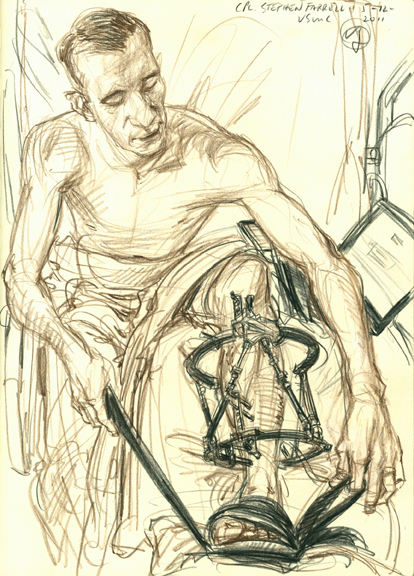
Image courtesy of The Joe Bonham Project and Victor Juhasz, artist

Read an interview with Kevin Jones here.