“Eyes Right, Confessions from a Woman Marine” by Tracy Crow

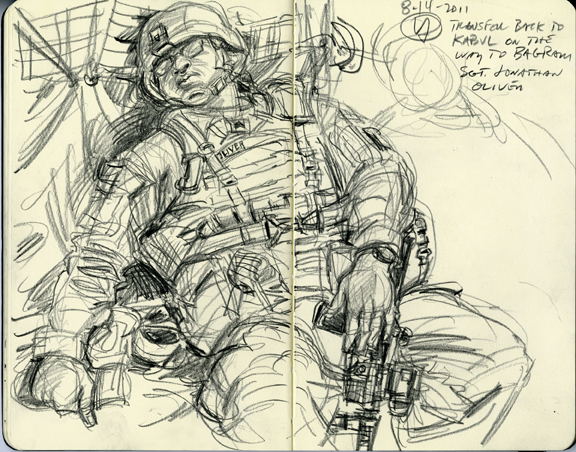
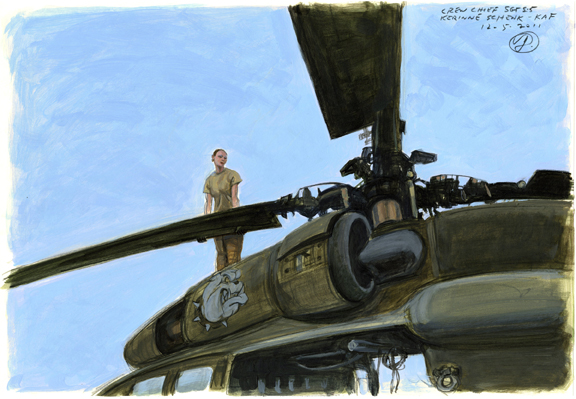
woman on helicopter
Image courtesy of Victor Juhasz, artist

When I was twenty-eight, younger than my daughter is today, I was facing the likelihood of a court-martial.

I followed a Marine sergeant down a polished corridor, past the clacking of typewriters and murmurs behind the closed doors of Military Police Headquarters, and pretended to be unafraid, as if I had nothing to hide, as if on the way there that morning I hadn’t seriously mapped out a plan for desertion. Inhaling and exhaling in the same forced rhythm of a runner pacing through a psychological wall, I was committed to a marathon of sorts, and so I was breathing in and breathing out, matching foot speed and cadence with the young Marine ahead of me: a machinated force, we were, matching left foot and right, left arm and right, until he pulled up short in front of a closed door. My toe stubbed against the heel of his boot. Acting politely unaware, he pushed open the door and stepped aside for me to enter. He wore well his role of consummate Marine, refusing the eye contact I was desperate to interpret.

“The captain will be with you shortly, Ma‘am,” he said.

I forced a smile. “Thank you, Sergeant.” After he disappeared behind the closed door, I heard those machine-like limbs working their way back down the corridor.

This was March 1987. The year Prozac made its debut. Gasoline was eighty-nine cents a gallon; the cost to mail a letter, just twenty-four cents. Televangelist Jim Bakker had self-destructed, much the same way I had, by way of sex-scandal.


** The remainder of this archived essay has been removed at the publisher’s request. The book from which this essay has been excerpted may be purchased at Amazon.

Read our interview with Tracy Crow here.

Tracy Crow is an assistant professor of creative writing at Eckerd College in St. Petersburg, Florida, and the nonfiction editor of Prime Number magazine. Her essays and short stories have appeared in a number of literary journals and been nominated for three Pushcart Prizes. Under the pen name Carver Greene, Crow published the conspiracy thriller An Unlawful Order, the first in a new series to feature a military heroine.

Excerpt reprinted from Eyes Right by Tracy Crow, by permission of the University of Nebraska Press. Copyright (2012) by the Board of Regents of the University of Nebraska.


Interview with Victor Juhasz


Victor Juhasz


Mary Akers:
Your work is so wonderful, Victor. We were thrilled to have you share your time and talents with us. Thanks also for reading all the work and selecting the /images to accompany them. Such an honor for our authors! I wanted to ask, was there any one piece in particular that stood out for you or that you connected especially well with?


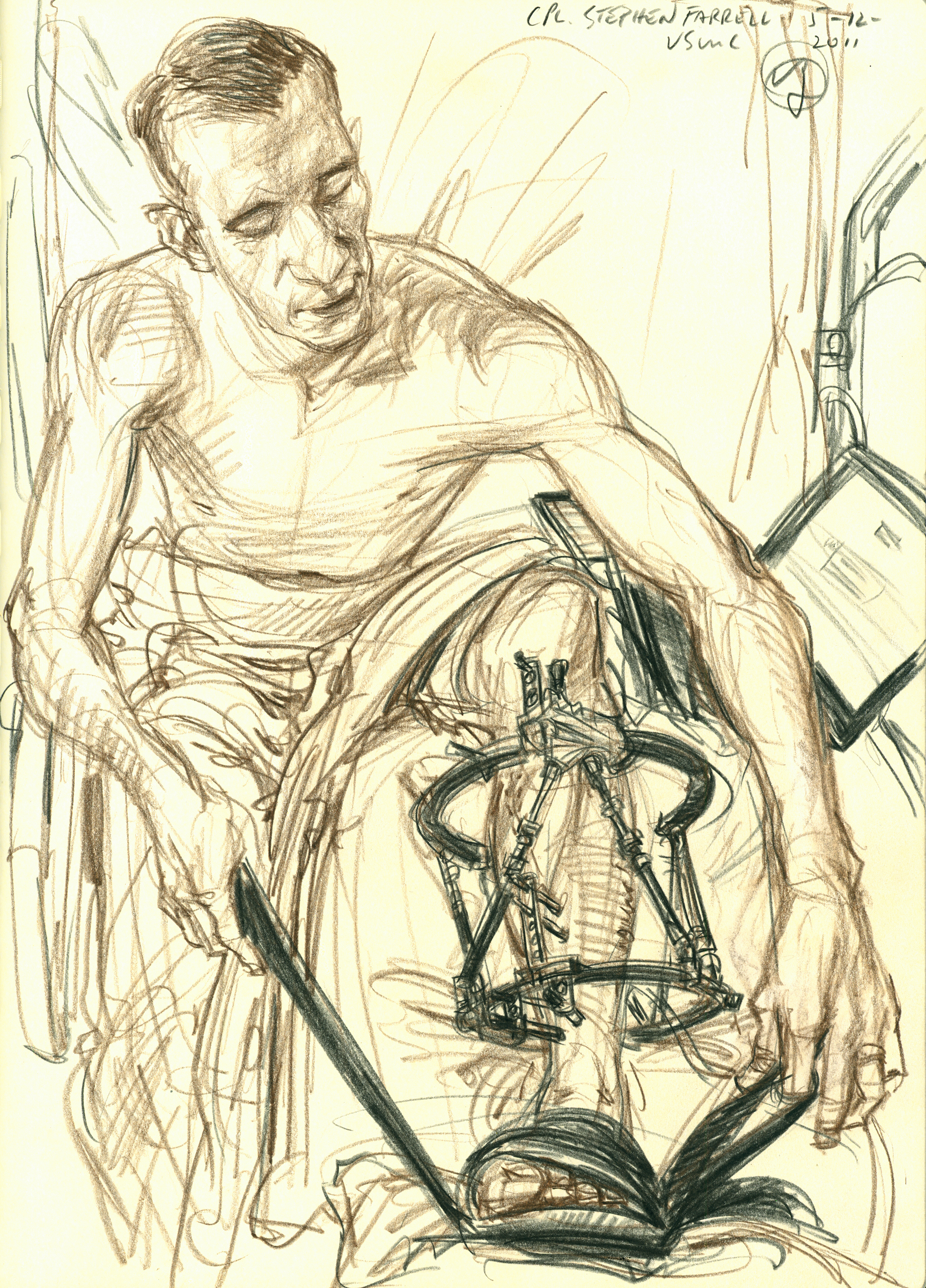
Victor Juhasz: I enjoyed reading every one that I received for review and to match to an illustration, all for different reasons.  One piece that arrived too late for me to make a call on selecting a drawing was by Kevin Jones.  Ironically the drawing you chose was of a wounded Marine I had done at Bethesda.  It worked perfectly.  I’ve been involved with the Joe Bonham Project now for almost a year.  It was started by a former Marine and combat artist, Michael D. Fay, who I can thank for giving me the kick in the pants to seek an embed over in Afghanistan last year.


The Bonham Project has been documenting, through drawings and paintings, the wounded who have been and are still returning from the front lines of our theaters of operation. It’s been very satisfying work from a spiritual as well as a personal level, giving voice, via the visual recording, to these warriors who have been injured in service to their country. Some of these wounded have suffered horrific wounds that will be with them always and create challenges that most of us would not even wish to consider.


Yet, to a man, and I say to a man because I haven’t drawn a wounded service woman yet, the attitudes have been remarkable. The sense of resiliency inspiring and humbling. Drawing and documenting these soldiers and Marines is one way I can say thank you. I guess Kevin’s piece resonated so strongly because it echoed some of the work I am currently doing and hope to continue till I won’t have to. We’ve got a son who is a Marine. Kevin is a former Marine.


Kevin Jones' story


MA: That’s a wonderful answer, Victor. I was delighted to have Kevin’s piece in this issue, and your illustration could have been drawn especially for it. Did you hear from any of the authors after the issue went live? In particular, I’m fascinated by the ways in which authors often  find personal meaning in an illustration for their work that we couldn’t have known or even anticipated. That seems like just another level on which artists commune with the work and with one another. Was there an example of that that you could share?


VJ: I received a very nice email from Nicole Robinson. Ironically, the pieces selected for her poetry were not military related but satirical illustrations done for MOTHER JONES and ROLLING STONE.  Yet Nicole seemed very connected to the pieces. Through the grapevine, a.k.a. Mary Akers, I was made aware that the reactions to the /images from the authors were quite positive, which made me happy.


Victor Juhasz image


MA: I think a lot about the function of art, the accessibility of art, and the conversation between artist and “consumer.” (Consumer, not in the commercial sense, but in the sense of “the person on the other end.”) I feel very strongly that art takes two. By that I mean that the artist makes a thing (painting, sculpture, song, whatever) but at first it is simply the artist talking to him-or-herself..until someone shows up on the other side of that art, enjoying it, experiencing it, or even hating it. But in a sense art takes two brains to be fully realized–the creator’s brain and the experiencer’s brain. What is your perspective on the idea of conversation being inherent in the creation/realization of art?


VJ: The way I look at it, if I can make myself chuckle at an illustration I’m working on, I know I’ll be making connections out there with the audience that reads the publication where the illustration appears. I’ve received the range of responses to my illustrations from a resounding “Yes” to real anger and offense. Luckily I get far fewer of the latter responses. As for the more serious work, like these military themed drawings and paintings, my focus is on the humanity of the subjects. I want them to make eye contact from the paper or the canvas with the viewer and for the viewer to experience a sense of that intimacy and connection, that sense of knowing the subject/s in the image.


MA: I attended a wonderful lecture by Margaret Atwood in which she spoke about the basic human need to be creative. If we doubt that, she said, we should think about the things that young children explore and do naturally, on their own. They sing, draw pictures, make up stories, dance. We need to nurture the arts in our public schools because creativity is at the core of what makes us human. What are some of your earliest memories of being creative as a child? Have they stayed with you in later life?


VJ: I am sorry to say this but my earliest motivations for being creative and expressing myself were driven by anxiety and fear. My parents fought a lot, they carried much baggage from their experiences in Europe during and after World War II. Nowadays one would quite easily say they suffered from PTSD. They weren’t emotionally equipped to hear each other because they were so absorbed by the traumas within themselves.  So they fought.  All the time. Soldiers and scenes of armies fighting huge battles were the earliest drawings I remember. I was working out my anxieties about all the fighting in the house. I think nowadays, especially in the satirical and political illustration that I do, fear and anxiety, along with rage, lie at the heart of some of my best work. Great comedy draws deep from the well of pain, humiliation, and frustration.


Now, having said all this, let me also add that creativity desperately needs to be nurtured in schools. This is a huge challenge. We live in a world where imagination is not valued. We have become passive receptors of computer generated /images, created by others, in mind boggling high definition, that leave nothing to one’s creative imagination. There are plenty of undeniably impressive special effects. There is, however, no mystery. Not trying to be a Luddite here. Just pointing out that there is incredible power, not to mention, magic, in what a child’s mind can visualize from hearing or reading a story or from taking some simple objects and creating a whole world and story with them.


MA: Last year I visited the Georgia O’Keefe museum in New Mexico (a bit of a pilgrimage, I must say) and I watched a movie in which she said as soon as she saw New Mexico she knew it was “a place she could breathe.” Do you have a place that inspires that feeling in you?


VJ: My wife and I moved to the New York Berkshires because the scenery was so inspiring. The farmlands, the rounded, weathered mountains. We love the drive to Williamstown, Massachusetts, about a half hour east when we visit her sister and her family. There are some views near the intersection of Rts. 43 and & 7 that are pure magic. On a good creative day my studio is my New Mexico.


Most importantly, we also have that New Mexico moment within ourselves, always ready, no matter where we are, if we just remain aware.


MA: Yes, I like that point of view. It’s all about accessing it, isn’t it? Both in terms of the creative act and the creative mindset.


Finally, since we are a recovery-themed journal, what role do you think recovery plays in the creative process? Many prisons, trauma counselors, psychotherapists, survivor’s groups, veterans organizations and the like employ art to help patients heal. Have you found yourself drawn to /images or themes that you later realized stemmed from something you needed to work through?


VJ: This kind of relates to your earlier question about childhood memories and creativity. I think we more or less spend our lives working on the issues that we inherited as kids. They just become variations on a theme- or themes. My mother was a survivor of the Soviet concentration camps, and like I mentioned before, suffered on a near daily basis with what we now call PTSD. I have spent many years working on that inherited sense of grief and sadness and fear and coming to some sort of terms with them. Events that happen here and around the world that upset so many people I know, don’t seem to surprise me that much. I grew up listening to recollections of horror and suffering. I have no illusions about this species. That might be one reason I seek a humorous route in my illustration as much as possible, especially if I can bring in the element of slapstick and absurdity. And slapstick is essentially cruelty made very funny. Interestingly, slapstick was a favorite of my mother’s as well, a form of comedy not normally associated with women.  She was as big a fan of The Three Stooges, Laurel and Hardy, Bugs and Daffy as I was and remain to this day.


MA: I find that fascinating, that inherited sense of grief. It’s so true, but we (as a society) tend not to think about grief and trauma in that way. If I might share a short anecdote with you…? I co-authored a book with a man who survived being sent to Siberia in 1939 and at one of our public appearances, he was confronted by a very angry woman who asked him how he could possibly forgive the Russians for what they had done to him and to his family. She would never, forgive, she said, pointing her finger as him, never.


Flash forward about six months and my co-author and I were approached at a book fair by a woman who had read our book and said she was in graduate school studying how the descendants of parents who have suffered trauma carry that trauma with them and even pass it into the next generation. Her mother, she said, had been banished to Siberia as a teenager and had never recovered emotionally. This young woman who approached us felt that she–even though she had never been to Siberia–had suffered as well. As we talked more, we discovered that this was the daughter of the very same woman who had confronted us six months earlier. It was a powerful message about the value of forgiveness, not only for oneself, even, but for the world, for the children, for the future.


Anyway, thank you so much, again Victor. It’s been wonderful working with you.

“Dissolving” by Tania Hershman

Shakespeare with Champagne
Image courtesy of Victor Juhasz, artist

When she had had an afternoon drowning in the feeling of being the imaginary lover of an imaginary man, she took herself out to the nearest place that would fill her with liquid and she drank forever. When the last had gone, swindled away in a nonsense moment, she swayed back into the virtual streets and bound her cells for home. There, thinking he might find it comforting to hear the music he was used to, she weighted his voicemail with old 50s songs, crooning into the receiver. When hours passed and he did not answer, she curled herself up with her own double helix and dissolved back into the air.


Tania Hershman is a former science journalist turned fiction writer. Her first book, The White Road and Other Stories,(Salt Modern Fiction, 2008), was commended, 2009 Orange Award and included in New Scientist’s Best Books of 2008. She is currently writer-in-residence in Bristol University’s Science Faculty and has been awarded an Arts Council England grant to work on a collection of biology-inspired short fiction. She blogs about writing at TaniaWrites.

Read an interview with Tania Hershman here.


“God’s Forgottens” by Maureen Lougen

Zues
Image courtesy of Victor Juhasz, artist, first published through Sleeping Bear Press.

This ain’t a place miracles ever happen. This ain’t a place anything good ever happens.

Even the cops don’t like coming here, and they gotta come here, least once or twice a month. We get fist fights, knife fights, heads cracked by pool cues, shoulders broke by slamming chairs. Hell, two or three times a year there’s always some damn concerned citizen talking about shutting the whole place down on account a the drunks and drugs and fights and body bags that spill out into their nice clean world. But the clientele we get here, don’t nobody want ’em nowhere else, so we don’t never get closed down.

Tonight’s being quiet, all things considered, and I can tell some of the fellas are gettin’ antsy. We got all the regulars tonight. Knife and Chainsaw – don’t know as I know anybody’s real name – are at the pool table, with Godzilla holding up the corner, waiting his turn. Mercy (’cause he’s got none) and Harley are playing cut-throat poker. Crank’s sharpening darts on his boot and Shirl is at the table closest to the door, being available to her own brand of clientele as they come and go, and the rest of God’s Forgottens are taking up space across the barroom floor, smoking and drinking and doing things their Mamas wouldn’t approve of.

It’s gettin’ late and just as I’m thinking this night might end and no blood on the floor, in walks Soccer Dad. Young guy, thirty if that. Clean hair, trimmed nails, clothes that seen an actual washer and dryer. He’s so far outta where he oughtta be, he might as well be on a different planet. Half the place turns to look at him, like wolves who suddenly notice supper. I’m feeling generous –  and I don’t want the cops back less’n three days after the last go-round – so I go over to tell him that if he don’t want to be tomorrow’s ‘identity withheld’ he better turn tail and run.

Especially since he’s headed right towards Godzilla.

I don’t know Godzilla’s right name, and that ain’t even a name he give himself. I call him that – not to his face – ’cause he’s huge and seems near always in a bad mood. Right from when he first set his butt on my barstool, it was like he rolled in off the thunderclouds what was hanging over the street that night, and the dry lightning flashing red to blue, cloud to cloud and back again, like it was Heaven and Hell playing keep away with the thunderbolts.

I took him for military, Godzilla, right from the jump.  It was his boots that looked it, sure, but it was more than that, too. Something hard to describe, but something – or a lot of somethings – one old soldier recognizes in another. Not that Godzilla’s anywhere near to the years I got collecting behind me. Not on the outside. On the outside, couldn’t be he was any more’n twenty-five. On the inside though, I could tell he was old. Same as everybody else ever set up shop in my place, Godzilla was seen too much, done too much, lived too much, old.

Being fair, he’s got niceness in him. Might be he’s bad tempered most of a day, but he’s never mean to somebody isn’t mean first. A person nice to him gets nice given back, sometimes outta two hands. One time he asked was I okay after the old woman laid me open with a beer bottle. For a whole coupla nights after that he did any heavy lifting it was I needed around the place n’wouldn’t even take a drink on the house for it. Shirl sure done got her a special place for him, even with her being old enough to be his Mama, or even his grandmama. Godzilla holds her chair and her coat and the door whenever it is she needs it, and it ain’t that I think he ever bought himself any of what it is she sells, but if it ever was he did, I’m thinking it’d be his for the asking.

But those that mess with him get messed back. He don’t like being crossed, he don’t like being touched, hell, sometimes he don’t hardly like being talked to. Since he’s been coming here all this past summer, he’s broke two arms, three noses, and six fingers. Other people’s. That I know of. Don’t get me wrong – they all had it coming. Just didn’t none of ’em see it coming. Nobody, not even Mercy, messes with Godzilla.

And Soccer Dad is headed right for him.

“Hey Buddy -” I try. I put my hand on his shoulder, meaning he should leave while it’s still in its socket, but he throws me off and keeps walking.

‘Your funeral. I think and follow close for ringside seats.

Godzilla’s paying nobody no mind but the pool game. Soccer Dad grabs his arm and pulls him around and Godzilla comes up swinging and I’m thinking the game is on. Soccer Dad don’t even flinch – he don’t care, he stands there glaring at Godzilla, and Godzilla’s car-sized fist stops dead just before it wallops him.

“What the hell? Soccer Dad demands and Godzilla’s face does something I ain’t ever seen it do – it goes soft, like that day Eyeball found his Mama’s wedding ring he thought he lost for a week, jammed up under a loose board under the pool table. Godzilla goes soft and looking like he don’t know what to do and drops his hand and don’t even try to look Soccer Dad in the face.

Mercy ain’t having none of it though. Tonight’s been quiet and he don’t like quiet and could be he’s taking Godzilla’s idleness personal. He shoves Soccer Dad but no more’n asks, “Who’re YOU?” before he’s on his face with Godzilla’s foot in his armpit and his arm twisted back around the wrong way and Godzilla saying, “He’s somebody you walk away from. Understand?

And it ain’t until Mercy snivels ‘Yessir’ practically that Godzilla lets go and goes back to stand in front of Soccer Dad, looking soft and worried and like he got caught after curfew.  By now they got the attention of the whole barroom, only neither of them don’t notice or don’t care. Soccer Dad don’t say nothing, he only just keeps glaring, like he can burn an answer outta Godzilla. It was then I seen the resemblance. Soccer Dad don’t have more’n a couple-three years on Godzilla, near to as tall, that same dead-on stare I seen Godzilla blasting folks with, and it’s on me to figure Soccer Dad is Godzilla’s brother.

“Tell me you got amnesia.” Soccer Dad snarls at him, like Godzilla ain’t got inches and attitude on him and it comes on me that Soccer Dad is only what he shows to the outside. There’s death under the clean clothes and trimmed nails, I can tell. “Tell me amnesia is why you’ve been back five months and didn’t even let us you were alive.”

Godzilla’s throat is bobbing like he can’t swallow something and he won’t look at Soccer Dad and his head tilts like he’s trying out excuses in his brain until finally I guess he finds one that might pass muster.

“Up ’til now, I didn’t know I was alive.”

Whatever that means, it means more than anything to Soccer Dad ‘cause he gets a look as soft as Godzilla’s. He wants to say something, he wants to say a lot of somethings, but he ain’t gonna say ’em here.

“Let’s go.

He turns like that, like his word is law and I guess it is, ‘cause Godzilla follows him. He even puts some hurry into it like Soccer Dad might just go on and leave him behind, never mind what he just went through to get him.

I follow ’em to the door and a little beyond, ’cause I know this ain’t something I’ll ever see again.

Godzilla follows Soccer Dad to the curb where they need to cross and Soccer Dad puts the back of his hand on Godzilla’s chest, saying with no words to mind the traffic. And Godzilla, who I know can crack glass just by looking at it, smiles.

The whole barroom is quiet, hushed like we all just maybe witnessed a miracle, and I don’t know, I think maybe we did…’cause one of God’s Forgottens got remembered after all.


Maureen Lougen started writing in fourth grade. When other kids were actually doing their schoolwork, she would pen a juvenile blend of her favorite TV shows on scraps of paper instead of paying attention to the teacher. She lives in a little town that’s seen better days, about a quarter mile from Lake Ontario. During the summer, the town smells like dead fish. (Which might explain why she’s still not married.) She shares her aged house with her too-smart-for-his-own-good son, a beagle that needs a C-Pap machine, a beagle-basset that suffers from Seasonal Affective Disorder, and two cats that hate each other. An avowed busybody and Nosy Parker, Maureen steals her ideas from other people’s lives and plunks them down in the middle of her stories just as they are. It’s just easier than doing research.



“Target” by Maria T. Groschup-Black

Target
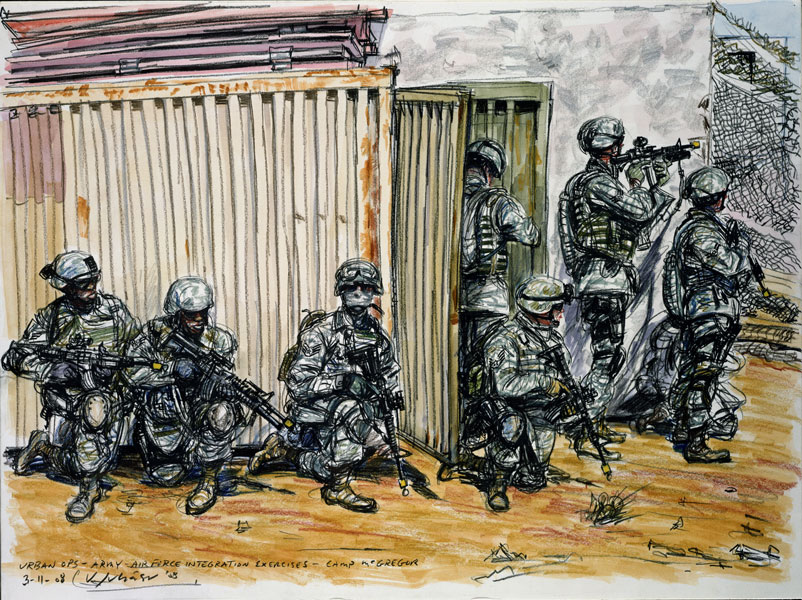
Image courtesy of USAF Art program and Victor Juhasz, artist.

The ending is always the same: Two shots to the chest, one to the head. He falters.

Two to the chest, one to the head. I’ve hit him. Why doesn’t he stop? Six to the chest and reload. He doesn’t stop. He doesn’t bleed.

I wake up. I am sweating; my heart is pounding. The beat echoes in my head like the rhythm of a bass drum. Every muscle is tense. I pull my lover close and whisper “I had the dream again.” I used to have that dream a lot, but I don’t sleep much anymore.

I get up.  I pour myself a drink.

Some say the dream is “insecurity.” Some say it represents a “lack of skill.”  Others say “fear.”  For me, the dream is much more.  Targets don’t bleed.  No matter the interpretation, they all say it is a common dream among police officers.

I’ve been on the force for twelve years. Twelve years is a long time. I am callous. I am indignant and arrogant. I shout at the television.

“You weren’t there, Asshole!  What do you know about my job?”

My lover tells me to calm down. I pour myself a drink.

A suspect high on drugs and alcohol resists and beats an officer with his own nightstick. He is shot. The public calls him “Martyr.” They call the officer “Murderer.”

And I? I pour myself a drink.

I get ready for work. My lover whispers “come home to me.” These words say it all. Without them my night is empty. We’ve been together a long time.

“Come home to me.”  She says.

“I will.” I promise.

I come home.

“How was your night dear?” She asks.

“Nothing special” I say.

I could tell her the stories, but I don’t talk about work anymore.

I want a drink. I go to a meeting.

I am angry. The public I have sworn to protect has turned its’ back on me.

“Walk in my shoes!” I shout.

They question my every step, my every method. They ask me to protect them, to solve their problems and to counsel them. I protect them. They want me fired.

“Walk in my shoes!” I shout.

I need a drink. I go to a meeting.

I go to meetings a lot now. I tell them I am angry; I am indignant.

“You did this to me! You, the public I serve and protect! Who will protect me?”

I tell them I am powerless and go home.

I wake up. I am sweating; my heart is pounding. I hear each beat echo in my mind.

Babump! Every muscle is tight.

Babump! I scream.

Babump! I pull my lover close.

Two shots to the chest, one to the head. He falters. Two to the chest, one to the head. He stops. He bleeds.

And I? I pour myself a drink.

I don’t sleep much anymore.


Maria T. Groschup-Black worked for 18 years in San Diego local law enforcement, first as Deputy Marshal and later as a police officer for the S.D Harbor Police. She currently resides in Spring Valley with her spouse of 10 years and their 3 children ages 10, 7, and 6. Her credits include articles written for and sold to Police Chief Magazine and Fire Chief Magazine. When not at work, Maria spends her day repairing the damage caused by three rambunctious boys while squeezing in a few moments of time for reading and writing.


“Coffee” by Stephen Ramey

Coffee
Image courtesy of Victor Juhasz, first published by Sleeping Bear Press.

He looks out over the city and thinks of death. Somewhere down there in the pit of this valley someone’s dying, curled into a ball in that dead end alley next to Ralph’s Surplus maybe, or leaning lopsided with a Lucky Strike still smoldering between veed fingers.

“Donut?” the counter clerk asks.

He pulls his gaze from the window. She’s pretty in a homely way, with curling brown locks that look entirely unmanageable, and a determinedly defiant jaw. Her skin is caramel brown.

“A dozen?” she says. Her eyes are bright somehow, like the lull in a storm when you can see lightning so clearly without having to endure its lash.

“Coffee,” he says.

“What kind?”

He squints at a menu that makes no sense. “Black?”

“Half,” she says without batting an eye. “My dad’s white.”

An intense embarrassment overcomes him. His tongue twists, looking for words.

“I’m just joshing with you,” she says. “You want sugar in that coffee?”

He nods mutely. She turns and drains coffee from a stainless steel urn into a Styrofoam cup. He watches her move, the way her hand goes to the swell of her hip. She’s been on her feet too long. Her hip aches, there in the hollow beneath the ribs.

He can’t help but think of the pain his wife endured in those final months after they gave up on chemo. He can’t help but recall the pain his son expressed this morning. Another argument, another slugfest, only this time he’d landed a punch, a real one.

“One lump or two?” It’s the clerk.

“No,” he says. It’s the shortest answer. She fits a lid to the cup; she slides his coffee across the counter.

“A dollar-fifty-nine,” she says.

He digs through his pocket for change. Three quarters, a dime, six pennies. It’s not enough.

His thoughts go purple, a throb like the swell growing on his son’s pudgy cheek. Death, he thinks. Death of flesh, death of love, death of dignity. He’s stared into the black eye of a gun a couple times, but hasn’t been able to make that coward finger squeeze.

“I can’t…” Words fail him. A rope constricts the pit of his belly, fibrous strands poking from a smooth weave. Coins clatter to the counter.

The clerk slides them onto her palm. She opens the register, deposits them.

“It’s okay,” she says in a voice gone quiet. “The shit isn’t worth what they charge anyhow.” Her teeth are far from straight, but they remind him of his wife’s.

She touches his hand. “Rough day?”

He looks at her fingers, the knuckles weathered, fingernails chewed to stubs. She has her own problems. Still, he can’t help it. He nods. He meets her gaze. For just an instant it’s like staring into the barrel of that gun, only it’s light inside, not dark. He thinks of that time he helped his wife plant a black walnut sapling where the elm came down. He thinks of their gloved hands touching.

And then the moment is gone. “Thanks,” he says. He takes the cup, feeling its warmth, thinking how muted it must be compared to the boiling liquid inside.

Life he thinks, turning from the counter. The clerk swivels her attention to the next person in line.


Stephen Ramey lives in an 1870s Victorian home on the edge of New Castle, Pennsylvania’s Historic North Hill District, overlooking a Pizza Hut and two wonderfully  complex church buildings. His short fictions have appeared in the Journal of Compressed Creative Arts, Bartleby Snopes, Pure Slush and Caper Literary Journal, among others. He edits the annual Triangulation anthology from Parsec Ink and blogs about that process at http://www.stephenvramey.com

Read our interview with Stephen Ramey here.


Interview with Nicole Robinson

Nicole Robinson

Joan Hanna: Nicole, we were so excited to have your poems Genesis and Trust Because in our Winter issue of r.kv.r.y. Can you first talk a little bit about the difference in the these two poems stylistically?

Nicole Robinson: Thank you, Joan. It’s an honor to have these poems in this issue of r.kv.r.y; I think the work that all of you do is lovely, and important. Words as recovery… it holds so many meanings for so many people. As for the different styles in “Genesis” and “Trust Because” –I suppose the styles are different because the urgency and questions as I was writing and playing with language were different. In “Genesis” I wanted to know how “it” all began. I’m still not sure I fully know what “it” is… But I know I wanted to dig at the beginnings of many things. I think it started splitting into sections because I kept trying to get deeper toward the “beginning.” I still have not gotten there. And I don’t even know if a beginning of anything really exists—because it’s so knotted into some other type of beginning. In “Trust Because” I needed to know why I should trust. Though again, I am not sure what I was trying to trust: my soul, maybe, or maybe some voice that speaks to me through poems to help me understand our complicated world. That poem (“Trust Because”) did not want to be split up—not into sections, stanzas, or even by a period. It reached out and grabbed everything, sort of like me in a thrift store.

JH: Trust Because is such an interestingly layered poem. It seems to have several conflicting points of view. Can you elaborate a little about how you came to the juxtaposition of /images in this poem?

NR: It certainly is a “layered” poem, though I never thought of various points of view being conflicting. I suppose the juxtaposition of /images and the layers came about because, well, the world we live in is vastly layered. Right now I’m thinking of a line from Stanley Kunitz’s poem, “The Layers” –it’s the part where a nimbus clouded voice speaks to him: “Live in the layers not on the litter.” With “Trust Because” I think I was at a place where I was buried in the litter, and some voice was telling me, and really bothering me, to “trust, because…”. And then, by trusting language, the way words sing in our mouths, I started listing the reasons to trust—while at the same time, accepting the place I was, a place where I could not trust, thus the lines “if I could give in and trust / I’d want to trust the redbud tree…” Eventually the poems comes to a place of acceptance, a place where I could be a woodpecker “beating his beak against bark, / the sound of it, something round, / a hole to hide out until I can find the world.” After all, it is beautiful, the way a woodpecker beats and beats at a tree until it pecks a hole large enough to find the food and nutrients it needs. Of course, I did not think of any of that while writing this poem. I simply trusted the music of language. Poems are such great teachers, aren’t they?


JH: I was especially excited to have Genesis as part of our war and military themed issue. You use the image of war in correlation with emotional and traumatic incidents in our lives. Can you share with our readers why you use the Gulf War as a jump off point in this poem?

NR: Good question. I’m not sure I have the exact answer. I am only 30. The Gulf War happened when I was young. But the television was always on, and somehow, the Gulf War really affected me. I did not know anyone (that I remember, at least) in the Gulf War, but I remember clips of /images on the television, and the feeling of great empathy for both the Iraqi people and the U.S. soldiers. I also remember, very clearly, wondering why people weren’t talking about it much, or trying to stop it. And also how I couldn’t really stop thinking about it, how it stuck with me every time I faced anything difficult, how it was somehow my job not to quiet that war, because if I couldn’t find a volume button for my own difficulties, then other peoples difficulties should not be silenced either. I was a strange kid, spent a lot of time looking at the sky and realizing we’re all sitting under it. I guess I used that at the beginning of the poem, because it was one of those “beginnings” I wanted to look at.


JH: I am so drawn to some of the contrasts in Genesis, for instance, in section 5, the lines: “hands can open softly like a shell casing, then fingers send bullets bleeding” have this idea of soft and harsh, or love and pain (if you will) as being initiated from the same source. This is such an interesting image to me. These contrasting parallels run throughout Genesis. Why do you think these /images set against one another are so strong in your work?

NR: First of all: thank you for the fine editing suggestion. Truly. I think I wrote: “…then fingers send bullets speeding.” But I like “bleeding” as well! Anyway, I guess I don’t’ really think of /images being set against one another when I’m writing because somehow, in someway, things are simply together. This might be off topic, but my first creative writing instructors as an undergraduate student, Virginia Dunn (who passed away, but is still very much alive in my thoughts) and Maj Ragain, helped me to hone in on what I already, in some small way, knew: pay attention, listen, see and feel myself in the other person or object. I’ve gone on to practice that, and by doing so I can’t help but see the connectedness of people, and things. To answer your question plainly: I suppose /images set “against one another” are often “strong” in my work because that is how it works in the world… but we have to be still and quiet enough to notice the beauty in them.


JH: I’m not sure if that was a serendipitous typo in thinking “bleeding” instead of “speeding” or how I actually pictured the image when I read the poem. One of the things I am so struck with in your poetry is the sense that somewhere within all of these intense realities there seems to be a voice that sees beauty in the world outside of the purview of emotional trauma. How do you think this positive voice seems to come through even though you are dealing with such deep emotional issues?

NR: I remember hearing or reading an interview, or maybe an essay, where Robert Pinsky talks or writes about poetry, and he says something about the process of human imagination taking in its surroundings and discovering how to make art from them. While I don’t intentionally think about making a “positive voice” I think I am searching for the art, the life, the deeper truth in things. I cannot tell you why I do this, but I do.  Maybe it’s some pure instinct to run into the unknown and find something worth picking up, holding and even transforming.


JH: Can you share a little about the work you do at the Wick Poetry Center?

NR: I pinch myself, very often, for being able to do the work I do. As you may know, the Wick Poetry Center is located in Kent, Ohio at Kent State University, and does a lot of work locally, regionally and nationally. I’m the program and outreach coordinator. This means I get to put my hand in a million jars and always come out with a really tasty treat. As we say often, the Wick Poetry Center “encourages new voices” –and it doesn’t matter if that voice is the winner of the Stan and Tom Wick Poetry Prize for a first book of poems, a third grader realizing the joy, pleasure and wisdom in his poem, or a psychiatric patient saying writing has allowed her to see she’s a beautiful person— it is all so powerful, watching poetry change lives. Basically my job at the Wick Poetry Center ranges from organizing an author’s visit, which is almost always more than a reading, to leading writing workshops in the schools, hospitals, community centers, and all over. On a daily basis I get to share what saved my life with others. Here’s the plug: visit one of our project websites: Traveling Stanzas or Speak Peace, or the Wick Poetry Center’s home website and become involved by joining “Friends of Wick” and/or supporting in some way (even if it’s liking us on Facebook)—help us bring poetry to all who need it, which is everyone.


JH: Nicole, thank you so much for sharing your lovely poems and your thoughts on writing with our readers at r.kv.r.y. Just one final question: can you tell us what recovery means to you?

NR: When I think of the word recovery I first think about loss, loss from personal trauma and from wars,environmental destruction, etc. Recovery to me is going back and picking up those pieces. And it can be a sloppy, painful mess at times. On a physical level (a good example of the non-physical) I think of my ACL reconstruction I had years ago. I tore my ACL skiing, had surgery, and then months of painful physical therapy where I learned to use my leg and knee again. During all of that pain there were pockets of beauty: bending my knee a little further, taking another step, witnessing the love and patience of my partner, Deb, and my friends. I guess what I’m getting at is the duality in the word recovery. For me recovery is filled with beauty and pain. Writing for me is an act of recovery; it allows me to follow the music of language and search, dig, ask questions, and slowly recover some part that was lost. Something in the act of recovery helps us to expand, so that we are able to hold what we did not have the capacity to hold before. Something about the act of recovery…  if we’re paying attention we’ll probably be doing it our entire lifetime(s). And that, I believe, is beautiful.

Interview with Tania Hershman

Tania Hershman

Tania Hershman: I decided that I was going to interview myself and ask the questions I’d always wanted to ask or been scared someone would ask. How does that sound?

Tania Hershman: That sounds fine, fire away.


TH: So, Dissolving, what’s that all about? Is it even a story?

TH: Ha! Well, I never explain my stories, especially the really tiny ones, because they are really whatever the reader wants them to be.

TH: Oh come on, you must know what it means! Why don’t you want to tell us?

TH: Look, there’s a woman, there’s a lover, he’s not answering, end of story. It’s not one of my more cryptic pieces.

TH: It is a bit, well, like a poem, isn’t it, maybe? Or something else? Is it a poem? What is it?

TH: Another question I’d rather not answer.

TH: You’re an annoying interviewee.

TH: You’re fairly annoying too. Look, does it matter if it’s called a short short story, flash fiction, microfiction, a prose poem? It’s all just writing, the rest are labels. I’m delighted that r.kv.r.y liked it enough to want to publish it, that’s the main thing, that it’s an arrangement of words that spoke to someone else.

TH: Okay, fine. How does it fit into the r.kv.r.y “shorts on survival” section?

TH: This is her way of surviving a relationship that she feels is verging on the imaginary. She gets drunk, she does something she’ll probably regret, but something she needs to do. I think we all know that feeling. I think we all know what it is like to dissolve, to come apart into our constituent atoms. For me, this combines tragedy with hope. She will survive, she may be altered but she is not defeated.


TH: That’s nice. I like that. Well said. Do you think you write about survival a lot?

TH: Yes, thinking about it, I probably do. Surviving failed love, surviving difficult parents, surviving unpleasant children, surviving society’s expectations. Hmm, yup, a lot of my stories deal with it, in some way. Actually, I think that for me, and I suspect for many writers, writing is survival. This is me playing out scenarios, testing to see what might work, what might not, like “thought experiments” in science, where you don’t do the actual experiment, you think it. I also believe that the role of stories is to help us survive. The first person who told the story about almost being eaten by a woolly mammoth, that would help everyone else avoid the same fate. But the story had/has to be gripping enough so that people listen. I think “story” is part of our highly-evolved survival strategy.

TH: Every kind of story?

TH: Look, I’m no academic, I don’t have a well-thought-out theory on this, but I do wonder why society loves stories, in all forms – TV, films, books etc… What do we get from it? We get to put ourselves in others’ shoes, and maybe, on a purely evolutionary level, this helps us get by in the world, make sense of the world, of experiences we haven’t had yet. Oy, I sound so serious!


TH: Tell me something funny.

TH: I’m really bad at jokes.

TH: Believe me, I know that. Okay, last thing: did I hear you have a book coming out?

TH: You heard right, I do – My Mother Was An Upright Piano: Fictions, will be published in May 2012 by Tangent Books and will contain 55 very short fictions, including Dissolving.


TH: “Fictions”, what does that mean? Why not “short stories”?

TH: I feel like even calling them “short stories” is a label. The one thing I can say about them is that they are fiction. Definitely. I thought I’d leave the labelling to someone else!

TH: I do think sometimes you’re a bit crazy.

TH: That’s charming. Thanks. And thanks for having me. Next time, I’ll get a better interviewer.

Interview with Maureen Lougen


Victor Juhasz image


Hunter Campbell: Congratulations on being published in rkvry!

Maureen Lougen:
Thanks. It’s great (and surprising) to be among such outstanding company in such a wonderful journal.


HC: We’ve briefly discussed writing in the abstract before, but not in the specific, so let me get right to it: your story God’s Forgottens is a compact tale of love and redemption. Where did you get the idea for it?

ML:
Honestly, I have no idea, other than it jumped off of the Rolodex of story ideas in my brain one day and refused to be ignored. Most of my stories and novels are about
something terrible happening to a person and they try and hide from it, and someone else from that person’s life finds them wherever they are, whether they’re hiding internally or externally, and brings them back into life. So, this was just one more cog in that wheel. Or – one more entry in that Rolodex.


HC: It’s a spare telling, very minimalistic in details and dialogue. Was that a conscious choice or just the way it came out?

ML:
I’m not sure that anything I write is a conscious choice. I watched the story take place through the bartender’s eyes and listened to him describe it, and he’s apparently not one to waste words. One thing I’ve learned in all my long years of writing – the reader is much smarter than I am and can fill in all those bits of detail much better than I ever could.


HC: Did you notice that nobody in the story actually has a name?

ML:
Caught that, did you? Yeah, the narrator, the bartender doesn’t know anybody’s name. He’s a good guy and a better bartender and he knows his clientele. He knows they don’t need or even want anybody knowing their names.


HC: Do you know their names?

ML: Oh, yeah. I mean, it took me writing a couple more chapters, but I found out what their names are. Most of them anyway.


HC: Where did you get the title for the story?

ML: I stole it from the narrator’s dialogue. When I heard him describing the patrons as “God’s Forgottens” I knew that had to be the title.


HC: You stole it from the dialogue? Isn’t that your dialogue? You wrote it, didn’t you?

ML: Honestly? No. Well, yes. But – I don’t create dialogue as much as I listen to the characters talking and then just write down what I hear. I didn’t hunt around in my brain for a name for the narrator to apply to his patrons; I just listened to him describing the scene and that’s the name he came up with. Most of the stories I write, it’s just a matter of me watching the scene unfold and listening to the characters talk and just writing it down.


HC: He has an interesting “voice”, the bartender. Do you know someone who talks that way, or did you make that up?

ML: I think it’s half Mater from the Cars movie (we watch that a lot at our house…) and half I don’t even know what. It’s just how I heard him talking in my head. If I can hear a character’s voice clearly, my job is half over. I find it hard if not impossible to write a character whose voice I can’t hear.


HC:
For some reason, the line about Godzilla coming into the bar off the lightning storm really caught me, it’s a great detail.

ML: Thanks. I live half a block from the shores of Lake Ontario, and one night last year there was a dry lightning storm and I took my son down to the end of our street to watch it over the lake. Some clouds were bluish, some were reddish, and as the lightning jumped from one cloud to another, the phrase “Heaven & Hell playing keep away” came to me, and I knew I had to use it in a story. So into the Rolodex it went until I could put it into this story.


HC:
You started writing when you were still in single digits. Do you remember the first story you ever wrote?

ML:
I don’t remember the story itself, but I distinctly remember the thrill I got when I wrote it down and then realized that I could go back and read it over and over again. I remember thinking that that was the best thing ever. I was hooked.


HC: Your son Joshua recently turned 10. Did becoming a Mom change your writing?

ML:
I don’t think there’s a single thing that becoming a Mom didn’t change. Joshua is the single biggest influence in my life. He’s outgoing and brilliant and charming and totally oblivious to the effect he has on people. How people are just drawn to him. A  friend of mine said that having Joshua is the best thing that happened to me because something as simple as going to the store isn’t just going to the store, it’s having to stop to talk to fifty people. Because – no surprise since I’m a writer – left to my own devices, I am not a people person. I’m an I’ll-sit-in-the-corner-and-write-while-you-go-somewhere-else-and-not-bother-me person. I’ve always been that way, even at family functions. But with Joshua, my life has opened up to countless new situations and meeting people by the dozens. I don’t know if that’s changed my writing per se, but it has definitely changed my life.


HC: What’s the hardest thing about writing?

ML: Having to stop writing to do something else. Anything else. If I have a minute to think, I’m thinking about writing. It’s like putting a videotape in, watching a movie play, “watching” my stories play out, tweaking them, polishing them, writing them even if I’m not at that moment writing them down. These days though, I’m more likely than not to have my attention called away every other minute by my son, “Mom! Guess what?!” and “Mom – look! Mom! Watch!” and “Mom! C’mere!” I love and adore my son. He’s the best thing that ever happened to me. It’s just when I’m in my head writing and I have to switch gears to focus on something else, it’s like stopping a tape and having to rewind to get back where I was.


HC:
What was the hardest thing about writing this story?

ML:
When I found out I was going to be published, it was the middle of the night, and I had no one to tell! Joshua and I were in Nashville for a convention, and it was after midnight when we got back to the room and Joshua went to sleep and I fired up my laptop to check my email. There was the email from Mary saying she wanted to publish the story – and no one I wanted to call was awake to share the news with. I had to wait until the next day. That was incredibly hard on my poor, fragile ego.


HC: Is your family supportive of your writing?

ML:
Very. Especially my sister Mare. Every Christmas and birthday and vacation that involves souvenirs, she makes sure to keep me well-supplied with pens and paper. She listens to me when I rattle on about my characters like they’re real people I actually know, and she either knows or knows how to find out the answer to most of the questions I ever pose to her when I’m stuck in a spot in a story. Actually, now that I think about it, she probably would’ve been okay being rudely awakened at 2am to hear my good news.


HC:
What are you working on these days?

ML:
Lots of things, unfortunately. It’s hard for me to single out one thing to work on exclusively until it’s done. I usually have a dozen stories going all at once. I don’t know if that’s fear of failure or fear of success. Or adult attention deficit disorder. But – amongst the many things I’m working on, I’m trying to finish the next 2 chapters of God’s Forgottens and get them ready for public consumption. I also have some stories for sale on Amazon and I’m working on their next chapters as well.


HC: What stories do you have on Amazon?

ML: There are three so far. The Badge, which is set in 1852 Texas. A Scatter of Bones, which is set at the end of the Civil War. And The Best, which somehow managed to actually have a modern day setting, go figure.


HC: Do they all have the theme of recovery?

ML:
They do. Most of my stories do. Well, The Badge not so much. A Scatter of Bones is about a young man returning home from a Confederate prisoner of war camp and trying to figure out where he fits into his family again. The Best is about a motherless little boy who’s supposed to write a paper for school about what moms do best. The Badge is about a teenage boy who has to bring in the man who shot and wounded his father. There’s recovery in a broad sense in the first two stories, but not so much in the third. You know, until I write the sequel.


HC:
Are most of your stories part of a larger series?

ML:
Apparently. I never plan it that way, but after a story is done, or even while I’m in the middle of it, something else in the characters’ lives will jump up into my awareness and I either start working on it right then, or it goes into the Rolodex to be worked on later. It just doesn’t stop.


HC: What does “recovery” mean to you?

ML: In simplest terms – it’s the healing after the horror.

Interview with Brandon Jennings

Brandon Jennings

Dustin Hoffman: Hey, Brandon, it’s a pleasure to interview someone I’ve spent so many nights drinking beers and discussing writing with. Now I have you where I want you, and you can’t just laugh off my questions with a joke about the literary continuum between Kafka and Looney Tunes. This time it’s serious. I’ve been reading your work in workshops and outside of class for years. You started writing mainly short fiction, but essays like “Paul Maidman ~ Banana Man” get a lot of your focus now. Could you talk a bit about how your process for approaching an essay differs from that of a story? What draws you to the essay form?

Brandon Davis Jennings: First it’s an honor to have this opportunity, to be interviewed by a writer I admire and have this interview published at a magazine that I respect. I’ll avoid all continuum references and get right to your questions. I’d be a liar if I claimed that most of the stories I’ve written weren’t rooted in my own experiences—good and bad. And I do consider myself a storywriter first. But the essay form is something I’ve been drawn to because the constraints it places on the narrative provides me with focus—sort of the way a poet might write a Sonnet in order to free himself from thinking about form. A lot of these essays, including this one about Paul, have things that I can’t shove out of my head; memories can become so distracting that in order to get past them, I have to write them and write them as truth. Simply put, I write these essays so that I can make room in my head for the stories I can’t tell yet. But I also feel the need to present these essay with all the care and attention that I would give a work of fiction.—Paul deserves nothing less than my best effort, and I wouldn’t want to present anything less than my best to an audience. And when it comes down to it, these essays are just the way I narrate my own life.


DH: Throughout this essay, we find inserts of dialogue that take place outside the reflective scenes. Arguments emerge through these excerpts that often strike at the very telling of the  essay. What’s your drive to include these? How do you see them as contributing to the overall effect?

BJ: The internal discussions you’ve mentioned are something that happened by accident at first, and they’ve continued to show up in my non-fiction. Sometimes they are my  conscience; sometimes they are complete artifice in order to get a laugh. Sometimes I’m not sure what they are until long after they’ve been written. As far as contributing to the overall effect, all I can say is that they exist within the essays because these essays are written by an older (and potentially wiser) me who feels comfortable making fun of himself and criticizing himself for being foolish or naïve or a jerk—for being human. There is always a voice in my head commenting on every thing I do; it’s like my conscience is work-shopping every choice I make (something that’s been going on for as long as I can remember); some of his comments are valuable, and sometimes he’s just talking to hear the sound of his voice. Maybe that’s a condition I should seek treatment for. But I’ve lived with it this long, so I won’t.


DH: Time becomes unhinged in this essay. We start with the banana show and then take big leaps to moments before and after. Rather than linear chronology, the essay scatters  time into modular sections. How do you approach time when writing, and in this essay, how did you find the sequence that works best, as in, for example, framing this piece with the banana show?

BJ: Because I’ve been a literature student for a while now, it’s easy to write something and then look at it in retrospect and make up an answer to a question like this. I could say that time is unhinged in the essay because I want it to reflect the way that the memories came to me. But I think a more reasonable explanation is that I wrote this with the frame of the banana show because it was about Paul, and he was The Banana Man to me before he was anything else, before I knew what the name meant. And although I could have just come right out and said why and how he earned that nickname, I wasn’t ready to say how it happened until the final paragraph. Certainly suspense played a role in my decision to reveal all the details at the end, but it wasn’t the most important factor. I didn’t intend for this to have a big twist at the end; that kind of narrative is rarely something I find worth writing or reading. But I needed the space in between when I introduced Paul in the essay and when I explain how he earned his nickname to prepare myself to deliver it honestly to the reader. It was like a written representation of the space I often need between myself and an event in order to write about it artfully. Although I do think it’s possible to analyze these kinds of decisions in retrospect, I didn’t think about any of this until I’d had the essay drafted. I’m a sweeper, as Vonnegut put it. So the essay often has to be on the page before I know how it needs to be written.


DH: There are some really funny moments in this essay, and then some moments that make me laugh and then make me feel bad for laughing. How do you approach humor?

BJ: There is little about life that isn’t funny to me; it borders on sick. This year my fiancé asked me to play in an annual softball game, and I don’t play sports anymore (partly)  because I don’t want to injure myself in pointless competitions. I played because I knew it would make her happy, and then I pulled my hamstring. I was angry in the moment, but things like that have happened to me my entire life, and if I didn’t laugh at them, I’d be even less fun to be around. So I don’t think I approach humor; humor approaches me. And if you feel bad for laughing at something I’ve written, then that has the potential to teach you something about yourself and about me. But I’m also a firm believer that if you understand exactly why something is funny, then it isn’t as funny as it could be. I won’t risk trying to explain that. I think that Craig Paulenich’s Goat Man poems achieve something along the lines of this; he blends horrifying and hilarious. A goat man is funny in a poem; a goat man is not funny when he’s reading a poem to you.


DH:
In the last sequence of the essay, the narrator says, “Eulogies are terrible—almost without fail.” Yet, this essay leans in that direction at times. Perhaps even this statement denying eulogy draws my sentiments in that direction. How is and isn’t this a eulogy? How do you approach writing about the dead, honoring them and remembering them through what we might initially imagine as unflattering vehicles?

BJ: I like how you call me “the narrator”. That makes me feel like I’ve achieved a level of dream state in the essay, and that hopefully when people read this they forget that they are being told facts and just enjoy the ride of the narrative. But this was one of the most difficult essays for me to write because it feels like I’m taking advantage of a tragedy. Maybe that’s foolish, but it’s how I feel; so maybe I’m a fool. But when I heard Paul died, I read a few articles that talked about him, things that claimed he was all these things and that had he lived, he could have been all these other things. I didn’t give a damn about what he could have been because he was a great guy to me when we were stationed together, and even though he’s gone now, that is all that matters. If I died in ten minutes I wouldn’t want people to make me out to be some potentially amazing person. I want people to remember the great moments we had together and the shitty ones too. This is a eulogy for Paul, but it’s also a thank you, for giving me the inspiration to talk about things that I have been afraid to talk about for a long time. Writing this essay opened up a vault I’d locked down for a couple decades.

Juhasz artwork

DH: What authors inspire you when writing about the delicately harsh themes of military life?

BJ: I can answer with Kurt Vonnegut, Joseph Heller, Tim O’Brien, Bruce Weigl—I could go on for pages probably. But I don’t read them or feel connected to these writers because I believe military life is any harsher than many of the kinds of life that people live. I think military life is romanticized a lot, and that’s something the above-mentioned writers work against; they aren’t recruiters—at least not on purpose. And I believe that having some kind of emotional pain that you can’t shake off is one of the draws of the military. People want their lives to matter and sometimes they think the best way to go about living a worthwhile life is by seeing how it feels to watch your friends explode. I’d be surprised if the number of people who signed up for EOD didn’t spike after The Hurt Locker came out, and I’d be a liar if I said there weren’t days that I wish I’d have done more while I was enlisted. Usually that only happens when writing is a challenge. I’m glad that I have all my parts and that I never saw anyone die.


DH: I’ve been enjoying reading archives on r.kv.r.y., and your essay fits the theme. What does “recovery” mean to you?

BJ: This is probably going to sound corny, but for me recovery is getting out of bed each day and being me. Some days it’s easy to recognize the things I should be grateful for, and other days it’s not. If I woke up one day and felt recovered, I don’t know what I would do with myself. There are always things pushing against me; recovery might be pushing back. And the only way I know how to push back is with words. That’s something that writing this essay about Paul helped me to understand more clearly.


Dustin M. Hoffman spent ten years as a house painter and drywaller before getting his MFA in fiction from Bowling Green State University. He is currently working on his PhD in creative writing at Western Michigan University. His work has recently appeared or is forthcoming in Blue Mesa Review, Puerto del Sol, Artifice, Cream City Review, Copper Nickel, Witness, Palooka, Southeast Review, and Indiana Review.