“I Can’t Help You” by Millicent Accardi

I Can't Help You
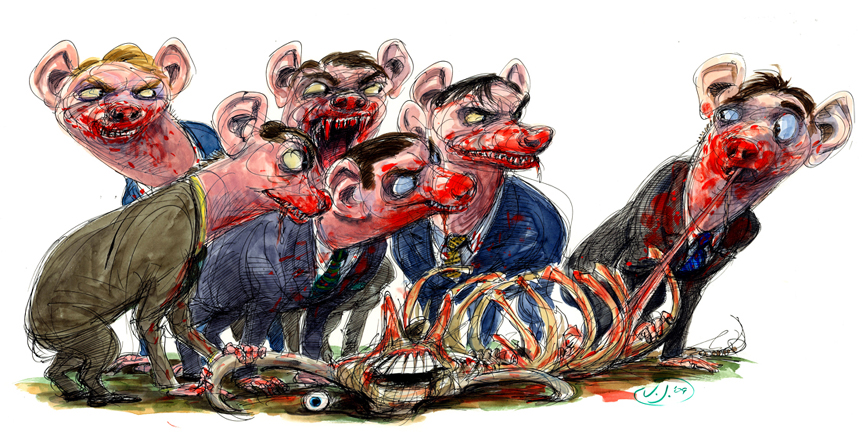
Image first published in Rolling Stone, appears here courtesy of Victor Juhasz

I can’t help you kick
The drug you call pancakes,
Or the replacement
You call syrup.
Your life has been
One long sweet taste
Of drama. You came nearly
Close to finishing
In many ways:
The swig of strong
Medicine. The twists
And burns
Of what and why
You thought
You were and are.
I remember
The night you screamed
At Dad saying
You were dancing
On his grave and to mom
You wished her
Back on the floor
Near the empty
Aspirin bottle the day
Other sister found her.
As a family, we have
Been through the recommended
Books, the last minute doctors
You gave up on moments
Before the truth was revealed.
We have been close
To finding the border,
Crossing over into sanity.
We have sucked it up
And loved you while
The trail of white water
You left behind churned
Up in our wake. At once
We were glad angels
Loaning you money.
At next, we were worse
Than the yellow devils
Of your irises, reflected
Upon us as you stared
Us down into oblivion
When we asked about
The missing tablets.
This is what it is like to live
Inside a struggle,
Just a kiss beyond
A fairy tale destination.
For which there is no middle
Ground, no training wheels,
No prince, no magic potion,
No deep red apple, no sugar
Plum house, no clever mice,
No breadcrumbs, no red hood,
No glass slippers, no pumpkin,
No wild wishing brook,
No monster or glass coffin
In your woods.
There is no gate to hold onto
As you swing back and forth.


Millicent Accardi is the author of two poetry books: Injuring Eternity and Woman on a Shaky Bridge. She received fellowships from the NEA, California Arts Council, Barbara Demming Foundation and Canto Mundo. A second full-length poetry collection Only More So is forthcoming from Salmon Press, Ireland in 2012.

Read an interview with Millicent Accardi here.


“Coffee” by Stephen Ramey

Coffee
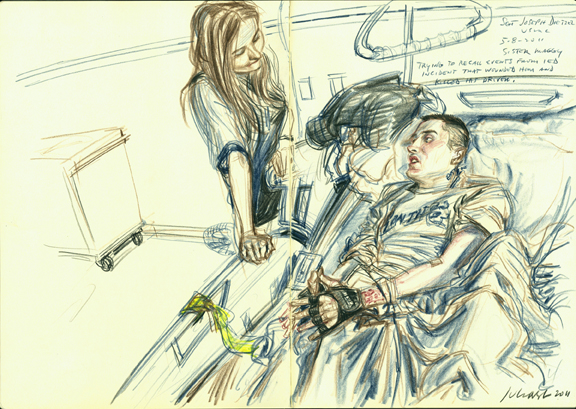
Image courtesy of Victor Juhasz, first published by Sleeping Bear Press.

He looks out over the city and thinks of death. Somewhere down there in the pit of this valley someone’s dying, curled into a ball in that dead end alley next to Ralph’s Surplus maybe, or leaning lopsided with a Lucky Strike still smoldering between veed fingers.

“Donut?” the counter clerk asks.

He pulls his gaze from the window. She’s pretty in a homely way, with curling brown locks that look entirely unmanageable, and a determinedly defiant jaw. Her skin is caramel brown.

“A dozen?” she says. Her eyes are bright somehow, like the lull in a storm when you can see lightning so clearly without having to endure its lash.

“Coffee,” he says.

“What kind?”

He squints at a menu that makes no sense. “Black?”

“Half,” she says without batting an eye. “My dad’s white.”

An intense embarrassment overcomes him. His tongue twists, looking for words.

“I’m just joshing with you,” she says. “You want sugar in that coffee?”

He nods mutely. She turns and drains coffee from a stainless steel urn into a Styrofoam cup. He watches her move, the way her hand goes to the swell of her hip. She’s been on her feet too long. Her hip aches, there in the hollow beneath the ribs.

He can’t help but think of the pain his wife endured in those final months after they gave up on chemo. He can’t help but recall the pain his son expressed this morning. Another argument, another slugfest, only this time he’d landed a punch, a real one.

“One lump or two?” It’s the clerk.

“No,” he says. It’s the shortest answer. She fits a lid to the cup; she slides his coffee across the counter.

“A dollar-fifty-nine,” she says.

He digs through his pocket for change. Three quarters, a dime, six pennies. It’s not enough.

His thoughts go purple, a throb like the swell growing on his son’s pudgy cheek. Death, he thinks. Death of flesh, death of love, death of dignity. He’s stared into the black eye of a gun a couple times, but hasn’t been able to make that coward finger squeeze.

“I can’t…” Words fail him. A rope constricts the pit of his belly, fibrous strands poking from a smooth weave. Coins clatter to the counter.

The clerk slides them onto her palm. She opens the register, deposits them.

“It’s okay,” she says in a voice gone quiet. “The shit isn’t worth what they charge anyhow.” Her teeth are far from straight, but they remind him of his wife’s.

She touches his hand. “Rough day?”

He looks at her fingers, the knuckles weathered, fingernails chewed to stubs. She has her own problems. Still, he can’t help it. He nods. He meets her gaze. For just an instant it’s like staring into the barrel of that gun, only it’s light inside, not dark. He thinks of that time he helped his wife plant a black walnut sapling where the elm came down. He thinks of their gloved hands touching.

And then the moment is gone. “Thanks,” he says. He takes the cup, feeling its warmth, thinking how muted it must be compared to the boiling liquid inside.

Life he thinks, turning from the counter. The clerk swivels her attention to the next person in line.


Stephen Ramey lives in an 1870s Victorian home on the edge of New Castle, Pennsylvania’s Historic North Hill District, overlooking a Pizza Hut and two wonderfully  complex church buildings. His short fictions have appeared in the Journal of Compressed Creative Arts, Bartleby Snopes, Pure Slush and Caper Literary Journal, among others. He edits the annual Triangulation anthology from Parsec Ink and blogs about that process at http://www.stephenvramey.com

Read our interview with Stephen Ramey here.


“Target” by Maria T. Groschup-Black

Target
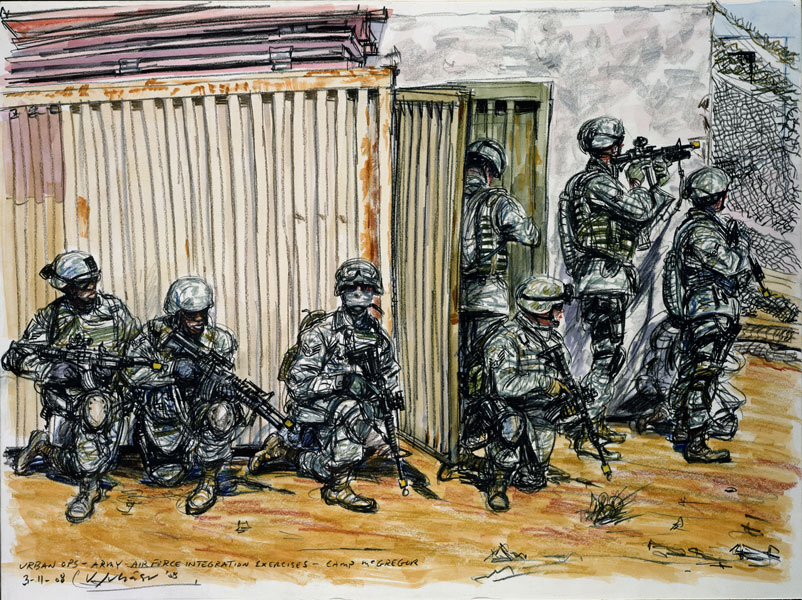
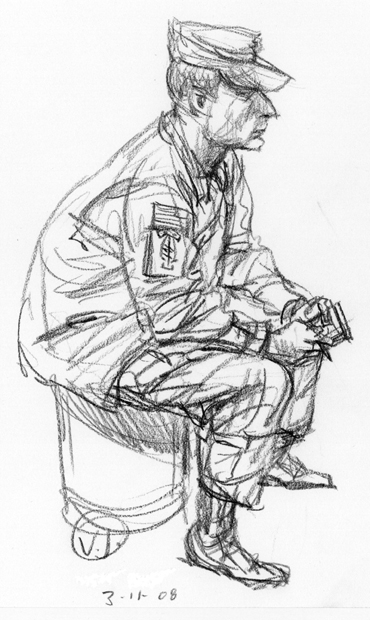
Image courtesy of USAF Art program and Victor Juhasz, artist.

The ending is always the same: Two shots to the chest, one to the head. He falters.

Two to the chest, one to the head. I’ve hit him. Why doesn’t he stop? Six to the chest and reload. He doesn’t stop. He doesn’t bleed.

I wake up. I am sweating; my heart is pounding. The beat echoes in my head like the rhythm of a bass drum. Every muscle is tense. I pull my lover close and whisper “I had the dream again.” I used to have that dream a lot, but I don’t sleep much anymore.

I get up.  I pour myself a drink.

Some say the dream is “insecurity.” Some say it represents a “lack of skill.”  Others say “fear.”  For me, the dream is much more.  Targets don’t bleed.  No matter the interpretation, they all say it is a common dream among police officers.

I’ve been on the force for twelve years. Twelve years is a long time. I am callous. I am indignant and arrogant. I shout at the television.

“You weren’t there, Asshole!  What do you know about my job?”

My lover tells me to calm down. I pour myself a drink.

A suspect high on drugs and alcohol resists and beats an officer with his own nightstick. He is shot. The public calls him “Martyr.” They call the officer “Murderer.”

And I? I pour myself a drink.

I get ready for work. My lover whispers “come home to me.” These words say it all. Without them my night is empty. We’ve been together a long time.

“Come home to me.”  She says.

“I will.” I promise.

I come home.

“How was your night dear?” She asks.

“Nothing special” I say.

I could tell her the stories, but I don’t talk about work anymore.

I want a drink. I go to a meeting.

I am angry. The public I have sworn to protect has turned its’ back on me.

“Walk in my shoes!” I shout.

They question my every step, my every method. They ask me to protect them, to solve their problems and to counsel them. I protect them. They want me fired.

“Walk in my shoes!” I shout.

I need a drink. I go to a meeting.

I go to meetings a lot now. I tell them I am angry; I am indignant.

“You did this to me! You, the public I serve and protect! Who will protect me?”

I tell them I am powerless and go home.

I wake up. I am sweating; my heart is pounding. I hear each beat echo in my mind.

Babump! Every muscle is tight.

Babump! I scream.

Babump! I pull my lover close.

Two shots to the chest, one to the head. He falters. Two to the chest, one to the head. He stops. He bleeds.

And I? I pour myself a drink.

I don’t sleep much anymore.


Maria T. Groschup-Black worked for 18 years in San Diego local law enforcement, first as Deputy Marshal and later as a police officer for the S.D Harbor Police. She currently resides in Spring Valley with her spouse of 10 years and their 3 children ages 10, 7, and 6. Her credits include articles written for and sold to Police Chief Magazine and Fire Chief Magazine. When not at work, Maria spends her day repairing the damage caused by three rambunctious boys while squeezing in a few moments of time for reading and writing.


“God’s Forgottens” by Maureen Lougen

Zues
Image courtesy of Victor Juhasz, artist, first published through Sleeping Bear Press.

This ain’t a place miracles ever happen. This ain’t a place anything good ever happens.

Even the cops don’t like coming here, and they gotta come here, least once or twice a month. We get fist fights, knife fights, heads cracked by pool cues, shoulders broke by slamming chairs. Hell, two or three times a year there’s always some damn concerned citizen talking about shutting the whole place down on account a the drunks and drugs and fights and body bags that spill out into their nice clean world. But the clientele we get here, don’t nobody want ’em nowhere else, so we don’t never get closed down.

Tonight’s being quiet, all things considered, and I can tell some of the fellas are gettin’ antsy. We got all the regulars tonight. Knife and Chainsaw – don’t know as I know anybody’s real name – are at the pool table, with Godzilla holding up the corner, waiting his turn. Mercy (’cause he’s got none) and Harley are playing cut-throat poker. Crank’s sharpening darts on his boot and Shirl is at the table closest to the door, being available to her own brand of clientele as they come and go, and the rest of God’s Forgottens are taking up space across the barroom floor, smoking and drinking and doing things their Mamas wouldn’t approve of.

It’s gettin’ late and just as I’m thinking this night might end and no blood on the floor, in walks Soccer Dad. Young guy, thirty if that. Clean hair, trimmed nails, clothes that seen an actual washer and dryer. He’s so far outta where he oughtta be, he might as well be on a different planet. Half the place turns to look at him, like wolves who suddenly notice supper. I’m feeling generous –  and I don’t want the cops back less’n three days after the last go-round – so I go over to tell him that if he don’t want to be tomorrow’s ‘identity withheld’ he better turn tail and run.

Especially since he’s headed right towards Godzilla.

I don’t know Godzilla’s right name, and that ain’t even a name he give himself. I call him that – not to his face – ’cause he’s huge and seems near always in a bad mood. Right from when he first set his butt on my barstool, it was like he rolled in off the thunderclouds what was hanging over the street that night, and the dry lightning flashing red to blue, cloud to cloud and back again, like it was Heaven and Hell playing keep away with the thunderbolts.

I took him for military, Godzilla, right from the jump.  It was his boots that looked it, sure, but it was more than that, too. Something hard to describe, but something – or a lot of somethings – one old soldier recognizes in another. Not that Godzilla’s anywhere near to the years I got collecting behind me. Not on the outside. On the outside, couldn’t be he was any more’n twenty-five. On the inside though, I could tell he was old. Same as everybody else ever set up shop in my place, Godzilla was seen too much, done too much, lived too much, old.

Being fair, he’s got niceness in him. Might be he’s bad tempered most of a day, but he’s never mean to somebody isn’t mean first. A person nice to him gets nice given back, sometimes outta two hands. One time he asked was I okay after the old woman laid me open with a beer bottle. For a whole coupla nights after that he did any heavy lifting it was I needed around the place n’wouldn’t even take a drink on the house for it. Shirl sure done got her a special place for him, even with her being old enough to be his Mama, or even his grandmama. Godzilla holds her chair and her coat and the door whenever it is she needs it, and it ain’t that I think he ever bought himself any of what it is she sells, but if it ever was he did, I’m thinking it’d be his for the asking.

But those that mess with him get messed back. He don’t like being crossed, he don’t like being touched, hell, sometimes he don’t hardly like being talked to. Since he’s been coming here all this past summer, he’s broke two arms, three noses, and six fingers. Other people’s. That I know of. Don’t get me wrong – they all had it coming. Just didn’t none of ’em see it coming. Nobody, not even Mercy, messes with Godzilla.

And Soccer Dad is headed right for him.

“Hey Buddy -” I try. I put my hand on his shoulder, meaning he should leave while it’s still in its socket, but he throws me off and keeps walking.

‘Your funeral. I think and follow close for ringside seats.

Godzilla’s paying nobody no mind but the pool game. Soccer Dad grabs his arm and pulls him around and Godzilla comes up swinging and I’m thinking the game is on. Soccer Dad don’t even flinch – he don’t care, he stands there glaring at Godzilla, and Godzilla’s car-sized fist stops dead just before it wallops him.

“What the hell? Soccer Dad demands and Godzilla’s face does something I ain’t ever seen it do – it goes soft, like that day Eyeball found his Mama’s wedding ring he thought he lost for a week, jammed up under a loose board under the pool table. Godzilla goes soft and looking like he don’t know what to do and drops his hand and don’t even try to look Soccer Dad in the face.

Mercy ain’t having none of it though. Tonight’s been quiet and he don’t like quiet and could be he’s taking Godzilla’s idleness personal. He shoves Soccer Dad but no more’n asks, “Who’re YOU?” before he’s on his face with Godzilla’s foot in his armpit and his arm twisted back around the wrong way and Godzilla saying, “He’s somebody you walk away from. Understand?

And it ain’t until Mercy snivels ‘Yessir’ practically that Godzilla lets go and goes back to stand in front of Soccer Dad, looking soft and worried and like he got caught after curfew.  By now they got the attention of the whole barroom, only neither of them don’t notice or don’t care. Soccer Dad don’t say nothing, he only just keeps glaring, like he can burn an answer outta Godzilla. It was then I seen the resemblance. Soccer Dad don’t have more’n a couple-three years on Godzilla, near to as tall, that same dead-on stare I seen Godzilla blasting folks with, and it’s on me to figure Soccer Dad is Godzilla’s brother.

“Tell me you got amnesia.” Soccer Dad snarls at him, like Godzilla ain’t got inches and attitude on him and it comes on me that Soccer Dad is only what he shows to the outside. There’s death under the clean clothes and trimmed nails, I can tell. “Tell me amnesia is why you’ve been back five months and didn’t even let us you were alive.”

Godzilla’s throat is bobbing like he can’t swallow something and he won’t look at Soccer Dad and his head tilts like he’s trying out excuses in his brain until finally I guess he finds one that might pass muster.

“Up ’til now, I didn’t know I was alive.”

Whatever that means, it means more than anything to Soccer Dad ‘cause he gets a look as soft as Godzilla’s. He wants to say something, he wants to say a lot of somethings, but he ain’t gonna say ’em here.

“Let’s go.

He turns like that, like his word is law and I guess it is, ‘cause Godzilla follows him. He even puts some hurry into it like Soccer Dad might just go on and leave him behind, never mind what he just went through to get him.

I follow ’em to the door and a little beyond, ’cause I know this ain’t something I’ll ever see again.

Godzilla follows Soccer Dad to the curb where they need to cross and Soccer Dad puts the back of his hand on Godzilla’s chest, saying with no words to mind the traffic. And Godzilla, who I know can crack glass just by looking at it, smiles.

The whole barroom is quiet, hushed like we all just maybe witnessed a miracle, and I don’t know, I think maybe we did…’cause one of God’s Forgottens got remembered after all.


Maureen Lougen started writing in fourth grade. When other kids were actually doing their schoolwork, she would pen a juvenile blend of her favorite TV shows on scraps of paper instead of paying attention to the teacher. She lives in a little town that’s seen better days, about a quarter mile from Lake Ontario. During the summer, the town smells like dead fish. (Which might explain why she’s still not married.) She shares her aged house with her too-smart-for-his-own-good son, a beagle that needs a C-Pap machine, a beagle-basset that suffers from Seasonal Affective Disorder, and two cats that hate each other. An avowed busybody and Nosy Parker, Maureen steals her ideas from other people’s lives and plunks them down in the middle of her stories just as they are. It’s just easier than doing research.


“Runner” by Benjamin Buchholz

Runner
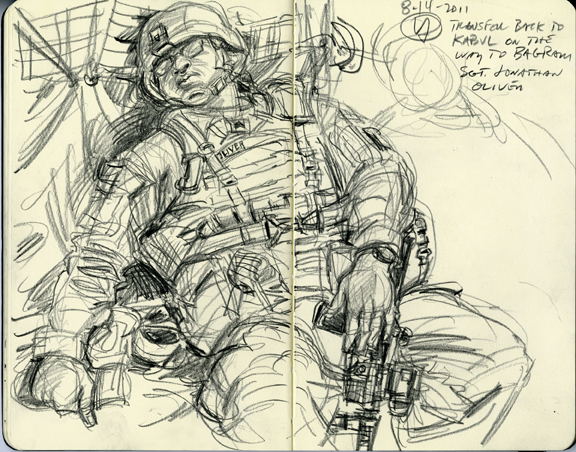
Image courtesy of The Joe Bonham Project and Victor Juhasz, artist

“Grady sent me,” I said as Annie opened the door to her house.

She touched the corner of her mouth with two fingers. Her lips parted into a non-smile, a tension of soft, unusually nervous little muscles. Like Grady, Annie was older than me by a decade, a fact that didn’t decrease my blushing anxiety. Ever since I could remember Annie formed in my mind the very fixture of beauty: gilded in the warm autumns of so many homecoming dances she and Grady graced, silvered in the snow in her mittens and scarves when we built forts and snow-castles, honeyed in summer with a tan from the beach when we built bonfires and our father — Grady is my brother, you see — invented odd, rambling ghost stories greatly augmented by the looming canopy of forest so near to our cabin and the lake.

I had come with — well, not-exactly — news.  Or, rather, something Grady needed said, a thing he couldn’t say himself; and, Lord, how would I do it?

Very quietly, with her gaze boring into me, she answered me: “He’s alright . . .”

I couldn’t tell if she asked it as a question, or if she knew, or thought she knew, Grady’s condition. Statement or question, it didn’t matter. My job remained the same. Little brother, you must, for me, this once just go in my place . . .

I looked beyond Annie, suddenly uncomfortable. Her home, a bungalow, gleamed with dark, immaculate wood. No lights lit the interior, not the blue flickering of a television, not the warm glow of a reading lamp, not the fluorescence of a bright bank above the kitchen sink. On the porch, Annie’s swing shook in the sockets of dry chains fastened to the ceiling. A cicada buzzed and bumped against the inside of a colored-glass fixture above the door. Annie held a pen in the hand that did not touch her lip.

“He’s back,” I said. “But you knew that already, right?”

“I had heard,” she said.

“He sold the house.”

“Really?”

“And his car.”

She looked past me toward the street. Did she see the ghost of Grady’s old black Monza revving at her curb?

“May I come in?”

Not taking her eyes away from the street, she half-turned in the doorway and stepped away to let me pass. As I brushed along her, crowded in that frame, I smelled the freshness of peeled orange about her; on the beveled top of her coffee table, a rind. She dropped her hand from her lip at last to shut the door behind me.

I sat in the reading chair. She sat next to me on the divan and leaned toward me. Her legs, not crossed, she tucked together paralleling the contour of the plush cushions.

“He boxed up all his stuff, the pictures and trophies and fishing rods and tool chest and books and old shirts and pants and took them all to Goodwill.”

“He stopped by my mother’s house,” she said, “and they talked a little while. Nana didn’t think there was anything wrong.”

“It was ‘beef jerky,’ he said.”

“What?”

“Boxes of beef jerky. That’s what got to him the most.”

“In the desert?”

“Care packages, one after the other. I sent them. You sent them. Dad sent them. Beef jerky. Pringles. Jolly Ranchers. Magazines.”

“And, now he won’t talk to me?”

That was the pivotal moment. She had sprung it on me even as I was building toward it. I could do nothing now but blurt truth.

“He is simplifying.”

“Which, I suppose, I should take in a very bad way,” said she, though she didn’t tremble, or cry, or lose the deep tone of her voice. She still possessed an elegance, even in defeat. “I am 28 years old now, Dalton.”

“I know.”

“Grady and I have been together since the ninth grade.”

“I know that too. I remember when you first came over to our house.”

“You were only knee-high that first time I saw you!” she said, actually managing to laugh.

“Still, I remember it. They say, sometimes, when major changes happen in a child’s life, they’ll start to remember earlier than normal. Like if someone died or something.”

This was, perhaps, the closest I’d come to admitting aloud Annie’s profound effect on me. And, I said it to her directly. I was saved: she smiled. Dreadful elegance, be damned! Was that all there would be, a smile? But she touched her fingers to her lips once again, to that same corner of her mouth, the worried corner, and said very softly, “Thank you.”

Somehow, the ‘thank you’ broke the awkwardness perfectly. We were again little brother and Annie, just like always.

“Simplifying?” she asked. “Is that what he couldn’t tell me himself?”

Down the street a truck rumbled beneath the canopy elms, spearing through a tunnel of its own sound and then disappearing.

“Actually, more than that,” I said. “He hasn’t really spoken with any of us, not too much, or — when he does — it is pleasant, formal, hellos, goodbyes, pass-the-milk-please. Until last night. I got home late. You know Amanda Wills?”

“Derrick Wills’ neice?”

“Yes.”

“I’ve been dating her since Christmas, or a little before that.”

“That’s wonderful,” Annie said, and she meant it.

“I brought her back a little late to her house, got back to my house even later. As I came up the porch I thought I was in deep shit when I saw the rocking-chair in motion through the window and a light still on in the living room.”

Annie said: “Grady and I were always late.”

“It was my first violation of curfew. I thought mom had waited up to scold me. But it was just Grady. I came up from behind him, trying to tip-toe past him, still uncertain if I had been caught.”

He didn’t turn to face me but said, kind of over his shoulder, “One time, kid, she told me why she did the things she does. She actually explained herself. It was amazing. She said that good people are boring.”

“What you talking about?” I asked.

“Doesn’t matter. Boring. Like concrete-block-boring. That’s what she said.”

“Grady, what the hell are you talking about?”

“Running naked around the elementary school on a dare. Sex in the dark of the gym, breaking in, a school night, play props built up like a castle around us and left there for the janitors to wonder about in the morning. Bonfires and tequila on the beach. Kissing her girlfriends to amuse me, to tease me. All meant, downright meant, to be bad.”

Annie didn’t even blink.

I kept on telling her what he had said.

“Then worse than that in college . . . I’m sure you can imagine, or better than that, depends who you’d ask. A wild time until I was gone and could breathe without her for the first time and then I wasn’t so sure. The world seemed changed and dim.”

“I think you are over-reacting,” I said. “That’s what we all think . . . she’s not that way anymore. She even goes to church most Sundays. Why haven’t you stopped in to say hello to her?”

“It’s not that simple,” he said. “Beef jerky.”

“Beef jerky?”

“I lived out of a box for four months as we moved up, building-to-building, into Baghdad. Everything I needed was in that box. I’d kept a journal of it all, immaculate, with drawings, and poems, and thoughts about her, and I meant to give it to her. That’s what I was going to do when I got back.”

“And?”

“If it had been dramatic, I think it would be more worth telling about. The box, it was just an MRE container. Old shitty box. Looked like scrap. Our squad moved out of a burnt-out grocery and up the street four blocks to a clinic. New HQ. And my sergeant threw that box out in the trash.”

“Shit,” I said, not knowing what to say.

“It was the best thing that happened to me over there.  I realized I didn’t need the beef jerky. I didn’t need the comics dad clipped and sent. I didn’t need the journal. I didn’t need the pictures I’d kept in my Kevlar since Kuwait.Simple.”

I paused.  That was the end. That was all Grady had said, the whole of the story I’d been sent to tell her. Actually more than he’d wanted me to tell her. But, after a moment, when Annie didn’t say anything or move or ask me any questions, I said: “Just give him time. It’s a phase.”

“No it’s not,” Annie said.

“It’s not?”

“No. Not for me.”

She didn’t seem sad, not really. Just steely. Quiet and steely.

“Why not?”

She took a second, gathering her thoughts, then leaned forward toward me in a way that was almost frightening. After a good long moment looking at me, she said, “Because I never ran naked anywhere in my life.”


Benjamin Buchholz’s debut novel “One Hundred and One Nights” (Little, Brown, 2011) has just been released. He also writes on Middle Eastern culture and oddities at his blog “Not Quite Right.”

Read our interview with Ben Buchholz here.


“Last Battle Aboard the Old Pro” by Jeffery Hess

Last Battle Aboard the Old Pro
Image courtesy USAF Art Program, Victor Juhasz, artist

Walberg punched a fist into his open palm and said, “I’m going to hit you so hard, Rudy, you’ll be too fucking numb to feel anybody else.”

He sat atop the workbench that ran the width of our workshop aboard the USS Proteus, his legs hung over, boot heels kicked into the sliding doors below. He was a tall, skinny guy from Long Island who always carried a copy of Mother Earth News folded in his back pocket and a pack of Winston menthols tucked into his sock.

Craig, a doughy Midwestern kid with big ears and Navy-issue glasses, leaned against the workbench and laughed at Walberg’s threat. He was Walberg’s best audience.

“Fuck that,” EM1 Wallace said with a condescending nod. He was leaning against the electrical switchboard. EM1 was my boss, the first black man I’d ever worked for. He looked more like a linebacker or a prison guard than a First Class electrician’s mate. He paused to scratch his chest then said, “You got a better chance of banging Madonna than you got of punching him harder than me.”

We were hanging out in the Sparky shop between knockoff and the dinner whistle aboard the Old Pro. This usually entailed a couple of us shooting the shit and generally dicking the dog. We were at sea. It was our first day out in more than six months. It was also the eve of a promotion for which I was long overdue.

Anyone aboard, E-4 and above, was allowed to punch me once. Tacking on my chevron. For most sailors, it was largely ceremonial.  A right of passage like fraternities in college. But there were others in it for the sport. I couldn’t blame them. There aren’t that many opportunities to hit someone, completely without repercussions or reprisals.

I’ve heard stories about guys who couldn’t raise their arms above their heads for two weeks and a couple urban legends where blood clots set in and killed the newly promoted guys in their sleep. I didn’t really believe that shit. From what I understood, the more people liked you, the harder they hit you, to earn your respect.

Craig said, “You better pull out the needle and thread. You’ll be Betsy Fucking Ross for the next couple days sewing on your chevrons.”

“Don’t go spending that extra money right away,” Walberg said. “They can take up to a year to start paying.”

The jump in rank promised $160 more per month. I didn’t have a wife and kids, but I was responsible for a family back home.

 ~

Whenever a new guy arrived, the squid assigned as his Ship Sponsor would ask, “How long’s your sentence?” No matter the reply, the Ship Sponsor always said, “It’ll seem longer.”

Most of my shipmates considered it a prison sentence, being stationed aboard the Old Pro. The ship was homeported in Apra Harbor, Guam, and we called it “the rock” because of its similarities to Alcatraz. The compressed land mass seemed to shrink daily; escape was virtually impossible, even when out at sea because they always had to come back to homeport. These squids referred to their massive ship as “the yard” because it was a cluster-fuck of iron and steel stretching the length of two football fields. They called the Chiefs “Hacks” as if they were prison guards. Captain was their Warden.

What the others considered imprisonment was freedom to me.

 ~

The shop was cold from the freestanding, five-ton AC unit that sat along the far wall. It offset the heat put out by the switchboard and the transformers for the GYRO navigation equipment up on the bridge.

Walberg hopped down from the workbench and walked toward EM1. He slung his arm up, but his reach was only halfway across the man’s broad shoulders. “Okay,” Walberg said. “I’ll admit that Rude’ll be crippled when you hit him, but please let me hit him first so he feels us both.”

Hixon sat on an overturned garbage can. He had been quiet, which wasn’t like him. When he had too many Mountain Dews, he was like one of those dogs that jump on everyone as they enter the house. This was his first cruise and I didn’t know if his change in demeanor was from seasickness or if he was just all fucked up over having to leave homeport. Neither made sense because he wasn’t missing anything back on Guam and so far, the seas had been smaller than some waves I’ve made in the toilet.

“At this pace,” Hixon spoke up, “you’re on pace to retire an E-5.”

Craig and Walberg said, “Ooh,” in unison.

EM1 looked at Hixon, said, “Damn,” and lowered his hand from the switchboard to cover his mouth.

My promotion was overdue because I’d gotten in a little trouble: once for missing a one-day ships movement because a Korean chick’s alarm clock didn’t go off, and once because I drank too much and got caught urinating publicly, on sacred Japanese land in Sasebo. I had also failed the Third Class Electrician’s Mate test twice. I knew my job. My performance evals listed me as a solid journeyman electrician, but even in school I was never good at paper tests. Ask me a question and I can tell you the perfect answer. Put me on a job and I’ll get it right the first time. But seeing the multiple choice answers in black and white, even at twenty-three years old, made them all look the same. I was still stunned that I’d guessed correctly enough times to finally pass.

Hixon said, “You’re as old as a canker sore at a nursing home.”

Coming from EM1 that would have been funny because he was older than me. Coming from Craig, it would have been funny because he was younger than me. But Hixon was my age and has held that rank for almost a year. He smiled his unhappy Tennessee smile.

This was my fourth cruise in almost as many years, but I was the lowest man on the totem pole in our workshop. All the others treated me as an equal. Hixon was the only one who showed me no respect. Fucker. While I was sweating it out in the fleet, he was sitting pretty in some fancy “C” school in Chicago. The difference meant something to squids like me. My uniforms had the grease and bloodstains while his were new and starched and loose around his arms and neck.

One more day and he wouldn’t be able to tell me what to do any more.

I said, “Shut up, Hixon. You’re as useful as a deck of cards at an orgy.”

He pulled out a modest wad of cash.

“Where’d you get all that money, Hixon?” EM1 said.

“Since we’re at sea, I’m saving money by jerking myself off.”

“I bet you are, fucking pud puller,” I said.

Stuffing the cash back into his pocket, Hixon said, “But tell your mother I’ll make it up to her when we get back.”

I pointed and said, “Don’t talk shit about my mother , asshole.” I hated the sonofabitch and for all I knew he hated me, too.

Hixon reached his hand out, slowly, almost playfully, toward my face. I didn’t feel threatened, didn’t move. In the next instant, his hand touched my face and he pushed me away, like a stiff-armed running back.

I heard noises in my head like tree branches or wooden boards cracking. My throat burned and my mouth grew pasty. I exploded with as quick a punch as I’d ever thrown.

The punch didn’t land as squarely as I would have liked, but my third and fourth knuckles throbbed instantly. The blood that streamed from Petty Officer Hixon’s nose surprised me.

He back-pedaled, bent at the waist, his arms out wide, hands shaking like a woman with wet finger nails. For a second I thought he was going to cry. Blood poured from his face. He reached up with shaking hands and smeared his cheeks. “My nose,” he said without inflection. An instant later, he called out, “Mercy be.” He doubled over, dripped blood onto the blue electrical safety mats with the faded USS Proteus pie-shaped emblem: “Prepared, Productive, Precise.”

“Pinch that snot blower of yours and lean your fucking head back,” EM1 said folding his arms across his chest.

By the time Hixon complied, a puddle had formed at his feet.

Hixon looked up at me. A stream of snot ran from his swelling nose. There was blood in the snot that hung from his right nostril. None of us spoke for a minute. The 400-Hertz generators hummed on the opposite side of a watertight door.

I stuffed my hands into my pockets and said, “No. Shit no. I didn’t just do that.”

EM1 said, “Well if he ain’t going to hit you back, you better get him up to sick bay right quick. That nose is fucked. And get back here to clean this shit up.” He pointed at the puddle.

Our shop was below the waterline. Sickbay was six decks up. “How am I going to get him  there without anyone seeing us?” I asked.

“You’re probably not.” EM1 said. “But on the way, ask him real nice if he’ll tell Doc that he fell.”

 ~

Hixon’s mouth was moving. The sounds he was making weren’t words, exactly. Not yet. They soon would be, I figured.

He whimpered and stopped at the hatch as if he couldn’t go on. I’d been busted in the nose plenty of times. Had my jaw broken after senior prom. Spent the remainder of the school year, and graduation, sipping shakes and beer through a straw because of it.

I was going to get locked up in the brig. The ship’s brig, “Hell” as all aboard called it, sat in the bowels of the ship. It had four cells with iron bars and was run by Chief Master at Arms Halsey, a fire hydrant of a man who once ran PT boats in Vietnam. He was thick with muscle, head shaved clean, with a heavy Louisiana accent. He sported the scales of justice tattooed on one forearm and a guillotine on the other and he squinted as if he perpetually had smoke in his eyes.

In the vestibule outside the shop, the rich and meaty smell of Sloppy Joes was as dense as a fart in the berthing compartment. It filled the passageway. It was dinnertime and most of the crew was on the mess decks for chow.

At the ladder, Hixon balanced his hand under the yellow stream jetting from his nose. I didn’t know if this was because he didn’t want to soil the deck or if he wanted to save it as a souvenir. “What the hell is that disgusting thing, anyway?”

“I don’t know,” he said, he held his fingers against his cheekbones as he angled his head down to see the first step. “But I fear it’s not a good sign.”

“Let’s go,” I said and tugged on his arm. The sleeve of his work shirt tore a little, the seam popping at the shoulder.

“You’ll have to help me,” he said.

I could have kicked him in the face. “Hang on,” I said, and took him by the arm.

He moaned as we took the next step. The groan came out low and guttural, so feeble that I wanted to laugh. “Quit your bellyaching,” I said. “I didn’t punch you in the legs.”

“I’ve never been punched in the nose before!” he said, still pinching the bridge of his nose.

“How can that be possible?” I half-dragged him up the ladder. “There must have been lines formed to do that since you was a kid.”

“I’ve never been in a fight before.”

All I saw when I looked down at him was the delicate white fingers he used to pinch the bridge of his nose and the yellow thing still dangling. I’d seen him in berthing every day for six months. He took off his t-shirt by slipping out the arms first and then pulling it over his head. The only guys I knew that did that were raised by single mothers.

His hands were small. They reminded me of my sisters.

The other day, over the phone from a half-booth on the pier, I told my mother I’d be sending home extra money. “Why?” she asked. “You gambling again?”

“No ma’am,” I said. “Because I’m advancing a payscale. I’m making 3rd Class.”

“It’s about time,” she said. “Your sister’s in rehab again. That shit cost money.”

I wasn’t allowed to backtalk. Back home I wasn’t allowed to be rude, to anyone. The town I grew up in was the two-stoplight variety with only one school, one store, and two thousand staring eyes. But after a couple years stationed aboard the Old Pro, I’d transformed myself into Rudy. I’d bulked up twenty pounds. I kept my hair short and a moustache a millimeter within regulation.

I’d joined the Navy for the steady paycheck, but also to get away from my mother and sister. I hated them both because my sister was the light in my mother’s eyes and that girl was never anything but trouble. She used to put pots and pans over my head and beat them with wooden spoons or spatulas. She was eight years older and mean as hell well before she found her way to speed and cocaine.

 ~

By the time I got Hixon to the next ladder, I expected the yellow thing to drop like an icicle from his nose, but it didn’t. His face was whiter now than his hairy knuckles. This is when I knew it wasn’t just snot dangling there.

A gust of wind blew the watertight door back into me as I opened it to the main deck. It took a good push to get it open while holding up Hixon with one arm, pushing with the other. Air rushed us once we made it to the main deck replacing the food smells of the mess decks with diesel fumes. Waves broke large enough to elevate spray that darkened our chambray work shirts. The last time I’d been topside, all conditions were calm.

Air on the main deck of the ship was different than it was below. It was easy to forget how bright sunlight actually was when you didn’t see it for a couple days. Being on the main deck, we were halfway to sick bay and I had to squint in order to see. The Boatswains moved in the sunlight – they gleamed like ghosts. Little bursts of sunlight glittered off their heads. Gulls cried overhead. One of the Boatswains reared back and spit over the side and dropped to do pushups on the deck.

“I don’t feel so good,” Hixon said, grabbing the life rail and collapsing his weight onto a mooring bollard. His voice was pitched higher now. “But thanks for helping me.”

“Helping you?” I said.

“I know,” he said, lowering his head between his knees as if to stop nausea. “You were ordered to.”

“If it wasn’t for me, you wouldn’t need to go to sick bay.”

“But orders are orders,” he said, pulling his head up, resting his elbows on his knees. “And they’re what’s really important.”

“What’s that supposed to mean?”

Hixon said, “What if we crossed paths out here with a Russian Destroyer? What if they launched on us? What do you suppose Reagan would do?”

I’d seen the movie “Patton” when I was a kid. In it, George C. Scott had said something about fighting the Russians right then because if they didn’t, we’d have to eventually. “He’d vaporize as much of the USSR as he could.”

“Exactly. And what if we fired on that ship first?”

“I reckon they’d vaporize the US. That’s why we always had them drills in school.”

“Exactly my point. All those drills. All the drills we’re forced to do on this ship. Do you think they’re just to kill time? If the Russians send a plane, we could be torpedoed in an instant. They got this fucking bird, the KA-27 Helix with counter-rotating triple-blade rotors. Those fuckers are anti-surface and anti-sub. Torpedoes and depth charges. They could search and destroy us on both fronts. They could be looking for a hot nuke and we could end up collateral damage.”

“You’re exaggerating,” I said.

“They’ve got Kirov cruisers that’ll do 40 knots. They got vertical launch missiles and anti-surface shit you can’t imagine.”

“They’re not going to use that shit against us. Nobody wants World War III.”

Hixon leaned forward, letting that yellow thing dangle. “Just in case, I’d rather have shipmates that didn’t hate me. If any shit goes down, hard feelings might make us react on attitude instead of our training. We can’t risk that.”

“If anything goes down tonight, I’ll be in the brig and no help to anyone.”

“I won’t say anything,” Hixon said. “I fell into the switchboard. Hit the switch for the 400s. That big nasty red one. That’ll work.”

“You’re fucking with me now.”

“I’m not. Seriously.” He looked up at me. “I won’t talk.”

“Why would you do that?”

“You’re my shipmate.”

“Don’t fuck with me, Hixon. If you’re going to be a dick, just rat me out. I don’t care.” I stopped for a minute and looked over the railing at the water breaking white at about four feet. “I suppose you want me to stand your watch or take your duty once a week for the entire cruise.”

“And make my rack every day…”

I wanted to punch him again.

“How about I do your laundry, too?” I said. “And buy you sodas.”

“Now you’re talking,” Hixon said, pushing himself to stand.

“Anything else?”

“I’m just fucking with you. I don’t want that stuff. All I want is you to hang around with me at chow and go with me on liberty.”

“That yellow thing dangling there must be part of your brains.”

“You might be right, Rudy. You agree to the terms?”

“And I don’t have to do none of that other shit?”

“Nope. That’s it.”

“Fine,” I said, though I would have rather been his servant than his friend.

Hixon held out his hand. I gripped his delicate fingers and he winced, trying to pull his hand away. I squeezed as if it could choke him.

~

The Boatswain’s mates packed it in for the day; their grinders quiet, their chipping hammers still. Most of the crew was at chow and it was quiet on deck. I turned around and grabbed the life rail in my hands, squeezing until my knuckles cracked. Suddenly the oppression the others had felt aboard the Old Pro overtook me. This salty bucket of shit was now my prison, too.

Befriending Hixon was a one-way ticket to alienation and unspecified rations of shit. The idea of having to break bread with him every meal repulsed me to the point that I feared a dramatic and deadly weight loss. And I knew immediately how impossible it would be to pick up women with him as a wingman. Unless he paid for a working girl, there was no chance. I’d never paid for it in my life and I wasn’t about to start now. And I sure as hell wasn’t going to go the whole cruise without getting any.

With every remaining ounce of energy I yelled, “Come and get me, you filthy fucking Ruskies.” I yelled more and louder expletives. “We’ll kick your fucking asses all the way back to Siberia.”

There were no ships visible on the horizon. Nothing but water.

I got Hixon up. The dangling yellow thing swayed as he got to his feet. I could have puked. “Hey,” I said.

Hixon’s head swiveled slowly, the dangling yellow thing moved with him.

“Either pinch that thing off or snort it back into your fucking head. It’s making me sick.”

Once inside Sick Bay, the chief corpsman looked up from his crossword puzzle. My vocal chords were raw from the abrasive salt air as I said, “Doc, call Master at Arms Halsey” and then told both of them the truth.


Jeffery Hess is the editor of Home of the Brave: Stories in Uniform, an anthology of military-related fiction. He holds an MFA in creative writing from Queens University of Charlotte and his writing has appeared in numerous corporate publications and websites, as well as in r.kv.r.y, Prime Number Magazine, The MacGuffin, Plots with Guns, The Houston Literary Review, the<em > Tampa Tribune, and Writer’s Journal. He lives in Florida where he leads a creative writing workshop for military veterans and is completing a novel.

Read an interview with Jeff Hess here.

“Last Battle Aboard the Old Pro” first appeared in The MacGuffin in slightly different form.

 

“The End of the War” by Patrick Cook

triage
Image courtesy of USAF Art Program and Victor Juhasz, artist

The last time I had done any nursing had been twenty-five years earlier, in Vietnam.

That was very different from nursing our mother. In Vietnam, we were passionate fighters against death, plunging burned pilots into ice baths to bring their temps down, stuffing gaping exit wounds with gauze four times a day, heroic treatment for heroic men. Now we were presiding over a sure death, the heroics over, surrender our only desire.

The summer sun filtered through shade and curtain, heating the bedroom so it was nearly warm enough for her. Monsignor Ancona anointed her. We had the candles and the crucifix and the holy water laid out, and we lowered the morphine dose enough to let her stay awake for the sacrament.

The morphine. We administered it by eyedropper into her colostomy every four hours and kept her knocked out. It was the only medicine we were giving her, in fact the only substance entering her body. How terrible that our abstemious mother, who smoked two cigarettes a week and had one glass of wine a month, should die in a stupor. It was better than pain, of course. She was prepared for death, and not only by the last sacraments. She’d known she had ovarian cancer for two years. Still, it seemed like a cheat.

She had eight children, and we were all there, with our spouses and the grandchildren. The house was full. We took turns sitting with her, fluffing the pillows and reminiscing. The late watches were especially fruitful of memories—her joy in her grandchildren, her love for teaching, her knack for celebration. There was no one for a party like our mother.

We had the hospice people in. Our nurse, Mary Hollern, expected to help us build a volunteer group of the neighbors, but when she saw all of us, abandoned her plan. We had plenty of nurses right there.

Mom started to develop bedsores. You have to turn a bed patient every two hours, especially an emaciated one, or the skin on the lower back breaks down and ulcerates. I caught hell from a lieutenant commander for neglecting this once—once—during a shift on the intensive care unit. When I wanted to turn my mother, though, Mary looked me in the eye and asked firmly, “Why?”

I thought about it. What was I saving her back for? Turning her was painful, and served no purpose. A lot of nursing designed for the living went out the window when death was a sure thing. We didn’t move her around, or suction her when her breath gurgled in her throat. We talked, we prayed, and we kept putting those drops into her colostomy.

We took turns sitting with her, slept on couches and floors, and tried to cooperate. In a big family like that, it was never possible before. Getting everyone together for a family picture was hard. We never even considered a real project. But here we were, setting up shifts, dividing responsibilities, just as though we knew what we were doing.

I wasn’t running things. It was a cooperative effort. But I was in the middle of it, taking my turn in the long night shifts, holding her hand, swabbing her teeth with an lemon flavored q-tip.

The last thing they had done at the hospital before sending her home was to put a drain into her stomach. The cancer had strangled her bowels, making it impossible for food or water to pass. As her bile built up, she retched once an hour, so the surgeon thought it better that her stomach drain onto gauze pads. Anything we gave her in the way of food or drink also drained through the tube, so it was impossible to nourish her. The only thing getting into her was the IV drip.

She was desperately thirsty. Denying her a drink seemed harsh, but it was necessary too.  I had done that before. We got a big Huey helo full of Vietnamese civilians, mostly women and children, early one day. They were victims of a Viet Cong mortar attack on their village. We had patients lined up on stretchers outside Triage in the morning sun. The mother of a badly wounded boy asked me for water—“Nu’oc, bac si. Nu’oc.”

I couldn’t give her son any water. He may have had abdominal wounds, and we couldn’t risk any leaks into his peritoneum. There was no way to explain that to his mother, of course. I barely knew the Vietnamese word for water, let alone peritoneum. I said firmly, “No can do, mamasan. No can do.” That look in her eye….

It was the right thing for mother, too. That didn’t make it any easier to deny her water. The week wore on, people came to visit—fellow teachers, Monsignor again, her doctor, who was so impressed by the fight that was in her. None of us left, although we took breaks. My sister stayed at my house a few nights, my brothers stayed with old friends. One night a family from the neighborhood stopped by and left two dozen bacon-wrapped filet mignon steaks with us, each about four inches thick. We broiled those in the yard as far away from the sickroom as we could, and practically inhaled them.

I could see the difference it made to have children and friends around you at the end of a long life, compared to a death surrounded by strangers when it had barely begun. We certainly didn’t try to tell the Marines we loved them in the middle of the night, no matter how far gone they were. We could reassure them—yes, you’ll be able to walk with a artificial leg, no, your face won’t always look like that, yes, your penis will still work. But that was for those who were going to live. Now all we wanted was her release.

Finally, mother gurgled with every breath. Mary Hollern explained to my brothers that her kidneys had failed and that the IV was actually drowning her. It was time to take even that away. I was not there at the time but I came into the sickroom when the nurse was still there. The first thing I noticed was the IV tube wrapped around the pole and pulled away from the bed.

My face must have dropped. I felt myself coloring. I couldn’t speak for a few seconds, and when I did, I sputtered. “What the hell happened? What did you do? Why is the goddamn IV…?” I knew she hadn’t died. I couldn’t believe they had pulled the IV while she was still alive.

Mary Hollern sized things up immediately. She got me out of the house, literally moving me out of the sickroom with her forearm. She said we were going for a walk to discuss this, and it was neither a suggestion nor an invitation. Mary would have made a good lieutenant commander.

My violence left me. I walked with her, up the sidewalk and around the long block.  “Look, Patrick,” she said, “Your mother is dying. Her kidneys have failed. We had to remove that IV or she would have drowned in the fluids.”

I managed to speak. “Yeah. You had to They had to. OK. They had to.”

“You were about to go off. I had to get you out of there. What do you think we’re doing? Trying to kill her?”

“That’s not it, Mary. That’s not it. OK, I lost it back there. You’re right. I lost it. But that’s not what it’s about.  I told you I’d been a corpsman in Vietnam?”

“You told me.”

“We had a tetanus case once. A young woman. Have you ever seen a case of tetanus?”

“No. Not many American nurses have ever seen a case of tetanus.”

“She had a bad case. Very advanced. She was so rigid with it she trembled. Her jaws were clamped shut. Her arm muscles were so contracted you couldn’t even get a blood pressure on her.”

“What did they do?”

“They’d never seen tetanus before either. Three of the doctors went to the medical library and looked it up. The books said to use curare. That’s the poison Brazilian Indians use to tip their arrows. It paralyzes the birds they shoot.”

“No kidding.” She was professionally interested. We were halfway around the block by now, and I wasn’t nearly as flustered.

“They figured out a dose and gave it to her in the IV. You should have seen that stuff work. She relaxed right away, all the stiffness gone, the little tight smile off her face. Only thing was, she couldn’t breathe.”

“Because the curare paralyzed the breathing center too.”

“That’s right. They put a respirator on her and told me to watch her. I was supposed to check vital signs every half hour. If the tetanus came back I was supposed to call them right away. They figured about four hours.”

“Did it come back?” Mary asked.

“That’s the trouble. No, it did not. She lay there, the machine breathing for her, all that evening. It didn’t come back on the next shift, either. Nor the next. Then it was my turn again. All the doctors gathered around the bed, discussed the whole thing, and decided they had given too high a dose. They had paralyzed her permanently.  She would never breathe again on her own, tetanus or no tetanus. So they walked away, and one of them said, over his shoulder, “Pull the plug.”

“Pull the plug?”

“Yeah. On the breathing machine. They killed her but I was supposed to pull the plug. I have a problem with pulling the plug, nurse.”

Mary Hollern took my arm and spun me around. “Look, Patrick. I’m sorry you had to go to Vietnam. I’m sorry you had to see what you saw. But you’re not there now. Your brothers did the right thing. Those doctors did the right thing. That woman wasn’t going to live and neither is your mother. I don’t ask you to accept it, not right now, but you have to sooner or later.”

This was a little tough to take. Mary was right, of course. If I couldn’t accept it, it was my duty to keep my mouth shut until I could. Yelling at my brothers was no answer.

We were back at the front door. I didn’t think any comment was called for. Mary knew that I’d reached a tentative peace, that I wasn’t going to make the situation worse, that the war was over.


Patrick Cook is a retired postal worker who lives in Grand Rapids Michigan with his wife Valorie. They have a daughter, Flannery Crittendon. The name alone tells you how badly he wants to be a writer.

Read our interview with Pat here.


“Paul Maidman, Banana Man” by Brandon Davis Jennings

recon in Iraq
Image courtesy of USAF Art Program and Victor Juhasz, artist

There’s no clear connection between the time I spent liberating Iraqis who never asked me to liberate them and my broken jaw, but it wasn’t until I woke up with my mandible askew that I decided to experience The Banana Show before I died.

The glowing red room where the show took place felt like the inside of a giant heart that beat to the rhythm of Diana Ross’ Everything is Everything. Bead curtains dangled behind the stage and a woman (aged precisely somewhere between thirty and seventy) burst through them. Her straight black hair and red-sequined skirt swished in tandem, always opposite her chin and hips. A couple guys new to the island sat in the crowd with me that night, but Paul did not. All he’d talked about before he went to Saudi was getting home to the states, and once he rotated back to Oki he talked about it more. I was happy he wasn’t with us because that meant he made it home. And I was ready to follow him—even though we’d never talk again. Paul was introduced as The Banana Man. That nickname faded a shade or two each time someone PCS’d. And one day he was just Paul. Maybe he was glad his nickname died before he did, and maybe he wouldn’t want me to say any of this. But I can’t afford to care what dead people want. This is what I do.

~

The night I arrived in Okinawa, Paul advised me that the drinking age was 20, so I bought a case of Guinness and Paul drove me and a couple guys around while we drank. After time had crumbled into bladder-pressure and fatigue, he dropped me off. And when I stumbled into my dorm room, it was littered with paper scraps. No one had a key except the dorm manager and myself, and the window was closed. I didn’t own a single sheet of paper, so it was clear that the specter of an Okinawan scribe had torn apart a collection of Haiku and left the trash for me. I vowed to never write haiku, cleaned up the mess, and then passed out.

~

Paul showed me an article in Time “Geeks vs G-men”. The quote said he was above webpage hacking because, “It’s too easy,” and, “It’s the younger kids who do it—13 or 14-year-olds.” This verified his maturity in print. Paul was so mature that one day he shouted “Bingo” and stamped a guy’s forehead with a blue bingo marker. Veschek, the guy, was twice the size of anyone in the shop, and he snapped the top off the marker and poured ink all over Paul’s face and uniform. Paul plopped down in the ink, smeared it across the floor tiles and laughed like a baby. Then, like an adult, Paul mopped the mess up. Veschek still looked angry when the mess was gone. Hopefully he’s over it by now; it’s been ten years.

—What if he isn’t?

—What if he is?

—Whatever.

~

One year the commander brought Collective Soul to the island. They play that song “Shine”. The concert was supposed to boost morale, but they would’ve had more success with a staticky recording of the chicken dance, an open bar, and hot wings. After the show, we all got drunk. Not because of the show or because it was a difficult day. It was just another day on Okinawa. And in typical fashion, we marched out the gate together, lost track of each other in the fog of booze, and retreated to the dorm when we’d squeezed out all the day’s possibilities or ran out of cash.

The next afternoon Paul told me about his encounter with one of the guys from the band. I’d like to say it was Josh. But according to Wikipedia there is no Josh and never was. So maybe it was Joel. What matters is that Paul bumped into the band at one of the Gate Two bars.

Paul bought a drink and Joel-Josh initiated a conversation with something like, “Do you know who I am?” It’s douchey for a celebrity to initiate a conversation this way.

—Do you know who I am?

—What difference does it make?

—I thought that was the point of this?

—There’s a point?

Paul says, No. Who are you?

I’m Corn Ball from Collective Soul.

Paul drinks, wipes his mouth on his forearm, and says, Wow. You guys used to be pretty cool. Now you suck.

Ending there would have made me think Paul dreamed it all up—the kind of thing a guy embarrassed about his past would create to appear like someone he’s not—nary a banana man. But the story wasn’t over. Corn Ball says back, Yeah. We’re trying to work on that. Then he and Paul go drinking together, and music and celebrity aren’t mentioned again.

I still don’t listen to Collective Soul or care what the band members’ names are, but thanks to Paul, one of them seems like an alright guy.

—That’s something.

—So is nothing when you shine the right light on it.

—I hate every thing about you.

~

Paul drove me around for eight hours one night so I could look at the lights of hotels and Pachinko parlors. We sped over slippery Okinawan roads—blue, yellow, green, and red flashed in the muggy darkness, and I drank beer after beer and tossed empties into the backseat. He liked house music or whatever that stuff is that’s an arrangement of pre-existing sounds. And I refuse to say it isn’t artful. Someone made the things we play with, but just because we manipulate those things in a way different than the creators intended, that doesn’t mean we’re cheating. But that night we listened to Lateralus. And Paul didn’t complain that I wanted to hear it loud or that I sang in my nasally voice. He didn’t complain that I wanted to see the ends of the island even though it was dark and I never left the car. He didn’t ask me, “Why?” once that night. And if he had I couldn’t have told him much more than that I was drunk because I drank a lot of beers, or that the road was wet because rain had fallen on it. He didn’t even ask for gas money. But not many people asked me for gas money before I went to Saudi.

—Nice back in the old days moment.

—Uphill both ways sandwiched between a blizzard and snow that erupted from holes in the ground.

—Nude?

—This isn’t a fable.

~

Mike Manchin is a friend of mine. Another veteran I served with in Okinawa. Some might laugh that I call it service, and I’m fine with that. Mike polished red apples on his sleeve in the manner of nine-hundred-year-old rutabaga farmers.

He called and said, “Paul got killed by a drunk driver out in Vegas.”

This was the first I’d heard of Paul in years; I’d barely talked to Manchin. He told me everyone was married and having kids. I told him I was still in school—to learn; I think. A drunken single mother had slammed her car into the back of Paul’s while he was stopped at a red light. He was on his way home from printing copies for an online class.

—You’ve driven drunk.

—Not that drunk.

—Hold on to veracity.

—The tighter I grip, the easier it spills through cracks in my fist.

~

Paul went to Saudi the rotation before me. He brought back pictures of the Batwoo—a Daewoo with a tape-altered name. He brought back gigabytes of music and probably a ton of stuff I never knew about. But the most important thing he brought back was tech control knowledge. “Shit breaks over there,” he said. And he was right. It wasn’t like Okinawa. I couldn’t show up for my eight hour shift at 1300, check my spam-filled yahoo email until 1630 and then call the person on the pager and tell them to call me at home if any circuits went down. In Saudi the uniform wasn’t just a fashion statement.

When Paul came back, KBEM was scrawled across the outage board in black dry-erase marker. That circuit had been down long before I ever showed up. It must not have done anything important because no one ever raised much hell about it. But Paul strutted into the shop his first day back and said, “Let’s fix that bastard.”

“Kay-bem?” I asked. “Why?”

“There’s no such thing as ‘kay-bem,'” he said. “Kilo. Bravo. Echo. Mike.”

“Calling it a different name won’t change anything.”

He went behind the frame—the first spot circuits touch as they enter a facility and the last spot they touch before they leave. Then he came back to the console holding the Fireberd and said, “Grab your hat.”

Soon it was well after 2100 and the circuit was up. We jiggled some wires, reset a couple circuit cards, and ran a bert, often referred to as a “bert test” and, as Paul mentioned with regularity, “The fucking T stands for test. It isn’t a bit error rate test test.” And after the test came up error-free, we erased the outage board, went to the dorm and drank a bottle of Bacardi 151 listening to house music so loud that it rattled my chest.

The next afternoon KBEM was back on the outage board. We ran tests at every point we could. Some Petty Officer on the navy end of the circuit called and asked what happened on our end, and we said, Hell no, Squidberg, the problem’s on your end. Before long the workday was over and we said, Fuck it, went home and drank another bottle of 151. Now I have trouble believing the circuit was ever up. Far as I know, KBEM’s still down and not doing what it was designed to do with near 100 percent efficiency.

~

My final week on Okinawa I junked my car, had the wires removed from my jaw. I said goodbye to my friends at Jack Nasty’s and the kids I talked with at their Yakitori stand. There wasn’t much left to do, and still it took a whole night of drinking to wind up in that bar. We swarmed down side streets. Someone would say it was in a certain door, and we’d enter and be escorted out by irritated locals. Someone would decide it was in the other direction and we’d crash into a dead end. But we found it. And maybe I wouldn’t have found it alone. Maybe that would’ve been for the best.

—Nothing bad happened.

—It sounds good that way.

—It’s melodramatic.

—Fine.

Inside the Banana Lady gyrated and men and women in the front row snapped to attention, mesmerized by her movement and her sequined skirt and high heels. I ordered two beers, but the waiter informed me that I could only have one at a time. So I consumed the first one hastily and then ordered a Jack and Coke. A group of men with high-and-tights sat in the front row with a couple American women; marines and their wives—no doubt celebrating an anniversary.

The round-bodied, thick-thighed Banana Lady unsnapped her skirt and slung it off stage. She shouted, “Hai,” then grabbed a roll of coins and presented it to the crowd. Each motion was exact, swift, and punctuated with a sharp, “Hai.” She placed a metal ashtray between her feet and squatted over it. Next she made the coins disappear and, one by one, released them into the tray beneath her. Klink. Klink. Klink. And so on—until she was out of change.

The bartender stared at me. I felt it. And when I looked at him, he scowled. I’d seen The Karate Kid Part II a hundred times, and this guy reminded me of Mr. Miyagi. Pat Morita, as you’re surely aware, was ethnically Japanese and merely played an Okinawan. So thinking this Okinawan looked Japanese made me more uncomfortable; it meant I was accidentally racist.

I gulped down half my Jack and Coke and caught the end of The Banana Lady’s first act. She dispensed change into the ashtray she hovered over and then snatched that tray and rattled it around to audibly verify her accomplishment. After scattered applause, she set the ashtray back on stage and then held up a bill for everyone to see. I was too drunk to make out the denomination. She crumpled it, stuffed it inside herself, and then squatted: four loud plinks followed. “Exact change,” was shouted from somewhere and that’s when I felt my mouth was open. My face was twisted into a shape that could indicate nothing other than disgust. I looked over to the bartender; he still scowled at me. So I took small sips from my drink to keep my mouth busy and, hopefully, mask my shock.

Then The Banana Lady grabbed a banana and held it up like Excalibur or some other phallic symbol that’s resonated for centuries and will resonate, pointedly, for centuries more. She performed over-exaggerated filatio on the fruit in the mode of corny pornography. And after a few moments of non-climactic fruit sucking, she pointed to people in the crowd and asked them, “Ne? Ne?” One of the men in the front row nodded and his wife play-slapped him. People whispered something about a blowjob and I think I mumbled, “Relax. It’s a goddamned banana.” I’m not certain I said anything intelligible. I am sure that the woman sat on the floor, legs spread enough to offer a gynecologist’s-eye view of her vagina and inner thighs. She peeled the banana half way and shoved the unpeeled half into herself. It resembled something like a yellow and white flower—a floppy banana lily. The white of the inner peel draped over her thigh glowed in the red light. Some laughed. Others cheered.

She plucked the banana, peeled it completely, tossed the peel aside, and shoved the meat inside her vagina. Next she contracted her muscles in such a way as to slice the banana into chunks that plopped into the ashtray. This was a process I had difficulty understanding. Not because I didn’t know that vagina’s have contractible muscles. For some reason, likely poor sexual education—I blame schools and parents—I thought those muscles could only be used during childbirth. So, at the very least, that woman had the decency to teach me something no one else had the stomach for. I looked away for a moment and saw that the bartender had stopped staring at me. I felt I’d redeemed myself. A goal of mine in Okinawa was to avoid being “one of those” Americans, and whenever I received approval, in many cases just being ignored rated as success, it made me feel like an ambassador for my country. But as I turned back in the direction of the stage, applause erupted throughout the room and a tiny blob of banana smacked my table, skipped toward me, and then landed on my crotch.

I can’t confirm what The Banana Lady does after that part of the show because I jumped up and power-walked back to base. I flashed my ID to the gate guard and hailed a cab. Once inside my room, I tore those jeans off and stuffed them into my trashcan. No one had forced me to watch that show, but I stayed until The Banana Lady fired or tossed a banana chunk at me. I was there when it splattered on my crotch. If I’d have watched the stage instead of the bartender, I might’ve dodged it. But if she’d seen me watching, she might have aimed at someone else.

—One problem with not looking is that you don’t see what hits you until you’ve been hit.

—A worse problem is that you’ll never see how it got there.

—Of course, if you get hit, you get hit regardless.

—And this circle is the circliest.

~

My first night on the island Paul drove me around while Tom Paige snuck in through my window and scattered paper all over. I had let them into my room, and Tom unlocked my window while I wasn’t looking. Tom said he had to go home, but instead, crawled into my room and trashed it. Two years went by and no one said a word. When I finally brought it up and said how weird it was, Tom explained it. We had a beer and laughed and he said it was too bad Paul PCS’d before the prank played out. But I bet the reaction Paul imagined I’d have was better. All I did was shake my head at Tom, puff a laugh out my nostrils, and, lovingly, call him an asshole.

~

Eulogies are terrible—almost without fail. So and so could have been much more. He died too young and never got a chance to blah. Who knows what any person could have done with another day on this blue-and-green orb? I don’t. And I don’t care what Paul could’ve been or done. He did things. And one of the things Paul Maidman did was lie down beneath The Banana Lady while she ejected chunks of peeled banana into his gaping mouth. That’s probably not a story he’d want his kids to hear, but Paul never had kids. And now Paul’s dead and nobody cares what dead people want. They don’t buy anything. They don’t vote. And it’s not a shame. It’s not too bad. It just is. If it wasn’t, I’d have no reason to say any of this. So I go on. So Paul does not. All the What Ifs can rot in hell.


Brandon Davis Jennings is an Iraq War veteran from West Virginia and currently a PhD literature student at Western Michigan University. His work has appeared in Crazyhorse #78, Black Warrior Review, The Berkeley Fiction Review, Monkeybicycle and is forthcoming in Hayden’s Ferry Review. He is hard at work on a collection of short stories, a novel, and a memoir.

Read our interview with Brandon Jennings here.

“Pose” by Christopher Searles

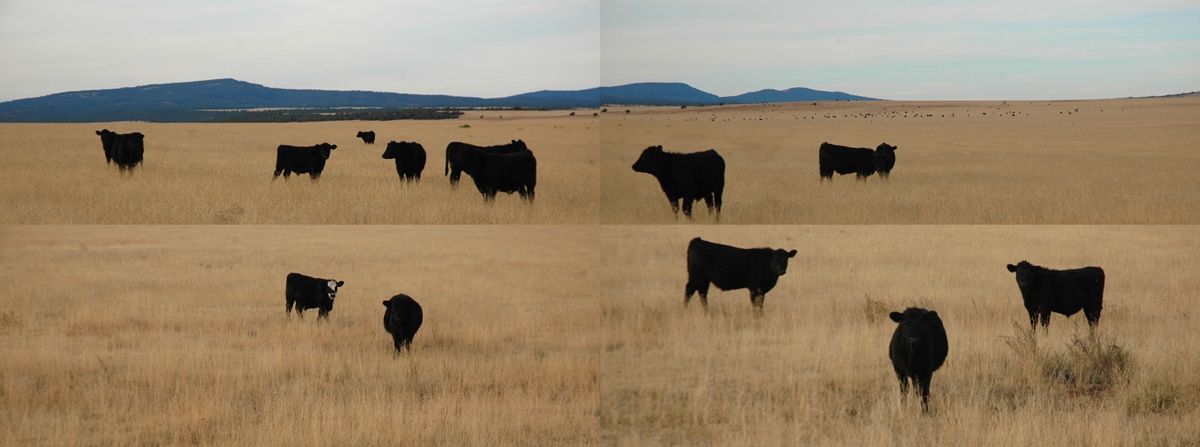
Cattle
Photocollage by Matthew Chase-Daniel, 2009

I slipped off my robe in front of everyone. My husband stood enraged, ready to jump the platform and wring my neck. But I knew when students began scratching their newsprint paper with conté, he’d have to teach.

There in his shirt and tie. His unassuming look. Complete with glasses. But in his head, flustered, wondering how I did it.

It didn’t take much to replace the scheduled life-drawing model. A hundred dollars to not sit naked for strangers was easy money. She had taken the cash and wished me luck.

I straightened out the folds in the platform’s covering sheet.

“Imperfections create depth,” he said, taking the robe from my trembling hands. I grinned, understanding his attempt to appear civil. He turned the small heater towards my flesh. I watched his every move, but sat still.

When I posed with my back erect, hands planted and eyes gazing upward, he circled the classroom. His words scattered. Distracted, by his wife spread out, breasts, ass, and pubic hairs exposed.

“Remember the darkest dark,” he said to a student who had his eyes fixed on my neck, just above a scar. Only a few weeks ago, that scar was a cut accompanied with a black eye and a busted lip to match.

“Next pose.” He said. His eyebrows raised and lips receded back. When I posed, he grimaced.

“What are you doing?” He mouthed with his teeth shut. “Stop it.” Everyone froze and looked around. But it only took one student to start drawing for the rest to attack my unusual pose.

I recalled every kick to my stomach, every punch to my face, every whack with an object to my body. And my eyes watered. He dashed from his position, knocking over a student’s easel and we caught a glimpse of my figure on paper.

My gaping mouth, the darkest mark on the page, I imagined he saw first. My hair, a mix of light and dark, yanked back with one hand. My back arched and knees spread out, pulled against the sheet causing what he called – depth. And the crosshatch shading on my skin, to me, resembled bruises.

“Professor?” A student shouted. I took a deep breath, closed my eyes and tensed my muscles.

And with a bang, the classroom door shut and he was gone. I stood up, slipped on my robe, and looked out at my audience. And for the first time, when my heartbeat returned to a normal pace, I spoke openly about my husband’s artistic work sketching my scars.


Christopher Searles has a Bachelor of Arts degree in English and creative writing. He also studied visual art at Seneca at York. For the past three years, he wrote short fiction while teaching English in South Korea. When he wasn’t teaching, or writing, he was learning about new cultures travelling throughout Southeast Asia. He currently returned to Toronto as a freelance writer. This is his first publication.

Read our interview with Chris here.


“Bridestealing” by Renée Giovarelli

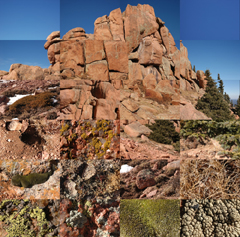
Bridestealing
Pike’s Peak, Colorado, 2008

Sitting on a wool blanket outside a yurt in May, high in the mountain pastures of Kyrgyzstan, I hugged my body for warmth as women trickled into our circle from all directions.

My interpreter, Zina, and I chatted about the history of this village, Alai, as we waited for the women to come from their homes. We were interviewing women about the new land legislation and whether they received land from the State after the fall of the Soviet Union.

I tried to sear the view of the dark blue and purple mountains covered in cloud mist into my brain as we talked. We were surrounded by mountains and streams and horses and sparse grass—a difficult place to survive, but a magnificent place to live. The cool damp air was welcome after the hot sun of the Fergana Valley, where we had been interviewing women for the last week.

Alai was known for its strong women because one of their own, Kurban-Jan-Datka, a celebrated female warrior, tried to keep the Russian conquerors out by tumbling rocks onto their heads as they marched up the mountain in 1876. The Russians were not deterred by the rocks, but Kyrgyz heroes only have to be brave and clever, not triumphant.

Occasionally Zina would call out a direction to someone in Kyrgyz: “Bring a chair for the agi,” (old woman) or, “Get an extra blanket.” Zina was in her forties like me, short and stocky with a round warm face and eyes that were nearly hidden by her cheeks when she smiled. Used to taking care of foreigners, she was equal parts mother and drill sergeant.

Once or twice someone brought an extra blanket, and the circle expanded and re-shaped so more women could sit. I relaxed as I listened to the women talk to each other and arrange themselves. I am at home among rural Kyrgyz women; their gifts of felt and embroidery hang on my walls in Seattle. Sometimes I take a moment to bury my face in one of them to again smell these pastures—damp wool, and sheep, burning dried manure, and wood smoke from the samovars.

There were two other Kyrgyz researchers with Zina and me. Once we explained who we were and what we were doing, we intended to break into smaller groups. Anara, the lead Kyrgyz social scientist—the best in Kyrgyzstan–would take a group of young women away to another area and interview them. Girls would not talk in front of their elders, especially if they were in the same group as their mothers-in-laws. Anara was in her early forties, pretty, but thin and stern, dressed in jeans and a polo shirt. Even in urban clothes, Zina looked as though she belonged with the shepherd women in their long colorful dresses and pants tucked into worn leather boots. Anara looked like an outsider–a researcher.

Nearly forgotten by Zina and Anara much of the time, the other Kyrgyz member of our team, Chinara, was a young lawyer whom I had been working with on Kyrgyz land legislation for the past year. I insisted that Chinara come along on this fieldwork because, like most young lawyers in the capital, Bishkek, she believed that once a law was passed, it would be followed. Law was, in her mind, the answer to all social ills. I wanted Chinara to be able to ask women about these laws we had worked so hard to pass so she might see the laws’ limitations and not be so willing to stop at the initial–and usually ineffective–first step of passing the law. Chinara was from a northern tribe and had never been to southern Kyrgyzstan. She dressed as though she were still in the office in Bishkek: skirt, pantyhose, and heels. Her youth and her outfit made her virtually invisible to Zina and Anara—they called her an “arrogant little fool.”

When the women from the village had settled, and it seemed that no others were coming, I started with a simple question. “Do any of you own land?”

“Ova,” some older women said, and others nodded. Yes.

“What do you grow on your land?”

“Potatoes,” one woman said. “Hay,” another answered. “Sheep,” said a woman in the back, and everyone laughed.

A young girl brought us tea and “salt,” which means bread and hand-churned butter, a traditional Kyrgyz welcome. The bread was round, about two inches thick and crusty from being baked on the side of a clay oven fueled by the dried manure that was stacked under the eaves of the animal shed. The butter was whipped cream with salt. A few older women took the circles of bread, broke them into hand-sized pieces, and spread them around the blanket. I was served my ripped piece of bread first, a sign of respect. Among the Kyrgyz–traditional nomads–travelers and outsiders receive the highest honors: the sheep’s head and the first piece of bread. Age and gender are the next consideration; an older, male foreigner is usually offered the sheep’s eyes, ranking high above all others. As a foreign female woman of middle-age in a circle made up of women only, I would be first in all ceremonies, followed by Zina, then Anara, and then the older women from Alai. Chinara would be lumped into the category of young women–the servers, not the served.

My questions became more personal as we continued to talk. Were any of them divorced or widowed? Had any of their husbands taken a second wife? How did these family changes affect their rights to the land? They talked easily about their lives, teasing each other and daring one another to answer my personal questions about dowry, alcoholism, and poverty.

“Do you want to go to college or get married?” Anara asked one girl in Kyrgyz, pointing to her with her head.

The girl looked down and said nothing.

“Are you already married?” she continued.

The girl still looked down and shook her head no.

“You have to stand up for yourself. Do you let your husbands beat you?” she asked of the whole group.

There were a few women who shook their heads, but no one spoke.

“If your husband beats you, you have to go to the police,” she continued. I was growing uncomfortable because lecturing women was not part of the research protocol.

“Anara,” I said quietly, “let’s break into groups.”

Anara took a group of young unmarried girls with her, and they left us to move to the other side of the common area so that neither group could hear the other. I told Chinara to stay with me because I wanted her to ask some questions of the group. I encouraged the women who were left with me to take their turn and ask me any questions they wanted. I believe this is an important part of the process because it lessens the researcher-subject dynamic, and because I know I am as much a curiosity to them as they are to me. They were anxious to ask about my age, my husband, my children, and how much money I make. My age (40) surprised them; they insisted I was much younger. As usual with any group of Kyrgyz women, they asked how much money I make—the question is not considered rude. Although I hesitated to say because I know it is an unimaginable sum to them, I opted for understatement instead of refusal to answer. Still, they clicked their tongues at the amount, thinking about what they would do with that kind of wealth.

“Were you stolen?” one young, married girl asked.

“No.” I shook my head, slightly amused. “That’s not our custom.” Bridestealing, also called bride kidnapping, is practiced by the traditional nomads of Central Asia. While the custom was hidden during the time of Soviet rule, it has resurged in the last twenty years and is now common again in rural areas of Kyrgyzstan, although against the law. A young man and his friends kidnap a young girl from her home or workplace and take her to his mother’s house. There, the mother of the young man tries to put a scarf on the head of the kidnapped girl. The girl can resist but is pressured not to by her future mother-in-law, who tells her she will break all social norms by “crossing” an older woman. Other women in the boy’s family usually join in the pressuring as well. Once the scarf is on the girl’s head, she is considered married, and her wedding night ensues, ending with the bloodied sheet hung outdoors for the village to see.

“How did you meet your husband then?” the young woman asked.

“We met at law school.”

The girls nodded their heads in approval. My life was easy, and this delighted them.

“Do you want to see pictures of my children?” I asked, pulling out the photos I carry. They all moved in closer.

I showed them my young daughter, my older son, my husband, and my white standard poodle.

“Even your dog is beautiful,” one woman said wistfully.

As we walked to the van to leave, Anara complained that the girls she interviewed acted like sheep, not giving their opinion on anything.

“It’s not right for them to talk,” Chinara said quietly. “Besides what would they have an opinion about?”

Anara looked at her with scorn.

Toward the end of our two weeks of research, we interviewed teenage girls in a very remote part of the country where the Aga Khan, the hereditary spiritual leader of Ismali Muslims, had built a college. The hall outside the classroom smelled so strongly of urine that I had to cover my mouth and nose as I made my way to the interview. The old battered hand-written sign on the front door of the building said, quite unnecessarily, “Broken Toilet.” We slipped into a room where twenty girls sat in a circle on small folding chairs. The wooden floor was filthy; the walls were painted light blue but covered in a layer of dust. Still the girls wore mini skirts and blouses and tight jeans and strappy shoes. We talked of being girls and women and what they wanted to be when they grew up. They all had plans—scientists, doctors, lawyers, teachers. I wondered, but didn’t ask, how they could be so clean and beautiful and have only an outhouse and ditch water for their toiletry. Did they wear those shoes to the outhouse?

Toward the end of the interview, I asked, “How many of you want to be stolen?”

Giggles and head shaking. No one raised her hand.

“How many of you would stay with the man who stole you?”

They all raised their hands. All of them.

“It would be a shame not to,” several of the girls said at once.

In this case, “a shame” means shameful. But it doesn’t describe a feeling; it describes an ever-present force. Shame must be avoided at all cost and is the energy behind so many traditions: shame on the individual, shame on her family, shame on her ancestors. It would be a shame not to slaughter a sheep for a funeral, even if it were your last sheep. It would be a shame not to make a sherdak rug for your daughter’s dowry. It would be a shame never to marry. It would be a shame not to provide your guests with tea and bread and salt.

“We don’t want to be stolen,” one girl said, “but time will show us our way.” Everyone nodded.

The university was the last stop before returning to Bishkek. On the way back to the city, I asked the Kyrgyz women how they met their husbands.

Anara immediately responded, “At the university.”

Zina was not married.

“I was stolen,” Chinara said. She smiled, then shrugged.

An overwhelming sadness welled up inside me as Chinara told us her story. She had been a gymnast and had to stop her training immediately. She did not like her husband when he stole her; she knew him and did not want to marry him. But they were still married, eight years later, and had three children. The idea of bridestealing had always bothered me—yet, at the same time I found it appealing–something I had not admitted to myself until that moment. I was so interested in its otherness, its origins, the romanticism of being whisked away by someone who had chosen you from afar.

What would it feel like to be Chinara and participate in these interviews, with rural women, and then discuss the answers with us? But she hadn’t really discussed anything with us, I realized. She had remained silent except for one or two comments, immediately shot down by Anara.

Zina said something to her tenderly, in Russian. But Anara, exasperated and impatient, lectured Chinara that she didn’t have to stay married to him, as if Chinara could or would leave her husband after eight years and three children.

Anara znait vso,” Chinara whispered to me angrily when we finally got out of the van for a break. Anara knows all.

***

A year later, on a return trip to Kyrgyzstan, I got a call from Anara. She wanted to see me. Being with Anara was work, but refusing the invitation would have been an insult, so I agreed, and soon we sat at the conference table in her small office and talked about her family, and mine, and drank tea.

“Did you go to Lake Issyk-kul this year?” Lake Issyk-kul is a beautiful lake in Kyrgyzstan where much of the country goes during the summer.

“Yes. But it wasn’t a good vacation.”

I waited for her to say something else.

She and her husband and son were on the beach. Her husband and son decided to return to their room, and Anara said she would follow when she finished her book. On her way back, she passed a group of boys standing in a circle, laughing and cheering. She walked closer. In the middle of the circle, a girl was being raped. When the boys saw Anara, they ran.

“You know, I have been to the US and Europe,” Anara said. “I know how things are there. I knew to go to the police with the girl, to get help for her.”

“But they were disgusting. They made us sit there while they smoked and laughed. The girl knew the boy. I demanded they arrest him and threatened them by saying I knew the Minister of Interior and I’d get them fired if they didn’t.”

It was getting dark now, the office completely quiet. Our tea was cold. Anara had stopped pouring.

“The police agreed to talk to the boy and his parents. The girl and I went to tell her parents what happened. Her father said he would kill the boy.”

“I took the girl’s parents to the police station and we met the boy’s parents there. The boy had admitted to the police that he had raped the girl. His parents started begging me not to press for charges. He was only 21; he was their only son. He was a good boy. He was drunk. He wouldn’t get out of jail alive, and if he did, he would be ruined, and they would be ruined.”

“What did the girl’s parents say?”

Anara looked down, and paused. She ran her thumb up and down her index finger.

“The girl’s father said they would press charges unless the boy married their daughter.”

“What?” I stood up.

She nodded, still running her thumb up and down her finger.

The girl was no longer a virgin. If the boy went to jail, everyone would know what had happened to her. She would be an unmarried woman, and not a virgin. They were both from a small village. She would never get married. The village would take sides, and many people would shun her for sending him to jail. Both their lives would be wrecked. She would bring shame to her family.

“I agreed to that in the end,” she said quietly. “We all agreed that would be the best thing.”

“The marriage?” I looked down at Anara’s hands.

“Yes.”

Anara wanted me to understand what had happened to her–how she had changed in that moment. She wanted me to understand that there was no other way, not now, not in that village, not with those families. She wanted absolution.

The thought of the girl was almost unbearable to me. Was this worse than bridestealing? For some terrible reason, ranking the horror seemed important. I wanted to compare it to something that now seemed more normal. I wanted the girl to go to law school and become a lawyer like Chinara.

The paper we had written together was on the table, bound and published by the World Bank: “Women’s Rights to Land in the Kyrgyz Republic.” On the cover, an older peasant woman stands in a doorway, looking out at her barren, hand-plowed field. I couldn’t remember her particular story. I only knew that she worked all day, and in the winter ate mostly bread and cabbage. But she had laughed when she saw me take her photograph. She insisted on fixing her hair and posing for me—not in front of the door, but by the big birch tree. The second picture was a better one of her, and I sent it to her later. But I used the first picture on the cover, because she’s caught in a moment of her real life, when she wasn’t smiling or posing. She might have been thinking about how much work it would take to plant her potatoes before it was too late in the year. Or she may have been considering whether the manure was dry enough to burn. One can see, though, that she is not imagining another life.


Renée Giovarelli works for a non-profit organization as a lawyer on issues related to women’s land rights in rural areas of developing countries. She recently graduated from the Vermont College of Fine Arts with an M.F.A. in Creative Non-Fiction and has been published in New Letters and Numéro Cinq. She was short-listed for a prize with Wasafiri Literary Magazine.

Read an interview with Renée here.