“The Lemon Method” by Anne Elliott

The Lemon Method
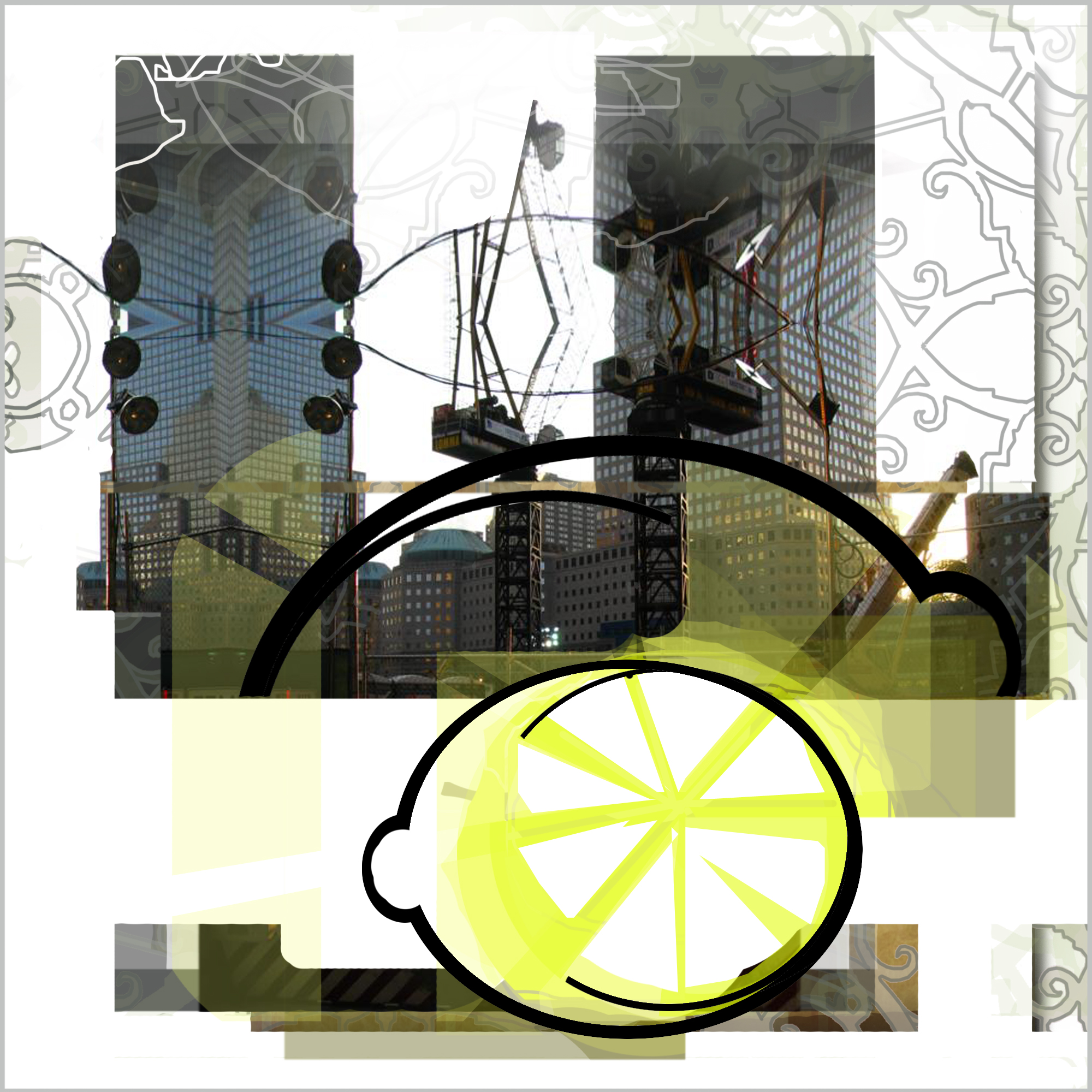
Illustration by Morgan Maurer, 2011

He stands four floors below, outside the window, playing God Bless America all goddamn day.

Across the street, a chapel is covered in ash, festooned with flags, crayon drawings, chains of origami birds. Gravestones in the churchyard, two centuries old, gray dirt, dead grass. Even the grass, dead. Looming behind, stubs of famous office tower, gravestones too, lit yellow into the night, still smoking.

Our old office is damaged, off limits, behind checkpoints we can see from our window.  Our new office is a conference room, four of us crowded around one table.  Laptops, papers, Doritos, dry-erase board.  And a lemon.  Tasha brought it to deal with our troubadour.

“If you show him the lemon,” Tasha says, “He won’t be able to play. It works to stop a whistler.” An old Russian trick, like medical suction cups bruising your back, like dog saliva to ward off infection.

“You just show it to him?” I’m laughing. I’m skeptical. This lemon is the best thing I have seen for awhile.

The lemon sits on the table for weeks, while the fife plays on. He doesn’t know we are in here, that we hear him all day, that his song penetrates our jumpy bodies like ash: particles of asphalt, computers, bones.

Phone calls from Boston, clients growing impatient. Now I notice how loud this colleague chews, that one laughs. Eyes to my screen, but nothing gets done. I look at the same word fifty times, and forget it fifty times. Every number looks wrong to me. A war of feet under the table, and apologies grow less sincere. That person’s lunch smells disgusting. I look straight ahead, out the window, at the newly empty sky.

I can’t take this song any more. I grab the lemon and go outside, ready to face the enemy.

On the street, tourists push against police barriers to get a glimpse of what isn’t there. Eyes turn skyward, mouths gape, taking in the dirty air.The fife guy breathes this all day. This is the gritty wind going through his instrument. The hat beside him holds quarters, no bills. He’s just an entrepreneur. He’s a symptom.

I hold the lemon up, show it to the disease. The stars and stripes, the new sirens, the horrid blue sky, the junk of grief.  I give it a good squeeze. It pushes back, solid and cool in my hand. When I go back inside, the fife plays on. The gritty wind is still there. The lookers still gape. Nothing has changed except my palm. It has turned waxy white, and smells like an innocent summer.


Anne Elliott is a securities analyst / writer living in Brooklyn. She has performed spoken word, with and without ukulele, at PS122, The Whitney Museum, St. Mark’s Poetry Project, and Woodstock ’94. Her stories have appeared in Hobart, Pindeldyboz, Opium, and others. Her hobbies include knitting and feral cat management.

Read our interview with Anne here.

“The Athlete” by Ed Falco

The Athlete
Illustration by Morgan Maurer, 2011

It had been years since El played a game of chess on an actual chess board with actual pieces, and even longer since he had chatted easily with a woman, and yet there he was, in the ornate living room of an old Victorian home in Lexington, Kentucky, seated in an overstuffed chair across from Tess, a tall-ish, athletic-looking woman of about his age, mid- to late-fifties, though he’d have guessed when he first met her that she was younger.

She sat across from him in another overstuffed chair, looking down to the slate table between them at a handsome antique chessboard and pieces. She wore faded blue jeans and a thin pale-yellow turtle-neck sweater that hid the loose folds of her neck, where, he had noticed the night before, her age did show. In her eyes he found a mix of intelligence and weariness he associated with successful women. He’d just explained that all the chess playing he’d done lately had been on a computer screen, with anonymous opponents from all over the world, and she’d said huh, as if it amazed her anyone would want to spend his time playing chess with someone he couldn’t see. They’d been talking like this, sharing little bits and pieces of their lives, for the past day and a half, since they’d been seat-mates on a flight out of New York to Roanoke, Virginia––a flight that had been diverted because of fog. They’d wound up in the Lexington airport late in the evening, and when flights there were grounded because of snow, they wound up sharing a cab to the same Bed and Breakfast a few miles from the airport, where they wound up sharing nightcaps in Tess’s room, followed by more easy conversation that lasted for hours and ended with them making love and falling asleep in each other’s arms.

In the morning, to El’s surprise, there was very little awkwardness. They’d risen, showered, dressed, and then gone down to breakfast chattering away, talking about everything in the world, from their histories and their lives to politics and science. It was as if neither of them could talk fast enough. Turned out, they both lived in TriBeca, relatively close to each other: El on North Moore Street, Tess on Leonard. They were both divorced, El for the six years, Tess for ten. El had been married for a dozen years before the divorce, Tess for more than twenty. They both had grown children: Tess, two girls and a boy; El, a son and a daughter. Tess worked in fundraising, El was in sales.

After breakfast, they’d retired to the living room and spent most of the rest of the day in front of an open fireplace, and every hour or so one or other of them took a chunk of wood from a stack on the red brick outer hearth and tossed it into the flames. Late in the afternoon, when it was clear there would be no flights out of Lexington until sometime the next day, the woman who ran the B&B, a grandmotherly figure with a balding head of gray hair and a belly that made her look impossibly pregnant, asked if they’d mind if she left them alone for awhile while she went to look after an elderly friend. Now it was late afternoon, the light outside gray and solemn, and they were alone in the house, midway through a chess game neither of them cared much about, a game that was meant only to provide an occasional diversion from their ongoing conversation.

Tess looked up from the chessboard, out a bay window overlooking a sloping hill and a trail that disappeared into a line of snow-covered trees. “Let’s go for a walk,” she said, “before it gets dark.”

“Seriously?” El looked out the window again, as if he might have been missing something. The snow was still coming down, though lightly, and there looked to be a foot or so on the ground. The scene was peaceful if dark––gently falling snow over fields and woods––until a gust of wind sent furious white swirls spinning into the trees.

“You’re a big guy,” Tess said. “You can take it.”

El said, “Looks awfully cold out there,” and then opened his arms and gazed down at himself, at the thin, dressy slacks and black shoes, at the white cotton shirt with fine blue stripes, more appropriate for a board meeting than a hike in the snow.

“She’s got everything,” Tess said. She jumped up from her chair, as if officially announcing the game of chess was over, and she motioned for El to follow her. “Look at this.” She opened a door off the foyer to reveal a closet stuffed full of winter gear in a variety of sizes: coats, scarves, boots, hats, gloves, multiples of everything. “Elwood,” she said, using his full name, teasing a little. “They have actual real woods here in Kentucky. Right out there, in fact.” She pointed out the bay window.

El wrapped a long green scarf around his neck and foraged through a line of winter coats, looking for something that might fit him. He was six-one and bulky, with thick legs and heavy thighs. “Did I tell you I played point guard in college?” he asked as he tried on the only coat he could find that would reach down to his waist.

“Really?” Tess said. “I love basketball. Were you good?” Then she added, quickly, “I mean, you must have been good––”

El laughed and said, “That’s all right.” He was struggling to get the coat zipper up over his belly. “I was too small to get much playing time, but when they let me on the court, I usually did pretty well.”

“Did you like playing?”

“Loved it,” El said, and left it at that. He took a step back and opened his arms. The coat was too small for him, but he’d managed to get it zipped up and buttoned.

“You need to put a second pair of pants on over those,” she said. “Do you have anything a little sturdier?”

“Pants?” He shook his head. “I’ve got another pair of dress slacks.”

“Better go get them,” she said. “The wind will whip right through those; might as well be naked.”

El said, “Fine. I’ll be a well-dressed woodsman,” and he went back up to the bedroom, where he found a heavier pair of socks and put them on over the first pair, and then struggled into a second pair of pants.

Before leaving the room, he looked at himself in a free-standing, full-length mirror. As he expected, he looked ridiculous: a big guy with a round face framed by a full head of gray hair, wearing a too-tight winter coat and a long green scarf with gray dress slacks, two pair. He smiled, amused at the figure he cut––and then his thoughts took a quick turn back to basketball. He had been modest with Tess. He hadn’t told her that in high school he’d been the team’s leading scorer sophomore through senior year, and that one college scout who watched him play said he had the sweetest three-point shot in the region. Still, he had no offers from Division I schools. Too small. He’d heard it over and over, through high school and college. Too small. After high school, he traveled halfway across the country to play for Oklahoma Wesleyan, a good Division 2 basketball school––only to get limited playing time, because, of course, he was too small to compete against the bigger, stronger players in the league.

Too small. The words were lodged somewhere deep inside him like slivers of heat. He told Tess he loved basketball, but his feeling for the game, back then at least, was something more than that. His whole life was immersed in basketball. When he wasn’t playing, he was practicing. When he wasn’t practicing the game, he was thinking about it. He did only what he had to do to get through the academics in high school, and the same in college. He was a good basketball player, and he believed that would be his future. In high school, he believed he’d be recruited by a division 1 team and go on to play in the pros. When that didn’t happen and he went on to a division 2 school, he believed he’d be noticed there and go on to play in the pros. When that didn’t happen, when he finished college having spent infinitely more time on the bench than on the court, he found himself ill-prepared for the work world. He wound up in sales by default, and he’d been in sales ever since. When he thought of basketball now, it was often with anger. His coaches and team mates, his parents and his friends, they’d all tried to tell him. He was too small for the pros. It wasn’t going to happen. He’d never forgiven them for being right, nor himself for not proving them wrong. His memories of basketball were buried in him like flames, like a roiling circle of heat.

Downstairs, he found Tess in front of the bay window, bundled up in a red quilted ski jacket, a white knit cap with ear muffs, and a long green scarf identical to the one he was wearing. “You look like a Christmas tree,” he said, and then laughed at his own joke.

“I put out some boots,” Tess said, “that look like they’ll fit you.” She pointed to the closet.

El said, “perfect,” as he slid his foot into a boot. A moment later he’d donned a knit cap and gloves and was heading out the front door with Tess behind him.

“Cold,” Tess said, announcing the obvious. She pulled her hat down over her forehead and wrapped her scarf over her face so only her eyes were exposed.

They waited together for a moment on the front steps of the house, looking across a snow-covered lawn that descended to a blacktop road. A plow had gone by less than an hour earlier, and the road was slushy with patches of ice and snow. Beyond the road was an open field surrounded by trees.

El said, “Sure you want to do this?”

Tess said, “I bet you it’ll be warmer when we get into the trees and out of the wind,” and then she lurched forward, down a pair of steps and toward the driveway.

“That’s a theory,” El said, following her, “but I wouldn’t bet on it.”

On the other side of the house, as they trekked over snow toward the tree line, a gust of wind kicked up and seemed to cut right through El. He stopped to tuck his pant legs into his boots, and when he looked up Tess had turned her back to the trees and was waiting for him. She pulled the scarf away from her face to reveal a smile. “Hey!” she called. “It’s gorgeous, isn’t it?”

El gave himself a moment to take in the white expanse of field enclosed by towering green-and-white speckled trees, their branches loaded with powdery snow. He jogged to catch up with Tess. When he reached her, he put his arm over her shoulder and pulled her close. She felt solid in his grasp, her body slim but muscular, and they continued trekking together through the snow toward the trees.

El’s marriage was largely a disaster, but as he walked through the cold and wind with his arm around Tess, his thoughts returned a moment to the good early days, when he had been in love with his wife, when they used to take long walks and talk about their future. El hadn’t had a loving thought about his wife in so long the memory left him feeling first disoriented and then sad. She had turned both his children against him. She had cost him a fortune in lawyer’s fees. She’d wound up with the house and most of his retirement fund, so that now he’d never be able to retire comfortably. He was distant from his children, money was tight, and he’d be working in sales until he got too old to do it anymore. After that, he didn’t know what would happen to him.

“Look,” Tess said. She pointed to a gap in the trees.

“Trail head.” El squeezed Tess’s shoulder and then let her loose. In the last several years, he had trained himself, with the help of a therapist, not to think much about his wife. There had been a point, before he started seeing a counselor, when he’d been so eaten up with bitterness he’d found himself thinking about murder and suicide, about killing his wife and his children and then himself. That he could even entertain such thoughts had frightened him into counseling. His therapist put him on medication for a couple of years, and that had helped––and now he lived an essentially solitary life that revolved around work. When he met people, it was through work. When he did anything social, it was through work. He had a distant, formal relationship with his children, and though he would have loved something more intimate, he didn’t know how to make it happen. He hadn’t spoken to his ex since the last time they’d met in a lawyer’s office, six years ago.

Once they were in the woods and out of the wind, it turned out Tess was right, and it was noticeably warmer. Tess leaned back against a boulder and undid her scarf, which she had wound around her neck and face. “Isn’t it great to be out in this?” she said. “I love Manhattan, but, wow . . .” She gestured to the snow-covered trees and the scattering of rocks and boulders all around them. “I’d forgotten how beautiful.”

El crouched in front of her and wrapped his arms around his knees. “But it’s still cold,” he said, “really cold.”

“This world . . .” Tess said, and she turned to look out through the trees, toward what appeared to be a meadow, some forty, fifty feet in front of them, at the bottom of a hill.

El pulled himself upright, embraced Tess, and kissed her. Tess seemed surprised at first, but then she put her arms around him and kissed him back.

“This is crazy,” El said. “Don’t you think?”

“What is?”

“Us,” El said. “This.” When Tess didn’t answer, he said, “Is it just me?”

Tess watched El for a moment, her eyes on his eyes, and then she kissed him again. “It’s all crazy,” she said. She reached for his hand and pulled him along.

El followed Tess on the trail, which curved around one boulder that was several feet high, and then between a pair of boulders that formed a narrow corridor and opened onto a steep downhill slope to the meadow. When the wind stopped for a moment, the woods grew suddenly quiet. El let go of Tess’s hand, possessed suddenly of an urge to touch the ragged surface of one of the boulders. As Tess continued down the hill, he took off one glove and pressed the palm of his hand to the rock. It was cold and solid. What else did he expect? Still, he held his hand against the stone and pushed his fingertips into the gritty surface. How long, he wondered, had this boulder been here, unmoved and unmoving? A few hundred thousand years? Millions? He rummaged around in his memory of geography classes and came up with an image of mountainous glaciers slowly retreating, gouging holes in the earth and leaving huge boulders scattered like pebbles.

Tess waved from the bottom of the hill. “Come look at this,” she called. “It’s lovely.”

Before El reached Tess, midway down the hill, it occurred to him the meadow wasn’t a meadow. It was too big, and there was something about the way the trees on the far side, now that he could see across . . . the trees all descended to the open space. It reminded him of his visits to the ocean in Oregon, the way the mountains descended to the sea. There was a space of perhaps two or three seconds between the moment it first dawned on him there was something odd about this meadow and the moment he realized it wasn’t a meadow at all, but a pond, a large pond surrounded by woods––and in those two or three seconds, Tess stepped out onto the ice and her feet slid out from under her.

El yelled “Wait!” and started to jog down the hill. He had only taken a couple of steps when he tripped on something, a rock or an exposed root. To keep his balance, he reached for a tree and slammed sideways into it, and then lost his balance anyway and tumbled and rolled for several feet before finally coming to a stop. Through all this, he was keenly aware of the bulk of his body: it felt like a great weight, utterly beyond his control, radically different from the body of his youth, the one he could hurl about on the basketball court so athletically. He didn’t know what shocked him more, the fall or that sense of his body as lumbering, uncontrollable bulk.

“It’s all ice,” Tess said. She had pulled herself to her feet and was looking up the hill. “Are you okay?” she asked. “You’re bleeding.”

“It’s a pond,” El called back to her. He wiped blood from the side of his face. First he thought he must have gotten scraped up when he hit the tree; then he realized there was too much blood, and he had gashed himself somewhere.

“You think?” Tess said. She was crouched and looking at the ice under her feet, her arms spread for balance. “Guess so,” she said.

A gust of wind came up and sent a spiral of snow across the pond as Tess took a careful step toward the shore and most of her body disappeared under the ice. El didn’t hear anything crack. There was no sound at all. One moment Tess was upright on the ice and the next she was submerged to her shoulders.

Tess said “Oh,” and then “Lord,” and looked up at El as if she were embarrassed.

At the bottom of the hill, El got down on his knees and worked to extricate a long branch from a pile of icy brush. The gloves were interfering with his grip and so he pulled them off and tossed them onto the ice. Tess had said only those two words—“Oh,” and “Lord”––and then she had gone silent as she struggled to pull herself out of the water, pushing her body forward. She appeared to be trying to walk, and slipping with each step. Her body lurched upright and then fell forward three times in quick succession, and then she stopped, her eyes open in a frightened glare, staring up the hill. She seemed to be conscious and aware. She was breathing hard, but she wasn’t moving or speaking.

When El, at last, was able to pull the branch free, he lay down on his belly and extended it to Tess. The ice was cracked and shattered now all the way to the shoreline, and he could see that the drop off was steep. Tess was only ten feet in front of him and the water was up to her breasts. “Take it,” he yelled. Tess clutched her heart with one hand and looked at the branch as if she couldn’t quite make out what it was or what to do with it. Her free arm rested easily on a heavy chunk of ice pressed up against her chest. “Take it,” El repeated. “I’ll pull you out. Grab hold of it.”

Tess looked at El and then at the shore, and then she lunged at the branch, reaching for it with both hands. For a second she managed to grab hold of it. One moment her arms were wrapped around the branch, her whole body leaning over it––and the next moment she was gone, disappeared under the water.

El shouted her name and rose to his knees. An instant passed then that felt more like several minutes. First, he explored his options. He could try to run and get help––but that would be the equivalent of leaving her to die. He might try lying to himself, he might try rationalizing––but he knew if he left her there, the only point in returning would be to retrieve her body. Or he could go in after her. He’d have to submerge himself in the water, pull her out, and then carry her up the steep hill, across the long field, and back to the house. He figured the chances of succeeding were exceedingly small. But maybe. Maybe he could do it. There was at least a chance.

Still, kneeling at the edge of the water he hesitated. His thoughts flew in a heartbeat first to his ex-wife, whom he saw in his mind for a moment vividly, her expression tender and concerned, and then to his children––and in a flash of memory he recalled his daughter falling from her bike, her legs and face scraped and bleeding, and how desperately she’d wrapped her arms around his neck as he carried her home. Both these /images came to him in the instant’s hesitation before he stepped into the freezing water.

The shock was stunning. It hit him like a body blow, as if he’d been slammed into a wall. After his first step he was in up to his waist, and the next step he was under water, struggling to make his brain work, commanding his feet to feel for the ground, his arms to search for Tess. Then, a heartbeat later, there was no thought at all, only a panicked, urgent thrashing until he found Tess and pulled her to the surface choking and spitting. Her body seemed impossibly heavy, as did his own, the two of them weighed down by thick layers of soaked clothes. They were surrounded by chunks of ice and slushy water, and El had come up facing the opposite shore, so that what he saw in front of him was a wide expanse of pristine snow surrounded by trees. He leaned back, his arms around Tess’s waist, and slipped and fell with his first attempt to take a backward step toward the shore. As he went under, his hip smacked into something hard and unmoving, and the impact was dull and sharp simultaneously––a dull thud and a sharp shock of heat shooting up his spine. When he found footing again and came up out of the water, he was facing the shore, his arms still fast around Tess’s waist.

They were close to solid ground now, only a few steps, only a few more feet––and El wasn’t at all sure he could do it. His arms and legs felt stuck, unmovable, his arms wrapped around Tess as she continued to cough and spit while laboring to breathe, his legs planted under the water. With a grunt he gathered all his strength and surged forward, pushing Tess out in front of him, heaving her toward land, and then he was under the water again, his feet slipping out from under him, and when he broke the surface for the second time, he saw Tess clawing her way out of the pond, pulling herself to the shore. With what strength he had remaining, he flung his body toward her, pushing through chunks of ice that pummeled his chest and legs, until he was finally beside her, and he managed to pull both himself and Tess all the way out of the water before collapsing onto his back and breathing hard while he waited for his heart to quit its terrible pounding, to slow down enough that he could manage something more than his own hard breathing.

Though his body felt exhausted beyond functioning, his mind apparently was still working methodically. He entertained a dim hope that someone might have seen them struggling in the water. They were, after all, nearby a small American city: they weren’t in the middle of the wilderness somewhere. Perhaps someone in a house on the other side of the pond, some kids out playing in the snow––perhaps someone saw them and was at that moment on the phone, dialing 911. Then, if they could hold on, others soon would be hurrying down the hill to take them away in ambulances––and all would be well. Maybe. El entertained these comforting thoughts until his heart stopped raging in his chest and he was able to turn over onto his side, where he found Tess, still on her back, breathing a little easier, looking up into the trees as if she saw something interesting there.

“Tess,” he said, his voice raw. “Tess. Can you hear me?”

Tess nodded and turned her head to look at him. “I can’t move,” she whispered. She added, almost inaudibly, “I can’t move my body.” Then her lips moved again, as if she might have thought she was speaking, but all that came out was a whisper of breath.

“Our clothes,” he said. “They’re weighing us down.”

Tess looked back at him, but made no effort to speak.

“Okay,” El said, with no idea what he meant. He struggled and managed to get himself sitting upright. His arms and legs felt as though they weighed tons, and it took him forever, fumbling with numb fingers, to get the zipper of his jacket down. By the time he had managed to get out of his coat and unwrap his tangled scarf from around his neck, he was exhausted again. He waited a moment and listened, his sodden jacket and scarf already beginning to freeze where they lay beside him in the snow. He had hoped to hear the sound of an engine in the distance, or the sound of boots trudging through the snow, or, best of all, maybe voices, voices calling for them.

But he heard nothing of the kind. Snow had started to come down harder and the wind blew constantly at about the force of a light breeze––and what he heard was the soft whisper of snowfall in the woods, and wind soughing through trees.

His first plan had been to carry Tess up the hill and back to the house––but that was impossible, and he understood that now with certainty. He could barely move himself, let alone carry Tess. He considered trying to get Tess out of her wet clothes, which he could see were already stiffening as ice crystals formed on the outer layers near her neck and wrists. He couldn’t figure which would be better for her, to leave her packed inside of wet, icy clothes, or to leave her further exposed to the wind and cold with them off. While he tried to consider that question, he noticed his thoughts had started to move sluggishly, and that in turn frightened him into moving.

“I’m going,” he said, meaning he was going to get help. He pulled himself to his feet and looked up the hill, which seemed to him now mountainously steep. He turned back one more time to Tess, stretched out on her back in a bright red jacket and green scarf, her hair stiff with ice, a light layer of bright new snow untouched around her. He thought to shout something reassuring to her, but he couldn’t come up with words, and he realized he was at least a little dazed now and his mind wasn’t functioning entirely right––and again that realization provided the surge of energy he needed to push himself forward and up the hill.

His exhaustion was overwhelming, like nothing he’d ever felt before. Even in his days playing basketball, when he’d sprint from one end of the court to the other at full speed until his legs finally gave out, when he’d fly up and down the stadium stairs, or work the weight machines until his arms were rubbery––none of it was anything like the exhaustion he felt climbing that hill. Each step required all his remaining will. Every time he fell, he tried to fall forward, so that when he got up again, which he did, over and over, he’d made a little progress, moving himself farther along––and in that manner he made it to the top of the hill, where he could see through the trees to the open field behind their B&B. In another fifty feet, he’d be out of the woods––and even if he couldn’t make it all the way across the field, he still might be seen by someone, by the old woman who owned the house, by kids out playing, by a car passing on the road. If he could make it out of the woods, he told himself, his chances were better, and if he could make it all the way to the house, he might yet still save himself and maybe Tess, maybe Tess also could be saved.

With those thoughts rattling around in his head, he stumbled forward, pushing himself one step at a time, and not until he reached the pair of boulders that formed a narrow corridor, did he allow himself to fall to his knees and rest a moment . . . just a moment, out of the stabbing wind, within the protection of the two ancient rocks, the one he had touched with wonder a million years ago, when the earth was still young and much was possible; when Tess, a woman who had appeared out of nowhere in his life and with whom he had been peacefully cuddled in the warmth of a down comforter the night before; when Tess, who was beautiful and smart and funny; when Tess was a dozen feet in front of him and ambling down a hill toward the pond that they both thought then was a meadow. He was at ease there, between those rocks, and suddenly, overpoweringly sleepy. When he thought about the intense desire to sleep that was overcoming him, and when he realized at the same moment he was no longer kneeling, but rather he was stretched out on his belly between the boulders, he had another, brief, panicky moment. He knew he had to pull himself up to his feet, he had to get up and keep moving, and he pushed his mind back to the /images that had come to him in the moment before he stepped into the water, in that moment when he made his choice to go in after Tess. He remembered his children and his wife, and his daughter’s arms around his neck as he carried her home.

One more time, then, he struggled to pull himself to his feet, and when his body wouldn’t move, he struggled harder, he struggled with all he had in him; and at the moment when he was about to give up, when he was on the verge of resigning himself to sleep, at that moment, suddenly, miraculously, he was fine. He was saved, both he and Tess. Together they walked away from the cold, out of the woods and over the surface of the pond. All around them, pristine snow gathered. When the wind blew, it danced in circles and sailed off into the stands of surrounding trees. They had both taken off their clothes to free themselves of the sopping, burdensome weight, and they walked easily over the ice, sure-footedly, side by side, leaving a trail of mist behind them, falling off them like smoke. The mist coming off Tess was white and wispy, while the mist off El was thick and swirling and tinted red. He saw himself then as if from above, a big man, bulky, walking beside Tess on the pond, leaving a cloud of red mist behind him, as if his body were casting off heat and leaving behind a trail of flame. He continued watching calmly, the bodies beneath him on the ice growing smaller and smaller as he rose higher, until they were merely points of light, and then they were nothing at all.


Ed Falco‘s most recent book is the short story collection, Burning Man, from SMU Press, in which “The Athlete” first appeared. Other recent books are the novel, Saint John of the Five Boroughs, and the short story collection, Sabbath Night in the Church of the Piranha, both from Unbridled Books. His stories have appeared in The Atlantic Monthly, Playboy, TriQuarterly, Best American Short Stories, and the Pushcart Prize anthology, among others. As an award-winning playwright, Falco is the author of Home Delivery, Sabbath Night in the Church of the Piranha and Radon.  In the summer of 2001, Falco worked with artists and actors from the United States, England, Greece, Bosnia, and Germany in an international theatre project meant to explore the healing power of drama. Ed lives in Blacksburg, Virginia, where he directs the Virginia Tech’s MFA program, and edits The New River, an online journal of digital writing. You can read more about Ed and his work here.

Read our interview with Ed here.

 

“Two-Headed Nightingale” by Shara Lessley

Two-Headed Nightingale
Illustration by Morgan Maurer, 2011

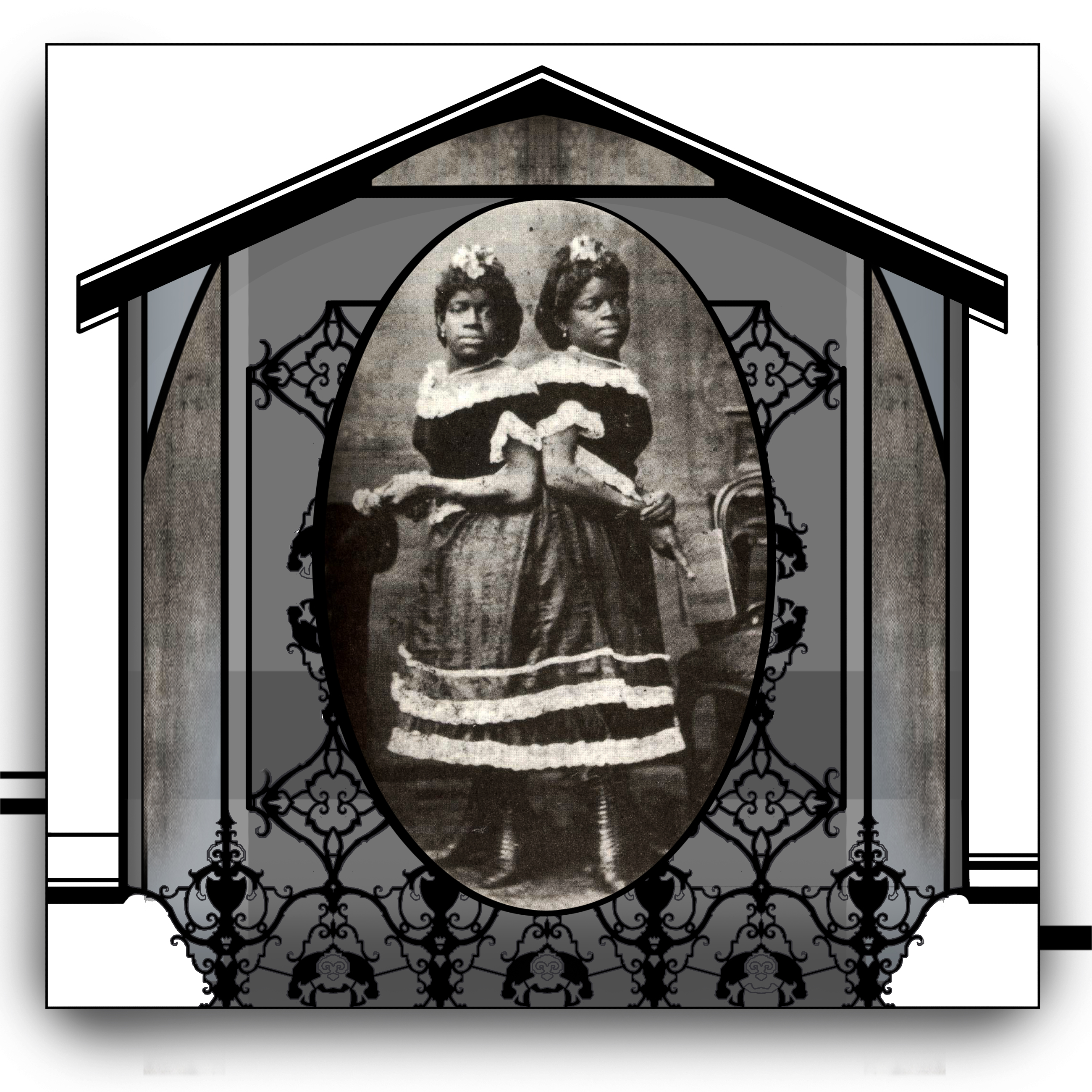
Christine & Millie McCoy, 1851-1912

tear open the breast                        and heart to tell
biological truth: no:                         the black, deformed
birth: yes: slavery                             of the interior

unlock the shackled                          spine to show
in sixty-one years monstrosity: yes:
she never left my side the fusion of vertebrae

the malformation                              of blood and bone
collision? no                                   our walk, a side-step
the backbone braided                        dance: a waltz

born 1851                                       as slaves: the body
twice betrayed: the sky                    held the sun: no, moon
“MOON AND SUN                              UNITED ON STAGE”

illusion? no: miracle:                           the sisters
merged, their voices                         layered like the nightingale’s
sheath of feathers,                            light hitting its wings

breaking up light –                            negress? no: they are
crimson blazing,                                their song quick and agile
as their hearts’ pumping:                      yes: one beat:

one pulse: one soul, two                   thoughts, from darkness,
a final note                                         dividing the air: the sudden outward
breath rushing to fill                            the other’s departure


Shara Lessley is a former Wallace Stegner Fellow in Poetry. Her awards include an O’Connor Fellowship from Colgate University, the Gilman School’s Tickner Fellowship, the Diane Middlebrook Poetry Fellowship from the Wisconsin Institute for Creative Writing, and a “Discovery”/The Nation Prize. Shara’s writing has appeared in Ploughshares, The Kenyon Review, Threepenny, Black Warrior Review, The Southern Review and Alaska Quarterly Review, among others. She was the recipient a 2009-2010 Artists’ Fellowship from the North Carolina Arts Council, and currently lives in Amman, Jordan. “Two-Headed Nightingale” first appeared in the journal Gulf Coast.

Read an interview with Shara here.


“God Bless Our Mess” by Dora Malech

God Bless Our Mess
Illustration by Morgan Maurer, 2011

Day by day, the days dissolved into the simplest of cross-stitched requests.
The sky let herself go—a fistful of sleet, a leftover moon.

Looking down became a hobby which payed off the morning when I found
an unmarked house key and a poorly molded plastic soldier.

On the path by the train tracks, I taught myself to recognize the marks
made by a limp in snow, shuffle in snow, stagger through snow.

There were calls to field, long-distance. Also, catcalls from moving trucks.
Some days I drove by Every Bloomin’ Thing and was tempted to turn off

into the parking lot and march into the greenhouse, remove my scarf and gloves
and stand bare-chested, crying pothos, ficus until I grew moss or was dragged away.

Some days I reached for my turn signal but kept driving. Thus, the weeks looked
like this: Monday—small claims court, Tuesday—leaky vessel,

Wednesday—scratched laugh track, Thursday—ritual burial, Friday—
blank check, Saturday—strip mall, Sunday—closed concession stand.

Another refrain snagged in my mind like a hangnail on some sweater’s pilled knit—
lit from within lit from within it went as I watched other women emerge orange

into the winter night, the sky a contusion, the streets all slush and no action,
their backs to a borrowed summer, to the bright lights of Jamaica Me Tan.


Dora Malech is the author of two collections of poems, Say So (Cleveland State University Poetry Center, 2011) and Shore Ordered Ocean (Waywiser Press, 2009). Her poems have appeared in numerous publications, including The New Yorker, Poetry, The Yale Review, Poetry London, American Letters & Commentary, and Best New Poets. She has been the recipient of a Ruth Lilly Poetry Fellowship, a Glenn Schaeffer Poetry Award, and a Writer’s Fellowship from the Civitella Ranieri Foundation. She has taught writing at the University of Iowa, Augustana College in Illinois, Victoria University in New Zealand, and Saint Mary’s College of California. She lives in Iowa City. “God Bless Our Mess” was first published in Chelsea, and appears in the collection Say So (Cleveland State University Poetry Center, 2011).

Read an interview with Dora here.


“Beadwork” by Anjali Enjeti

stained glass window
Image by Kristin Beeler

My mother is perched on the edge of the couch with string woven between her fingers. When she shifts her legs, the tiny little beads in her lap sound like grains of rice pouring into a pot.

The hollow capsules are small, delicate, and light, clinging to the edge of my coffee table. My mom feels me watching her and says, “These are for the soldiers in Iraq. They want them all black.”

She pauses to consider their uniqueness, then continues. “It makes them seem more masculine, I suppose. And they look quite sharp, too.”

I try to picture American soldiers combing the desert with dog tags hanging around their necks, M16s secured to their chests, and black rosaries stuffed in their pockets.

My mother is surrounded by several pastel-colored tin buckets left over from past Easters, each filled to the rim with beads. Every few seconds, her unpainted fingernails sift through and select one. She then squints her eyes slightly in order to thread it.

I wonder why she just didn’t take up sewing.

When she does this, she is in a quiet, contemplative place. Somehow I find that the repetitious rhythm of beading resembles chanting — refrains of solace. I’ve never seen her so meditative. When my stomach growls I want to ask her what we should make for dinner. But I hold my tongue in order to avoid the awkward interruption.

I don’t know the prayers of the rosary. I attend Mass sporadically, and have never been confirmed as a Catholic. Though I feel a sense of peace when I sit in the pews of the church, there is a rift that will never be bridged between my feminist beliefs and Catholic ideology. I find it infuriating that women can’t be priests, that priests can’t marry, and that the pro-life platform has become the helm of the Church’s teachings. I question, probably too often, whether there even is a God.

And then there are my father’s Hindu beliefs to consider, sandwiching me between two faiths. So I remain at a distance, my relationship to Catholicism tenuous at best. I am hanging on by a thread, though I never tell my mother this.

In September 2006, soon after entering the second trimester, I called my mother while supine in a darkened ultrasound room. My hands were shaking so badly I could barely press the numbers on the phone.

“Hi Mom,” I said with a breathy, high-pitched voice. “The baby died.”

My mother normally remembers the exact day and time of every pregnancy appointment I have ever had. With my first two pregnancies, which resulted in two healthy girls, she was often calling me before I got off the examining table. “Did you hear the baby’s heartbeat?” she would shout into the phone, loud enough for the nurse scheduling my next appointment to overhear her.

On this particular day, because my mother had forgotten about my appointment, the news took some time to register. In the deafening silence that followed, I could almost hear her morbid thought process: Anjali is pregnant. Her appointment was today. But, how can it be? How can the baby be dead?

When my words finally made sense, she echoed my sobbing into the phone. The next day she flew up for my D & C, staying on a week to help me recover.

Soon thereafter, for the first time since becoming a church member twenty-five years earlier, my mother joined a ministry. Every Thursday night, she meets up with a group of women who make rosaries for people around the world.

I received the first one. It was blue — for the son we lost.

At first I found my mother’s new camaraderie irritating. I was hurt when she abruptly ended our phone conversations on Thursday evenings because she needed to dash out the door to a rosary-making meeting. I was jealous that she had established a nurturing collective — a means to work through her grief, whereas I still felt incredibly isolated despite a miscarriage support group and countless hours talking with mother-friends who had endured similar losses.

On the Friday mornings after her meetings with the Rosary Ladies, my mother would call to report the run-down of prayers and well wishes being sent my way. “Angela also had a miscarriage,” she’d say. “She prays for you every day.”

Or, “Lana’s niece just had a miscarriage, too.”

Some days, though, I didn’t really give a shit about these third-party condolences. What did they – these silly women with bead buckets – know about me?

While still in the throes of grief, I became pregnant again, and miscarried again. This time, the Rosary Ladies had a lot to pray about. There was a month of repeated hemorrhaging episodes, frequent trips to the ER, follow-up ultrasounds, powerful medications to expunge the “products of conception,” and then eventually, a second D & C. The Rosary Ladies prayed for my safety during the surgery. They Hail Mary’ed for a quick physical recovery. They Our Fathered for strength. They Glory Be’ed my scarred and depleted womb and Signed the Cross for my ability to bear a healthy child again.

Time passed. The Rosary Ladies, including my mother, kept beading.

Now, as I watch her delicately link prayers, I shift to relieve the pressure from the small head currently wedged up under my left rib cage.

We await the arrival of my third baby.

My mother seems serene, but her reflexive, repetitive fingers belie her easy-going facade. She is worried sick about this baby. To feign relaxation, we pass the day with superficial indulgences and vapid conversation. The verdict of every OB appointment and every ultrasound is a highly anxious ordeal. My mother can’t seem to stop making rosaries. She blames her dedication to the task on the group’s self-imposed goal of ten completed rosaries per week.

But my mother is really just afraid.

And so are the Rosary Ladies. They are saying extra prayers for me. Their beads surround me. I have one rosary hanging off the review mirror of my car, one folded in my backpack, two shoved in my nightstand, and one in the junk drawer of my kitchen, tangled with a spool of thread.

The other day, while picking up scattered remains of a puzzle, I found another in a toy box.

Even though I’ve never met them, the Rosary Ladies are now intimately connected to this lapsed Catholic’s pregnancy. I no longer shrug off their urgent messages of hope sent through my mother. Although I am still not much of a believer in religion, I have become a believer in the healing power of the beads. I listen closely to the rhythm of their sifting and pouring — I see the threading and knotting as an emblem of apology, an acknowledgment of pain, a ceremony of love and forgiveness. They provide me with a means to understand the fragility of life.

I realize, too, that the beads are my mother’s way of showing me that she continues to grieve deeply for my miscarriages. That her soft, warm embrace still holds me tight, and will never let me go.

My mother makes the final knots in her latest creation, hangs the cross, and delicately folds a green and blue rosary into my open palm. I would have never paired those two colors in a single strand. But when the rosary is complete, their union makes perfect sense.

I leave her work space and lug myself upstairs. I am heavy now, far along in my third trimester of pregnancy.

I enter the nursery unsure of where to place it. But when I see the sunlight shining through the blinds, illuminating the crib against the far wall, I follow the rays and position the rosary in the center of the newly laundered crib sheet.

It eagerly awaits, as do I, the soft dough skin of a newborn.


Anjali Enjeti is a graduate of Duke University and Washington University School of Law. She is a regular contributor to skirt.com. Her essay “Fade to Brown” is included in the anthology Call Me Okaasan: Adventures in Mothering Across Cultures (Wyatt-Mackenzie Press 2009) and was quoted in The Japan Times. Her essay “In the Dark” appears in the anthology, Other Tongues: Mixed Race Women Speak Out (Inanna Press 2010), and she has a forthcoming piece in an anthology by Catalyst Press. She has also written for Mothering, Catholic Parent, Hip Mama, and MotherVerse. She lives in Atlanta.

Read our interview with Anjali here.

“Saint Jerry Wants a Medium Pizza with Half Pepperoni” by Sonya Huber

hearts entwined
Image by Kristin Beeler

My first call to a domestic violence shelter started with a bumbling request: “I don’t really even know what I’m asking for. . . He never hit me,” I said.

The legal advocate reeled off a spiel that sounded routine: Emotional, verbal, and sexual abuse are categories of domestic violence. That triptych list seemed as real to her as the specials at Pizza Hut.

I knew that list. I knew it for others and did not know it for myself.

In my pizza mind, the fragments of knowledge layered like pepperoni and olives on a tomato sauce sea, its crust barely containing the splattered chaos of ingredients. Like my high school days as a Pizza Hut waitress, the knowledge of feminist theory and women’s lives rested alongside and yet strangely separate from other pockets of knowledge.

St. Jerry Springer clocked in as kitchen supervisor at this Pizza Hut in my mind. He didn’t want to work there either, but he staffed the shifts and only paid “smart women,” the ones who did not tell secrets. The other ones, the talkers, were just looking for attention. Smart women earned degrees and wrote books. Smart women never got themselves into these kinds of situations. Smart women and smart men at smart conferences and schools invoked St. Jerry so consistently that he barely got a chance to rest and eat a slice.

I couldn’t get that Jerry-Springer-Invocation off my skin. It clung to me like incense, like the smell of Pizza Hut Meat Lover’s Pizza would adhere to my skin after each evening shift.

I still remember how to slice green peppers to stock the salad bar, twenty years after turning in my polyester apron.

Other women were smart were myself were stupid were somehow here.

I had told a man I loved him a thousand times. Those tiny curled sentences did nothing to stop waves of text messages, emails, phone calls, tricks, lies, mutterings, threats, and blunt words. St. Jerry hovered in the corner with little practical advice. I didn’t mind him. He actually understood; I lit candles maybe half to him and half to remind myself of warmth.

One night I put my son to bed and deleted a hate-filled voicemail. I curled into the couch like a ball of Kleenex, used up and frayed.

I can’t do this anymore. I’d do anything to make this end.

The thought faded, but the poison aftertaste made me stop. I raised my torso upright in the silent living room, sensing a new level of danger: the temptation to give up.

I reached for the phone book and flipped through tissue-thin pages. I found the number for the hotline and the shelter, circled it on the page, and then forced myself to write it in a notebook.

I didn’t want to do lots of things but I did them anyway. I cleaned up puke from the Men’s Room at Pizza Hut when I was sixteen. At thirty-nine, I could make a phone call. After writing down the numbers, following a string of digits to the decision, I could sleep.

I still dream of Pizza Hut. Twenty years later I have tables of squinting customers I cannot satisfy, nonsensical orders and buzzers and ticking clocks.

We talked. I got a case file. Jerry rode shotgun.

Months later I pressed the button on the call box and was buzzed in through the heavy metal door. I sat down in the advocate’s office and replayed the latest confrontation, looking for wedges in which to insert sanity, choices I could have made, pivot points for change.

I asked her what to do the next time, hoping for a threaded retreat through a mountain pass or a secret map.

“Call 911,” she said. “That’s what people do. If someone is bothering them and they don’t feel safe, they call for help.”

My mouth and eyes widened in a blank what?

“You’re probably thinking about all the times in the past when you could have called and didn’t,” she said.

After my appointment, I sat under the oval leaves of a large magnolia tree. “I’m a smart woman,” I said in quiet wonder. The words escaped my lips and traveled the mercifully short distance to my ears.

When all else fails, do the worksheets. I filled out the blanks in the safety plan and followed the directions. I stocked my car with identification and emergency supplies in case I needed to leave. And, finally, I keyed 911 into my phone. No drama, no failure, no Jerry.

I sat on my meditation cushion, lost for a moment in the orange flames that wavered above a cluster of votive candles. In front of me, a small print of a green-skinned Buddha sat in a frame I’d found at a garage sale. I did what I had learned to do in Buddhist classes: I felt my breath gently expand in my ribcage. I felt the air around my body against my skin. I tried to be here in this moment.

Behind me, a drum solo exploded. The drum set only fit in my meditation room. My four-year-old wanted to follow me, so when I meditated he played drums. The crashing waves of sound created a force field to repel my fears like a barrage of gongs ringing in a temple.

“Ma, can you fix the cymbals?” rang a high, sweet voice. I turned to see my son with wild blonde hair and a drumstick in each hand. I leaned over to adjust the brass-colored high-hat dinged with a thousand dents, each a record of a dissipated smash.

My son had arranged smooth rocks and a small set of sky-blue barbells in careful bunches around the metal feel of the drums. He had strung gold plastic Mardi Gras beads around the bass.

“Some people put this one there, but I put it over here,” he explained in a singsong as he touched the tall high-hat cymbal. “You can have it how you like it.”

I gave up on meditation and blew out the candles, but my son’s words looped in my head.

We can have it how we like it: such a hard-earned sentence. I release it as an invocation to St. Jerry, an aspiration to compare my longings to the color and texture and taste of my life as I live it, this exact darting day.


Sonya Huber is the author of two books of creative nonfiction, Opa Nobody (2008) and Cover Me: A Health Insurance Memoir (2010), and a textbook, The Backwards Research Guide for Writers (forthcoming in 2011). She teaches in the Department of Writing and Linguistics at Georgia Southern University and in the Low-Residency MFA Program at Ashland University. More info is available at www.sonyahuber.com.

Read our interview with Sonya here.

“Forgiving the Darkness” by Eric G. Wilson


Image by Kristin Beeler

When I was thirty-five years old, not long after I had witnessed my first and only child born into the world, I closed myself into the room where I wrote books and imagined sliding my father’s old shotgun into my mouth and pulling the trigger.

This happened in April, the month of my birthday, harsh always in reminding me, through its thousand pregnant buds, of what I have not become. I was sitting at my desk staring straight ahead, and I could feel that hot pressure behind my eyes, there in the worst moments, like I needed terribly to cry but could not. The sun had gone down but the blinds were still closed. I did not want light, not even the day’s ghostly afterglow falling on the silver fountain pen or the mirror over the mantle. Utter darkness I desired, the complete negation of things. I didn’t close my eyes, though; this was a blackness I sought, strangely, to perceive, as though I might get the truth of it all before leaving the earth, undergo an apocalypse of the cold uncaring shadow that blots out the peony and the cardinal and all the poets.

I knew the gun was in the basement, leaning alone behind the furnace. All I had to do was descend the stairs. But I couldn’t lift myself from the chair. I heard my baby cry in a distant room. She was hungry, and I knew I should go help my wife feed her, but I was indifferent, like the dark air. I lacked the volition to cause my own death, and the love required to give my girl life. This was worse than hell. It was limbo’s listlessness. I was apathetic and apathetic about being apathetic. What restoration for me then, what path back to light and love and purpose? What mercy?

There was more than one night like this during that bleak period eight years ago, only weeks after my daughter’s birth. During a time when most people are vital, anxious but hopeful as they ponder new life, I was worse than dead. I was neither dead nor alive. I hovered somewhere in between, a ghost. I had fallen into my profoundest depression yet, despair so deep that I could scarcely move from a chair in my sunless study, much less take up the call to care for my little girl.

I was at an age when many suffer a crisis of faith. They find themselves, like Dante the Pilgrim, lost in a gloomy wood. But most who struggle in this wilderness at least ache for an innocence past or look hopefully toward a providential future, and these desires offer solace, a conviction that there is light close by and love that endures through the loneliness. I had no such yearnings.

My depression was no worse than that of others who struggle with mental illness. I was not special. In fact, I probably had an easier time than many who have suffered terrible traumas—dead children or wives, horrific crimes, near-fatal diseases. But still I was one of millions who forget what it’s like to live, for whom hell would be a relief.

Hell torments its inmates into escapist cravings. Deep depression is different. It is not an infernal pit where one burns and thirsts. It is the empty place where feeling dies.

My form of depression was (and is) bipolar disorder, that condition that pulls the soul asunder between meaningless malaise and a manic busyness. The one side, the despairing one, says: why bother with anything, with writing or taking an April walk? Nothing matters. The other side, febrile and frenetic, howls: wrench every single second into purposeful striving, a heroic quest in the void. These combatants cancel each other. Concocted meanings are blotted out in the ponderous gloom, and reconciliation with nothingness, potentially serene, never comes.

This condition, hounding me most of my life, flared violently in the years following the birth of my daughter Una.  The new responsibilities of fatherhood threatened the coping habits I had constructed over the years. Until my daughter came into the world, I had tried to solace myself, perversely, by holding to an obsessive, exhausting work schedule that imbued my life with significance while numbing me against desolation.

I woke every morning at four, wrote for three hours, took a one-hour run, and then rushed to my office at school—I’m a university English professor—where I wrote, conducted research, or taught until six in the evening. When I returned home, I slammed the booze, five drinks a night, or more.  The anesthesia of alcohol tranquilized my perturbed nerves and eased my guilt in the face of my wife’s pleas for an intimacy I couldn’t provide.

By the time I reached my mid-thirties, I had published three books with two more under contract. I had published numerous articles in scholarly journals,. I had spoken at conferences. I had been invited to lecture at good universities. I had received awards—from my own university but also from the National Humanities Center. I was granted early tenure and promoted early to full professor and received an endowed professorship.

I was addicted to success. It suggested to the world that I was mentally healthy and thus gave me an excuse not to address those dark moods and sleepless fevers that alienated me from those who might love me and whom I might love. What I didn’t realize, was that this desperate hunger for accolades was a symptom of my disorder, the mania manifesting itself. And my separation from those with affection for me was not a mark of my character, my ability to shut off emotion in the name of my vocational calling. My aloofness was a result of my malady: depression’s indifference to blood.

Thus was my state when my daughter was born. I was a machine but thought I was human. I was afraid and alone but had convinced myself I was brave, self-reliant. Then this little creature came screaming into my life and her very survival required that I work less, that I disrupt my habits. My carapace cracked and fell away, and I was forced to face all the feelings that I had been repressing. I wasn’t a noble quester for truth, above vulnerability and the need for love. I was an extremely sad man, hopeless, but pitifully trying to convince himself, through obsessive bustle, that he wasn’t sorrowful and thus that he didn’t need affection’s solace.

Exposed, I suffered the worthlessness I had tried to avoid. For the first time in my life, I seriously considered suicide. I started making death plans, and told myself that my daughter would be better off without me, that I, in my despair, would traumatize her.

My wife Sandi was painfully attuned to my deadness. She was married to a zombie, and knew it, and had endured this numbness for years, and, regardless of my being the father of her child, wanted, understandably, out. She loved me, she said, and it would break her heart, but she was determined to leave, for her sake and our daughter’s, if I didn’t seek help. She made psychotherapy the condition of her staying.

Life without Sandi and Una, with me alone and alcoholic and a stranger: this blunt reality struck me. I reluctantly agreed to seek counseling.

I had seen psychiatrists before. Each time, I received a quick (and erroneous) diagnosis— situational depression or unipolar depression—and a prescription for an SSRI like Paxil, Zoloft, or Celexa. These meds made my symptoms worse, rendering me more morose or manic, and each time I stopped taking them.

This time, at my wife’s urgent request, I forewent one-on-one therapy and entered a group. Her assumption was that I would most benefit from being pulled out of my narcissistic contemplations and forced to respond to others.

The idea behind group therapy is that we exist in groups and our psychological problems are best addressed in communal settings. Ideally, group members become substitutes for those close to us. When such simulations occur, we can work on problems with our loved ones in a safe environment.

This form of therapy requires stark honesty that often foments heated exchanges. Wishing to avoid conflict—and not really wanting to face my own problems—I remained mostly silent during the first few weeks. When anyone criticized my reticence, I said something blandly agreeable, and that usually appeased.

Then I was exposed and broken.

On this night, I was catatonically depressed. I sat in the session glumly, saying nothing and staring at the floor. Finally, with only about ten minutes to go, one of the female members, during an awkward period of silence, blurted out: “It’s Eric I worry about the most. I wouldn’t be a bit surprised to read about him in the papers one morning. He’s the kind who stays quiet, puts on the fake grin, does his work, is successful, but then one night blows his head off. I worry about you, Eric.”

No one is ready for it.

Adam slept when an invisible hand ripped out his rib and turned it into a woman. A young woman on the verge of birthing fades away into the ether’s pinkish hills, when a scalpel gashes her side and out flows her ruddy child.

Causality seems shattered. To predict is impossible. There is something new under the sun.

An outburst from a woman I barely knew did what my wife’s beseeching and my baby’s crying could not. It found the hidden dark box in which I imprisoned my monstrous grief and cracked it open, releasing all the ferocious howling sorrow I been afraid to face—sorrow over my failure to love and my loneliness and my slow cruelties.

I wailed. Salty water burned my cheeks. Snot oozed into my mouth. I might’ve wept for ten seconds or an hour; I might have been in the room or Jerusalem.

When I returned to an awareness of my surroundings, I considered bolting for the door. But the woman who had expressed her concern gently handed me a nearby box of Kleenex. I cleaned my face. I looked around. Everyone was waiting.

I confessed, desperate to be absolved. I said I was selfish and arrogant, a terrible father and husband, and, worst of all, suicidal.

I expected support and affirmation. What I got was an angry look from one of the younger women in the group. With her eyes hard, enraged, staring at me, she told how her father had neglected her. He was an alcoholic and always either too drunk to give a damn about anything other than his own pleasure or too hung over to care about anything but the next drink to ease his pain. He never told her he loved her. He sometimes forgot her name. He died of liver failure and left the family destitute.

Her father’s neglect, she concluded, had deeply damaged her. She had been in therapy for years but remained depressed. She had nothing good in her life.

This woman continued to glower. She leaned forward. She spoke directly to me: “Do you want your daughter to turn out like me? She will, I promise you that, if you don’t change your ways right now. Every second you’re not showing her all the love you have, you’re not doing right by her. Every second is precious but you’re living like you’ve got twenty lives and a million chances. You get one chance, and it’s now, and you’re fucking it up.”

The therapist said that time was up. The women rushed from the room. I followed. I wanted to say something. But she was gone before I could catch her.

I stood alone on the dim sidewalk bearing the weight of the unforgiving night and afraid to take one wrong step. Everything counted; every single instant. And I had been living as though there were numberless opportunities for sharing affection and I would live forever and have infinity to get it right. But now I knew: each fraction of a second I did not love my child with all I had was fatal. I was killing my baby.

That disturbing night was a rarity: a true turning point. As I walked home alone after the session, I could sense my very innards shifting, creating new sight. I saw that I had granted my illness lordship over me. I had done so because I got a pay-off, albeit a perverse one. In viewing my depression as a demonic despot subjecting me to its savage fancies, I was able to escape responsibility—the sickness, after all, was running things—and thus to indulge fully my selfish desire to let my ego flourish unfettered, not obliged to anyone or anything. But this liberation was illusory. In reality, I was confining myself in a narcissistic prison and divorcing myself from the earth’s multitudinous possibilities for nourishing connections.

The scales fell from my eyes. Whatever the depression’s origin—be it genetic or environmental or a series of bad choices—it had, through its debilitating fluctuations between torpor and anxiety, hindered my ability to reach imaginatively beyond myself to sympathize or empathize with others and thus kept me isolated, divided from those with whom I might otherwise enjoy mutually inspiriting relationships. This insight, blatantly obvious now, ridiculously so, had eluded me. Kierkegaard is right: “What characterizes despair is just this — that it is ignorant of being despair.”

Enkindled with my vision, I pledged to myself, with an urgency I’d never known before, to cherish my daughter, no matter how, and to recover, somehow, adoration for my wife, and, perhaps, though this was more far-fetched, achieve at least a regard, unselfish, for others—people, of course, but also other living creatures, in the fields or the sky.

Though I’d made such vows before, I did so tepidly, and I’d failed to keep them. The spirit is willing but the flesh is weak. This time, however, I began to make good. First, I found a good psychiatrist who gave me my current diagnosis (bipolar II, mixed) and prescribed appropriate medications. He recommended a skilled psychotherapist who convinced me of the importance of taking responsibility for my mental state.

As I adapted to the medications and struggled to implement the lessons of my therapist, I rather fortuitously, one winter morning, came across a passage from William Blake. This was in 2006, when my daughter was three. The lines were as follows: “Mutual Forgiveness of Each vice, / Such are the Gates of Paradise.”

I understood that forgiveness need not be simply the letting go of anger; it can also be a way of seeing that opens us to bliss, that cleanses the “doors of perception,” as Blake puts it elsewhere, and perceives the world as it is: infinite in its exquisite intricacies. I concluded that forgiving requires that we put aside our egocentric concerns—our desires to preserve our comforts and senses of rightness—and attempt to witness and embrace the real, a fertile chiaroscuro, now luminous and now crepuscular, and not as we want it to be.

To trade the narcissistic “ought” for the generous “is”: this is forgiveness, and it can be proffered toward humans and nonhumans alike, toward those who might be our enemies and those maladies that sometimes lay us low.

From that day onward—buoyed by effective drugs and supported by excellent psychotherapy and continually catalyzed by the possible consequences of failed fatherhood—I have labored to forgive my manic depression, to relinquish my negative judgments toward it, to cease viewing it as a tyrannical taskmaster ruining my life, as a depraved warden of my solipsistic prison. This effort has liberated my bipolar to be what it irreducibly and mysteriously is: not a curse but a part of me no different in kind from my hands or auricles or larynx, an element of my constitution, something there, no more and no less. With the depression emancipated, I have been freed myself—no longer a mere puppet pulled by my disease’s whims but a proper creature, a flexible gathering of varied elements and possibilities, with the depression forming a most potent measure.

Stripped of its dark powers, my condition has emerged as more than an affliction. It also has arisen as an indispensable force in the shaping of my identity, of my flaws, yes, but also of my promising sensibilities. Although the depression continues to seduce me into narcissism, indifference, and suicidal fantasies, it persists in revealing to me, through its negative example, what I most need to become human—the vulnerability that comes with the giving and receiving of affection. Doing so, it, the mania and the despair, discloses to me the requirements of fatherhood and the beauties of my daughter.

Una is now eight years old and growing. She has become a good swimmer, and she has recently started singing lessons. When the year turns to fall, she plays soccer. This past winter, she started reading the strange books of Roald Dahl. Her favorite game is to act out characters she has created, usually orphans on journeys. She enjoys all animals and likes to watch our gray cat jump. Her jokes are funny. She is always laughing. When she calls me from my study, I now answer and get up and walk through the door.


Eric G. Wilson is the Thomas H. Pritchard Professor of English at Wake Forest University.  This essay is adapted from his most recent book, The Mercy of Eternity: A Memoir of Depression and Grace (Northwestern University Press).  His earlier books include Against Happiness: In Praise of Melancholy (Farrar, Straus, and Giroux) and Secret Cinema: Gnostic Vision in Film (Continuum).

Read more about Eric’s work here.

“The Last Man to Ever Let You Down” by Hobie Anthony

bus stop
Image by Kristin Beeler

Jefferson pulled the lever and the backhoe creaked and bucked, fighting soil hard-baked by months of record heat.

These Yankees liked the holes six feet deep by ten feet wide, just like in Georgia, but today the hole was one hundred and sixty feet long.  He filled the bucket and then dumped the dry earth to the side.

Jefferson sopped sweat from his brow. He looked down from his perch and saw two priests and a small crowd of official-looking types. No one was in mourning clothes; no one was crying. He was digging the hole on account of those who died in that terrible 1995 summer. He looked at the line of pine boxes. Old folks who’d died in their apartments listening to the weather on transistor radios, afraid to turn on a fan for the expense on their bill, fearful to open a door or window in neighborhoods rife with crime. They were Chicagoans, accustomed to deep cold, but not to hundred and twenty degree heat. No names marked their grave, not even why they died. They were all as one, buried side-by-side in solidarity; they lived alone and apart in life, now trench-mates for eternity.

“Hot enough for ya, Georgia?” Rylowicz said. He was the boss over the county’s graveyards. He had a nickname for everyone, a different one every week.

“Name’s Jefferson, or Jeff.”

“Yeah, sure. It gets hot here in Illinois, too,” Rylowicz said. “Got that cracker?”

“Yes sir.”

“So, go get your drink of water and get back to digging that trench. These muckety-mucks all think these bodies are important,” Rylowicz said. “Bunch a bums getting a free hole, if you ask me.”

“Yes sir.”

“I want boxes in the ground in two hours, you got that, Georgia?” Rylowicz said. “It’s too friggin’ hot for this crap.”

All the boxes were lined up and unmarked. The wood of some had split, some were warped, others nailed wrong. Jefferson was sure no body was dressed in funeral best; there were no open caskets today. No family here no way. He made extra sure to scrape the edges of the trench, to square the corners just right. He could do that much for the departed. Someone should do as much for him when his time came. After digging all these holes, he was damn sure due a nice one of his own.

In Atlanta, he’d been restless and wanted a change, so he hopped a bus in the middle of the day after cashing his final paycheck from Oakland Cemetery. He had no wife, no dog, nothing to keep him hanging around. Jefferson meant to escape his past, and his mistakes. He’d close the door on all of it. A fresh change might help him get his family back, or at least they’d be farther away so it’d hurt less without them. All Chicago offered so far was flatland smart-alecks, and more heat. At least he arrived after the most brutal weather had passed.

Several day laborers were on hand to help him out, Mexicans who didn’t speak much English. They all agreed in a common language of nod and gesture to place the bodies in the ground with care. Ropes and spare lumber eased the caskets to rest.

A reporter showed up with a pad of paper and asked questions.  “What are the dimensions of the hole?”  She adjusted her glasses and spoke with efficiency. Jefferson noted her new clothes, her heels wobbling in the loose dirt. He answered, then returned to work. He didn’t want to talk too much, knew these people were just like him. To the reporter, they were a novelty, newsworthy fodder for a fish wrapper. Jefferson knew they were as close to family as he had in that moment. The reporter was an alien in this world.

They picked up the pace and each of the six hundred bodies was placed in the hole. Jefferson waited in his rig while the Reverends recited the Lord’s Prayer and sprinkled holy water.  After the priests, officials, and the reporter left, he covered the dead, using the back of the scoop to tamp the dirt with care.

“We got ’em all in the ground, boss,” Jefferson said.

“What’s with this ‘boss’ crap?” Rylowicz said.

“Just something to say, I reckon.”

“Yeah, well, I guess you want to go home or something like that.”

“Not if there’s more work to do,” Jefferson said.

“Get out. Be back tomorrow at six a.m. in the morning,” Rylowicz said. “There’s five regular holes to dig and some yard work, too.”

Jefferson stopped by the mass grave on his way to the bus stop. He pressed the dirt under his boot and spit. His head hung a bit and the world took a step back from him. He wandered to the bus, dazed, lost in thought, detached. He paid the fare, collected his transfer, yet was surprised to find himself several stops down the road. He was in a bubble, removed, bouncing down pothole avenues, a million miles from the thugs, drunks, and prostitutes who were with him on the bus. All six hundred lost and alone, he thought. No family, no friends, no money for a proper burial and a headstone to show that they lived, that they mattered on this earth.

He didn’t feel right and couldn’t sit still. He wanted to be numb, wasn’t even sure why, but he didn’t want to feel. He thought back over the hole, examining each move of the shovel in the eye of his memory. A wine smell from the seat behind him stung his nose; it reeked of sweet. His mouth watered. The aroma crawled through his mind, through memories of smooth afternoons and riotous evenings. Jefferson watched an elderly woman roll a fully loaded cart of wilting groceries down the steps of the bus, one at a time. Thump, step-step; thump, step-step; thump, step-step.

He could picture the label on the wine. He’d woken up next to it enough times; the smell was stronger in his memory than his mama’s biscuits. It had caused him so much pain and sickness, that was what he needed to remember, the loss. The wino made a joke to the woman next to him and it was funny. Jefferson felt a little easy, he found himself laughing, and the man’s laughter wafted a haze of wine-breath. He felt his back loosen as he chuckled; he felt better already.

“Whaddya want?” The bartender was Chicago-quick and to the point.

“I want me a Darth Vader tattoo just like that,” Jefferson said.

“Only me and one other guy got one,” the bartender said. “Lemme tell ya what – he ain’t you, pal.”

“Beer and a shot of whisky,” Jefferson said. “Tall beer, short whiskey. Haha.”

“Never seen you here, bud,” the bartender said. “You new to the neighborhood?”

“Been here a few weeks.”

“Well, welcome, pal.” The bartender picked a white chit from under the bar top. Diggers Pub was printed around the outside of the thin disc. “You use that whenever you need it, it’s good for one drink only.”

Jefferson laughed and pulled a bronze coin from his pocket. IX was engraved on the medallion, along with AA slogans and symbols. “I tell ya what, I’ll trade you even.”

The bartender took the coin and held it at a distance, then grabbed his reading glasses to inspect it. Jefferson eyed the coin in the other man’s hands and it looked insignificant, a cheap piece of brass with words printed on it. Not worth a damn.

“Tell ya what, and you think about this,” the bartender said. “You wanna leave those drinks on the bar, we switch coins and I don’t charge ya.”

“Or?”

“Or, you drink what you have and I continue to serve you all night,” he said. “You can only leave that stool to piss or play pool until I clean up after closing. Only then can you leave. But, you have to put down everything I pour for you. Still, no charge.” The bartender crossed his arms. “Your choice.”

“I only wanted one drink.”

“Why’d you already order two?”

“Fuck it,” Jefferson said. “I can put down whatever you set up, man.”

Jefferson looked hard into the bartender’s eyes, picked up the shot glass and took the first drink. The whiskey burned all the way down.  His eyes watered and his head buzzed a bit. He felt familiar to himself, free from care. The beer was cold and soothed the burn. He pulled a cigarette from a fresh pack and lit it. He coughed.

“How long since you quit smoking?”

“What’s your name, anyways?”

“Harold, you?”

“Jefferson.”


“Where did you get that cute Southern accent?”

Francie’s perfume was strong enough to cut the cigarette fog, and it helped Jefferson keep his concentration. He hadn’t had a drink in almost ten years and his low tolerance was showing. But he still wanted more and Harold obliged. Her lips were shiny and red. She was talking about her boss or her ex-husband. Jefferson wasn’t quite sure.

“I’m from Georgia,” he said. “North Georgia.”

“Oh, it’s nice down there, warm,” she said. “I been to Florida, to visit my sister and her kids. Orlando.”

“Hot enough up here to kill damn near six-hundred people.” Jefferson adjusted himself on the stool. Harold poured two shots of vodka.

“Oh, them,” she said. “Them people just didn’t know enough to turn on a fan or nothing.”

Jefferson offered her the extra drink and she gladly took it. “Nobody even came to their funerals. Just some goddamn priests and a reporter.”

They clinked their glasses and drank, a slice of lemon crusted with sugar chased the liquor. Jefferson didn’t recall bars doing fancy tricks like that back in Georgia.

“Yeah, well,” Francie said. “Why did ya come up here to this hellhole? You know it snows like a bastard. What do they say, Harry? Two seasons in Chicago? Winter and road construction! Ha!”

“Why not? I wanted to see something different,” Jefferson said. “Besides, I thought it wouldn’t be so damn hot up here.”

“Don’t nobody miss ya back there?” Francie said, “Kids? Wife?”

“Not no more, I don’t reckon,” Jefferson said. “No dog, neither, but I’m looking for a dog.”


Jefferson woke up on the floor of his hotel room at ten o’clock the next morning; he lay in a crusty puddle of vomit. His brain pounded, he had a black eye, and his shoulder was blazing with fire. He couldn’t recall how he’d gotten back home, nor could he recall much after leaving work. But he knew he’d been drinking, that almost ten years of patience and hard work was lost in one single evening. He figured that if no one important knew, then maybe it didn’t really happen at all. There really was no one, anyways, he figured. He was free. Fuck it, he thought. Fuck it all to hell.

Someone pounded on the door, so he opened it.

“Yeah?”

“Mr. Williams, you got to go,” Mr. Novak, the hotel manager, was standing there with his arms crossed. Novak was backed by a larger, taller man who also held his arms crossed, accentuating superhuman chest muscles and the neck of an oak tree. “We heard about last night, goddamn Mikey’s gonna lose some of his teeth. I don’t care who started it, either. You gotta go.”

“I can explain.”

“If you can do it while you pack, then fine.”

Jefferson shoved clothes into his duffel bag. He’d just begun to use the dresser that came with the room and he took the neatly folded and stacked clothes and shoved them into his old army sack. On top, he placed his two books, a Bible and his first and only copy of Alcoholics Anonymous. He’d carried that book with him ever since a man gave it to him at the shelter back in Atlanta. Every page was marked with notes, definitions and guides for helping others to understand the book and find redemption. It just wasn’t right to throw it away. Not yet.

He had one framed photograph of his children. Their mother had sent it once he’d found a halfway house. He’d begged her for it in between shouting matches. The note that came with the photo used the word “disappointment” five different times. He counted the important words in her letter just like he’d counted words in his Big Book. Each one meant more than the last.

“Hey, if you need to call someone,” Novak said. “Like you need a ride or something, you can make some local calls in the office.”

Jefferson showed him the photograph, “None of ’em would answer, even if they was local.”

He walked down filthy streets, aimless, patches of broken glass dotted the sidewalk like little welcome mats to hell. The sun burned on his balding head.  There were young kids scattered up and down the sidewalk on either side and Jefferson recognized the set-up for an open-air drug market. Whispered offers slithered from shaded mouths.

“Straight or looking?”

“Lookin’ for work?”

“Got the rocks, got the rocks…”

He shuffled past the muffled, shadowy questions. He wasn’t looking to get high, yet. He wanted to vomit from the heat. His eyes felt like they were hanging in wet sacks, floating around his head. He turned down an alley to piss.

He hid himself behind a dumpster to relieve himself. He must not have pissed the whole night before, from the feel of things. He heard a rustle in the dumpster, possibly a rat. The pee kept flowing. Another rustle and a noise, but not a rat noise. He lifted the lid, too curious to wait for his bladder. He pissed on his shoe. He craned his neck to see into the bin and saw a man’s hand. When it jerked, he pissed on his foot again.

His body emptied, he stood on a brick to peer over into the garbage. A man rolled around, bewildered. Jefferson extended his hand and the man grabbed at it, but missed. He leaned in, grabbed the man by the coat, and pulled him out of the dumpster.

“What you doing in the garbage, mister?”

“Don’t know,” the man said. “Kids must’ve done it.”

The man smelled of urine, feces, body odor, and garbage. Jefferson pretended not to notice and swallowed hard. The man’s face, once white, was ashen. His eyes swam in bloody, bloodshot goo.

Jefferson knew this man, or thousands like him, thousands now dead or who would be better off dead. He’d seen them take their first showers and rejoice to the preachers, then return to the streets and live like rats. One out of them could come back to life and learn to comb his hair, dress himself proper, hold a job. Jefferson was one man who no longer needed to wake up in filth and squalor. Maybe there could be two.

“You live out here, huh?”

“You got a dollar?”

Jefferson gave the man a dollar. He turned, shuffled away, hobbled. Jefferson watched him, felt the lame leg, knew the search for survival.

“Hey, buddy, your leg okay? You need help?”

The man waved him off, dropped his head a bit more and continued down the alley, checking the other dumpsters for food scraps, soda cans with a sip, or shiny objects to hold. Jefferson offered help once, twice more. The man kept moving away. Jefferson turned around and walked back out to the sun-scorched sidewalk.


“Mr. Rylowicz?”

“Who’s this?” Rylowicz said. “This goddamn Georgia?”

“Yes sir.”

“Where the hell are ya?” Rylowicz said. “You was supposed to be here at 6 a.m. in the goddamn morning.”

“I’m sorry sir, I, I got sick.”

“Drunk, you sound like you got drunk.”

“That is the truth, sir.”

“You be back here tomorrow?”

“Yes sir.”

“Sober?”

“Forever, sir.”

“Last chance, jagoff,” Rylowicz said. “You’re lucky you dig a good hole, else I’d drop you like a bad habit.”

The air was thickened in the phone booth, Jefferson could hardly breathe and he couldn’t turn around. He looked out across the street where a liquor store stood with the door wide open. A shopping cart loaded with cans sat outside on the sidewalk.

“Yes boss, I won’t let ya down.”


Hobie Anthony is a Portland, Oregon writer who lives under the radar, behind the hedges, and at your backdoor. He holds an M.F.A. from Queens University of Charlotte and has been published or is forthcoming in such journals as Jersey Devil Press, Wigleaf, Rose and Thorn, Gloom Cupboard, and The Los Angeles Review, among others. He is currently at work on a novel and more short stories.

“Mermaid Rock” by Helen Branch


Image by Kristin Beeler

Adele sits on the wooden Adirondack chair, her elbows and hands resting on the paddle armrests.

The dense summer air makes it too hot to move. Gnats encircle her head.  She keeps her eyes and lips closed against them, but they whine in her ears and enter her nose.  She is stone, she thinks, although the sawn off edges of the chair are sharp against the skin of her thighs.

As a child, she had gone to the cabin with her mother and father.  It was the only cabin on the lake, surrounded by the wild woods. She had brought books to read, curling in the cushions of the swing seats hanging in the wide front porch.  The cushions were covered in green plaid material that had a plastic sheen and smelled of damp.  It was a time in her life when she could read all afternoon and be dazed when someone called her name.

She had gone swimming in the lake.  Parts were very deep.  She would float in an inner tube, her arms hooked over the rubber, warming in the sun.  The current would take her into ribbons of startlingly cold waters; she would tread to stay in pockets of warm.  Near the dock the water was shallow.  Adele could wade out twenty feet before she couldn’t touch bottom.  Another fifty feet beyond was an unusual rock formation.  Like an iceberg, most of the rock was submerged under water, but enough of it protruded out to create a mini-island in the lake.  She had named it Mermaid Rock.  The first time she really swam, she swam to Mermaid Rock.  There was just room enough for her to climb out and bask in the sun.

After her marriage, she had brought Tim.  When they drove in the first time she pointed out where to park, where pine needles dampened the ground and cleared off encroaching undergrowth.  He had gotten out of the car, breathing in the air, looking over the cabin and its porch facing the water.  She had been pleased watching him take it in.  He’ll love it as much as I, she thought, thinking of him opening an unanticipated gift.

He had stripped off his shirt, stepped out of his sneakers and shorts and in bare feet had run down the path onto the dock.  Don’t dive, she called after him.  It’s too shallow.

The heat continues into the third day.  She thinks I have made a mistake coming here.  That night, she reads by the light of a gas lantern, and then bored, she carries her lantern up to bed.  She peels off her t-shirt.  Drowned gnats are pooled in the hollow between her breasts.  She wipes them off and stepping out of her shorts, she lies down naked on top of her bed, and puts out the light.  Her bed is in front of a screened window.  She hears the awakening of the night as creatures move in the brush.  There is no breeze.

One time they had hiked into the woods.  Tim carried a backpack and in it Adele had packed some sandwiches and a thermos of iced tea.  They ate their lunch in a small clearing, sitting on a fallen tree trunk.  They saw a praying mantis clinging to a twig.  Look how large it is, Adele said.  Tim touched it, tried to catch it, but it fell into the grasses and they couldn’t find it again.

Adele lies in bed for some time listening to the woods. Inside herself she rustles and scratches, picking at things buried.  Finally, she gets up and running her hand along the wall, goes down the stairs and outside.  She leans against a round log post that supports the roof of the porch.  It is cedar, tall and straight, its bark peeled off and the surface hard and smooth.  She wraps her arms around it, places her cheek against the wood.  It is cool.  Where branches had been there are worn rounded knobs.  One presses against her hip bone and hurts.

They had walked until they came to the railroad tracks.   The ground on either side had been cleared of brush and the tracks themselves were on a long raised mound of earth.  It was steep to climb to the top but Tim scrambled up and walked from beam to beam.  Come on up he said.

There is no air to breathe, few stars.  The full moon is larger than life, a cool imitation of the sun, casting shadows that slide in place.  The light plays on the surface of the lake and, from where she stands, alone, she can see Mermaid Rock.

It’s a freight line, Adele had said.  It’s still used.  I counted one hundred and twenty one cars one time.  Tim squatted down looking up the line where the rails disappeared into the distance.  He sat on the middle of a tie and put a hand on each iron rail.  I’ll feel it coming before I see it.  And then he lay down, his arms outstretched.  Come on up here, he said.  It’s too steep, she said.

That was a sign, she thinks now.

Come on, let’s do it, Tim had said.  Here on the rails.  She said what? Are you kidding?  Outside where anybody can see?  The trains come through here all the time.  It’s too dangerous.

Tim had laughed, teasing.  It’s coming, he said.  I feel it.  Come up here now before you miss it.

Tim, she had called.  Get down now.  And Tim had laughed and said it’s coming, I can feel it.

Adele had looked down the line to each side, had climbed up a bit of the slope to see better and then she did see the train, a bright light on point.  Tim, she said, please, but she backed down and moved beyond where sharp gravel had been poured to keep back the weeds.  She could see Tim’s hands gripping the rails and now heard the train, the sound catching up.  Then the train arrived roaring over the rails, deafening and sharp with friction.  And, she couldn’t see Tim.  He had disappeared.

Adele had sat by the side, watching the train cars go past.  Car after car, minute after minute.  He’s rolled to the other side, she thought. She brought her knees up to her chin, sitting like she sat when she was a little girl at the edge of the fire pit her father made, watching the flames and sparks twirl up into the air.  When the last car went by, she climbed up the slope, looking for Tim, waiting to hear his laugh, laughing at her for her timidity, embracing her.  But, Tim wasn’t there.

She had headed back to the cabin.  How strange, how disorienting it was to walk back alone.  She knew the path and kept to it, checking off the landmarks as she came to them.  Could Tim find his way back without her?  Should she call the police?

When she had gotten back to the cabin, Tim was swinging in the hanging chair under the roof of the porch.  How did you get here ahead of me, she cried.

She thinks now, she will swim to Mermaid Rock.

The path down to the lake is steep.  There are flat stone steps and a dirt path.  She walks carefully, the sharp little pebbles biting into her feet.  She reaches the dock.  There is a ladder on the side of it so that you don’t have to pick your way over the slippery green muck near the shoreline.  Turning around, she steps backwards and down.

Tim had gotten tired of her.  She was a drag on him.  They never did anything, he said.

The first brush with the water is a surprise.  Her breath catches high in her throat. She pauses as the water laps around her ankle.  She takes her next step down and the coolness twines itself around her shins.  The next step brings her to the bottom.  She stops there, feeling the sand and pebbles slip under her feet, the water rocking, and then settling as she stands.

The surface of the lake is unbroken until Mermaid Rock pushes through.

Adele wades out away from the dock.  The lake bed yields to her with little whirlwinds of sand.  The water raises cool up her legs, up her thighs.  She holds her arms up, arced in front of her, above the surface of the water and still she goes deeper.  The water’s edge laps over the curve of her hip, rising to below her navel.   Adele holds her stomach in tightly as every pulse of the water reaches new skin.  A flush of cool sensation ripples up her chest and radiates around her breasts drawing each nipple tight.  Looking down, the moonlight is reflected. She is bisected now, two Adele’s.  One is heavy, above the surface, clammy with the day’s sweat.  The other glows softly, cool, her pubic hair curled densely with small seed pearls of air, little baubles that lift themselves and circling, float up.

She takes a breath and tilts forward, falling.  The water catches her.  Her arms shape a v for her head.  She lifts her hips up, pushing her torso down under the water and forward, moving to Mermaid Rock.   The cold, through her hair, down her neck, engulfing her is stunning.  But, as quickly as she feels it, the shock is over.  The water rushes against her ears, supporting her weight, but beyond that, the water has ceased to exist like the air she breathes.

It takes only a few short strokes and she is at her rock.  She touches it with her hand.  It is granite, hard and studded with quartz that glitters in the moonlight.  She climbs up it and the lake sends out ripples to the shore that echo and then grow quiet. She lies on her back, her feet still under water, her spine following the gentle upward curve.  Adele shimmers like Mermaid Rock in the night.


Helen Branch is pursuing an MFA in Creative Writing at Fairleigh Dickinson University.  She holds a BA in Political Science and a Masters in Industrial Relations and worked in Human Resources before resigning to raise her two sons.  She currently volunteers at a domestic abuse agency.

Read our interview with Helen here.

“The Revolving Door” by T. J. Forrester

postcard
Image by Kristin Beeler

Sometimes the nurses call us by our full names. I don’t know why. Maybe it offers insulation from the inevitable, or maybe dying creates such gravitas the weight of our first-n-lasts give the halls the resonance a hospice deserves.

Like I said, I don’t know why. I do know the nurses are the only ones in the place resigned to our deaths.

Demetri–silk thong aficionado–isn’t dying until a Democrat is elected president. Michael isn’t dying until the tech stocks rebound. Newly converted, he carries a bible and preaches repentance. The only heterosexual in the northeast wing is Chad Quail. Michael disputes Chad’s sexuality, claiming he crotch-watched while they had tea in the sitting room. Demetri, of the opinion no queer eye can resist a pink thong, swears Chad is straight but not narrow. Demetri is correct. How do I know?

I am Chad Quail, and I am the longest living resident.

We share a house on Jump Street in St. Louis, Missouri. Our rooms are small and spare and nearly identical. Mine is decorated in Ocean Delight, and I have a beachscape on the wall above my desk. I spend my time on a computer researching addresses of old lovers, an activity that brings little satisfaction. Michael, the broke stockbroker with the newfound righteousness, says writing letters is my way of staying alive.

Bah.

A rap at my door, and a nurse enters. That’s another thing that comes with dying. Or should I say, goes with dying. Privacy. I could have been whacking off. Not that she’d care. The old biddy probably hasn’t had a lover in twenty years.

“You missed breakfast,” Mrs. Franklin says.

Her blue eyes look me up and down. She smells like strawberry shampoo and her uniform bulges at the waist. Like the night nurse, and the weekend nurse, and the nurses who fill in, Mrs. Franklin speaks in a professional voice tinted with diplomacy.

I shift the pad on my desk. Today, I addressed a letter to Skyler Langley, a young woman I remember vividly. She had brown eyes and boobs that hung to her belly button. Skyler wouldn’t let me touch her boobs, although one time I snuck a grope when we were doing the nasty. They were mushy as mashed potatoes.

We met in a bar when I was bumming around Tampa, Florida, and two days later we were naked in her trailer with an eight ball of coke and a needle. I’d never put drugs in my arm, but she sweet-talked me and I’ll never forget that rush. My heart beating like an insane drummer, my johnson so hard she rode it for hours. In the morning, we fought, I remember that, and she gave me a black eye and I think I broke her ribs. We were together for three months, then she went into rehab. I never saw her again.

“Time for your cocktail,” says Mrs. Franklin. She holds a silver tray with two glasses of water and a cup brimming with pills. At that moment, I am struck at how little we know each other. I suppose, if she had a son, he’d be about my age. She grasps my elbow and props me in my chair. That’s the thing about hospice nurses. They spend their days plumping pillows, buttoning collars, zipping pants, and when they see an out-of-kilter patient, they unreel their plumb bob and make an adjustment.

“I’m not a two-by-four.” I purposefully tilt toward the floor, and she shoulders me upright.

“You take your pills by lunch and I’ll sneak you an extra slice of apple pie.”

“How are the homos this morning?” Yesterday, Demetri curled into a fetal position. He’d better snap out of it; his birthday is next week and I ordered a gift, a heart-shaped thong, from Victoria Secret.

“Don’t you worry, Chad Quail, you take those pills and we’ll see about getting you that pie.”

“My shoulder itches.”

“Here?” Her fingernails ripple my skin, and my chin droops to my clavicle. The touching . . . I miss it most. In here, no one touches.

“A little to the left. . . there . . . that’s the spot.” I yip and paw my stomach. I like it when she smiles.

~

Dear Skyler,

How ya doin snookems? Long time no see.

I pause and ponder my chicken scratches, then flip a page and doodle. Sometimes I think about women I almost bedded but didn’t, the ones who said “no” for whatever reason. Was that divine intervention, a voice inside their heads saying, “Tell him you’re on your period, or you have a boyfriend, or you have the clap. Tell him anything but don’t let him stick it inside you.” Of course, back then I didn’t know I was sick, a small consolation, because I for sure knew I took chances with the needle. If I gave them something they couldn’t shake, it was their fault as much as mine. And visa versa. I mean, let’s get real, my illness isn’t an Immaculate Infection. Someone gave it to me. Was it Skyler? That guess is as good as any.

Dear Skyler,

Whatz up? Bet you don’t know who this is?

The doctors say I contracted the disease twelve years ago. Out of the 172 women on my list, that puts approximately 90 in the danger zone. But I can’t dwell on it. That’s why I write my letters, to keep my mind off things. I opt for my standard approach.

Dear Skyler Langley,

I regret to inform you that . . .

Skyler’s letter is letter number twenty-one. The previous twenty, mailed over the last eight months, elicited three responses. I haven’t read them. For now, telling them is enough.


WEDNESDAY IS LOVING HEART MIXER DAY, the noon hour when residents meet in the sitting room and stare at each other. It’s winter and ice crystals coat the windows. Outside, snow swirls and according to the weather channel the air is a crisp 28 degrees. The chairs, sofas, recliners, are arranged in a circle. A table in the center has chips and dip; and lemon punch in a crystal bowl. Michael and I are early. He holds a bible on his lap. His fingers, long and gaunt, riffle pages.

“It says it right here.” Michael’s eyes bulge in flesh-tightened sockets. “The unrighteous will suffer mightily at the hand of God.”

We are dying for the same reason, and while I think it’s intriguing my favorite body part played a role, Michael doesn’t appreciate the irony.

“Demetri’s still in bed,” I say. “I think this is it for him.”

From the southwest wing, cancer patients stumble into the room. They are five strong, three women and two men, bald-headed and scrawny, white gowns draped over their shoulders. In a way, I envy them and their disease. To die without guilt is a gift.

From the southeast wing come the Alzheimer victims. There is nothing in their eyes, not even a reflection. Nurses with firm hands push the wheelchairs. I don’t envy the ancients. To live without knowing is a fate no one deserves.

From the northwest wing, alcoholics file around the table and sit on the sofa along the wall, limbs swollen like boiled hotdogs. Their faces wear a perpetually surprised look, as though the bottle snuck up and hit them on the head.

“It’s like West Side story,” Michael says. “We’re the Crips, and the Lushes are the Bloods. The Chemos are the Mexican Mafia, and the Airheads are the Cosa Nostra–”

“Shut up,” I say.

“Fucking faggots,” an alcoholic says, and rocks back and forth.

“Chad’s not gay,” Michael says, and I’m surprised Demetri’s opinion dented Michael’s hard-boiled brain.

A woman, her dome shining under the fluorescent lights, speaks in a whispery voice. “Can’t we all get along?”

The joint cracks up. I laugh so hard snot runs out my nose. Michael pounds his knee, and the sour alcoholic has tears on his cheeks. It feels good to cut loose, like we staved off Grim Reaper for another day. Too soon, though, giggles subside. No one eats. No one drinks.

At 1:00, a voice on a speaker puts us out of our misery. “Ladies and gentleman, we hope you enjoyed the Loving Heart Mixer. Please return to your rooms.”

Glass enclosures line the hallway and inside each cubicle, ash-filled urns, like respectful sentries, watch our passage. It doesn’t surprise me residents who die here choose to remain here. We are modern-day lepers, the diseased limb society has severed. Up ahead, Michael slows and I sneak behind him and pinch his ass.

“Bitch.” He slaps my hand.

“Just trying to make you feel at home.”

“It doesn’t help.”

I am instantly sorry. Sexual overtures, even if they are made in fun, are a no-no among the dying. There is nothing attractive about two bone-racks slogging to their rooms so they can choke down their next round of horse pills.

I make a right to Demetri’s room and Michael continues down the hall. My friend, a knobby lump, lies under a blanket. All I can see is a tuft of black hair. I know he doesn’t want to talk. We have a lot in common, he and I. He was a mason, myself a carpenter, both drifters, both flunked out of college. Me because of a woman, him because of a man. On his walls dangle a variety of pink thongs, and I suspect they are there to remind him who he is. I stand quietly for a few minutes, then leave without saying goodbye.


IN THE GARDEN, March tulips are aflame. Clouds laze across the sky. Mrs. Franklin wheels me under an oak tree and says she’ll come back in an hour. Michael and Demetri are dead, and I’m strapped in a chair. Under my hospital gown is an elastic diaper, an embarrassing development, but my biggest worry is my fingers. Stiff and complaining, they make writing a chore.

Yesterday, I sent a letter to Joy Goochland. She was a bartender in Seattle when I was living out there and selling crank to college kids. She was fifty-five, fifteen years older than yours truly. I won’t lie. Glands under my throat were swollen and I’d had trouble shaking colds, so I suspected something was wrong. I didn’t dwell on it; the sex was too good to pass up.

“Chad Quail, you have a visitor.” Mrs. Franklin has returned, and with her stands a black-haired woman wearing a lavender blouse. The woman’s hair feathers across her forehead and she tucks the strands behind her ear. The curve of her throat stirs a memory too buried to surface, but I know her, I swear I do.

Mrs. Franklin leaves, and I study the woman’s face, trying to pick up a clue. When she speaks, her gaze sharpens and her words tumble. “You mailed my daughter a letter. She’s dead, I want you to know that. Been dead six months. She’s dead and she’s not coming back.”

The woman wraps her slender fingers around my wrist, squeezes until I wince and pull away. Her voice is hoarse, dark and dank, from a place I don’t want to go.

“My baby’s dead.”

I see her now, I see Skyler’s face in her mother’s, and I work spit around my mouth to loosen my tongue. The words don’t come at first, and when they do, they’re garbled.

“My name is Chad Quail and I’m a medical miracle. I should have died two years ago and the doctors don’t know why.”

“What?”

“I’ve seen seventeen Homos die. I’ve seen fourteen Chemos, seven Lushes, and four Airheads die and I’m still here. I’m still here and I don’t know why.”

“Didn’t you hear me? My baby’s dead.”

“Demetri died three days before his birthday. I still have his present in my room. Michael died on Valentine’s Day and wanted to be cremated with his bible. I’m still here, Chad Quail has outlived them all.”

The woman’s brown eyes, Skyler’s eyes, no longer focus on me. She turns, and walks down the curved sidewalk and disappears inside the hospice. My bowels relax, and sludge warms my crotch. I cross my arms and ponder the visit. What should I have said? Your daughter was a junkie and it’s a tossup who killed who. Bah. The blame game is for the uninfected.


IN THE MIDDLE OF JULY, the nurses hold a barbecue on the lawn, and if I worm up my pillow and look out the window, I can see residents in white gowns, some sitting in lawn chairs, others in wheelchairs, a few standing. Faces have changed but the illnesses have not. The only constants in the joint are the nurses; the floors, the walls, and the ceilings; the Wednesday, Loving Heart Mixer, which I no longer attend, and of course, me. It’s going on two and a half years, and I’m still here. Fourteen more Homos have died. I can’t keep up with residents in the other wings; lately the revolving door spins so fast I’ve lost count.

Nurses grill sausages and hamburgers. A breeze drives smoke downward, and a nurse coughs and turns her head. Under the oak, my favorite spot, a cancer patient nibbles a hamburger, then doubles over and vomit spews from his mouth. He puts down his plate and wipes his chin. An Alzheimer patient chews a hot dog, the pace of her jaw reminding me of a straining locomotive.

I wish the hospice would bring in someone dying of something different, anything, I don’t care. Give me a Muscular Dystrophy or a Lou Gherig’s Disease or a Parkinson’s. Give me anything but what I’ve got.

I’m sick of it all, but mostly I’m sick of writing these letters. The response stack no longer fits in the desk drawer, and envelopes are stacked alongside the computer. I’m working on a letter to Judy Prescott. My memory, once so clear, has hazed, and although she’s the last lover on my list, I can’t see her when I close my eyes. We met in a Greek restaurant in San Francisco. She smelled like Juicy Fruit, I do remember that. I also remember she was half my age, and liked rap. We didn’t last long. Oh! That’s right. She had red hair, close cropped, like she went to the barber instead of a stylist. I might have been her second or third lover. She hadn’t had many.

Today, I scratched out a consonant and tomorrow I’ll add a comma and then the day after tomorrow I’ll start on the message. The two words are barely legible, letters scrawled in starts and stops, but maybe she’ll recognize her name.

Mrs. Franklin bustles into the room. She takes my temperature and wipes sweat beads from my forehead. I close my eye, a slow droop, open it, then force my lips apart in what I hope is a smile.

“Why, Chad Quail,” she says. “Are you flirting with me?”

I nod.

She takes the pencil and pad; and puts it within easy reach. Although she knows how difficult it is for me to work my fingers, she has not offered to write my letters. I don’t hold it against her. Outside, a summer shower surprises the party, and the residents and the nurses scurry for shelter. Smoke from the grill whitens, then stops altogether. A patient in a wheelchair, a man with wiry, white hair, turns his face to the clouds and spreads his arms to form a cross. His gown is drenched and water drips from his elbows. It is a symbolic gesture. In here, everyone, sooner or later, welcomes death.


LABOR DAY COMES AND GOES, and I am still here. I’ve completed my letter to Judy Prescott and it’s folded inside a stamped envelope on my bed stand. October and November rumble in and out of my life, and I am still here. It’s been seven months since I received a response, and dust collects on the letter pile on my desk. I recognize some of the names on the return addresses—June Popular, Holly Mackinaw, Mary Sue Treadwell, Tyesaha Buttons—but some are unfamiliar and these I suspect are the fathers, the mothers, the brothers and sisters, the distraught husbands.

In December, Mrs. Franklin transfers to the Alzheimer wing, but she comes and sits with me in the evenings. I don’t know why. I weigh sixty-six pounds, and I’m all bone. Most of the time a white sheet covers me from neck to toe, but during the sponge baths, I can see, I can see what’s happened to me. My ribs peel from my sternum in hard curves, and my arms, thin as straws, lie motionless at my sides. My legs have atrophied and protrude from my pelvis like grisly crowbars. Chad Quail looks like someone attached a suction hose to his ass and sucked him dry. Where did he go? What happened to the 180-pound man, the sexy guy who could get any woman, what happened to him?

Now, with the Great Beyond closing in, when the guilt drawer opens I don’t have strength to slam it. Sleep is my only reprieve, but I’m scared, I’m scared to sleep. Most days, I stare at the ceiling and think about the letters. They are the only unknowns in my life. The only dumpsters I’ve not crawled into.

Outside the oak leaves flutter and twist in the wind, some floating to the ground, others clinging to limbs. Mrs. Franklin is by my bed, the letters in her lap, and she reads somberly. I catch a phrase now and then, but my gaze is on the ocean mural above my desk. There’s a small boy with a bucket and a red shovel, and he hovers over a sandcastle. Over his head, against the turquoise sky, a gull is in full flight. Mrs. Franklin’s voice drones in the background.

Go to hell.

I imagine the sounds of the beach; the rhythmic crash of breakers on sand; the growl of the motorboat in the distance; the faint buzz of a seashell held to the ear.

Thank you for having the courage. . .

I can smell sunscreen, mine? and cool, ocean air. It’s salty, and clean.

Bastard.

The sand is gritty under my feet, and the sun is warm on my face. The water laps against my legs, then my waist, but Chad Quail will go no further.

I forgive you.

Mrs. Franklin puts down the letters. She holds his hand. She wipes his forehead. Chad Quail, are you ready to mail it now? Are you ready to mail this last letter? He studies the sky, the water; he smells the air; he feels the wet sand between his toes. He focuses on the young boy, the boy on the sand with the shovel and the pail, the boy with the quizzical look, the innocent, the boy with a future. Life is short, Chad Quail thinks, and slides into the surf. Yes, he says over his shoulder, yes, please, if you have the time, please send that last letter. The waves lap his face and he strokes hard for the watery air. It’s time, he says, it’s time.


T. J. Forrester has a debut novel forthcoming February 1st, 2011. He wrote Miracles, Inc. while living in Virginia. The attic room was small, chilly in the winter, but his landlord was very kind and fed him when he was without food. His stories have appeared in numerous literary journals, including The Emerson Review, Harpur Palate, The Literary Review, The MacGuffin, The Mississippi Review, Potomac Review, and Storyglossia.

Read our interview with T.J. here.