“1984” by Craig Boyer

spider and drain
Image by Kristin Beeler

Steam rises. My clothes begin to freeze. Those damned coin-operated dryers at the dormitory never do the job.

I save quarters for cigarettes and dollars for beer and never have enough for more than one dryer cycle. Soon I’m frozen solid as the Tin Man. Other students, well bundled for the downhill walk to class, don’t notice.

Dormitories of brick stand silent and brown. The river is choked with ice and the ice is piled with snow. Trees stand naked and the sun sleeps, buried by clouds. Boots whisper over the snow and words turn to smoke. The white wall of the campus chapel is defaced by the black, spray-painted words of Nietzsche: God is Dead.

Am I dead, too?

In developmental psychology class, I begin to thaw. Twenty minutes into the lecture, I might have just climbed out of a swimming pool. But nobody looks. Not even when a small puddle forms beneath the hems of my jeans. My sleeves drip onto my blank notebook. Even the little, gray-haired professor, who has no choice but to look, doesn’t.

A woman in a denim jacket palms me a menthol. I hate menthols, but beggars can’t be choosers. As pathetic as this looks, bumming isn’t as bad as digging through ashtrays in the dormitory. And I’ve wandered the student union so long that my clothes are nearly dry. Ten more cigarettes and my empty pack will be full again.

A few more empty beer cans from the wastebaskets in the dormitory and I’ll skip my afternoon philosophy class and carry them to the recycling machine on Water Street. This benevolent, cast-iron monster spits quarters. I hope it spits enough for me to buy a twelve-pack of cheap, local beer—but even twelve beers don’t get me drunk enough. Not anymore.

I’ll have to use my knife.

It’s a bread knife, serrated, bent and blunt, but not too blunt to cut a hole in a can of beer. Warm beer works best. It’s easier to swallow. So I split my stash in half: six cans for the refrigerator and six for the ledge. Then I set the first can at an angle on my writing desk, prop the bottom of it with a psychology book, drive the crooked knife through the aluminum, fold back the sharp edges, seal the hole with my mouth as I lift the can and pop the top.

Five seconds and the beer is gone.

I shove the can under my desk like I shoved empty vodka bottles under my bed before I went away to college, where I planned to quit drinking— right after my 20th birthday.

When I’m drinking, my roommate stays away.

Popping another beer open, I feel a good buzz start. After “shooting” three more I can relax and drink the cold ones that I crammed into my roommate’s little refrigerator in place of his sodas.

Finally, I’m a little drunk. Only two cans remain from the twelve-pack. The news starts. Outside, far beyond the women’s residence hall, red lights flash from a radio tower. Red…. Black…. Red…. Black…. Red…. Black….

The beer is gone. I feel dull all over. This knife is dull, too. I press harder, running the serrated blade across my palm. The stinging sensation isn’t mine—I’m simply aware it is there. I press harder…. The blood is mine. I use it to write on the blue wall of the dormitory room using the words of the Beatles: “HELTER SKELTER.”

I wonder if anyone will notice.


Craig Boyer started writing in the mid-1980s by recording his nightmares and sharing them with Dr. J. Allan Hobson of Harvard, one of the world’s foremost dream researchers.  Since that time he has published essays in Blueline, Breakaway Books, Nostalgia Press, and The Bellevue Literary Review, where in 2005 he published The Devil and a Pocketful of Glass about his lifelong struggle with obsessive-compulsive disorder.  In 2003 he was admitted to the MFA program at the University of Iowa, but chose instead to keep his full-time job and start a family.  He now works as a behavioral specialist with Emotionally/Behaviorally Disturbed high-school students and has a beautiful wife (Liz) and two beautiful children: (Ellie-6 and Alex-2).  1984 is an excerpt from his memoir-in-progress, Deja Vu: snapshots from the journey of an obsessive-compulsive. Visit his website at: Deja Vu

Read our interview with Craig here.

“Enough” by Jason Schneiderman

red rose
Image by Kristin Beeler

She grips the lectern. Her eyes are steady. She has Rasputin eyes. Steve McQueen eyes.

My father is transfixed, leaning forward in his chair to meet her stare. She starts with “The world is what you make of it,” and the next forty minutes is about the law of survival, how you have to be ruthless, how nothing can stop you from getting what you want if you never back down.

“Why do one percent of Americans possess ninety percent of America’s wealth?” she calls out, and the crowd shouts back “Because they deserve it,” which surprises me. These people aren’t rich. We’re in a hotel ballroom, not Madison Square Garden. The chair I am sitting on is badly cushioned and poorly upholstered.

How did they know to yell that? My father yells it too, which makes me look at him, but he shrugs. When she finishes, there are testimonials from people who lost everything and how great it was to be left with nothing. How the end of welfare made this woman start her business, and how not having health care made this man take responsibility for his diet.

We’re getting to the question and answer section, which seems stupid to me, since this day seems all about not helping other people. I want to ask a question, but I don’t know how to say what I want to know.

Everyone is talking about money, and I want to ask about gratitude or grace. I want to ask about care and about need. I want to ask about how I have better dental care than the Feudal lords of medieval Europe and how that makes me appreciate this long line of dentists and anesthesiologists going all the way back to Ancient Egypt. I want to ask about how the rose bush in my backyard was developed by botanists, and how much I need them when I go outside. Or how magical it is to me that my trash gets picked up every Monday and Thursday, or how even in their ruthlessness, everyone in this room seems to want to help each other out.

I want to ask about value and I want to ask about family. My dad looks kind of hopeful when I get in line to ask a question, but when my question comes out, not.

It doesn’t come out like I had thought it would. It comes out, “Do you have to love someone to want them to be OK?”

She looks puzzled, then angry. She takes a breath, says, “Get a job.”


Jason Schneiderman is the author of Sublimation Point, a Stahlecker Selection from Four Way Books, and Striking Surface, winner of the 2009 Richard Snyder Prize from Ashland Poetry Press.  His poetry and essays have appeared in numerous journals and anthologies, including American Poetry Review, The Best American Poetry, Poetry London, Grand Street, The Penguin Book of the Sonnet, Story Quarterly, and Tin House. He has received fellowships from Yaddo, The Fine Arts Work Center, and The Bread Loaf Writers’ Conference.  He was the recipient of the Emily Dickinson Award from the Poetry Society of America in 2004.  He currently directs the Writing Center at the Borough of Manhattan Community College.

Read our interview with Jason here.

“Betty” by Debbie Ann Ice

a row of lockers
Image by Kristin Beeler

After my morning workout and shower at the YMCA, I finish drying my hair then pause at the mirror, looking for one more wrinkle or blemish to cover. That is when I notice her.

She is older, perhaps early eighties, naked, and she wanders around the lockers holding a towel to her breasts. Her hair is the kind of red that wants to be gray but is chemically constrained. Her eyebrows are fading, almost hairless, and her back is slightly humped. Another naked woman, about her age, towel tied around her chest, face long, eyes alert, follows her.

“What’s in it, Betty?” the woman with alert eyes says. “What were you wearing today?”

Betty doesn’t respond, keeps walking.

“My pants are blue,” she finally says as she stops and waves a hand at a row of lockers. “I know it was right here when I left. It was one of these.”

Betty’s friend opens several lockers–all empty.

Another naked elderly woman, a towel tied tightly around her chest, appears. Her hair is a lovely poof of yellow, so fine I imagine if I blew, it would fly away like dandelion fur.

“Dark blue?” the yellow haired lady asks.

“No, Ann. Light blue,” says Betty, still walking, now over by another set of lockers. She leans in to study the number. She moves on. The women follow.

Ann opens the lockers with fury, pushing clothes around before slamming the door shut again. She is faster than the long faced woman, more efficient. She goes through several lockers, before marching into the adjoining room.

“Betty, you didn’t change in that room,” Ann says. “You changed in here. You get confused when you leave the showers because of all the turns.”

They wander about the room, opening lockers. I decide to help out.

I hear Ann again in the distance. “Here it is Betty! Right here. Blue pants. This must be your locker.”

Betty looks inside. “No.” She steps away and stares off into space. “Ann, I don’t have blue pants.”

Ann says nothing. We all wait, not knowing what to look for.

“No,” Betty says again. “Not blue. I think my pants were beige, actually.”

Ann calls out. “Andrea, we are looking for beige pants. Betty’s pants are beige.”  They haven’t noticed me because I work quietly, peaking into lockers and closing them quickly. I pause before closing one door to touch a lavender silk blouse; the smooth, light feel reassures me its authentic. The pants are black linen and the black heeled sandals have just that trace of lavender that says the woman not only has taste but time and patience to synchronize her clothes. The locker behind me slams shut.

“Is that your locker, or are you checking it?” Ann says.

“Sorry, I’m slow. I’ve checked most of this row. No beige.”

Ann walks past me, towel still to chest. “I liked that shirt too,” she says.

Andrea is in the other room, checking the dressing rooms. When she returns to the lockers I hear her open one, shuffle clothes around, then step back.

“Here we are,” Andrea shouts. She pulls out worsted wool beige pants with black specks and holds them up. Betty is saved. She does not have to go home naked.

Back at my locker I turn to Andrea, now getting dressed near me. I say, “You know, I lose my car in the parking lot all the time, so I can relate.” Her smile is weak and she looks at me in a way that implies, at your age we call that mentally ill. I quickly add, “But I always find my car!” She laughs and I feel sane.

I overhear Ann talking to Betty, now seated on the bench, as if exhausted with the trauma of a lost locker.

“What I do?” Ann says. “Is this– I always place myself wherever I go. I notice things. Where I am in relation to other objects in the room. I find this helps.”

Betty thanks Ann and says she will try to remember to do that. She pauses a moment then drops her head. “Gene did so much for me. This past year I realized how much he did. My brain can’t hold it all.”

“Yes, it can,” Ann says, now walking to a dressing room, looking straight ahead, not back at Betty.  “And don’t think Gene didn’t place himself, too. He’s up there placing himself right now.”


WHEN I DRIVE out of the parking lot, I can’t stop thinking about Betty. I imagine she is leaning over her steering wheel, heading home. I wonder if she is alone. Where are her children right now at 9 am in the morning? Perhaps she has a daughter with children off at college. Perhaps this daughter has an important job. She’s a lawyer in New York, now seated at a conference table, its periphery filled with important people who have come to close a “deal.” They are making small talk. One asks her where she’s from. And maybe at the precise moment Betty parks the car in her garage, her daughter tells the man she is from Darien, Connecticut.

Betty turns the ignition, gets out of the car, leaving the keys inside. She pauses at the front door, trying to remember what it is she needs to get inside.

Someone at the table in New York asks Betty’s daughter if her family is still there. She says, well, her mother is there, her father passed away last year.

Betty turns and faces her car. She regards its fender peaking out of the garage. Her azalea bushes are now in full bloom and the splash of red and white gives her house a certain vigor. She is proud of her flowers. She steps back into the yard, and the colors, her home, the car, are before her.

The daughter falls silent after she says “mother,” her past meeting her present quick like a camera flash. Someone asks her a question, but the flash comes again, and she is back with her mother.

It works, this placement of herself. Betty thinks keys! The keys are in her car!

The daughter smiles, sips her coffee, looks at the papers before her, the men and women at her side. The meeting begins.


Debbie Ann Ice has been published in numerous online and print journals such as Storyglossia, Night Train, Fence Magazine, and others. Like the entire universe, she has written a few novels and is constantly editing them. She is originally from Savannah, Georgia but has lived in New England so long that the sultry, humid days by a river seem like a dream. She loves her family–one husband, two teenage boys, two girls( who happen to be English bulldogs but are treated like humans). She has learned to love New England– the tough as nails women, the matter-of-fact, sometimes abrupt, way of facing people and life, the genuine strength of character, the ability to walk around in 15 degree temperature with a stiff smile and straight back. But when she dreams, it’s always about humid days by a river.

Read our interview with Deb here.

“Two Voices: My Nurse and I” by Carolyn Kreiter-Foronda


Image by Kristin Beeler

After Frida Kahlo’s Mi Nana y Yo, 1937

You do not nourish me, though you offer your breasts,
A wet-nurse,

while my real mother gives birth to a sister.
I do my duty.  I sacrifice

Your milk bitter as oleander, I call you Nana.
a suckling infant at home,

I’d rather press my lips to clouds drizzling
shedding tears

over a maze of leaves, engorged veins
buoyant as breath.

feeding insects, giddy with song.   Newly born:
Wiggling, you turn from me,

a praying mantis, a monarch sucking fluid from stalks.
obsidian eyes, empty.

Estranged, I refuse to knead your chest,
Disheveled Universe,

releasing drops into my half-opened mouth.
crack open this shield.

Indian woman, why won’t you remove your mask?
Reorder this life

As moon candles the stars, cradle me
saturated with providence

so I can fold back time and dream my mother
among splashes of rain,

nurses me, her milk—consecrated by a kiss—
spilling from a holy font.


Carolyn Kreiter-Foronda has published five books of poetry and co-edited two poetry anthologies.  Her poems have appeared in numerous magazines, including Autumn Sky Poetry, Nimrod, Prairie Schooner, Mid-American Review, Best of Literary Journals, with work forthcoming in Poet Lore and An Endless Skyway, an anthology of poems by U.S. State Poets Laureate.  She has received five grants from the Virginia Commission for the Arts, a Council for Basic Education fellowship award, an Edgar Allan Poe first-place award, a Virginia Cultural Laureate Award, four Pushcart nominations, and many others. Carolyn also works as a visual artist.  She served as Poet Laureate of Virginia, 2006-2008.

Read our interview with Carolyn here.


“Young Dimas Rosas, Deceased at Age Three, 1937” by Carolyn Kreiter-Foronda

Hands with Jacob's ladder
Image by Kristin Beeler

“The death that moves me the most is the slow death of a young person—”
Frida Kahlo

I robe you for Paradise,
surround you with marigolds.
Sleeping child, saintly
in a mantle, brown feet
bared from birth to death:
O how you loved
delphiniums and baby’s breath
in the courtyard of my home,
your mother calling you
to her side as she swept
the walkway.  I crown you,
array you like a king
in plush gold, paint your eyes
slightly open as if still alive
with wonder.  The gladiolus:
spiritual blossoms in your hands
spread as apricot wings
to lift you: an angelito
into blue skies far from
the judgment hall of our elders.


Carolyn Kreiter-Foronda has published five books of poetry and co-edited two poetry anthologies.  Her poems have appeared in numerous magazines, including Autumn Sky Poetry, Nimrod, Prairie Schooner, Mid-American Review, Best of Literary Journals, with work forthcoming in Poet Lore and An Endless Skyway, an anthology of poems by U.S. State Poets Laureate.  She has received five grants from the Virginia Commission for the Arts, a Council for Basic Education fellowship award, an Edgar Allan Poe first-place award, a Virginia Cultural Laureate Award, four Pushcart nominations, and many others. Carolyn also works as a visual artist.  She served as Poet Laureate of Virginia, 2006-2008.

Read our interview with Carolyn here.

“Race Change Operation” by Thomas Sayers Ellis


Image by Kristin Beeler

When I awake I will be white, the color of law.
I will be new, clean, good; and as pure as snow.
I will remember “being black” the way one
experiences deja vu, as shadow-memory-feeling.
Race will return to its original association with running
and winning, though I will never have to do either
(ever again) to prove myself Olympic, human or equal.
My English, by fault of gaze (theirs), will upgrade.
I will call my Mama, Mother and my Bruh, Brother
and, as cultural-life-insurance, the gatekeepers will
amputate my verbal nouns and double-descriptives.
When I grow my hair long I will favor Walt Whitman
more than Wole Soyinka. My pale, red neck will scare me,
a frightening irony of freedom. The Literary Party in power
will adopt me, saying “TSE is proof of our commitment
to (verse) diversity….” I am. Narrative poets will use me
as long as they can trust me, and Elliptical women
will want me in their anthologies but not as a colleague.
What will I do with myself other than prove myself,
my whiteness, and that blackness is behind me?
The poetry in my walk will become prose.
I will be a white fiction full of black-ish progression,
the first human bestseller, a Jigga Book Spook.
It will be like having tenure, my value will be done.
This is crazy, this lose-a-world way to whiteness.
What happened to “smiling,” to “playing the game,”
to being one of their favorites, to interracial marriage?
As a black, I won a Mrs. Giles Whiting Writer’s Award,
so imagine what I will win when I become one of them.
I can see it now, my MacArthur. Jungle eyes, a Guggenheim.
This might be the most racist decision I’ve ever made
but these lines, unlike the color line, were written to break.
I am tired of lines, of waiting, of lies, my bio full of prizes.
I want my own whiteness, to own then free (someone like) me
even if it means reintegrating another sinking ship.
I’ll be that Shine, defiant and drowned, dream alive.


Thomas Sayers Ellis co-founded The Dark Room Collective (in Cambridge, Massachusetts); and received his M.F.A. from Brown University. He is the author of The Maverick Room (2005), which won the John C. Zacharis First Book Award, and a recipient of a Mrs. Giles Whiting Writers’ Award. His poems and photographs have appeared in numerous journals and anthologies, including Callaloo, Best American Poetry (1997, 2001 and 2010), Grand Street, The Baffler, Jubilat, Tin House, Poetry, and The Nation. He is also an Assistant Professor of Writing at Sarah Lawrence College, a faculty member of the Lesley University low-residency M.F.A Program and a Caven Canem faculty member. He lives in Brooklyn, NY and is currently working on The Go-Go Book: People in the Pocket in Washington, D.C. A new collection of poetry, Skin, Inc., has just appeared from Graywolf Press.


“Learning How to Pray” by Cathy Smith Bowers

ghostly flowers
Image by Kristin Beeler

When I heard my brother
was dying         youngest
of the six of us            our
lovely boy         I who in matters
of the spirit
had been always suspect
who even as a child
snubbed Mama’s mealtime ritual
began finally to
pray          and fearing
I would offend
or miss completely
the rightful target of my pleas
went knocking everywhere
the Buddha’s huge
and starry churning        Shiva
Vishnu       Isis    the worn
and ragged god of Ishmael
I bowed to the Druid reverence
of trees       to water     fire
and wind          prayed to weather
to carbon          that sole link
to all things
this and other worldly
our carbon who art in heaven
prayed to rake and plow
the sweet acid stench of dung
to fly        to the fly’s soiled
wing        and to the soil
I could not stop
myself               I like a nymphomaniac
the dark promiscuity
of my spirit       there
for the taking       whore
of my breaking heart     willing
to lie down       with anything.


Cathy Smith Bowers was born and reared, one of six children, in the small mill town of Lancaster, South Carolina. Her poems have appeared widely in publications such as The Atlantic Monthly, The Georgia Review, Poetry, The Southern Review, and The Kenyon Review. She served for many years as poet-in-residence at Queens University of Charlotte where she received the 2002 JB Fuqua Distinguished Educator Award. She now teaches in the Queens low-residency MFA program and at Wofford. She is the author of four collections of poetry: The Love That Ended Yesterday in Texas, Texas Tech University Press, 1992; Traveling in Time of Danger, Iris Press, 1999; A Book of Minutes, Iris Press, 2004; The Candle I Hold Up To See You, Iris Press, 2009. Smith Bowers is the current Poet Laureate of the state of North Carolina.

Read a review of Like Shining from Shook Foil here.


“Groceries” by Cathy Smith Bowers

gnome, ginger root
Image by Kristin Beeler, 2011.
(See also “The Brussels Sprout Rule” by Ali J. Shaw.)

I had a boyfriend once, after my mother
and brothers and sisters and I
fled my father’s house, who worked
at the Piggly Wiggly where he stocked
shelves on Fridays until midnight
then drove to my house to sneak me out,
take me down to the tracks by the cotton mill
where he lifted me and the quilt I’d brought
into an empty boxcar. All night
the wild thunder of looms. The roar of trains
passing on adjacent tracks, hauling
their difficult cargo, cotton bales
or rolls of muslin on their way
to the bleachery to be whitened, patterned
into stripes and checks, into still-life gardens
of wisteria and rose. And when the whistle
signaled third shift free, he would lift me
down again onto the gravel and take me home.
If my mother ever knew, she didn’t say, so glad
in her new freedom, so grateful for the bags
of damaged goods stolen from the stockroom
and left on our kitchen table. Slashed
bags of rice and beans he had bandaged
with masking tape, the labelless cans,
the cereals and detergents in varying
stages of destruction. Plenty
to get us through the week, and even some plums
and cherries, tender and delicious,
still whole inside the mutilated cans
and floating in their own sweet juice.


Cathy Smith Bowers was born and reared, one of six children, in the small mill town of Lancaster, South Carolina. Her poems have appeared widely in publications such as The Atlantic Monthly, The Georgia Review, Poetry, The Southern Review, and The Kenyon Review. She served for many years as poet-in-residence at Queens University of Charlotte where she received the 2002 JB Fuqua Distinguished Educator Award. She now teaches in the Queens low-residency MFA program and at Wofford. She is the author of four collections of poetry: The Love That Ended Yesterday in Texas, Texas Tech University Press, 1992; Traveling in Time of Danger, Iris Press, 1999; A Book of Minutes, Iris Press, 2004; The Candle I Hold Up To See You, Iris Press, 2009. Smith Bowers is the current Poet Laureate of the state of North Carolina.

Read a review of Like Shining from Shook Foil here.


“Salsa” by Kim Chinquee

pink clouds
Image by Kristin Beeler

My mom, my son, and I went to dinner at a place called Margarita’s. My mom ordered herself a peach one.

I agreed to share until I remembered once waking to see who I’d called the night before, through the history of my cell phone, seeing a new picture, the screen saver. I thought it was my son in the picture. You couldn’t really tell who it was, laying face down in the kitchen. But then I looked in his room and he was sleeping. I looked in the mirror, looked again at the picture. It started to dawn on me, how things progressed, but it was mostly black out.  I still remembered the smell, my hair stuck from the vomit. My son said if I did that again, he’d never see me again, ever. That was just last year. Now, he’d just flown in, his first visit here from college.

We sat there, under the umbrella, eating chips and salsa. My son jumped over the rail, going to smoke in the lot. Two ladies said he must be an athlete.

My mom sipped her drink, and said maybe later we could take a drive to see her brother’s campsite. It would take an hour to get there. I asked her what we’d do. My uncle was completely pleasant. I told my mom I wasn’t sure. I remembered my son and me when he was little. We’d rent these silly movies. We’d drive to find a sunset. We’d color with our noses. We’d make a pie and put it on a doorstep. We’d turn up the tape and dance like hoodlums.

By the time the food came, my mom was on her second happy hour special. I got a seafood salad, skipping all the stuff like sour cream and the big fried shell. My mom got a steak meal, which looked better than mine. I don’t remember what my son got. It started to rain, and then my mom said the campsite was out of the question.

Finally, we all ran to the car, saying the last one there is a raincoat.


Kim Chinquee is the author of the collections Oh Baby and Pretty. She lives in Buffalo, New York.

Review of Like Shining from Shook Foil

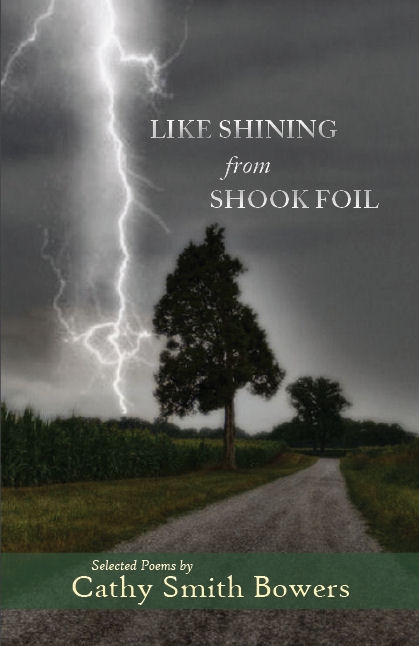
book cover, tree with lightning

Like Shining from Shook Foil
Selected Poems by Cathy Smith Bowers
Press 53 Winston-Salem, North Carolina
142 pages
www.press53.com

When I was still a novice poet, an acquaintance introduced me to The Love That Ended Yesterday in Texas by Cathy Smith Bowers. Almost instantly I said to myself, “I want to write poems like these.”

More than a dozen years later, I feel the same way. Smith Bowers (what an apt name for a poet whose poems provide so much shelter for people who have known sorrow) writes in a voice that begs to be read aloud:

“Desert moved into town
and made itself at home.
Houses glowed like skulls.
Banisters lined the stoops
like rows of teeth.”

(“One Hundred and Ten Degrees”)

Readers of Like Shining from Shook Foil will not have to struggle with esoteric words or awkward syntax. Lines follow each other smoothly, most often by unfolding a clear narrative, but also by following a logic that, at least on the surface, seems predictable and trustworthy.

Stepping into one of Smith Bowers’ poems is like getting on a train. You’re off and running within the first few lines: “When I heard the sudden / thunder of my husband’s truck,” (“You can’t drive the Same Truck Twice”) or, “It’s not my brother’s dying / that I fear, that perfect healing” (“Pacific Time”). However, for all these elements that make her poems easy to get into and stay with, what is going on in them is by no means simple. One of my favorites of her early poems, “Wanting Them Back,” gets at the ambivalence many of us feel as we live between seasons by using the simile of a wood-carver who has fashioned a little boy out of a piece of pine. To the carver’s surprise, the boy comes to life and starts running away. Of the boy, Smith Bowers writes that he, too, is “astonished at the ruckus in his chest, / at the strange old man at his back / who kept crying Be wood! Be wood!”

Among her most compelling poems are those that deal with her relationships with her father, her brother, and her second husband, all now dead. These poems give voice to the anger, longing, bafflement, gratitude, and sadness that many of her readers know about firsthand, and many more will recognize as part of the human condition. None moves me more than “Learning How To Pray,” in which the writer, who has heretofore disavowed religion, becomes willing to pray to any god, goddess or substance, if it will help her brother:

I like a nymphomaniac
the dark promiscuity
of my spirit     there
for the taking         whore
of my breaking heart   willing
to lie down      with anything

As to the balance of the selections in the collection as a whole, there are generous portions from The Love That Ended Yesterday in Texas (Iris Books 1992) and Traveling in Time of Danger (Iris Books 1999). I wish the current editor, Tom Lombardo, had selected more poems from her Book of Minutes (Iris Books 2004), as I believe this brief form (an eight syllable first line followed by three four syllable lines, with this stanza pattern repeated three times) might well offer American poets our own distinctive short poem serving the same purpose as that of the Haiku. Although there are compelling poems from The Candle I Hold Up to See You (Iris Books 2009) such as “Questions for Pluto,” “Solace,” and “Pear Moonshine,” I am not sure that these poems convey the multi-layered complexity of her other collections. Happily, the section of uncollected published poems is loaded with wonders, most notably “River” and “Watching for Meteors.”

Like Shining from Shook Foil will bring new pleasures to all but the most inveterate readers of her poetry. For those not familiar with her work, this collection gathers the best of Smith Bowers’ poems, allowing readers a sense of their remarkable depth and breadth.

Like Shining From Shook Foil Selected Poems by Cathy Smith Bowers
Press 53
http://www.press53.com/bioCathySmithBowers.html

J. Stephen Rhodes‘ poems have appeared in Shenandoah, Tar River Poetry, and The International Poetry Review, among others. His poetry collection, The Time I Didn’t Know What to Do Next, was recently published by Wind Publications. He is a Presbyterian minister and a retired theological educator. His website is: http://www.jstephenrhodes.com