“The Persistence of Desire” by Richard Wirick

This is, of course, the name of one of his stories. In it, a man who has escaped his  farm town past, a rustic with urban vanities, nonetheless returns there to visit a trusted dentist. He sees the things that have changed since his childhood visits, the most telling being a digit-based (though not digital) clock, its minutes dropping away, as he watches, “into the brimming void.

What has not changed is his passion for a childhood flame who happens to drop
by the office, chat him up a bit, blush under his revived attentions, and eventually,
almost silently, alludes to the anomies her marriage there has doomed her to. Though
his themes are as abundant as Adam’s names, persistence is Updike’s perpetual
character-driver, the life force that animates each form of his characters’ transcendence:

[Janet] arose and came against his chest, and Clyde,
included in the close aroma her hair and skin gave off,
felt weak and broad and grand, like a declining rose.
Janet tucked a folded note into the pocket of his shirt and
said conversationally, “He’s waiting outside in the car.”
The neutral, ominous “he” opened wide a conspi-
racy Clyde instantly entered. He stayed behind a minute,
to give her time to get away. Ringed by judging eyes of the
young and old, he felt like an actor snug behind the blinding
protection of the footlights; he squinted prolongedly at the
speedometer-clock, which, like a letter delivered on the stage,
was blank.

And who wrote better about abiding religiosity, the search for faith that Updike saw as essential and unexplainable by reference to historical or social forces? In the story “The Man Who Loved Extinct Animals,” the protagonist sees in the joints and hinges of the fossils he assembles the delicate bridges that the mind builds over the abyss. The brimming void may blind us, he seems to say, but as long as we rivet the beams together, keep busy with the reality or the illusion of building and don’t look down, we will be fine for the time being.

Persistence also abides, though less than in other writers, in those characters who shore up some art, or artifact, against their ruin. One of the most powerful of “The Olinger Stories” (Collected in 2004’s Collected Early Stories), is “The Alligators.” An elementary school boy fashions his first illustrations not out of any transcendent wish, but to satirize a classmate whose ostracism is a requirement for popularity. He feels guilt  at creating for such a mean and limited purpose, but then, as he shares other, maturing drawings with friends, sees that he has inherited a transfiguring power, and one conferring the consolations of infinity.

What often persists the most could be the most unattractive but necessary of qualities—market ambition, social climbing, the Sinclair Lewis hucksterism that tells us the historical echoes of the “Rabbit” nickname. In the story “The City,” a man falls ill while traveling on business, and as he recovers through hallucinations and incisional pain, we think that maybe he will reassess, prioritize, hunger for the stasis of a family and fixed life. But the desire to impress and dazzle is as basic to the organism as eating or breathing, and the brush with death seems to have taught him nothing but the need for reserves of energy stored up by rest. It was always Updike’s exploration of ambition that made him that most American of writers. Roth and Bellow approached it brilliantly through urbanized machers of immigrant merchant classes, but Updike filtered it through our Rotary Club speakers, the Toyota salesman (Rabbit Is Rich) quoting gas mileage stats to us from Consumer Reports.

Perhaps the greatest persistence he portrayed was longing itself; yearning, the desire to rise higher and keep hope borne up in one’s bearing as the very badge of existence. Like Francis Bacon, Updike believed the world is laid out for us, kindly disposed to our discovery and enjoyment: “Full of Joye and Wondrous Goode.” That transporting, almost erotic elixir of exploration runs through the age-sequenced life snapshots of the narrator of “Museums and Women.” It first visits him like a spell as he traverses a county reliquary with his mother:

Who she was was a mystery so deep it never formed itself
into a question. She had descended to me from thin clouds of
preexistent time, enveloped me, and set me moving toward an
unseen goal with a vague expectation that in the beginning was
more hers than mine. She was not content. I felt that the motion
that brought us again and again to the museum was an agitated
one, that she was pointing me through these corridors toward a
radiant place that she had despaired of reaching . . .I was her
son and the center of her expectations. I dutifully absorbed the
light-struck terror of the hushed high ceilings and went through
each doorway with a kind of timid rapacity.

What is sought here—though great—is not as important as the sensation, the very texture of seeking: she was pointing me. . . toward a radiant place she had despaired of reaching. Updike owns the luxuriance of The Search more than anyone (perhaps excepting Walker Percy) in modern letters: he invented the theme out of whole cloth and then perfected it in more than fifty books, through hundreds of characters. His perspective on it was tactile, limber, instinctual, breezy, and at the same time solemn, like one of his epistolary clergymen. William Pritchard said of him, reviewing the collection with the above story as its title: “He is a religious writer, he is a comic realist; he knows what everything feels like, how everything works. He is putting together a body of work which, in substantial intelligent creation, will eventually be seen as second to none in our time.” Eventually seen? For those in the know, the fathomless depth, and the dexterity, was staggeringly obvious from the start. Chip McGrath, in his tribute in The Times, posed the question: “If you could write that well by taking a pill, who wouldn’t swallow whole fistfuls of them?”

Though we had no way of knowing it, my colleague Victoria Pynchon  and I saw him in his very last public appearance, at UCLA’s Royce Hall in December. He read a quick passage from The Widows of Eastwick, where Alexandra, the aging Rhode Island witch of the Seventies, is now an old woman on a Nile cruise, telepathically electrocuting bats that are flying across her steamer bow and mussing her hair. Everything you could want in establishing a scene is there: the colors of the foul but suddenly clearing river, the Monet hues of the Egyptian twilight, the precisely rendered sound of something we’ll never hear but know could sound only that way were we to witness it—a bat’s fur and rubbery extremities flaming up and then dousing themselves to death in the water.Wrapped up in this sensuous music—much as with his beloved Proust and Bellow—is the effortless, sudden ranging between third person and first, the immediately recognizable hinges of his free indirect style. It is what hit American readers of Rabbit, Run like a thunderbolt in 1959, or like the welcome sun Harry sees on the first page, sliding open the door of his dark, Satanic Linotype shop and blinking at the kindly-disposed world, the bright, haphazard gravel under the soles of his basketball hi-tops. It was the same shifts in register and perspective that made you always know but never care which thought was Rabbit’s or which was his creator’s. He dove like a . . . what?

Like a bat—down into everyone’s head and hovered there meticulously. He got out of them just what was needed for reality to create their observations and then, with a pirouette Sam Tannenhaus called “pure magic,” let his characters’ minds in turn press out upon the world their seeing had reconstituted.

He honed this to perfection in the opening scenes of Rabbit At Rest, where the narrator jumps inside Rabbit (he’s waiting for his wife to get out of the bathroom at the Ft. Myers airport) long enough for us to feel the man’s gluttonous elation, then leaps back to look at his character like a Babbitesque, portly clodhopper, chewing and dribbling a candy bar, gazing at his own strange sunstruck extinction:

While she’s in the ladies he cannot resist going into the shop and buying
something to nibble, a Planter’s Original Peanut Bar, the wrapper says. It was
broken in two somewhere in transit and thinks one half to offer his two
grandchildren when they’re all in the car heading home. It would make a small hit.
But the first half is so good he eats the second and even dumps the sweet
crumbs out of the wrapper into his palm and with his tongue eats them all up like
an anteater . . . . . As he tries with his tongue to clean the sticky brittle stuff, the
caramelized sugar and corn syrup, from between his teeth—all his still, thank God,
and the front ones not even crowned—Rabbit stares out at the big square of
sunny afternoon. As the candy settles in his stomach a sense of doom regrows its
claws around his heart: little prongs like those that hold a diamond solitaire.

We come finally to the little shadow under the intensity of appetite: its forbiddeness and its premonition of oblivion. You stuff yourself, but with something of your own negation.

Later, even closer to death, Rabbit looks up from his heart bypass operating table and sees on a video screen his own horrific viscera, “the pulsing wet tubes we inherited from the squid.” Harry is reassured that his doctor is Jewish, having a

Gentile prejudice that Jews do everything a little better
than other people, something about all those generations
crouched over the Talmud and watch-repair tables, they
aren’t as distracted as other persuasions, they don’t expect
to have as much fun. They stay off the booze and dope and
have a weakness only . . .for broads.

We get Harry’s immediate assessment of his surgeon’s vices, but only after we’ve sailed around the room a little, flitting omnisciently within the purely authorial, purely sociological adumbration of the character.

At the reading, Updike finally laid down the copper-jacketed book and talked awhile with a writer from the L.A. Times Book Review. All his observations were witty, generous, self-deprecating, and in the words of his own epitaph for his beloved editor William Maxwell, “funny and wise and kind and true.” He finished with a gush of enthusiasm about the newly-elected Obama, clasping his hands together, appearing to rise up out of his chair like one of his early cartoon whiffenpoofs. Then he took a series of mostly inept audience questions, steering each gracefully toward a cognizable answer. The inevitable what-are-you-working-on eventually arrived, and for once he really didn’t have a thought-through response. He shrugged his shoulders, slapped his palms on his knees, and said “I’ll only say I intend to stay in this writing business until I drop over dead.” And lucky for us, by God, he did.


Richard Wirick lives in Los Angeles, California, with his wife and three children, where he practices law and writes. He is the co-founder of the journal Transformation and the author of the hauntingly lyrical collection of prose poems 100 Siberian Post Cards.

“The Prison Diaries of Arthur Longworth” by Arthur Longworth

one:  where I am

Sunday, July 27th
(first day of diary)


I suppose I should start by telling you where I am. This is an
old prison (well over a hundred years old) and it would be better
suited as a historical site, than a place to keep prisoners. It’s
falling apart. The state wanted to close it years ago because it
cost too much to operate, but they can’t, Even though they are
constantly building new prisons and adding to the ones they
already have, there are too many of us.

They have nowhere else to put us.

The massive Romanesque architecture of the prison’s
buildings, gun towers, and the thirty foot wall that surrounds us
is composed of worn red brick. Millions of them. The mortar that
has for so long held them together is falling out. In places, the
bricks have separated in distinct fault lines. Weeds have taken
root between them and sprout directly from the sides of buildings
and the wall. It’s a funny sight.

There is a contrast in the wall between the uppermost
section—which was replaced after it broke apart and toppled into
the big yard ten years ago during an earthquake—and the rest of
it which is covered with a dark, crusty type of moss. The contrast
is becoming less apparent though. Long streaks of rust from the
razor wire that crowns the top of the wall have stained the new
section and the moss is beginning to encroach.

I’m not as old as the prison (43 now) but there are times I
feel like it because prison is all that I know. I have been in since I
was eighteen. That is, if you don’t count the juvenile institutions I
spent my childhood in. Longer, if you do. Looking back it seems
like a long time. I’m conscious that I’m swiftly approaching the
limit of a prisoner’s life expectancy—which isn’t the same as that
of a free person’s.

two: proximity
Monday, July 28th

My celly, Bucky, began vomiting a few days ago. He’s in the
infirmary now with some kind of food poisoning. He isn’t the only
one who got it, so he has company.

I wouldn’t wish a sickness like that on anyone but, I have to
admit, his absence from the small place that is our cell is a bit of a
relief. I am less distracted, able to write more, and can get off my
bunk whenever I want, instead of the way we have to do it when
there are two of us…taking turns.

It isn’t that I don’t like Bucky, or care what happens to him. I
do. He came highly recommended (my friend Jimmy vouched for
him). After my last celly was transferred, the cell house sergeant
told me I would have to find another, or he would find one for
me. I had Bucky move in later that day.

Bucky came to prison as a juvenile with a four year sentence,
but in the few years he has been here six more have been added
to it because of his behavior (and I suspect he will stretch it to
more than that before he is through). He gets into trouble
because he’s afflicted with what used to be called in my time
“hyperactivity”, now ADHD. They give him Ritalin in an attempt to
control it, but he sells the pills. He has no other source of money
–no parents, he was raised by the state.

You may wonder why I choose to live with a prisoner like
Bucky, afflicted as he is and only nineteen years old. But, the
truth is, I am more comfortable around him than I would be
around someone who wasn’t sent to prison until he was older. I
have patience for Bucky because I understand him…at least the
circumstances that brought him to prison, because they are not
much different from the ones that brought me here when I was
his age.

I have to yell at Bucky sometimes to take a shower because
he forgets, or to wash his socks. But, besides that, he isn’t a
problem. He’s trustworthy and his word is good. What more
could I ask?

The problem isn’t my celly, it’s that this prison has the
smallest cells in the system—we literally live on top of each other
here. State officials know they aren’t supposed to put more than
one prisoner into a cell this small. An injunction was issued by a
Federal Court years ago that kept them from doing it—until the
state got it lifted by telling the court that prisoners were
volunteering to be crammed in together. Bastards.

I’ve pondered writing to the court to tell them the truth, but I
know it wouldn’t be wise. Others have tried it and everyone
knows what happened to them. Because of the overcrowding,
more than a thousand of our state’s prisoners are housed in
other states (long distances away), and I would quickly find
myself with them if I were to write the court.

Bucky is a decent celly, but I am going to enjoy this time while
he is gone. I don’t miss being forced into such close proximity
with anyone.

three: birds of a feather
Wednesday, July 30th

We were allowed out into the Big Yard this morning and I went
with the hope of catching sight of the young osprey that has been
hanging around the prison recently. Last week he landed on one
of the lights above the wall and I was able to get a good look at
him. He at me, as well.

No sight of the osprey today though. It was warm early and the
only birds to see were starlings, a small group in the grass on the
far side of the yard. They are always here because they don’t
migrate, the prison is their home. I have watched enough
generations of them live out their lives here, go from chicks to
death, to be able to tell you with certainty that they don’t go
anywhere.

I like to watch birds—which is strange when you consider that I
have spent many years of my life in IMU (maximum-security)
where I was unable to see them. There you are confined only to a
small cell, you don’t get to see outside. Then again, maybe it is
because of that experience that I have gained this appreciation for
them. I don’t think I had it before they put me in that place.

The starlings in the yard this morning were parents with their
offspring. Although the young ones were no smaller than the
adults, they were easy to pick out because of their coloring and
the way they behaved. While the adults search the grass for
food—thrusting their heads down into it and looking around, then
taking a few steps and repeating the process—their fledglings
follow them raising a ruckus, squawking and shaking their wings.
The only time the youngsters were quiet was when one of their
parents stuffed a bug in their throats. As soon as they got it
down, they would begin squawking again.

Sometimes when I am watching birds, thoughts come to me—
like the one I had this morning. As I watched the starlings, I
couldn’t’t help but recognize a correlation between them and a
certain kind of prisoner—those who were raised by the state in its
institutions. They, too, were brought up to be where they are.
Free people, I suspect, would think it ridiculous to say that, but
that is only because they don’t know what it is like—what growing
up in those places teaches you, and what it doesn’t. It doesn’t
prepare you for a life in civilized society. The only thing a young
person raised by the state is fit for is this right here. I’ve been in
long enough to see that cycle play itself out too, generation after
generation—I’m thinking of Bucky now, one of the most recent
generation.

Is it fair to write this? To believe it? My own generation comes
to mind now, those who grew up with me in those places. Yes, I
think it is fair…because I can’t think of a single instance where it
wasn’t true.

four: home
Thursday, July 31st

It is raining today. When we’re locked in our cells we can’t see
outside, but I know it is raining because water is running in
rivulets down the inner wall of the cell house, being absorbed into
state-issue blankets that have been laid out for this purpose. The
blankets must be changed frequently by the tier porters. Water
drips from cracks in the ceiling, the drops fall into large plastic
garbage barrels placed strategically on the cell house floor four
stories below.

It isn’t raining hard, if it was, more water would be coming
through the cracks. It’s funny to see streams of water pouring
from the ceiling (funny in the same way it is to see errant weeds
growing from the sides of old brick buildings here and on the wall).

I wonder how much longer this place is going to last. What if it
fell down? Wouldn’t that be funny? What would they do? Tell us
to go home? When you have lived your entire life in prison, where
is home?

five: fight
Saturday, August 2nd

There was a fight tonight during the last movement period.
(Movement periods are times during the day when we’re allowed
to move from one area of the prison to another.) Fights are
hardly unusual here, they happen all the time. I wouldn’t bother
mentioning it if there wasn’t more to it.

The fight broke out in the main corridor leading to our
cellhouse between two prisoners of different races and quickly
swelled to include more prisoners of those same races—six of one
and eight of the other. This kind of fight is more serious than
usual because it affects everyone in the prison, tautens the
already threaded line of tension that runs through everything
here, and carries with it the very real possibility that the entire
place will erupt into violence.

Alarms sounded, and the gates inside the prison that control
movement on its sidewalks and through its corridors slammed
shut, cutting off other prisoners’ ability to get to the disturbance.
Guards converged from every section of the prison.

I saw the fight from behind a wall of bars that separates one
end of the corridor from the other, part of a large crowd that was
caught there when the gates slammed. All of us watched as the
drama played out. One of the race groups involved in the fight
was my own and I was immediately conscious that there were
members of the other race in the crowd around me. I tallied the
numbers in my mind—theirs, ours— and shifted in the crowd,
moving closer to the others of my own race. I watched myself
doing this and realized what I was doing was automatic—having
done it so many times in the past, I didn’t have to think about it.
And I wasn’t alone, everyone in that crowd did what I did. The
races separated. I wonder at what point in a prison sentence that
a person becomes like this. Reaching into my memory as far as I
can…I can’t remember. I’ll have to ask someone newer.

We are in our cells now, locked in for the night. The cell block is
quiet, that’s  how you can tell something is going on. All it would
take is for someone to say something, to direct it out through the
bars of their cell into the quiet bock. Maybe not even that. It may
be already going to happen anyway. We’ll see what tomorrow
brings, when the cell doors are racked in the morning.

six: search
Monday, August 4th

I found my cell destroyed when I returned from the Big Yard this
morning. It was impossible to take it in all at once, so I stood at the
bars for some time looking in, trying to make sense of the mess,
assess the damage.

Everything was on the floor. The sheets and blankets that cover the
thin foam pads we call mattresses, stripped off and thrown there—
Bucky’s and mine. The cardboard boxes that I keep my property in had
been turned upside down and dumped there too. My heart froze at the
sight of my writing tablets in a twisted pile, loose pages scattered.

Anger came over me and I entered the cell. The door racked shut
behind me. Bucky’s property was dumped in the corner and his meager
collection of possessions were pushed under the toilet. The cover of my
favorite writing book was torn and I realized that it is as good as gone,
its useful life ended—not because the damage had destroyed it, but
because it is the reason guards will use to take it in the next cell search.
According to prison policy, it is now “altered.” No matter that they did it.

When I picked up the writing tablets, I noticed that my photos were
under everything, strewn across the concrete floor face down. I
dropped the tablets and hurried to pick them up. Some lay in water and
there was no way I could salvage them.

It would have been easy at that point to tell myself it was the last
straw, to self-destruct. It was what I wanted more than anything to do.

The photos were of Kriss—of Kriss and me together. Kriss, who has
visited me for the last fifteen years, who sacrificed so much in her life in
order to befriend me, then more in order to marry me. She has been
with me through the hardest times and is the only family I have ever
known. Do they not know that I love this woman more than life itself?
My anger turned red-hot; my hatred of them, implacable.

I reminded myself that the photos aren’t her, they’re just photos.
She doesn’t want me to self-destruct and end up in the hole. I tried to
imagine her here, what she would say. A shadow passed in front of the
cell and I looked up to see a guard standing there. He looked young and
a bit nervous. I stared at him with the blank cast of my prison face, not
saying anything. I didn’t know why he had come to my cell (to witness
firsthand the misery he had caused and revel in it?) I remember exactly
what I thought at that moment, “It’s too soon…I haven’t composed
myself yet…I’m not ready to hear what you have to say…get out of here
and leave me alone!”

The guard smiled in an attempt to appear friendly, to bridge the
gulf. He offered an offhand apology for the mess and informed me that
it wasn’t their fault (he and the others guards who did it), the order to
search the cell had been handed down “from above.” He looked at me
as though he expected me to say something.

I held on to my deadpan expression—as much a part of me as it is, I
had difficulty maintaining it. I told him quietly to leave.

The guard began to say something, but I didn’t give him the chance.
I yelled, ”LEAVE!” imbuing the word with all of the anger that I felt, no
longer interested in concealing it. It was as civil a tone as I could
manage, His expression turned angry instantly, his lips compressed into
a tight resentful line and he moved off.

For a moment, I tried to look at things from the young guard’s
point of view, but it was useless. There is no way I could understand a
guard like that, how he and his buddies could possibly think that it was
okay to do this, and that he would be able to come by the cell afterward
and explain away what they had done, that I would be okay with it and
everything would be all right—or, at least, no different than before they
did it.

I sat down heavily atop the wreckage of my property, no longer
interested in trying to sort through them or pick things up, the photos
of Kriss still in my hands. I counseled myself—as I have done countless
times in the past—that I don’t really own anything…photos or anything
else. No one does here. What you have in regard to property, you only
have through good fortune, and only for the time being, there is no
guarantee you will be able to retain it. If you lash yourself to it—what
you think is yours—prison will break you. Anything you have in here can
be taken or destroyed on the whim of those who keep you, and the
more you cling to it, the more likely it is to happen.

Breathing deep, I allowed my thoughts to settle and reminded
myself of the source of my strength, My strength lies in the knowledge
that guards can take everything from me, strip me naked and throw me
into a concrete and steel cell with nothing, leave me there an indefinite
period of time (months or years) and I will find a way to survive, to
come out of it sane and still a functional human being with the ability to
start anew. I know this because they have done it, and I have made it
through…many times. It is these times that are my greatest victories.

The only thing we truly own in prison is what we possess when we
are naked…locked inside of a cell with nothing. If a person can figure out
what that is and cultivate it, abide in it, what they take from him
materially means nothing, that is when he is doing time right. If you’re
unaware of what you have to fall back on when you’ve been stripped of
everything…then you truly are poor.

I feel better now. I realize I only get upset because I forget, lose
touch with what I already know, the source of my strength. When I’m in
touch, none of this is able to bother me…and I don’t feel the need to hate anymore.

seven: fat jack
Tuesday, August 5th

They transferred Fat Jack to the infirmary today. I was glad I got the
chance to see him before he left, but it was difficult watching him go. I
have known him a long time and he really is a decent person.

It’s funny that I still call him Fat Jack even though he isn’t fat
anymore and hasn’t been for some time. His belly protrudes, but that is
only because his organs are distended, painfully bloated with the toxins
his liver is unable to filter from his blood. The rest of him is skeleton-
like, the flesh that remains hangs loosely from his bones. He is in the
latter stages of Hepatitis C infection.

Jack’s transfer isn’t a surprise, he knew it was coming. It’s inevitable
when you lose touch with who and where you are—when you ask
guards questions that don’t make sense and wander unconsciously into
sections of the prison you aren’t supposed to go. We have both seen it
before (infirmary staff say that the prison HVC infection rate is over
seventy percent), most recently with some of Jack’s closest friends:
Chuck, Leo, Speedy…Bill.

Jack took Bill’s death the hardest. Bill, who spoke of being betrayed
before his transfer to the infirmary. He passed most of his sentence
working as a clerk in the chapel, certain that Jesus would get him out of
prison one day. “Faith” he called it. As it turned out, it was nothing
more than overconfidence in Jesus’ ability to influence the affairs of the
Department of Corrections. Bill died within days of his move out of the
cell house and Jack has made a point of declaring his own position on
Jesus ever since. Even when he is in one of his delusional states, his
position doesn’t change—there is no Jesus.

For me, what the state is doing to Fat Jack throws into question
their assertion that their prisons only house those who are too
dangerous to allow into society. After all, Jack can hardly get around
anymore—he was sent to prison for drug offenses. What would it hurt
to cut his sentence and let him die outside these walls? Wouldn’t that
be the right thing to do? Every terminally ill prisoner I have known
asked for this, but I’ve never seen it granted.

It was hard to watch Jack make that walk today. I tried to lighten his
mood by telling him that Bucky (my celly) is in the infirmary…that he will
see him there…but my words sounded phony because they didn’t match
what was in my heart. I wish that I could have thought of something
more meaningful to say. Jack seemed unusually clearheaded. Watching
him trudge off down the walk in the direction of Medical, I believe he
knew this would be the last time he was going to make that trip.

eight: about education
Thursday, August 7th

Everything stopped while I was reading a newspaper in
the library today—the article said that Alexander
Solzhenitsyn passed away in his home in Moscow. The rest
of the world continued on, I suppose, but everything
stopped inside of me. I retreated to my cell and remain here
in order to contemplate his life, and the connection I have
for so long felt with him. I realize you may not understand—
why Mr. Solzhenitsyn meant anything to me, why the news
of his death affects me. Let me try to explain.

When I was sent to prison many years ago as a very
young man, I had only a seventh grade education and didn’t
read or write very well. I had never heard of Mr.
Solzhenitsyn. I wanted to go to school and get an
education, which was something that was not available to
me before I came to prison, but I soon discovered I wasn’t
allowed to attend school inside either. Prison officials said it
would be a waste of their time and resources to educate me
because I had a life sentence. They told me I would only be
allowed to take barber or janitor classes—two vocations that
would make me a useful prisoner.

At this point, I didn’t even know if it was possible for me
to learn—if I had the same abilities as others—but I had
made up my mind to try, so I set out to educate myself. I
went to the prison library and began to check out books. It
was a small library and poorly stocked, but I read everything
I could…biography, history, philosophy, language. Then I
made tests and gave them to myself in order to be sure I
had retained all that I was pouring into my mind.

On the back shelf of the library one day I came across a
treasure—a three volume set of Mr. Solzhenitsyn’s Gulag
Archipelago
. When I got it back to my cell, it held me
entranced long after I finished it.

I went on to read all of Mr. Solzhenitsyn’s published
works. My favorite is a small book entitled One Day in the
Life of Ivan
Denisovich—the story of a day in the life of a
prisoner in the Soviet Union. I love that book, not only
because it reflects the strength and perseverance of the
human spirit in the face of seeming hopelessness but,
because it could have only been written by a prisoner…only a
prisoner can know of so many of the things he wrote. In
fact the book startled me when I read it because I knew it
was written about prisoners in another country, during a
different time, under different circumstances, yet I felt as if I
was reading about prisoners and guards I know, what goes
on here, and what goes through many of our minds while
we’re experiencing it. There were so many parallels, I couldn’t
help but feel close to them. Of course, I am conscious that
Ivan and many of those in prison around him were political
prisoners, and I and those around me are criminals, but
there is still a connection…and that connection is that we are
human beings.

The experience of prison as it exists in our country today
is no less damaging to the individual or society than the
experience of it that Mr. Solzhenitsyn wrote about. There
are many differences, but it is no less harmful and those
who would believe otherwise are deluding themselves;
certainly they have never been prisoners. The only argument
to be made is whether or not (because of the harm many of
us have caused others) we deserve it, and if the price of
doing this to so many of us is worth the toll it takes upon
society. I’ve often wondered what Mr. Solzhenitsyn would
think (write) if he were able to experience what it is like to
be a long-term prisoner in this country today where prison
has become an industry into which human beings are fed,
and out of which is spat a product that is much less capable
of functioning in society than the one that went in.

Being in prison in this country is different now than it ever
has been before. There are more people inside—many times
more. Never has there been anywhere close to this number.

And sentences are longer and harsher than ever. Is that
because people are worse today than they were in the past?
Worth less? Less able to redeem themselves, or less
deserving of the opportunity to do so?

And young people—the ones with the greatest potential
to reform themselves—are given those sentences. We have
prisoners in this state who were given mandatory Life
without the Possibility of Parole sentences when they were
thirteen, fourteen, and fifteen years old. We have prisoners
struck-out as career criminals when they were nineteen,
twenty, and twenty-one. They too have mandatory Life
without Parole sentences. “Mandatory” means that a judge
didn’t have a choice in the matter, the sentence was
mandated by legislators (lawmakers who decided without
ever meeting these young people or considering their
circumstances, that there is nothing in them worth
salvaging, that they can never change, and that they
deserve nothing ever other than unremitting punishment.

Maybe I am deluding myself, but I have always felt that
Mr. Solzhenitsyn would be able to relate to what is going on
here with many prisoners…feel as close to us as I have
always felt to him. Getting a sentence of Life without Parole
when you are young is hopelessness. Continuing on after
that, learning to survive in an American prison and proceed
forward as decades stack one atop another, and you have
long since forgotten what is on the other side of these
walls, is perseverance of human spirit.

Mr. Solzhenitsyn’s writing inspired me as a young prisoner
to continue my efforts to educate myself and, eventually, led
me to write a book modeled after his One Day in the Life of
Ivan Denisovich
. It’s a manuscript that is passed from
convict to convict; the story of one day in the life of a
prisoner inside the prison in which I grew into adulthood and
have spent most of my life—the prison in Walla Walla. When
officials there discovered a copy and read it, they threw me
in the hole and revoked my medium-custody classification.
But the manuscript still makes its rounds. Prisoners read it
because it puts words to what they are unable to, relates
the truth about prison, and what it does to those who are
in it. I have always felt that Mr. Solzhenitsyn is as
responsible for the existence of this convict manuscript as I
am.

I wonder if Mr. Solzhenitsyn ever dreamed while he was in
prison that his life would turn out as it has…that he would
live outlive the system that imprisoned him… that he would
one day live free…that he would own a home (in Moscow)
and that he would be able to die there. Perseverance of
spirit. Thank you Mr. Solzhenitsyn for showing us what that
is. No better example could have been given, no better life
lived.

nine: crowded
Friday, August 8th

Bucky was released from the infirmary today around noon. He
surprised me when he showed up at the cell haggard and pale,
hunched over because his stomach still hurt. He said that he had
seen Fat Jack.

Part of me is glad that he is back. Tomorrow, if he is up to it, we
will play chess. He likes getting beat.

I am trying to suppress the other part of me—the part that
doesn’t like to be crowded.

ten: a river of faces
Tuesday, August 12th

My friend, Kenny, got out of prison yesterday. He felt bad
about leaving, I could tell. Not bad that he was getting out, but
that I’m not.

It’s a kind of guilt that I don’t understand. He wanted me to
say something, I know, to allay what he was feeling. But I didn’t.
It’s not my fault what he feels.

Kenny is a decent person, but he cannot fathom the endless
line of people I have seen get out in the last twenty-five years, a
river of faces almost as large the one I have watched flow in. And
he is only one ripple in that river. I didn’t want to try and explain
that to him. Better that he just went…thinking what he thought,
feeling what he felt.

Never do I mouth the same tired platitudes I hear from
others—“Good luck…” “I hope you make it…” “It’s been good to
know you…” etc. I can’t bring myself to do it. Only in the last few
years have I become aware of what I say—“See you later…” Maybe
that is what I am hoping for. And…why not. The odds are it’s
true. Am I supposed to feel bad when they come back? You think
I want to be alone in here? Or surrounded only by those I don’t
like?

I realize it’s a fucked up way to think. I’m working on it.

Eleven: The Sting
Thursday, August 14th<

An unusual sight on the Big Yard today—two gold finches. I
heard them and looked up in time to see them flit over. That was
it, only a second or two worth of sighting, but enough to be sure
of what they were.

The young starlings were more independent than last time I
observed them—they have ceased to bother their parents so
much. All that differentiates them from adults now is their
coloring.

I’m not sure what made me think of it, but as I watched the
birds it occurred to me that prison is harder on people who were
sent here when they are older. At least, those who are older than
twenty-one. When you’re sent to prison younger than that, there
comes a point when it loses its sting, you lose touch with the fact
that you are being punished. This is true especially if you have a
life sentence because when you live your entire adult life in prison,
no matter how bad it gets in here, your situation is only what
you, as an adult, have ever known it to be. You go about life the
best you can without the handicap of memories of a better time
or place (unless it’s memories of a better prison you were in
once, compared to the one you are in now).

After living so long here I’m conscious that prison is
punishment only because of what I see on the faces of those not
yet accustomed to it. Watching the newly arrived, it’s obvious
that what they find in here isn’t what they are used to, not what
is considered normal outside these walls…undoubtedly a long way
from it. Their reaction infuses itself on their faces, a dawning look
of horror; realization that they now have to live like this, will have
to find a way to do it…or knot a sheet around their neck. They
don’t know the half of it yet.

Even as I write this I’m aware that it isn’t completely true, I’m
not entirely unbothered by prison, the experience of life here isn’t
bereft of punishment for me. That is because I’m not blameless. I
am responsible for the death of an innocent person, that is why I
am here. And it eats at me…always has. What bothers me is that
I don’t feel like I’ve ever been able to pay anything back, in any
way make up for the crime I as an ignorant young person
committed—no matter what happens in here, no matter how bad
or intolerable it gets, prison has never made me feel like I am
doing that.


Arthur Longworth has been incarcerated since age 18. His youth was spent in a variety of foster homes – usually for only two or three months at a time. He was separated from his sister at an early age and, in his teens, he lived in a series of youth facilities. At sixteen he was released to the streets with no means of support. He had only a seventh-grade education and began life in Seattle breaking into cars and doing petty criminal activity. At age 18 he escalated to armed robbery and in one holdup a victim was killed. Arthur was convicted of first-degree murder and sentenced to life without parole.  After Longworth arrived in prison he asked to go to school to get an education. He was told that as a “lifer” he wouldn’t need an education. Eventually he visited the library and educated himself.

“Chimney Fire” by Mary Lewis

Chimney_Fire_0001

Clara pushed herself off the plywood floor and looked down at where her face had been.  No blood this time, but the skin around her left eye was puffy and tender to the touch. Earlier in the year she would have found some snow to put on it, but March had turned it all to mud and she’d forgotten to fill the ice trays in the freezer. Last time he was upset because she overcooked his eggs again, but this time he found a bank statement for a checking account she had just opened in her name. She should have told Eunice at the bank not to send them, but she was in a hurry to fill out the forms before anyone knew so she forgot that detail. Her first deposit was part of her last paycheck from the turkey plant, split so that most of it still went to the joint account, so Stan wouldn’t notice. Of course now he knew everything, but he only had time to rough her up a little before going off to work in the lumber yard. Later he’d make up for that.

Slowly she stood and walked to the stove in the corner of the old log cabin. Only a few sticks to feed the dying embers, she’d have to go to the outdoor pile to get more.  Then she looked at the stack of broken down cardboard boxes behind a chair, waiting to be recycled. A bit of that would get the fire blazing again while she got more wood. She folded a piece in two and thrust it in. She put in another. As it took, the draft pulled strongly and heat radiated into her chilled arms. Then she heard a small crackling coming from the stovepipe itself. In one spot a circle of red grew larger on the surface of the black metal.  A chimney fire. Creosote had been building up there for years, from low fires out of soft wood, and now it was on fire in the chimney. Hadn’t been able to get much besides box elder lately, and that was great for making creosote. Clara knew what to do, damp down the fire and stop feeding it. She reached for the damper handle above the stove, but her hand went to her eye instead and she stared into the red spot that seemed to grow large enough for her to dive in.

Her hand fell to her side and a tear welled up, stinging the tender swelling on her face as it made a trail down her cheek. She hugged herself and bent forward to ease the empty feeling in her belly, and let the lump in her throat grow large, but she did not sit down. Instead she paced the few steps it took to span the small kitchen, to the window overlooking the wooded ravine, then to the opposite wall where a small window in the door looked out on the muddy path that led to the field road. She paced to ease the tightness in her neck and the indecision in her heart. An image came to her from her childhood, of a tiger who traced the same monotonous track over and over in a tiny cage in the old Como Park Zoo in St. Paul, and looked at her with vacant eyes, as though knowing he could get no help from her.

She paused by the stove, listening to the crackling that was always a fire alarm in the past, but now pulled her down a path she dimly realized she was already treading. Some harsh bit of that knowledge welled up from inside like a sudden release of steam that propelled the hand that knew it should turn the damper down, to do an opposing action. It grasped the chair and threw it aside to get to the cardboard. She stuffed all that she could into the firebox and then flew up the stairs to the loft. The stovepipe glared red-hot in two places on its way to the ceiling. She dragged a cardboard box full of old newspapers next to the chimney and it began to smolder. She pulled the old dresser as close as she could and soon mushroom clouds of smoke grew to engulf it. Clara raced downstairs and threw on her chore jacket. She pulled on her mud boots and charged through the door. Her eyes fastened on the path so she could avoid the muddiest puddles. That’s why she didn’t notice the figure on the path until she bumped into him.

“What the…?” said the figure, a man of rugged build, in coveralls and a denim jacket.

Clara stopped in her tracks and looked him full in the face. The veins at his temple were about to burst.

“Go to Marsden’s and call for help,” said Clara. Why had he come back so soon? Maybe the truck had gotten stuck in the mud.

“You didn’t call yourself?” Stan pushed her aside to get past her on the narrow path.

He ran to the house and opened the door. Smoke poured out.

“Too late, the phone wouldn’t work,” said Clara, picking herself up off the ground.

“We’ll just see about that,” said Stan as he disappeared into the smoke-filled room.

Clara considered her options. Continue down the path to the truck, but it was probably stuck, and she didn’t have the keys anyway. She could race out along the driveway to the county road, but that was half a mile over open fields, no place to hide. Better to head to the woods, he’d have a harder time following her there. She started running along the wooded path that led down the ravine. In a moment she heard Stan screaming, “You bitch, you started it! You torched my house. Son of a bitch! Damn, you can’t run away from this!”

Stan was still in good shape, from farm work and work at the lumber yard, so Clara had to escape with something other than speed. At least she had a head start. The trail twisted down at a steep grade. She had to slow down here to keep from toppling forward.

Gooseberry thorns ripped at her pants. Her feet struggled to regain balance over a muddy spot. Down the ravine, she knew she’d have to cross the creek, and hoped it wasn’t so high as to submerge the stepping stones. No such luck, she splashed through the brown water up to her knees. Nowhere to hide, the underbrush was still bare of leaves this early in the spring. Clara glanced over her shoulder, just long enough to see Stan racing down the slope. She left the trail along the creek and took off uphill climbing to the cliff edge above her. No longer able to run because it was so steep, she planted her feet into the moist earth, one after another.  A wave of dizziness swept over her but she put her head down to fend it off and forced her lungs to gulp more air. Behind her she heard Stan plunge through the creek, cursing as he hit the water.

Just under the limestone ledge Clara followed a raccoon trail that traced the contour of the cliff. It ran into a break in the cliff, a grassy slope between two rocky faces. She pulled herself up the steep slope by grabbing on to scraggly branches of juniper. Her hands went instinctively to the live branches, which looked a lot like the dead ones. Only way to know with juniper was practice. Too bad Stan knew how too.

Now on flatter ground above the cliffs that lined the ravine, she thought ahead. The Torkelson’s had left a bit of their cornfield standing last fall, because it was too wet to get the combine in. She picked up speed again, leaping over fallen trees, skirting tangles of brush. There was a place in the barbed wire fence last fall where the top wire was down.

She angled to the right to find it. Yes, still there. She could straddle it there without having to step on the lower wire. The barbs tore into her pants and bit into the skin of her inner thigh, but did not slow her down. She dove into the corn and loped down a row, ignoring the sharp edges of dried corn stalks that scratched her face. Just a few yards in, there was no way to see her from the outside. She could be anywhere in that patch, maybe a half acre of standing corn. But she had to find a spot and hold still. Any movement would give her position away in the still air. Good thing Stan hadn’t brought Truman. That hound would have no trouble sniffing her out.

It was easier to be still when sitting, so she found a place to settle, where some stalks had fallen over. She willed herself to breathe deeply and slowly so she could listen for Stan, but her heart was still too loud. In a few more heartbeats she heard him rustling at the edge of the corn. He cursed quietly now, hoping not to warn her she supposed. Clara saw without seeing the curve of his back as he plunged into the cornfield. He had a way of sliding his shoulders up and forward that gave his back a hunch when he was angry. It was a warning to her, like the fur raised on Truman’s’ neck when he caught the scent of a coon. Stan was too good a hunter to think he could find her this way. He’d have to flush her out or wait her out. Maybe he’d go back and get Truman. Nope, then she’d get out of there. He could wait all day in a deer stand, barely moving. But he wasn’t angry at the whitetails. He wouldn’t last two minutes in this hunt. Clara could keep still. She’d had practice. When a drunken fog gripped him it was best to get out of his way. In their little cabin, the only way to do that was to be still. She’d sit in her red rocker by the kitchen window looking out while he swore at the TV and the government and Maynard, his boss at the lumber yard. He’d forget all about her at such times, unless she got up to get a cup of coffee. Then she’d be the focus of his curses, and the blows would not be far behind.

He was closer now. She could hear the dry cornstalks scratching out of the way.

Suddenly the rattling stopped. Clara turned her head way to the right to see the spot.

Maybe six rows over, a black boot smeared with mud. That was all she could see because near the ground the corn forest was thin with only stalks. The canopy of pale brown leaves concealed the rest of his body. At his eye level there were so many leaves in the way you couldn’t see more than the next row. All he’d have to do was to crouch down and he’d see her. But would he think of this? Clara held still but her heart would not stop beating. The brown fabric of his chore pants stretched over a bent knee, and a hand reached to the ground. His back carved a hunch in profile. He looked ahead, then to the left. When he looked right he’d see her.

She didn’t give him that chance. Like a ruffed grouse she sprang up with a yelp. No matter how many times she’d had one fly up in front of her, it always startled her and made her stop in her tracks. She hoped it would do the same to Stan now. She sprang straight forward in the direction she was facing, the woods. He wouldn’t expect her to go back. Clara scaled the fence at the same place she’d just crossed it in the other direction. Stan crashed through row on row to get to hers and he was fast, but he’d taken a moment to start his pursuit and change directions. The grouse impersonation had worked.

“Damn, you think you can scare me you bitch! This is it Clara, you’re not getting away this time.”

He’d kill her, she knew it. She started back in the same direction she’d come, looking for ways around brush and over fallen trees. Her path angled downstream along the cliff edge to a break she’d climbed up many times before. The slope was so steep and rocky she had to use branches again. Like aerial stepping stones she reached for one, then the next, twisting to go backwards down the draw. They might not support Stan. When she reached the creek she heard Stan starting his descent. A branch cracked under his weight and she heard his boots scuffle. His curses changed from anger to fear for a few moments. But he regained his feet well down the slope.

Clara plunged back across the muddy water and headed along the creek edge to the path that she’d come down from the house. Fastest trail out of the ravine. Too tired to think of strategy. Smoke settled into the ravine, burning her eyes. At a turn in the path she glanced over her shoulder. Stan had gained on her. If she stumbled he would be on top of her. She’d get to the house and put it between them. Close now, she made her legs struggle on though her lungs screamed and spots of dizziness passed in front of her eyes. Another few steps and she was out of the ravine and on flatter land again, twenty yards from the house. Clara raced to get to the other side of it where the smoke was thickest, and ran into something, someone.

“Clara, we came as soon as we saw the smoke,” said Frank, their nearest neighbor.

“Tried to call you, but got a busy, so I called the fire department. Don’t know if they can even get in through the mud.”

Clara could barely speak through her heaving lungs. “Frank, what a savior you are.”

She pulled back from him and let her heart beat twice before saying, “We were checking the woods fence when we smelled smoke.” A little ways back Frank’s grown son, Mike, peered into the windows of the smoke filled house, an ax in his hands.

“Think you can hide from me!” Now it was Stan’s voice disembodied in the smoke.

Then he burst through the screen of smoke, still running. Stan braked when he saw Clara and Frank, but it took several yards for him to come to a complete stop, so close Clara’s feet bit into the soft earth, ready to run again. But she stood her ground when Stan grabbed her arms and shook her hard. “She started this fire, and I’m not going to let her get away with it.”

“Mike get over here!,” yelled Frank, and they struggled to pin back Stan’s arms to release Clara from his grip. “Just calm down Stan, let her be.”

“The Hell I will, she’s trying to destroy everything I worked for, the bitch!” He broke one arm free of Mike, who had to grab it again.

Clara looked at the three of them, framed by the cloud of smoke engulfing the house.

“It was nothing but a cage and you can’t keep me in it anymore!” She took deep breaths to stop her heart from crashing into the walls of her chest.

Frank said “Clara, take my truck, the keys are in the ignition. Amy’s home.”

Stan struggled against his captors like some overgrown beetle in a horror movie, his human guise now shed. That was what she’d lived with all these years. He bent forward in half to lunge against his restraints, so his eyes raged upward from beneath his heavy brow to look a her.

Clara planted her feet to draw strength from the earth and looked down at him. “I’m leaving you Stan.” She took her time to turn away from him, as though she was in a video in slow motion. Her breathing slowed with each step down the path. It was good to be done with running, but it would take a long time to get the smell of smoke out of her hair.


Mary Lewis has published many works of short fiction and has a story in the collection Frank Walsh’s Kitchen and Other Stories. She contributes articles on environmental issues to her local paper and teaches biology at Luther College in Decorah, IA.  Before that,  Lewis worked on a research farm for sustainable agriculture that she co-founded.  Lewis taught piano and dance for a number of years and has a weakness for Beethoven and Chopin.  Skating is another passion, both ice and roller, but wheels work best in parades.

“Alameda Street” (Author Unknown)


The yellow light turned red. Emma expected a miracle from her mother. The magic trick.
But maybe there’d never be another day like the time they got off the freeway and
every light on Alameda street turned green with a flick of her mother’s wrist.

Emma loved and hated Alameda street. She loved it when she and her mother drove
away from their South-Central apartment to Griffith Park to see the horses or to
Redondo Beach to ride the ferryboat. She hated the dreariness of the street and only
liked the Farmer John factory with its pictures of happy pigs and Farmer John himself,
wearing blue overalls and a big hat. She listened for the sound of snorting pigs, but
only smelled a nasty odor of raw bacon.

“Can we have McDonald’s tonight?” Emma said.

“We have left-over steak from Sizzler’s. We also have hot dogs,” her mother said.

“Hot dogs. You’ve got to be kidding.”

“Do I look like I’m kidding?” Her mother scrunched her lips to her left cheek and made
the I’m-not-kidding face.

Emma thought her mother’s I’m-not-kidding face was stupid. She wasn’t a baby; she
was ten and a half years old.

The light turned green again, but a slow car in front of them boxed their blue Datsun
next to a beat-up pickup truck the color of rust and swimming pool algae. The driver of
the pickup caught Emma’s attention as he flapped his pink puckered lips, his white shirt
billowed like a pirate ship’s sail. Emma pretended not to see the dark-haired stranger
and the guy next to him blowing kisses at her.

Her mother smiled and drew Emma’s bangs away from her eyes.

“Give them a thrill, baby. You can do it.” Her mother blew a kiss to the pickup as it
slowed passed them.

The men turned. Their eyes widened as they smiled back and gave each other a loud
high-five slap.

Emma didn’t say anything.

“Flirt with them a little.” Her mother winked and shimmied her shoulders.

“Mom.” Emma wrinkled her nose and stared hard at her mother.

“I won’t tell grandma.” Her mother persisted.

“I don’t care.” She flung her bangs back over her eyes and plucked at her split ends.

Emma was lost in her thoughts when the men in the rusty truck caught up with them
again. The driver in the white shirt gave Emma a strange look she didn’t understand like
she had taken something from him or like he knew her.

“I like your smile, mamita.” The driver licked his lips as he made goo-goo eyes at Emma.
“Que chula you are linda bebita,” he said.

She frowned at him. Emma wanted to make a gagging gesture, but instead looked
straight ahead.

Her mother was no longer flirting with the men. Her smile had faded back to the I’m-
not-kidding look.

The pickup truck stayed next to them.

“This is my nephew. Do you like him? Do you like me?” The driver gave Emma a gold-
toothy smile.

Emma jerked her head and looked away from him.

“Roll up the window and write down their license plate number.” Her mother sped up,
then slowed down and went around the pickup truck.

“Mom. There’s nothing to write with.” She rifled through the glove compartment. But
only found the Pat Benatar bumper sticker she’d been looking for, her charm bracelet,
and a plastic spoon.

No pens, pencils, crayons, or markers.

“It’s okay, sweetheart. They’ll go away,” she said. “Remember the license plate.”

Her mother flipped the men off with her middle finger held high in the rear view mirror.
In return, the driver flicked his skinny tongue up and down. The pickup truck looped
over and passed her mother on her left and then slowed down.

“Your girl’s fine. Like her foxy mama,” the driver yelled. He stuck out his tongue and
pretended to lick a popsicle. He continued to slobber and drool like her uncle Oscar’s
German Shepherd.

“What creeps!” Her mother rolled up her window and maneuvered the Datsun to the far
right lane.

Emma knew her mother wasn’t able to change the light fast enough to get away from
those guys.

She’d lost her magic.

It frightened Emma to see her mother looking so scared and wild-eyed, the way she got
whenever the man, who supposedly was her father, dropped in on them.

They came to another light. The men were not in sight, but Emma pleaded silently for
the light to change.

“One, two, change,” Emma whispered. Only her words sounded loud like a car coming
to a screeching halt on the freeway.

Something did happen. But it wasn’t the signal changing to green. Their car rocked
back and forth like a bumper car ride at Knott’s Berry Farm. The jolt shook their necks
forward. Emma reached for the useless, broken seatbelt at her side and flinched at the
sight of her mother’s arm flashing across her chest. It was those guys in the pickup
truck.

The men blew kisses back at them and laughed as they gunned their engine and
honked. As their car sped down Alameda, Emma’s mother seemed equally eager to put
dust between her and the pickup. Without waiting for the red light to change, she hung
an illegal left onto Gage Avenue and the Datsun rattled over the railroad tracks. Her
mother wiped another tear away and looked nervously into the rearview mirror.

“Mom! The light was red.”

“Tranquila, m’hijita.” Her mother kept her eyes on the road. “Tranquila,” she repeated.
She murmured to herself as if reciting a Hail Mary.

Emma was grateful to see the sights of her neighborhood, Magda’s gaudy, pink house,
the McDonald’s golden arches, and their beige appartment building in the distance. She
vowed never to let her mother play that game again. She wanted to say I told you so.
But her mother’s face glistened, trails of sweat and tears rolled past her lips.

“Roll down your window. It’s stuffy in here.” Her mother wiped her face with her fingers.

Emma tried to think of something to say to make her mother feel better. “I memorized
the license number,” was all she managed.

“Don’t worry. They’re gone.” She stroked Emma’s hair.

Once home, her mother drew open the kitchen curtains to let the late summer light into
their dark apartment. She tugged the bathroom’s accordion door open, showered, then
blow-dried her hair. The rickety accordion door snapped ajar.

“Are we going somewhere?” Emma stood high on her tiptoes and clasped her hands
tightly.

“I’m going out. You’re staying home.” Steam drifted out as her mother pushed in the
flimsy door.

“But it’s your day off.” Emma tried to sound like she was having a mature conversation
with her mother.

“And I’m going out,” her mother said.

“But you promised. And those–.”

“We went to the car wash. We went to the park. You rode the ponies. We got ice
cream and you had a pretzel. Don’t I deserve some fun?”

“Who are you going with?” Emma said.

“I don’t know. One of Lucy’s coworkers.”

“A blind date! After what happened to us, you’re going to meet some weirdo?” Emma
rolled her eyes, threw her hands in the air. Emma knew she was acting like a baby, but
she continued to sigh and whine.

Her mother eyed Emma with her serious face. “Basta! No more of this. He works with
Lucy and she’ll be there with her date. Okay!”

Emma went into the bedroom and closed the door. But she soon crept back to the
hallway where she watched her mother put on her make-up. Emma thought her mother
looked like a movie star when she dressed up. Like one of Charlie’s Angels. Her mother
caught her crouching near the door and handed her the black pencil. Emma took the
eyeliner and melted it with the stove’s flame. She ran back to the bathroom so her
mother could make the line under her eyes while the pencil was still hot. Her mother put
red lipstick on Emma and they gave each other air kisses so they wouldn’t smudge their
cherried lips.

“See. I can be fun.” Emma made one last attempt to change her mother’s mind.

“I know, baby. But when you start dating, you won’t even remember you have a
mother.

Besides you’ll be snoring when I get home.” Her mother slipped on a short black dress
over a bra and pantyhose.

“Not true.” Emma slumped on her vinyl bean bag in front of the television set.

“Will you get to bed on time?” Her mother adjusted the strap on her heels.

“Yes, mommy, dearest. I’ll say my prayers and brush my teeth too.” Emma used the
falsetto voice she knew grated on her mother’s nerves.

“Don’t be smart, young lady.” Her mother said slowly, but loudly through her clenched
teeth.

“You have Mrs. Garcia’s number from upstairs.” Her voice returned to normal and she
pointed to her knit sweater. Emma dutifully brought it and draped it over her mother’s
bent arm. Her mother kissed Emma on the top of her forehead, the sweet spot–she
called it.

Emma went back to sulking.

Before she left, her mother shook a box of macaroni and cheese, left it on the kitchen
counter and then waved goodbye. Emma was not excited about cooking the pasta for
dinner. She pulled a big fake smile as her mother gestured for her to also lock the
deadbolt.

Emma brushed her teeth and went to bed. But she couldn’t sleep. A few times during
the night, she thought she heard the rumble of the rusty pickup truck’s engine. She
worried until she heard the locks click open and heels lightly tap across the linoleum.
Emma closed her eyes and relaxed into sleep. She knew her mother was safe tonight.


Author Unknown. If you are the author of this piece or know who is, please let us know at r.kv.r.y.editor(at)gmail(dot)com. We lost records when the old website imploded, and would like to fully credit all authors who have generously shared their work with us. Thank you.

“Balancing Act: No Net Required” (Author Unknown)


Image result for balancing

I enter the house, balancing the dry cleaning and a bag of
groceries, and discover the door is unlocked. Damn, Kaitlin. How many
times have I told you to check the lock before you get on the bus! Or did
you lose your key again? When she gets home… I feel a twinge of guilt.
She is reliable, and I give her so much responsibility…Damn, it! I trip over
something and almost drop the groceries. Did she leave her backpack
again… Oh. It’s his bags. He let himself in the same way he had gone out.

He’s back.

My stomach knots, a hundred twisting, tearing knots. I balance
myself against the wall, suppressing the need to vomit. I remember this
feeling. The panic, the loss of breath. The pain. The day I came home
from work, carrying a bag of Chinese take-out, finding his drawers
empty, his bags gone. And all the days, and nights, after that first day,
the terrible, gnawing, suffocating pain…But it had disappeared. I had
managed to pack it away in the unknown closets of my heart.

Until now.

What was once the anxiety of his absence is now the regret of his
return. I had survived the rejection, endured the humiliation. I had finally
picked myself up, steadied myself. How dare he come back now!

I stand in the doorway, shifting the weight of the bag against my
heaving chest, Afraid to enter my own home. Gathering courage through
righteous anger. I can hear the intruder in the kitchen.

He steps out, carrying a pile of folded shirts. He is doing his laundry.
He isn’t back! Only stopped by to take care of his dirty laundry.

How tidy.

We face one another. We do not speak because there is too much
to say. Why did you leave me? Why can’t you love me? What do I do
now? Questions hang over our heads, suspended by silence, building an
insurmountable wall between us.

Again he fills his bags with garments now washed gray. He is bent
over, at my feet. I stand like a warrior, the dry cleaning slung over my
shoulder, groceries beneath one arm, afraid to breathe least I fall. No one
speaks.

He zips the back with finality and maneuvers around my balanced
body. He turns his back to go, carrying his bags one on each side, like
the scales of justice. I watch him leave, wondering why I feel guilty in the
service of this life sentence. I notice how easily he manages the stairs.
His baggage does not weigh him down.

Now I am alone, again. The door remains open, making me feel
vulnerable, so I kick it shut with one foot. Alone, until Kaitlin comes home
with her backpack full of books and crumpled papers.

When I was young, my grandmother took me to the circus. I
remember the acrobats. The Flying Wallendas. A family climbing into a
pyramid and balancing upon the high wire. I was terrified for them.

“Don’t worry,” my Grammy assured me. “They are a family. They
have practiced supporting one another. See how easily the man holds
the woman upon his shoulders? See how the children are balanced
against their mother. They are holding each other up.”

“But what if one of them falls?” I persisted.

“Well, sometimes that happens,” Grammy admitted. “One may
falter, or get tired and let go. Then they will all be off-balanced.”

“Will they die?”

“Not if there is a net beneath. With a net, they bounce back. Of
course, they have to climb back to the top, and they are no doubt angry,
probably embarrassed, knowing everyone is watching. It doesn’t make
for a very good show.”

“What if there is no net?”

“Well,” the old woman sighed, “that has happened. People died.
Others were crippled, paralyzed.”

What the hell kind of show is that, I thought then. I think it now.

I am crying. Tears of regret and of relief. He is gone. I am still
standing. I try to wipe my eyes, but my hands are full. Juggling the
groceries and the dry cleaning, I step lightly across the tight rope into
my future.


Author Unknown. If you are the author of this piece or know who is, please let us know at r.kv.r.y.editor(at)gmail(dot)com. We lost records when the old website imploded, and would like to fully credit all authors who have generously shared their work with us. Thank you.

“Debbie’s Ranch” by Scott Kauffman

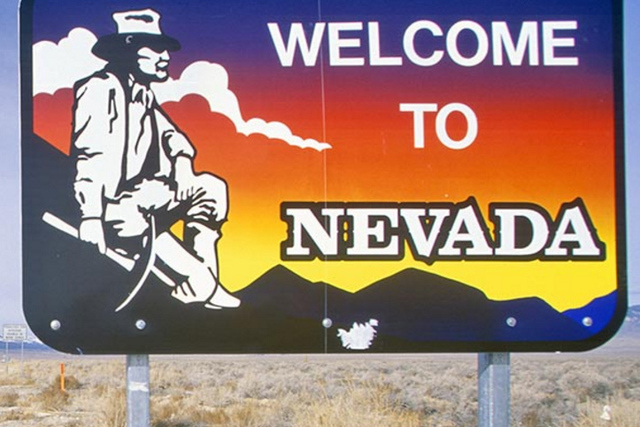
https://www.reviewjournal.com/wp-content/uploads/2016/09/web1_welcometonevada_7069366.jpg

Eddie McCoy was an hour’s drive out of Battle Mountain, Nevada, heading north on U.S. 95 for the Oregon border, when he slowed his Ford pickup and eased it onto the shoulder. He cut the engine, and the cylinders misfired and rattled on for a few seconds more before a final, smoky cough belched from the exhaust pipe. Eddie opened the door and stepped down into the sand, leaving his keys in the ignition. He limped around the truck bed and on out into the desert, his head down, his hands clasped behind his back, the look about him of a man who had reached the end of something.

A hundred yards from the truck Eddie came upon a shoulder-high boulder. He pulled himself up and sat, his legs dangling over the edge. A crimson fan of light was unfolding before the Rockies as the sun came up, blood red and as squat as a knifed-out heart somebody had put his boot to. Eddie reached into a shirt pocket for his Winstons and shook one out. He was edging a thumbnail under the matchbook cover when he noticed her. Eddie took out his cigarette. Pointed at him from the midnight-blue cover was a bent over, thonged bottom. Looking around from in front of the bottom smiled a woman with shoulder-length hair the color of dirty snow, “Debbie’s Ranch” etched above her head in an arc of pink script.

He shook his head. “Now, who in Hell ever heard of a cathouse advertising themselves with matchbooks? Like they was a bar or a restaurant. Some filling station a dad might consider stopping by for a Pepsi with his kids.”

Eddie rubbed a callused thumb over the woman’s bottom, shapely as any in a cowboy dream. “Well, I guess there’s a somebody out there who’s thought of everything you ain’t and are unlikely to ever will.”

He had gotten off I-80 a mile south of Battle Mountain the evening before, so dazed from the day’s driving he almost missed the exit. Twenty-four hours earlier, the clerk behind the desk in a Motel Six on the other side of Cheyenne had asked him when he checked in if he cared to reserve the room for a second night. The Weather Service was calling for a freak summer snowstorm to hit before the next nightfall.

“Room’s will be gone before you know it.” The clerk nodded at Eddie’s feet. “Hellfire, son. We’ll have folks sleeping where you’re standing.”

Eddie showered, and after he came out he sat on the bed wrapped in the towel and considered waiting out the storm in his room, catch up on some sleep. One turn through the channels on the chained-to-the-wall television settled his decision for him otherwise. Re-runs of sitcoms with no plots he thought dumb and had refused to watch the first time they’d been on. Mindless game shows with mindless contestants. People jawing about their problems who wouldn’t know a real one if it came up and kicked them in their rumps grown wide from sitting around jawing about their problems. He was up and on the road before dawn.

His truck had no air conditioning, and by evening Eddie was dehydrated from driving first
through the mountains and then the high desert. He hadn’t eaten anything since the jelly
doughnut he’d scarfed down in the motel lobby when he was checking out, and now he could hear his stomach growling even with the wind blasting through both rolled-down windows. The gas gauge needle was riding on “E” and had been for fifteen minutes. There were no cars before him and none behind, and with his bum leg, unless somebody stopped, he’d be crow bait before he limped into the next town.

Five days before, Eddie had blinked his eyes open at 4:44. The same time as he did every
morning. No alarm clock needed. He reached for Lisa, but because he was sleeping on the couch, his hand found only air.

Eddie unwound the sheet he had wrapped himself into during the night and swung his legs to the carpet and went into the quarter-bath off the kitchen. When he came out, he switched on the overhead stove light and from a cupboard took out a can of Fancy Feast. He stooped and divided it between Satchmoe and Sophie. The kitties were sitting by their respective bowls, in no hurry to get at their food and instead watching him, their ears perked, judging by his voice, his stroke of their coats, whether they would spend the day napping on their sun nook or hiding out in closet corners. On his way to the sink, Eddie emptied their water bowls in the one potted fern out of a dozen he’d not managed to kill. He filled the bowls and returned them and walked back to the bedroom.

He opened the closet door and with his toe poked at the pile of clothes heaped on the floor. He bent over and picked out a blue-denim shirt, and before he reached his arms into its sleeves he held it to his nose. As Eddie buttoned up the front, he sucked in the Rolling-Rock belly he’d been working on. He pulled on his gray canvas trousers, abraded and threadbare at the knees, and reached for his steel-toed boots. Before lacing up the left, he reached in a finger and traced the scar slicing his Achilles tendon.

“You ain’t dreamed of doin’ nothing since the day you bought this.” He took out his finger and knotted the laces. “Maybe it’s time you started.”

Eddie returned to the kitchen and scooped uncooked oatmeal into a bowl and poured over it last week’s milk. He walked out to the picture window in the living room and, as he ate, watched a full moon set over the duck pond across the street.

At the midmorning break, Eddie shut down his arc weld and walked into the supervisor’s office, his work cap in hand behind his back and asked for a couple of weeks off.

“Surprised you hadn’t asked for any before now.”

“Yes, sir.”

“You came in the day after the funeral.”

Eddie shifted his cap to his other hand. He looked at the office door window, its smoky, pebbled glass opaque. “I like to stay busy. Keeps me from wandering where I shouldn’t.”

After his shift let out, Eddie gassed up the truck and from a rack of roadmaps took one for the eastern half of the country. He’d have gotten one for the western states too, but the attendant said there wasn’t sufficient demand for the station to justify stocking them.

When he got home, Eddie walked next door to Jude and Christina Hardy’s. In their mailbox he laid a note with feeding instructions for the kitties and dropped his key on top of the note and crossed back across their lawns. Eddie put a TV dinner in the oven and went into the bedroom and packed a duffle bag and his toilet kit. At his dresser, Eddie studied her photograph, twisting his wedding band back and forth on his finger as if it were a lock whose combination he couldn’t quite get. He took it off and laid it before the frame, a thumb resting for a moment on the gold rim. Ten minutes later Eddie had eaten his half cooked supper and was in the truck, his Thermos of black coffee on the seat beside him, headed up Route 7 toward the Turnpike.

* * *

At the Battle Mountain exit, Eddie turned right and followed the sign pointing to town and
stopped at the first filling station he came to. He pulled up to one of eight rows of pumps and turned off the ignition and sat back in his seat. He looked at the gas gauge and tapped it with a knuckle. The needle didn’t so much as flicker.

He got out of his truck and walked around to a pump and studied the prices before he crossed the cement concourse and pushed open the door to the station. Behind the counter were two teenage boys, one slouched against the cash register, the other, his arms raised like a prize fighter, jabbing into the air with quick left stabs as he recounted a street fight he had witnessed the night before. The two wore identical sky-blue shirts with “Earl” stitched above the breast pocket of one and “Sam” above that of the other. Out of each ink-stained pocket protruded an air gauge and half a dozen pens. All twenty of their fingernails were broken and jagged and grease filled. They wore khaki-colored baseball caps, which bore above the bill a red and yellow “Sanderson’s Shell” decal. Out from under the caps spilled their oily, collar-length hair. Earl was cultivating a wispy mustache, and both were badly pimpled from a filling station fare of Cokes and Snickers and Lays, their faces red-budded like cactus flowers ready to pop.

Sam, the boy behind the cash register, straightened when Eddie came in. “Yes, sir?”

Eddie reached into a back pocket for his wallet and took out two fives and a ten and lay the bills on the counter. “Twenty on number thirteen pump.”

Sam reached for the money with one hand and rang up the purchase with the other. “Yes, sir. Twenty on lucky thirteen.”

Eddie turned to go, but halfway to the door he stopped and looked out the plate glass window.

The boys watched him.

“Will there be anything else?” Sam asked.

Eddie didn’t answer. He was studying his truck, which had taken on an odd hue under the
florescent lights, as though by some magic of desert air its paint had turned translucent and beneath it his truck glowed, softly, like a lanterned candle.

“I hope he ain’t going to get weird on us,” Earl whispered. He reached up and took down the restroom key that was hanging behind them and slid it under the counter. He looked out at Eddie’s truck. “Fornicate hisself all over our head like that one dude done last week.”
Eddie turned to the boys. “There some place abouts I can grab a bite to eat?”

A smile slowly spread across Earl’s face. He jostled Sam with his elbow. “Notice them plates?”

Sam nodded.

“Go ahead,” Earl hissed. “Tell him.”

“There’s Debbie’s.”

“Good place to eat?”

“None better,” Sam said. “Ask them about their desserts they serve with whipped cream
delight.”

Earl raised a hand to the other boy’s shoulder and turned his back. He seemed to have caught something in his throat.

“Which way is it?” Eddie asked.

Sam pointed out the window. “Go left when you pull back on the highway. ‘Bout two mile down the road. Big red sign out front right before their turnoff. Can’t miss it.”

Earl hacked all the harder.

“Thanks,” Eddie said and went out.

As he filled his gas tank, Eddie cleaned the dirt and the smashed, sun-baked bugs from the windshield. He went to the dispenser and grabbed a handful of paper towels. When he turned around, he took one step back toward his truck and stopped. A set of yellow eyes were pointing at him from behind the front grill. Eddie let go the towels, and the evening wind that had begun to rise at sunset scattered them across concourse and out into the desert.

He walked to the front of his truck and stooped and reached up under his bumper with the
handle of the window squeegee and pried out the carcass of the jackrabbit he’d thumped a mile this side of the Nevada line. Eddie grabbed the fur on the back of its neck and walked it to the trash container and dropped the rabbit in, pushing on its hindquarters with the squeegee handle to get it down the hole. “Let the dead bury the dead.”

He climbed back into his truck and pulled up to the road and stopped. At first the boys weren’t certain if he would go left, but he did.

“Think he’ll come back pissed?” Sam said.

“How long have you been pumping gas here?”

“Be a year in December.”

“So far, any of ‘em ever come back? Even that minister with his wife and kids in tow?”

Sam shook his head. He drummed his fingers on top of the register and looked down the road, the glow of Eddie’s taillights already swallowed by the coming of night, the red desert dust filling the air.

“Miss Debbie ought to be aputting us on commission for all the business we’re sending her way,” Earl said. “At least let us take it out in trade now and again with one of them big-titted girls of hers.”

Sam grinned. “You are one horned-up toad tonight.”

“No different than any other.”

When he saw the twenty-foot-tall billboard, Eddie took his foot from the gas pedal and touched his brakes. The lower row of bulbs had either not yet come on or burned out and not been replaced. The top row was lit, though, and beneath the lights “Debbie’s Ranch” was written in script.

A hundred feet beyond the sign he came to a gravel drive and stopped. He leaned over and
cranked open his passenger window. He saw no buildings, no window lights, just a blue neon “D” that hovered in the dark. Eddie shifted into first and followed the drive to a parking lot where the only other vehicle was a dust-covered Ram Charger. He switched off his headlights.

Outside his windshield, heat lightning flashed above the desert floor, illuminating within tall,
Telarian skeins hundreds of cacti, T-shaped like graveyard crosses. Along the horizon, he could make out the silhouette of the western most Rocky Mountains he had come out of late that morning as the snow had started to spit on his windshield.

When he climbed down from his pickup, the sand carried in the wind stung his eyes almost shut.

He lowered his head and limped as quickly as he could across the lot to the front door. Inside, Eddie took out his bandana and wiped the grit from his face, and he stood there a moment, his eyes graying a dark lit by brass lanterns hung from overhead beams.

The room had about it a queer odor, something similar to an alchemy of cow manure and
Channel Number 5. The sides of the adobe building swayed and had two-inch cracks running from floor to ceiling, and its walls were buttressed with piers not all a part of the original Spanish architecture. Hung on the walls were oil paintings framed in black patina as finely cracked as old enamel glazing. Portraits of formally dressed men and women who stood out in front of the premises, a woman in one holding a Winchester .30-.30 carbine in the crook of her arms.

Beneath the prints a collection of pioneer antiques. A foot-pedaled Singer sewing machine. An ancient stereopticon.

At a table near the bar sat a pot-bellied, wide-butted rancher, maybe ten years older than
Eddie, outfitted in too-tight jeans and ostrich-leather cowboy boots. He wore a snap-button
shirt made of red-checkered gingham, and an inch-thick dewlap of fat rolled over his neck collar he had drawn tight with a black string tie. A woman with orange-dyed hair and dressed in a rainbow-colored robe and matching turban sat dealing him cards, five times larger in size than cards from an ordinary deck and oddly printed. No spades or clubs. No hearts. The only card Eddie could make out had on it a hooded skeleton holding a scythe.

On the other side of the room sat two women, smiling at him with a casual carnality. One,
looking at him from over her shoulder, wore a pink, long-sleeved evening gown, similar to one he had seen on television when he managed to stay awake for the Academy Awards, except this woman’s dress was cut so low in the back the crack of her bottom showed. The other wore something like a one-piece bathing suit. Banana yellow, frilly and lacy, the woman’s enormous breasts all but spilling like cantaloupes out onto the table. The two kept on talking even as they appraised him from head to toe but mostly in the middle, eating him with their predacious eyes, and for the first time in months Eddie felt a swelling inside his trousers.

A white-haired man with a Colonel Sanders’ goatee stood behind a polished counter cut from birds-eye-maple. Eddie walked over to him and sat on a stool upholstered in rawhide and ran a hand through his hair.

“What’ll it be?”

Eddie didn’t look at him. He was trying to keep his focus on a square foot of wood-planked floor halfway between him and the two women. Out of the corner of his eye he saw the turbaned woman studying the cards before her, shaking her head as though what she saw met with her disapproval. He told the barman to bring him a Rolling Rock.

The fat man sitting at the table with the turbaned woman twisted around and smirked. The
barman arched his white eyebrows. He studied Eddie’s washed out, button-down shirt and
craned his neck over the counter and nodded at his boots. “Shoot. I could tell you was an
Eastern dude soon as you come through my door.”

“A what?”

“Ain’t no Rock served west of Omaha, son.”

“No?”

“Hardly any served west of St. Louis.”

Eddie nodded thoughtfully, as though the barman had graced him with one of life’s smaller
epiphanies. “I guess I hadn’t been paying all that much attention. Last few days I’ve been tryin’ some of the brews I can’t ordinarily get.”

Eddie scanned the backbar, studying the signs advertising Budweiser and Blue Ribbon and Mail Pouch Chewing Tobacco. “Just give me whatever you got on draught.”

“We only carry about ten.”

Eddie leaned forward and squinted at the tap handles.

“How ‘bout a nice cold Mich?” the barman said. “You got the look of about you of one of them Reno-high-rollers.”

Eddie grinned. “In that case . . .”

“Tall Michelob comin’ at you.”

The barman walked down the counter and crouched. Out of a freezer beneath the bar he took a frosted, fishbowl mug so large it took him both hands to hold. He stood and put mug beneath a tap, whistling as he drew the beer.

Along the backbar hung plastic-bagged snacks of peanuts and cashews. A raunchy Penthouse calendar. At one end, stood a tall jar with a rattlesnake coiled inside, the alcohol evaporated down so the tip of its tail had rotted white and a bit of its spine showed. Above the row of beer taps midway to the ceiling hung a chrome-plated reading light and beneath it a sign:

Our Pleasure Menu
Appetizers
Sensual Breast Massage
Lingerie Show
Power Shower for Two
Very Naughty Dancing
Entrees
Straight Lay
½ and ½
Reverse ½ and ½
Bondage for You or Me

The barman set the foaming mug before him. “That’ll be two-fifty.”

Eddie swallowed, his eyes locked on the Pleasure Menu.

“Two dollars and fifty cents,” the barman repeated, slowly and raising his voice, holding onto the mug by its stem.

The fat man at the table looked up to the ceiling and shook his head.

“Sorry,” Eddie said and reached for his wallet and put down a five-dollar bill.

The barman let go the mug and picked up the bill. “That’s okay, son. His first time here, our
menu has a way of sucking a man’s wind out right down to his gonads.”

Eddie looked back to the menu. “Boy, you got that right.”

The barman went to the register. When he came back, he lay down Eddie’s change and went to the sink at the other end and began to wash out the glasses he’d left soaping. Eddie lifted the fishbowl with both hands and emptied half of it. Across the room, Eddie could hear the whispers of the two women, but not the words. Their eyes never strayed from him. When he tried to get a better look, the women in pink gave him a pout, and with her hand parted the slit in the gown running along her thigh.

Eddie took another long drink of beer and stood and walked over to the old-time Wurlitzer
setting against the wall opposite from the two women and reached into his jeans’ pocket.

“It’s unplugged,” the barman called over to him.

Eddie turned around.

The barman was holding a glass up to a lantern, twisting it in the waxen light. He huffed on the glass and wiped at it some more with his cloth. “Got us a live orcheestra coming on in a bit.”

“You got a band?”

“No, an orchestra. One with violins and a cello and the whole shebang.”

“Shebanged before you get banged,” said the fat man at the table.

Eddie pushed the quarter back into his pocket. Above the jukebox hung a row of pencil
sketches. One of empty train tracks, a thin spire of smoke rising into the air far in the distance, the mountains in the background resembling those he’d seen from out in the parking lot. One of what looked like a portrait of the goateed barman. Pretty good likeness too. Another of a car plunging over a cliff into nothingness, a girl behind the wheel, an older woman behind her in the back seat holding up a bottle, the mouth of the girl open, her hair coming out in her hands like bunches of charred straw. A voice behind Eddie spoke.

“See anything you like?”

Eddie McCoy was an hour’s drive out of Battle Mountain, Nevada, heading north on U.S.
95 for the Oregon border, when he slowed his Ford pickup and eased it onto the
shoulder. He cut the engine, and the cylinders misfired and rattled on for a few seconds
more before a final, smoky cough belched from the exhaust pipe. Eddie opened the door
and stepped down into the sand, leaving his keys in the ignition. He limped around the
truck bed and on out into the desert, his head down, his hands clasped behind his back,
the look about him of a man who had reached the end of something.

A hundred yards from the truck Eddie came upon a shoulder-high boulder. He pulled
himself up and sat, his legs dangling over the edge. A crimson fan of light was unfolding
before the Rockies as the sun came up, blood red and as squat as a knifed-out heart
somebody had put his boot to.

Eddie reached into a shirt pocket for his Winstons and shook one out. He was edging a
thumbnail under the matchbook cover when he noticed her. Eddie took out his cigarette.
Pointed at him from the midnight-blue cover was a bent over, thonged bottom. Looking
around from in front of the bottom smiled a woman with shoulder-length hair the color of
dirty snow, Debbie’s Ranch etched above her head in an arc of pink script.

He shook his head. “Now, who in Hell ever heard of a cathouse advertising themselves
with matchbooks? Like they was a bar or a restaurant. Some filling station a dad might
consider stopping by for a Pepsi with his kids.”

Eddie rubbed a callused thumb over the woman’s bottom, shapely as any in a cowboy
dream. “Well, I guess there’s a somebody out there who’s thought of everything you ain’t
and are unlikely to ever will.”

He had gotten off I-80 a mile south of Battle Mountain the evening before, so dazed from
the day’s driving he almost missed the exit. Twenty-four hours earlier, the clerk behind
the desk in a Motel Six on the other side of Cheyenne had asked him when he checked in
if he cared to reserve the room for a second night. The Weather Service was calling for a
freak summer snowstorm to hit before the next nightfall.

“Room’s will be gone before you know it.” The clerk nodded at Eddie’s feet. “Hellfire, son.
We’ll have folks sleeping where you’re standing.”

Eddie showered, and after he came out he sat on the bed wrapped in the towel and
considered waiting out the storm in his room, catch up on some sleep. One turn through
the channels on the chained-to-the-wall television settled his decision for him otherwise.
Re-runs of sitcoms with no plots he thought dumb and had refused to watch the first
time they’d been on. Mindless game shows with mindless contestants. People jawing
about their problems who wouldn’t know a real one if it came up and kicked them in their
rumps grown wide from sitting around jawing about their problems. He was up and on the
road before dawn.

His truck had no air conditioning, and by evening Eddie was dehydrated from driving first
through the mountains and then the high desert. He hadn’t eaten anything since the jelly
doughnut he’d scarfed down in the motel lobby when he was checking out, and now he
could hear his stomach growling even with the wind blasting through both rolled-down
windows. The gas gauge needle was riding on “E” and had been for fifteen minutes. There
were no cars before him and none behind, and with his bum leg, unless somebody
stopped, he’d be crow bait before he limped into the next town.

Five days before, Eddie had blinked his eyes open at 4:44. The same time as he did every
morning. No alarm clock needed. He reached for Lisa, but because he was sleeping on the
couch, his hand found only air.

Eddie unwound the sheet he had wrapped himself into during the night and swung his
legs to the carpet and went into the quarter-bath off the kitchen. When he came out, he
switched on the overhead stove light and from a cupboard took out a can of Fancy Feast.
He stooped and divided it between Satchmoe and Sophie. The kitties were sitting by their
respective bowls, in no hurry to get at their food and instead watching him, their ears
perked, judging by his voice, his stroke of their coats, whether they would spend the day
napping on their sun nook or hiding out in closet corners. On his way to the sink, Eddie
emptied their water bowls in the one potted fern out of a dozen he’d not managed to kill.
He filled the bowls and returned them and walked back to the bedroom.

He opened the closet door and with his toe poked at the pile of clothes heaped on the
floor. He bent over and picked out a blue-denim shirt, and before he reached his arms into
its sleeves he held it to his nose. As Eddie buttoned up the front, he sucked in the Rolling-
Rock belly he’d been working on. He pulled on his gray canvas trousers, abraded and
threadbare at the knees, and reached for his steel-toed boots. Before lacing up the left,
he reached in a finger and traced the scar slicing his Achilles tendon.

“You ain’t dreamed of doin’ nothing since the day you bought this.” He took out his finger
and knotted the laces. “Maybe it’s time you started.”

Eddie returned to the kitchen and scooped uncooked oatmeal into a bowl and poured over
it last week’s milk. He walked out to the picture window in the living room and, as he ate,
watched a full moon set over the duck pond across the street.

At the midmorning break, Eddie shut down his arc weld and walked into the supervisor’s
office, his work cap in hand behind his back and asked for a couple of weeks off.

“Surprised you hadn’t asked for any before now.”

“Yes, sir.”

“You came in the day after the funeral.”

Eddie shifted his cap to his other hand. He looked at the office door window, its smoky,
pebbled glass opaque. “I like to stay busy. Keeps me from wandering where I shouldn’t.”

After his shift let out, Eddie gassed up the truck and from a rack of roadmaps took one
for the eastern half of the country. He’d have gotten one for the western states too, but
the attendant said there wasn’t sufficient demand for the station to justify stocking them.

When he got home, Eddie walked next door to Jude and Christina Hardy’s. In their
mailbox he laid a note with feeding instructions for the kitties and dropped his key on top
of the note and crossed back across their lawns. Eddie put a TV dinner in the oven and
went into the bedroom and packed a duffel bag and his toilet kit. At his dresser, Eddie
studied her photograph, twisting his wedding band back and forth on his finger as if it
were a lock whose combination he couldn’t quite get. He took it off and laid it before the
frame, a thumb resting for a moment on the gold rim. Ten minutes later Eddie had eaten
his half cooked supper and was in the truck, his Thermos of black coffee on the seat
beside him, headed up Route 7 toward the Turnpike.

* * *

At the Battle Mountain exit, Eddie turned right and followed the sign pointing to town and
stopped at the first filling station he came to. He pulled up to one of eight rows of pumps
and turned off the ignition and sat back in his seat. He looked at the gas gauge and
tapped it with a knuckle. The needle didn’t so much as flicker.

He got out of his truck and walked around to a pump and studied the prices before he
crossed the cement concourse and pushed open the door to the station. Behind the
counter were two teenage boys, one slouched against the cash register, the other, his
arms raised like a prize fighter, jabbing into the air with quick left stabs as he recounted a
street fight he had witnessed the night before. The two wore identical sky-blue shirts with
“Earl” stitched above the breast pocket of one and “Sam” above that of the other. Out of
each ink-stained pocket protruded an air gauge and half a dozen pens. All twenty of their
fingernails were broken and jagged and greasefilled.
They wore khaki-colored baseball caps, which bore above the bill a red and yellow
Sanderson’s Shell decal. Out from under the caps spilled their oily, collar-length hair. Earl
was cultivating a wispy mustache, and both were badly pimpled from a filling station fare
of Cokes and Snickers and Lays, their faces red-budded like cactus flowers ready to pop.

Sam, the boy behind the cash register, straightened when Eddie came in. “Yes, sir?”

Eddie reached into a back pocket for his wallet and took out two fives and a ten
and lay the bills on the counter. “Twenty on number thirteen pump.”

Sam reached for the money with one hand and rang up the purchase with the
other. “Yes, sir. Twenty on lucky thirteen.”

Eddie turned to go, but halfway to the door he stopped and looked out the plate
glass window. The boys watched him.

“Will there be anything else?” Sam asked.

Eddie didn’t answer. He was studying his truck, which had taken on an odd hue
under the florescent lights, as though by some magic of desert air its paint had
turned translucent and beneath it his truck glowed, softly, like a lanterned candle.

“I hope he ain’t going to get weird on us,” Earl whispered. He reached up and
took down the restroom key that was hanging behind them and slid it under the
counter. He looked out at Eddie’s truck. “Fornicate hisself all over our head like
that one dude done last week.”

Eddie turned to the boys. “There some place abouts I can grab a bite to eat?”

A smile slowly spread across Earl’s face. He jostled Sam with his elbow. “Notice
them plates?”

Sam nodded.

“Go ahead,” Earl hissed. “Tell him.”

“There’s Debbie’s.”

“Good place to eat?”

“None better,” Sam said. “Ask them about their desserts they serve with whipped
cream delight.”

Earl raised a hand to the other boy’s shoulder and turned his back. He seemed to
have caught something in his throat.

“Which way is it?” Eddie asked.

Sam pointed out the window. “Go left when you pull back on the highway. ‘Bout
two mile down the road. Big red sign out front right before their turnoff. Can’t
miss it.”

Earl hacked all the harder.

“Thanks,” Eddie said and went out.

As he filled his gas tank, Eddie cleaned the dirt and the smashed, sun-baked
bugs from the windshield. He went to the dispenser and grabbed a handful of
paper towels. When he turned around, he took one step back toward his truck
and stopped. A set of yellow eyes were pointing at him from behind the front grill.
Eddie let go the towels, and the evening wind that had begun to rise at sunset
scattered them across concourse and out into the desert.

He walked to the front of his truck and stooped and reached up under his
bumper with the handle of the window squeegee and pried out the carcass of the
jackrabbit he’d thumped a mile this side of the Nevada line. Eddie grabbed the fur
on the back of its neck and walked it to the trash container and dropped the
rabbit in, pushing on its hindquarters with the squeegee handle to get it down
the hole. “Let the dead bury the dead.”

He climbed back into his truck and pulled up to the road and stopped. At first the
boys weren’t certain if he would go left, but he did.

“Think he’ll come back pissed?” Sam said.

“How long have you been pumping gas here?”

“Be a year in December.”

“So far, any of ‘em ever come back? Even that minister with his wife and kids in
tow?”

Sam shook his head. He drummed his fingers on top of the register and looked
down the road, the glow of Eddie’s taillights already swallowed by the coming of
night, the red desert dust filling the air.

“Miss Debbie ought to be aputting us on commission for all the business we’re
sending her way,” Earl said. “At least let us take it out in trade now and again
with one of them big-titted girls of hers.”

Sam grinned. “You are one horned-up toad tonight.”

“No different than any other.”

When he saw the twenty-foot-tall billboard, Eddie took his foot from the gas
pedal and touched his brakes. The lower row of bulbs had either not yet come on
or burned out and not been replaced. The top row was lit, though, and beneath
the lights Debbie’s Ranch was written in script.

A hundred feet beyond the sign he came to a gravel drive and stopped. He leaned
over and cranked open his passenger window. He saw no buildings, no window
lights, just a blue neon “D” that hovered in the dark. Eddie shifted into first and
followed the drive to a parking lot where the only other vehicle was a dust-
covered Ram Charger. He switched off his headlights. Outside his windshield, heat
lightning flashed above the desert floor, illuminating within tall, Telarian skeins
hundreds of cacti, T-shaped like graveyard crosses. Along the horizon, he could
make out the silhouette of the western most Rocky Mountains he had come out
of late that morning as the snow had started to spit on his windshield.

When he climbed down from his pickup, the sand carried in the wind stung his
eyes almost shut. He lowered his head and limped as quickly as he could across
the lot to the front door. Inside, Eddie took out his bandana and wiped the grit
from his face, and he stood there a moment, his eyes graying a dark lit by brass
lanterns hung from overhead beams.

The room had about it a queer odor, something similar to an alchemy of cow
manure and Channel Number 5. The sides of the adobe building swayed and had
two-inch cracks running from floor to ceiling, and its walls were buttressed with
piers not all a part of the original Spanish architecture. Hung on the walls were oil
paintings framed in black patina as finely cracked as old enamel glazing. Portraits
of formally dressed men and women who stood out in front of the premises, a
woman in one holding a Winchester .30-.30 carbine in the crook of her arms.

Beneath the prints a collection of pioneer antiques. A foot-pedaled Singer sewing
machine. An ancient stereopticon.

At a table near the bar sat a pot-bellied, wide-butted rancher, maybe ten years
older than Eddie, outfitted in too-tight jeans and ostrich-leather cowboy boots.

He wore a snap-button shirt made of red-checkered gingham, and an inch-thick
dewlap of fat rolled over his neck collar he had drawn tight with a black string tie.

A woman with orange-dyed hair and dressed in a rainbow-colored robe and
matching turban sat dealing him cards, five times larger in size than cards from
an ordinary deck and oddly printed. No spades or clubs. No hearts. The only card
Eddie could make out had on it a hooded skeleton holding a scythe.

On the other side of the room sat two women, smiling at him with a casual
carnality. One, looking at him from over her shoulder, wore a pink, long-sleeved
evening gown, similar to one he had seen on television when he managed to stay
awake for the Academy Awards, except this woman’s dress was cut so low in the
back the crack of her bottom showed. The other wore something like a one-piece
bathing suit. Banana yellow, frilly and lacy, the woman’s enormous breasts all but
spilling like cantaloupes out onto the table. The two kept on talking even as they
appraised him from head to toe but mostly in the middle, eating him with their
predacious eyes, and for the first time in months Eddie felt a welling inside his
trousers.

A white-haired man with a Colonel Sanders’ goatee stood behind a polished
counter cut from birds-eye-maple. Eddie walked over to him and sat on a stool
upholstered in rawhide and ran a hand through his hair.

“What’ll it be?”

Eddie didn’t look at him. He was trying to keep his focus on a square foot of
wood-planked floor halfway between him and the two women. Out of the corner
of his eye he saw the turbaned woman studying the cards before her, shaking
her head as though what she saw met with her disapproval. He told the barman
to bring him a Rolling Rock.

The fat man sitting at the table with the turbaned woman twisted around and
smirked. The barman arched his white eyebrows. He studied Eddie’s washed out,
button-down shirt and craned his neck over the counter and nodded at his
boots. “Shoot. I could tell you was an Eastern dude soon as you come through
my door.”

“A what?”

“Ain’t no Rock served west of Omaha, son.”

“No?”

“Hardly any served west of St. Louis.”

Eddie nodded thoughtfully, as though the barman had graced him with one of life’
s smaller epiphanies. “I guess I hadn’t been paying all that much attention. Last
few days I’ve been tryin’ some of the brews I can’t ordinarily get.”

Eddie scanned the back bar, studying the signs advertising Budweiser and Blue
Ribbon and Mail Pouch Chewing Tobacco. “Just give me whatever you got on
draught.”

“We only carry about ten.”

Eddie leaned forward and squinted at the tap handles.

“How ‘bout a nice cold Mich?” the barman said. “You got the look of about you of
one of them Reno-high-rollers.”

Eddie grinned. “In that case . . .”

“Tall Michelob comin’ at you.”

The barman walked down the counter and crouched. Out of a freezer beneath the
bar he took a frosted, fishbowl mug so large it took him both hands to hold. He
stood and put mug beneath a tap, whistling as he drew the beer.

Along the backbar hung plastic-bagged snacks of peanuts and cashews. A
raunchy Penthouse calendar. At one end, stood a tall jar with a rattlesnake coiled
inside, the alcohol evaporated down so the tip of its tail had rotted white and a
bit of its spine showed. Above the row of beer taps midway to the ceiling hung a
chrome-plated reading light and beneath it a sign:

Our Pleasure Menu
Appetizers
Sensual Breast Massage
Lingerie Show
Power Shower for Two
Very Naughty Dancing
Entrees
Straight Lay
½ and ½
Reverse ½ and ½
Bondage for You or Me

The barman set the foaming mug before him. “That’ll be two-fifty.”

Eddie swallowed, his eyes locked on the Pleasure Menu.

“Two dollars and fifty cents,” the barman repeated, slowly and raising his voice,
holding onto the mug by its stem.

The fat man at the table looked up to the ceiling and shook his head.

“Sorry,” Eddie said and reached for his wallet and put down a five-dollar bill.

The barman let go the mug and picked up the bill. “That’s okay, son. His first time
here, our menu has a way of sucking a man’s wind out right down to his gonads.”
Eddie looked back to the menu. “Boy, you got that right.”

The barman went to the register. When he came back, he lay down Eddie’s
change and went to the sink at the other end and began to wash out the glasses
he’d left soaping. Eddie lifted the fishbowl with both hands and emptied half of it.

Across the room, Eddie could hear the whispers of the two women, but not the
words. Their eyes never strayed from him. When he tried to get a better look,
the women in pink gave him a pout, and with her hand parted the slit in the gown
running along her thigh.

Eddie took another long drink of beer and stood and walked over to the old-time
Wurlitzer setting against the wall opposite from the two women and reached into
his jeans’ pocket.

“It’s unplugged,” the barman called over to him.

Eddie turned around.

The barman was holding a glass up to a lantern, twisting it in the waxen light. He
huffed on the glass and wiped at it some more with his cloth. “Got us a live
orcheestra coming on in a bit.”

“You got a band?”

“No, an orcheestra. One with violins and a cello and the whole shebang.”

“Shebanged before you get banged,” said the fat man at the table.

Eddie pushed the quarter back into his pocket. Above the jukebox hung a row of
pencil sketches. One of empty train tracks, a thin spire of smoke rising into the
air far in the distance, the mountains in the background resembling those he’d
seen from out in the parking lot. One of what looked like a portrait of the goateed
barman. Pretty good likeness too. Another of a car plunging over a cliff into
nothingness, a girl behind the wheel, an older woman behind her in the back seat
holding up a bottle, the mouth of the girl open, her hair coming out in her hands
like bunches of charred straw. A voice behind Eddie spoke.

“See anything you like?”

Eddie turned around. She looked to be maybe twenty, tall for a girl even
accounting for her three-inch stiletto pumps. She wore a loose-fitting, black linen
dress that fell half way down her cheerleader-muscled thighs. The dress was
short-sleeved to her elbows, and not low cut across the bust that showed off all
the more her brickhouse figure. When she turned her head, the girl’s dangling
earrings winked in the lantern lights. Her eyes were a forget-me-not blue, shiny,
like those of a small-town girl the first time she thinks a boy likes her. She had
the prettiest smile Eddie had ever seen, yet impish, as though she was about to
have some fun, not with any malice, but only to see if he caught her sense of
humor. She had highlighted her sparrow-brown hair with hints of henna and
permed it into ringlet curls that fell to her neck and gleamed as though she had
wandered in from the rain.

Eddie’s eyes darted across the room to the two women. He looked back to the
girl. “Miss?”

She nodded at the wall behind the jukebox. “See anything you like?”

He turned and looked again at the drawings. “They’re all good.”

“Thank you.”

Eddie tapped a thumb knuckle against his chin. “Very good.”

“I drew them.”

He turned back to her. “No fooling?”

She smiled and cocked her head toward the bar. “Buy a lady a drink?”

The barman had a napkin on the counter next to Eddie’s beer and stood waiting.

“Your usual, sweet pea?”

“Yes, easy on the ice for the first one.”

“As always.” The barman turned to Eddie. “Another fishbowl for you, pardner?”

“I would, thank you,” Eddie said, and reached for his wallet and brought out a
twenty and lay it before him. “In case you’ll be wanting a re-fill,” he said.

A television set was turned on in a room behind the backbar. God talks to us in
Genesis about Adam and Eve. He doesn’t say anything about Adam and Steve.
Not in Genesis and not anywhere else.

The girl giggled. “Debbie loves Jerry Falwell.”

“Really?”

“Sunday mornings he’s on too early. So she videotapes his sermons and watches
the show in the evening.”

The barman set down their drinks.

“Debbie says preachers make the best lays.”

“I’d never heard that.”

The girl twisted around on the stool and with her painted eyes looked about the
bar. She sipped on her straw. “You’d be surprised what you can learn here about
people.”

She set her drink on the bar and rotated the stool so the outside of her knees
touched the inside of his. “So what’s your name, sweetie?”

He told her. “Yours?”

The girl looked up at the lantern above them. She twisted a ringlet of hair about
her forefinger. “Have you ever read Moby Dick?”

Eddie glanced down at his steel-toed boots, dusty and grease stained. He shook
his head. “Never been much of a reader.”

The girl smiled. She took her hand from her hair and put two fingers over the
inside of her wrist as if she’d some blemish to conceal. “Call me Isabella.”

Eddie whispered her name half aloud. “I ain’t never met no Isabella before.”

“Or Izzy if you like.”

He considered her suggestion, slightly rocking his head from side to side. “All
right. Izzy suits me fine.”

“Where you headed to?”

“Portland.”

“As in Oregon? Or the other direction, as in Maine?”

“No, Oregon,” Eddie said. “My buddy, George, works on a paper up there. When I
get to his place he’s fixing to take a few days off to take me fishin’.”

Izzy leaned and sipped at her drink, a tall concoction of various colored liquids
layered one atop the other. She looked at the turbaned woman, and when she
straightened from her drink she sighed. “You have to admire someone who will
cheat at tarot, don’t you think?”

“Excuse me?”

“Of course, it will do her no good. Your fate is your fate. Ahab will tell you as
much.”

Eddie looked down the bar to the cash register. “He the bartender?”

The girl shook her head. A woman came in through the back door, hips swaying
to her own drummer, and Izzy called out. “Now, there’s a real honey.”

The woman put a hand to her peroxide scalded hair. “There’s a real honey,
herself.”

The girl stirred her drink. “Where you from?”

When he told her, Izzy’s eyes lit up. “Me too.”

“Really?”

“Athens. You know where that is?”

“Not exactly.” Eddie emptied his fishbowl and to the bartender pointed two
fingers at their glasses.

“Wasn’t born there,” Izzy said.

“Where was it you was born?”

“Germany. Frankfurt.”

“How’d you come to be born there?”

“My dad was in the Army.”

The barman brought their drinks. She raised her glass to Eddie. “Thank you.”

“My pleasure.”

“It can be,” Izzy said. She put her plum shaded lips to the straw and winked.
Eddie’s face reddened, and Izzy laughed and laid her hand on his forearm. “Just
kidding. Debbie doesn’t pressure us to get down to business. If a guy wants to
come in and talk, what she loses in tricks she makes up on the drinks they buy
us.”

She took back her hand. “I don’t normally start out with a guy by giving up my
life story. Not even a little of it.”

“How come you did with me?”

The girl put her fingertips to the rim of her glass and twisted it back and forth as
she might the channel dial on a car radio. “Because you’re from home.”

“Your mom and dad still there?”

“Her and my step-dad.”

“Step-dad?”

“Mom left my real dad a couple of months after I came along.”

Through the door adjacent the back bar came three young men, striding almost
in a parade march, clean cut, their faces as solemn as door-to-door Jehovah’s
Witnesses, instrument valises in hand and dressed in black tuxedos and white
bow ties and scarlet cummerbunds. They crossed the room to a redwood dais in
the far corner and uncased their instruments. Eddie watched as they tightened
and tuned the strings. After a while he asked Izzy what kind of band they were.

“Chamber orchestra.”

“I can’t recollect ever hearing one of them.

“The blond kid is Debbie’s nephew. He’ll be a senior at UNLV come fall. She pays
his tuition. Makes him come up here on his breaks. Says it gives the place some
class. Entice some of those high rollers from Reno to come our way before they
head back to Tahoe and San Francisco.”

She finished her drink. The bartender set before her another. They watched the
musicians. “What kind of tunes is it they play?” Eddie said.

“Lots of Bach. Some Teleman. Debbie prefers baroque to classical, the German
composers to the Italian, seeing how she was brought up Lutheran, but she’ll
allow them to play some Mozart now and again.”

“Charlie Daniels most likely is out of the question?”

“Oh, they could, but they wouldn’t get past the first chord before Debbie would
be out here, cussing them red, Reverend Jerry on Sunday be damned.”

The musicians raised their instruments. “They’re really very good.”

The cello player slowly drew his bow across the strings. Izzy closed her eyes and
smiled like a woman just kissed. “I love the cello.”

As they listened, the girl’s long, unringed fingers moved gently to the music like
they were brushing away smoke.

“Too bad about your folks divorcing when you was so young and all.”

“Better than when I got older. One less person I don’t have to forget.”

“Was your mom expecting when she got married?”

Izzy stirred her drink.

“Sorry. I’ve picked up a bad habit of nosing where I shouldn’t be.”

“She was an orphan.”

“I see,” Eddie said, and nodded, as though her mother being an orphan explained
how it was her daughter had ended up selling herself.

“Mom’s father died of a heart attack before she was born. Her mother when she
was five. Breast cancer. She and Aunt Mary and Uncle Ralph were raised by Aunt
Iris. My great-aunt.”

The musicians had come to the end of the first piece and were leafing through
their sheets of music, quietly debating among themselves what next to play. Izzy
slipped off her stool and crossed to the dais and said something to Debbie’s
nephew. He spoke to the others who again raised their instruments. The girl
returned to the bar.

“It’s an allegro,” Izzy said. “By Vivaldi.”

Eddie lowered his head. It sounded similar to church music only with more joy. He
told her it was very pretty.

“On the day I’m married, this will be my recessional.”

Izzy leaned back and rested both her elbows on the bar behind her so that she
faced the musicians. “On New Year’s Eve, when Iris was at her Saint Patrick’s
bingo extravaganza, Mom snuck out with her cronies and drove to a bar down in
Parkersburg. That’s where she met my dad.”

“Short courtship?”

“Goodness no. Mom’s not cheap. They dated for more than a month. Got married
on Valentine’s Day.”

“Love at first sight?”

Izzy shook her head. “Mom wanted to get away from Iris is all, and she met a
man horned up enough to take her on, warts and all. When I came along, she
was a year younger than I am now. After she dumped him and came home, she
dumped me on Iris. Moved up to Columbus, and from what Iris told me it was
party central.”

“How old was you when she remarried?”

“Almost six.”

“You go to live with them?”

“Yeah. Didn’t want to.”

“I can see why not,” Eddie said.

“She scared me. Before Mom remarried, on the days she could recover from her
hangover and bother herself to drive down, she had a temper that was all match
and no fuse. Sometimes I hid out under the porch until she left.”

Since Eddie had come in, the wind had steadily picked up, and now it whistled
through the cracks that fissured the adobe, swinging the lanterns. The candle
flame in the lamp above them flickered as it healed in a circle around the glass.

“She only got worse,” the girl said.

The orchestra came to the end of the music that some day would usher Izzy into her
new life. The musicians turned the pages.

“After I flunked sophomore chemistry this spring, she told me to get the fuck out of
her house. Her exact words.”

She laughed.

“What’s so funny?”

“Not only did I get the fuck out of her house, I got out of her house fucking.”

Izzy rolled up her right sleeve. “Let me show you. Better than any Reno-Front-Street-
tattoo.”

She shifted around on the stool and held out her arm so that the light illuminating the
Pleasure Menu shone upon it. Below the shoulder, her arm concaved in, a third of the
deltoid muscle carved away, the skin wrinkled and discolored to a deep purple, like an
eggplant someone had set in the oven to bake and forgotten.

Eddie started to reach out to touch her shoulder, but stopped. He emptied his beer.

When the barman brought him another, Eddie asked for a shooter of Old Granddad.

“I ain’t even gonna ask how you managed that one.”

The barman brought the shooter. Eddie downed it before the barman could leave and
handed back the glass and asked him to bring another.

“I was sitting at the kitchen table, working on a sketch of Aunt Iris for art class. Mom
was at the stove, frying cod and drinking wine. Too much wine. Maybe her third or
fourth glass. Like always, mad as hell about something, muttering goddamnit this and
fuck that.”

Izzy raised her glass as if to drink, but set it back on the bar. “Mom lifted the skillet,
like she was going to drain the grease in the sink, holding it on her side between us.

As she passed, I twisted my drawing around to show her, but she was already staring
at it, her hand holding the skillet handle quivering, the grease in the pan swishing
around the rim.

“She tipped the skillet, and the grease splattered over my shoulder. Cooked it like one
more piece of cod. When she ripped off my sweater, she took with it every stitch of
skin right down to the elbow. I must have passed out because the next thing I
remember is waking up in intensive care.”

The barman brought his shooter. Eddied took the drink and downed it, nodding as he
handed back the glass.

“After the social worker allowed me to go home, I had to bathe my arm three and four
times a day because of the puzzy seepage. The odor reminded me of dead fish with
their plucked out eyes that wash up on the beach that I could smell before I saw
them. That was me. You could smell me before you saw me. Know exactly what room
I was in before you came in. Or didn’t come in.

“In the summer, a quack surgeon Mom found in Columbus did the skin grafts. I read
in the paper a while ago he lost his license for over-billing insurance companies and
kicking back half to the patients.”

Izzy fingered the stubble on her shoulder, the hair as thick and fine as that on a
shaved cat. “He took the grafts from my lower abdomen. I hadn’t yet reached
puberty, and in a year or so when I did, not only did I have an ugly scar, but surprise!
I had an ugly scar that grew pussy hair. One I get to shave once a week just like I do
my legs.”

She pulled down her sleeve and smoothed out the material. “She missed my face only
because she was drunk. If she hadn’t, I’d be a star attraction with Barnum & Bailey
rather than in a whorehouse. Come see the girl who grows cunt hair on her face.

“When she told me to get out, I went to Iris. She bought me ‘Hector,’ that yellow
Plymouth parked in back. The next week I headed for California. Got as far as Battle
Mountain before my money ran out.”

She twisted around on the stool, her eyes sweeping over the bar. “I couldn’t have
ended up in a nicer place. I like the guys that come in. Got some regulars going now.”

Eddie emptied the shot glass the barman had set before him. He washed it down with
a good portion of the fishbowl. “Guess you’re glad to be clear of her.”

The girl shook her head. “There’s a dream I started having not long after I got here. I’
ll be driving Hector car west on I-80. My back seat stacked high and my trunk filled full
with everything I own. The sun is shining and a cloudless sky gleams turquoise blue.

The wind is blowing through the rolled-down window and whips my hair so that it
flows out like the tail of a mare at full gallop, and when me and Hector cross the state
line into Indiana, I let go with my best, cheerleader-touchdown whoop.

“As we cross the country, oceans of corn surround us, and I’m the intrepid voyager,
an Ishmael of the Mid-west, finally set free on my life’s journey. I sing along to every
song that plays on the radio, even the country western tunes when I have trouble
picking up rock stations west of the Mississippi, and I sing these all the louder
because Mom hated them so much, and for the first time in a long while I am happy.

“When we climb into the Rockies, Hector struggles up the steep grades. I keep
watching his engine temperature, and as the needle gets close to the red “H” I drop
our speed, sometimes down to 20 miles an hour. Steam smokes out of the radiator. I
hold my breath and ask God to please see us through to California. Please. If He will, I
would never ask for anything more. Oh, please, please, please.

“I pray and pray and pray until a sign tells me that we have crested the Continental
Divide. As Hector and me start our decent to the Pacific, the temperature gauge
drops. I begin to sing California Here We Come, repeating the verses over and over
until in the mirror I see my mother in the back seat, holding up a bottle of Drano, my
possessions strewn across the Interstate behind us.

“She scolds me not to be a nitwit. To watch the road. I do. In the mirror I am
watching her too. As she twists off the bottle cap, my fingers feel glued to the
steering wheel, and I want with all my heart to let go. Bottle in hand, she reaches
over the seat, smiling, her gleaming white teeth pointed, sharp as a she wolf’s, and
pours the Drano over my head, like a priest blessing me into a new life might
administer a baptismal, burning into my scalp, eating away my skin, blinding my eyes.

I finally let go the steering wheel and reach up and my hair comes out in handfuls.
Hector careens off the road and crashes through the guardrail. As we’re falling, my
mother leans over the seat and whispers in my ear, asking me if I really believed
escaping her would be all that easy. Asking me why I was so silly to believe it even
possible.”

Izzy emptied her glass. She raised it to the barman, but his back was to her, pouring
a drink for the fat man who had left the tarot cards and now stood at the far end of
the counter. When he saw the girl, he puckered his thick lips at her. She shrugged.

She lowered her glass to the bar and turned to Eddie, who sat staring into his cupped
hands. Izzy reached over and took his left into both of hers. She rubbed a thumb
over his ring finger. “You’re not married, sweetie?”

Eddie didn’t answer.

“Divorced?”

When he still did not answer, Izzy reached up and jostled his shoulder. “Hey, anybody
home?”

Eddie shook his head.

“I hope you’re not queer. One wonders in every now and again. Why I don’t know.”
She squinted at him with one eye. “You don’t look like a pillow biter.”

Eddie lifted his fishbowl. “No. Not yet, leastwise.”

She ran her fingertips through his hair above his ear. “Good looking guy like you
never been married?”

“Yeah. I was.”

“Long ago?”

“Long enough.”

Izzy raised her glass to the barman again who this time saw her. They sat. When the
orchestra began an adagio, Izzy asked if he cared to slow dance, and Eddie told her
about his gimpy leg.

“You sure you just don’t know how? I can teach you.”

Eddie lifted his boot and rested its heel on his knee. He loosened the laces and pulled
his foot part way out and rolled down his sock. She bent forward and ran her finger
from the outside ball of his anklebone to the inside ball along the jagged scar that
sliced his Achilles tendon.

“Nice,” she said.

“Not as nice as yours.”

“At least I can dance. Girl who can’t dance doesn’t stand a chance in her life.”

“Her life,” Eddie repeated.

“What about it?”

He looked at the girl’s neck. Her breasts. Her eyes. “You know what a Y-scar is?”
“It’s what you get when you’ve been autopsied.”

Eddie pulled his sock up. As he re-laced his boot, a kid came in, his black Stetson
cocked back a little, grinning crookedly as though to the punch line of a randy joke he
didn’t quite get. When he spotted the two women who had been eyeing Eddie, he
walked over to their table and said something. He waved to the barman and made a
circling motion around the table with his finger, and told the barman to bring him a
Coors.

The bar had been filling, and a girl who didn’t look old enough to drive was waiting the
tables. After the barman poured the drinks the kid had ordered, he placed them on a
tray and pushed it toward the girl, who carried the tray over to the table. As she bent
to serve the drinks, the girl knocked over the kid’s beer. The kid grinned all the more
and said something. The women laughed, and the girl hurried back to the bar.

“What is it, Sylvia?” the bartender said.

The girl’s eyes were wet. “He said my tits were too big.”

“He said what?”

“That hick sonofabitch said the reason I knocked over his stupid beer was on account
of my tits being too big.”

The barman tried not to smile. He walked to the end of the bar. He seemed to be
studying the tall jar holding the rattlesnake. When he came back, the barman told
Sylvia to see if any of the girls needed help getting dressed. “I can handle the tables
for a while until you collect yourself.”

“All right.”

“Don’t be too long.”

After the girl left, Izzy said that Sylvia had just gotten into town. “Hitchhiked in from
Montana. Sheep ranch twenty miles outside of Billings. Been here not quite a week.

Hasn’t got used to the guys having their fun. Teasing her and such.”

“Who’s the cowboy?”

Izzy looked over at the table. “Oh, that’s Hanky.”

“Hanky?”

“My Sunday sweetie.”

Eddie grinned. “You got one for every day of the week?”

“Not yet. He’s one of my regulars, though. Comes in to see me after his wife’s gone
off to prayer meeting.”

“Kindly taking his life into his own hands, ain’t he?”

Izzy shook her head. “Closest Baptist church holding Sunday evening services is the
one way over in Reno. Be close to midnight before she’s home. Later, if she stops to
play the slots. It’s early, and he’s a bit quick on the draw so he’ll be home and tucked
in long before she’s back.”

“I thought maybe he was interested in one of them two at the table,” Eddie said.

“No, he’s just flirting with Delores and Sweet Sally, trying to get me jealous, see if I’ll
give him a Sunday special. He’ll be over directly.”

The orchestra began again.

“Bach,” Izzy said, and smiled. Joy.

They listened. When the barman came by, he picked up her empty glass, leaving
behind on the wood a circle of damp breath. She watched as it waned inward from the
edges until it disappeared altogether. “You know, sweetie, you’re not going to find
her in here.”

Eddie fingered the threads fraying from a sleeve of the shirt she had bought for him
on his last birthday, his and her interlinked initials sewn into the cuffs.

“You don’t seem like the type to even try to.”

“Didn’t know where I was until I came in.”

Izzy grinned. “I’ll bet you stopped at the Shell station.”

“How’d you know?”

“Sanderson’s brats are always sending some unsuspecting soul this way. They must
have got wind about Debbie’s thing for preachers because a month back they sent
one over, him wearing a white collar. He and his wife and a half dozen, snot-nosed-
bastard brats. The oldest even pinched my butt while Debbie was trying to talk his
parents into a threesome.”

The musicians played. As the bar filled with men, women came in by the back door.
Some wore little more than fancy underwear beneath see-throughs. Others could
have been Cinderella stopping by on her way to the ball. One woman wore a black
satin blouse and a tight, blue leather skirt with a whip looped around her belt and
boots that reached halfway up her thighs. There was no formality about them, and
they and the men seemed as well acquainted as Elks at a lodge meeting.

The bartender came up to Izzy. “I hate to ask you this, darlin’, but you being the
newbie and all.”

“That’s ok.”

“We’ve gotten too busy for me both to be waiting tables and working the bar.”

Izzy got down from the stool.

“It’ll just be for another minute ‘til Sylvia collects herself.” He looked at Eddie. “Let me
get you another on the house until she comes back on.”

Eddie raised his hand.

Izzy smiled. “I think my friend might be finished for the night.”

Eddie nodded. He reached for his wallet and lay a ten-dollar bill on top of the change
pile and twisted his stool around toward the door. As he started to rise, Izzy placed
two fingers on the inside of his wrist. “Thank you for not asking me why I became a
whore.” Her eyes swept the room. “For some men, my loving isn’t enough. They have
to have my soul too.”

He took her fingers from his wrist, and holding both her hands in his looked into the
girl’s eyes where he saw his reflected self dropping down a well with no bottom to it.

“Didn’t see the need.”

He gave her hands a squeeze. “You take care, sweetie.”

“You too.”

Eddie started for the door. He stopped and turned back. “I hope you get what you’re
after. Whatever it is.”

Izzy looked over to the table where the kid still stood. She looked at Eddie. “When
you get back, go see my mom. Let her know where I ended up. Maybe then I’ll be
ready to move on.” She gave him a wink. “And you never know who it might be with.”

Eddie smiled. “Couldn’t get that lucky.”

“You better sleep off the beers and shots in your truck before you head out. I’d let
you use my trailer out back, but you know . . . .”

“Gotta take care of business.”

“Girl’s got to pay the rent.”

Eddie raised his hand and turned and limped out into the night. Izzy went to where
the bartender had a tray waiting. “Got away from you, did he?” the bartender said.

“Had me confused with somebody else.”

* * *

When Eddie woke in the early morning dark, he pushed himself up from the truck seat
and looked out his windshield. Dust clouds boiling off the desert rolled across the
parking lot, distorting the air so that the world looked as though he were seeing it
through the bottom of a beer glass. A black-clothed woman may have gone out the
back door and into a trailer. He lay back down. When Eddie woke again, he was
shivering from the cold and his mouth tasted of barf. He slowly sat up and looked at
his watch.

“Ought to be a place opening up soon where I can get some breakfast.”

He started up the truck and followed the drive out to the road and stopped. From the
glove box he took a roadmap. He reached up and switched on the dome light and
unfolded the map and studied it. “Maybe I should stick to the back roads and stay out
of the fast lane.”

Eddie put his truck in gear and turned the other way from the Interstate. He drove
for about an hour until he pulled off the road and limped out into the desert.

When he came back to his truck, he walked up to the fender by the front tire. He
listened. No coming traffic. Nothing, not even a bird cackle. He unzipped, and when he
finished urinating he wiped his hands on the thighs of his jeans and climbed back into
the truck and continued on up U.S. 95.


Scott Kauffman graduated summa cum laude from Ohio University in Athens, Ohio, and in the upper ten percent of his class from the Lewis & Clark Law School in Portland, Oregon, where he was a member of the Environmental Law Review. Following graduation, Scott tried dozens of criminal cases, first as an assistant state prosecutor and then as an assistant public defender in a rural Ohio community. His first novel, In Deepest Consequences, was published by Medallion Press in 2006. Scott resides in Newport Beach, California where he maintains an active law practice. He is currently at work on a second novel and a collection of short stories. When not working or writing, Scott gardens, reads, and listens to baroque music.

“Mother’s Keeper” by Thea Zimmer


“Portrait of the Artist’s Mother” by Camille Pissaro

Emerging from the gate, her smile was like a seven-year-old kid’s, gone to Six Flags, all adventuresome and free, meeting up with her best buds. Just to have someone to talk to, somewhere to go besides her bedroom, was a great thrill for her, though she always claimed, when asked, that it didn’t bother her to be alone, to lack a reason to get up, while family members were off at work.

I met her at the gate, a gentle surge of mother-love in her eyes, or at least a greatly weathered sweetness. I whisked her away, relieved that we’d avoided some terrific hassle like her getting lost along the way, or a security breech—the plane making an emergent stop to expel a dangerously disoriented old lady. Jaunty and lightweight, she practically skipped down the concourse, tra-la-la-ing past the security station. When we met up with my husband Luke, his face reflected, in his more patient manner, my own apprehension.

“Three weeks?” Luke and I asked each other after we’d brought her back to our temporary and tiny one-bedroom apartment. “How many more days?” we then asked at least once every day of Mom’s visit, our eyes rolling in that oh-my-God manner, neither of us ever even having children to contend with. “What’ll I do if Mom throws up?” I asked. Luke promised to clean it up, though he reminded me that the idea for the visit had been mine. My sister Mary, with whom my mom lived, had greatly welcomed it, agreeing to give me a little money from Mom’s account for my loss of work time.

Despite our efforts to explain otherwise, Mom had it all figured out: we were staying in her apartment—not the other way around. In Mom’s mind, our two cats were hers, which we were graciously feeding. Though she didn’t know precisely who we were, this was of no concern to her; she just kept thanking us for being such nice people in that kind, chipper manner that seemed to have only intensified with the loss of so much else.

“Who is Mary?” Mom asked when I announced I was calling Mary. Exasperated by her relentless questions, which seemed to have become even more ridiculous, I ignored her.

“Why didn’t you warn me of Mom’s deterioration,” I asked Mary on the phone.

“She’ll get better, more oriented as the weeks go by; you’ll see,” Mary answered, ignoring my question.

With Mom having gone to the little girl’s room, I felt free to complain. “If it wasn’t for her neurotic personality, the selfish narcissism she’s always had, she wouldn’t be near so difficult.” Mary agreed heartily. “Have fun dear,” she said with sisterly sarcasm. But I wasn’t laughing—awash as I was with all the old feelings: the guilt, oh yes, but also the anger, resentment, and pain. Why!—why had she never encouraged in me the greatness I’d so desperately wanted to see in myself? Why had she not sent me, as a girl, to therapy after my father left. She’d had to work full-time, and I’d felt she’d neglected me in particular. My father having been out of the picture, I had only her to blame for my teenage depressions, the deadening apathy that completely took hold, leaving me to feel only a few blips of pleasure or happiness over the years. I was sure I’d never felt real love, not even for my lovely and tolerant husband.

“I’ll just go to my room now and be quiet,” Mom said, as I set about to make dinner. Mom had always been a good girl, a daddy’s girl (her own mother dying when she was nine).

“Nooo Mom. That room’s for Luke. He has to get up and work in the morning. We’ll sleep out here in the living room, you on that futon, me on that one.”

“Okay, dear,” she answered, not seeming to mind the cramped quarters—the fact that her futon and mine were almost touching with just a few steps from hers to the bathroom and a few steps from mine to the front door. “We’ll have a good time,” she said.

“Yeah,” I said, remembering she snored loudly. Mary also mentioned that Mom talked, muttered, incessantly in her sleep.

Because Mom liked to rearrange things, I’d gone to great lengths to hide things that she might rearrange or mistake for trash or things she might eat. Once, I caught her, gritting her teeth with effort, attempting to pull a rigorously glued-on decoration—a fake piece of peppermint candy—from my antique candy jar. All pills, of course, had to be hidden so she wouldn’t assume they were hers, which, left to her own attempts at dosing, might kill her. Various tapes and bells were placed on drawers, stove knobs, freezer and fridge handles. She giggled, seeming not to understand their purpose, asking if it was Christmas (not a clue it was April). Since she thought our beloved indoor-only cats were hers, there was no telling how she might rearrange them. Triple sets of bells had been placed on windows and doors. I felt, with such armaments, there was no way she’d wander out in the middle of the night, setting our fluffy babies free. “Maybe we should let them out,” mom would say.

“No mom, they never go out.”

Little did I anticipate that all her undiagnosed OCD tendencies of the past had greatly intensified. Before going to bed, she spent hours rearranging the bedding on her futon. Of particular concern to her was the crackly plastic shower curtain underneath the fitted sheet. I’d put it there to protect the futon, though I really had no reason to believe she pee-pee’d in her sleep. I kept it there, feeling it best not to try and explain its purpose, even as she spent hours circling the futon, smoothing out the crackles and wrinkles, clearly confused by their origin. She’d take exasperated breaks, only to start folding and refolding the bedding, deciding and un-deciding on the arrangement of pillows and covers.

Finally, late one night, with Luke and me even more exhausted than the night before, my “interventions” reached that perfect parental pitch. “Stop it. The bed is fine. Pleeease go brush your teeth.” With effort, I pushed the futon frame against the wall, thwarting her circles. “Please put your pajamas on,” I commanded, pleaded.

“Shut up,” she snapped, hands on hips, her tone drippingly sarcastic, uncharacteristic at least in recent memory. With super-human strength, she yanked the futon away from the wall and resumed circling and smoothing.

“Pajamas, pleeease,” I begged.

“Shut up!” she shrieked. She’d amazingly morphed into me as a teenager, yet also with the innocence that her complete obliviousness to time and place afforded. “What’s it to you if I want to fix my bed, stay up late?”

“Pajamas pleeease.” I surged with anger, sure she was waking the neighbors.

“Shut the hell up,” mom ranted. “It’s my house,” she raged. “I can do what I want!”

“No,” Luke intervened, “it’s our house,” his calm authority making Mom stop, something flickering across her face, and then the rage bursting over her again.

“Here!” Spittle flying. “Is THIS want you want?” she screamed, pulling her shirt and her bra up over her head, flashing her fallen breasts.

Luke, in shock, turned away just in time. Miraculously, I managed to sit her down, distract her, and she cheerfully put her PJs on and went to bed. Interestingly enough—although she claimed to not remember the incident even minutes after it—from this night on, she ceased the rearranging whenever I asked, going to bed thereafter as complacently as a lamb.

“The child becomes the mother; the mother becomes the child,” Mom had become fond of saying. “What’s this? What’s that?”

“That’s soap Mom, that’s shampoo.”

“Do I wash my hair with this?”

“No, mom, that’s toothpaste. Get in the shower now.” Although my brusqueness tended to sadden and discourage me, there was nothing I could do to stop its guilty flow.

“It’s too cold, too hot, too cold,” she’d say with a little whine, wanting me to spend a good five minutes adjusting the shower’s temperature.

“Mom…it’s fine,” I’d exclaim. “You’re being ridiculous, like a little child.” (I refrained from saying, like you’re retarded.) I gladly left her to dry herself, a task which took over thirty minutes, instructing herself the entire time, indicating to herself where to dry real good. Coming back to dress her, facing her in her most naked and vulnerable, I’d sometimes try to explain: “Mom, I never asked, never wanted, to be a mom…that’s why I never had kids.” I didn’t come right out and say it sickened me that she wanted me to be her mom, when she’d never been a proper mom to me, never instilled in me the mother-love.

As the weeks passed, I became filled with irritation at her joy as she sat across from Luke and me, hanging on our every word as we talked and ate, apparently her favorite “big folks” in all the world. It was hard to tell with whom she was more captivated. Luke was wonderful with her. He’d talk to her of art and science, eventually coming back to God or the existence of space aliens (her two favorite subjects) proving that, if someone tried enough, a real conversation could still be had. After dinner, they’d settle in front of the Internet, looking up childhood songs that Luke noticed she was always humming: “Rachel, Rachel, Reuben, Reuben” and the one about “giving babies away for a half a pound of tea.”

“I was brilliant, you know,” Mom interjected into many conversations. It dawned on me during this visit that it’d become like a broken record, an obvious badge of self-defense. She’d been telling friends and family about her magnificent brain for as long as I could remember—how she’d skipped grades in school, entered college when she was 15; how she was one of the few women in her era to earn a graduate degree in chemistry, from Vanderbilt no less. Although the details had become lost to her, she continued to speak of her past brilliance. In fact, she seemed to be bringing it up more in recent days, making me realize, in a rare objective moment, that some part of her must’ve known her repetitive questions, her abject helplessness, were aggravating to others.

My objectivity, however, was fleeting, considering my need to confront her yet again: Why hadn’t she motivated her children to be academic successes? Why hadn’t she told us we were brilliant? I cross-examined her as I always had, though it ate me up a little. Why hadn’t she been concerned about my apathy? I pushed on in the manner we’d always jabbed at each other—she, perhaps inadvertently, even when fully cognizant.

“Mom,” I asked, “why is your brilliance the only thing you can remember?”

“I was a great student,” she insisted quite moodily, jauntily, “my children never did well in school. It’s the grades, the grades.” Actually, there was one other thing she persistently remembered. “Men are jerks,” she remained quick to conclude. Although she’d ultimately forgotten who my father was or that she’d been abandoned by him, her jokes and jibes remained full of admonitions regarding men and, more recently, hubbies. “Be nice to him, honey, or he’ll find himself a little chickie,” giggle, giggle.

“Mom, they’re not all like that.” I’d been rather desperately trying to convince her since I was a girl. I gave up, though, by the third week. Any attempt at sustained conversation had just become too much.

By the third week, the world was dropping out from under me. “God dammit! Mom’s pooping in her pants.” I called Luke at work. “I can’t believe it,” I lamented, “a little even got on the futon.” I called big sis. She said it’d never happened at home, and the CNA who’d started helping with mom had never mentioned it. “Ooohhh freakin gross,” I bellowed, but I set about then, with amazing resolve, bleaching the sheets after herding mom off to the shower, scolding her. I resigned myself to the inevitable: Diapers. I made plans to restrict her foods: smaller quantities, less veggies, spice, and grease. I could only pray her sphincter wouldn’t completely give out. Or my last nerve. I was beyond exhaustion. I continued to be woken up several times a night by Mom’s babbling, snippets of which seemed to pertain to longstanding issues between us, making them impossible to ignore.

“I did the best I could,” she’d say, far more convincing than I’d ever heard her in any waking, lucid state. “He tried to come back…,” babble, gurgle, babble, cough.

“Mom, pleeease,” I’d say, turning up the TV; it never seeming to wake her. I wasn’t sure what bothered me more, the genuine remorse in any recognizable statements, or the raw, saliva-filled mutters, the braying of the very old, the demented.

“Mary…Maaary…” By the third week, her sleep babble intensified in the form of calling out for big sis. I’d gotten up early, defeated, a virtual zombie, perhaps long-tired of shouldering my rebellious front, of justifying my reasons for being the selfish daughter as she’d so long-ago implied. “Mary…Mary…where?”

The raw need in her voice was impossible to ignore, even as I turned on my computer, trying to grab some rare work time. I sat there with my coffee, watching her toss and turn, listening to her increasingly bewildered muttering. Her dark turmoil seemed to confirm what I’d sensed we shared in waking hours—the stubborn regret, the mutual disappointment, clouding up the air between us, denser and blacker than ever. I turned back to my computer, fighting tears.

“Mary…MAAAry!” She screamed—“MAAAryyy!”—the sound of it ear-splitting, blood-curdling, the sound of a woman on a precipice, facing death itself. Her terror so lancing, it cut through me, curiously engendering a symbiosis, so rich and pure. “MARY!”

Rushing to her, rousing her from sleep, my words flowed out: “I love you; I love you so much.” I sat her up, hugged her hard.

“I was on a boat,” she said, still trembling, “falling off.”

Three days later, Mom flew home. I called to make sure she’d arrived okay. “Who are you?” she said with her little chuckle, “you know I can’t remember.” “Don’t worry,” I told her. It didn’t really matter so much anymore. I was just glad to hear her voice again. I was still glowing from the night before when she’d been rolling around in her sleep, babbling, still working things out. “I did the best I could.” “Yes mom, I know you did,” I’d responded. Surprisingly, my words stirred her. She’d sleep-moved closer, down to the end of the bed. I did all I knew how,” she said. “You are a wonderful mother,” I’d said, fighting easy tears. She smiled, that peaceful, knowing smile she’d always had in our best moments.

Hanging up the phone, I turned to Luke. “I miss Mom …” that little ache in my voice. “Me, too,” he said emphatically.


Thea Zimmer’s fiction appears in Fringe and Infinity’s Kitchen, both featuring her interactive narrative “Cake it!”  Thea’s more “traditional” short stories appears in such publications as New Dead Families, Unlikely Stories of the Third Kind, Hackwriters, Weirdyear, Infective Ink, and Dial Magazine. She was a finalist in the Summer Literary Seminars contest. She wrote the libretto for a multimedia opera, funded by a major arts foundation, to be performed in Miami Beach.

“Loves Me Loves Me Not” (Author Unknown)

Ray climbed the stairs and walked down the hallway toward our bedroom. He opened one side of the French doors and sat next to me on the bed.

“What are you doing, Hon?” he asked, trying to sound cheerful.

“Nothing,” I said, looking up at his thick six-foot frame. “Just sitting.”

He gently placed his hand on my leg. I must have winced, because he asked, “Are you okay?”

“Yeah, I’m okay,” I said, thinking, no, no, no, I’m not okay.

There was something shocking about Ray’s hand on my thigh, muscular from his hands-on management style at a fiberglass manufacturing plant.  Tonight it was swollen and bruised.  I put my hand over his, tenderly.  I was going to ask what had happened, how he’d injured himself when it hit me.  The impact of his fist on my leg injured him too. It looked painful. A wave of sympathy washed over me.

“Oh, Ray,” I said and started to cry. The memory of the night before was too fresh.

He put his arm around me. “I’m sorry, honey,” he said. “I’m so sorry.” Then, quietly, “I won’t
do it again. I promise. I don’t know why I do it.”

“I know,” I said. “I know.” And, like so many times before, I comforted him. And once again I
believed him.

*        *        *

Five years passed between that night and New Year’s Eve of 1976.  We’d argued about
something too small to remember but large enough to ignite Ray’s anger.

In the dining room, he pushed me from behind before knocking my feet out from under me
with his leg. I tucked into a fetal position, steeling myself for the blows I knew would come.

“Please, Ray,” I pleaded.  “Please don’t.” He kicked the small of my back over and over again before bending over to put his hand over my face.  And punching it. This was a “technique” he’d explained to me once as we saw it demonstrated in a movie by the actors.  It was supposed to prevent telltale face bruising.

He screamed, “You’ll never be anything without me. You’re nothing! Nothing. I don’t need
you.” I covered by head with my arms, waiting for it to end.

His yelling awakened our son who stood, frightened, in the entrance to the living room, crying and stomping his feet, “Mommy, Mommy!” Then to his father. “No, Daddy, no! You’re hurting her.” And to me again, “Mom-meee!!” He looked so helpless, like the “Little Ray” everybody called him. I wasn’t able to go to him. I lay on the floor as still as possible, waiting for the beating to end. I knew from experience that if I tried to get up, Ray would throw me against the furniture. Or against a wall.

Gritting his teeth, Ray kicked my back one last time, then yelled at Raymond to “Get in your room. Now!”

Raymond, looking much younger than twelve, ran crying down the hallway and closed his
door. He was tall for his age, slim, and he hadn’t yet entered puberty.  When we moved from our townhouse into a new home in Diamond Bar, California, I made sure we transformed his room from a child’s to a boy’s. We picked up two wood-framed twin beds, and we replaced his colorful plastic toy boxes with a book case.  Raymond himself picked out a dark plaid bedspread to replace his car-motif bed cover.  He was growing up. But this night, he looked like a little boy once again. It isn’t right he has to see this, I thought. This isn’t fair. Nothing was right or fair.

Ray stomped away to the back of the house, toward our bedroom. When I couldn’t hear him anymore, I slowly got up, assessing the damage. Every part of me hurt, so it was difficult to tell how bad it was this time. I was exhausted and emotionally spent.

I walked through the living room and down the hallway. I quietly opened Raymond’s door to
peak in. He was lying awake in his bed. I kissed him on the forehead and told him good night. He wrapped his arms tightly around my neck and didn’t let go. “It’s okay, sweetie,” I told him. “It’s okay.” As I walked out of Raymond’s room and into the hallway, Ray appeared before me, as if materializing out of thin air.

“Where do you think you’re going?” he asked.

“To the bathroom,” I said quietly.

“No, you’re not!” With that, he grabbed my hair and dragged me to the entryway. What I
remember most is that I moaned, not because my hair – long at the time — was being pulled, but because my body ached. He opened the front door and shoved me outside, all 120 pounds of me. “Leave!” he yelled as he slammed the door behind him. Then I heard him turn the lock.

I sat down, gingerly, on the concrete step, then whispered, more into the night than anything else, “Happy New Year.” Raymond was in his bedroom, frightened by what he’d just witnessed, his dad inside with him, full of anger, and me locked outside, not knowing what to do.

I don’t know how long I sat out there. It could have been an hour. Or two. Or it could have
been ten minutes. The brand-new neighborhood of mostly large houses was quiet. I was
barefoot, wearing slacks and a light sweater Ray had given me for Christmas. Across the
street, I looked past the houses to the golf course greens behind them. It was a sea of
darkness. The calmness helped me think. I knew the abuse was getting worse with each
instance. It was almost 1977, before there were women’s centers, before there was an
understanding about battered spouses, before I understood it myself.

I put my hand on the wall of our house, braced myself, and pulled myself up. I walked to the front door and knocked. After about thirty seconds, Ray opened the door, he didn’t say
anything, and then he turned and walked away.

It was at that moment that something inside me clicked. It had taken me years to reach that point, but I finally got it. I knew there wasn’t anything I could do or say to change it. I knew he couldn’t help himself, because he didn’t accept that something wasn’t quite right with him. Instead, he blamed me.

At the same time, I knew that no matter how contorted and red with rage his normally
handsome face was, he didn’t mean to hurt me. I knew he couldn’t will away his anger. It was borne years earlier, from a childhood of hurt, of dejection, rejection, and neglect, from a too-busy mother and her cruel boyfriends and multiple husbands, and a father who gave him up, at age five, with his four-year-old sister, to a Colorado orphanage for a year, telling him his mother was dead. That manifested into an out-of-control anger that was unpredictable. Ray was damaged.

It was at that moment when I finally knew what I had to do. The more time that passed, the
worse it had gotten. When Ray lost control, there was no stopping him, no reasoning with
him. I had a sinking feeling that one day he would go too far, hit or kick me too hard, or throw me one too many times.

In the front bathroom, I rinsed off my face. My nose was swollen. The skin on my back tingled, as if from a bad sunburn. But that was it. Nothing is broken, I reassured myself. But I knew at a deeper level that everything was broken. In the past, Ray had given me cracked ribs, a blood clot, and black eyes so severe that my eyes were swollen shut for a week. Tonight, I thought, I was lucky. This time. But I was also sad.

I knew what I had to do. With that new-found realization, the tears began to flow, almost
uncontrollably. I cried for our son for him having to see the violence, but more profoundly, for having to live it, and for his future for having to overcome it. I cried for Ray for whatever was broken inside him. I cried because I couldn’t fix what was wrong with him and with us. I cried for the love that could no longer be and could no longer grow. I cried for every bad thing that ever happened to me, to him and to Raymond. I cried for what was about to happen to our marriage, for the future I knew we wouldn’t have together. I wept for the us that was no more.

Within a week, a moving van was at the house and I was gone.  I’ve never looked back.


Author Unknown. If you are the author of this piece or know who is, please let us know at r.kv.r.y.editor(at)gmail(dot)com. We lost records when the old website imploded, and would like to fully credit all authors who have generously shared their work with us. Thank you.

“Goat Men” by Jesse Scaccia


Image result for wellingtons

‘It’s time, Jesse,’ he says, and I know just what he means.

Wellingtons. Blue bucket red bucket bottles. The metal
contraption that holds four bottles at once because lord
knows we can’t very well ask the goats to form an orderly
line. The Lassie dogs look up with hope, see the equipment,
and bow their heads. We climb the hill. The herd charges
the gates.

The oldest one’s tats hang heavy, one shorter than the
other, the nub done in by a case of gangrene that nearly
killed her last year. The five kids, all white as clouds, nuzzle
together by the latch. They learn quickly, these. The one
spotted like a brown cow watches us with one eye. The
farmer swears- no, he thinks- that the brown one can
watch the hill with the one eye and us with the other.

‘They get mad when we’re late,’ he grumbles at me.

Over coffee at the restaurant in the hippie town on the way
to the farm I told him that I like goats. ‘They’re ornery,
have a real mind of their own, and I like that,’ I said.

‘We’ll get along just fine then,’ he returned, earnestly.

We do the high knee dance through the gates to keep the
girls from barging through to the two boys next door.

‘What will happen if we let them through?’

‘They’ll fuck, and it’s not time for that.’ It’s not season and
plus, they haven’t consumed enough of the apple cider
vinegar the farmer has been mixing into their feed to
produce more (profitable) female offspring. Apparently, the
Y sperm hate acid, they shudder from the taste of it.

But now: it’s time. The farmer drags the old one into the
barn by the ears. They hate having their ears pulled. The
young ones don’t like it when you mess with  the
pubescent pile of bones spilling out between their eyes.

‘What’s a rookie mistake?’ I ask as the farmer settles down
for the evening milking.

‘Pulling.’

The goat’s neck is strapped with a leather dog collar to the
post. The farmer squeezes and I’m shocked by the force
with which the milk shoots out. Tsssssss! It is foamy and
warm. Thick grey cobwebs that look as strong as uneven
bars hang between the rafters. I dip the plastic cup I snuck
out from the kitchen into the blue bucket. It tastes good.
Goat milk is the healthiest for babies, country doctors say.
Both to get babies to grow and to get them to sleep. Milk
just like this: unpasteurized, unfiltered, not from an animal
to a tank to a truck to a refrigerator to a back seat to a
smaller refrigerator to a bottle.

Like this: Tsssssssss! From pink flesh to pink lips.

Parker and I feed the kids first. They bully and fight. We
keep the bottles waist high to emulate their mothers’ tats. I
swear that Number 26 looks at me with genuine longing as
I feed him.

Later. It’s so dark I can’t see the road and for reasons
uncrystallized, ungraspable at the moment I want to cry.

I am running and something of the darkness overtakes me.
Thoughts spill out ungoverned. Most pass. One sticks:
eternal sunshine of my spotty mind.

My lungs beat their desperate cadence against my ribs. Still
here, motherfucker. We’re not going to let you die,
motherfucker.

I still dream about my dad every night and I want to cry.

I had to leave my boys in Cape Town before I was ready.
Days after my best friend told me he was Positive and I
promised I would be there for him but my sister, when I
told her I was going to miss the funeral she wouldn’t stop
crying, she could barely get the words out:

‘Dad needs you,’ she said. Even though dad was dead she
said it again in the thin space between heaves.

‘Dad needs you.’

We don’t talk anymore, my sister and I, and I don’t know
why.

I speak more to my dad, in my dreams, than I did the six
months before he died. In my dreams I hold him every
chance I get. I hold his hands, I rest my head on his
shoulder. I tell him I’m sorry so many times and I grip him
so hard that I wake myself up.

I’m on a ship on the lake that spills from the North Sea. I’m
on a train past the sheep fields with my mouth wide open.
I’m in Amsterdam on the floor of a hotel, tucked between
the bed and the wall, stoned and shaking. I am nowhere. I
am in bed with a Hungarian whose boyfriend is in Barcelona.
I fall asleep next to a Swede and she snores against my
neck and she must be lonely, she’s holding me so.

I am nowhere and he is everywhere.

I like the second one better and I believe the second one.

‘Where should I run?’ I asked the farmer.

‘Run the lights,’ he said.

So I do. Down the dark dirt road. Past the grocery store
that has no blueberries and the bar next door and the
bridge that is the end of the farmer’s world. I run until
there are no more lights and it is no longer safe.

Finally- and if I said this before I was lying- but I am finally
falling. The buried me is rising from eggshells and compost
and fresh dirt and is meeting the me to whom the gift of
gravity has been returned. The zombie me, the version
you’ve known of me since February (or long before? since
we met? since the beginning?) cannot fight both fronts. I
am forced to love myself and I do.

While the farmer was still milking I dropped to my knees on
the flakes of red sandstone. One-two-threefourfive the kids
formed a semi-circle around me. I lifted my hood and I
butted their heads. I could feel their back legs straining as
they pressed. None of us moved- the balance of opposing
forces- and I knew that, some day, I would be a goat man
too.


Jesse Scaccia is a columnist for the Norfolk Compass. He also is the editor of AltDaily.com. This essay is excerpted from a book in progress, All That Will Remain We Shall Tear From The Ground With Our Fists. The writer can be reached at jessescaccia@gmail.com.

“Pssssssst” by Carol Kanter

Image result for unripe banana

It is a secret what happened
once and more than once
when I was small
much smaller than my cousin

who taught me how to feel
helpless and afraid
for doing what I knew
was wrong

only because he made me promise
not to tell, NEVER
to tell. He would hiss at me
“Or Else”

and twist my skinny arm
behind my back
to show he could and would
make me suffer worse.

He did not explain how
he had the power
or what worse might be
just left me

to imagine—
how in the night dark
mom and dad would leave
Forever.

I try to keep the secret
buried deep
but it leaks out in bad dreams
I cannot shake

because they grip me
the way a not-quite-ripe banana
holds tight its peel.
But already I can smell

how delicious it will be
to strip off fear
when I get big enough
to tell.


Carol Kanter‘s poetry has been published in Ariel, Blue Unicorn, ByLine, Common Ground, Explorations, Hammers, Iowa Woman, Kaleidoscope Ink, The Madison Review, The Mid-America Poetry Review, Pudding Magazine, River Oak Review, Sendero, Sweet Annie Press, Thema, Universities West Press, and a number of anthologies. Korone named her the Illinois Winner of its 2001 writing project. Atlanta Review gave her an International Merit Award in poetry in 2003 and 2005. Finishing Line Press published her first chapbook, “Out of Southern Africa,” in 2005, and her second, “Chronicle of Dog,” in 2006