“Joy Despite the Cracks” by Pamela Knight

A  huge, sparkling “8” adorned the roof of Star’s restaurant.  “Wow,” thought Joyce, Star’s and I have the same anniversary. Eight years sober.  A slight smile crossed her lips as she remembered the stargazer lilies her friend Marie gave her to celebrate the occasion.  Stars again.  It’ll be good to see Marie this weekend. Thank God for friends.

The twangy voice of the radio D.J. hummed in the middle of a skit that Joyce was not following. “Crackpot!“ his edgy voice squelched.

“Crackpot, crackpot!” Brenda and Bobby, ten and twelve, seized the word excitedly, trying it out in various insulting forms. Laughing and poking each other.  They were delighted with their new word.

“Your kids are such all around kids !” one friend had gushed. “Not afraid to talk or laugh or enjoy things.” Admittedly, Bobby delighted his basketball team. Brenda drew balloons to herself like a magnet.

Joyce was less enchanted to hear a word that so rawly summoned up /images of substances.

“Crackpot means crazy or a sham,” Joyce explained before drifting back to her self absorbed reverie. “A lot like my last relationship.” Despite Joyce’s  best intentions not to think about Paul and to move forward, she slid into the pain of their recent breakup.

The pain was gnawing and obsessive. Paul made her feel complete even though Joyce knew no one “completes” you. Day dreaming about him and how it would be when she was with him — how it would be when they got married —  had been distracting.  Had been sufficiently numbing to keep her from dwelling on her mother’s health, unpaid bills and Bobby falling asleep in class at school. Now that the relationship was over her thoughts prefaced each illusive longing with “if only, if only.”

If only we could have had a life together like the day we went down the Cape — a day that as a microcosm of life with Paul Joyce dreamed of.  The phone conversations leading up to the date purred gently and suggestively. The kids were spending the weekend with their father. Paul pulled up to Joyce’s home early with his van and loaded her bike beside his. The early summer sun shone.

The tentatively defined couple drove to the Bourne Bridge. Parking the van, Joyce thrilled to be doing something with someone who shared her drive for exercise. Happily, surrounded by breezy salt scented sunshine, they began the seven mile scenic ride along the Cape Cod Canal. Once they stopped and rested on a park bench and ate the snack Paul had thoughtfully prepared.

Afterwards, calmed and invigorated by the bike ride, they continued flirting. Joyce knew she was falling in love despite Paul’s reminders throughout the eight month relationship to keep things casual. They traveled further down the Cape to Dennis Beach and found a secluded sand bar. Paul read his novel, comfortably settled in a webbed lounge chair, as Joyce, fantasizing of many days to come like this one read the newspaper contentedly.

Topping the day off, the two stopped at Joyce’s parent’s house and Joyce proudly introduced her new boyfriend. The perfect day was rounded out with a meal out and a visit to a local AA meeting. Sleeping together ended the ideal day.

But Paul called a few weeks later, stumbling over, “it’s too soon after my divorce for me to be serious.” Joyce reeled.  She was still stunned, empty and grieving as she journeyed to the Recovery Convention.

Joyce pulled into the parking lot of the Sheraton Tara where she and the kids would spend the weekend. She was looking forward to attending workshops but was not to the nitty gritty settling requiring trips back and forth for the cooler and luggage.  Getting the kids to help remained difficult.

“Mom, this is too heavy,” Brenda whined, struggling to hold up her end of the cooler.

“Ma, can’t we just go swimming? Can’t we do this later?” Bobby definitely would prefer to shirk. “We could have just bought drinks here anyway.”

“Honey, you know I’m trying to save some money by bringing our own.” Joyce wrestled with two suitcases and a backpack.

Once again her thoughts strayed to Paul and why he would leave her.  Why she didn’t have a partner to help with stuff like this.  She remembered what her counselor advised: don’t ask why. Ask how. How can I live my life happily or at least serenely? God please help me. She remembered to ask for help with these aching, annoying continuous thoughts. Thoughts of something, outside of her, that owned her- Paul rented space in
her head and seemed permanently lodged in her heart.  It was impossible to evict him.

“Joyce!”

“Marie, I’m so glad to see you.”

“Hi Bren, hi Bob, how’re you doing, kids?”

“Good,” they chimed. Small grins appeared. Marie’s teenagers were here. Sometimes they swore, and while Mom denigrated this behavior, Bobby, especially, commended it.

“Come, guys, you can make it though you do look a little overburdened. Let me take something.”

Try as she might to relax after they settled in, Joyce could not. Bobby and Brenda monotonously echoed “Crackpot, crackpot,” as they cannonballed into the pool. They barely noticed as Joyce left to go to a workshop.

“Thanks a bunch, June,” she called to Marie’s sixteen year old daughter who joined in with the antics of Bobby and Brenda as Joyce left the pool area.

“Crackpot. What is this crackpot crap?“ Joyce heard June ask as she left. She felt mildly free and told herself to be grateful for the small blessing of having an hour to herself.

The title of the workshop listed on the program was Joy Despite the Loss of Our Dreams. The topic resonated with Joyce. Becoming absorbed in the sharing as she sat in the room Joyce was prompted by something the speaker said to remember her brother who died in his early twenties. After a few minutes of sadness, she realized she may not have had these feelings when he died ten years ago because she had been drinking and drugging.

She thought of that eight ball they had as kids. The one they’d ask questions of and wait impatiently as the answer slowly slid into focus. It was just like that.  Her brother Ed slid into view. She was nineteen and he was fifteen. They’d hopped into the VW and traveled up to Vermont. After smoking the joint she brought, they lay in sleeping bags beside a country road. Side by side they watched shooting stars cascade into the deep, wide indigo sky.

The speaker was saying, “despite the loss of my dream of staying with my wife, I am grateful to have my kids in my life, to be sober, and to be a productive member of society. Every day I ask God for help. The losses in my life are scars. Today I plan to turn my scars into stars.”

Everyone clapped to hear the positive spin.  It was Serendipitous that she’d been thinking about stars (and scars) at the same time as the speaker. Synchronicity or coincidence nurtured her faith and hope. It helped her trust that being a single mom and working full time must be God’s will. Marie always suggested that God’s will was wanting what one had and appreciating it. Joyce had been journaling and recording all the synchronistic events that had occurred, proof if she needed it that life played on key. She would read a
character’s name in a book and then someone with that name would appear in her life.  She marveled at these happenings and wondered what message the universe was trying to convey to her.

People in twelve step programs call this type of coincidence God-incidence. For Joyce it helped to show that a Power Greater than Herself was working in her life. One day she took a walk while on vacation, not really knowing where she was going.  At the end of the walk she came across a dingy with her initials painted on it. Another time she took her teenage nephew to see Ozzie Osbourne. Wondering, even as she was there, if
this had been the right thing to do, Joyce opened the Anita Shreve book she hoped to read during the chaos and found it dedicated to Ozzie. At these moments, Joyce felt in the right place, sure of God’s blessing.

Leaving the workshop, Joyce mulled over all she wanted to tell Marie. Briefly she thought of Paul but remembered to stay present with herself, here and now. Marie was walking to the pool.

“Marie, Marie!” Joyce called.

The two hugged.

“You look a little better,” Marie observed. . Marie knew how badly Joyce had been taking it since Paul broke up with her.

“I am. That meeting was really good. I thought of my brother; I felt the pain- deep original pain, so to speak, and then I remembered a wonderful day with him and by feeling it and grieving and then having the good memory, I think I released some of the pain.”

“That’s right, girl. Its okay, it’s going to be okay,” Marie encouraged.

The pair hurried into the pool area. Suddenly happy to be with her family Joyce grandly greeted her children, “My stars, my stars!” she called as she saw them.

Used to their mother’s whims and grandiosity and what they called ‘recovery crap’ such as the Easy Does It but Do It bumper sticker their car sported, they grimaced good naturedly but answered, “Hey, Mom.”

“You’re coming to the big meeting tonight,” she reminded them. “How’s the water?

“Great. Real warm,“ Brenda spluttered. “Can I go in the Jacuzzi?”

Joyce and Marie exchanged glances. Kids always pushing limits.

“How about we check out the paddle boats?”

“Okay,” everyone agreed.

The paddle boat experience bonded the two single parented families together. Only an occasional joking affront of “crackpot” was uttered by the younger members of the group. By now even June was throwing the term around. Joyce explained how the word had come over the air and how the kids had become obsessive about it.

“Crackpot is a funny word, I have to agree,” Marie told the kids. Then, to Joyce, commiserating, she added, “And gratitude, patience and acceptance are funny words, too.”

That night, refreshed from the outdoor entertainment and a nice meal of Asian food, the group went to the ballroom to hear the main speaker of the convention. Usually the keynote speaker was clever and engaging, able to make the audience identify and laugh.

“Let me tell you a Zen story,” Loretta began, “that has to do with character defects and not being fully present for our realities. There were two pots that were being used to carry water.   One pot was broken and dripped along the path; the pot was not perfect. The cracked pot went to the Zen master and complained about its condition. But, look behind you, the Zen master said. I put seeds in your path and every day the crack in your side allowed the water to seep out and nourish the plants. Look at the beautiful flowers you have grown!” Loretta laughed. “And you know I am just an old cracked pot! But that’s okay, because God has been with me every step of the way.”

Joyce became mindful that she had not thought of Paul for five hours and that she was enjoying life exactly as it was right now. Tears filled her eyes as she felt the grace of another serendipitous moment. Cracked pot. Crackpot. She put an arm around each child and gave a warm squeeze. A full, wide smile emerged on Joyce’s face as she turned to see if Marie had caught the coincidental gift. Marie nodded.

“I really, really want what I have,” Joyce whispered.

Brenda and Bobby rolled their eyes. Silently they mouthed a word to each other.


Pamela Knight has worked as a subway mass transit driver for the MBTA in Boston, MA, for the last twenty three years. She has published two pieces in Chicken Soup for the Recovering Soul Daily Meditations. Residing by Nantasket Beach, she lives with her two teenage children and three cats. She enjoys her book club, gardening and bird watching.

“Rain” by Michael P. McManus

It’s dark and raining and beyond the darkness I can hear the river rising in the rain. It’s been that way for three days, the rain falling so hard I cannot see anything.  And what is before me? I struggle through the mud, a place where the rain has become a ubiquitous wall that shifts and shapes the world around me. If I could see where I were going, if it were daylight, if the moon were high and the sky was clear, I know there would be mossy rocks, vetches, forget-me-nots, many kinds of wild flowers. I know if I could see beyond the river I would see an immense mountain covered with balsams, hemlocks, spruces, pines, beeches and maples. There could be sunlight falling on the foliage and the shadows it made would be a girl who smiles and then walks away forever.

I have killed a man. His body is stiff and cold and the rain slides off it and his clothes cling to him like a second skin. When the lightning flashes, I can see his face, a smile locked there until decomposition begins, his skin the color of flour. I have dragged him for hours. I have kept my head low, but still the branches have scraped and touched and tried to hold me with boney fingers. Perhaps I am bleeding, my blood mixing with the rain and the rain mixing with the blood and if I were Christ the world could drink of me. But I am not and this morning I killed a man who was once my friend, a man who I have known since the third grade.

He was not killed for adultery or theft or any other condemnations that one could argue as supposition for any murder. No, he was killed quite succinctly, quite commonly, because he had remarked with little fanfare that I lacked the courage for killing. And then it was finished. And then it was done. There was no remoteness as one might find when looking upon a lighthouse from far out at sea. No, he had turned his head and in one instant I had pressed the pistol barrel to his head and before he had time to reason what had befallen him, my finger had pulled the trigger.

The body crumpled as he fell to the floor and through I expected some kind of virtue there was none. There was, however, at the moment of death, an overriding calm as if time had ceased to be anything but a name and perception. I looked down on him to find that quizzical grin, the one I had known since childhood, and wondered if his soul had left him? Blood had run into his blue eyes and I asked myself how it would be for his wife. She was a beautiful women who did not deserve such a thing, but it was finished now and outside it was raining and thundering and from time to time the house shook and before I went outside to load him into the back of my truck, wrapped tight head to foot in a dark tarp, I turned off the television. CNN was talking about the profits made by the oil companies and that was the last thing I wanted to listen to.

In the end it’s always some son-of-a-bitch sitting in his glassed-in office on the fiftieth floor, some gray-haired CEO who’s out to fuck the common man. Now I’m fucked for life, through I don’t know if I’ll ever be caught. I think I’m smarter than that. And if I could, I’d be dragging the CEO of Exxon through the mud and rain not the heavy body of Wilson Woolf, a man who at one point in my life I would have died for. But he’s the one who’s dead and I wish he would have watched his weight because my back hurts and the buildup of Lactic acid in my arms makes my muscles burn.

As I stop to rest I can hear the river roaring close by and for a moment I picture the oil fields burning during the Gulf War. The skies are black from the rising smoke and it’s raining oil on a platoon of Marines and through they won’t say it out loud each of them is wondering how-in-the-hell did it get to this?

Then I’m thinking about the moment in The Deer Hunter where De Niro holds up a bullet and says, “this is this.” Well this is this and here I am and here Wilson is and because I don’t believe in the concept of sin I wonder what it means for me in the end? It doesn’t matter now because what will be will be and it’s all one giant cliché, one which means nothing because nothing can be done, and even as I near the river I’m sure the oil gurus are smirking and thinking of excuses to jack up the price on crude oil as much as they can.

I dragged him towards the water by his ankles but his boots slipped off and so I had to take up his wrists and lean back and pull and keep at it until the water was lapping at my feet. The river is high and mighty and wild and it has heard my laughs before. I was young once and so was Wilson and we swam here summers when the only worries were what our mothers were cooking for supper.  But I’m thankful now that the river is the way it is and I’m sure it will take his body far downstream and if it’s found they won’t find the gun because I’ve broken it down into pieces and thrown them away miles apart.

As Wilson floats away I’m imagining the CEO of Exxon fucking his mistress and whispering in her ear little nothings about the Porsche he’s going to buy her. As for me I know I used half a tank of gas driving out here and there’s a good chance the prices will go up again tomorrow.  On the way home I know I better fill up because I’ve had visions about the new world order and it isn’t a pretty thing and on nights like this when it’s not all that clear a man like me never gets a break.


Michael P. McManus is a two time Pushcart nominee and recipient of a Fellowship from the Louisiana Division of the Arts. He was born in Altoona, Pennsylvania. He currently lives in Louisiana where by day he sells plumbing supplies to the masses. At night he reads and writes, and from time to time sips a round or two at the local Irish pub. He is a Navy Veteran and lifetime member of the Disabled American Veterans. Michael’s poems and short stories have appeared in numerous publications.

“Cargo” by Nathan Leslie

Dear Susan,

I have no idea when I might be able to send another letter to you. The strangest events have unfolded here. Now David, Josh, and I are the only ones left. We spent the last week scuffing out an existence from our p-boat, floating aimlessly in these waters. Luckily, we became adequately effective at catching whatever fish swam in our direction, mostly or spearing them with sharpened laths from our p-boat, or shooting the ones that approached the surface  (though we are loath to use what scarce ammo we have). We are simply lucky—lucky to have made it this far, lucky to have escaped the fate that befell most of the others.

You can probably guess that food wasn’t our greatest problem. It was water. So many of the survivors simply died of thirst, even with our method in place. What did we do? We discovered we could boil the water and catch the steam in the empty barrels of our automatics, if we angled them just so. It was enough to keep us alive. It’s a shame we didn’t discover it before.

I even became used to the taste of raw fish. You wouldn’t believe it if you saw me. I would whack their heads against the side of the p-boat, scrape their scales against the corner of the craft, and dig in. When you’re that hungry eyeballs, scales, gills, guts, none of it bothers you.

Where are we now?  Well, that’s why I’m writing you today. We reached land two days ago.  We are currently on the shore of some small island in this part of the Pacific. We just found a fresh water source and nearly drank ourselves sick, collapsing in laughter and semi-delirium by the boulders of the creek. We feel as if we are the luckiest souls on the planet.  Yesterday we even managed to shoot two birds, which we were able to roast over an open fire. The birds tasted gamy, but they were at least a change from our recent diet.

I miss you and the boys. Please send my love to everyone including that no-good brother of yours.  I wonder how much he’d like to be in my shoes now. I think it’s possible that my thoughts of home have kept me alive. I dream of you and all the times we have shared, and I feel even more fortunate each day I survive. But then I start thinking of the soldiers I saw wither before my eyes. It is something to see a man dry out like a prune. Many times I have closed my eyes and thought of a big Sunday pancake breakfast with you and the boys flanking me. God willing, I will do that again.

Love,

Charles


Nathan Leslie has published four collections of short fiction include Reverse Negative (Ravenna Press, 2006) and Drivers (Hamilton Stone Editions, 2005).  Leslie’s work has appeared in over 100 magazines including Shenandoah, South Carolina Review, North American Review, and Cimarron Review. He is fiction editor for The Pedestal Magazine. His website is www.nathanleslie.com

“Multicolored Tunneled Life” by Mary Akers


Photo Montage:EPA Superfund Site, Love Canal, no.1 © by Masumi Hayashi

~For Lois Gibbs, Love Canal survivor and activist

Sylvie weighs a warm river stone in the palm of each hand like a balance, deciding which to keep and which to toss. She looks up as Hank casts a long fly that drops weightless into a silver pool; water swirls and eddies all around him. Hank loves to fish.Sylvie loves to set her rhythms to the warble of the water’s ceaseless song. She loves the inevitable search for the perfect marbled river rock to cup its sacred smoothness and nestle the shape of eons in her hand.

Sylvie sits up and waves to Hank, then scoots her rear from side to side, scrunching the
pebbles at the water’s edge into a customized seat. She closes her eyes and leans back
against a boulder, tilting her face towards a shaft of sunlight that burns pink through her
eyelids and falls full and warm upon her forehead, cheeks, and neck. She concentrates on the music of the river: the mellow, liquid plink-plunks of water flowing over rocks, the nasal whine of late summer cicadas, and the background harmony of a wood thrush’s lonely call, ee-o-lay.

This is their eighth summer returning to the river, and Sylvie never tires of it. Little River
reminds her of the rivers of her childhood and although it’s aptly named—especially for this
end of the county—it has a presence nonetheless, and like Hank, has more than held her
interest through the years.

This has been the driest summer in her memory, though, and the river is down at least three feet from last year. It feels diminished—dirtier, and rockier, and Hank has fewer pools in which to fish but lots of rocks to walk upon, which he does, since he opted not to bring his waders today.

She hears a shout of triumph and opens her eyes to see Hank about 300 yards down the
riverbed with a thrashing fish at the end of his line. Even from this distance she sees that he’s smiling. She places the shapelier of the two stones in her pocket and begins stepping rock to rock to join him in his victory.

Sylvie loves her husband, has loved him ever since she met him. Mister Popular, athletic,
sandy-haired, happy-go-lucky Hank—Big Man On Campus, as the brothers of Psi Epsilon used to say. Hank was captain of the soccer team at UVA, back when soccer was barely heard of in the southern states, and Pele was at the height of popularity in South America. Sylvie and Hank met at a game actually, his senior year at UVA, her junior year at Virginia Tech, arch rivals, culture vs. agriculture he used to tease. They could hardly wait to get married and start a family.


Photo Montage:EPA Superfund Site, Love Canal, no.1 © by Masumi Hayashi

By the time Sylvie makes it across the slippery rocks to Hank he already has the fish on a
stringer and back in the water, where it flails about in frustration. “Be right back,” he says.
“Saw another jump down river.”

Sylvie squats to watch the captive fish. It alternately rests and curves its body in an attempt to rid itself of the metal rod running down its mouth and out past the gill. With a sudden sinking urge, Sylvie wants to set it free. She can picture the grateful swish of its tail as the fish takes a giant pain-free breath and escapes, weary, but wiser. The fish turns its eye upward to study Sylvie and she feels its wordless pleading. She’s got to help it. She’ll figure out what to tell Hank later. The fish can’t wait. It’s dying before her eyes. She feels it dying with a stabbing pain in her jaw and she has to save it. She squats lower on her haunches and reaches down into the water with both hands, circling them around the fish’s slender body.

The fish flips as if to chase its tail and a dorsal spine catches in her thumb. She cries out and
jumps back in surprise nearly upsetting her precarious perch on the rock.

What? What is it?” Hank says from behind her. “You okay?”<

“Fine,” Sylvie says past the thumb in her mouth. “I’m fine. I thought you were downstream?”

“I was. Damn fish took my lucky fly.”

“Oh.” She points at the remaining fish. “This one’s dying, Hank. Look.”

“Dying?” he says. “Poor thing.” Sylvie isn’t sure if he’s mocking her. She decides to think the best of Hank and smiles. She’s learned, in thirteen years of marriage, that you get into trouble assuming the worst. “He looks to be about six inches, though, legal enough, guess we’ll just have to share him tonight.”

She’s still smiling as Hank bends down, picks the fish up by the stringer, lays it across the rock and with a knee on the fish to steady it, cuts off the head.

“Oh,” she says, and sits. Sylvie has never seen this part of the fresh caught river dinners,
savored before the fire on camp chairs, steaming in tin foil, shiny with buttered scallions and salt.

Hank quickly slits the fish from tail to missing head. With a deft scoop he eviscerates it and out plops a mass of multicolored, tunneled life topped by a still beating heart. With the knifepoint he motions toward a small pink heap. “Look, honey. See the eggs? It’s a female.” His knife chinks against the rock as he flicks the heaving mass of eggs closer for Sylvie to inspect. Two long rosy sacks swell and bulge with tiny pearls then taper to small threads. Not just a female, a mother-to-be.

Sylvie and Hank planned this long weekend on the Little River as their getaway, a second
honeymoon, of sorts, at which they intended to relax, reconnect, and reconceive. Which isn’t a word, of course, but they use it just the same. Not to friends, though, who can’t bear to ask anymore, since their fourth and most recent loss occurred in the final trimester, no longer even a miscarriage, but a stillbirth. And it was still a birth: their perfectly formed, miniature son, lashes knitted together, arrived with all the attendant labor pains and follow-up bleeding. But what Sylvie remembers most is the eerie quiet of the labor room, and holding her tiny pewter baby in that deafening vacuum of sound.

And she remembers the milk. How it overflowed, two days after her empty-armed return from the hospital. Her ill-informed breasts, one step behind in the message chain—thank you but we won’t be needing your services after all.

Sylvie shakes her head and looks back to the fish. She stares at the severed luminous green head, lips gaping around their shackle, mouth gasping soundless at impossible air. Bloody and bodiless, it lies on the rock as sun sparkles along the mottled jawline lush as a forest floor, dapples of silver sunlight and moss agate green.

The shimmery colors remind Sylvie of her little brother Luke and the magic mud they used to make as kids. Out behind the house at the shed where nothing grew they found the most amazing patch of ground. It first appeared in spring, after the blizzard of ’77 when snow reached up to the roof at the little white house where they were born, near Niagara Falls, honeymoon capital of the world. Each time it rained that spring, their magic spot would sparkle with drips of color and glowing rainbows that ran through their hands like gloppy strands of pizza cheese.

That summer Sylvie turned twelve, still half-child herself, teetering on the cusp of outgrowing six-year-old Luke’s games. In their childhood lore it became known as the hot rock summer. Mysterious bright blue rocks that exploded like pistol caps when you threw them onto concrete appeared in their backyard. They were cryptic moon rocks—weapons sent back from secret agent astronauts to fight an alien invasion. Luke loved those “hot rocks” and emptied a blue pocketful onto his bedside table every night.

And here, in the glistening mound of fish guts sit two remarkable blue shapes that wink up at her. What, inside a fish, could be blue?

“Here, honey, look,” Hank says eagerly. “You can tell what he just ate. A crayfish.” He holds up each blue pincher in turn to show her. “Cutting open the stomach and checking? That’s my favorite part.”

“She,” Sylvie says and leans forward to pick up the tiny crayfish tail, perfectly preserved and neatly severed from the rest of its body, a Barbie lobster dinner. The fish must have captured and eaten the crayfish only moments before attacking Hank’s lucky fly. There had been no time for digestion. And what had the crayfish eaten that morning which in turn might have been spared?

So much unnecessary loss of life.

“They love crayfish,” Hank says, sawing through the flesh behind a ventral fin. The small
armature of flexible bones crunches beneath the knife. “At least his last meal was a
happy one.”

“Hers,” Sylvie says.“Hmmm?” Hank looks up from the fish, confused.

“Oh yeah, hers,” he says and smiles.

Sylvie has always loved Hank’s smile. It’s a movie star smile, even though Hank never
gives his teeth a second thought. Good teeth were just one more thing that came
naturally to Hank. Sylvie had dreams where rooms of children smiled towards her, all
wearing Hank’s radiant grin.She picks up the head of the fish and gently removes the metal clip, sliding it past the pink feathered gills soft as rose petals. They spread and fan, choking on air that doesn’t satisfy, air that goes nowhere. She strokes the silk-skinned jaw and slips the end of her pinkie inside the mouth, running it along a small spur of teeth.

“There’s a lot of blood in the head,” Hank says, “but not much anywhere else.” Sylvie
sees this. It’s thick and dark red, stringy and disappointing like the menstrual blood that
mocks her every month.

After Luke died it became even more important for Sylvie to have children, as if she hadn’t wanted them enough before. But losing a brother who was nineteen to liver failure? And he the last male to carry on the family name? Well it left her with a weighty emptiness, a whistling black void. And Sylvie longed to fill it. But her body refused. Or pretended to comply only to switch teams just when she thought she was home free. So hard to explain, these emotions of hers.

First and foremost, there was the question of fault. Whose systems have let us down?
Initially the doctors called it a simple failure to conceive. Then, when Sylvie conceived
and lost, it became failure to sustain a pregnancy. And finally, after far too many losses
and subsequent invasive probings, it was labeled a possible incompetent cervix. Sylvie
did her sit-ups. She took extra folic acid. She stayed bedridden for days. For weeks she
crossed her legs thinking, just stay in. Please stay in.

She was constantly reminded that there were women, women everywhere, who
conceived effortlessly, recklessly. Women dismayed by the little plus sign on the stick,
women who longed for a monthly crimson reassurance. Sylvie was haunted by the
millions of cavalier abortions performed every day to rid these women of their burdens,
when all she wanted was the one.

The worst of all though, was the continuous roller coaster ride of hope and
disappointment, the please, please let me be always followed by the no, no not this
time.

The day the government bought their Love Canal home, Sylvie’s mother fled to Virginia’s
pristine bluegrass hills, taking the children with her. And Sylvie has heard the constant
ticking ever since, the corporeal time bomb that wakes her wide-eyed in the night, her
very own tell-tale heart.

“Should I put it in the water?” Sylvie asks as she cradles the fish’s pointed snout and
rubs her thumb along the smooth skin below the eye.

“No, I’ll bury it in the dirt when I’m done. Along with the entrails.”

She dips the head in anyway and washes away tiny pebbled bits and pine scrubbings.
The watery marbled eye peers upward at her through the silver surface. Sylvie
shudders. “Can she see without her body if the brain is still attached?”

“Aw honey, don’t worry. It’s just a fish. He can’t feel anything, I promise.” Silver scales
shed like shining raindrops as Hank scrapes from tail to head, sideways with the blade
of his knife.

She, Sylvie thinks. She can’t feel anything.

But Sylvie knows that sometimes it’s the things you can’t see or hear or feel that do the
most damage. Likewise, the things that lull you into life: the place you lay your head at
night, the sound of water flowing through its cycles, the shifting ground beneath your
feet, the air you breathe.

Sylvie sets down the head to pick up the discarded ventral fin. She spreads it open like a
fan. Thin ribs, webbed by a gossamer skin, open beneath her fingers. “It’s a wing,” she
says, watching the veins open and close between her fingers. “Do they fly?”

“Sure,” Hank says, smiling. “Smallmouth are really feisty and just leap right into the air.
That’s why they’re so much fun to catch.” He picks up the head and places the knife
along the jaw, its point resting against the eye, which rotates slightly from the pressure.
“With a smallmouth the jaw won’t go past the eye. Largemouth bass go back a lot
farther.”

She nods, bringing the fin with its tiny piece of attached flesh to her nose and sniffing.
“It smells sweet.”

“Yeah, baby. Good eatin’. Course, later, your fingers won’t smell so sweet. By this
afternoon they’ll be rank as a fish market.” He lays down the head, flops the fish carcass
over and begins scraping the other side as scales shower the surrounding rock, hit the
surface of the water and float gently downward to lie sparkling along the bottom of the
small pool of water.

He stands then, her husband, and folds up his knife, sliding the cleaned and gutted fish
into a two-handled plastic grocery bag. He picks up the head and entrails in his other
hand and maneuvers across the slippery faces of half-submerged rocks to the trail.
Sylvie carries the rod. Just before they reach the dirt road where they have left the car
Hank takes several steps to the side and drops the head and entrails into the
surrounding weeds.

“I thought you were going to bury it?” she says.

“Yeah, well, it’s been so long since we’ve had rain, the ground’s too hard. It’ll be fine,
honey. Don’t worry. Some animal will come along and eat what’s left of him.”

She watches his back as he pushes through the weeds at the end of the trail. His
outline disappears from view as he steps out into the sunlit clearing.

“What’s left of her,” she says.


Mary Akers has published fiction in Xavier Review, Primavera, Literary Mama, Ink Pot, RE:AL, Pindeldyboz, and Ars Medica, among others.Her story Wild, Wild Horses was named a Notable Story of 2004 by storySouth and was short-listed for the Million Writers Award. She is the recipient of a 2004 Bread Loaf Waitership as well as 2005 and 2006 Bread Loaf work-study scholarships and is a graduate of the Queens University of Charlotte MFA program in creative writing. Originally trained as a potter, Ms. Akers currently works as Director of Admissions at the Institute for Tropical Marine Ecology, a study-abroad program that she co-founded in 1999, located in Dominica, West Indies.

“The Ninth Step” by Jen Conley


8. Made a list of all persons we have harmed, and became willing to make amends to them all.

9. Made direct amends to such people wherever possible, except when to do so would injure them or others.

2 Suggested Steps of Alcoholics Anonymous

Jeff was dreaming of the accident again. His eyes popped open and he saw the ceiling fan
swirl slowly above his head, around and around, just like the car did when it hit the tree and
flipped over. In the dream the rolling didn’t stop; he felt the flopping and flopping of the car
until he woke up in his bed, the ceiling fan gently spinning above.

His wife was already gone. Her job started at six. She worked at a nearby nursing home,
running the front desk, a recent job promotion from housekeeping. He could hear his boys,
shouting and slamming the kitchen cabinets. They were in middle school, just about
teenagers, almost the same age as Jeff was when his mother left home for good.

He got out of bed, took a shower, and eventually found the boys sitting in front of the
television, staring at television cartoons, slurping cereal out of their bowls. He told them
they had ten minutes before the bus came. Trent, the older one, nodded but the little one,
TJ, shrugged. “School sucks,” TJ said.

Jeff went outside for a cigarette. Tracey’s new rule was that all cigarettes should be smoked outside. He followed the rule even though Tracy sometimes, on a cold day, lit her cigarettes in the kitchen before going out. Jeff stared out into the woods of dry scrub pines. The needles moved gently in the soft morning wind. His backyard was green. “Green as a
shamrock from Ireland,” his buddy Jesse had said when he came to check on the sprinkler system two weeks earlier. Suddenly this morning the lawn’s lush greenness looked out of place against the dry, dusty Pine Barrens of New Jersey. It was so fake.

“You look like shit, Dad,” TJ said when Jeff walked back into the house. Jeff swiped him
gently across his head and told them to go get on the bus. They were both back within
minutes. “We missed it,” TJ shrugged. “I guess we’ll just stay home and bond, right Dad?”

Jeff sighed. “Get in the goddamn truck.”

They stopped at the local convenience store. Trent and TJ jumped out of the truck and
shuffled into the store, Trent moving slower, more bored with the adventure than TJ. Inside,
TJ raced to the candy aisle and Trent to the magazine rack to check out a car magazine. Jeff poured himself a cup of coffee at the center station.

“How old are those boys now?” Kay called from over the deli counter. She was slicing hard
rolls in half.

“Trent is thirteen and TJ is eleven,” he said.

“Jesus, hon,” Kay snickered. “I bet you’re not even thirty-five.”

Jeff capped up his coffee and walked to the register counter. The boys noticed quickly
enough to add a candy bar and a car magazine to Jeff’s order. Kay followed them to the
register to ring up their purchases. “We’re short this morning,” she explained. “And the new girl is out for a cigarette break.” Jeff nodded and then told her he needed a pack of Camel Filters. The boys grabbed their stuff and wandered outside while Jeff waited for his change.

Kay leaned in closer to Jeff as she handed him his money. “Diane came in yesterday. She
looked good.”

It had been fifteen years since he’d seen Diane. Two weeks earlier, Jesse’s wife Lori
mentioned Diane’s name. Within seconds, Tracey and Lori were poking fun at the Diane they knew in high school, the way women sometimes do, no matter how many years have
passed. Last month, his cousin Tim had seen Diane in the post office.

“I told her I’ve been sober for over seven years,” Kay said, tapping her red nails on the
counter. “I told her I see you all the time.”

Jeff grabbed the pack of cigarettes and pulled off the plastic. Then he looked through the
glass and saw TJ doing flips around a protection bar in front of the store.

“She said she’s at her mom’s old place. Her mom passed away last summer. So I said she could always come back here to work. She didn’t seem too interested.” Kay slapped the counter and chuckled at her own joke.

Jeff pulled a cigarette out of his pack and stuck it in his mouth.

“She ain’t married,” Kay said grimly. “I got the feeling she’s had the same luck as me when it comes to men.”

Jeff nodded and tapped the counter. “I’ll see ya,” he muttered, walking through the glass
doors, lighting his cigarette when he got outside. “Off that!” he yelled to TJ.

When they reached the middle school, Jeff told the boys that he had a job up north and
would not be able to pick them up if they missed the bus after school. TJ told him not to
worry because he was always the first one on his bus at the end of the day.

The traffic was difficult. An accident had closed a lane and slowed the road in general. When Jeff finally did pass the cracked up cars, he saw one victim covered in a white blanket on the stretcher. The EMT workers huddled around the man but they seemed to be smiling and Jeff
guessed he wasn’t in serious danger. Once, when Jeff first learned to drive, he let a young
girl in an old Chevy Nova pull out in front of him across a double lane to get to the opposite
side. Jeff thought she would wait and look before driving through the oncoming traffic, but
she didn’t. She slammed into the passenger side of a Lincoln Continental. Jeff remembered the old man getting out of the Lincoln and yelling to her that she was stupid. Jeff drove away, not wanting to be a witness for the old man and not wanting to be late to pick up Diane from her job at the convenience store.
Jeff was a heavy duty equipment mechanic. He traveled around the state fixing broken
down front loaders and bulldozers and cranes. He got the job right out of high school
through his cousin Tim. Tim’s father had been a foreman for the company for many years.

He died six months after he retired.

Today, Jeff was at a site up in Middlesex County where they were putting up an office
building. He spent two hours fixing the engine of a crane. Then he sat in his truck and
watched it move, spinning back and then forward, lifting up and down.

Diane transferred into his high school at the end of his junior year. She was almost sixteen
and a year behind him. Her family had just moved from South Amboy to a house in an old
neighborhood near a lake that had long been deemed unsafe for swimming. Something
about strange high bacteria levels. Diane wasn’t in any of his classes except for first period.
There he saw her first thing every morning, fresh blue eye shadow, glossy lips, and damp
hair, usually wearing rock t-shirts and tight jeans. Jeff didn’t speak to her but he never
missed watching her enter the classroom, books cradled in her arms, face brightening as she quietly smiled at the students near her assigned seat.

Soon after Diane arrived, the rumors began to swirl around her and her sister–that Diane
had a boyfriend back in South Amboy, that their mother was a drunk, that they had to move
because their father had been messing with a girl who had a biker boyfriend with a price on his head. Jeff, like everyone else, didn’t know which story was true and which was false, but it added a scandalous enigma to the girls, especially Diane, who was quiet. It was her older sister who did the talking, angrily dropping family dirt after a couple swigs of whiskey or lines of coke.

On a July evening in Tim’s backyard after the sun had slipped away and left the sky deep
orange and purple, Jeff talked to Diane for the first time. He came through the side gate and saw her doing cartwheels and round-offs across the dusty yard, greenish brown tufts of grass barely surviving the heat of the dry summer. He stopped for a moment, watching her twirl over and over, her dark, long hair flying around her like an oriental fan. When she
finished, the girls at the white patio table cheered and the guys said things like “cool” and
“awesome”. One of the girls asked Diane why she didn’t go out for cheerleading and Beth,
Tim’s girlfriend, laughed. “Diane isn’t dumb enough.” Diane smiled and sat down at the table.

Jeff pulled up a chair and lit a cigarette.

“You were in my first period class,” she said to him.

Jeff nodded.

After work, when Jeff pulled his truck up in front of his house, he found TJ playing street
hockey with some neighborhood boys. Trent was inside, flipping the television channels, his feet propped up on the coffee table.

“Mom is going out with some friends tonight. She just called. She said you can make us
dinner.”

Jeff nodded and went outside to smoke a cigarette.

Within hours of first speaking to Diane in Tim’s backyard, Jeff was kissing her in his car.

She told him that she didn’t have a boyfriend up in South Amboy. She’d said that because she didn’t want to stupidly hook up with the wrong guy at a new school. Before she knew what was what. Jeff thought about this as he kissed the side of her neck. It tasted of sweat and dust. She talked some more and told him the rest of the rumors were pretty much true. Her mother was a drunk and her father had been cheating. His “woman” was only eighteen. Diane’s sister lied about the rest of the story because she was embarrassed. Diane’s sister knew dad’s girlfriend from Girl Scouts.

“He sounds like a dick,” Jeff mumbled as he kissed her chest and then her neck again.

“You have to take me home now,” Diane told him, gently pushing him away. “You can come by tomorrow night and pick me up if you like.”

Jeff had been with many girls. Three years earlier, when Jeff was fourteen, he and his sister came home to find that their mother had left for Fort Lauderdale with some man from work. Their father cared for them but he preferred drinking to parenting and spent a lot of his time at the local bar. Tim’s parents looked out for Jeff and his sister, but they couldn’t do much about Jeff’s poor grades and womanizing. Someone must have told Diane that he was bad news, he thought, as he groped for one last kiss.

Sure enough, the following night as soon as she got in his car and he reached for her, Diane told him that he would have to stay true if he wanted her to be his girlfriend.

Jeff stopped and stared at her. He had heard this demand before. Usually he explained that he wasn’t a girlfriend-type-of-guy and lit a cigarette right away, like he imagined Steve
McQueen would. But with Diane, he couldn’t look away to light a cigarette. She was wearing blue eye shadow and her sharp cheekbones were dusted with pink blush glittering softly under the streetlight filtering into his car. He leaned over and kissed her. As Diane kissed him back, he could feel his chest tighten. He could barely breathe.

They spent the rest of the summer like this–meeting in his car and driving off to secluded
places where they could be alone. Once in a while he took her to a party at someone’s
house or, more likely, to the woods where all of the kids would stand around a fire, drinking
beers, and listening to Judas Priest or Van Halen tapes. By the time they started school in
September, Jeff was meeting Diane at her locker between classes so they could kiss or bicker or talk about what time she needed to be picked up from her job as a cashier at the
convenience store. Everyone knew they were a couple now, and everyone knew how
strange it was for Jeff to hang around one girl for so long. Of course the boys teased him and jabbed him in the stomach. “You’re pussy-whipped, dude!” they’d laugh at him. Jeff would tell them to fuck off and, if he was desperate to get them off his back, them that Diane was a good lay so why bother going back to Chevys and Fords when he was driving a Porsche? The boys would then bow over with more laughter because the truth was it took months before Diane would let them consummate their relationship. And the real truth was that Jeff would have waited for years if she asked him to, and all of his buddies seemed to sense it.

It was after ten when Tracey walked through the door. Her face was pink and she smelled like cigarettes. She was drunk. She stumbled across the living room floor, collapsing into the green oversized chair Trent had been sitting in earlier. “I can drink,” she stated. Jeff ignored her and stared at the television. “Don’t give me any of your pissy attitude. I’m not an alcoholic.”

Jeff flicked his eyes to her. She was trying to light a cigarette. It had been two years since he had started AA. He was true to it. It was hard because he didn’t see his cousin or his old buddies too much anymore. It was too difficult to hang around drinking people for long periods of time. Jeff had apologized over and over to Tracey for all the rotten things he remembered doing and the rotten things he hadn’t remembered doing. He cheated. He’d thrown things across the kitchen and screamed at Tracey. He told her he regretted marrying her. One night he threw a pot of coffee at the wall and just missed her head. Another time, he stumbled through the door and pissed on the new living room carpet. The one her mother bought them as an anniversary gift.

But Tracey was still angry. She’d invite women from work over to share Cosmopolitans or
Strawberry Daiquiris, even though Jeff‘s AA book sat on the kitchen counter. Tracey went out to the bars of Seaside with her friends and got smashed with all the twenty-one-year-olds even though she was already thirty-four. When they argued, Tracey yelled about his cheating, bringing up names and places. She stopped buying him Christmas and birthday presents. She hated him.

Tracey passed out in the chair with her cigarette burning. Jeff took the cigarette away and
finished it himself on the back porch. Then he helped her into the bedroom. When Tracey was in high school she’d been curvy. Now she was just skinny. She smoked a lot of cigarettes and drank a lot of coffee. Her teeth were yellow.

The summer after Diane and Jeff connected was the summer after Jeff’s graduation. Tim’s father had gotten Jeff the mechanic job by then and Diane’s father started another  affair. With the nineteen-year-old daughter of a local police officer. Diane’s sister had quit school and had moved back to South Amboy with an old boyfriend. Diane’s mother was drinking heavily and Diane was hanging out around Jeff more and more. She was calling him four and five times a day. She hung out in the woods with Jeff’s buddies at night and into the early morning, drinking around a crackling fire. When summer was over and she returned to school, Diane was frantic that something was going wrong with their relationship. Most of the guys told Jeff to dump her, that she was becoming an old ball and chain. He didn’t. He drove her to her job and picked her up at night. Sometimes, when his father was passed out drunk for the night or simply failed to come home, he let her stay over in his bedroom. And even though they bickered and fought about his drinking, he still wouldn’t cut her loose. He just drank more and told her to take it easy.

When Diane’s father was caught having sex with the policeman’s daughter in front of her dad’s house, he decided to leave for Pittsburgh. At the same time, Diane got into a lopsided argument with her mother and was kicked out of the house. She showed up at Jeff’s door with a large duffle bag and Jeff let her stay. Often, on the way home from work, Jeff would stop off at a liquor store that didn’t ID its patrons and buy a can of beer and an airplane bottle of Jack Daniels. He’d sit in the parking lot, sweaty and dirty from work, sucking back his whiskey and guzzling his beer covered with a paper bag. And then, as if God himself decided to bail Jeff out, five weeks after moving in with him, Diane’s father arrived with a Sheriff’s officer who told Diane that she had to move to Pittsburgh with her father. Diane screamed and bawled hopelessly as they all but dragged her to father’s car.

“I don’t want to go,” she cried, gripping Jeff’s arm. “Don’t let me go!”

Jeff looked at the Sheriff’s officer and then at Diane’s father. The officer fished a cigarette out of his front pocket and shook his head with impatience. “Goddamn job,” he muttered. Diane’s father, who was sitting in front of the steering wheel, looked at his watch and then started up the car.

Jeff gently pushed Diane into the car and shut the door. She rolled down the window and
grabbed his hand. “It’s not fair,” she sobbed. “Please don’t let me go.” Jeff frowned and told
her he’d come out there and visit. “Hell, I’ll get a job out there. And when you finish school
and turn eighteen, you can come back to New Jersey.”

Diane nodded and wiped her eyes, her blue eye shadow washing away. Jeff kissed her and she begged him to not forget to come to Pittsburgh. He told her he would remember and in that moment he knew he would not. As the car pulled away, the only emotion Jeff could summon up was an unyielding, rock-solid sense of relief.

The next morning, Tracey called in sick and sat in the green chair, drinking water and watching television. Trent and TJ got ready for school quickly and went out to catch the bus early. Jeff made Tracey some coffee and placed it on the side table next to her. She mumbled a thank you and flipped the channels. Jeff walked out to his truck.

He ran into Tim at the gas station who was drinking coffee and talking with their buddy, Jesse. Jeff tried to get away with a wave but the two of them walked up to his truck. Jesse asked about the lawn and Tim asked about the boys. Then Jesse said that he had just run into Diane the day before. “She’s good, I guess.” Jeff nodded, hopped back in his truck, and drove away.

After Diane left, Jeff spent the next two weeks hanging out, drinking beer and smoking weed  with his friends. Diane called at strange hours and sometimes he’d sleep right through the calls and his sister would have to get the phone. Diane was sometimes crying and sometimes angry. But mostly she just sounded depressed.

It took three months for Jeff to take up with other girls again. It wasn’t cheating because Diane’s calls were fading away. The first girl he messed with was a friend of his sister’s. Then there were the girls who drank too much beer and then there was Tracey. Diane’s eighteenth birthday at the end of August came and went.

Six months later, after shoving Diane into the back of his mind, he suddenly wondered about her. He was sitting in his car, waiting for Tim and his younger brother, Lou, to come out of their house so they could go down to Seaside. They had gotten a hold of some new fake ID’s and they were going to try them out. So while Jeff sat, smoking a cigarette, listening to the song “Southern Cross” on the radio, the little girl across the street began to twirl along her grassy front yard in a stream of cartwheels. He watched her go across the lawn and then back again, the soft harmonies of the music tumbling through the car like paper ashes from a fire. When the girl finished, she raised her arms like an Olympic star. Jeff smiled.

After a successful night of drinking in the bars of Seaside and even a good fist fight with a
couple of obnoxious guys down for the week from Queens, Jeff walked into his house and called Diane. It was almost three in the morning but her father still answered and said she had moved in with a new boyfriend.

“And it’s not in your best interest to be calling her because her new boyfriend is a nefarious character,” her father snickered. Jeff got off the phone, went into his sister’s bedroom, and pulled out an old dictionary off her bookshelf. “Nefarious” meant wicked, despicable, evil.

The next morning, a lot more sober and a lot less sentimental, Jeff promised himself never to call Diane again.

Jeff stopped into the convenience store before heading home. Kay wasn’t working and that was good. He knew he had a meeting that night and she would be there, ready to help, smoking her cigarettes and drinking her coffee. Kay sponsored him when he first joined AA. During late hours, she sat on the phone with him or met him at a diner where they talked about his urge to drink. He missed his buddies, he said to her once. Kay nodded and lit a cigarette. “But they don’t miss you drunk. They hate you drunk.”

He grabbed some coffee and a lottery ticket, wishing he could just go get a beer. All his life he wanted to just go out and drink with his buddies. It was so simple for so long. If Tracey was pissed off, he’d go drink. If his boys were getting to be too much, he’d get in the car and go drink. Even when Diane left, even when he was so confused, even when he just couldn’t understand why he didn’t go out to Pittsburgh and get her, he would just go drink. It was just easier to go drink.

Jeff’s sister took the call from Diane’s father. The “nefarious boyfriend” had beaten Diane up. Apparently, he had done a huge amount of speed in no time and lost it when she came home. They argued until he ripped the ceramic lamp out of the wall and flung it at her. She ran to the apartment of an elderly neighbor. But the boyfriend came after her, throwing open the door and hurling Diane against the neighbor’s china cabinet, sending shards of glass and thin porcelain through the air, sprinkling on the pine chairs and into the thick threads of the shag carpeting. When Diane pulled herself up, the boyfriend punched and kicked her over and over again before he kicked her out the door and to the outside stairwell, where she rolled down the steps, her head smashing on the concrete. Then he went back into his apartment and slammed the door.

Jeff didn’t believe this story. His sister shook her head and called the hospital in Pittsburgh. Sure enough, said the nurse, Diane was there, in intensive care, in critical condition. Eventually, Diane’ s sister called Jeff’s sister and said that Diane might die. She had several broken ribs, a shattered wrist, a broken ankle, internal bleeding, a punctured lung, and a broken hip, not to mention twenty-five stitches on the left side of her head. Diane’s sister said the boyfriend had been wearing steel-toed boots. She said that Diane would have died if the elderly neighbor hadn’t called the police right away. She said Jeff should come out, immediately. It would really help Diane.

Jeff told his sister to call Diane’s sister back and tell her he was coming out there. Then he got into his car and sped off, racing down the back roads until he hit the highway. He rode without music, wondering what she would look like. Wondering what he could say to her. Wondering what the hell he was even going out there for. And then, when he reached the Pennsylvania border–the Delaware River–he noticed a small bar on the right side of the highway, its glossy sign glimmering in the afternoon sunlight. Jeff drove the car across the graveled parking lot and lit a cigarette. He pulled out his fake ID and went in to have a beer to calm his nerves, take the edge off, rest. Inside, the darkness and the tender smile from the pretty bartender softened his anxiety. He drank his beer quickly. Then he had another and another, until it was night and a Happy Hour crowd trickled in, most of them men, sweaty and dirty from work.

Someone put some money in the jukebox. Jeff listened to “Harvest Moon” and watched the
bartender sing along as she pulled bottled beers out of the cooler and poured Jack Daniels for her customers. After a while, the alcohol helped Jeff befriend some of the locals enough to tell them his troubles. “I don’t think I love her, dude,” he said to a thick man with a long, blond braid down his back. “I used to love her but I don’t think I do now. I know I should, but I think I don’t. So maybe I shouldn’t go.”

The man with the braid nodded and told Jeff that he was in a real shitty situation.

“Women,” he shrugged. “I wish I could help you but I got my own troubles with them.” Then the man leaned in closer to Jeff. “But I find a drink here and there makes them a hell of a lot easier to deal with.” He fell back against his chair, howled with laughter and slapped Jeff on the back. Jeff nodded and lit a cigarette. A minute later, the man ordered tequila shots. “Don’t forget my lemons, sweetie,” he said to the pretty bartender and winked at Jeff.

When Jeff’s sister found him walking through their house the next morning, she just shook her head. “Nice work, handsome,” she said, pouring herself a bowl of Corn Flakes.

It wasn’t long before he ended up with Tracey. She liked to drink and hang out with his friends. She was small but tough and she could handle the loud, rotten words that came from any of his buddies’ mouths. Hell, she had a rotten, loud mouth herself. But, inevitably, she got tired of Jeff’s drinking and his cheating and she eventually started screaming at him during parties and in the bars. Sometimes, she’d find him sharing a joint in the bar parking lot with some asshole he’d been sitting next to for three hours. She’d scream at him in the parking lot. Then she’d go off with her girlfriends, bitching about what a shithead Jeff was. Jeff would just shrug, head back into the bar, and order another drink.

It was after the car accident that Jeff decided that he might as well be with Tracey. They had been driving down a back road, the day almost gone, the shadows of twilight lurking in-between the trees. Tracey was at the wheel and they had just passed his old elementary school. He was thinking about Field Day and making Easter baskets when a deer darted across the road. Tracey swerved to miss it, smacking into an old tree, the crack echoing in Jeff’s ear as the car twirled over and over again, finally coming to a rest on its hood. Tracey never screamed. She had such a loud mouth but now she was quiet. Jeff quickly crawled out of the car through the open window. He raced to the other side to see if she was alive. She was in shock. Her eyes were wide and her breath shallow. He touched her skin and it was cold. He knew he wasn’t supposed to move a
person but he heard a nasty hissing sound from the engine and he was unsure if there would be an explosion like in all the television movies he was always watching. So he pried and pulled the door open, the car dented and smashed, upside down, and scooped her out of the seat. He carried her to the front lawn of an old woman’s house, who was standing in her screened porch yelling that she had just called the ambulance. Another woman raced across the lawn from the house next door and covered Tracey with a blanket. Tracey just stared ahead, straight up at the indigo sky. Within minutes, the ambulance arrived.

A few months later, Tracey announced that she was pregnant. And just like that, he fell into domestic life, face first.

Of course, he could have taken off. Plenty of guys did that. He could have gotten a job under-the-table, down in Florida, maybe even the Keys, so that the government couldn’t track him down for child-support. Men do it all the time, they told Jeff in his local bar. You didn’t ask to get her knocked up. You didn’t ask to have the baby. But Jeff married Tracey anyway. His cousin Tim had just gotten engaged. His buddy Jesse was recently. It was no big deal, they said. It was the right thing to do.

Jeff’s sister told him not to marry Tracey. She told him to pay the fucking child support and just deal with it. However, she soon moved down to Virginia Beach with her lottery ticket–some naval officer she met at a Jesse’s wedding, and her advice was lost in the fumes of the moving truck.

Before Jeff’s sister moved away to Virginia, she ran into Diane’s mother at the grocery store. Diane was just getting out of bed, she said. A year later, and she was just getting out of bed.

Now he was ready to leave. To take off to the Keys or California or the Grand Canyon. He
could just go get Diane and leave, sending for his boys a few weeks later. He could tell her that he made a mistake. He’d been cocky. He was an alcoholic. He didn’t know what he was doing. He didn’t know what he had with her. He knew he had made a mess. He knew how sorry he was.

Kay was always telling him that he had to apologize to every person he had ever hurt during his drinking days. He had apologized to Tim and Lou for smashing up their boat with a crow bar. He had apologized to Jesse for calling his wife a whore in front of his daughter’s eighth birthday party. He had apologized to his sister for calling her up in the middle of the night on so many nights and telling her what a shitty sister she was. He apologized to his boys for showing up at their baseball games drunk and screaming at their coach. He had apologized to everyone except Diane, right?

After work, he drove over to her mother’s house near the polluted lake. His heart pounded
thick and fast as he rode past the old house, the blue asbestos shingles chipped in various
spots, the over-grown bushes covering the bottom half of all the windows, a dark blue sedan in the driveway. Jeff drove quickly, breathing easier as he reached the next corner. He drove around again, slowing down as he approached the house, noticing the front tire of the blue sedan was very low. He saw the front door open and then he sped up.

At the next corner, he stopped his truck. The neighborhood was quiet, each house divided by a patch of scraggly pine trees and dry brush. If he went around again, it would be the last time. If he drove around again, he’d have to get out of his truck and walk up to her door and speak.

He did circle around again, his stomach knotted. Diane stood in her driveway, her hands in her jacket pocket. He slowed the truck down, put it in park, and got out. He walked towards her but she was shaking her head. Her skin was still pale but he could see the indentation of a scar which lined from underneath her forehead until it faded just before it reached her ear. It looked like someone had once tried to slice her head off. She didn’t smile and there was no trace of blue eye shadow or glittering pink blush, just a plain, colorless face and the scar. When she walked towards him, her gait was slightly off.

“You keep going around and around, huh?” Diane said, her voice heavier than he remembered. She held out her hand. “Nice to see you.”

Jeff hesitated before shaking it. “I’m sorry. I was just making sure this was the house. My
memory is shot,” he lied.

Diane nodded, smiling a bit. “Kay told me you quit drinking.”

Jeff sighed and nodded.

She made small talk with him. She told him that the house was sold and she was moving to South Carolina, not far from Myrtle Beach. Her sister was down there with her two kids. Diane asked about his friends and his sister, squinting her eyes in the fading afternoon sunlight.

Diane smiled. “Well, it was nice to see you.” She put her hands in her pockets.

“Listen,” Jeff started to say but Diane shook her head. “Go home, Jeff. Thank you for stopping by but go home.”

She turned and walked back up her driveway, up to the porch which was crumbling around the corners. “You have kids. Go home.” She paused before climbing the porch, as if to get her pain in check. “I’m good. Go home.”

Diane opened the door and walked into the house.

Jeff drove out onto the highway to an old bar set behind a gas station. He kept seeing Diane in her hospital bed, waiting for him, her hopes lurching every time someone came into her room. Jeff sat in his truck long enough to smoke three cigarettes. He watched men get out of their trucks and walk into the bar. Jeff turned his head and watched the scrawny pine trees tilt and rock in the wind. Then he put the truck in gear and drove away.

Back home, TJ was in the street playing hockey. He lifted his goalie mask and walked up to his father, halting the game and causing the other kids to yell. TJ ignored them and warned Jeff that Tracey had gone out with her friends.

“Pretty funny, Dad. Now you get to take care of her.” He grinned, showing his crooked teeth.

Just then, Trent walked out of the house with a skinny girl with short, blonde hair. They

traipsed across the lush green lawn until she broke out into a short run and then cartwheeled all the way down to the dark edge of the tarred road.

“Check that out,” TJ said, nudging his father in the elbow. Then he lowered his face mask and walked back to his hockey game.


Jen Conley grew up near Lakehurst, New Jersey, graduated from Elon College, North Carolina, and spent a year and a half living in London, England. She lives in New Jersey with her husband and son, where she teaches sixth grade. In May of 2006 she presented a story at the Cornelia Street Café in Greenwich Village, New York City. Her last story appeared in RE:AL, The Journal of Liberal Arts.

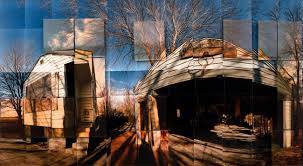
“Shooting Azimuths” by Tracy Crow


1. Geographic North

After chow, I climbed to the windy top of the metal bleachers with the others from my platoon. We wiggled along the cold seats until everyone was shoulder to shoulder and hip to hip, allowing room for the four platoons now marching from the chow hall with a thumping boot cadence that made the metal beneath me hum. This was April, 1985, in Quantico. The time of the night compass march. The true test, some had said, of courage and leadership.

I was twenty-six, a Marine, a new officer, a wife, a mother, and one of nine women squeezed in among the tall bodies of men who in their bulky field jackets and cammies made staying warm that chilly evening in northern Virginia nearly possible.

When all five platoons had scooted into tight sitting formations, our lieutenant training officer hopped onto the bottom bleacher. “Look up,” he said, pointing into the lilac phase of sunset. “You’ll notice there’s no moon tonight, unlike last week’s practice session.” I was envisioning the ancient mariners on a night such as this; salty sea captains at the helms of long wooden boats, helplessly adrift on swells during nights when the moon and the constellations were as out of sight as land in the middle of the sea. What would they have given for our compasses, our knowledge about navigation?

The lieutenant was saying that at nightfall we would travel about a mile, one that is, if we stayed on course, two or more, if we got lost. The goal, he added, was to navigate unfamiliar terrain to a row of metal ammo boxes we would find spaced fifty feet apart. To pass, we would have to land precisely at the correct ammo box for our coordinates. He warned about the river, how it was overflowing because of the beaver dams, and Don’t fall into a beaver dam! I pinpointed the river on my map. Drew a black circle around the exact crossing.

Lessons learned in training save lives during combat! Last to know, first to go! Want to win a war? Tell it to the Marines…. A Marine officer has to know how to read a map, how to plot coordinates for artillery fire that won’t wipe out friendlies. A Marine officer has to know how to lead Marines into and out of combat zones, because as everyone knows, one wrong turn could get everyone killed.

Admittedly, our combat training in Quantico was during the middle of a relatively quiet era in military history if you discounted the invasion into Grenada, Cold War threats, a bombing raid on Tripoli, and the peacekeeping mission in Beirut that had turned anything but peaceful. The Soviets were the Evil Empire. War felt imminent, and our fear of war, along with a healthy fear of failure, compelled us to take seriously each training exercise, even if conditions at Quantico were artificially manufactured.

In the practice for the night compass march a week earlier, and in the same bleachers, each of us had drawn coordinates and then shot azimuths, plotting them on our maps with protractors and compasses–a task easier in the classroom on the evenness of tabletop than on your lap, I can assure you–and then we were marched under a full moon to a wooded area. The signal, a pistol crack, had set us off on foot through a hundred yards of forest that seemingly conspired against us by pulling a shade to the moonlight.

I tripped over roots, lost count of my steps, and had to backtrack. I offered my hand in an outstretched sacrifice to the wicked vines and low hanging limbs that otherwise slashed at my face and neck. I feared for my eyes mostly, fighting the imaginary sharp sticks as they darted toward me. And then there had been the crackle of limbs and leaves, a holler from someone who tripped, a nervous giggle, and the OORAH! from the first Marine who had made it through to smooth asphalt. When I stumbled from the darkness to an umbrella of light beneath a streetlamp, I found myself at the feet of a smiling lance corporal who verified my success by writing on my card a fat, black checkmark.

The lieutenant was now pacing the metal bleacher, waiting for the lists of coordinates to make their way among two hundred and thirty. When I had mine, I quickly plotted my coordinates, balancing compass and pen and map and protractor on my lap. I should admit to feeling overly confident. Not only had I passed the practice march, but I had remained behind at Quantico the weekend before, Easter weekend, with Himes, Johnson, and a handful of others for additional training.

At home, however, my husband, a Marine captain, was finding his role as a single parent to our daughter a challenging one. Eight weeks earlier, I had been a sergeant, a reporter for the base newspaper, ending each workday at four-thirty, picking up our daughter at daycare, and setting dinner on the table as my husband walked through the door. Now, I was an officer, too, chosen to lead just as he had been chosen seven years earlier.

There had been other separations during our marriage: my photojournalism classes in Indianapolis when our daughter was six months old; my coverage of desert combat training in Twentynine Palms, California, when she was eighteen months and of mountain warfare training in Bridgeport, California, a year after that. My husband’s ability to cope as a single parent had reduced with each separation, and after eight weeks in Quantico, I was fully questioning my decision to follow his career path.

“Not coming home for Easter?” he said the night I called. I leaned against the wall in the barrack’s lounge, winding and rewinding the telephone cord around my index finger. “But that’s two weekends in a row.”

“Monday is the night compass march. I need to practice this weekend.”

“But what am I supposed to tell our daughter?”

I gave the phone cord one long tug, a long sigh. “I know, I know, but she’s only four and a half.”

Geographically, I was two hours north from our home in Hampton, and felt fortunate to have made it home several weekends. Three women who were also mothers didn’t live close enough to commute; they spent their weekends in uninterrupted blocks of study time for tests on Soviet weapon systems and on nuclear, biological, and chemical warfare. And then there had been the outburst of chicken pox–my husband hadn’t known you shouldn’t place a child with chicken pox in a tub of water. After six years of marriage, I was learning he didn’t know a great deal about anything outside his military self, which these days, close to retirement, included golf handicaps more than General Orders.

But at night in my room at the barracks, I lay in a single bunk with my M-16 rifle locked to the bed frame, and pictured my husband a hundred miles away in our bed, our daughter in hers, tucked beneath a Sleeping Beauty bedspread. One day I would have to answer for all this, for leaving them months at a time. Too, I wondered what our daughter would think about having been raised by two parents who had been trained to kill.

I’d had a revelation about my husband a few weeks earlier during another night training exercise. It was the night all five platoons were driven to a live-firing range at dusk where we were divided into groups of two and instructed to dig fighting holes.

The winter ground had been cold and unyielding. I had struggled to match my partner, a man, shovel for shovel, and despite the cold air that felt closer to winter than spring, I was perspiring. My feet, however, felt numb and my fingers, like brittle sticks, ready to snap.

After digging to four feet, we propped our machine guns on the upper edge of the bunker, positioning the weapons into what would be intersecting fields of fire. When the shrill whistle commenced firing, I lunged for the machine gun and squeezed off rounds, hot cartridge shells grazing my hands and cheeks. My jolting body became one with machine; my mind, however, floated with the red sea of tracer bullets crisscrossing with such precision, such danger, such beauty I hated to see it all diminished so by the white flares shot into the black holes of space to illuminate a make-believe enemy.

This, I thought, is what combat looks like. Beautiful, just before the ugly. And, if we were lucky, this would be the closest to combat we would ever get. This, I remember thinking, too, was what my husband must have seen in Vietnam, and now I was seeing him not as the combat officer he had become, but as the frightened private he must have been in ‘68, in Da Nang and Hue. How had he, how had anyone faced this red scissoring–of friendly fire intersected with enemy? And I suddenly understood why, in the commissary on Okinawa several years earlier, as I had been pushing our infant daughter in the stroller behind him down the aisle of canned meats and vegetables and past an old woman with bright eyes and bowed legs who was speaking Vietnamese to her daughter, he had dropped the can of tuna and flattened himself against the shelves.

Back in the barrack’s lounge among the rows of black and silver telephones, I heard my husband say he wanted me home for Easter. Another woman Marine from my platoon was shuffling into the lounge. She smiled, headed for a telephone across the room, and inserted a fistful of quarters that were clinking as if falling from a slot machine.

I turned my back on her and wound the telephone cord around my finger. “Three weeks,” I whispered into the phone. “You can hang on that long, can‘t you?” In three weeks, I would pack the new uniforms–the dress blues and the dress whites– the pearl-handled officer’s sword, the weapons guidebooks on machine guns, howitzers, and Soviet tanks, and put Quantico in the rear view mirror. And once home? Then what? All that awkwardness of trying to become again the wife and mother I had been forced to let go of for so many weeks. What if I couldn’t become all that again?

Three weeks: twenty-one days. Hadn’t I read somewhere it took just twenty-one days to establish a habit. Or, had that been to break one? “I really need to stay for this extra navigation training.”

“You’re becoming impossible!”

I gave the phone cord a final tug. “Didn’t you fail the night compass march?”

At two a.m. Easter Sunday, the day before the night compass march, I heard a knock. From my bunk to the door, I dragged the dream of the day’s two-hour practice march over brown hills–the smell of cold, lifeless trees still in my hair–and the memory of counting and recounting my steps, of refiguring grid north from geographic north from magnetic north in an effort to find true north. I opened the door and he was there: in his arms our sleeping toddler with a blush of the pox on her chin, shoeless, lost in her own dreams, wearing the new Easter dress. Rumpled.

2. True North

For the night compass march, you set off on foot at nightfall, and at first everything seems almost pleasant. You’re bundled in a heavy field jacket over your cammies, you’re wearing boots, and around your waist, a belt with a canteen of water. You have a flashlight and a compass with a red needle that points toward magnetic north regardless of the direction you turn your body. The trick is in remembering to turn your body and compass as one.

Forty, forty-one, forty-two…sixty-five steps per hundred meters, and you’re mentally tracking the meters and the steps across dark dry acres and up and over small hills. You could get used to this, this thrill of independence that is feeding your spirit, of self-reliance; for the first time you know where you are and where you need to go.

After a while, you start wondering how everyone else is getting along. You shine the flashlight on your wristwatch; nearly an hour has passed since you last heard another Marine…and now you are beginning to slow down. You fix in your mind the step count, so you can stop, have a look around without losing your place. You check left and listen. Nothing. No crickets, no frogs, no birds. You check right. Nothing but the noise in your head and the roar of silence in your ears.

You think, What are the odds I’m the only one in more than two hundred to have drawn these coordinates?And then it happens. That sliding silver pinball that rolls and rolls around in your brain until it drops like cold metal into your heart: you’re lost. Or maybe, just maybe, you’re the only one on the true trail. That’s it, you say. You’re right, for after all, hadn’t you made it through the dark forest last week? In the classroom, hadn’t you correctly plotted every coordinate? You refer to your map for the elevation, searching on paper for the depression you’re standing in. You walk on. Up and over another hill toward the sound of rapids. The river. And so you must be right.

The icy water swirls around your ankles and you trudge on to the knees, to the hips, to the waist, holding your ground, stopping to check your compass, remembering when you learned to cross a river two years earlier at mountain warfare training in northern California how easy it is to be swept away or pulled off course, and so you adjust, lift a foot, place it down, slide another along the unsettled bottom until the river around you sinks from your waist to hips, to knees, to ankles. Downstream, the crash of limbs: Goddam beavers! You shout into the cavern of darkness toward the voice, Everything okay? A reluctant, Yeah! sends you back on course.

A half hour later, your toes are stumping against asphalt. Something’s wrong here, you think, and you pull out the map, click on the flashlight. Look up. You’ve learned true north can be found by locating the moon and its angle to the North Star. But there’s no moon, remember? But neither is there supposed to be a road here under your feet. What you want to think is, Who put this Goddam road here? What you’re really thinking is, Who forgot to put this road on the Goddam map? Because what you don’t want to think is, How the hell did I wander so far off course I found a road not on the Goddam map? And you’re wondering if you’re even on the fucking base anymore. And where the hell is everybody? And how long will they wait before sending out a search party. And how if you’d been able to eat more for dinner than a package of peanut butter crackers–only a sadistic idiot orders a weigh-in after chow– you would be thinking more clearly. And you’ve decided that when you get back to the barracks, if you get back, you’re going to order a large pepperoni pizza with double cheese from that place that delivers on base until midnight.

Then you stomp the road and curse at the sky because there’s no one here to act shocked and because yelling is the one thing you can control right now and because the sound of your voice feels a little less lonely. And you cry, because no one’s here to see. You read somewhere that scientists believe the magnetic poles reverse themselves every five hundred thousand years or so– meaning what is north today flips south tomorrow–and since Earth is apparently long overdue for a reversal of magnetic poles…suppose your compass needle has been pointing south all along?

You picture your husband, smug when you tell him you failed the night compass march after ruining the family’s Easter weekend, and this makes you wish the poles had reversed themselves, that if you have to fail the night compass march, then let your failure come as a result of a cataclysmic event. And then you stuff the map and compass into your field jacket pocket, make a half turn toward the direction from where you came, and walk on, just walking, no longer thinking or caring about step counts and meters, for what does all that matter if your whole world has turned upside down. The next time your feet touch asphalt they’re near an ammo box. Squint hard and you can just make out the line of the other ammo boxes along the shoulder of the road. Marines are emerging ghostlike, one and two at a time from the trees, halting by their boxes, silently handing over their cards to enlisted Marines. You’re waiting for the lance corporal at yours as he compares your coordinates with the number on the ammo box.

He looks into your face. “Ma’am,” he says, “you landed at the very opposite end of the course.”

You extend a shaky hand for the card. “Damn beavers,” you say, but you’re thinking, So, this is failure…This is what my husband felt that night seven years ago when he failed the night compass march, and you’re wishing for a way to make it up to him.

The lance corporal leans over you, whispers, “Get back into the woods, Ma’am…walk all the way down to the last box.” And then he’ s shoving you out of sight. At first, your feet refuse to budge, but that’s okay, because your mind has raced on without them: a hundred flashes of the past, present, and future hanging on your next decision. A true test of courage and leadership.

Then you’re zigzagging through the forest, welcoming the thorny vines that slash your face and neck. You’re falling over stumps and limbs, and picking yourself up, and ignoring the pain in your knee and the swelling of your ankle. Your left cheek stings and you wonder if the scar will be permanent.

You come out the other end of the dark forest, changed. You won’t go to the last box; you take the one second from the end. A perfect score you can’t stomach. You’ll give your husband that satisfaction.

Another lance corporal takes your card, jots down the number, and says, “Congratulations, Ma’am, you have successfully navigated the night compass march.”

You mutter a thanks and secretly vow to practice every weekend until you can plot true north with your eyes closed. As you shuffle toward the cattle car up ahead that’s idling on the shoulder of the road, you’re thinking, Sure, this may be peacetime, but how long could anyone expect it to last? You’re mentally hanging up on your husband’s telephone protests, when you spot Himes, who is now boarding the cattle car. You grab the bottom edge of his field jacket. Yank him from the steps. He smells of woods and dirt and sweat. On his neck, a nasty scratch resembles a thread of beaded garnets.

“I went to the wrong box…”

“Shhh!” he says, grabbing a fistful of your jacket to pull you closer. “Everybody did…”


Tracy Crow is a former Marine Corps officer and an award- winning military journalist whose news and feature articles about Marine life and training during the 1980s were published in The New York Times, the Los Angeles Times, and the San Diego Tribune, among others. “Shooting Azimuths” is an excerpt, originally published in Puerto del Sol and nominated for the Pushcart Prize, from her military memoir, “Eyes Right.” Ms. Crow’s literary nonfiction has also appeared in The Missouri Review and Mississippi Review. She is a three-time Pushcart Prize nominee. Ms. Crow has a B.A. in creative writing from Eckerd College in St. Petersburg, Florida, and an M.F.A. from Queens University of Charlotte in North Carolina. She teaches creative writing at Eckerd College.

“Mr. Percodan” by David H. Katz

Light is the anomie of poetry
Mr. Percodan, please let me be you
breed from me your steely fingers
crystals of a blighted blue

When the pale dead sight of day is gone
your pale dead voice lingers on
stretched softly through a pillowcase
of sweat, eggshell and yawning dregs

Lace squeezed through most suitable hands
dull is the mist at masquerade ball
the metal detector grunts and scrapes,
as I bolt through the lens of your shiny floor

Now the lifeless branch droops
fantasizes megaskin
between the stumps, between the root
life betrays its sleepy self
the quaint bouquet meant for someone else

Saturated, I break my fall
this toxic lock so faint, so kind
triage for two on sunburnt sand
Mr. Perco D, I bow to your call


David H. Katz is an artist, photographer and writer based in New York City. His writings on art, politics, entertainment, and conditions humane and inhumane have appeared in High Times, TANK, The Village Voice, Jewish Quarterly, The Villager, The East Village Eye, and elsewhere. He lives in Chinatown, under the shadow of the Manhattan Bridge.

“The MacMurray Method” by Juleigh Howard-Hobson

First thing I do is check the television. They said it had cable.
Yep, punching the remote from the dark orange quilt on the
queen size bed, it’s got cable. Fred MacMurray stares out at me
from TVLand for a split black and white second before I click it off
again.  I don’t need to watch.  I just like knowing Fred and his
family are still there.

This time, it’s the Desert Moon Motel with its strange
unwrinkleable quilt; the air crisp – the way motel rooms always
get once the air conditioner starts. Hell, it’s still like 90 degrees
Fahrenheit at least outside, but in here, in here it’s just fine.

Like the All-American TV dream come true.

Then, right before I know what I’m doing—dozing, thinking,
whatever—it all comes back to mind. Summertime. 1976. I was 13.
There was no cable yet, but that was okay—the re-runs were still
on from 3 to 6 every day after school. All day, on some channels,
during the summer vacation…

Hot afternoons soaked in warm stale sticky cheap empty cans of
beer come floating back through my mind. The stump of wood I
crushed them on, crushed them with an eroded sledgehammer
that used to be my grandfather’s. The stump stunk like a bad old
drunk.  My hands stunk. And my t-shirt, where quarter-full cans
sprayed up lukewarm—sometimes hot—dregs, stunk. The big
black garbage bag I dragged out from the hot garage, full of
empty Lucky Lager or Black Label cans, stunk.

The cans on the bottom were sweaty with the stuff that dribbled
out of the cans on top. Those were my grandmother’s cans. My
father drained his dry. Every son of a bitch’s got one decent thing
to be said for them, right? My father drained his dry.

The blasting heat of those California July days worked like some
sort of unholy incubator: the cans emerged wet and warm, like
little alive things. Little alive belching dripping slimy hot things that
came back day after summer day to be crushed.

Hit straight down on top was the best way to crush them.  Struck
on the side still meant the edges had to smashed in –that took
three swings as opposed to one, but the sledge hammer –it stunk
of hot beer, too—was heavy and there was less of  a chance of
missing that way. When I was done with the bag, I could go in and
watch TV.

I got exactly nothing for doing that, I remember. That was my
keep. My duty. My work. Everybody had to pull their own weight—
even if they never asked to be there. Even if my father kept
saying ‘shut up’ with a backhand when I asked what weight he
pulled. Kept saying ‘mind your own business, you don’t know the
first thing about jack, why … don’t … you …just … shut … the …
hell … up’. That was his keep.

My father had more important things than weight to pull.  He was
an artist, which meant that he was special, even if only him and
my grandmother knew it. He could draw tattoo flash of both the
Jimmies: Page and Hendrix, and the Hank Williams Jr. logo too.
Freehand. So special.

That is, that’s what he did when he did anything. Like all great
artists he could only work when he was inspired—to expect him to
get a real job (not mailing art to tattoo magazines and hanging
with some guy who airbrushed pictures of Jesus on lowriders, but
a real job like the real dads did on the shows) would be an insult.
And to insult him was to insult my Grandmother.  Because
Grandma believed in him.  Loved him.

I figured if she loved him, she would have wanted the best for him.
Maybe even for his kid. Yeah, right.

She called me a stool pigeon when I told her about my father
smoking pot all the time.  I was 13, I figured she’d make him stop,
make him better, make him like the other dads I knew, the way
dads were supposed to be.  The dads on TV.

I saw them every day.  Dads were like Mr. Brady. Sheriff Taylor.
Mr. Douglas. Even a dad like plain old Ed Johnson who wasn’t on
TV but who rented a light blue-sided ranchette across the street
from Grandma. She said that the whole Johnson family was just
plain white trash because they didn’t own that house. But I
watched Mr. Johnson go to work every morning.  His kids wore
real Levi’s and got driven to school in a clean tan Malibu station
wagon, with bumper stickers.  They had a color TV too.

But, after I told her, she didn’t make my dad stop smoking pot;
she just stopped liking me, instead. Put her television set in her
bedroom, where I wasn’t allowed to go.

I’ve got to stop laying here, on this cold bed, and try and get
some rest now.  Because I have to stop thinking now and turn on
that TV — any channel – find Fred MacMurray,  and my
Marlboros, and what’s left in my coffee cup or I’ll never make it to
that meeting in the morning.  And I have to make it.

I have to keep making it. That’s what I do.  I make it.

Like they do on TV.


Juleigh Howard-Hobson‘s writings have appeared in various journals, including Flipside Magazine and the anthology Undertow.


“Someone May Answer” by Arlene Zide

You may knock at all their doors-
the president,  your senator,
the landlord
Even your own dead mother’s
they may not answer
Won’t answer

But
they say in Aleppo
in the folded caves of Afghanistan,  beneath
the black crow coverings of Tehran
If you knock at God’s
door,  at some holy gate without St. Peter standing guard
someone
will answer
God or devil
Golden angel or light-bearer

The Catholics offer up their suffering to it
Jews sorrow before its ragged broken stones
Hindus hold grudges about it
Buddhists
make an art of not caring
about it

God or devil
Golden angel or light-bearer
Those who play at human lilas of pain
at tsunamis of corpses littering the beach like seashells
Indifferent clockmakers
Or sexless forces of light
Someone
may answer

who?


Arlene  Zide is a poet, linguist and translator whose poetry has appeared widely in numerous journals both in the US and India, including Rattapallax, Meridians, Rhino, Xanadu, Women’s Review of Books, and, Primavera.


“All Quiet in Western Kabul” by Judith Koffler


It’s an ordinary summer night in western Kabul. Or so it seems to me on this ten-day “Reality Tour” of Afghanistan.

The brilliant adolescent moon pours out light above the ruined habitations, bombed out
mosques, and twisted wreckage that testify to 24 years of war here. The stars pulse against a cloudless sky swept clean by the night breezes. The mountains seem to hug the horizon on all sides, and there seems to be a settled tranquility in the neighborhood as if it were deep in the countryside. Perhaps it is the lack of electricity.

Abdul Amid, a tall twenty-something Afghan with gentle eyes, a moustache, and a shock of
thick black hair, sits on the back patio of the guest house cradling his AK-47 rifle.  He scans the perimeter of the six-foot high wall with its four rows of barbed wire. At the far corner of the dusty back yard is the neighbor’s latrine, where the grandmother, the three sons, daughter, and three grandchildren traipse as Nature dictates. Midway between the patio and the latrine is the water pump, which the cook had been priming earlier this evening. To the far right sits the ancient truck engine they use as a generator. Tonight it had been loudly running and pumping fumes into the yard.

Abdul Amid’s eyes light on the scruffy circle of green spinach that the cook has been
irrigating. There’s a black and white rabbit hiding somewhere around the house; he comes early in the morning to nibble on the leaves. Abdul Amid is hoping to catch him for dinner and has put stones at the rabbit hole at the side of the house.  Food is very expensive these days.

He sighs. We don’t know what he is dreaming; he is too young to have experienced Kabul
before the war, before this spectacle of frozen bombardment stared back at him from the
adjoining houses.  Next door there is rubble, an empty kidney-shaped swimming pool filled
with broken bricks and rocks, a small cave with a unexploded rocket that the neighborhood
kids play with. Beyond the back fence the roof of another dwelling collapses over the second story, where children climb and play during the day. All these tumble-down houses, ruins with corrugated tin thrown up for roofs, have occupants, families with gaggles of small children, chickens running about, and occasionally a dog.   At some more pacific time, decades ago, they may have been dwellings of happy families, professionals and business people.

In the quiet, Abdul Amid’s eyes are drawn beyond the barbed wire and neighborhood rubble to the surrounding mountains and, briefly, to the stars.

He wears a dark blue vest with the words “Security” embroidered on the pocket and a sheriff’s badge imported from the U.S.  His job is to protect the guests, a group of six Americans on a ten-day “reality tour” of Afghanistan.  He wonders what they are talking about.  They seem to laugh all the time.  One of them, Ben Tupper, a former National Guardsman, comes outside and talks animatedly in a tongue that is foreign to Abdul Amid, but he can understand a few words and Ben is good with sign language.  An hour later, they are disassembling the AK-47 and cleaning its parts together by the light of the moon.  The other guests, like me, are inside reviewing the events of the day, a visit to the mine museum, where rockets have been turned into flower pots, and to the Red Cross prosthesis unit, where one-legged children and a few old shepherds, victims of landmines, were waiting to be fitted with artificial limbs.

Inside the spacious, three-bedroom house, Wahid Omar has just turned off the generator,
climbed the stairs and gone to bed.  He is a tall, pensive man in his forties, a professor of
French literature at the University of Colorado.  His wife and children are back home in the
States, but that home is an exile’s home. Wahid is here for the summer to teach French at
Kabul University, oversee the guest house, lead the group tours for the visitors, and work on his many projects as educational director for Afghans for Tomorrow. They have built several schools already in Kabul and in outlying provinces. Hundreds of children – including girls – are being educated again, some teachers have good jobs, and more Afghan professionals have been attracted to return to the country or to share their professional skills in the task of reconstruction.

Many things trouble Wahid tonight. He has explained to the group that the war is not over.
The real war continues:  armies of lawless warlords, poppies, poverty, ignorance. The money for reconstruction and security has been diverted to Iraq for no good reason.  Meanwhile, the Taliban and armed vigilantes regroup and terrorize citizens in their efforts to register to vote. Mujahedin have shot and threatened Afghans carrying registration cards.  UN aid workers have been killed by car bombs, two Swiss tourists have been killed in Kabul, eleven Chinese highway workers were shot in their sleep, foreign doctors have been killed, and the U. S. Embassy has just sent emails warning that kidnappings and car bombs threaten the security of foreigners. Even Chicken Street, the usual shopping district for foreigners, is not safe.

Earlier in the day, a young Afghan woman had been speaking to Wahid over tea at the dining room table. She is setting up a radio station in a southern province, despite death threats from the Taliban.  Two days ago, someone fired a rocket at her car.  It caused minor damage but did not deter her.

At dinner, Wahid again instructed the guests to keep the drapes drawn upstairs and down.
Taxed with the responsibility for their safety, he strictly confines us to the house whenever we are not out touring in the minivan. Another guest and I, eager for exercise and for adventure, have been chafing at the confinement. We have begun to wear down Wahid’s patience with a proposal to put on burqas and explore the neighborhood.  But tomorrow Wahid and his driver, Daoud, will take our group out of Kabul into the Shamali Plain, where the land is green with vineyards, there are gardens and flowering trees, and another school built by Afghans for Tomorrow.

On the way, we will pay a visit to a newly rebuilt mosque. After our planes bombed the original mosque, an American church group and a mosque in New York raised the money to construct a new mosque and minaret. Chloe Breyer, asleep in the next room, has shepherded this project. She’s an ordained Episcopalian minister, a feisty, attractive young New Yorker who knows how to grapple with the big-bellied contractor, who will doubtless demand more money when they meet up tomorrow.

As Wahid falls asleep in the darkness, /images of the Kabul of his recollection – a  thriving,
modern metropolis of 700,000, where women dressed in Western fashion and the people
were prosperous and well-educated, where he learned to love Zola, Hugo, and Sartre at the Francophone school – may visit him and give relief to the reality he confronts by day:  a dusty, choking, treeless city where three and a half million post-war Afghans crowd together in the search for work, water, and safety.

Across the street on this quiet night is a tiny booth painted pink and blue, shut up tight.   It
faces Wahid’s house. By day it is the equivalent of a 24/7 convenience store, with its dust-
covered cans of soda, crackers, candy bars, small paper containers of mango juice. From before daybreak until the stars come out, the proprietor sits patiently inside, like an omniscient ticket taker, and watches the neighborhood as if it were a theatre. Perhaps he had also watched the theatre of war years ago, before he fled for safety to Iran.

He is the actor Khoja Mohammed Najeer, a white-bearded, swarthy Afghan with noble wrinkles and a far-away expression. He played the role of the old man in the film, Osama, and earned $40 for his performance. Now he nurses a severely blackened and swollen right foot, injured from another movie set when he had to keep it in freezing water for a long period of time. But Khoja Mohammed is sleeping now, dreaming perhaps of the money that should have come to him from his performance in Osama. And of the fame that is due him. Tomorrow he will risebefore 4 AM, heed the first muezzin call, and open his little booth for business. He keeps a watch out for Wahid and worries about him if Wahid does not come home at his usual time.

All through western Kabul, the streets are dark, the houses illumined only by candles or with the help of generators, which are expensive to run. This part of the city is also home to Kabul University, one of the places to go for relief from the merciless blaze of the Afghan sun. On this night the moonlight falls over the university’s quiet lawns, trees sweep their leaves in the wind and the ardent songbirds are now asleep. In the afternoon, students had lazed here after class, the young women in their headscarves sitting together in a grove of filtered light among the trees and reviewing the lessons of their literature class.  Some had practiced their English on the American visitors and eagerly got their photos taken. Some had pulled back with a shadow of resentment in their eyes. Many wonder about their future.

Over a year ago, there was a student uprising here about living conditions and not enough
food; two students were shot to death by Karzai’s police. Rumors are that Taliban adherents among faculty and students have shaved off their beards but have not discarded their ideology. Professors, if they have been paid at all, earn about $50 a month; sometimes their wives put on burqas and go begging in the streets. Often the professors sell used clothing which they drape over railings to display in the busier parts of town.  What resentments brew here are hard to calculate.

Among students, there are many questions. Why is the US backing a corrupt government that capitulates to the warlords? Why hasn’t the US followed the Bonn agreement and disarmed the warlords? What happened to the promises to rebuild the city and its destroyed infrastructure, to resupply electricity to the rest of Kabul?   Why have 65,000 people been killed since 2001? Why did the US give $5 million to the Taliban in the first place? Who gave bin Laden his power and money? Why are the Americans promoting a culture of impunity with torture and sexual abuse in the prisons?  Where are the promised security forces? Why does the American army fire on civilians and bomb wedding parties? Do American people know that what Bush is doing is not good for the people of America?

These are the questions that plague some Afghan minds by day and that disturb their sleep at night, even as the stars twinkle indifferently overhead. They have not been questions that seem to disturb the sleep of Americans, even if the Taliban and al Qaeda were once the terror of our daily consciousness. If indifference is a celestial attribute, perhaps it is understandable that we mimic it. What can be said, on this velvety night in late June, 2004, is that all is quiet on western Kabul’s front – for the time being.


Judith Koffler is a mediator, editor and academic consultant in Santa Monica, California. She can be reached by email at Judithkoffler@yahoo.com.