
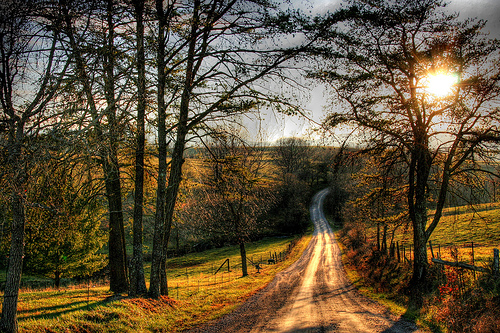
“How to Walk Down a Country Road” by Felicia Mitchell

F.Mitchell 2004

One.  You don’t really need a guide to help
You find the way.
Just follow all the doves
That gather on the wires until you see
No more. Then you will know you’ve gone so far
There are no wires or houses.  Two. Avoid
Advice that says to face the traffic when
You’re on a curve.  Look at those doves.
They know
The difference between life and death is not
As easy as all that.  It takes some sense
To cross the road when cars are tumbling down
Like cold, white water with no place for you
To navigate.
Three. Lose the road. You don’t
Know country roads until you’ve stepped aside
Into somebody’s pasture or a stream
With rocks as smooth as wings on doves-or stopped
Beneath an apple tree and eaten one
To prove you could survive in nature if
You really had to.  Four. Turn back before
Your time runs out.  Five.  The doves may look
As if they’re watching over you.  They’re not.
The crows aren’t either.  Not the cows, the leaves,
The lines on asphalt separating gray
From gray.  You’re on your own.  Find your way home
Alone and then you’ll know exactly what
It’s like to walk right down a country road.


Felicia Mitchell teaches creative writing at Emory & Henry College.  Her poems appear regularly in journals such as Terrain, Many Mountains Moving, and Survivor, and are found in a few anthologies and chapbooks. Many of her poems touch on issues of abuse and the theme of psychological survival.

 

“Unbroken” by Sara-Anne Beaulieu

stock photo

27 years, I have tried to
shed your skin, weighted
on me like an overcoat.

27 years, I pick this pen
up, stand tall to your
reddened toothless face, spit

flying from your lips.
To draw my adult form
over the child, her inky

jagged body in the corners
of the mind.
She looks

at you, unable to separate newly
sobered you, from old, stagnant scent of booze,
bloated belly full of beer, hair trigger

temper. Separate the you
from the demons that
that still flare your nostrils

monstrously. Demons that dig wide fingers into
my arm, dragging me, the child, out the door,
screaming

shut your ungrateful mouth; to get
the fuck out. So slick, no bruise surfaced.
Beneath skin, blood rattles,

heart, hands, legs quake.
A low familiar howl
escapes from the child’s lips

as your back turns to me,
and I scream not again, not
again.

Watch me father. Watch
me throw the coat
to the ground,

the fists, the
slammed cupboards, the
beer bottles spinning in infinity.

Enough.

My voice shakes, trying to
destroy this black eye of
rage and sickness; save the child

who has been waiting
10 years ago, yesterday, this
minute.

Waiting for me to shed your skin,
the fracture of 27 years, and emerge
unbroken.


Sara-Anne Beaulieu is a recent Masters of Fine Arts graduate at New England College in Henniker, New Hampshire. She has studied with poets Anne Waldman, Jeff Friedman, and Joan Larkin. She has just completed her thesis on Diane di Prima’s Loba, and her own manuscript No Roses. Ms. Beaulieu currently resides in Rhode Island.

“Event Horizon” by Joel Deutsch


We speak of being
sucked in, as if need
had not propelled us.
As if we might still croon the litany
of birthdate social security mother’s maiden name
and recollect the particles
we pressed into shape and service
crammed into our shoes.

But this rearrangement
is profound, this condition
infinite density.
Nothing escapes, not even light.
This gravity
takes us like a death squad
from the borders of sunlit plots.
Somos desaparecidos. We are disappeared.

They find our hoes, rakes, rusted rifles,
the gleaming blades of identity
we thought would hack our way home.

They sound alarms, call a curfew,
comb the places they knew us to haunt.
They seek evidence of our indivisible natures
in shopping lists, laundry tags,
in hearsay reports of our dreams.

Night falls. They are exhausted.
They gather by fires
in a long, bewildered silence.

Finally, someone mutters
“fell in love.”
In dark rooms redolent of the usual suppers,
tobacco ashes glow and bob in helpless agreement.

They give it up, let it go.
They let their daughters
use the phone again.


Joel Deutsch
is a writer living in Los Angeles. His literary non-fiction and
novel in progress can be read at www.joeldeutsch.net

“Grace” by Joseph Mockus


We live behind the oldest living
telephone pole in san francisco
gray scag professing high voltage
between porcelain cups you radiate
charm from an era when
wood steel and glass
perfected the sweet sound of future
Tiles crack the stucco bursts
to reconcile new mortgages
we sit in italian light here
late afternoon with my daughter
and study that electric tree
planted and hooked to this
our play ground home

And I see what I could see
if I were newborn watching
her call that broken pole by name
electric light surging
I can feel that blood beyond my fingers
and before I can remember I am
in but not of the world


Joseph Mockus is a Bay Area poet, rock ‘n roll drummer and criminal defense attorney. A graduate of U.C. Berkeley’s Literature Department, his work has been published in the small University press.

“Space Time is Curved” by Victoria Pynchon

(for Anne)

Space time is curved
and gravity does not hold
the moon like a ball
on a string.

Gravity, they say,
just names the shape
of space, simply expresses
the curve of it.

We’re like that.  We curve
space time around
each other.

I’ve said this before:

every cell contains the whole
of us, yet makes a single
piece of us, muscle or sinew,
tissue or bone.

We’re like that.  We go
where we’re needed.

Remember, my love, that love
is what moves anything
in the direction of another,
woman toward her kind
and the creatures toward
their god, the apple toward
the ground as it falls
and the fire toward
the sky as it burns.

Love is a shape, not a force
and we do not hold
each other like moons
on a string.

We are love’s form,
my sweet, love’s
expression.

And I curve
into you
naturally.

Victoria Pynchon has been published in Poet Lore, Transformation, a Journal of Literature, Ideas and the Arts, Kalliope, Ledge, and the Southern New Hampshire Literary Journal among others. Ms. Pynchon is an attorney-mediator who lives in Los Angeles, California with her husband, Stephen Goldberg.