Interview with Marko Fong

Myra Sherman: Marko, I really enjoyed your short story Simulators. It’s such a unique portrayal of addiction and recovery. I don’t believe I’ve read anything like it. Your ability to convey a serious subject in a fantasy world, in a manner both humorous and chilling, is remarkable. And with internet addiction now becoming a concern, the issues addressed go far beyond the world of gaming. I was most reminded of the Sci-Fi television series, Caprica, and its exploration of the dangers of living virtually. And that brings me to my first question. You’ve set this in what appears to be an alternate reality in the early 1980s. The time period is part of the story’s fascination, but still seems an unusual choice. Was there a particular impetus or inspiration for this story?

Marko Fong: Myra, first thanks for your always kind and thoughtful take on my story and I need to check out Caprica. Oddly, Simulators grew out of my real attempt to create a computer game in 1986. At that time, it was still mostly shooting or maze games. One of the exceptions for home computer was flight simulator. Supposedly, you could learn to fly without the danger or expense of actually flying an airplane. The mechanics of being a pilot aren’t that complicated. The thing that needs to be simulated is the fear of dying should you make a mistake. The computers of the time couldn’t convey visceral panic. You need to do these things with the instruments vibrating, the wind blowing, and your adrenaline screaming, “Help me Mr. Wizard!”

As mentioned in the story, AIDS and herpes were then on every single-and-looking person’s mind and Erica Jong’s “Fear of Flying” was still a Tonight Show monologue staple. Pre-internet computer games weren’t interactive yet. A “date simulator” needed to have something resembling artificial intelligence. Enter the Turing Test.

Alan Turing helped crack Enigma, one of the German codes in World War 2. Turing also happened to be gay and in those days gay dating involved a level of cryptography beyond the alphabet soup on Craig’s list or Perfect Match. The Turing Test was a simple humanistic measure of artificial intelligence. If a person couldn’t distinguish between the answers given by a computer program and those given by a real human being, then it could be said the program had achieved a level of artificial intelligence. We now know better – you can replicate human behavior, but actual intelligence is different, which explains Rick Santorum.

As with most magic (finding love being a form of magic), the illusion really comes from the willing suspension of disbelief more than it comes from making something impossible happen. It was pre-Nintendo Wii, but I wanted to attach sensors to a computer and use the feedback to determine how the computer game responded. The other “self” in the date simulator program would just be a projection of the player’s excitement level. Sadly, the friend doing the coding didn’t have the foggiest idea of what I was after and I was too lazy to write it myself and wound up without a Wozniak. Anyway, instead of becoming Steve Jobs 2, I turned the idea into a short story that no one would publish. In 1987, it wasn’t literary and it wasn’t science fiction. I should mention that I’m very shy in person and I had no idea how a good date was supposed to go.

Weirdly, the real world arguably caught up with the story. Mary took pity on Simulators and saw that it was about addiction and recovery and not just speculative fiction.


MS: I was quite taken with your prefatory note. It both places the narrative in the past and foretells the future. The ending may also offer insight into a time when we were just human, which adds so much. Did you first conceive of Simulators without the prefatory note? Or did you start with the note, and then write the story?

MF: I added the note in 2011. When I resuscitated the story, a few people told me that it was still funny, but arcade-based computer games felt too dated. I was reluctant to eliminate all my jokes about quarters. I stole a page from Canticle for Liebowitz and Atwood’s Handmaid’s Tale and it somehow added that same layer of “might have happened or maybe already did.”
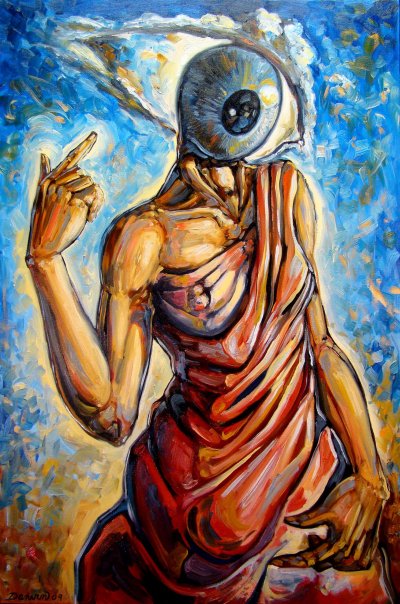
Eye Always Was by Darwin Leon

MS: Then there’s the last line, I felt the coolness of her wedding band when she grabbed my joystick. I’m sure you’ve had many different reactions to this ending. I first thought it was funny, and not literal, but then began to wonder. I’m sure ambiguity was part of your intention, but could you clarify, or at least share how the line came to you?

MF: Those who hate electronic gaming call it a form of masturbation and I always found the visual similarity between joystick and phallus ironic. Addiction to pornography is partly due to the fact that the image you’re getting off to doesn’t have a mind of her/its own, but the fantasy is that it/she does and she wants to do these things with you. I had this image of Jerry and Gretchen turning themselves into flesh and blood date simulators.

Some readers were really offended by the drift into porn ending and I find that’s often a sign that you should keep something. It means you provoked someone emotionally. Gardner talks about the fictive dream, but I sometimes aim for the fictive splash of consciousness.


MS: One of this story’s strengths is your strong depiction of addiction. You’ve captured the obsessive-compulsive quality, rationalization, and escape into internal fantasies. At least that’s how I think of addiction. I’d love to know your thoughts on this, how you see addiction.

MF: Funny you should ask. In your wonderful short story collection, Jailed, I noticed how many of your characters were both affected by the literal walls of the jail but also how they were prisoners of various addictions which land them and keep them there. We get addicted because it’s a shortcut to some pleasure center of our brain that screens out pain. Over time, the path to that pleasure center gets grooved and at some point you start spending most of your life inside that groove. A rivulet of chemicals turns into you-on-this-little-raft-on-swollen-Amazon-rapids. The rush is very psychological and internal, but the triggers are very physical. It’s why the joystick and the quarters are such big players in the story’s physicality. Once he starts the routine, Jerry’s cycle gets shorter yet more consuming.


MS: Another intriguing idea was that people didn’t want personal home-Simulators. I found this surprising. Could you explain your thinking here?

MF: The one very dated bit in the story is the big blue box instead of the various tiny personal devices implanted into modern life. I recently lost my cell phone while on vacation and I felt some mixture of being either naked or having had something amputated. Twenty plus years ago, you could play Tetris or Space Invaders on your home computer, but I had noticed that it lost its appeal much faster. In the arcade, you could get obsessed with posting one of the 10 high scores even though you didn’t have the faintest idea who “MarylovesJack10” was, but it was like a dialogue with that unseen person. Once you made the “hall of fame”, you” owned” the machine, but someone else could show and lift his leg and mark your territory. Alas, Simulators didn’t anticipate the internet, so Re: the ownership thing, boy was I wrong! Explains why Steve Jobs is a famous dead person and I’m an obscure writer with a day job. Even when I saw the future, I couldn’t see enough of it.

For what it’s worth, I miss pinball, my long ago addiction. It was this 25-cent celebration of the marvels of the electro-mechanical age. “Tilt” made it alive and sexual in some way, even though it was unapologetically a machine. Also that thwack sound when you happened to win a game or got a match for a free game. Way more satisfying. My neighbor’s wife bought him a restored pinball machine. It just wasn’t as much fun without quarters. Had they kept that part, I might have covered their mortgage for them or at least their dsl connection.


MS: How would you explain the recovery process in your story? And what are your thoughts on recovery in general?

MF: I was trying to raise the question are Jerry and Gretchen recovered? Their real relationship as husband and wife becomes a kind of methadone. Is this a happy ending or are they just free of the physical addiction to the machines?

I think real recovery involves some form of fundamental change in your relationship to yourself. It’s very deep stuff and there’s no magic formula which is I suspect why Mary’s been able to build a journal around the subject. The Simulator in the story is really only a projection of the player. Jerry’s not really recovered until he’s open to love with Gretchen as another independent soul with all the risks and surprises that come with that. As it happens, the “soul” and whether or not it’s an illusion was one of the philosophical questions raised by the Turing Test.


MS: Thanks, Marko. Any last thoughts or comments?

MF: I still wonder how Darwin Leon knew what I looked like. Thanks for your very insightful take on Simulators and can I borrow some quarters?


Myra Sherman is a clinical social worker, and past r.kv.r.y contributor. Her short story collection, JAILED, is available from Desperanto Press. More information about Myra and her writing can be found at www.desperanto.com and www.myrasherman.com

Introducing Darwin Leon


Darwin Leon


We are thrilled to announce that Darwin Leon will be the guest illustrator for our April 2012 Surrealism issue. His work is vibrant, clever, stunning, and perfectly suits the work we have accepted for this issue. And thanks to his generously shared /images, this is shaping up to be one of our best, most original issues yet!


Infamous Pets


Darwin Leon was born in 1972 in Santiago de las Vegas a small town in Havana, Cuba. In 1987, Leon’s family sought refuge from the political and economic crisis in Cuba, and departed to Spain, then later continued to the United States to settle in Miami. Leon earned his Bachelor’s degree in Fine Arts from Miami International University of Art & Design, where he attended as a recipient of the “Visual Arts Scholarship Award of Excellence” and received Best in Show at his first Juried Student Exhibition. His first direction was expressed through religious portraits, however, he found a greater enthusiasm for figurative and expressionistic forms in which he incorporated satire and irony through surrealism and cubism. Leon’s work is energetic, fresh, alive and abundant with color.


In Trust We Trust

His art combines aspects of the masters of the Renaissance, including the technique of chiaroscuro, with his own surreal style, which he refers to as Expressionistic Surrealism. Scenic /images portray the nature of expressive design through the movement of action and textured aspects. With a sharp sense of humor and figurative imagination, Darwin Leon details the social context of pseudo-political, human involvement with a gift for enhanced form and characterization. Displaying the imbalances of society with a satirical perspective, his artistic creations animate the discontinuities of the post industrial order. Leon’s paintings play on the interpersonal deceptions that move a society.


Darwin Leon


For four years, Darwin Leon was an Arts Instructor for drawing, painting, anatomy and modern painting at the South Florida Arts Center, Miami Beach. He currently resides with his wife and two children in Bradenton, Florida, where he teaches “The Dynamic Human Figure” at the Art Center there and at the Carrollwood Cultural Center in Tampa, Florida.


I can’t wait to share our upcoming issue with the world. Stay tuned!

Interview with Victor Juhasz


Victor Juhasz


Mary Akers:
Your work is so wonderful, Victor. We were thrilled to have you share your time and talents with us. Thanks also for reading all the work and selecting the /images to accompany them. Such an honor for our authors! I wanted to ask, was there any one piece in particular that stood out for you or that you connected especially well with?


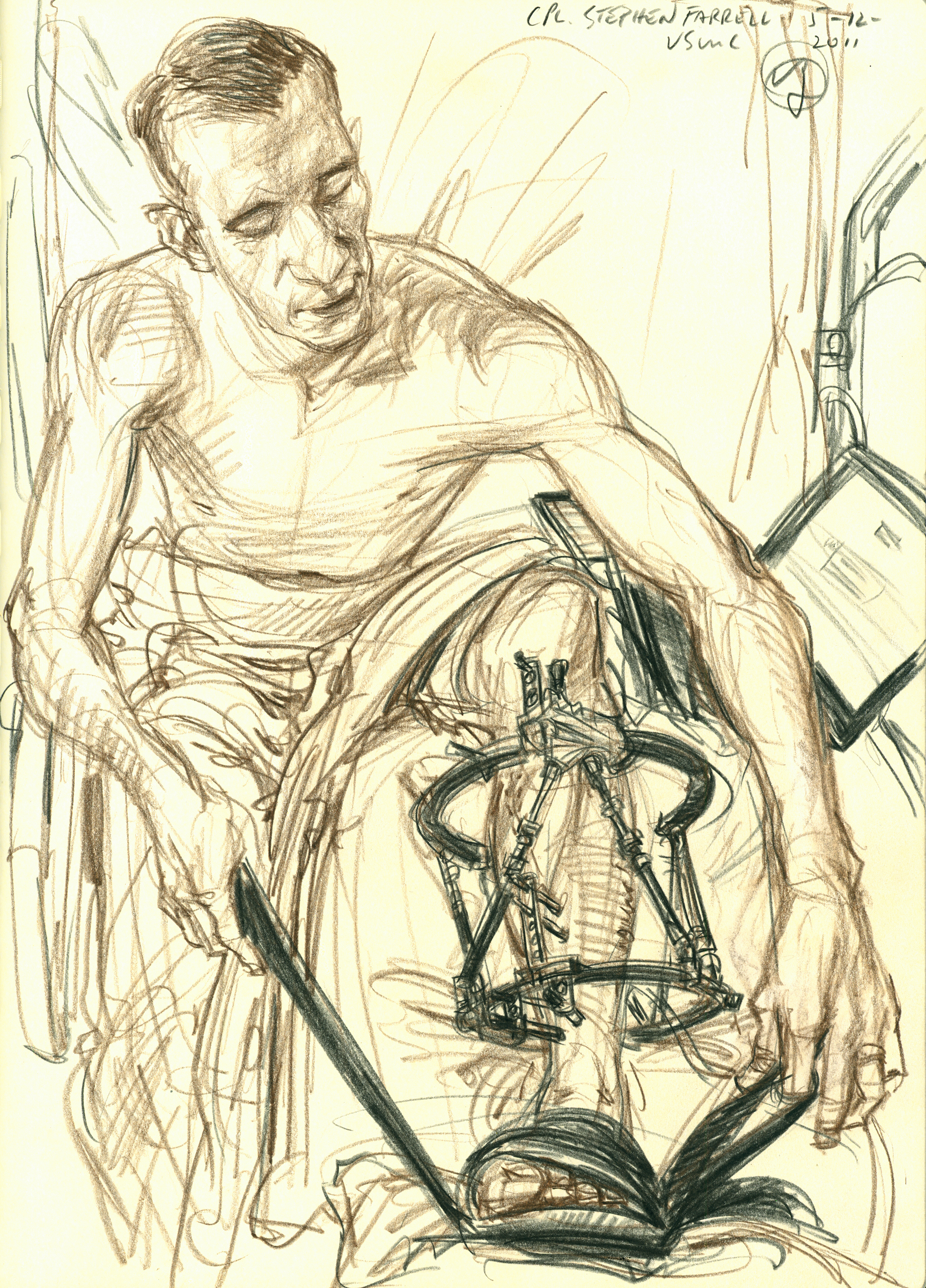
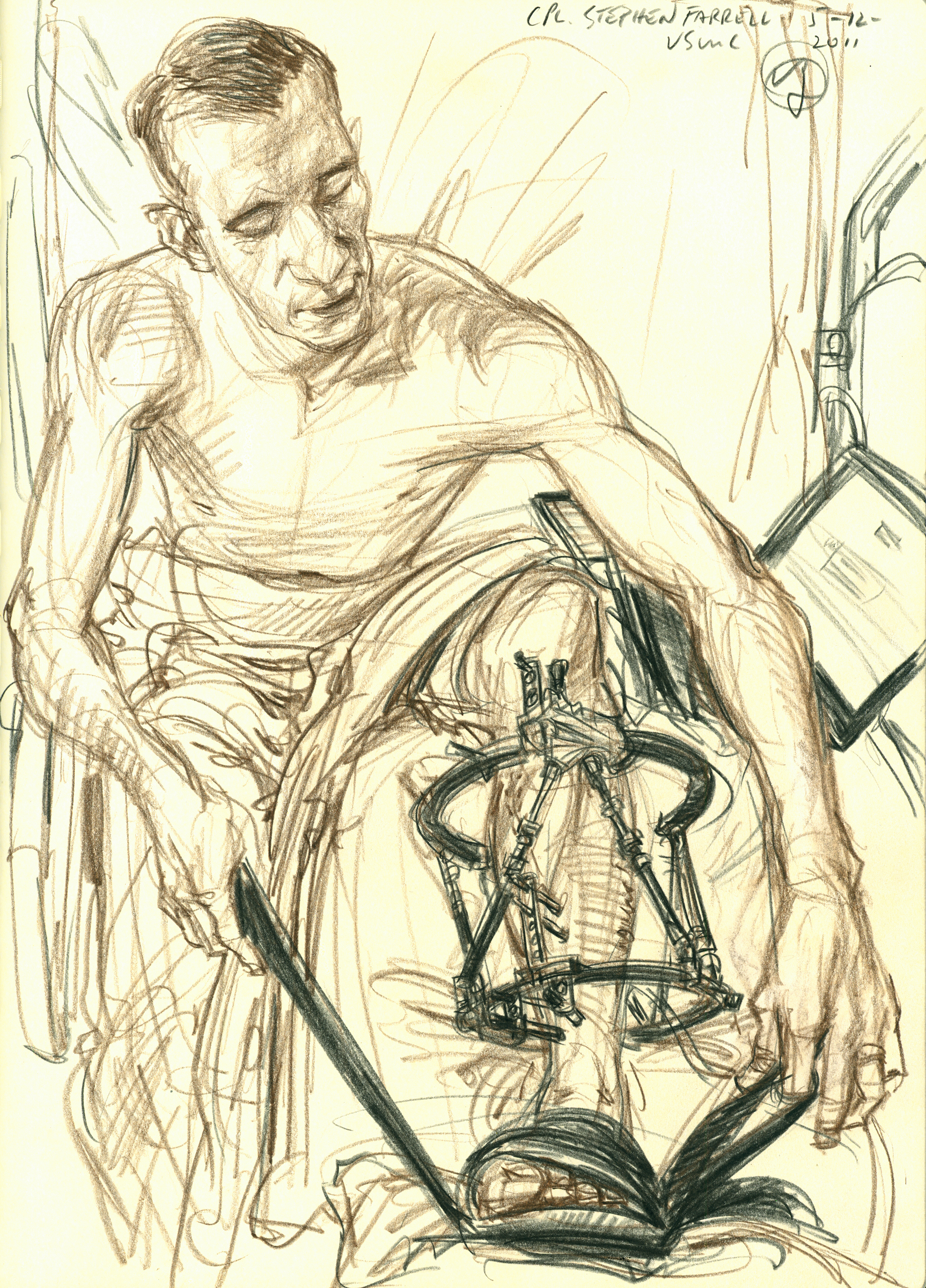
Victor Juhasz: I enjoyed reading every one that I received for review and to match to an illustration, all for different reasons.  One piece that arrived too late for me to make a call on selecting a drawing was by Kevin Jones.  Ironically the drawing you chose was of a wounded Marine I had done at Bethesda.  It worked perfectly.  I’ve been involved with the Joe Bonham Project now for almost a year.  It was started by a former Marine and combat artist, Michael D. Fay, who I can thank for giving me the kick in the pants to seek an embed over in Afghanistan last year.


The Bonham Project has been documenting, through drawings and paintings, the wounded who have been and are still returning from the front lines of our theaters of operation. It’s been very satisfying work from a spiritual as well as a personal level, giving voice, via the visual recording, to these warriors who have been injured in service to their country. Some of these wounded have suffered horrific wounds that will be with them always and create challenges that most of us would not even wish to consider.


Yet, to a man, and I say to a man because I haven’t drawn a wounded service woman yet, the attitudes have been remarkable. The sense of resiliency inspiring and humbling. Drawing and documenting these soldiers and Marines is one way I can say thank you. I guess Kevin’s piece resonated so strongly because it echoed some of the work I am currently doing and hope to continue till I won’t have to. We’ve got a son who is a Marine. Kevin is a former Marine.


Kevin Jones' story


MA: That’s a wonderful answer, Victor. I was delighted to have Kevin’s piece in this issue, and your illustration could have been drawn especially for it. Did you hear from any of the authors after the issue went live? In particular, I’m fascinated by the ways in which authors often  find personal meaning in an illustration for their work that we couldn’t have known or even anticipated. That seems like just another level on which artists commune with the work and with one another. Was there an example of that that you could share?


VJ: I received a very nice email from Nicole Robinson. Ironically, the pieces selected for her poetry were not military related but satirical illustrations done for MOTHER JONES and ROLLING STONE.  Yet Nicole seemed very connected to the pieces. Through the grapevine, a.k.a. Mary Akers, I was made aware that the reactions to the /images from the authors were quite positive, which made me happy.


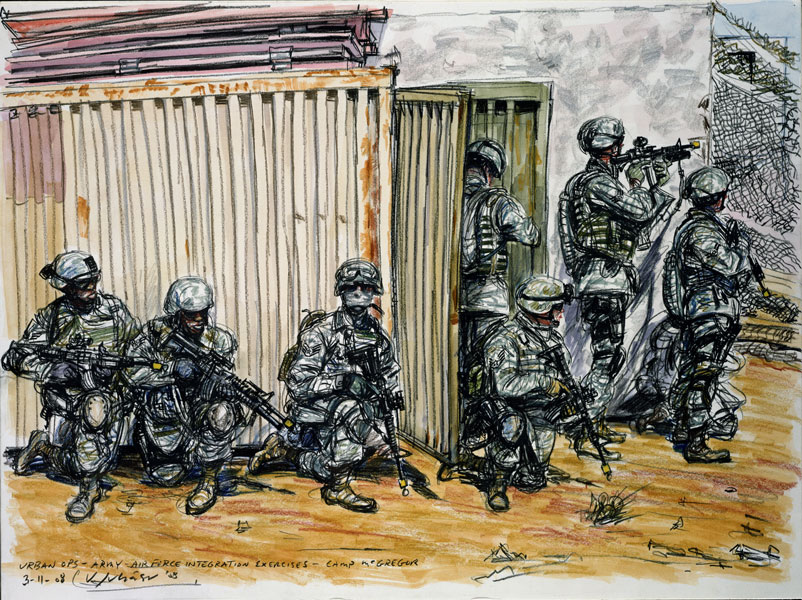
Victor Juhasz image


MA: I think a lot about the function of art, the accessibility of art, and the conversation between artist and “consumer.” (Consumer, not in the commercial sense, but in the sense of “the person on the other end.”) I feel very strongly that art takes two. By that I mean that the artist makes a thing (painting, sculpture, song, whatever) but at first it is simply the artist talking to him-or-herself..until someone shows up on the other side of that art, enjoying it, experiencing it, or even hating it. But in a sense art takes two brains to be fully realized–the creator’s brain and the experiencer’s brain. What is your perspective on the idea of conversation being inherent in the creation/realization of art?


VJ: The way I look at it, if I can make myself chuckle at an illustration I’m working on, I know I’ll be making connections out there with the audience that reads the publication where the illustration appears. I’ve received the range of responses to my illustrations from a resounding “Yes” to real anger and offense. Luckily I get far fewer of the latter responses. As for the more serious work, like these military themed drawings and paintings, my focus is on the humanity of the subjects. I want them to make eye contact from the paper or the canvas with the viewer and for the viewer to experience a sense of that intimacy and connection, that sense of knowing the subject/s in the image.


MA: I attended a wonderful lecture by Margaret Atwood in which she spoke about the basic human need to be creative. If we doubt that, she said, we should think about the things that young children explore and do naturally, on their own. They sing, draw pictures, make up stories, dance. We need to nurture the arts in our public schools because creativity is at the core of what makes us human. What are some of your earliest memories of being creative as a child? Have they stayed with you in later life?


VJ: I am sorry to say this but my earliest motivations for being creative and expressing myself were driven by anxiety and fear. My parents fought a lot, they carried much baggage from their experiences in Europe during and after World War II. Nowadays one would quite easily say they suffered from PTSD. They weren’t emotionally equipped to hear each other because they were so absorbed by the traumas within themselves.  So they fought.  All the time. Soldiers and scenes of armies fighting huge battles were the earliest drawings I remember. I was working out my anxieties about all the fighting in the house. I think nowadays, especially in the satirical and political illustration that I do, fear and anxiety, along with rage, lie at the heart of some of my best work. Great comedy draws deep from the well of pain, humiliation, and frustration.


Now, having said all this, let me also add that creativity desperately needs to be nurtured in schools. This is a huge challenge. We live in a world where imagination is not valued. We have become passive receptors of computer generated /images, created by others, in mind boggling high definition, that leave nothing to one’s creative imagination. There are plenty of undeniably impressive special effects. There is, however, no mystery. Not trying to be a Luddite here. Just pointing out that there is incredible power, not to mention, magic, in what a child’s mind can visualize from hearing or reading a story or from taking some simple objects and creating a whole world and story with them.


MA: Last year I visited the Georgia O’Keefe museum in New Mexico (a bit of a pilgrimage, I must say) and I watched a movie in which she said as soon as she saw New Mexico she knew it was “a place she could breathe.” Do you have a place that inspires that feeling in you?


VJ: My wife and I moved to the New York Berkshires because the scenery was so inspiring. The farmlands, the rounded, weathered mountains. We love the drive to Williamstown, Massachusetts, about a half hour east when we visit her sister and her family. There are some views near the intersection of Rts. 43 and & 7 that are pure magic. On a good creative day my studio is my New Mexico.


Most importantly, we also have that New Mexico moment within ourselves, always ready, no matter where we are, if we just remain aware.


MA: Yes, I like that point of view. It’s all about accessing it, isn’t it? Both in terms of the creative act and the creative mindset.


Finally, since we are a recovery-themed journal, what role do you think recovery plays in the creative process? Many prisons, trauma counselors, psychotherapists, survivor’s groups, veterans organizations and the like employ art to help patients heal. Have you found yourself drawn to /images or themes that you later realized stemmed from something you needed to work through?


VJ: This kind of relates to your earlier question about childhood memories and creativity. I think we more or less spend our lives working on the issues that we inherited as kids. They just become variations on a theme- or themes. My mother was a survivor of the Soviet concentration camps, and like I mentioned before, suffered on a near daily basis with what we now call PTSD. I have spent many years working on that inherited sense of grief and sadness and fear and coming to some sort of terms with them. Events that happen here and around the world that upset so many people I know, don’t seem to surprise me that much. I grew up listening to recollections of horror and suffering. I have no illusions about this species. That might be one reason I seek a humorous route in my illustration as much as possible, especially if I can bring in the element of slapstick and absurdity. And slapstick is essentially cruelty made very funny. Interestingly, slapstick was a favorite of my mother’s as well, a form of comedy not normally associated with women.  She was as big a fan of The Three Stooges, Laurel and Hardy, Bugs and Daffy as I was and remain to this day.


MA: I find that fascinating, that inherited sense of grief. It’s so true, but we (as a society) tend not to think about grief and trauma in that way. If I might share a short anecdote with you…? I co-authored a book with a man who survived being sent to Siberia in 1939 and at one of our public appearances, he was confronted by a very angry woman who asked him how he could possibly forgive the Russians for what they had done to him and to his family. She would never, forgive, she said, pointing her finger as him, never.


Flash forward about six months and my co-author and I were approached at a book fair by a woman who had read our book and said she was in graduate school studying how the descendants of parents who have suffered trauma carry that trauma with them and even pass it into the next generation. Her mother, she said, had been banished to Siberia as a teenager and had never recovered emotionally. This young woman who approached us felt that she–even though she had never been to Siberia–had suffered as well. As we talked more, we discovered that this was the daughter of the very same woman who had confronted us six months earlier. It was a powerful message about the value of forgiveness, not only for oneself, even, but for the world, for the children, for the future.


Anyway, thank you so much, again Victor. It’s been wonderful working with you.

Interview with Nicole Robinson

Nicole Robinson

Joan Hanna: Nicole, we were so excited to have your poems Genesis and Trust Because in our Winter issue of r.kv.r.y. Can you first talk a little bit about the difference in the these two poems stylistically?

Nicole Robinson: Thank you, Joan. It’s an honor to have these poems in this issue of r.kv.r.y; I think the work that all of you do is lovely, and important. Words as recovery… it holds so many meanings for so many people. As for the different styles in “Genesis” and “Trust Because” –I suppose the styles are different because the urgency and questions as I was writing and playing with language were different. In “Genesis” I wanted to know how “it” all began. I’m still not sure I fully know what “it” is… But I know I wanted to dig at the beginnings of many things. I think it started splitting into sections because I kept trying to get deeper toward the “beginning.” I still have not gotten there. And I don’t even know if a beginning of anything really exists—because it’s so knotted into some other type of beginning. In “Trust Because” I needed to know why I should trust. Though again, I am not sure what I was trying to trust: my soul, maybe, or maybe some voice that speaks to me through poems to help me understand our complicated world. That poem (“Trust Because”) did not want to be split up—not into sections, stanzas, or even by a period. It reached out and grabbed everything, sort of like me in a thrift store.

JH: Trust Because is such an interestingly layered poem. It seems to have several conflicting points of view. Can you elaborate a little about how you came to the juxtaposition of /images in this poem?

NR: It certainly is a “layered” poem, though I never thought of various points of view being conflicting. I suppose the juxtaposition of /images and the layers came about because, well, the world we live in is vastly layered. Right now I’m thinking of a line from Stanley Kunitz’s poem, “The Layers” –it’s the part where a nimbus clouded voice speaks to him: “Live in the layers not on the litter.” With “Trust Because” I think I was at a place where I was buried in the litter, and some voice was telling me, and really bothering me, to “trust, because…”. And then, by trusting language, the way words sing in our mouths, I started listing the reasons to trust—while at the same time, accepting the place I was, a place where I could not trust, thus the lines “if I could give in and trust / I’d want to trust the redbud tree…” Eventually the poems comes to a place of acceptance, a place where I could be a woodpecker “beating his beak against bark, / the sound of it, something round, / a hole to hide out until I can find the world.” After all, it is beautiful, the way a woodpecker beats and beats at a tree until it pecks a hole large enough to find the food and nutrients it needs. Of course, I did not think of any of that while writing this poem. I simply trusted the music of language. Poems are such great teachers, aren’t they?


JH: I was especially excited to have Genesis as part of our war and military themed issue. You use the image of war in correlation with emotional and traumatic incidents in our lives. Can you share with our readers why you use the Gulf War as a jump off point in this poem?

NR: Good question. I’m not sure I have the exact answer. I am only 30. The Gulf War happened when I was young. But the television was always on, and somehow, the Gulf War really affected me. I did not know anyone (that I remember, at least) in the Gulf War, but I remember clips of /images on the television, and the feeling of great empathy for both the Iraqi people and the U.S. soldiers. I also remember, very clearly, wondering why people weren’t talking about it much, or trying to stop it. And also how I couldn’t really stop thinking about it, how it stuck with me every time I faced anything difficult, how it was somehow my job not to quiet that war, because if I couldn’t find a volume button for my own difficulties, then other peoples difficulties should not be silenced either. I was a strange kid, spent a lot of time looking at the sky and realizing we’re all sitting under it. I guess I used that at the beginning of the poem, because it was one of those “beginnings” I wanted to look at.


JH: I am so drawn to some of the contrasts in Genesis, for instance, in section 5, the lines: “hands can open softly like a shell casing, then fingers send bullets bleeding” have this idea of soft and harsh, or love and pain (if you will) as being initiated from the same source. This is such an interesting image to me. These contrasting parallels run throughout Genesis. Why do you think these /images set against one another are so strong in your work?

NR: First of all: thank you for the fine editing suggestion. Truly. I think I wrote: “…then fingers send bullets speeding.” But I like “bleeding” as well! Anyway, I guess I don’t’ really think of /images being set against one another when I’m writing because somehow, in someway, things are simply together. This might be off topic, but my first creative writing instructors as an undergraduate student, Virginia Dunn (who passed away, but is still very much alive in my thoughts) and Maj Ragain, helped me to hone in on what I already, in some small way, knew: pay attention, listen, see and feel myself in the other person or object. I’ve gone on to practice that, and by doing so I can’t help but see the connectedness of people, and things. To answer your question plainly: I suppose /images set “against one another” are often “strong” in my work because that is how it works in the world… but we have to be still and quiet enough to notice the beauty in them.


JH: I’m not sure if that was a serendipitous typo in thinking “bleeding” instead of “speeding” or how I actually pictured the image when I read the poem. One of the things I am so struck with in your poetry is the sense that somewhere within all of these intense realities there seems to be a voice that sees beauty in the world outside of the purview of emotional trauma. How do you think this positive voice seems to come through even though you are dealing with such deep emotional issues?

NR: I remember hearing or reading an interview, or maybe an essay, where Robert Pinsky talks or writes about poetry, and he says something about the process of human imagination taking in its surroundings and discovering how to make art from them. While I don’t intentionally think about making a “positive voice” I think I am searching for the art, the life, the deeper truth in things. I cannot tell you why I do this, but I do.  Maybe it’s some pure instinct to run into the unknown and find something worth picking up, holding and even transforming.


JH: Can you share a little about the work you do at the Wick Poetry Center?

NR: I pinch myself, very often, for being able to do the work I do. As you may know, the Wick Poetry Center is located in Kent, Ohio at Kent State University, and does a lot of work locally, regionally and nationally. I’m the program and outreach coordinator. This means I get to put my hand in a million jars and always come out with a really tasty treat. As we say often, the Wick Poetry Center “encourages new voices” –and it doesn’t matter if that voice is the winner of the Stan and Tom Wick Poetry Prize for a first book of poems, a third grader realizing the joy, pleasure and wisdom in his poem, or a psychiatric patient saying writing has allowed her to see she’s a beautiful person— it is all so powerful, watching poetry change lives. Basically my job at the Wick Poetry Center ranges from organizing an author’s visit, which is almost always more than a reading, to leading writing workshops in the schools, hospitals, community centers, and all over. On a daily basis I get to share what saved my life with others. Here’s the plug: visit one of our project websites: Traveling Stanzas or Speak Peace, or the Wick Poetry Center’s home website and become involved by joining “Friends of Wick” and/or supporting in some way (even if it’s liking us on Facebook)—help us bring poetry to all who need it, which is everyone.


JH: Nicole, thank you so much for sharing your lovely poems and your thoughts on writing with our readers at r.kv.r.y. Just one final question: can you tell us what recovery means to you?

NR: When I think of the word recovery I first think about loss, loss from personal trauma and from wars,environmental destruction, etc. Recovery to me is going back and picking up those pieces. And it can be a sloppy, painful mess at times. On a physical level (a good example of the non-physical) I think of my ACL reconstruction I had years ago. I tore my ACL skiing, had surgery, and then months of painful physical therapy where I learned to use my leg and knee again. During all of that pain there were pockets of beauty: bending my knee a little further, taking another step, witnessing the love and patience of my partner, Deb, and my friends. I guess what I’m getting at is the duality in the word recovery. For me recovery is filled with beauty and pain. Writing for me is an act of recovery; it allows me to follow the music of language and search, dig, ask questions, and slowly recover some part that was lost. Something in the act of recovery helps us to expand, so that we are able to hold what we did not have the capacity to hold before. Something about the act of recovery…  if we’re paying attention we’ll probably be doing it our entire lifetime(s). And that, I believe, is beautiful.

Interview with Stephen Ramey

Stephen Ramey

Kristine Ong Muslim: Hi, Stephen. Your short story, “Coffee,” in the Winter 2012 issue is a strong piece that deals with loss and mortality. I admire the way that you pulled it off without involving any tear-jerking scenes. The incredibly suggestive statement – “Her hip aches, there in the hollow beneath the ribs” – says it all. That is brilliant. I realize that this is a standard question for many writer interviews, but can you tell us if there is a particular incident that inspired you to write this story?

Stephen Ramey: Thanks for your kind comments. There was no specific incident that led me to this coffee shop and this counter clerk, but it does echo the impression I had when I first moved to New Castle. It’s a beautiful little city that has been crumbling for years. There’s a sense of hopelessness in people’s eyes as they hurry past recently remodeled store fronts that have been boarded over yet again. But once you meet local folks, you feel their pride of place and a resolute kindness that shines through. I believe that much of what came out in “Coffee” stems from that perceived tension between the city’s surface and its beating heart. It’s a very interesting place to live as a writer.


KOM: I love flash fiction, and I can’t help but rave at your stunning short story called Leaving the Garden at The Journal of Compressed Creative Arts. The visual overload is startling and unforgettable. I’ve also read several of your stories before reading “Coffee,” “Leaving the Garden,” and “A Formidable Joy.” I know that I’ve mentioned to you before that your writing reminds me of Terry Bisson. Another detail that I’ve noticed in your stories is that you excel at creating first lines.  So, can you let me in on your writing process? Do you usually finish your micro-shorts in one sitting? Do you normally start with a sentence in mind or an image perhaps?

SR: Thanks for reading! I’m humbled to be compared to a truly great writer like Terry Bisson.

My process is typically this. On Tuesday morning, I sit down with a prompt at Show Me Your Lits and write for 90 minutes. Sometimes, as in the case of each of the flash pieces you mention, something worthwhile results. I revise based on peer comments, then polish and let it sit for a time. When I’m ready to submit, I read the piece again, revise, and send it off. If I receive editorial comments, I revise again, polish again, and send it back out. Every work remains a work in progress until an editor says ‘yes’, or more rarely, ‘Yes!’. I find that prompts help me  to focus, or maybe it’s the challenge of constraint that pushes me to create these pieces. It seems the more I limit myself, the more strongly my imagination works to break “the rules” in creative ways.

It’s interesting that you mention first lines. That was a real weakness for me in the past. I tended to write static scene and character setting lines that provided context, but no spark for the reader. The key for me was to read tons (and I do mean tons) of opening lines. The really strong openings begin to jump out. Now, I probably work hardest on getting a reader into the story. I don’t let myself begin with simple context, but strive to command attention with a confident assertion that hints at what readers are about to experience. Then I move to more concrete context (in general). So, yes, I do often begin with a sentence that catches my interest. “Leaving the Garden” began in that manner. I was contemplating an image of a cemetery seen through a bomb scope, but it was that first sentence that launched the story. With that sentence the entire concept gelled.


KOM: What are your favorite themes?

SR: The issue that really interests me is the tension between self and other, e.g. our need for gratification pitted against a need to be acknowledged by others, our desire to remain individual against the requirement to participate in stable society. I’m also interested in the myriad ways we seek purpose in our lives. That said, I try not to write overtly about issues, but to create character driven story experiences. Theme inevitably leaks in.


KOM: What drives you to write?

SR: Now, you’ve touched a sore spot. The truth is that nothing drives me to write. I wish it were otherwise, believe me. I would be perfectly content to wile away my days reading books, watching television, playing video games. My driving force is to leave something of worth behind when I die. Sounds macabre, I know, but that has been my secret goal since I can remember. I think it’s because I read Asimov’s The Foundation Trilogy when I was deeply depressed in high school. It opened my eyes as nothing before had done. I’ve always longed to create-I do have that going for me-but had not understood the power of creation until that experience. It changed me in a positive way. I think I hope to do the same for some future depressed high school student. The problem is that in order to create a master work, one has to become a master first, and one does not do that by reading books, watching television, playing video games. Once I finally pounded that truth through my thick skull, I began writing regularly.


KOM: There are so many writers who choose to self-publish nowadays. The preponderance of those 99-cent self-published ebooks is becoming the norm. What are your thoughts about self-publishing?

SR: This is a complex issue for me. On the one hand, we live in a society that values distribution over creativity, and that is a very poor model for encouraging diverse creations. We worship the Creative, but we buy product. On that point, I’m very happy to see ebooks taking hold. They bypass to a large degree the necessities of the old business models.

On the other hand, self-publishing can be an excuse not to get better at one’s craft. My view is that an artist should  strive for perfection throughout his/her lifetime. Without a “quality” filter between me and publication, do I really have a an incentive to improve my craft? I don’t know. I guess, for now, I’m most interested in the legitimate small press that is emerging. I like the idea of having editorial involvement in the process of vetting works.


KOM: Can you tell us about your current writing projects?

SR: Right now, my focus is on editing the new Triangulation anthology, an annual speculative fiction collection from Parsec Ink. I’m revising an epic fantasy novel for my agent, and hope to start work this year on a literary novel that’s been brewing in my noggin for a while. For those who might want to keep up with my doings, I blog at RameyWrites.

Kristine Ong Muslim is the author of the forthcoming short fiction collection We Bury the Landscape (Queen’s Ferry Press) and several books and chapbooks, most recently Insomnia (Medulla Publishing). Her short fiction and poetry have appeared in many publications, from Boston Review to Southword. Her online home and blog: http://kristinemuslim.weebly.com

Interview with Kevin Jones

Kevin Jones

Jeffery Hess: I enjoyed reading your story The Edge of Water, about a veteran returning home from the war in Iraq. You and I both served in the military, and one thing I learned during my time in the service is that people enlist for very different reasons. Can you tell us when and why you enlisted?

Kevin Jones: I joined the Marine Corps in May of 1990. At the time I was living in a small, studio apartment and trying (unsuccessfully) to attend community college.  I worked for an art house movie theatre making minimum wage which, while very cool, did not let me eat as much or as often as I would have liked. I had several friends who joined the military right out of high school and they seemed to be doing well, so one day I went to visit a recruiter to see what he had to say. The biggest attraction to the Marines, as opposed to the other services, was that they were offering a challenge. Could I complete boot camp? The other services talked about bonuses or job training or college funds, but the Marine Corps offered none of that. They told me up front that boot camp would be the most difficult thing I’d ever done, if I even finished, and that had a strong, reverse-psychological way of attracting me. In short, I was looking for a way to prove myself, even if I didn’t know who I was trying to prove myself to. The Marine Corps offered that in a way, to me, that none of the other branches did.

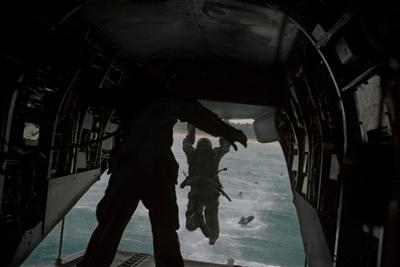
Scout Swimmers

JH: When we were talking earlier, you mentioned that you had an epiphany while home on leave: your sister helped you discover Henry Rollins at an indie record shop and this made you realize you had to become a writer. Can you elaborate on this formative occasion?

KJ: After I graduated from the School of Infantry I was sent, almost immediately, to Saudi Arabia and Operation Desert Storm.  When I returned from the war, I had some block leave and went back to Sacramento (my home town) and tried to re-adjust. My sister was going to college and ran around with a group of actors and filmmakers and she had discovered Henry Rollins while I was overseas. While on leave she’d gone to Tower Books and bought me “Black Coffee Blues” and “See a Grown Man Cry.”  I’d been writing here and there all my life but without any real focus. Reading Rollins made me realize that if I wanted to write, I just needed to do it, and that there was no “wrong” way to write. It was the sort of muscular, no BS, no excuses kind of attitude that dovetailed perfectly with my service as a Marine, and I’ve pretty much been writing nonstop, in one form or another, since reading those books.

JH: Your characters often have military backgrounds but are not necessarily based on your experience. What is it about the military that you find makes for compelling characters?

KJ: I like the idea of characters thrust into situations they cannot get out of and forced to work with people they might otherwise not have anything to do with. I also like writing about organizations with very specific cultures, rules, and languages. The military, obviously, fits this interest, as do law enforcement, medicine, academia, and a host of other areas. For whatever reason, I’ve had more success with military themed stores than with other works I’ve written.


JH: Your current position in education involves the military. And your plans after completing your doctorate do as well. How so?

KJ: I’m finishing a PhD in Educational Policy at the University of Florida right now and I’m researching how military veterans make the transition from combat to higher education. What is that process? How do they adapt? How does the experience change them and how do they change the colleges and universities they attend? I founded the Student Veterans of America chapter at the university where I teach and am involved with several veterans groups at campuses across Florida as well. According to some estimates, there are going to be over a million and a half veterans of Iraq and Afghanistan leaving the military in the next few years. I’m a firm believer in higher education as a means to help these people successfully transition back to civilian life and move forward with their lives.


JH: That sounds like an excellent project, Kevin. Thanks for sharing your time with us. It’s been a very interesting discussion. And readers, stay tuned: on Wednesday we turn the tables and Kevin interviews me.

Interview with Jeffery Hess

Jeff Hess

Kevin Jones: A lot of people join the military for a new life or to make a fresh start. Rudy, the main character in your story Last Battle Aboard the Old Pro, seems to be one of these people (even if he’s making a hash out of it). Why did you join the Navy? What were you looking for? Did you find it?

Jeffery Hess: My high school senior trip was a seven-day cruise to two ports in Mexico and Key West. I was seventeen years old in international waters on a cruise ship full of alcohol and high school seniors. It was a non-stop party. A couple buddies with me were already signed up for the Navy. I might have been thinking about the Navy before the cruise, but I enlisted just two months after graduation. It seemed to me that a job that took you places couldn’t be all bad.

On some level, I believe I also joined the Navy out of some noble call to defend my country and I’m very happy that that was the result. But the pressing motivation for enlisting was that I wasn’t ready for college and I didn’t want to spend all my time at a job at a point in my life when I didn’t know what else was out there in the world. That senior cruise gave me a taste and I wanted more.

Beyond the cliché of seeing the world through a porthole, though, the Navy offered honest, hard work, the potential to advance incrementally in rank, while serving my country and making my parents proud, all with the opportunity to see at least part of the world. I couldn’t pass that up. During my six-year enlistment, I saw a fair amount of the northern hemisphere. I worked hard and played hard and made a lot of great friends. It was as productive a gig as I could imagine between high school and college. So, yes. I’ve never really thought about it before, but I suppose I did find what I was looking for.


KJ: The Old Pro in the story is a relic in an otherwise high tech Navy (I was particularly taken with the comparison between the ship’s minimal defenses and the Soviet Union’s high powered naval forces). How does that fit into the narrative? Were you making a conscious decision by placing the events on a ship that’s basically waiting to be decomissioned?

JH: I served two years aboard the very ship named in the story. The USS Proteus. We called her The Old Pro because she was the oldest ship in the fleet — she had been present at the Japanese Surrender with six Japanese submarines moored on each side. When I arrived for duty in her homeport of Apra Harbor, Guam, forty years later, the ship was in dry dock. Various repairs were being made and a number of equipment upgrades were getting installed, but the ship was a weathered hulk built during the Roosevelt administration whose sole purpose was to serve as lactating sow for all her submarine pups.

The Proteus was a submarine tender with barely enough fire power to make a balloon burst by shooting into a clown’s mouth. At the time, I resented the thought that my ship was equipped with undersized weaponry. I felt trapped on the little island when we were in port and vulnerable to the enemy while we were at sea. Years later in civilian life, I realized that our weapons weren’t the guns aboard our ship, but rather the submarines that we tended were. Each sub that stopped by for refueling, restocking, or repairing was like a giant torpedo filled with missiles and more torpedoes. Collectively we were a powerful and important factor in the Cold War. (I spent the last three years of my enlistment aboard the newest ship in the fleet, a guided-missile cruiser, with all the latest and greatest firepower. My enlistment ended about a month after the Berlin wall came down.)

Of course, the crew didn’t know the Old Pro would be decommissioned a few years later. And I can’t say I set the story there for any greater reason than it’s loosely based on actual events and it all seemed to fit.

Jeff Hess

KJ: This feels to me like the first chapter (or certainly an early chapter) in a novel. Is it? Was it meant to be at one point? We read a lot about short stories growing into novels, but the reverse also happens (the novel that hits a dead end and becomes a short story or two). On a larger level, how do you deal with stories that end up in different forms than you’d hoped they’d be when you started?

JH: This story was written as a stand-alone story, but now that you bring it up, I’m amazed to consider the fact that this story is exactly the kind of backstory the protagonist would have in the novel I just completed, which grew out of a totally different short story. As for this story, I wouldn’t be surprised if it ended up the basis of a chapter or a large flashback in my next novel.

As for the forms stories take as they’re being written, I’d say that I’m pretty flexible. The story I’m working on now changed recently from being about an Ensign aboard a ship to being about his wife back in their homeport. All the hardcore Navy stuff I had from this guy’s point of view had to be scrapped in favor of this woman who doesn’t deal well with time alone. It’s a totally different story than the one I began writing, but the character was so real to me that she took over and demanded to be written about. I’m pleased with the direction it’s going, but I wouldn’t have discovered all this crazy stuff about her if I had forced myself to write about her Ensign husband out at sea. So, in a sense, the character directed the form, the focus, whatever. If it doesn’t work, I can always go back to the ship with her husband at sea.

KJ: Military-themed fiction runs the very real risk of turning into cliché, but yours avoids this entirely. How do you maintain the conventions of the genre while keeping the story fresh?

JH: I’m flattered that you consider my writing fresh. That’s a huge compliment. I hate to answer your question with self-deprecation, but I don’t know. I think I just try to tell a story as close to the way it would have happened. I’ve never deconstructed or analyzed one of my stories for this sense of freshness, but I think my characters tend to be put-upon, or somehow downtrodden and fighting against circumstances to get what they want, even when they don’t succeed. This is often set in the shadow of the Navy or prior Navy service because that was a formative time in my life and it’s vivid to me and fertile ground for such stories that entertain me and hopefully others as well.


KJ: Do you see yourself as a military writer or a writer who just happens to write characters and stories with military backgrounds? Are you concerned about being thought of as a military writer?

JH: I think this ties into your previous question, based on your compliment of my bringing a freshness to the stories. Most of my stories and even the novel I recently completed involve characters in or recently out of the Navy. There’s something unique about the confinement of ships out at sea and of the workshops on those ships. People of various ages from often very different backgrounds are thrown together and there’s no escape. You can’t call in sick on a ship. And you can’t quit. That can lead to all sorts of situations. And there are situations, decisions, and emotions to deal with after getting out, as well.

I don’t see myself with any kind of label though I’d be fine with someone considering me a military writer. I once described a story of mine as Navy Noir because of the dark characters and the elements of crime and violence. I’ve never seen that term anywhere, so perhaps that’s a new label. Who’s to say? Maybe I’m a crime writer. Many of my characters are also from Florida, so would that make me a Florida writer, too?

There’s a sense of expectation that comes from labels. Perhaps that’s a good way to keep writers on track. But when I’m banging away on my laptop, alone, at night, I’m not thinking of labels or expectations, I’m just writing variations of the stories I’d like to read.


KJ: You run a creative writing workshop for military veterans. How has that affected your work? What changes, if any, have you made in your writing process since forming this organization?

JH: I got the idea for the workshop while finishing my MFA program. The Navy was very good to me and we were in the middle of two wars. In an attempt to show my gratitude, I wanted to share my passion of writing and reading with others who have served.

In advance of the first workshop, a reporter from the Tampa Tribune interviewed me over the phone and one of her questions was, “Do you write about your own military experience?” The rest of the interview is a blur in my memory because I was so unprepared for that question. It seems stupid to me now that I wouldn’t have anticipated that question, but I didn’t and I had no ready answer. To that point, most of my writing contained main characters who had some past or even distant affiliation with the military, but I didn’t draw directly from my experiences in my writing, using the backdrop of my experiences aboard ship and in various ports. I’ve been making up for lost time ever since.

The workshop has affected my writing positively since we began in late 2007. We have a dedicated group of writers who inspire and challenge and entertain me. Being in that kind of creative environment and sharing comments on the work each week helps cement my writing knowledge and enables me to pursue new knowledge to share with the group. I’m constantly learning.

Interview with Millicent Accardi

Susan Rogers: You and I have both written several poems together with a group of poets organized by Kathabela Wilson called POETS ON SITE. One focus of this group is writing poetry inspired by the artwork in local galleries and museums and then performing these poems in the location of the artwork. These ekphrastic poems are always an interesting collaboration with the poet and the artist and are part of a long tradition of poets engaging artwork. Sometimes ekphrastic poems are narratives about the artists who created the artwork. Sometimes ekphrastic poems are interpretations of the story that seems to be held within the artwork. I really love your poem “Still Life with Bird” that you wrote for Susan Dobay’s painting “Still Life With Bird.” This poem will be published soon in the POETS ON SITE collection, “On Awakening.” In this poem you manage to engage both visual art and music, spinning a riff on Charlie Parker. The poem is written in a very fluid, jazzy style that resonates both with the painting and with Parker. What was the process you used to engage Susan Dobay’s painting and write that poem?

Millicent Accardi: I looked at the painting and tried to see what it was telling me and, from the table and the feeling of falling from the perspective as well as the title. It reminded me of the music and the life of Charlie Parker. So I went with that, like I “go with” a jazz piece. From that premise, I tried to build an adlib solo impromptu response to both the painting and the music and how they tied into each other.


SR: You have created a wonderful forum for poets to get together and workshop their poetry: The Westside Women Writers. This group both encourages the creation of new poetry and facilitates the process of revision, in that it provides constructive feedback to the poets on their poems. In addition to bringing your poems to this group, what else do you do to craft your poems? Do you have any personal guidelines you follow in revising your work and how do you decide whether a poem you have written is “finished” and ready for publication?

MA: I write in purple notebooks; I write on the computer; I write in my mind, in the shower, while driving. It depends. Poems beget more poems and I find when I am “on a roll,” the poems come easily and frequently. When I am not, they are non-existent and I do not press myself to produce work. There are times when I set the stage for poetry to “be possible,” like when I participate in poetry prompt exercises. One that is sponsored by Molly Fisk has been of particular use to me. She posts one prompt per day and a group of writers write to that prompt every day for a month. Early in 2011, I did 3 or 4 solid months of these prompts. Then, I felt I needed a break. And my day job called out to me to get to work to earn money for the mortgage and taxes. Writing is like that for me, either feast or famine!

As far as completion, sometimes I feel as if a poem is never finished, but, for me, it is usually one of two things: either I have nothing left to add or take away to make it better and I give up and surrender that it is complete, OR what I have written matches what I have in my mind. When it matches, then my job, for whatever it is worth, is finished. Done. Otherwise, every poem I have ever written is open to change, open and available for revision. Even after a poem has been in print.

Here’s a quote that comes to mind, “Some poems are very hard to write, must be carved into granite with a feather. Others burst out of the head armored and ready to command a chariot drawn by swans.” –Dean Young


SR: Which three poets would you say have had the most influence on your poetry and why?

MA: I think I will go with contemporary poets first: citing Lynda Hull, Ralph Angel, Pablo Neruda, WS Merwin, William Stafford, CK Williams, ai, Michael S Harper, CD Wright, Ruth Stone, and a wonderful Portuguese poet, Nuno Júdice. From other times: Yeats, TS Eliot, and Christina Rossetti. In particular I appreciate and am amazed by poets who transport me to new worlds, new places either inside their heads or in a literary landscape.


SR: Imagine you are sitting in a coffee shop in a city where you do not know anyone. You are quietly reading a book of poetry and you overhear a conversation at the next table between two people. They are talking about poetry and you hear them mention your name and one of your books of poems. It could be “Injuring Eternity,” “Woman on a Shaky Bridge,” or your soon to be published book, “Only More So.” Or it could be the unwritten book you will publish after that one. They say something very complimentary about this book of poems. What would you most like to hear them say about your poetry? What would you consider to be the highest praise for a poet?

MA: My answer is very simple; that they are reading the work. This is all a writer can ask, except perhaps that the work affects them in some way, either by actions in their life or causing them to sit and stare into space for a moment to think, to ponder, to see the world or their lives in a new way.

I am continually astonished when I “meet” someone in cyberspace who has read my work. The other day, Carlo Matos, a poet in Chicago, posted a line from one of my poems “Spitting Nails” as his Facebook Status. Now, THAT made my day!


SR: On September 24th 2011 you participated along with your Westside Women Writers group in a 100 Thousand Poets for Change event. This event was a global initiative to use poetry as a vehicle to promote peace as well as positive social, environmental and political change. The Westside Women Writers wrote poems about peace and recited them on that day. Then afterwards you posted the poems the group had written online as part of this global event. The poem that you included in this event, “Renovation” is a beautifully written and very poignant contribution describing a veteran’s painful journey to reconstruct his life. I felt it was a very apt choice for this purpose as it eloquently speaks to the lingering pain and the wounds that never heal inflicted by war and thus speaks to the importance of maintaining peace in the world. Is this role of poetry as a force for change in the world important to you?

MA: “Renovation” was originally written as a piece about a man who had lived through a way (I was thinking of the Vietnam War) and who had returned home to mundane chores and a daily life that, while it felt familiar and safe, was also seen through new eyes, that everything was or had been transformed because it was now seen through a new veil, a veil of war and having served overseas and having seen horrific things and that he was not or no longer capable of existing as the same person he was before; incapable of putting in tile or a floor or even hugging his wife. There was this wall of separation. He’s been to a place of pain that he could not talk about or express and it clouded every aspect of his daily life. And he could do nothing and felt helpless to change it.

As a teacher a community college I had many students in my night classes who had returned from the Middle East, who had served in the Army or the Marines and were back home, many of them with young families and new marriages and they were making their way as grocery checkers or working in gun factories or making deliveries. They were plodding along, trying to do the right thing, but in their minds they were back in the sand, nervous, alone, in a place of killing that no amount of normal life back home could erase. I saw many of them end up in jail for odd reasons, drunk driving, abuse, petty thieving. They did not know or understand how to “be” normal as they were.


SR: Just as there are many different forms and types of poetry there are also many different reasons for both writing and reading poetry. Poems can be inspiring, informative, transformational and even therapeutic. Reading poetry can help us recover a part of ourselves that we have lost and writing poetry can help us process and recover what we once knew but has been buried deep within. In what way has poetry been an action of “recovery” for you? In what way do you hope it will serve as a sense of “recovery” for your readers?

MA: Recovery, to me is recovering one’s life. Plain and simple. It is getting back or unearthing what a soul should be, before whatever happened that took away livelihood and free will. Recovery may be recovering from drugs or alcohol or grief. It could be recovering from a sickness? It could be a healing from a place of artificiality to a place of real. Recovery is a process of peeling back the layers to get to “self.” To return to or to find for the first time the person you were or were or are meant to be. To be not in recovery is to deny life, to cover life up and bear false witness to your own being.


SUSAN ROGERS
considers poetry a vehicle for light and a tool for the exchange of positive energy. She is a practitioner of Sukyo Mahikari— a spiritual practice that promotes positive thoughts, words and action. She is also a photographer and a licensed attorney. Her work can be found in the book Chopin and Cherries, numerous journals, anthologies and chapbooks including the forthcoming San Diego Annual: The Best Poems of San Diego 2011-2012. In 2011, her comments about poetry and poetry workshops were published in an essay on the national site, Women’s Voices for Change. Her poetry can be heard online or in person as part of two audio tours for the Pacific Asia Museum in Pasadena, California. She has also been interviewed by Lois P. Jones for KPFK’s Poets Café. This interview is archived at http://www.timothy-green.org/blog/susanrogers/

Sukyo Mahikari North America – www.sukyomahikari.org

Interview with Brandon Jennings

Brandon Jennings

Dustin Hoffman: Hey, Brandon, it’s a pleasure to interview someone I’ve spent so many nights drinking beers and discussing writing with. Now I have you where I want you, and you can’t just laugh off my questions with a joke about the literary continuum between Kafka and Looney Tunes. This time it’s serious. I’ve been reading your work in workshops and outside of class for years. You started writing mainly short fiction, but essays like “Paul Maidman ~ Banana Man” get a lot of your focus now. Could you talk a bit about how your process for approaching an essay differs from that of a story? What draws you to the essay form?

Brandon Davis Jennings: First it’s an honor to have this opportunity, to be interviewed by a writer I admire and have this interview published at a magazine that I respect. I’ll avoid all continuum references and get right to your questions. I’d be a liar if I claimed that most of the stories I’ve written weren’t rooted in my own experiences—good and bad. And I do consider myself a storywriter first. But the essay form is something I’ve been drawn to because the constraints it places on the narrative provides me with focus—sort of the way a poet might write a Sonnet in order to free himself from thinking about form. A lot of these essays, including this one about Paul, have things that I can’t shove out of my head; memories can become so distracting that in order to get past them, I have to write them and write them as truth. Simply put, I write these essays so that I can make room in my head for the stories I can’t tell yet. But I also feel the need to present these essay with all the care and attention that I would give a work of fiction.—Paul deserves nothing less than my best effort, and I wouldn’t want to present anything less than my best to an audience. And when it comes down to it, these essays are just the way I narrate my own life.


DH: Throughout this essay, we find inserts of dialogue that take place outside the reflective scenes. Arguments emerge through these excerpts that often strike at the very telling of the  essay. What’s your drive to include these? How do you see them as contributing to the overall effect?

BJ: The internal discussions you’ve mentioned are something that happened by accident at first, and they’ve continued to show up in my non-fiction. Sometimes they are my  conscience; sometimes they are complete artifice in order to get a laugh. Sometimes I’m not sure what they are until long after they’ve been written. As far as contributing to the overall effect, all I can say is that they exist within the essays because these essays are written by an older (and potentially wiser) me who feels comfortable making fun of himself and criticizing himself for being foolish or naïve or a jerk—for being human. There is always a voice in my head commenting on every thing I do; it’s like my conscience is work-shopping every choice I make (something that’s been going on for as long as I can remember); some of his comments are valuable, and sometimes he’s just talking to hear the sound of his voice. Maybe that’s a condition I should seek treatment for. But I’ve lived with it this long, so I won’t.


DH: Time becomes unhinged in this essay. We start with the banana show and then take big leaps to moments before and after. Rather than linear chronology, the essay scatters  time into modular sections. How do you approach time when writing, and in this essay, how did you find the sequence that works best, as in, for example, framing this piece with the banana show?

BJ: Because I’ve been a literature student for a while now, it’s easy to write something and then look at it in retrospect and make up an answer to a question like this. I could say that time is unhinged in the essay because I want it to reflect the way that the memories came to me. But I think a more reasonable explanation is that I wrote this with the frame of the banana show because it was about Paul, and he was The Banana Man to me before he was anything else, before I knew what the name meant. And although I could have just come right out and said why and how he earned that nickname, I wasn’t ready to say how it happened until the final paragraph. Certainly suspense played a role in my decision to reveal all the details at the end, but it wasn’t the most important factor. I didn’t intend for this to have a big twist at the end; that kind of narrative is rarely something I find worth writing or reading. But I needed the space in between when I introduced Paul in the essay and when I explain how he earned his nickname to prepare myself to deliver it honestly to the reader. It was like a written representation of the space I often need between myself and an event in order to write about it artfully. Although I do think it’s possible to analyze these kinds of decisions in retrospect, I didn’t think about any of this until I’d had the essay drafted. I’m a sweeper, as Vonnegut put it. So the essay often has to be on the page before I know how it needs to be written.


DH: There are some really funny moments in this essay, and then some moments that make me laugh and then make me feel bad for laughing. How do you approach humor?

BJ: There is little about life that isn’t funny to me; it borders on sick. This year my fiancé asked me to play in an annual softball game, and I don’t play sports anymore (partly)  because I don’t want to injure myself in pointless competitions. I played because I knew it would make her happy, and then I pulled my hamstring. I was angry in the moment, but things like that have happened to me my entire life, and if I didn’t laugh at them, I’d be even less fun to be around. So I don’t think I approach humor; humor approaches me. And if you feel bad for laughing at something I’ve written, then that has the potential to teach you something about yourself and about me. But I’m also a firm believer that if you understand exactly why something is funny, then it isn’t as funny as it could be. I won’t risk trying to explain that. I think that Craig Paulenich’s Goat Man poems achieve something along the lines of this; he blends horrifying and hilarious. A goat man is funny in a poem; a goat man is not funny when he’s reading a poem to you.


DH:
In the last sequence of the essay, the narrator says, “Eulogies are terrible—almost without fail.” Yet, this essay leans in that direction at times. Perhaps even this statement denying eulogy draws my sentiments in that direction. How is and isn’t this a eulogy? How do you approach writing about the dead, honoring them and remembering them through what we might initially imagine as unflattering vehicles?

BJ: I like how you call me “the narrator”. That makes me feel like I’ve achieved a level of dream state in the essay, and that hopefully when people read this they forget that they are being told facts and just enjoy the ride of the narrative. But this was one of the most difficult essays for me to write because it feels like I’m taking advantage of a tragedy. Maybe that’s foolish, but it’s how I feel; so maybe I’m a fool. But when I heard Paul died, I read a few articles that talked about him, things that claimed he was all these things and that had he lived, he could have been all these other things. I didn’t give a damn about what he could have been because he was a great guy to me when we were stationed together, and even though he’s gone now, that is all that matters. If I died in ten minutes I wouldn’t want people to make me out to be some potentially amazing person. I want people to remember the great moments we had together and the shitty ones too. This is a eulogy for Paul, but it’s also a thank you, for giving me the inspiration to talk about things that I have been afraid to talk about for a long time. Writing this essay opened up a vault I’d locked down for a couple decades.

Juhasz artwork

DH: What authors inspire you when writing about the delicately harsh themes of military life?

BJ: I can answer with Kurt Vonnegut, Joseph Heller, Tim O’Brien, Bruce Weigl—I could go on for pages probably. But I don’t read them or feel connected to these writers because I believe military life is any harsher than many of the kinds of life that people live. I think military life is romanticized a lot, and that’s something the above-mentioned writers work against; they aren’t recruiters—at least not on purpose. And I believe that having some kind of emotional pain that you can’t shake off is one of the draws of the military. People want their lives to matter and sometimes they think the best way to go about living a worthwhile life is by seeing how it feels to watch your friends explode. I’d be surprised if the number of people who signed up for EOD didn’t spike after The Hurt Locker came out, and I’d be a liar if I said there weren’t days that I wish I’d have done more while I was enlisted. Usually that only happens when writing is a challenge. I’m glad that I have all my parts and that I never saw anyone die.


DH: I’ve been enjoying reading archives on r.kv.r.y., and your essay fits the theme. What does “recovery” mean to you?

BJ: This is probably going to sound corny, but for me recovery is getting out of bed each day and being me. Some days it’s easy to recognize the things I should be grateful for, and other days it’s not. If I woke up one day and felt recovered, I don’t know what I would do with myself. There are always things pushing against me; recovery might be pushing back. And the only way I know how to push back is with words. That’s something that writing this essay about Paul helped me to understand more clearly.


Dustin M. Hoffman spent ten years as a house painter and drywaller before getting his MFA in fiction from Bowling Green State University. He is currently working on his PhD in creative writing at Western Michigan University. His work has recently appeared or is forthcoming in Blue Mesa Review, Puerto del Sol, Artifice, Cream City Review, Copper Nickel, Witness, Palooka, Southeast Review, and Indiana Review.