Interview with Erin McReynolds

Erin McReynolds

Joan Hanna: I so enjoyed “I Nearly Lost You There” and was excited to have it appear in our July Issue. Can you share with our readers why you chose to write about domestic violence?

Erin McReynolds: I’m writing a memoir in short segments about my mother’s 2004 murder at the hands of her boyfriend, and my finding her body – I guess that’s incorrect: it’s really about our lives together up to that point, as well as my life after it.


JH: The subheadings you use are really interesting and one of the things that drew us into your work. Can you speak a bit about how you formatted this piece and how you envision the subheadings enhancing the reader’s experience?

EM: I wanted to write a book about my mother’s murder and the trauma of finding her body, of our wholes lives together, really. It was always going to be written in segments – some more fleshed-out stories and some essays, and some more crafted vignettes like this one. At first, I thought about organizing the book by stages of grief, but I found that I was missing some stages (anger, depression) and enjoying brand new ones (obsession, an almost jacked–up “high”). This segment illustrates the obsessive phase that lasted for about a year or more, in which I constantly imagined “what if I’d gotten there just a few seconds after it happened? What’s the latest I could have arrived and still saved her life?” The first part plays that out; the second part goes back further, to earlier in the evening – we learned at the trial a few years later what that night was like, and I wrote this piece soon after; the third part is the way it actually happened, which was that I found her three days after she’d died. If the question put forth by the piece is, “How far back would I have to have gone to save her life?” the fourth and final piece answers that with a “never.” She and I will always be suspended in the moment where I see I’ve lost her; I can’t control her. In the end, my turning away is an act of letting go of the obsessive misapprehension that I could have saved her.

JH: Great insights. Thank you for giving us a glimpse into your process. Are there links to any current projects you would like to share with our readers?

EM: I kept a blog for a while here, where I tried to find a home for the unbelievable maelstrom of thoughts, memories, dreams, weird facts and occurrences that came from my trauma. I’ve recently published another essay, this one about my mother’s and my relationship with violence at Prime Number Magazine called “We Hit People,” and a fictionalized version of my sort-of anger phase called “VIVA!” in the Winter 2011 issue of North American Review. I’m about halfway done with the book.


JH: Thanks for allowing us to publish “I Nearly Lost You There” as part of our July Issue. I’ve enjoyed discussing it with you. Just one final question: Can you share with our readers what recovery means to you?

EM: I’d love to – because that’s really why I’m writing this book. When my mother was alive, I detested a lot of things about her: her wide hips, her sloppy eating, her carefree attitude towards everything, the way she picked her lip manically when nervous. And then, she was gone, and an amazing thing happened: I found her in my own wide hips, my own nervous tics, my own increasingly relaxed attitude towards things. I hear her when I sneeze, when I yell, when I talk to the dog. That’s recovery for me: I now love and accept these indelible parts of myself because they came from her. That’s a gift that loss can offer, if you are willing to accept it.

Interview with Sylvia Hoffmire

Mary Akers: Hi, Sylvia. Thanks for agreeing to talk with me today. I enjoyed your wonderful Shorts On Survival piece “Carrying the Day.” The first line is fantastic. It starts “I know the sun was shining that day or I wouldn’t have been hanging sheets on the line to dry.” What a simple sentence, yes? And yet it manages to feel very ominous. How can that be? It amazes me every time I read it. Why do you think it reads as such an ominous first line?

Sylvia Hoffmire: The sense of foreboding conjured in that first line arose in my perception from the implication of a reluctantly forced memory, the fact that she can only be certain the sun had shone through a recalled action. My intention was to convey a sense of her obfuscated  memory.


MA: I’ve been thinking a lot about the importance of beginnings lately. How do you find your first lines? Do they come to you right away, before anything else? Or do you have to go back and mine your writing to find just where the piece will start?

SH: Finding the beginning, the exact right place to enter the story, can stall me for days when beginning a new piece. Even though I know that it may change many times in the process of revision, I need to feel that I’m in the right place at the right time before I can embark comfortably and productively to discover the unfolding narrative. And when I’ve found that place, then, of course, the crafting of the opening sentence becomes the challenge. Often, I just have to take myself firmly in hand and get on with it, banking on the fact that at some point in the process the opening will reveal itself…


MA: I think one of the things that makes your story so visceral, so real, is the way in which you use commonplace details described in a fresh way. “His playpen bare as birth” and “the back steps sagging toward the middle” and “my hair, fresh washed and lemon rinsed” are just a few examples of what I mean. Could you talk a little bit about how details work to create a mood in this story?

SH: With this story, in particular, I knew from the outset that it would be a very short, very compressed piece, and I wanted every single word to be freighted with the narrator’s controlled despair. I knew this story’s success hinged on the reader’s empathy; therefore, the sensory details were key. In all my writing I rely heavily on visual details to convey character so that what the narrator sees and remembers provides clarity for the reader, entry into the particularity of the narrative. And I would venture to say that my teaching (of creative writing) focuses on encouraging recognition of  the significant details contained within the mundane. In my daily practice, as well as my teaching, I know that’s no small order.

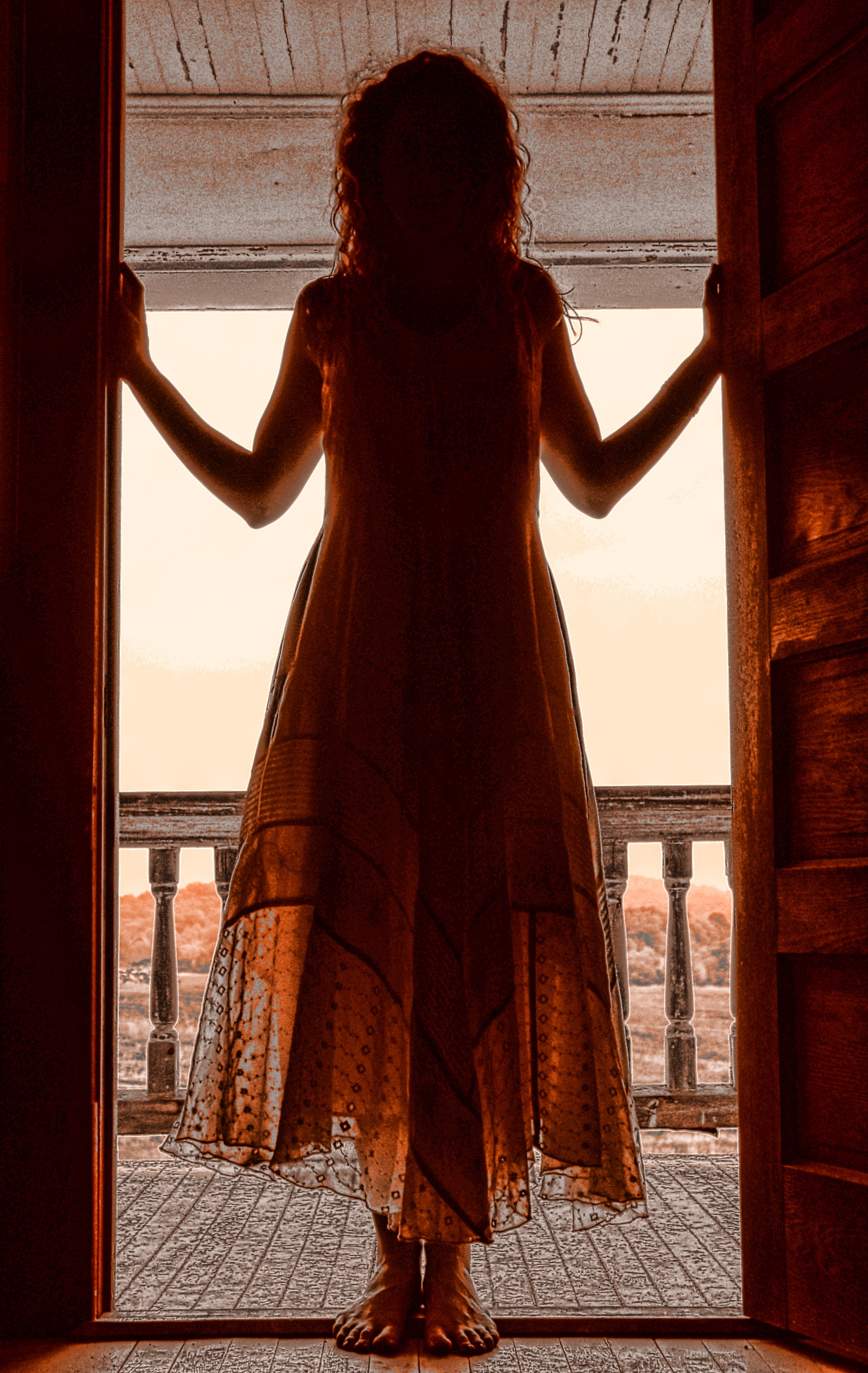
MA: What did you think of the illustration that Jenn Rhubright picked for your piece? I’m always surprised by how often the writers find the illustrator’s selection to be spot on for some reason that couldn’t have been known. Did Jenn’s photo have any special resonance for you?

SH: An illustration’s meaning is so embedded in the eye of the beholder.  For me, Jenn Rhubright captured a moment in time which actually precedes the narrative – is back story, if you will. She depicted a moment in the protagonist’s life when she was free. Though she can never be free again –  that instant in the doorway, the illusion of choice – resonates in her life everyday.


MA: And finally, what does recovery mean to you?

SH: With something as deeply wounding as the loss of a child, I can’t imagine that recovery is ever possible, but, clearly, endurance might be essential for many reasons. How or why she chose to endure…or didn’t… evoked  the ambivalence present in the ending of the story.

Interview with Jenn Rhubright

Jenn Rhubright


Mary Akers: Hi, Jenn. We were thrilled that you agreed to illustrate this issue of r.kv.r.y. I’ve been a fan of your work for several years now and it’s wonderful to have the opportunity to share your /images with our readers. One of the things that I love most about your photographs is the richness of color and the depth that your /images achieve. Do you also feel these are some of the strengths in your work? What do you feel makes your work so unique, so fresh?

Jenn Rhubright: Well first of all, Mary…a resounding thank you for your compliments on my work! It’s funny, photography is so instinctive for me. I honestly have a hard time not really knowing what makes it unique or intriguing to other people. All I know is that I like what I see, I take a picture of it, and 92% of the time I like the end result of said picture. I was a writer for many years before picking up a camera so to be able to tell a story, or more importantly, for other people to be able to create their own story, from one of my /images…is…in a word: rad.


MA:
Yes, I love that confluence. This whole issue came together beautifully, thanks to your unifying /images. Was there one poem or essay or story that especially stood out for you, or tugged at some part of your creative brain?

JR: Yes. Carrying The Day by Sylvia Hoffmire. Partly because I recently adopted my son, Aiden James, so of course the topic hit home for me. But more than that, it was Hoffmire’s incredible imagery combined with the multiple levels of emotion conveyed in a short piece of writing that impressed me. She’s got mad skills, I’ll definitely be looking out for more of her work.


MA: I’m a big fan of Sylvia Hoffmire’s work, too. And along those lines, I’ve long felt that one of the reasons art is a deeply moving experience for people is because they take it in and make it their own–ascribe to it some part of their own personal history, if you will. And I think we sometimes work very hard to do this when we view creative work, even when we aren’t aware of working to make those associations…rather like a computer humming in the background, processing data while showing something very different on the screen. I’m babbling a bit here, but trying to get at the idea that some of the authors may have found meaning in your /images that you didn’t anticipate (and couldn’t have anticipated). I know some of them wrote to you after the issue went live. Were there any notes about your /images that surprised you?


JR: We artists always seems to be tuned in to similar frequencies wouldn’t you say? Just like you and I respect each others work so much as well as marvel (humbly I might add) at how the collective end results compliment each other so nicely. Yes, I did get a great response from the writers about the /images I matched with their pieces and the validation was good medicine for someone who hasn’t been creating art as much as I would like (read: new mom).

MA: I think every artist wishes they had certain talents that they don’t believe they possess. If you could enhance your abilities in some part of your process, what would it be?

JR: Interesting and tough question! The one trait I wish I possessed more of…and I’m not sure it qualifies as a talent, is the act of following through. I suck at deadlines, whether they’re imposed by someone else or myself. But all in all, I’m very grateful for the talents I have been given as well as the ones I have nurtured. It’s an honor to be an artist.

MA: Well, you made this deadline just fine. Thank you! 🙂

I love seeing how an artist’s body of work changes over time. Have you found your creative focus altered at all by the experience of being a new mom? (Congratulations, by the way.)

JR: Thank you! Being a mom rocks, no doubt. The biggest challenge of course is finding the time to write, photograph and keep up with my music, but I am confident that the time spent being a good parent is part of the artistic process for me. And it’s an amazing personal epiphany for me to learn that motherhood is an art form unto itself.

MA: And finally, what does recovery mean to you?

JR: Hmmmm..well, to me recovery is synonymous with process, as we charter through this life journey we are constantly recovering from old experiences as well as new ones. Recovery is never ending when one equates it with the goal of being the best earthling one can be in this lifetime.

Interview with Brian Hall


Image courtesy of Jenn Rhubright

Joan Hanna: We were so pleased to have “Bearing Down” in the July issue of r.kv.r.y. This was a very interesting retelling of an incident that happened just before your grandfather’s suicide. Although you begin your story stating that your grandfather committed suicide, this was not the focus of “Bearing Down.” Can you give us a little more background into how this story came about?

Brian Hall: First, I want to say how happy and grateful I am that “Bearing Down” found a home in r.kv.r.y. I never imagined five years ago, when I began to focus on this essay, that I would find a place as perfect for it as r.kv.r.y.  I guess you can say I began the essay almost immediately after my grandfather had committed suicide in 2003. I knew I would have to write about it to understand what the hell had happened, or, more accurately, why it happened, which, I think, is a natural reaction. I know many in my family wondered why, and it seemed many friends of the family tried to stop us from asking this question. One friend of the family even came to me after the funeral and said, “You’re going to kill yourself if you keep wondering why this happened.” Though the statement’s phrasing could have been less fitting to the situation, the message was clear: asking why is the most dangerous question because, many times, the easy answer is to blame ourselves, to say, “If I only visited more,” or “If just picked up the phone and called,” or “If just did this or that,” he wouldn’t have done it.

I think many times we believe we could have been super heroes and saved the person if we only had done one or two things differently. When in reality, as in my grandfather’s case, nothing I could have done or said would have changed his mind. He wanted out, and wanted out on his own terms. Of course, that hasn’t stopped me from asking why and dealing with the subsequent blame. When I seriously began to work on the essay, I decided to focus on the “blame” aspect. I wanted to explore that last moment I saw him alive and show how I missed an opportunity to really talk to him. I realized, in hindsight, that his failure to answer the, “What’s the matter with you?” question, is my failure to see that he had not come out of his depression at all, and really, what’s bearing down on me is what happens when I focus on blaming myself: guilt.

I didn’t get serious about writing the essay until 2006. Before then I did try to write about it, but many of those early drafts were more cathartic than reflective. I believe I needed the catharsis before I really could honestly reflect on the suicide and my grandfather’s life. Though there was something really satisfying about writing down—unleashing really—a litany of obscenities to describe him and his actions, I was able to really focus on the essay while in the MFA program at the University of Wisconsin-Madison. An exercise in a Creative Nonfiction class was to write a short essay while staying under a set word count. I chose either 800 or 850. I decided that I would try to honestly reflect on my grandfather’s suicide for this assignment because I wanted to keep it simple, focusing on that last moment I was with him. I also didn’t want the suicide to be a surprise at the end, which may have created a more sentimental essay than I wanted, so I decided to lead with it, letting the reader know, matter-of-factly, that my grandfather committed suicide and here is what happened the last time I saw him. It was important for me to maintain that matter-of-fact tone throughout the essay because, again, I didn’t want to be sentimental, which I think would have weakened the essay.

As you can probably tell, I am very aware with sentimentality. I’m not saying that there is never a time or a place for it, but I think a writer needs to pick his or her spots to be sentimental because sometimes a sentimental moment in writing comes off as cliché. For example, when my mother called and told me what happened, I reacted like someone in a movie. I screamed, “No! No!” into the phone, dropped to my knees, and cried. I don’t think if this essay started that way, the essay would have been very good. Even though it was true, it was not very original. I decided when I wrote it to maintain the tone and to use a moment, such as the left-foot accelerator, as my way to creatively explore a moment that could have easily been cliché.


JH: In this essay you seem, although somewhat reluctantly at first, to have a soft spot for your grandfather. Can you explain how this emotional aspect of the relationship between you and your grandfather helped to shape this story?

BH: My grandfather always had a personality that can be described as kind-hearted and also abrasive. He was always willing to help friends and family as much as he could, and he would always tell you exactly what he thought of you or your situation. Very much like the essay, when he spoke to you, it always seemed like it was your fault and that you were somehow incapable of doing the simplest of tasks. As you could probably imagine, there were many moments when he made me feel completely insecure and self-conscious because his words cut that deep.

When I began thinking about this essay, I knew it would be a personal essay (and not a nonfiction piece that explored, objectively, the suicide rate among the elderly, which was one direction I considered), and I would, essentially, be a character in it. As a character in the essay, I didn’t want to be pick one of the moments when he made me feel bad about myself because of something he said to me. If I chose a moment like that, the reader would see a kid feeling sad because an old man verbally attacked him. I don’t think the reader would have been able to connect or understand why I wrote an essay about him. Taking him to Canton for the accelerator was the best because it showed vulnerability in both of us. I appeared as cold-hearted grandson who didn’t want to help his depressed grandfather, and he was an ornery old man who really missed the way his life used to be.

In short, the emotional aspect allowed my grandfather and me to become characters in the essay, and we had our own strengths and weaknesses. I think it is important in a personal essay to show the reader that all the people involved, especially the narrator, are not perfect. I think it helps give the writing depth.


JH: What I really liked about “Bearing Down” is that it comes across as a kind of heartfelt remembrance. Can you share with our readers how you were able to add this type of detail into the story despite the fact that you were dealing with your grandfather’s gruff personality?

BH: I think the gruff personality is part of the heartfelt remembrance. I didn’t want to be around him when he was depressed because he was not abrasive, gruff. I didn’t know how to handle him when he became more introverted because, during the time after my grandmother’s death and his hip replacement surgery, he seemed weaker—emotionally, physically—than I ever remembered him. This seemed to shatter my perception of him as someone who would, and could, stand up to anybody. When he began to critique my driving and asking the “What’s the matter with you?” questions, I began to feel more comfortable with him because he became the ornery person I remembered, and I truly did (and do) miss that about him.


JH: Do you have any current projects, websites or blogs you would like to share with our readers?

BH: I don’t have a website. I’ve tried blogging at a few different places, but I’m terrible at maintaining them. I do have a few recent publications that range from fiction to creative nonfiction.

I have a short story in THIS Literary Magazine: Natural History Museum

I have essay in Shadowbox: Study Bible: The Parable of Natural Law  You can find it by clicking on the center magazine and then clicking on the top right bottle. (It will make sense when you get there.)

I also have another essay in The Chronicle of Higher Education: Educating Our ‘Customers’

JH: Brian, thank you so much for sharing not only your story but also these very personal events with our readers. We are honored to have “Bearing Down” as part of our July issue. Just one final question: can you share with our readers what recovery means to you?

BH: The first word that comes to mind is “acceptance,” but I think there is more to it than that. I think it is fair to say that I’m still recovering from my grandfather’s suicide, and I have had to do more than just accept it. I had to be honest about it in so many ways, so that’s what recovery means to me: honesty.

Interview with Jude Marr

Jude Marr

Joan Hanna: We were so happy to have your poem, “The Autobiography of Miss Jane Doe” as part of our July Issue. Your poem is a fascinating view of responses that attempt to reconstruct a life from recovered bones. Can you share with our readers why you became fascinated by this topic?

Jude Marr: I guess the idea of Jane came to haunt me through a TV documentary I watched about a year ago. The show I saw used a mixture of CSI-type techniques and
historical research to reconstruct a young woman’s life story from her recovered bones. The bones weren’t that old—from the mid-nineteenth century—and as I watched, I became more and more uncomfortable with the implications of fleshing out a person—someone who lived in the lifetime of my great-grandparents—from her disinterred remains. The real Jane Doe’s age, her likely death from venereal disease, and her passive, post-mortem exposure as a source of entertainment all produced a deeply-felt, and deeply feminist, response in me.


JH: Knowing that you had such a feminist response to this incident I find it very interesting that you used a technique of multiple voices in this poem. I wonder if you would give our readers a little bit of insight as to why you chose to represent the academic, artistic and archeological in this way?

JM: In fact, the original version of this poem had only one voice. When I began to write, I was very focused on expressing my reaction to what seemed to me a particularly egregious example of the objectification of women—in academia, in art, and even in advanced decomposition. However, I eventually came to realize that, although I felt better for having turned my ire into irony, I was as guilty as anyone of using “Jane” without her permission. Of course, there’s no other way to write about someone long dead, but at least I could give this young woman another name and a chance to tell her own story. I liked setting my imagination against dry bones. And—for me, the nicest irony—May’s tale turned out to be rather different than science expected.


JH: “The Autobiography of Miss Jane Doe” version in our July issue is very different from the one voice version of the original poem. There was a strong editing component in getting “The Autobiography of Miss Jane Doe” ready for publication on r.kv.r.y. Can you elaborate a little about that experience with our readers?

JM: Yes, indeed. Well, I submitted the poem without May’s voice. And I was absolutely delighted to get any feedback, let alone the positive offer of editorial input. I’m relatively new to the process of sending my poems out into the world. I’ve had a couple of other things accepted—which was extremely pleasing, of course—but I think I got even more of a thrill out of working with you guys to improve what I submitted. That’s when I felt like a real writer. Both the original critique of the poem’s tone and the suggestion of adding another voice brought me to the realization I described above, and I believe to a much better poem—one that’s at least as much felt as thought.


JH: Thank you so much for giving our readers a glimpse into the evolving writing process for this poem. Do you have a website or links to other publications or projects you would like to share with our readers?

JM: I don’t have a website, although all kinds of people tell me that I should. Maybe now that I’m embarking on my MFA at Georgia College, I’ll have the time and the courage to take more than baby steps toward the web-version of my life. I can, however, offer a link to two of my poems which appeared in a recent edition of The Cortland Review


JH: Thank you, Jude, for taking the time to interview and share your fine work with r.kv.r.y. Congratulations on entering the MFA program at Georgia College, I’m sure that will be an amazing experience for you. I have one final question: can you share with our readers what recovery means to you?

JM: I’ve been thinking about this a lot. I guess I have a habit of talking all around a subject, even when I know what I most want to say, but this time I’m going to keep it simple. Simply, for me, recovery means strength.

And thank you so much, for liking my work enough to publish it, and for giving me this chance to expand. I’ve loved the whole process, and I’m telling all my friends!

Showcasing the work of C. Dale Young


C. Dale Young’s fine poetry has been published in such well-respected journals, such as Ploughshares, The Paris Review, The Southern Review, and The Virginia Quarterly Review, among others. He teaches at the Warren Wilson low-residency MFA program in creative wwriting and is poetry editor for The New England Review. And somehow, in his spare time, he works full time as a doctor. Which is why he didn’t have time to participate in an interview–as if saving lives and stuff was more important than our interview. The nerve! No, seriously, we get it, we understand, and we’re just delighted to have his work in our journal and a review of his latest book, TORN.


We are also delighted to be able to point you to his two other books of poetry.


His first book was The Day Underneath the Day. (2001, Northern University Press)


“Gifted with a vivid and exact skill, Young’s writing resembles an intricate anatomy lesson. His powers of observation probe the small energies of the natural world. Again and again the ordinary details of life transform themselves under the delicate pressure of his words-the movement of birds’ wings, the color and texture of tropical flowers, the study of the ocean waves, the “scalpel of light” cutting through the beginning of the day. The language of Young’s poems evokes an ultimate sense of place through a gorgeous marriage of tone and diction that echoes James Merrill and Amy Clampitt. As he meticulously maps out human passions and emotions, he explores both the surfaces and depths of everything that he surveys. His confident and polished verse unfolds intricate layers of landscape, seeking the order that lies beneath the unruly patterns of our lives.”


Here is a sample poem from that collection:


Fireweed

A single seedling, camp follower of arson . . .

Follower of ashes; follower
of the bleached-out, burned-out
cascade of buildings, lotfuls

of whitened soil speckled with debris
let down by a gutted church
still aspiring to an ether-blue sky

centuries gone; follower
of scripts apotheosized into smoke,
notes lifted into air by flames

that all but threatened the entire lane
with the silence we call a bed
of dirt; follower of the match,

the instigator here and abroad,
the matutinal magnifying glass
focusing light into unwitting

summer grass, into cruciform twigs;
follower of the caveat
ignored because it was too small;

follower of the fourth oldest dream —
the landscape burning and burning.

in memory of Amy Clampitt


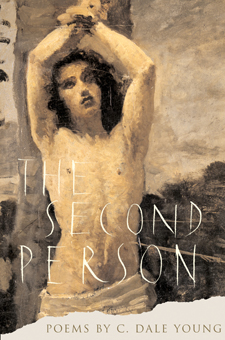
His second book was The Second Person (2007, Four Way Books) which was a finalist for the Lambda Book Award.


“In The Second Person, we encounter the searing presence of the Beloved—a “you” that seems to advance and retreat from the gaze of both the speaker and the reader. Young, a vivid renderer of landscape, has shifted his painterly eye from the exterior world to an interior one filled with the complexities of failure and doubt. In the collection, we continue to get the verbal precision and accuracy we already identify with Young’s poems, but we also get a more compelling poetry, one infused with the tradition of the love lyric and a relentless exploration of loss.”


Here’s a sample poem from that book:


The Architects of Time

and so, the lot had to be vacant
except for the lone tree.
The first, on arrival, would

throw his hands up, reaffirm
that with a gesture he could
return the leaves to the branches.
Another, tired from the journey,

would lie down
and, closing his eyes, hasten
the demise of the locusts.
It was always the same.

A week, a century, the empty lot.
The last architect, the great
philosopher, was late as usual—
when they talked about the end,

he would laugh and remind them
they were now at the mercy
of the scientists, without whom
the architects would cease to exist.


And finally, the gorgeous TORN, also from Four Way Books. The two poems in this issue of r.kv.r.y. are taken from that book and can be read here: Torn and here: Sepsis


You can also read more sample poems at the author’s website.

Interview with Ed Falco

Ed Falco

Mary Akers: Hi, Ed. Thanks for agreeing to be interviewed. I so enjoyed your story The Athlete. I was thrilled when SMU Press graciously agreed to let us reprint it in this issue. In fact, that whole collection was a delight to read. I’m embarrassed to admit it, but I’m new to your work. When I raved to several writer friends about your latest collection, Burning Man, the most common response I received was some version of “Well, duh.” It was as if I’d crashed a really happening party that everyone else had been enjoying for hours. “Hey, Mary, where’ve you been? Come on in, the writing’s FINE!” I look forward to immersing myself in more of your excellent work. What would you recommend I read next?

Ed Falco: You’re far from alone in missing this particular party. I’ve never managed to break through to a large readership with my stories, or with any of my writing for that matter. I think short story lovers know my work, and I suspect those are the friends you mention. I’m of two minds about all this. I would love to have a larger readership. It would be great to walk into a bookstore and find my books on the shelves––which is something that only rarely happens. On the other hand, I publish almost everything I write in good literary journals and with terrific university or independent presses (like Unbridled Books and SMU, publishers of my most recent couple of books), and I know from reviews, letters, emails, and the occasional prize or award, that my stories connect with lots of good readers. On most days I’m happy with where I am as a writer. On some days I wish for more.

Unbridled Books put together a nice selection of my short stories in Sabbath Night In The Church of the Piranha: New and Selected Stories, and I’d happily recommend that collection to you. And I’d recommend my last two novels from Unbridled: Saint John of the Five Boroughs, and Wolf Point. Wolf Point is a dark literary thriller that got especially good reviews, from The Sunday New York Times, where it was an Editor’s Choice selection, to Mystery Scene. For more reviews, you can go to my website (http://edfalco.us) and click on the book covers.

MA: Hey, on Amazon it says that customers who purchased Burning Man also purchased John Banville’s The Sea, Colum McCann’s Let the Great World Spin, and Paul Harding’s Tinkers, all three excellent reads and big prize winners, too. It sounds to me like your fans know exactly where your work belongs.

I love this quote from a review of your novel Saint John of the Five Boroughs: “A saga of a family ruptured and an artist discovering herself, in which far-flung elements knit together skillfully, movingly—and not a little frighteningly. As always in [the work of] Falco, the drama is dominated by its women, seen frankly yet with empathy. Early missteps all but hobble the women here, younger and older. But this winning accomplishment, a new benchmark for its author, reminds us that few things can be so beautiful as a scar.” (John Domini on Emerging Writers’ Network) What a great description. I thought the women in your collection were strong characters skillfully rendered. What is it about employing a feminine voice/point-of-view that appeals to you as a writer?

EF: In that John Domini review, I especially appreciated his noticing and mentioning that I often write about women, since I’ve heard myself tagged before as a guy’s writer. It’s true that in my short stories especially the narrators are mostly men. The reason for that should be obvious, and I think it might be strange if it were otherwise. I wouldn’t expect to pick up a Lorrie Moore collection and find a preponderance of male narrators. I have written from a woman’s viewpoint, however, especially in my novels, and I don’t find this a particularly difficult trick. To write at all one has to believe that he or she can inhabit other worlds––other characters, other circumstances, other times and places. Otherwise we’d all be limited to writing as navel-gazing.

I grew up around women (one twin and two older sisters) and have spent much of my adult life around women. I’ve been married twice, and I’ve raised a daughter. For several years I was a single parent. I’ve had ample opportunity to engage with women of every age. Seeing the world truly through another’s eyes is indeed a kind of magic trick, but it is not one that’s limited by gender. As for what appeals to me about writing from a woman’s point of view, same thing that appeals to me about all writing: the immersion into and exploration of an engaging fictional situation, the attempt to follow the characters and the situation to a moment that’s revelatory.

MA: Art is a big part of my life (my undergrad degree is in Fine Arts and I was a potter for ten years), but oddly enough I don’t draw on my art background in my writing all that often. You have written a lot about art and artists. Why is that a recurring theme for you?

EF: I’ve spent a lot of my life around art and artists. I’m close to my older brother, Frank, who is a visual artist. Frank was married to an actress. Art runs in the family, and so I feel like I know something about an artist’s life. Like all writers, I use what I know.


MA: I recently had a chance to visit the Georgia O’Keefe Museum in Sante Fe and while there I watched a film of her speaking about her life. She said that when she first saw New Mexico, she realized it was “a place where she could breathe.” Do you have such a place in your life? If so, how does that place enter your work and/or inspire you?

EF: I suspect I can write pretty much anywhere I can find space, a degree of peace, and quiet. Place doesn’t inspire me in the way that seems to have inspired Georgia O’Keefe. I live largely inside my own head, though I make an honest effort to get outside myself, to open my eyes to the world around me, to see. I have to make the effort though, otherwise I wind up right back inside my own thoughts, dreams, fantasies, concerns, etc. I love the ocean, does that count? I hope to wind up living close to the ocean one day. I feel expansive around bodies of water. I feel opened-up. When I start writing, though, I go right back inside my own head.


MA: The idea of a novel written in hypertext fascinates me. It makes the process of transferring text from writer to reader even more interactive than it already is. How did you get into this and what about the form intrigues you? Also, how do you think the recent rise of e-readers will affect the form?

EF: I’ve always been interested in writing that isn’t linear, that jumps around, that works by association rather than the straightforward progress of logic and linear design. I was influenced early on by Rimbaud, by the surrealists, by Gertrude Stein, by the craziness of Dada. So when I discovered Eastgate Systems’ hypertext authoring system, Storyspace––a software program that allowed writers to construct literary mazes the reader navigated by the near magical technology of the link, I jumped at the chance to experiment with it. This, keep in mind, was back before everyone owned a personal computer, a period of time in which only a few people had heard rumors of something called the World Wide Web. In 1997, Eastgate published A Dream with Demons, a 350 page novel I wrote in which every chapter is linked to a collection of linked notes by the purported author of the novel, Preston Morris. The novel tells a straightforward story, which the notes interrogate, question, and undermine. If more than 25 people have actually read the whole thing, I’d be shocked. My favorite hypertext piece (of mine) is “Charmin’ Cleary,” which is still available via Eastgate’s Reading Room.

Technology, as is it want to do, changed rapidly.  In short order it was possible to link not just text, but /images and sound, video and animation.  I started calling the genre hypermedia rather than hypertext, and I wrote a number of pieces that are still available on the web, including Self-Portrait as Child w/ Father and Circa 1967 – 1968

Lately, Flash animation dominates what is now called Electronic Lit or New Media Writing.  I’ve only written one piece in Flash (Chemical Landscapes, Digital Tales) and I haven’t written a new piece of electronic lit in several years now, though I continue to edit The New River, an online journal I founded in 1996, making it the first and the oldest journal devoted exclusively to new media writing.

It’s been evident for a long time to anyone who has thought about the issue that reading would eventually make the transition from the page to the screen. It’s inevitable. The economics of book production are solidly 19th Century and have long-been doomed. Up until recently, however, I thought the transition would be further off in the future than now appears to be the case. The iPad appears to be an attractive device for reading on screen. Between the iPad, the iPhone (and most other smart phones), the Kindle and the Nook, there are already large numbers of people reading on screen. Eventually, when writers grow up composing on computers, with their multi-media capabilities, and reading on devices capable of rendering multiple media, I expect new forms of literary-visual art will emerge. These new possibilities are, in fact, what the online journal The New River is designed to explore.

Having said all that, I remain a hard-core book lover. I prefer hardcovers to paperbacks and paperbacks to e-readers. I doubt that will change for me and for millions more like me. We like curling up in a favorite chair with a beautiful book in hand. A press like Unbridled, for example, produces books that invite you to settle down and fall into a good read. E-readers on the other hand tempt you with fifty other things you might do other than read.

In the near future, my best guess is that books will become more expensive, and still those of us who can afford to buy them will do so. The rest of us will read on screen, as the price of a read becomes less expensive. What all this will mean for writers in terms of economics and income remains unclear.

MA: That’s fascinating, Ed. Thanks for the links. I look forward to checking these out. And I’m especially intrigued by the idea of physical books becoming more expensive objects as e-readers increase. In my twenties, I worked as a bookbinder in Colonial Williamsburg and in the 18th century, books were incredibly labor-intensive objects to produce. First paper had to be made from pulverized rags, cured for months, the type was all hand-set, backwards and upside-down, piece-by-tiny-piece, one sheet at a time was hand-pressed, each folio was folded by hand, the folios were then sewn onto a loom, then the cardboard covers were attached, the pages trimmed, the spine glued (with horsehide glue) and hammered into round, the leather shaved down and shaped (the paste cooked from flour and water), and finally the end pages were pasted down. Consequently, in the 18th century, the simplest of books cost as much as a week’s wages. Can you imagine being a book lover back then–with no public libraries? It’s a big part of why Thomas Jefferson went broke. But I can just imagine how much more we would cherish our books if we paid a comparable amount for them today. Books! The new/old luxury item.

Speaking of books, congratulations on being selected to write The Godfather prequel. That is such exciting news! Have you been a longtime fan of the Godfather movies? Have you read the two sequels? What did you do for research?

EF: Thanks. Writing The Family Corleone, a prequel to The Godfather saga, was a great pleasure. Yes, I have been a longtime fan of both movies, and I had read Puzo’s novel many years ago and enjoyed it. For research, I reread the novel and one of the sequels, by Mark Winegardner, The Godfather Returns. I also reread Doctorow’s Billy Bathgate and World’s Fair, and William Kennedy’s Albany trio, as well as several other books of fiction and nonfiction that touched on the era of the depression and subject of crime. I watched the movies again, read the newspapers from the time, and watched video and audio clips from the thirties online.

By the time I started writing, I was thinking of The Godfather as American mythology. The characters, after their various incarnations in multiple movies, books, and a video game, have moved into the realm of mythical figures. Once I started thinking of the story as mythology, it was easy to see myself as an interpreter of the myth, someone taking the established outlines of characters and events and manipulating them to my own ends. This is not unlike the way poets and writers for centuries used Greek and Roman mythology.

In addition to the larger outlines of the story from the books and movies, I also had the general outline of a story developed from pages extracted from Puzo’s screenplays for the Godfather III and IV (unproduced) to guide me. Starting with characters and an outline made the process of writing the novel much easier, and left me free to concentrate on other elements of the story. All in all, I had fun with it. It was an engaging fictional problem. How do you write a good book that fits into a well-known saga, with universally known characters, a book that can stand on its own and still be of a piece with the other books and movies? I hope I solved those problems, but I’ll have to wait and see what others have to say about that. I think a lot of people will be surprised by The Family Corleone. If I’m right, it’s going to be fun to see the responses the book garners.

And maybe I’ll finally get that larger readership I’ve been looking for.


MA: I sincerely hope so, Ed. I believe you are a true writer’s writer, and it’s always gratifying when someone devoted to the craft gains a wider audience. Hey, I can promise you at least one sale.

Interview with Doug Bond

Doug Bond

Mary Akers: Hi, Doug. Thanks for giving us your excellent short piece “Traces in the Winter Sky” for this issue. I think what struck me about it right away was that it’s about a marriage, about love, but it isn’t tragic, or ironic, or forced. How refreshing! Instead it’s about recovering the love in a marriage, and what married person doesn’t have to do that almost every day of married life? I’m curious: was that the recovery theme that you also felt would make it a good fit for us? Or did you have another take on this story?

Doug Bond: Ha! Great first question, Mary. Yes! I did have another take on this story…but only at first, many, many revisions ago, and as it nudged slowly along to its current state I can say that it was my discovery of r.kv.r.y. and the mission of your journal which gave me the impetus to stretch the way I’d been approaching the story.

The piece started out as a simple sketch of a middle aged guy walking his dog on a cold clear winter night, the Orion constellation prompting in him a reverie about youth and 1st love.

So the first sense for me of “recovery” in the storyline related to a past, an emotional state, that had gone lost. As I continued to work on the story, I was led to a conception of this man, Tyler, as a person who has recently gone blind. The motifs were already there: searching in the dark, distant light,  Orion’s mythology (once blinded but sight regained), the presence of the dog (a lab!) I just didn’t see it at first! The first set of versions in which I made the blindness too present felt heavy and freighted, so I tried backing off on making his sightless-ness overt or specific in the narrative.

The withholding of information ended up creating an intriguing tension which I felt balanced the more potentially syrupy or sweet framing in the story. As it turns out it’s not necessary at all for the reader to know or believe Tyler is blind. But since I wrote with this strongly in mind, I ended up relying on senses other than sight to set his relationship in the world.

Once I had the “blindness” done right in the story there was still something missing…it couldn’t just be him feeling sorry for himself and remembering the good old days. So the biggest epiphany for me in writing the story came in discovering that the girl, Jenny, he romanticizes during his memory of high school is, fifty years later, the woman waiting for him at home. I began to see them together…like the two stars in Orion’s belt…so close together, they’d become one, a co-dependence, and it’s tensions, escalated by Tyler’s infirmity in the world.

I did some superficial research on the constellation Orion (ok, I “Wiki’ed it). But this line re: the double star (Mintaka) in the belt really anchored the piece in my mind as being at core about the marriage: The Mintaka system constitutes an eclipsing binary variable star, where the eclipse of one star over the other creates a dip in brightness.

Eclipse and recovery. The sum greater than the parts, something that can project an elegant luminescence from a distance wherein at core is a fiery exchange of energy between two distinct entities rotating in mutual dependence.

Yikes! Is it any wonder we project so much onto the night sky…it’s been pulling stories out of us for a long, long time! But truthfully, I really didn’t have a theme in mind at all when I wrote this…I just wanted very badly to have a story published with both the word’s Betelgeuse and Rigel playing a starring role.

MA: Oh, I love what you say about the night sky pulling stories out of us for eons. So true. Brilliant.

Your use of time is interesting in this story, too. Tyler spends at least as much time thinking about the past as he does existing in the present. And the past is where the change of heart occurs for both the character and the reader. I find that time shifts can be really tricky to convey, but you do it well here. Are time shifts and backstory devices that you feel comfortable using to tell a story?

DB: Thank you for saying that the time shift worked. It was tricky. Lots of re-writes, and the adding of little subtle details in an attempt to try and not disorient the reader. Since the emotional energy for me in telling this story came from a place of wistfulness, I pretty much had to commit to a time shift. Tyler is in the present and I want the reader to be inside him in that “now” but to know what he’s feeling about the past and what it is that he is contending with in these memories.

The “blindness” conceit actually helped here since I had to make all of the “present” setting experienced by him exclusively through non-visual references…the sounds, of wind, dog tags, the coldness of the air and the ballasting feel of a tree trunk. Tyler’s communion with the past comes to him through the non-visual senses too…taste and smell, but the memory of light is what comes through the strongest.

I had strong advice in an early draft to avoid any in depth backstory. Ended up being a goad. There are so many un-written rules about writing, and particularly flash-fiction….what “not” to do and time-shift rides up there high on the lists, as does withholding information, which I am also guilty of….ie. regarding Tyler’s blindness and just who it is he was reminiscing about. Maybe sometimes trying to dance around these rules gives an otherwise un-tappable energy to a narrative, but for god’s sake take my advice and don’t ever try to write flash with backstory. The POV headaches can make you go…well, never mind.

MA: What did you think of Jenn Rhubright‘s illustration for your piece?

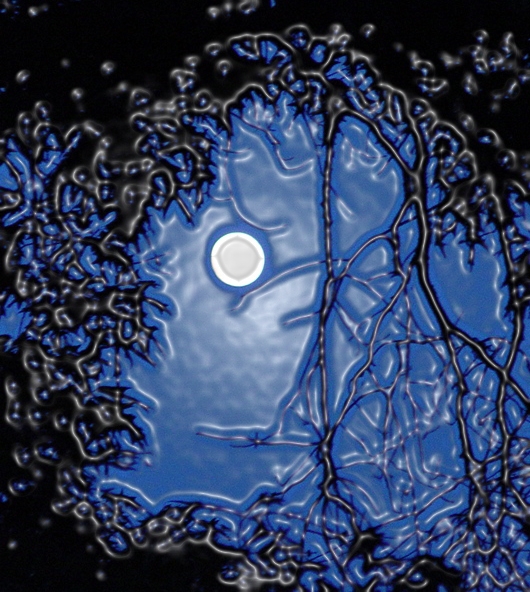
DB: I was really floored when I saw it. I thought…how did she do that? I’d kind of expected, since the piece is so strongly anchored by the Orion constellation, that the  accompanying image would be much in parallel….a re-rendering, in some creative way, of the Hunter image or of the belt or a larger tapestry of stars. Jenn’s illustration feels so much more intimate to me. She focuses the light into one delicately set white circle, pearl-like in the composition. It actually spills a reflective heat into the darker space around it…the way she captures the glow. But it’s the tangled weave of threaded black along the midnight blue that got me….an intimation of something sinuous in conflict with, but pushed aside by, the pulsing of the light. I loved this aspect of participation with r.kv.r.y. Jenn’s work brought a wonderful dimension to the entire issue.

MA: What does “recovery” mean to you?

DB: I think one’s first instinct in defining “recovery”, is to believe it has to be a return, like in the mathematical sense, to a previous balance, a putting back again to a prior state of wholeness. In the few, as yet, truly difficult “recoveries” I’ve witnessed first hand or been a part of what you realize as you come through is: that’s impossible. There really is no turning back of the clock. Time will always exact its costs, moneyback guarantee be damned.

But the gift which comes in recovery is realizing that your initial ache for “return” was somewhat puerile, and that in the alchemy of recovery lies a transformation which does indeed make you perhaps, better…improved…there’s something in the release of what’s lost which allows a new balance to be attained.

For Tyler, his life has been altered by an age-related infirmity, a dramatic one. Whether literal or psychic, he has suffered lost vision. He feels untethered. And into this doubt and confusion comes a memory, an image of something immutable, to his thinking, the winter sky, unchanged in 50 years of 5 million. It’s all a matter of perspective with the sky though, isn’t it…Red Giants, White Dwarfs, exploding Blue Supernova and an earthbound lens skewing all the angles. Everything is in flux…even the Christmas lights.

Still, if only in imagination it is the “firmament” (what a wonderfully archaic word!) which gives Tyler an arc to his earlier self, and inspires a connection with his wife, the actual touching of her face at the end of the story, renewing the light within them both, and in that way lays before them a chart of hope and endurance for the future. Thankfully they have a very well trained dog to keep them on the right path.


MA: Wonderful, Doug. Thanks for speaking with us. It’s been a great conversation. And in true guide-dog spirit…I will guide our readers to more of your fine work:

The Thing That Filled First (Used Furniture Review)

Where the Ocean Ends (Necessary Fiction)

Go hide! (Staccato Fiction)

Knock It Off, Honey (Up the Staircase)

Why Aren’t There Fireflies (Camroc Press Review)

Tea with Mrs. Doyle (Wilderness House Literary Review)

Interview with Jen McConnell


Katie Phillips: Hi, Jen. We were thrilled to have your story “Shakespeare’s Garden” in this issue of r.kv.r.y. Please tell us a bit about your writing process. Do you prefer a certain time of day? A certain place in your home or apartment? What habits do you practice to get in the writing groove?

Jen McConnell: Sometimes I wish I could schedule myself to write every day, say for two hours to work steadily at this story or that novel. And sometimes I can. I did National Novel Writing Month last November and got up most mornings and wrote, half awake, from 6:30 – 7:30. But I could only keep that up for a limited time. Life just gets in the way.

Virginia Woolf said we need a room of our own to write, but for me, I write where I can, when I can – at home, at a coffee shop, on a computer, longhand in my journal. Most writers I know are like this. I think those writers that can schedule four hours blocks of writing time every morning, like Stephen King, are the exception, not the rule.

While I was in Goddard College’s low-residency MFA program, I was lucky enough to work just part-time. Some days I could write for 10 hours straight in my sweats in my apartment. Other days I was lucky to get an hour at the coffee shop.

Any sense of schedule I had went out the window after my daughter was born in 2005. Since then it’s been even more ad hoc. But that’s just the physical act of writing.

My creative process, however, is much more specific to my personality.

For me writing is the way I release the thoughts and feelings–coherent or not–that rattle around inside me. I don’t consciously plan out what story I’m going to tell. The story comes to me.

The stories I like to read most are those that don’t feel like they were written by someone. Those stories that feel as if they were out there in the world and were simply transcribed or translated from an invisible language.

Alice Munro, Richard Ford and Charles Baxter are great examples of getting out of the way of the story. At my best, I feel like this kind of translator. As if a story is handed to me, fully formed, and it is my duty to write it down as best as I can. This has happened to me a few times.

The first draft of my story “What We Call Living” was written longhand during a plane ride. I did very little editing between the first and final drafts and, because of that, the raw emotion remained intact. Different scenes in the story “The Last Time” had been recurring to me–separately–for years but one day, like jigsaw pieces finding each other, they suddenly snapped together.

The latest short story I’ve written, “The Divorced Man’s Guide to the First Year,” came to me so unexpectedly that I pulled my car to the side of the road to write in my journal as fast as I could. This is what I mean by getting out of the way of the story.

Other stories, like Shakespeare’s Garden, are much more challenging. In fact, the final version that is published here took ten years to get to.

With these more difficult stories, the ideas and emotions are there at the beginning but by the end of the first draft something is just not right. So I try something else–add a new character, change the setting or reverse the point of view–but I have finally learned that instead of tinkering endlessly with a draft, I need to open up and let the real story come to me. It is much easier for me to let go now, after fifteen years of writing, when it was at the beginning, when I so desperately wanted to control what I was writing.

colorful flowers

KP: In “Shakespeare’s Garden,” Evelyn and Janey experience grief in different ways. How do you feel their respective experiences fit in with the theme of recovery?

JM: I don’t actually create the characters in my stories. I simply chronicle their actions. In that vein, I believe that Evelyn and Janey act as they always have (and always will): Evelyn waits and Janey ignores. Because of this, when Richard dies, Evelyn’s life comes to a complete standstill, which she was heading for all along. Janey tries to smooth things into shape by having the driveway fixed. This is how the women cope. They have preempted recovery by not confronting their own grief. Unfortunately, this only postpones the inevitable, and painful, process of recovery. A friend of mine who has M.S. told me once that nothing hurts as much as healing does.


KP: What do you find to be the most challenging aspect of writing?

JM: Having an incomplete idea. Ideas come to me all the time – for scenes, stories, screenplays, novels. But besides not having enough time to write (every writer’s biggest challenge), I am overwhelmed with these bits and pieces when I have no sense what to do with them.

Sometimes I will have part of a story in my brain for years but it doesn’t go anywhere. Sometimes I’ll try to force it into another story or idea I have, but it just doesn’t gel. So I let the idea go. I have dozens of these ideas floating around.

But sometimes, one idea will find another and they will give birth to a whole story. It sounds silly when I write this, but that’s how it happens for me. Inevitably, the ideas and stories that don’t work are the ones I try to force.

Most times though, ideas find each other when I am NOT thinking about them – usually while I am walking the dog or in the shower. That’s when I have to hurry and find my journal and get it down before it’s gone.


KP: Which work of Shakespeare inspires you most and why?

JM: Hamlet is a close second. It is such an amazing character study. But my very favorite is Twelfth Night. I’ve seen it performed many times and it’s just so clever and fun. Each time it is so refreshing, it’s like watching it for the first time again. I think being able to read or view something over and over again is the highest compliment that we can pay to art.

One of the best nights of my life was seeing Twelfth Night performed under a night sky in London at the reproduction of the Globe Theater. I was filled with joy during the entire performance, and amazed that a story, written hundreds of years ago, can still be so transformative without any “modern” translation. Seeing it reminds me of the true power of words and inspires me to keep writing.

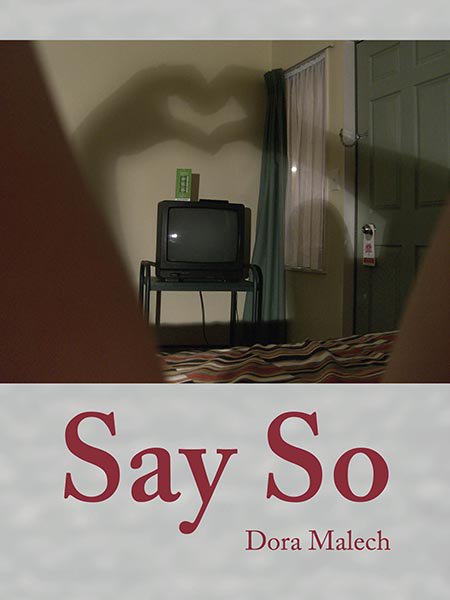
Review of Say So

Say So
by Dora Malech
Cleveland State University Poetry Center
November 2010
88 pages

Say So by Dora Malech is a tumble down the language rabbit hole.

It takes you into a world of wordplay that is more than mere playful language. These poems are serious business and will gather your senses until you are absorbed into their consciousness. When Malech titled her book, Say So, it was a signpost to her readers because that is exactly what she does in this, her second full-length collection of poetry.

Malech sets the obvious against the hidden and blends them into a musicality that peels away layers until the reader feels as exposed as the /images in her poems. The wordplay trickles in and around the words like a meandering tributary that opens up into a vast river of /images that rushes through to her readers.

Malech’s speech is straightforward and at times raw. She  begins her poems with a searing openness that both beckons the reader and grips like a vise. Some of the titles in this collection include:

“Oh Grow Up”
“Lying Down With Dogs”
“Note To So Sorry For Self”
“Them’s Fighting Words”
And, my personal favorite: “Goodbye I Love You.”

But these beckoning titles are only a part of the story. Malech takes everyday speech and weaves it into a rhythmic and melodic song. In “Love Poem” she  juxtapositions opposites until they tell an intimate story:

“Get over it, meaning, the moon.
Tell me you’ll dismember this night forever,
you my punch-drunking bag, tar to my feather.
More than the sum of our private parts, we are some
peekaboo, some peak and valley, some
bright equation (if and then but, if er than uh).
My fruit bat, my gewgew. You had me at no duh.” (5)

The combination of positives and negatives within the play of everyday words gives her readers an insight into the duality of love and relationships in a clever, tongue-in-cheek fashion.

But as one reads this collection, one sees through to the heart of this duality. There is something much stronger being expressed within these seemingly playful lines. This is evident in poems such as “Pop Quiz”:

“Twist of lime or twisted arm? Lent hand or footsie?
All the crossword puzzle nouns can’t help me now—“

This ominous beginning only deepens as the poem continues:

“Tactile error means wrong cheek to cheek.
I’m wetting my unicorn suit. Can’t blame this mess
On longwinded weather, cyst, or whiskey dick”

Until we come to the end and are left with a final line of strength and defiance:

“Throat closed for repairs, I gag a bit, allergic
to the peanut gallery: “Its your fucking heart, man.”
I pledge a lesion, draw a spine in the sand.” (47)

Malech’s poems have many voices in this collection: some are sad, some sarcastic, some are funny with a sneering backhand; but, no matter the subject, this collection will sing to you. It is definitely best when read over and over. Keep Say So on your bedside table for those sleepless nights when you need something to remind you that the world is indeed an amazing place filled with contradictions and beauty hiding in very strange places.


Joan Hanna was born and raised in Philadelphia. She has a BA in Writing Arts from Rowan University and is completing her MFA in Creative Writing, Poetry and Creative Nonfiction at Ashland University. Her poems have appeared in Common threads, Modicum, the premier issue of Glassworks and the 15th anniversary edition of Poetry Ink. Joan is a reader for River Teeth and writes reviews for Author Exposure and Poets’ Quarterly.