Interview with Diane Hoover Bechtler

Mary Akers: In your piece “The Darning Needles,” you write, “I don’t know how to mend things.” That is a moving and potent statement. Could you speak a bit about the link between mending (as a concept) and recovery (as a concept)?

Diane Hoover Bechtler: “I don’t know how to mend things” is obviously a metaphor for not being able to mend my broken marriage. I lost my husband, my dream house and my health all in a short period of time. Had I tried to absorb all that loss at one time, I would have drowned in the tsunami created by the huge amount of loss. My husband and I put that house together and appointed it perfectly. My furniture, my art, even my workout equipment all stayed with him. After 18 years I had to build an entirely different and new life.


MA: Your piece says something important about loss–of objects and of people–and how the two can feel linked in our minds. Are there other sorts of loss do you think we might link together?

DHB: All the change and all the loss had to seep in to my life and reach the groundwater. That way I could survive. Seep is the key word. Everything had to move slower. But it didn’t because that’s the nature of life.

My survival depended on moving forward and I was paralyzed. I was overwhelmed. I learned that life will move you forward because it goes on. Seasons change; friends change; children leave home; fashion changes; politics change. So life in all of its changes pushes you forward. Whether I wanted to recover or not hardly mattered. Since there’s nowhere to hide, you find yourself moving on because life is moving on.


MA: You also write about a lack of memory as an act of self-preservation. Can you expand on this for our readers?

DHB: Not being able to remember is a powerful coping tool. It all comes back, but not in a flood. It comes back in droplets. Easier to absorb. Very few positive things were happening in my life–this caused me to cling to the things that were positive as tightly as I could. I threw myself into school. It became my lifeline.

MA: What did you think of the illustration Morgan Maurer did for your piece?

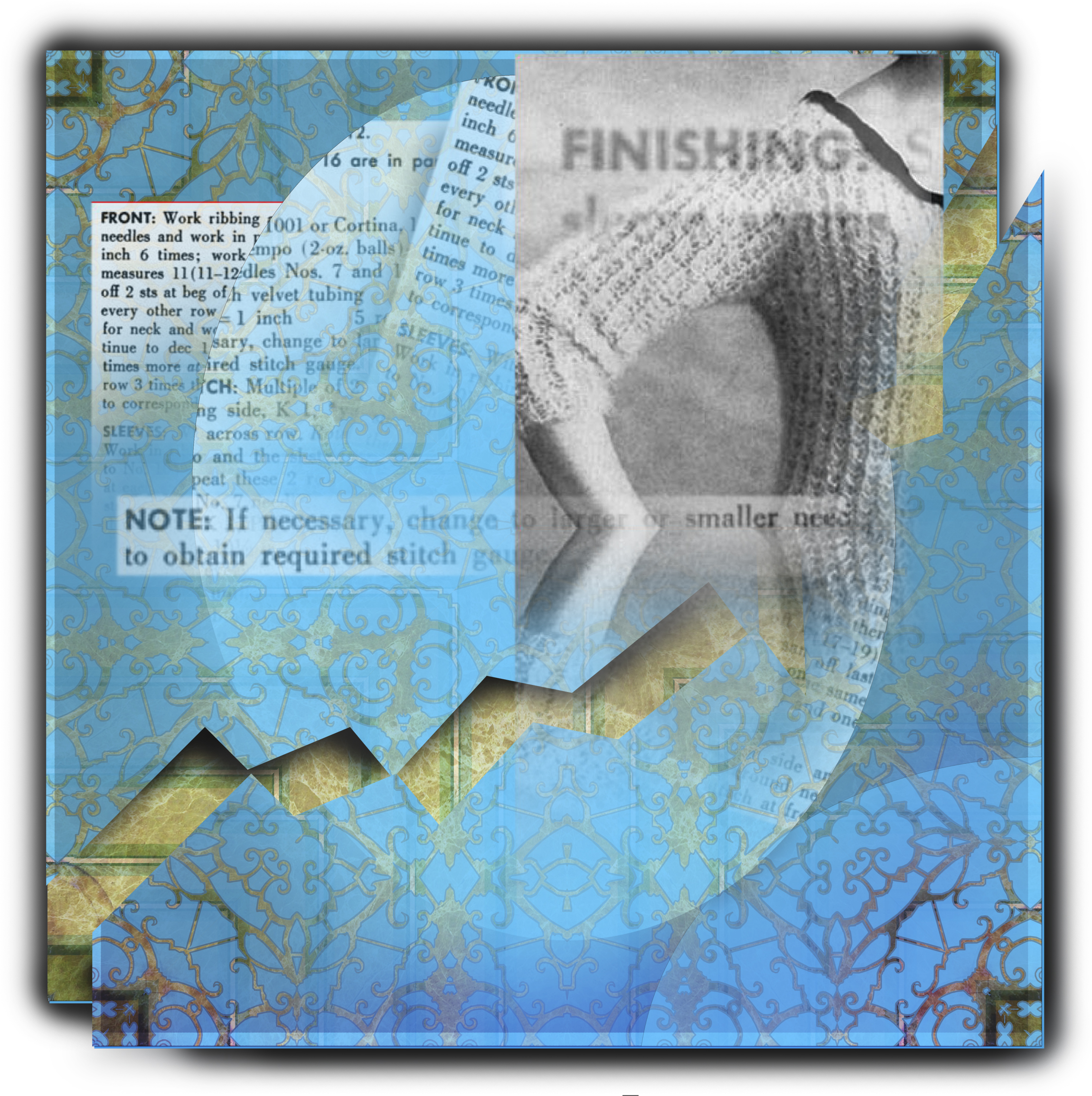
DHB: The artwork done by Morgan Mauer was particularly appropriate. The sweater was being knitted or unraveled. It was changing. It was coming or going. On the other side of whatever was happening it was going to be a different thing.


MA: And finally, what does “recovery” mean to you?

DHB: Recovery is active. I wanted to be rescued which is a passive motion.


MA: Thanks so much for talking with us today, Diane. And for our readers, here are some links to more of Diane’s fine work:

My husband, the Chevette

Feasting

Dental Floss

The Secret to Eternal Life

The Death of Love

Interview with Matthew Vollmer


Mary Akers: I really enjoyed your story Bodies. Especially the fantastic voice of the first-person narrator who is a self-admitted drunk, but somehow manages to endear us to him through his fresh use of language and by being both hard on himself and funny. Here’s a good example of what I mean:

“Like a true hot shot, I woke up in the sand, among broken seashells and cigarette butts and ice cream wrappers and those plastic discs you snap on the tops of soda cups. I dragged myself into a sitting position, smacked ants from my legs, and stared at the churning sea. It occurred to me that Primordial Man might’ve watched a similar sunrise bleed across this same froth. He had not, however, smelled doughnuts, and that was one of a few things I could think of that separated his world from mine.”

That’s a perfect paragraph in my world. If I might ask you to analyze your own words for a moment, what do you think it is about that paragraph that works so darn well? And why do we, as readers, get enjoyment from reading about fatally flawed characters?

Matthew Vollmer: I actually like that paragraph, too. And I can’t say that about most paragraphs I write. This story came after a trip to Carolina Beach, where I’d been reading, for the first time, some stories by Barry Hannah. I liked how so many of his narrators seemed ticked-off, furious, bad-tempered, cocky, and rude. I wanted to try to harness that energy, and somehow, when I started imagining this dude and heard his voice, I just started to transcribe it.

I’m probably not the best person to analyze why the paragraph works. I can tell you though, that I like how it starts: “Like a true hot shot, I woke up in the sand.” For me, any character who’s basically saying “I’m an idiot” automatically endears themselves to me. I guess there’s a lot of contrast here, what with the beach, which is supposed to be and often is beautiful, and the trash embedded in the sand, so maybe there’s some tension generated there. Finally, there’s an absurd quality to the last line, what with the of primitive man staring at this same scene and the narrator thinking that smell of doughnuts is one of “a few things” that separate the two worlds; the understated-ness of that always sort of made me chuckle.

MA: Not only did I like “Bodies” but your entire collection (Future Missionaries of America) was a really enjoyable read. You did some inventive things with structure that messed with my head in a wonderful way. In particular, I’m thinking of the story “Will & Testament” which is (stay with me, readers) a copy of the last will and testament of Andrew Walter, written shortly before his death and mailed to 27 unknown people, their names selected from the phone book, asking them to distribute his final remains and possessions. (Complete with extensive footnotes.) It’s brilliant, really, in the way it looks both forward and backward in time, anticipating all contingencies and getting the final say. I also appreciate how well it maintains the legal-speak throughout the story. If you received such a letter, would you agree to be his executor?

MV: Honestly, I don’t know. If I received a letter like that I would probably freak the eff out. But I would be intrigued and probably tempted to honor the requests. Though I’d have to check with an attorney about the legal ramifications. I’m not sure how legal it is to actually cut up and distribute sections of a dead man’s brain… even if the dead man left instructions to do so.


MA: And staying with the idea of structure a moment longer, could you say a little bit about how your stories find their structures? (i.e. ahead of time? in the process of the writing?)

MV: Mostly in the process. I rarely write from beginning to end. My process is messy and haphazard. I’m impatient to get to the “good parts,” whatever those may be, so usually I end up writing the sections of the story that I’m drawn to first, then perform a lot of shuffling.


MA: I love stories that incorporate a character struggling with a specific religion or any widely held belief system. I admire how seamlessly you do this in your stories. It’s been my experience that stories with any sort of religious reference or focus can be difficult to place. Have you found this to be the case, as well? And if so, why do you think that is?

MV: I actually haven’t had that experience. Epoch took the title story about two weeks after I’d sent it. And I don’t remember “The Digging” (the one about the boy performing “free labor” at a Christian boarding school) being all that difficult to place… I enjoy reading stories that focus on a character struggling with some kind of internal conflict, and because religion has been such a relentless presence in my life, I end up coming back to it again and again.

MA: Salt is the publisher of the copy of Future Missionaries of America that I own, but I understand that they were not your original publisher. Could you describe a little bit of the history of your path to publication? I think it would be a very interesting and instructive story for our readers…and could even speak to the idea of “recovery.”

MV: My collection was actually accepted first by Salt. I’d sent to MacAdam Cage as well, and when I got the news from Salt I checked in with MC. They said they wanted it, so I brokered a deal with both houses so that MC would do US and Salt would take care of UK/Europe. My book was originally slated for 2008 but due to some technical problems with the manuscript it got pushed back to 2009. Unfortunately, that was right after the economy tanked and MacAdam Cage was forced to basically fire their entire staff and replace them with interns. It was basically a nightmare. To make a long and super complicated if not maddening story short, let’s just say that the New York Times review of my book came out, but there was no book to be had. It didn’t come out until two months after that. Originally, MC was going to publish a hard and soft cover version simultaneously, but they ended up only publishing the hard cover, and eventually decided, despite having received a significant number of orders for the paperback, that they were done with the book. So I had my agent retain the rights, which we then gave to Salt, and now they’re distributing it in the U.S. So I suppose THAT was a recovery of sorts… Many times I wondered if this was it, if the book was on the brink of death, but it kept coming back.

MA: And finally, what does “recovery” mean to you?

MV: For me, recovery usually involves arriving at a place where I look back on a time in my life and think, dang, what was I thinking or why did I allow myself to be put in that particular situation? I made a lot of stupid decisions as an adolescent and college student and I often remember those days and think 1. I’m glad to have survived THAT part of my life and 2. thank God I’m not there anymore.


MA: Thank you, Matthew. And thanks for sharing your fine, inventive work with us. For our readers, you can find out more about Matthew at his website and access his stories and essays here.

Interview with Stefanie Freele

Stefanie


Mary Akers: Your story In the Basement really struck a chord with me, and I’ve heard the same from readers. I wonder if the use of second person to tell this story in part accounts for the way we take it in as readers. Do you use second person often? What do you think the advantages of it are? The disadvantages?


Stefanie Freele: I’m not a huge fan of reading second person, nor writing in it, even though obviously I occasionally do. Sometimes the ‘you’ can be unnecessarily intrusive, too pointing-at-the reader, even accusatory. I wrote this story in third person, changed it to first person and settled in second. In this story, third person felt too distant – as if the character’s anguish was too far away, leaving a mile of safety in-between the reader and the character: third was too comfortable for the reader, yet this story is about discomfort. First person felt too much like Stefanie Freele is the narrator which could position the reader back toward the author instead of toward the protagonist. When I tried out second, it seemed right – like binoculars finally zooming in. I think second person can be used for a variety of good reasons: explanation, allegation, etc. In this story, now that I think about it, I perhaps chose second person for the uneasiness such a perspective might cause.


MA: Congratulations on winning the Glimmer train fiction contest! I was thrilled to hear that you had won. How did you react when you first got the news?


SF: Certainly I won’t forget that day. Elated! Surprised! Flabbergasted.


MA: Recently, I had a conversation about “success” with a good friend of mine who is also a writer. She defines it very differently than I do and I wonder about what has to happen before a writer thinks of himself or herself as a successful writer. I think we often spend too much time looking toward the next goal and attaching a feeling of success to obtaining that. How do you define “success” as a writer?


SF: I’ve always had a hard time with the word success. It seems to be such a black and white concept. If you aren’t successful, then you are a failure. And, success is such an individual notion. My garden’s first strawberry is something to rejoice; your seven rows of healthy asparagus might be a chore to pick. I don’t think I use that word, “success,” in my vocabulary – it reminds me of people who drive posh vehicles but have huge car payments. I like the words content or pleased or happy instead. And, if you were to ask me, am I content as a writer, yes I am – I’m writing. I’m learning, reading, growing, my writing is improving, I know some of my weaknesses and I’m working on them, fussing with them.


MA: That’s brilliant. I think I need to adopt your asparagus-strawberry success point-of-view. Perhaps even start a movement. Single Strawberry Successes unite!


I know that you grew up in Wisconsin. Do you think the idea of “place” creeps into your writing? If so, how does it reveal itself?


SF: Growing up in Wisconsin creeps into everything about me. I loved growing up there. The seasons are extreme, the northern colors stunning, the people down-to-earth. I feel like I haven’t yet done Wisconsin justice actually, I have a bunch of stories sketched and brewing (excuse the Milwaukee pun) that take place in Wisconsin.


In the Basement


MA: Morgan Mauer’s illustration for your piece was one of my very favorites. What did you think of it? Did you find any special meaning in it?


SF: I could over-analyze the illustration, but I like to leave art to speak for itself. The artwork is stunning, haunting, symbolic – perhaps especially for me, the author of the story. In the first draft of “In The Basement”, I used wording in the end something like ‘that she was walking toward death’ but that was too obvious. I changed the language to walking in the direction of more food – which if things continue on that tangent for her, she will die. The illustration has a giant D in it, which really grabbed me as an indicator

of “Death”. The profile – emphasizing the body parts that can be destroyed by bulimia – in its scientific portrayal, overlaps the border, becoming stronger as the picture moves right, or weaker toward the left toward that daunting D, depending how you look at it: I love that careful detail.


MA: What does “recovery” mean to you?


SF: Recovery is everywhere. The character from “In The Basement” is in can’t-find-the-way-out hell. That is a form of recovery: knowledge that this-right-here isn’t working. There are so many stages of recovery: hitting a bottom, turning it over, moving on, seeking help, doing the right thing, reaching for the highest good, etc.etc. I’m thinking even that hurt of compulsion – like the heaviest anchor — is part of recovery.


MA: Yes, that’s excellent, Stefanie. I think it is, too. Thanks so much for sharing your thoughts and your fine work with us.

Interview with Shara Lessley

Bruce Snider: Can you talk a bit about the origins of your poem, “Two-Headed Nightingale”?  What inspired it? How long did it take to complete?

Shara Lessley: Inspiration? Because the poem was written eight years ago, I honestly can’t recall! Its source might have been an image at the Circus World Museum in Baraboo, Wisconsin, or one pulled from some online archive. Regardless of where I first saw the conjoined songstresses’ photo, I remember being very moved by both the biographical and fictive details surrounding the lives of Christine and Millie McCoy. At the time, I was struggling — and failing! — to write narrative poems in a rather straightforward way. “Two-Headed Nightingale” demanded I abandon linear strategies. The poem’s voices and viewpoints are multiple, ever-shifting. Christine and Millie speak, of course, as does the general public (audience members, promoters, a mortician, etc.). As I remember it, the drafting process was quite frenzied: while the poem’s various players argued about the reductive sum of the sisters’ identity — are they miraculous, monstrous, inferior on grounds of race or gender, medical curiosities, substantially talented, or simply slaves? — I was pursuing a larger argument about the possibilities of how I might move poetically. Whatever its limitations, “Two-Headed Nightingale” was critical for me in that I entered the poem still wrestling with the idea of plot and emerged from the poem’s confines secure in my identity as a primarily lyric poet.


BS: Would you call your process for this poem typical for your work?

SL: The poems of my own I’m most married to have come rather urgently from start to finish in some approximation of what will be their final form. In other words, it’s extremely difficult for me to piece together fragments, lines, and phrases culled from different periods of time. If I can’t find my way out of a draft during the first sitting — even if the ending is temporary and reworked a hundred times over — it’s unlikely that piece of writing will survive. I envy poets with a gift for hoarding, those whose talents include rescuing and recycling a sentence here, a stanza there. I, on the other hand, remain chained to my desk hour after hour in an attempt to chisel the air.

As with all things, I suppose, there are exceptions. “Wintering“, for example, was written over some odd months during long walks across Stanford’s campus. “Already winter makes a corpse of things,” rang in my ear for days until it was joined by the phrase “Snow reshapes what ice has taken.” When an emotional declaration later emerged to counter the initial sentences’ descriptive impulse, a breakthrough occurred: “You’ve lost interest in letters. So let sunrise come.” Frankly, this psychological turn left me perplexed. Letters from whom, I wondered? And why had their author “lost interest”? After a few more weeks of running the lines in my head, the speaker’s identity revealed itself: a woman abandoned and left to fend for herself somewhere in the unforgiving northern plains of the late 1800s. Particular and peculiar as it seemed, I didn’t question it. The rest of the draft followed shortly.


BS: As is often true in your poetry, you use line in “Two-Headed Nightingale” to provide a remarkable source of tension. Can you talk a little bit about the relationship between the poem’s formal elements and its narrative?  Is line something you think about in the early stages of composition?

SL: Truth told, I’m syntactically obsessed! I’m completely charged by the possibilities of what a sentence can do musically — the elongation of a phrase by Donne, for example, followed by some swift and unanticipated contraction. Whereas diction and phrasing provide the poem’s rhythmic score, I like to think of the line as a kind of choreography that both extends and counters its sonic movement. At times, the line underscores music: it seems to dance with it, to provide the kind of support as would an ideal partner. A phrase’s volume is increased via enjambment, for example, by calling attention to a particular word dangling at its end. In such moments, the lyric moment is amplified. Elsewhere, the line might create emphasis by resisting rhythm. Breaks, in other words, can delay, suspend, counter, or work against the poem’s essential rhythms. They can be quite surprising. Do I think about the line’s greater contributions to musical and dramatic tension during the early stages of composition? Absolutely. For me, structure is muscular. In this regard, I’m very much like a trained dancer; that is, at all times I try my best to be sensitive to (and conscience of) the line’s integrity.


BS: Who do you think of as your primary influences?  And have those changed over the years?

SL: Where to begin! My influences, it seems, are simultaneously ever- and never-changing. I love Marianne Moore and Elizabeth Bishop for their gusto and precision, as well as more recent work by contemporary poets like Brigit Pegeen Kelly and Terrance Hayes. I often crave George Oppen and Keats. I’ve already mentioned Donne, I think. I can’t resist Plath’s dramatic urgency. This fall, I spent a lot of time savoring select poems by Lorca. Lately, I’ve been acquainting myself with poets and writers from the Middle East. I also read a lot of prose. A few days ago I finished Flaubert in Egypt. It was horrifying and a hoot all at once.


BS: You mention that “Two-Headed Nightingale” was written eight years ago. What about your more recent work?

SL: “Two-Headed Nightingale” is the title poem of a collection forthcoming from New Issues in 2012. I’m currently working on a manuscript tentatively titled The Explosive Expert’s Wife, which takes as its subject the history of stateside bombings and life in the Middle East. Overall, it’s a much more cohesive project than Two-Headed Nightingale. Although I live in Amman, the poems themselves aren’t necessarily autobiographical. For the first time in my writing life, I have lists of titles from which individual poems are emerging. As a result, the drafting process feels very fresh.


BS: You recently moved to Jordan. Has life overseas affected the direction of your work?

SL: It’s difficult to articulate the extent to which living in Amman has deepened my relationship with poetry. Jordan itself is complicated and rich, beautiful, challenging and, at times, utterly baffling. Petra, Wadi Rum, the Dead Sea, Jerash: what a gift to have such places within reach! The region’s sounds and textures, its history, geography, political complications — I find all of these factors deeply impacting. Granted, there are times I feel very far away from home. After many months, I’m still struggling to learn Arabic. Although the process isn’t pretty, I find joy in the daily failures. With the shift of a single vowel, for instance, I recently told someone “the sky is a giant apricot,” instead of “the weather is quite sunny.” From this I gather that whatever my location, language is damned well determined to remind me that my mistakes are often more interesting than the security of their everyday counterparts.


Bruce Snider is the author of Paradise, Indiana, winner of the 2011 Lena-Miles Wever Todd Poetry Prize (forthcoming from Pleiades Press), as well as The Year We Studied Women, winner of the Felix Pollak Prize in Poetry (University of Wisconsin Press). A former Wallace Stegner Fellow and Jones Lecturer at Stanford University, he is the 2011 writer-in-residence at the Amy Clampitt House in Lenox, MA.

Introducing Jenn Rhubright


We’re absolutely thrilled to announce that the guest illustrator for the July issue of r.kv.r.y. will be the fabulous Jenn Rhubright. I’ve admired her work ever since I was first directed to it by Kevin Watson at Press 53. Kevin called me late one evening to discuss possible cover /images for my short story collection. As soon as I visited Jenn’s flickr site, I was an instant fan. Within about five minutes we found the perfect photo to use as a cover and contacted Jenn to request it. The result is a vibrant image that both perfectly reflects the title, and appeals to men and women alike:


Since working with Jenn, and being exposed to more of her photographic work, I’ve come to appreciate just how versatile a photographer she is. Her body of work is varied and beautiful and always fascinating. Classic cars and engine parts, stunning naturescapes, interesting people, and revealing self-portraits. I’ve included a few sample photos here, just to whet your appetite for the July issue. Jenn has been reading the poems, essays and short stories and designing or selecting an image to accompany each one. It’s daunting, but she’s already delivered some fabulous /images. I can hardly wait to see the whole thing come together. It’s going to be stunning!


In the meatime, enjoy a few samples of her work:


aqua car with fins


rock in the sea


green door and old man in white


You can learn more about Jenn by visiting her Facebook page (no really, she said you could!) or her flickr site.


An interview with Carolyn Kreiter-Foronda


[Carolyn’s fine poems from the January 2011 issue can be read here and here.]

Mary Akers: Hi, Carolyn. Thanks so much for agreeing to talk with me, today. I know that in addition to your fine poetry you are a painter and sculptor, and I was hoping we could talk a little bit about art and creativity. First off, I’m wondering if you find that your poetry and artwork inform or overlap one another in exciting and/or inspiring ways? And could you talk briefly about the joys and frustrations of the overlap?

Carolyn Kreiter-Foronda: Because I frequently experiment, I find that this inclination informs both art forms. Just as I’ve been heavily influenced by the philosophical insights of Jackson Pollack and the abstract innovations of the Washington, D.C. painter, Sam Gilliam, I’ve been influenced by my former creative writing professors, Peter Klappert and Ai, whose dramatic monologues opened doors of exploration in my own poetry. Secondly, as an abstract colorist painter, I rely on colors to speak emotionally to viewers. As a writer, I interweave color into ekphrastic, or art-inspired poems, by carefully selecting words or syntactical arrangements that visually engage the reader. Another overlap that exists in my poetry and artwork emerged after studying Georgia O’Keeffe, who taught me to look closely at a subject to really see it. My paintings and poems zero in on a subject to offer my audience a close-up view. However, I seldom use my own artwork as an impetus for a poem. Nor does the overlap between the two arts ever frustrate me. I attribute this to the joy I derive from creating.


MA: My undergraduate degree is in fine arts, and I was a potter for ten years, so I’ve thought a lot about the function of art, the accessibility of art, and the conversation between artist and “consumer.” (And I use the word consumer, not in the commercial sense, but in the sense of “the person on the other end.”) I guess I’m trying to touch on the idea that art takes two. I feel this very strongly. The artist makes a thing (poem, sculpture, meal, song, whatever)–we could even call it an art widget–but at first it is simply the artist talking to him-or-herself until there is someone on the other side of that art, enjoying it, experiencing it, or even hating it. But in a sense art takes two brains to be fully realized–the creator’s brain and the experiencer’s brain. I’ve rambled on, but would you like to comment on this? What is your perspective on the idea of conversation being inherent in the creation/realization of art?

CKF: I enthusiastically agree with you. Art does take two to be fully realized. For years I wrote for myself, largely using poetry as a therapeutic act of coping. I had a near-death experience as a teenager, surviving the harsh realities of a life-threatening illness by minutes. During the nine-month healing stage, I wrote frequently, often exploring the richness of the world and the gift of life I’d been given. Sadly, a few years later my mother, a close friend, and our family physician passed away, leaving me grief-stricken. My solitary jottings became a source of comfort. In graduate school my professors encouraged me to publish, thereby sharing my work with an outside audience. Receiving feedback from magazine editors, readers, and friends opened my eyes to “the conversation between the artist and consumer”—as you so aptly describe this exchange. We need to be open-minded and welcome a conversation with the viewers/readers of our work. After all, others’ perceptions might inform the next step we take as creative artists.

River Country by Carolyn Kreiter-Foronda

MA: Yes! A brilliant observation, and one I hadn’t considered: that sometimes the reactions of others help us take our work to the next level. In my experience, a piece of writing can mean very different things to different readers. Probably because each reader brings his-or-her own life experiences to the reading of the work. In a sense, the reader completes the work that the writer begins. Do you find that readers interpret your work in ways that surprise you? How do you feel about that?

CKF: I’m constantly surprised by the array of interpretations my poems evoke. I vividly recall an exchange with a student, which took place over twenty years ago in a high school Advanced Placement English class. As a guest poet, I was candidly asked by a student if the horse in one of my poems symbolized my adolescent desire for sex. I fumbled for a moment, and then told the inquisitive young man about my horseback riding experiences, which had inspired the poem. I honestly acknowledged that writers sometimes subconsciously add symbolic suggestions to their work. I explained that the critic, who exercises analytical thinking skills when interpreting a poem, brings an entirely different set of skills to the reading of a work than does the poet, who relies on creative thinking to hone a piece. We as writers have no control over a critic’s interpretation of our poems, since each reader’s background of experiences will affect his/her interpretation. How do I feel about this? I’ve learned to let go of a poem or book once it’s published. Because I revise exhaustively and subject each poem to harsh scrutiny, I’m hopeful that others’ interpretations won’t be too far afield from my intentions.


MA: I recently attended a wonderful lecture by Margaret Atwood (who is a poet, a fiction writer, an essayist, a cartoonist, an inventor, a knitter–clearly she loves to create) and one of the things she spoke about was the basic human need to be creative. She said that if we doubt that at all, we should think about the things that children explore and do naturally, on their own, as they grow. What do they do? They sing, draw pictures, make up stories, dance. And so we need to nurture the arts in our public schools because creativity is at the core of what makes us human. What are some of your earliest memories of being creative as a child? Have they stayed with you in later life?

CKF: First, let me say that Margaret Atwood is one of our most gifted writers and thinkers, whose range of creativity is astounding. I wholeheartedly agree with her contention that we need to nurture the arts in public schools. As a former English Specialist and Writing Resource teacher for a large public school system, I developed teacher workshops that would encourage creativity in elementary through high school. On the college level, I taught teachers how to read and write poetry in hopes that they, in turn, would offer similar lessons for their students. We must remember that all meaningful discoveries and inventions which impact the future direction of mankind come from creative thinkers. I often use Bill Gates as an example of one who altered the world with his creative gifts. Unfortunately, schools which primarily teach “test-taking skills” stifle many great minds.

My earliest memories of being creative as a child remain vivid. My mother—a brilliant woman—offered me countless opportunities to draw and write. Armed with crayons and paper, I wrote my first poem before entering elementary school. In addition to enrolling my sister and me in summer art classes, my parents took us on field trips. We visited art galleries, civil war sites, and historical museums. But we also invented our own playground, sculpting mounds of sand into mountains for our toy cars to scale. I was a tree-climber, who spent hours daydreaming in the arms of an old oak. Today’s kids seldom reap the benefits of exploring nature. Few can identify a Carolina wren’s call or distinguish a hickory from a loblolly. We need to limit the time young learners spend in front of a television or computer. We need to offer challenges which encourage our children to embrace creativity in an outdoor setting.

How have childhood acts of creativity stayed with me? Ten years ago when I retired, my husband and I moved to the country. I turned once again to the rural life to ignite my imagination. Since uprooting myself from the big city life of Washington, D.C., I’ve produced enough paintings to be featured in three solo art exhibits, as well as several group exhibits. I’ve completed three books, with another manuscript on the way. I’m grateful that my parents recognized the importance of fostering creativity in their children. For me, it’s the most natural way of thinking.

Dragon Flight

Dragon in Flight by Carolyn Kreiter-Foronda

MA: This next question is a bit of an aside, but I’ll ask it anyway. I’ve seen videos of elephants painting pictures in Thailand. Some of the paintings they produce are remarkably expressive and graceful. What do you make of this? Do you think it is an elephant simply performing a trick to please a trainer? Or a fellow sentient being enjoying the creative act?

CKF: Years ago while on an African safari, I learned a great deal from our guides about these large, intelligent mammals. What’s astonishing is how easily elephants grasp seemingly impossible concepts that other animals fail to master or learn as tricks. I feel certain that these gifted creatures are trainable, as evidenced by featured shows in circuses. Like you, I’ve marveled at the videos of elephants painting pictures. But then I’m one who believes in the human/ animal connection. If the bond is strong enough and if the reward—e.g., a treat—is ample, the animal will likely respond, as elephants do, by learning to paint. Is the elephant enjoying the creative act? I’ll leave it to the experts to answer that!


MA: And finally, since we are a recovery-themed journal, what role do you think recovery plays in the creative process? Many prisons, trauma counselors, psychotherapists, survivor’s groups, veterans organizations and the like employ art to help patients heal. Have you found yourself drawn to /images or themes that you later realized stemmed from something you needed to work through?

CKF: Absolutely. In fact, as a teacher, I’ve worked in nursing homes and homeless shelters to help patients heal. As noted earlier, I, too, benefited at an early age from using poetry as therapy. My book, Death Comes Riding, and my current manuscript-in-progress about the relationship between Diego Rivera and Frida Kahlo both deal with the recovery theme. Often, I’m drawn to themes that stem from a problem I need to work through. One art has never been enough to help me cope. I’ve studied classical music, art, poetry, as well as dance. All of the arts quell my spirit by offering an outlet to meet my emotional needs. Without the arts, life would lose a vital dimension—one which nourishes the soul.


MA: I feel like I could talk with you about these subjects for hours. I know I need to find a place to end our discussion, but I’m really inspired by your wide creative study and especially your interest in Frida Kahlo and Diego Rivera (an interest I share). Clearly their lives have been an inspiration to many creative types over the years. Barbara Kingsolver’s recent novel The Lacuna comes to mind, as does the incredible 2002 film Frida by the director Julie Taymor and starring Salma Hayek, just to name two. Many of the people inspired by Frida are women artists themselves. I feel like she represents some aspect of ourselves that we often keep hidden. Anyway, sorry, that’s not my question. My question hearkens back to the idea of the artist as conversationalist, and it strikes me that Diego and Frida had very different styles of communicating. Diego clearly wanted a dialogue with the people. His massive murals were all about history and society and social justice. But Frida’s paintings were more private explorations of pain and loss and identity. Much of her creative work was a variation on the self-portrait, and yet that speaks to us so very deeply. Would you care to comment on this?

CKF: You’ve described my book perfectly!  Diego and Frida were conversationalists.  I became interested in the duo after visiting El Museo del Barrio in New York where I viewed a marvelous exhibit of both artists’ work.  In 2006 I talked my husband, a Spanish-speaker, into traveling to Mexico City with me to see Diego’s immense murals on site.  Prior to experiencing his art firsthand, I had thought that Frida’s work would speak to me more forcefully, but I was wrong.  Diego’s interest in representing the struggles of the common people, as well as their working habits and joyful festivals tugged at my heartstrings.  I returned home and spent hours researching his work, his life, and his relationship with Frida.  I then turned my attention to her paintings, primarily focusing on the riveting self-portraits which reveal the inner workings of her mind.  In 2010 my husband assisted me during a return trip to Mexico to see Diego’s frescoes in the Ministry of Education building.  These works of art inspired eleven monologues.  We also toured for a second time Frida’s Blue House in Coyoacan, where she lived most of her life.  Appropriately, the epigraph which introduces Frida’s section of the book reveals her self-understanding:  “I am not sick.  I am broken.  But I am happy to be alive as long as I can paint.”  The majority of the poems in this section are two-voice poems that reveal the dual nature of a woman, fraught with pain over losing her ability to have children, as well as the destructive nature of her relationship with Diego.  Writing this book has been one of my most challenging and intriguing experiences–an ambitious undertaking, but one which I feel was worth my effort.

MA: Well, after all you’ve revealed in our discussion, I’m sure your book will be wonderful. I can’t wait to read it. And thank you so much for participating, Carolyn. This has been an enjoyable and enlightening discussion.

If you’re interested in finding out more about Carolyn or her work, you can visit her website here or listen to audio files of her work inspired by the paintings of Frida Kahlo at Terrain.org

There’s also an audio interview with Carolyn here.

Showcasing the work of Eric G. Wilson

Eric’s very personal essay (Forgiving the Darkness) was one of those pieces that I really didn’t have to think about accepting. In fact, as soon as I finished reading it I immediately passed it along to my non-fiction editor (Joan Hana) with a note that read something along the lines of, “I want this!” Most of the time I try hard not to take such a biased stand when I pass work along, preferring to let the r.kv.r.y. genre editors respond to a piece without knowing what my feelings about the work are, but occasionally I can’t contain my enthusiasm and want to be sure we get back to the author and ask for the work as quickly as possible. I needn’t have worried. Eric’s essay has moved everyone I’ve talked to who has read it. It’s honest, kind, unflinching, and universal in its search for meaning in sadness.

Which brings me to his most recent book (from which his r.kv.r.y. essay was excerpted): The Mercy of Eternity: A Memoir of Depression and Grace

(Evanston, IL: Northwestern University Press, 2010)

I haven’t had the opportunity to read this yet (it was released last fall) but I hope to soon. The Minneapolis Star Tribune had this to say about the book: “Brilliant, transcendent . . . In this raw, beautiful memoir, Wilson personalizes the themes he explored in his critically acclaimed 2008 book Against Happiness: In Praise of Melancholy [see below], exploring not only his own mental illness but the intellectual, emotional and spiritual journey he embarked on that saved his life, even infused it with meaning and beauty.”

Eric is also the author of Against Happiness: In Praise of Melancholy (New York: Farrar, Straus, and Giroux/ Sarah Crichton Books, 2008) which Publisher’s Weekly described this way: “This slender, powerful salvo offers a sure-to-be controversial alternative to the recent cottage industry of high-brow happiness books. Wilson, chair of Wake Forest University’s English Department, claims that Americans today are too interested in being happy. (He points to the widespread use of antidepressants as exhibit A.) It is inauthentic and shallow, charges Wilson, to relentlessly seek happiness in a world full of tragedy. Wilson argues forcefully that melancholia is a necessary ingredient of any culture that wishes to be innovative or inventive. In particular, we need melancholy if we want to make true, beautiful art. Wilson calls for Americans to recognize and embrace melancholia, and he praises as bold radicals those who already live with the truth of melancholy.”

And here is an excellent NPR interview with Eric, discussing Against Happiness.

An interview with Hobie Anthony

Hobie


Today, I’m speaking with Hobie Anthony about his fine story The Last Man to Ever Let You Down.

Mary Akers: Hi, Hobie. Thanks for agreeing to be interviewed. I’d like to talk about your main character, Jefferson. He seems to be an intriguing but not particularly likable fellow. Do you think the writer always has to love his or her characters, no matter how prickly they may be?


Hobie Anthony: As a matter of fact, I think it’s important to find those elements which aren’t likeable in even the most conventional character. As writers and artists I think it’s important for us to look squarely at the ugly side of things. Purely likable characters, characters who seem to have no flaws, are the most boring characters I could imagine.


I find it interesting that you didn’t find Jefferson likable. He is a roughneck sort of guy, but I found him completely likable. But, I like your reaction to him, it means that readers find different elements in the story which I might not have consciously intended. I think the best stories come from outside of us, leading us down the page, not the ones we drag, kicking and screaming, to contrived conclusions.


In fact, I’ve had other friendly, surprising disagreements with people over this story. I think this has to do with my experience with, and perspective on, drunks and junkies – and the recovery process in general. It’s not an easily described phenomenon and is rather personal and subjective. It’s also a baffling phenomenon with no easy answers or clear formulas for success.


Where I find Last Man to be a hopeful story, others see Jefferson as doomed. He may be, I’m not sure any more. At the end, it’s all up to him. I think this ambiguity is 100% valid and part of the great fun of literature.


MA: I agree. Ambiguity allows the reader to make his or her conclusion about the story. But, actually, I didn’t phrase part of the previous question quite right. I did find Jefferson likable (I’m a fan of roughneck characters) but as readers, we had internal access to his thoughts and feelings, which I think makes us soften towards him. What I meant when I wrote “not particularly likable” was that the other characters in the story didn’t seem to like him much. His boss, Francie, the bartender, the hotel manager, even the guy at the end who is dumpster diving. I felt like they never quite understood Jefferson and the end result of their interactions with him left me feeling as if he was still all alone (physically and emotionally). Would you like a chance to respond to that?


HA: Yes, Jefferson is very much alone in the end. He does have the opportunity to return to work and I hope he shows up. But, it’s all his choice. He can do his duty to himself and return to a life of good work or he can rejoin his comrades in the gutter. In the end we all must make these sorts of choices, but rarely do we have them laid out so plainly. Jefferson has to actually choose to live, it’s not a given for him. Much as cancer survivors speak of choosing to live and fight, Jefferson has the same sort of choice.


So, I see the other characters as putting Jefferson in a situation where he must take action. Though his boss is rather prickly, he shows Jefferson a modicum of grace in offering him his job back. Even the bartender helps Jefferson to see that maybe drinking isn’t for him – he won’t let Jefferson get away with only a few drinks, playing with his alcoholic condition. Rather, the bartender sends Jefferson straight to what drunks call a “bottom.” That is, rather than allow Jefferson to tinker with his disease, taking a slow, painful trip to the end, the bartender ups the ante, forcing Jefferson to face the reality of his disease head-on with no bull – straight, no chaser.


I hope Jefferson will return to work and perhaps start to find a group of friends, etc. But the choice to take that path is his to make alone.


MA: Agreed. Do you find yourself providing some sort of redemption for your troubled characters when you write about them? And if so, what form does that redemption take? If not, why do you think you keep redemption out of their reach? (By “redemption”, I simply mean something that “redeems them” either in their own minds or in the eyes of others.)


HA: I don’t often think in that term, but I suppose I do try to illustrate the full spectrum of my characters so that we see the good and bad of them. It’s my aim to show a character like Jefferson in such a way that he can illustrate something to a high-class executive or a middle class school teacher, as he is just as human as they are. They may spend their lives trying to rise above the rest, but at the end of the day, it’s Jefferson who lets them down. It is our shared humanity which, once acknowledged, can help us redeem ourselves. Through literature, writers can embed that message inside the reader so that perhaps change can begin to occur.


MA:
Yes, I agree that readers can see themselves in characters if we write them well, and the resulting empathy can alter and even transform a belief system. I always find a little bit of myself in my characters, and character is almost always my starting point. How about you? Do you start with character when you write a story? Or does the character evolve out of the story?


HA: I always start with character. I often have little idea of what they are going to be doing in their story or even who they truly are. They may have a job which helps, as in the case of Jefferson, or some other fact of their lives may influence the action or help to bring them into relief – such as a physical deformity or mental twist.


Ultimately, it comes down to language and finding the right temp for that character. Often I can carry a character around for weeks or years before finding the perfect rhythms to bring them out onto the page.


MA: What does the term “recovery” mean to you?


HA: Recovery is a process of shedding difficulty and suffering in our lives. We try to recover what is true inside of us – what lies past the conceits, the selfish fears, which cause much of the suffering. It’s a process of change and transformation which must come from within – no matter how the suffering is manifested.


I think the best we can achieve on a day-to-day basis is a semblance of authenticity, accepting the flaws in ourselves and others. This applies to all people, not merely addicts,cancer patients, or other “known patients.”


MA: Wow. I really love that description. Thank you, Hobie, for sharing your work and your insights. It’s been great.

An Interview with T.J. Forrester

Mary Akers: Hi, TJ. Thanks so much for agreeing to talk with me about your newly released novel, Miracles, Inc (official release date Feb 1st, but available for order today!), which I very much enjoyed. (The ending took hold of me and would not let go!) First off, congratulations! I understand this is your first novel–your first published book–and your acknowledgments section has quite an interesting “hook” of its own. Would you care to say anything about that?

T.J. Forrester: Thank you, Mary. I’m excited about the opportunity to share my thoughts with you and your readers. Yes, this is my first novel, and I’ve walked around in a daze since Kerri Kolen at Simon & Schuster offered acceptance. I prefer to allow the acknowledgment to stand on its own, but will say I owe a debt to one of the kindest people I’ve ever met.


MA: Your main character, Vernon Oliver, really fascinates me. For one thing, he is totally, brutally honest with himself, he’s honest as a narrator when speaking to his readers, but he is profoundly, unashamedly dishonest in his professional life. I don’t know that I even have a question formed, but would you care to comment on that observation?

TJ: That’s an astute observation and one I had not considered. Vernon won’t steal so much as a nickle from his employer, he comes to work mostly on time, he loved his little sister, he pressures his employer to give his actors a raise, he visits his parents, and he’s devoted to his lover. These attributes, when taken together, describe a fairly decent human being. Why then, is he capable of such dishonesty in his professional life? One reason, I think. His hatred for God allows him to compartmentalize his morals.


MA: Ah, that makes sense. I also found that inability to keep his promise to his terminally ill little sister Lucy to be so ironic and resonant in his later life as a famous faith healer. How do you think that unfulfilled promise affected his relationships with the others in his life, particularly with his partner Rickie?

TJ: One of the things I admire about Vernon is he is capable of love after the death of his sister. I’ve been through that kind of loss at a young age, and the bricks I stacked around my heart to protect myself from the pain took years to dismantle. Vernon is able to form a relationship a year after Lucy’s death, but there is a desperation to the love that I doubt he would have had without the tragedy. (Having failed one love, he is determined not to fail another.) Rickie, abandoned at birth, demands a fierce loyalty in her lover, so she and Vernon are a perfect match.


MA: Yes, they are. I enjoyed seeing their relationship change and grow throughout the book. Speaking of changes, this story took a number of twists and turns that surprised me (in a good way), and then other events that I kept thinking would come back to haunt Vernon never did (but they kept me guessing right up to the end). Could you speak to how you plot when writing a novel? I know there are many techniques–time lines, outlines, color-coded sticky notes, and even random napkin scrawls. Could you give us a peek into your unique process?

TJ: I’m one of those writers who can’t plot in advance. That’s not exactly correct. I can plot in advance but when I try it the story comes out piecemeal, as though I’ve stuffed it into little jars, lined them up, and said that’s a novel.

I began Miracles, Inc. knowing Vernon was on death row and that was pretty much it. I wrote scene by scene, chapter by chapter, gave the characters some rein, and the plot revealed itself a little at a time. This type of process wastes a lot of time because the characters sometimes lead me on unproductive tangents, but trusting my intuition is the only way I can create a seamless and organic story.


MA: And on a final, conceptual note, Carly’s role in the story really intrigued me. I understand her purpose in terms of making the plot take a serious turn, but to me, she seemed to stand for all the unrealistic hopes we harbor in our lives. What role do you see her playing in Vernon’s life? If you had to assign her a purpose in this story, what would it be?

TJ: Carly appeared because I wanted to spice up the prison scenes. I wish I could say I intentionally created a symbolic character, but that part of the story just turned out that way. Perhaps this is an instance of the whole being greater than the sum of its parts. I’m sorry I can’t offer more insight. For me, the act of producing the story is a mystical experience and there is a whole lot I don’t understand about the process.

What role does she play? She offers him hope where there is none, an ironic circumstance, given he made a living on preying on the hopes of others. What purpose does she have? After this discussion it appears she takes on another dimension for the reader. A symbol of unrealistic hope works for me.


MA: Excellent, T.J.. Thanks so much for sharing your time with us. And congratulations again on the release of Miracles, Inc.. I hope lots of readers pick it up! (Great cover, too!)

An Interview with Debbie Ann Ice


Mary Akers: I loved your SOS piece “Betty” and the way your narrator watches and describes the scene for us then re-imagines it from another angle. God, I feel like poor Betty most days. Wandering, searching, naked. It’s such a great allegory, really. And then the interactions between the other women, efficient Ann, who also covets the lavender shirt. This story is so rich. Can you tell me a little about what inspired it?

Debbie Ann Ice: I work out at that YMCA regularly, and one afternoon I noticed these older women  wandering around looking into lockers. I had seen them before. I think they were in a swim aerobics class certain days at the same time. One was very much like the Betty in the story, and yes she did lose her locker, so the others were helping out. I just loved them– their way of accepting the situation, how they all worked together. No one made a big deal about losing one’s clothes. No one teased Betty. No one rolled their eyes.  No one acted like they were in a hurry. “This is who we are,” their way of being said to me. “We are old and we lose things. And we are managing just fine, thank you!” So, of course, I couldn’t get enough of them, I soaked them into my bone marrow. Do you do that sometimes? Soak up people you notice and think are terrific? If I didn’t pause to write, I think I’d follow people around. I would be on TV, handcuffed, some older woman telling the reporter, “She seemed nice at the gym, but then I noticed her car behind me, then in my driveway.”

I did peek into lockers and help. But the rest of the story was simply inspired by observing them and trying to figure out Betty, her loss, her lostness. I can imagine losing a loved one feels like wandering around naked and being unable to find your clothes.  And who cannot relate to that?

By the way, I lose things all the time, and I do forget where I parked my car in big parking lots.


MA: Betty learning to “place” herself speaks to me. Like Ann in the story says, aren’t we all placing ourselves all the time? And after a monumental loss like Betty’s it strikes me that she would not only be placing herself, but REplacing herself in her changed landscape. Do you think Betty will find her new place without Gene?

DAI:Of course she will! Betty owns herself.  She’s just temporarily lost and naked. There are always these Anns and Andreas hanging around to guide people. Everybody wants to help a Betty because we admire those who own themselves, who strive to survive, not linger. Besides, we are all Bettys wondering around naked at some point in our life.  Don’t you think?


MA: Yes, I do. Which brings me to one of my favorite questions to ask of contributors: What does “recovery” mean to you?

DAI:I think everyone has a different definition. My definition of recovery is the time it takes to move from defining yourself by the impact of the world upon you to defining yourself  as your impact upon the world. Severe stress, trauma, loss, addiction are huge pains that require lots of work. But every day holds little pains for everyone, small hiccups, we all have to recover from. A bad phone conversation, a rejection of some sort, your kid talking back to you, you and your husband fighting etc. If you let these pains define you, you risk giving yourself permission to act horribly, because you see yourself as a product, not a mover.Dickens described people in one of his books (Tale of Two Cities I think) as houses that hold great mysteries inside, mysteries we can only guess at. A little light escapes the windows, we see shadowy movement, we notice the paint on the outside, we notice the roof that needs repair, we see the driveway with a few potholes. But we can only imagine what is taking place inside.  Sometimes what happens inside is horrifying, so horrifying the outside of the house starts looking worn down–the  paint peels, the roof falls apart, the driveway potholes sit there. Recovery is handling whatever has to be handled in such a way that the house returns to a good condition. It starts to look OK again, holds up well during the seasons and fits nicely into the neighborhood.

This is why it’s best to refrain from concluding anything about anyone based upon outside appearances, or mistakes, or a bad day. Judgment blinds one to the fact that inside the house is a mystery.


MA: Maybe you’ve already answered this, but since it was my next question, I’ll go ahead and ask. This past week I had a chance to promote r.kv.r.y. and I would tell people that we are a themed journal, with the notion of recovery at its core. Then I would add, when the person looked doubtful, that “After all, we’re all recovering from something.” Do you think this is a true statement?

DAI:Everybody has something they are dealing with. Even the most perfect person (and in my town there are a ton of perfect people! They frighten me!) has something they are trying to deal with. How they deal with it defines them. And everyone has their own plan unique to them.

Some people have to recover from their recovery! I read this terrific essay in New York Times magazine by a writer who had been seeing therapists for 40 years. 40 YEARS!! And what she could not get over was something most all of us would consider, well, minor. She simply didn’t think her parents paid enough attention to her.Anyway, years and years, talking about the parents, then everyone else in her life and how they made her feel. blah blah blah. Totally cocooned in her past, her victimhood. She was a great writer, very honest about this, very funny. Anyway, finally, a therapist mentioned it may be time for her to try life without therapy. So she had to see a therapist who specialized in determining if she could live without therapy. Then, when those therapy results suggested that, yes, indeed she could live without therapy, she had to find a therapist who specialized in weaning her off therapy. She is now being treated– I kid you not!– for past addiction to therapy.


MA: That’s a great story. I think I know that person. And I may have to use that sometime–may I? I’ll pay you a dollar. (One of my writing mentors says if you use someone’s idea, pay them a dollar–that way it’s not stealing and you don’t have to feel bad about it.) On a more personal note, I know that you have two lovely canine daughters and that they often appear in your work. Here’s your chance to speak to the loveliness of the breed. Would you tell us all something that you’d like us to know about bulldogs?

DAI:Bulldogs have wrinkles that have to be cleaned.

Bulldogs have little bellies that sometimes drag through mud and puddles and leave their muddy imprint upon furniture.

Bulldogs wobble when they run. And they love to play, like toddlers.

Bulldogs have lots of health problems and require constant care.

Bulldogs are the most stubborn animals created.  Once, on a walk, my two bulldogs decided “OK, no more walking. We’re tired and that’s it.” And there I was in a neighborhood, quite a distance from home,  with two fat things blobbed out on the side of the road. I sat in the grass and waved at cars until Dora (the oldest and fattest) decided she would rather sleep on the couch, so slowly stood and started movement. I had to carry Daisy, who was younger at the time, half the way back. Everyone who passed in a car was laughing hysterically.

Bulldogs are misunderstood at dog parks. The average typical, non-bulldog dog has 100 different facial expressions and thus have amazing social skills. The bulldog can only make 10 distinct facial expressions due to excessive wrinkles. Thus dogs don’t get them right away. But when they do get them, they love them. This understanding has to be helped along by the caretaker.

Bulldogs sometimes put their heads and little cheeks on your shoulder. They  crawl onto your lap like a

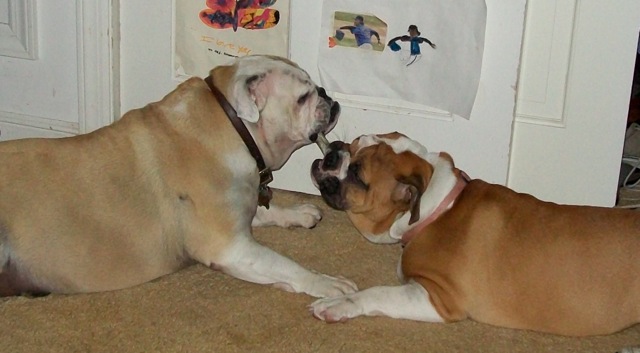
And here is a picture of my bulldogs sharing a bone. One chews on one end, the other on the other end.

Bulldogs sharing a bone