“Elixir in Exile” by Lucine Kasbarian

Kasbarian-Elixer in Exile1

If Ponce De León could search for the Fountain of Youth, could an Armenian daughter demystify the elusive Iskiri Hayat?

Hidden away in my parents’ home in New Jersey is an extraordinary liquid in a glass decanter shaped like Aladdin’s lamp.

Tinted like a carnelian gem and with a spicy, musky, transporting scent, this exotic liquid seemed destined to be applied like perfume rather than consumed like a beverage. The liquid only emerges from its cabinet to be carefully meted out for honored guests or as a folk remedy for the odd illness.

Enter the rare and precious Iskiri Hayat. Persian for “the elixir of life,” this tonic has been a source of curiosity and admiration since my childhood—a cryptic key to a fascinating past.

The word iskir is a dialectical variant (Turkish corruption) of the Persian iksir (elixir). Hayat means “life” in Persian and Arabic. And from the veneration with which the beverage was spoken about and handled when I was a child, I was convinced that Iskiri Hayat had mystical properties.

Dèdè (my paternal grandfather) knew our Armenian ancestors concocted this liqueur in their native land, but not much else—other than that one whiff had the power to transport an inhaler from exile all the way back to our native province of Dikranagerd (present-day Diyarbakir, Turkey).

I once got a glimpse of the raw ingredients, each preserved in a cloth sack tied with string. Some of them—what looked like clusters of horsehair, or a bunch of petrified raisins—could have populated a witch doctor’s medicine bag. When I was old enough, Hairig (my father) would reel off the 20 ingredients of the liqueur to me in reverent tones: Amlaj, Kadi Oti, Koursi Kajar… Recited in succession, they sounded like an incantation. In fact, as an adult, I learned that Hairig regretted not asking Dèdè more about “the medicines”—what Dèdè called the herbs and spices comprising Iskiri Hayat.

On his last visit to Beirut in the 1950s, Dèdè returned with a batch of the ingredients given to him by Manoush, one of his three sisters. Illiterate, she prevailed upon her nephew, Vahan Dadoyan, to take dictation and write in Armenian script the name of each ingredient on a tag that would be affixed to each item. As was customary for that generation, women knew recipes by heart and gauged ingredients atchki chapov (by eye). Thus, Manoush did not identify any measurements.

Fortunately, Dèdè possessed a dry mixture of ingredients already combined. We don’t know where he got it, but Hairig had, since the 1950s, repeatedly used it to make the drink. Today, our quantity is scarce and the potency of those mixed herbs, roots and spices has been depleted. Only one bottle of Iskiri Hayat remains. This has only intensified Hairig’s mission to decode and recreate the family recipe for Iskiri Hayat.

How could my father, in the 21st century and far from his ancestral homeland, reconstruct the recipe when he didn’t even know the English language equivalent for the names of some of these captivating-sounding ingredients, nor how much of each ingredient to dispense?

Alas, like the melange of spices and herbs in this ethereal concoction, many of the ingredients’ names themselves were probably combinations of languages spoken along the Silk Road, including the Armenian dialect of Dikranagerd, Arabic, Western Armenian, Kurdish, Turkish and perhaps even Chaldean Neo-Aramaic. Even for someone like my American-born father, who was fluent in the dialect of Dikranagerd and possessed more than a dozen dictionaries for the languages in question, trying to make sense of some names was problematic.

He knew that Sunboul Hindi was Indian Hyacinth. And that Manafsha Koki was Violet Root. But what the blazes were Agil Koki, Houslouban and Badrankoudj?

So much was lost in the genocide. To cut the Gordian Knot for an Armenian of the diaspora is to locate his/her confiscated, ancestral house in Western Armenia. Since Turkish authorities deliberately changed regional names and landmarks after 1915 to obfuscate their Armenian origins, the directives (often descriptions of the house and surrounding areas, handed down verbally from genocide survivor ancestors) are today insufficient.

For Hairig, another vexing quest had been to find people, of Dikranagerd ancestry or otherwise, who could help him decipher the names and meanings of the elusive ingredients in Iskiri Hayat. Though the famous Cookbook of Dikranagerd possessed a recipe for Iskiri Hayat, it was not the formula he sought. And while some firms produce commercial formulas, he wanted our specific ancestral recipe.

While the task seemed insurmountable, my father had made some progress over the years. However, in recent times, he seemed to have exhausted his options.

So, when I decided to make the pilgrimage to the deserts of Der Zor—the killing fields of the Armenian genocide—last year, I hoped to extend our search to Haleb (Aleppo, Syria), where some genocide survivors (including my relatives) found refuge. There, I surmised, the right person would surely recognize the ingredients’ names, know what they looked like, and even point me to where I could obtain them. We could worry later about how much of each item to blend.

Ultimately, my aim was to refresh Hairig’s supply—and from a source logistically close to Dikranagerd. Doing so seemed a meaningful thing a grateful child could do for a devoted parent in his twilight years.

My father had never seen the home of his ancestors and, yet, he carried the ham yev hod (flavors and fragrances) of Dikranagerd in his words, thoughts and deeds—from his modesty, humor and hospitality, to his dialect and storytelling ability, to his culinary and musical aptitudes. A humble gift would be to help him make that remarkable elixir that could, at least emotionally, bring his ancestors, their way of life, and our lost homeland back to him. And was it not worth it to rediscover a missing and precious part of our culinary heritage, and perhaps share it with the world?

During those fleeting days I spent in Haleb and through fellow traveler Deacon Shant Kazanjian (another Dikranagerdsi—a person hailing from Dikranagerd), I met and quickly bonded with Talin Giragosian and Avo Tashjian, a married couple who possessed the fine qualities one would wish to encounter among Armenians. Talin also happened to be Dikranagerdsi, and it stirred the senses to hear her and Deacon Shant converse in our earthy, colorful, near-extinct dialect. Talin, an English teacher, tried her hand at translating the Iskiri Hayat ingredients we did not recognize, and even enlisted her mother’s assistance. However, they both were as baffled as my father had been over the virtual hieroglyphics. And with that, Talin and Avo met me at the famed covered Bazaar near the Citadel of Aleppo, where the passageways are said to extend from the Fortress all the way to the Armenian Cathedral of the 40 Martyrs in the Old City.

This underground marketplace was a reminder of what life was like centuries ago. Rather than seeming anachronistic and backward, the atmosphere was invigorating. The Bazaar lured visitors to connect with history by showcasing cultural features that had managed to remain intact despite the modern world’s creeping influence. Here, people were not “living in the past,” as some are inclined to say about those who don’t conform to modern habits. These people preferred to cling to their traditions, taking part in an authentic continuation of the past in the present.

As we entered the Bazaar, we marveled at the vaulted ceilings, the intricately carved doors and metalwork on the walls. Merchants — some wearing kaftans, others in Western dress — would call out to customers. Through the narrow, serpentine passageways, hired hands led donkeys carrying sacks of grain. Others carried supplies on horseback. Niquab-wearing women haggled over prices. Through the labyrinths, we passed through the jewelry, textile, pottery and camel meat districts, until we finally reached the herb and spice district.

Talin directed me to the stall belonging to the Spice Man of Aleppo. He was the eldest, best known and most amply supplied of the spice vendors. Talin surmised that the Spice Man, who inherited the business from his father and grandfather, retained the knowledge they had amassed and transmitted to him. This would have meant that when our ancestors emerged from the deserts of Der Zor speaking a variety of dialects, the Spice Man’s grandparents picked up the many names a product went by, including those used by the Armenians.

In spite of whatever their personal ambitions may have been, the Spice Man’s four sons all worked in the family business, operating out of a closet-sized stall. It was teeming with bottles, packets, canisters and jars filled with powders, liquids, seeds and roots. A ladder led to a trap door on the ceiling that opened into an attic, their main storehouse.

Unable to communicate with words, I still could not contain my zeal upon encountering the Spice Man. Stoic and world-weary, he had no inkling of or interest in the source of my enthusiasm. A man of few words as it was, the Spice Man did not speak English. But as Talin recited the shopping list to him, name by name, something incredible occurred:

“Do you have Agil Koki?”, she asked in Arabic.

The Spice Man gestured a grand nod of the head, like a solemn bow, to signal “Yes.”

“What about Badrankoodj?”

Again, the Spice Man’s head would slowly move from up to down until his chin brushed his collarbone.

And so this ritual went on. Talin would say a name, and the Spice Man would unhurriedly acknowledge that not only did he know what the word meant, but that he stocked the desired item.

Then, the Spice Man would call out to his sons to each fill different parts of the order.

By the time Talin was through, we had collected all but one of the ingredients on the list. Even if he were not interrupted by demands from his customers, the Spice Man still would not have been inclined to have a significant chat. We were neither able to cajole him to explain in Arabic some of the more esoteric terms, nor did Talin recognize mystery ingredients by sight or smell. However, the Spice Man’s sons did write down, in Roman letters, each ingredient’s name on its corresponding package—a revealing moment.

I was in mortal shock when we left the stall having completed the lion’s share of my mission. To celebrate, Avo, Talin, Shant and I went to the Bazaar’s bath oil and fragrance district and rewarded ourselves by purchasing traditional kissehs—the coarse washcloths used by our elders.

Back in my hotel room, I shed a tear while inhaling each aromatic ingredient. Then, I securely packed them into Ziploc bags, distributed them throughout my luggage, and hoped I wouldn’t be taken aside at Damascus airport for suspected drug smuggling. Even afterwards, the heavenly scents that clung to the clothes in my suitcase made my mouth water when I unpacked them back in the States.

What was Hairig’s reaction when I returned to New Jersey, told him my tale, and presented him with one packet after the next? He seemed gratified, but also at a loss. Were we really that close to our goal? It was almost too remarkable. He inspected each sachet carefully as if to say “So this is what Badrankoodj looks like!” and braced himself for the next step: finding a knowledgeable spice vendor who could give us English equivalents to foreign words with the help of visual stimulus.

From here, we will keep readers apprised of the last legs of our intoxicating voyage. The reconstituted beverage may indeed be so supernatural that the next time you hear from us may be from Dikranagerd itself.


Lucine Kasbarian, writer, political cartoonist and book publicist, has been immersed in book, magazine, newspaper and online publishing for more than 30 years. She is a descendant of survivors of the 1915 Turkish genocide of the Armenians, Assyrians and Greeks, which drove her grandparents from their native lands in Western Armenia (now within the borders of Turkey). Lucine is the author of Armenia: A Rugged Land, an Enduring People (Simon & Schuster) and The Greedy Sparrow: An Armenian Tale (Marshall Cavendish). Her syndicated works, often about the culture of exile, appear in media outlets throughout the world. Visit her at: lucinekasbarian.com

Elixir in Exile first appeared in The Armenian Weekly.

Read our interview with Lucine here.
“Watermark” by Patricia Heim

Watermark

I lie face down on the black leather couch. After three years of coming here, I am finally weeping.

I hear him rise from his black leather chair, feel the air swoop as the blanket falls over me. Gently, he smoothes it around my shoulder; I hadn’t expected such a gesture. He’s an analyst, after all. Yet, it feels right.

Back in his seat, I sense him leaning forward, head bowed, hands clasped between his knees. He is my witness.

My arm, sleeved in cashmere, covers my face. I am steeping in memory, forget how old I am, middle-aged I suppose, heart flash-frozen at thirteen.

The Sondheim song spins, round in my head. Last night, alone, I played it over and over. Ethereal and so sad, I never realized. The bid for clowns made me think of her, though I don’t know why. I cried inconsolably like the child I once was.

~

I see her in the kitchen. Springtime, she’s fixing supper, her gingham house dress hugging her form. I sit at the table, reading aloud my geography text. I’m content just to be in the room with her. The metal scent of screens mingles with the twilight air, marking the hour I educate her−tonight of watery places. Their names, all poetry to me: Isthmus of Panama, Straits of Gibraltar, Marianna Trench, Lake Meade; the pulsing cadence, soothing, incantatory.

Below us, in the basement, a turtle conch from the Philippines hums a chorus of the ocean. When I was small she held to my ear. I found it beautiful and then fascinating, how it cradled in its chamber the might of the sea.

The days lengthen. In the dining room, dust motes twirl in columns of sunlight. On my knees, I’m waxing the mahogany. She sits at the window sill, chatting on the phone with her sister. They are laughing like schoolgirls. She doodles in blue ink; cups and saucers in the curled margins of the yellow telephone directory. On the backs of torn envelopes she scribbles grocery lists, saves the loose-leaf for notes, sometimes to my teacher.

Seventh grade finally ends. I’ve wiggled my way into the popular group. My best friend and I make prank calls to strangers. We think this is funny. She invites me for dinner, so I dial my mom.

“Are you sure you don’t want to come home?” she asks, as if I’m the one who’s wavering.” I’ve made roast beef, one of your favorites.”

“That sounds good, Mom,” I say, hoping my warmth will tide her over. “Save me some leftovers? I won’t be too long.”

~

Midsummer, I’m off swimming at the pool, mastering the back dive. She sleeps in her bedroom, tangled up in the sheets, pale and incoherent. A week before, she was quarantined at the hospital, thrashing about, tied to the bedrails. We stood in the corridor, faces poked through the doorway, our words (“We’re here, Mom … getting better… home soon…miss you”) sailing across the room, straining to reach her.

“Meningitis,” they said, though they hadn’t a clue. Finally, they released her.

“Exhaustion,” they concluded.

The morning she returns, I race to the front porch at the sound of wheels, the engine cut to an eerie silence. Eternity passes. I can barely move or breathe. From the driver’s side, my father appears, then, circles to her door before craning to lift her. I don’t understand why she slumps into his frame, why he practically carries her.

I steady the door as they shuffle through, a rhyming couplet, a living pieta. He sets her down on the sofa, head flopping beneath the weight of the mass lurking in her brain, growing like a grapefruit. Only an autopsy will eventually reveal it.

Either she doesn’t know me or can’t say my name. “It’s Patsy” my dad exclaims.

“Patsy,” she repeats, as if learning to speak.

Stunned, I stumble through the downstairs before lurching onto the back porch where I’ve been known to dance and sing. I clutch my chest, because I can’t inhale, then crumple to the ground, choking and sobbing.

Days later, my friends and I are planning a funfair, my debut as gypsy fortune-teller. She’s not supposed to wake up, while I hold my breath and tiptoe toward her bureau.

“What are you doing?” I hear her say.

“Borrowing some jewelry for a fair we’re having,” I answer, not daring to face her. “I’m supposed to be the gypsy; I read palms and predict the future. I’ll bring them back as soon as it’s over.”

“You never help me,” she scolds, before drifting back off. I gaze out the window, fists  dripping with rhinestones, the green world calling.

“Help you?” I want to scream. “How am I supposed to help you? You’re always asleep. Most of the time, you don’t even make sense.”

Days later, she disappears.

“A seizure,” my father explains, hours after I’ve come home from the pool, darting up and down the stairs, yelping for her. He’d rushed her to the hospital. There wasn’t time to leave a note.

I wonder if she’ll ever come back, as I think about lilacs, how she gathered them in vases. At the hospital, she dreams of her dead mother. “I’m tired,” and, “Take care of Patsy,” she moans to anyone in sight, especially my father, seizing his arm, her gray eyes glaring.

The nurse phones at dawn on a Sunday morning, “Mr. Finn, your wife’s condition is very grave.”

A flock of dresses eyes me from the closet. What to wear poses the biggest question.

Am I a girl or a woman?

The minute hand won’t move. The wardrobe doesn’t answer.

We weren’t late. She died moments after we got the call. It wasn’t my fault, but still, I blamed myself all my life as if I had been selfish, as if I were a criminal. How could I have known, at thirteen, that my world had overturned and nothing could be done, that my need for control was perfectly normal?

Eighth grade, acorns thud into puddles of leaves. My mind fingers a stone, ponders it ceaselessly. Never, it reads. Never, I repeat, over and over. Once, the word had meaning, but in the reciting, it gets whittled down to nonsense. The unconscious fails in its attempt to represent absence.

Before long, I recite all manner of things, facts and formulas, stirring lines of literature, skeins of poetry, and litanies of prayer. I held onto my mind, but the girl that was me, I can’t seem to locate. Even beyond the closet, choosing is still difficult. Things often aren’t quite right. Almost always, something is missing.

In my mind, I open the door, while alone in the living room, she sits very still. Her face looks vacant, disapproving, I think.

Hot tears graze my cheeks, while a voice inside whispers, “You have to say, ‘good-bye.”

“Good-bye,” I say, sounding like I mean it.

It is necessary, sometimes, to be firm.


Patricia Heim is a psychotherapist in private practice in Philadelphia. She received both her B. A. and M.A. from Immaculata University and post-graduate training from the Psychoanalytic Center of Philadelphia. Pat lives with her husband on a farm in Chester County, Pennsylvania and writes with the Greater Philadelphia Wordshop studio.

Read an interview with Pat Heim here.

“Hot Glass” by Michael Milburn

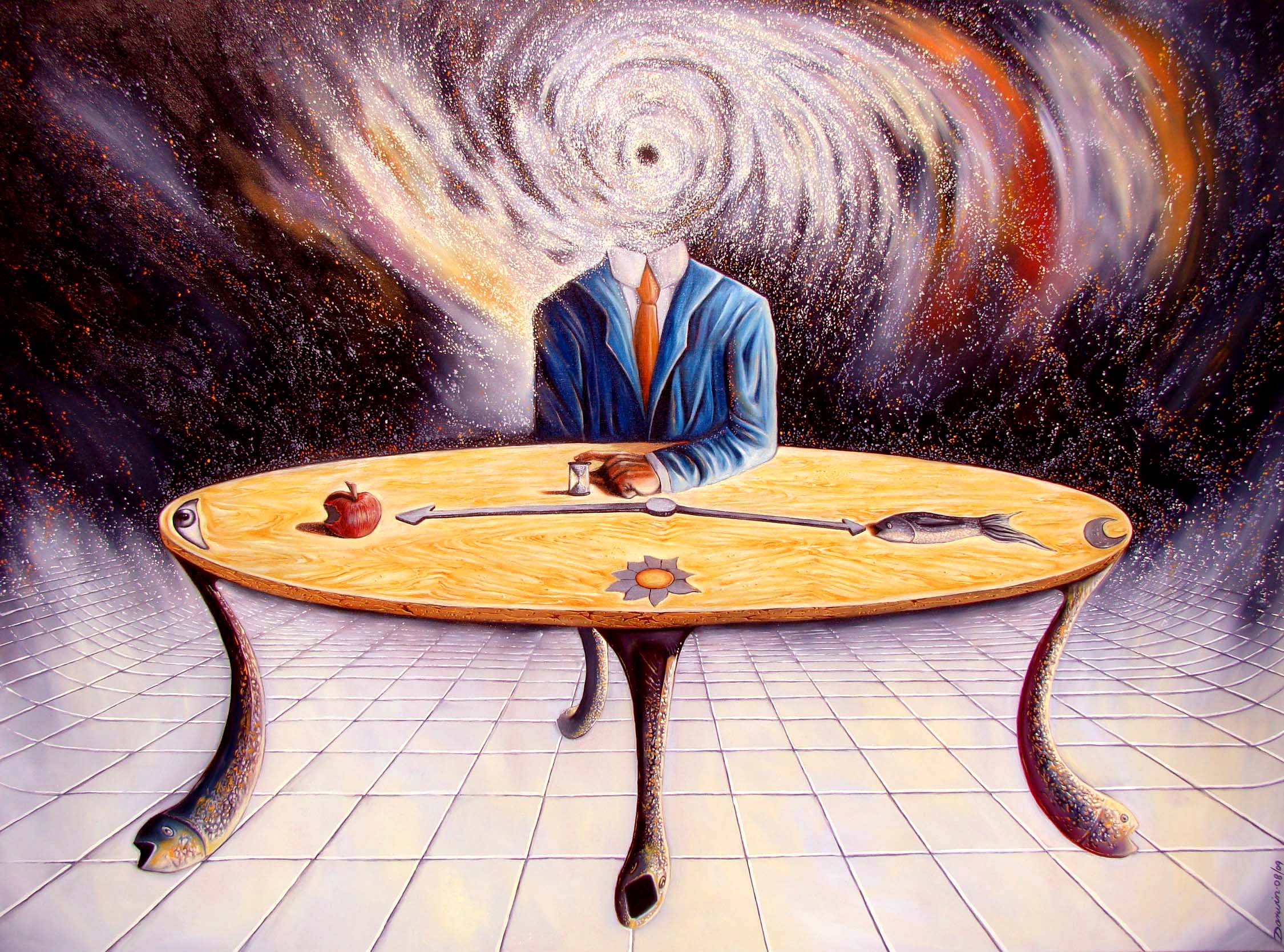
Man Attempting (Michael Milburn)
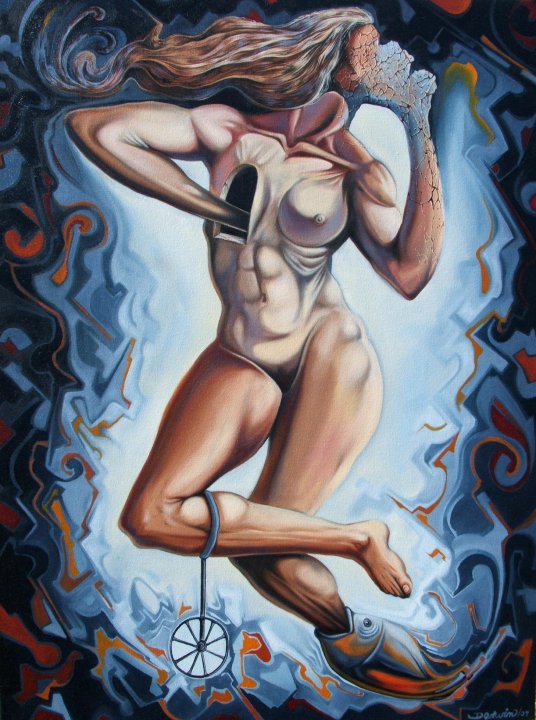
“Man Attempting to Comprehend his Place in the Universe, Time, and Space,” Darwin Leon.

“That was lethal,” my mother said, closing the front door behind her.

I didn’t know if she meant lethal for me to have downed three vodka screwdrivers before getting behind the wheel of my car, lethal to have arrived drunk at a college friend’s New Year’s Eve party the night before, or both. My parents and I had just returned from a neighbor’s house where my father wrote a check to repair the lawn I detoured through on the way home, churning up sod and sideswiping trees. Before disappearing into his study, he ordered me to come up with a repayment plan, the extent of my punishment. His restraint surprised me until I remembered that his own chronic recklessness with alcohol made it awkward for him to sound too disapproving.

In time, my parents came to refer to that incident as a typical youthful bender, a rite of passage for an eighteen-year-old boy who had reached the legal drinking age a few months before. I saw it that way, too, though it ceased to look so harmless in the wake of subsequent alcohol-related calamities. Factor in my childhood exposure to my father’s copious drinking, and my troubles with alcohol later in life, and that New Year’s Eve scene turns into an omen that I should have taken more seriously. Gulping alcohol has always been my way of pounding my nerves into submission; in those days, three drinks was the minimum required to get me out of the house to a social engagement.

Later that year, my college roommate announced that he had invited two girls to our dorm room. I hurried out to buy a pint of vodka and a quart of orange juice to neutralize my shyness. I drank so avidly in preparation for the girls’ arrival (they only stayed for twenty minutes) that I passed out in my clothes and woke the next morning having wet the bed. A Halloween party that fall ended with me carried home in my devil costume, my roommates (one of whom had just completed reserve training at Quantico) chanting a Marine fight song as they marched me through the quad. After that, it became increasingly hard to laugh off my binges, and I have since given up alcohol many times for periods ranging from a week to a year. Today, I strictly limit my intake with regard to when, where, how much, and how often I drink, but I have not stopped for good, a failing that I blame on alcohol’s power to extinguish my anxiety.

For as long as I can remember, I have suffered from phobias provoked by crowds, heights, enclosed spaces, and social interaction. Even alone and remote from any threat, I am subject to apprehension with no identifiable cause. By quelling these symptoms, alcohol makes me feel right in a way I never do when sober, a way that I imagine people who don’t crave it feel all the time. In his article “Who Falls to Addiction, and Who is Unscathed,” the physician Richard Friedman suggests that drug and alcohol abusers “may have blunted reward systems in the brain, and that for them everyday pleasures don’t come close to the powerful reward of drugs.” A study in the Archives of General Psychiatry confirms alcohol’s attractiveness and its danger when used as a balm for anxiety.

…of 34,653 American adults, 13% of the people who had consumed alcohol or drugs in the previous year said they’d done so to reduce their anxiety, fear, or panic about a situation….People with diagnosed anxiety disorders

who self-medicated at the start of the study were two to five times more likely than those who did not self-medicate to develop a drug or alcohol problem within three years.

My affinity for alcohol began in my father’s bar, a tiny room centrally located between our house’s living room and den. Its contents reflected his pride in being able to serve anyone’s beverage of choice on demand. A small antiquated refrigerator always stocked a six-pack of Heineken for him and my three older brothers, a bottle of rosé for my mother’s nightly two glasses, a vintage white or red wine for dinner, and on holidays a magnum of champagne wedged between ice-trays in the freezer. A cupboard held half gallons of vodka and gin alongside various expensive whiskeys received as gifts or earmarked for guests. Reserve cases of beer and wine filled a narrow closet.

I never had any difficulty obtaining alcohol growing up. My brothers were too prolific in their drinking to miss the Heinekens I carried out to my tree fort in the woods, and there were enough leftover bottles of dinner wine that I could sneak one up to my bedroom while my parents napped. A six-pack of beer and bottles of my mother’s rosé accompanied me back to boarding school after each vacation, swaddled in my duffel bag. If my father had discovered me pilfering his booze, his reaction would likely have been “That’s my boy.” He was far more eager to educate me in the rituals of alcohol than to shield me from its dangers.

When I was ten, he taught me how to make a mint julep by mashing mint leaves against the bottom of a tumbler filled with Jack Daniels. I poured this concoction over crushed ice, stirred in a packet of Sweet N’ Low—a nod to his current diet—and served it to him on the patio in a frosted silver goblet. I hated the taste, just as I hated the Budweisers that my uncle expected me to have open for him when he visited, but delighted my elders by taking healthy swigs from these drinks before handing them over. When I turned seventeen and my father allowed me my own glass of wine at dinner, I had been accepting sips from his glass for years. By then I had already acquired a taste for beer and wine and made myself sick enough on scotch, gin, rum, and tequila that I have never been tempted by them since.

At boarding school, drinking felt like a natural rather than a criminal activity. On weekend nights, I’d sit in the window of my dorm room with a smuggled bottle of my mother’s rosé. These solitary sessions would have astonished my classmates, who tended to break rules boastfully and in groups, and who knew me as the straightest of straight arrows, not just because I played sports, studied hard, and wore bland preppy clothes, but because I was so shy. None of my close friends drank, and I wouldn’t have dared approach anyone who did to invite myself along on a debauch. I had been getting drunk alone since I was thirteen and didn’t crave company or recognition. I drank to ease the anxiety that I felt in my school’s academically and socially competitive environment.

After midnight one Saturday, a boy strode into my room to borrow a book while I was occupied with my bottle of Mateus. He stared at me with a combination of surprise and respect before wordlessly accepting a glass. By the next day—or perhaps that evening after he left to spread the word—my reputation had undergone a dramatic makeover. One of the chronic miscreants who lived on the floor below passed me on the way to Sunday brunch, and with a medley of winks, nods, and oblique compliments let me know that he knew that I wasn’t as innocent as I seemed. This was unwelcome news—I knew how naughty I was and saw no profit in others knowing too, especially an image-conscious slacker unlikely to make it to graduation.

In college, where my multiple roommates made solitude impossible, my drinking retained its private aspect, as I focused on ingesting alcohol rather than enjoying the party. Several times a week my roommates and I partook of a local bar’s happy hour, surrounded by other freshmen. As my friends paid attention to each other and to the girls in the room, I hurried to get drunk enough to cope with any of the latter approaching our table.  An observer would have thought the scene harmless—a college freshman relaxing in boisterous good company. I was passing my courses and playing two sports. Looked at another way, I was spending most of my evenings drunk and much of the rest of my time looking forward to getting drunk. A ubiquitous public service ad at that time warned, “If you’re drinking to be social, it’s not social drinking.” Then what is it, I wondered, and why do it? Why not switch to ginger ale?

Even in comfortable company, with a friend or two in my dorm room, I outpaced everyone. I couldn’t plead social or other stresses at these times; getting drunk was a race to get out of my mind as quickly as possible. My tendency to pass out early usually spared me embarrassments like the New Year’s Eve drive and Halloween march. An exception occurred one evening in the college dining hall. Primed by several pre-dinner beers, a friend and I sat near two boys who lived in our dorm—precocious intellectuals who dressed conservatively and read The Wall Street Journal. I began making fun of the pair in a loud voice, mocking their dress and speech as my friend tried to shush me. “I think we’re being insulted,” one said as they rose to leave.

The memory of that scene still mortifies me, as if a demon had seized my tongue and forced me to speak as someone I neither was nor wanted to be. I can’t remember how I faced the boys in the dorm afterward, but three years later on the eve of commencement I encountered one of them walking through a quiet neighborhood near campus. Before he could stride past, I stopped him and apologized for my behavior as a freshman. He listened, nodded in acceptance, and walked away. Even if my immaturity mitigates my offense somewhat, it’s hard not to find evidence of alcoholism in my drinking at that age, my future temperance notwithstanding.

I first noticed the duality between drinking as fun and as destructive behavior in my father’s practice. On a typical weekday he might have a cocktail and wine at lunch with his Wall Street cronies, one or two beers in a Penn Station bar while waiting for his commuter train, another in the bar by our local Long Island station before my mother picked him up, a glass of sherry upon arriving home and wine with dinner. On vacations he’d announce at breakfast the precise time he planned to start drinking that morning. Once a year, usually on New Year’s Day, he went on the wagon as part of a new diet or on doctor’s orders for hypertension. After a week or so his resolve faltered, especially if one of my older brothers arrived home and began draining Heinekens in front of him.

My ex-wife used to press me to admit that my father was an alcoholic, and I’d exasperate her by demanding a precise definition of the word. How could a man so successful warrant that label? He was a Wall Street lawyer who worked full-time into his seventies and retained several clients beyond that age. He provided for his family, came home in time for dinner when he wasn’t traveling or preparing for trial, attended graduations and sports events, and took us on vacation to Bermuda every March. He was also a surly, vindictive drunk who humiliated my mother and taught his children to avoid him, and whose scorn left psychological scars on every member of his family. He showed up intoxicated and limping at my sister’s wedding after causing a car accident on the way to the church. Alcoholic? It depends how you look at it.

Perhaps my quibbling over labels betrays my reluctance to diagnose myself; I have drunk so sparingly for the past twenty years that there’s little outward evidence of a problem. A friend in AA jokes that if he had my self-control he’d never have had to quit drinking, though his sobriety demands far more discipline than mine. I simply avoid alcohol in situations where it impairs me. After squeezing my four-year-old son’s arm too hard during a beer-fueled scolding, I stopped drinking in his presence, and have not done so for the past twenty-one years. Realizing that disagreements were likelier to turn ugly if I was even mildly hungover, I stopped drinking around my girlfriend. In my thirties I stopped drinking in my parents’ house, where moderation was impossible in the face of my father’s persistent hospitality. My final withdrawal came a few years ago when two glasses of wine made me so inarticulate at a dinner party that I stopped drinking in public.

Today I only drink by myself, some wine or cognac on week-end nights when my family is asleep. I’d like to say that I stop after achieving a pleasant buzz, but in truth I drink the way I always have, fast and purposefully until the alcohol blots out my anxiety. As long as I stick to a strict schedule, I tell myself, I need never join my friend in recovery. Besides, what difference would it make if I stopped? My longing for alcohol would continue, and the only negative effect of my solitary binges is a slight hangover the next morning. That and my awareness that I cannot stop, and that calling my drinking harmless is as self-deluding as when I drove across the neighbor’s lawn thirty-five years ago.

In his essay “Under the Influence” Scott Russell Sanders worries that growing up with an alcoholic father has made him susceptible to abusing alcohol himself. As an adult, he confines himself to “…once a week, perhaps, a glass of wine, a can of beer, nothing stronger, nothing more.” Sanders recalls seeing his father take his first drink of the day: “I watch the amber liquid pour down his throat, the alcohol steal into his blood, the key turn in his brain.” For me that key turns when my first sip begins to deaden the quickened, frantic feeling that anxiety maintains in me. Nothing else, not therapy or meditation or success or love has given me such relief, and that’s why I do not or cannot give up drinking for good.

A few years ago I mentioned my fondness for English beer to my son and he said, “But I’ve never seen you take a drink.” Drinking alone allows me to keep my troubled relationship with alcohol a secret. People who know me would laugh at the idea of me being an alcoholic or even concerned about the possibility. At parties, my request for water or ginger ale elicits curious looks as I imagine strangers speculating about my alcoholic past. Like a man with that grim history, my outward temperance belies an inner craving. I look forward to my weekly ration more than to anything in my life. “Right now I would eat hot glass / if it got in the way of this fantasy” a line in a friend’s poem goes. When it comes to alcohol, that’s how I feel.


Michael Milburn teaches English in New Haven, Connecticut. His essays have recently appeared in New England Review and Hippocampus. His third book of poems, Carpe Something, will appear this summer from Word Press.

Check out our feature on Michael here.

“Afterward: a Draft” by Kathryn Winograd

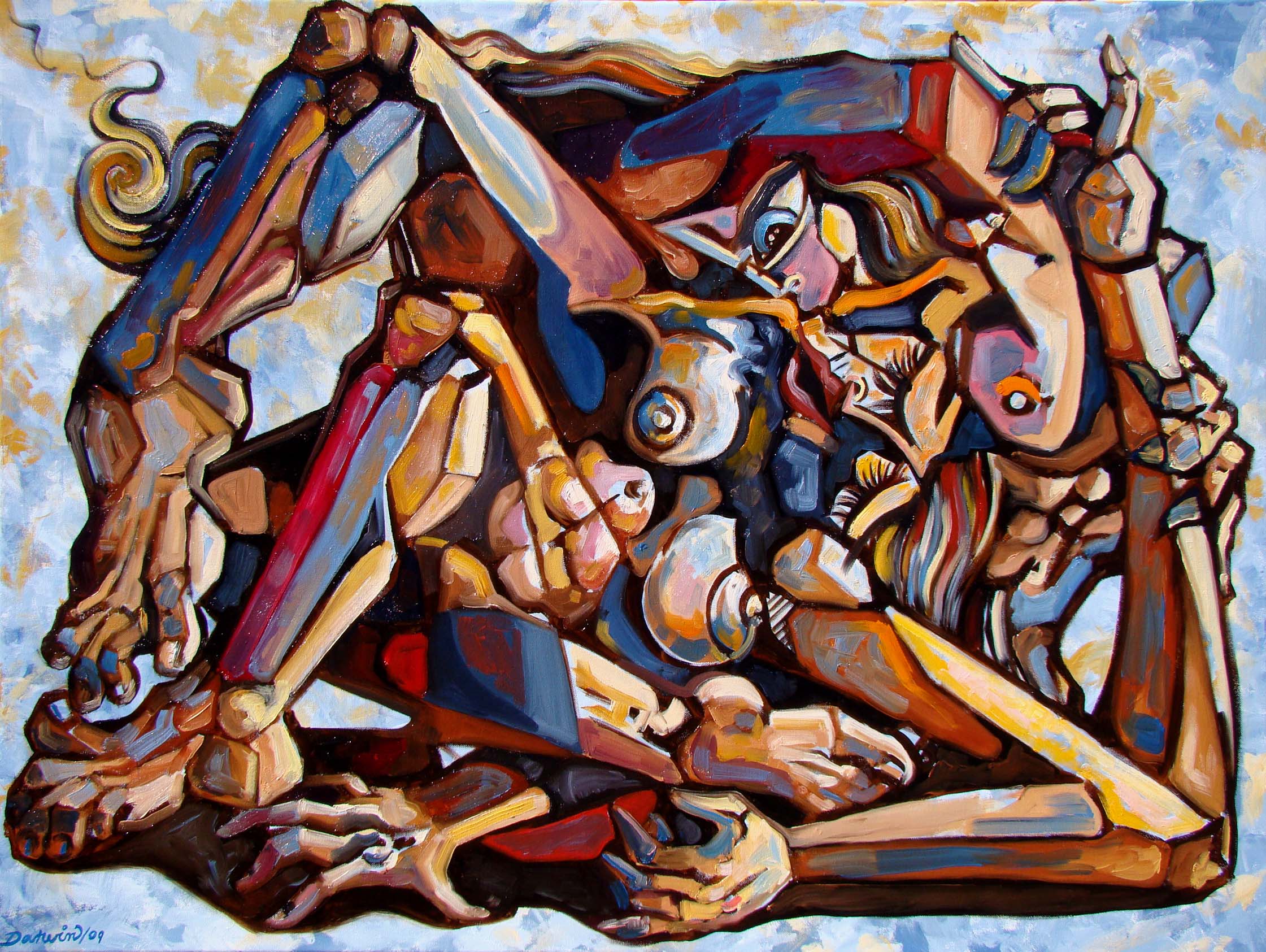
The Rape (Kathryn Winograd)
“The Rape,” oil on canvas, Darwin Leon

In the early 1970s, ’71 or ’72, I think, (see how already the narrative breaks down), I was raped by a man I did not know.

I was 13 or I was 12. I was in the 8th grade or in the 7th, both years lost, only an image left, an English teacher, who had dyed black hair, who was kindly, who asked me in the middle of class one day if I were okay, if I needed to leave the room, to go home. She touched me on the shoulder, I want to say. (What is the right narrative?) I don’t know what I was doing or what I looked like to cause her such alarm; I only remember sitting on the end of the row nearest the door and her asking me if I were okay, and my mother telling me later (so even this is wrong; where is the silence I only remember?) that this teacher had had a daughter raped too and so she was concerned for me, she understood. I don’t know if a year had passed by then or if it were in the same year; I don’t know if I left the class or if I stayed.

~

Most of my life I have not remembered this man’s name, this boy’s. (He was 19, and, at 52 now, I realize that I cannot think of him as anything else), and I won’t give him his name here, even though once I had the idea of looking his record up, of researching his life as if that would prove my indifference to him finally. He met me half way up the lane along the cemetery to our house; he must have watched from the graves as I stepped off the school bus. He asked me his question. I answered him. Politely. (I’ve read somewhere now that young girls are most often attacked because of this vulnerability. We are asked to be nice, to be helpful. And so we are.) He came up to me on the driveway by the cemetery. He asked me where the Smiths were. I told him. I pointed the way for him and then I turned away. Without fear.  Without surprise. (Small comfort, this, when I hear of another young girl or woman raped, murdered–I think when I was lying on the ground and he was finally leaving me that he could so easily have put his hands around my throat and I would have died. Or he could have stabbed me with a knife and I would have died. Without fear. Without surprise. Everything happened so quickly; everything was simply something that happened–detached, removed from me, my every sense heightened, but not in fear, only in wonder, only in minute-by-minute half-comprehensions. What I hope for those other women.)

He put his arms were around me from the back and said not to scream. He tried to punch me in the stomach but my coat was thick and sturdy and I felt none of it. He said he wanted to go steady, for me to be his girlfriend, all the time taking me further into the woods. The only fear I remember now was when he pushed me to the ground and ripped my pants from me and the wad of gum I had been chewing jammed up against my throat and I was afraid I would choke so I turned my head to the side to spit it out. I saw the dead leave then, what I remember most. He lay on me. I felt pain. Later a lawyer would ask me in court if I thought he had used his fingers to “penetrate” me. (I didn’t know what he meant. I had never been with a boy. Why would anyone want to put their fingers there?)

I bit him. Not bravely. He put his fingers near my mouth, so I bit him. He stood above me, crying. He said I had hurt him. He backed away from me into the woods, still crying. Only then was I afraid, that he might return. I wrapped my torn pants around my waist and ran to the barbed-wire fence that ran along the roadside. A man on a tractor appeared. I waved at him, crying. (He must have been a farmer in the area, but I don’t remember who he was and no one ever said anything to me about him.) I don’t remember how we got to my neighbor’s, if I rode his tractor or if he walked me there.  I sat on the couch with the girl I went to school with who lived in this house with no plumbing, no mother.  My parents were out of town, in Florida. There was no one to come and get me. I don’t know if I rode in a police car or if an ambulance took me someplace. My mother would tell me later how she wept and cried at the airline ticket counter in Florida, begging the airlines to give her a ticket home so that she could be with me. (There is that other narrative. And yet I keep saying we never spoke of it.) I was examined; evidence taken. I remember little of this: nurses talking to me, the curtain they pulled around the bed, perhaps some more pain. Medical students in a residency program my father oversaw came to take me home–I think. They had been staying with me. I don’t remember how we got home. I do remember vividly passing through our gate and being greeted by the large pack of dogs that roamed our farm and how much I wished that I had made it that far, to the gate, to the dogs that would have helped me. (I have kept dogs ever since.)

My mother arrived sometime late at night. I was asleep or half sleeping. She appeared, weeping. I remember little else of that night. My father offered a large reward for information regarding this boy.  He and I drove to the sheriff’s station one night, sat in the back of an unmarked car with the overhead light turned off and watched the sheriff call a possible suspect out of his home or out of a bar. I don’t know which. I didn’t recognize him. I think there was a lineup at some point, but I don’t know for sure. A young man my father and mother had befriended told them about seeing someone at a bar that night, with a band-aid on his finger. He had been bragging. He was arrested. We went to court.

My mother told me that I needed to do this, that the boy had attacked other young girls my age, that each time he had gone a little further, obviously accelerating what he was doing, that he had to be stopped in case he killed someone. That I had to be the someone to stop him. I remember little of the trial. My mother and father would take me, before or after, for ice cream. I don’t know what we talked about. I found out later, or I think my mother told me, (here again, that narrative of silence falters), that the judge for the case was the father of a young girl in my class. My mother made me a dress for the day I testified. It was red. It had blue anchors on it and a white collar. My mother said that I was so young it was really bad for this man. (I didn’t know that at the same time I was going through trial, women’s groups in the seventies were fighting to change rape laws that had forced women to prove physical resistance to the attack and personal chastity.) I don’t remember what I said in court or what was said to me except for that question about the fingers. At the end, he was convicted. I sat in the courtroom when the sentence was announced. The police led this boy past me. His mother appeared from the rows across the aisle, crying, “You told me you didn’t do it. You told me you didn’t do it.” I think I threw the red dress away, but I don’t know.

~

I think of the nineteen-year-old boys I teach in college now, the friends of my daughters, how young they are. Of the life I’ve had these past thirty-nine years–school, college, graduate school, marriage, children, work. A man, a good man, who loves me. Only last year my mother told me that “this guy,” she called him, had gotten out of prison after twenty-five years. (Could this even be right? I have been married twenty-five years and didn’t marry until thirteen years after this rape. Where is my narrative now?) I think of the Super Max prison in Florence, Colorado. And of the men I read about who are in solitary confinement for 23 hours a day, for years and years. I am not sure what we are trying to accomplish. I ask myself if even this boy deserved to be imprisoned for so long for such a stupid act when he was nineteen. (I remember hearing that my father, every year the boy came up for parole, submitted his statement that he shouldn’t be released. Later my mother telling that this boy’s sentence was extended over and over again, not because of me, but because of what he did in prison. “It’s not about you anymore,” she told me.) I don’t know what this boy did in prison. I don’t know how many other girls he touched before me that day. I don’t know what might have happened if he had not been stopped, had not been imprisoned. I did good, I tell myself.

Today I know this about rape–my own is insignificant. In 2008, after decades, centuries of systematic rape, the United Nations Security Council finally recognized “that women and girls are particularly targeted by the use of sexual violence, including as a tactic of war.” As of today, 200,000 women raped in the Democratic Republic of Congo: forty women a day. 200,000 women raped during the Bangladesh Liberation War. 20,000 women raped during the Bosnian War. In Liberia, 92 percent of 1600 women interviewed reporting sexual violence. Rape as a tool of war in Darfur, Uganda, Sierra Leone. Women not just incidentals now in the course of a war, but chattels of patriarchal societies, defiled to dishonor, to harm a man, his family.  Hundreds of thousands of women raped multiple times until their bodies are irreparably injured, until they bear the children of their rapists, and, through some grace, must still love these children, even as their own families ostracize, isolate, shame, humiliate, stone, kill them.

I know that there are women in refugee camps today, their men gone, dead, who are forced to gather wood or water or to take their children somewhere outside of these camps, their tents, to defecate. And they are raped. And their children raped. I think of the small inventions that can save them: the stove that does not need wood, the small community well dug for potable water. Amnesty International reports that Native American women are two and a half times more likely to be sexually assaulted than other women in the United States. I think of the women teachers I have worked with on the reservation for the past six years. What have they been through? What have they seen their daughters suffer? Their granddaughters? Even the statistics tell us nothing: most Native American women are reluctant to report sexual assault given the lack of assistance they are given in the process and the few times the perpetuators are even convicted. And yet it is the men who are the “holy” men, the only ones who can hear the holy voices. As in every society.

I know now that I perpetuated a crime in my silence, that every moment of my silence meant another moment of secrecy for a sect no woman wants to be a part of, that no woman should be blamed for. (No one said anything to me that I remember, except for the one English teacher whose daughter had been raped, who might have touched me in tenderness. Well, I know now I want to say that, to keep the narrative, but I know I am wrong. One day I was riding horses with a friend—round hair, round face, round cheeks in the sunlight on her horse. “You know what they are saying about you, don’t you? You should go to another school. Move away,” she said. Later my mother wanted to write the school a note for the principal to read over the intercom, to thank everyone for how good they had been to me. I had told my mother nothing of what had been said or not said.

“Where is my little sunshine?” my mother once asked me, forgivable now because I see the silence was mine, not hers.)

My daughter asks me a simple question: why should a penis have power over a woman? And I feel a physical shock. I have no answer for that. She tells me of a village where rape is unheard of simply because the society will not accept the idea of rape, that somehow the penis could be more powerful than the vagina, that a man taking a woman should mean ruin for anyone. I think of the simple physiology of that moment when I was raped–what I can’t even remember well, describe well, have not even forgotten well. I know now that my single experience, my five minutes, has cost me more than I should ever have allowed myself to pay, and that this is the real narrative.

Here I am: poet, essayist. I am supposed to transform all this into something, some metaphor about trees and rock, about a spinning wheel and a woman who keeps ripping out the shroud of her life, but I can’t. And now I won’t.


Kathryn Winograd, poet and essayist, is author of Air Into Breath (Ashland Poetry Series), winner of the Colorado Book Award in Poetry, and Stepping Sideways Into Poetry (Scholastic, Inc), a classroom resource book for K12 teachers. She recently won 1st place in the Non-rhyming Poetry category of the Writer’s Digest 80th Annual Writing Competition 2011, and 1st place in the Chautauqua Poetry contest. Her essay, “Bathing” was named a Notable Essay in Best American Essays 2011 and is included in The Fourth Genre: Contemporary Writers of/on Creative Nonfiction along with “(Note to Self): The Lyric Essay.” Recent or forthcoming publications include Fourth Genre, River Teeth, Hotel Amerika, Puerto del Sol, and Literary Mama.

Read an interview with Kathryn here.


“Eyes Right, Confessions from a Woman Marine” by Tracy Crow

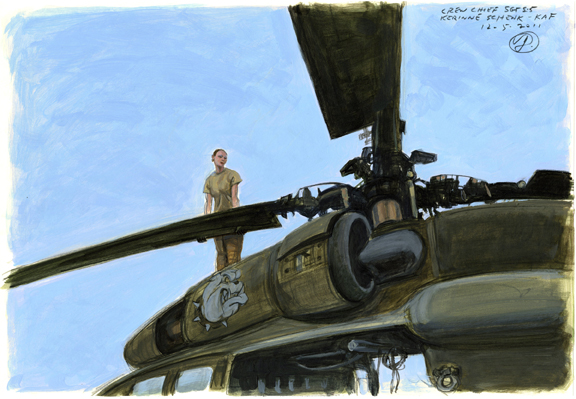
woman on helicopter
Image courtesy of Victor Juhasz, artist

When I was twenty-eight, younger than my daughter is today, I was facing the likelihood of a court-martial.

I followed a Marine sergeant down a polished corridor, past the clacking of typewriters and murmurs behind the closed doors of Military Police Headquarters, and pretended to be unafraid, as if I had nothing to hide, as if on the way there that morning I hadn’t seriously mapped out a plan for desertion. Inhaling and exhaling in the same forced rhythm of a runner pacing through a psychological wall, I was committed to a marathon of sorts, and so I was breathing in and breathing out, matching foot speed and cadence with the young Marine ahead of me: a machinated force, we were, matching left foot and right, left arm and right, until he pulled up short in front of a closed door. My toe stubbed against the heel of his boot. Acting politely unaware, he pushed open the door and stepped aside for me to enter. He wore well his role of consummate Marine, refusing the eye contact I was desperate to interpret.

“The captain will be with you shortly, Ma‘am,” he said.

I forced a smile. “Thank you, Sergeant.” After he disappeared behind the closed door, I heard those machine-like limbs working their way back down the corridor.

This was March 1987. The year Prozac made its debut. Gasoline was eighty-nine cents a gallon; the cost to mail a letter, just twenty-four cents. Televangelist Jim Bakker had self-destructed, much the same way I had, by way of sex-scandal.


** The remainder of this archived essay has been removed at the publisher’s request. The book from which this essay has been excerpted may be purchased at Amazon.

Read our interview with Tracy Crow here.

Tracy Crow is an assistant professor of creative writing at Eckerd College in St. Petersburg, Florida, and the nonfiction editor of Prime Number magazine. Her essays and short stories have appeared in a number of literary journals and been nominated for three Pushcart Prizes. Under the pen name Carver Greene, Crow published the conspiracy thriller An Unlawful Order, the first in a new series to feature a military heroine.

Excerpt reprinted from Eyes Right by Tracy Crow, by permission of the University of Nebraska Press. Copyright (2012) by the Board of Regents of the University of Nebraska.


“The End of the War” by Patrick Cook

triage
Image courtesy of USAF Art Program and Victor Juhasz, artist

The last time I had done any nursing had been twenty-five years earlier, in Vietnam.

That was very different from nursing our mother. In Vietnam, we were passionate fighters against death, plunging burned pilots into ice baths to bring their temps down, stuffing gaping exit wounds with gauze four times a day, heroic treatment for heroic men. Now we were presiding over a sure death, the heroics over, surrender our only desire.

The summer sun filtered through shade and curtain, heating the bedroom so it was nearly warm enough for her. Monsignor Ancona anointed her. We had the candles and the crucifix and the holy water laid out, and we lowered the morphine dose enough to let her stay awake for the sacrament.

The morphine. We administered it by eyedropper into her colostomy every four hours and kept her knocked out. It was the only medicine we were giving her, in fact the only substance entering her body. How terrible that our abstemious mother, who smoked two cigarettes a week and had one glass of wine a month, should die in a stupor. It was better than pain, of course. She was prepared for death, and not only by the last sacraments. She’d known she had ovarian cancer for two years. Still, it seemed like a cheat.

She had eight children, and we were all there, with our spouses and the grandchildren. The house was full. We took turns sitting with her, fluffing the pillows and reminiscing. The late watches were especially fruitful of memories—her joy in her grandchildren, her love for teaching, her knack for celebration. There was no one for a party like our mother.

We had the hospice people in. Our nurse, Mary Hollern, expected to help us build a volunteer group of the neighbors, but when she saw all of us, abandoned her plan. We had plenty of nurses right there.

Mom started to develop bedsores. You have to turn a bed patient every two hours, especially an emaciated one, or the skin on the lower back breaks down and ulcerates. I caught hell from a lieutenant commander for neglecting this once—once—during a shift on the intensive care unit. When I wanted to turn my mother, though, Mary looked me in the eye and asked firmly, “Why?”

I thought about it. What was I saving her back for? Turning her was painful, and served no purpose. A lot of nursing designed for the living went out the window when death was a sure thing. We didn’t move her around, or suction her when her breath gurgled in her throat. We talked, we prayed, and we kept putting those drops into her colostomy.

We took turns sitting with her, slept on couches and floors, and tried to cooperate. In a big family like that, it was never possible before. Getting everyone together for a family picture was hard. We never even considered a real project. But here we were, setting up shifts, dividing responsibilities, just as though we knew what we were doing.

I wasn’t running things. It was a cooperative effort. But I was in the middle of it, taking my turn in the long night shifts, holding her hand, swabbing her teeth with an lemon flavored q-tip.

The last thing they had done at the hospital before sending her home was to put a drain into her stomach. The cancer had strangled her bowels, making it impossible for food or water to pass. As her bile built up, she retched once an hour, so the surgeon thought it better that her stomach drain onto gauze pads. Anything we gave her in the way of food or drink also drained through the tube, so it was impossible to nourish her. The only thing getting into her was the IV drip.

She was desperately thirsty. Denying her a drink seemed harsh, but it was necessary too.  I had done that before. We got a big Huey helo full of Vietnamese civilians, mostly women and children, early one day. They were victims of a Viet Cong mortar attack on their village. We had patients lined up on stretchers outside Triage in the morning sun. The mother of a badly wounded boy asked me for water—“Nu’oc, bac si. Nu’oc.”

I couldn’t give her son any water. He may have had abdominal wounds, and we couldn’t risk any leaks into his peritoneum. There was no way to explain that to his mother, of course. I barely knew the Vietnamese word for water, let alone peritoneum. I said firmly, “No can do, mamasan. No can do.” That look in her eye….

It was the right thing for mother, too. That didn’t make it any easier to deny her water. The week wore on, people came to visit—fellow teachers, Monsignor again, her doctor, who was so impressed by the fight that was in her. None of us left, although we took breaks. My sister stayed at my house a few nights, my brothers stayed with old friends. One night a family from the neighborhood stopped by and left two dozen bacon-wrapped filet mignon steaks with us, each about four inches thick. We broiled those in the yard as far away from the sickroom as we could, and practically inhaled them.

I could see the difference it made to have children and friends around you at the end of a long life, compared to a death surrounded by strangers when it had barely begun. We certainly didn’t try to tell the Marines we loved them in the middle of the night, no matter how far gone they were. We could reassure them—yes, you’ll be able to walk with a artificial leg, no, your face won’t always look like that, yes, your penis will still work. But that was for those who were going to live. Now all we wanted was her release.

Finally, mother gurgled with every breath. Mary Hollern explained to my brothers that her kidneys had failed and that the IV was actually drowning her. It was time to take even that away. I was not there at the time but I came into the sickroom when the nurse was still there. The first thing I noticed was the IV tube wrapped around the pole and pulled away from the bed.

My face must have dropped. I felt myself coloring. I couldn’t speak for a few seconds, and when I did, I sputtered. “What the hell happened? What did you do? Why is the goddamn IV…?” I knew she hadn’t died. I couldn’t believe they had pulled the IV while she was still alive.

Mary Hollern sized things up immediately. She got me out of the house, literally moving me out of the sickroom with her forearm. She said we were going for a walk to discuss this, and it was neither a suggestion nor an invitation. Mary would have made a good lieutenant commander.

My violence left me. I walked with her, up the sidewalk and around the long block.  “Look, Patrick,” she said, “Your mother is dying. Her kidneys have failed. We had to remove that IV or she would have drowned in the fluids.”

I managed to speak. “Yeah. You had to They had to. OK. They had to.”

“You were about to go off. I had to get you out of there. What do you think we’re doing? Trying to kill her?”

“That’s not it, Mary. That’s not it. OK, I lost it back there. You’re right. I lost it. But that’s not what it’s about.  I told you I’d been a corpsman in Vietnam?”

“You told me.”

“We had a tetanus case once. A young woman. Have you ever seen a case of tetanus?”

“No. Not many American nurses have ever seen a case of tetanus.”

“She had a bad case. Very advanced. She was so rigid with it she trembled. Her jaws were clamped shut. Her arm muscles were so contracted you couldn’t even get a blood pressure on her.”

“What did they do?”

“They’d never seen tetanus before either. Three of the doctors went to the medical library and looked it up. The books said to use curare. That’s the poison Brazilian Indians use to tip their arrows. It paralyzes the birds they shoot.”

“No kidding.” She was professionally interested. We were halfway around the block by now, and I wasn’t nearly as flustered.

“They figured out a dose and gave it to her in the IV. You should have seen that stuff work. She relaxed right away, all the stiffness gone, the little tight smile off her face. Only thing was, she couldn’t breathe.”

“Because the curare paralyzed the breathing center too.”

“That’s right. They put a respirator on her and told me to watch her. I was supposed to check vital signs every half hour. If the tetanus came back I was supposed to call them right away. They figured about four hours.”

“Did it come back?” Mary asked.

“That’s the trouble. No, it did not. She lay there, the machine breathing for her, all that evening. It didn’t come back on the next shift, either. Nor the next. Then it was my turn again. All the doctors gathered around the bed, discussed the whole thing, and decided they had given too high a dose. They had paralyzed her permanently.  She would never breathe again on her own, tetanus or no tetanus. So they walked away, and one of them said, over his shoulder, “Pull the plug.”

“Pull the plug?”

“Yeah. On the breathing machine. They killed her but I was supposed to pull the plug. I have a problem with pulling the plug, nurse.”

Mary Hollern took my arm and spun me around. “Look, Patrick. I’m sorry you had to go to Vietnam. I’m sorry you had to see what you saw. But you’re not there now. Your brothers did the right thing. Those doctors did the right thing. That woman wasn’t going to live and neither is your mother. I don’t ask you to accept it, not right now, but you have to sooner or later.”

This was a little tough to take. Mary was right, of course. If I couldn’t accept it, it was my duty to keep my mouth shut until I could. Yelling at my brothers was no answer.

We were back at the front door. I didn’t think any comment was called for. Mary knew that I’d reached a tentative peace, that I wasn’t going to make the situation worse, that the war was over.


Patrick Cook is a retired postal worker who lives in Grand Rapids Michigan with his wife Valorie. They have a daughter, Flannery Crittendon. The name alone tells you how badly he wants to be a writer.

Read our interview with Pat here.


“Paul Maidman, Banana Man” by Brandon Davis Jennings

recon in Iraq
Image courtesy of USAF Art Program and Victor Juhasz, artist

There’s no clear connection between the time I spent liberating Iraqis who never asked me to liberate them and my broken jaw, but it wasn’t until I woke up with my mandible askew that I decided to experience The Banana Show before I died.

The glowing red room where the show took place felt like the inside of a giant heart that beat to the rhythm of Diana Ross’ Everything is Everything. Bead curtains dangled behind the stage and a woman (aged precisely somewhere between thirty and seventy) burst through them. Her straight black hair and red-sequined skirt swished in tandem, always opposite her chin and hips. A couple guys new to the island sat in the crowd with me that night, but Paul did not. All he’d talked about before he went to Saudi was getting home to the states, and once he rotated back to Oki he talked about it more. I was happy he wasn’t with us because that meant he made it home. And I was ready to follow him—even though we’d never talk again. Paul was introduced as The Banana Man. That nickname faded a shade or two each time someone PCS’d. And one day he was just Paul. Maybe he was glad his nickname died before he did, and maybe he wouldn’t want me to say any of this. But I can’t afford to care what dead people want. This is what I do.

~

The night I arrived in Okinawa, Paul advised me that the drinking age was 20, so I bought a case of Guinness and Paul drove me and a couple guys around while we drank. After time had crumbled into bladder-pressure and fatigue, he dropped me off. And when I stumbled into my dorm room, it was littered with paper scraps. No one had a key except the dorm manager and myself, and the window was closed. I didn’t own a single sheet of paper, so it was clear that the specter of an Okinawan scribe had torn apart a collection of Haiku and left the trash for me. I vowed to never write haiku, cleaned up the mess, and then passed out.

~

Paul showed me an article in Time “Geeks vs G-men”. The quote said he was above webpage hacking because, “It’s too easy,” and, “It’s the younger kids who do it—13 or 14-year-olds.” This verified his maturity in print. Paul was so mature that one day he shouted “Bingo” and stamped a guy’s forehead with a blue bingo marker. Veschek, the guy, was twice the size of anyone in the shop, and he snapped the top off the marker and poured ink all over Paul’s face and uniform. Paul plopped down in the ink, smeared it across the floor tiles and laughed like a baby. Then, like an adult, Paul mopped the mess up. Veschek still looked angry when the mess was gone. Hopefully he’s over it by now; it’s been ten years.

—What if he isn’t?

—What if he is?

—Whatever.

~

One year the commander brought Collective Soul to the island. They play that song “Shine”. The concert was supposed to boost morale, but they would’ve had more success with a staticky recording of the chicken dance, an open bar, and hot wings. After the show, we all got drunk. Not because of the show or because it was a difficult day. It was just another day on Okinawa. And in typical fashion, we marched out the gate together, lost track of each other in the fog of booze, and retreated to the dorm when we’d squeezed out all the day’s possibilities or ran out of cash.

The next afternoon Paul told me about his encounter with one of the guys from the band. I’d like to say it was Josh. But according to Wikipedia there is no Josh and never was. So maybe it was Joel. What matters is that Paul bumped into the band at one of the Gate Two bars.

Paul bought a drink and Joel-Josh initiated a conversation with something like, “Do you know who I am?” It’s douchey for a celebrity to initiate a conversation this way.

—Do you know who I am?

—What difference does it make?

—I thought that was the point of this?

—There’s a point?

Paul says, No. Who are you?

I’m Corn Ball from Collective Soul.

Paul drinks, wipes his mouth on his forearm, and says, Wow. You guys used to be pretty cool. Now you suck.

Ending there would have made me think Paul dreamed it all up—the kind of thing a guy embarrassed about his past would create to appear like someone he’s not—nary a banana man. But the story wasn’t over. Corn Ball says back, Yeah. We’re trying to work on that. Then he and Paul go drinking together, and music and celebrity aren’t mentioned again.

I still don’t listen to Collective Soul or care what the band members’ names are, but thanks to Paul, one of them seems like an alright guy.

—That’s something.

—So is nothing when you shine the right light on it.

—I hate every thing about you.

~

Paul drove me around for eight hours one night so I could look at the lights of hotels and Pachinko parlors. We sped over slippery Okinawan roads—blue, yellow, green, and red flashed in the muggy darkness, and I drank beer after beer and tossed empties into the backseat. He liked house music or whatever that stuff is that’s an arrangement of pre-existing sounds. And I refuse to say it isn’t artful. Someone made the things we play with, but just because we manipulate those things in a way different than the creators intended, that doesn’t mean we’re cheating. But that night we listened to Lateralus. And Paul didn’t complain that I wanted to hear it loud or that I sang in my nasally voice. He didn’t complain that I wanted to see the ends of the island even though it was dark and I never left the car. He didn’t ask me, “Why?” once that night. And if he had I couldn’t have told him much more than that I was drunk because I drank a lot of beers, or that the road was wet because rain had fallen on it. He didn’t even ask for gas money. But not many people asked me for gas money before I went to Saudi.

—Nice back in the old days moment.

—Uphill both ways sandwiched between a blizzard and snow that erupted from holes in the ground.

—Nude?

—This isn’t a fable.

~

Mike Manchin is a friend of mine. Another veteran I served with in Okinawa. Some might laugh that I call it service, and I’m fine with that. Mike polished red apples on his sleeve in the manner of nine-hundred-year-old rutabaga farmers.

He called and said, “Paul got killed by a drunk driver out in Vegas.”

This was the first I’d heard of Paul in years; I’d barely talked to Manchin. He told me everyone was married and having kids. I told him I was still in school—to learn; I think. A drunken single mother had slammed her car into the back of Paul’s while he was stopped at a red light. He was on his way home from printing copies for an online class.

—You’ve driven drunk.

—Not that drunk.

—Hold on to veracity.

—The tighter I grip, the easier it spills through cracks in my fist.

~

Paul went to Saudi the rotation before me. He brought back pictures of the Batwoo—a Daewoo with a tape-altered name. He brought back gigabytes of music and probably a ton of stuff I never knew about. But the most important thing he brought back was tech control knowledge. “Shit breaks over there,” he said. And he was right. It wasn’t like Okinawa. I couldn’t show up for my eight hour shift at 1300, check my spam-filled yahoo email until 1630 and then call the person on the pager and tell them to call me at home if any circuits went down. In Saudi the uniform wasn’t just a fashion statement.

When Paul came back, KBEM was scrawled across the outage board in black dry-erase marker. That circuit had been down long before I ever showed up. It must not have done anything important because no one ever raised much hell about it. But Paul strutted into the shop his first day back and said, “Let’s fix that bastard.”

“Kay-bem?” I asked. “Why?”

“There’s no such thing as ‘kay-bem,'” he said. “Kilo. Bravo. Echo. Mike.”

“Calling it a different name won’t change anything.”

He went behind the frame—the first spot circuits touch as they enter a facility and the last spot they touch before they leave. Then he came back to the console holding the Fireberd and said, “Grab your hat.”

Soon it was well after 2100 and the circuit was up. We jiggled some wires, reset a couple circuit cards, and ran a bert, often referred to as a “bert test” and, as Paul mentioned with regularity, “The fucking T stands for test. It isn’t a bit error rate test test.” And after the test came up error-free, we erased the outage board, went to the dorm and drank a bottle of Bacardi 151 listening to house music so loud that it rattled my chest.

The next afternoon KBEM was back on the outage board. We ran tests at every point we could. Some Petty Officer on the navy end of the circuit called and asked what happened on our end, and we said, Hell no, Squidberg, the problem’s on your end. Before long the workday was over and we said, Fuck it, went home and drank another bottle of 151. Now I have trouble believing the circuit was ever up. Far as I know, KBEM’s still down and not doing what it was designed to do with near 100 percent efficiency.

~

My final week on Okinawa I junked my car, had the wires removed from my jaw. I said goodbye to my friends at Jack Nasty’s and the kids I talked with at their Yakitori stand. There wasn’t much left to do, and still it took a whole night of drinking to wind up in that bar. We swarmed down side streets. Someone would say it was in a certain door, and we’d enter and be escorted out by irritated locals. Someone would decide it was in the other direction and we’d crash into a dead end. But we found it. And maybe I wouldn’t have found it alone. Maybe that would’ve been for the best.

—Nothing bad happened.

—It sounds good that way.

—It’s melodramatic.

—Fine.

Inside the Banana Lady gyrated and men and women in the front row snapped to attention, mesmerized by her movement and her sequined skirt and high heels. I ordered two beers, but the waiter informed me that I could only have one at a time. So I consumed the first one hastily and then ordered a Jack and Coke. A group of men with high-and-tights sat in the front row with a couple American women; marines and their wives—no doubt celebrating an anniversary.

The round-bodied, thick-thighed Banana Lady unsnapped her skirt and slung it off stage. She shouted, “Hai,” then grabbed a roll of coins and presented it to the crowd. Each motion was exact, swift, and punctuated with a sharp, “Hai.” She placed a metal ashtray between her feet and squatted over it. Next she made the coins disappear and, one by one, released them into the tray beneath her. Klink. Klink. Klink. And so on—until she was out of change.

The bartender stared at me. I felt it. And when I looked at him, he scowled. I’d seen The Karate Kid Part II a hundred times, and this guy reminded me of Mr. Miyagi. Pat Morita, as you’re surely aware, was ethnically Japanese and merely played an Okinawan. So thinking this Okinawan looked Japanese made me more uncomfortable; it meant I was accidentally racist.

I gulped down half my Jack and Coke and caught the end of The Banana Lady’s first act. She dispensed change into the ashtray she hovered over and then snatched that tray and rattled it around to audibly verify her accomplishment. After scattered applause, she set the ashtray back on stage and then held up a bill for everyone to see. I was too drunk to make out the denomination. She crumpled it, stuffed it inside herself, and then squatted: four loud plinks followed. “Exact change,” was shouted from somewhere and that’s when I felt my mouth was open. My face was twisted into a shape that could indicate nothing other than disgust. I looked over to the bartender; he still scowled at me. So I took small sips from my drink to keep my mouth busy and, hopefully, mask my shock.

Then The Banana Lady grabbed a banana and held it up like Excalibur or some other phallic symbol that’s resonated for centuries and will resonate, pointedly, for centuries more. She performed over-exaggerated filatio on the fruit in the mode of corny pornography. And after a few moments of non-climactic fruit sucking, she pointed to people in the crowd and asked them, “Ne? Ne?” One of the men in the front row nodded and his wife play-slapped him. People whispered something about a blowjob and I think I mumbled, “Relax. It’s a goddamned banana.” I’m not certain I said anything intelligible. I am sure that the woman sat on the floor, legs spread enough to offer a gynecologist’s-eye view of her vagina and inner thighs. She peeled the banana half way and shoved the unpeeled half into herself. It resembled something like a yellow and white flower—a floppy banana lily. The white of the inner peel draped over her thigh glowed in the red light. Some laughed. Others cheered.

She plucked the banana, peeled it completely, tossed the peel aside, and shoved the meat inside her vagina. Next she contracted her muscles in such a way as to slice the banana into chunks that plopped into the ashtray. This was a process I had difficulty understanding. Not because I didn’t know that vagina’s have contractible muscles. For some reason, likely poor sexual education—I blame schools and parents—I thought those muscles could only be used during childbirth. So, at the very least, that woman had the decency to teach me something no one else had the stomach for. I looked away for a moment and saw that the bartender had stopped staring at me. I felt I’d redeemed myself. A goal of mine in Okinawa was to avoid being “one of those” Americans, and whenever I received approval, in many cases just being ignored rated as success, it made me feel like an ambassador for my country. But as I turned back in the direction of the stage, applause erupted throughout the room and a tiny blob of banana smacked my table, skipped toward me, and then landed on my crotch.

I can’t confirm what The Banana Lady does after that part of the show because I jumped up and power-walked back to base. I flashed my ID to the gate guard and hailed a cab. Once inside my room, I tore those jeans off and stuffed them into my trashcan. No one had forced me to watch that show, but I stayed until The Banana Lady fired or tossed a banana chunk at me. I was there when it splattered on my crotch. If I’d have watched the stage instead of the bartender, I might’ve dodged it. But if she’d seen me watching, she might have aimed at someone else.

—One problem with not looking is that you don’t see what hits you until you’ve been hit.

—A worse problem is that you’ll never see how it got there.

—Of course, if you get hit, you get hit regardless.

—And this circle is the circliest.

~

My first night on the island Paul drove me around while Tom Paige snuck in through my window and scattered paper all over. I had let them into my room, and Tom unlocked my window while I wasn’t looking. Tom said he had to go home, but instead, crawled into my room and trashed it. Two years went by and no one said a word. When I finally brought it up and said how weird it was, Tom explained it. We had a beer and laughed and he said it was too bad Paul PCS’d before the prank played out. But I bet the reaction Paul imagined I’d have was better. All I did was shake my head at Tom, puff a laugh out my nostrils, and, lovingly, call him an asshole.

~

Eulogies are terrible—almost without fail. So and so could have been much more. He died too young and never got a chance to blah. Who knows what any person could have done with another day on this blue-and-green orb? I don’t. And I don’t care what Paul could’ve been or done. He did things. And one of the things Paul Maidman did was lie down beneath The Banana Lady while she ejected chunks of peeled banana into his gaping mouth. That’s probably not a story he’d want his kids to hear, but Paul never had kids. And now Paul’s dead and nobody cares what dead people want. They don’t buy anything. They don’t vote. And it’s not a shame. It’s not too bad. It just is. If it wasn’t, I’d have no reason to say any of this. So I go on. So Paul does not. All the What Ifs can rot in hell.


Brandon Davis Jennings is an Iraq War veteran from West Virginia and currently a PhD literature student at Western Michigan University. His work has appeared in Crazyhorse #78, Black Warrior Review, The Berkeley Fiction Review, Monkeybicycle and is forthcoming in Hayden’s Ferry Review. He is hard at work on a collection of short stories, a novel, and a memoir.

Read our interview with Brandon Jennings here.

“Bridestealing” by Renée Giovarelli

Bridestealing
Pike’s Peak, Colorado, 2008

Sitting on a wool blanket outside a yurt in May, high in the mountain pastures of Kyrgyzstan, I hugged my body for warmth as women trickled into our circle from all directions.

My interpreter, Zina, and I chatted about the history of this village, Alai, as we waited for the women to come from their homes. We were interviewing women about the new land legislation and whether they received land from the State after the fall of the Soviet Union.

I tried to sear the view of the dark blue and purple mountains covered in cloud mist into my brain as we talked. We were surrounded by mountains and streams and horses and sparse grass—a difficult place to survive, but a magnificent place to live. The cool damp air was welcome after the hot sun of the Fergana Valley, where we had been interviewing women for the last week.

Alai was known for its strong women because one of their own, Kurban-Jan-Datka, a celebrated female warrior, tried to keep the Russian conquerors out by tumbling rocks onto their heads as they marched up the mountain in 1876. The Russians were not deterred by the rocks, but Kyrgyz heroes only have to be brave and clever, not triumphant.

Occasionally Zina would call out a direction to someone in Kyrgyz: “Bring a chair for the agi,” (old woman) or, “Get an extra blanket.” Zina was in her forties like me, short and stocky with a round warm face and eyes that were nearly hidden by her cheeks when she smiled. Used to taking care of foreigners, she was equal parts mother and drill sergeant.

Once or twice someone brought an extra blanket, and the circle expanded and re-shaped so more women could sit. I relaxed as I listened to the women talk to each other and arrange themselves. I am at home among rural Kyrgyz women; their gifts of felt and embroidery hang on my walls in Seattle. Sometimes I take a moment to bury my face in one of them to again smell these pastures—damp wool, and sheep, burning dried manure, and wood smoke from the samovars.

There were two other Kyrgyz researchers with Zina and me. Once we explained who we were and what we were doing, we intended to break into smaller groups. Anara, the lead Kyrgyz social scientist—the best in Kyrgyzstan–would take a group of young women away to another area and interview them. Girls would not talk in front of their elders, especially if they were in the same group as their mothers-in-laws. Anara was in her early forties, pretty, but thin and stern, dressed in jeans and a polo shirt. Even in urban clothes, Zina looked as though she belonged with the shepherd women in their long colorful dresses and pants tucked into worn leather boots. Anara looked like an outsider–a researcher.

Nearly forgotten by Zina and Anara much of the time, the other Kyrgyz member of our team, Chinara, was a young lawyer whom I had been working with on Kyrgyz land legislation for the past year. I insisted that Chinara come along on this fieldwork because, like most young lawyers in the capital, Bishkek, she believed that once a law was passed, it would be followed. Law was, in her mind, the answer to all social ills. I wanted Chinara to be able to ask women about these laws we had worked so hard to pass so she might see the laws’ limitations and not be so willing to stop at the initial–and usually ineffective–first step of passing the law. Chinara was from a northern tribe and had never been to southern Kyrgyzstan. She dressed as though she were still in the office in Bishkek: skirt, pantyhose, and heels. Her youth and her outfit made her virtually invisible to Zina and Anara—they called her an “arrogant little fool.”

When the women from the village had settled, and it seemed that no others were coming, I started with a simple question. “Do any of you own land?”

“Ova,” some older women said, and others nodded. Yes.

“What do you grow on your land?”

“Potatoes,” one woman said. “Hay,” another answered. “Sheep,” said a woman in the back, and everyone laughed.

A young girl brought us tea and “salt,” which means bread and hand-churned butter, a traditional Kyrgyz welcome. The bread was round, about two inches thick and crusty from being baked on the side of a clay oven fueled by the dried manure that was stacked under the eaves of the animal shed. The butter was whipped cream with salt. A few older women took the circles of bread, broke them into hand-sized pieces, and spread them around the blanket. I was served my ripped piece of bread first, a sign of respect. Among the Kyrgyz–traditional nomads–travelers and outsiders receive the highest honors: the sheep’s head and the first piece of bread. Age and gender are the next consideration; an older, male foreigner is usually offered the sheep’s eyes, ranking high above all others. As a foreign female woman of middle-age in a circle made up of women only, I would be first in all ceremonies, followed by Zina, then Anara, and then the older women from Alai. Chinara would be lumped into the category of young women–the servers, not the served.

My questions became more personal as we continued to talk. Were any of them divorced or widowed? Had any of their husbands taken a second wife? How did these family changes affect their rights to the land? They talked easily about their lives, teasing each other and daring one another to answer my personal questions about dowry, alcoholism, and poverty.

“Do you want to go to college or get married?” Anara asked one girl in Kyrgyz, pointing to her with her head.

The girl looked down and said nothing.

“Are you already married?” she continued.

The girl still looked down and shook her head no.

“You have to stand up for yourself. Do you let your husbands beat you?” she asked of the whole group.

There were a few women who shook their heads, but no one spoke.

“If your husband beats you, you have to go to the police,” she continued. I was growing uncomfortable because lecturing women was not part of the research protocol.

“Anara,” I said quietly, “let’s break into groups.”

Anara took a group of young unmarried girls with her, and they left us to move to the other side of the common area so that neither group could hear the other. I told Chinara to stay with me because I wanted her to ask some questions of the group. I encouraged the women who were left with me to take their turn and ask me any questions they wanted. I believe this is an important part of the process because it lessens the researcher-subject dynamic, and because I know I am as much a curiosity to them as they are to me. They were anxious to ask about my age, my husband, my children, and how much money I make. My age (40) surprised them; they insisted I was much younger. As usual with any group of Kyrgyz women, they asked how much money I make—the question is not considered rude. Although I hesitated to say because I know it is an unimaginable sum to them, I opted for understatement instead of refusal to answer. Still, they clicked their tongues at the amount, thinking about what they would do with that kind of wealth.

“Were you stolen?” one young, married girl asked.

“No.” I shook my head, slightly amused. “That’s not our custom.” Bridestealing, also called bride kidnapping, is practiced by the traditional nomads of Central Asia. While the custom was hidden during the time of Soviet rule, it has resurged in the last twenty years and is now common again in rural areas of Kyrgyzstan, although against the law. A young man and his friends kidnap a young girl from her home or workplace and take her to his mother’s house. There, the mother of the young man tries to put a scarf on the head of the kidnapped girl. The girl can resist but is pressured not to by her future mother-in-law, who tells her she will break all social norms by “crossing” an older woman. Other women in the boy’s family usually join in the pressuring as well. Once the scarf is on the girl’s head, she is considered married, and her wedding night ensues, ending with the bloodied sheet hung outdoors for the village to see.

“How did you meet your husband then?” the young woman asked.

“We met at law school.”

The girls nodded their heads in approval. My life was easy, and this delighted them.

“Do you want to see pictures of my children?” I asked, pulling out the photos I carry. They all moved in closer.

I showed them my young daughter, my older son, my husband, and my white standard poodle.

“Even your dog is beautiful,” one woman said wistfully.

As we walked to the van to leave, Anara complained that the girls she interviewed acted like sheep, not giving their opinion on anything.

“It’s not right for them to talk,” Chinara said quietly. “Besides what would they have an opinion about?”

Anara looked at her with scorn.

Toward the end of our two weeks of research, we interviewed teenage girls in a very remote part of the country where the Aga Khan, the hereditary spiritual leader of Ismali Muslims, had built a college. The hall outside the classroom smelled so strongly of urine that I had to cover my mouth and nose as I made my way to the interview. The old battered hand-written sign on the front door of the building said, quite unnecessarily, “Broken Toilet.” We slipped into a room where twenty girls sat in a circle on small folding chairs. The wooden floor was filthy; the walls were painted light blue but covered in a layer of dust. Still the girls wore mini skirts and blouses and tight jeans and strappy shoes. We talked of being girls and women and what they wanted to be when they grew up. They all had plans—scientists, doctors, lawyers, teachers. I wondered, but didn’t ask, how they could be so clean and beautiful and have only an outhouse and ditch water for their toiletry. Did they wear those shoes to the outhouse?

Toward the end of the interview, I asked, “How many of you want to be stolen?”

Giggles and head shaking. No one raised her hand.

“How many of you would stay with the man who stole you?”

They all raised their hands. All of them.

“It would be a shame not to,” several of the girls said at once.

In this case, “a shame” means shameful. But it doesn’t describe a feeling; it describes an ever-present force. Shame must be avoided at all cost and is the energy behind so many traditions: shame on the individual, shame on her family, shame on her ancestors. It would be a shame not to slaughter a sheep for a funeral, even if it were your last sheep. It would be a shame not to make a sherdak rug for your daughter’s dowry. It would be a shame never to marry. It would be a shame not to provide your guests with tea and bread and salt.

“We don’t want to be stolen,” one girl said, “but time will show us our way.” Everyone nodded.

The university was the last stop before returning to Bishkek. On the way back to the city, I asked the Kyrgyz women how they met their husbands.

Anara immediately responded, “At the university.”

Zina was not married.

“I was stolen,” Chinara said. She smiled, then shrugged.

An overwhelming sadness welled up inside me as Chinara told us her story. She had been a gymnast and had to stop her training immediately. She did not like her husband when he stole her; she knew him and did not want to marry him. But they were still married, eight years later, and had three children. The idea of bridestealing had always bothered me—yet, at the same time I found it appealing–something I had not admitted to myself until that moment. I was so interested in its otherness, its origins, the romanticism of being whisked away by someone who had chosen you from afar.

What would it feel like to be Chinara and participate in these interviews, with rural women, and then discuss the answers with us? But she hadn’t really discussed anything with us, I realized. She had remained silent except for one or two comments, immediately shot down by Anara.

Zina said something to her tenderly, in Russian. But Anara, exasperated and impatient, lectured Chinara that she didn’t have to stay married to him, as if Chinara could or would leave her husband after eight years and three children.

Anara znait vso,” Chinara whispered to me angrily when we finally got out of the van for a break. Anara knows all.

***

A year later, on a return trip to Kyrgyzstan, I got a call from Anara. She wanted to see me. Being with Anara was work, but refusing the invitation would have been an insult, so I agreed, and soon we sat at the conference table in her small office and talked about her family, and mine, and drank tea.

“Did you go to Lake Issyk-kul this year?” Lake Issyk-kul is a beautiful lake in Kyrgyzstan where much of the country goes during the summer.

“Yes. But it wasn’t a good vacation.”

I waited for her to say something else.

She and her husband and son were on the beach. Her husband and son decided to return to their room, and Anara said she would follow when she finished her book. On her way back, she passed a group of boys standing in a circle, laughing and cheering. She walked closer. In the middle of the circle, a girl was being raped. When the boys saw Anara, they ran.

“You know, I have been to the US and Europe,” Anara said. “I know how things are there. I knew to go to the police with the girl, to get help for her.”

“But they were disgusting. They made us sit there while they smoked and laughed. The girl knew the boy. I demanded they arrest him and threatened them by saying I knew the Minister of Interior and I’d get them fired if they didn’t.”

It was getting dark now, the office completely quiet. Our tea was cold. Anara had stopped pouring.

“The police agreed to talk to the boy and his parents. The girl and I went to tell her parents what happened. Her father said he would kill the boy.”

“I took the girl’s parents to the police station and we met the boy’s parents there. The boy had admitted to the police that he had raped the girl. His parents started begging me not to press for charges. He was only 21; he was their only son. He was a good boy. He was drunk. He wouldn’t get out of jail alive, and if he did, he would be ruined, and they would be ruined.”

“What did the girl’s parents say?”

Anara looked down, and paused. She ran her thumb up and down her index finger.

“The girl’s father said they would press charges unless the boy married their daughter.”

“What?” I stood up.

She nodded, still running her thumb up and down her finger.

The girl was no longer a virgin. If the boy went to jail, everyone would know what had happened to her. She would be an unmarried woman, and not a virgin. They were both from a small village. She would never get married. The village would take sides, and many people would shun her for sending him to jail. Both their lives would be wrecked. She would bring shame to her family.

“I agreed to that in the end,” she said quietly. “We all agreed that would be the best thing.”

“The marriage?” I looked down at Anara’s hands.

“Yes.”

Anara wanted me to understand what had happened to her–how she had changed in that moment. She wanted me to understand that there was no other way, not now, not in that village, not with those families. She wanted absolution.

The thought of the girl was almost unbearable to me. Was this worse than bridestealing? For some terrible reason, ranking the horror seemed important. I wanted to compare it to something that now seemed more normal. I wanted the girl to go to law school and become a lawyer like Chinara.

The paper we had written together was on the table, bound and published by the World Bank: “Women’s Rights to Land in the Kyrgyz Republic.” On the cover, an older peasant woman stands in a doorway, looking out at her barren, hand-plowed field. I couldn’t remember her particular story. I only knew that she worked all day, and in the winter ate mostly bread and cabbage. But she had laughed when she saw me take her photograph. She insisted on fixing her hair and posing for me—not in front of the door, but by the big birch tree. The second picture was a better one of her, and I sent it to her later. But I used the first picture on the cover, because she’s caught in a moment of her real life, when she wasn’t smiling or posing. She might have been thinking about how much work it would take to plant her potatoes before it was too late in the year. Or she may have been considering whether the manure was dry enough to burn. One can see, though, that she is not imagining another life.


Renée Giovarelli works for a non-profit organization as a lawyer on issues related to women’s land rights in rural areas of developing countries. She recently graduated from the Vermont College of Fine Arts with an M.F.A. in Creative Non-Fiction and has been published in New Letters and Numéro Cinq. She was short-listed for a prize with Wasafiri Literary Magazine.

Read an interview with Renée here.


“Shaping Stone” by Mel Jones

Shaping Stone
Photocollage by Matthew Chase-Daniel

The Cliffs of Moher rise seven hundred feet out of the Atlantic Ocean, on Ireland’s west coast in County Clare. I’m never quite sure if the ocean shapes the rocks—or the rocks the ocean.

Either way, the view cuts a deep impression into everyone who sees them. They are, for many, the definition of Irishness.

Imposing.

Unapproachable.

Daring invaders to try their strength, the Cliffs have survived—intact, better than any ancient wall. I can imagine the Romans coming across the sea and stopping at the Cliffs, and deciding not to push forward, deciding that penetrating those walls wouldn’t be possible. It doesn’t matter that the Romans didn’t come, it doesn’t matter that they would have come to the other coast and likely never seen the Cliffs, I imagine it anyway and Hadrian would have been humbled.

When I saw the Cliffs of Moher for the first time, I thought about my father and the only story he ever told me about his service in World War II. I don’t even know how much truth there is to it, but he did tell it the same way every time. He was headed for the beach at Normandy, for D-day. The boat passed by the coast of Ireland. All of the American soldiers of Irish descent on board came up to the deck to gaze at the shamrock shores of what they had always been told was home. They had grown up in South Boston, Massachusetts—Southie, a little Ireland. Every man saluted. They were close enough to swim to shore, but didn’t. Instead, they watched the coast in silence as the stories told by their mothers flashed before them and then melted back into the mists of the Atlantic.

No looking back. Instead, they saw the rest of Europe filtered through the adjustable-sight of an M1 Garand. They saved the world.

Dad always said that few of them ever saw Ireland again. It faded back into imagination and fairy tales, someplace remembered in a cultural consciousness, encoded in fiddle tunes and feises.

“Ah, it’s no matter,” he’d say, “Ireland’s just another place faraway where too many dreams died.” He’d pour a cure-all from the crystal decanter and slip into a silence that filled everything and everyone around him.

It’s not faraway places that kill dreams, but the silences we create right here.

Unlike my father, my first experience of the Cliffs was on Irish soil. I gazed out at the ocean from atop the Cliffs and imagined his taibhse-long that had so long ago passed by, with a hundred men saluting back at me, each of them filled with a sort of disenchanted longing. As I walked along the pathway to O’Brien’s Tower at the top, I talked to the Travelers, Irish gypsies. They line the busy path hawking their wares to tourists and pilgrims. I listened to their music and bought their handcrafted bowls, flutes, and sarongs. I walked along the Cliffs, not too close to the treacherous drop, and took in the view from several vantage points.

I did walk beyond the Danger and Hazard signs. Because I’m like that, daring the wind, pushing the boundaries.

I approached the rickety fences along the land’s edge, about three feet from the seven-hundred-foot drop. I had come to see the entire island from a thousand angles, to find what made me feel broken inside—what made me need to test the wind. I watched the people on the other side of the fence, lying flat and hanging over the precipice—what could they be looking for? What were they trying to see? I wanted to see—understand—my family, the family that had been silenced by the great span of water below. I wanted to know how that taciturn distance had shaped me.

Who were the ancestors, long dead, about whom I knew nothing, the family my father’s mother, Nana, had left behind and tucked away in her memory—never to be shared? I wanted to know the family that died with her so many years ago. I had come armed with my grandmother’s name, Nora Reidy, and the only town she ever mentioned to me, Miltown Malbay. I had come looking for the magic that my grandmother had always claimed lived over there. I had come knowing I was coming home—whatever that would turn out to be.

My grandmother carried one suitcase and her Irishness onto the boat for the three-week journey into the unknown, alone—a ritual—an initiation. Like her ancestors before her, who had survived Christianization, Vikings, famine, and the British, Nora Reidy would survive—in America. She would not surrender. She crossed the ocean and left poverty, disease, and any sense of family history behind. Silence prevailed, except in bedtime stories that subtly carried the ancient ways forward.

“’Tis not the land that makes ya Irish, sure. ’Tis the Irish that makes the land. ’Tisn’t a nationality dear, ’tis a spirit, and one day the pipes will call ye home.” That’s what my grandmother said. Like Muslims to Mecca, many Irish-Americans return to the tiny island of their ancestry, an obligatory pilgrimage. They return to touch the passion and the poison that has infused their lives. Like salmon swimming upstream, the desire to reach the mystical isle—to go home—can be overpowering. Back to the poetry, back to the pubs.

Singing was the only thing that Nana and Dad ever did together. And as I was growing up, they did it every night. I can still hear them singing about pipes calling, in harmony, as my younger brother Danny closed his eyes and drifted off to sleep. Next, it would be my turn for a song. In my hand-me-down foot-pajamas I would climb into Nana’s lap and sleepily listen to her rich brogue as she recalled for me, again, in songs and stories, her childhood on the west coast of Ireland in County Clare. I remember more stories than songs. There were tales of abbeys, all founded by Padriac—the great saint that he was—and castles where my brother and sisters and I could—would be king and queens, at least in our imaginations.

There were tales of banshees, solitaries, and fairies—the little people who took care of the earth; the ancient people, the world’s first environmentalists, who left the planet in our care. Her stories of the vast green landscape of her youth were filled with longing and lamentation. “That’s who we’re descended from—the peoples of the West—the magic folk. They had red hair, just like you. And they’ve left them to us, the animals and plants, to take care of, don’t you know. Yes, indeed,” she’d pause to stroke the family dog, “yes, we need to tend to them.” Her commentary stirred the imagination with /images of a simple, pure life without the intrusion of alcohol, arguing, and anger.

Then the moment would pass and Nana would carefully readjust her mother’s ivory woolen shawl to protect us both from the harsh New England cold that seeped through the insulated walls and defied radiator and furnace. She wrapped it around us. The shawl was all she had of her mother’s, all she had from home.

I coveted it.

“Have yer Da fetch me some Tay,” Nana would say with a wink. Her piercing blue eyes carefully watched as I scurried off to bring her the tea that Dad prepared for her each night. She brushed her long silver hair back off of her forehead and with elegant slender fingers braided one small piece underneath; with remarkable ease she used it to tie back the rest.

“There are magic places and ancient things—the great rock table, built by fairies, or was it giants?—Oh ’tis no matter now, ’tis it?” She would start her story as I climbed into her lap. “’Tis the most amazing thing I ever did see.” Nana waxed poetically about Irish mythological women, Maeve and Deirdre. She talked about their courage, their independence, and their strength. Their ability to endure and live life on their own terms. “Be like Maeve little one. Never let any one control ya. Or be like Deidre. Die first.”

“Don’t be fillin’ her with your tempestuous tales now. Jesus, Ma, fairies and dyin’!” Dad interrupted. “She has a wild enough imagination. Jesus, Mary, and Joseph. Fairies! This is Boston, not Miltown!”  My father walked to the crystal decanter that held some curious Irish cure for regret. He filled his glass, drained it in one swift motion and filled it again. He drank it like his thirst had no bottom.

“Can’t even get the name right, it’s Miltown Malbay, son. Say the whole thing, enough of your short-cuttin’” Nana winked to me again, “’Tis off to bed with ya, lass. Don’t pay your Da no mind. Who knows what dreams tomorrow holds.” She glared at my dad, “If you don’t believe in dreamin’ that’s your own problem ’tisn’t it? All your answers are there in that glass I ’spose? Whiskey is a powerful magic, ’tis indeed. The deeds done by its magic would shame all the demons in hell. Shame on you. Remember now,” she turned back to me, “don’t let anyone control ya!” She sang a chorus from Galway Bay, or Rose of Mooncoin as I drifted to sleep.

As the only redhead born into the family I was special. Nana, took possession of me when I was a newborn. She left my siblings to the care of my mother. Nana thought my mother was inept and she made no secret of that. In return, my mother never said a gracious or complementary thing about Nana. Their contempt for one another was palpable and I was between them. I was Nana’s chosen one and therefore, by default, devalued by my mother and envied by my father. It is said that the human personality is formed in the first two years of life. Nana molded me. But she moved into a nursing home when I was four, and died when I was six leaving me the different one, the odd child, standing slightly apart in family photos—with no arm encircling me and inviting me to join in.

I’m told that my mother was not my dad’s first choice for a bride. He was in love an elegant Irish-American woman named Kathleen, Kitty. Nana loved Kitty. Dad went to Europe to help save the world during World War II and Kitty married his best friend. He was heartbroken. Dad came home from Germany, met my mom, and they were married shortly thereafter. There were no stories of anyone swept off their feet, or wild romances. They met. They married.

Period.

My parents divorced when I was fourteen years old. That meant my dad didn’t sleep in the guest room anymore and dinners wouldn’t be shrouded in resentment and non-fights. Long silences would no longer be punctuated by wounded egos, slamming doors, and hidden whiskey bottles. Nine o’clock Mass and daily confession. I naively thought it could mean that my parents would find something a-kin to happiness out there. I’ve seen pictures of my parents looking like married people but I personally never saw them behave that way. They conceived eight babies, so at some point they must have had a connection. My mother lost four third trimester babies before delivering her first healthy child. I have two older sisters and a younger brother. Somewhere in those years something happened and the tenuous connection between my parents was broken and my father, drowning in alcohol, moved out.

The silence his absence left echoed in the void of my soul. I wondered what his mother, my Nana, would think of all that had transpired. I wondered what it took to shame demons. Their divorce took me one step further from the magic places and ancient things of my childhood. It buried deep in the recesses of my mind, castle ruins and places where every one could be a king or queen. But, what we learn at bedtime comes back to haunt us—or hold us—and as the sound of my dad’s car faded into the distance, in my mind I heard my Nana’s voice say, “Be like Maeve little one. Never let any one control ya. Or be like Deidre. Die first.”

And I believed a little piece of me died.

*

But my grandmother had also told me the story of CùChulainn. He is a mythical war hero. In typical mythical hero fashion, his dad was a god. CùChulainn was the embodiment of what we typically associate with the Irish: impetuous, courageous, and proud. He was a bit of a drunkard. He faced all of his enemies, come what may. Nothing could hold him back. In his final battle, his enemy, Lugaid, who just happens to have magic arrows, attacks him. CùChulainn’s charioteer is killed, then his horse. The hero is mortally wounded. He refuses to succumb to his wounds; instead he straps himself to a stone. He will die on his feet. The sight instills terror in his enemies and the only creature brave enough to approach him is a raven. Even in death, CùChulainn surrendered nothing.

I clung to CùChulainn’s story. And it has served me well. I can be all of those stereotypical Irish things. I can even add a few more adjectives about redheaded women.   I often wonder how my dad didn’t seem to know this story. Or if he did, why he didn’t use it as a model in his own life. When my parents divorced, he moved into a one bedroom apartment where he drank away his twilight years. He never walked the streets of Milltown Malbay, or stood looking out over the Cliffs of Moher. He closed the door behind him and yielded to his demons.

At twenty-six, I moved from Boston to Virginia because I didn’t want to become that. Like Nana, I was chasing a dream into the unknown, come what may. I moved to a farm. I taught my children tales of banshees, solitaries, and fairies—the little people who took care of the earth; the ancient people, who left the planet in our care. I taught them, as my grandmother had taught me, to protect animals. I sought a simple, pure life and eventually the pipes did call me home. And each trip to Ireland has taught me something about magic, survival, and the ability to face all enemies, internal and external. About myself.

During my last trip, I spent time in a pub with several local musicians. If I closed my eyes, I could hear Nana and Dad singing Danny Boy with them. I could feel the memory of the brush of an Irish wool shawl against my cheek. But, no one was drinking tea. The air was smoky, too warm, and heavy with the smell of Guinness and Jameson. I brushed my long hair back off of my forehead and braided one small piece underneath; I used it to tie back the rest.

At last call, a young woman began to sing, Sonny don’t go away, I’m here all alone. People shushed each other. The pub became silent as the patrons respectfully listened to the commanding, poignant voice sing a story it seemed they all knew too well. Many years have rolled on, though he’s barely a man.

I had never heard the song before but a chill of recognition ran through me. It was Dad’s story. I thought about my dad playing soccer by the L Street Pier in Southie with the grandfather I never met. He was killed, hit by a car, stumbling home from the pub, drunk. There’s not much to do, but he does what he can. I thought about the New York Mets and the contract my dad passed on to stay and home and take care of my widowed grandmother, Nana.

I ordered a double. Sits by his window, in his room by the stair.

I spent the next two days thinking about my father and his unrealized dreams—his alcoholism and of all that it robbed him. Many years have rolled on, Sonny’s old and alone. As I walked paths by Dysert O’Deas, I thought about Dad, in his one bedroom apartment everyday, hiding empty bottles from himself, looking up a new word in his ragged dictionary in the evening and watching Jeopardy—calling me six-hundred miles away to tell me he’d gotten every answer right.

Surrendering.

Every day wondering what his life might have been.

As I lay in my bed in my rented room at Ashgrove House, after a third night of singing at Fitzpatrick’s, I thought about the Irish mythology I knew so well: fierce, determined women with messages to share about passionate living. Deidre, and Maeve. Every night ended with Sonny’s Dream, a pub full of little surrenders.

I thought about CùChulainn tied to a stone and facing his death without flinching. I thought about my grandmother crossing the ocean alone to chase her dream—and not surrendering. As I lay there I was sure of one thing, I didn’t want to spend my sunset years wondering what my life might have been. I had come to Ireland to find the past, so that I would not be condemned to repeating it. But I realized that the past is open to interpretation. I could have Nana’s story, or Dad’s.

On my last day in Ireland, I drove out to the Cliffs of Moher for one final look. I’m still not quite sure if the ocean shapes the rocks—or the rocks the ocean. But the view cut a deep impression. They remind me of CùChulainn. Nana.

Me.


Mel Jones had her own poetry column in a local newspaper at 15 and was determined that she would be the next Shakespeare or Tolkien. But then life intervened. She grew up and raised a family. Mel did her undergraduate work at The College of William and Mary, and graduate work at Virginia Commonwealth University and Antioch University, Los Angeles. She holds degrees in History, English, Rhetoric, Literature, and Creative Writing (Nonfiction). Yes, she’s overeducated. She’s done extensive genealogical research, edited a now defunct literary journal, and has taught children ranging from kindergarten through college. Mel writes on a small leisure farm west of Richmond, Virginia where she lives with her partner, parrots, and progeny. She recently had an epiphany: if she sent her work out more, she would be published more. She’s working on that.

Read an interview with Mel here.


“Status Check” by Tiff Holland

Polihale, Hawaii
Polihale, Kauai, Hawaii, 2007

I call Mom every morning, or she calls me. We check on each other. She asks if the room is spinning. I ask about her breathing. Most days it’s a quick hello, status, goodbye. I ask how she is and she says, as well as can be expected. When she asks me how I am, I tell her I’m fine.

I’ve been mostly fine for almost a year now, but some days she doesn’t believe me. She’ll ask again, maybe even a third time. “Are you sure?” she’ll say. “A no-shitter?” And I’ll tell her it’s a no-shitter. Maybe she’ll say my voice sounds tired, ask, am I tired, but I sleep more than anyone I know. I have to.

Usually, if I sound funny it’s because I’m still in bed. What she hears is my sound machine, the near white noise of the sea crashing on waves. I tell her this and she tells me to go back to bed, but if she calls while I’m still in bed, I’ve slept too long or lingered too long with the dogs. So, I get up. Staying horizontal too long is a sure way to get dizzy.

I can tell a lot about Mom by her voice, too. When I talk to her she’s always been up for hours. Her husband, Three, gets up at five, wakes her getting ready for work. He doesn’t know how to be quiet. When he comes to the house his voice echoes off corners that don’t seem to exist the rest of the time, amplifies him. He walks loud and always manages to jingle the dogs’ collars when he leans down to pet them. His chair scrapes the tiled floor and when he opens a paper bag, the whole house opens, the whole world.

Sometimes the world still falls down underneath me, but it almost always rights itself quickly. My vision rarely bobs. The blurriness is minor. I’ve only seen double once in the last six months. We’ve finally straightened out my meds, even found one to stop the ringing in my left ear. There are days I can actually hear her voice, garbled but her, without my hearing aid. Mom has always had a great telephone voice, so feminine. I never understood how a voice could be so feminine. When she’d answer the phone at the beauty shop it made you want to come in, sit in her chair, tell her your secrets. And when a man would call, it would turn ever so slightly, smoother, like pillow talk standing up. In person, with a man it sounded tangerine. I don’t know how else to explain it. Her voice made her sound even prettier than she was, made the man feel like he was more desirable than he could ever be. But now her voice is weak from the steroids, the oxygen, the inhalers. Usually, when I ask how she is she tells me she’s fine, it’s just the meds, but lately, she’s started to tell me how hard it is to get her breath. She’s started talking about maybe not being around. She lost a tooth and didn’t want to get it repaired, and this worries me, this not caring. Last week she admitted that she absolutely couldn’t catch her breath—twice. She didn’t tell me when it happened but told me a few days later: no air came in or went out, no matter how hard she tried.

Yesterday, she couldn’t speak a complete sentence. I drove straight over, hooked up her portable oxygen, held her arm as we walked the ten steps to the car. She had to stop twice. I wanted to be strong enough to pick her up, carry her. Instead, I took her to the hospital, had her admitted. That’s when I learned she was still smoking.

She had this gorgeous doctor, and she admitted to him she’d been smoking, probably because he was so good looking, because of her own weakness for that sort of thing, because he held her hand when he talked to her and promised he’d make her feel better. She pointed at me when she made her admission, as my jaw fell, told me not to judge. She told the doctor it was only four cigarettes a day. He had perfect features and hair, which she complimented him on adding she knew what she was talking about.

Later, after the morphine, she told him that while he was good looking, she would have given him a run when she was younger, that’s how good looking she was, and he told her she was still very pretty. She waved him away, turned her head, but her skin gained a luster I hadn’t seen in a while. He asked her more questions. Apologized he couldn’t fix her up there and would have to admit her, and she said that might not be that bad, maybe she’d see him again. She actually tried to conjure up that magic voice, when she said it, but she couldn’t. It was gone.


Tiff Holland’s work has recently appeared in Blip, elimae and Frigg and has been thrice nominated for the Pushcart Prize. Her chapbook “Betty Superman” won the 2011 Rose Metal Prize for short-short fiction. Her poetry chapbook “Bone In a Tin Funnel” is available through Pudding House Press.

Read an interview with Tiff here.