“Quesasomethings” by Mary Lewis

Quesasomethings

Dora stashed her snowpants and backpack on the floor under the rack full of tailored coats and fluffy scarves too long for a bicycle ride. Sweaty from her day in the anatomy lab and the bike ride through the snow, she let steam rise off before entering the room. She had left the letter from the tenure committee unopened on her desk, afraid it would spoil her weekend. Slim envelopes frightened her. But tenured or not, boyfriend or not, friend or not, she was going to party down.

A ballroom that lived up to its name only in size, the walls had no decoration, the furniture looked like it was about to fold up again, and the lighting made the inhabitants look jaundiced. In the dim light and she scanned the groups clustered around tables and at the bar. Most were pure as Ivory soap, more than 99% English or Philosophy or Sociology, except for Classics because there was only Melvin so he latched on to the English table. Not a single scientist. This would be tough, but she wanted those little cracker fish as much as any English professor, so she approached two of them at the nearest table, fashionably tall so you could tarry a bit without committing to sitting down.

“Hi Gloria, Alan, got your Christmas shopping done yet?” Unoriginal, but she had to start somewhere.

“What I do with a student who doesn’t contribute to discussion is call on him and make him squirm. It takes grit,” said Gloria, who tipped her wine glass half empty with one gulp.

“Yeah, but I can’t wait for one laggard to say something stupid, it takes up too much class time,” said Alan puffing cracker crumbs thru his beard.

She tried again. “I just give them cats to skin and they all have something to say about that.”

Gloria looked at her for the first time, and actually rolled her eyes, then turned back to Alan.

Burned that bridge, but it was her own fault. Just wish they’d take their eyes off their navels and look around once in a while. Dora had 75 nursing students in her human anatomy class, where they cut up cute little kitties instead of people, because cats are smaller and cheaper. Nurses need to know how muscles connect to bone and what it means when kidneys fail because they’ll have patients with broken bones and failing kidneys. It’s fine to discuss the symbolism of the whiteness of Moby Dick in some literature class, but you don’t need to discuss the meaning of bile. You just have to know it comes from the liver, is stored in the gall bladder, emulsifies fat and sometimes goes bad and gets stony. Dora put a handful of fish crackers in her mouth and the fake carnivory pleased her.

She’d jumped through all the hoops, but hadn’t held her tongue like good little pre-tenure profs ought to do. It bugged her that the president kept pushing for higher enrollments to keep up with increasing costs. That was like saying let’s make more babies so we can have more taxpayers. Dora had opened her big mouth at faculty meeting and actually said that. Who needs a gadfly like that around? Maybe she wouldn’t tenure herself if she was the pres.

It was just a Friday going home party, no big shakes, but she could look a little more artsy, so before approaching the next group she took out her barrette and let her hair loose. It didn’t so much fall as spring outward like a frizzy halo that made her two inches taller. This time she just smiled and listened, as a thin woman in a pencil skirt asked a shorter woman with the bosom of a Wagnerian soprano how she began her theory class.

“The basics first of course, tonic, subdominant, dominant chords, and I really want them to hear them before they start doing their own progressions, or go into the other triads.”

“Do you ever try 12 bar blues?” said Dora. “Very rich in those basic chords I hear. Hi I’m Dora, from biology.”

The pencil skirt glanced at her without smiling, but the chesty one said, “Hi Dora, I’m Loyce and this is Kendra. So you play the blues do you?” Her eyebrows raised high enough to be seen from the back row.

“Just enough to moan while I strum.” She didn’t tell them she used to teach piano lessons and had students improvise the blues for recitals. She’d already stepped on disciplinary toes tonight. Besides that was years past when her piano business held them up while the farm pulled them down. Kendra looked around the room and Loyce took a sip of her Chardonnay, but said no more. They were just waiting for her to go so they could continue their conversation.   Dora proved it by drifting off and turning to watch them start up again.

Extruded into no man’s land between the tables, she was a lone wanderer adrift like Odysseus between Scylla and Charybdis.   Why did she feel that eyes watched her when no one had taken any notice of her? Did they all know how the tenure committee voted? Sweat returned under the collar of her plain biologist shirt and she had to escape.

~

“OK, I’ll tell you my most secret thing, if you tell me yours,” Dora said to Rhonda on their way to school. “But not till recess, OK?”

Rhonda stopped at the curb to look both ways and then at Dora without the hint of a smile. “Sure, we’ll talk in the spit pit,” she said. She put a lot of “s” into it.

At recess they crept out of the clear September sunshine down the outdoor stairwell to the basement of Stolp, the old school that had only a year to go before the wrecking ball. They were the last sixth grade to go through.

The stuff between the bricks powdered out to make a dust next to the walls, but in the stairwell turned into a dirty clay in the sinking moisture that smelled like a sewer. Some kids said huge centipedes lived in the cracks between the bricks down there. Mrs. Stebbins was busy watching dodge ball around the corner, and Kyle and Lloyd hadn’t seen them or they’d race over, but maybe they wouldn’t spit on a girl anymore.

“We’ll be real blood sisters after we share our deepest secrets, that’s how it works,” said Rhonda. Dora could not see her face in the shadows, but watched her head cock to the side and fold her arms in front of her. “You go first.”

Dora started, but it didn’t seem like her own voice. “When I was in third grade this boy visited his grandma down the block and played catch with me and my brother sometimes. We thought it was cool that a sixth grader would even look at us, but there weren’t many kids his age on the block. So one day he said let’s go in the garage and play a new game, but he didn’t want Jason to come along.”

Dora was so close to Rhonda she could feel her breath on her face.

“So he tells me to take off my pants, just so he can look. And then he kind of holds my wrists and I think, OK, big deal, it’s just my body and all girls have the same thing. So I do it, and I don’t know what he would have done if I hadn’t. He took out a flashlight and looked for awhile and then we went out and he played catch with Jason, but I didn’t feel like it.”

“Wow, Dora, this is big. Did you ever tell anyone?”

“You’re the only one Rhonda, and you can see how private it really is.” Dora shook a little in the cool air and wanted the sun, but said, “Now you tell.”

But Rhonda turned and ran up the stairs, calling to Penny and Carol even before she got to ground level.

~

Something in the stale beer-tinged air hit her nostrils, an undercurrent of mildew, resident of dark damp places. Maybe that’s what had set her off down memory lane and toyed with her panic button. She’d leave with some self respect, dammit, and managed to sift back to the entrance of the ballroom, but Jane entered as Dora rummaged around for her snowpants. “What’s the matter Dora, they run out of nachos?” Dora enjoyed the feel and smell of the cool air that still clung to Jane’s woolen coat. “Why not stick around for awhile?”

“I don’t have time to be scorned, and I already got my crackers.”

“Don’t tell me you started talking about cats again, do you know how many English professors have herds of them?” She pulled her scarf off and shook her long russet hair free. Jane practiced social glue where Dora dissolved it. She should have been in communications because she did that better than anyone Dora knew, but she taught organic chemistry, the one required course that nearly all biologists dreaded. Luckily for them she was not a hard ass, and found ways to make all those endless ring compounds dance through the formulas of creation and dissolution.

Jane took Dora’s arm and turned her back into the room. No one but Jane could do that, and Dora let herself be led for a little while. “What tables haven’t you destroyed,” she said as though she was asking for a grocery list.

Dora sulked at her side.

“All of them? Well what about the bar?”

At the far end Will hunched with both elbows on the bar. He must have come in after Dora did. “C’mon, we’ll go after the lonely boy, he’ll be flattered even with cat talk,” said Jane. She plopped down on the stool next to Will. “Hi Will, have you met my friend Dora?”

He uncoiled like a snail peeling out of its shell, but still attached to it, so now Dora looked up at him. The first time she met him was at Corncob Days last July, under a pop up tent filled with tables of squat little clay bowls in earthy tones. Then as now she pictured his long body curled around the wheel as his hands shaped tiny bowls hidden by his endless fingers. What could you put in them, cups of soup? Who can survive on cups of soup? But she had picked up a bowl to feel the curve inside and out, and to see if he would notice.

He got up from his folding chair and greeted her. “I’m not sure why I make bowls so small, and everyone wonders why, I can see you do too.”

He was new to the art department, from someplace in the mountains, Montana maybe? She picked up the tiniest bowl and laid her Jackson down, so she wouldn’t have to stay. Now the bowl sat on her kitchen window sill sprouting colored toothpicks she never used. It was something to look at while she washed the dishes. In class Will would be the quiet student Gloria couldn’t wait to crucify, but then she’d repent because of the jewels that came out of his mouth. What would he say now?

“Dora, isn’t it? You were the first one to buy a bowl from me last summer.”

The heat rose again to her face. What. She was far too young for hot flashes.

“Was I really? I’m not sure what got into me. ” Foot in mouth, a social disease she’d had all her life. Jane thrust an elbow to her ribs, but Will just smiled and left space for her. Empty space with nothing to hold on to. “Sorry, I really liked, like that bowl.”

Bowl, Charybdis, Rhonda’s silhouette between her and sunlight, centipede cracks between long gone crumbling bricks. Biologists shouldn’t be scared of centipedes.

Jane gave her a little sideways hug and whispered in her ear. “That away girl, you can take it from here.” Then to both she said, “I need to get back to Alan about our committee on cross disciplinary studies, so, if you’ll excuse me,” and she floated off like a life raft out of reach to leave Dora in ever smaller circles going down.

“You know I was just about to go too, pick up curly light bulbs at Ace before they close.” She longed for the cold air outside that door.

“Yeah, they do close early, that was the hardest thing to get used to after Boulder,” said Will. “But say, I was thinking I need more than spinach dip and stubby carrots, they just make me hungrier.”

“Me too, but I’ve learned to fill up on crackers.” She felt the tug of the door like she was attached to it by a wire.

“So I was thinking, after the hardware store and all, do you want to meet at La Fiesta Burrito for burritos or quesa whatevers?”

The imaginary wire went slack and left her vibrating. And when the quivering inside her stopped she sat on the bar stool because there was nothing left to hold her up. Will sat down too and they both turned to face the bar, she with her head in her hands. This time she was glad to let the silence grow until it filled her to the brim and spilled out as tears she could not catch between her fingers.

“I’m sorry, it’s not you.”

“Glad to hear it, but it seems I brought it on.” said Will. She heard the stool creak as he shifted in her direction. It was a wonder he didn’t just escape, the way she wanted to do moments ago.

“It’s just that I have to fight all the time just to stay afloat, and there you are offering me quesa somethings and they seemed to me like some kind of Spanish life raft, so I just stopped treading and that made the waterworks come.” She never cried.

Will offered her a bar napkin, the kind they give to you with a drink, small like the bowl on her window sill. One was not enough so he grabbed a handful. Some guys would be trying to put their arm around her by now.

“I think I should answer your question, in case I wasn’t clear before,” said Dora. “Burritos are too filling but put cheese on anything and I’ll snarf it down.”

~

The cold air made crystals of the moisture in her nostrils as Dora coasted downhill on the icy sidewalks all the way to La Fiesta Burrito. She forgot the spit pit and the sallow faces and her plans to buy curly light bulbs at Ace Hardware. But something clicked in her brain and she chanted it the last few blocks to the rhythm of her wheels: dilla, dilla, dilla.


Mary Lewis has published stories in Trapeze, Valley Voice, and Frank Walsh’s Kitchen and Other Stories. She also has published in Persimmon Tree, Lost Lake Folk Opera Magazine, and Wapsipinicon Almanac. This is her second story for r.kv.r.y.. She is pursuing an MFA in fiction at Augsburg College and teaches biology at Luther College in Decorah, Iowa. She helped start Badgersett Research Corporation where hazels are being developed for growers in the Midwest. She is a figure skater, and for many years taught dance and piano.
“Treatment” by Douglas Shearer

Treatment

My father was the straight man in a comedy duo without a partner. The world was his funny man. His comedic feeds were so good that the punch line was implied, and people would laugh. He, on the other hand, would keep his stoic expression, only on rare occasions revealing the slightest smirk or shoulder jiggle from suppressed laughter. This left his audience wondering if they had simply misunderstood what he’d said, sometimes apologizing for their laughter, which was exactly what he was going for.

I once found him sitting on my bed wearing my mother’s housecoat; a lamp shade on his head with a large green plant protruding from it. He looked up at me with piercing serious eyes and quickly strummed the guitar he had in his hands. He began to serenade me with “Lady of Spain.” He could neither play guitar nor sing if his life depended on it, which made the scene all the more absurd, and funny. When his performance was over, he got up and left the room without a bow or comment.

In some ways he was a typical dad. We played catch, he taught me how to fish, and how to swim, and he hit me when I deserved it. Times were different. Dad was also a gambler: horses, poker, stocks and commodities. He taught me about those too. Contrary to what you might think about gamblers, if he was up, he was a nervous wreck, but if he was down, he didn’t have a care in the world. He’d often say, “The bank’s got money I haven’t spent yet.” He also gambled on life. He smoked too much, didn’t exercise enough and his diet consisted of half eaten sandwiches and handfuls of antacids.

We thought he’d beaten it, but the cancer came back, and they couldn’t cut it out of him the second time. He had chemotherapy, radiation, and other experimental treatments that managed to rob him of his humor without killing the tumor. I watched him age before my eyes. His hair fell out in chunks, and gray skin hung off his thin bones. He had nothing left to give, had no fight left in him. If anyone had a reason to go, he did, but he stayed, not for himself, but for us. He became a test subject, and then a statistic.

My father died when I was fifteen from an overdose of Percodan. He popped them like candies and chased them with whisky, but it wasn’t enough to stop the pain until twenty of them were ground up in his drink. He died and finally got peace, but the man who was my father was gone long before his body expired. To this day, I’m not sure if it was the cancer or the alleged cure that led him to his grave.

It was tough, suddenly being the man of the house in a one-income family earning less than the poverty level with two siblings and a needy cocker spaniel. The only thing that Dad bequeathed us was debt. I became carpenter, plumber, electrician, roofer, dog walker and counselor. Yes, it was tough, but watching a man you love peacefully sleep in a chair then suddenly writhe in pain, hands balled into fists, neck stretched and back arched so that he almost vaults out of the chair, was worse.

When he died, it changed me. Friends didn’t know what to say, so they said nothing. I let those friendships drift away. My teenage life, and all the social norms that go along with it, was put on hold, never to be re-visited. I anticipated, but did not tempt, death. I wouldn’t take chances. No thrill seeking for me. I was not the gambler my father was. My focus was on the inevitability of death, and worse, a fear of intimacy that it would take ten years and two psychologists to help me recover from. I was and still am a cautious but prepared man. I eat well and exercise regularly. When I married and had children we bought life insurance and wrote a will. We drew up legal documents declaring who should raise our children should we both pass. We arranged trust funds for them.

I’ve never ridden a motorcycle nor jumped out of a perfectly good airplane with a parachute strapped to my back. I have never engaged the services of a prostitute, snorted cocaine, or kissed a camel. Okay, there was that one time, but I was really drunk and I made five bucks on the dare…the camel, not the coke or the prostitute.

Eighteen months ago the surgeon took out one of my kidneys. He said that the cancer was not a typical type for its location. I had no idea what that meant, but he explained that what they removed from me was probably a secondary cancer, suggesting that there was another tumor somewhere in my body. CT scans, x-rays and blood work revealed nothing, and then one day a year later, I just fell down. They found it in my brain. It’s inoperable.

I don’t smoke. Dad still did, even at the end. No point quitting, I guess, when the finish line is running towards you. I don’t have anything to quit. There’s no smoking gun that caused my affliction. Cancer does not discriminate.

The pain from the radiotherapy and chemotherapy stays long after the treatments are over. I don’t take Percodan. I take Morphine. My cancer is different. The pills are different, but the result is the same. My body is so used to the pain meds, that they have little effect. I have to take larger and larger doses, enough to put most men down, but all it does for me is dull the pain a bit. At the same time it makes me constipated, drowsy, and I throw up a lot. All of a sudden, I started thinking about using marijuana, cocaine, even heroin…anything to let me stay…be a father, a husband and contribute to my family’s wellbeing, but would I actually contribute or would I just sleep, slumped over in the chair, like Dad did? What about riding a motorcycle, or jumping out of a plane? If I’d lived my life differently and thrown caution to the wind, would I have ended up in the same place?

I think we’ve taught our kids good survival skills, and when I’m gone, the insurance will pay off the mortgage and put the kids through school. There will be no need for our teenage son to suddenly become the man of the house.

When I gave that drink to Dad all those years ago, I’d imagined him smiling when he tasted the bitterness and saw the chalky color of his drink caused by the Percodan I’d ground up in his glass. I’d imagined him falling asleep and drifting off to the afterlife with that smile still on his face, knowing that I’d taken his pain away. The glass was empty. He drank it all.

Yes, times were different, but I knew then, and know now, how the law, society, and the church would view what I’ve done. Call it euthanasia if you want, but I’ve had to live with the fact that I murdered my father. I can’t allow my pain to force my son into the same decision. Some would call me a criminal for what I’ve done, and some will call me a coward for what I’m about to do, but they are my choices, and I believe, the right ones. Maybe I’ll go to hell for what I’ve done, but hell can’t be worse than this.

“Hey, Son! Bring your old man the whiskey and my pills.”


Douglas Shearer spent years traveling for work and living out of a suitcase before returning to the city of his youth near Toronto, Canada where he now lives with his wife and two children. He graduated from The Institute of Children’s Literature in 2010 and was published in non-fiction before completing the course. His instructor said she loved his style, but suggested he not limit himself to writing for kids. “Treatment” is his first fiction to be published.

Read an interview with Douglas here.

“Mouseskull” by Ann Pancake

Mouseskull1

Listen to Ann Pancake’s wonderful short story MOUSESKULL as performed by Gina Miani Detwiler.


Ann Pancake grew up in Romney and Summersville, WV. Her first novel, Strange As This Weather Has Been (Counterpoint 2007), features a southern West Virginia family devastated by mountaintop removal mining. The novel was one of Kirkus Review’s Top Ten Fiction Books of 2007, won the 2007 Weatherford Award, and was a finalist for the 2008 Orion Book Award. Her collection of short stories, Given Ground, won the 2000 Bakeless award, and she has also received a Whiting Award, an NEA Grant, a Pushcart Prize, and creative writing fellowships from the states of Washington, West Virginia, and Pennsylvania. Her fiction and essays have appeared in The Georgia ReviewPoets and WritersNarrative, and New Stories from the South. She lives in Seattle and teaches in the low-residency MFA program at Pacific Lutheran University. “Mouseskull” first appeared in The Georgia Review.

Gina Miani Detwiler has a BA in English and Drama from Vassar College and studied Theatre Directing at Columbia University. She worked for several years as a theatre specialist and Entertainment Director for the US Army in Germany and has acted, written and directed for theatre companies in Colorado and New York.  She loves reading aloud to her kids and was thrilled to be asked to contribute to r.k.vr.y with an audio version of the amazing story Mouseskull. She’s written the novels Avalon, The Hammer of God, and the forthcoming Forlorn. www.ginamiani.com


“The Beginnings of Sorrow” by Pinckney Benedict

The Beginnings of Sorrow

Vandal Boucher told his dog Hark to go snatch the duck out of the rushes where it had fallen, and Hark told him No. In days to come, Vandal probably wished he’d just pointed his Ithaca 12-gauge side-by-side at Hark’s fine-boned skull right that moment and pulled the trigger on the second barrel (he had emptied the first to bring down the duck) and blown the dog’s brains out, there at the edge of the freezing, sludgy pond. But that unanticipated answer—any answer would have been a surprise, of course, but this was no, unmistakably no, in a pleasant tenor, without any obvious edge of anger or resentment—that single syllable took him aback and prevented him from taking action.

Vandal’s old man, now: back in the day, Vandal’s old man Xerxes Boucher would have slain the dog that showed him any sign of strangeness or resistance to his will, let alone one that told him no. Dog’s sucking the golden yolks out of the eggs? Blam. Dog’s taking chickens out of the coop? Blam. Dog’s not sticking tight enough to the sheep, so the coyotes are chivvying them across the high pastures? This dog’s your favorite, your special pet? You wish I would refrain from shooting the dog? Well, sonny, you wish in one hand and shit in the other, see which gets full first. Blam. Nothing could stop him, no pleading or promises, and threats were out of the question. But that was Xerxes in his prime, and Vandal wasn’t a patch on him, everybody said so, Vandal himself had ruefully to agree with the general assessment of his character. So when Hark said no, Vandal just blinked. “Come again?” he said.

No.

Well, Vandal thought. He looked out into the reeds, where the body of the mallard he had just shot bobbed in the dark water. That water looked cold. Hark sat on the shore, blinking up at Vandal with mild eyes. It would have struck Xerxes Boucher as outrageous that the dog should balk at wading out there into that cold, muddy mess, the soupy muck at the pond’s margin at least shoulder-deep for the dog where the dead mallard floated, maybe deep enough that a dog—even a sizable dog like Hark—would have to swim.

But damn it if, on that gray November morning, with a hot thermos of his wife’s bitter black coffee nearby just waiting on him to drink it, and a solid breakfast when he got home after the hunt, and dry socks—Damned if Vandal couldn’t see the dog’s point.

“Okay,” he said. “This once.”

He was wearing his thick rubber waders, the ones that went all the way up to the middle of his chest, so he took off his coat—the frigid air bit into him, made his breath go short—laid the coat down on the bank, set the shotgun on top of the coat, and set off after the mallard himself. The waders clutched his calves as the greasy pond water surged around his legs, and his feet sank unpleasantly into the soft bottom. He considered what might be sleeping down there: frogs settled in for the winter, dreaming their slick wet dreams; flabby catfish whiskered like old men; great knobby snapping turtles, their thick round shells overlapping one another like the shields of some ancient army.

They were down there in the dark, the turtles that had survived unchanged from the age of the dinosaurs, with their spines buckled so that they fit, neatly folded, within their shells; and their eyes closed fast, their turtle hearts beating slow, slow, slow, waiting on the passing of another winter. And what if the winter never passed and spring never came, as looked more and more likely? How long would they sleep, how long could such creatures wait in the dark? A long time, Vandal suspected. Time beyond counting. It might suit them well, the endless empty twilight that the world seemed dead-set on becoming.

Vandal didn’t care to put his feet on such creatures, and when his toes touched something hard, he tried to tread elsewhere. The pond bottom was full of hard things, and most of them were probably rocks, but better safe than sorry. He had seen the jaws on snapping turtles up close, the beak on the skeletal face like a hawk’s or an eagle’s, hooked and hard-edged and sharp as a razor. Easy to lose a toe to such a creature.

When he reached the mallard—it was truly a perfect bird, its head and neck a deep oily green, unmarked by the flying shot—he plucked its limp body up out of the water and waved it over his head for the dog to see. “Got it!” he called.

Hark wasn’t paying any attention to him at all. He was sitting next to the tall silver thermos and gazing quizzically at the coat and, cradled on the coat, Vandal’s shotgun.

~ ~ ~

“I told him to go get the duck,” Vandal said to his wife, who was called Bridie. Then, to Hark, he said, “Tell her what you told me.”

No, said Hark.

Bridie looked from her husband to the dog. “Does he mean to tell you no,” she asked, working to keep her voice even and calm, her tone reasonable. “Or does he mean he won’t tell me?”

No, the dog said again. It wasn’t like a bark, which Bridie would have much preferred, one of those clever dogs that has been taught by its owner to “talk” by mimicking human speech without understanding what it was saying. “What’s on top of a house?” Roof! “How does sandpaper feel?” Rough! “Who’s the greatest ballplayer of all time?” Ruth!

DiMaggio, she thought to herself. That’s the punchline. The dog says Ruth! but really it’s DiMaggio.

Vandal laughed. He was a big broad-shouldered good-natured man with an infectious laugh, which was one of the reasons Bridie loved him, and she smiled despite her misgivings. The dog seemed delighted with the turn of events too.

“That’s the sixty-four dollar question, ain’t it?” Vandal said. He clapped Hark on the head in the old familiar way, and the dog shifted out from under the cupped hand, eyes suddenly slitted and opaque.

No, it said.

Much as she loved Vandal, and much as she had hated his bear of a father, with his great sweaty hands always ready to squeeze her behind or pinch her under her skirt as she was climbing the stairs, always ready to brush against her breasts—glad as she was that the mean old man was in the cold cold ground, she couldn’t help but think at that moment that a little of Xerxes’ unflinching resolve wouldn’t have gone amiss in Vandal’s character, in this circumstance. She wished that the dog had said pretty much anything else: Yes, or better yet, yes sir. Even a word of complaint, cold, wet, dark. Afraid. But this flat refusal unnerved her.

“He takes a lot on himself, doesn’t he? For a dog,” she said.

“Talking dog,” said Vandal, his pride written on his knobby face, as though he had taught the dog to speak all by himself, as though it had been his idea.

Hark had begun wandering through the house, inspecting the dark heavy furniture like he had never seen it or the place before. Not exploring timidly, like a guest unsure of his welcome, but more like a new owner. Bridie thought she saw him twitch a lip disdainfully as he sniffed at the fraying upholstery of the davenport. He looked to her for a moment as though maybe he were going to lift his leg. “No!” she snapped. “Bad boy!”

He glanced from her to Vandal and back again, trotted over to Vandal’s easy chair with his tail curled high over his back. He gave off the distinct air of having won some sort of victory. “Come here,” Bridie called to him. She snapped her fingers, and he swung his narrow, intelligent head, looking past his shoulder at her.

No, he said, and he hopped up into Vandal’s chair. Bridie was relieved to see how small he was in the chair, into which Vandal had to work to wedge his bulky frame.

There was room for two of Hark in the seat, three even, so lean was he, slender long-legged retriever mix. Vandal nodded at him with approval. The dog turned around and around and around as though he were treading down brush to make himself a nest, in the ancient way of dogs. In the end, though, he settled himself upright rather than lying down, his spine against the back of the chair, his head high.

“Xerxes wouldn’t never allow a dog up in his chair like that,” Bridie said. And was immediately sorry she had said it. Vandal had adored and dreaded his brutal, unstoppable old man, and any comparison between them left him feeling failed and wanting. Xerxes, Xerxes. Will he never leave our house?

“Xerxes never had him a talking dog,” Vandal said. He handed the dead mallard to her. Its glossy head and neck stretched down toward the floor in a comical way, its pearlescent eyes long gone into death. It was a large, muscular bird.

“Not much of a talking dog,” Bridie said. She turned, taking the mallard away into the kitchen when she saw the flash of irritation in Vandal’s eyes. She didn’t look toward Hark, because she didn’t want to see the expression of satisfaction that she felt sure animated his doggy features. She wanted to let Vandal have this moment, this chance to own something that his father couldn’t have imagined, let alone possessed, but it was—it was wrong. Twisted, bent. It was a thing that couldn’t be but was, it was unspeakable, and it was there in her living room, sitting in her husband’s chair. “Not much of one, if all it can manage to say is no.”

~ ~ ~

Hark reclined in the easy chair in the parlor. The television was tuned to the evening news, and the dog watched and listened with bright gleaming eyes, giving every appearance of understanding what was said: Wars and rumors of wars. Earthquakes and famines and troubles. None of it was good at all, it hadn’t been good in some little time, but none of it seemed to bother him in the least. He chewed briefly at his own hip, after some itch that was deeply hidden there, and then went back to his television viewing.

Vandal sat on the near end of the davenport, not appearing to hear the news. From time to time he reached out a hand to pet Hark, but Hark shifted his weight and leaned away, just out of reach. It was what Bridie had always striven to do when Xerxes went to put his hands on her but that she had somehow never managed, to create that small distance between them that would prove unbridgeable. Always the hand reached her, to pet and stroke and pinch, always when Vandal’s attention was turned elsewhere. And them living in Xerxes’ house, and her helpless to turn him away.

About the third time Vandal put his hand out, Hark tore his gaze from the TV screen, snarled, snapped, his jaws closing with a wicked click just shy of Vandal’s reaching fingertips. Vandal withdrew his hand, looking sheepish.

“No?” he asked the dog.

No, Hark said, and he settled back into the soft cushions of the chair, his eyes fixed once more on the flickering screen.

~ ~ ~

Over Bridie’s objections, Hark ate dinner at the table with them that night. Vandal insisted. The dog tried to climb into the chair with arms, Vandal’s seat at the head of the table. Vandal wasn’t going to protest, but Bridie wouldn’t allow it. She flapped the kitchen towel—it was covered in delicate blue cornflowers—at him, waved her hands and shouted “Shoo! Shoo!” until he slipped down out of the chair and, throwing resentful glances her way, slunk over to one of the chairs at the side of the table and took his place.

He ate like an animal, she noted with satisfaction, chasing the duck leg she had given him around and around the rim of the broad plate with his sharp snout, working to grasp the bone with his teeth, his tongue hanging drolly from the side of his mouth. Always, the leg escaped him. Each time it did, she put it carefully back in the middle of the plate, and he went after it again. From time to time he would stop his pursuit of the drumstick and watch Bridie and Vandal manipulate their utensils, raise their forks to their mouths, dab at their lips with napkins. His own napkin was tucked bib-like under the broad leather strap of his collar, and it billowed ridiculously out over his narrow, hairy chest. Vandal watched this process through a number of repetitions, his brow furrowed, before he put down his knife and fork.

“You can’t let a dog have duck bones like that,” he said. “He’ll crack the bone and swallow it and the sharp edges will lodge in his throat.”

Good, Bridie thought. Let him. The dog stared across the table at her, his face twisted into what she took to be an accusatory grimace. Hark had always been Vandal’s dog, never hers, and she had never felt much affection for him, but he had always seemed to her to be a perfectly normal dog, not overfriendly but that was normal in an animal that was brought up to work rather than as a pet. Restrained in his affections, but never hostile. Lean and quick and hard-muscled, with the bland face and expressions of his kind. And now he looked at her as though he knew what she was thinking—an image of Hark coughing, wheezing, hacking up blood on the kitchen floor swam back into her consciousness—and hated her for it.

Was there an element of surprise there too? she wondered. He hadn’t known about the bones. An unanticipated danger, and now he knew, and she could sense him filing the information away, so that such a thing would never be a threat to him again. What else was he ignorant about?

Bridie had never disliked Hark before, had never disliked any of Vandal’s boisterous happy-go-lucky hunting dogs, the bird dogs, the bear dogs, the coon dogs, all of them camped out in the tilting kennel attached to the pole barn. They shared the long fenced run that stretched across the barnyard, and they would woof and whirl and slobber when she went out to feed them. Dogs with names like Sam and Kettle and Bengal and Ranger. And Hark. Hark the waterdog, a little quieter than the others, more subdued, maybe, but nothing obvious about him to separate him from the rest of them. They were Vandal’s friends and companions, they admired him even when Xerxes fed him scorn, and they were kind to him when even she herself wasn’t. She didn’t fool with them much.

Something had come alive in Hark, something that allowed him, compelled him, to say no, and now he was at her table when the rest were outside in the cold and the dark, now he was looking her in the eye. That was another new thing, this direct confrontation; he had always cast his gaze down, properly canine, when his eyes had locked with hers in the past. He’d regained his earlier cocksureness, and the impression of self-satisfaction that she had from him made him unbearable to her.

Vandal was leaning over, working his knife, paring the crispy skin and the leg meat away from the bone. “Here you go,” he told the dog, his tone fond. Hark sniffed.

“If he plans to eat his food at the table like people,” Bridie said, “then he better learn to pick it up like people.”

Vandal stopped cutting. Bridie half-expected Hark to say No in the light voice that sounded so strange coming out of that long maw, with its mottled tongue and (as they seemed to her) cruel-looking teeth. Instead, he nudged Vandal out of his way and planted one forepaw squarely on the duck leg. He understands, Bridie thought to herself.

The plate tipped and skittered away from him, the duck leg tumbling off it, the china ringing against the hard oak of the tabletop. The dog looked perplexed, but Vandal slid the plate back into place, picked up the drumstick and laid it gently down.

Just as gently, Hark put his paw on the leg bone, pinning it. He lowered his head, closed his teeth securely on the leg—the chafing squeak of tooth against bone made Bridie squint her eyes in disgust—and pulled away a triumphant mouthful of duck. He tossed it back, swallowed without chewing, and went after the leg again.

“Good dog,” Vandal said. The dog’s ears flickered at the familiar phrase, but he didn’t raise his head from the plate. Bridie bit into her own portion. Duck was normally one of her favorites, but this meal filled her mouth like ashes. Vandal stopped chewing, leaned down close to his plate, his lips pursed as though he were about to kiss his food, his eyes screwed nearly shut. He made a little spitting noise, and a pellet of lead shot, no bigger than a flea, pinged onto his plate, bounced, and lay still.

~ ~ ~

After supper, as Bridie retted up the kitchen, Vandal sat cross-legged on the floor in the parlor, the shotgun broken down and spread out on several thicknesses of newspaper on the floor before him. A small smoky fire—the wood was too green to burn well, hadn’t aged sufficiently—flared and popped in the hearth.

Hark sat in the comfortable chair, and his posture had become—she felt sure of this—more human than it had been previously. He was sitting like a man now, a misshapen man, yes, with a curved spine and his head low between his shoulders, but he was working to sit upright. He looked ridiculous, as she glanced in at him from where she was working, but she felt no impulse to laugh. Was he larger than he had been? Did he fill the chair more fully? While she watched, he lost his precarious balance, slipped to the side, thrashed for a moment before righting himself again.

The television was on, the usual chatter from the local news, a terrible wreck out on the state highway, a plant shutting down in the county seat, a marvel on a nearby farm, a Holstein calf born with two heads, both of them alive and bawling, both of them sucking milk. Who could even take note of something like that in these times, Bridie wondered to herself as she worked to scrub the grease from the plates. The next day it would be something else, and something else after that, until the wonders and the sports and the abominations (how to tell the difference among them?) piled up so high that there wouldn’t be any room left for them, for her and for Vandal, the regular ones, the ones that remained.

A talking dog? Was that stranger than a two-headed calf? Stranger than poor old Woodrow Scurry’s horses eating each other in his stables a fortnight earlier? Every day the world around her seemed more peculiar than it had the day before, and every day she felt herself getting a little more used to the new strangenesses, numb to them, and wondering idly what ones the next day would bring.

How you use? They were Hark’s words, clumsy and laughable, coming to her over the din of the voices on the television. There was another sort of show on, this one a game of some type, where people shouted at one another, encouragement and curses. That thing, Hark said.

“So,” Vandal said, “you can say more than No.”

How you use that thing, Hark said again. A demand this time, not a question.

The shotgun, Bridie thought, and she dropped the plate she was washing back into the sink full of lukewarm water and dying suds and hurried into the den, drying her hands on a dishtowel as she went.

“Don’t tell him that,” she said.

Vandal looked up at her, startled. Just above him on the wall hung a picture that his mother had hung there as a young woman. She had died young. In the decades since it had been hung, the picture, it occurred to Bridie, had taken in every event that had occurred in that low-ceilinged, claustrophobic room. It depicted Jesus, a thick-muscled Jesus, naked but for a drape of white cloth, getting his baptism in the river Jordan. The Baptist raised a crooked hand over his head, water spilling from the upraised palm.

Vandal was fitting the barrels of the shotgun—which had been his old man’s but which was now his, like the house, like the farm—back into the stock. The metal mated to the wood with a definitive click. “Why in the world wouldn’t I tell him?

Bridie was at a loss for a cogent answer. It seemed obvious to her that Vandal ought not to impart such information to the dog just for the asking, but he didn’t share her worry at all, it was clear. How to explain? The dog looked at her with, she thought, an expression of feigned innocence. “A dog ought not to know how to use a gun,” she said.

Vandal chuckled. “He doesn’t even have hands. He has no fingers.

“So why tell him how a gun works?”

“Because he wants to know.”

“And should he know everything he wants to, just because he wants to know it?”

Vandal shrugged. Bridie felt heat flooding her face. How could he not understand? He thought it was terrific, the way the dog had decided to talk, the way he could sit there with it and watch television, the way it asked him questions, the way it wanted to know the things that he knew. He was happy to share with it: his table, his food, his house, his knowledge. He was treating the dog like a friend, like a member of the family. Like a child, his child.

“What he wants is to have hands. What he wants is to be a man. To do what you do. To have what you have.”

She caught Hark gazing at her intently, his eyes gleaming, hungry, his nose wet, his broad flat tongue caught between the rows of his teeth.

“What’s wrong with that?” Vandal wanted to know.

He is not your boy, she wanted to tell him. He is not your son. He is a dog, and it’s wrong that he can talk. You want to share what you have with him, but he doesn’t want to share it with you. He wants to have it instead of you.

The dog wrinkled his nose, sniffing, and she knew suddenly that he was taking her in, the scent of her. A dog’s nose was, she knew, a million times more sensitive than a man’s. He could know her by her scent. He could tell that she was afraid of him. He could follow her anywhere, because of that phenomenal sense of smell. In prehistoric times, before men became human and made servants out of them, Hark and his kind would have hunted her down in a pack and eaten her alive. Her scent would have led them to her. Hark’s eyes narrowed, and her words clung to her jaws. She couldn’t bear to speak them in front of the dog. She blinked, dropped her gaze and, under the animal’s intense scrutiny, fled the room.

Behind her, Vandal spoke. “This here’s the breech,” he said. The gun snicked open. “This here is where the shells go.” The gun thumped closed.

**Excerpted from Miracle Boy and Other Stories (Press 53).


Pinckney Benedict grew up on his family’s dairy farm in the mountains of southern West Virginia. He has published three collections of short fiction (Town Smokes, The Wrecking Yard, and Miracle Boy) and a novel (Dogs of God). His stories have appeared in Esquire, Zoetrope: All-Story, StoryQuarterly, Ontario Review, the O. Henry Award series, New Stories from the South, the Pushcart Prize Anthology, The Oxford Book of American Short Stories, and The Ecco Anthology of Contemporary American Short Fiction. He is the recipient of a Literature Fellowship from the National Endowment for the Arts, a Literary Fellowship from the West Virginia Commission on the Arts, a Michener Fellowship, the Nelson Algren Award, an Individual Artist’s grant from the Illinois Arts Council, and Britain’s Steinbeck Award. He is a professor in the English Department at Southern Illinois University in Carbondale, Illinois.

Read an interview with Pinckney here.

“Elemenopy” by Sylvia Foley

Elemenopy

Mornings often smelled like tar, although other things might burn: eggs on the stove, toast in the toaster, a cigarette hole in a robe. Be good, Ruth Mowry’s daddy said when he left for work such mornings. My girls, he’d call out, kissing Ruth and her mother on top of their heads when he came home. At dusk the crows cried Tar! Tar! as they tumbled out of the sky.

The Mowry house stood near-last on a dead-end road, and after the dead end came the tar flats, a piece of Carville land which in 1959 nobody wanted, now the boom was over. A one-lane access road ran a hundred yards further out to the tar pit itself. Barrels of tar, even a road roller with its giant foot (smooth as a baby’s rump, Ruth Mowry’s daddy said, his hand resting on the warm metal) had been forgotten nearby. On hot days the tar bubbled at the tops of the barrels, and a rippled heat rose off the flats. Ruth was let out barefoot; her father said any child of his ought to know enough to watch for nails. Tar’ll keep her stuck down fast, he persuaded her mother—she won’t get far.

To Ruth, who was four, a sturdy child on scabbed legs, each night arrived from nowhere. Suddenly it was close to bedtime; her parents put the lights out before her eyes. You are bigger now than you were, they told her. When in the dimness they stepped away from her, she checked her parts. Here was a gray arm. Here was the brutal hair in her eye, and her bitten tongue, and the dark holes in her head and privates. When you were born you had a strawberry birthmark, her mother murmured, here, at your nostril. You couldn’t breathe right, so the doctor took it out. Ruth took to watching how her chest rose and fell. What if she forgot?

“You’d die,” her daddy said one night over his ice cream.

He grinned. He held her mother’s swollen feet on his lap under the table and rubbed them until her mother pulled away. Finally he said, “But don’t worry. You can’t forget. It’s built-in, that control; it’s set deep in your fishy brain.”

She understood the idea of automatic breathing, the helplessness of it, though she could not articulate how she knew.


One day Ruth and her mother were having lemonade on the back stoop when a neighbor, name of Mrs. Doone, stopped by. Doone had sharp red elbows, and Ruth did not like to be near her, or most other people. She leaned back against her mother.

“Don’t.” Her mother swatted at her tiredly, and sent her in for the whiskey bottle. “Be quick but don’t run.”

The kitchen was full of dull green light that filtered through the shades. Ruth made out the chrome handle of the refrigerator, the silvery pots and glasses in the dish rack. The shape of the bottle was here, too; it was on the counter, blocking the stove clock’s eye. Outside on the stoop her mother and Doone murmured back and forth. With both hands Ruth pulled the bottle down.

She was quick as her parents saw she would be, quick legs, quick mind. The alphabet’s toy words came easy: abee seedy, elemenopy. She understood the bottom layer, the simple parts of what her parents said: the blocks, if not the tricks they could do with words. Supper talk was plain. Daddy is an engineer, Daddy makes machines. What kind? Refrigerators. She did not like the slippery talk they spoke with whiskey. When her mother said things such as “I got a bug in my machine, too; I want him home at night,” to Ruth it meant a kind of No, no, gimme! “I want” or “I don’t want” were often clear to her, but not the rest, the wanted things. She hung behind the screen, listening. The stove eye saw her. All she wanted was for Doone to go away.

Her mother was muttering about the baby she said was in her belly. “I can’t see my damn feet. I can’t hardly walk a step without the floor tripping me up.”

“Such won’t last, Iris,” Doone said. “Baby’ll get itself born soon enough.”

Ruth pushed open the screen door, holding the bottle fast by its neck.

“Let go now, honey,” her mother said, taking the bottle, and to Doone, “Freshen that?”

Doone smiled and tried to pet Ruth’s hair.

Ruth hopped back against her mother’s legs, meaning to escape just so far. But the legs gave way, and she tumbled over the side of the concrete stoop. As she fell, a hand reached out and snagged her arm, and another caught her shorts, and they lowered her to the ground. “Oh, she’s all right,” her mother said. Ruth squatted in the driveway, just beyond.

At twilight the street lamps came on. Her mother’s face stood out flat and white as a plate. Their voices seesawed back and forth until, finally, Doone got up to go home. She waved good-bye and ducked under the clothesline, Ruth’s daddy’s shirtsleeves brushing her shoulders.

Ruth’s mother rubbed her own swollen belly and closed her eyes and smoked. The cigarette’s orange coal at last flew out and landed at Ruth’s feet. There was no more talk, only the night-cooled smells of smoke and tar, until her mother said in her tired voice, “Let’s go back inside.”


Next day was too hot; the road shimmered early on. Ruth’s mother kept her in after lunch.

She built a city on the kitchen floor. First she had to decide—night or day? The sun was there in the ceiling, showing itself in the blaze of the lightbulb. She stacked baking pans for buildings. Certain alphabet blocks stood for people; the red rubber bands were balloons that showed what they were thinking.

This one thinks of how a baby got into its stomach—eaten. This one picks up the sister (Ruth picked up the saltshaker) and shakes it until the insides come out. That one rides to work on a bus. Here is a rabbit in the grass; here (bit of electrical tape) a crow. These are the telephone wires singing with headaches. These are the refrigerators holding the cold food. Here is me (Ruth gave the shaker a rubber band) on my tricycle. Here is me finding Daddy’s money for him in his pocket. Here I am falling down.

Now it is suppertime, and the crows have flown home, and the eye in the stove sees you while you play. Your mother has gotten up from the couch and is standing by the sink, just waking up. Her eyes drift to one side and her mouth yawns to show her egg teeth. The bottle slides from her hand and falls in the sink with a broken sound.

Ruth’s mother jumped.

“I’m clumsy,” she said, her eyes angled so she couldn’t really see Ruth. She got the dustpan and picked slivers of glass from the white sink and pretended to hide them in Ruth’s dirty hair along with her damp fingers. “Did you get cut? Look what I found!” Obediently Ruth said Ooh over the sprinkle of brightness found on her. The bristle brush appeared. The fire ants swept over her scalp. The windows went dark. Her mother stood Ruth on a chair, and washed her hair under the faucet.


Ruth’s daddy was building a cellar under his house; in fact, he bragged, it was almost done. In Carville, Tennessee, nobody put cellars under houses. He could not understand that. Everything he did made room around him. There was money in his pockets when he came home. He loomed in the kitchen doorway. He washed his hands at the sink, humming in the refrigerator’s monotonous language. Ruth knelt on the stool beside him and dug his money out. He turned and opened his mouth wide for her. “Look at all this gold,” he said, bending so she might examine his molars.

“Are we rich?”

He burst out laughing. “When I’m dead you can tell the undertaker to yank it all out for you,” he said, patting Ruth’s head. He opened the refrigerator door and basked in the coolness.

At supper he hunched over his plate; his hair waved out from his cowlick where it had grown long.

“You look like a lunatic, Dan. Get a haircut,” her mother pleaded.

“I don’t get you Southerners.” He cut into his fried eggs with a steak knife. “Where is a man supposed to put things? There’s no garage on this house, either.” He said this as if it were proof of some failing. He trimmed the whites and scooped up each yolk to swallow whole.

“Disgusting,” her mother said. She went and put her plate on the counter, tossing back her messy hair, her red mouth around a new cigarette as she turned and leaned against the sink. “You, finish,” she said to Ruth.

The cold eggs rubbed unpleasantly against Ruth’s teeth.

After supper they sat out on the back steps awhile. When her mother rose to do the dishes, her daddy pulled on his black knit cap. He winked at Ruth, and she followed him and stood exactly where he told her to in the driveway, holding a flashlight. He carried two-by-fours into the cellar hole under the living room. He buttoned his collar and pulled his cap low over his ears against spiders. They nested in the floorboards above his head, a dangerous rain, he told her; black widows eat their own husbands. She shivered for him. “You see? I’m all right—go back inside now,” he called from the floodlit cellar. But she wanted to hear the hammer sound—he was making the walls.


What she would remember was the three of them dancing in the living room to the loud Mexican records until her mother fell down. She would remember how exultant they were, stamping and whirling. When her mother’s tangled black hair caught in her daddy’s hands, he pulled her head back sharply, and kissed her neck. She was laughing when she fell, slumping heavily to the couch, her eyes rolling back. “Faker,” he said. “You’ve got nowhere to go, Iris.” But she didn’t rise, so he stood over her, his face flushed, breathing unevenly. His shirt was dark with sweat. He raised her legs to the cushions and covered her with a sheet. She stiffened and rolled away from him, showing the underpants that cut under her big belly. There was spit on her cheek.

He picked Ruth up and said she was his good girl. She had never seen him as happy as he was that minute. He carried Ruth into her room and shushed her. He showed her the rabbit’s head on the wall. He sucked the rabbit’s ears—his fingers. “Daddy’s checking you,” he said, “hold still,” and he hummed his soft hum. There: he poked between her tired legs. She jerked and whined when he cracked her open.

She understood nothing. These are the letterless blocks; these are the whiskey bottles her mother pulls from under the floor; this is the money she takes from her daddy’s pocket. Daddy put his fire-ant finger on her, and shivered like a very cold man. She lay quite still. She watched the ceiling for the sun. It’s still night, her daddy whispered. Why? Because it is. When he put on the lamp, that was when he looked scared. A little blood was coming out of her. “You fell,” he said. “You fell, that’s all. Did I see you? You and your mother were dancing so fast.” He patted her clean with a washcloth. “Good thing I checked you,” he said with his sweaty mouth. “You’ll be okay.”


In the morning Ruth’s mother called the doctor to say Ruth had another infection. “It’s the badness coming out, is all,” she said into the telephone. She put Ruth in the bathtub and washed her with hot water and tar shampoo. There was a red rubber band around her own hair, wrapped tight so no one could guess what she was thinking.

The water hammered from the faucet and was shut off. “Daddy’s gone,” she told Ruth. “He went to work, but he left you these.” She showed her paper children, the kind that came in McCall’s magazine, and left her a towel to dry with.

The boy doll had curly hair that was coming unstuck from its backing. Ruth peeled his face to see how he was made. When she tried to fix him, pressing her thumb over his damp eyes, his face kept lifting away. She felt the sudden pump of her heart as she climbed out of the tub.

In the magazine there were not only doll’s clothes to punch out, but spare arms and legs. You laid the pink flesh of a new arm over an old one. She waited for her mother to forget her. She was good at remembering. She was a breather like her daddy, who loved her. The baby living in her mother’s belly was so heavy it pulled her mother down.


The habits that came to Ruth were those of quickness, and falling. She understood plain things, eggs and rectangles and rhymes. When her father sang the one about falling, Rock-a-bye Baby, she was never afraid. She didn’t yet understand things such as jealousy, and tearing sadness.

June bugs smacked the kitchen screens as soon as evening came. Her mother whacked a head of lettuce against the sink to get the water out. The alphabet towers had toppled in the corner. The cellar door squeaked when Ruth pulled it open. “You’ll fall. You’re not allowed down there, so don’t try anything,” her mother said without turning. “I’ve got eyes in the back of my head, you know.”

Ruth stood at the top of the cellar stairs listening to her daddy’s sawing—he was home again. The lights were blazing. Lightbulbs were the color of salt; that was why moths licked them. Then the moths’ wings burned. Did it hurt when that happened? No answer from the red rubber bands, or the dolls’ mouths. The steps ran down to the cellar like a steep block slide, and when she looked she saw it was her turn. She felt her mother’s eyes on her like a push.

“Shoo, flies,” her mother said to the June bugs. What did the tricky words mean: you’ll fall, you fell. What was falling like? Ruth tried, but she couldn’t remember any other falling, only Doone’s and her mother’s hands picking her out of the air. The boy doll was in her hand. She pinched his flat head to keep him still, and swayed out until she lost her balance.

It was a quick, loud fall, with no thinking in it, only hard banging against the stairs that echoed in her different parts. At the end her ear struck the bottom step; her legs pointed up the stairs. Her daddy ran to her and put his thumbs to her eyelids, trying to see in. My God, his mouth said; she could not hear him very well. He felt her bones and picked her up. His nose ran. She tried to say, Wipe it, Daddy; no air would leave her. She could hear her mother calling her, saying, Ruth, Ruth! Want my baby, under the salt light, and she was so thirsty, but she felt no push to answer.


Sylvia Foleys first book,  Life in the Air Ocean (Knopf, 1999), a collection of linked short stories, was named one of the Best Books of 1999 by the Los Angeles Times. The title story won GQ’s 1997 Frederick Exley Fiction Competition. Her stories have appeared in various literary journals, including Story, Open City, LIT, Zoetrope, and The Antioch Review; and in the anthologies On the Rocks: The KGB Bar Fiction Anthology (St. Martin’s Press, 2002) and They’re At It Again: Stories from 20 Years of Open City (Open City Books, 2011). Her poetry has appeared in Black River Review, Sinister Wisdom, Conditions, and Alaska Quarterly Review. She holds an MFA from Columbia University and has received fellowships from the Virginia Center for the Creative Arts and Yaddo.

Elemenopy first appeared in Life in the Air Ocean (Knopf, 1999).

Read an interview with Sylvia here.

“The Stars at Noon” by David Jauss

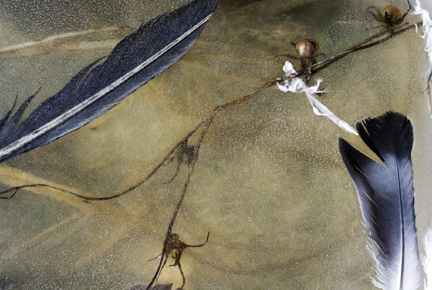
The Stars at Noon (Frozen Feathers)
Frozen Feathers, image by Karen Bell

She had been sleeping, it seemed, then she heard someone cough. Who is coughing? she thought. Then she realized: it was herself.

Silly old woman. Silly half-dead old woman.

Then she noticed that she was sitting up. Why? She looked around the hospital room. The vaporizer breathing the menthol odor of death. The late afternoon light on the linoleum like the outline of someone killed in a highway accident.

Anastasia shivered. Why did she have to think such thoughts? This was no time to think like that. This was a time for joy.

She lay back into herself, hugged the chill inside her. It wouldn’t be long now.

Now what was that? Nurses talking in the hallway? She raised her head from the pillow and strained to hear what they were saying. But she couldn’t make out the words over the hiss of the vaporizer, so she lay back.

Then it wasn’t nurses talking. It was cicadas buzzing in the trees around her father’s farm.

She’d heard that ratcheting hum every August when she was growing up. Once, she and Tom collected the brittle, umber-colored husks left in the elms after the humming stopped. She stood under each tree holding one of their father’s empty cigar boxes while Tom shinnied up and found the desiccated husks. At first he crushed a lot of them, they were so fragile; later, he learned how to cradle them in his palm.

She had that cigar box full of them somewhere. Where?

And who was this?

The nurse’s face hung before her like a question waiting to be answered. “Sister Anastasia? Are you awake?”

Why did nurses wear white, nuns black?

“You have a visitor, Sister.”

Hovering beside her in the half-light: Sister Beatrice. The children are right. We do look like blackbirds. She watched Beatrice pull a white handkerchief out of her black sleeve and blow her nose. The old nun laughed, then coughed. She hugged her ribs until she stopped coughing.

Was this how Tom had felt? Dry and ready to crumble?

“Sister Anastasia?”

It was that big-nosed nurse again. What do you want now?

“It’s time for your afternoon chest rub, but I’ll wait till you’re through visiting. Whenever you’re done, just buzz for me, okay?”

He would drop down from the tree with his hands full of husks.

“I’m dying,” she said, but Tom was gone.

“Pardon me?” a voice said. “Did you say something, Sister?”

Anastasia turned to the voice’s face: it was Sister Beatrice. Then she laughed. A blackbird with wire-rimmed glasses. She had to tell the children.

The children—she had almost forgotten the children. How they would suffer when they heard she was dead! She remembered how hard they had cried last spring, when the touring company of the Black Hills Passion Play performed the crucifixion at their school, and she imagined them at her funeral: the boys, bravely blinking, and the girls, their faces in their hands.

What was she thinking of? How could she think such a thing?

“I am an old sinner,” she whispered. “Forgive me.”

“For what?” Beatrice asked. “You’ve never done anything to hurt me. You know that.”

Anastasia looked at the young nun. She was about to explain, but the coughing started again. When it was over, Anastasia was sitting up. Beatrice helped her lie back.

“Are you all right?” Beatrice worried.

“I need a priest,” Anastasia said. She’d been asking for Last Rites for two days, but all she’d received were more pain pills. “Call Father Switzer. Please.”

“Don’t you talk like that,” Beatrice scolded. “Dr. Gaertner says you’ll be fine in a week or so. You’re going to be under the weather awhile, but what do you expect when you don’t wear your shawl when you should? You can’t say we didn’t warn you—and time and again.”

Anastasia smiled at her stern look. No wonder her children ignored her when she disciplined them: no matter how hard she tried, she couldn’t look angry, not with that baby face.

Then Beatrice’s chin began to quiver and the stern look dissolved. Taking out her handkerchief, she turned away. “I’m sorry, Sister,” she said. “I shouldn’t cry; there’s nothing to cry about.” Then she began to cry even harder. She turned back to Anastasia. “Oh, Sister, I hate to see you so sick!” she sobbed, and threw her arms around her.

Beatrice’s wide wimple blocked the last bit of light from the hospital window, and Anastasia felt the darkness settling around her. She had been waiting for it, and it had finally come. She breathed it in, felt it fill her hollow cheeks and lungs.

But Beatrice rose, wiping her tears, and the light came back.

“I’m not supposed to tell you this,” she said, “but I will. We’re planning a big birthday party for you when you get back. We’re going to decorate the lunchroom with balloons and crepe paper and signs, and the kids are going to sing ‘Happy Birthday,’ and then we’re going to have cake and ice cream and play some games. Sister Rose is going to bake a huge cake, and I’m going to decorate it. I had the best idea ever: I’m going to spell out your name with candles! Can’t you just imagine how beautiful it’ll look when all the candles are lit?”

If a candle was still burning after you tried to blow it out, that meant you had a secret boyfriend. And if the stem of your apple snapped on the third twist, that meant his name began with C.

A young man was once in love with me, Anastasia said. Or did she? Sister Beatrice did not seem to hear. “I know I shouldn’t have told you,” Beatrice was saying. “It was supposed to be a surprise and everything, but I just wanted you to know how much we care about you.”

She shouldn’t be thinking about Carl now: she didn’t want to spoil her death with thoughts of old boyfriends. She was a nun, not a housewife. But everyone else who knew her when she was young was dead: Tom was dead, Mother and Father, her friends. Everyone. Carl was the only one left who would remember what she was like when she was a little girl.

Why did that matter?

The fall from innocence was fortunate; it was sinful to regret it. Adam and Eve banished to Heaven. The discarded apple making cider in its bruises.

What now?

Beatrice was patting her hand. Nice puppy.

“All the kids miss you terribly, and so do we,” she said. “I know Antoinette Marie is short-tempered with you sometimes, but she doesn’t mean anything by it, and she misses you as much as Camilla and Rose and I do. And Father Switzer—you know you’ve always been his favorite. Just this morning he said he can’t wait to see your smiling face again.”

Anastasia thought she heard Father Switzer’s lisping Latin. She rose to her elbows. He’s finally here. It’s finally time. She looked around the room for his shock of blond hair and boyish face.

But it was only the vaporizer, hissing its dark litany. What a foolish woman! Anastasia lay back into a laugh. She knew she’d start coughing again, but she didn’t care. It was too funny. She was too funny.

“What is it?” Beatrice asked.

Anastasia crossed her hands at her neck, trying to strangle the cough before it began. But it began anyway, and she coughed until she was dizzy, until green and gold burned neon under her eyelids.

She thought: so much pain. But what was this compared to the agony in the garden, the sweating of blood, the scourging, the crowning with thorns, the crucifixion and death? No, it was wrong to complain about a little cough. Her suffering was meaningless. She wished she could cough blood, to make herself more worthy of death.

“Are you feeling all right now?” Beatrice said. She was wiping the old nun’s face with a hand towel.

Anastasia couldn’t speak for a moment, and when she did, the words seemed heavy, as if she had to draw them up from deep in her lungs. “I don’t know how to die,” she said.

“You’re not going to die, Sister. You’re just sick and overtired, that’s all. You’ll be back to normal in no time.”

The laity at least had the luxury of making wills, disposing of property. But she had nothing to will, she had given everything, even her will, away. Be it done unto me according to Thy word. All these years she had been exhilarated by that surrender, and her subsequent nothingness, but now she was frightened. She remembered the afternoon Tom lowered her into Grandpa Emery’s dry well so she could see the stars: only from the vantage point of darkness could you see the light buried within the light. And she had married the darkness, worn its black habit, so she could be reborn into that light. But what if she had not really surrendered but only given up?

After Tom died, she was the dead one. His absence was so complete it was presence, but no one noticed her, the true ghost. Father sat on the porch rocker, smoking and staring into the night, never saying anything about him or even mentioning his name. But Mother couldn’t talk about anything else. She’d sit in the kitchen and talk for hours with Mrs. Willoughby about him. He was born to be a priest, she’d say. When he was little, he’d pin a dishtowel around his neck like a chasuble and pretend to celebrate Mass, distributing cookies to the neighbor children as if they were Hosts. And he was always praying. Sometimes he’d even talk to his guardian angel as if he could really see him.

How could she tell her parents she too was no longer of this world? Something had died in her when Tom had died, but something had been born, too. A vocation. She stood in front of her bedroom mirror and practiced her announcement for days before she finally told them.

“You must be cold, Sister. Your lips look a little blue. Do you want me to get you another blanket?”

Tom had not been afraid of death and neither was she. But she was almost ashamed to die. Tom was so young, he might not even recognize her. He had been only seventeen when he died. A year later, her first in the convent, she was seventeen too, and all that year she had cherished the thought that they were twins, in a way. But now she was old enough to be his grandmother.

“Why, you are cold. And it’s so warm in here!”

Just then a cough caught in her larynx, choking her. She opened her mouth and gulped, but there was no air. She gulped until her ears rang, until air no longer mattered, and then she lay quietly, watching Beatrice’s white hands flutter about her wimple.

What was that silly girl so excited about?

Then Beatrice lifted her up and her breath came back in sobs. Each swallow of saliva scalded her throat.

“Oh, Sister, are you all right?”

She had almost touched bottom that time. She had come so close, so very close, and Beatrice had ruined it.

Beatrice’s lip was quivering now. “I hate to see you like this,” she said. “You mean so much to me . . .”

Anastasia lay back. I want to die now. Why won’t you leave me alone?

“You’ve been like a mother to me. I don’t know what—”

“I’m just an old nun,” Anastasia snapped. “I’m not your mother.”

“What’s wrong?” Beatrice asked. “Did I say something wrong? I didn’t mean—”

“Why don’t you just go away? Can’t you see I’m tired?”

Beatrice took out her handkerchief again. Tears, tears. Won’t she ever stop?

“I’m sorry, Sister, it’s just that I love you.”

“What do you know about love?” Anastasia said. And she remembered how once, when they were playing Statues, Carl kissed her to make her come alive, and she fell giggling into grass so green it shone. But that was before, that was when they were still children. Years later, he took her for a buggy ride behind her father’s big chestnut mare and, stopping in the woods, kissed her twice before she could say a word. All the way home, the wind lifted the pale underbellies of poplar leaves, and the woods purred.

But the last time she let him kiss her was the Sunday before Tom died. It had rained while they were in church that morning, and the hay in the loft smelled pungent and musty. It was the smell of loam, of a freshly dug grave, and each time Carl kissed her, he drove her deeper into the hay, deeper into the smell, until she couldn’t breathe. She thought of Tom lying in his hospital bed, and asked God to take her instead of him. He was the good one, the holy one: he should live, not her. All the while Carl kissed her, she prayed for her death. She let him kiss her a long time, until he began to moan with the desire to do more. His moans confused her: they sounded like Tom’s, though they came from pleasure instead of pain. That didn’t make sense to her. But nothing made sense to her anymore, except her desire to die in Tom’s place.

After Carl left, she went to her room and waited for her parents to come home from the hospital. By the time they returned, she had a fever, but she did not tell them: it was her secret, her private miracle. She wept herself to sleep, imagining her funeral. But the next day her fever was gone, and four days after that, Tom was dead.

Beatrice was drying her eyes again. “I don’t understand,” she said. “You’ve always said you loved me like a daughter. So why can’t I say you’ve been like a mother to me?”

Later she went to the loft alone and lay in the one window’s shaft of sun, sweating in the prickly hay. Dervishes of dust spun in the stained light, descending on her with an almost suffocating weight. She had never realized how omnipresent, nor how active, the dust was.

“Maybe you wish I didn’t love you,” Beatrice sniffled. “But I do, and I always will.”

Anastasia looked at her. She was young and pretty, her whole life ahead of her. She’d never pray to die in her place. She’d never beg God to let her lie on this bed, her skin wrinkled and liver-spotted, her lungs congested with pneumonia, her heart running down like a clock.

“No, you don’t,” she said.

“Why are you saying these things to me? You know I love you.”

Anastasia tried to answer, but she couldn’t. Where was her breath? She tried to cough, to open her lungs, but the noiseless spasms only made her throat hurt. It ached the way it did when her children knelt at the communion rail for the first time and stuck out their tongues for the Host. There was a throb at the root of her tongue, a desire. But for what?

Then she coughed so hard that something seemed to snap in her chest. A knot of phlegm humped onto her tongue. It tasted like rust.

Beatrice’s face wavered in front of her, stippled with sweat. “Please be all right, Sister. Please.”

Anastasia spat onto the bedspread and turned to the wall.

At the wake, old ladies dressed in black hovered in the vestibule like crows. They hugged her and said they were so very sorry, Tom was such a fine young man, he would have made a wonderful priest. Their mouths were crumbling, their yellow skin smelled like sour milk.

“I’m sick of your sympathy,” Anastasia said. She closed her eyes. “I’m sick of you.”

“How can you say such a thing?” Beatrice said. She was wadding Kleenex to wipe up the mucous. “Try to think how I feel.” And then her thin-glass voice broke: “What have I done?”

If he had lived until his ordination, he would have been buried in complete vestments—cassock, surplice, amice, alb, maniple, chasuble, and stole. Not a black blazer and bowtie.

“Why are you so angry at me?”

It had to be a mannequin in the casket; it couldn’t be Tom. It had to be a mannequin wearing Tom’s clothes.

“His skin looked like plastic, but I kissed him anyway,” Anastasia said.

Beatrice stopped. “What did you say?”

Anastasia refused to believe the diagnosis. The doctors can’t be right. He doesn’t look sick at all. See how big and strong he is?

But in his marrow, a blizzard of white blood cells.

“Please tell me what’s wrong.”

A hand on her shoulder. Anastasia looked up. Beatrice again: her face fish-belly white.

The old nun turned over onto her back. “Leukemia,” she explained.

Beatrice put her hand to her forehead. It shook as she rubbed her eyebrows with her thumb and forefinger. “No, Sister, you don’t have leukemia,” she said. Then: “I think we’d better call the doctor.”

“Just let me die,” Anastasia said. And then her phlegm-clotted lungs closed up. But this time she did not struggle for air. This time she closed her lips into a thin smile.

Her lungs were gray cocoons about to burst. Inside, the soul’s wings beating.

My Lord, my Lord, take me for Thy most humble bride!

Beatrice clutched her handkerchief as if it were holding her up. “Oh, Sister!” she cried, and hurried out of the room, her habit scything the last light.

This was it. This was what she had been waiting for all these years, the end of all that passion and memory. She had no fear of dying. She was a bride of Christ: death was her dowry, nothing more.

All day she had been travelling backward, a flower folding back into its bud. For years she had thought only occasionally about Tom and Carl, but today she had returned to that age when she thought about them daily. And now she was almost back to her birth.

Tom: the husks of cicadas’ songs in his hands. A touch could shatter them to shards. Oh, what music the soul must make as it shucks the body!

All she had to do was shut her eyes and the earth would close over her, and she would be lost, perfectly lost. She did not need Father Switzer or Carl or anybody. She laid her hands palms-up at her sides and waited for the last ecstatic moment. Then the dark began to murmur as if it had silt in its throat. She closed her eyes. What joy! she thought. And she sank into the darkness until the whining of the winch stopped and Tom’s head appeared over the ledge. “Didn’t I tell you?” he shouted down the well. “You can see them, can’t you?” But she didn’t answer, couldn’t answer. She just clung to the rope and swung there in the darkness, staring up at Tom, his hair blond as an angel’s, and beyond him, the stars in the noonday sky.


Father Switzer drove down the exit ramp of the hospital parking lot, paid the middle-aged woman in the booth, and turned out onto the boulevard.

“The painters just finished today,” he continued. “I think they did a bang-up job. They’ve changed the whole atmosphere of the lunchroom. You wouldn’t believe the difference.” Then, as if he’d just thought of it, he added, “Say, why don’t we swing by the lunchroom before I take you back to the convent? That way you can see for yourself how nice it looks.”

Anastasia noticed a smile starting around the corner of his mouth. The smirk of a boy who tells a lie that is technically true. The pleasure of sin without the guilt.

“It’ll only take a minute,” he persisted.

She looked out the window of the station wagon. The houses they were passing were among the oldest in the city, but none of them had been built before she was born. Some of them had For Sale signs stuck in their brown lawns. She thought of the children in their art smocks, painting signs for her birthday party. She couldn’t say no, but neither could she say yes.

“How could we afford to paint the lunchroom?” she asked wearily.

But he was ready for that question. “Some of the parishioners volunteered to do the painting, so it cost us almost nothing,” he answered.

She knew he was grinning now. She continued to look out the window. I will do it for the children, she thought. For the children and Beatrice.

But when Father Switzer wheeled her into the lunchroom and she saw the balloons dangling from the undulating rows of crepe paper streamers, the banners that read HAPPY BIRTHDAY!, WELCOME BACK, SISTER ANASTASIA!, and WE MISSED YOU!, the tables set with pink and yellow paper cups and plates, and the children in their party hats leaping up from their chairs shouting, “Surprise!” and twirling noisemakers, she could not act surprised or happy. She tried to clap her hands to her face in a dumb show of shock, but they stopped halfway and fell back into her lap like broken-winged birds.

Rose and Antoinette Marie welcomed her back. Camilla took her hand and pressed it softly between hers.

But where was Beatrice? Anastasia looked around the room and found her standing by the far table, pretending to be supervising her third- and fourth-graders. She put her finger to her lips unnecessarily.

Just then, Father Switzer raised his hands in a pontifical gesture. “Quiet down, children, quiet down.” The students sat back in their seats heavily. Father Switzer waited until the chairs quit squeaking, then looked at Anastasia and winked. “Didn’t I tell you the painters did a great job? Just look at these signs. The boys and girls spent half the day painting them. Not to mention blowing up balloons and hanging crepe paper and whatnot. And Sister Rose has baked a gigantic cake.”

At this, one of the boys let out a whoop. Antoinette Marie rolled her sleeves up her plump red forearms and frowned in a parody of discipline.

Father Switzer was getting serious now. He had his hand on Anastasia’s shoulder. “I wouldn’t be telling the truth, Sister, if I didn’t say we were all pretty worried about you. We spent a lot of time on our knees, especially after you had your close call.”

Anastasia closed her eyes. The reflector on the intern’s forehead had shone like the eye of a monstrance. She’d heard Beatrice say, “Is she breathing?” and then the oxygen mask descended over her nose and mouth like a new, unwanted face. A horrible face. She tried to push it away, but it fit too tightly. And now the face was hers, though no one else could see it. She opened her eyes and saw that Beatrice was watching her. She tried to smile, but Beatrice looked away.

Could Beatrice see it too?

“But God heard our prayers,” Father Switzer was saying, “and now you’re back with us and we can finally celebrate your birthday. I know we’re a few days late, but we hadn’t counted on your illness. In any case, we intend to make up for lateness with style.” Father Switzer grinned and nodded at Antoinette Marie. “Ready, Sister?”

Antoinette Marie produced a pitch pipe from her pocket and hummed the key of C. Then, flourishing her arms and vigorously mouthing the words, she led everyone through two choruses of “Happy Birthday.” When they were through, some of the children jumped up and swarmed around Anastasia’s wheelchair. “I’m so glad you’re not sick anymore,” a skinny blue-eyed girl said. “Me too,” said the boy standing next to her.

Anastasia looked from one face to another. She couldn’t remember who they were. She had been away for only three weeks and already she had forgotten their names.

“I’m happy to be back,” she managed.

Beatrice stepped into the circle of children. “Let’s not tire Sister Anastasia, children. She shouldn’t have too much excitement right away.” She turned her wrinkled brow to Camilla. “Perhaps we should have the cake sooner than we’d planned.”

Camilla looked at Anastasia. “All right,” she said. Then she turned to the children. “Let’s bring out the cake and ice cream!”

“Yay!” cried the children.

“Take your seats,” Father Switzer ordered, and the children scrambled into their places. Antoinette Marie and Rose disappeared into the kitchen.

“Are you all right?” Camilla asked Anastasia. “You don’t seem yourself.”

“I think she’s overcome with surprise,” Beatrice answered for her.

The children cheered then, for Sister Rose had just emerged from the kitchen, carrying an enormous sheet cake. Antoinette Marie followed her out the double doors, pushing a cartload of vanilla Dixie cups and tiny wooden spoons.

“Stay in your seats, children,” Father Switzer commanded. “Sister Rose, the first slice is for our guest of honor.”

They set the cake on the table in front of Anastasia. There was only one candle on the cake, stuck in the middle of waves of chocolate frosting. Rose struck a match and lit it.

Anastasia looked at Beatrice. “Where are all the candles?” she said.

“We wanted to save your breath,” Beatrice answered, and looked away.

“Come on, Sister!” some boys shouted. “Make a wish and blow it out.”

The old nun stared at the candle. The cake was so big, the candle so small. In the dark frosting, the flame’s reflection flickered, a dying star.

“Come on, Sister!”

Anastasia clasped her shawl tighter around her neck and leaned forward in the wheelchair. For a moment, everyone was silent. She felt them all watching her, waiting for her to blow out the candle, and she closed her eyes. Behind her eyelids, the darkness was private and peaceful, a refuge, and she wished everything were so dark that no one could see her, not Father Switzer or the children or even Beatrice. She wished she were invisible, there but not there, a darkness inside the darkness, like Tom, like God.

“Sister?” Father Switzer said.

With an effort, she opened her eyes and looked at the candle’s puny light.

“Have you made your wish?” he asked.

She nodded. Then she took a deep breath and blew the flame out.


David Jauss is the author of the short story collections Glossolalia: New & Selected StoriesBlack Maps and Crimes of Passion, and two collections of poems, You Are Not Here and Improvising Rivers, as well as a collection of essays, On Writing Fiction. His short stories have been published in numerous magazines and reprinted in such anthologies as Best American Short Stories, The O. Henry Awards: Prize Stories, and, twice in The Pushcart Prize: Best of the Small Presses. He is the recipient of a National Endowment for the Arts Fellowship, a James A. Michener Fellowship, three fellowships from the Arkansas Arts Council, and one from the Minnesota State Arts Board. His collection Black Maps received the Associated Writers and Writing Programs Award for Short Fiction. He teaches creative writing at the University of Arkansas at Little Rock and in the low-residency MFA in Writing Program at Vermont College of Fine Arts.

Read an interview with David here.

“Squandering the Fellowship” by Jessie Hennen

Squandering (Row of petals)
Row of Petals, image by Karen Bell

As usual, you’re late. You take the wooden stairs two at a time, round the landing, and stop in front of the director’s office, where you gulp air and try to look confident. (It doesn’t work.) Then you knock. Nobody answers. You dither in the hallway for a second, then decide to wait for her.

Once your eyes have adjusted, the office is frighteningly venerable. Shelves and shelves of voluptuous bottles glow in the afternoon sunlight, all shining with their own importance. The empty Jim Beam black label might have come from the grocery store down the street, and there’s even a whole row of PBR cans, which is surprising, it’s so mass-appeal and pulpy. But then there are the true exotics that let you know you’re in the Workshop director’s office: emerald-green absinthe bottles with necks like lamps. A diamond-shaped blue flask, almost knee high. A series of tiny bottles that look like they should hold perfume. All of them beautiful rarities, and all of them expect something of you.

You sit down at the long wooden table, run your index finger around one of the many beverage rings. It occurs to you that hundreds of people have sat here before and many of them have never been successful. You’re very late. It seems impossible that she could be this late too. You are just starting to really panic when something thunks against the door. When you open it for her, she blinks in surprise, then says, “Hello! I almost forgot we were meeting!”

It’s still really strange to see her in person, but today, she looks nothing like her black and white photos. Her arms are packed with what’s got to be student work: cans clank in an empty 30-rack of Rolling Rock, and a 40 of malt liquor is tucked under her elbow. She lets all of it tumble in a pile next to her desk, then opens a drawer and pulls out a fifth of Absolut. The Director pours four fingers into a glass, adds ice, then tops it off with a splash of kiwi juice and some strawberry-flavored Sobe water from the little refrigerator. It’s an innovative, gorgeous combination, and frankly you are filled with jealousy.

“Just got to finish this up for this afternoon,” she says. “Deadlines, you know?” and she rolls her eyes conspiratorially.

You thank her for seeing you. “I’m having trouble.”

“Mm-hmm,” she says, sitting down behind the desk, neither confirming nor denying what she knows. And so, for the first time, you start to talk about your problem.

“Sometimes I set out to, you know, start early. The way the really successful people do it.”

The director raises her eyebrows. She has pulled a square of knitting out of her bag, but somehow it’s not stopping her from sipping at her cocktail.

You forge on. “You know – you know how it goes, right? You just get in the store right when it opens, pick up bourbon or rye or whatever. At first it’s great, it’s going like gangbusters. You just sip away at it, little by little, just like the manuals tell you to.” You point at the empty Bulleit Bourbon on her shelf. “Last workshop, right, I thought I’d finish one of those. Just something real classic, mixed with a little coke, over ice, in a nice glass, savored on my porch. I’ve got a great porch.”

“Aren’t porches nice?” she murmurs, rounding a row.

“But you can’t drink all the time. You’ve got to take a break. There’s sort of a digestive process in which you set it aside, give the old stomach a rest, mull it over….” You sound like you do when you’re teaching. She nods.

“Me, though?” You gulp, and your stomach starts to churn like it did around 4 am last night, when you knew you had to see her. ”This keeps happening. Every time I’m up. Like, I buy the thing, but I get a few sips in, barely a dent, and I – I just become convinced it’s all wrong.”

“Huh,” she says.

“I think, like, this isn’t what I’m meant to be drinking. It’s not me. And I just get disgusted with myself, and so I start out on some other project. Beer mixed with lemonade in Hickory Hill Park, say. Or… six Long Island Iced Teas at the gay bar, washed down by Jack and Coke. Or something exotic, really exotic…”

She finishes the sentence. “Absinthe, or something.”

“Yeah, like absinthe.” Or something. “So – so I start off on all of these projects, and then sooner than I realize workshop is coming up, and I panic, because though I’ve, you know, started a lot,” you’re exaggerating, “I’ve finished nothing. Sure, I’ve gone to Prairie Lights a few times, just to be seen drinking, but what do I really get done there? Just a Houndstooth or two…” The truth is, it’s getting oppressive on your porch. The open bourbon bottles are gathering dust, and the red wine is filled with odd chunky flakes. “The morning I’m due, I panic. I open the same bottle of bourbon I started with, and just resolve to really do it right this time.”

She sighs, understanding. “And then you have to finish the whole thing, and you’re too wobbly to get down to Rye House, and your friend has to pick you up.”

“Literally.” Has she been watching you? “This isn’t how it’s supposed to work, I think. And once I get there, here’s the worst part, I think it’s all gone, I’ve done what I needed to do, but once we’re sitting around the table, I look at the bottle in my hand and it’s, like, two-thirds of the way there. It’s not even finished, and I can’t even sit up straight. All the while there’s Ethanol Grainin sitting across from me, two bottles in and he’s fine, he drank them on the treadmill this morning for God’s sake…” You breathe.

Sam Changover nods. She bites her lip, then lifts the knitting from her lap. Somehow, while you’ve been talking, she’s knitted an entire baby sweater. Then she looks at you, and she says, “Have you heard of Arthur Pullock?”

Politely, you say, “What?”

“Arthur Pullock,” she says again.

It’s like that time her agent asked you which drinkers you most modeled yourself after, and it was like your mind had nothing in it. You just opened and closed your mouth for a minute and then what came out was “Amy Winehouse” and the agent laughed and said “Sure, if the singing hadn’t gotten to her…”

Finally you say, “Nope.”

“Well.” She finishes the cocktail, then pours another. “Not many have. But I think you should really look into his work. You’re from Minnesota, right?”

“Er, Wisconsin, yeah…”

“Well, Pullock was Minnesotan, and your stuff kind of reminds me of him. He did a really interesting body of work with bourbon in the fifties. Look him up – he just, he drank in a lot of fascinating places,” and she spins for you a narrative of Pullock’s ability to swig bourbon in the bath, while plowing, while copulating, to stay out in bars til half past three even though the town was a dry town and the speakeasy closed at ten. “He was just– so forceful with his habits. Of course, you’re young, I’m not expecting you to…”

“To be a Winehouse,” you say. “Or a Churchill.”

“Of course not – you’re young. But really: look into Pullock. And we’ve got a lot of cool drinkers coming into town for the festival, maybe you’ll find a role model there.”

You breathe, because she’s not quite getting your problem. It’s not like you need more inspiration. You’ve been to John’s, you’ve seen the wall of possible drinks – the problem isn’t drinking them, it’s finishing them. And the worst are the times when it just all becomes too much and you pull out a notebook – then, when you look at the clock, it’s five a.m. and you have a drunk due at noon the next day and you don’t even care.

“Can I borrow a beer?” you say. “Sorry, I just want to get something down.”

“Of course,” she says, and she rummages around and hands you a cold PBR.

You click it open and take a swig. And sure, it feels right, the way it did when you were just a kid, sitting in your mom’s garage, but it doesn’t come as easy as – as other things. “Professor Changover, can I be honest with you? I’ve got – I mean, I think I’ve got – a writing problem.”

She furrows her brow.

“I mean, I don’t think this is insurmountable, not at all,” you assure her. “I was born to drink. It runs in my family, my mom could’ve gone pro if she hadn’t had to support us.”

“Of course. You’re in at the Iowa Drinking Workshop,” she murmurs. “Best program in the country.”

“Yeah! And I know a lot of famous drinkers have writing problems. I mean, I saw the series downtown last year, and half of them were just reading through all of it. One guy got so excited I didn’t see him pick up his gin-and-tonic once in the second half, he was that into reciting some epic poem.”

“Hm,” and she sips carefully around the little umbrella. “Well, they do seem to go together, writing and drinking.” But you know she’s never had a problem with it. Maybe she’s thinking of the really successful drunks in your program – the ones who maybe, like, write a page or two in the company of others, but then they go on home, finish their twelve-pack for workshop, then start a bottle of wine, two. Just as a side project.

“I’ve got to confess,” you say, your throat gulping, “that it’s bigger than that.”

She looks up.

“See… I spent… just a lot, a lot of my stipend this year on it.”

“Mmm.”

“I know. I got the Mel Gibson fellowship and that meant you expected so much of me, and really it’s just weighing on me, how badly I’ve disappointed you. But what am I supposed to do, left alone with two thousand extra dollars?” You croak, “I spent it on a… a really nice desktop.”

It’s waiting at home. It’s got an extra monitor, even. You are such a hedonist. You wait for her to fire you.

“Look.” Sam Changover places a hand on yours. It’s cold from the drink. She says, “If you’re serious about drinking, well, it will find a way. But there’s only so much we can do for you, you know? When it comes down to it, the only person swallowing those quirky little cocktails is you.”

“Silly derivative fluff,” you choke.

She smiles. “Look up Pullock. Sometimes you’ve just got to drink through the derivative stuff in order to get to what you’re really meant to do.”

Though you’re swallowing beer over the lump in your throat, you cannot help but feel inspired. You suppose she’s the Drinking Workshop director for a reason.

“Well,” you say, your voice quavering, “at least I’m not turning in the crap my students do. The other day, I had a girl show up for workshop with, like, four half-drunk cans of Miller Lite. Can you beat that?”

“Sometimes you teach them, and sometimes they teach you,” she says, unraveling the sweater and starting over again even though it looked great the first time.


Jessie Hennen recently received her MFA in fiction (and other subjects) from the Iowa Writers’ Workshop. Before her time at Iowa, she worked in Munich, Germany, first as a nanny and then as a marketing project manager. Her work has or will appear on The Millions.com, in Untoward Magazine, Fiction365 and the Minneapolis Star Tribune. She is currently at work on “Flight,” her first novel.

“Roadside Flowers” by Karin C. Davidson

Roadside Flowers (Yellow Grass Field)
Yellow Grass Field, Chromogenic Print by Karen Bell

Hoa leaned down and snatched another stem. Her fistful of flowers was leggy, tattered, but brilliant. Gold, orange, red. Just seven years old, she stood in the center of the path, her toes sunk into the fine pale dirt. She waved the flowers at me.

“Jaymes-man,” she called. “You take picture?”

Earlier in the week I’d let her wear the thin leather camera strap around her neck and take pictures of her father and mother, her aunts and uncles, the cooking fires, the rice fields, earthenware bowls of pho, even me. I’d developed the film and made enough prints to share. From each, faces peered, looking down, laughing, pointing. In one, Hoa’s grandmother offered a bowl of steaming noodle soup, fogging the lens and catching the moment before everyone squatted to eat. In another, a baby brother was hidden under his mother’s blouse, the blur of his small kicking feet a contrast to his mother’s silent gaze. And one without faces, only cumulus clouds, sunlight, a sweep of green grass and purple cattails.


Assigned to my battalion as a photographer, in the field I carried the Kodak I brought from home, a dozen film canisters, an M-16, ammunition, and a pair of canteens. I’d signed on as an infantryman, but my CO caught wind of the camera, decided I was better suited to capturing images than VC, and put me in charge of changing the mood. “I’m talking morale, Williams. Get these men’s fucking bravery and honor covered; you’ll do better there than covering their asses.” Stars and Stripes published nearly everything I gave them, only a tenth of the photos I took. The other percentage was out of focus, or out of bounds, the negatives sealed in envelopes and filed in heat-resistant boxes.

It was Year of the Rat, and we all became water rats, sinking in rivers and rice paddies, my camera and film bag held above my shoulders along with my rifle. We had wit and curiosity, and we were nervous and aggressive. Tagging along behind the point man, itching for a fight, smoking in order to stay quiet. Waiting, listening. I measured my steps, I refocused, I balanced my load, so much smaller than some. The light meter gave me a reading; I adjusted the viewfinder; I pressed the shutter release, advanced the film, and just as quickly discovered the next image, a fraction of the field before me, the picture as contained as the war was wide.


Sometimes you have to go away to come back.

My orders were to honor men and make them noble by documenting their actions. “Now let’s get this straight, Williams! We are not talking about combat. We are not talking about the goddamned beauty of the battlefield. We are talking about survival and making sense out of this mess.” My orders were to look through a lens into men’s souls. “These are not your friends, goddammit! These are heroes. Make it so.” My orders were to hump into the hills with my own platoon, with my own rifle, with my own canteens and 35 mm camera, but not with the lump in my throat that came from seeing and hearing and disbelieving.

I tried my best, and still, the CO kept on yelling.

“He just loves you, Williams, bro,” Shields promised. “He just wants to get all up inside of that sweet shiny lens himself.”

“Why don’t you get some pictures of the girls for us, Jamesy-boy?” McPhee licked his fingers and squeezed one eye closed, as if he were aiming a camera instead of an M-60. “Slide up under some ao dai and see what they have to offer.”

I did take pictures of women, in silhouette, from afar. Women in yellow, red, white ao dai, like flowers, their long black hair swept under their conical hats, shadows over their faces. They walked through the markets and called out to the merchants, laughing, taking green papayas into their arms, silver fish into their baskets. Sometimes they looked at me—me trying to frame their eyes, their burdens—but mostly they looked away.

I was the grunt, the new boy, the one chosen to shoot pictures, rather than people.

The children in the villes found me curious and stared and followed me when their elders let them. Children standing at the front gate of a school, waving and calling out until their teacher called them back inside. Children in flooded rice fields, their trousers pulled waist-high, catching crabs and small fish. Later these same fields were flooded with light, that of the moon and artillery fire, the petals of water lilies scattered with the scales of dead fish, the carcass of a buffalo calf, and men’s bodies hidden beneath the tall, silent grasses.


I’d heard about the bamboo jungles, tigers that appeared shining like bright butter in the forest when all was quiet. I’d heard of the meadows of poppies, opium available in rooms above the bars in Saigon, an long arm’s length away from Long Binh Jail. And I learned there were tunnels that reached under the earth for miles and miles, and pits covered in thatched grass to hide the punji stakes. Firsthand, these became my education, better than that of a classroom, and I memorized each breath of each day, laden with salt from the salt tabs in our packs, laying low under sniper fire, old timers telling me to stay down if I wanted to see the sun set.


“Williams Jaymes-man,” Hoa said. “You come home soon?”

I had been in country for barely a month and had almost the full tour still in front of me.


I knew how to fish in Florida mangrove swamps. Hunting for Charlie was something entirely different. The underwater roots of the Vietnamese mangroves hid leeches, not bonefish. Straight from the bottle I had my first taste of backwash whiskey, on the banks of that brown-water stretch of river, in a downpour that outclassed any thunderstorm in the Keys. No matter the tropical heat, I shivered under the standard-issue rain poncho, in a daze of fever and confusion, not sure whether to hold my rifle or camera.

“You got to take your Monday pills, baby boy,” Shields said.

Monday pills. CPs. Chloraquine-Primaquine. Anti-malaria pills. Another standard-issue item that hadn’t gotten lost in the mail between boot camp and the boonies. I had been given the dosage, same as everyone else.

I shook harder, and Shields raked me with his stare.

“You think you’re going somewhere, Williams? You ain’t going nowhere, man. You are staying right here in this shithole, just like the rest of us.”

McPhee was bad enough; Shields was worse. Shields was bad news, trippin, kick-em-til-they-die crazy, one re-up too many. Sly slept with one eye open, Torchdog with the other eye shut—partners in crime. Tibbs wrote in a notebook that he rolled up inside his sleeve after each entry. Baker hummed under his breath, and hid a harmonica in his pack. Mankiewitz kept quiet and then kept us all guessing.

Mankiewitz, who in the middle of one already miserable sodden night, sent incoming our way by yelling, “Come over here and light up my landing zone, Little Miss Saigon!”

The same night Shields broke down and kissed the ground one final time. The same night marionettes danced in the jungle and not just in my mind. The same night the rain spiraled down in strands, like those beaded curtains in that one-time bar. The same night poppies grew from my chest and bloomed bright and vermillion right there in the mud. The same night the dust-off flew out one KIA and one WIA.


“Jaymes! You go away long, long time?” Hoa stood on the road and waved her flowers. I held up my camera, but didn’t wave back.


Karin C. Davidson‘s stories have appeared in The Los Angeles Review, Passages North, Post Road, and elsewhere. She has an MFA from Lesley University, Pushcart and Best of the Net nominations, and awards including the Orlando Prize for Short Fiction, the Waasmode Short Fiction Prize, and the Ohio Arts Council Individual Excellence Award. Her fiction has been shortlisted in several writing competitions, including the Jaimy Gordon Fiction Prize, the Faulkner-Wisdom Writing Competition, and the UK Bridport Prize. A chapbook of her story collection was a finalist in the 2012 Iron Horse Literary Review Single Author Competition. Originally from the Gulf Coast, she also writes at karincdavidson.com.

Read an interview with Karin here.

You Don’t Know Me

You Don't Know Me (Female Statuary, Versailles)
Female Statuary – Versailles, Chromogenic Print by Karen Bell

She sleeps with the bedroom door open because her children have night terrors. It’s how Nina hears the intruder in the hallway. Less than a week in this new house and they’ve found her.

The clock/radio says it’s 4:08 AM.

Nina planks in bed and bites her tongue to stop from yelling: waking her son and daughter in the next room would just get them killed, too.

The recent spate of death threats ricochet through her mind. She left Guatemala before but work drew her back. Thirty-four years old and she doesn’t want to die like this, not like this, not when she’s finally making a difference.

Already it’s too late to search for a weapon and the intruder pauses in the bedroom doorway shapeless as spilt ink, then clumps his steel toecap boots across the yawning floorboards toward her bed, lighted now by the claret haze of the clock/radio, this man stands to her right and leans his face toward hers. He wears no mask. Wants her to see him. The whites of his eyes full-moon bright, glossy as hardboiled eggs.

No point calling the Policía Nacional Civil because this man is a uniform-wearing officer. He’s one of the You-Don’t-Know-Me. In every level of government. Used to be the Civil Defense Patrols back when the death squads operated with impunity.

He leans closer, their faces almost touching now, and stutters hot breath on her wet skin.

He has eaten hotdog. Drank guaro.

The officer moves back a step, towers over Nina, studies her supine form wearing panties and bra, too hot at night in this house to have sheets. She moves her hands onto her belly, covers what little she can. And waits.

4:12 AM.

4:16.

4:20.

He leaves.

Oily cologne lingers.

~

Nina stands at the kitchen window and watches vehicles conga line at a roadblock. Mixed Army and PNC on patrol. A daily occurrence.

Eight-year-old Jairo and his younger sister Flor are sitting at the breakfast table.

“Was someone here last night?” Jairo asks.

Nina moves a wall of black hair behind her shoulder. It’s middle-parted like a grade school teacher’s, and everything about her features seems crumpled like an overworked checkout operator, everything except her espresso-dark eyes.

“Yes, a man was here.”

“Did you know him?”

She bites her lip and turns back toward the window and the tears are hot and wild in her eyes.

Jairo stabs the fried egg on his plate and mops the yolk with a corn tortilla. Flor pastes refried black beans on her tortilla but gets most of it on her hands. Nina wets a dish cloth under the tap then remembers the water isn’t safe and instead uses a wet wipe.

“Does this mean we have to leave again?”

~

“This is 2005,” the caller says. “It’s almost nine years since the ‘96 peace accord. The only thing changing is everything’s getting worse. More people poor. More Mayan farmers killed and displaced.”

The line clicks dead.

Nina’s morning show on Radio Universidad, nine-to-noon daily, has no one waiting on the switchboard to speak. When she started a year ago, there were always too many. But the recent trouble, the murders, has scared them off.

“The terror structures remain as they have during the war,” she says into the mic. “Operating with impunity. Their members hold key positions in political parties, the Supreme Court, the media. Unless we fight for reconciliation through truth, this evil will never leave our country. Our memories, your voices, are the only way we can ensure history does not repeat itself. These evil people are hidden and they think that because we don’t know who they are they’re safe to keep doing what they’ve been doing forever. But we know who they are. We know.”

A switchboard light blinks with a caller.

“I was there in 1982 when Montt’s military personnel attacked my village, Dos Erres. Montt was looking for Fuerzas Armadas Rebeldes. There were none. We were ladinos, mixed white. A small village with two churches, Catholic and Evangelical. Carlos Antonio Carias, the army commander, gave us a proclamation. Join his civil-defense patrol. We refused. Two hundred and fifty were slaughtered, men, women, and children. I was twelve. They let me live because I was lighter skinned and have green eyes…”

He stops speaking.

“How did you survive?”

He weeps, chugs like an engine turning over. The call ends.

“Without strong individuals like that we will never know the truth… Our next caller, please, take your time, tell us anything you want.”

The woman says, “What makes you qualified to ask these things?”

~

Nina’s father dies in an accident. He’s a university professor. Her mother is distraught, has five children to provide for. Nina is nine.

She’s thirteen and in the library. Researching. Nina always asking questions. She finds an article about her father that says a death squad entered the college and cut down seven professors, knocking them like bowling pins, and it happened out in the open for all to see. Her father was murdered.

Her mother, traumatized by the incident, has lied all these years.

Nina graduates from university with a degree in journalism. She still has no way to get the truth about her father out. She goes to the biggest radio station. Nothing.

For three months she pursues the director of Radio Universidad. She gets a meeting.

“Your listeners need to hear someone young, a woman.”

He laughs. “And who is that going to be?”

She smiles and raises her hand as if answering a question at school. “Me!”

~

“Some records suggest that over two hundred thousand, mostly Mayan, lost their lives during the civil war. But no one knows for sure. We need the victims, those who have witnessed, endured and suffered to call in and tell us their story. The truth is the only weapon we have.”

~

Nina enters Jose Miguel’s office. He’s the editor of Prensa Libre newspaper, has thick plummy lips and a solid eyebrow across his forehead like it’s been drawn with an eyeliner. He is sitting on the edge of his desk, waiting for her.

“I’m worried you’re making too much trouble for yourself.”

“It’s the truth.”

He lifts a printout of her previous article and reads: “Since 2001, in just four years, a thousand women have been murdered. Ninety percent have been raped first.”

“I have a daughter. I don’t want her growing up in a world like this.”

“If she ever gets to grow up.”

Nina pulls back her hand to slap him. He doesn’t blink but his cheeks redden.

“I shouldn’t have said—”

“Maybe I should just run back to the US?”

He places the printout on the tabletop. Sucks his teeth while he thinks. “This other article you have sent me…” He lifts another printout. Scans through it.

Civil Defense Patrols. Paramilitary groups. Countless murders. Control of supreme court, customs, immigration, import/export, the drug trade. Refusal to be dismantled as per the 1996 peace accord. Evidence of terror structures still operating with impunity as they had done during the civil war. The main difference: instead of acting directly for the state, they now have free reign. Powerful enough to have breached political parties and the media.

“I would ask you not to publish it,” he says.

“Are you scared?”

“Nina, the fallout from this will be terrible. You would need to leave Guatemala first.”

~

Nina kisses Jairo’s forehead; he sleeps with his thumb in his mouth. Flor clutches a stuffed lion. Nina watches her sleeping children for a long time in the hard light of the naked hallway bulb. Their breathing is slow and regular like ocean waves.

She steps into the hallway and the rough-sawn floorboards creak.

“I don’t want to move again,” Flor says. Nina faces her daughter but she has rolled onto her side and is looking away. “I’m tired of moving.”

“Is the man coming back tonight?” Jairo asks. “I can stay up and keep guard.”

~

“Are you not afraid?” the caller asks.

“I’m terrified.”

“You have a family. Do you not worry for their safety?”

“I had to publish the article,” Nina says. “And I can’t keep running. None of us can keep running.”

“What if they take you?”

“They won’t,” she says. “I’m in the public eye. Media attention is keeping me alive. But the people I ask to call into this show, the ones without protection, they’re the one who are in danger. Calling in, telling what happened, that takes courage I don’t have.”

~

Nina is at a market stall.

Licuados en leche. Sin hielo.”

The man next to her is staring. He’s watching her and is making a point of letting her know he’s watching her. She avoids eye contact, snatches her fresh fruit shake and rushes off.

The man follows.

She darts through a gaggle of students.

Outside the market, Nina crosses the street. She checks to see the man is gone and takes a breath. She had forgotten to breathe. A police officer collides with her and she clatters to the pavement. A young couple come to her aid, demand to know why the officer did this. The officer spits on the ground and sets his hand on his holstered pistol.

Nina springs to her feet and runs.

~

The single room hut is constructed of bare blocks and contains two beds for five people. A single rack of shelves behind a curtain contains everything Nina owns, everything she could grab before fleeing her home. There’s a single bare bulb for light and a portable TV in the corner with aluminum-foil rabbit ears. The kitchen is outside and has a wood fire. Water for the pila comes from a hose in the street.

Jairo and Flor are playing in the backyard. It’s walled in. Relatively safe.

The day after Nina’s article appeared in the Prensa Libre, her radio show was canceled. Intimidation escalated. Bullets pinged her car. She was uninjured.

“I have nowhere left to go,” she says, “nowhere to turn. I can’t go outside because they’ll find us.”

The man who has come to help her doesn’t respond, keeps watching out the window, scrutinizing the street.

“I want to leave,” she says. “You can get me and my family across the border?”

“You have friends here,” Eliseo says. “We have arranged a meeting with Amnesty International. They want to help, maybe they can make you into a spokesperson. The others won’t dare hurt you then.” He carries a holstered sidearm and they have arranged to take turns manning the perimeter.

~

Lunch is a chicken taco and a little pile of shredded lettuce topped with two slices of tomato – all that ever passes for a fresh garden salad. Nina is getting used to it. In the US they had a never-ending array of vegetables, but here they are surprisingly rare.

“You have been staring at the lettuce for an hour.”

“I don’t know what to do.”

“Get the story out,” he says. “Same as you always have.”

“But there’s no radio station. No newspaper.” Her hands tremble. Couldn’t help but think about her father, how hard it had been to get to where she was, to get her story out.

“You already have a radio station. And a newspaper.”

She glances at the laptop which was given to her by an anonymous friend. There was no box and the charger was from a different model.

~

Hello Dolly.

The first post on her blog is about Nelson Hernández López, an indigenous union and campesino leader murdered on return from a protest march.

An hour later, a reply to the post reads: It doesn’t matter if the guerrillas were going to turn Guatemala into another Cuba. Rape, torture and murder of all civilians, whether they supported the guerrillas or not, is indefensible. Montt must be brought to justice and tried for these abominations he carried out on behalf of the state.

Nina receives an email: Encarnación Quej, indigenous Tzutuhil leader, is murdered by masked men on his way to work today. She broadcasts the news on her website.

More emails. Gerónimo Ucelo Medoza, leader of the minority Xinca indigenous group, is murdered and five colleagues kidnapped. They are still missing. The group had been demonstrating against mining operations by a Canadian company.

The next day, Nina starts Familiares de Desaparecidos which is a forum in memory of the disappeared. She writes, “After decades of questions without answers, and a growing list of victims, we create this forum so that the memory of the disappeared will remain. Their stories will be remembered.”

She conducts an interview with the New York Times: “Forced disappearance in Guatemala still happens. In fact, it has expanded. And it relies on silent collaboration. It’s a means of social control and political dominance which has gained the power of impunity because of the vast political and commercial powers that finance and conceal these crimes.”

~

Knuckles rap the door. There is always someone knocking. Nina opens it. Outside is an injured woman, a woman who has come from the protest at Cuatro Caminos intersection. Her head is bandaged with a man’s white cotton shirt and there are freckles of blood. She wants to speak about the army killing unarmed protesters. Today it is a friend outside but Nina knows one day they will come for her, same as they did for her father. At least she will know who they are.


Michael McGlade grew up in an Irish farmhouse where the leaky roof didn’t bother him as much as the fear of electrocution from the nightly scramble for prime position beneath the chicken lamp, the only source of heating in the house – a large infrared heat lamp more commonly used for poultry. He has had 36 short stories appear in Green Door, J Journal, Ambit, Grain, Downstate Story, and other journals. He holds a master’s degree in English from Queen’s University, Ireland. You can find out the latest news and views from him on McGladeWriting.com.

“I Am the Widow” by Leslie Pietrzyk

I Am the Widow (Pietrizyk)

Just like at any movie or TV funeral, his casket gets put up front, set under specially focused lighting, parenthesized by yardstick-high sprays of white gladiolus. Plump velvet kneeler in front of him, velvet curtains behind. Top half of the box open, so we can see his face. If we want to see him dead, that is, if we want to look right at death. There are plenty ducking their heads, twisting necks around and staring up high into the ceiling or deep down through the carpeted floor. Not me. Right off, I grab hold of his hand, entwine my fingers around his, not because that feels so great but because it unnerves the people circling me. Hell yeah. I’m grabbing a dead man’s hand. I’m grabbing my dead husband’s hand. Maybe I won’t let go. Maybe I’m going crazy.

I’m certain I’m going crazy. I’m certain I am.

What happened was sudden. Alive—and then not. The two of us—and then a pack of family roaming around, in their suits and dark, sensible dresses, howling and clawing each other into tense hugs. A dead body sprawled on the kitchen floor—and then this dead body tucked neatly into a casket. What happened is fast. This is the worst whirling ride at a carnival you can’t jump off of.

Not knowing much on planning funerals, when the professionals say, “Open casket?”, I nod like I mean yes. Not knowing when there’s an open casket, people read an invitation to toss a little something on in. Guess there’s meaning, though a list looks pretty junky: Color photos by a lake, a postcard of the jagged Chicago skyline, pizza take-out menu, half a bottle of tequila, an old lady’s rosary, a wad of clover freshly ripped from a lawn, foot-long length of red wrapping ribbon knotted in four places, wooden fraternity paddle, dog-eared paperback of Fahrenheit 451, brittle-yellow Palm Sunday palm frond, tarnished baby spoon, crayoned drawing of a dinosaur-like creature, scuffed-up baseball, pencil sketch of a lion’s head, a regular ordinary brick—(come on!)—an unopened package of two Twinkies, the Let’s Go Spain & Portugal guidebook with swelled-up pages from falling in water presumably somewhere in Spain or Portugal, race bib #1458 from the Marine Corps Marathon, a bleached-out whelk, a nickel and two super-shiny pennies in a stack, smooth grey rock the size of a big toe, an acorn, Bob Marley import CD, baby food jar half-filled with sand. Four or five flap-tucked envelopes with his name in ink across the front. It’s a jigsaw puzzle of a big picture of nothing. Everything all means something but the only one who maybe could explain is lying there dead.

And you’d have to say after a while that things get more than a little ridiculous, this casket as receptacle, this dump it all in mentality, because there I am holding onto his hand, when tra-la-la-ing up is some second cousin I barely met—maybe at the wedding, maybe—heaving in an old shop class project from middle school that supposedly they’d worked on together.

What’s he supposed to do in the afterlife—IF THERE IS ONE, WHICH THERE ISN’T—with an old lamp base shaped like a wagon wheel, I want to know.

I put nothing in there. No note, no picture, no shop class project. I want him coming back, so I’m leaving him reasons to haunt me. I’m turning him angry enough to rise up and come after me. Damn it.

All the while I’m smiling, clinging to his hard, dead hand. They got them folded up on his chest, like insect wings, like a way no one poses in real, living life. Left hand on top, so that’s the one I’m grabbing, with that malicious wedding ring, its “til death do you part” mockery. People crush into me with hugs; people pressing around me cry through a blizzard of tissues, and sobs ricochet off the walls. As long as I’ve got his hand, I act like I’m okay since that’s what they need. I crack a joke or two, smile, smile. Everyone’s so relieved to laugh, relieved that laughing is wrong but still possible. They’re treating me like I’m clear cut glass. I appreciate it.

Two days of this, me clinging to that hand, rubbing my thumb along the curve of his wedding ring like I want to wear through the metal, and people dropping their shit in the casket like it’s a recycle bin. I get used to it. It’s the new life I’ve got. It’s what I’ve got. It’s something settled. It’s that.

I never planned a funeral so what I forget is the part where they pack up. They’ve got to lock the box. Actually, I didn’t forget about that part; I just never knew it. I’m, like, twenty-nine years old, so how many funerals was I not someone’s kid at? How’d the box get closed? Never thought about it, but someone has to do it, it’s going to be done, and someone’s got to be the last one to look at him, the last one holding that hard, dead hand, the one hanging on to the end. Me.

Calm-voiced professionals infiltrate, swarm the room, though it’s only two or three of them really, calmly suggesting in their calm, buttery voices that we retire to the outer lobby, that they need to prepare for transport.

Like…the space shuttle? The Jetsons and Star Trek? Transport? I hate words that don’t mean what they mean.

It’s like Noah’s Ark docked out back, everyone buddying up two-by-two as they leave the room, the crying thick as pudding. There goes my mother with her sister; his mother—oh, she’s so sad; she wants desperately to be sadder than me; I should let her win—she’s draped like an eel across the arms of her husband; his two brothers, stiff-shouldered; my brother-in-law towing my sister, her spiky heels poking dots in the carpet; my dad and my uncle, the brother he didn’t talk to for five years until now. His poor, sad dad standing by himself. One son comes back for him. He walks out next to his son, his body a limp, as if all the bones have been broken and put together backward. The favorite sister and her boyfriend no one likes; she’s not looking me in the eye, so it’s the boyfriend watching, the boyfriend’s pale blue eyes, clear like flat water, the last in the room with me.

I’ve got his hand through all this. Don’t know why. Doesn’t make me feel better. But I’m afraid something will happen if I let go. They’ll take him away if I let go. They’ll swipe his wedding ring. (“You know they steal the jewelry,” more than one person whispers in my ear.) There’s a picture in my head of a bottom dresser drawer rattling with a thousand different wedding rings.

Then me. Alone.

No one comes back for me.

The one who would come back for me? Who would march me out to the Ark? I’m holding his hard, dead hand. Damn it. The professional has seen people cry like this, I’m sure. Like this, like this too, like this, this. These are endless, unforgettable minutes I won’t think about again.

No one wants to touch me.

I’ve got to let go. I’ve got to, and I don’t know how I do, but I do, and when I do, my own hand feels hard and dead, not part of my own body ever again.

I march myself to the outer room, to the sad stares, slam myself against the isolating wall of sympathy. Right now, I’m saddest. All I’m seeing right now are the miles of my own tears.

Then the favorite sister announces that she has a note. She has to drop it in. She forgot. She meant to. She has a note for him. This note she wrote last night. She holds up a tattered envelope, like a “who needs two” scalper. She’s the youngest, the baby of the family, only twenty, nesting in the safety of being everyone’s favorite, even after flunking out of the good college and then the less good college, even with the boyfriend no one likes. She wanted to be a vet, but now she works in a pet store while she figures out her life. She might be pregnant; there’s that look about her of a complicated secret, and she drank club soda last night when the rest of them were at the vodka, and now this note. So hard to hate her, but with that smudgy envelope in her hand, I do. Even though she lived with us that summer, even though that summer she and I sat out nights on the moon-splashed deck with glasses of white wine, talking as if we were the sisters. Even though I never got along much with my own sister and didn’t see what having a sister meant until I met his favorite sister. Even though all that.

Even though he would hate me saying in a very loud voice: “No! I have to be the last one to see him. You can’t go back in there.”

The outer lobby turns super-quiet. As the widow speaks…as the widow speaks, the lobby turns super-quiet. There are no professionals here. There are just sad people.

She’s flummoxed, gripping her tattered envelope—it’s pink, as if from a greeting card—and her boyfriend grabs her elbow, maybe thinking she might puddle to the ground.

I am the widow. (That word means me.)

“Okay,” says the favorite sister, finally, slowly. Each syllable a hundred years long. Everyone is breath-held. “I won’t,” she says. “But can you please…?” She stretches out her hand, giving me the envelope, which I take even though I don’t want to. I don’t want to go back in there; I don’t want to interrupt the professionals as they prepare to transport, I don’t want to have to say, “Excuse me, I am the widow, and here’s one more thing to drop into that casket, one more thing that wasn’t said at the right time, the right time being when he was ALIVE, one more thing that’s too late to matter now because he’s DEAD, and one more time I have to see him and then not see him, one more letting go to remember, one more hammer pounding this forever through my chest.” Do that, say that—alone.

I swing myself through the doors, and it’s okay because nothing much has happened because maybe this goes on all the time when you’re a professional—maybe people come swinging back ALL THE TIME with one last thing to cram into the open casket or one last check that the wedding ring’s in place. A professional snaps that calm smile back on and says, “Yes? What can we do for you?”

I look at the ceiling. I look at the floor. I tore off that hand once, I said goodbye. I’m alone.

I shake my head like I mean no. “I’m sorry,” I say. The pink envelope goes right then into my purse, smashed down to the very bottom, where the lint breeds. She’ll never know. I’ll fish out my wallet, my keys, the sunglasses, then I’ll shove this purse and everything inside down into a trash bag for the Salvation Army, where I’ll also shove his suits and his T-shirts and his winter coat and his shoes and his neckties and all the rest of everything that once was his.

Let him haunt me. Let him haunt me forever, please God. It’s the only prayer I’ve got.


Leslie Pietrzyk is the author of two novels, Pears on a Willow Tree and A Year and a Day. Her short fiction has appeared in many journals, including Gettysburg Review, River Styx, Shenandoah, and The Sun.  She teaches fiction in the low-residency MFA program at Converse College and in the graduate writing program at Johns Hopkins University.