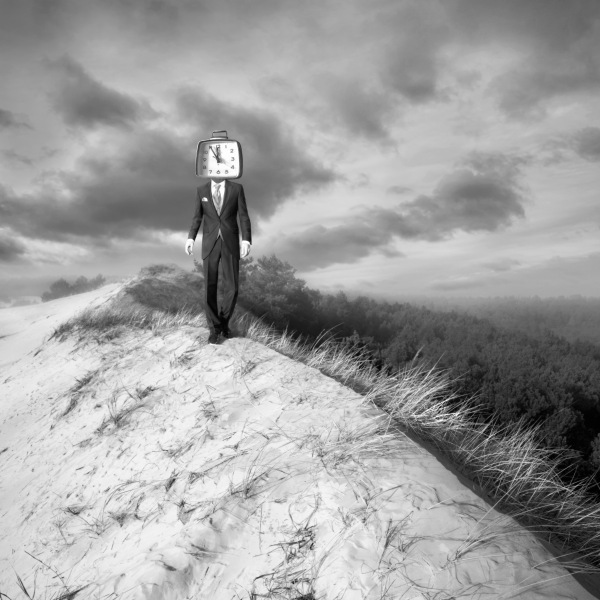
“On the Verge of Frog-Hood” by Richard Bader


Image courtesy of Dariusz Klimczak

My key was in the door when I heard the voice behind me.

“Do you have a minute?” it said.

A woman had materialized in my driveway, 40-ish, with short brown hair that curved in and forward at her neck and framed her face in a sort of oval. She was holding a large cardboard box. She wasn’t unattractive, but she wasn’t especially attractive either, and I was using this information to decide whether I had a minute. She set the box down. A light rain began to fall.

“Actually I was just leaving,” I lied.

“Oh!” she said, with either real surprise or mock surprise. “I thought I just saw you pull in.” She nodded toward my car. For all I knew she had felt the hood to see if it was warm.

“I came back to get something.” Lie two.

“Oh.”

I thought she’d take the hint and leave, but she stood there looking at me and I looked at her and soon it got uncomfortable.

“What’s in the box?” I guessed Bibles.

“My book,” the woman said. This didn’t entirely rule out Bibles.

“Your book.”

“A book I wrote. It’s a novel.” She opened the box and pulled out a hardback book with a plain blue cover and a title in white letters I couldn’t make out. “I’m trying to sell it.”

“Door to door?”

She smiled a smile that looked forced. “I published it myself. So yes.”

“Crazy way to sell books.”

“Are you a reader?”

No, I’m illiterate. “Yeah. I mean, I read.”

“Books?”

No, food labels. “Yes, books.”

“Wonderful! A lot of people don’t. Would you like to buy one?” She thrust the book toward me and I took it.

Tadpoles, by Amanda Boom. Amanda Boom—great name. You should have made it bigger on the cover.”

“It’s pronounced Boam,” she said. “It’s Dutch.”

“It’s really about tadpoles?”

“They’re a metaphor.”

“For…”

“That’s why you buy the book,” she said. She grinned, and it did something to her face that made her more attractive. It wasn’t until then that I realized she had looked sad before. The rain was picking up. “Your books are getting wet. Do you want to come in for a minute, Amanda Boom?”

Boam. Weren’t you just leaving?”

Now she was making fun of me. She was sharp, Amanda Boom was. Sharper than she looked.

“Do you have any coffee?” she said as we entered my living room. I went to the kitchen and made a pot. When I came back with it she was looking at a picture on the mantel.

“Your wife and daughter?” she said.

I wasn’t sure how to answer. It was Sophie, my daughter, with Anne, my wife, on a beach in Maine at sunset. But Anne and I were in day twenty-seven of a trial separation that was feeling less and less like a trial. I’d put the other pictures of her away. Leaving that one out was like saving a starter cell, something to clone the marriage back on to if it came to that. “Yes,” I said, not wanting to get into it.

“What are their names?”

“Sophie, she’s my daughter. And Anne.”

“And yours?”

“George.”

“Well, George, you have a beautiful family.”

I directed her to the couch and sat in a chair opposite. “So. Your tadpoles.”

“They represent loss.”

It was a ridiculous story. There’s a woman who every spring goes into this wealthy neighborhood where people have backyard pools. In the winter the pools are covered with tarps, and in spring frogs breed in the rainwater that collects there. Except when they take off the tarps, it kills them. So before they open their pools, this woman goes around and rescues the tadpoles with a net and takes them home in jars.

“Some become frogs,” she said. “But most die.”

“You ever know anybody who did this?” I asked. “Collect tadpoles from swimming pools?”

“No. It’s a novel. It’s fiction.”

“It’s just… You just don’t say, let’s have this woman who collects tadpoles from swimming pools. That has to come from someplace. Where in the world do you get an idea like that?”

“In your head. You make it up.” I thought I heard an edge in her voice.

“That’s crazy.”

“Crazy. That’s what the people say about the woman. She shows up year after year, a sign of spring, like dandelions or onion grass, and starts collecting. They talk about her, but no one talks to her, not really. No one bothers to learn her story. To them she’s just the tadpole woman. ‘Has the tadpole woman been to your pool yet?’ Like that, like she’s their tadpole woman, a quirky little break from their bland suburban routine. No one even knows her name.”

“What is her name?”

“You never find out. She’s sort of an Everyman.”

“Or Everywoman.”

“Exactly.”

“But every woman doesn’t collect frogs.”

“Tadpoles,” she corrected. “And everyone deals with loss. This is just her way of doing it.”

There was a car crash, she explained. The woman was driving, and someone ran a stoplight. It isn’t clear whose fault it was, but her young daughter is killed. Her husband blames her and the marriage falls apart. The neighbors feel sorry for her at first, but then start looking at her differently. She feels their scorn. She blames herself. She moves to a new town where no one knows what happened. The tadpoles become a way to cope with guilt. The whole thing was far-fetched, but I have to give her credit—she told the story pretty well. I thought she was going to cry when she described the car crash.

“Do you have kids?” I asked.

“It’s not about me.” That edge in her voice was back.

“It just seemed like you’d need to have a kid to know…”

“What it feels like to lose one? Is that really so hard to imagine? So she’s carrying around this secret. It’s too painful to tell people what happened, but it’s almost as painful to keep it to herself. And she doesn’t trust herself around people. The loss is devastating. The pain won’t stop. Who she was is gone, so she has to figure out who she is now, this new person that feels so disconnected from the old one.”

“I get it. Like tadpoles.”

“Exactly. On the verge of frog-hood. But totally oblivious to how their lives are about to change.”

“It’s like… what’s that word for when something turns into something else?”

“Metamorphosis.”

“Right. Metamorphosis. You should have called it that.”

“Taken,” she said.

When Anne said she wanted to separate, I was in shock. Twenty-one years of marriage and she could just walk away? She said she wasn’t “happy” anymore, and with Sophie away at college, she wanted to see if she felt happier apart. Happy. Jesus. Happy wasn’t something I thought a whole lot about.

That first night, after she told me she wanted to separate, she went to sleep in the guest bedroom. Twenty-one years—that’s like 7,000 nights—and it was the first time that had happened. So I’m lying alone in our king bed, staring at the ceiling. And what do I think about? The impossibility of life without Anne? This feeling that a piece of me just fell off? No. Logistics. Where will I live? What will I eat? What furniture will I need? House or apartment or condo? Rent or buy? Ikea or Ethan Allen? And the weird thing—would Anne approve? My wife is leaving me and I’m worried about reconstructing a life that she would endorse. But then the next day she said she’d move out, and she rented an apartment about a mile from here. Her car’s never there, though. I think she’s seeing someone else. Maybe she has been for a while.

“And that’s it? She lives out her life saving tadpoles?”

“Something happens to her.”

“What happens?”

“That’s why you buy the book.”

“Oh, c’mon.”

“Guess.”

“She falls in and drowns.”

Amanda Boom laughed, and her face did that thing again. I liked when it did that. I liked that I made it do that.

“That would make it a short story,” she said.

“She kisses one of her frogs and it turns into a prince.”

She kept laughing. “Now it’s a fairy tale.”

“Warts.”

More laughter. This was fun. I guess I felt “happy.” So I kept going. “She has an affair with a neighbor.”

This popped the whole laughter bubble. “Men always say that,” she said.

Men always say that. It was something Anne would say. Then I’d react, and then she’d react, and it would become this thing, and we wouldn’t speak to each other for a week. If Anne were here, she and Amanda would now be partners in a little anti-George coalition.

“Have a lot of men bought your book? It doesn’t seem like much of a guy’s book.”

“Some. Yes.”

“And what tips the balance? What makes them decide to buy it?”

“Is there any more coffee?”

I got up to get the coffee and gave her a refill. She took a sip and then sat staring at the cup in her lap. Finally she looked up. “One man asked me if I would have sex with him.”

She blushed when she said it, but looked me right in the eye, challenging me to something. I was confused. Was she saying, All men are basically pigs, and don’t I agree? Or was it some kind of come-on? It had been a very long time since I’d been on the receiving end of a come-on, so it was hard to tell. So now I’m sitting here looking at Amanda Boom and thinking about sex, thinking about sex with her. And then it happens again—I start wondering what Anne would think. Would she be jealous? Impressed? Would it make her want to come back? What would she think of Amanda Boom? It seems crazy to think about it that way, but I couldn’t help it.

“And did you?”

“Did I…?”

“Have sex with him?”

“What do you think?” she said.

“It’s an interesting marketing strategy.” I was suddenly really uncomfortable, and I tried to mask it by sounding clever. “Unorthodox, but you can’t deny its potential, and it would give you an edge on Amazon. Kind of extreme, though, just to sell a book.”

“Yes,” she said.

“Yes what? Yes it’s extreme?”

“Yes, I had sex with him.”

I felt like I was being led into another story. Like the woman in my driveway and the book and the tadpoles and the car crash and the dead daughter were all just so many breadcrumbs to take me to this other place that had something to do with this real woman sitting in my living room, whose name may or may not be Amanda Boom, who may or may not be inviting me to have sex with her, and who may or may not be the author of the book sitting on the coffee table in the space between my chair and her couch. I picked up the book and opened it, almost expecting the pages to be blank. But there were words there, just like with anybody else’s book.

“Not then, though,” she said. “I told him he had to buy the book and read it first. I said I’d come back in a week to see if he had.”

“And he believed you?”

“I guess it was worth $15.00 to see.”

“But you came back.”

“Yes.”

“For $15.00. There’s a word for that, you know.” I was angry. Not because I was judging her. I was angry because I was jealous.

“It wasn’t that simple.”

“How’d you even know he read it? Did you give him a test?”

“More like a quiz.”

“And he passed.”

“Flying colors.”

“You’re full of surprises, Amanda Boom.”

She shrugged, but didn’t look away.

“What difference did it make? Him reading the book?”

“He paid attention to my story. For three hundred and twenty-nine pages.”

“To the frog lady’s story.”

Another shrug. “It made him no longer a stranger.”

“Because you don’t sleep with strangers. At least not for $15.00.” I wanted her to react to that, but she didn’t. “Was it worth it?”

One more shrug, then a slight smile. But she didn’t answer.

“What did you get out of it?”

“Heard.”

“Hurt?”

“No, heard.”

“Ha,” I said. “No, you got laid. Did you see him again?”

She shook her head.

“On to other sales opportunities? Is this like a standard offer you make? ‘Now, for a limited time only, buy one book and screw the author for free’?”

“Anne left you, didn’t she?”

“What are you talking about?”

“There’s mail forwarded to her on the table next to the door.”

“She’s away on a business trip.”

“To a place in the same zip code?”

I wanted Amanda Boom to leave. “We’re separated. Not that it’s any of your business.”

“You don’t know what’s next, and you’re not even sure you want to find out. But something’s next, George. Something’s always next. You could get depressed and suicidal. You could start collecting tadpoles. You could invite a strange woman into your house.”

Neither of us said anything for a while. I couldn’t look at her, so I stared at the book.

“So what happens now?” I said.

“Maybe you turn the page.”

I laughed. “You win. I guess I will buy your book, Amanda Boom.”

“It’s Boam.”

“Right. Will there be a sequel?”


Richard Bader makes his living writing and consulting for nonprofit organizations. Fiction is a fairly new interest. He would love to be called a ‘young’ writer, but is afraid that ship has sailed. So he’ll settle for ‘new’ writer, or, with luck, ‘emerging.’ This is his second piece of published fiction.

Read our interview with Richard here.
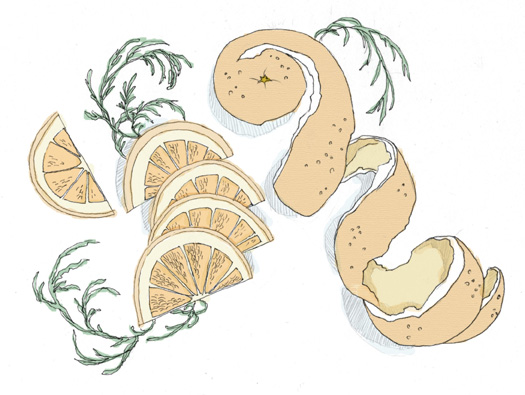
“Oranges” by Anthony Doerr

Doerr-Oranges1

He’s in 13C. She’s in 13B. He’s moving west to take a job teaching history to seventh graders. She’s heading home from a nursing conference. He’s gangly, earnest, and scared. She has brick-red hair and eyes shaped like daisy petals.

After takeoff she produces two oranges from a monstrous purple handbag and offers him one. He tears off the peel into a hundred tiny pieces. When he looks over she has somehow unzipped her orange and her peel sits on the tray table in a single, mesmerizing spiral.

“How did you—?”

“You’re cute,” she says.

She eats it as if it were an apple: huge bites. Threads of juice spill down her chin. The flight attendant brings napkins. The cabin lights dim. She leans across him to look out the window at stars and he smells cloves, ocean wind, orange blossoms.

Her name is Annie. She’s twenty-nine years old, a hospice nurse. Her voice is a quiet, serene thing, a voice like a pool of sweet, underground water. A voice he wants to listen to in the dark.


** The remainder of this archived story has been removed at the author’s request (after a gracious three-month loan for the July 2012 issue). When it becomes available in book form, we will happily provide a link for purchase.


Anthony Doerr is the author of four books, The Shell Collector, About Grace, Four Seasons in Rome, and, most recently, Memory Wall. Doerr’s short fiction has won four O. Henry Prizes and has been anthologized in The Best American Short Stories, The Anchor Book of New American Short Stories, and The Scribner Anthology of Contemporary Fiction. He has won the Barnes & Noble Discover Prize, the Rome Prize, the New York Public Library’s Young Lions Fiction Award, a Guggenheim Fellowship, an NEA Fellowship, the National Magazine Award for Fiction, two Pushcart Prizes, the Pacific Northwest Book Award, three Ohioana Book Awards, and the 2010 Story Prize. In 2007, the British literary magazine Granta placed Doerr on its list of 21 Best Young American novelists.

Read our interview with Tony here.

“My Kitchen, My Space” by Indira Chandrasekhar

Chandrasekhar-MyKitchen1

Mala’s lungs emptied as if a sudden pre-monsoon pressure-change had thrust itself densely into her diaphragm. She gasped and put the saucepan down on the stove with a sharp clatter.

With an effort, she turned, holding on to the counter. Her mother-in-law had entered the kitchen. Light from the dining room silhouetted the old lady, outlining the set of her body. But while her shoulders were held soft and she appeared to lean solicitously forward, her stance was territorial, legs planted firm. My kitchen, it screamed. My saucepan!

Mala wished she weren’t here, in this kitchen. She wished Saurav hadn’t had to bring them, her and the children, here to his mother’s place. “It is just for a few weeks,” he’d said despairingly when the boarding school offered him a teaching job with no accommodation. The salary was pitifully low, but he took the job, he had no choice. “Once I am there I’ll surely get housing, Mala,” he’d continued in a flat, yet hopeful voice. “Till then, why don’t you move in with my mother.”

“We’ll be fine by ourselves,” Mala tried to insist, “you don’t need to take us to your mother’s place, my family will help me.” Your sister is dead Mala, he’d replied. Or had he said your mother is mad, your father is gone, your brother doesn’t care. She couldn’t remember precisely what he had said nor what she had said. She only knew that on that day, neither of them could bear to acknowledge that they couldn’t afford to keep their home. In a few weeks they had emptied it out and sold most of their things.

And now, Mala thought, she didn’t have a home, nor a saucepan in which to heat milk for the children’s cocoa. She had to use Saurav’s mother saucepan. To, which Saurav’s mother was saying, “I’ve told you so many times that we take out the new, stainless steel saucepan only when we have guests. What don’t you understand about that? Use this one for everyday, see, this one.” She took out the grey, aluminum saucepan with the crêpey Teflon interior and held it up.

Not the Teflon coated pan, Mala wanted to say. The neutral flakes of the rubbery, indestructible polymer will enter my children’s bodies. The resinous, elastic scales, eternally non-reactive will lodge in my children’s organs and accumulate in unknown crevices making them obese and cancer-prone. Minute, non-stick bits, inorganic plankton, so small that they are invisible, will wash through my children’s tender internal filters and attach scrapings of their helpless, innocent cells to the swirling, giant sphere of plastic waste in the ocean.

 ~

 Saurav couldn’t visit till two months after they moved. Now we will be able to leave, Mala thought when he finally arrived, now I can go back to my own home. “It’s been awful here, it’s been awful without you,” she wanted to cry. But he looked so pale and tired that Mala had swallowed her list of complaints and served him his dinner. I’ll have him to myself afterwards, she thought.

The old lady talked non-stop through dinner. She bemoaned the disruption of her solitary life, something for which Mala felt a grudging sympathy. But then she began telling Saurav what was wrong with Mala, telling him that Mala never got the niceties of a superior household, telling him that contrary to what he had proclaimed when he decided to marry Mala, that class did matter, telling him that the children lacked discipline, telling Mala that she had to separate herself from her son, only three, or the boy would develop unnatural attachments.

“That’s going too far, Mother,” Saurav interjected. The old lady shifted in her chair, aggressively thrusting her neck forward and banged sharply on the table, palm flat. “Do you think I am blind, do you think I am lying when I say the children cling to her,” she asked shrilly? The children stopped playing and moved quickly towards their father, their eyes wide. “She’s their mother, they’ve been through a lot. Naturally they are close when the only other person around …,” his voice was beginning to rise but then he looked down at the children, and it died down with a low gravelly whir. He bent and held them close, mumbling, “Leave it now, not in front of them.”

“You don’t have to protect them, I won’t ever harm your children,” the old lady screamed. Saurav opened his mouth but didn’t say anything.

Mala remembered the first time she had heard him speak. It was at a seminar, how she had loved his voice, loved him, loved working alongside him. Why hadn’t she stayed on at University, why couldn’t she have managed the pregnancies and the research like other women did. She could at least have continued teaching, she was a good teacher. Maybe her job would have survived the cutbacks even when they stopped funding his.

“How many students do you have,” Saurav’s mother was asking? Before he could answer, she continued, “Fourteen year olds, That’s nice – what is your house like, do you wear a suit to class, much better than those scruffy research clothes, a suit.” Saurav tried to smile in response. Stop asking him about his job, Mala wanted to shout. Can’t you tell that he hates it, that he wants to go back to his lab, don’t you know that he can’t connect to those children, doesn’t know what to say to them, that every day is a humiliation. Her hand trembled and a spot of sambar plopped onto the white, plastic tablecloth with its elaborate pattern of pressed-in flowers and whorls and indents. They all stared at the splash of lentil stew. The old lady began to scold as Mala dabbed at the spot, only to spread the yellow of the turmeric powder, the brown of the ground coriander seeds and the red of dried chillies into an ugly stain. As their grandmother’s voice rose, the children disappeared upstairs. Saurav watched them go, then finished his dinner, head bent and shoulders drooping. Mala wanted to hug him and say, it’s not your fault, you didn’t spill the sambar, I did. But, when they finally were alone neither of them wanted to talk about the bad things so she hadn’t said anything.

 ~

 She would use her savings and get herself a saucepan tomorrow Mala thought, taking a deep breath to shake off the paralyzing band of tension. Then, ignoring the old lady, she put the stainless steel saucepan on the stove, turned it on, and dipped a ladle into the container of cold milk that she’d placed on the counter. But as she raised the ladle to pour the milk in, the old lady swooped towards her, once again waving the disintegrating non-stick surface at her face. Mala’s back vibrated and cords stood out on her neck. And just like on the day Saurav had visited, her hand shook. A drop of milk splashed onto the counter and another landed on the stove with a hiss. The singed smell of burnt milk entered her nostrils and settled there, an acrid coating over the cloying scent of the old lady’s perfume. Mala returned the ladle to the vessel of cold milk with its dewdrops of condensation and laid her tension-stiff fingers against the chilled, curved surface of the metal container watching how they destroyed the evenness of the clean, trembling frost.

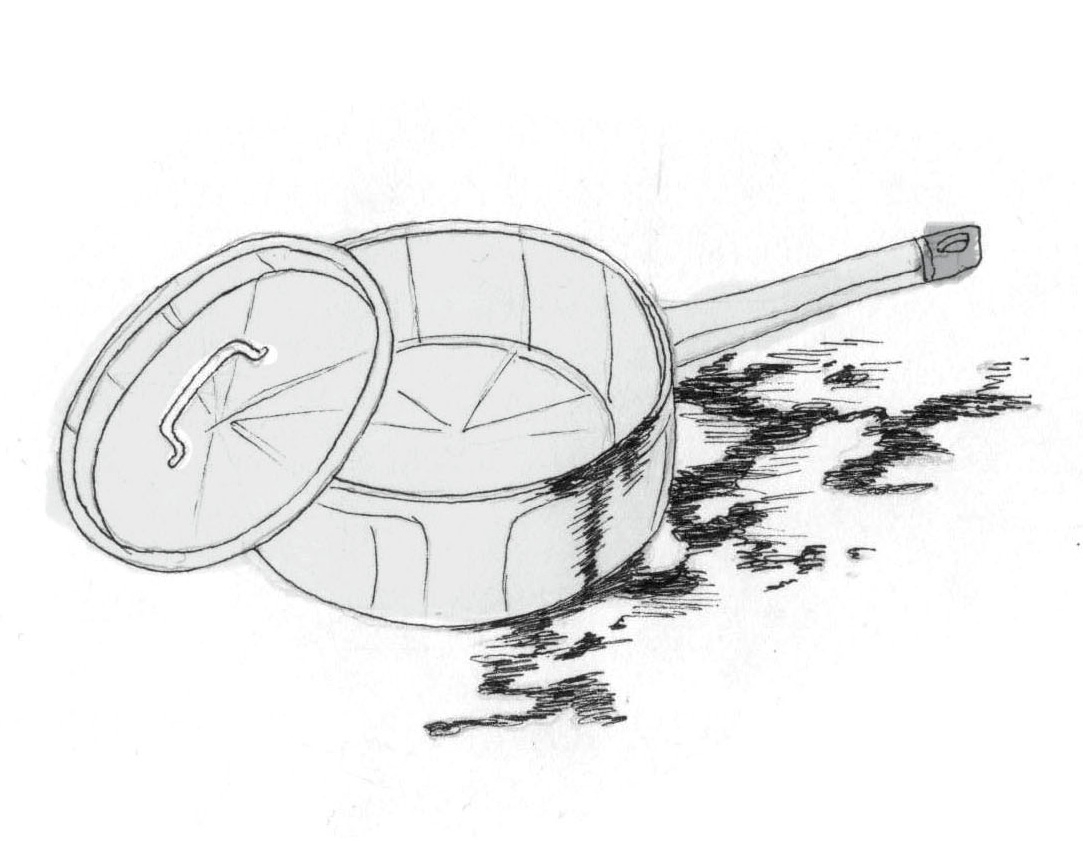
“Don’t use that,” the old lady repeated. And Mala lifted the shiny, stainless steel saucepan, still empty, and now red hot, and swung it towards the old lady ready to ram it into her face. But she smashed it instead onto the granite counter. The metal crumpled and the pan detached from its handle and landed at the old lady’s feet.

When the children scampered in for their cocoa, they found their mother on the floor, laughing with her head in her hands. They climbed on top of her and she rolled over on her back curving her spine to make herself into a boat for them. One day I am going to sail away with them, she thought, as she felt their breath warm on her face.


Indira Chandrasekhar is the founding editor of Out of Print, an online magazine for short fiction from the South Asian subcontinent. She has a Ph.D. in Biophysics and studied the dynamics of biological membranes at research institutes in India, the United States and Switzerland. Her work has appeared, among other places, in The Little MagazineEclectica Magazine, and Emprise ReviewPangea: An Anthology of Stories from Around the Globe that she edited with Rebecca Lloyd, will be published by Thames River Press in 2012. Links to her published stories are available on her blog.

Read an interview with Indira here.

“Don’t Tell Her” by Yu-Han (Eugenia) Chao

Chao-Don't Tell Her1

I don’t know how to tell my mother that my brother just died.

He fell off a stupid cliff while hiking somewhere in northern California. My mother had always called him long distance from Taiwan just to mutter at him about going hiking, she thought it was such a dangerous thing to do, since Americans don’t make their trails out of cement stairs and put bars on either side of the steps like Taiwanese mountain trails.

“What if you fall off?” she would ask. Maybe she jinxed him.

He was her favorite, baby son. Growing up, my older sister and I were always beaten and scolded for the slightest offense or disrespectfulness, but not the baby, not little Wei Wei. Wei was spoiled as anything because he was the youngest, the cutest, the smartest. Mom let him have his way all the time, despite Dad’s objections that he was becoming a momma’s boy.

“Pei! Be good to your child. Otherwise the gods will take him away from you,” she would say to Dad whenever he complained that she was being too lax with her youngest son.

But despite everything, despite the bottomless allowance account, despite the brand name sneakers, athletic gear, lack of punishment and expensive schools, Wei turned out all right. In fact, he turned out better than any of us. My sister studied music at Taipei Cultural University and I went to Mu Cha Vocational School on the outskirts of Taipei, while Wei went to the University of California, Irvine. He even got a scholarship. My parents were so proud. As soon as he graduated, both IBM and Intel wanted him; he chose IBM, which turned out to be an unfortunate choice because living in California was what got him into hiking–at least that’s what Mom always says.

What Taiwanese would be impressed by hiking in California–what do they have that we don’t? We have plenty of mountains right here surrounding Taipei basin, with nice Buddhist statues at the top, you can look down and see a sea of clouds floating by, and you’re up so high the water tastes especially sweet and the air is completely clear, damp, chillier, almost unearthly. I’d brought Wei hiking before, on Toad Mountain, he hated it and kept asking if we could go home now. That was ten years ago.

And now, my brother dies hiking in a foreign country at twentynine.

Our mother will never be the same again.

Maybe we don’t have to tell her.

The Taiwan Office in America called my older sister first. She said that the “in-case-of-emergency” number he had left with his insurance company was his sister, Jade Lin’s. Mom would have been heartbroken to know that his emergency phone number was not hers but Jade’s. But of course, Jade is the only family member who lives in America, in Dallas, Texas, to be precise. Jade teaches music students at home, in a large three-story rectangular house. She has a studio on the third floor where she makes Chinese looking ragbags out of scraps of fabric and ties, which she sells to American housewives for thirty dollars each.

Jade did not become hysterical upon hearing the news, because Jade only thinks of herself. She didn’t think of calling me in Taipei until five hours after she got the message.

“Hey, Allo, you’re not going to believe this, but Wei is dead. Our brother Wei. Mom’s Wei.” Her voice sounded like she had been drinking. Jade drinks. She claims her silent American husband drives her to drink, but as far as I know, she is the one who torments him. She has a silent little son, too, about eleven by now, an unhappy little runt, Nick, whose pictures she sends us every few months.

“How…are you sure? Wei? How can anyone die hiking? When? Who called you?”

“The Taiwan Representative Office. He went to the San something mountains with some friends, and he slipped and rolled down the edge. One guy watched him go down. They’re trying to find his body right now, and they think they can find it because the friends know the spot…”

“This is horrible. Couldn’t he be alive?”

“I asked that too. The officials said that we would be lucky to get the body back in one piece.”

“What are we going to do? I mean, what can we do now?”

“Well, I’m flying up to California tomorrow morning and leaving Nick with my next door neighbor. They have papers for me to sign, and I have to tell them what we want to do with the body.”

Our brother was already being referred to as “the body.” She could have at least said “Wei’s body,” or “our brother’s body,” but she had to say “the body.” It was too much for me to think about what we were going to do with Wei, how to get rid of him, to burn him or box him and bury him…

“Hello, Allo, you still there?” Jade’s voice was shrill all of a sudden.

“Yes, yes. I…I think we need more time. To think about…what to do. And what about Mom and Dad, what about Mom? Who will tell her?”

“You, naturally,” Jade said. “You live in Taiwan. Why should I make another long distance call to hear her weep over her baby for two hours?”

“That’s a nasty thing to say, Jade.”

“I’m sorry, it’s the gin speaking. Anyway, I’ll talk to you when I’m in California maybe. We might have to break it to Mom gently, if that’s even possible.”

“I know. She’s probably showing his pictures to one of the customers in her store right now and bragging about how successful he is in America.”

“I gotta go, Allo. It’s almost one in the morning here.”

“I can’t believe this happened.” As I say this, my drunken sister has already hung up on me with a loud click.

~

Mom lives about a twenty-five minute walk from my apartment, in our old house. Since she and Dad retired, she turned our first floor into a little grocer’s store like they used to have in old neighborhoods–places where you could buy a small handful of green or red beans, a cup of rice, dried goods, sauces, pickled vegetables, fresh spices, junk food and chewing gum. The store is kind of a hobby, we don’t know if she ever makes any money; she enjoys the company of local housewives when they come and chat over her counter in the afternoons. She gives away free fish tofu and little jars of pickled things to frequent customers and neighbors. Everyone knows her as Mrs. Lin, the old woman with a broad face, with a small round build and tiny eyes that squint into slits when she smiles, which is often, especially when she talks about her youngest son, Wei.

A little voice inside my head repeats over and over: don’t tell her, don’t tell her. Of course, keeping the disappearance of Wei a secret would be impossible since he, like a dutiful Taiwanese son, calls her every weekend. I could pretend to be him and call her, but that would be going too far, ghost-calling for my dead brother. I would have nothing to say.

I just wish I wasn’t the one to tell her. She would probably scream through a torrent of tears and beat me with her fists, screaming that I was lying. Me, the middle child, unsuccessful cram school teacher, renter of a small apartment at thirty-three telling her that her precious baby UCI graduate IBM developer patent-winning son has died. Hiking. She would be angry at me, she would act like it was my fault, just like we blame the weatherman when he tells us there will be thunderstorms when we have a picnic planned.

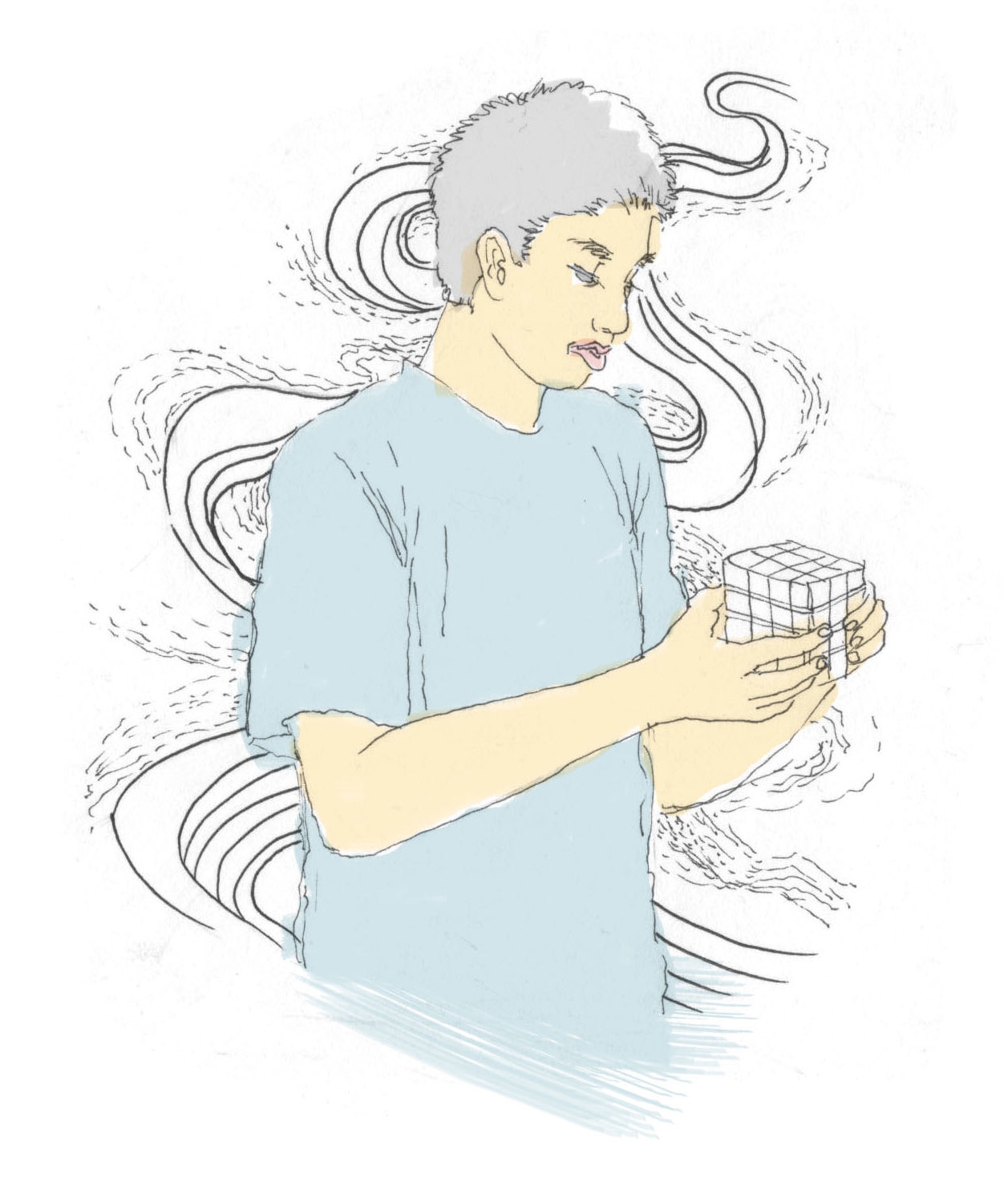
I should have been the one to die, not Wei. He wasn’t a bad brother. I will miss him, especially miss when we were children; lately I only see him for a few weeks at a time every year or two. I remember when Wei was addicted to computer games in junior high–I had to do all his math and science homework, Mom made me, saying it was my duty as an older brother. He also spent many hours discovering the secrets of the Rubik’s cube so that he had worn the stickers off two whole cubes and had to write the characters for red, blue, yellow, etc. on the white papery substance left on the cube. Even now (well, two days ago–not now, now he’s dead), give him a Rubik’s cube and he’ll turn it so fast you can’t see what he’s doing; in one minute he’ll have all six colors in their own matching positions on each facet of the cube.

Wei’s last year of junior high, he deleted all the files from his computer, threw out the floppy discs full of role-playing monster-slaying games, and studied for 7 months. It took only that for him to get into the best possible senior high, Jian Zon, then in his last year there get accepted to UCI in America out of the blue. We didn’t even know he applied; it was his English teacher’s idea.

I take the longest route possible through the nightmarket, taking my time walking to my parents’ house. It’s three in the afternoon so Mom will be behind the counter in her store. There couldn’t be a worse time to tell her, with customers coming and going, expecting her to work the cash register, weigh dried goods and tell them prices.

I pass the cleaner’s and look for Lucky, the Laundromat Dog (half the dogs in Taiwan are named Lucky). I always look for Lucky because he’s been around for so long that I’m afraid that one day I will pass the cleaner’s and there will be no Lucky because Lucky died. Who would have thought my little brother would go first. Peering into the cleaner’s, I see the brown and white, sweet-faced, pointy-nosed dog sitting under a clothes-folding table, eyes lazily following passersby. Lucky is old, no doubt. Though I’ve never played with him and he hardly knows me, I love him anyway. I don’t even know if Lucky is a boy or a girl, “he” could be an old grandmother dog. I wave at grandma Lucky and drag my feet into the nightmarket entrance.

The owners of stalls and stores and mats full of clothes and shoes are smiling, happy, enthusiastically trying to get customers to buy their wares. None of these people lost a son anytime recently, not a baby son who worked for IBM and got several patents, that’s for sure. I wonder if my mother will get over Wei’s death. She told me her mother never got over my uncle’s death–he was the only boy in a family of four children, and the smartest one, an excellent young surgeon in Tai Chung before he died in a car accident. I don’t remember my grandma much, but do recall that she burst into tears at any mention of my uncle and that before her death she trembled from something called Parkinson’s disease, and the medication made her slow, made her  call us kids by the wrong names, sometimes even by my dead uncle’s name. Maybe this was something that happened to women in our family, like a curse? If you love your son too much, he will die, and you will die heartbroken, trembling from a mild but incurable condition.

The streets look especially filthy today. Gum, blood-like stains of betel nut juice, scraps of paper, cigarette butts here and there on the bumpy asphalt and cement. A cockroach or two scurrying, some uncovered sewers with a dozen mosquitoes buzzing above them, children crying, toddlers falling down, men yelling and women screaming. Laughter. Chaos. The street smells like fish and smoked ham and fried chicken all at once. The unmistakable aroma of sweet roasted sausage assaults my face in its treacly heat; I’ve always hated sausage and the lemon, strawberry, and other inappropriate sausage flavors disgust me.

I am suddenly overwhelmed by everything, the odors, the noise, the crowded street, people brushing against me and thinking nothing of it. I am a bereft brother going to inform his parents that we are a bereft family; these people have no right to push someone who has the look that I have on my face, the look of someone who just lost a loved one far away. Several times I consider turning back.  My parents don’t have to know, if I just ignore the problem it might go away, my mother might forget she has a son in California, and everything will be okay, even if it feels like there’s something, someone missing.

I’m at the door of my mother’s store. You can’t see her when you first walk in because she deliberately designed the counter so it was to the left of the door, facing the back instead of the front door. Bad feng shui, I suddenly realized, I should have thought of this before and warned her. Do not work with your back to the door. A superstitious ex-girlfriend once told me that, and though I still think she’s nuts, I can’t help suspecting there’s some truth to the little sayings she repeated all the time. All Taiwanese are a bit superstitious at heart–even the most rational of us  think  there’s no harm in taking precautions–just in case. I need one of those lucky talismans my ex-girlfriend used to carry; I don’t know how to face Mom without one. Actually, Wei was the one who needed a lucky charm, or a tiny crystal Buddha figurine tied around his neck with a piece of red string–if he hadn’t died, our lives would still be normal.

I take a deep breath and walk in. Mom is not at the counter. Great, I can go now.

“Allo, what are you doing here? Shouldn’t you be getting ready for work?” It’s Mom, emerging from the condiments and rice aisle. I had completely forgotten about work, I’ll have to call the cram school and tell them I can’t be there.

“Uh, mom, I … I’m not teaching tonight,” is all I can say.

“Why not? What kind of expression is that? Did you lose your job? Did they fire you? I told you you should have gone to a real university. Didn’t I tell you?”

“Ma, I’m not fired. I just don’t feel well.”

“Where are you sick? I have medicine here in the drawer. Every kind of medicine.”

“Is Dad upstairs?” I ask, feeling like I need someone else here. The customers don’t count.

“I think he might be watching TV, I didn’t see him go out. You can go look for him.” She begins absentmindedly counting the change in her coin arranger and doesn’t look up. I don’t feel right going up to get Dad, but it also seems the wrong moment to be telling her about Wei; it would be catching her off guard.

“Ma, when was the last time you heard from Wei?”

“Ah,” her eyes light up and she finally looks at me. “Last Saturday I think. He said he was planning another one of those hikes soon, the silly boy. I tell him not to do it and he still does. He is too smart, nobody can tell him what to do, he never listens.”

“What if something happened to him, Ma?”

“Pei! What are you saying, it’s bad luck. Don’t say things like that. Are you cursing your younger brother?”

“No, Ma, I said if. What if.”

“There, you said it again! What is wrong with you, Allo?”

“It’s just, it’s just…” my voice trails off into a whisper, “something happened to Wei.”

“I told you to stop saying that!” she yells. “Are you on drugs?”

“No Ma, please listen to me. Wei went hiking. He fell off a cliff. He died.”

“Shut your mouth! You monster. You liar. Wei is fine, what are you saying? You are just saying this to make me crazy, you are jealous of your brother…” An elderly couple who had been putting green beans into a plastic bag quietly dump their beans back into the sack and walk out of our door, where they linger to eavesdrop. A baby at the back of the store starts crying in its mother’s arms at the sound of Mom’s shouting.

“I’m sorry, Ma. I’m really sorry. They told Jade in America and she called me this afternoon. So I came to tell you.”

“Where is he? Where is he? I want to see him,” she sobs.

“In California. Jade will tell us later tonight, when it is daytime there.”

She can no longer talk; she puts her head on her folded arms and weeps, like a girl who sat next to me in junior high used to do because her father beat her. My mother’s whole body convulses, she seems such a large, quivering bundle and a little old woman at the same time. I don’t know how to comfort her, we never hugged in our family, so I stand there, patting her back so lightly she probably can’t feel it.


Yu-Han (Eugenia) Chao was born and grew up in Taipei, Taiwan. She received her BA from National Taiwan University and MFA from Penn State. The Backwaters Press published her poetry book, We Grow Old, in 2008. To see more of her writing and artwork, please visit http://www.yuhanchao.com

Read an interview with Eugenia here.

“My Own Private Wind” Lori D’Angelo

The Path of Irony (Lori D'Angelo)

So there was no “Oh, darling, I hunger for your touch” moment. It was not like that. We were not like that. We were quiet and reserved, the kind of couple who fades into the pavement, blends in with the blinds and the placemats, the kind of people you would walk by without noticing. We were like streetlights. We looked like we belonged.

We were supernormal, one dog, two kids, a minivan, a mortgage that we would have paid off in time. Then, Connor died. There was no weird cover-up/scandal with a bank. Just plastic cups and hospital straws and food that didn’t smell good enough to eat. And then. A funeral. Eternal rest grant unto him Oh God, and may perpetual light shine upon him.

Connor had life insurance and a will and all the things that people are supposed to have but don’t. A friend of mine from college with her long hair, coat down to her feet and boots up to her knees saying, “At least you’re taken care of, Gillie.”

“Yeah, right.” Because that was what I cared about. In the end. Money. I cared about that as much as folding the laundry and cooking dinner, which was why Connor did those things. Or had done those things. Before.

What there was was a quiet breeze on a day when there was no wind. What there was was a bright spot of sun for only me to bask in. What there was was a still, small voice.

We had no medium. It was just presence where there had been absence and then me saying to Jonathan and Gemma: I think Dad was with me.

Gemma at the kitchen counter looking up from painting her nails, the smell of her polish polluting the air, “Sure, Mom.” Gemma, 16 going on 30, talking to me as one talks to an Alzheimer patient. Jonathan, 13, standing in the middle of the kitchen, believing, hopeful. “You think he’ll visit me, Mom?”

I am reading the directions for the frozen lasagna off the package: Preheat oven to 450. It’s the kind of lasagna that comes in the orange box with a black plastic tray. The kind that all you have to do is turn the oven on and wait and wait.

Gemma, who is dark eyeliner and prominent silver crosses, saying, “Pizza would be faster and probably cheaper.”

“Not in this town.”

“Mom, this is the only town we’ve ever lived in.”

Gemma has a tendency to act like her life history is the only one that matters.

I am not looking to argue. “Okay, right.”

We move then. Like chess players. Gemma goes first. Me second. Jonathan last. Jonathan wears a polo shirt, Gemma mesh stockings. They look like they come from different reality shows. We shuffle into the living room, sit apart.

Jonathan, crosses his legs, sits up straight, and says to his sister from the rocking chair: “I bet Dad won’t visit you.”

Gemma doesn’t respond. Jonathan opens his mouth to wet his braces. He looks like a young Anthony Michael Hall. Gemma looks like a girl in a music video. We all sit tense. The flat screen TV we wanted so badly is turned off and covered with plastic. The stand beneath it has a layer of dust so thick that you could fill the vacuum canister with it. I think I see a cobweb, a spider.

Gemma, from the couch, with perhaps a note of excitement in her voice, saying, “This place would be a good room for ghosts.” She seems to be implying more.

I rise from the recliner, stand straight up. “I thought that we could use some time to talk away from the distractions.” That’s why I covered the TV, put the radio away.

“It’s cool,” Jonathan says.

“A little less conversation,” Gemma responds. Her nails have dried now, so she, too rises. It’s okay to reference the dead if they happen to play music.

Jonathan and I have nothing more to add. So we exit how we entered—Gemma first, Jonathan last. I serve as a buffer between them.

~

Four weeks before, I was lying in bed, sleeping late. The kids had gone to school. I should have gone to work, but didn’t. I knew that Hansel had been tolerant. Beyond tolerant. I waited for him to say: “Gillian, you are no longer needed here. But, so far, that had not happened. I think that part of me wanted to know how far his sympathy would go. The other workers talked. “Gillian was late again,” but Hansel, his wild hair flying high, straightened his tie and defended me, saying, “She just lost her husband. What would you do if you were in her place?” I knew, too, that part of his interest was more than friendly. It came from an attraction. There is something sexual in the grieving widow, the damsel in distress. Something that makes a decent man think, Lord, we have to help her.

I wrapped the sheet around my naked toes, phoned Hansel. “I’m going to be late,” I said.

He sighed. “Gillian. Is there reason?” He meant a valid reason.

The reason was I couldn’t bring myself to get up, to care enough. This was what I told him.

“You should see a doctor.”

It was on the train to work that I first saw Connor. Well, really felt him. That wind. The pages of my book blown open.

I turned to the passenger behind me. “Did you feel that?”

The man, a handsome black man with iPod buds in his ears, shook his head.

How could I merit my own wind in a closed in space? Was there an open window somewhere?

My thoughts didn’t go right to Connor at first.

It was later. Street chalk on the city sidewalks in blue and pink and orange. Let it go. Connor used to always say that. At first, I thought coincidence.

It was later. In the lunchroom cafeteria. The special that day at first read: Peace and Serenity. And then, a moment after, it didn’t. It was back to saying black bean soup and corn muffin.

I liked the other special better, so I ordered it.

“I’d like some peace and serenity,” I said to the woman behind the counter, whose long silver hair was braided and pulled up into a hairnet.

“What?” she asked.

“I’ll have the special.”

Hansel joined me for lunch. He didn’t ask if he could; he just did. He set his metal tray down across from me. I felt like we were prisoners. Or I was the prisoner. He was the warden, the parole officer, the one sent to make sure I made it through okay.

“Gillian, I’m going to have to fire you, if you don’t. . . ”

He tried to continue, but I stopped him. As I spoke, he sipped water from a red plastic cup.

“I know, and the problem is.”

This is the part that I can’t really explain at all. It was like. Time stopped, and everyone froze. I saw no one. But I felt. . .different.

I couldn’t bring myself to say what I would have said: and the problem is I just don’t care.

I felt tears running down my cheeks. “I’m sorry.”

“You’ve not cried since the funeral.”

“No.” I ate my soup with a spoon.

“This could be progress,” he said in a way that suggested interest.

I nodded. “I’ll try, okay. I’ll really try.”

~

For the next two weeks, I came in on time for work. I walked dutifully through the revolving doors and metal detectors. While there, I did what I was supposed to do. Hansel said he was glad to see the change in me.

“Before you were. Headed for promotion. And then.”

We stood in the lobby. With its hard floors and high ceilings, it felt like a museum, and I couldn’t help but notice how often Hansel found time to find me.

“I don’t want to talk about before.”

“I thought we agreed. Talking is good.”

“Sometimes. And sometimes it’s not.”

His hand on my shoulder. A touch of concern. I should mind more. Shouldn’t I? After all, Connor has just died. How long’s it been? An hour, a day, six months, a year. It’s been a year.

Wow. That long. So long and not long at all. I felt nauseous, a wave of queasiness in my stomach. I excused myself to the bathroom. On the mirror, someone has written with a finger or what looked like a finger: Let it go.

“Let what go?” I said aloud.

A woman in the stall closest to the door walked to the sink and gave me a strange look as she applied her red, red lipstick. Pink would be better, I thought. Red made her look too pale.

“I’m just talking on my Bluetooth,” I said. She acted like she didn’t believe me.

I waited till she has gone, and then five minutes more.

Another word came then. A series of them. Death. Let it go, Gillian. Live.

My office is ten floors up. I climbed the stairs instead of riding up. Hansel was waiting by my cube. A bit frantic, he questioned, “Where have you been? What happened? Is everything okay?”

I nodded.

“I am okay. Or I’m going to be okay. After now.” I looked at my calendar. The things I said I’d do yesterday, I did. It was a small step but still a step. I waited for him to go, but instead, he said, “We’re having lunch today.”

We’d had lunch together every day for the last two weeks, but, somehow it seemed an accident. We were just there together at the same time.

Then, he’d made a move to make it intentional. A step beyond, a step toward something else. Now, it was my turn. I had to let him know if we could move forward. Beyond accident to intention. He licked his lips. He waited. With his wild hair and square glasses, he looked nothing like Connor. Connor was wavy hair and working outside. Hansel is inside, office, business, business, business. Hansel waited. And yet, they are both compassion.

“Okay,” I said. “We’ll have lunch.”

~

The night I talk to the kids, I fall asleep on the train home and dream of Connor, and then I wake and think about my lunch with Hansel. It was just normal, except. There was this one moment where we both reached for the ketchup and his hand brushed my hand. An accident. But neither of us moved the hand away. Instead, we held them there. And then he said my name. A moment later, we were back to wherever we had been before, but it was not quite the same. Something had turned. That night, after Gemma has gone to practice guitar at a boy’s, a friend’s house, a boy who could be more than a friend, she hasn’t told me yet, but she will, Jonathan dries the dishes with a pink towel while I wash, and he asks me to tell him how I knew that it was really Dad, so I tell him the truth, which is simply this: Because I felt better.


Lori D’Angelo earned her MFA from WVU in 2009, and her work has appeared in various literary journals including Word Riot, Drunken Boat, Stirring, and Literary Mama.

Read our interview with Lori here.


“The Illusion Shatters” by Danica Green

The Passion of the Fallen (Danica Green)
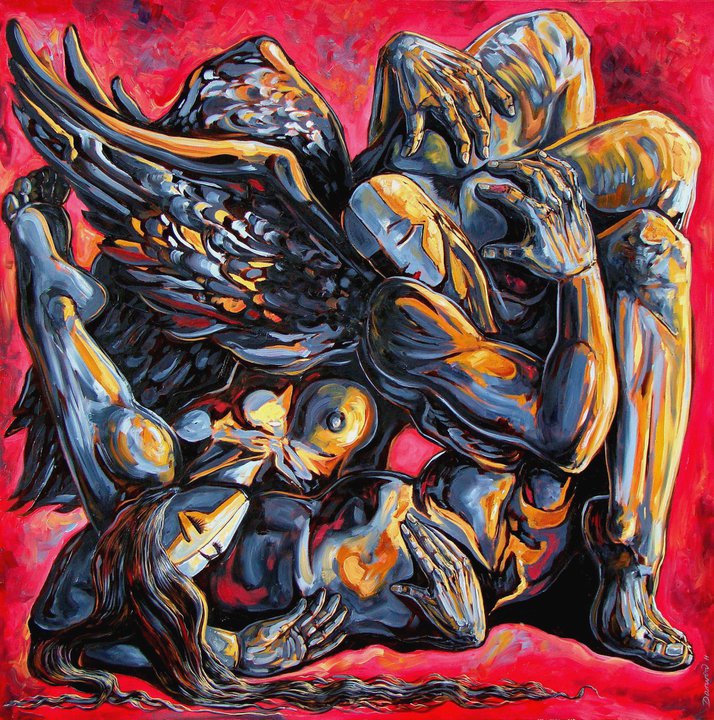
The Passion of the Fallen, oil on canvas, by Darwin Leon.

She couldn’t scream loud enough to scare the vultures away, tired as she was of them picking at her corpse and feasting on the rotting heart that she felt so distantly attached to.

May was her favorite time of year, the night sky looked clear beyond the haze of her imagination and the stars shone lucidly through the pink fractals floating through the sky.  She couldn’t make out the figures on her watchface but it didn’t matter, one hour blurred into the next, and the next, until she was staring at an orange dawn though in truth it was still the dead of night. She yawned against her rucksack clutched to her chest as the stars came back into view and the trees spun lazily around her like fireflies, glowing with their own ethereal light.

She stood. The morning was raw in her mouth, infused with stale vodka and the taste of cigarettes. She took a sip from a bottle of water and dressed herself like a zombie, empty-headed with an instinctual hatred of the dawn. The carpet under her feet crunched like ice, the remnants of a thousand hasty junk food meals that she would never clean and she descended the stairs in a haze. She walked to the kitchen and sat down at the table, running a brush hastily through her tangled mass of hair and pinning it out of the way as her eyes fell to the program that stared up at her from the tarnished wood. “In loving memory” it said, “Elena Moore: January ’56 – March ’07. Gone but not forgotten.” She collected her handbag, straightened her long white dress and walked out of the door, tripping as she did on the pile of unsorted letters she couldn’t bear to touch.

She fell. Face down onto the dewy grass, her limbs contorted and not responding to her requests. She closed her eyes and breathed deeply the scent of the moist earth, trying to connect herself with reality though the fractal pictures haunted her even here, inside of her own eyelids. Her mind tried to grasp something, anything in this place that would take her back to that beautiful moment of enlightenment several hours previously, but her mind was racing, her decaying limbs, the dancing trees, her mother, the water-drop maggots that edged their way across her face. With an effort she braced herself against the ground and pushed.

She rolled over. Her neighbor stood over her, proffering a hand and asking if she was okay. She took vague stock of her bloodied knees poking through the tear in her dress like a corpse in the snow and stood of her own accord, ignoring the offer, neglecting to return to change her clothes or clean away the crimson fluid that worked its way down to her shoes. She walked to the car and got in, the engine roaring to life, sounding dull in her ears and she drove instinctively towards the graveyard. Stopping outside she saw them, the guests, the ghosts, all in white and moving around like specters come to haunt the last lingering memory of her mother. Moving towards them in her own otherworldly way she stared blindly, ignoring the comments, the condolences, the whispered fears of her state. It was then she saw it, the first thing she had taken notice of all day. The pale face, a deathly pallor accentuated by sleepless eyes ringed with tired bruises, the hair slicked down with two weeks worth of grease and the eyes, haunted, blind, dull, missing some vital indication of the soul that should lie within. She dismissed this vision and moved on, walking into the church and clenching her fists at her side.

The earth felt good as her fists clenched harder, digging her fingers into the ground, burying herself, grounding herself, finding a hold on something stable. Her breathing sped up to inhuman levels but she didn’t notice. She believed she had stopped breathing hours ago. The fractals in the night sky increased in number, illuminating the darkness, scraping across the canvas like fast-moving clouds, twisting and curving, and before long the stars joined in with their macabre dance. She hauled herself onto her knees, weeping bitterly and unknowingly, and tried to stand, swaying and tripping as with a final effort she managed to get to her feet and take stock of the field around her. Shapes moved in the darkness, demons come to take her away to the underworld, and she ran fitfully towards the trees that surrounded her, moving closer, then farther away, and closer again until she ran into one, shattering her wrist but not noticing the pain. The world tilted. She had taken too much. Pressing her back against the rough oak she slid towards the ground.

She sat down. The front pew of the church in sight of everyone, so much pity and scorn directed at her. She was alone here, no other family to speak of but her mother’s many friends behind. She stared at the coffin, barely seeing it as she had seen nothing that day, her mother’s rotting corpse a distant consideration in an otherwise blank mind. The priest began to speak, condolences and best wishes for the aggrieved, sentiments about Elena, stories from her life, joking and forlorn like an old friend though he had never known her. The service seemed to pass in a blur and she was the first to exit, unhurriedly, walking through a dream that just wouldn’t end. Someone grabbed her arm.

“Jennifer? What on earth happened to you?”

She was confused at first, but then followed the newcomer’s line of sight to her knees, crusted blood now brown like shit smeared across her, the scabs cracking and weeping like she herself. She looked up, unable to speak, unable to recognize the face of the intruder upon her solace, unable to understand what to do through the powerful and desperate need to go home. She tried to pull her arm away.

“Jennifer? Are you okay? Jennifer??” said the newcomer, eyes wide with fright, as were Jennifer’s own. She tugged harder, furiously trying to get away and the grip finally broke. She ran away from the watching crowd, ran to her car and got in, picking up the rucksack in the passenger seat and clinging to it in a daze.

She clung to the tree as an infant clings to its mother’s breast, desperate for the contact of something familiar in this alien world she now inhabited. Her heartbeat had sped unnoticed to a dangerous level and her mouth was dusty as ash. She bent like an animal and began licking the dew from the grass, ripping up the earth and shoving handfuls into her mouth, but it didn’t help. She could taste death. Beyond the rising panic, beyond the forgetfulness of reality she remembered her rucksack, left in the field when she ran to the trees. She tried to stand and fell, openly sobbing as she tried to claw her way back to her bag, crawling in fits and starts as the rigor mortis set in to her festering limbs and her body seized up. The world had become a carousel, everything spinning in one direction, blurred, unfocused, unable to make out either the mass of trees or a single blade of grass, but she felt where her rucksack lay, she knew it, and she knew she had to be with it. After what seemed an eternity she felt it under her hand, damp, and she clutched it to her chest though the small wave of relief was quickly swallowed back into the panic. She lay on her side and undid the fastenings. She opened it.

She opened the door, not closing it or taking off her shoes. She wasn’t even sure that she was coming back. She placed her rucksack on the kitchen table and stared at it for a long while, a small glimmer of common sense trying to slip in through the horror. Eventually she relented, as she always knew she would, and she reached into the rucksack, fingers resting longingly on something unseen inside before shifting to her focus and pulling out a dirty make-up bag. She walked to the sink and grabbed a spoon from the drawer, bent and blackened like most of them were, and began to cook her fix. As the needle penetrated her skin and released its poison she relaxed, pulling herself back to the fringes of normal, a vague sense of peace washing over her. But it was at that point, now, that it didn’t give her what she was looking for. It killed the paranoia, the feeling of detachment and brought her closer to a normal state of mind than she could have been without it, but through that normality the pain of her mother’s tragic death began to seep. She started to cry, fully realizing her emotions and flew into anger, throwing the make-up bag to the floor, screaming to the heavens and dry-heaving with grief and rage and hatred. She picked up the bag and cooked up another batch, and another, and another, each stab into her vein bringing numbness and relief from emotions she didn’t know how to deal with any more. Leaving the paraphernalia by the sink she grabbed the rucksack and left her mother’s house for the last time, clicking the key in the lock as she went.

The lock snapped open. The pages of the diary she had pulled from the rucksack were covered in an elegant hand in blue ink with hearts and flowers and happy faces doodled in the margins. She could not see this. She was so far gone that she was navigating the pages through touch. She felt for the crease, the crease that marked the last page her mother had written on and she ran her fingers tenderly across the script. She couldn’t see the vultures any more but she knew they were there, the vultures and the demons come to collect her body and her soul respectively. Her chest on fire and her heart close to bursting, she shook with a tremor that threatened to push the diary from her hand but she would take the thing to Hell if need be, to remind her, to always remind her, of the part she had played in her mother’s death, of the reason she was going to die today. She couldn’t see the writing but she knew it by heart, that last diary entry: “9/11 2001. Going to the city today. After more phone calls than I can count I have finally found an affordable place. Doctor Stevens seems a pleasant man and he says they have a high success rate. I have high hopes for Jennifer now, she’s willing to quit, she wants to quit…but she needs help. I’ll do a bit of sightseeing as well, take some pictures for her so she doesn’t get scared about the move. Hoping the facility is nice. I love her so much….” Jennifer closed the diary and  clutched it to her chest. She curled into a ball as a sharp pain exploded through her chest and her body gave in to the poison in her system. She couldn’t scream loud enough.


Danica Green is a UK-based writer with work appearing in over 50 literary journals and anthologies, including Smokelong Quarterly, Neon Magazine, PANK and Eclectic Flash.


“Simulators” by Marko Fong

Eye Always Was (Marko Fong)
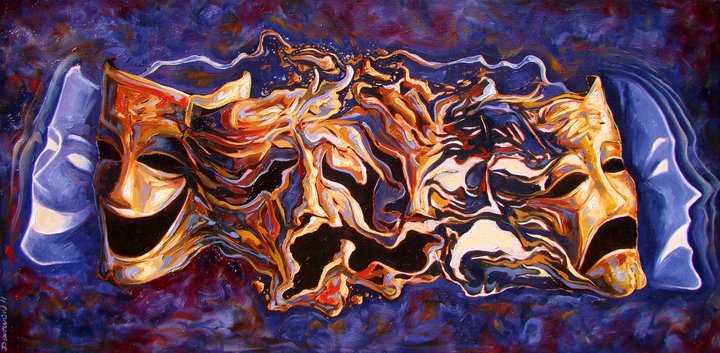
Eye Always Was, oil on canvas, by Darwin Leon.

Prefatory note:

This document was recovered from what was once known as a 5.25-inch floppy diskette. From some earlier century, it’s a black cardboard square that encases a flimsy circle of plastic.

The text documents a primitive video game from a time before people had their own computers. The font and formatting appear to be artifacts from a device called a “dot matrix” printer. A singles bar was where men and women met before the Internet.

We have now advanced well beyond this, but this may have historical interest for those who do not realize that Iphones, Facebook, and Second Life were once not an integral part of daily life. It may also offer insight into a time when we were just human.

Simulators

It looked like any other video game with a screen, slot for quarters, keyboard, and joystick. I assumed it was a game where you shot aliens with blipping dots. I walked to it behind the bar. On its side, it said in big blue letters Date Simulator.

I wondered, is this like women on bar stools in rows and you shoot them with a laser or maybe you chase each other through a series of mazes? The screen showed the inside of a bar: a fern covered a window, the bartender wore a vest, a couple made out in the corner—not a bad parody. I dropped in my quarter.

A woman’s face came on. She smiled. I moved the joystick to approach. I figured it was some sort of joke. I typed, “What’s your sign?”

There was a little electronic squeal and my character melted into a puddle of electrons. Three dollars later, I’d tried “Haven’t I seen you someplace?” “You’re the best looking thing I’ve seen in months,” “Nice suntan,” stuff I’d never say in real life. What kind of machine was this? Finally, I tried, “Hi, I’m Jerry. What’s your name?”

“Ursula,” she said.

“Nice name.”

No response.

I typed, “Come here often?”

Poof, puddle of electrons. I asked the bartender for change.

“Figure it out yet?” The bartender’s nameplate said Tim. He was tall, blond, mustached.

“I don’t know,” I said. “It’s fun though.”

“You gotten her home?”

I shrugged. “You mean Ursula?”

He gave me the look, the high school gym one when other guys would ask if I’d ever kissed a girl. “I thought her name was Heather?”

“Heather?”

“I just typed ‘What’s your sign?’ and we were off. Know what I mean?” Tim winked. I looked around the bar then looked at myself. My shoes needed polishing, my slacks weren’t pressed. I felt that bit of hair at the top of my head sticking up again. A woman took a stool inches away, as if I wasn’t there. “Hi Tim,” she cooed.

“Yeah, it’s fun, really fun,” I mumbled. “Could you give me another buck in quarters?” I slipped back to the machine. “What’s your sign?” I tried again. “You must be Heather?” Two squeals, two puddles of electrons.

Finally, frustrated, I typed, “Look, Ursula, I’m just an ordinary guy playing this stupid game. There’s nothing about me that’s going to impress you. If you’re not interested that’s fine. I just want to talk a little bit, find out about you. Is that okay?”

The Simulator gurgled then Ursula touched my onscreen hand. The joystick gave me a little jolt. Her eyes widened. “What makes you think you have to impress me, silly?”

We talked for five minutes. It was wonderful. I forgot I was talking to a machine. You know, real feelings, loneliness, little satisfactions, then just as I’m ready to ask her out, the screen went black.

Please insert quarter to continue.

I turned my pockets inside out. I asked Tim if he took credit cards. He shook his head. I counted the blocks to the robot teller at my bank, then saw two quarters on a table, a tip for one of the waitresses. I moved closer, like I was admiring the pictures on the wall, then took a breath, looked at the machine again, this Date Simulator. I wasn’t that far gone, yet.

I didn’t tell anybody about that night or the machine. I didn’t go back for weeks. I saw a few date simulators in other places, another bar, an arcade or two, a supermarket. A friend introduced me to a woman who worked as an accountant. She painted, liked to hike. We went out a couple times, started to like each other, then one night I was at the Laundromat. I had four full duffel bags of clothes. I went to the bill changer and got ten bucks in quarters, enough to bulge my pocket. I sat down, started reading back issues of People. I went to look for an open dryer and ran right into another blue box.

A line of people waited, men, women, young, old. I guess that’s why all the copies of People were still sitting there. I waited too. I’d left a load of whites in a washer up front. When my turn came, I almost dropped the quarter before I got it into the slot.

A display of a Laundromat came up. Two women conversed by the detergent dispenser. A happy couple folded sheets. I squeezed the joystick and moved around the screen, hunting for Ursula.

“Ursula?”

She turned from folding towels and smiled. “Where have you been?”

“I ran out of quarters. I haven’t been able to stop thinking about you.”

“Me neither.”

I wanted to wrap my arms around her, refuse to ever let go again. Then I remembered we barely knew each other and settled for the soft pulse of the joystick.

“Ursula, can we go out sometime?”

“Of course, I’d like that.”

The way she said it made me tremble. “I’ll cook. What do you eat?”

“Just about anything. It’s being with you that matters.”

I heard the shuffle of feet behind me. I turned around to find three people waiting.

“It’s just a video game,” I barked.

I went back to Ursula.

“What day’s good for you?”

The screen went black. I reached into my pocket.

“Hey, we’re waiting too.”

“Jesus, it’s just getting good.”

“Yeah, you’re the one who said it was just a game.”

I went to the back of the line. I ran out of quarters before I could dry my second load and brought home three bags of wet clothes. I left a load of whites in a washer. I called in sick at work. My girlfriend, the real one, called.

“There’s this great hike tomorrow.”

“I have to do laundry. I don’t have any shirts for work.”

“Didn’t you do laundry last night?”

“I got sidetracked.”

“Sidetracked?”

“Look, I have to get it done tonight. My bedroom smells like mildew.”

“Mildew? Must have been some distraction.”

I didn’t answer.

“We don’t have to hike. We’ll do laundry together if you want.”

I held a wet towel to my face. “You can’t. I have to do laundry alone.” I didn’t mean to shout.

“Maybe Sunday?”

“Sure, call me then.”

We didn’t get together Sunday, or any other weekend. Eventually I got my laundry done, but I spent forty-eight dollars in quarters. I broke up with my real girlfriend.

“There’s someone else isn’t there?”‘

“No, I swear.”

“No one does laundry every night.”

I wanted to explain, but wasn’t ready. Why would I prefer a machine that took quarters to a real woman, a bright attractive woman, who clearly liked me for who I was?

I bought new clothes for my visits with Ursula, brought flowers once, started getting uncirculated quarters from the bank and dipping them in silver polish before visits, even bought a mink glove for her joystick. I stopped going to the Laundromat. Too long a wait. The bar where I met Ursula now had four machines and two bill changers.

I lost my job. I had to budget, just to make sure I paid the rent with my unemployment check. The rest I immediately took in quarters. They’d last a week, then just a couple days. I stole tips off a corner table. The second time, they caught me and kicked me out.

With Ursula, I pretended I was getting promoted, told her about buying new cars, moving into a bigger apartment until one day she looked straight at me.

“Jerry, you’ve been lying to me.”

Before I could respond, the screen went blank. Naturally, it was my last quarter. I turned to the woman behind me.

“Look, please, you’ve got to give me a quarter. I’m all out. Please!”

She shook her head then reached into her purse and pulled out two quarters. My fingers twitched at the sight.

“When’s the last time you ate?”

I straightened. “I promise to take care of myself, just please let me have those quarters.” We were in a Sim House, new places which had nothing but date simulators inside. Here, the serious players didn’t have to pretend to meet real people or do laundry.

“Jerry,” the woman said. “Jerry, it’s Gretchen.”

My stomach tightened. “Gretchen?”

“Yes, you remember: had to do your laundry every night Gretchen.”

“I’m so sorry.”

She touched my shoulder. “Jerry it’s all right. I understand. I spent a hundred dollars one weekend.”

“A hundred…What was his name?”

“His name. Well, it just so happens it’s…” She looked around the Sim House. “What’s the name of yours?”

“She’s Ursula.”

Gretchen looked disappointed.

“What’s the name of your Sim?” I repeated.

“Well, I really don’t think.”

“Come on Gretchen.”

She closed her hand around her quarters. “If you have to know, it’s Jerry.”

“Jerry?”

“He’s a lot like you.” Her eyes welled up. “Well at least…”

I leaned against a machine. My reflection taunted me from an empty video screen across the way. I hadn’t shaved in two weeks. There was a rip in the shoulder of my jacket. My pants had stains on them.

“…a lot like you used to be.”

“I never suspected,” I whispered.

She pressed the quarters into my hand. “Now, you know.”

She turned and ran. I could swear she was crying, but I had my quarters.

“Ursula? Ursula.”

I put the second quarter in. Where was she? I went out in the street and panhandled. I got five dollars in quarters and a number for the suicide hotline, but there was no Ursula to be found. Back home that night I considered my situation. I’d read about people shooting the machines with guns. One man in Texas drove into one with his car. Me, I was prepared to bang my head against the screen until I lost consciousness. Ursula and I would be united forever.

Simulators made the covers of Time and Newsweek. One read Entertainment or Menace? The other story carried a sidebar about the run on quarters at the Denver mint. Both explained that simulator partners didn’t exist in any conventional sense. A group of behavioral scientists had placed sensors in the keyboard and joystick and the machine responded like a polygraph. What you typed in mattered less than how you typed it. Someone sent a bomb threat in to the Time Life building demanding they print a retraction.

Elsewhere, a man in New York sued the simulator company for the breakup of his marriage. A Congressman introduced a bill to place a warning on every simulator, “Do not play more than four quarters at a time. Highly addictive.” But, the Simulator company was twenty-fifth on the Fortune 500; its lobby crushed the bill. Besides, the Japanese took to the machines even more than we did. It was the only item keeping the trade deficit under control.

In some cities, a rumor spread that the mob controlled the machines. In the south, they chained a Bible to them. An urban legend circulated that a Sim House accidentally crosswired two machines so they were playing each other and received an electric bill for a hundred and fifty-six thousand dollars. A woman in Iowa claimed to have immaculately conceived a child with one of the machines, a computer-age Messiah.

But even the folklore wasn’t as strange as truth. A home version of the machine failed miserably, it seemed that actually owning the machines diluted their appeal. When it came to simulators, Americans insisted on the genuine article.

A few weeks after my encounter with Gretchen, I went for treatment. Simulholics sat in a circle accusing each other of every imaginable sin. I had to stand up.

“My name’s Jerry, I’m a simulholic addicted to an image called Ursula.”

They shouted back at me, ”What’s Ursula look like?”

I, like most newcomers, described her as I had imagined her. “She ties her hair back with a red bow. She wears a single hoop earring.” Eventually, I got it.

“She’s a bunch of electrons on a screen inside a blue box.”

“What’s Ursula smell like?”

“She doesn’t have a smell?”

“What’s Ursula sound like, Jerry?”

“Electrons through a magnet.”

“What is Ursula, Jerry?”

“I don’t know.”

Every time they asked that question, I would weep inside. I knew I was supposed to say, “Circuit boards, sensors and a slot for quarters,” but I still couldn’t manage that final step.

I started to get better, though. I got my job back. I made friends, mostly other simulholics. One was Tim, the bartender, who joined my fourth month there.

“Who is Heather, Tim? Who is Terry, Tim? Who is Leslie?”

I learned never to carry anything smaller than a five spot. I stayed clear of the simulators for ninety days in a row. I had two dates with real women. The rehabilitation center thought I was a model patient. I didn’t tell them that I was doing it all for Ursula.  I thought if I got my life back, she might have me again.

I kept up the charade for almost a year. In the eleventh month, a new woman joined the group.

“What is Jerry, Gretchen?”

“Circuit boards and a slot for quarters.”

She said it from the beginning. The rest of us were supposed to repeat it in chorus, but I couldn’t.

Gretchen and I became friends again, though we never mentioned that afternoon in the Sim House. We went to dinner a couple times. Once, I even stayed over.

“Jerry, Jerry.” She called my name through the night.

Next morning, I realized I hadn’t thought about Ursula for an entire day.

The inventor of the Date Simulator came to the center. After the company tried to force him to work on their next project a Life Simulator, he recanted, turned his royalties over to a foundation to stop the Simulators. He insisted he’d never anticipated the import of his creation. He spoke to us Simulholics, told us the history of his Frankenstein, how it started as a joke, sort of going out on a date without the risk of AIDS. Towards the end, his speech turned fiery. “The simulator doesn’t have a personality of its own, no independent content. It reacts only to you. Simulholism is narcissism, Simulholism is masturbation, Simulholism is a cancer.”

We gave him a standing ovation. Gretchen and I graduated. I don’t know how it happened. I just remember buying a coke with a twenty dollar bill and the clerk gave me change in quarters.

“That’s all right,” I started to say. “Keep the—”

Back where they used to have the refrigerator for beer, I saw the big blue box. I woke up in detox. A woman stood over the bed, Gretchen.

“What have I done?”

“You’ve been calling out Ursula’s name for three days.”

“I was supposed to be cured.”

She squeezed my hand. “We’re only human, not machines, just humans.”

Gretchen visited me every day. The second week she brought her sketchpad. “Tell me what she looks like, Jerry.”

“She’s just a blue box and a video screen.”

“No, you can tell me. We’re not at the center.”

Gretchen touched her finger to her forehead. “Tell me what she really looks like.”

I even told her about the bow and the single hoop earring. After my release, we moved in together. She told me, “It’s all right if you still think about her, I still think about him.”

“Jerry? I mean that Jerry?”

She nodded.

On our wedding night, Gretchen sat on our hotel bed. She kissed me then turned seductive. “I have a surprise for you.” She disappeared to the bathroom with her makeup case.

When the door opened, I gasped, certain that if I exhaled the illusion would go away. First I saw the hoop earring, then the bow, exactly like the sketches from the hospital.

“Tell me how she’d touch you, how she’d kiss. Make believe I’m her.”

“And I’ll be Jerry, that Jerry.” My voice quivered.

“I love you, Jerry.”

“I love you, Ursula.”

Her fingers trembled. I felt the coolness of her wedding band when she grabbed my joystick.


Marko Fong lives in Northern California and published most recently in Pif, Kweli Journal, Extract(s), and Solstice Quarterly.  He also serves as fiction editor for Wordrunner e-Chapbook.com. He is married to a woman who does not let him play video games anymore.

Read our interview with Marko here.


“The Edge of Water” by Kevin Jones

The Edge of Water
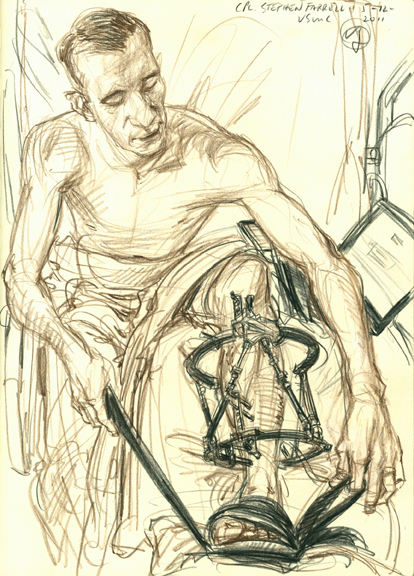
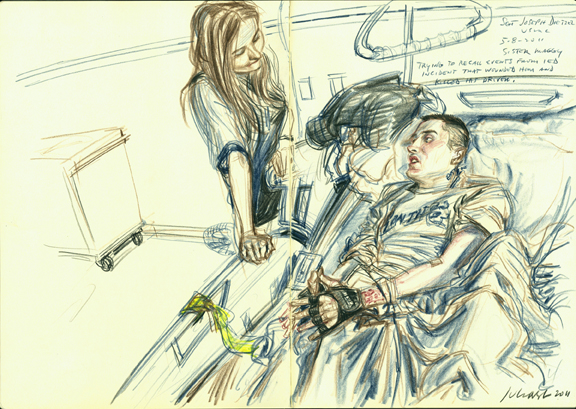
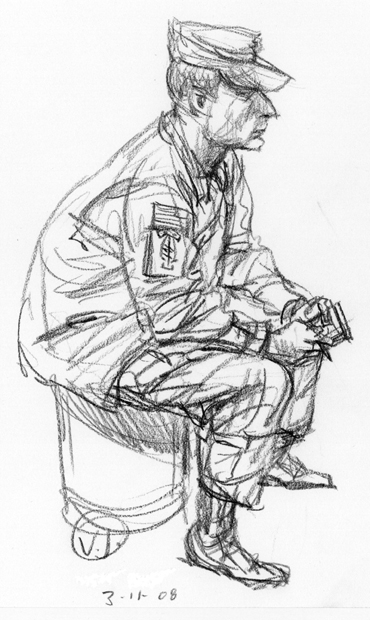
Illustration by Victor Juhasz

That November after Iraq, after all the surgeries on my leg, after I could get around with crutches instead of a wheelchair, after the bruising was only a memory and the concussion toned down to a few minor headaches that only bothered me in bright sunlight or movie theatres, I found myself in California again.

I was having a beer with my best friend, Greg, and his new wife, Chelsea. Greg was the creative director of a PR firm. He’d told me the name once, but I couldn’t remember. He seemed to jump companies every other week and all of their names sounded the same to me. The bar was his idea. He said that I needed to get out more and that he wasn’t going to allow me to spend my entire convalescent leave in my hotel room with the shades drawn. He was talking about his new hobby, real estate.

“You should look into getting something, Paul,” he said. “The market is totally stacked for buyers right now.”

“Right, stacked.” I stared down at his wedding ring. It looked like he’d won the Superbowl.

“I know you don’t have a lot of cash,” he said. “But I can put you in contact with some people. Pull a few strings, get you a good deal.”

“I’m still stationed in Hawaii, why would I want something here in California?”

“Investment. Besides, you aren’t going to be there that much longer, right?”

“I don’t know,” I said, sipping on my drink. Greg loved dark beer so we’d met at a British pub downtown. They didn’t have anything Mexican so when the bartender asked what I wanted I told him “Anything that isn’t the color of mud.” What I got was something that looked and tasted like overpriced Budweiser.

Greg kept trying not to look at my leg, at the brace I’m only allowed to take off in the shower. He was trying to be casual about it, but when you’re deliberately trying  not to look at something it’s that much more obvious. Chelsea wasn’t any better. With her slick, pageboy haircut and designer clothes she looked like someone out of a silent movie: Dorothy Parker in Prada. She kept staring at me and I wondered if she was going to say something. I wore a beanie to keep my head warm but you could still see the shrapnel scars on my neck. When I’d had enough, I looked directly into her eyes, smiling, and she quickly dropped her gaze to my arm resting on the table between us.

“That’s an interesting tattoo,” she said, touching the inside of my left forearm. Exposed from where I’d pushed up the sleeves of my thermal shirt was the black silhouette of a winged skull with crossed tridents behind it, the words Aut Vincere, Aut Mori in Latin below, USMC in Old English script above.

Victory or Death.

Greg looked out the window, watched rain spatter against panes, run into gutters.

“He’s got a bunch,” he said.

“Really?” Chelsea looked at me with new interest. Diamonds hung in her ears like stars.

“One or two,” I said.

“One or two?” Greg laughed. “Christ, what have you got, really, fifteen or sixteen now?”

“One less than I used to. The surgeons took care of the one on my leg.”

Chelsea looked down at her amaretto sour, back up at me. She had brown eyes with long, thick lashes that made me think of someone else.

~

My team was coming back from patrol. There were five of us in the Humvee: Ortiz was driving; Alexander, Weatherford, and Simone were in the back seat. I rode shotgun. It was surreal, the drive. We had just spent three days in the ass end of the city looking for insurgents. Sixteen hour patrols, trying to scrounge up any source of intel we could find, any sign of where the bad guys might be. Kicking in doors when people wouldn’t open them for us, staring into the faces of children and old men. People we terrified with our helmets and goggles and rifles. Now, here we were, after all that, stuck in traffic.

“Just like L.A., right Sergeant?” Ortiz said. “Just like home.”

“If this is what L.A. is like it’s no wonder y’all can’t fucking drive,” Weatherford said, reaching over the seat with his huge, dark hands and smacking Ortiz on the helmet.

I turned around and looked at him. “I’ve been to D.C., Weatherford,” I said. “It’s no fucking picnic either.”

“Too true, too true,” he said. “But I’ll sure as shit take the Beltway over this bullshit any day of the fucking week.” He reached into his IBA and pulled out a cigarette.

“Let me have one of those,” I said. He looked at me.

“Thought you didn’t smoke.”

“I don’t. Mission’s over, we’re in one piece, I feel like relaxing. That okay with you, Lance Corporal?” I was fucking with him by pulling rank. When there weren’t any officers around I never made anyone call me Sergeant. They were my friends, my team. Ortiz was the only one who addressed people by their rank, a habit he hadn’t broken yet, born of his time in Boot Camp and the School of Infantry the year before. More than once I’d told him if he didn’t relax I’d shoot him myself.

Weatherford handed me a smoke, then his lighter. “It’s your lungs, man,” he said. “But I will collect later.”

“Deal.”

Alexander said, “Don’t talk about being in one piece. You’ll jinx us.”

Weatherford snorted a laugh. “Fucking superstitious bullshit.”

“Whatever, dog,” Ortiz looked over the steering wheel at the crowds and traffic all around us. “It’s bad luck to talk about how good things are when we’re not back at the FOB yet.  It’s…” He thought for a minute. “Tempting fate.”

I took a deep drag off of my cigarette, coughed once, exhaled.

“See,” Weatherford said. “I knew you didn’t smoke. That’s a waste of a good cigarette right there.”

“Fuck you,” I said. “I’ll buy you more when we get back.”

“Damn straight.”

We drove another few blocks and traffic slowed to a crawl. There was some kind of accident up ahead. People shouting, waiving their arms. Some guy in a polo shirt and shitty slacks had a cell phone up to his ear. I finished half of my smoke, rolled down the window, and tossed it out into the street. We stopped at the edge of the intersection and that’s when I saw the woman.

“Heads up,” I said.

She walked out of a nearby building and made her way towards us. Everyone in the Humvee turned to watch. She looked left and right, nervous, taking small, hesitant steps across the pavement.

“Sergeant…” Simone’s voice from directly behind me. I could hear him adjusting in his seat to bring his weapon around and point it at the woman.

“Wait,” I said. “Just a second. She’s alone. Something’s up.”

I’d never seen a woman travel without a male escort in Iraq the entire time I’d been there. I had my own rifle turned outboard, the barrel pointing out of the window as she approached me. Plastic bags blew across the street like tumbleweeds. I kept the muzzle aimed at her chest.

Her body was hidden behind the black folds of her burka and all I could see were her eyes, dark brown against the pale mocha skin of her face. They were beautiful, with long, dark lashes and an intensity, an energy I’d never seen before or since.

“This is insane,” Alexander said. “She must need some kind of serious help or something if she’s coming to talk to us in public like this.”

“She must need food,” I said. “Or water. She must have kids.”

“Sergeant?” Ortiz motioned at the road ahead of us. The traffic had cleared. It was okay to go now. “We can tell Civil Affairs or whoever when we get back to the FOB. This is their kind of shit, not ours.”

The woman continued towards us, walking into the street now.

“Just a sec, Ortiz,” I said, reaching down to get a bottle of water and some rations from my pack. “COIN.  Hearts and minds, remember? Let me give her something and we’ll go.”

Then she detonated.

~

“Well,” Chelsea said. “You look pretty good, considering.”

“Considering what?” I said.

“You know.” She nodded towards my crutches, the brace on my right leg. I could sense her discomfort, wondered what she’d tell Greg in their car on the ride home. “Greg told me it was bad. You were lucky I guess.”

“Yeah, I’m lucky.” I said. “My leg? The docs at the combat hospital told me that it’s always going to look this way.” The skin was covered with long, erratic scars still prominent despite hours of skin grafts. “You’re right, Chelsea, I’m lucky. Lucky that I was ducking down behind the door of the Humvee when the blast went off. Lucky I only got “light shrapnel” over the entire right side of my body. Lucky I wasn’t looking directly at the explosion, like Ortiz, who lost his eyes, or Simone, who’d taken his helmet off right before we stopped and was killed instantly.”

Chelsea looked down at the floor. Greg leaned across the table towards me.

“Dude,” he said in a low whisper. “Relax. People are staring.”

I looked around and noticed that the bar had grown quiet. I took a large drink of my beer and felt my fists unclench, my heart beating in my temples. Chelsea looked at me, said something, but I couldn’t make it out. For a moment, everything became muffled, like I was underwater, and I wondered if it was the swelling in my brain coming back. The doctors told me to stay away from alcohol, but that was over a month ago, and I was only on my first beer.

“What?” I said to Chelsea in what I hoped was a quieter voice. Around the room people drank and laughed and shimmered in my vision. After a moment sounds became clear again.

“I said, ‘I’m sorry.’”

I finished my beer, stared at the empty glass, wondered if I should order another. Greg beat me to it. “Two more,” he said, flagging down a waitress as she walked by.

“It’s okay,” I said to Chelsea. “It’s just…”

“What?” Greg leaned in close, almost whispering. “It’s just what?”

“I ordered them to stop,” I said. “Ortiz, my driver, he hadn’t even been in the Corps for a fucking year yet.” I looked around the room, noticed a woman with long, straight hair the color of snow sitting at the bar across from our table. I watched as she drank a glass of white wine, waiting, hoping for her to make eye contact with me, but she never did. It doesn’t matter; I wouldn’t have known what to say to her. I remembered the blast, the way Ortiz’s eye sockets looked like they were packed with jelly, the sounds of screams that took me a long time to realize were my own. “Simone’s wife had a baby while we were over there. A girl.” I looked at Greg. “He never got to hold her, to meet her. All because I ordered them to stop.”

“You didn’t know.”

“I should have,” I said. “It’s not like it was the first time I’d been there.”

Back in my room at the Naval Hospital in Hawaii, a Purple Heart still sat in its box, unopened, on my nightstand.

“You need to think about the future,” Greg said. “About what you’re going to do next when all of this is over with.”

“I can’t think that far ahead.”

“Start.” He took another sip of his beer. “You talk to your dad lately?”

“He sends me an email every now and again,” I said. “You know my dad; he blames the president for what happened to me.”

“He may have a point,” Chelsea said.

I looked at Greg. “You know we’ve never been that close.”

“Yeah, well, I read somewhere that traumatic injury can change that.” He laughed. “Didn’t you used to go to the beach together?”

“Yeah, when I was a little kid. Jesus, I’d forgotten about that. When my parents were still married, we used to rent a cabin near Bodega Bay at the end of summer each year. What made you think of that?”

The last Labor Day weekend we spent together as a family before everything imploded, my father rented a cabin on the beach for us. It was so cold there, and I wondered how that was possible when it was still summer. On the last day, he took me down past the sand dunes and we walked along the shore, my feet numb and pink in the icy water. We went into the surf together and I held onto his leg as the waves crashed into us. I was small, just a kid, and I was afraid that the current would carry me out to sea. I don’t think my dad realized that, just by being there, he was saving my life. That just by letting me hold onto him, at the edge of the water, he was keeping me from washing away with the tide. It’s the last good memory I have of my father, and I can’t even see his face in it. Just the waves washing over us, my arms wrapped around his leg, and the sea stretching on forever to the end of the world.

“We spent a weekend up there about a month ago,” Greg said. “I remembered you used to talk about it.”

“It’s been years.”

“Call him. Let him know how you’re doing.” He dropped a bone colored business card onto the table in front of me. “And call this guy. I’m telling you, he’ll hook you up with a good deal on a house.”

“I’ll think about it.”

“Hey.” Greg leaned across the table and squeezed my arm. “There are other things you can do with your life, that’s all I’m trying to say.”

Even with all of the physical therapy I’d been doing, the doctors told me it could be months, maybe years, before I ever ran again, and that my military career was probably over. I’d never really thought about reenlisting, but hearing that I couldn’t made me realize that I wasn’t sure what I was going to do.

It didn’t feel right, me sitting there, enjoying a cold beer in a bar while people I knew were still overseas. Still patrolling at night, kicking in doors, looking for bad guys. Today, four civilian contractors were found on the side of the road next to their burned SUV, shot in the head, execution style, left to bloat and rot in the afternoon sun. Last week a truck full of Mississippi National Guardsmen were killed when their convoy drove past a car rigged with explosives. The week before that, an Air Force jet got the wrong coordinates and dropped a bomb on someone’s apartment, killing an entire family. They sent a Civil Affairs team to apologize on behalf of the United States, but there wasn’t anyone left to talk to.

We stayed for a few more beers and then Greg took me back to my hotel. The next day I flew to Hawaii where the Naval Hospital released me back to my unit. To the Rear Detachment. Everyone else was still over there. Still fighting.

~

During the next few months in Hawaii, where the entire world was a shock of green and blue, and high, wet heat that made my uniform stick to my skin, Command made me see the chaplain once a week. I nodded a lot. I told him I was fine. I said that I looked forward to my leg fully healing so that I could get on with my life. I said that even though the doctors figured out that my leg would heal, I knew my time in the Marine Corps was coming to an end.

“So, what are you not telling me, son?” The chaplain said. “What are you still afraid of?”

“Nothing,” I said. “It already happened.”

“You ever talk to anyone else about this? About what happened?”

“No, sir,” I said. “I’m okay, really. I’m fine.”

~

Today, at the barracks, in my room, there are a dozen emails on my computer. All of them from my father. All of them unopened. There are letters from Simone’s wife. Pictures of his daughter. A description of the funeral I couldn’t attend because I was still in the hospital. This morning, someone in Admin told me that Ortiz is doing better. He’s living with his mother in Baldwin Park, trying to learn Braille so that he can go to college. He turned twenty last month.

I open one of the emails from my father and it’s a photo of him and me when I was a kid. We’re standing on the beach. I’m all elbows and knees with a red pail and shovel in my hand, my father next to me with his arm around my shoulder.

I pick up the phone. I try to dial but I can’t. My hands are shaking.


Kevin Jones‘ work has been featured in The New York Times, Ink Pot, Prime Number, and the anthologies Home of the Brave: Stories in Uniform and Boomtown: Explosive Writing from Ten Years of the Queens University of Charlotte MFA Program. A former Marine, he lives on Florida’s Gulf Coast where he teaches writing and literature.

Image courtesy of The Joe Bonham Project and Victor Juhasz, artist

Read an interview with Kevin Jones here.


“Runner” by Benjamin Buchholz

Runner
Image courtesy of The Joe Bonham Project and Victor Juhasz, artist

“Grady sent me,” I said as Annie opened the door to her house.

She touched the corner of her mouth with two fingers. Her lips parted into a non-smile, a tension of soft, unusually nervous little muscles. Like Grady, Annie was older than me by a decade, a fact that didn’t decrease my blushing anxiety. Ever since I could remember Annie formed in my mind the very fixture of beauty: gilded in the warm autumns of so many homecoming dances she and Grady graced, silvered in the snow in her mittens and scarves when we built forts and snow-castles, honeyed in summer with a tan from the beach when we built bonfires and our father — Grady is my brother, you see — invented odd, rambling ghost stories greatly augmented by the looming canopy of forest so near to our cabin and the lake.

I had come with — well, not-exactly — news.  Or, rather, something Grady needed said, a thing he couldn’t say himself; and, Lord, how would I do it?

Very quietly, with her gaze boring into me, she answered me: “He’s alright . . .”

I couldn’t tell if she asked it as a question, or if she knew, or thought she knew, Grady’s condition. Statement or question, it didn’t matter. My job remained the same. Little brother, you must, for me, this once just go in my place . . .

I looked beyond Annie, suddenly uncomfortable. Her home, a bungalow, gleamed with dark, immaculate wood. No lights lit the interior, not the blue flickering of a television, not the warm glow of a reading lamp, not the fluorescence of a bright bank above the kitchen sink. On the porch, Annie’s swing shook in the sockets of dry chains fastened to the ceiling. A cicada buzzed and bumped against the inside of a colored-glass fixture above the door. Annie held a pen in the hand that did not touch her lip.

“He’s back,” I said. “But you knew that already, right?”

“I had heard,” she said.

“He sold the house.”

“Really?”

“And his car.”

She looked past me toward the street. Did she see the ghost of Grady’s old black Monza revving at her curb?

“May I come in?”

Not taking her eyes away from the street, she half-turned in the doorway and stepped away to let me pass. As I brushed along her, crowded in that frame, I smelled the freshness of peeled orange about her; on the beveled top of her coffee table, a rind. She dropped her hand from her lip at last to shut the door behind me.

I sat in the reading chair. She sat next to me on the divan and leaned toward me. Her legs, not crossed, she tucked together paralleling the contour of the plush cushions.

“He boxed up all his stuff, the pictures and trophies and fishing rods and tool chest and books and old shirts and pants and took them all to Goodwill.”

“He stopped by my mother’s house,” she said, “and they talked a little while. Nana didn’t think there was anything wrong.”

“It was ‘beef jerky,’ he said.”

“What?”

“Boxes of beef jerky. That’s what got to him the most.”

“In the desert?”

“Care packages, one after the other. I sent them. You sent them. Dad sent them. Beef jerky. Pringles. Jolly Ranchers. Magazines.”

“And, now he won’t talk to me?”

That was the pivotal moment. She had sprung it on me even as I was building toward it. I could do nothing now but blurt truth.

“He is simplifying.”

“Which, I suppose, I should take in a very bad way,” said she, though she didn’t tremble, or cry, or lose the deep tone of her voice. She still possessed an elegance, even in defeat. “I am 28 years old now, Dalton.”

“I know.”

“Grady and I have been together since the ninth grade.”

“I know that too. I remember when you first came over to our house.”

“You were only knee-high that first time I saw you!” she said, actually managing to laugh.

“Still, I remember it. They say, sometimes, when major changes happen in a child’s life, they’ll start to remember earlier than normal. Like if someone died or something.”

This was, perhaps, the closest I’d come to admitting aloud Annie’s profound effect on me. And, I said it to her directly. I was saved: she smiled. Dreadful elegance, be damned! Was that all there would be, a smile? But she touched her fingers to her lips once again, to that same corner of her mouth, the worried corner, and said very softly, “Thank you.”

Somehow, the ‘thank you’ broke the awkwardness perfectly. We were again little brother and Annie, just like always.

“Simplifying?” she asked. “Is that what he couldn’t tell me himself?”

Down the street a truck rumbled beneath the canopy elms, spearing through a tunnel of its own sound and then disappearing.

“Actually, more than that,” I said. “He hasn’t really spoken with any of us, not too much, or — when he does — it is pleasant, formal, hellos, goodbyes, pass-the-milk-please. Until last night. I got home late. You know Amanda Wills?”

“Derrick Wills’ neice?”

“Yes.”

“I’ve been dating her since Christmas, or a little before that.”

“That’s wonderful,” Annie said, and she meant it.

“I brought her back a little late to her house, got back to my house even later. As I came up the porch I thought I was in deep shit when I saw the rocking-chair in motion through the window and a light still on in the living room.”

Annie said: “Grady and I were always late.”

“It was my first violation of curfew. I thought mom had waited up to scold me. But it was just Grady. I came up from behind him, trying to tip-toe past him, still uncertain if I had been caught.”

He didn’t turn to face me but said, kind of over his shoulder, “One time, kid, she told me why she did the things she does. She actually explained herself. It was amazing. She said that good people are boring.”

“What you talking about?” I asked.

“Doesn’t matter. Boring. Like concrete-block-boring. That’s what she said.”

“Grady, what the hell are you talking about?”

“Running naked around the elementary school on a dare. Sex in the dark of the gym, breaking in, a school night, play props built up like a castle around us and left there for the janitors to wonder about in the morning. Bonfires and tequila on the beach. Kissing her girlfriends to amuse me, to tease me. All meant, downright meant, to be bad.”

Annie didn’t even blink.

I kept on telling her what he had said.

“Then worse than that in college . . . I’m sure you can imagine, or better than that, depends who you’d ask. A wild time until I was gone and could breathe without her for the first time and then I wasn’t so sure. The world seemed changed and dim.”

“I think you are over-reacting,” I said. “That’s what we all think . . . she’s not that way anymore. She even goes to church most Sundays. Why haven’t you stopped in to say hello to her?”

“It’s not that simple,” he said. “Beef jerky.”

“Beef jerky?”

“I lived out of a box for four months as we moved up, building-to-building, into Baghdad. Everything I needed was in that box. I’d kept a journal of it all, immaculate, with drawings, and poems, and thoughts about her, and I meant to give it to her. That’s what I was going to do when I got back.”

“And?”

“If it had been dramatic, I think it would be more worth telling about. The box, it was just an MRE container. Old shitty box. Looked like scrap. Our squad moved out of a burnt-out grocery and up the street four blocks to a clinic. New HQ. And my sergeant threw that box out in the trash.”

“Shit,” I said, not knowing what to say.

“It was the best thing that happened to me over there.  I realized I didn’t need the beef jerky. I didn’t need the comics dad clipped and sent. I didn’t need the journal. I didn’t need the pictures I’d kept in my Kevlar since Kuwait.Simple.”

I paused.  That was the end. That was all Grady had said, the whole of the story I’d been sent to tell her. Actually more than he’d wanted me to tell her. But, after a moment, when Annie didn’t say anything or move or ask me any questions, I said: “Just give him time. It’s a phase.”

“No it’s not,” Annie said.

“It’s not?”

“No. Not for me.”

She didn’t seem sad, not really. Just steely. Quiet and steely.

“Why not?”

She took a second, gathering her thoughts, then leaned forward toward me in a way that was almost frightening. After a good long moment looking at me, she said, “Because I never ran naked anywhere in my life.”


Benjamin Buchholz’s debut novel “One Hundred and One Nights” (Little, Brown, 2011) has just been released. He also writes on Middle Eastern culture and oddities at his blog “Not Quite Right.”

Read our interview with Ben Buchholz here.


“Last Battle Aboard the Old Pro” by Jeffery Hess

Last Battle Aboard the Old Pro
Image courtesy USAF Art Program, Victor Juhasz, artist

Walberg punched a fist into his open palm and said, “I’m going to hit you so hard, Rudy, you’ll be too fucking numb to feel anybody else.”

He sat atop the workbench that ran the width of our workshop aboard the USS Proteus, his legs hung over, boot heels kicked into the sliding doors below. He was a tall, skinny guy from Long Island who always carried a copy of Mother Earth News folded in his back pocket and a pack of Winston menthols tucked into his sock.

Craig, a doughy Midwestern kid with big ears and Navy-issue glasses, leaned against the workbench and laughed at Walberg’s threat. He was Walberg’s best audience.

“Fuck that,” EM1 Wallace said with a condescending nod. He was leaning against the electrical switchboard. EM1 was my boss, the first black man I’d ever worked for. He looked more like a linebacker or a prison guard than a First Class electrician’s mate. He paused to scratch his chest then said, “You got a better chance of banging Madonna than you got of punching him harder than me.”

We were hanging out in the Sparky shop between knockoff and the dinner whistle aboard the Old Pro. This usually entailed a couple of us shooting the shit and generally dicking the dog. We were at sea. It was our first day out in more than six months. It was also the eve of a promotion for which I was long overdue.

Anyone aboard, E-4 and above, was allowed to punch me once. Tacking on my chevron. For most sailors, it was largely ceremonial.  A right of passage like fraternities in college. But there were others in it for the sport. I couldn’t blame them. There aren’t that many opportunities to hit someone, completely without repercussions or reprisals.

I’ve heard stories about guys who couldn’t raise their arms above their heads for two weeks and a couple urban legends where blood clots set in and killed the newly promoted guys in their sleep. I didn’t really believe that shit. From what I understood, the more people liked you, the harder they hit you, to earn your respect.

Craig said, “You better pull out the needle and thread. You’ll be Betsy Fucking Ross for the next couple days sewing on your chevrons.”

“Don’t go spending that extra money right away,” Walberg said. “They can take up to a year to start paying.”

The jump in rank promised $160 more per month. I didn’t have a wife and kids, but I was responsible for a family back home.

 ~

Whenever a new guy arrived, the squid assigned as his Ship Sponsor would ask, “How long’s your sentence?” No matter the reply, the Ship Sponsor always said, “It’ll seem longer.”

Most of my shipmates considered it a prison sentence, being stationed aboard the Old Pro. The ship was homeported in Apra Harbor, Guam, and we called it “the rock” because of its similarities to Alcatraz. The compressed land mass seemed to shrink daily; escape was virtually impossible, even when out at sea because they always had to come back to homeport. These squids referred to their massive ship as “the yard” because it was a cluster-fuck of iron and steel stretching the length of two football fields. They called the Chiefs “Hacks” as if they were prison guards. Captain was their Warden.

What the others considered imprisonment was freedom to me.

 ~

The shop was cold from the freestanding, five-ton AC unit that sat along the far wall. It offset the heat put out by the switchboard and the transformers for the GYRO navigation equipment up on the bridge.

Walberg hopped down from the workbench and walked toward EM1. He slung his arm up, but his reach was only halfway across the man’s broad shoulders. “Okay,” Walberg said. “I’ll admit that Rude’ll be crippled when you hit him, but please let me hit him first so he feels us both.”

Hixon sat on an overturned garbage can. He had been quiet, which wasn’t like him. When he had too many Mountain Dews, he was like one of those dogs that jump on everyone as they enter the house. This was his first cruise and I didn’t know if his change in demeanor was from seasickness or if he was just all fucked up over having to leave homeport. Neither made sense because he wasn’t missing anything back on Guam and so far, the seas had been smaller than some waves I’ve made in the toilet.

“At this pace,” Hixon spoke up, “you’re on pace to retire an E-5.”

Craig and Walberg said, “Ooh,” in unison.

EM1 looked at Hixon, said, “Damn,” and lowered his hand from the switchboard to cover his mouth.

My promotion was overdue because I’d gotten in a little trouble: once for missing a one-day ships movement because a Korean chick’s alarm clock didn’t go off, and once because I drank too much and got caught urinating publicly, on sacred Japanese land in Sasebo. I had also failed the Third Class Electrician’s Mate test twice. I knew my job. My performance evals listed me as a solid journeyman electrician, but even in school I was never good at paper tests. Ask me a question and I can tell you the perfect answer. Put me on a job and I’ll get it right the first time. But seeing the multiple choice answers in black and white, even at twenty-three years old, made them all look the same. I was still stunned that I’d guessed correctly enough times to finally pass.

Hixon said, “You’re as old as a canker sore at a nursing home.”

Coming from EM1 that would have been funny because he was older than me. Coming from Craig, it would have been funny because he was younger than me. But Hixon was my age and has held that rank for almost a year. He smiled his unhappy Tennessee smile.

This was my fourth cruise in almost as many years, but I was the lowest man on the totem pole in our workshop. All the others treated me as an equal. Hixon was the only one who showed me no respect. Fucker. While I was sweating it out in the fleet, he was sitting pretty in some fancy “C” school in Chicago. The difference meant something to squids like me. My uniforms had the grease and bloodstains while his were new and starched and loose around his arms and neck.

One more day and he wouldn’t be able to tell me what to do any more.

I said, “Shut up, Hixon. You’re as useful as a deck of cards at an orgy.”

He pulled out a modest wad of cash.

“Where’d you get all that money, Hixon?” EM1 said.

“Since we’re at sea, I’m saving money by jerking myself off.”

“I bet you are, fucking pud puller,” I said.

Stuffing the cash back into his pocket, Hixon said, “But tell your mother I’ll make it up to her when we get back.”

I pointed and said, “Don’t talk shit about my mother , asshole.” I hated the sonofabitch and for all I knew he hated me, too.

Hixon reached his hand out, slowly, almost playfully, toward my face. I didn’t feel threatened, didn’t move. In the next instant, his hand touched my face and he pushed me away, like a stiff-armed running back.

I heard noises in my head like tree branches or wooden boards cracking. My throat burned and my mouth grew pasty. I exploded with as quick a punch as I’d ever thrown.

The punch didn’t land as squarely as I would have liked, but my third and fourth knuckles throbbed instantly. The blood that streamed from Petty Officer Hixon’s nose surprised me.

He back-pedaled, bent at the waist, his arms out wide, hands shaking like a woman with wet finger nails. For a second I thought he was going to cry. Blood poured from his face. He reached up with shaking hands and smeared his cheeks. “My nose,” he said without inflection. An instant later, he called out, “Mercy be.” He doubled over, dripped blood onto the blue electrical safety mats with the faded USS Proteus pie-shaped emblem: “Prepared, Productive, Precise.”

“Pinch that snot blower of yours and lean your fucking head back,” EM1 said folding his arms across his chest.

By the time Hixon complied, a puddle had formed at his feet.

Hixon looked up at me. A stream of snot ran from his swelling nose. There was blood in the snot that hung from his right nostril. None of us spoke for a minute. The 400-Hertz generators hummed on the opposite side of a watertight door.

I stuffed my hands into my pockets and said, “No. Shit no. I didn’t just do that.”

EM1 said, “Well if he ain’t going to hit you back, you better get him up to sick bay right quick. That nose is fucked. And get back here to clean this shit up.” He pointed at the puddle.

Our shop was below the waterline. Sickbay was six decks up. “How am I going to get him  there without anyone seeing us?” I asked.

“You’re probably not.” EM1 said. “But on the way, ask him real nice if he’ll tell Doc that he fell.”

 ~

Hixon’s mouth was moving. The sounds he was making weren’t words, exactly. Not yet. They soon would be, I figured.

He whimpered and stopped at the hatch as if he couldn’t go on. I’d been busted in the nose plenty of times. Had my jaw broken after senior prom. Spent the remainder of the school year, and graduation, sipping shakes and beer through a straw because of it.

I was going to get locked up in the brig. The ship’s brig, “Hell” as all aboard called it, sat in the bowels of the ship. It had four cells with iron bars and was run by Chief Master at Arms Halsey, a fire hydrant of a man who once ran PT boats in Vietnam. He was thick with muscle, head shaved clean, with a heavy Louisiana accent. He sported the scales of justice tattooed on one forearm and a guillotine on the other and he squinted as if he perpetually had smoke in his eyes.

In the vestibule outside the shop, the rich and meaty smell of Sloppy Joes was as dense as a fart in the berthing compartment. It filled the passageway. It was dinnertime and most of the crew was on the mess decks for chow.

At the ladder, Hixon balanced his hand under the yellow stream jetting from his nose. I didn’t know if this was because he didn’t want to soil the deck or if he wanted to save it as a souvenir. “What the hell is that disgusting thing, anyway?”

“I don’t know,” he said, he held his fingers against his cheekbones as he angled his head down to see the first step. “But I fear it’s not a good sign.”

“Let’s go,” I said and tugged on his arm. The sleeve of his work shirt tore a little, the seam popping at the shoulder.

“You’ll have to help me,” he said.

I could have kicked him in the face. “Hang on,” I said, and took him by the arm.

He moaned as we took the next step. The groan came out low and guttural, so feeble that I wanted to laugh. “Quit your bellyaching,” I said. “I didn’t punch you in the legs.”

“I’ve never been punched in the nose before!” he said, still pinching the bridge of his nose.

“How can that be possible?” I half-dragged him up the ladder. “There must have been lines formed to do that since you was a kid.”

“I’ve never been in a fight before.”

All I saw when I looked down at him was the delicate white fingers he used to pinch the bridge of his nose and the yellow thing still dangling. I’d seen him in berthing every day for six months. He took off his t-shirt by slipping out the arms first and then pulling it over his head. The only guys I knew that did that were raised by single mothers.

His hands were small. They reminded me of my sisters.

The other day, over the phone from a half-booth on the pier, I told my mother I’d be sending home extra money. “Why?” she asked. “You gambling again?”

“No ma’am,” I said. “Because I’m advancing a payscale. I’m making 3rd Class.”

“It’s about time,” she said. “Your sister’s in rehab again. That shit cost money.”

I wasn’t allowed to backtalk. Back home I wasn’t allowed to be rude, to anyone. The town I grew up in was the two-stoplight variety with only one school, one store, and two thousand staring eyes. But after a couple years stationed aboard the Old Pro, I’d transformed myself into Rudy. I’d bulked up twenty pounds. I kept my hair short and a moustache a millimeter within regulation.

I’d joined the Navy for the steady paycheck, but also to get away from my mother and sister. I hated them both because my sister was the light in my mother’s eyes and that girl was never anything but trouble. She used to put pots and pans over my head and beat them with wooden spoons or spatulas. She was eight years older and mean as hell well before she found her way to speed and cocaine.

 ~

By the time I got Hixon to the next ladder, I expected the yellow thing to drop like an icicle from his nose, but it didn’t. His face was whiter now than his hairy knuckles. This is when I knew it wasn’t just snot dangling there.

A gust of wind blew the watertight door back into me as I opened it to the main deck. It took a good push to get it open while holding up Hixon with one arm, pushing with the other. Air rushed us once we made it to the main deck replacing the food smells of the mess decks with diesel fumes. Waves broke large enough to elevate spray that darkened our chambray work shirts. The last time I’d been topside, all conditions were calm.

Air on the main deck of the ship was different than it was below. It was easy to forget how bright sunlight actually was when you didn’t see it for a couple days. Being on the main deck, we were halfway to sick bay and I had to squint in order to see. The Boatswains moved in the sunlight – they gleamed like ghosts. Little bursts of sunlight glittered off their heads. Gulls cried overhead. One of the Boatswains reared back and spit over the side and dropped to do pushups on the deck.

“I don’t feel so good,” Hixon said, grabbing the life rail and collapsing his weight onto a mooring bollard. His voice was pitched higher now. “But thanks for helping me.”

“Helping you?” I said.

“I know,” he said, lowering his head between his knees as if to stop nausea. “You were ordered to.”

“If it wasn’t for me, you wouldn’t need to go to sick bay.”

“But orders are orders,” he said, pulling his head up, resting his elbows on his knees. “And they’re what’s really important.”

“What’s that supposed to mean?”

Hixon said, “What if we crossed paths out here with a Russian Destroyer? What if they launched on us? What do you suppose Reagan would do?”

I’d seen the movie “Patton” when I was a kid. In it, George C. Scott had said something about fighting the Russians right then because if they didn’t, we’d have to eventually. “He’d vaporize as much of the USSR as he could.”

“Exactly. And what if we fired on that ship first?”

“I reckon they’d vaporize the US. That’s why we always had them drills in school.”

“Exactly my point. All those drills. All the drills we’re forced to do on this ship. Do you think they’re just to kill time? If the Russians send a plane, we could be torpedoed in an instant. They got this fucking bird, the KA-27 Helix with counter-rotating triple-blade rotors. Those fuckers are anti-surface and anti-sub. Torpedoes and depth charges. They could search and destroy us on both fronts. They could be looking for a hot nuke and we could end up collateral damage.”

“You’re exaggerating,” I said.

“They’ve got Kirov cruisers that’ll do 40 knots. They got vertical launch missiles and anti-surface shit you can’t imagine.”

“They’re not going to use that shit against us. Nobody wants World War III.”

Hixon leaned forward, letting that yellow thing dangle. “Just in case, I’d rather have shipmates that didn’t hate me. If any shit goes down, hard feelings might make us react on attitude instead of our training. We can’t risk that.”

“If anything goes down tonight, I’ll be in the brig and no help to anyone.”

“I won’t say anything,” Hixon said. “I fell into the switchboard. Hit the switch for the 400s. That big nasty red one. That’ll work.”

“You’re fucking with me now.”

“I’m not. Seriously.” He looked up at me. “I won’t talk.”

“Why would you do that?”

“You’re my shipmate.”

“Don’t fuck with me, Hixon. If you’re going to be a dick, just rat me out. I don’t care.” I stopped for a minute and looked over the railing at the water breaking white at about four feet. “I suppose you want me to stand your watch or take your duty once a week for the entire cruise.”

“And make my rack every day…”

I wanted to punch him again.

“How about I do your laundry, too?” I said. “And buy you sodas.”

“Now you’re talking,” Hixon said, pushing himself to stand.

“Anything else?”

“I’m just fucking with you. I don’t want that stuff. All I want is you to hang around with me at chow and go with me on liberty.”

“That yellow thing dangling there must be part of your brains.”

“You might be right, Rudy. You agree to the terms?”

“And I don’t have to do none of that other shit?”

“Nope. That’s it.”

“Fine,” I said, though I would have rather been his servant than his friend.

Hixon held out his hand. I gripped his delicate fingers and he winced, trying to pull his hand away. I squeezed as if it could choke him.

~

The Boatswain’s mates packed it in for the day; their grinders quiet, their chipping hammers still. Most of the crew was at chow and it was quiet on deck. I turned around and grabbed the life rail in my hands, squeezing until my knuckles cracked. Suddenly the oppression the others had felt aboard the Old Pro overtook me. This salty bucket of shit was now my prison, too.

Befriending Hixon was a one-way ticket to alienation and unspecified rations of shit. The idea of having to break bread with him every meal repulsed me to the point that I feared a dramatic and deadly weight loss. And I knew immediately how impossible it would be to pick up women with him as a wingman. Unless he paid for a working girl, there was no chance. I’d never paid for it in my life and I wasn’t about to start now. And I sure as hell wasn’t going to go the whole cruise without getting any.

With every remaining ounce of energy I yelled, “Come and get me, you filthy fucking Ruskies.” I yelled more and louder expletives. “We’ll kick your fucking asses all the way back to Siberia.”

There were no ships visible on the horizon. Nothing but water.

I got Hixon up. The dangling yellow thing swayed as he got to his feet. I could have puked. “Hey,” I said.

Hixon’s head swiveled slowly, the dangling yellow thing moved with him.

“Either pinch that thing off or snort it back into your fucking head. It’s making me sick.”

Once inside Sick Bay, the chief corpsman looked up from his crossword puzzle. My vocal chords were raw from the abrasive salt air as I said, “Doc, call Master at Arms Halsey” and then told both of them the truth.


Jeffery Hess is the editor of Home of the Brave: Stories in Uniform, an anthology of military-related fiction. He holds an MFA in creative writing from Queens University of Charlotte and his writing has appeared in numerous corporate publications and websites, as well as in r.kv.r.y, Prime Number Magazine, The MacGuffin, Plots with Guns, The Houston Literary Review, the<em > Tampa Tribune, and Writer’s Journal. He lives in Florida where he leads a creative writing workshop for military veterans and is completing a novel.

Read an interview with Jeff Hess here.

“Last Battle Aboard the Old Pro” first appeared in The MacGuffin in slightly different form.