“Breathing Without Air” by Leslie L. Nielsen

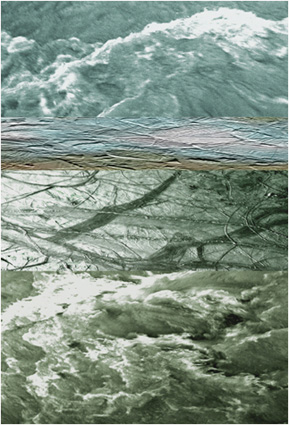
Breathing without Air (Glacialwaters)
Glacial Waters (BC/Jupiter), Direct Digital C-print by Karen Bell

WARNING: To avoid danger of suffocation keep this bag
away from babies and children

Keep this bag close to you, adult:
you are a visitor clutching her coat, a limp crooked accordion-fold fan
against your thudding chest,
the person you’ve come to see has apparently been
moved elsewhere, rescheduled, released—so you wait, rehearsing
what you’ll say
although you are free to go—there are cabs
in the street and a bus stop at the corner,
it’s just a short walk home,
but if you linger—well, perhaps the bag
is all you’ve got.

This bag is a danger to others, it is
like a safari net weighted with rocks on its circumference, flinging
from a tree
onto innocent wildebeests or leopards, it is
a noose, a drowning, a body count—
it might have carried explosives
that, upon exploding, leave behind exotic toxic wind and powders
choking bystanders—
you are watching this on video in a darkened room, your wings
folded, feathertips across your knees.

In the event of emergency this bag is not an adequate flotation device—
you are too substantial, it will not keep your head above
water, it is not a pool toy
but if you are sinking and no one
is around to rescue you, or if you have sunk
into a nosedive, the cracks in the sofa, the river of forgetfulness, quick—
before you lose awareness
put your head in the bag,
listen to what it calls you, the way you hear your name, the name
of your dog, the name your mother chose for private parts,
the name you wish to see on your grave—
take slow shallow breaths and you will survive.


Leslie L. Nielsen, originally from Ohio, immigrated to Denmark in 2013 where she continues editorial work for Poets’ Quarterly and River Teeth Journal. Her poems have appeared in journals such as r.kv.r.y., The Missing Slate and Literary Mama.  She holds an MA in English Literature from The Ohio State University and an MFA in Poetry and Creative Nonfiction from Ashland University. She teaches writing, leads workshops in creativity, and occasionally blogs.

Read an interview with Leslie here.
“Sleight of Hand” by Mickey J. Corrigan

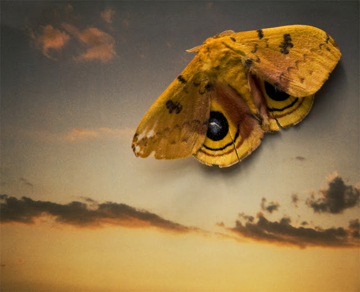
Sleight of Hand (Moth on Polaroid Sky)
Moth on a Polaroid Sky by Karen Bell

All warfare is based on this:
deception. Tonight, your mask
alcohol and brass and disarray
to hide your self-impersonation.

Mahogany bar, sports on twelve
flat screen TVs.
Happy hour cheese
hard to the touch.
Tiny cold
hot dogs on sticks.
Drunks laughing,
your face
unreadable,
gaping mouth socked,
duct-taped eyes full
of ancient shadow.

You’re growing older
younger
than your parents did.

You pose, display what’s on tap
for the night. Bog woman.
Out of your black cave
into the ragged firelight.

Now you see her, now you don’t
see a woman in a bar,

You are the retribution artist
dead rabbit in your hat,
bloodied rags up your sleeve.
Pull out
a moment of distraction, false
impressions, fake confessions,
jokes
on you.
Now you see it
now you don’t,

the usual toast
just another wet defeat.

Always, a man appears
out of nowhere
lacking the gold doubloon
of his own mutiny.

He slides over, leans in,
handsome after three drinks
delightful after more.

You: up for whatever
comes after that.

You call the shots.


Mickey J. Corrigan publishes pulpy fiction with presses with names like Breathless, Champagne, and Bottom Drawer. Her most recent novella is the spoofy romantic comedy F*ck Normal. A coming of age novel is due out later this year. Poetry and short fiction have appeared in literary journals. Visit at www.mickeyjcorrigan.com or on Goodreads.

“To His Wife” by Mark McKain

To His Wife (mars_va)
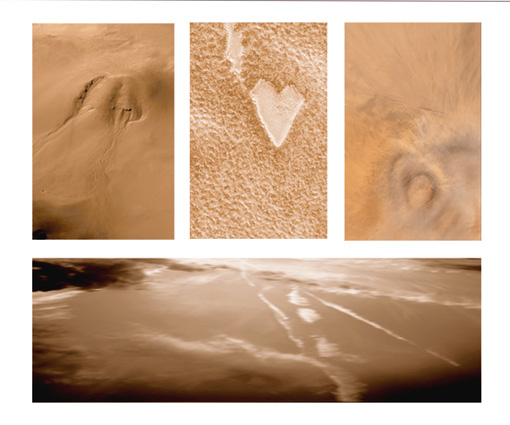
Mars/VA Sampler, Direct Digital C=print by Karen Bell

If you could see them in the thousands,
doll-eyed, dressed in body-fitting uniforms—
are they even birds?

They love the zero degree, the chase of squid and krill.
Springing onto the beach, they flap, preen,
gossip in groups, then begin the trek to stony outcrops.

(Yes, they waddle. Yes, they sway like a bowling pin,
falling. They could out race you up that hill,
gloved feet built for snowy ascent.)

Glaciers and leopard seals watch their march
as the colony blares its complaint; eggs,
chicks, regurgitated fish, ammonia-

reeking shit, binding pebbles and down
as the adults sing HATCH HATCH HATCH
loud as a great refinery,

bold experiment in penguin replication.
We have not replicated. We are the comet,
the alien invasion, the avant-garde

of billions who do not love basalt,
thousand-foot ice sheets; have no blubber
against impossible cold, fear sky-veined bergs,

blue foggy light, the season of night,
leviathans wagging a monstrous tail.
If you were here, holding my hand

like those crossed wings, listening to love calls,
we would pray to Darwin, whisper to our DNA,
implore our worse, our better instincts—

let them live!


Mark McKain has had work appear in The New Republic, Agni, Subtropics, Cimarron Review, The Journal, American Letters & Commentary, Cortland Review and elsewhere. He was recently awarded a Writing Fellowships at the Virginia Center for the Creative Arts. The Center for Book Arts published a limited edition Broadside of his poem “Wild Coffee,” and he is also the author of the chapbook “Ranging the Moon.” He teaches screenwriting at Full Sail University in Orlando, Florida.

Read an interview with Mark here.

“Starry Night” by Jillian Ross

(Vincent Van Gogh – 1889)
“There is no blue without yellow and without orange.”

Starry Night (Vision Fire)
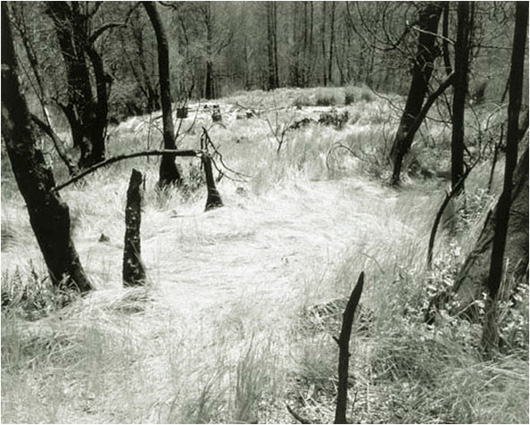
Vision Fire, Inverness Ridge, CA, Gelatin Silver Print by Karen Bell

Sheltered in cypress,
the pastor’s son clings
to the trunk of his faith.
Lightning grabs the night sky,
fires off a brilliant chaos.
Stars flow in whirling rhyme
from the white spire of truth.

Elastic rhythms reassure him,
but his mind cannot sustain
bright hope. Trembling
at the crackling sabotage,
he weeps as his wild symphony
disintegrates. Bewilderment
cowers in the closet of despair.

Elixir—a green glide through
aqua sky to amber field.
Stained hands clench
the revolver aimed inward.
For two days, life leaks
through quiet hands as
heart fails, mind dissolves.

Epiphany—he soars
into his starry night
soothed by a maze of grace
through stained glass tunnels
where all his colors meld
into pearlized reunion with the Son.
Sheltered here, Vincent shines.


Jillian Ross is a perennial writer and garden designer. She finds writing—like design—to be a combination of art and craft, enhanced by a dose of inspiration. She strives to combine these elements in her work and keep the weeds under control. Jillian earned her MFA in Creative Writing at Fairfield University in 2013. Her work has appeared in Dappled Things, The Noctua Review, Dogwood, The Penwood Review, Extracts, Poetry Quarterly, Mason’s Road, Weston Magazine, The Country Capitalist, Fairfield County Life, and Connecticut Gardener. Jillian lives in Connecticut with FaxMachine and CopyCat, mirror-image tuxedo cats who are fascinated by the working sounds of technology.


Read an interview with Jillian here.

“Age of Consent” by Bill Glose

Glose (Garden Path #2 - Versailles
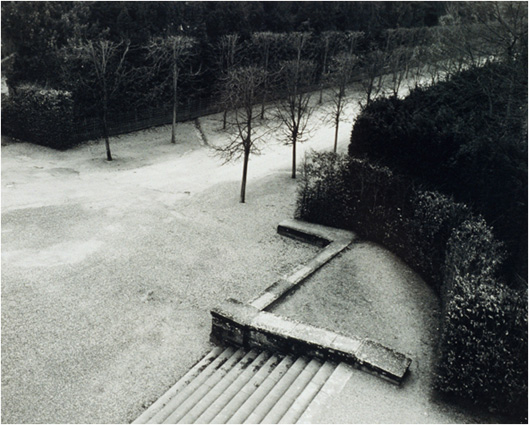
Garden Path #2, Versailles, Gelatin Silver Print by Karen Bell

Easy to forget how young I was
when asked to kill or be killed.

The past is a window caked with
ashes of spent years. Tutankhamen

clasped his first golden scepter
at ten. Released it at nineteen.

Framed by a striped Nemes headdress,
face on his sarcophagus is confident,

wiser than time. Our own pyramids
were built atop recruits fresh

from high school, more comfortable
holding a rifle than a razor. Wars

are always fought by children. A kid,
once dared, will leap from a rooftop

into a pool. Regret is a word
in dictionaries of old men.


Bill Glose is a former paratrooper, Gulf War veteran, and author of the poetry collections Half a Man (FutureCycle Press, 2013) and The Human Touch (San Francisco Bay Press, 2007). In 2011, he was named the Daily Press Poet Laureate. His poems have appeared in numerous publications, including Narrative Magazine, Chiron Review, and Poet Lore.

“Scar Tissue” by Carrie Krucinski

Scar Tissue (Krucinski)

It’s been 8 years since
I’ve been down aisle 5
at Walgreens. Shaving Cream/
Razors/Aftershave. I don’t need
a soothsayer to tell me
Gem razor blades cut
my skin like butter.
The pharmacist looks
at my prescription.
I don’t look her in the eye.
My mind meanders to
bacitracin, bandages,
sewing kits. I just have
to pay for my meds
and make it out the door.
Addiction is addiction,
mine is rooted in blood,
stitches, scar tissue that
will never leave me.
My arms tell of a thousand
year sadness; 40 years may
be left in this life;
Nirvana isn’t eternal.


Carrie L. Krucinski lives in Elyria, Ohio with her husband, Steven, and bulldog, Watson. She earned her MFA in Creative Writing from Ashland University and teaches English at Lorain County Community College.

Read an interview with Carrie here.

“Labradorite, or Black Irish” by Kyle Laws

Labradorite (Kyle Laws)

Turner Ray says about the dark, perfectly smoothed stone
that he holds in his hands that scientists have discovered
mountains on the moon with exactly this composition,
that it’s believed the moon was once part of Earth, and
when struck by an asteroid spun off, but not far enough
to be out of the same orbit. It remains attached by a thread
of gravity where it exerts influence—the pull of tides.

The philosophical connections are enough for an afternoon’s
thought, but what lingers is that first trip to the dermatologist
when she took one look at me, and announced to the intern
shadowing her, Black Irish, keep an eye out for them, very
susceptible to skin cancer.
Never having heard the term,
it didn’t sound like a compliment. And maybe because
of the look on my face she followed with, You know,
the Elizabeth Taylor look—pale skin, almost black hair,
and piercing eyes in shades of blue, some almost violet
like Elizabeth’s.

Better, but Black Irish haunts me, as does the labradorite.
Turner Ray tells me to hold it up to the light so I can see
the variations, how on the glass at the back of gallery
it looks black, but with light, colors of gold and green
appear, and chips of iron welded into its formation.
A stone that started on Earth went to the moon,
how the Irish in exodus after the famine must have felt,
and when they landed after 11 to 12 days in steerage,
it was what was whispered of them, black, like the scars
on potato they could no longer eat.


Kyle Laws poems, stories, and essays have recently appeared in Abbey, Anglican Theological Review, Cities (U.K.), Delmarva Review, Eleventh Muse, Exit 13, The Final Note, IthacaLit, Journey to Crone (U.K.), Lummox, The Main Street Rag, Malpaís Review, The Más Tequila Review, Mead: The Magazine of Literature and Libations, Misfitmagazine, The Nervous Breakdown, Pearl, Philadelphia Poets, Pilgrimage, and St. Sebastian Review. Collections include My Visions Are As Real As Your Movies, Joan of Arc Says to Rudolph Valentino (dancing girl press), George Sand’s Haiti (co-winner of Poetry West’s 2013 award), Storm Inside the Walls (little books press), Going into Exile (Abbey Chapbooks), Tango (Kings Estate Press), and Apricot Wounds Straddling the Sky (Poetry Motel’s Suburban Wilderness Press). She edited two volumes for the Pueblo Poetry Project—From the Garret on Grand: On Miss Lonelyhearts and the Virgin of Guadalupe and Midnight Train to Dodge. She currently is editor of Casa de Cinco Hermanas Press. www.kylelaws.com

Read an interview with Kyle here.

“Tilt” by David Faldet

Tilt (Faldet)

Parking against the bushes,
she leaves the drive clear
to the garage: three years
since she took away his keys,
a year since she sold the Sierra
he parked behind the door,
half a year since he moved
to that long corridor, “the Meadows,”
where his mind wanders,
and for the first time in nearly
six decades he sleeps alone.

Out the front picture window
of the house he left behind
the three great leafless branches
of a single flowering crab grow east,
away from the scar to the west
at the center of a swell of earth
where the second crab was set,
the shaded one, twelve feet
from the mate –  into which it spread
for 57 years and, taken out,
left tilted away from nothing visible.


David Faldet’s poetry has been published in such journals as Mid-American Review, The Midwest Quarterly, Ekphrasis, Arion, and Sow’s Ear Poetry Review. His book Oneota Flow, a natural history of the Upper Iowa was published in 2009 by University of Iowa Press. He works and lives in Decorah, Iowa.

Read an interview with David here.

“The Body of an American Paratrooper” by Ashaki Jackson

The Body of a Soldier
The body of an American paratrooper killed in action in the jungle near the Cambodian border is raised up to an evacuation helicopter (Henri Huet, 1966)

This body:
a question and broken
compass  North-pointing or ascending
and bruised like a savior

I mean the body is dead

Fully-clothed and suspended in a truth-
ful place

When I say truthful   I mean honest

as skin                                                          {A loose
tongue}   I’m saying
“obvious”   The body hides
nothing but prayer and low tide

retreating all
its breathless melody   Now: stiff
slow in its arch   I swear he is a black-
necked stork cascading

So sure   his mother will open
her wide-mouthed wail   jowls brimming
with iridescent plumage   Her body too

passing through
surrender


Ashaki M. Jackson is a Cave Canem poetry fellow and a member of the Voices of Our Nations Arts (VONA) writing community. Her work has appeared in publications including Eleven Eleven and Suisun Valley Review. She is also a social psychologist who works with teen girls throughout Greater Los Angeles.

Read an interview with Ashaki here.

“Two Variations on the Theme of Goodbye” by Christine Aletti

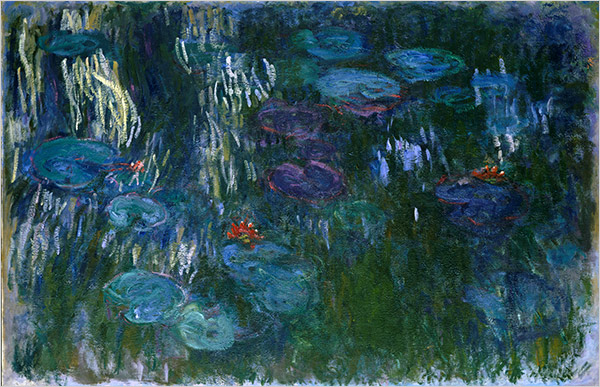
Monet_water lillies (Two Variations On)
Water Lilies, a study by Claude Monet, circa 1920

1.

The night needing left, bromeliads broke
from trees.  I hung my belly on the line to
dry in the moonlight and admired its shine.

Just at the edge of shadow, I waited,
patiently, for your voice.  Nothing came.
All was silent.  The palms stood solitary

as guards.  Cranes settled down, indifferent
to air.  The ponds blackened in disregard
and below, the trout denied swimming.

All was silent.  I should’ve known:
without needing, there’d be no noise, no
cacophony of please, I love you, let’s

have dinner.  I should’ve known:
my belly would twist and dry on the line
and emptiness would feel, simply, like nothing.

I grew to miss our arguing— the way
your words spiked inside me like
those broken flowers— the way

arguing leaves sloped and sighed, allowed
for the speckle of cream.  Out the door:
coffee-bean grinders and night-time tremors,

I think I lost a tooth in your mug—
Can you swallow my agenda?  Or,
even better, yesterday’s phrases?

There’s no need to utter them now.


2.

And forgetting, forgetting never came.
Sundays it rained and I never made it
to the beach.  Little dogs fell in the pool

while the oak held toads, fucking.
Their bellows pulsed alien and dank.
Summer wouldn’t leave; I sat outside

only at 6 am, when it was simply thick
air and gnats ignorant to flesh. Listened
in piss yellow patio lights to trucks rattle

down the road beyond the lake, airplanes
echo, soar and flash red and I forgot nothing
of New York City on a Monday; how when

it was finally quiet— the cologne and beer
disgusted, the handbills disheartened— fruit
trucks started down Broadway, tin-tailed,

stumbling into every little piece of broken
asphalt.  I never slept.  And how, when
you finally answered what lingered—

the cellphone’s throb and the question’s
swallow—salamanders didn’t stop
creeping up concrete. Gnats still attacked.

Even in the heat, forgetting never came;
Florida remained a yeast infection
that yearned for my body’s niches, but

I was not ready to give myself over
to invasion and forget everything, you.


Christine Aletti has an M.F.A. from Sarah Lawrence College. Her poems have been published in Two Hawks Quarterly and Tattoo Highway. Christine lives in New Jersey, where she teaches writing to unruly youths and yoga to disciplined yuppies.