“Short Prayer” by Michelle Olney

1792-103774
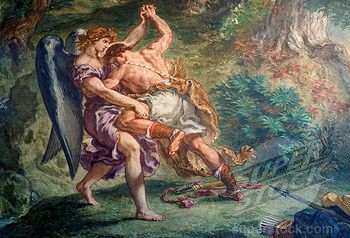
Jacob Wrestling with the Angel by Eugene Delacroix, 1861

I unearth the grey siddur
given me as a child.

I creak its cover open
to the short prayer for healing.
Ayl na, refa na la.

I do not need a prayer book
to recall this meager necklace of words,

nor your body in reach to feel the hollow
severity of your frame.

The spine balances in my hand.
I know you will not be healed.

I know you will not be healed because
you lean into your illness

as one does a strong wind: carelessly.
Death accelerates toward you.  Listen.

My prayer is a means of talking to you.
I read the words to myself.
Ayl na, refa na la.


Michelle Olney studied Creative Writing at Brandeis University, where she received the American Poets Honorary Prize (2009). She was recently hired as Poetry Editor for the speculative genre magazine Isotropic Fiction. She lives and works in Portland, ME.

“lullaby” by Kiik A.K.

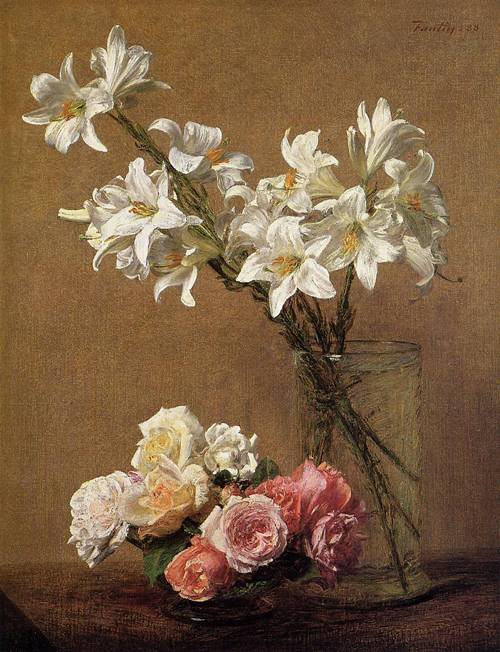
Henri Fantin-Latour (French Realist Painter, 1836-1904) Roses and Lilies 1888
Roses and Lilies by Henri Fantin-Latour, 1888

If I fold the page into a single
white glove I’m saying goodbye

If I fold it into a cricket
you will know the lullaby
seals itself between your dreaming
eye and the unsteady dream

A lantern calls to you
and I past a solitary dream
to meet in the shared tunnel
of your remembering

Six paper lilies means
I have fallen through the tunnel
and cannot rise, I am singing to you
from the shoulders of crickets
at your window

If I fold the page into a bowl
you will know I am out
collecting rain

Though you dream of thirst
and wake to the dry perfume of lilies


Kiik A.K. previously studied poetics at Santa Clara University and UC Davis and is a current graduate student of creative writing at UC San Diego. His work has appeared or is forthcoming in the journals iO, Scythe, Washington Square, Barge Press, The Brooklyner, Alligator Juniper, CutBank and Alice Blue Review. “lullaby” was written for Kane and Peggy Araki.

“The World’s Last Morning” by Roy Bentley

St._George_Slaying_Dragon (Worlds Last Morning)
St. George Slaying the Dragon by Hans von Aachen, 16th century

Every day someone goes to work unwillingly
or loses a job that he or she hated but needed to live—
the strip-mall organic eatery, Paradise Tire & Service—
and every night someone lies down with disappointment
curled around itself at the foot of a futon, stretching
in the folds of the comforter like a portly mouser.

But this morning the moon jousted between clouds,
upper rooms of the atmosphere a knight on horseback.
Then the horse and his knight had to concede something,
first to the blue-black dark and then to the dawnlight.
Then moonset whitened night sky above the Midwest,
and whole cities of plate glass shattered. You could say

a compassionate God must love the dumb shits
because he made so many of them, their glossolalia
having less to do with speaking with tongues of fire
than with the violence of those taught to subjugate.
You could say when all that plate glass shattered,

it was a consequence of the blunders of six billion
whispering the same deathbed prayer of conversion.
Prattling away in Spanish-accented English, an iPhone
sends a single penultimate voicemail into the air. Maybe
you hear: This is Miguel at Paradise Tire & Service—
jour Solara is finished and ready to be picked up…


Roy Bentley’s poems have appeared in the Southern Review, North American Review, Shenandoah, Mid-American Review, Prairie Schooner, American Literary Review, The Journal, New Virginia Review, Laurel Review, Sou’wester and elsewhere.

“Paris in October” by Katie Rice

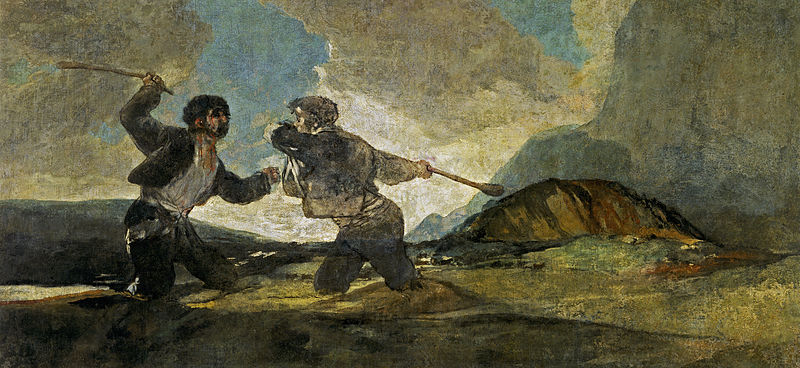
800px-Francisco_de_Goya_y_Lucientes_-_Duelo_a_garrotazos(Paris in October)
“Duelo a garrotazos” by Francisco de Goya, circa 1819

The endless summer,
the interminable summer,
under whose glare the Goyas burned,
Dos viejos comiendo now orange
with the handprint of the sun.

We go see them in their sterile room.
I let you take me behind
Las Pinturas Negras and undress me.
Two men dueling, knee deep in sand—
I sink dangerous into you.

Outside the Prado the dry heat breaks.
Next weekend I will be leaving
Madrid for Paris. You will stay
with your Spanish family—
it is time, anyway, to say goodbye.

You threw my house key through the gate
at El Palacio Real before I left.
“It is secret and royal,” you said.
“It is irreversible,” I said.
Now in the city of light and gold,
I watch amantes throw keys into the Seine,

I drink warm coffee,
brown like the back of your neck,
the darkest creases of your body.
Graffiti on the table reminds me
of Goya painting black and yellow frescos
on his walls before his death.

You alone in your house now,
(and hasn’t there been a death?)
remembering us before the Spanish heat
made me elastic, and you, callous.
I step into the lush French rain.

It is not only bloom and beauty here;
couples walk streets that smell like piss.
They make me think of you,
and you make me think of Saturn
with his white eyes and wild hair,
clutching his bloody, headless son.

A father eating his children to fight fate.
Those wild white eyes…
He once was a god,
once was somebody’s lover.


Katie Rice earned her BA in English: Creative Writing from Colgate University. She now works at Penguin Random House and lives in Brooklyn, NY.  Her poems have appeared in Black Bottom Review.

Read an interview with Katie here.

“The Wind in the Jug” by Jack Troy

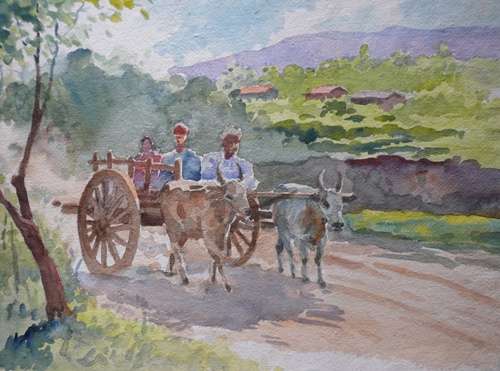
Bullock-cart-by-M-K-Kelkar(Wind in teh Jug)
“Bullock Cart” watercolor painting by M.K. Kelkar
(For the Abolitionist Potters of Chester County, Pennsylvania)

Bluebird potters, they called you,
your kiln-smoke grafting winter on to spring.
You had the power to call birds north
with a gallon crock, rung by your knuckle,
toning the fire-birthed heat to the breeze,
that clear note drifting south
below the Mason-Dixon line.

Your county’s hills enclose me here
the way that sleepers’ knees push up green quilts.
In this fieldstone cellar-hole, open to March’s sky,
I find your stoneware jug, tamped in a niche
one hundred fifty years ago.
Blue-gray clay hide restrains the bulbous dark inside.
I sniff the vinegared past, tip to my ear this conch,
this echo-holder, stamped by a whorl at the handle’s base.
I read you by your thumbprint, potter.
Mahlon Brosius, John Vickers, I hear you in there.
My breath across the jug-mouth rumbles.
Sound spills from this clay chrysalis
like that of distant tumbrels, or your wagons
mounded high with straw-packed mugs and porringers.
Slaves — runaways — were the heart of your cargo.
Scheming their freedom, you trundled them north,
Quaker to Quaker, binding the law’s weak wrists
with your compassion.

Within these cellar walls I’m centered,
like a man who wakes up in a bowl.
This stony jug’s the gift of time, and flesh, and fire.
Its hand-fixed form now shapes the wind
these bluebirds ride and liven with their song.
Hold back here, jug, the earth from closing down.


Jack Troy is a potter, teacher and writer who lives and works in Huntingdon, PA. He has taught over 200 workshops for potters and his work in clay has taken him to 24 countries. His poems have appeared in West Branch, Pivot, Friends Journal, Kestrel, The Studio Potter, and Common Ground. His collection of poems, Calling the Planet Home, was self-published in 2003. His website is jacktroy.net

Read an interview with Jack here.

“Why You’re Here” by Rick Gray

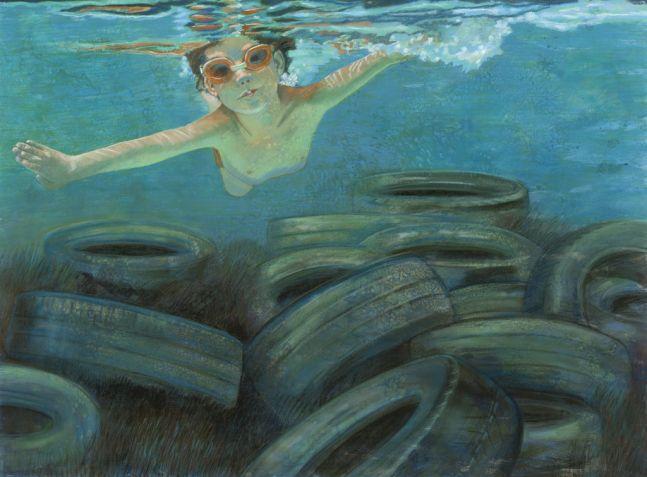
Why You're Here (In the Gyre)
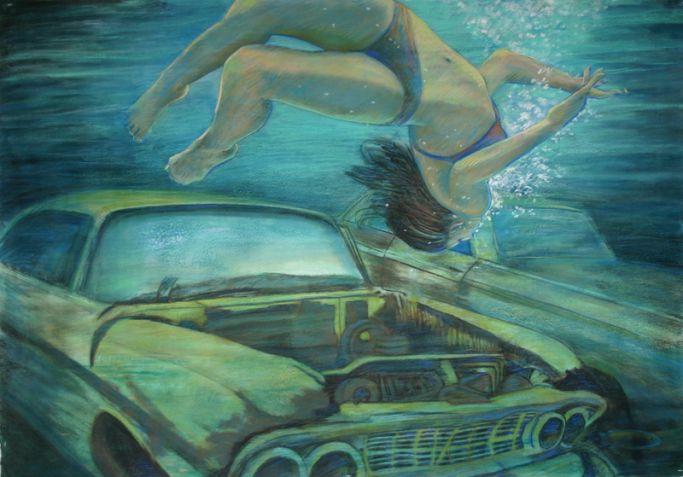
“Tires Underwater” by Elizabeth leader, pastel with mixed media

When I was sure the nurse was out
in the sick bed next to mine,
And 30 milligrams of Karachi diazepam couldn’t stop
the thudding propellers,

I rose quiet as a Seal and aimed for the
poppy fields of Helmand District located
just south of the analgesic section
I had scoped in the clinic medicine chest.

I almost got them right
Into my open mouth
Little white words I can’t spit out
When the nurse’s voice

Blazed through Afghan darkness
ten years of Texas truck stop waitress behind it
like a red warning flare that said
That’s why you’re here.


Rick Gray has a poem appearing in the winter issue of Salamander. He was a finalist for the Editor’s Award at MARGIE. His essay, “Total Darkness,” will appear in the forthcoming book, Neither Here Nor There: An Anthology of Reverse Culture Shock. When not in Afghanistan, he lives in Florida with his wife and twin daughters.

“Four for the Duke” by Charlie Clark

Four for the Duke
“Catholic Campus–Dodge Street” by Elizabeth Leader, collage with found object

1. The Duke’s Letter to His Wife Explaining His Prolonged Stay at the Spring Cottage

Some have to travel a long way to discover
the pleasure of a good deep square of green.
But that sounds too much like wisdom.
The year is young, I’m only partly in the country,
and all I know of grass is what the groundsman tells me.
The last time I put my body down in some, I was drunk.
Quaint, I know, though it may have been why the magic didn’t take.
Or it may have been because of whatever darkness was crawling through the dustbins,
making me sweat two hundred yellow pounds.
It smelled like peppermint schnapps and a sun-burnt slaughterhouse.
You couldn’t have told us apart, there upon the ground.
I say that like I’m proud.
Of all the things to poison myself with
I keep choosing the least effective.


2. Third Draft of the Duke’s Annual Summer Letter to His Mistress

It’s almost easy, love, sitting here while the sky blackens through the bare,
devil-fingered limbs of my courtyard’s sole strange tree, its trunk so narrow
one can grasp it, nearly, like a handle, except for how the bark’s jagged shingles scrape the hand,
the gashes quickly going red and welled along the palm.
Not knowing, I call it the tree of knowledge.
(It’s common knowledge pain eases with a joke, even one so bad.)
I’m sure there’s someone who knows how to suck the poison out
while someone else knows how to enter such a wound and come through the other end improved.
You’re adept at one of these at least.
Each takes a skill beyond my understanding.
Most skills are beyond me
except for how, when my limits bleed like this,
I gather their unspooling contents, and, making a ladle of my hands,
offer up as much as you will drink.


3. The Duke’s Letter About His Last Fall Walk, Its Recipient Uncertain

Stopping last evening at the curve along the creek
where one has a good clear view of the portion of the dilapidated graveyard
whose headstones all have fallen among a rash of still-hanging-on little yellow flowers we called
poppers when I was young,
I saw the long, fist-thick coil of a serpent soaking from one slab the last of the season’s heat.
Stalled there watching, I suddenly recalled the dream in which I wore a jacket made of snakes.
Not just skins, but whole live ones wrapped around me,
tails always rattling to warn others of my approach.
And constant biting. The first would kill while the next one would revive me.
No mercy in it, though their clacking sounded happy, like workmen when they whistle.
Thinking this while watching across the water, just before the light gave out completely,
I saw a rabbit, grazing on the flowers, wander in among the graves.
I thought they had a better nose for these things.
When I shouted it stared in my direction.
It had eyes like a Byzantine Jesus.


4. Winter; the Duke’s Last Letter, Copied in Triplicate

It took distance to realize what I need is distance.
On my walks, I look out at the empty trees
and am satisfied not knowing any of their names,
feeling for them only sorrow.
There are days when even looking at them is too much,
when it’s enough to sit listening to the oscillations of my heart.
I’d say you should hear the range of it,
the way it seems sometimes it should tear
from all the blood it’s taking in,
but that would require you placing your head against my chest,
and, separating your pulse from mine,
listening as best you can.
Even then you might not hear the thing I mean.
Please think of me when you see shadows.


Charlie Clark’s work has appeared in Crazyhorse; Forklift, Ohio; Fugue; The Missouri Review; New Orleans Review; Smartish Pace; and elsewhere. He earned his MFA in poetry at the University of Maryland.

 

“Relics” by Meg Tuite

Auto Grave
“Auto Grave” by Elizabeth Leader, mixed media on Fabriano paper

You swallowed the winning rainbow marbles so
slimy Stuart wouldn’t steal what was now stuck
to the gum you didn’t mean to inhale
while you were talking,

sucked like a vacuum
into the shipwreck you wish
you could swim through
revisit all those floating treasures
from the past.

Bottle caps chugged down with beers
on a dare, out of boredom,
cat whiskers stuck in your throat
Maria swore would give you cat eyes

cigarette butts gagged on over and over
from the same goddamn plastic cup used as an ashtray
you kept picking up
instead of your drink next to it
while underwater in a stoned-wash haze,

the bag of hash you mouth-raped
when your train was approaching France from Amsterdam
German shepherds sniffing and straining to locate your interior

the used condom you fished out of the trash
endowed into your gullet
while Crank Campbell was in the bathroom
readjusting his perfection

the bulge of love proclamations you wrote to Patrick Burnett
on scented green post-its that you tore to pieces
slugged back with saliva
before Mr. Riley, your math teacher,
made it down the aisle to confiscate

flies, mosquitoes and at least one moth diving your airways
every sweaty summer you rode your bike

hedged in between the glitter,
hairspray and poppers,
robin’s egg blue eye shadow, lines of coke,
cascades of plum, tangerine and berry lipsticks, angel dust
you licked before and after slathering your eyes, mouth
radiating chemicals bubbling up from your floating internal wreckage

as each boy’s tongues and hands
glided through those tentacles of seaweed
and yesterday’s gems, submerged you in a future
that felt more like an unearthed tomb.


Meg Tuite‘s writing has appeared in numerous journals including Epiphany, JMWW, One, the Journal, Monkeybicycle and Boston Literary Magazine. She has been nominated several times for the Pushcart Prize. She is fiction editor of Santa Fe Literary Review and Connotation Press, author of Domestic Apparition (San Francisco Bay Press, 2011), Disparate Pathos (Monkey Puzzle Press, 2012), Reverberations (Deadly Chaps Press, 2012), Bound By Blue (Sententia Books, 2013), and Her Skin is a Costume (Red Bird Chapbooks, 2013). She won the Twin Antlers Collaborative Poetry award from Artistically Declined Press for her poetry collection, written with Heather Fowler and Michelle Reale, Bare Bulbs Swinging, (2014). She teaches at the Santa Fe Community College.


“A Landmass of Birds” by Kyle Adamson

The North Pacific Gyre (Landmass)
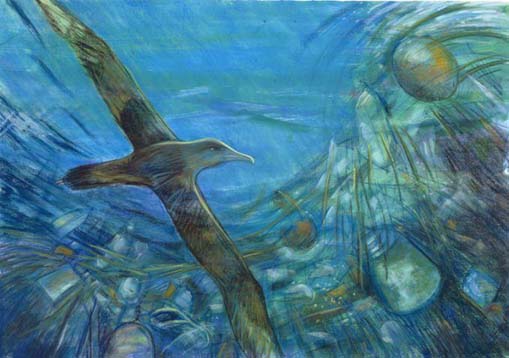
“The North Pacific Gyre” by Elizabet Leader, Pastel on Fabriano paper

We live in a landmass of birds.
This is a poem about grief.
How the brackish water bleeds
into the poisoned orange glow.

How only in a glimpse
when the car whooshes
over a concrete bridge,
I see the island patrolled
by predatory beaks.
So inhospitable
& burning like whiskey
on an arid palette.
This moment lives
in the sour sand
between my tongue & cheek
& deep in my veins
with tidal malice.

It’s shore out of reach;
puddles are crusted, dry,
thirsty with rife.
How the rocks huddled together
like shattered television sets
with frail driftwood antennas.

So many that lay strewn
with vacant eye sockets.

I will only speak of winged cannibals.
How deafening the shrill,
how baron the skeleton trees.

The soil, putrid & foul
with shattered eggshells
like salt on a charred rib,
I wish this were a poem about apologies.
This is where we hail, we are.


Kyle Adamson is an MFA student at Bennington College and earned a BFA in Creative Writing from Hamline University. He is the winner of the 2010 AWP Intro to Journals Award in poetry and has been published in the Artful Dodge and Revolver and forthcoming in the Alaska Quarterly Review, the Water-Stone Review, and the Midway Journal. Kyle served in the Marine Corps infantry and deployed twice to Iraq. Kyle resides in Saint Paul, Minnesota.


“Fecundity, Expanse” by Sasha West

god asks why (Fecundity, Expanse)
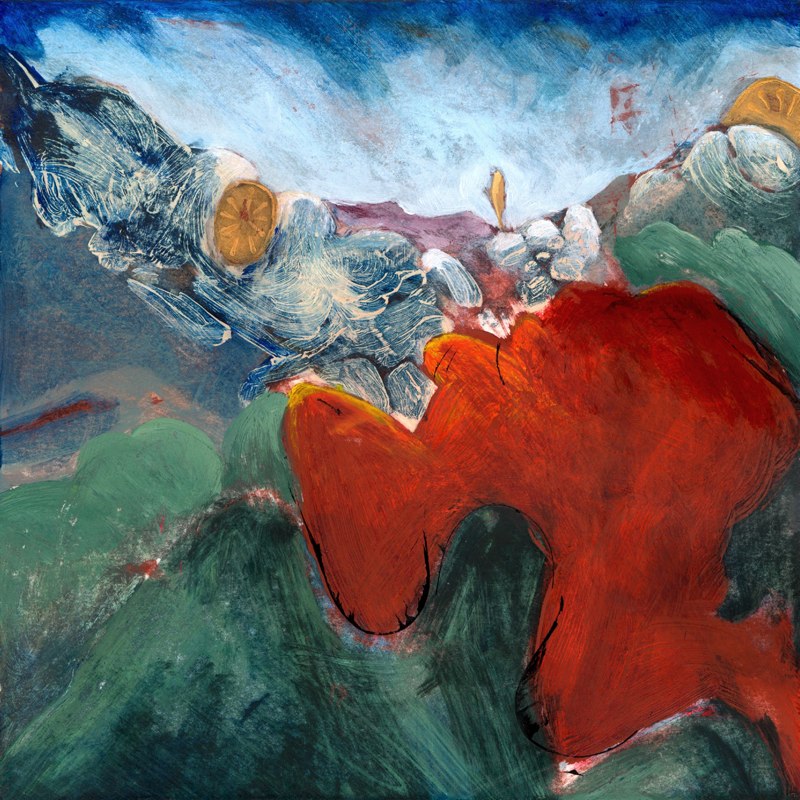
“God Asks Why” by Peter Groesbeck.
(See also “Fuel” by Lanier Wright Fields.)

Dregs in the hotel glasses, arranged in lines of song.
Skin cells on tub bottoms, my hair
on the brush, tangled in the trash, curled in the drain.
All day, he touched bodies and objects—fingerprints
on doorknobs, windowsills, and coins—obsessed
with the outside of gloves, books, crepe paper,
anything that could be bloated or ruined with water. We remade
the world in residue. I lived inside the constant pulsing
of my absent home, an uncommon and ever-present idea
of the recalled native land in the mind. When we stop,
I lie down in tall grass to form a silhouette.
When we stop, I lie for a long time in the edge of waves
until my body has been carved into beach. I leave my body
in the beach so it fills and empties. We made effigies
in ice, in weeds woven in grass, in peonies floating. When we began
to sleep together—in a  desultory manner at first
and then with great urgency, I let his come
leak out of me purposefully, with art
so that sometimes I left behind
a spot, sometimes a crescent, a harvest scythe.
I let the stains wax and wane with the month, the moon;
Every fourth week, the story bled.
Had you read our motel beds across,
like a comic strip, you would have seen us
making with our bodies a calendar,
situating ourselves physically inside a narrative of those days.


Sasha West has had work appear in Ninth Letter, Forklift, OH, Callaloo, Born, American Poet, Third Coast, and elsewhere. Her poems have garnered two Pushcart nominations, a Houston Arts Alliance Grant, Rice University’s Parks Fellowship, and scholarships to the Bread Loaf Writers Conference.  She holds graduate degrees from Johns Hopkins and the University of Houston, where she was editor of Gulf Coast. She currently lives in Austin with her husband and teaches writing to the graduate students at UT Austin’s LBJ School of Public Affairs.

Read our interview with Sasha here.