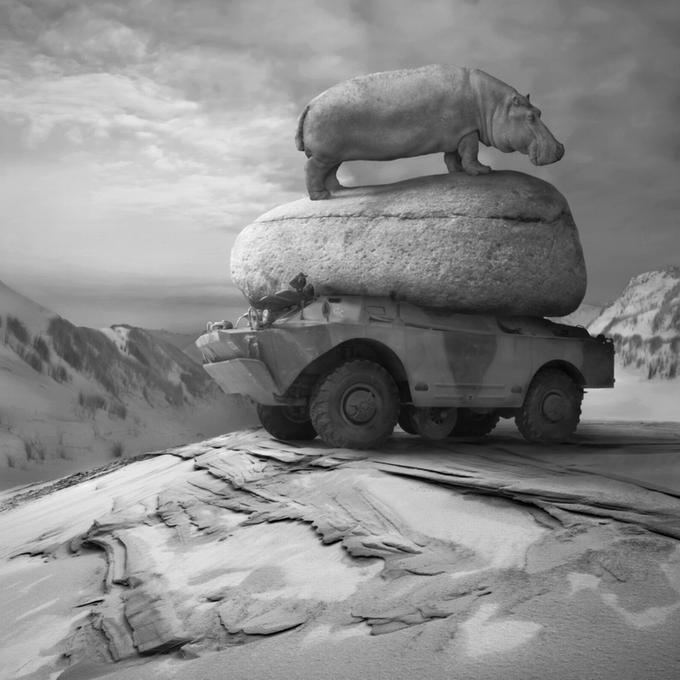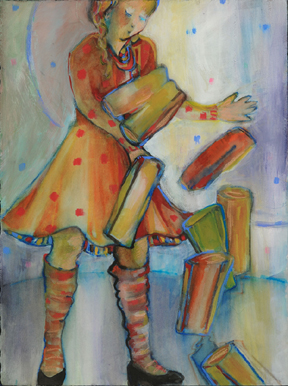
“I Dreamed Your Epic” by Gay Giordano

I Dreamed Your Epic (Whoops)
“Whoops” by Marilyn Sears Bourbon

Children roll out like oranges
from doorways,
you appear, neck slashed
by a red scarf.
Ugly matrons full of advice
yank their fleshy stockings by the band
then pour the principal’s coffee.

Your mother half expects you to have caught
your scarf in a wheel
garland of itchy regrets
her petticoats frozen
her hair stiff.
You retreat into your peel.
Poor little orange.

Your father comes home
throat stitched to his collar
gurgling into a martini
tossing olives at the dog.

That envelope in the attic, dust,
your father beating the days,
your dollhouse like ashes.
Everything is used, even the roses.

Your mother stares at the ceiling
listening to the house pleat.
She has only lent you her face,
yours is on tiptoe
waiting for an invitation.


Gay Giordano earned her BA from Carnegie Mellon University in creative writing and her MA in philosophy at The New School for Social Research. She has been published in Mudfish, Ghost Ocean Magazine, The Lullwater Review, Illya’s Honey, The South Carolina Review, The Oakland Review and other journals. She has been a resident at VCCA, The Martha’s Vineyard Writer’s Residency, the Banff Center for the Arts, Bennington College, and the Dorland Mountain Arts Colony. She lives in New York City with her husband, with whom she co- translates German-language plays and aphorisms.

Read our interview with Gay here.

“Umbrella Mouth Gulper Eel” by Jamie McGraw

Umbrella Mouth (Escargot)
“Escargot” by Marilyn Sears Bourbon

Two nights ago my father found me

dead. My body formed like a metal scrap
malformed by extreme heat.
A beat of him in an ocher grave.

Outside a starling grappled with a whore of a bee.
Inside a syringe containing cotton shreds,
coagulated blood, bacteria, and smack
hugged my left forearm.

*

At age five I called ants my friends,
showed them my baby teeth collection.
They grew so fond of me,
learned it’s okay to lose things,
you’ll go right on living.

*

The day I died I studied photographs of deep-sea creatures:
megamouth sharks, fangtooths, vampire squids.
The most frightful ones filled with light.

They care not who sees their crookedness,
their orthodontic atrocities.
God damned them to the deep,
because they’re so damned ugly.

Not so unkind, though,
to be so deep in something
that God grants you your very own light.

Just so you can recall your body.
Just so you can remember
you exist.


Jamie McGraw lives in and sometimes leaves North Carolina. She is currently enrolled in Queens University of Charlotte’s MFA program. Previous work has been published in APA journal Families, Systems, and Health, Red Fez, and Beatdom. Her spirit animal is a lobster. Don’t ask. (Actually, no. Do. Do ask.)

Read an interview with Jamie here.

“The 8th of May: A Vow” by Daniel Nathan Terry


“Wooden House” Image courtesy of Dariusz Klimczak.
(See also “Leaf Music” by Sudha Balagopal.)

~Upon seeing a video of a man in North Carolina firing his rifle
into a sign asking citizens to Vote Against NC Amendment One.

There are oaks that remember
what we would forget–the burn of the rope,
how a body takes on more weight
the moment it breathes its last, how
the earth below shoeless feet grows
hungry for the slaughtered. There are rooms
where paint has been rolled over
blood, where the body’s salt has been
vacuumed into bags of dust, where the veneer
of a nightstand still bears the imprint
of a living hand’s last message. Ghosts
of children and men and women hang
from fences, linger in the corners
of dorm rooms, of courtrooms, of churches.
This is how we deal with it around here, he said,
after emptying his gun into a plea for equality, and some people
were shocked by his quivering pride. I will try
not to think of him when I stand in a room
in DC and vow to continue to love the man
I have loved for 16 years. I will try not to remember
that 17 years ago, a friend of mine opened his door
to a cry for help from the other side, only to be robbed
then stabbed to death with his own kitchen knives
because the thief felt threatened that my friend–
while begging for his life–revealed that he was gay.
I will even try not to think of my grandfather
who cannot forgive me for loving the man
who held me steady as I purchased the dress my grandmother
was to be buried in. I will try not to think of the memory
of these oaks, of those fences, of some rooms. I will say I will
and mean carry on loving you until death. I will
think of the dorm room where we first made love,
I will think of the fence around our house
and its roses that change color in the heat. I will
think of the Carolina oak who might remember
the night we kissed in the first bands of rain
from a hurricane just making landfall.


Daniel Nathan Terry, a former landscaper and horticulturist, is the author of Capturing the Dead (NFSPS 2008), which won The Stevens Prize, and a chapbook, Days of Dark Miracles (Seven Kitchens Press 2011). His second full-length book, Waxwings, was released by Lethe Press in July of 2012. His poetry has appeared, or is forthcoming, in many journals and anthologies, including New South, Poet Lore, Chautauqua, and Collective Brightness. He teaches English at the University of North Carolina Wilmington.

Read our interview with Daniel here.

“Ants” by Lowell Jaeger


“Peace,” image courtesy of Dariusz Klimczak

Ants do what ants do: hive
in creases and cracks, build
villages in my garden wall, and frenzy
through daily routine in what looks to me
as rushing to and fro for no
discernible cause—from where I stand,
at least, just now alert
to this nation’s invasion into my own
sovereign soils.
A bugle
wails its alarm, calling me to march
to the garden shed, survey the stores
—powders, sprays, bombs—
arm myself against this foreign assault.

In the blast of afternoon heat, the ants
zigzag from chore to chore, absorbed
in each career, lofting bits of leaf and bark,
grains of sand.  The queen’s orders relayed—we think—
in chemical codes of one’s antennae wiped
across another’s.  Do they suspect me?
Do they see me?  How can they comprehend
the impending doom
raining down
from my shaker of Bug-B-Gone,
guaranteed to rid any garden and lawn
of creatures unwanted.  The napalm
burns into their polished uniform hides.
Some run, some collapse, some writhe.
I bulldoze their bunker with my shoe,
over-ending stones beneath which lie

nurseries of the unborn, a next generation
assigned to care and feed the future hive, till
my shadow looms overhead,
and I’ve put an end to all of that.  Which is natural,
isn’t it?  Ants do what ants do.
My species too.


Lowell Jaeger founded Many Voices Press and compiled Poems Across the Big Sky, an anthology of Montana poets, and New Poets of the American West. His third collection of poems, Suddenly Out of a Long Sleep (Arctos Press) was published in 2009 and was a finalist for the Paterson Award. His fourth collection, WE, (Main Street Rag) was published in 2010. He received fellowships from the NEA and the Montana Arts Council and won the Grolier Poetry Peace Prize. Jaeger was awarded the Montana Governor’s Humanities Award for his work in promoting thoughtful civic discourse.

Read an interview with Lowell here.

“Excavation” by Lowell Jaeger


“Sandmachine” Image courtesy of Dariusz Klimczak

They’d carved
(this army of ants)
in the gravel . . .
an expressway!

My son and I stood watching
constant traffic.
Frenzied comings
and goings.

Aztecs.  Egyptians.
Giant blocks heaved
shoulder to shoulder,
bits of leaf and bark.

The hive mounding,
grain by grain
proudly skyward.
Whatever their plan

our lunchtime ended.
My son in the backhoe
and I with my spade
ripped the earth

beneath them.  Another
civilization lost.  Buried.
We laid a hundred
yards of crushed-rock

driveway that afternoon.
All the while, glancing
over our shoulders.
Feeling small.


Lowell Jaeger founded Many Voices Press and compiled Poems Across the Big Sky, an anthology of Montana poets, and New Poets of the American West. His third collection of poems, Suddenly Out of a Long Sleep (Arctos Press) was published in 2009 and was a finalist for the Paterson Award. His fourth collection, WE, (Main Street Rag) was published in 2010. He received fellowships from the NEA and the Montana Arts Council and won the Grolier Poetry Peace Prize. Jaeger was awarded the Montana Governor’s Humanities Award for his work in promoting thoughtful civic discourse.

Read an interview with Lowell here.

“The Crackhead’s Palindrome” by Catherine Owen


“On the Road” Image courtesy of Dariusz Klimczak

It comes right down to this. Just one more hit
and he will be cured of the need
for this frenzy in the dark, this scrounging:
things he can pawn, lies he can tell.
She will know then; all will be revealed.
Something will save him from the sharp,
tight hankering in his brain, this net
he’s cast around the world: the feel
of pressing the glass mouth full, sucking
and the sense that he is everything
in that one split second rush.
Now he is Hercules eternally is he not.
So surely this time that will be it.

O surely this time that will be it.
Now he is Hercules eternally is he not?
In that one split second rush there
is the sense that he is everything, sucking,
pressing the glass mouth full, the feel
he’s been cast around the world, a net
tight & hankering in his brain.
Something will save him from the sharp She
who will know then; all will be revealed –
those things he’s pawned, the lies he can tell.
All for this frenzy in the dark, this scrounging
to be cured of the need.
It comes right down to this. Just one more hit.


Catherine Owen has published nine collections of poetry and one of prose. Her work has been translated and has appeared in journals in NA, Europe and Australia. Her website is www.catherineowen.org.

Read our interview with Catherine here.

Review of WE by Lowell Jaeger

We

WE
Poems by Lowell Jaeger
Main Street Rag, 2010

WE is a glimpse of the extraordinary, hidden within seemingly mundane everyday lives, and Lowell Jaeger gives us beautifully constructed portraits of the people you may not notice rushing to catch your bus or pushing past on a street when late for an appointment.

The titles alone reveal the objects of his scrutiny: “regular guy,” “stroke survivor,” “the wives,” ”dad,” and “door to door jesus.”

But what Jaeger gives his reader is something that transcends any idea of a lofty introspection. It’s quite the opposite. Jaeger solidifies this idea of exploring the seemingly simple and takes us deep into where these people live, how they work, and who they might be in a way that creates connections to us all.

In “If They Blow,’ the reader is dropped into the middle of a conversation as if we were eavesdropping in a crowded room full of strangers:

If They Blow

“…run for shelter, Dad said.
Means Krushchev’s launched his warheads.
I’d asked: Why the yellow horns on a tower
atop the grandstand’s roof? (31)

In “we all know trouble when we see it” the dialogue is realistic and so regionally dense that I was brought back to sitting in a diner as a kid fascinated by the chatter of the adults around me; a place of no secrets where verbal clues alone become the vehicle to understanding:

“Birdie snags the waitress to question
this or that about the bill. Silly,
but I hold my breath to listen…” (81)

“every mother” gives us the gruffness of the man, the tirelessness of the woman and the obliviousness of the children where a mere car breakdown can create a whole new level of frustration in an already exhausted day:

Try it again, the man shouts
like he’s peeved at her
when his machine won’t go.
He adds a string of curses,
drops his wrench, and she’s on the spot
with a wad of Kleenex
to nurse torn knuckles.” (19-20)

Lowell Jaeger’s WE is a collection of portraits that give us an inside view of people at their everyday tasks, errands, and jobs, but these characters become so much more than that by the end of the book. This is a contemporary view of who we are, where we come from, and where so many of us really live. WE is a beautifully crafted poetry collection with intimate language, densely sketched /images, and as realistic a viewpoint as any observer could discover. I have become a fan.

“Summer Kitchen” by Elizabeth Glixman

Glixman-Summer Kitchen1

The children threw us both away,
chicken feed to the birds when you passed.
The house for sale with the garlic press,
the copper pots I made clean sold for ten cents each.
The beige crocheted lace that outlined the front door window
your boots caked with field mud scenes.
our wedding pictures, the picture of Hunter the dog,
gone to a bidder visiting estate sales.

Nothing feels like earth in my new home.
I pull old apple tree silhouettes in memory
through the kitchen windows
frenzied black lines in the dawn without a crunch
walking dreams that take me to the
beginning when we were warm and full.

I am a chicken without fat in this grassless yard,
a bent woman tied straight in a chair
watching the nurses go by delivering
dried cod fillet. potatoes and applesauce
with a dab of fake whipped cream.
They promise me  there will be more minutes
to recall the stained potholders on the hooks,
and the red wine stains on the curtains in the summer kitchen
where we got drunk when you were ill,
where the peonies you planted bloomed outside the window.
It all drifts in my head, rivers before this frost.
No children visit me.
You and I grew in that quiet home,
ate curry in the yard, met the spitting Llamas
our neighbors bought. Loved well.


Elizabeth Glixman is a poet, writer and artist. Her fiction and poetry have appeared online and in print in many publications including Wicked Alice, In Posse Review, 3 A.M. Magazine, Tough Times Companion, a publication of The Virginia Foundation for the Humanities, Her Circle Ezine, Frigg, Meow Poetry, Journey anthology and Velvet Avalanche, an anthology of erotic poetry. Her author interviews, articles, book reviews, and creative non-fiction pieces have appeared in The Pedestal Magazine, Whole Life Times, Spirit of Change, Hadassah Magazine, Eclectica and the anthologies Chocolate for A Woman’s Soul II and Cup of Comfort For Women. She is the author of four poetry chapbooks: A White Girl Lynching (Pudding House Publications, 2008), Cowboy Writes a Letter & Other Love Poems (Pudding House Publications, 2010), and The Wonder of It All (Alternating Current, 2011). I Am the Flame (Finishing Line Press) is forthcoming July 2012.


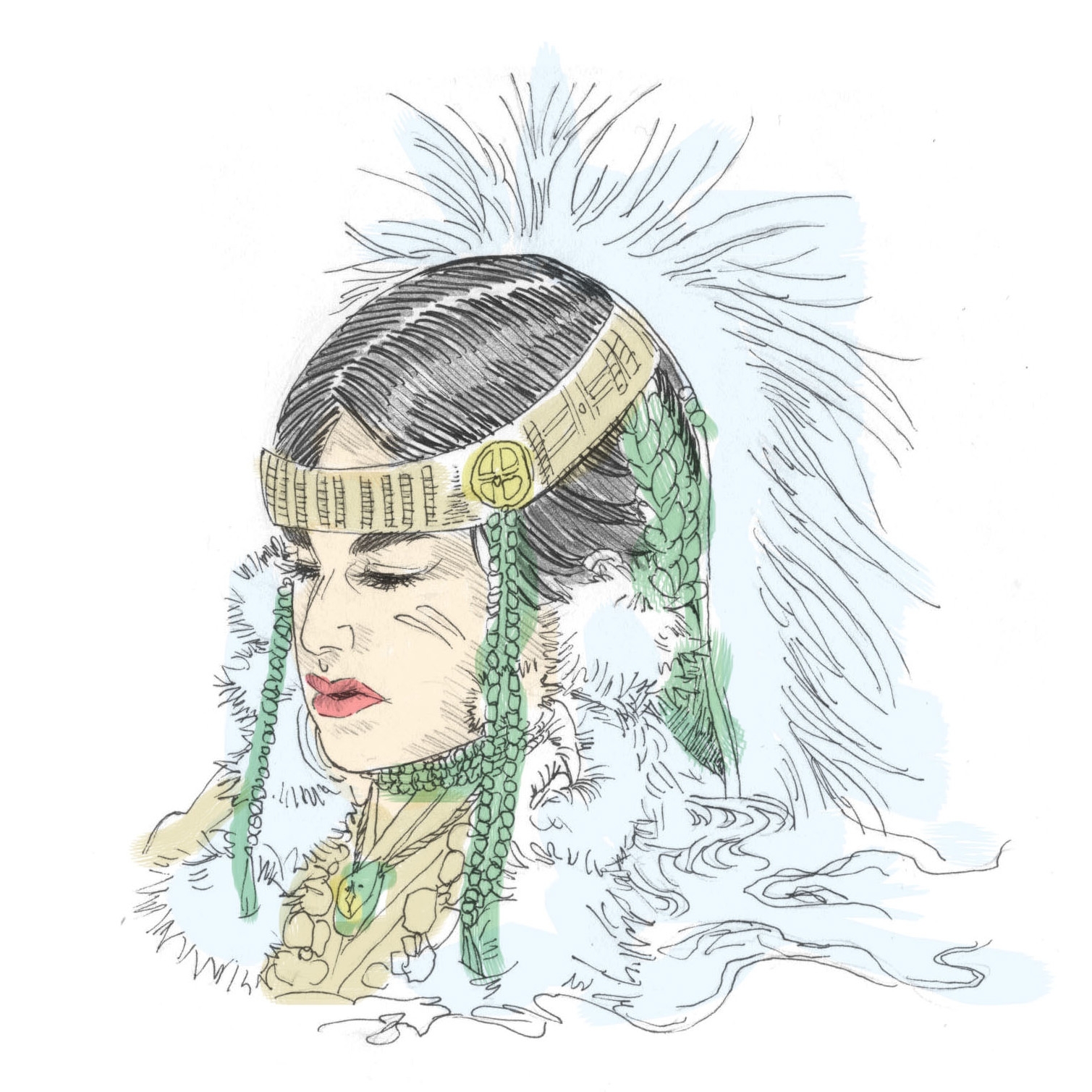
“The Uneasy Voice of the Grass: Cuwignaka Duta Tells Her Dream” by Lisa Ress

Ress-Uneasy Voice1

Dakota Territory, 1864

In my dream I am walking there
where the north fork of the Platte
and the Laramie meet, where the grass

grew thickest, tender and green.
as the dark heart shapes of cottonwood leaves,
as lacewings, delicate dragonfly needles,

fat hoppers, the killdeer’s sweet home.
I know red as the buffalo’s flesh,
woodpeckers’ crests flashing bright

tied in our warriors’ black hair, I know red
as blood, the color of my skin,
and my name: Red Dress.

And white I once knew as ice on the buffalo grass,
the winter cottonwoods’ ermine bones,
knew it sometimes as hunger.

Now I know white as treaties, as
bible tracts, bills of sale, the mission
schoolbook’ s icy pages,

In my dream I am struggling to walk
across endless white ground,
forcing my legs between stalks of ripped

parchment, the wind howling
around me, clawing to rip
sheets from the ground. This whiteness

has spread, it eats at the land. I look back
at my footsteps. “Tate,” I say to the wind,
I am here for a reason.

–After Susan Power’s The Grass Dancer (G.P. Putnam & Sons, 1994)

Lisa Ress first came to Appalachia (Blacksburg, Virginia) in the early 1960s and fell in love with the region, returned to go “back to the land” in Floyd County in the ‘70s and ‘80s and finally was able to retire to a co-housing community in Blacksburg after teaching college and university English and writing courses for a number of years. Over 100 poems have been published in a variety of magazines. Her first book, Flight Patterns, won the 1982 Associated Writing Program prize and was published by UVa Press. She was also awarded an NEA grant. Her second book, Object Relations, has just been published by Wilder Publications and is available at Banres & Noble and Amazon.

“The Uncropped Photograph— Nick Ut’s Vietnam, June 8, 1972” by Gary Dop

Dop-Uncropped Photograph1

Four children with little, naked Kim Phuc
run down Route 1 by Trang Bang. Seven soldiers

in uniform behind little, naked Kim Phuc
lift their boots away from Trang Bang.  One

often-cropped photographer, four steps beside little,
naked Kim Phuc, loads his Canon to shoot Trang Bang.

The children burn and run.  The soldiers walk,
but one, far off, a miniature ghost, talks to the cloud

and refuses to follow as the children dance away
from their pluming rose garden.  The helmets pull

the men toward the space between the fire
and the naked nine-year-old flying, her arms wings

of the fallen.  Phan Thi Kim Phuc’s family
are behind the firewall, among the dead.  Some

of the soldiers blur like the clouds
they called down.  One, who can’t consider the ground

of boiling blood, faces the smoke of freedom.  We all
look away.  Only the youngest child, a little boy

in a white cotton shirt, orphan of falling fires, looks back,
his eyes blistered away from time, toward Trang Bang.


Gary Dop—a poet, scriptwriter, essayist, and actor—lives with his wife and three daughters in Minneapolis, where he teaches creative writing at North Central University. He received a Special Mention in the 2011 Pushcart Prize Anthology, his essays have aired on public radio’s All Things Considered, and his poems have appeared in Prairie Schooner, Poetry Northwest, Agni, New Letters, Rattle, and North American Review, among others.

Read our interview with Gary here.