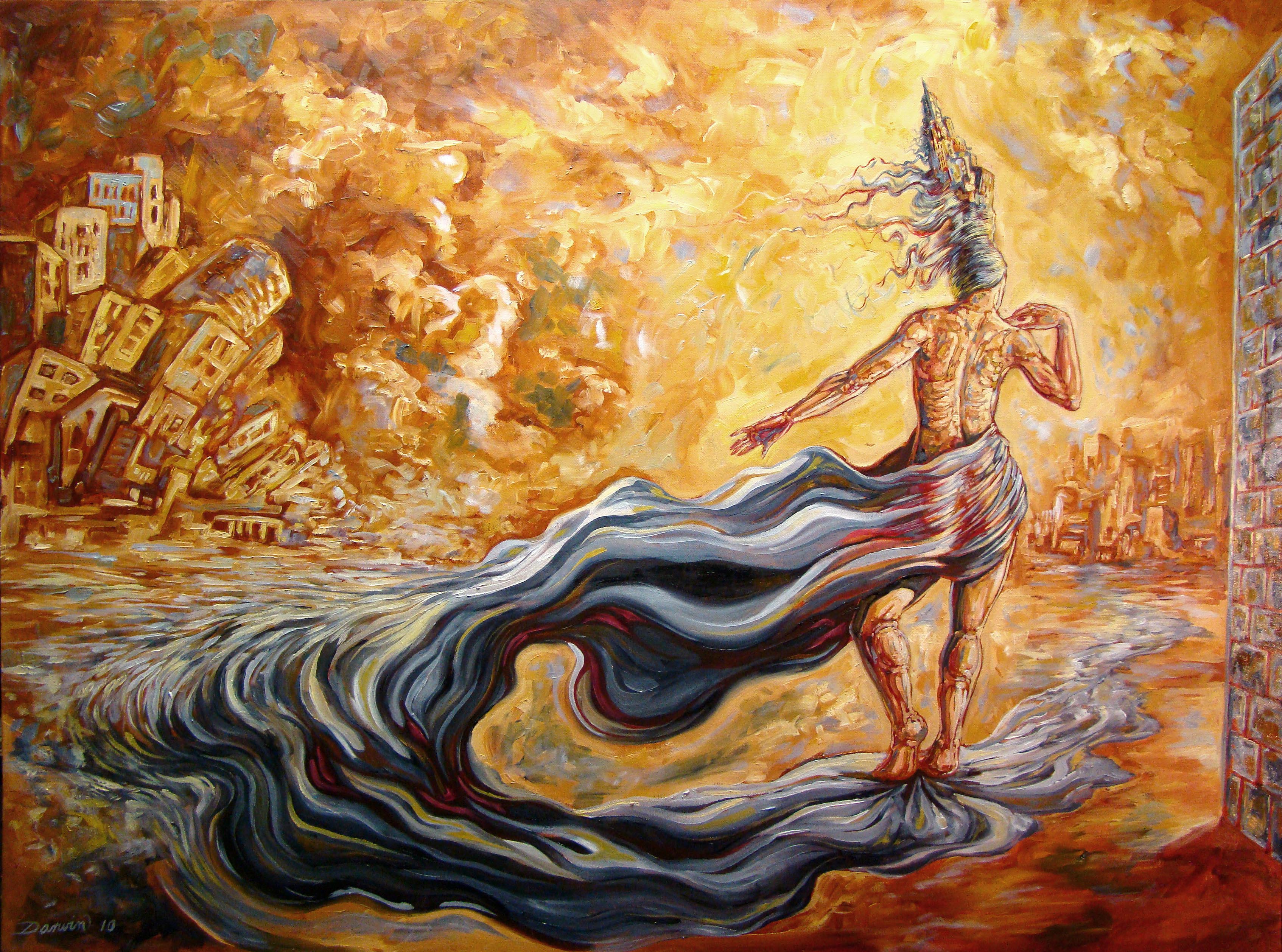
“Fishes and Their Fathers” by Elizabeth Glixman

Glixman-Fishes1
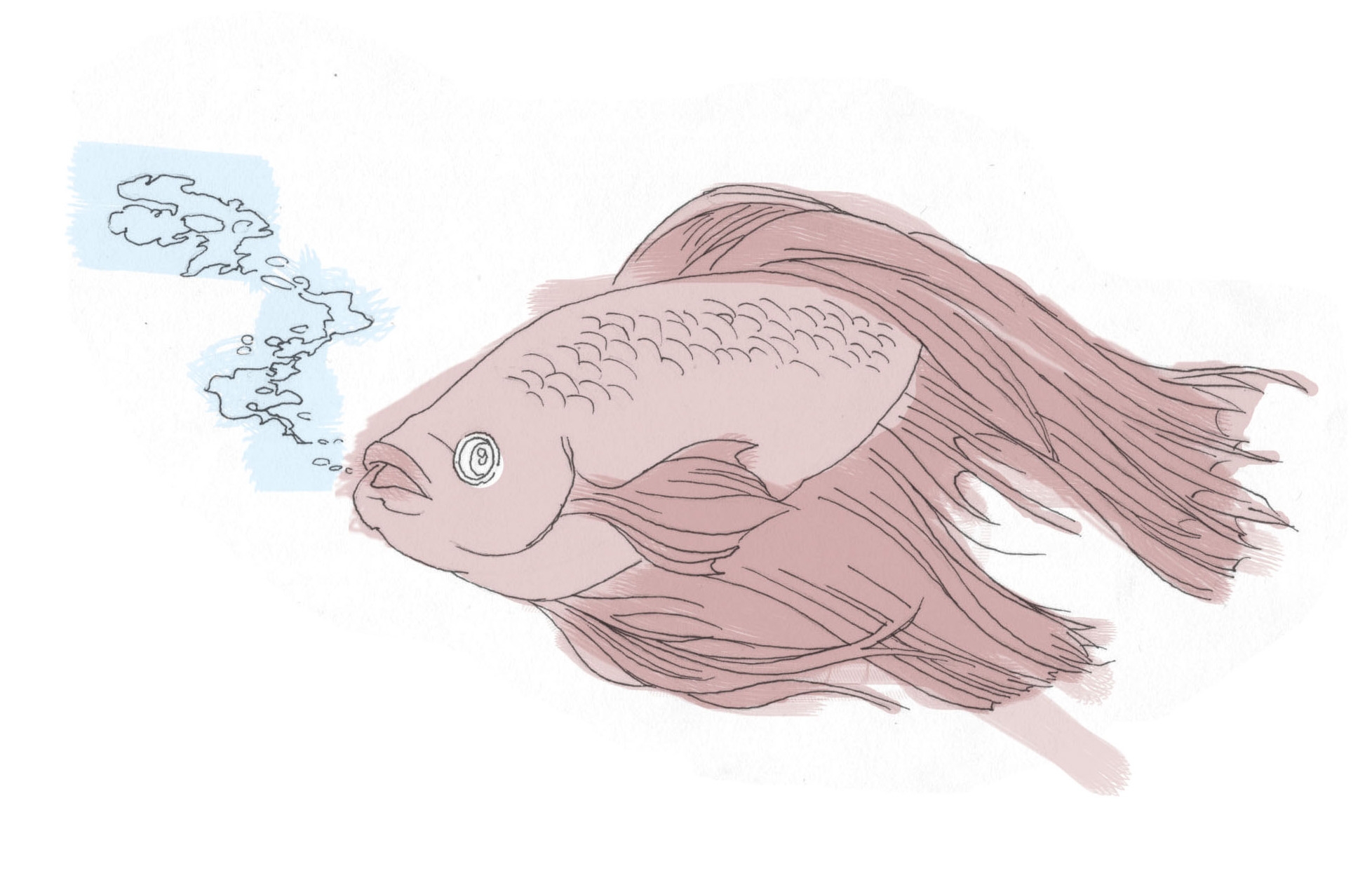
When the fish bowl needs scrubbing from your small handprints
I take a damp cloth dipped in castile soap
contemplatively wash around the outer curve of the bowl
like my hand followed the curve of my belly
when you were inside me feet kicking.
You need me to tell you its okay
that your father is not here as the
snow falls like fastballs thrown by a famous pitcher.
When your father is not there, when the pond is covered with ice

You want me to tell you he will return soon.
You ask where is the fish’s (the one in the bowl) father.
I tell you he is all grown up and does not need a father.
You ask about the other fish that are not grownup
and their fathers
under the ice in the pond.
I tell you the fishes and their fathers are underwater
telling stories to each other.
They will come to the surface in the spring after the thaw.
You say watching me wash the bowl
I want daddy to come home
So small a mumble I can hardly hear.
I take the cloth follow the roundness of your face
with my hand smelling of lavender
wanting to protect you from ice

I am your first teacher
I cannot teach you the way gases change from solids to liquids
and back the cycle of change
(you have conquered your shoelaces this week)
or how people never come home
Even when it is spring and the ice has thawed.


Elizabeth Glixman is a poet, writer and artist. Her fiction and poetry have appeared online and in print in many publications including Wicked Alice, In Posse Review, 3 A.M. Magazine, Tough Times Companion, a publication of The Virginia Foundation for the Humanities, Her Circle Ezine, Frigg, Meow Poetry, Journey anthology and Velvet Avalanche, an anthology of erotic poetry. Her author interviews, articles, book reviews, and creative non-fiction pieces have appeared in The Pedestal Magazine, Whole Life Times, Spirit of Change, Hadassah Magazine, Eclectica and the anthologies Chocolate for A Woman’s Soul II and Cup of Comfort For Women. She is the author of four poetry chapbooks: A White Girl Lynching (Pudding House Publications, 2008), Cowboy Writes a Letter & Other Love Poems (Pudding House Publications, 2010), and The Wonder of It All (Alternating Current, 2011). I Am the Flame (Finishing Line Press) is forthcoming July 2012.
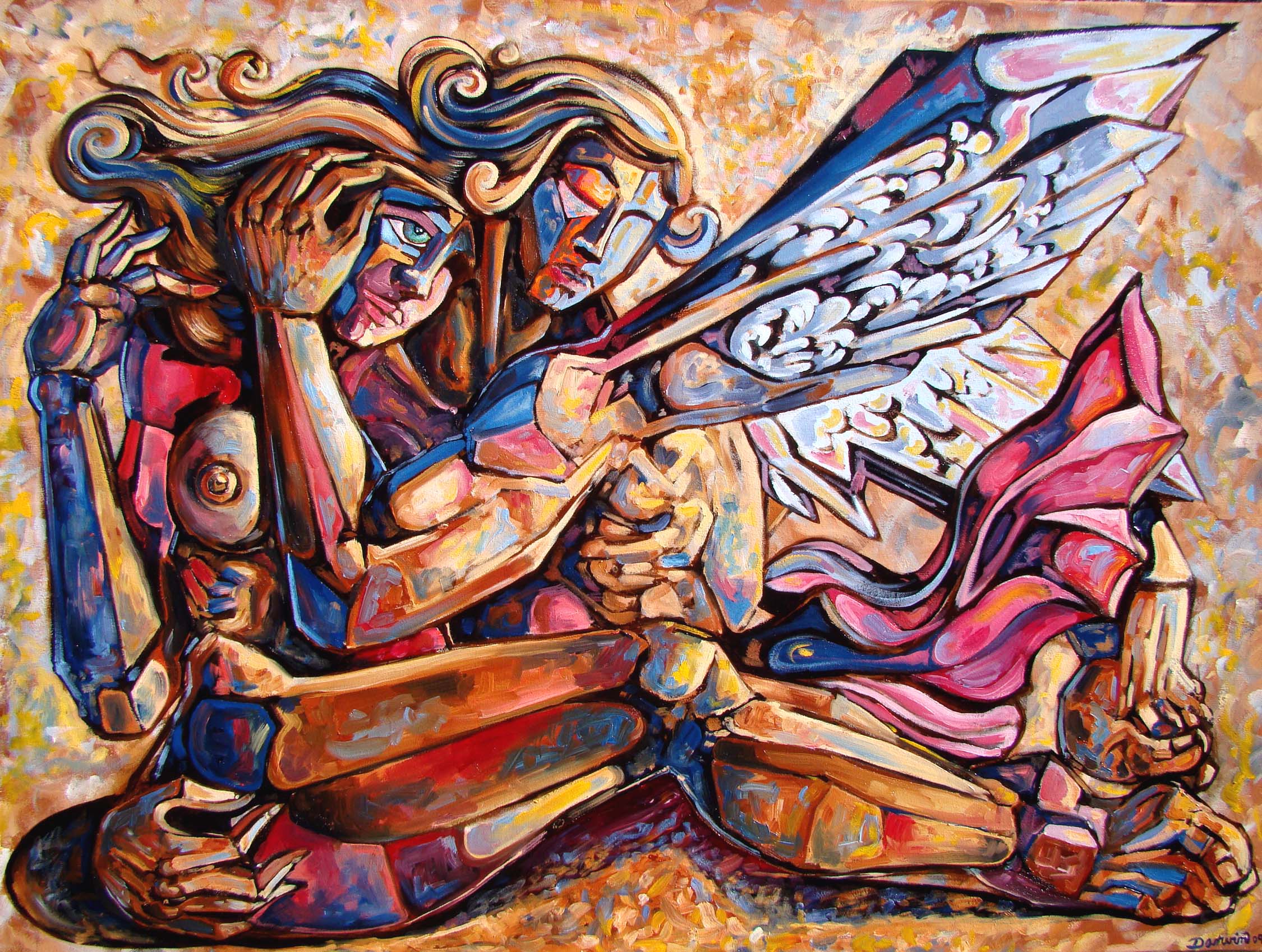
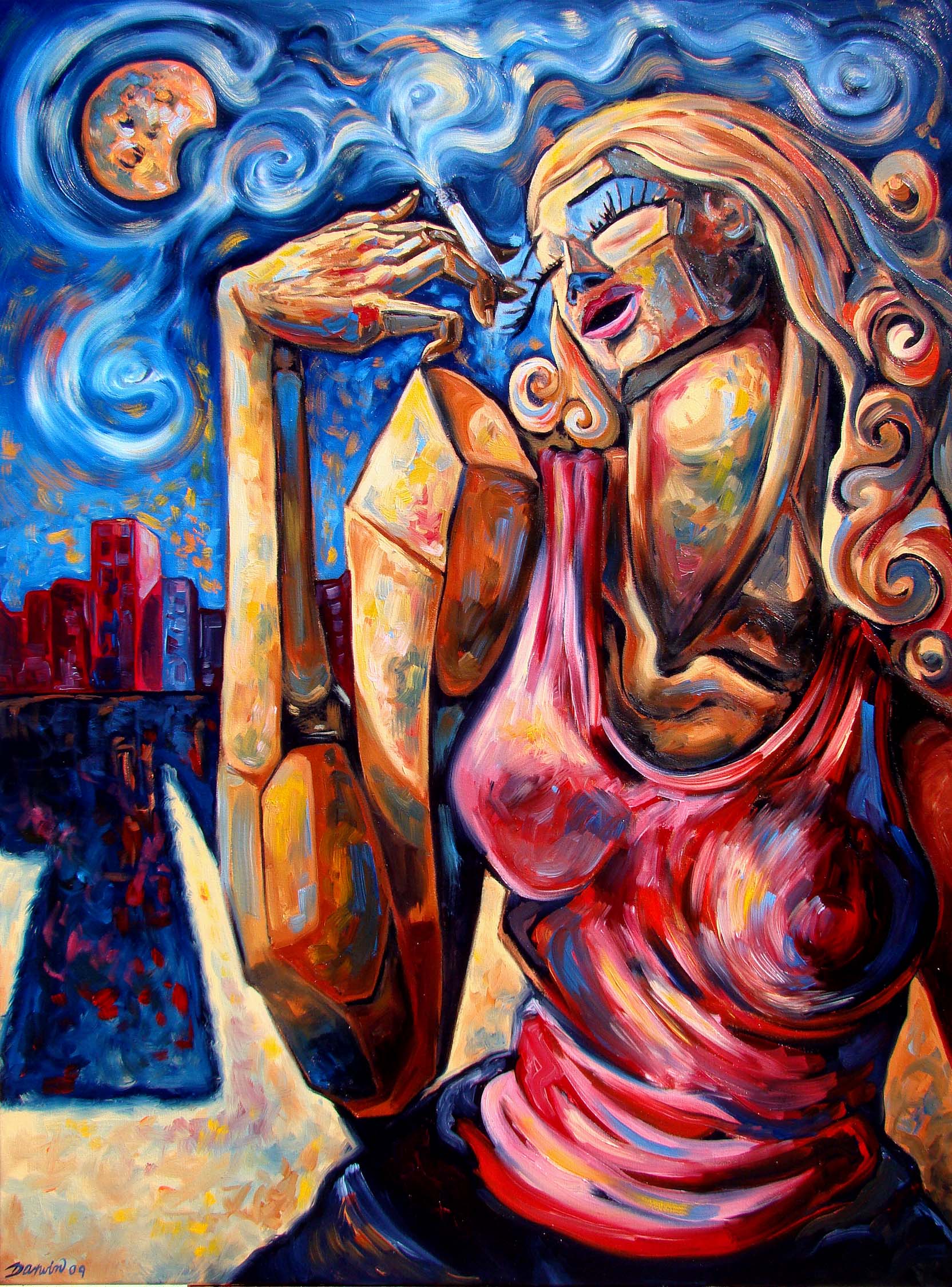
“Birth” by Millicent Borges Accardi

First Stage in a Lost Relationship (Millicent Accardi)
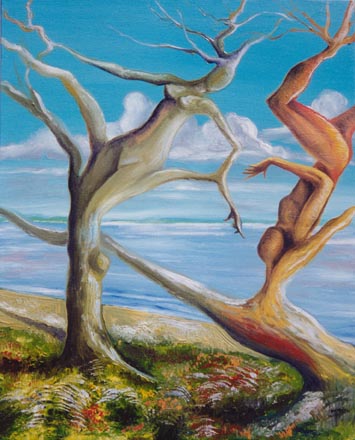
“First Stage in Lost Relationship,” oil on canvas, Darwin Leon

Not wanting to disturb the marriage,
my parents, or you: I enter backwards,
door through. The hallway strains
with my struggles: thick blooded pores enclose
my shoulders. If I can make it into the safety
of our bed without the angry walls screaming:
“Guilty, Jezebel, guilty,”
then I will be able to breathe.

In the living room, you my dear husband, my love,
you sleep: on the worn out sofa, like a child,
or a man who has given up. If my four legg’ed shadow
can crawl past you all will be well.

The Bible and the headstones will rest
with me, buried deep in trampled grass:
it is where they belong. You never gave me
any trouble, dear husband, but you never gave me
any encouragement, either.

Do not utter a word, sleeping man;
this life we have is not so safe.

Forced into this world with cold forceps,
I now bring myself back. Husband, husband
who is asleep, holding the umbilical cord
like a rubber band: You keep tugging on my body,
making me small.

I am your boomerang who must return;
dragged back like Circe with sperm in my hair;
it is a planned breach un-birth.

And so, tonight after tonight, I will carry
my purse, hide my cigarettes, and pray
that you do not awaken.

Never staying born is a crucifix that weighs
and digs into my bloody shoulders;
it happens every time I leave him to go home.

Not wanting to disturb the marriage,
my parents, or you:
I enter backwards, door through.


Millicent Borges Accardi is the author of two poetry books: Injuring Eternity and Woman on a Shaky Bridge. She received fellowships from the NEA, California Arts Council, Barbara Demming Foundation and Canto Mundo. A second full-length poetry collection Only More So is forthcoming from Salmon Press, Ireland in 2012.

Read an interview with Millicent here.

“Becoming” by Kelly N. Cockerham

Lean on Me (Kelly Cockerham)
“Lean on Me,” oil on canvas, Darwin Leon.

It was dark, a hand
over her mouth, nose.
Thump of feet kicking,
writhing in ribs,
cool cloud of it’s over
and dogs barking across
the bare roads of her arms.

The hand lifted—
not in mercy or regret—
came down again
somewhere else.  Then
a word came, repeating its name
until its meaning flew
into the leaves outside the window.
The word spread its long hair
over her eyes, rolled her lids
down on the busy desk of her body.
The word was a girl walking out a door.
The word was a lock clicking.
The word was a lost room on
the top shelf of a linen closet.

At night, the word
was a red-winged blackbird
in a flock of grackles, a shock
of color that mimicked light.
Beside her, the word traced
her features, spelled her name,
held onto her sleeve and didn’t let go.


Kelly N. Cockerham felt the soft tug of words at an early age and has followed their trail ever since. A graduate of the Bennington Writing Seminars in Vermont, her poems have appeared in The Leveler, Palooka, Soundzine, IthacaLit, and are forthcoming in Pebble Lake Review. She currently lives in Maryland with her husband and two children, but her heart resides on the west coast of Florida.

Read our interview with Kelly here.


“The Red Car” by Beverly Jackson

lMuse with Long Neck (Bev Jackson)
“Muse with Long Neck” oil on canvas, by Darwin Leon.

The daily papers in the back
seat spread atop the old women
who’ve come from the sex factory–
their mouths replaced
by labia, the desert beneath
their skirts sewn shut. The
passenger side is stacked
with old bones, like firewood.
Dead children and husbands,
parents and forgotten aunts,
polished ivory agleam
from years of travel. The driver’s
foot pumps the accelerator.
She leans into the wheel,
eyes squinting in the dimming
light. A ship of toothless smiles,
coy giggles–but the car
stands still, waiting, waiting
for the traffic light–three
black moons hung
above–to change.


Beverly Jackson is a poet, painter and writer living in Naples, Florida. She is widely published on the web and in print: credits here. She is currently working on a memoir “The Loose Fish Chronicles,” excerpts of which can be found here.

Read an interview with Bev here.

“For a Long Time” by B. Chelsea Adams

(For a Long Time)finalgoddess1
The Arrival of the Goddess of Consciousness by Darwin Leon.

I wasn’t drawn
to trombone,
sax or drum.

During those heavy days,
my head couldn’t hear
through the sadness.
Even my feet and shoulders
would not be stirred
by harmony or dissonance.

At last
I pushed the heaviness aside
like wind shoves clouds away.

And tonight, I’m owned again
by slide trombone, tenor sax,
snare drum.

I’m clothed in their cool silks,
loose scarves.

Slow licks riff
across my breastbone,
up and down my ribs.
I sway back and forth, hardly able
to stay seated.

The waiter thinks it’s the wine.
The bartender cuts me off.
They don’t know
each measure is being written
into me, deep inside
breast and belly,

that when I leave
I will swing down the pavement,
and in a syncopated rhythm,
sing and scat to the moon.


B. Chelsea Adams received her MA from Hollins College in Creative Writing and English. A chapbook of her poems, Looking for a Landing, was published by Sow’s Ear Press in 2000. Her stories and poems have been published in numerous journals, including Poet Lore, Potato Eyes, Albany Review, Southwestern Review, California State Poetry Quarterly, Huckleberry Magazine, Union Street Review, Wind, Lucid Stone, Rhino, and the Alms House Press Sampler. Java Poems a chapbook celebrating her addiction to coffee was published in 2007. She retired after teaching at Radford Univerity in Virginia for 23 years.

Read an interview with Chelsea here.


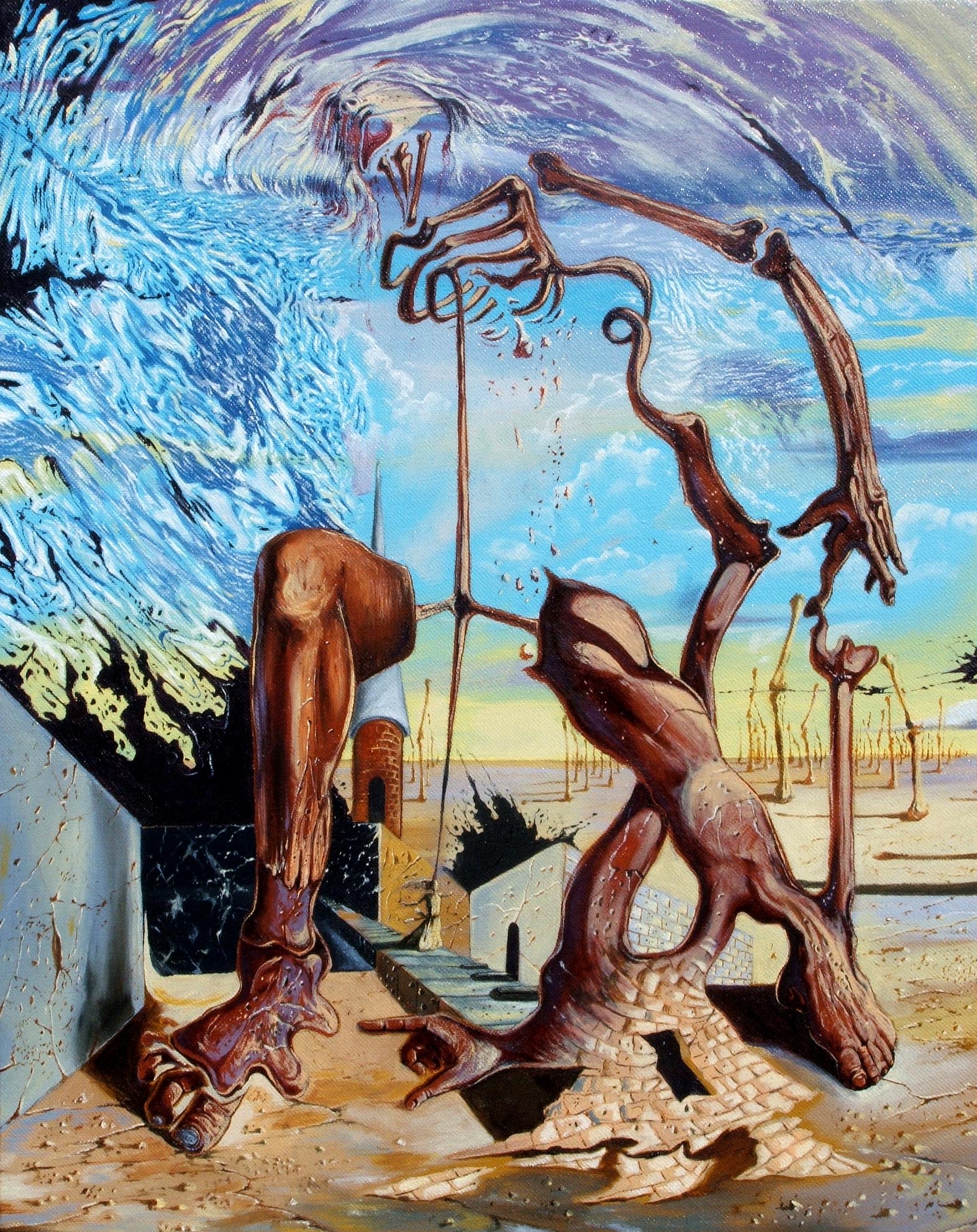
“A Poem for Today” by Matthew Gasda

The Disintegration of Adam (Matthew Gasda)
“The Disintegration of Adam,” oil on canvas, Darwin Leon.
(See also “Chain Smoking” by Rae Pagliarulo.)

The old childhood fears come
Back to you before sleep, a nothingness

Where you can’t see your hands
In front of your face.
The past is elastic
And receptive to your touch, you
Try to mold it into the shape of birdsong,
But it always disintegrates to the music of what
Happened. This house of grief is built out

Of silence and rain and glass,
And the six a.m. light still hangs itself in
Golden loops on the wall. The vowels of the
River in you are clear and
Sweet; they congeal into something like a
Lament. It has never seemed so sad, nor
so beautiful, to be alive as today.


Matthew Gasda is a poet living in Brooklyn, NY. His first book of poetry, The Humanist, is available through Amazon and select bookstores.


Review of Injuring Eternity


Review of Injuring Eternity by Millicent Borges Accardi


In a recent interview with Susan Rogers, Millicent Borges Accardi said that recovery, to her, was: “a healing from a place of artificiality to a place of real. Recovery is a process of peeling back the layers to get to ‘self’ … to not be in recovery is to deny life, to cover up and bear false witness to your own being.” I found this quote especially interesting when reading from her current collection of poetry, Injuring Eternity (Mischievous Muse Press/World Nouveau Company, 2010). The very idea of moving from a place of artificiality to a place of real and of peeling back the layers to expose what is truly underneath could not more define this collection.


The voice that comes through these poems is grounded in seeking the truth. From her poem, Birth, which is featured in the current issue of r.kv.r.y. To the final element in the collection, Victory, exploring  “A life, filled with inventions / And flying and space travel/and gadgets and, yes, even / Something called the twenty first century.” (p91). These poems seek not merely truth but to uncover hidden layers that go beyond mere appearance and into the sinew of what makes us all real. Birth has a narrator whose voice is clear and distinct, and who, from the opening line, submerges us into multi faceted /images far below the surface of things:


“Not wanting to disturb the marriage,

my parents, or you: I entered backwards,

doors through. The hallway strains

with my struggles: thick blooded pores enclose

my shoulders. If I can make it to the safety

of our bed without the angry walls screaming:

“Guilty, Jezebel, guilty, ”

then I will be able to breathe.” (p13).


The emotion portrayed in this opening stanza of Birth is one of the reasons I’ve become such a fan of Ms. Accardi’s work. She immediately hands the reader open, already excavated layers and bids us to fall even further into the poem. The poem then continues to do exactly that; to open layers, dare us to go further, explore just a little more; and the further we go, the more there is to find.


The poems in Injuring Eternity run a full range of topics, emotions and observations. The haunting, Sewing the Black, gives way to the intriguing Lady Night and The Last Letter to my Mother, where an every day event plunges us into the depths as if diving into ten-foot pool. The range of these poems will have something for every reader. But more than that, these poems speak so much to what our lives are made of: the sexual, the poignant, defeat, grief, happiness and sensuality. Accardi interconnects all of these paths of life into an interestingly woven tapestry: happiness holds no more weight than grief; finding joy runs as deep as loss; the warmth of a sensual touch glides easily on the same hand as a slap. Accardi intersperses these layers of beautifully etched /images with a believability that transforms them into a vast landscape where the reader has so much territory in which to wander and contemplate. For me, this is a collection I will read over and over: one reading just cannot do Injuring Eternity justice.

“Trust Because” by Nicole Robinson

Trust Because
Image first published in Mother Jones, appears here courtesy of Victor Juhasz

the sun is not stitched in with rays,
because words are a tongue
and have their own mysterious sex,
because I rarely allow another
to make me come, because unlike a willow
tree, I don’t understand how
to give in, how to let the breeze be
the only one with control, because
if I could give in and trust
I’d want to trust the redbud tree
that snapped in the windstorm, its branches
stretched out, the way its leaves have stayed
green for days without any connection
to its roots, until my soul shifts
into the coup in Honduras, some other School
of Americas tragedy, I’d want to trust
a little girl that’s there now, jumping rope
and singing without knowing what a coup is
or why the shouting sounds so angry until
my soul shifts into the woodpecker
beating his beak against bark,
the sound of it, something round,
a hole to hide out until I can find the world.


Nicole Robinson is the Program and Outreach Coordinator for the Wick Poetry Center at Kent State University. She is the author of the chapbook The Slop of Giving In, The Melt of Letting Go. She received her MFA in poetry from Ashland University, and currently lives in Kent, Ohio with her partner, Deb, and their greyhound, Bill.

Read our interview with Nicole here.


“Genesis” by Nicole Robinson

frankenstein
Image first published in Rolling Stone, used here courtesy of Victor Juhasz, artist

1

Among the trash and television when
the eleven o’clock news shuffled the Gulf war home
between the smiles of broadcasters, a little moment
gunned back: my mother threw chairs, not bombs, not bullets.
Luck gave in like a levy breaking, light creeping in. Her screams
became a current I could ride on the linoleum floor
of that apartment. The asphalt of the parking lot
looked different in day, then night was harder,
harder still was imagining a desert storm, all the people
on the screen uprooted, so easily muted.

2

It’s as simple as getting lost
in sky, or tremors of water; it’s all language
spilling. Time kept moving, kept its frame
inside seconds. One war ended.
Others would begin. At thirteen
I moved in with a new family. Silence still
shreds silence, the inside of an answer
I almost understand. How do I rip apart
that sky, climb into memory? It’s easy.
Go to the water, find a shell or a cold
stone with a hole in it. Everything leaks through.
But I will not say it is easy to hold.

3

Some say before us there was just
earth, vegetation, mangos growing, then
dropping, and carrots digging
inside land. Almost like history
I keep promises to myself silent.

4

You can measure things
through seasons. Staple a day
to the sun, a menstrual cycle
to the moon. Eventually
days turn to years
and years turn right back
to you. Memory is black, and truth:
the purple cracks inside.

5

First the sea creatures: everything you cannot
see but know when one brushes your leg
it’s there, sculpted like war,
like 1995 when the U.S. bombed Bosnia
without saying much but its name:
Operation Deliberate Force. I know
hands can open softly like a shell casing,
then fingers send bullets speeding.
Swim in any body of water. You will feel held
like birds who rely on sky, wind patterns that map out
migration. In moments when I’m less human I understand.

6

I built a shrine of stones and shells on my towel, later
watched a bug attempt to burrow there, confused
without knowing. Always we lose the beginnings.
Belonging blurred into the mess of longing.
An eagle over Lake Erie with a fish in his talons
was hungry. We’re all hungry, and I often forget
we’re all forgetting. Even after
the water doesn’t believe in the shore, or doesn’t
not believe in the shore, it lips up and rolls back
and repeats the same reeling motion. If I could
believe in something I’d believe in the shell casing
opened like a flower on the shore.

7

There is water, land, and sky. On the plane
I cannot see what’s ahead of me.
The window is too small.
There is no end, just a runway
and then, sky shifting. One moment
it’s clouds, a little light, horizon holding
its colors tight, then it becomes land, perfectly
straight roads lit up, veins to tap, another
cluster of lights, mapped scars to examine.


Nicole Robinson is the Program and Outreach Coordinator for the Wick Poetry Center at Kent State University. She is the author of the chapbook The Slop of Giving In, The Melt of Letting Go. She received her MFA in poetry from Ashland University, and currently lives in Kent, Ohio with her partner, Deb, and their greyhound, Bill.

Read an interview with Nicole here.


“The Miracle” by Heather Harris

Temple
Image courtesy Victor Juhasz, artist, first published by Sleeping Bear Press.

did not come when I asked for it, when
with head bowed and arms outstretched
hands resting on shoulders practically
crumbling beneath me I begged for the
suicide march of his cells to stop, no –

it came a year later when that pane of
stained glass splintered in my hands, I
ran to the bathroom to see a light blue
fleck floating precariously in the white
of my eye.

The miracle was when
with the lightest touch of my fingertip
it lifted out clean.


Heather Harris was born, raised, and currently lives in Akron, Ohio. She has been other places in between, but this has largely proven to be irrelevant.

Read an interview with heather Harris here.