“Aloha to Alcohol” by John Wojtowicz

aloha-to-alcohol
“At What Point Does a Moment Become a Memory?” by Dawn Surrat

It’s the sight of Rosalita severed in half
on the dashboard that haunts me most.
Her sunbathed grass skirt left to expose
the spiral spring core that once made her
hoop and hula to the rhythm of the road.
I can’t recall the impact or the EMS.
The sobriety tests and subsequent handcuffs
are just a flicker compared to the picture
of the wreckage wrought to my Rosalita.
The promise of sobriety soothed my mother’s
sleeplessness as marijuana medicated mine.
My former four-wheeled white stallion
was scrapped with Rosalita’s torso still attached.
Firmly mounted, she had only wavered
to sway side-to-side with her ukulele;
a peripheral pleasure that produced
a smile even during hazes of consciousness.
The image of her broken body and shattered
porcelain face precedes every “last drink.”
Before the world again reminds me of what
makes inanimate objects so easy to love.


John Wojtowicz grew up working on his family’s azalea and rhododendron nursery in the backwoods of South Jersey. He is currently employed as a social worker and takes every opportunity to combine this work with his passion for wilderness. Besides poetry, he likes bonfire, boots, beer, and bluegrass. He has been previously published in Stoneboat, Five2one, Naugatuck River Review, El Portal, and The Mom Egg.
 

“Night Shelter” by Roy Bentley

night-shelter_thefatalmoment
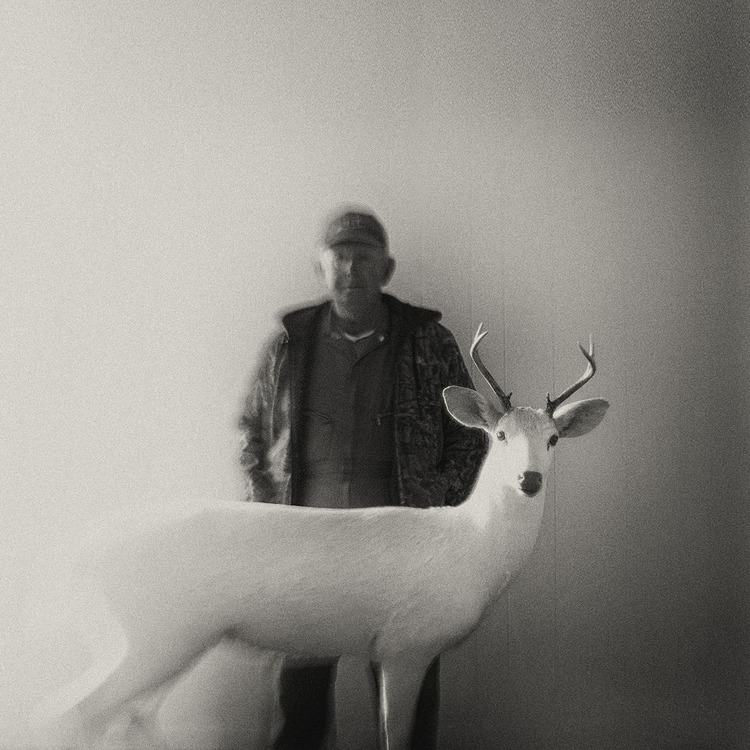
“The Fatal Moment” by Dawn Surratt

Above this agnostic ground, the dark rises
from the floor of the pines and it comes down
from branches as a mist after unsensational rain.
There’s a squall and sycamore leaves louver open.

Bobcats know the proportion of dry to wet spaces.
And this one is all paws and impatience, pacing off
provisional shelter under the trees. He pads before
unbraiding a dinner rabbit. Clouds across a blue

moon near an ocean can be a human face, Threat,
and still subordinate to the next meal. In one version
of the life of this cat, eyes saucer at machine sounds
on the best route of escape. Again, he falls to work—

maybe the natal den is a cave and springtime kittens
off New Jersey 539, but a rabbit in the mouth is worth
two driven from cover elsewhere. By a log the needles
are thin, tensile arms. Hilled and dry enough for now.


Roy Bentley was born in Dayton, Ohio. He is the author of four books and several chapbooks. Poems have appeared in The Southern Review, Blackbird, Shenandoah, Indiana Review, Prairie Schooner, North American Review and elsewhere—recently, in the anthologies New Poetry from the Midwest and Every River on Earth. He has received a Creative Writing Fellowship from the NEA (in poetry), as well as fellowships from the arts councils of Ohio and Florida. These days, he makes his home in Pataskala, Ohio.

“Those Who Once Lived There Return” by Wendy Miles

those-who-once-lived
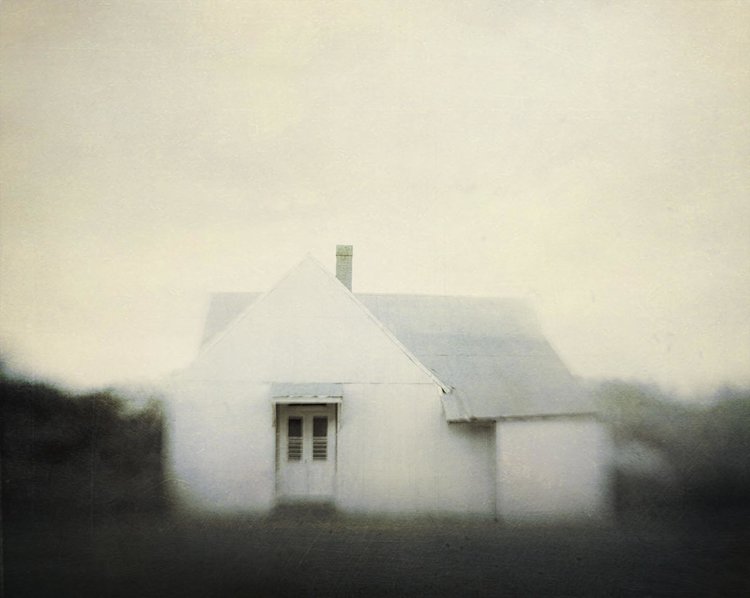
“What We Leave Behind,” Image by Dawn Surratt.
(See also “The Unspoken” by Margaret MacInnis.)

There where a golden bird is made
golden by October’s slanting light,

through the threshold of the hidden house
the empty clothes are seated in chairs.

The threshold gone, go ahead
and float. No one to see. Listen.

One loose shingle shifts
and forever tumbles.

A wooden drawer wails,
one hammer hitched on scissors.

You know something lies dead
across the road. Barbed wire fence,

rusted, looks to have uprooted posts
and embedded itself in tight periphery.

Even so, how can anyone sleep
with the windows nailed shut?

Can the bird know how golden
its body becomes? If you place the cup,

twist the dishrag, fold it in such a way,
look out the window again. You saw once

a cat snatched up by a hawk, legs
splayed straight as sticks.

How those bodies merged.
How those bodies merged

and awakened the air.


Wendy Miles’s work has been anthologized and appears in places such as Arts & Letters, Memoir Journal, Tupelo Quarterly, Southern Poetry Review, Hunger Mountain, storySouth, The MacGuffin and Alabama Literary Review. Winner of the 2014 Patricia Dobler Poetry Award, semi-finalist for the 2016 and 2013 Perugia Press Prize and a three-time Pushcart Prize nominee, she teaches writing at Randolph College in Virginia.

Read an interview with Wendy here.


“Clearing Ivy” by Alan Toltzis

clearing-ivy-2
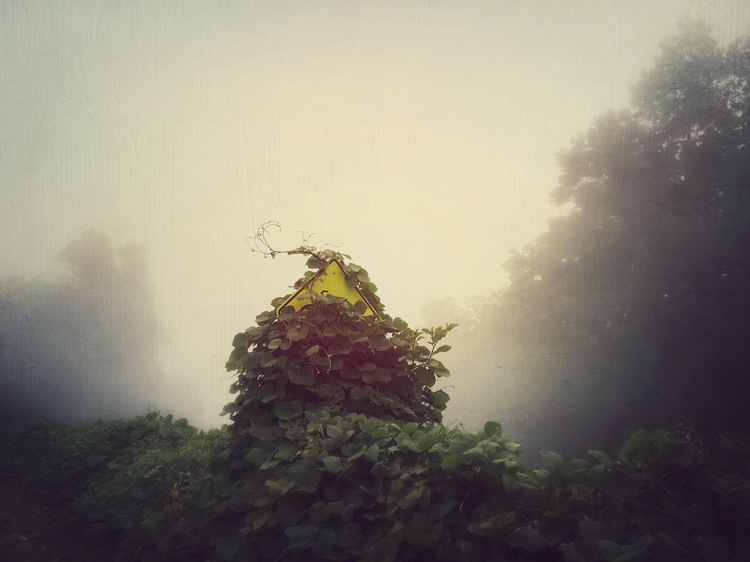
“Signs,” Image by Dawn Surratt

Its roots felt their way across my skin
looking for soft spots,
probably digging in wherever
it was easiest. Who’s to say?

With unforgiving tedium,

it crept

and wound

and clutched

dislodging mortar in a retaining wall
and bending a trunk under its weight.

Inevitability has no need to rush.

Miles of twisting gnarled vine
grip until
barehanded and bloody-knuckled
you rip and scrape away at the aftermath
revealing little claw marks
etched into its path.


Alan Toltzis is the author of The Last Commandment and the founder of The Psalm Project, which teaches poetry to kids in middle and high school. Recent work has appeared in Right Hand Pointing, The Provo Canyon Review, As It Ought to Be, Red Wolf, and Burningword Literary Journal. Find him online at alantoltzis.com.

Read an interview with Alan here.


“I Am Not Worth $8.50” by Jennifer Schomburg Kanke

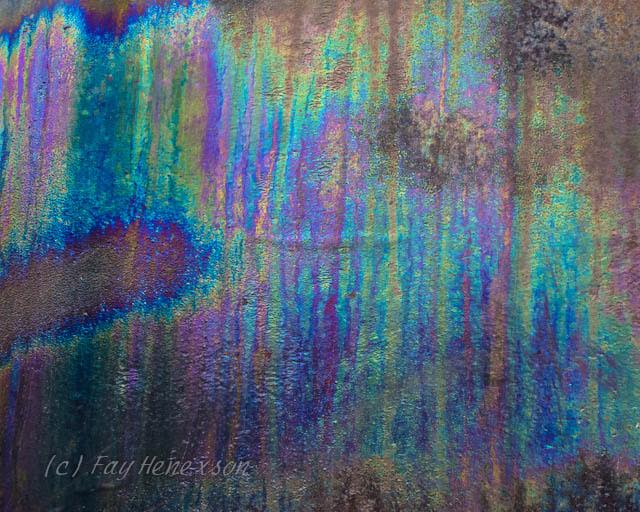
I am Not Worth (Under the Sea)
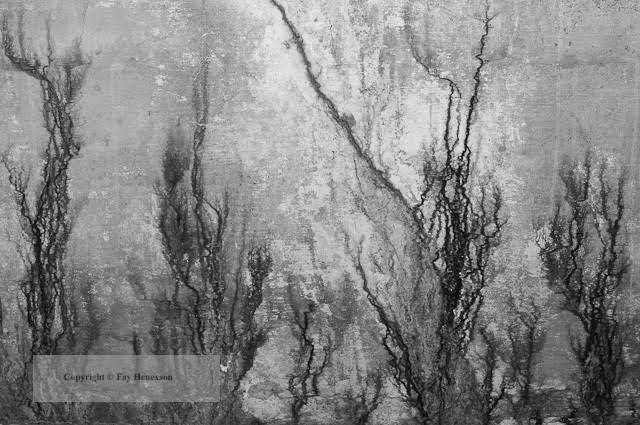
“Under the Sea,” Photograph by Fay Henexson

The hallway mirror is veined with gold paint,
each square a repetition of the last,
making the distance from the living room
to my bedroom look farther than it is.
One step, two steps, three and safe
to hold the door shut with thin arms
against whoever wants in tonight.
My parents buy a lock,
it’s broken within a month.
Replacing it would be a waste of money.


Jennifer Schomburg Kanke is originally from Columbus, Ohio and currently lives in Tallahassee, Florida where she teaches creative writing and critical theory at Florida State University. Her work has appeared in Prairie Schooner, Pleiades, and Nimrod.

Read an interview with Jennifer here.


Two Poems by Magdalene Fry

Barks (Tree Bark #2)
“Tree Bark #2,” Photograph by Fay Henexson

From Barks, no title

Dante and William pulled Gabriel
by the hand, in just that kind of way
little girls would, dressed in lacy
Sabbath shoes, tip toeing to the attic
where someone hid a secret from old
grandmother, and if they didn’t put
up a finger to their lips — the cat
would rend the poke in two with so
many laughters. It is uncountable —
“Shh,” they said and brushed his
tawny feathers between their wide
open palms in turns, “We’re straightening
our scarves about your neck, for tomorrow
some sun would like to glance about your
eyelashes.” Gabriel blushed. How he did.


From Vois, no title

Lest a we
sunder the gravel toothed
yesterdays’ big burp,
I light candles
and make single
a self in knowing
there be another I
than me – hallelujah
the brain, the vat
and them birds that
call out how time
is not but space with
light and light
with space – and
the tree nymphs cackle the grandest
middle fingers with
the opal story of
stone and root
and ever green in
mind. And on Olympus
they draw straws
and make card castles
not batting an eye
on the difference
between Delphi
and Solomon –
drink up, Zeus thunders
a surely nominative thy
and begins to speak
in ships and in –
anon, anon, anew.


Magdalene Fry is a single-parent advocate from Wayne County, West Virginia, and was educated at Anglia Ruskin and Marshall Universities. She lives in Michigan with her daughter and works as a mental health and wellness coordinator. These selections are from her books Barks and Vois.


“Living in Fear” by Liam Hogan

Living in Fear 1(Red Volcano)
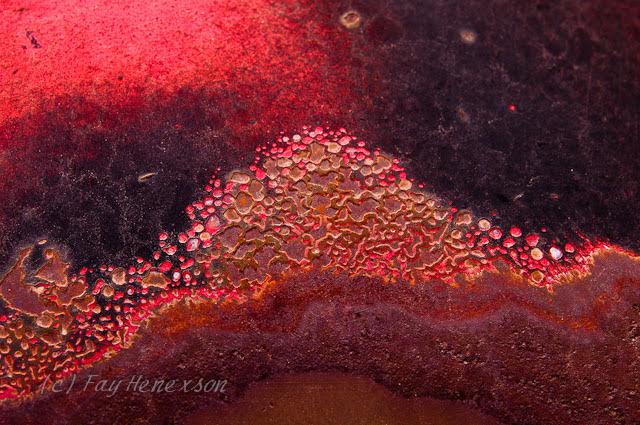
“Red Volcano,” Photograph by Fay Henexson

today is little white birds and the silent sun
and airplanes, repeating themselves
and sirens

where are you going, friend?
haven’t you heard?
the world is cold, and made of glass


Liam Cloud Hogan is a student in the Writing B.F.A. program at Pratt Institute in Brooklyn. This is his first professional publication.


“All These Cures” by Kelly DuMar

All these Cures (Broken Sunset1)
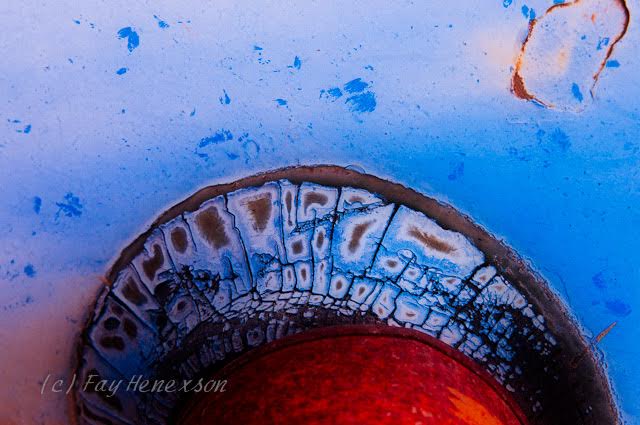
“Broken Sunset,” Photograph by Fay Henexson

One day you imagine the grandmother you need
and find her living in a Swedish bakery serving
tea to customers in wooden booths on wooden
floors in her sweet and steamy shop where she
feeds your hunger for cinnamon and vanilla,
your dream of comfort from butter and baking, the
yeasty promise of pastry curling and browning.

You ring the bell and a door swings open on a
ritual you make so she can greet you. If she speaks
Swedish you will never know. Her intuition is precise
and proofed in silence. The blend of tea she serves
you cannot tell. Her cures are brewed in brightly
painted pots, steeped in mystery, poured into China
cups on saucers she sets steaming under your nose.

Her intention is to love you no matter what and you
learn to let that be a nice surprise. You learn to trust
she means what she makes you feel, warmed and
wanted, sweetened and safely seated, belonging.

Every time you ring the bell a door swings open and
she is there to greet you until the day she doesn’t
because she is dead. You thought she lived where
she would live forever, but your imagination means
more than that. What she leaves you is the shop,
your place in it, and the mystery of who you must
serve in her absence.


Kelly DuMar is a poet, playwright and workshop facilitator from the Boston area. Her poems are published in many literary magazines, including “Lumina Online,” “Corium,” “Cape Cod Review,” “Kindred,” and “Tupelo Quarterly,” and her award-winning poetry chapbook, “All These Cures,” was published by Lit House Press in 2014. Kelly’s award winning plays have been produced around the US and Canada, and are published by dramatic publishers. Kelly founded and produces the Our Voices Festival of Women Playwrights at Wellesley College, now in its 10th year, and she serves on the boards & faculties of The International Women’s Writing Guild, and the Transformative Language Arts Network. Her new book of poetry & prose will be published by Finishing Line Press in 2016. Her website is kellydumar.com


“Mourning Light” by Rachel Crawford

Mourning Light (Shimmer) 
“Shimmer,” Photograph by Fay Henexson

When I woke I thought the sun was shining,
but it was only the overhead light
burning in my daughter’s pink and white room.

Grey light filtered through the leaves of the ash
that tapped on my bedroom window all night
making me dream of rain. I drew the blinds

on the tear-streaked morning, the muddy light,
the ash. I stepped across the hall to find
my daughter fingerpainting on the wall,

her hand a rainbow in mid-air. Still drenched
in dreams of loss, I leaned in the doorway
and watched her paint, one after another,

a yellow sun
shining on a red house
next to a green tree
by a white bridge
crossing a blue river.


Rachel Crawford is a writer, teacher, and editor whose poems and stories appear in Red Rock Review, Mudlark, Lucid Rhythms, The Lyric, Figures of Speech, Apeiron Review, Red River Review, The Yellow Chair Review, Illya’s Honey, Freshwater Poetry Journal, Adanna Literary Journal (forthcoming), Literary Juice, The Wayfarer: A Journal of Contemplative Literature, Anima Poetry Journal, Crack the Spine, Her Texas, Rock & Sling: A Journal of Witness, and RiverSedge. She lives in central Texas with her husband and daughter.


“Placental Insufficiency” by Todd Follett

Placental Insufficiency
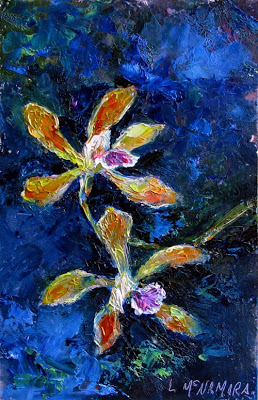
“Butterfly Orchids” by Lori McNamara, oil on masonite.

“that restless beast, who, coming
against me, little by little was driving
me back to where the sun is silent”

– Inferno, Canto I

into these grottos
onyx in chaos
impossible lines
contradicting

I have come here
to find a child

across brackish waters
churning still
borne onto the char
inside the crust

I have a child
I’ve come here to find

under antiseptic light
in clothes worn for days
we collapsed into chairs
and the heat of each other
machines bleating
pauses and wails
she came to tell us
our sun went out

I’ve come to find
I have a child
here


Todd Follett lives in Alameda, California and is currently enrolled in the MFA Writing program at the University of San Francisco. His poems have appeared or are forthcoming in Spoon River Poetry Review, Natural Bridge, DMQ Review, and The Pedestal Magazine.

Read an interview with Todd here.