“You Belong” by Tina Pocha

You Belong
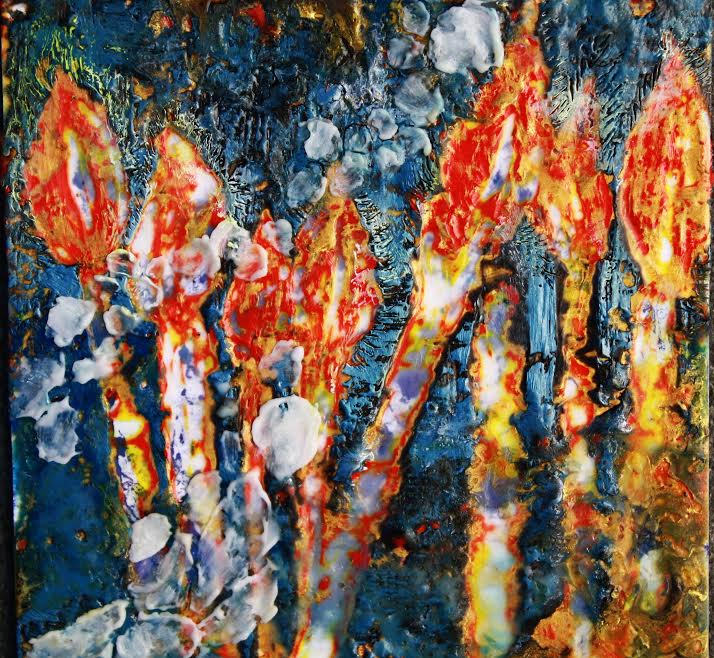
“Wax becomes fire” by Mia Avramut, wax on masonite board, 6 x 6 in.

She gave me a gift
her disclosure
her addiction
She laid it out
as if to say
here
warm your feet on this
And I do
each time I feel
the world rise up
to swallow me
I remember
I am not alone
on that cold tile floor


Tina Pocha was born and raised in Bombay, India. She is a scientist by training and a writer by avocation. She currently works as an academic in the field of language and literacy, and is a new and emerging poet with publications in Cadence Collective and Eunoia Review and more publications forthcoming in Hyacinth Press and East Jasmine Review. You can find more of her writing at www.tinapocha.com


“Plea” by Rayya Liebich

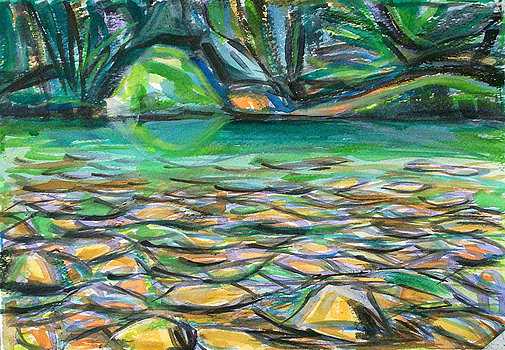
Plea_capilano-canyon-river-lagoon-low-water
“Capilano Canyon River Lagoon” by Allen Forrest, watercolor

Give me

poetry.

Soak me in

piano sonatas.

Pour my milk in tall

wine glasses.

Spill an ocean

for me to

grieve in.


Rayya Liebich is a graduate of English Lit. from Mc Gill University and her poetry has been published in “Seasonings” edited by Anne DeGrace. Her play “3 Minutes” was awarded first prize in the Kootenay Literary Competition in 2005.


“cross” by Dan Jacoby

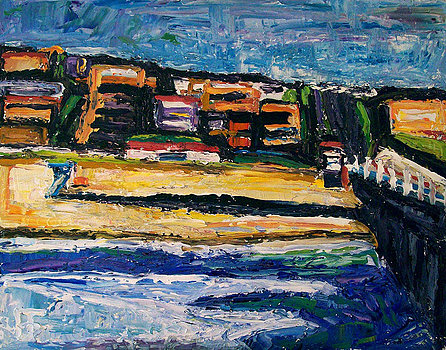
cross_manhattan-beach-ii-
“Manhattan Beach II” by Allen Forrest, oil on canvas

third day of a seven day binge
party line is
take him to confession
kind of….sometimes…..maybe
faith’s last stand
up for the down stroke
need for adrenalin rush
to elevate the moment
mistake not to engage others
should run towards that shit
breath in new long vowels
into some old words
come up with new nickname
stop surfing underground
old boots in new dirt
heading for newtown beach
to pull the sea air over him
and soak off
all the old mattress labels


Dan Jacoby was born in 1947 in Chicago. He is a graduate of St. Louis University and has published poetry in Badlands Literary Journal, Belle Rev Review, Black Heart Press, Bombay Gin, Canary, Chicago Literati, Cowboy Poetry Press, Floyd County Moonshine, Indiana Voice Journal, Haunted Waters Press, Deep South Magazine, Lines and Stars, Red Booth Review, The Tishman Review, Wilderness House Literary Review, Steel Toe Review, Red Fez, and the Vehicle. He is a member of the American Academy of Poets.

Read an interview with Dan here.

“Unhatched Caddis” by Scott T. Starbuck

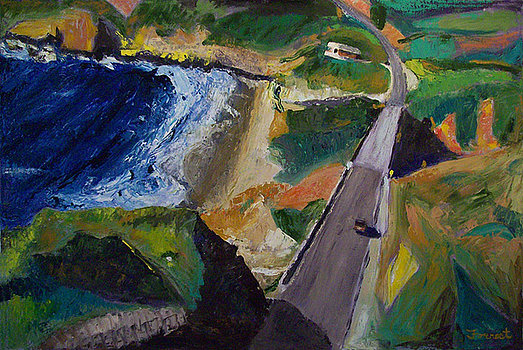
Unhatched Caddis_ca-hwy-1-stinson-beach-
“CA Hwy 1” by Allen Forrest, oil on canvas

Unhatched Caddis

struggling in the raft bag
in the back of my car
required an 8 hour drive
back to her native river.

I was accused of doing it
on purpose
so I could go fishing
but it was because

I too had been taken
from my home
of ancient evergreens
and swift pure waters.

For years I have watched them
hatch and rise
like tiny wish-granting fairies
landing on my arm.

On our long drive
she sat by me in a blueberry
Nancy’s yogurt cup
and I kept the music low

so as not to hurt
her caddis ears
which were likely
injured

when my landlord said,
“Does Scott know
the carbon footprint
to save that bug?”

At the river
caddis crawled away
in her stone tower
and lived happily ever after,

maybe the only one
of her kind
in 10,000 years
to be that crazy-lucky.


Scott T. Starbuck was a 2013 Artsmith Fellow on Orcas Island, a 2014 Friends of William Stafford Scholar at the “Speak Truth to Power” FOR Seabeck Conference, and writer-in-residence at The Sitka Center for Art and Ecology. Thomas Rain Crowe wrote about Scott T. Starbuck’s latest book forthcoming from Fomite Press, “Industrial Oz may just be the most cogent and sustained collection of quality eco-activist poetry ever written in this culture, this country.”  Activist Bill McKibben wrote, “Industrial Oz is . . . rousing, needling, haunting.” His blog Trees, Fish, and Dreams is at riverseek.blogspot.com

“Equal Time” by Herb Kauderer

Equal Time_capilano-canyon
“Capilano Canyon” by Allen Forrest, oil on canvas

This week
I know three more dead people.
That is the reality of becoming old.

Age
is washed in the knowledge
of all that’s lost as life goes along;
belief, friendships, goods, security,
eras, youthful energy, innocence.

It’s easy to wallow in loss,
but today
I will think of good things.

After all,
joy deserves equal time,
but is rarely loud enough to demand it.

So I will think of the tree near Cayuga Creek
draped in captured fishing lures,
webs of fishing lines,
and so many red & yellow bobbers & floats & sinkers
they appear to be fruits & blossoms
on those unleafed, early spring branches.

I will think of my children,
running from the mother goose that hissed
as it protected its eggs. And remember
giggling with them afterward on the bench
of the Reinstein nature trail.

I will look at my collection of John MacDonald books
and pick one to read
while I wrap myself
in the warm fuzzy blanket I inherited from my aunt.
But first I will indulge in my favorite mint black tea.
And butter cookies.

After all, joy deserves equal time.


Herb Kauderer is a retired Teamster who is currently an associate professor of English at Hilbert College. He holds an MFA from Goddard College among his diverse degrees, and author Will McDermott has called him “the master of life change.” Herb has had about a thousand poems published including eight chapbooks, most recently The Book of Answers which has met with great critical success.

Read an interview with Herb here.

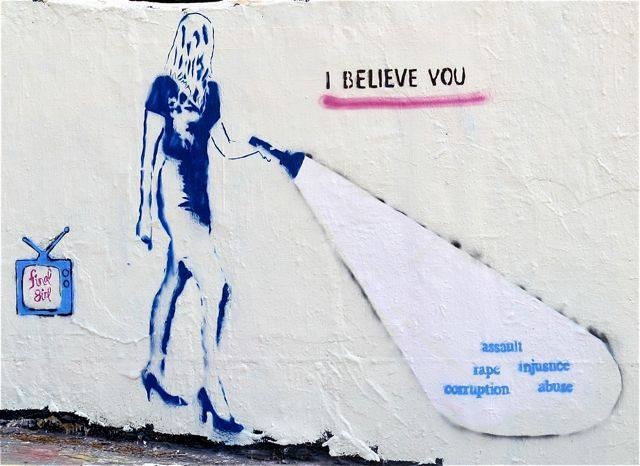
“The Way it Really Was” by Ann Goldsmith

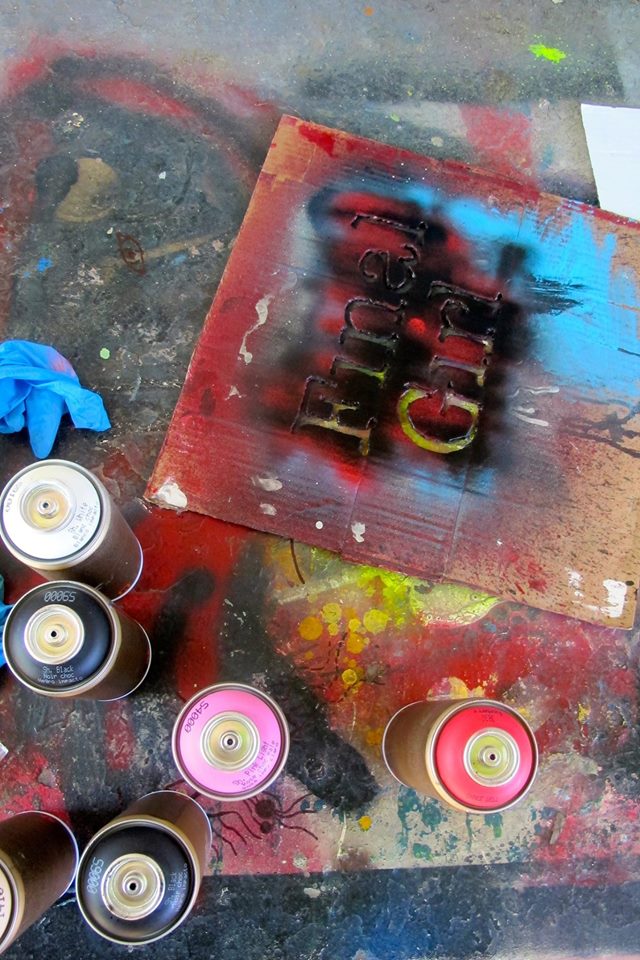
Final Girl street paint

From the beginning he got
all the perks, the glitz:
The Big Originator
            The Fomenting Father
                        Chairman of the Universe.
Creations erupted from his eyebrows,
his toenails. He sneezed
and the tides surged.

Where absence had been
he touched the Nothing into color,
motion, music. Clouds, red moons, geysers.
Time’s metronomic wink.

But no shadows. No reflections.
Last Moments, not yet.
Things colliding before they cooled,
mountain into mountain,
plain into pleated cliff. When,

in swirls of protoplasm, sea grass,
he rolled out animals and humans,
it wasn’t long before teeth
began to gnaw on unrestrained
succulence. Feasting everywhere
but no time to digest.

For the first few eons he was too
giddy to even glance
in my direction.
It took wearying periods of steady gazing
to temper the furious pace
of his fiery consummations.

Where would being be,
I tried to show, without a place
for roots and refinements? For rest?
No one mentions me, but
I was the one who mirrored it all back
until he began to see.


Ann Goldsmith‘s second book of poems, THE SPACES BETWEEN US, appeared in April 2010. She won the Quarterly Review of Literature’s Poetry Prize for her first book, NO ONE IS THE SAME AGAIN. Goldsmith holds a doctorate from the University of Buffalo, where she taught English for ten years. She has also served on the faculties of D’Youville and St. Trocaire Colleges, and worked as Western New York Coordinator for ALPS, a statewide poetry-in-the-schools organization. She has served as poet-in-residence at the Chautauqua Institution, and taught writing at Buffalo’s Trinity Center, which granted her an Excellence in Teaching Award. Her recently completed book of poems, WAITING AT THE TURN, is looking for a publisher.

“Deficient” by Amanda Kimmerly

Final Girl (Deficient)

My doctor says fingernails are the first to show— ripples, ridges;
like a washboard meant to wring out must.

My mother calls from the laundry room.
Her bones, like egg shells, cracking

“Honey, eat your breakfast.”

—Vitamins.

I swallow them whole, like issues: women’s, men’s, multi-

They catch, like phlegm, in the throat,
muzzle in the mouth like certain words:

hunger         ugly         growl

I peek inside my lunch box.
Another grapefruit. A friendly note:

“You’ll thank me soon, love.”

I cradle my hands, the missing moon in my nail bed
the waves of white, anemic flecks.


Amanda Kimmerly is a creative writing coach, editor and owner of Polished Pear Creative Editing out of Los Angeles, California, whose fierce aim is to weave manuscripts into masterpieces for emerging writers. Her poetry can be found in Mad Hatter’s Review, Full of Crow, 3Elements Review, Pear Noir!, and Arsenic Lobster. Read her fiction at Storychord Magazine, and her blog at www.PolishedPearCreative.com, where she discusses metaphysical and practical tools for enhancing overall creative freedom. Dreaming is one of her favorite hobbies. Find her at @PortraitOfALady.

“Unreported” by Patricia Caspers

Final Girl (Unreported)

1.

The Girl I Was

wants to apologize
for the vodka sting
in her throat,
the giggling want
of the footballers
who tossed her like a pigskin,
her splash of laughter
under pool water,
piercing blue.

That girl lost
the soaked clothes
someone peeled away,
and she’s sorry
for the replacements
two sizes too big,
with room enough
for the pug-faced one
to thrash
his freckled hands
past her waistband
and wrench open
the place where
she still smelled of chlorine.

And she didn’t mean
for the room
to become a swirling
circus of rusted rings,
didn’t intend to lose
her focus, to swallow
her voice, her breath,
as his friend took her—

she asks forgiveness
for not knowing where—

for waking up after,
bloody and sober,
stumbling alone
into a night
barren of stars.


2.

The Woman I Intend to Be

So many equinoxes later,
Persephone flings flip flops
and sunscreen into her satchel
at the first crack and mournful cry
of ice straining against the river’s flow.
The ferryman paddles against the current,
and with each splash of the oar, each
knock of floe against the hull, the idea
of Hades blurs, as if it’s a photograph
held so close the image dissolves, and soon
she’s not even in the frame, and that night
in the meadow is gone. The hyacinth and crocus
become a dot-to-dot on the final page
in the book of her childhood. Like Sysiphus
she begins the mystery again,
but the 1 is never in the same place twice,
and the 2 is a freefall off the page,
into the next volume, Adulthood, a sequel
bereft of foreshadowing, whose narrator
is unreliable and easily sickened
by the scent of narcissus.

She plays dominatrix
to thin-boned, sweet-lipped
mortals who sigh that her body is a vessel,
her body is riverine. She fucks, and doesn’t
return calls or read the poems
left on her doorstep. She fills her mouth
with wine, with almonds and olives,
and apricots, honey-steeped thiples, but nothing
washes clean the bitter seeds lodged
in her throat.

Who am I kidding?

I am no goddess. There is no spring
to beckon me from the underworld.
That boy has long since forgotten
my name. It’s time
to dismantle this mausoleum of shame,
put down the “should haves,” pick up the oars,
become the river, the craft, the orchard
of saplings in bloom on the far bank
where the slow spring light is indiscriminate,
and warmer now.


3.

The Mother I Am: An Open Letter to Demeter

Mother of Harvest, of Plenty, of Compromise,
These scales will never balance our horizon.
Time and again we’ve been patient
while men make gods and beasts of themselves,
gorge on our daughters, spit them into hell.
Listen, the judge has jizz on his hands.
His brothers devour Chicago dogs smeared with relish
and grunt approval from the sidelines.

The time for prayer has passed.

Gather the wronged: Persephone, Europa, Leda,
Medusa, Halpin, Washington, Havrilla,
the un-named in Stuebenville, in every country.

We will not pretty the ugly in them with
the shivs of our mouths. We may flinch
from the sucker punch of memory,
but we will not stop gathering the arsenal of our rage,
will not stop until we storm the fortress,
tear it down stone by stick, blaze the pyre,
and watch as every last fucker burns.


Patricia Caspers is the founding editor of West Trestle Review and poetry editor at Prick of the Spindle. Her full-length poetry collection, In the Belly of the Albatross will arrive via Glass Lyre Press in September, 2015.

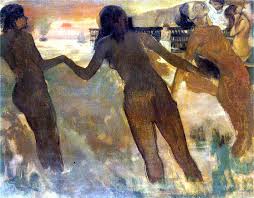
The Dance by Aidan Rooney

The Dance
Petites Paysannes se baignant à la mer vers le soir by Edgar Degas

The decades, give or take, to set things right,
repopulate a strand that flopped with fish
the sucked-back sea cast up before the quake
with girls naked for no one but themselves
in surf that’s up this evening even if
the sun gives the impression it’s gone down
in the diesel-spewing port of Jacmel,
and will do all it can to cool the fire-
storms of revolutions raged so long
what else can three girls do but want someone
to paint them crudely in in a hurry,
lashings of roasted cocoa, coffee, sugar,
rinsed of coal and salt and scorched-earth lime
at close of day, dancing into the dark.


Aidan Rooney is a native of Monaghan, Ireland, resident in the U.S. since 1987. He lives in Hingham, Massachusetts and teaches at Thayer Academy.  He was awarded the Hennessy Literary Award for New Irish Poet in 1997, and his collections, Day Release (2000) and Tightrope (2007) are published by The Gallery Press in Ireland. More recently (2013), he was awarded the Daniel Varoujan Award from the New England Poetry Club. Widely published in Europe and North America, his work has appeared in various anthologies including Staying Alive (Bloodaxe) and 180 More (Random House).

“Bathing My 20-Year-Old Son After He Has Broken His Arm” by Cecil Sayre

Bathing

He mentions it first, the awkwardness, one grown man bathing another.

I have thought it, and tried not thinking it, and have quietly cursed
his wild anger breaking and destroying

even moments such as these that should be private.
It is awkward washing his hair, now grown long like mine.

I last bathed him when he was a baby,
maybe older, maybe two, when his hair was short and fair,

but this boy is not a baby, his head hard beneath my scrubbing fingers,
his back broad and strong,

he is a son becoming more man than I can ever handle.
I rinse his hair and wash the soap from his back,

say, “Here,” and toss him the washcloth.
“You can do the rest, you still have one good hand.”

It is then that he says it, not before, and I nod and grunt in agreement,
sitting on the toilet, staring at the floor, counting the tiles.


Cecil Sayre is a visiting lecturer for the English Department of Indiana University. His work has appeared or is forthcoming in Naugatuck Literary Review, Slipstream, and Southern Indiana Review.