“Groceries” by Cathy Smith Bowers

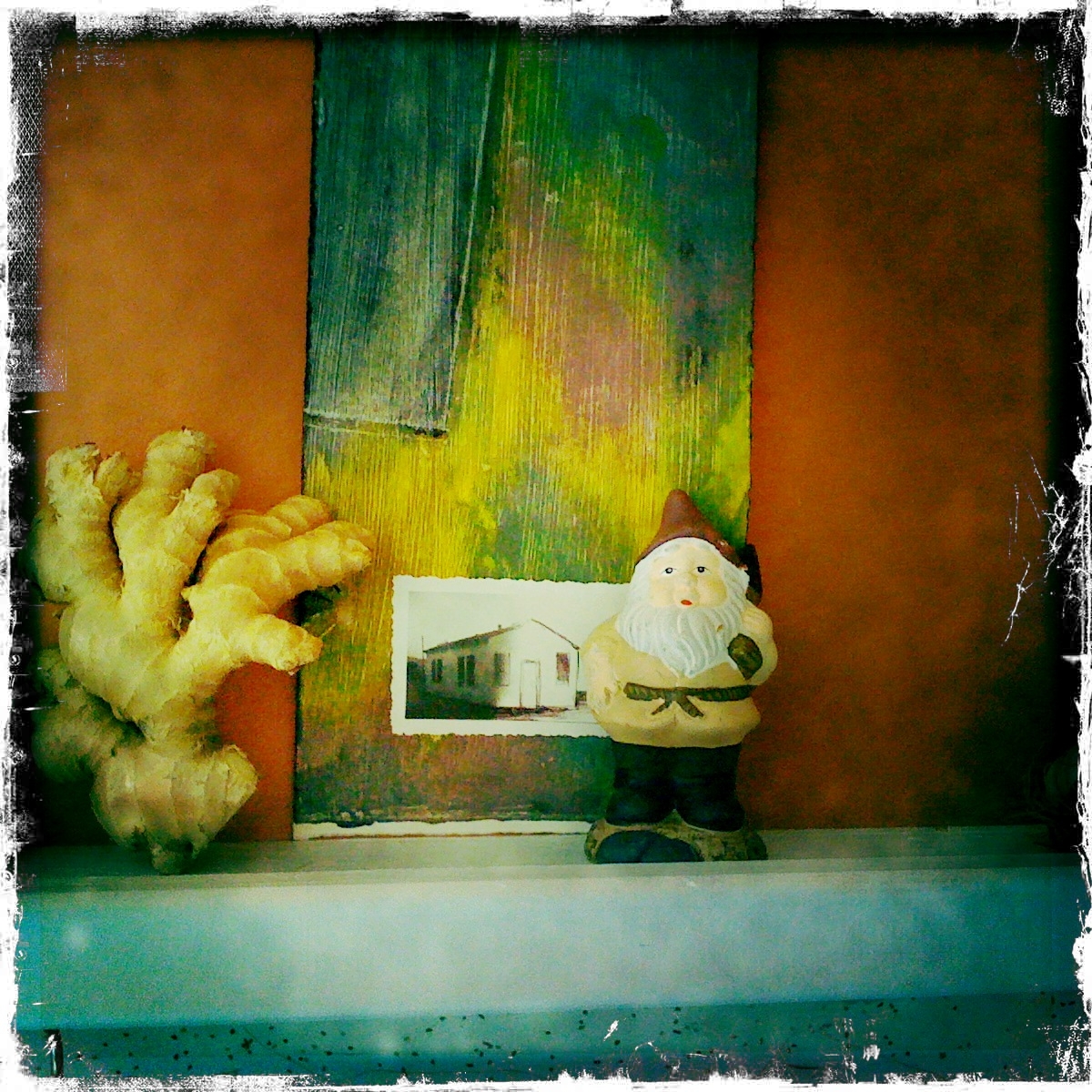
gnome, ginger root
Image by Kristin Beeler, 2011.
(See also “The Brussels Sprout Rule” by Ali J. Shaw.)

I had a boyfriend once, after my mother
and brothers and sisters and I
fled my father’s house, who worked
at the Piggly Wiggly where he stocked
shelves on Fridays until midnight
then drove to my house to sneak me out,
take me down to the tracks by the cotton mill
where he lifted me and the quilt I’d brought
into an empty boxcar. All night
the wild thunder of looms. The roar of trains
passing on adjacent tracks, hauling
their difficult cargo, cotton bales
or rolls of muslin on their way
to the bleachery to be whitened, patterned
into stripes and checks, into still-life gardens
of wisteria and rose. And when the whistle
signaled third shift free, he would lift me
down again onto the gravel and take me home.
If my mother ever knew, she didn’t say, so glad
in her new freedom, so grateful for the bags
of damaged goods stolen from the stockroom
and left on our kitchen table. Slashed
bags of rice and beans he had bandaged
with masking tape, the labelless cans,
the cereals and detergents in varying
stages of destruction. Plenty
to get us through the week, and even some plums
and cherries, tender and delicious,
still whole inside the mutilated cans
and floating in their own sweet juice.


Cathy Smith Bowers was born and reared, one of six children, in the small mill town of Lancaster, South Carolina. Her poems have appeared widely in publications such as The Atlantic Monthly, The Georgia Review, Poetry, The Southern Review, and The Kenyon Review. She served for many years as poet-in-residence at Queens University of Charlotte where she received the 2002 JB Fuqua Distinguished Educator Award. She now teaches in the Queens low-residency MFA program and at Wofford. She is the author of four collections of poetry: The Love That Ended Yesterday in Texas, Texas Tech University Press, 1992; Traveling in Time of Danger, Iris Press, 1999; A Book of Minutes, Iris Press, 2004; The Candle I Hold Up To See You, Iris Press, 2009. Smith Bowers is the current Poet Laureate of the state of North Carolina.

Read a review of Like Shining from Shook Foil here.

 

“That Year” by Susan Laughter Meyers

Yellow Flowers
Image by Dawn Estrin

for my mother

When the black-eyed susans begin to bloom
in the backyard, and the moonbeam coreopsis
bursts into tiny stars, I think of the year

I banished yellow from my life. It was the year
I dug up the lantana, when I didn’t plant
narcissus and all the buttery bulbs

but chose white, and a little blue, for the garden
without knowing that I was readying
for two long years of her dying. The next spring

I painted our kitchen, once a lemony gloss, ecru.
I threw out from my closet all the blouses
hinting, from their hangers, of glad canaries.

Beginning that fall I dressed in a dull haze
of beige, toning myself down for the end.
I ignored the incandescence of morning, the amber

of dusk, and leaned to clouds billowed in black.
The week in November she died I loaded the trunk
of my car with flats of pansies, three sacks of bulbs.

I wanted my hands working the dirt, a dark loam
that would spring into jonquils, daffodils—bright
coronas of yellow, and yellow, and yellow.


Susan Laughter Meyers is the author of the full collection Keep and Give Away and the chapbook Lessons in Leaving. Her poetry has also appeared in The Southern Review, Beloit Poetry Journal, Subtropics, and numerous other journals and anthologies. A long-time writing instructor, she lives with her husband in rural Givhans, SC. That Year first appeared in The Southern Review, was reprinted in Keep and Give Away, ©2006, University of South Carolina Press, and is reproduced by r.kv.r.y. with permission.

“Like Father” by Jericho Brown

Like Father
Image by Dawn Estrin

My father’s embrace is tighter
Now that he knows
He is not the only man in my life.
He whispers, Remember when, and, I love you,
As he holds my hand hungry
For a discussion of Bible scriptures
Over breakfast. He pours cups of coffee
I can’t stop
Spilling.

My father’s embrace is firm and warm
Now that he knows. He begs forgiveness
For anything he may have done to make me
Turn to abomination
As he watches my eggs, scrambled
Soft. Yolk runs all over the plate.
A rubber band binds the morning paper.

My father’s embrace tightens. Grits
Stiffen. I hug back
Like a little boy, gripping
To prove his handshake.
Daddy squeezes me close,
But I cannot feel his heartbeat
And he cannot hear mine—
There is too much flesh between us,
Two men in love.


Jericho Brown worked as the speechwriter for the Mayor of New Orleans before receiving his PhD in Creative Writing and Literature from the University of Houston. He also holds an MFA from the University of New Orleans and a BA from Dillard University. The recipient of the Whiting Writers Award, the Bunting Fellowship from the Radcliffe Institute at Harvard University, and two travel fellowships to the Krakow Poetry Seminar in Poland, Brown teaches creative writing as an Assistant Professor of English at the University of San Diego.  His poems have appeared in The Iowa Review, jubilat, New England Review, Oxford American, and several other journals and anthologies.  His first book, PLEASE (New Issues), won the 2009 American Book Award. Like Father is taken from Please by Jericho Brown (New Issues 2008) Copyright © 2008 by Jericho Brown. All rights reserved. Reprinted with permission from the author.

“And” by Isobel Dixon

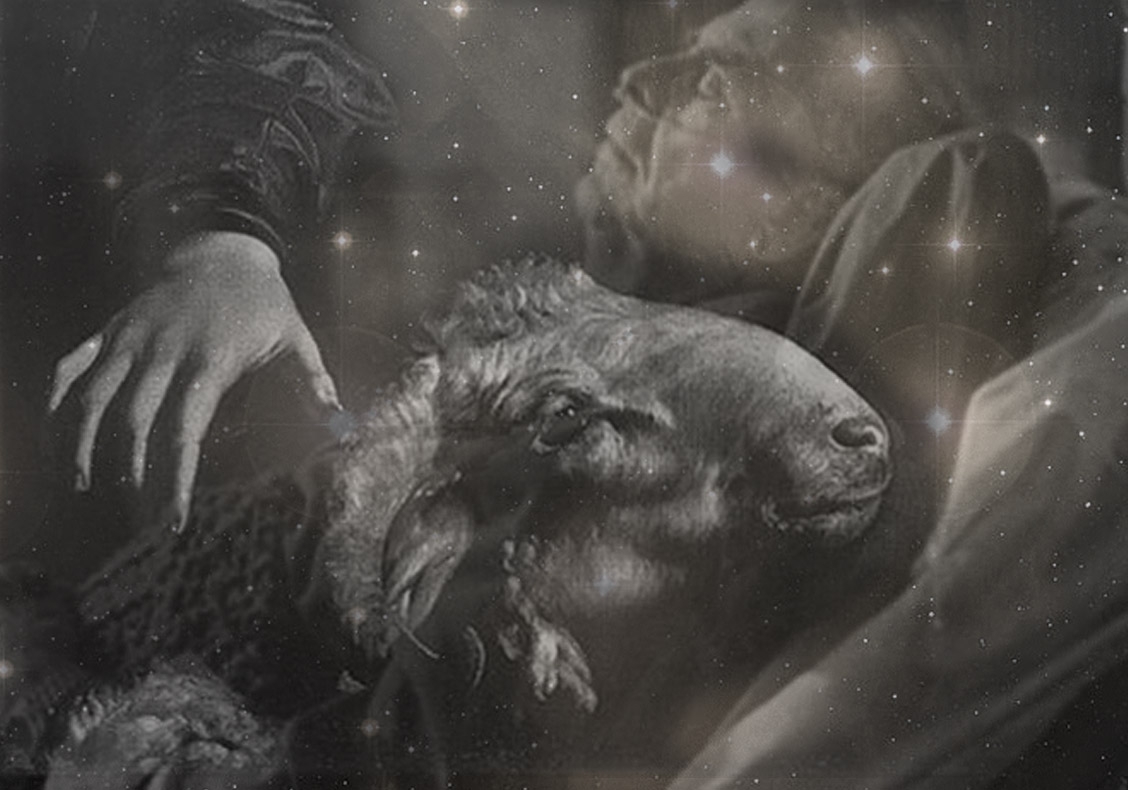
deathbed ram
Image by Dawn Estrin

And I was thinking in the breaking dawn,
my fingers on my father’s precious skin:
so this is what a death is like.

And not just any death, I see that now: the good death
of a good man. How it takes a lifetime
to prepare for such a death.
And a lifetime after for the rest of us, recovering.
Trying not to botch what’s left us of our own.


Isobel Dixon grew up in South Africa, where her prize-winning debut Weather Eye was published. Her poems have appeared in The Paris Review, Financial Times, The Guardian, The Manhattan Review, Southwest Review, Magma, Succour and Wasafiri, among others. She has been commissioned to write poems for the British Film Institute, and her work is included in several anthologies, including Penguin’s Poems for Love and The Forward Book of Poetry 2009. Her latest collection A Fold in the Map is published by Salt. Her next collection, The Tempest Prognosticator, comes out from Salt next year. www.isobeldixon.com And is taken from A Fold in the Map, ©2007, (UK: Salt; SA: Jacana), Reprinted with permission.


“Lamb” by Isobel Dixon

deathbed ram
Image by Dawn Estrin

We left him sleeping peaceful in the night
but they have tied him down, bony wrists
wrapped in a sheepskin cuff, lashed tightly to the rail.

He was fierce after we left, they say:
shouting, tearing at the drip. Hard to believe it
of this gentle man, but this morning,

unbound for the time we’re there, he cavils,
clawing at the needle in his arm, moaning
and stubborn, baring his teeth at us

when we refuse. I stroke his fettered hand,
his paper forehead, murmur comfort,
courage, anything. He shakes me off, tossing

his head, red-eyed, an angry ram. Ha!
I must remember who I am: his child,
just a child, why do I question him?

So I hold my tongue, but stay. Lift up the cup,
with its candy-striped concertina straw,
to his splintered lip and he, in resignation, sucks.

Yes, we make a meagre congregation, father,
disobedient. The flesh, indeed, is weak.
Still, remembered echoes of his sermons come:

a promised child, the tangled ram, the sheep-clothed son;
last-minute rescues, legacies, and lies.
The promised and the chosen, certain hopes.

How, from these stories are we to be wise?
His word was clear and sure before, but now
his raging, rambling, shakes this listener’s heart.

And yet, to be here, of some small use,
is a kind of peace. Three spoons of food,
oil for his hands, his feet. Then at last,
at last, returning to gentleness, he sleeps.


Isobel Dixon grew up in South Africa, where her prize-winning debut Weather Eye was published. Her poems have appeared in The Paris Review, Financial Times, The Guardian, The Manhattan Review, Southwest Review, Magma, Succour and Wasafiri, among others. She has been commissioned to write poems for the British Film Institute, and her work is included in several anthologies, including Penguin’s Poems for Love and The Forward Book of Poetry 2009. Her latest collection A Fold in the Map is published by Salt. Her next collection, The Tempest Prognosticator, comes out from Salt next year. www.isobeldixon.com Lamb taken from A Fold in the Map, ©2007, (UK: Salt; SA: Jacana), Reprinted with permission.


“Big Trouble” by Clinton B. Campbell

Big Trouble
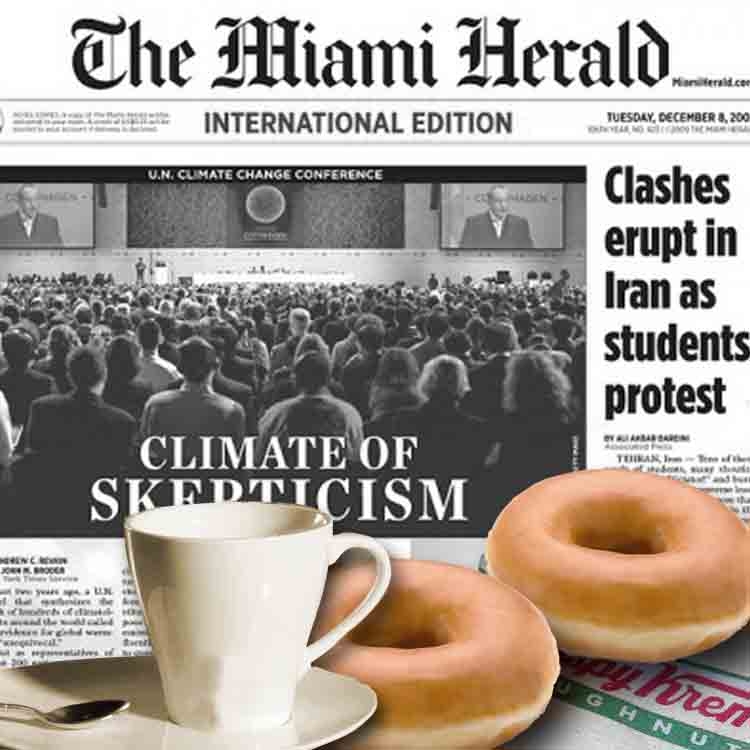
Image by Dawn Estrin

While I was out-to-lunch,
my wife answered the phone.
It was Dave Barry calling me.

I had been warned she might
run off with a prose writer.
I am a poet with no future.

He promised her
a Stephen King first edition
and a night job at Krispy Kreme.

Now she is living in Miami.
I recognize her in Dave’s new novel,
she’s Pixie, the porno queen.

“A little to the left,”
her one and only line.
I know she wants to come back,

but I canceled my subscription
to the Miami Herald.
It’s as good as a Mexican divorce.


Clinton B. Campbell says: “‘The first books they burn are poetry books; the first people they put in jail are poets.’ This quote is historically true. Why are the lowly poets so important to be imprisoned, as was the case in South America, Russia and most other imperialist nations over the history of writing? I believe it is because poets are the keepers of the truth, and ‘they’ don’t want the truth to be known. As a poet or any writer, it is our responsibility to keep telling the truth knowing the truth has little to do with the facts and little to do with recorded history.” Clint is currently re-reading Nineteen Eighty Four. Even though he is widely published, Clint is probably best known as house-husband for photographer/poet Karen M. Peluso. They live in Beaufort, SC.

“Semantics of Rape” by Kirsten Hemmy

book and knife
Image by Dawn Estrin

I think I get stuck
on almost, its taste sharp & sticking

in my throat, the same as knife, as is.
It is true after all, that you change

your words & form follows. Memory is
a frightening thing, so same as real, & it is

what gets people lost & found: I wake
some nights, my mouth a perfect circle, choking

on you, the fear as real as taste, as fighting
the impulse to either kill you or give in.


Kirsten Hemmy is an artist in Charlotte, NC. She is the founder of Mosaic Literary Center, an organization committed to providing art and writing opportunities to underserved communities. Her work has been the recipient of the Linda Flowers Literary Award and the Academy of American Poets Award. She is an assistant professor of English and the Chair of the Department of Interdisciplinary Studies, Philosophy and Religion at Johnson C. Smith University.


“Conditional” by Paul Hostovsky


(photograph by cole rise)

What if
this well-dressed man
exiting that magnificent
glass building
and walking toward that expensive
car with the livery plates
waiting for him at the curb
suddenly began
urinating
on the sidewalk
in the middle of
everything,
his excellent
tie flapping in the breeze,
his face and posture
betraying a powerlessness
over this mournful
necessary stream
as it dies in a dribble
at his feet…
You might think
it was a bladder condition,
or a prostate condition,
or a moral condition—
but you would never guess
that it’s a fairy tale
condition:
glass buildings,
expensive cars,
excellent grammars
and legal instruments
notwithstanding,
this well-dressed man,
not bothering
to shake himself dry
in the middle
of everything,
ducks into his pumpkin coach
and goes speeding off down
Wall Street,
transmogrifying
into his own
body.


Paul Hostovsky has long and generously contributed poetry to r.kv.r.y. His poems have been featured on Poetry Daily, Verse Daily, and The Writer’s Almanac; and published in Carolina Quarterly, Shenandoah, New Delta Review, Atlanta Review, Poetry East, and many other journals and anthologies. He won the Comstock Review‘s Muriel Craft Bailey Award in 2001, as well as chapbook contests from Grayson Books, Riverstone Press, Frank Cat Press, and Split Oak Press. He has two full-length poetry collections, Bending the Notes (2008), and Dear Truth (2009), both from Main Street Rag. Paul’s poems have been nominated for a Pushcart Prize 13 times, and won one once. He makes his living in Boston as an interpreter at the Massachusetts Commission for the Deaf and Hard of Hearing where he specializes in working with the deaf-blind.

“the dollar in the wishing well” by Paul Hostovsky

Expensive delicate boat
with a hundred chances on board
floating above the drowned brown
pennies with their one chance each
piled on top of each other
on the abject bottom

shivers, wavers, turns
over, capsizes and the green
president goes under and in
god we trust and all that fancy
acanthus leaf
amounting to a wish
that was taken for granted
yet is not granted

(drawing, Mathemetician by Jody Stadler)


Paul Hostovsky, has long and generously contributed poetry to r.kv.r.y.  His poems have been featured on Poetry Daily, Verse Daily, and The Writer’s Almanac; and published in Carolina Quarterly, Shenandoah, New Delta Review, Atlanta Review, Poetry East, and many other journals and anthologies. He won the Comstock Review‘s Muriel Craft Bailey Award in 2001, as well as chapbook contests from Grayson Books, Riverstone Press, Frank Cat Press, and Split Oak Press. He has two full-length poetry collections, Bending the Notes (2008), and Dear Truth (2009), both from Main Street Rag. Paul’s poems have been nominated for a Pushcart Prize 13 times, and won one once. He makes his living in Boston as an interpreter at the Massachusetts Commission for the Deaf and Hard of Hearing where he specializes in working with the deaf-blind.

“price check” by Paul Hostovsky

I think the price of sugar should go up
to reflect the irreplaceable
place of sweetness in the dark
world. I mean look
around. The ice is melting into everything and the levels
of pain are rising worldwide with alarming
silence seeping into everything
and it has a vaguely metal taste we seem
to recognize though we never
tasted it till now. I’m telling you
a pound of premium pure cane
granulated sugar in a box
is holy,
yet it’s only $1.89. I mean shame
on you who know in your heart
and soul, in your kidneys and on
your tongue you would give anything,
do anything, pay any price for a little more
of this ore, this wealth spreading like
love all around the bowl of
oatmeal of the world.

 
Paul Hostovsky, has long and generously contributed poetry to r.kv.r.y.  His poems have been featured on Poetry Daily, Verse Daily, and The Writer’s Almanac; and published in Carolina Quarterly, Shenandoah, New Delta Review, Atlanta Review, Poetry East, and many other journals and anthologies. He won the Comstock Review‘s Muriel Craft Bailey Award in 2001, as well as chapbook contests from Grayson Books, Riverstone Press, Frank Cat Press, and Split Oak Press. He has two full-length poetry collections, Bending the Notes (2008), and Dear Truth (2009), both from Main Street Rag. Paul’s poems have been nominated for a Pushcart Prize 13 times, and won one once. He makes his living in Boston as an interpreter at the Massachusetts Commission for the Deaf and Hard of Hearing where he specializes in working with the deaf-blind.