“The Ché Guevara Diet” by Alex Galper

Green Leaved Plants

The way Guevara attempted to set Latin America on revolutionary fire,
I try to shed some pounds.
as Ché counted every bullet before landing in Bolivia,
I count every damn calorie.
as he fought his way out of the jungles,
I’ve battled for the third day in a row
my bloody war with creamy donuts.

as Ché ran surrounded by soldiers,
I’m encircled by blueberry cheesecake.
it is everywhere. At work, at home,
in the hands of guests arriving at every party.
Evil capitalist cheesecake!

as Guevara was ambushed and captured,
I absolutely coincidentally entered a bakery, hollering my bold
revolutionary defiance.
“you can’t kill me! I’m Ché Guevara himself!”
And I screamed, pointing behind the glass, “you can’t sell me this one, and
that one, and that one! I’m Galper! I should fly after girls,

and not roll like a wheel!”
too bad. The execution squad’s hearts are unmoved, their eyes are
emotionless,
and the cruel honey cake and pitiless crème Brule
are deaf to my great romantic plans.

Bee-bullets fly out of the beehive of rifles,
Ché collapses into the nameless pit of Eternal Life,
and progressive humanity breaks down in tears.

Weak Galper falls into bed,
snoring, unable to move a finger,
and the Ideal of Womanhood departs,
cursing and untouched.


~Alex Galper

“The Bus Driver at Night” by Kaja Katamay‘

Man in White T Shirt Standing on the Bus

can tell you what to watch out for, where to go. I don’t know
where to put my hands anymore –
neatly folded on the lap like a napkin? or resting
slack and supplicant like little martyrs at my side.
The bus driver at night could tell you where
you were, or where you would be. I don’t need to know
either, just want a chance at the wheel so I can make that slow, wide driver’s wave
through the windshield
as we pass a sister bus on a side street in the dark, warm inside and heaving close
as canes of sugar.


Kaja Katamay‘s poetry and nonfiction has appeared or is forthcoming in eye-rhyme, The Oregon Review of Arts, and Caketrain, among others. She lives in Portland, OR.

“My Father’s Depression” by Dane Cervine

I remember crawling with my father
on our hands and knees deep into the seaside cave—
the still wet sand, the small flash light beam
mapping the rock roof as it descended to its dead end.
Alone with my father in the cramped dark—and I swore,
I’d never stay there, in sand depressed by heavy bodies,
waiting for the sea to wash our shapes away.


Dane Cervine makes his first appearance in this issue of r.kv.r.y.  Dane’s work appeared recently in the SUN Magazine, Atlanta Review, the Birmingham Review, and the Bathyspheric Review.Dane’s book The Jeweled Net of Indra from Plain View Press can be viewed at his new website danecervine.typepad.com. Dane is a member of the Emerald Street Writers in Santa Cruz, California, where he serves as Chief of Children’s Mental Health for the county.

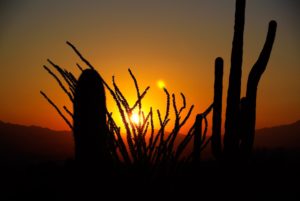
“Among the Cacti That Resembled Desert Gravestones” by Zachary C. Bush

You spent your twentieth birthday getting clean
With an Indian chief and his son, who taught you
To lure rain clouds by their ancestral dance

Those men were so stunning; shouting and
Spinning sweat from their long black hair before
The rain fell and cooled the sand beneath our feet.


Zachary C. Bush, Among the Cacti that Resembled Desert Gravestones, is a poet and writer. He lives in Georgia. His work has appeared in over two dozen online and print literary journals. He has more recent work forthcoming in GHOTI Magazine, The CommonLine Project, and the Poet Plant Press 2007: Lunch Anthology. He is also the author of two forthcoming chapbooks of poetry through Scintillating Publications (2007) and Pudding House Publications (2007). This is Zachary’s second appearance in r.kv.r.y.

“Lost” by Louise Kantro


You shun
calls, work, friends
night sleep
grooming
equilibrium
an actual job
and what you call
my need to control.

I fear
the loose robes
you wrap around
your hours
theft
collection agencies
car wrecks and
cocaine’s seductive
lies.

But yet I hope.


Louise Kantro teaches high school and received her MFA in Creative Writing in 2003.  She has published and/or won prizes for more than two dozen stories.  Married for thirty-five years, with two grown sons, she lives in a messy house with her husband and two cats.

“The Spell” by Dane Cervine


In Peet’s Coffee, a young man sits by the window
on a wooden stool, grimacing under weather-darkened skin.
Fidgeting irritably when another man sits near to share the light,
he bolts to a far empty table, face tense, reddening. A woman
with a baby and blonde toddler carry hot chocolate and pastries
toward the three empty seats at his table, asks if they are free.
He says yes, face softening as the little girl chats amiably,
looks him in the eye, smiles. An immense beast lifts
from his body, withdrawing talons, allowing the skin
around his eyes to soften, smooth. The little girl’s voice
a spell, taming his demons till they purr like sated kittens.


Dane Cervine’s poetry appeared recently in the SUN Magazine, Atlanta Review, the Birmingham Review, and the Bathyspheric Review.. His book The Jeweled Net of Indra from Plain View Press can be viewed at his new website danecervine.typepad.com. Dane is a member of the Emerald Street Writers in Santa Cruz, California, where he serves as Chief of Children’s Mental Health for the county.

“Aftermath” by John Wesick


Empty bottles everywhere – on the counter, the desk, on the bookshelf by the DSM-IV.
They surround congealed bean dip studded with shards of nachos.

Cigarette butts smudged with red lipstick.
Gnawed chicken wings on grease-stained
napkins. Soiled underwear on the door knob.
The used condom under the bed oozes
like a gutted squid. The smell of stale beer.

Empties rattle on the way to the dumpster.
One falls from the garbage bag and bursts on the sidewalk. A dirty look from between the neighbor’s blinds.

Dry Cheerios, the last of the orange juice.
An apologetic phone call to the boss.
No work today, only Dr. Phil, Judge Judy, and Clifford the Big Red Dog.

Metal bangs and broken glass tinkles
from the parking lot where a garbage truck labors.
The sun staggers through the sweltering afternoon.
Safe in the shade of drawn curtains, a clock counts down toward happy hour.


John Wesick has a Ph.D. in physics, has practiced Buddhism for over twenty years, and has published over a hundred poems in small press journals such as Pearl, Pudding, Slipstream, American Tanka, Anthology Magazine, The Blind Man’s Rainbow, Ceremony, Edgz, The Kaleidoscope Review, The Magee Park Anthology, The New Verse News, Poesia, Sacred Journey, San Diego Writer’s Monthly, Sunken Lines, Tidepools, Zillah, and others. 

“Listen: I Have Long Kept Silent” by Stacy Thieszen


1. The last two horses died in their traces and we left the wagon behind.

2. Walking with slow weary steps through grasses high as our throats, searching for water.

3. The wind flapping our clothing as it shakes the leaves of aspens so they show their white bellies.

4. This was a land of few trees, unreliable water, great heat, gold-green grasses without end.

5. The land of grass became a land of blood.

6.  Your mission is to listen, or not.

7.  Our mission is to thrive.

8.  After so many years, I speak because I see the past circling by my window, because I believe you will understand.

9.  This time is not so different from that time, the land, the hunger, the mission of our people.

10.  The herds of monstrous, untenable beasts we have called buffalo.

11. A woman, this woman, myself, I can swim through grass as fish swim through water and I swam until I could swim no more and this became our home, my husband and I as alone as if capsized on any desert isle.

12. Except for the savages.

~

1. I have held the truth in my belly these many years.

2. Your mission is to hear the truth this time. You may choose to listen or you may hum and look away.

3. The wind and successive disasters which left my husband and myself the only survivors had driven us far from the trail; we could expect no rescue.

4. We marked the days by scratching in the dirt, and the wind erased our timekeeping.

5. The buffalo had shoulders like mountains, eyes like stones.

6. We prevailed because we believed it would be so.

7. We learned that the flesh of the savage is good.

8. Our mission is to grow and prosper.

9. Our mission is to clear the land of darkness.

10. My eyes never became accustomed to the red rush of blood, my hands to the feel of the skin parting from flesh, sucking and then ripping free.

~

1. When it finally rained, I lay on flattened grass and let the water wash my skin, my great shining wheel of hair.

2. You have heard stories of savage and settler, but it was not then as you have now heard, not here.

3. My husband and I ate a nation.

4. By the Grace of God. How else could two kill two-thousand?

5. This homestead is a testament to the gun and the keen blue eye.

6. I have held my tongue all these years.

7. Your mission is to listen to what was hidden.

8. We ate the meat of their bodies, made supple clothes of their skin, wove blankets of their long, dark hair, used their bones as tools and crushed them into mortar.

9. Between you and me is the difference of an hour or a year or a hundred miles, no more.

~

1. Our mission is to build sturdy and pleasant houses that keep out the bats and snakes and haunting insinuation of the wind.

2. I only followed my husband’s will. I could make that claim.

3. After more than ten years, the faces of civilization caught up with us.

4. My husband emphasized our industry, the neat rows of corn and potatoes, the clean and sturdy house. The absence of savages.

5. The truth was right before their eyes, but their mouths said buffalo skins, bones of buffalo—how amazing!

6. Did they not see how fine my shoes were, how soft?

7. From then on we had to hunt rabbit, deer and buffalo with our new neighbors, slicing open those alien four-legged bodies, roasting that exotic meat.

8. Our mission is to triumph over those unlike ourselves.

9. Still, our mission is to feed upon the savages to build a stronger country.

10.  This prairie is an ocean where I’ve had to learn to swim.

11. It was not at first my idea or desire.


Stacy Thieszen‘s short stories have appeared in the anthology Blink, Clackamas Literary Review, South Dakota Review, and other small journals. She has completed two novels, one of which was a finalist for the Bellwether Prize last year. She lives in Minneapolis with her husband and son and works as a writer for a large nonprofit organization.

“To Be Like Him” by Yvette A. Schnoeker-Shorb


To hell with the apple–at her core,
Eve simply wanted to explore paradise
before converting it to Eden.
But she sought advice
from the problematic tree–the only tree
that would ever cut down a human.

Yet the scarlet, fertile fruit seduced her
as knowledge is hot, and once inflamed
the sassy lass snaked her way to Adam;
with each kiss, offered her hypothesis
on why she so desperately desired
the mind of the creator.

I know how she felt,
for the fateful flame was
not the type one holds for a lover;
still, it glows with want, blue
in the center with sin-red heat
inspiring the heart into submission.

But it is the psyche that fans the fire
and which designed Eve’s descent–the fall
rendered as a consequence of some savage
angel extending his residence from heaven
to earthly woods, rather than being depicted
as merely a woman’s addiction to theory.

Clearly, how could Eve’s craving forbidden
frameworks hidden in that hot-bed garden,
that is, her heady attraction to abstractions
sired first by some admired other,
be portrayed as depraved or as betrayal
when it feels so much like love?


Yvette A. Schnoeker-Shorb’s poetry has appeared in Blueline, Pinyon, Wild Earth, Red River Review, Terrain.org, The Pedestal Magazine, The Midwest Quarterly, Hawai’i Pacific Review, Poem, Karamu, and many other journals. She is co-editor of the Sustainable Ways Newsletter and co-founder of Native West Press. She holds an interdisciplinary MA in Ecosemantics and is currently assisting Terril Shorb, Coordinator of the Sustainable Community Development track at Prescott College, with research related to human perceptions and behavior toward the natural environment.

“My New Life” by Dee Shapiro


My new life fills my head
Every moment it tells me
I will be fine

Pulled through the past
and through each day
what do I want to remember
when memory fails?

These few things:

impending darkness
repelled by an evening clearly lit
by lamplight

a conversation connubial
with the promise of passion

waking
to a cool morning
after a heat wave.


Dee Shapiro is a poet, painter, and writer. Her poems and essays have appeared in Chiron Review, Small Pond Magazine, Black Bear, Blue Line, Adirondack Review, New Press Literary Quarterly, Aught, The Bark, Heresies Connecticut River Review, Rhapsoidia and Confrontation. She teaches art history and studio art at Empire State College, Old Westbury, NY.