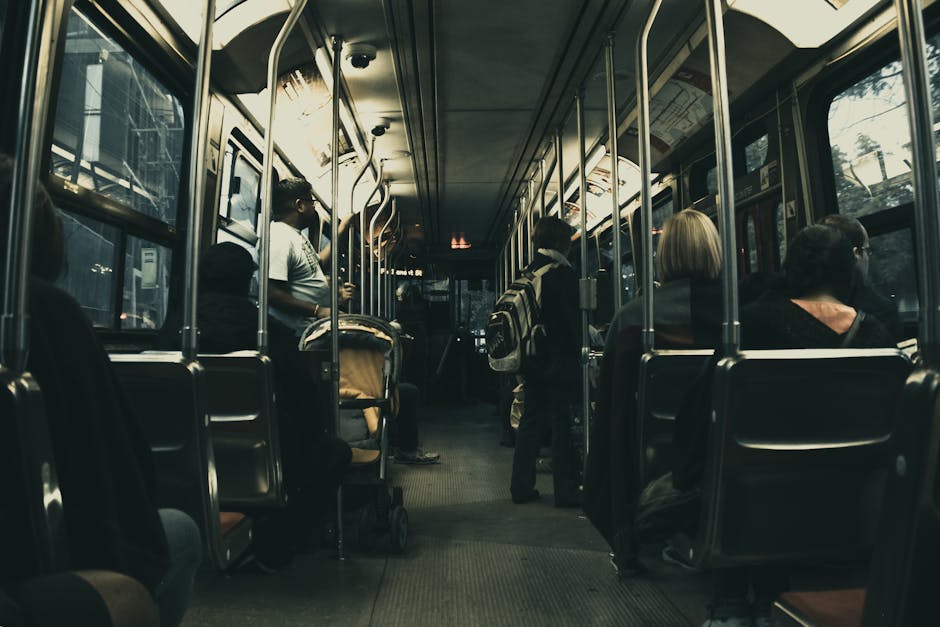
“The Bus Driver at Night” by Kaja Katamay‘

Man in White T Shirt Standing on the Bus

can tell you what to watch out for, where to go. I don’t know
where to put my hands anymore –
neatly folded on the lap like a napkin? or resting
slack and supplicant like little martyrs at my side.
The bus driver at night could tell you where
you were, or where you would be. I don’t need to know
either, just want a chance at the wheel so I can make that slow, wide driver’s wave
through the windshield
as we pass a sister bus on a side street in the dark, warm inside and heaving close
as canes of sugar.


Kaja Katamay‘s poetry and nonfiction has appeared or is forthcoming in eye-rhyme, The Oregon Review of Arts, and Caketrain, among others. She lives in Portland, OR.

“David” by Joe Lynch

When the afflicted man
called out, the Lord
heard/And from his distress
he saved him.
Psalm 34 Verse 7
A psalm of David

It was a hot August day and this was our fourth call in a week for an overdose.  Bad heroin had descended on the neighborhood and the junkies had no choice but to take the chance. I shut off the siren as Tommy parked the truck in front of a small brick apartment building. Brian, Stan and I hurried to the second floor. Tommy stayed with the truck.

A shirtless kid in about his mid-twenties met us at an open door. He kept blubbering about his friend. The shirtless kid was tall and thin. He carried himself hunched-over. I don’t know if that was his natural stature if he hunched to keep the large silver chain and cross he wore from flailing about.

“He’s dead.” He choked out between sobs. “I told him not to do that shit no more and now he’s dead.” The kid couldn’t stay still.  He started into the apartment and then came back to us.

“Oh God, Oh God,” he kept repeating, brushing at the tears on his face.

We’re just firefighters. It used to be we only ran into burning buildings. Now we do medical emergencies too. The medics are overworked. We get to the emergency quicker and hopefully keep the patient alive long enough for the medics to arrive.

“Calm down,” I commanded the boy.  “Where’s your buddy?”

“He’s in the bathroom.  I threw him in the shower to try to bring him back but he ain’t breathing.”

Brian had our medical bag and brushed past me and the kid and looked around. “Where’s the bathroom?” He asked.

“It’s straight back.” The boy sobbed. The apartment was one large room with the kitchen area to the rear. Brian and Stan headed in that direction. The skinny kid tried to follow them.  I grabbed his arm. I wanted him with me in case things went south.  “You stay with me.” I said. “You’re not going to do anything but get in the way. My guys will do whatever they can for your buddy.” I kept my voice soft, trying to calm him.

Brian and Stan disappear into a door on the left.  The kid threw himself to the floor with a wail and sat with his back against the wall with his elbows on his knees, and his face in his large hands.

The apartment was cheap, but not dirty, at least not yet. They must have just moved in.  It appeared to have just been refurbished and our footsteps gave a little echo as we moved around.  A new off-white paint covered the ceilings and bare walls. The only furniture was a medium sized light brown wood table sitting in the middle of the floor.

The empty apartment was a pleasant change for us. The usual when dealing with junkies was squalor.  No doubt over time, this apartment would become an odorous roach infested hole. The big silver cross and chain would be gone too, sold or hocked. I’m not casting judgment. My son’s an addict. It’s just what drugs do to people.

The kid staggered to his feet and was crying again. He started to make a rush towards the back. “Let me see him.” he cried trying to bull past me. I got in front of the boy and put my hand on his chest. “Calm down son. You can’t help.”

I felt sorry for him but I’ve learned to stay unaffected. My guys claim nothing ever bothers me. They say ice water runs through my veins.  It’s not true. I feel things as much as anybody but I’ve learned to keep it on the surface. After twenty-eight years of dealing with trauma, I don’t let it go to my core.

“What’s your name?” I kept my voice calm and comforting. I try to treat everyone with kindness. Its good business and I guess it’s my nature.

“Adam”

“What’s your buddy’s name, Adam?” Just then Stan’s blonde head popped out of the bathroom.

“He’s alive, Lieutenant,” Stan yelled, “but he’s in deep. We need help getting him out of the tub to work him.”

I joined them in the tiny bathroom. Stan and Brian were in front of me but I got a glimpse of a short muscular kid stretched on his back in a pool of water. The small bathroom made the move difficult. Brian hoisted the boy’s shoulders and head from the tub and then handed him to me.  I cradled his upper body in my arms. Stan grabbed under his knees and I backed out of the bathroom. We stretched him out on the kitchen floor and I got my first good look at him.

I looked at his face and my legs started to go on me. I can’t ever remember that happening to me before. I willed myself not to fall. It was David.

At least I thought it was David. I took a longer look. The boy had the same short muscular body, the same sandy brown hair and even the same not quite round face. I scrutinized his face and breathed deeper. This boy’s face was just ever so slightly dissimilar. I hadn’t seen David in weeks but I was certain that this wasn’t him. I took a deep breath and tried to calm myself.

This boy was in bad shape, though. His breathing was down to about three or four respirations a minute. Brian hooked the bag valve mask to the oxygen cylinder and placed it over the kid’s mouth. Brian started working the bag. Using his hand to squeeze the air in the bag and push it into the boy’s lungs. I watched his chest rise and with it a blue vein protruded on his forehead.

The blue vein caused me to look again. My son has a vein in his forehead that bulges much the same way. I had watched it rise in anger the day I threw him out. He had been to rehab four times. Each time he stayed clean for awhile but ended up worse than the time before. Finally, I made him leave. He was angry, Maggie, my wife and his mother, was hysterical but I managed to keep it all on the surface. I knew was being overly scrupulous
but I had to convince myself once more that this wasn’t my son. I studied his body and face until I convinced myself again.

I remembered the first time I saw I saw that blue vein. David came out of the womb screaming and when he cried a blue vein protruded angrily from his forehead.  He was the fourth child for Maggie and me and the only time I had been in the delivery room. I had been at the bar for the others.

The nurse handed me the baby. I cradled him in my arms and my eyes filled with tears, back then everything went to my core. I handed the baby back to the nurse and went to Maggie.  Her face flush from the delivery smiled at me. She looked as content as an infant herself.

“I’m so glad you’re here.” She sighed.

“I’m so sorry for everything.” I said. Our hands were entwined and I had my cheek against hers drawing strength from her.

“I know,” is all she said.

“I can’t tell you I’ll never drink again but I can tell you I never want to drink again. They say you can only do it one day at a time.” Fresh tears filled my eyes.

“I know what they say but I really think everything is going to be okay now.” The baby let out a wail and we looked over at his red face and the vein straining like it would burst and we both laughed.

“I think he has your temperament.” She joked.

“Is he going to be alright?” Adam’s voice brought me back to the here and now. I turned my head away and wiped at my eyes before turning back to answer.

“Well, he’s still alive but he’s not out of the woods.” Adam seemed to be in a little more control and I decided to press him a little. “What were you guys doing?”  I was sure it was heroin but it was good to get confirmation for the medics and the hospital.

“I don’t know. I wasn’t here.  He was like this when I found him” Adam’s pinpointed eyes told me otherwise.

“Hey man,” I said. “I don’t give a fuck what you guys were doing. You’re not in trouble with me and the cops ain’t going to follow up on this little bullshit. I’m just trying to help your buddy. Was it heroin?”

“Yeah,” he dropped his head and mumbled.

“Didn’t you guys hear about the bad stuff going around?”

“No, it wasn’t like that. He went crazy. He just kept shooting up. His supposed to go to detox tomorrow and wanted to get really wasted one last time.”

Brian continued to work the bag. Heroin takes you so deep you just stop breathing and soon after go into cardiac arrest. As long as Brian assisted his breathing, the boy should come out of this okay. When the medics arrived they would shoot him up with Narcan. It’s a drug that gets into the cells and blocks the opiate. Narcan can be amazing. It usually brings the patient back from being next to dead in a minute or two. I’ve seen them sit right up and become furious because you ruined their high.

But this kid had us a little worried. We didn’t say it. We could read it on each other. He wasn’t responding like he should and it seemed like it was taking the medics forever. Stan was shaking him and calling to him as Brian worked the bag.

“Hey buddy, wake up.” Stan rubbed his knuckle hard across the guy’s sternum trying to bring him around.

“What’s your buddy’s name?” Stan called to Adam.

“David,” Adam answered.

“David, wake up!  David, wake up, David, David!” Stan kept hollering into the boy’s face. I shuddered each time he called David’s name.

Everything about this run had been strange including my own behavior. I found myself standing directly over David scrutinizing him for the third time. My guys gave me concerned sidelong glances. I didn’t care what they thought. I needed to convince myself anew.

This boy had the same short cropped hair cut my David wore. He had the same thick eyebrows and he had that damned blue vein straining with each squeeze of the bag. I stood and stared at the boy long after I knew he wasn’t my son.

My concentration waned and my mind drifted back again, this time to before David’s birth. For a long time I had been sick with the booze. I went through countless car accidents, fights and overnights at the local precinct. These were small inconveniences but the depression ate me up. After a suicide attempt, I stopped. I just detoxed and stopped—no rehab.

The A.A. meetings helped. I stayed out of trouble but I stayed wounded for a long time. In some ways I was sicker without a drink than I had been with one. The depression wouldn’t lift and the mania for a drink drove me mad. I laid awake at night and it seemed as if I had four or five thoughts running through my head at the same time. On the rare occasions I did sleep, I awoke from nightmares in a cold sweat and an overwhelming compulsion to drink.

It was only a matter of time before I drank and suicide would follow. I chose to do it on my terms. I bought a gun. The feel of it in my hand gave me butterflies. I’d get a motel room so Maggie wouldn’t find the body and of course I’d get a bottle.

I’m not sure why I went to a meeting that night maybe a part of me didn’t want to die. I hadn’t told anyone about the gun or my plan but a friend at the meeting recognized my depression. He told me about how he had been depressed early on and how meditation helped him. He told me to read the Psalms and reflect on the words.

I didn’t have much faith in God and didn’t think anything could save me from myself but I had nothing to lose. I decided to give meditation a week because like I said I had nothing to lose. When the craving came that night I began to read the Psalms. I read them without hope or belief. I read them aloud because it seemed to be the right thing to do. The sound of my own voice consoled me. It soothed like a parent rocking a sick child.

The first week passed and I put my appointment with the gun off and tried it for another week and then another. The obsession lifted a little at a time. I sold the gun and never drank again. We named the baby David, after the killer of the giant and the author of the Psalms.

“Yo Lieutenant,” Brian’s voice brought me back. “Shouldn’t the squad be here by now?”

“They were coming all the way from across town. I’ll radio them and get an ETA.”  But before I keyed up my mike, I heard the distant wail of a siren.

“I hear them now.” Stan confirmed.

Two female medics came in, Erin and Grace. We had worked with them many times before.  It didn’t take long before Erin started a line and was giving him Narcan. “Keep working the bag,” she told Brian. “He’ll be up in a minute cursing us.”

I took over for Brian bagging the patient. It isn’t a hard task but Brian had been at it a long time and you get uncomfortable. Besides I wanted to do something to try to keep myself focused. I repositioned David’s head to be sure that his airway was open and squeezed the bag at regular intervals.

The bag was connected to our oxygen tank. With each squeeze pure oxygen pushed into his lungs. The cylinder then refilled the bag making it ready to be pushed into his lungs again.

I squeezed the bag. Let it refill and squeezed again. My full concentration was on working the bag and I found myself breathing in the same deep rhythm, squeeze. I watched David’s face as I breathed with him, squeeze, the blue vein on his forehead bulging and straining with each inhalation, squeeze. My eyes became wet with tears, squeeze.

Many minutes passed and David’s complexion went from gray to pale but there was little other improvement. The deep breathing had me in a kind of trance and I was only vaguely aware of Erin shooting David up with more medicine. I heard a voice screaming behind me. It seemed to come from another land.

“He’s not waking up! You guys said it would wake him up!” It was Adam.

“You have to calm the fuck down. You’re not helping,” Stan yelled back. It was really my job to keep order but I just kept breathing with young David while the madness went on around me. I kept my gaze on his forehead watching the vein pop each time I squeezed the bag. At some level I knew I should give the task to someone else and take command of the scene but I felt safe in the rhythm of breath like being in a rocker with an infant.

I heard Grace’s voice coming from that other land, sounding worried.

“We’ve done all we can here.  Let’s get him out.”  She bent down next to me.

“I’ll get the bag, Lieutenant.” It was her job but I couldn’t let go.

“C’mon Lieutenant, I got it.” She insisted. Her voice was firm but gentle and she looked at me with a compassionate gaze that I had seen her use on only the very ill. I relented and Grace took the bag as they carried David down the stairs.

I stayed in the apartment to pull myself together while they took David down the stairs and placed him in the ambulance.

I had forgotten about Adam. He was back against the wall with his hands in his face. “Oh, my God, Oh my God.” I put my hand on the back of his head.

“C’mon Son, I’ll get you a ride with the medics to the hospital”

Adam got up but was little unsteady on his feet. I grabbed his arm as we made our way down the steps.  “You said. He was going to wake up.” His voice cracked with emotion.

“Sometimes it just takes a little longer for some people. His color was coming back. I think he’ll come around.” Then I added, “Besides, he’s beloved by God.” I don’t know why I said it. It just came out.

Adam looked at me like I was the one on drugs, “What do you mean?” He put his long fingers around his silver cross, clinging to it.

“David, the name means beloved by God. I think God will get him through this.”

I thought about the Psalms. I thought about my son. “Yeah, God’s going to get him through this.” I spoke to comfort Adam but he had already climbed into the ambulance. I spoke only to myself and it soothed me.


Joe Lynch is a retired Fire Captain from Philadelphia with an MFA from Rosemont College. He continues to live and write from the “City of Brotherly Love”. He writes because he claims that it is the closest thing to running into burning buildings.  His prose has appeared in numerous publications. Most recently, The View From Here and Sunken Lines. He has a story due out in Morpheus Tales in October 2009.

“Step Nine” by Brother Benet Tvedten


Gray Concrete Column Inside Vintage Building

Abbot George had wanted to send him away for treatment of alcoholism, but Father Benjamin pleaded, “No, no! Don’t do that.” To get the abbot off his back, he said, “I’ll check out Alcoholics Anonymous.”

“Good,” Abbot George sighed, relieved that there hadn’t been more of an argument. Nor had Father Benjamin put up a fuss when asked to relinquish the supply of booze that he kept in his room. “I’ll lock it in the liquor cabinet where it belongs,” the abbot said.

The abbot and the rest of the monks were convinced that Father Benjamin had hit bottom after having driven through a closed garage door twice in one month. The amazing thing was that he had never been arrested for driving under the influence.  He’d always managed to evade the law. Now after having had to replace the two garage doors within a short time, Brother Cyril, who was in charge of abbey vehicles, demanded of the abbot, “Get that man some help or give me a different job.”

For twenty years Father Benjamin had taught English in the high school for boys run by the monks. The students had liked him and they often agreed that he made a dull subject enjoyable.  Some of their parents banded together, however, and got Father Benjamin fired for having their sons read The Catcher in the Rye as a class assignment. “I can’t believe that folks are still getting worked up over that book,” he told Abbot George.

Father Benjamin, because he had been so popular among the students, was named alumni director. One of his duties was to attend stand-ups with the old boys in various places within driving distance from the monastery. All of these gatherings began with a happy hour. Wine was  served at dinner, followed by more drinking throughout the evening. In the beginning, he had been able to drive home sober, but for the past couple of years, his drinking had become increasingly problematic. Abbot George told him several times not to drink too much at these events. There had been a few occasions when the alumni insisted that Father Benjamin stay overnight at a motel or go home with one of them.

Abbot George informed Father Benjamin that A.A. meetings were held in town on Wednesday evenings at the courthouse, and that he could accompany Brother Stanley to them.  “You’ve missed this week’s, but you’ll be prepared to go next week.”

“I was never anything like Stanley. I was never that bad.”

“You both need A.A.  There will be no more discussion.”

Father Benjamin admitted to himself that now and the he’d been tipsy. But he
definitely had not become an old soak like Brother Stanley. Alcohol made Father
Benjamin feel light-hearted, and there was nothing wrong with that. One needed
to be cheerful at alumni gatherings. Alcohol made him more sociable. He couldn’t
think of anything he’d ever done at such events that would have been an
embarrassment for the monastic community.

The abbot had reminded him that operating a vehicle in a state of intoxication
was a criminal act. Father Benjamin replied that he felt badly about wrecking two
garage doors and doing “minimal damage to a car.” He confessed to being “a
little drunk” when this happened. “But I’ve never been arrested because of my
driving.”

“You’ve never been caught,” Abbot George answered.

“I’ve never had an accident.”

“What do you mean by that?” the abbot yelled. “You’ve never had an accident?”

“I mean out on the highway.”

~

“How it works,” the woman said, and proceeded to read from Chapter Five
of a thick book bound with a blue cover. She named twelve steps that lead to
sobriety. The book called this “a simple program.”  Father Benjamin thought the
woman looked vaguely familiar. She said her name was Marge.  “Now, we have
someone new here tonight. Let’s do our introductions,” Marge suggested.
Twenty people, most of them drinking coffee from large paper cups, were
gathered around two long tables that had been shoved together.

Giving their first names and identifying themselves as alcoholics, they waited
for Father Benjamin to introduce himself. He already knew a couple of the people
in the room. Jerry Thompson was an alumnus of the abbey school. Bob Kruger
was the abbey’s lawyer. He’d called himself “a grateful alcoholic.” The other
familiar looking A.A. members may have likewise been parishioners of St. Brigid’s
here in town.   Now and then he was the substitute for their pastor. He did a lot of
parish work throughout the diocese, filling in for priests who were away. This had
conveniently provided him an opportunity to stop at liquor stores on the way
there and back to the monastery. Perhaps Marge appeared to be someone he
should know because he’d met her at one of the parishes.

Unlike the other people at the meeting, Father Benjamin was reluctant to call
himself an alcoholic, but they were waiting for him to introduce himself. At last he
said, “I’m Father Benjamin, and the abbot thinks I’m an alcoholic.”

Everyone laughed. “Yeah, yeah,” one of the men said, “we’ve all said that sort
of thing about ourselves. It was always someone else who thought we were
alcoholic.”

Brother Stanley brought down the house when he said, “I’m Stanley, and the
abbot has no doubts about my being an alkie.”

Marge informed the group that Step Nine would be discussed this evening.
“For the sake of the new member, I’ll repeat that Step Eight has us make a list of
all the people we’ve harmed by our drinking, and now Step Nine is the actual
making of amends to those people.”

One after another, they took turns telling about having apologized for the
hardship and embarrassment they had caused loved ones, and employers, and
other persons for whom they should have shown more respect.

“I was a real pain in the butt for my community,” Brother Stanley said as he
began talking about himself. Father Benjamin could agree with that statement.
He thought sobriety hasn’t changed Stanley one single iota.

“I pass,” Brother Stanley said when he was finished describing his method of
making amends. Again, the rest of them waited for Father Benjamin to whom the
topic had been passed. Finally, he said, “I’m Father Benjamin…”

Brother Stanley interrupted him, “We don’t go by titles here. You’re simply
Benjamin, a common ordinary drunk like the rest of us.”

Marge told him, “We all realize that you’ve got a ways to go yet before you
take Steps Eight and Nine, but, from what you’ve heard us say, do you wish to
comment on Step Nine?”

“I don’t believe there is anyone to whom I owe an apology,” he answered.
“What the hell!” Brother Stanley shouted. “You practically tore down our
garage.  Don’t you think you should apologize for that?”

“You did worse things,” Father Benjamin retorted. “You spat in the abbot’s
face one time when you were drunk”

Jerry Thompson said, “Benjamin, you were the priest at my father’s funeral
last month.”

“Yes, Father Parsons was gone, so the abbey provided a priest.”

“You kept praying for the repose of her soul; not his. And at the cemetery,
you almost toppled into the grave. One of the pallbearers grabbed hold of
your arm. I think my family deserves an apology.”

“I do remember being a bit unsteady, but I was just getting over the flu.”
Jerry Thompson said, “I think you need to apologize to me for that lie.”
Father Benjamin knew it was a lie. He’d been drinking the pastor’s booze all
morning and was fairly looped when he went over to the church for the funeral.

“I apologized to Abbot George for spitting in his face,” Brother Stanley assured everyone.

A woman said, “I think you’re still in a stage of denial, Benjamin. Don’t you
see how powerless you are over alcohol? How unmanageable your life has
become?”

Brother Stanley chimed in again. “It’s time for you to start taking
responsibility for your actions.”

“Stop blaming others,” someone said.

“I’m not putting blame on anyone,” Father Benjamin replied.

Jerry Thompson wanted to go another round with him. “Remember my
brother, Mike?  He also went to your school, a few years ahead of me. He brought home a dirty book you’d given his class to read. That wasn’t a very responsible thing to do.”

“I’ll be damned! Why are you bringing up that?”

“You introduced pornography into a Catholic school,” Brother Stanley charged.

“What do you know about literary things?” Father Benjamin shouted at his confrere.

Marge wrapped her knuckles on the table. “I think we should stop taking Benjamin’s inventory.” She said to him, “If you don’t have anything to say about Step Nine, let’s move on.”

Nothing happened. Brother Stanley poked him. “If you aren’t going to talk,
you’re supposed to say, I pass.”

Father Benjamin asked himself: Why did I ever get into this predicament?
He saw what his life was going to be like from now on. It was going to be pretty
dismal traveling to town and back with Brother Stanley week after week. O
Lord, let me get home this evening, he prayed, without killing Brother Stanley.
Everyone had spoken about Step Nine, and it appeared Marge was going
to close the meeting. But she had something else that needed to be
addressed to Father Benjamin specifically. “We all  know that becoming drunk
often causes us to lose our inhibitions. I think there is another apology you
need to consider making with regard to a wedding at St. Brigid’s in June.”
Father Parsons, who’d been called away unexpectedly, had requested
Abbot George to provide a substitute.

“It was a lovely wedding,” Father Benjamin said. But to tell the truth, these
six months later, he could not recall what either the bride or the groom looked
like.  For that matter, he didn’t remember their names.

“It was my daughter’s wedding,” Marge said. “My husband captured your
improprieties at the reception on his cam recorder. However, I asked him to
erase it. But my family and I would like an apology. Not necessarily now. Later,
as you continue in the program.” Father Benjamin had no idea to what she
was referring, and he was too humiliated to ask.

Then they all stood up and prayed the Lord’s Prayer. Afterwards everyone,
except Father Benjamin, who was unaware of what was expected, said in
unison, “Keep coming back. It works.

If you work it.”

Brother Stanley volunteered to preside at next Wednesday’s meeting.

“Thanks Stanley,” they said, all together again.

“And,” Brother Stanley added, “Benjamin will make the coffee.”

“Thanks Benjamin.”

On the way to car, Father Benjamin commented, “My, but they drink a lot of
coffee.”

“You’ll get used to it,” Brother Stanley said.

~

All week long he examined his conscience, but Father Benjamin could not
recollect what he had done at the wedding reception.  Marge had suggested
that he should make amends, but for what?

What could he have done that was so upsetting at the wedding
reception?  It was something so bad that it had been erased from her husband’
s cam recorder.  Although Marge had said the group shouldn’t take his
inventory, she herself would indeed have to tell him what he’d done.  The
incident was also erased from his memory.

On Wednesday afternoon, Brother Stanley approached Father Benjamin
and told him, “We’ll have to leave earlier this evening. You’ve got to make the
coffee.  Remember?”

At the meeting when his turn came for an introduction, he said, “I’m
Benjamin, and I’m an alcoholic.” He said that every Wednesday evening for
the next month.

For now that’s who he was. Perhaps the time would come when he could be
able to identify himself in the same manner that Bob Kruger did. Maybe
someday he would be able to say, “I’m Benjamin and I’m a grateful alcoholic.”
He might even be able to ask Marge what his improper behavior have been on
the day of her daughter’s wedding.


Brother Benet Tvedten has lived at Blue Cloud Abbey in South Dakota for fifty years. He has three books in print at the present time. All are related to Benedictine monastic life. He has had fiction published in literary magazines and anthologies. A novella, All Manner of Monks, received the Minnesota Voices Project award in 1985 and was published by New Rivers Press. Brother Benet edits his community’s newsletter and participates in 12 Step Retreats that are held at the monastery.

“My Father’s Depression” by Dane Cervine

I remember crawling with my father
on our hands and knees deep into the seaside cave—
the still wet sand, the small flash light beam
mapping the rock roof as it descended to its dead end.
Alone with my father in the cramped dark—and I swore,
I’d never stay there, in sand depressed by heavy bodies,
waiting for the sea to wash our shapes away.


Dane Cervine makes his first appearance in this issue of r.kv.r.y.  Dane’s work appeared recently in the SUN Magazine, Atlanta Review, the Birmingham Review, and the Bathyspheric Review.Dane’s book The Jeweled Net of Indra from Plain View Press can be viewed at his new website danecervine.typepad.com. Dane is a member of the Emerald Street Writers in Santa Cruz, California, where he serves as Chief of Children’s Mental Health for the county.

“Among the Cacti That Resembled Desert Gravestones” by Zachary C. Bush

You spent your twentieth birthday getting clean
With an Indian chief and his son, who taught you
To lure rain clouds by their ancestral dance

Those men were so stunning; shouting and
Spinning sweat from their long black hair before
The rain fell and cooled the sand beneath our feet.


Zachary C. Bush, Among the Cacti that Resembled Desert Gravestones, is a poet and writer. He lives in Georgia. His work has appeared in over two dozen online and print literary journals. He has more recent work forthcoming in GHOTI Magazine, The CommonLine Project, and the Poet Plant Press 2007: Lunch Anthology. He is also the author of two forthcoming chapbooks of poetry through Scintillating Publications (2007) and Pudding House Publications (2007). This is Zachary’s second appearance in r.kv.r.y.

“Funeral Home” by Robert Flanagan


He looked up and down the darkened street before climbing onto the porch of the funeral home. A lone street light provided weak, yellow light as he climbed the four concrete steps.

He had waited until the sun was down before making his move, so that the only people, who might see him  might be police, so he kept a sharp eye out for them.

Izzy Bolo was homeless and drunk, but he knew things.  He knew where the bodies were buried.  He loved that saying, especially as he snuck onto the porch of an undertaker.

He made his way over to the corner, getting as far away from the street as he could, and lay down on the piece of cardboard that he had stashed in the bushes.  He used the cardboard, because although he stunk of liquor and had not shave, or bathed in days, he had been upset when he had come to last week and discovered that he was covered with dust and dirt–most of it from lying on the Sweet’s Funeral Home’s porch at night.

Izzy had gotten to his feet and brushed himself off. It had taken him all of the way to the shelter to get the dust and dirt off.

He got some cold cereal and milk for breakfast up at the shelter.  He was homeless, but he knew he had to eat something.  An old rummy had told him that.

“Hey, Izzy.  You ok?”

That was Jacky, the morning man at the shelter.  He was a big guy, but had been out on the streets himself, so knew that underneath a lot of these guys’s insistence that they were ok, he knew that many of them were barely hanging on.

He was used to coming into the shelter in the morning and hearing about this or that one, who just was no more.

Jacky had also been one of the dead men walking before he came into the shelter for more then a meal.

The shelter had programs, and he wished a guy like Izzy would get involved.  He looked at Izzy, and for the first time thought he saw the signs of wet brain.

Izzy was a short, skinny white guy, but he had always seemed to have it together.

Nowadays, Izzy was much dirtier and unkempt then Jack had ever seen him.  He wondered where Izzy was crashing, because he was not on the list of regulars at the shelter.

Izzy ate silently and then went outside and wandered down to the Avenue, where he would bum change and get a half pint of vodka.

He would drink half of it fast to get the edge off, and then sip it until dinner time back at the shelter.

He sat on the steps of the park sipping his bounty, and thinking soft thoughts. If and when his pain in the ass mind would ask him why he didn’t get off of the street, he would take a sip and the thought would go away.

At dinner time, Izzy went up and sat in the park across from the shelter.  He would cross the busy street and get in line for a meal when they started letting people in.

The shelter was across a street, but between the booze and the speeding cars, sometimes it seemed a lifetime away.

There were times when he could barely manage to get to his feet to wait patiently to cross the street. Saying “Fuck It” was but a breath away.

“Izzy, man.  How you doing?” asked Jackie, spotting the small, man in the back of the line and making a point to walk back there.

The line of homeless men went out onto the sidewalk these days.  There was something about Izzy that interested Jackie.

Izzy was white and Jackie was black, but one alcoholic recognized a kindred spirit.

“I’m fine.” Izzy said, looking at his shoes.

“You know, they got good things here for a fella like you and me.”

“Yeah.”

Jackie walked away, feeling the melancholia that seeing so much misery, yet being able to do jack-shit about it made a man feel bad, but there were too many of them to dwell on only one.

Still, he wondered what was driving Izzy.  Izzy was a smart man underneath all of that booze.

Izzy ate his meal just as he had done earlier.  He ate alone, never asking someone to pass the plastic bowl, with slices of bread to mop up some of the sauce from the spaghetti and meatballs.

Afterward, he disappeared and went back down to sit alone and then much later, he slept.

“No, please, no.  Oh, God.  Stop……No.”, he groaned at one point.

Even though he was terribly uncomfortable on the cement porch of the funeral home, the dream came.  Izzy was not aware, but felt hung over in the morning and took a swallow of booze.

He had been sleeping down by the tracks and had been awakened by the noise.

After the men had done what they wanted to do with the girl, they had come running by where Izzy was.

Izzy had opened his eyes a bit, but he soon resumed his vodka infused sleep, but not before seeing who one of the men were.

Izzy went up to the shelter as usual, but this time when Jackie came wandering around, he asked in his friendly way, “hey, Izzy.  How you doing?”

“I’m ok.”

“Where you crashing, man?”

“Around.”

“You know, we got room.”

“I’m ok.”

“Somebody said a few guys were hanging around Sweets.”

“I wouldn’t know.” replied Izzy.  His heart thrummed in his chest.

“Hanging around a funeral place would give me the creeps.”

Izzy looked up into the face of the man.

Jacky had undergone a remarkable transformation in the past few years.  He was clean shaven and was wearing nice clothes.

When they found Izzy’s body, they had initially thought he had frozen to death, as it was January by that time.

When Izzy was assaulted, he was anestitized, so did not feel the thrusts, nor hear the voice, which said, “sorry, man, but I can’t risk you remembering”

As he drifted off, Izzy heard his father screaming at him, but that was before he heard nothing.  Some slightly irate citizen called the police the next day.

“You people have got to do something!  I was out for a walk and saw this dead body on the porch of the funeral Home.

It was lying on the porch of a funeral home, for Christ’s sake!

Turning the body over, that the two patrol cops saw the puncture wounds, and later, as they drove away, Officer Joey Claiborne began talking to his partner about the TV show his old lady had been blabbing about.

“They started out talking about how a tiger can’t change its stripes….”

“Who started out?” asked William, his partner.

“The great show. The one I was telling you about, dummy.”


Robert Flanagan has been in recovery for a number of years. For awhile, he lived on the steps of a funeral home.

“A Doll for You” by Emily Watters

My body looked hot in that turquoise dress and I had good eyes. At least that’s what some drunk guy told me. Right before he turned his head to do a closed-mouth burp and put a thick hand around my waist. I peeled him off with a tight smile and walked away. I could feel my eyes dulling.

Looking out across the torn up frat house, it was clear it was getting late. Newfound couples had trickled out the side doors and the boys who hadn’t closed the deal were getting desperate.

Another vulture walked over, “Hey, what house are you in?”

”Zeta Chi.”

”Sweet. You know Sarah?”

We both looked over at Sarah. She was dancing like a stripper on a phony Greek pillar. It had been sexy earlier, but with the floor clearing out, now it was just sad. “Yeah. Actually, she’s my roommate.”

“Seriously? That is so hot. You guys should make out.”

“Yeah, because that’s what college needs. More fake lesbians.”

He laughed, a little too hard.

I sighed. “Tell you what, I’m gonna go check on my friend.”

“Oh, all right, you need a drink?”

“No, I’m set.”

Looking over it all, from a balcony with broken railing and a banner draping down reading “AEO”, it felt like I wasn’t there at all. Like I was just floating over this sea of unnatural spawning, of half-attempted failed fertilizations.

Their greased words were so absurdly calculated to me now.  Please, like I was supposed to spread my legs for that. To think, I used to be ignored by these insects. I had actually wasted an entire summer running and tanning to stand there feeling like a piñata dangling from the ceiling, and I was not about to let some staggering drunk crack me open.

If I wanted my college paid for, I had to join my mother’s blessed sorority.

They had to take me, I was a “legacy”, meaning my mom used to be a sister. Ah, the dreaded legacy. Unless you are missing your front teeth or steaming with body odor, legacy status means a sorority must accept you.

To keep things fair, it is often not made public among the sorority as to who are the legacies and who are the real pledges. As a result, it is thrown around as an insult. Say something embarrassing, wear something ugly and expect the cutting whisper and snicker, “legacy.”

And me, I didn’t keep anyone guessing because I had the most jarring marker of all: I was fat.

The part that really made the girls discuss me late night was that I didn’t seem to care. That was the real crime. When I laughed and made jokes about my thighs, the older girls cringed. I might as well have been flaunting a stab wound.

None of this seemed to dent me too much. I like to think I was undentable until Josh came along. Josh: better known as the guy who slept with the fat girl. Josh lived down the hall from me in Langston’s dorm. If it weren’t for the acne, he could have been one of those shirtless guys in an Abercrombie ad. Or rather, it seemed like he had serious aspirations of becoming part of an Abercrombie ad. He was pledging a frat that year. There was something about the open hostility of frats that I liked. It seemed more honest. He spent a lot of time getting called douche bag, cleaning a house he didn’t live in and getting force fed drinks, but he usually made time to hang out.

He didn’t make a move for most of the year. That didn’t happen until the St. Patrick’s Day date party (where he took another nameless girl who was not me). Afterwards, he stumbled to my room. I was still awake.

He pounded on my door and whispered loud, “Jennnn, open up.” I opened the door and he tried to focus on me with his intoxicated puppy eyes.

He was wearing a shirt that read “Kiss me I’m Irish.” He squinted one eye and was able to fix on my raised eyebrow.  He pointed at his chest, “C’mon man, read the shirt.”

”Go to bed, Josh.”

”Jen, c’mon, I loooove you.”

”That’s cute, really. Now, go to bed.”

He knocked on my door the next morning. Through the peephole, he scrunched his brow at me and smiled. I sighed and opened the door. He took a seat on my bed and let his fingers graze through my CDs. He pulled one out, “AC/DC? Are you serious?”

“Yeah, I was serious,” I said, folding my arms. “You know, in that I think I’m a rocker even though I’m fourteen and live in the suburbs kind of way.”

“Hmmm. I could see that.” he smiled from the corner of his mouth. “I’m sorry about last night … I was pretty drunk.”

I sat down at the edge of the bed. “Yeah, I know.”

He scratched the nape of his neck and turned his head to peer at me. “Remember that time you saved me from the RA and hid me in your closet?”

I looked at him and smiled. “Yeah, cause it was like last week.”

Then he took his other hand and pulled me towards him. “I liked that,” he said close to my mouth. Then he kissed me.

“Smooth” I mumbled through the kiss. “Real smooth.”

“Shhhh.”

“Don’t shhh me,” I said and pushed him back on the bed. I went down with him and kissed his smirking lips back.

His frat brother saw us leave my room later that afternoon. Josh jerked a little when he saw him. Then he started talking fast and laughing at things that weren’t funny. Nothing was officially said between them, but by the end of the day, his whole frat knew what happened. This provided a new source for the constant mockery. I overheard one guy ask him if he planned to bring Chewbacca to the next date party. I didn’t listen for his response. I was big, but I was not furry. Next time I saw Josh, I greeted him with “Rawwrrrrrr.”  He paused and touched my arm. “Those guys are idiots,” he said.

Before summer break, Josh and I spent every day studying in the arboretum for finals.  He wasn’t exactly acing his classes and so I was glad to see him study. The day before his chemistry final, as he rummaged through his wind-blown papers, he looked up at me and said, ”Man, I don’t want to go to the house tonight.”

“Don’t,” I said. “I’m sure they’ll understand.”

He shrugged. “I gotta. If I don’t, they’ll just haze me worse later.”

“So, what? They’ll put three brooms up your ass instead of one?”

“I don’t even know. I heard it’s bad.”

He came to my room the next afternoon with stale alcohol oozing from his pores, “I missed my exam.”

”Shit.”

”Yeah.”

Josh took me to the last date party of the year. Most of the older girls from my house were there. They saw me and smiled the way a princess might look at the peasantry. They probably whispered about whether or not this was a charity ball. Later on, he danced with me and kissed me, in front of everyone—the older girls, his frat brothers. As far as I was concerned, it might as well have been the President of the United States, which would have been weird, but no less monumental.

It was only three days later that I saw Lauren, a senior in the house, standing on the porch of AEO on a messy Saturday morning with Josh. She was kissing him and gripping her hand on his ass like the man she was. She was one of those gorgeous, man-in-a-woman’s body types that strangely made the rest of us women question our own womanhood. There was no hope for me.

That same day, I got a ride home for the summer. I didn’t call or try to see him before I left, but I did leave a post-it note message on his door that read “Screw Off”. It was true that I didn’t start out the year quite this fat. Maybe it was the drinking, the not exercising, it was hard to tell. When I walked up the steps to meet my mom and she hugged me, I could feel her gripping my fat rolls, weighing them in her hands. “Oh, Jen, you got bigger, didn’t you?” she said, pulling back and looking at me with pursed lips. I gritted my jaw and carried my stuff to my old room. A room plastered with pictures of thirty-pounds-less me.

Before school ended, the other Jennifer in our hall, the one I heard people call “Skinny Jenny” to differentiate us, had asked if I wanted to run a marathon with her. She handed me a packet she printed from the Internet and squeezed my arm with her tanned painted fingers. “C’mon, it’ll be fun.”

“Can you believe that?” I said to Josh later, “You think this is one of Skinny Jen’s do-gooder projects? Making Jennies everywhere skinny? Sick.”

He watched my furrowed brow and said nothing.

Anyways, I kept the packet and I think you know where this is going. I trained all summer. It hurt, my body hurt, at times I wanted to quit, the fat melted off. Blah, blah, blah. As you know already, I went back to school looking gorgeous. You would have no idea I was a legacy, seriously. I bet you’d even try and talk to me in class and not just because I said something funny. In fact, I didn’t have to say anything funny anymore to get attention. I could just sit around and bat my eyes like an idiot and that seemed to be enough for people. The guys from my old dorm, the ones that used to call me their “little sister,” were now feeding me beer and asking if I wanted to crash at their place. Which is very weak code for “Wanna hook up?”

I also moved into the sorority house that fall. Its insides bulged with an ironic tradition. Only ladies lived there. No drinks were to be kept in the house because ladies don’t drink. If they must, they were to locate the nearest fraternity house and flirt with boys to get free drinks.

The girls in the sorority approved of my new body, but my methods were met with mixed opinion. While some thought running that much to lose weight was unnatural, others thought it wasn’t unnatural enough. Diet pills and vomiting were the traditional methods of choice. The downstairs bathroom, the only private restroom in the house, was unofficially where the bulimics did their business. I laughed in disbelief when my roommate told me that. Later, she motioned to me as Mandy, a slim beauty with puffy cheeks, slipped out after dinner. I stepped in and my nose burned from the tinge of ripe vomit.

That first week back, our house was preparing for rush. The first set of rush was a series of mixer parties. There, we were to chit-chat with the rushees and then seduce them with a mini-fashion show detailing the possibilities of sorority life: date parties, barn dances, eternal friendships and boys, lots and lots of boys. On an evening when the more goal-oriented, future-leader types were inside decorating the parlor with crepe paper and balloons, my roommate and I sat on the porch in the summer heat.  She let a cigarette dangle at her side and stretched her neck back in her chair.

“You know,” she said, turning to me. “They want you in the fashion sequence.”

“That thing is retarded,” I said, surprised at my own smile. “So, like what part?”

She exhaled with a low giggle. “I don’t know, a good one. Think you’d let me do a little something with your hair?”

“What, like a French twist?”

She laughed. “No sweetie, I was thinking you’d make a kick ass blonde.”

I pulled a strand of hair between my fingers and examined it. It looked almost dirty in my painted hand. “All right.”

That next week, she and I went to a party at AEO’s and that’s how I found myself in the turquoise dress. Looking down from the balcony, I saw Josh. He was leaning in towards some girl. She had her head down and a sweater tied around her waist. I knew that trick. It was to hide her ass. It doesn’t necessarily mean that her ass is enormous or one that needs to be hidden from children. It only means that she is ashamed of this part of hers. And ultimately, she doesn’t like herself. A sure sign for the savvy frat guy that he has a pretty good chance of getting laid.

I went down the stairs, my high heels sticking to the floor as I walked over to Josh. I let him take me in. I watched him close while he pretended like he didn’t think I looked incredible. His jaw all lax like a damn yokel.  Not that I’m terrifically clear what a yokel is, I saw it on a rerun of the Simpsons, I think. The ass-sweater girl moved her eyes between us and then looked away.

“Jen, dude, what’d you do?” he asked, eyeing the curve of my waist.

“The whole Jenny-marathon thing. I’m gonna run Chicago. It’s this weekend.”

“Shit, you’re kidding?” he said, his eyes now at my thighs.

“Yeah, you should see the other Jenny,” I said and sucked in my cheeks, doing my best anorexic impression.

He laughed and his wet eyes sparkled.

That was all we said to each other that night. He didn’t leave with ass-sweater girl. I watched him walk over to his friends and caught them gawking at me. They were probably stumbling for a way to turn this into an insult—maybe asking if Fox was still airing “The Swan”. I watched him in fragments as I drifted in and out of broken conversations. Josh, downing more drinks. Josh, giving half-hearted high fives and Josh, precious Josh, loudly challenging his friend to a stair-rolling contest. I went out the back door and behind me, I heard someone yell, “One…Two…Three!” followed by tumbling sounds and low, synchronized cheers.

I walked home alone and let myself think about him a little. I thought he might call me that weekend, maybe to wish me luck at the race or to make plans to go to the Arboretum. I fantasized that now, in a rush of desire, he’d pull me into the woods, slip between my legs and not even care who saw him.

He didn’t call that weekend. I came back from the marathon late Sunday night to a sleeping sorority. I left the next morning before the other girls could get to me–they were gonna ask if he called and I didn’t have a good answer. I sat on the stairs in front of the library and sipped coffee, wondering what gave. The campus was empty except for me and a homeless guy who was curled up next to the stairs. I let the coffee warm my hands and let the wind crawl up my pant legs. I drifted into class and found my explanation. His printed face was staring at me from a newspaper on the floor. I stared back and felt a burn wash through me. I grabbed the newspaper with my free hand and watched the paper tremble at its edges. It read: Fraternity Rushee Dies on Initiation Night.

Josh. Stupid fucking Josh. They used his high school fucking photo and had blown it up to a frame-able size. He had his classic debonair grin slapped on.  I used to do an impression of that grin. Then he’d shove me. I’d shove him back. He was smaller than me and he’d pretend to fall. It was like a dance we had. Now, I had to go sharing that look of his with the whole damn campus. I wouldn’t dare picture his hands on me right then, I wouldn’t picture him laughing with me at that photo, and yet here I was, doing just that. I gripped the newspaper and like a little kid, I knit my brow tight and tried to bolt out of class. I was doing this goofy galloping thing with my sore legs and holding my chest like it was gonna start bleeding everywhere.

I got back home, to the sorority house, if you can call that a home. I crumpled up in my new gorgeous body. Not a goddamn ounce of anything to hold on to. One of the older girls found me.  She must have heard me crying from the bathroom next to my room.

She slid in next to me on the lower bunk and put her hand on my side.

“I heard,” she said. I wasn’t even sure which one she was, Kelly or Kristen, maybe. It didn’t matter, it barely mattered which one I was. I let her stroke my hair for a while, until I started to feel like a damn Barbie doll. I had been slipping into this amorphous sea since the moment my mom had grabbed my fat roll.

I had been heading for being just another laughing-at-jokes-I-don’t-even-get girl and it was time to grab hold of something. And it was not going to be Kelly-Kristen. “I gotta get out of here,” I said, pushing my stained face off the pillow and pushing this beautiful woman off of my bed. She was probably gawking at me like I was a damn zombie risen from the dead, but it didn’t matter, I was all ready out of the room.


Emily Watters is a second year resident in Psychiatry at Northwestern University. She has previously published works in Student Jama and The New Physician. She currently resides in Chicago and enjoys biking to work along Lake Michigan every day.

“Opening” by Amy Prodromou


I had planned for Elian to leave her.  It seemed to fit the fiction, satisfy a need for
some kind of bitter, tragic end.  But now that it has happened I find it appalling to
write of his leaving.  I think that perhaps we have been preparing for the leaving all of
our lives.  That any time we willingly enter into a relationship, we enter a contract—
agree to being left.  We agree even as we welcome the other person with wide-open
mouths.  We agree the moment we sit opposite to them across a table, bodies leaning
towards each other—then with hunched, embarrassed shoulders, we let them leave.
We do not know this consciously, or perhaps, if we ever knew, we try to forget it in
the nights that follow, when their eyes are open only towards us.  But this promise of
their leaving lies always just beneath our skin.  When it rises, like a wave, we ignore it
or  watch as it breaks against broad backs during sticky nights, relieved when it
crashes and splits into harmless ocean spray.  And yet, we know even as it settles
across our faces that it is not gone forever—it has just disappeared for a while into
that part of the ocean that’s too far beyond our sight—gathering strength.

I suppose it was like this for Elizabeth when she met Elian.  You will know what I’m
talking about only if you have ever driven into a thunderstorm from a great distance.
You are in a black car.  It does not matter what car, only that it is sleek, powerful, that
it lurches towards the future with just a tap of your foot.  Beside you, the evening sky
is still a pale magenta, behind, still lit up from beneath by the sun.  But in front of
you, you see that it is already night.  And as you move forward the air coming in
through the windows gets thicker, coats the hair on your forearm.  You have a
destination and cannot ignore that just because wet weather waits for you.  The
lightening is still far off; to your right, it splits the darkened sky, but only occasionally.
There, the clouds have parted, like flesh, to reveal an insistent shade of pink.  You don’
t know where it comes from—the sun is behind you.  But you drive towards it and can
still see its beauty for all that it gashes across the sky and lasts only for as long as
you divert your gaze.

It happened the way bad news always does. A car accident, the questions posed
but left unanswered, the sleepy stumbling into jeans and T-shirt. But it was the
first time it had happened for Elizabeth. It was nothing less than theatrical.

Carla was being moved to the Nicosia hospital. To Intensive Care.

The early-morning sun makes everything on the highway look gentle. At 6:30 a.
m., there is not much traffic yet on the road to Nicosia. The tarmac stretching
ahead of Elizabeth has a compassionate glow. She grips the steering wheel,
praying in a low voice, not for Carla, but for herself, and for Elian.  She thinks, this
will bring him back to me.  Nothing matters except that she is here for him now,
when his mother has twice had to have life shocked back into her.

It was December, and Elizabeth was sitting in Carla’s living room. She hadn’t
expected to be made to feel so welcome; this visit was, after all, for Katerina and
Juan. Yet here was Carla, winking and nodding at her over ashtrays and plates of
cashew nuts. Her hair shone golden against her black dress. She was holding her
slender arm out, the red wine in her glass shifting comfortably with her
movements. Carla spoke with her whole body. Wide, generous movements of hips
and shoulders punctuated her sentences, while her eyebrows and mouth moved
to somehow hold everyone in the room. When Carla embraced her, Elizabeth felt
the full pressure of her breasts against her rib cage, felt the squeeze inward of
her hands against her lower back. The gaze from those brown eyes reached out
to caress whoever they were looking at. Elizabeth felt there was a secret there
held for her alone.

Elian was sitting across from her.  Elizabeth was only half-listening to him while
she studied his face. His nose spoke precision.  Everything seemed carefully
placed—the outlines of his eyes straight and deliberate—looking directly at her—
no questions or expectations there.  The open gaze of having been honestly
placed in the world.

Once they had gone out, he seemed shy around her, and they didn’t talk much—
the music was too loud, and after trying to coax a few comments from him, she
gave up. She spoke instead to her friend Maria, both of them comfortable with the
intimate distances and hot whispers of nightlife. At the club Elizabeth’s gaze
rested on Elian’s small hand awkwardly cupping Maria’s knee. So none of them
were prepared for what would happen on the way home.

Maria was in the passenger seat, while Elian sat still and quiet in the back. Elian
lived out by the cinemas, and logic predicted that Elizabeth would drop him off
first, and then Maria, on her way back to her house. So even Elizabeth didn’t quite
understand it when she found herself maneuvering the car through the road
works just outside of Maria’s house, deliberately not looking at her.  Deliberately
pushing the image of Elian’s small hands from her mind.

Maria got out of the car and Elizabeth took a deep breath as Elian walked around
the car and let himself into the passenger seat. He wouldn’t look at her, making
much of fastening the seatbelt securely around him. She drove to his house a little
too quickly.

When they got there, he turned to her and tried to smile, said “Thanks” quickly,
and made as if to leave. There was an awkward silence where Elizabeth could
almost hear the condensation forming on the windows. He breathed in sharply
and she realized he was about to say “Goodnight,” about to open the car door
and escape the sticky intimacy that was growing around them, pushing upwards
and outwards against the car’s interior. Her hand moved almost instinctively to his
leg, a gentle pressure meant to stall him. He looked at her, then away again, his
head tilting deeper towards embarrassed shoulders.

“Are you sure you have to . . . .”  The question, unformed, died, but she caught his
lips just as they curled to form words. They kissed deeply, almost immediately,
embarrassment fading behind generous, sucking mouths. Elian held on to both her
ears as though he was steering a yacht, or as someone might carefully maneuver a
periscope from within the confines of a submarine to see—incredibly—what’s above
water.

When she moved her hand downwards, fumbling with his zipper, he grabbed it and
shoved it away, reaching again for her ears, clinging, steering them back on course.

The hospital horrifies her. The strong smell of sickness and its futile antiseptic cures
hang heavily around the information desk. Pipes are visible outside of concrete
walls—nuts and bolts rusting—things not meant to be seen. And everywhere the
blue and red pipes lie exposed.

When Elizabeth reaches the 4th floor, she sees them all sitting on a wooden bench
in a small corridor. Katerina, Juan, Michali, Diana, her husband, and their baby.  Elian
is closest to her; his arms are folded on his knees and his head is buried there. He
doesn’t see her walk towards them; he sees nothing. When she reaches him she
gives him an awkward pat on the top of his head. He looks up briefly with red-raw
eyes, then cushions his head once again between his elbows..

She realizes when she talks to the rest of them that she is no good at consoling.
She is sharply aware of the importance of looking concerned, but feels completely
outside of their grief, as if they have wrapped a makeshift shelter around
themselves, and there is no room for her.  Her brain quickly conjures up the bodily
speech for worry: it wills eyebrows to knot together, lips to purse and curl down.

She looks hard at Elian’s sister, Diana, trying to gauge how bad things are with
Carla, and with them all. Diana’s features point towards some strange place at the
centre of her face. From her Elizabeth discovers that they don’t really believe their
mother is going to be all right. This astounds her, because she knows—she knows—
that Carla isn’t going to die. But for now she enters their emotion, keeps pace with
the fear running in visible lines around their bodies. She tisks and shakes her head
slowly, mimicking the movements of many grieving Cypriot grandmothers in scenes
on TV, old, bent women who lost their sons in the Turkish invasion of 1974.  She
asks about Carla and hears that she almost died twice in the Larnaca hospital, that
she’s already undergone two surgeries, and that the third surgery here is an effort
to stabilize her and get her out of critical condition. At the Larnaca hospital, there
weren’t any specialists who could breathe air back into lungs, sew together
ruptured spleens, re-build rib cages, or fix damaged livers.

She asks about Carla, but she is more worried about Elian now, especially because
she can feel that she’s already missed out on so much; they’ve already almost lost
her twice, as a group, up all night, and she wasn’t there—didn’t see him bang his
head against the wall when they brought out his mother’s light green shirt with
blood on the frills.

Carla and Juan were shouting at each other outside of Elian’s room. Elizabeth
listened to them, catching her breath. She felt her heart squeeze tightly with each
beat, leaving her shoulders raised almost to her ears with the strain. Elian sat
beside her on the bed and they stared forward, faces strained towards the back of
the white door. The shine on it reflected the bright afternoon sun which flared and
waned with the intonation of the voices just outside. She couldn’t understand the
Spanish, so she listened instead to the sounds.

Carla was high-pitched and wailing. “Aiyee! Aiyee! Aiyee!” Her voice held and
contained Juan’s outbursts, his screams flooding, rushing through the cracks
underneath the door. Elizabeth tried to process his rage.  It oiled the sides of his
throat, letting the untapped sounds within him rush out in a stream of accusations.
A furious ache unleashed. Den eisai mamma!  He was speaking Greek.  You’re not a
mother!

And then Elizabeth heard another voice. For a second she thought that their
stepfather, Michali, had joined in. The voice was deep and guttural, resonating with
a raw, unreal echo, as though they were hiding a synthesizer somewhere in the
hallway. It was impossibly deep. But this voice was speaking Spanish—it was their
mother. Elian had been smoking a cigarette and nervously pacing. Now he stubbed
it out and came to kneel by Elizabeth’s legs, wrapping his arms around her calves.
But the next instant he was on his feet again and moving towards the door. His
hand reached out to the white door handle.  It stayed there.

Elizabeth had read of fury like this. She had read of sounds that goaded, that tore
up a person, trembled and shook bodies; she’d heard of fury that was beast-like,
that had no place in real life. But she didn’t recognize the intensity of hatred that
twisted Carla’s vocal chords, mutated sounds into a spitting, frothing ooze. When
they heard the banging noises Elian came again to kneel by Elizabeth’s. It sounded
as if someone had lifted the couch and thrown it against the wall. Elizabeth watched
the white shine on the door ripple with the vibration. She looked down at Elian’s
head in her lap, at the early bald patch forming amid the black tangles, shiny and
porous. She considered asking him if he should go out, at least, to see if they were
okay. Juan’s voice was now pleading, his pain cushioned in Spanish vowels. Carla
called on Greek gods and Spanish angels to help her.

Then there was sudden quiet, a slammed door and a ripple, and Elizabeth loosened
fingers that had been clutching the black hair in her lap. She whispered into it, “I’m
sorry.”

She felt his fingers, buried in the backs of her knees, work down her legs and curl
around her feet. “You make me feel safe,” he said to them.

She is sitting next to Elian on the bench. There isn’t much room, and she has to sit
close.  She doesn’t know what else to do because he won’t look up at her, and
Diana has already pressed her hand meaningfully and thanked her for being there
for her brother. His silence embarrasses her.  She looks around and wonders if
anyone can see that they don’t look like two people who love each other. Mainly
because she can feel their eyes on her, she leans and whispers into his left ear.

“Eisai kala, are you okay?”

His head moves forward in a noncommittal nod. He keeps looking at the floor. She
places her hand hesitantly on his neck and squeezes, then realises how inadequate
this gesture seems, like football players reassuring themselves before a game.  So
she puts her arm around him and kisses his neck. But it’s no use. Now Elizabeth can
see only the curl of his shoulders rounded firmly against her, even the hairs on his
neck seem to shift and bristle away from her touch.

It had never occurred to Elizabeth how incredibly intimate feet are. She
thought that they were generally the ugliest part of the human body—too
wide or too calloused, most often deformed in some small way, but then, no
one really sees this. Toes fan, splay, protrude, curl themselves one under
the other, vie for dominance (“Is your second toe longer than your big toe?”
This was the question that had most occupied her as a child), but always,
ultimately, balance.

She had always said to friends that she would rather sell her body for sex
than have anyone touch her feet.

So it was a bit of a shock when she found out about Elian’s obsession with
feet. He had seen hers first, after the first few times they had sex, when
they had started leaving the light on. She was always embarrassed of her
feet, and tried to fold them underneath her when she was sitting, or tuck
one under her bottom, one under the sheet when they were in bed, trying
to look casual. But he found them out—he would slide his hand down her leg
and grip her feet, hold them up, kiss the sole until she jerked away and
pulled him up to her, focusing his attention somewhere else.

But he persevered, and finally she would let him hold onto them for longer
and longer periods of time. She began to think her feet were beautiful.

She noticed that whenever she was shy and insisted keeping her feet to
herself, he became sulky and the sex was never as good. So she started
letting him slip a pillow underneath her tailbone, so he could reach her
better and still get to touch and suck her feet.

The first time she watched him—watched his eyebrows come together in
almost-pain, whining, until his head, hands and chest jerked in separate
directions and she held up her arms protectively in front of her, so absolutely
sure was she that his dead weight would fall on her and crush her, because
he had seemed to have absolutely forgotten she was there. But he
managed to clumsily break his fall with bent wrists at her sides, breathing
heavily across her, their flat chests sliding on sweat, making soft sucking
noises.

After that, he didn’t let her keep her eyes open.

He sits up and looks at her. His face pulls downwards with weariness. He
lets his gaze rest on her, then sighs, looking resigned and determined to
make her understand something. “You don’t have to be here.”

Her throat is thick when she swallows. “No, I don’t mind. I called work.
Anyway, I want to stay.”

“I’ll be fine. Just go home.” He straightens up slightly, shifting his thighs
from where they had slumped against her own. When he looks at her at all,
his gaze is accusing. He is regal in his grief.

It suddenly occurs to her how unfair this is. She is uncomfortable and no
longer tries to touch him. He has cocooned himself in a shell of self-righteous
pain. He almost seems to be enjoying his right to push himself over an edge
he could only have imagined before the accident. Look at me. My mother’s
dying. Aren’t I lucky?

In the time before sleep, and never when he was completely, consciously
awake, Elian saw things, and he spoke what he saw. They were /images;
random /images he would describe, or people he would have conversations
with, until something would jerk him upwards into a whimper. He never
remembered what he saw and was never conscious of what he was saying,
only Elizabeth, bent towards him and holding her breath to drown out the
drumming in her ears, would hear clearly. It wasn’t the mumbled confused
talk of sleep—it was full sentences and scenes spilling perfect descriptions.
“I have to lift it off you,” he was saying one night. And then she knew it was
falling, whatever it was, because he was saying “No,” and shaking his head,
“No, no,” then the jerk, and the whimper. He opened his eyes, and she
knew he was glad that she was there. Not because he smiled suddenly—
though he did—but because the down-turned mouth that followed was like
a child’s, who, while reprimanding his mother for having left him too long, is
happy, all the same, to go to sleep once she has returned, arm flung around
her, wildly forgiving.

“I lof you.” These were the only times when he would say it, and she would
try not to giggle at his Spanish accent, would hide her wide mouth in her
pillow to catch any sound. It was the only thing he said to her in English,
and it always reminded her that he was strongly, solidly Colombian behind
the polished, school-boy Greek. “I lof you,” and the “f” was soft, like the
“ph” in “cacophony,” not hard like “fox” or “fish” or “fear.” The words were
soft in her ear—cushioned—and there they would hover,  merging gently
into the whimpers that would come once more from his dark, troubled sleep.

“I want to go to the pish.” Carla was already unsteady on her feet, and it
was only eight o’clock. Spittle collected on her lips.

The Irish Pub.

“Okay, ma, okay,” Juan said.  He pushed her thighs more squarely onto the
white kitchen chair.

Elizabeth watched as Carla’s head kept falling forward. She remembered a
time in college. She had been asking for the pital. To be taken to the pital.
“Alright, alright, we’ll take you to the pital,” Regis, the star basketball player
had said. Juan’s tone now reminded her of him, brought his face leaping into
her thoughts. “But I don’t think you need to go to the hospital, baby. You
just need some sleep. They ain’t gonna help you at the pital.” And then he
laughed. A deep, sympathetic laugh. A jazz player’s laugh.

“But we’re not going until later, ma.” Juan was humoring, gentle, deceiving.
“Why don’t you take a nap?”

Her head whipped up angrily. “No! I don’t want to go to sleep!” She
reached unsteadily for her drink that was perched on the table, ice cubes
leaking into whiskey, sweating through the glass.

Elian reached for it. “No, ma.  No, no, no.”  It was the same tone he used
with his baby cousins who had tried his patience with couch pillows and
piggybacks. But she was strong in her stubbornness and pulled the glass
from him, liquid spilling out onto the table in droplets that widened and wept
into the yellow tablecloth.

Elian wouldn’t catch Elizabeth’s eye. He had taken to pretending that she
wasn’t there again. He became engrossed with looking at the floor tiles
when she put her hand on his leg, smoothing his thigh. When everyone had
gone and Carla was in bed, she spoke to him hesitatingly. “Let’s just go and
meet them at the pub.”

But he just looked at his beer, his features straight and determined. “I’m
not going to leave my mother.”  Then a short pause before the obvious and
the unnecessary. “She’s my mother.”  Another pause.  “You go, if you want.”
His face had on it the kind of resignation that hurries in age.

Elizabeth stood up to leave. He had left her again with the uneasy feeling of
being stuck. She felt she would be equally unhelpful if she stayed or if she
went. She felt herself to be equally a burden and a release.

Elizabeth studied Elian sleeping next to her. They were turned towards
each other on his small single bed.  She absently smoothed down the
worn threads of the coloured sheet between them, looming large in her
line of vision, so that she could see him better. A few wisps of black hair
hung from his forehead, like jagged teeth, incisor-like. His eyebrows were
thick, spreading unevenly, like clinging strips of dark carpet. She imagined
his eyes opening to look at her—deeply black, expecting— promising
nothing.

She knew his face well enough to know that only the right eye had bags
underneath it.  Above, an inverted crescent cradled the eye, outlining it, a
punctuation mark for this window to the soul.  His nose was a sure slope
pointing forward, reaching beyond to something he was perhaps unaware
of.  Honest nostrils—a generous curve to them.  In sleep his mouth was
caught, suspended slightly open, as if in mid-sentence, or as if he’d
stopped himself from saying something. She could see the outline of two
teeth beneath the top slackened lip, squarely centering the mouth. His
top lip stretched upwards and parted in the middle, forming a “V” framed
by just a spattering of black stubble. The lower lip drooped, hanging
heavy in the middle, a shadow that came from being too often
disappointed. The chin added flesh to an angular jaw, embedding a soft
black patch of hair at its centre. But the cheeks were what gave the face
its generosity, softening the angles, cushioning cheekbones protruding
from within, the silent insistence left over from an almost-forgotten
American Indian heritage.

When he did open his eyes, the look was immediately inviting before that
first push of consciousness. Almost completely open but for that catch,
that split second of mistrust—resisting being studied so closely in his
sleep. His lips curved further downwards. When his eyes closed again,
she knew it was for his own protection.

Elian hovers near the doors that lead into the critical ward. He is anxious
and fluttering, his head strains forward to see into the secret rooms
beyond. He has forgotten to remove the blue sanitary bags puffing out
around his black trainers. He is pierced with a new energy now that he
has peered around the old white painted wooden doors to glimpse his
mother. He brings the restlessness with him as he comes back to sit down
next to her, static electric charging the very follicles of his hair. He pulls
the blue bags off of his shoes with a snap.

The wooden doors push outwards and the surgeon, dressed in blue,
adjusts his face to carefully reveal nothing as he makes his way towards
the group huddled on the bench. He addresses Diana. “We’re going to
have to wheel your mother out through here to take her to the operating
room.”

Diana’s face muscles click with this new information, jerked out of the
passive strain of waiting for hours with no news. “Is she going to be
okay?”

Again the doctor is non-committal. “We’ll know more after the operation.”
He seems like a man used to relying on the economy of language to
disentangle himself from the black-hole pressure of other people’s needs.
He turns his back quickly to Diana before she can form her next question.
It takes only a second for the wooden doors to close behind him.

The good thing is that Carla is no longer in critical condition. She can be
moved. She can be wheeled. But in the wheeling, Elizabeth sees them all
line up to watch her, feels a piece of themselves separate and follow her
along the metal sides of the hospital bed.  She knows it isn’t a good idea
for Elian to see her.  She has tried to distract him, feed him. But she’s
feeble against this new need in him, this straining to climb into his
mother’s body.  Elizabeth tries not to look at Carla, but the blue and
purple skin holding her swelling eyes, the red jags across her forehead,
the sinking sheet over what she knows to be a full and rolling chest, hold
her mesmerized. The sound that comes from Elian is small—a catch in his
throat—only the beginning of his silent protest.

She has made it through the operation, and they can see her.  Elizabeth
sees Elian’s family hastily form and shuffle around what is to her an
unknown hierarchy as they wait in turns to see their mother. Elizabeth will
be last.  She wants to be last, to have the time to quench the nausea
rising in her throat, to loosen the tightening of stomach muscles.  She
cannot wait for Elian to see her, but he is fifth on the list. She knows that
when he sees that she is okay, he will come back to her.  She waits for
him to let her near, know it will come soon.

When he comes out of her ward he is visibly lighter. The dark circles in the
thinning skin around his eyes have lifted.  He smiles at Diana and they
hug for a long time.  Elizabeth watches the skin on his cheeks wrinkle
above his sister’s shoulder, sees the white patch among black hair as he
bends forward.  She waits to catch the smile with her own lips throbbing
from the strain of the last half-day. But when he straightens up, he walks
stiffly towards her; the smile fades.  She is not allowed in his joy.

She wonders what had happened to them between this moment and the
time when the airbags opened up to crush Carla’s ribs?

Elian asks her if she wants to see his mother and comes in with her.  They
bend together; the blue bags snap and close about their ankles.  He
stands by to let her go in first, and she is surprised by how beautiful Carla
looks.  She is propped up on white pillows, her golden hair tousled, but
splayed around her head like a halo. Her brown eyes have a softness to
them, a depth, an echo of the secret Elizabeth once saw there.  She is
pink, the gash above her head subdued now and almost cosmetic-
looking.  She reaches for Elizabeth’s hand, and Elian’s, and they sit on
either side of her bed, her legs small mounds of white between them.
She holds them together with bruised arms tracking blue up their sides.
She cannot speak, but looks at both of them, this glowing woman freshly
back from heaven.  Elizabeth turns to Elian, filled with the hope that
speaks from Carla’s skin, about to tell him she can’t believe how beautiful
. . . but the words freeze on her jaw as she sees the look.  She knows the
half-smile is for Carla.  And that he will not tell her just yet.

When Carla takes her hand away to reach for her neck, Elizabeth sees
how her head strains to one side, sees her try to pull away from the
plastic tube embedded there.

The final blow will be when he cannot bear to come home with her. When
Elizabeth will sit, for a moment, in her car, and see them all leaving
together. Juan will have his arm carelessly around Katerina, and Elian will
walk self-consciously beside them. Diana will follow, a little behind, hoist
her baby further up on her hip. They might share a joke, a moment of
relief brought about by the good news. Their mother will live. And
Elizabeth will watch them walk across the car park, silhouetted against
dirty hospital walls. She’ll see in the flap of Elian’s hair a breeze that can
mellow impossible grief and smooth blue lines of pain lying just beneath
our skin.


Amy Prodromou graduated from the University of Bridgeport where she received the Award for Excellence in Creative Writing. She is third-time graduate winner of the annual Southern Connecticut State University Graduate Fiction Contest (2000-2002). She has been published in some small magazines, such as Cadences: A Literary Journal of the Arts in Cyprus, and most recently in peer-reviewed e-journal EAPSU: An Online Journal of Critical and Creative Writing.  She has a Masters of Letters in Creative Writing (University of Sydney, 2005) and is working on a novel.

“She Was Always Sunday” by David Plumb


She was stark naked and falling fifteen stories at three in the morning.  A
Siamese cat howled from an eighth floor balcony when she passed.  She woke up on
the couch screaming, “You bastard, you fucked up the T.V.”

The room hung in familiar silence; the only sounds became her breath and a car that
seemed to inhale as it drew closer and exhale as it passed down the off-ramp and up
the block.

She was armpits stuck to blouse, black slacks tangled at the crotch, sweaty panty
hose, short hair matted like a rooster; she only drank beer breath, cigarettes and a
half-eaten piece of banana cream pie.   Where the hell was the lighter?  He probably
stole it.  He fucked up the T.V. even if he did have good teeth.  She lit the cigarette on
the stove.  The smoke rose and lingered in the dim yellow light and she shivered with
the dream.

They came and went by the dozens; middle of the week men who smiled and went
home early, dazzled with drink and stories of wonderful columns of figures that came
out just right, price indexes rising and falling, dockets lost and found, new suits, cars,
clubs, wives and a vacant acceptance when she lied about her age.  “Who the hell lies
about their age anymore?  I do.”  The room had nothing to contribute.

Weeks passed, telephones rang, teeth got brushed, armpits shaved twice a week;
she shopped her lunch, bought cigarettes, went back to work, left late, stopped at the
Regis for a nightcap, intended to marry, but no children, thank you very much.

She smiled to herself and ran her free hand through her hair, frowned, flicked the
ashes on the table, stood up and undressed quickly,  Oh the men, the men.  The room
seemed hot when she looked down at herself.  Somewhere doorbells rang and tennis
rackets thwacked in morning fog.

Tall black hair, she couldn’t tell the eyes for the glasses.  He’d already had a few drinks
when she sat next to him at the far end of the bar.  He smelled like wool.  A nice guy
who bought her a drink right off, then another and another.

“I’m worried about not putting on weight.” she said.

He told her she looked fine.  He asked her the usual.  Bought her a third drink and one
for himself.

It felt real.  It was real.  Poor little body thrown over the balcony.  Poor little body
broken on the street.  Cars slowed down.  Blood tricked from her nice little mouth.  Her
eyes rolled back.

The poor girl opened a beer; slinked back to the couch, flicked on the T.V. and waited.
She hadn’t turned on the sound, but she knew it was something about God.

The guy was polite, clean, complimentary, probably a genius.  Now it was Sunday.  He
was a fool.  Something poured out of magazine ads and gin bottles, to be petted,
fucked, picked up after and thrown away.  Her teeth itched.

It’s about your daughter.  She fell.  Tell them anything Mother.  Tell them she was a
career girl, a lawyer.  Just look at the place she lives in.  What nice people.  Safe.  Tell
them Mother.

“ Oh my poor dear daughter.  We had crab at Thanksgiving, just the two of us. We
stood right at that window.  It just couldn’t have been suicide.”

Allowed.  That was it.  She allowed him to look around her apartment.  He stopped in
the kitchen and looked in the drawer under the sink, cocked his head, scrutinized.
Allowed.  Oh yes, he’d drag her to Barbados to look at the moon, or Ohio, New Jersey,
somewhere, to meet someone.  They always want you to meet someone if you look
right.  She’d be good to have around if he was drunk and couldn’t drive. Not about to
drive.  No way.  She knew all she had to do to was run her tongue over her upper lip
and any old friend of his would give them a lift.

“Where’d she fall from?”  The officer looked up, tipped his hat back on his head and
scratched just above his left temple.  The gold cap on his right incisor caught the sun.

“I don’t know.  I just don’t know.  She was just lying there when I walked by.  Awful,
just awful.  She’s so beautiful.  My God, I was just going to get some milk.”

“Take it easy lady.”  He re-adjusted his cap and put his hand on her shoulder.  She
was all wrapped up in coat and buttons, shopping bag, blue hair and bifocals.  So
small, so small and tired, she didn’t deserve to see this.  “Wally, call the wagon and
take a walk over to the office and ask around.  This looks funny.”

“Real funny.  Men.”

Broken cigarettes on the floor.  She lifted the glass.  Her nipples swelled and she
smiled.  Good hips, thin good hips.  Enough flesh so he’d like it and still feel the bone
underneath.  Her skin settled easily through ten o’clock, stretched eleven, tingled
eleven-ten, her oh-so-bay-brown eyes blinked slowly.  The TV screamed in silence.

Did he want anything to eat?  There was nothing to drink.  First the usual cuddle, and
then short pecking on the cheek.  Hands off so far.  She tried the tongue.  Let him
sweat.  No patience.  Hard as a rock.  Drunk as a loon.  Mammy’s little boy love
‘shortnin’ shortnin’, ran down her left nostril and sneezed on his shoulder.  “Turn on
the TV will you?”  He smiled and turned on the TV.  It went black.

“I hope you haven’t broken it.”  She yawned.  “I hope you haven’t broken my
television.”

“I will be fine, just fine.  Give me a minute.”

“Well I’m going to the bathroom while you play electrician.”

“It will be fine.”  He was crawling around behind the couch.

They come and go, electricians, carpenters, amateur photographers, TV repairmen.  All
the same.  Finger in the hole, butt in a mess.  She curled up in Sunday beer and smiled
to herself.  It was getting chilly.  Was the sun shining?  Maybe he could fix her bicycle.
She could fix it herself.  Good hands for a big man.  Generally huge hands flop.  Flop
around.  Stick it here.  Stick it.  Fumbler.  Stick it here.  I’ll smile.

“It’s a good thing.”

“What?”

“It works.  The TV.  It’s working.”

“I told you.”

She flopped on the couch and lit a cigarette. “It’s a good thing.”

“What the hell are you getting nasty for?”

“Don’t get upset.”

“What’s the big thing? It works.”

Condescending she thought.  “Oh don’t be so sensitive.”

He walked around behind her.  The room grew thick in a split second.  She felt a
warning bell.  He’s between me and the door.  A rush.  Hot.  A nut.  A nut in the
apartment.

“Forget it.  You’re too sensitive,” she said.

“Too sensitive, too sensitive.  What’s the stink over the stupid TV?”

Light a cigarette.  Quick.  He’s going to kill me.  Strangle me with the TV cord.  The
towel.  Panty hose.  He stuck them in his jacket pocket.  He’s taking them out.  So
warm and slow.  Jesus.

“Sit over here.”  She patted the couch next to her left thigh.  Fool.  “Don’t panic.”

“Don’t panic,” he yelled.  “DON’T PANIC!”

“Keep your voice down.”

Remember the smell.  Some kind of musk.  In case, just in case.  He’s everywhere.
Laughing.  He’s laughing at me.  Don’t turn around.  No.  Please. Don’t.

The room grew brighter.  She took another beer from the refrigerator, let the door
swing shut by itself, tossed the cap in the garbage and walked slowly towards the
window, pulled the drapes, slid the glass door open and stepped out on the balcony.
The sun stuck her in afternoon and the cool breeze made goose bumps leap furiously
along her naked arms.  She took a swig and held it in her mouth for a good two
seconds. She leaned against the railing.  She watched a yellow pick-up coming down
the off-ramp to Washington St.


David Plumb‘s work appears in St. Martin’s Anthology, Mondo James Dean, Irrepressible
Appetites An Anthology of Food, Beyond the Pleasure Dome, 100 Poets Against the War, Salt Press, UK, The Miami Herald, The Washington Post
and The Orlando Sentinel. Books include The Music Stopped and Your Monkey’s on Fire, stories; Drugs and All That; and Man in a Suitcase, Poems. A Slight Change in the Weather, short stories will be published in November 2006. Mr. Plumb has worked as a paramedic, a butcher, a San Francisco cab driver and an actor in several Hollywood films.

“Pop Pop” by Madeleine Mysko


At six-thirty in the morning, Jim’s new grandchild Andrew was crying in the back bedroom. Jim lay still in the dim morning light, while his wife Betsy got out of bed and padded away. The baby stopped crying. Jim heard Betsy murmur something, and then his daughter-in-law Valerie murmur in reply.

And now that he was truly awake, the realization shifted into his consciousness:  Their son
Scott was not in the back bedroom, where he had slept every summer of his life while they
were in Stone Harbor. Scott was in Iraq.

Betsy returned to bed.

“Everything all right?” Jim asked over his shoulder.

“Yes.  She’s nursing him.”

Andrew was seven weeks old. He’d been born a full month early, and was still scrawny and starved-looking. He was continually writhing and grunting to be picked up, his whole head darkly flushed, like a tiny old man with high blood pressure. According to Jim’s calculations, Valerie was nursing him every two and a half hours, sometimes sooner. Even though the doctors had gone over Andrew and declared him healthy, Jim’s gut reaction, the first time he laid eyes him, was that there would be some sort of bad news they’d get later on.

“I think she’s going to make a good little mother,” Betsy added.

Betsy had been thrilled to learn that Valerie would bring the baby down to the beach. “I get to be the grandma for a whole month,” she said. She and Valerie had phoned and emailed back and forth, and it was Valerie says this, or Valerie says that, until Valerie actually pulled into the driveway with the baby and all his paraphernalia. Apparently Betsy had managed to control her resentment—or maybe to wipe it out entirely—that Valerie had stolen Scott from his long-standing college sweetheart, and then sealed the coup with a wedding so simple that only the immediate family could be invited. Somehow Betsy had welcomed Valerie with arms flung wide, a change in attitude that continued to surprise Jim, and that he could only attribute to the effect babies have on women.

He rolled over onto his back. “Why do you think she wanted to come and stay with us?” he
asked, directing the question softly to the ceiling.

Betsy turned to face him. “Because we’re the grandparents.”

He kept his eyes on the ceiling. “You’d think she be more comfortable with her own mother.”

“In that tiny apartment?” She yanked the sheet over her shoulder and turned away again.

“You’ve got to give her a chance, Jim.”

“What do you mean?”

“You know what I mean. She’s our daughter-in-law, and she wants to be with us. You should be glad.”

“I didn’t say I wasn’t glad.”

“And besides,” Betsy said, “you’re the only grandfather Andrew has.”

Valerie’s own father had died when she was a child, and her mother had never re-married. They had learned that much during the hasty planning for the wedding. Later, Jim had pressed Scott for more details. “Well, first her father just left them,” Scott reported. “I think he was sort of screwed up.  And then later he died. I don’t know of what.”  It wasn’t the sort of story Jim had expected, and he was sorry he’d asked.

Betsy settled back into sleep, but Jim lay awake, lining up the day’s projects in his head. It had rained overnight, and the forecast was for a gradual clearing—probably not a good beach day, but a good morning to make the drive over to Wildwood. Betsy had asked him to pick up a dozen apple fritters from Britton’s bakery. Around noon their two daughters, Chris and Angie, would be arriving, along with Angie’s fiancé Logan, and possibly a friend of theirs.  Betsy wanted to have the apple fritters—a family tradition—on hand.

Jim pictured the bakery box laden with the dark, sweet apple fritters, but found it hard to work up any enthusiasm. Still, he got up and dressed quickly at the foot of the bed.  If Betsy was awake, she didn’t let on.

Heading for the stairs, passing the back bedroom, he heard Valerie talking quietly. He thought she might be on the phone, then realized she was talking to the baby—matter-of-factly, as though an infant might say something matter-of-fact in response.  Suddenly the door opened and Valerie stepped out, lugging the carrier with the baby already strapped in like a little astronaut.

She was wearing a red T-shirt pulled snug over her breasts, and jeans that undercut her belly, which was still rounded from the pregnancy.  Andrew was wearing baggy shorts and a shirt with a 4th of July firecracker on the front.  He was writhing around already.

“Oh,” she whispered.  “I’m sorry we woke you.”

“It’s OK, ” he said, continuing down the stairs. “I’m an early riser.”

She followed him into the kitchen, set the Andrew in his carrier on the table, and put the
pacifier in his mouth. “Should I make coffee?” she asked.

“Sure. But none for me, thanks.  I’m on my way out to the bakery.  They open at six.”
She smiled. She was not an especially pretty girl, but was striking somehow—arresting—with those wide blue eyes. Her strawberry blonde hair was pulled back from her face with a red elastic band. She seemed barely more than a kid, but she was 26—Scott’s age—and like Scott had a graduate degree in computer science. “You going to get the apple fritters?” she asked.

“That’s right.”

“Scott told me about them.”

“Gotta have those apple fritters.”  He smiled back hard, then quickly glanced away, out
through the screen door to the beach towels, which had been left on the line overnight, and
were sodden with rain.

For the past two days it had given him a wrench every time she spoke Scott’s name. She was practically a stranger to the rest of them, and yet she spoke as though Scott had been hers forever. His mind veered to the old girlfriend Alicia, who had fit so naturally into the family vacations and holidays, four years in a row, the whole time Scott was in college. But he couldn’t allow himself to think about Alicia, whom he hadn’t particularly missed before, but now suddenly did, deeply.

Valerie was still smiling. “Maybe we’ll ride along with you,” she said.

“Oh. Well, the bakery’s way over in Wildwood . . .”

“I know. Andy loves to ride.  He’ll probably sleep.”

He looked at his grandson, who was sucking weakly on the pacifier now, just enough to keep it from falling out of his mouth, his eyelids drifting down towards sleep. “OK.  Sure.”

“It would be easier to take my car, if you don’t mind.  It’s all set up with the car seat.”

“Right. We’ll take yours.”

“You hear that, Andy?” she cooed. “We’re going for a ride with Pop-Pop.”  She picked up the baby carrier and Jim followed her out to the car that she called hers, though it had actually once belonged to Jim an Betsy—the old Taurus station wagon, which they’d passed down to Scott when he was in graduate school.

“How many miles you got on this thing?” Jim asked, getting behind the wheel.

“A lot.”  She was fussing expertly with the baby’s safety belts and buckles.  “I’ll sit in the back,” she said. “That way I can keep him happy.”

He leaned down to read the odometer: 183,000.  He’d taken good care of the Taurus, and he imagined Scott had too, at least when he was home to do it. Of the three children, Scott had always been the most sensible—careful, good with his hands, methodical around the house and the garage.  Jim remembered the Taurus parked in the driveway at home in Baltimore, the hood propped open, Scott peering into the engine. His heart beat weightily in his chest.

They headed slowly out Second Avenue, passing the early-morning cyclists, and the
walkers and joggers skirting the puddles. Jim counted three joggers pushing big-wheeled
baby strollers ahead of them, young fathers letting the young mothers sleep in.
The day was looking grayer, the sun making its way behind more rain clouds.  But the
automatic sprinklers along Second Avenue were hard at work on the lawns of the brand-
new houses—oblivious, nobody with the good sense to shut them off, or maybe nobody
home. Often, at the really big places, that was the case. Like the big place at the end of
their own street, the one with the wings and turrets, and a rose garden put in already,
but not a living soul around.

“Stone Harbor is so pretty,” Valerie said dreamily from the back.

“Yes.”  There wasn’t much left of the real Stone Harbor, the summer place of his
childhood. Most of it had been bought up and bulldozed, to make room for multi-million
dollar places that took up whole blocks. But he didn’t feel like going into that with her.

At the stoplight he looked over his shoulder. “Is he asleep?”

She smiled and gave a thumb’s-up. “Out like a light.”

What was it he didn’t like about her?  He drove on, shoving the question away, though
he’d have to deal with it eventually. Maybe that had been his gripe with her from the
beginning—her arrival as the instant-daughter-in-law, an out-of-the-blue permanent
fixture in the family. And then she’d immediately made it worse by bringing a baby into
the picture. Jim had done the math: It couldn’t have been a shotgun wedding. Even if
Andrew had been a full term baby, his arrival would have come a good 11 months into
the marriage.

When he glanced over his shoulder again he found that Valerie had closed her eyes—
probably exhausted, with all that nursing around the clock. It reassured him to feel
sympathy for her.

It began to rain, fine as mist. At the inlet, they rounded the point and rode up the
drawbridge. He rolled down the window to pay at the tollbooth.

“Oh! I dozed off,” Valerie said. “I’m not very good company.”

“That’s OK. Go ahead and get some shut-eye.  We’re not even to Wildwood yet.”

He turned the windshield wipers on low. They squeaked back and forth, clearing the view
of gray water, gray clouds, and a lone, hovering gull.  It occurred to him that it was the
sort of morning that made a person long for a dry corner to hunker down in, with a cup of
coffee and something good to read.

*      *      *      *      *

One cold Sunday the previous winter, Jim and Scott had driven down to the beach house
to do some repairs and install a new vanity in the bathroom. Afterwards, heading back to
Baltimore in sleet and rain, they had pulled off for coffee at a roadside place outside
Bridgeton. They’d sat in a booth, while the sleet hissed at the window, making plans for
the beach house.  Scott had made a list on the paper napkin, starting with the necessary
jobs at the top and ending with his grand scheme—to tear down the old screened-in
porch and build an addition.  He’d even sketched the addition on the back of the napkin.
Jim still had that napkin.  It was in his dresser drawer at home, top left, under the socks.

“Family’s growing, Pops,” Scott had said that winter Sunday, smiling slyly. “You’ll need
room for the grandkids.”

At that point, Jim’s sole struggle had been to deal with a grandchild coming so soon,
before he’d even adjusted to the daughter-in-law. But soon after he’d had to deal with
the dread.

The dread arrived a couple weeks later, when Scott called to tell them his unit had been
deployed to Iraq. Jim was on the phone in the bedroom. Betsy was on the extension in
the laundry room downstairs. When Scott said Iraq, Betsy yelled it back to him—Iraq?  Jim
could hear the water going into the washing machine behind her, then Scott: It’ll be all
right, Mom.

Jim had known it was coming, ever since Scott joined the National Guard.  He’d known the
whole time Scott was playing soldier on the weekends, taking all the high-tech training
they had to offer, not to mention the extra paycheck. Jim could have said I told you so,
but inexplicably the news had stunned him.  He couldn’t speak, couldn’t get enough air
into his chest, and had to sit on the edge of the bed with the phone resting on his
shoulder.

Scott was in Iraq before the winter was over, before the baby was born.  The whole
family had made the best of it—chipper emails, containers of cookies and brownies,
photos and videos of the baby from day one. Scott said he liked the work in Iraq, said he
was very busy and the time was flying. Before they knew it, he’d be home.  It’ll be all
right, Mom.

But for Jim it was catastrophic. He had to concentrate on staying level, and felt worn out
before he could even set his feet on the floor in the morning. He couldn’t read the paper,
or watch the news. Even the local stories—mother of three killed by a drunk driver, two
ditch diggers dead in a freak mudslide: Unbearable sadness was just around every
corner. He had to keep bolstering himself against it.

“What’s the matter?” Betsy kept asking. “Is it Scott? Are you worrying?”

He withdrew from her into silence, and then felt hurt, as though it were she who had
turned away.

They had married in 1970, two months after he came home from Vietnam. They’d
immediately bought a home, a dilapidated rowhouse that exacted a lot of backbreaking
work. Both of them had good jobs as schoolteachers, but after the children came along,
and until the youngest was in middle school, Betsy was mostly stay-at-home—which was
fine with her, fine with both of them. Every summer they moved to Stone Harbor, to the
cottage that for years had belonged to Jim’s mother and now belonged to Jim. A friend of
Betsy’s from college owned a paint and wallpaper business in Cape May, and there was
always summer income for Jim, and for the kids too, when they got to be teenagers.
It hadn’t been entirely a bed of roses. They’d had to nurse their daughter Chris back from
near-death after a car accident her senior year in high school. And then Jim’s mother’s
had died of breast cancer.

Jim had always been close to his mother. His father, a melancholy alcoholic, had died
young, but long before that Jim had taken on the role of the good son for his long-
suffering mother. He’d been a model teenager, a levelheaded college student.  He’d even
managed to come home from Vietnam in one piece so that is mother could get on with
her life.

Ever since Scott was deployed, Jim would think of his mother and suffer again the same
shock of realization—that she was gone now, that he no longer had to shield her from
bad news. He suffered the shock almost daily, as though he couldn’t get reality into his
head.

Betsy had been nagging him. “Maybe there’s something you can take, something mild,”
she said. “I think you should call Dr. Josephs.  It’s not like you, Jim, to be so tired all the
time.” She seemed hurt too, as though he’d failed her in some way. Tired.  It struck him
that it was just like her to couch it in the mildest of terms.

The day they were packing for Stone Harbor, Betsy had gotten sidetracked into sifting
through a shoebox of old photos. Apparently Valerie had asked her to bring a few
pictures of Scott when he was a baby.

“Look what I found,” she said, when Jim came into the bedroom.

It was not a baby picture.  It was a photo of Jim in Vietnam, with his arms around two
buddies from his supply unit. Instantly his eyes filled with tears, not because of any
feeling for his younger self or for the other two, whose names he’d have trouble calling
up, but because for a moment he actually thought that the boy in the middle—blonde and
sunburned, dressed in fatigues, grinning back at him like he hadn’t a care in the world—
was Scott.

He handed the photo back to her.

“Are you all right?” she asked.

“Jesus,” he said. “We were babies.”

She frowned at the photo. “You were twenty-three.”  Her voice was so level he wanted
to shake her.

He’d never told her much about Vietnam. There hadn’t been much to tell. He’d been
assigned to the big supply depot at Ben Hoa, where he spent his days filling out forms,
moving things into the country and out to the bases—everything from fuel and ammo to
potato chips and beer. He’d witnessed only two distant rocket attacks, neither of which
hit their mark. And other than a black eye sustained in a game of pick-up, he’d managed
to come through his tour of duty unscathed.

It wasn’t like he hadn’t been touched by the news of the others—killed, severely injured.
But now, staring at the photograph, feeling the dread roll over him again, he realized he
couldn’t remember any of the particulars. He’d read about post-traumatic stress
syndrome. But what trauma had he suffered really?  It felt as though something might be
waiting back there, something terrible and crippling, poised to move into the light. Was
he being punished for the blitheness of his youth, for not paying attention?

He found a parking spot right in front of Britton’s Bakery.  The second he turned off the engine there was downpour of rain.

He looked over his shoulder. Valerie yawned, and smiled at him sheepishly. There was no sound from the baby.

“It won’t take me long,” he said. Beyond the steamed-up windows of the bakery, he could see there were only three people in line. “Anything I can get you?  They’ve got doughnuts and sticky buns too.

Friends of ours really swear by the sticky buns.”

“I think I’ll try an apple fritter. I’m looking forward to that,” she said.  “Oh—Looks like they’ve got coffee.”

At the door of the bakery, a young man was pulling up the hood of his parka, awkwardly balancing his cup.

“You want coffee?” Jim asked.

“I’d love some—decaf, please. Black.”

“Sure,” he said, and made his dash through the rain and into the bakery.

Waiting in line, he counted only a dozen or so apple fritters left in the case, but fortunately the people ahead of him wanted the doughnuts and sticky buns. While the girl behind the counter boxed up his order, he filled a cup with Decaf Breakfast Blend, figuring that was a safer bet than one of the flavored ones. There was a stack of morning papers next to the coffee station. Two Dead in Iraq.   The girl handed over the box.  It was heavy and warm.

“These must be right out of the oven,” he said, with as much cheer as he could muster.

“Yes sir.”  She was already looking past him at the next person.

When he got back to the car, the baby was wailing. Valerie had taken him out of his seat and was jiggling him, patting him on the back.

“You better keep the coffee up there,” she said, “until I get him settled down.”

He settled the coffee in the console and the bakery box on the front seat.  He started up the car, but figured he ought to wait for the go-ahead, since the baby wasn’t strapped in yet. Suddenly the wailing stopped. There was a whimper, a muffled shudder, and he knew she’d put him to the breast.

“I’m sorry,” she said. “This will only take a couple of minutes.”

“It’s all right.  We’re not in any rush.”

He turned off the engine and stared through the rain pouring down the windshield. He wasn’t squeamish about breast-feeding—Betsy had nursed all three of theirs until they were at least a year old—but he didn’t want to turn around and lay his eyes on Valerie with her T-shirt lifted up.

“Go on and break out your apple fritter, Pop-Pop,” she said. “When I email Scott, I want to tell him you had the first one of the season.”

Scott must have let her in on the routine they’d established, how they’d make the early-morning drive over to Britton’s and then immediately open the box and eat the first fritter in the car. He forgot about the nursing and turned to glance in her direction.  She had thrown a little yellow blanket over her breast and the baby.

“You email him every day?” he said.

“A couple times a day.  But he doesn’t have time to answer them all.”

He managed some small talk with her—about the weather, when it would break, and who was arriving when for the weekend. Under it all was the sound of his grandchild’s desperate gulping at the breast.

“There,” she said at last. “That ought to top him off, at least until we get home.”

She lifted the baby and kissed him lightly on the cheek. The baby was limp with sleep already, a dribble of milk leaking from his mouth.  She tucked him out of sight again, into his seat.

“I’ll take that coffee now,” she said.

He passed it back. “You want a fritter?”

“You’re going to join me, aren’t you?” Her smile was hesitant, and he saw that it was a big deal. The instant they got back to the house, she’d probably be emailing Scott about it.

“Sure,” he said, because he had no choice.

He opened the box, and lifted up the first fritter of the season. “They’re big,” he said, holding it out between them. “You want to split one?”

“OK.”

He pulled the fritter apart, and handed her the larger piece. “You can always come back for more.”

She bit in immediately. “Mm . . . Fabulous.”

He gazed down Atlantic Avenue, through the rain blown hard now by gusts of wind. He remembered a fair morning when he and Scott had parked up by the beach, with the bakery box lying open on the seat between them. That was the year they planned the family reunion and the big quoits tournament with the cousins. This year, he’d made up his mind there would be no games on the beach, not without Scott.  To that end, when he packed for Stone Harbor, he’d deliberately left the quoits up in the attic. But Betsy had come behind him and packed them anyway.

He pictured Scott pacing off the stakes on the beach—the tide out, the sand wet and packed, just right for quoits. He pictured Scott picking up a quoit, curling with it, letting it go in perfect form. From the back of his mind the dread was approaching, crushing whatever it had not already swept from its path. His throat tightened, and he had to breathe shallowly.

“This time next year Andy will probably be walking,” Valerie said. “Scott says we ought get one of those cabanas—the kind with the poles—so we can keep him out of the sun. Because you know he’s going to love the beach. Just like his daddy and his Pop-Pop.”

Family’s growing, Pops.

Jim pictured the paper napkin in his drawer, Scott’s sketch on the back.  Before he could get a grip, he was imagining how terrible it would be—something happening to Scott and then afterwards finding that sketch under the pile of socks, holding it in his hands, recalling the day they’d made big plans for the future, as though the future were ever sure.

Valerie chattered on. “Scott says while I’m down here I ought to take a look at them, and do some pricing.”

He would like to have reared around and let her have it: My son is in Iraq, for Christ’s sake.  Who are you, and what do you know about anything?

She leaned forward, her hand on the front seat, close to his shoulder. “Do think they’d carry them in the hardware store?”

“Excuse me?”

“Those cabanas—Do you think they’d carry them in the hardware store?”

“Probably not.”

She removed her hand from the seat. “Aren’t you going to eat your apple fritter?”

He gave a short laugh. “For some reason I don’t have much appetite. Do you want this other half?”

“Sure,” she said softly.

He handed it to her, and started up the car.

“I guess it’s hard for you, with Scott not here,” she said. “Maybe you wanted to drive over by yourself.”

“No,” he said, but it came out too forcefully. He tried then to soften it with a smile, turning to glance over his shoulder. “Really, I’m glad you came along.”

For several blocks he could feel the tension, as though there had been some awful argument.  In his distraction he missed a turn he knew like the back of his hand.  They wound up on an unfamiliar block of North Wildwood, passing a couple of seedy shops and a bar on the corner.  The rainwater, dammed up by a wad of trash at the curb, was eddying out into the road, and he was thinking how sad the face of that bar was in the light of morning, how very much the image of regret.  He took note that the rain was letting up, and turned the windshield wipers to low. Suddenly, from behind the telephone pole, there appeared a wild-eyed, wild-haired man whose wet clothes were plastered to his bony frame. The man stepped off the curb, and lurched blindly into their path.

“Jesus Christ,” Jim cried, slamming on the brakes.

Beyond the foggy windshield, he saw the man hop clear, glaring back over
his shoulder with his wild eyes. But at the same moment, from behind, came
the trouble—another car rear-ending them.

It was a hard enough hit that he felt the snap of the seatbelt across his chest, and at the same time felt the thud against the seat—Valerie being thrown forward. Valerie gave a small, plaintive cry—“Shit”—as though it were she who had done something stupid. No sound from the baby.

He got out of the car. There was a small black pick-up truck smack against
the back of the Taurus. The driver was a teenaged girl, hopping out now,
coming toward him. He opened the back door of the Taurus to look in.

“We’re fine, Pop-Pop,” Valerie said, and gave a weak laugh. She had one
hand on the infant seat and the other on her forehead. She hadn’t been
wearing a seatbelt, and had been thrown clear off the seat. Andrew was
unperturbed, still asleep with his pacifier balanced on his little shoulder.

The teenaged girl was at his elbow now, peering into the back seat too.

”Oh my God,” she squealed. “A baby—Is he OK?  I’m so sorry.  I tried to
stop.  Oh my God.”  He saw she was wearing a name tag on the pocket of
her white oxford shirt—Casey.

“We’re all right,” Valerie said. “Really.”  She smiled at the girl and pointed to
Andrew. “See? He didn’t even wake up.”

The girl was crying now, punching her cell phone, turning her face from
them.  “Mom?” she wailed into her phone, and burst into tears.
Jim got back in the car for the registration, which was in the glove
compartment, in the pocket of the manual, exactly where he’d kept it when
the Taurus was his.

“Poor thing,” Valerie murmured.

He pressed his lips together and shook his head.

By then the girl—Casey—had managed to get a grip. Together they surveyed
the damage. The truck was fine, but the dent on the Taurus ran the full
length of the back panel.  The girl proved to be surprisingly mature about it,
accepting that the fault was hers without question, though they both knew
the one really to blame was wild-eyed pedestrian, who had disappeared
instantly of course.

They moved the vehicles to the side of the road, though there was hardly
reason to. Few people were out on the road at that hour.

Peculiar, Jim thought, that the girl should be following that close, at just the
wrong moment.

“Are you sure you’re OK?” Jim asked the girl. “You might feel sore later—
Whiplash, you know.”

“I’m fine. How about you?”

“I’m OK.”

Valerie opened the car window. The girl went over to speak to her.

“I’m so sorry,” the girl said.

“It’s OK. It wasn’t your fault.”

“How old is your baby?”

“Seven weeks.”

The girl closed her eyes and shook her head.

“Hey—” Valerie said, reaching out to pat the girl’s arm. “This little guy is
tougher than you think.”

“You should bring him to the Wild Blue Sea Café some day,” the girl said,
“and I’ll serve him a plate of pancakes, no charge.”

“OK, I will. You’re a waitress?”

“In the summer.”

The girl gave Jim a polite wave then, hopped into the truck, and drove away.

When she was out of view, he got in the driver’s seat, and turned around to
look at Valerie. The right side of her face was pink—the brow and the
cheekbone, the point of impact. She had that sort of pale skin that showed
the slightest brush.

“You hit your face,” he said. “Does it hurt?”

“It’s OK.”

“Maybe you should put some ice on it when we get home.  Well, at least
now you’ll have something exciting to write to Scott about.”

She rolled her eyes. “I don’t think I’ll tell him about this one. I should have
buckled up.”  There was something in her expression he couldn’t read. She
swallowed hard, a symptom he recognized—She was sad about something.

He glanced at Andrew, who was sleeping so peacefully that the usual
ruddiness had drained from his face. His skin was as delicately pale now as
his mother’s.

“Look at that, will you,” he said, giving Valerie an encouraging smile.

“I mean, you’d think he’d wake up for a car crash.”

She laughed, but he could see she was struggling now not to cry.

“What is it, Valerie?” he asked.

“I don’t know.” She looked away, out the window, in the direction of the bar
on the corner.  A woman with her hair in rollers was picking up the trash
from the sidewalk.

“It was that man,” Valerie said.  “I mean he came out of nowhere.”

Jim nodded.  “He was damned lucky we didn’t kill him.”

“I know, but the thing is—I felt so sorry for him.” Her voice was constrained
now to a whisper.  She swallowed again. “For a second I thought it was my
dad.”

Jim was so unsettled he continued nodding his head, as though he
understood, as though he agreed it might have been possible.

“I mean the last time I saw my dad I was six years old,” she said, “but every
now and then—it’s always when I see some homeless guy on the street,
some poor old drunk—I get this awful sadness.” She smiled at him
apologetically. “I know—It’s weird. And I can’t believe I just said drunk.  I
hate that word.”

“I hate it too,” he said—couldn’t believe he said—but kept on going anyway.

“It’s offensive. My father was an alcoholic.”

And now she was the one nodding, taking it in. “Scott didn’t tell me.”

Scott.  There it was again, that shock of her speaking his name. “I don’t
think Scott really knows.”

“Oh.” She put her hand on her chest.  It appeared she was about to about
to pledge allegiance, but lightly.  It appeared that it hurt.  At last she took a
deep breath, and smiled at him.

He smiled back. “Well, this has certainly been my most interesting trip to
Britton’s,” he said, starting up the car.

She laughed. “Well, I don’t think we want to make a tradition out of it. At
least not the crash part.”

It occurred to him that he ought to say something more, maybe get back to
what she said about it being hard for him with Scott not there, because she
was right about that.  But then he thought it best to give it a rest, for the
time being.

As they approached the bridge to Stone Harbor, they passed a man and a
sunburned boy, walking along the side of the road with their fishing poles.

He thought of Scott, heard his voice on the phone: It’ll be all right. I’m fine—
Fine as the blonde, sunburned boy grinning out of that old photograph with
his arms around his buddies. The dread enveloped him, but he drove on
through it.

A few blocks from the beach house, Andrew woke up.  By the time they
pulled into the driveway, he was screaming at the top of his lungs.
Betsy was standing on the porch in her bathrobe, poking around in her
flower boxes.

“There’s Grandma,” Jim said.

“There’s Grandma,” Valerie echoed, working to free her screaming child from
his safety straps, as though it were second nature and she’d been doing
that sort of maneuver all her life.


Madeleine Mysko is a registered nurse and a graduate of The Writing Seminars of The Johns Hopkins University. Her poems, stories, and essays have appeared in such venues as The Hudson Review, Shenandoah, Bellevue Literary Review, The Baltimore Sun and American Journal of Nursing. Her first novel, Bringing Vincent Home (Plain View Press) is based on her experiences as an Army nurse on the burn ward during the Vietnam War, and is due for release in September 2007.  A poetry collection, Crucial Blue (Rager Media), is due for release in 2008.