Interview with Orlaith O’Sullivan

Orlaith O'Sullivan

T. L. Sherwood: I fell in love with your story, “As Time Goes By,” during the first read though.  Humphrey Bogart and his movies are woven into the story so deftly, so I have to ask–what is your favorite Bogart movie?

Orlaith O’Sullivan: Tough question! I really love his whole body of work, but if I had to choose one… it would be The Big Sleep. Such a superb film noir, and watching Bogart and Bacall spark off each other with that razor-sharp script – it’s a gem!


TLS: Great choice. It’s one of my favorites, too. Now, the grandfather in your story is a wonderfully vivid character, but Susan is just as sharp. Did these characters come to you first, or was the ending where the story originated?

OO: I think it began with the grandfather in his sickbed, certain of all his beliefs, and then I panned out from there, and explored who else was in his life, and how they experienced his illness. The ending was a surprise to me too! Sometimes when I’m writing, there are connections forming that I’m not consciously aware of – I remember writing this story, and thinking ‘we just need a key lime pie, some feathers and a goat’ – I realised that the narrative had been building towards this all the time.


TLS: It is such a good ending! Do you have any writing rituals? A favorite place to write?

OO: It’s a mix for me – in regular out-and-about life, I jot down a lot of short moments; it might be a turn of phrase or a colour that strikes me, so I’m very happy to sit in a coffee shop and scribble out thoughts long-hand. At home, I’m grateful to have a super light laptop, so I can curl up and tap away. There’s a lot of flexibility around writing: sometimes I’ll fill the place with music, if a story resonates with a particular album; other times the environment is quite quiet. I can always tell when momentum has built beautifully because when I’m sleeping, I dream that I’m writing – just typing away, working out a story, enjoying the words as they appear.

TLS: Is there anything you could share about the novel you’re working on? Are any of the characters in “As Time Goes By” going to be in it?

OO: It’s a literary thriller, about the museum world and the underbelly of antiquities smuggling. It’s inspired by a story I wrote a few years back called “Gilt.” To my knowledge, none of the “As Time Goes By” folk appear, but I’ve thought that before and been proven wrong!


TLS: Who (or what) is the biggest influence on your writing?

OO: I get inspired by daily life – the voices and colours, the stories people share. “As Time Goes By” arose from the experiences of several of my friends: relatives had suffered strokes, and they were re-forming relationships and coming to understand the new landscape they were in. I also enjoy random bits of information that turn up along the way – in the story, there’s mention of the man who invented the saxophone surviving several assassination attempts – that’s true!


TLS: What does recovery mean to you?

OO: Ending with a tough question! Hmm… I think for me, recovery isn’t necessarily about getting back to where I was pre-illness. It’s about acknowledging the suffering that I feel from being ill, and somehow transforming that to the point where I’m not feeling incomplete or less than my pre-illness self. For me, that means I can have a sense of wellness and wholeness, even though there is illness or pain in my body or mind.


TLS: Thank you so much for your answers, Orlaith. It’s been a pleasure to chat with you.

Interview with Meg Tuite

Meg Tuite

Joan Hanna: We were so excited to include your poem “Relics” in our October Issue. Can you share with our readers how this poem came about?

Meg Tuite: I was thinking of all the things that we swallow in a lifetime, including our words, our rage, our pain. I started working the poem from there and found many items that speak of different periods in my life.


JH: I love that this poem is filled with things that are at once ordinary and yet definitive of the stages of growth. Can you discuss how you chose these images for the poem?

MT: Yes, definitely images that came from different periods of life. I thought of the wild freedom I had as a kid, a teenager, all those things we think we love, want to hang on to and yet don’t understand. Lost love, jealousy, drugs, sex and all those bugs that dive in some of that life outside of ourselves. A kid on a bike is a beautiful thing and I spent my childhood on a bike, as close to flying as I could get. Then the high school years when experimentation of drugs, sex, make-up and glitter were prominent. Once again, ‘yesterday’s gems…’ Okay, I haven’t really given up on any of those, except maybe the glitter? NO. The glitter, too.


JH: What did you think of the image used to illustrate your piece?

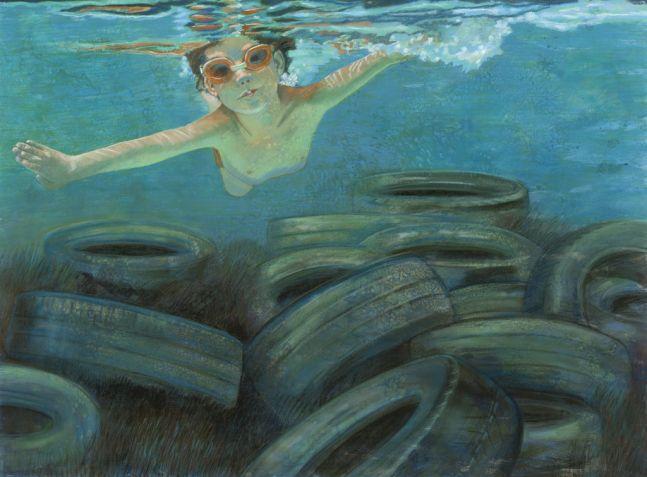
MT: The artwork by Elizabeth Leader, “Auto Grave,” with the girl diving down in the water and the wreckage below says it all. “Auto Grave” and the poem are a perfect match. Thank you so much for that collaborative beauty, Elizabeth.

 JH: I find it fascinating that all of the objects in your poem have some sort of an oral context. Can you expand on that imagery?

MT: We ingest so many things in life and I often wondered if we could look back at all of those relics, would they tell a story like swimming through the debris of a shipwreck? Memory is a strange gnome. It only gives us minute details of any moment and yet we write memoirs and stories to wrap around those feelings and visuals we still carry like a package. I think of all the things I’ve swallowed and that’s a lot of crap “slugged back with saliva.” And once again the words, feelings, ideas, rage, sadness and pain that are never unleashed, taken inward and float around clinging to internal organs for how long? I’ve heard it takes seven years to clear your lungs from smoking, but what about cigarette butts, or a condom in the digestive tract? If we could just strain out each organ and find out what it still carried, we’d be back in the womb.


JH: Please include any links to your website, other publications or other links you would like to share with our readers.

MT: My websites: megtuite.wordpress.com and www.megtuite.com
Also www.magnanimousportraits.com a site with over 150 different collages of writers, artists, musicians and innovators screened on to t-shirts) Hope you check them out.

I have two new collections out right now. “Bound By Blue,” (Sententia Books) is a collection of short stories. (The above link also includes a video of me reading a story from the collection at my book launch in Santa Fe.)

Her Skin is a Costume,” is a long chapbook (80 pgs) published through Red Bird Chapbooks. It is a linked tale that follows a family through flash pieces.


JH: Thank you so much for taking the time to discuss your poetry and “Relics.” Can you answer one final question? Can you discuss what recovery means to you?

MT: I love your questions, Joan. I’m trying to squeeze the fog out of my cells so I can find something worthwhile to say. Recovery is finding that I’m still not ten or twelve emotionally when I go back home to see my Dad. Recovery is breaking through some fear that held me prisoner for a damn long eternity. Recovery is writing what I need to write and letting my voice speak and not swallow itself anymore.


Interview of Erica W. Jamieson

Erica Jamieson

Barbara Straus Lodge: I’m sitting here with Erica Jamieson at one of our favorite writing places, The Funnel Mill in Santa Monica, California. We have written together for years. Erica, did you ever think I’d be interviewing you about a recent publication?

Erica Jamieson: I’m just so thrilled that we’ll have our names in the same literary journal at the same time! I hope it’s a precedent that continues! Should we order our Chai Masala before we get started?


BL: Oh yes, and in fact, I read somewhere that in Ayurvedic medicine the main ingredients in chai are described as “sattvic” – known to revitalize and simultaneously help clear the mind and calm the spirit. A perfect beginning to our meeting. Let me begin by telling you how deeply moved I was by your most recent publication, Hope Like Blue Skies. Will you explain your inspiration for this most beautiful, poignant short story?

EJ: I wrote this piece in response to a short story contest in which we were asked to take a picture off of the internet and use it as a prompt for a story. I searched through the public pictures on Picasso and found a photo of an old ice cream truck with the word “Waratah” printed on the side. When I started writing the story, the only thing I had in mind was a broken down truck and a couple. I felt somehow the truck was going to be symbolic of something broken in them.

Netta was based very loosely on someone in my family who’s spirits never faltered despite some significant challenges in her life, including miscarriage and giving birth to a stillborn child. As this story took shape, I saw the ice cream truck balanced against this kind of grief. I created the husband character, Rex, to reflect upon the profound effect such grief might have on a husband as well as a wife. I pictured him as having just gotten stuck in his own sadness, the same way a broken down truck would become immovable. I played with the notion that Netta would have an innate understanding of time and healing and the hope a new pregnancy would bring.


BL: In much of your other work like Angels In The Wind, (Spittoon Magazine, December 2011), and All That Remains of Etta, (Lilith Magazine, Spring 2013), you use nature, especially wind, as a metaphor. Will you expand on that?

EJ: Okay, that’s astute. I hadn’t noticed I do that, and it’s not intentional from story to story but now that you bring it up, wind and/or the change in weather is something present in a lot of my work. I don’t write much about weather, but I do see wind and change as powerful elements that interact with characters either as catalyst for reflection or as a some sort of guide. I grew up in the Great Lakes Region so sudden bursts of inexplicable weather was very common. I remember so much of my childhood as centered around these drastic changes in weather and that I was extremely sensitive to them. One of my strongest memories from camp was of standing on the porch to our cabin and feeling a storm roll in over Lake Charlevoix.

There would be wind, than rain, than sudden blackness, then sunshine! We’d stay in the cabin for the hour or so it lasted playing Jacks or cards, but the best part was standing on the porch being part of those extreme natural forces.


BL: You were so young to have had an awareness of being part of something much bigger than yourself. No wonder you are so wise! And how do you see your work as a reflection of incorporating this sensitivity to nature in your work?

EJ: So, In Angels there is a scene where Eloise goes to the window and watches great gusts of wind bending the trees so they appear to be dancing in circles, then bowing down to the ground and rising again. It’s that moment that she understands the depth of her grief over both her loss of her husband and her assistance in his suicide. Years before I wrote that story, I woke to loud Santa Ana winds in the middle of the night and I watched this swirling of tree tops out of my window. By the time I turned to wake up my husband, the wind had stilled and the night was quiet again. I always wondered why I saw that, if I really did! I felt like there was a message in that wind, and for Eloise at the moment she has tried to erase some of Eli from her body, the angels speak to her and tell her it won’t be that easy.

In Etta, I used the swirling snow at the moment the two woman meet to create a fugue state in which past and present might viscerally be blurred. There is a woman in a black coat that reminds her so much of her mother, and I think that happens, we blur memories sometimes, the past seems to get swirled and meshed with the present. I hope by infusing familiar sensibilities of the weather, readers get that visceral sense of change. In Hope, the virtual paralysis of both characters is plays against the hot, stifling heat, only to be broken by the storm that comes crashing wildly in with the understanding that Netta is pregnant again.


BL: That is so interesting to me, having been born and raised in LA without knowing dramatic weather. But I do love our version of wind, especially the Santa Anas…I feel their excitement and believe the wind carries, or at the very least, reminds us of the interconnectedness of all life. Your stories highlight how changes in nature can create awareness of both our internal and external words. I very much enjoy reading your insights. Now that we are talking about some of your other stories, you often address the theme of grief and recovery, why is that so?

EJ: Yes, well for a while I did find myself writing a series of stories about grief, Hope included. I seem to be breaking out of that now but when I started, I was inspired by people who survive — who go on with their lives and even thrive in the face of immeasurable grief. Their capacity to heal and grow through unfathomable suffering, even finding a way to live with joy and hope, is what both humbled and astonished me.

I haven’t suffered that kind of unexpected loss and my respect for the individuals who have has resulted in my creating these characters. I hope my stories do honor to the people who have suffered inexplicable losses. They were written out of reverence and a humble attempt at empathy.


BL: Well, I certainly compliment you on your courage to approach such tender, difficult topics. Your writing does what you intend and not only illustrates this kind of strength, yet also allows the reader to relate in an empathetic, compassionate way. And so, why the title, Hope Like Blue Skies?

EJ: I’m almost embarrassed to admit this, but I wanted to challenge myself to write a story that wasn’t necessarily all on the page, and of course that brings to mind Hemingway’s Hills Like White Elephants. That was my inspiration for the how I originally approached this story and in earlier versions, I think the interchange between Netta and Rex was far more subtle making it difficult to understand how they had arrived at their current situation. I tried to write a story with grave undertones because I think that’s where we carry so much of real life, in those undertones. You know, we talk about the weather but we are really talking about what happened at the party last night!


BL: What are you working on now?

EJ: I’m always writing short stories and listening. When I’m at a coffee shop and overhear conversations, oftentimes, a line of that conversation wakes a character up in my head.


BL: That sounds intriguing! Go on….

EJ: Let’s say I’m somewhere and I hear something out of context….I can’t wait to create a world around the words I heard and try to guess what they might actually mean. My kids do that with me all the time. They point out a flamboyantly dressed person or an irate customer and they ask “what’s their story?” The more outrageous I get with telling the story, the more they love it. There’s inspiration everywhere. We just have to get out of our own heads and take note. So much easier said than done, though.


BL: Easier said than done is the understatement of the week! Describe for me your writing process.

EJ: I’m always writing starts to stories. I like beginnings. In fact, most of my published work has started with a beginning that I put away for a while and returned to years later. When I read those early beginnings with a more mature eye,

I take off into a story that might not otherwise have been there when I wrote them down before. Life experience helps. Another perk of aging. Currently, though, I’m turning my focus towards writing a novel. As I’m used to thinking in vignettes I’m really challenging myself to see a character through his or her full experience. In a novel, characters move into and out of experiences and I need to envision him or her handling new and different challenges. I need to get to know my characters deeply, inside and out, and hopefully they will then help me through those processes as well.

BL: I thought I was alone! I’ve always written personal essays for publication, short pieces with beginnings, middles, and ends…and now that I’m in the process of writing a much longer piece, my memoir, I’m faced with the challenge of consistently weaving the character’s personalities and changing life experiences throughout the book. It’s definitely different. Looking at both the forest and the trees can certainly be both daunting and enlivening, given the unexpected gusts of wind. Good luck with your novel. I know it will be fantastic. And thanks so much for taking the time away from getting to know your characters to talk with me, Erica. I look forward to writing together and reading more and more of your work.

The stories mentioned in this interview can be read at Erica’s website, www.ericawjamieson.com.

Interview with David Licata

david_licata

Jessica Roth: What, exactly, set “Wonder” in motion? When you finished writing it, had it carried you to the same place you thought it would when you began?

David Licata: I was at an artist residency (where we met, Playa Summer Lake) and on a 1,000-words-a-day schedule, forcing myself to produce first drafts to round out this collection of connected stories I’ve been working on for longer than I like to admit. I had the catalyzing event of the collection (the senseless murder of a valued member of a community) and I had the characters. I had completed several stories, published one in The Literary Review, but until I set “Wonder” down, I hadn’t written anything that explored the most intimate and immediate reaction to the event—that of the wife of the victim responding to the news that her husband has been shot. I knew I needed to write that story, but I couldn’t go there for a long time. I guess I felt safe at this residency. The thing that set the story itself in motion was the main image, the cart. I had that swimming around in my head for at least six years. I wasn’t hoarding it, it was just there. I didn’t have plans for it. But when I started writing this story, I knew that image had a place in it.

For the most part, the story did bring me to where I thought it would. Curiously, though, the starting point was very different in all but the last draft. In previous drafts it had a false beginning. I was trying to do a little misdirection, but really it was a last ditch attempt at avoidance.


JR: I remember reading an earlier draft of “Wonder.” What did your revision process look like? How is revising a short-short like this different from revising a longer piece of fiction?

DL: Usually I write a first draft and then put it away, just forget about it for at least six months. I might revise other stories or work on something else, but I try to distance myself from first drafts.

Then at some point I have an urge to work on it. I pick it up and take a deep breath, because reading my first drafts is torturous. First drafts try very hard to convince me to stop writing.

But if a couple of things glimmer in that first draft–an image, a sentence, a bit of dialog, an action–if there’s something redeemable in it, I will only despair for several days and look at it again and start cutting it. I’m generally one of those taker-outer writers. Cut, cut, cut. With the short pieces, under a 1,000 words, I find I work very quickly. My short pieces aren’t poetic in that flash fiction sense, so I don’t obsess over the language the way a poet might. Usually after six or seven drafts I discover that I’m not improving it anymore. That’s when I ask someone I trust if they’d give it a read. (Thank you, again!) Longer stories go through many more drafts and I put them away more often and for longer periods. Reading the first drafts of longer stories is exponentially more distressing.


JR: You already know that I am skeptical of hard, fast divisions between genres. Is there an autobiographical element to “Wonder”? In general, when you are writing, how do you navigate between factual truth and narrative truth–where does your allegiance lie?

DL: There are autobiographical elements to “Wonder.” The cart is based on an actual event. I was with my mother the day she took her last breath, by her bedside holding her hand. I went home that day, taking a bus from New Jersey into New York City. I live near Lincoln Center, and there’s a pedestrian passageway under the Metropolitan Opera, it’s a little bit of a short cut. I walked through it as I had many times, but this day there was horse, a cart, and a man and woman in what I think were Italian peasant costumes. I guess they were part of the opera that was happening that night and this was where they waited for their cue. But I had never seen anything like that before there. I thanked the universe for letting me experience a sense of wonder on that day. It was the tiniest glint of hope on the most despairing day of my life. Nothing like that glint would appear again for a year, though.

I’m not that interested in portraying factual truth. I am interested in portraying emotional truth. The same goes for my nonfiction work. Navigation is trickier there, though. I suspect I’ll be dealing with those waters for as long as I work in nonfiction.

JR: Okay, here’s the question we all love-hate: What is “Wonder” about? What do you want readers to be thinking or feeling when they reach the last word?

DL: Most of us will experience that call, the one we dread, the one that is unimaginable and inevitable. It’s about trying to make sense of that call. The descriptor on R.KV.R.Y is nice. It’s “about wonder in the midst of tragedy.” True. But I wanted the story to be emotionally true, and that’s why it doesn’t end with the character seeing the cart, it doesn’t end on a hopeful note. She loses the cart and she searches for it but doesn’t find it. She’s going to be driving in darkness for quite a while before she finds that wonder again. That’s how grief is.

I suppose I’d like the reader to feel a sense of the preciousness of life.


JR You’ve told me you are working on a short story collection. How does “Wonder” fit in?

DL: The collection is about what happens to a community when one of its citizens is violently removed. What happens immediately and over time. Chronologically, the death in “Wonder” is the first event in the collection. “Wonder” introduces us to a few of the main characters, either directly or indirectly. The wife is featured in many stories, prominently in some, less so in others. Same with the son, who is mentioned in passing in “Wonder.” The dead man’s absence is present in every story.

But I haven’t committed to the sequence of the stories. There’s no reason it has to be organized chronologically.


JR: You were first introduced to me as a filmmaker. Is there a relationship between that work and your work as a writer? If so, where do the two intersect?

DL: I like to think there is. They are different limbs sprouting from the same trunk. I seem to explore the same themes in the films and in the writing—mortality, legacy, continuity, community, the passing of time, the power of having a passion. My brain seems to like puzzles, so I play a lot with story structure. There are many points of view in the collection, told over an expanse of time. In the documentary I’m working on now, “A Life’s Work,” I’m focusing on four people who have dedicated their lives to projects they likely won’t see completed in their lifetimes. The film is told in several chapters, not three acts, and instead of Person A telling his complete story, Person B telling her complete story and so on, there is intercutting between subjects so the similarities and differences of these people becomes a huge part of the story.

The mediums fill different personal needs. I can be very social, that’s the filmmaker side, the side that likes to collaborate with a group of other artists to realize a project that can’t be undertaken by one person. But I also value being and working alone, and that’s the writer side.

It’s a bit schizo, but it seems to work.


Jessica Roth lives in Boise, Idaho, where she writes stories that should be poems and poems that should be stories, instead of working on her first novel. She is a graduate of Prescott College and a Frederick & Frances Sommer fellow. Her poetry and prose have appeared in Alligator Juniper and CT Review. She most recently received the Glenn Balch Award for her short story, “Mesquite.”

Interview with Sasha West

Sasha West

Mary Akers: Hi, Sasha. Thanks so much for agreeing to talk with me today. I just loved your poem “Fecundity, Expanse” in the July issue of r.kv.r.y.. When I first read that poem, I didn’t have a sense of how it fit into this whole wonderful themed collection of yours. Now that I’ve been reading your collection “Failure and I Bury the Body” I have an even better (perhaps wider) appreciation for the poem and its place amid a larger work of art. Something like seeing a beautiful detail of a painting and then stepping back and seeing a whole beautiful mural and going, “Whoa!”

I’m curious how this linked collection evolved. Did you set out to write a whole collection that was linked? Did you examine a grouping of poems and look for the links and then accentuate them? Did you map out the poems you wanted to write beforehand? Granting that the process for every collection is unique, how did it work for this one?

Sasha West: Thanks for including that poem in r.kv.r.y, Mary. In terms of the collection, I’d written one earlier allegorical poem in which a woman gives birth to a baby who is Loneliness, and I was intrigued with the idea of working with more allegorical characters. I’d been thinking about medieval allegories and how vices and virtues became flesh characters in them—and so I started thinking what our modern- day seven vices might be. After loneliness, failure came to mind, so I began drafting with the two main characters in mind—Failure and the unnamed narrator—and the project started to grow. The idea that the narrator was taking a road trip with Failure across the American Southwest came early. I knew I wanted them to be living inside of how climate change and nuclear tests and other bits of history have affected that landscape—and I knew it would be a long poem, but back when I started, a long poem to me was 6-8 pages. (The book clocks in at 128 pages!) Sometimes the project feels to me like a set of poems that come together into a whole and sometimes it feels like one poem that happens in parts. In one version of the manuscript, the pieces weren’t individually titled—so each new poem was a new section of road, a part of the single whole gesture through time.

The experience as it expanded was what I imagine writing a novel to be. As I was working on their story, I started discovering things about these characters and their world. I realized Failure was always performing strange little experiments as they went along, and so those came in, and then I realized the narrator was so ready to follow Failure because she felt broken and broken-hearted in equal measure. She was trying to leave something behind that wouldn’t stay left. Thus arrived the character of the Corpse who they pick up on the side of the road, who won’t stay buried—and the poem kept growing.


MA: I love linkages in both poems and short stories. I feel like they force us to do a little extra work (as readers) beyond what we are already doing when reading. And I say “work,” but I don’t mean that in an onerous or pejorative sense. I mean it more like the “work” that comes with discovery. It’s exciting, rewarding work, not laboursome. Does that make sense?

SW: Absolutely—and I agree. There’s a readerly pleasure in peeling back layers, in noticing patterns across a whole, in returning to the same landscapes or dilemmas at multiple points in a text and watching how they change. I feel like they engage our curiosity. And because linked poems or short stories have gaps built into how they give you information (more gaps, let’s say, than your average realist novel), they make the negative space around them active. I hope for that in this book: that a reader might notice Failure’s experiments and dream up others, that a reader might fill in the story of the Corpse that the narrator half- tells, half-obscures.


MA: Yes! Negative space! I think about negative space so much. I once had an undergraduate professor who made us draw an entire photograph (of ourselves, from childhood) and when we were “finished,” he made us go back and erase portions of it. It was a mind-expanding exercise for me that continues to inform my writing to this day. What is necessary? What is more beautiful in its absence? I feel like that is the essence of poetry–the condensation and distillation, the annealing of words.

Do you, as a reader, enjoy reading linked work?

SW: Yes! In fact I just had the pleasure of slowly discovering the links in your new collection Bones of an Inland Sea. I like it when those links feel organic and when they slowly unfold, as they do across your book. It feels like recognizing someone who is dear to you in the airport of a faraway city. I tend to read poetry and novels more than stories, so I especially love links in a story collection because I get a better sense of the map in the writer’s head—how all the pieces come together into a territory. I’m fond of linked poems for the way they can create that same expanse. While I don’t tend to write poems with traditional rhyme across lines, I am interested in the idea of rhyme across a book—the way repetition and variation operate to forge relationships between the various pieces.

MA: Thank you! I enjoyed finding and creating the links in that collection.

Your addendum FAILURE’S ACCOUNTING OF INFLUENCES is so fascinating and exciting. When I discovered it, it made me go back and reread the poems I had already read and look at them as part of a larger conversation, as art informing art. Was that your intent?

SW: Yes, it was. I knew I wanted to use some small elements of collage (or bricolage) and allusion in the work, but I didn’t want those elements to overpower the pieces and make the collection about the surface instead of the story. I feel like sometimes the thing in a poem that comes from somewhere else doesn’t become wholly embedded because we are so quick to call it out, to mark it as other. (Sometimes I feel like the notes sections are intellectual gossip—who is inside the poems, who has this person read, have I read the same people? Seen the same things?) All of that can distract from the work. I’m interested in visual artists who make something new of collage (Robert Rauschenberg, let’s say), and what we see is the whole rather than the sources, though the sources are also visible, embedded if you look closely enough. Obviously, there’s not really a way to do that in a book, but I was trying.

There’s also a way I want these characters to move through a world haunted by other things—paintings, news, books, maps, magazine articles. There’s a poem where the narrator tells a story about a trip she didn’t take to Antarctica and most of it is a recounting of Herzog’s Encounters at the End of the World. It’s not her story, but she’s taken the film, swallowed it as a mythical place, and added to it. We do that in our lives with stories and objects and other people. We use what we find outside ourselves to explain life to ourselves. So I wanted all the allusions and echoes to be part and parcel of the project.

That might seem to argue for not marking these other bits of text at all—but there’s this other side of using someone else’s work where I am grateful to what I have they have given me. I also realize collage can be obscured in writing more easily than the visual arts. I needed a system of pointing, as Gertrude Stein might say. I wanted a way to point to the worlds inside the poems without marking them as something other or separate. The accounting came out of that. Failure’s character is experimenting and tallying and list- making, so he got to do that often in the book—and he was put in charge of the titles and the references.


MA: “A system of pointing.” Brilliant. The “Failure’s Accounting of Influences” pages also made me think about continuity. And not just continuity in art, but continuity in failure. And how close Failure rides beside us as we create. How this imaginary personification shadows us and haunts us but also cradles us and soothes us. So interesting. Would you like to comment on that?

SW: Years ago I became obsessed with the idea that we’re always looking at success when we’re learning to write—and that we are missing something because of that. Graduate programs teach the greats, and writers hand off beloved texts Xeroxed or copied from lit journals like so much samizdat, but we ignore everything that fails (or we relegate it to the territory of snark). I was teaching a class where we read through every book in order of some mid- to late-career poets—people I really admired who’d published between 3-7 books. When you’ve written that much, some of it is inevitably better than other work—and some of the books really failed. I was struck by how interesting the failures were—and how they often opened up space for some breakthrough (or just break) later. I wrote an essay called “In Praise of Failure” and tried to look at what it could do. I started seeing failure as a generous and necessary force in becoming an artist.

On the personal side, my twenties were marked by a lot of failures, things that didn’t go the way I’d hoped or intended. I wanted a more generative and hopeful way to think about the time. And I was casting about for a way to come to terms with our country’s failure to address climate change adequately. Our country has been terrible in so many ways and ghosts of that come into the book—blankets with smallpox, bodies dragged by trucks. Everywhere—as artist, person, citizen—I kept feeling this need to find something beautiful and strange in what was breaking. There’s a bravery in coming to terms with failure that I wanted my narrator to find. Perhaps I was hoping that would leak back from the book into my life.

And with all of these ideas circling around the manuscript, at some point Failure started being a character I felt a fondness for. I was interested in his childhood and his strange relationship to a pack of dogs that kept chasing him down trying to kill him. (No dice, as he is, of course, immortal.) I was interested in his vulnerabilities and failures—and his imagination. He felt like a strange god who’d settled into our house in a benign way, something I should treat with tenderness—something with fur and a pulse.


MA: “In Praise of Failure.” I would love to read that essay. It should be required reading, actually.

My two favorite poems in Failure and I Bury the Body (so far) are “Machine That Leaves and Never Returns” and “Failure Dreams of Elements.” I imagine that isn’t a big surprise to you, given what you know about me and my affinity for and protectiveness towards Nature. So many exquisite lines.

“Fish hook, fish hook, fish hook: a necklace.”

“…and when I choose / the field, it disappears inside the bodies of the grasshoppers / and when I choose the pool, he fills the chlorine with carcasses of bees / and when he offers me arroyos, he sends angry horses through them…”

So beautiful. I have no question to add, just sheer adoration for your lines.

SW: Thank you! I’m glad the nature element speaks to you. For me, part of the shadow and haunting of the book is in the environment, the things I keep learning about what we are doing to it. How to live amid all this failure to acknowledge what’s happening and failure to do right, and still have hope? I have a new daughter, so I want the world to stay beautiful and intact even more now than I did when I finished writing the book. My stakes in it are higher. I want her to have gentle monsoons in the southwest and walk on the coasts I’ve loved. I think we have to understand the mystery of the world or we won’t want to save it. We have to want to be lost in its moments.

MA: Yes. I find it hard to comprehend sometimes how someone who has a child–or, you know, breathes air and drinks water–doesn’t come around to environmentalism at some point. Maybe the problem feels too big to grasp and so gets willfully ignored.

The cover of your book is stunning. Texturally appealing, even. It speaks to me and makes me want to open it. Did you have any say in your cover art? Did the designers get it right the first time? Or did Failure intrude on the early attempts?

SW: I was very lucky. The publisher was really open to suggestions for the cover. I gave the designers a set of images that appealed to me, and told them which were my top three—and this was one of those three. But I didn’t know for ages which image they would pick and what we would be able to get the rights for. Somewhere along the way without realizing it, I started picturing the book with this image whenever I thought of it. When the email came with potential covers, even before I opened it, I’d decided if this image wasn’t there I’d try to fight for it—but there it was.

The cover—which comes from a series of Ellen Grossman’s—felt exactly right to me. She talks about being influenced by cartography, topography, land masses, water currents, etc. You can’t see it on the cover of my book, but she also records the date and time at the start and end of each line—so each one is a little journey. My characters are often in the desert, looking at mountains and maps—so these images fit that. But the characters also have a ghost life in Siberia/Antarctica—and the image also felt right for icebergs and the sea. It allowed me to feel like a setting was being made for the readers without building anything literal that gets in the way of their discoveries of space through the work. I like that people have said it looks like gauze, or a dragon. I like that it’s amorphous. Failure is a Protean character in the book, often trying on new costumes, new forms, so I like the idea of the cover being directive and ambiguous at once. Plus her blue in this image is gorgeous. I could live in that blue.


MA: That is an exquisite, rare blue. When I read your beautiful poems, I feel like I’m seeing something rare, something exquisite that I haven’t seen before. It feels like work so deeply intellectual and yet also so deeply somatic that I fall in love sentence-by-sentence. Keeping in mind what we’ve talked about here, whom else would you suggest I read for something in a similar vein?

SW: That’s such a kind thing to say about my work—one of those compliments I cross my fingers is true about the work in the world—since little would make me happier than having balanced well the head and heart and body. I’m also always scared that I wear the people who have influenced me on my sleeve, so I’m glad it’s maybe not as transparent as all that. Try Anne Carson, Claudia Rankine, Matthea Harvey, Mark Strand, Zbigniew Herbert, Eula Biss, Laurie Sheck. That’s probably good enough to start with, right?


MA: Thank you! A reading list is a gift that keeps on giving. And finally, because we are a recovery-themed journal, what does “recovery” mean to you?

SW: Is it too simple to say finding a way out of failure? Finding a way to peacefully live with failure? It’s part of what this project is borne out of. How do we as Frost says “back out of all this now too much for us”? We have to make peace with our public and private histories without trying to make them disappear— and without making a museum out of them. I don’t have a full way to talk about this yet, but I think recovery also must contain forgiveness. At some point, maybe I’ll start writing about the seven modern virtues. I think forgiveness must be one of them.

“Why You’re Here” by Rick Gray

Why You're Here (In the Gyre)
“Tires Underwater” by Elizabeth leader, pastel with mixed media

When I was sure the nurse was out
in the sick bed next to mine,
And 30 milligrams of Karachi diazepam couldn’t stop
the thudding propellers,

I rose quiet as a Seal and aimed for the
poppy fields of Helmand District located
just south of the analgesic section
I had scoped in the clinic medicine chest.

I almost got them right
Into my open mouth
Little white words I can’t spit out
When the nurse’s voice

Blazed through Afghan darkness
ten years of Texas truck stop waitress behind it
like a red warning flare that said
That’s why you’re here.


Rick Gray has a poem appearing in the winter issue of Salamander. He was a finalist for the Editor’s Award at MARGIE. His essay, “Total Darkness,” will appear in the forthcoming book, Neither Here Nor There: An Anthology of Reverse Culture Shock. When not in Afghanistan, he lives in Florida with his wife and twin daughters.

“Four for the Duke” by Charlie Clark

Four for the Duke
“Catholic Campus–Dodge Street” by Elizabeth Leader, collage with found object

1. The Duke’s Letter to His Wife Explaining His Prolonged Stay at the Spring Cottage

Some have to travel a long way to discover
the pleasure of a good deep square of green.
But that sounds too much like wisdom.
The year is young, I’m only partly in the country,
and all I know of grass is what the groundsman tells me.
The last time I put my body down in some, I was drunk.
Quaint, I know, though it may have been why the magic didn’t take.
Or it may have been because of whatever darkness was crawling through the dustbins,
making me sweat two hundred yellow pounds.
It smelled like peppermint schnapps and a sun-burnt slaughterhouse.
You couldn’t have told us apart, there upon the ground.
I say that like I’m proud.
Of all the things to poison myself with
I keep choosing the least effective.


2. Third Draft of the Duke’s Annual Summer Letter to His Mistress

It’s almost easy, love, sitting here while the sky blackens through the bare,
devil-fingered limbs of my courtyard’s sole strange tree, its trunk so narrow
one can grasp it, nearly, like a handle, except for how the bark’s jagged shingles scrape the hand,
the gashes quickly going red and welled along the palm.
Not knowing, I call it the tree of knowledge.
(It’s common knowledge pain eases with a joke, even one so bad.)
I’m sure there’s someone who knows how to suck the poison out
while someone else knows how to enter such a wound and come through the other end improved.
You’re adept at one of these at least.
Each takes a skill beyond my understanding.
Most skills are beyond me
except for how, when my limits bleed like this,
I gather their unspooling contents, and, making a ladle of my hands,
offer up as much as you will drink.


3. The Duke’s Letter About His Last Fall Walk, Its Recipient Uncertain

Stopping last evening at the curve along the creek
where one has a good clear view of the portion of the dilapidated graveyard
whose headstones all have fallen among a rash of still-hanging-on little yellow flowers we called
poppers when I was young,
I saw the long, fist-thick coil of a serpent soaking from one slab the last of the season’s heat.
Stalled there watching, I suddenly recalled the dream in which I wore a jacket made of snakes.
Not just skins, but whole live ones wrapped around me,
tails always rattling to warn others of my approach.
And constant biting. The first would kill while the next one would revive me.
No mercy in it, though their clacking sounded happy, like workmen when they whistle.
Thinking this while watching across the water, just before the light gave out completely,
I saw a rabbit, grazing on the flowers, wander in among the graves.
I thought they had a better nose for these things.
When I shouted it stared in my direction.
It had eyes like a Byzantine Jesus.


4. Winter; the Duke’s Last Letter, Copied in Triplicate

It took distance to realize what I need is distance.
On my walks, I look out at the empty trees
and am satisfied not knowing any of their names,
feeling for them only sorrow.
There are days when even looking at them is too much,
when it’s enough to sit listening to the oscillations of my heart.
I’d say you should hear the range of it,
the way it seems sometimes it should tear
from all the blood it’s taking in,
but that would require you placing your head against my chest,
and, separating your pulse from mine,
listening as best you can.
Even then you might not hear the thing I mean.
Please think of me when you see shadows.


Charlie Clark’s work has appeared in Crazyhorse; Forklift, Ohio; Fugue; The Missouri Review; New Orleans Review; Smartish Pace; and elsewhere. He earned his MFA in poetry at the University of Maryland.


“American Epiphany, Part II” by Robert Boswell

American Epiphany Part II
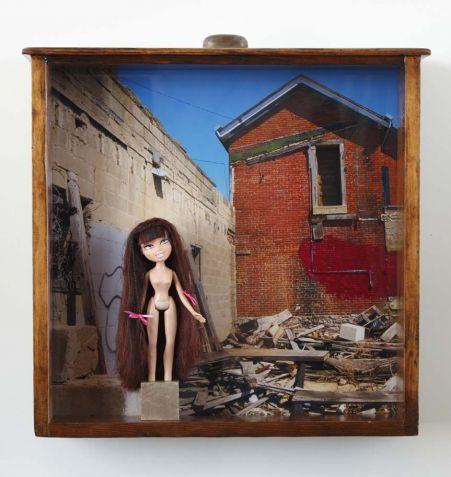
Jade-Bratz from the TOYOLOGY series, by Elizabeth Leader, 2011, Mixed Media Assemblage

Continued from Part I

The freckled boy locked the door behind them. He was sweating. “It’s amazing you’re even alive,” he said. “We saw a whole cow fly by. A whole entire cow.”

“This is my husband,” she said to the fat boy. To her husband, she said, “This is the boy that put Coke in my iced tea.”

They shook hands.

“It wasn’t dead,” the boy said. “Its hooves were stomping the air.” He demonstrated with his puffy fists.

“Thanks for that, Skippy,” she said.

Dmitry made a beeline for Kenny, throwing his arms around him. Tera supposed that it was odd of her to call Kenny for help, but she had known he would come. Men want to rescue you. And sometimes you want to be rescued.

“The phone lines are down or I would have called you,” Kenny said after they’d settled in a booth. He gave a nod in the direction of his quivering vehicle. “I’d have told you to stay at the facility. The reports say this one is a monster.” He nodded his head in a different direction. “Julio has a radio. We got an update before the batteries gave out.”

“Tornadoes are mercurial storms,” Dmitry said. “They may destroy a single house in a neighborhood and leave all the others untouched.”

“There’s a bottle of whiskey in my car,” Tera said. “Do you suppose Skippy would be willing to fetch it?”

“We’ve missed you,” Kenny said to Dmitry. “The whole department. Students ask about you daily.”

“Students,” Dmitry replied. “There’re so many of them. Aren’t there? Generation after generation of students. We should probably all gather in the bathroom, don’t you think?”

Kenny sent her an S.O.S. but she was making sense of hubby by this time.

“The safest place in a storm,” she said, “is the bathroom.”

“Of course,” Kenny said, relieved. “Why is that I wonder?”

“Small size,” Dmitry said, “wall strength, the fixtures.” After a moment, he added, “Interiority.”

It was then that the immense funnel showed itself in the windows of the Hardee’s, a great undulate of white rope. Some bored god with a lariat the size of the Sears Tower.

Skippy and his gang claimed the Guys, which left them with the Gals. A small, translucent window covered with chicken wire let in smeared dollops of light. Dmitry sat on a toilet in the handicapped stall, and Tera sat on his lap. Kenny was in the adjacent stall. If she ducked her head low, she could see his sneakers. The bathroom tile and metal stalls turned their voices hard and made them bounce like rubber balls about the room.

Her men talked for a while about changes in the department, how one of Dmitry’s enemies had made a push to usurp the planned hire. The sociology department was divided along theoretical lines, much like Europe in the first half of the twentieth century, and battles periodically erupted. Dmitry and Kenny tossed volleys back and forth over the metal wall about internecine hostilities. Tera had studied in the department for three years, but she was content to listen, recalling the afternoon in his office that she told him she was quitting the program, and how he took her into his arms (they were lovers by this time) and she curled into his lap, smelling the leather of his chair. The toilet wasn’t quite so comfy, but she felt finally at ease. He sounded so much more himself talking about an assistant professor who did arbitrary interviews with the poor and published them as research, validity and reliability be damned, and how another colleague, who collected and analyzed monkey sperm, hated the assistant professor so much that he hired undergraduates to answer her ad and pose as the homeless. Universities were home to the most extreme kinds of idiocy.

Dmitry said to Kenny, “I’m aware, of course, that you and my wife had intercourse.”

She kept her head bent against his chest. The other stall fell silent. They could hear things outside bumping against the shabby building. Girders squealed, as the wind tried to rip the lid from the box.

“Sexual intercourse,” Dmitry clarified.

“I understand you,” Kenny said. “What do you want me to say?”

The next silence was even longer, but the world happily stepped into the gap, and it occurred to Tera to say that the wind was the sky’s way of complaining. She had confessed to Dmitry some weeks ago, during one of her visits to the farm. He hadn’t responded, and she hadn’t been sure that he was tracking the conversation.

Finally, she said, “I’m sorry.”

“Yes,” Dmitry said. “You told me that.”

“Something’s happening underneath,” Kenny said. “The water’s rocking.”

“Don’t you lose your mind, too,” she said, an inconsiderate remark, considering.

“The water in the toilet is full of waves,” Kenny insisted.

They stood, lifted the lid, and looked.

“It seems to be rising,” she said.

“It’s attempting to communicate,” Dmitry said. “It’s weary of its life. We only think of the sewer when we have something foul we wish for it to take away.” He leaned lower. “Forgive us,” he spoke this directly into the open mouth of the toilet.

Strange spears of light entered the stall, and Kenny stepped in, joining them, latching the door behind him. He pointed upward, but stared at them. “We should hold each other,” he said.

The ceiling was rattling, and a peculiar, strained light leapt in the gaps. Wires, electrical coils as thick as Tera’s arms, held the hovering ceiling, kept it from continuing its levitation. Everywhere beneath them, chained to them like the famous cannon ball, was the betrayal, in which Tera and Kenny did terrible and wonderful things behind Dmitry’s back while he continued to do nice things for them.

And that second betrayal, when she refused to continue loving Kenny despite Dmitry having removed himself from the picture; that was there, too, in the darkness beneath their forked bodies.

“It may be a septic system out here,” Dmitry said, clutching her tightly. “Not a sewer system, per se.” His face was lit by an unholy flash of light, as if by divine touch, and then it went dark. Her men crowded around her, holding her tight.

The howling was suddenly fierce, and Tera yelled out that she loved him, without saying which him, and held tight to them both.

Skippy was unconscious, and the place was a certifiable mess. Much of what had been the top of the building was now in the parking lot and on the highway, and rain fell through the gaps. All the loose furniture—the freestanding chairs and tables, the newspaper rack, and the March of Dimes candy dispenser—were gone, erased, still whirling over the Midwest somewhere beyond their ability to see. The booths were missing their tables. The seats and backs had inflated with water, and damp stuffing burst from the seams like sea creatures emerging from primordial caves. A great blossom of grime was laid over every item that remained in the room. There was no litter on the floor, only puddles, streams, tributaries, and poor fat Skippy, lying on his back, Dmitry and Julio kneeling over him, while Kenny and a spare Hardee Boy used mops and towels (the storage room was undamaged) to keep the growing flood away from his great, beached body. Tera’s cell phone no longer worked and the landline didn’t even offer static.

The men pumped furiously on Skippy’s chest, as if he were deflating. During the height of the storm, he had inexplicably left the Men’s and darted out into the chaos.

“He didn’t say nothing,” Julio offered, apologetically. “It was no way we could go after him.”

After a long while, they gave up their efforts.

Tera had expected death to lend them a sense of wonder, to provide a spectacle, or at least a profound moment or two, but he merely looked cheapened, like a toy the day after Christmas.

“He’s peed himself,” Julio said, backing away.

The storm had been kind enough to bring Tera her car and nudge it up against the flagpole. Unfortunately, it was parked upside down. The passenger door was gone, but the glove box was intact and shut, and when she popped it open, the fifth of whiskey plopped into her waiting palm.

Dmitry took too many swigs of it. The liquor emitted a mixed set of signals to his brain, some of them sane but unkind (he punched Kenny in the chest) and some of them insane but helpful (when the rain abated, he filled his shoes with grease from the kitchen spill and built a fire in the parking lot, where they roasted frozen meat patties). His conversation rambled from sharp-edged replies to meaningless, idiosyncratic comments. When his mind had been clear, his intellectual passion was a fearsome thing to behold, a deep well of icy water, frigid to the skin and almost too cold to drink, but as clear as snowmelt and as quick as death.

At some point, Julio took each of them out to the road to see: the tabletops from the booths were laid out on the highway in a row, like the keys to a piano.

It was the smell of flaming meat, they would later speculate, that brought Skippy back from the dead.

“God, that smells good,” he said, stumbling out of the ruined Hardee’s and into the parking lot, sopping wet and walking funny but undeniably alive. The fire provided the only light, and in that grease-fed blaze, he looked pale and otherworldly, and Tera knew she wasn’t the only one who thought he had taken a journey and returned.

“Jesus shit,” Julio said. “You all right?”

“My chest hurts is all.”

“We thought you were dead,” Tera told him. “Dead dead. Not like, dead for a while.”

“Holy cow,” he said. “Dead.” He made an awful face. “You just left my body in there?”

She shrugged. “We were sort of hungry.”

“Kinda sucks that nobody even, you know, sat with the body.”

“We’ll do better next time.” She crossed her heart.

Stars emerged, pricking the dark, but there were too many of them. “The constellations are gone,” Dmitry said, pointing. “They’ve been cut loose. They’re all on their own.”

“What’s it like to be dead?” Tera asked.

Skippy shrugged. “I didn’t feel any difference.”

“Why you run out into that shit?” Julio demanded.

Skippy pondered that for awhile. “Something I’d forgotten,” he said and then snapped his fingers. “My umbrella. It was under the counter, and I thought I ought to get it.” He smiled and shook his head in something like wonder. “All other thoughts left my brain, and I just ran out after it.” He looked up at the nameless stars for several seconds. “It has a silver tip,” he clarified. “That umbrella does.”

Tera was young enough and she had extended her education long enough that she could still say that she had been a student for most of her life. Unless she went back to school, though, that would change, and how would she think of herself then? Sometimes she seemed like a sheet of music on which someone had typed prose, and so, on fresh blank paper, she worked to create a narrative, but what came out was a set of lyrics. It seemed likely that her tombstone would be covered with finger-paint.

In the days to come, she would find that her husband was both eager and apprehensive to return to his old life, where he was exceptional and treated with deference, where the possibility of being undone by a foolish girl he had taken into his home was as unlikely as the presence of thieves who break into your house to leave gifts. Eventually, he would become himself again, the revered professor of sociology, loved by students and admired by his peers. Except he would no longer care for research. He would give up his great theories, the beautiful speculations on the causes of heartache and suffering among the masses. He would quit opening the journals that arrived in the mail, never ripping off their transparent covers. He would even give up the newspaper. He’d had such a specific and specialized view of the world, and yet he ditched it without so much as a whimper. Tera could only imagine the outlook he had abandoned, where events of the world conformed to reasonable inquiry. While most saw chaos and irrational grief, he had seen reasons, a hidden order, and irrational grief.

One night, years after the storm, Tera and Dmitry would go to a revolving restaurant in a high rise, and beyond the window radiant droplets streamed in unison on the distant freeway, and she realized this was how she thought of his research, the view it gave him, things boiled down to their essences and moving in a pattern. He had this view while the rest of them had to walk the streets. It seemed like a lot to abandon.

“It wasn’t dark,” Skippy said suddenly. “Being dead. It was real colorful, like magazine pictures tossed ever which way. And I wasn’t fat, so much. But it was real loud. Lots of voices saying things in two million languages, and there was construction going on. I knew if I hung around I’d have to pitch in.”

“So you came back alive instead,” Julio said. “Being a lazy bastard finally paid off.”

Skippy had this way of shrugging that made his neck disappear. “It was more like there was a spring, a coiled metal spring, with like a steering wheel on the end of it—is my car out here at all?” He glanced about for only a second. “I clung to that steering wheel, and the spring was, you know, thrusting me out, but I didn’t let go and it sprung back, and that’s when I smelled burgers and opened my eyes.”

The night air had been softened by the parade of large objects flying through it, and a mist settled about their faces and skin and clothing, and an owl started in with a lonesome hoot that was almost mechanical in its alteration of pitch.

“That must be the cops,” Julio said.

“That’s a siren?” Tera asked.

Dmitry said, “I thought it was an owl.” He laughed at himself.

She didn’t tell him that she had made the same ridiculous mistake, but it pleased her that they shared that error and made her optimistic that they might make a go of it after all. There appeared then little moons of lights, to go with the siren, twin moons, as if they really were on a foreign world. And then twirling blue beacons took over the sky.

Kenny would finish his PhD that May and go on the market. Dmitry would write an enthusiastic letter of recommendation, and Kenny would take a job out West. They would hear about his marriage to a blandly attractive woman and the fact of their children, but he did not send cards or email photographs. He and Dmitry would occasionally run into each other at professional conferences, but Tera has not seen Kenny and has not heard from him in all these years, and while she had worried that she might be tempted to cheat on her marriage again, it never happened. She can say for sure that it will never happen, as her husband lies in the next room dying, and she works on these pages between visits. This is a new hospital, and she can see the river from the waiting room, a curling blackness that winds through the city. But it’s not Dmitry’s dying that she wishes to write about, and not the past several years, which have been like any couple’s years—a song with a good chorus but mixed verses. They never had children and that is both a relief and a regret, and Dmitry never wrote another professional word, which is unquestionably Tera’s fault but she has made her peace with it. She doesn’t care to write about any of these things, just that night, all those years ago.

The woman’s nose has been reconstructed to look like a pennywhistle, her ears unnaturally flat against her head, like cloth flaps. She no longer looks like a koala. She looks like gecko. Tera goes online to find a phone number for the Hardee’s, which she has passed maybe fifty times since that night without ever making a return visit, a brand new and equally hideous building having replaced the old one. No one at the new Hardee’s was employed fifteen years ago, but the manager is interested in her quest and willing to go through the employment files. “That storm,” he says while perusing the records, “I was in college at the time, but my mother witnessed the funnel. As tall as skyscraper, she said.”

Julio’s number belongs to his parents, who reveal to Tera that he has moved to Los Angeles. They provide the number.

“There wasn’t no Skippy,” Julio says.

“The freckled boy,” she explains. “Overweight? He died and came back to life?”

“Oh, him,” Julio says. “He died again a couple weeks later. Went in his sleep.” He sighs and adds, “That’s how I want to go.”

Dmitry will almost certainly go in his sleep. He rarely opens his eyes. Yet she believes he can hear her, and she recognizes his attempts to respond, though they are the smallest of diminished movements. She will try to be beside Dmitry when he dies.

“Poor Skippy,” she says.

“It wasn’t Skippy,” Julio says. “It was like Larry or Lance or something.”

“Lazarus?”

“You got a bad memory on you.”

She wants to know why he died.

“The doctors said internal injuries. That was some storm, all right. What I remember most is the tabletops on the highway, just like stair steps, only not going up.”

She thanks Julio and says goodbye. In another moment, after she has composed herself, she’ll go in and read to her husband what she has written, but she is not quite finished writing.

Out there in the Hardee’s parking lot, she had felt drowsy and sluggish, as if she had been living another person’s life. The dark was returning everything to its proper shape, erasing the magic, the stars settling again in their familiar patterns—though there were more stars than she had ever seen. Even the shyest of the celestial eyes had stepped forward to look.

Without any of the human forms of illumination, save for the fire, the bandage of night was complete, and Tera and her men stopped bleeding. They stood near the heat with their hands to the flames in the gesture of stop, as if they wished to hold back, to limit the influence of light a little while longer. She imagined them as the first humans, walking upright but communicating by crude gestures and guttural noises. The margins between the past and present had been blown away, and they huddled together as several forms of themselves. Tera was at least a dozen women standing before the fire, and some versions of Dmitry loved her and some hated her, and some had not noticed that she was there. And the Kennys and Julios and Skippys and those other working stiffs all gathered at the flames, a bundle of humanity. They had become a crowd, a crown, a vast recollection of life, which was what Dmitry studied, what he had used that precious mind of his to investigate and analyze. Bodies of people.

Her epiphany in the Hardee’s parking lot, a half-dreamt vision. Write about that night, she would say to Dmitry in the years to come. He would just smile and rock his head to one side, content in his textual silence. You write about it, he would say.

“What I’d like to do next,” Skippy told her, “now that I’ve been dead and all…” He paused to bite the burger in his hand. They had no buns, and his patty was hot. Grease on his jowls glistened in the firelight. “What I’d like to do next…”

But the sirens grew suddenly louder and the gaudy light show ended the adventure. They were packed off into cars, and Tera fell asleep in the back of a police cruiser, nestled between Kenny and Dmitry, the bodies of people she loved.


Robert Boswell has a new novel, Tumbledown, from Graywolf Press. He has published three story collections, seven novels, and two books of nonfiction. More than 70 stories and essays have appeared in the New Yorker, Best American Short Stories, O. Henry Prize Stories, Pushcart Prize Stories, Esquire, Colorado Review, Epoch, Ploughshares, and more. He shares the Cullen Endowed Chair in Creative Writing with his wife, Antonya Nelson. They live in Houston, Texas; Las Cruces, New Mexico; and Telluride, Colorado. They also spend time in a ghost town high in the Rockies.

Read our interview with Robert here.

“The Knock Down” by Margot Taylor

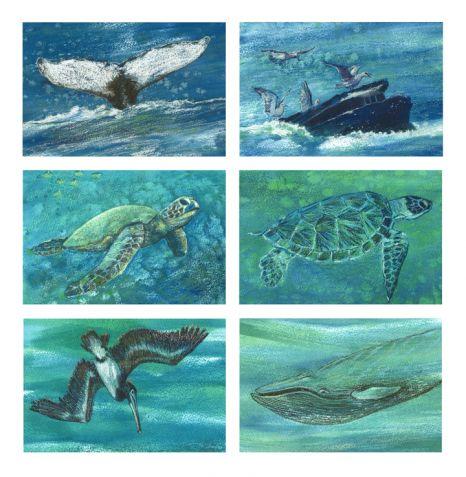
Endangered Sea Creatures
“Endangered Sea Creatures” by Elizabeth Leader, Mixed media

Sarah married a man who was building a boat to sail around the world. She loved that he was so intrepid, so exactly her idea of a man. She loved that, with John, her life wouldn’t be ordinary.

But it all went wrong the day they set out, into a fresh breeze and a glittering sea, as England thinned to a pencil line, and the sky turned to lead. She blogged about it afterwards; about how the wind built and the sea heaped up and a wave like a house slewed the boat and knocked her down; and how water fell on them like concrete and the sail seemed it would be buried forever but slow as a waterlogged bird it lifted somehow miraculously out of the sea.

She blogged about how they turned, and ran before the wind, and crawled back into Falmouth; how they tied up, and went into the cabin, and waded through bedding and floating food.

She didn’t blog about John, how she went to him to be held, and he was shaking, and instead she had to hold him. She didn’t blog about how, in the following days, and the following weeks, he seemed smaller. How she wanted to plump him up like a cushion, knock him back into being him.

“Hey,” Sarah said. “Everyone thinks we’re amazing.”

She read from her laptop. ‘“Omg you guys are awesome.” And this one. “You crazy sons of bitches. Totally mad – but bloody heroic.” And another. “Do it for me. Live the dream.”’

“Listen to them, John.”

He shrugged and looked away.

“Fine,” she said. “Whatever.”

The boat was cleaned up and ready again. John checked the forecast every day, but couldn’t make the decision to leave. So they shopped at Tesco, read their books, and slept. Sarah wanted to blog about the shrimp she found swimming in circles in the loo, but if she blogged, people would ask where they were. The shrimp stayed a day, then must’ve got bored, because he left. Other boats touched down like migrating birds, and left again, and every time another boat left, Sarah would look at her husband, to see if he saw how easy it was for other people.

John reached from his bunk one night and touched her arm. “Don’t be angry,” he said.  When she knew he slept, she turned on her laptop and started to type.

‘Wending our way up a distributary of the Orinoco. The most amazing thing today–little fish swimming in the loo, shards of brilliant colour. Water hyacinths float past like carpets and the butterflies are half a foot across. We lie awake at night listening to the hoots, screeches and grunts from the jungle all around.”

She smiled. How her friends would envy her as they read her post over their cornflakes.

“Cheer up,” she said to John, next morning. “Things aren’t so bad.  Why don’t we get a takeaway and a DVD tonight?”

She allowed enough weeks for a passage to the Pacific before she blogged again saying she had sat on a rock with a sunbathing iguana in the Galapagos. A few months later she told about their temporary work picking oranges in California. Then Alaska and she had them stepping onto a frosted deck into a morning so raw and brilliant it hurt. She told of an iceberg nearly hit and a blue whale passing like a submarine under their hull.

Back in Falmouth, England, when the winter gales blew, Sarah and John moved a little further upriver and tucked themselves somewhere snug, near a thatched pub which did cream teas, and a village shop.

“Check this before I post it?” Sarah said from her laptop.

John read over her shoulder.

“What?” she said. “What’s so funny?”

“We saw penguins in Alaska?”

Sarah stared at him, then knocked her head with the flat of her hand. “Stupid.”

John caught her hand in his. “You know what? I’m sick of ice and polar bears.”

“I am too,” Sarah said. “So where shall we go?”

“I’m thinking maybe … Hawaii? White beaches, palm trees, rum cocktails. If we catch the trade winds we could be there in no time. How does that sound?”


Margot Taylor lives near Taunton, UK, and works in her local library. Her short fiction has appeared in the Willesden Herald Prize anthology and online at Pulp.net, been performed at Liars’ League in London, and is forthcoming in Storyglossia.

Read an interview with Margot here.

“As Time Goes By” by Orlaith O’Sullivan

Who Will Build
“Who Will Build the City Up Each Time?” by Elizabeth Leader, Acrylic & spray paint with recycled wood

Please, folks. Please, if you’ll only grant me a moment, I can straighten this whole mess out.

The man in Room 12 is my grandfather. I’m Terry’s youngest grandson, Donal Bradley. I live over in London. I came in Tuesday, and since visiting hours finish by—what time is it now? 2am—seriously? That’s… that’s later than I thought. My point is this: I’m a daytime visitor, so you wouldn’t necessarily know me.

Terry practically raised us after Dad died. When we were kids, I was his favourite. Kick the ball around on Sunday mornings; down to Cork Con after mass; drive back through Cobh, cast off from the pier. Terry’s boy, I was. But I grew, and the years passed, and we stretched far apart. Stretched thin. Finola gave him great-grandchildren, and of course, Susan took the teaching job here. And what was I? An investment banker with JP Morgan won’t hold a candle to the Headmistress of Castlegyleen Primary School.

It took me a while to come back. Susan told me what was happening, but sure, what could I do? It’s not like I could unfrazzle his brain.


By the time I arrived at the nursing home, Terry had suffered seventeen strokes. I brought Mayan gold chocolates and a Get Well Soon Granddad! card—a musical fancy that chimed Louis Armstrong’s What a Wonderful World. Susan warned that he might not know me, but he seemed alright.

‘There you are!’ he boomed. ‘Donal, come in—excellent! I trust the cats haven’t been too noisy?’

‘What’s that, Granddad?’

‘The cats. They’ve not been causing a nuisance?’

He kept tigers. That’s what he said. Had four of them, out the back of the car park. Was minding them for the Maharajah, someone he’d worked with in the past. And then he winked, as though I should understand.

‘The Maharajah, right… Is he from the Central Statistics Office?’

A deep belly-laugh shook his frame. ‘Ah, that was a good cover—lasted me years! The Maharajah is moving palaces at the minute, and the elephants are his prime concern—fierce sensitive creatures. At least I’m not stuck with the white peacocks—can you imagine fifty of those feckers running around here!’

I replayed Susan’s words in my mind. She’d not mentioned Terry had gone stone-mad.

‘Gold’s a devilish sort of a thing,’ Terry declared, eyeing me. ‘Gold-greed rots the soul like a cancer. Not the Maharajah: that man treats gold with respect; uses it with wisdom; dispenses it with kindness. Thus has it ever been.’

I opened the chocolates and listened to his tales of the tigers. The kitchen porters of Castlegyleen Lodge Nursing & Residential Home sneaked out food for the cats. I was made lean out the window to the left, to Car Park B. Could I glimpse a striped tail between the Volvos and the hatchbacks? Only last week, one of the consultants discovered a scratch down the length of his Saab. The ex-wife was blamed, but Terry knew better. ‘Those cats have been through an ordeal to get here. Sure, they’re bound to act up some.’

When the nurse came in to change his drip, I peeked at the clipboard on the end of the bed. Not one of the medications was familiar to me.

Terry’s IV drip talks to him—did you know that? The thing is American. Broadcasts news reports about his food: ‘Good afternoon, this is CNN Special News. We’re going now live to Nutrition Inc., where Head Chef Bob Billywig will take us through the dish for the day. Bob…?’ Granddad hears background sounds: a busy kitchen, with things sizzling on hot grills. Then Bob Billywig speaks: ‘Well folks, Terry Bradley has a treat in store today! Elmer’s cooking up a quarter-pound sirloin burger with spicy fries, and there’s a slice of Martha’s key lime pie to follow—sheer heaven!’

‘It was blueberry pie yesterday,’ Granddad says, worry darkening his eyes. ‘I don’t know that I like key lime…’

The absurdity of it! That instant, my fears broke open and fell away from me. ‘You’ll love it, Granddad,’ I said. ‘Key lime pie is delicious.’

Terry looked at me, nodded. ‘You know that Bogart only played Sam Spade once?’ I relaxed back into the chair, taking a moment to trace the connection: key lime… Key Largo. ‘Just that once. The same with Philip Marlowe: played him one time and pow! The part was his forever. Once was all it took for Bogie. Indelible, that man was. Indelible.’

We chatted all afternoon, making our way through half the chocolates. Granddad might have been sitting up at the bar in Con. Easygoing, confident, affable. And I loved him this way—loved him—even if he was talking unadulterated shite.

The nurse finally came and ousted me. As I went to leave, Terry told me his Admission Form needed updating. He spoke four languages now: they should add Urdu, and Luxembourgian.

I grinned. ‘Isn’t this place fantastic?’

Granddad leaned back, his thin head sinking into the pillow. ‘They need to keep me safe. I’m important to them, to the Tribunal.’

That evening I stopped by Susan’s, where Granddad stayed until he was beyond her help. The caring had taken its toll: there was neither fondness nor pleasure in her voice. ‘Spent his days looking out to sea. Kept remarking how many dolphins were around. He thought every white horse was a dolphin; thought the sea was chock-full of them! I told him, but he wouldn’t hear it! Like that with everything, he was. Insisted the evening swallows were giant bats. Over from East Africa, he said. Wanted to point it out on a map! To me!’


On Wednesday, I brought yellow balloons and a copy of The African Queen. Thought I could read aloud, if Granddad didn’t feel like talking.

But he did: about how he worked with a secret government department; how his testimony would be crucial to the Tribunal. ‘Gold diggers and back stabbers, the lot of them! What gold does to a man’s soul, Donal, and he only falls the harder for it. A dangerous game…’ I suspected he was conflating the Tribunal with The Treasure of the Sierra Madre, but maybe not. I’ve been out of Ireland a long time. ‘Do you know, in all my years I’ve never heard the saxophone played live?’

I jumped over to the new conversation. Some Sundays, I brunched in Camden, at the Jazz Café.

‘Do you know that the man who invented the saxophone survived multiple assassination attempts? Even shootings,’ said Terry. ‘That man had enemies. His whole life, he was a victim of crooks and slanderers and jealous men. But that music…’ he shook his head slowly against the pillow. ‘Those notes. Haunting. Like starlight in a lonely place. And all those feathers…’

I stayed until he drifted off, mumbling the words that were coming from the IV drip, Bob Billywig describing the late-night snack that Elmer was fixing for Terry: a cup of Wisconsin Blue Ribbon chilli and golden sweet cornbread.

That night, Susan wept. She just wanted things back the way they were before.

Funny thing was, I almost felt they were.


When I opened his door on Thursday, Terry’s bony frame cowered under the covers. ‘Help me, Donal!’ he begged, tears streaming down his face. ‘For God’s sake, close the blinds!’

There was a sniper outside, waiting to take his shot. It was because of the Tribunal: Granddad had been tracked down. ‘I’m too big a threat,’ he said. ‘They sent me a warning, took out the white tiger with the blue eyes. Bang bang goodnight.’ The other cats remained in danger. Their food could no longer be trusted; the porters had been bribed.

I said I’d take care of the cats, but he turned on me. ‘And how will you feed three Bengal tigers? With your fancy investment accounts and your City of London. You’ve no local connections!’ Granddad turned his face from me. ‘What am I going to say to the Maharajah!’

I watched my grandfather weep.

Later, he was easier. He described his magical stay at Susan’s house: how the dolphins careered through the waves like a scene from a Grecian vase; how the bats swooshed through the twilight realm. Closing his eyes, he murmured. ‘I wish I’d heard the saxophone live. Wish I’d spoken to your mother before she died. Wish I’d sailed to Tangiers when I had the chance, traveled by caravan over to Casablanca. I could have gone to Luxembourg; to Lyme Regis. But the cards are dealt the other way now, dealt for the last time. There’ll be no more shuffling.’

I couldn’t tell what desires were real or imagined. What did it matter? I asked about the saxophone, the feathers. ‘Have you never seen, Donal? The notes transform into feathers, drifting across the air, soaring, swooping… And bullets can’t get through them, not saxophone feathers! The inventor saw to that. Survived multiple assassination attempts, he did.’

That evening, the IV drip came to life as Terry nodded off. It said men were coming for him. They would never let him testify, it promised. Soon he’d be sleeping the big sleep.

I watched him, remembering the pride welling as I walked into Cork Con beside that man. Terry’s boy, I was.


I started making calls on the way back to the hotel. It still took me a full day to organise everything. I practically hijacked Caroline and Soweto. We didn’t make it back from Dublin until after 11pm. The three of us sneaked in, with two rolling suitcases and the saxophone case. And the bin-bag stuffed with feathers.

Caroline went first. She explained that the Tribunal’s judge took a call last night—from the Maharajah. He explained Terry’s special circumstances. She would take his statement in Urdu—to keep it on the QT. She’d bring it straight to Dublin to be entered into evidence.

Granddad nodded, like he’d expected it all along. ‘That’s friendship for you! Half a world away, Donal, and it’s as if he’s in this room with me! We were no angels, back in the day. I got him out of a tight spot, helped him through a dark passage. And he’s not forgotten me!’

He started to speak, low and serious. Soweto put in his mute and warmed up. I unpacked: laid out the cake box; let out the goat and the rabbits—they were all I could get my hands on at short notice. I thought they’d reassure Granddad that the tigers would be cared for. I settled the animals as best I could, then blue-tacked up the pictures of Tangiers and Luxembourg and Lyme Regis.

The testimony brought Granddad some relief, I think. He checked over Caroline’s work, said she’d done a fine job. I witnessed his statement, along with Soweto here—on alto sax.

Then Soweto played. From the first sonorous note, Granddad was enthralled. I used four pillows’ worth of duck down, following the music rising and falling and whirling around the room. Long ostrich feathers did for the sliding glissandos and soaring crescendos. The whole time, Granddad stayed fixated on that golden swirl, big watery tears blurring his pale blue eyes.

I’m… I’m so sorry for all the inconvenience, especially the feathers, and the goat—I’d have been in and out if it weren’t for him. Caroline and Soweto came to understand my motives, but there was no winning over that feckin’ goat. The commotion started when he made a bolt for the cake box. The poor rabbits took fright, tripping up Caroline, who fell back on poor Soweto. Listen, I know I’ve a cheek to ask, but could someone see that Granddad gets to taste the key lime pie? It’s on his locker, a bit battered now…

I can go in myself? How’s that? You remember me from Con—a young lad sitting up beside his grandfather?

Ah go on. I’ve changed a bit, surely?


Orlaith O’Sullivan is an award-winning writer with a PhD in Renaissance literature. Her short story Gilt won joint first prize in the inaugural Fish-Knife Award (2006). Louisa and the Sea was short-listed for the 2007 William Trevor International Short Story Competition. Her short story A Tall Tale won The Stinging Fly prize 2008. She currently lives is Dublin, and is editing her first novel.

Read our interview with Orlaith here.