“Hope Like Blue Skies” by Erica Jamieson

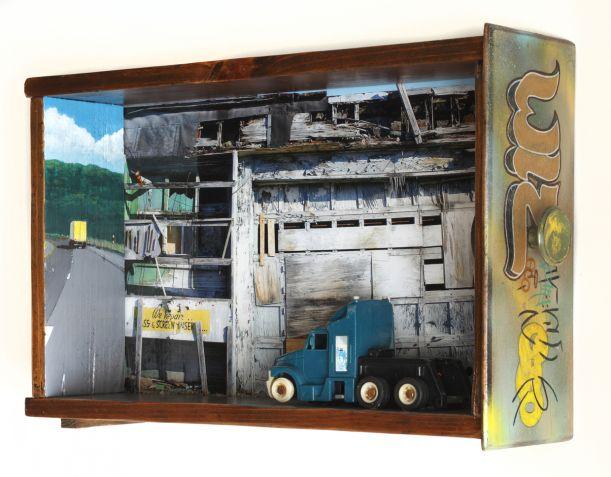
Trucks
“We Repair Trucks,” by Elizabeth Leader, from the Toyology Series, Mixed media assemblage

Netta dipped inside the case with her metal scooper, fearing she’d perspire right into the barrel of chocolate chip mint. She wiped at the drop of sweat making its way down her nose with the back of her hand. What with the humming and heating of the freezers, she was already dizzy red hot in early June. Only thing cool about her was that one strip of belly that leaned right up against the freezer when she bent in to scoop. It was the coolness right there, where so much hurt and wanting had seared into a congealed mass of love, that made her remember the old truck sitting idle out back.

“You got to get that truck fixed,” she said to Rex, looking so fresh with his hot coffee of all things on such a day. That steam coming up over the rim of his cup just about made Netta swoon. “How you sitting so cool over there, Rex, honey? I’m burning up to hell here.”

“It’s too early for summer fever,” Rex said to her. Netta looked out through the Waratah Homemade Ice Cream sign etched onto the glass of the big plate window. Sky outside was nothing but a suffocating haze of Lake Michigan air, wet and heavy, waiting on something to break.

“You come on over to my side of the counter and try scooping with these condensers heating me up so.”

“I’m reading the want ads, Netta-bird.”

“What you ought to be reading, Rex, honey, is the how-to on getting that truck out there up and running. It’s time.” She turned to the boy, the youngest of the Van Dwek kids, waiting on his cone. “It was the Waratah fortune, that truck was,” she said. “Ain’t that so, Rex? Your granddaddy brought it home spanking new, shining white with blue trim. I saw some pictures. Boy, that was a proud day, wasn’t it, Rex? You want sprinkles, honey?”

“Never was much of a Waratah fortune. My papa should have sold it for scrap.”

“I remember the truck at Pink Lake last summer,” the Van Dwek boy said.

Netta caught Rex glancing up at the boy. He had his palm resting on the paper, a finger extended on the page as if it were the only thing keeping him upright. “You go on down to Mitchell’s garage,” she said to Rex, “see about that refurbished engine we talked about and those spare parts. See if they come in yet. What else you got to do today?”

Smiling at the boy, she said, “Why, you look so like your daddy.”

“There’s a rain coming, Netta-bird. Let me wait it out in peace,” Rex said.

The boy dug into his pockets for loose change. Netta waited. “Skies like blue hope, now, ain’t that what follows a summer rainstorm? Nothing more hopeful than that. Blue skies after a storm. You go, Rex, right after this weather blows through, you’ll get on that truck, go over to Mitchell’s? Get that truck working again.” She winked at the boy. “Maybe put in some working air-conditioning? Now won’t that be something nice.”

“I got a quarter and ten dimes,” the boy said, looking at the change in his hand.

“You sure you don’t have another quarter?”

“Last summer you let me have it for whatever I had in my pocket!”

“Now that doesn’t sound like me. Does that, Rex? Giving away ice cream at bargain basement prices.”

“I was with my brother William, and it was the last time you came out to the lake with that truck, the one you was just talking about. I remember because you dropped William’s cone.”

Netta could see the vein at the corner of Rex’ forehead, on the left side just above his eye, pumping blood fast like he was trying to heat up something that had just about froze over.

“It was near on to ninety that day. Rex remembers. I was sitting on a whole lot of heat. Stepping out of that truck on to the swelter of asphalt did nothing to cool me. Rex had gone off for water—that damn radiator couldn’t hold more than a one way out to the lake—and I was working the truck.”

“And you scooped William out another and said you can scoop quicker than the one on the ground would melt. That’s what you said to me and William, and you took what I had in my pocket for the $1.50 sized cone. And nothing for William’s second.”

Netta had been half in half out of the side door on that truck pulling on the strawberry ice cream when she felt a sigh from deep within her. She dropped the cone and touched the widening side of her belly where her hand measured the seven months of baby.

The Van Dwek boy was holding out all he had to give to Netta, still short a quarter.

“Now, does your papa give his blueberries and peaches away, and your momma her pies, for a smile, now do they?”

“She’s not baking on account of the new baby. When my middle brother was born, we didn’t have one of her pies until his first birthday. That’s why I came down here. You can’t take a baby to a hot beach, that’s what Delia said when I was looking for your truck yesterday at the lake.”

Rex stood up, cracking his chair against the wall, giving flight to those circled want ads. When Rex had returned to the truck that day with water to quench the radiator, they started toward home. Netta told him to take the Gas Junction Exit and head on straight to the hospital. More than anything she was surprised at the work it took to birth that dead baby, just as much as she imagined it would be one that was kicking and screaming and looking for her breast.

Netta gave the boy his cone. “I’ll take your $1.25 for a $1.50 cone today, young Mr. Van Dwek. You tell your momma and that new baby hey from me, okay? Maybe I’ll make you all a pie and bring it over for church picnic some Sunday. Your family still goes every Sunday, ain’t that so?”

“I knew you’d remember!”

“Now get on going home before the rain starts.” Netta watched Rex watching the boy. The boy opened the door just as a shot of wind came thrusting through. “Here it comes!” the boy shouted as he went running into the beginning rain, the wind slamming at the door. Another gust came just then, and the door got so caught up by that wind it flew back open. The bells on the window over top jangled and the screen rattled. The wind whipped back, doubling in with a blackening sky. Rex jumped to grab the door, but Netta had come alongside him and stood in the opening. Her skirt and apron caught the coiling air and flapped into twists around her legs. Her hair had come loose. She inhaled and felt cool even before she stepped out into the rain.

“I’m not ready for church, Netta,” Rex said.

“You didn’t hear me make any promises, now did you, Rex?”

A shuddering of thunder sounded, and a flash of lightning followed far off in the distance.

“I should have fixed that truck last year, when it was just the radiator. Would have been nothing. Now, it’s the whole damn engine,” Rex said.

“Nothing that can’t be fixed, or replaced.”

“Them doctors didn’t sound too hopeful.” It was at the hospital the truck wheezed its last, and the engine cracked right there in the parking lot. They had to hitch it up and tow it back to the ice cream shop. Took what little money they had saved for a crib and stroller, some cotton tees and diapers, and used it instead for a solid birch box. Netta’s people came, walked with her through the black iron gates of the cemetery so she’d have someone to lean on in the late summer heat when the little box, that little box, was lowered deep into the ground.

“Look out there, Rex, you can see blue sky coming right in behind the storm, just like I said.”

“I wish I could feel it, Netta-bird, I wish I could feel that blue sky coming.”

Netta took Rex’s hand and placed it just south of her belly. His hand stretched out over the flatness of her belly, but just in the center where she had placed his palm, ever so slight, there was a quickening that made her heart race the wind.

“You telling me something, Netta-bird?”

“You’ve got to get that truck up and running. That’s all I’ve been saying. What’re we gonna do, Rex? Let it sit and rot?” They stood in the rain, his hand on her belly, waiting on that blue sky. Netta never took her face from out of the wind. She swayed on her feet, humming with her body, and felt Rex stirring with the heat of something lost between them.


Erica Jamieson writes fiction and creative non-fiction. Her work has appeared in print and online at various journals including Lilith, Spittoon and Self Magazine. She lives in Los Angeles with her family and mentors at risk teen girls through creative writing with the non-profit WriteGirl. She can be reached at ericawjamieson.com

Read an interview with Erica here.

Interview with Ruvanee Pietersz Vilhauer

Ruvannee V

Karin C. Davidson:  Ruvanee, your story, “Craving,” is such a complicated and careful look at intimacy and, in a very restrained way, of sexuality. Sexuality is the theme of r.kv.r.y.’s Summer 2013 issue, and so I love that your story is included here. Would you speak about the origins of this story, how you came to write of this couple, exhausted and overwhelmed by their responsibilities of caring for the elderly, blessed and later unblessed by the presence of the young woman who comes to help them?

Ruvanee Pietersz Vilhauer: This story was influenced by an essay I had recently written, about an elderly relative’s struggle with dementia, but it arose primarily from my feeling exhausted by a set of administrative tasks at work—that had nothing to do with caring for the elderly—and wondering about the very human tendency to want an easy way out, and about the value of service and sacrifice. The idea of sacrifice—with its many negative as well as positive connotations—interests me; it is a theme I explore elsewhere as well.


KCD: “On the day Ivy Auntie went missing, Sriya Polgoda wished, once again, for more help.” This is the first line of “Craving,” an incredible first line in that it is deftly worded, each part so very simple, yet pointing straight into the conflict and the story’s heart. When you begin stories, do the drafted first lines lead you directly into the rest of the narrative, or do you find those intricate beginnings through revision?

RPV: Thank you for the kind words, Karin. There have been occasions when I’ve labored over first lines, revising wording and even the point at which a story begins. Most of the time, though, first lines come to me almost fully formed. Beginnings are much easier for me than endings, with which I struggle, revising over and over until I feel they are right.


KCD: Tradition, ritual, and religion are present in lines like: “Dharmapala bathed three lotus flowers in filtered water and placed them before the Buddha statue in the foyer. He knelt in gratitude, chanting the five precepts,” and “It is true, as the Buddha said, that craving leads to suffering.” These cultural elements inform the characters and add dimension and depth. As in “Craving,” many of your stories introduce these elements and at times relinquish them, especially when the dramatic action takes an unexpected turn.

Would you say that your background of growing up in Sri Lanka and living in places around the world, such as Australia, India, and Thailand, has influenced your writing and allowed you to include the details essential to your stories?


RPV: All the places I’ve lived influence my writing, and especially Sri Lanka, to which I feel a special closeness, having spent my most formative years there. I think religion and reverence are more a part of everyday life there than in the U.S. People who practice their religion aren’t oddities or noteworthy, because almost everyone has some sort of religious view. And the traditions and rituals of the main religions in Sri Lanka—Buddhism, Christianity, Hinduism, Islam—have a tendency to leak into each other. I grew up celebrating those mingled traditions. I think it is a challenge, but important, to represent these pervasive traditions and rituals authentically, without resorting to exoticism.

helpless (Craving)

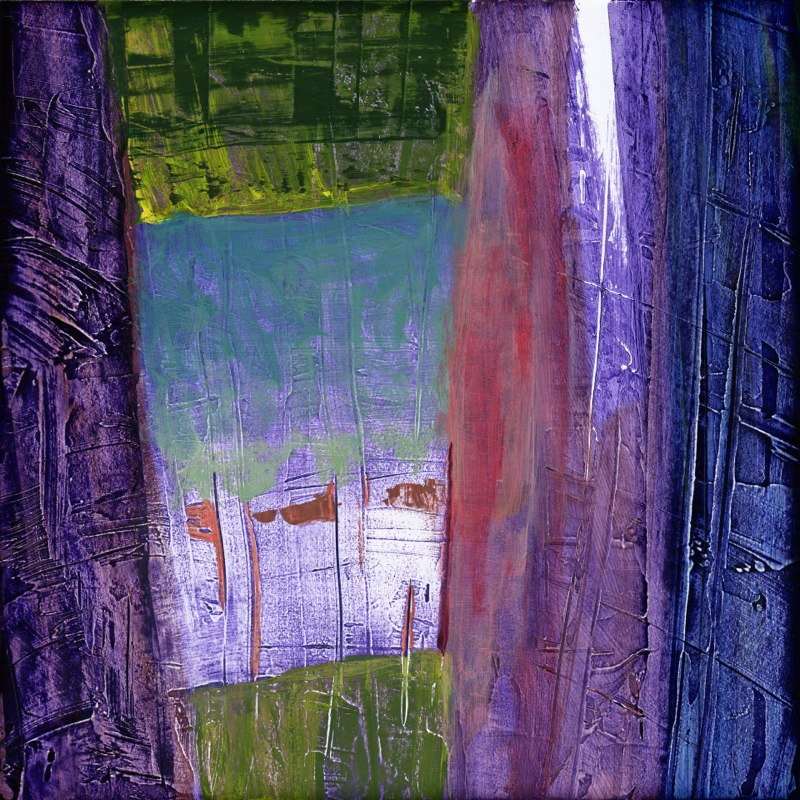
KCD: To me, the artwork that illustrated your story seemed especially to reflect the crippling sadness at the end. The colors and cavernous lines even captured the emotional depth of “Craving.” Sriya’s decision is such a difficult, devastating, quiet one. The suffering of craving becomes bottomless. Do you agree?

RPV: I loved Peter Groesbeck’s artwork in this issue of r.kv.r.y. This particular piece brought to my mind a view of a light-filled place, framed on either side by curtains. The view could be either through a window, or reflected in a window. In a way, the artwork represents two possible interpretations of my story’s ending. The dark curtains represent Sriya’s sadness and sense of loss. I think there is a question about what she sees through their frame. Is she seeing what is outside, or what is inside? On the one hand, there is the possibility that what she yearns for is beyond her reach. On the other hand is the possibility that she might get past yearning for what she does not have, and instead find value and meaning in her life’s work.


KCD:  Many of your stories are meditations on relationships. There seems always an unspoken distance that lies between the characters in these relationships. In writing about these characters—from Sri Lanka, from San Francisco, from unnamed places—you build the emotional layers of their world so that they twist into complex, unyielding formations and questions of trust arise. What is your process of finding voices for these characters, deciding on the viewpoint, and at times focusing in on the woman’s perspective?

RPV: As for many writers, relationships are at the center of a story for me. What interests me most are the motivations of characters, the heavy secrets and contradictory desires that drive them towards or away from others, the ways in which they try to transcend their fears.

Characters come from all kinds of places. Sometimes a stranger mutters in the grocery store checkout line or runs through a parking lot, and I wonder about what his or her story might be. Other times, I read a news story or hear an incident recounted, and that makes me wonder about what kind of people might be involved. Sometimes characters are completely imaginary, or based on an image in a dream. Or they could be amalgams of acquaintances, people I know, and, I suppose, bits of me. Finding the right perspective is not always straightforward. Sometimes after I have decided who is going to be in a story, I play around with different characters’ perspectives until I hit on one that feels right.


KCD:  Your educational and professional background includes biology, psychology, and teaching. Do you find that these different areas of expertise filter into your writing?

RPV:  I think my biology background shows up in the images and metaphors I use in my stories, and in the details of places and scenes that capture my attention. My psychology background and my clinical training also have a huge influence on my writing. Creating rounded, sympathetic characters requires the same kind of empathic effort a clinician needs to make in a therapy context. I think a lot about what kinds of past experiences my characters must have had for them to end up in their present situation, about how the bonds of the past might constrain their future, and about what kinds of encounters and relationships might transform them.

I teach subjects that a lot of people might consider quite dry—neuroscience and research methods—but it is work I enjoy as much as writing. When I am teaching, I connect with people in a very different way, although communicating ideas is central to both writing and teaching.


KCD: And in the same way, how has the literary world influenced your fiction? Which writers have inspired and taught you, and continue to do so?

RPV: I am an eclectic reader. I like to read stories with believable, well-developed characters and atmosphere. Clean writing, with good rhythm and without flowery words or sentimentality, is important to me, as it clearly is to you, judging from the language in stories like your lovely “The Peterson’s Field Guide to the Birds,” in Nomos Review, which I understand is an excerpt from your upcoming novel-in-stories, Sybelia Drive. I am looking forward to seeing it in print.

My literary influences are varied. I grew up reading a hodge-podge of second-hand books that my mother bought from book sales in Colombo: Jane Austen and the Brontes, Enid Blyton and Agatha Christie, abridged volumes of Dickens, the Narnia books, Little Women, Treasure Island, Gulliver’s Travels, Tintin and Asterix, Robinson Crusoe, etc. Book sales were exciting family events when I was a kid. I was introduced to The Iliad and The Odyssey through stacks of Finding Out magazines; I still have a few crumbling issues. And I was exposed to the works of Coleridge, Blake, Yeats, Spenser and many other poets through elocution classes I took as a kid; we recited poems, although I don’t recall ever discussing them back then. I loved the rhythm and language of those poems. Some of my favorite writers now: Margaret Atwood, Cormac McCarthy, Kazuo Ishiguro, Monica Ali, Jhumpa Lahiri, Alice Munro, Tom Wolfe, Ann Patchett. Recent books I’ve liked by contemporary authors: Peace Like a River (Leif Enger), Case Histories (Kate Atkinson), Skippy Dies (Paul Murray), The Book of Lost Things (John Connolly), The Vanishing Act of Esme Lennox (Maggie O’Farrell), The Passage (Justin Cronin), A Kind of Intimacy (Jenn Ashworth), Snow in August (Pete Hamill), The Glass Castle (Jeanette Walls). And numerous others.


KCD:  I understand you are working on a short story collection about Sri Lankan immigrants. Is “Craving” a part of that collection? And do you find as you’re working through the stories that themes surface, or that motifs and refrains present themselves? I’ve found that to occur in my own writing, how I’ll revisit the same themes in different ways, through varying perspectives, and it’s always surprising. So I wondered about your own discoveries here. What else would you like to tell us about the collection?

RPV: Most of the pieces I’ve written lately belong to a group of stories about Sri Lankan immigrants, although not “Craving.” As you say, the same themes do come up in surprising ways. It is always interesting to explore a theme from different, and sometimes opposing, perspectives. I am also enjoying tying the stories together in other ways, for example by using a particular image or object in more than one story. I try to pick up a thread from here and there and weave them together; by doing that enough, I hope to create the whole picture I have in mind.


KCD: Thanks so much, Ruvanee, for this chance to talk about your writing. I’ve truly enjoyed our conversation.


Karin C. Davidson is originally from the Gulf Coast. She is presently working on a novel and sending out her story collection, The Geography of First Kisses, to small presses. Her stories have recently appeared in The Los Angeles Review, Passages North, and Post Road, and have won awards including the Orlando Prize for Short Fiction and the Waasmode Short Fiction Prize. She has an MFA from Lesley University and works as an editor for Narrative Magazine and an interviews writer at Hothouse Magazine. Her website is karincdavidson.com.

“Wonder” by David Licata

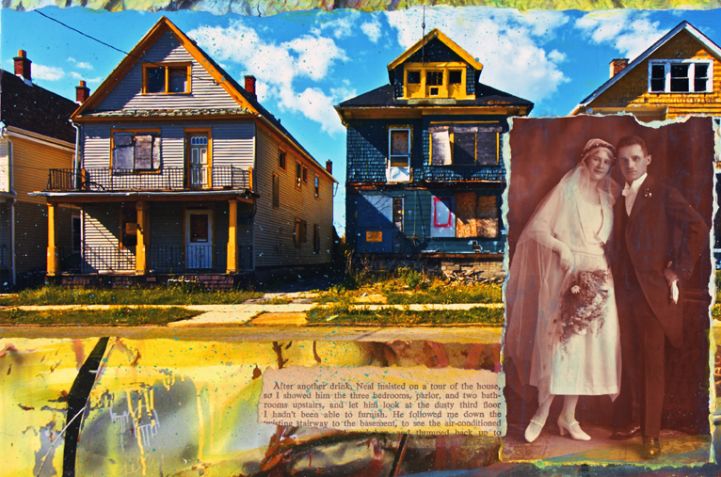
The Bridal Couple (Wonder)
“The Bridal Couple” by Elizabeth Leader, mixed media

The voicemail made no sense so I listened to it again: “Sarah, it’s Paul, Stephen’s been shot.” He paused for a few seconds. I heard him swallow and exhale. “We’re at St. Mary’s in Jersey City. You’ve got to get here. There’s a lot of blood. He’s been shot. You’ve got to get here!”

I listened to the message again in my car and then called Paul, Stephen’s brother, but still I didn’t understand. How had my husband been shot? Why? Was he okay? Somehow I drove to the hospital and found the ER and met Paul and two uniformed policemen. One officer—a short stocky man with a crew cut—did all of the talking. He told me, matter-of-factly, that Paul and Stephen had walked into a convenience store, the store was held up, guns were fired, and a bullet entered Stephen’s head. He finished with “I’m sorry,” before he and his mute partner disappeared.

At some point, a doctor appeared and told us Stephen was dead. I thought for a second that everyone had gone insane. Then I thought it was an elaborate, cruel joke. Someone led me to a seat; someone else offered me a sedative. My skin felt foreign. My eyes were closed tightly one minute, wide open and unblinking the next. Every question I asked had an unsatisfactory answer.

I asked to see Stephen and someone led me to a room where he lay on a gurney, lifeless. It was a Stephen I had never seen and I vowed not to remember him that way, but for years to come this was the only image of him I could conjure.

Gail, my brother’s wife, my best friend, met me at the hospital and got me out of there. Every car sped by us on the turnpike and it took forever to reach my exit. Traffic moved unusually slowly on Fort Lee Road, my town’s east-west thoroughfare.

“What the hell?” Gail pulled alongside a donkey drawing a wooden cart with red, white, and green bunting draped around it. A man in a dark, rustic suit one size too small drove the donkey. In the bed of the cart sat a mariachi band and a young couple dressed in late 19th century Mexican wedding attire. He wore a black suit, white shirt, and string bow tie. She held a bouquet of red roses and wore a crocheted shawl over a white lacy gown with ruffles at the hem. They were smiling and beautiful and enjoying the music. Their skin glowed as if it had absorbed centuries of Mexican sun and was just this instant emanating it. This was a strange thing to behold.

“Are they opening a Mexican restaurant around here?” Gail asked.

“Not that I know of.”  I turned off the radio and opened the window. A blast of December cold smacked my face. I wished it were colder.

The music was lively, the colors so vibrant, and the clothes and the people in them were lovely. It was surreal and beautiful, and I remember in that moment thanking god that I still had the ability to experience wonder. I could see something, hear something, and appreciate beauty. My eyes filled. We followed the cart and I realized I hadn’t been breathing.

Gail accelerated passed the cart and I closed the window. “That was really weird,” she said.

I watched the scene fall into the distance in the side-view mirror. Then Gail made a right turn on Glenwood, weaving through the suburban streets until she pulled into our driveway, my driveway.

“What time is it? I have to pick up Stevie!”

“Greg picked him up,” Gail said. “He left work and picked him up. He’s at our place now.” Apparently we had already been through this.

“How do I tell him his father’s dead? How do I tell him that?” We’d been through this, too.

Gail’s answer this time was to simply place her hand on top of mine. The softness of her touch started me weeping again.

After what seemed like a very long time and no time at all, I opened the door. A force kept me in my seat. I couldn’t exit the car. Gail met me on the passenger’s side.

“I can’t go in there.”

“Would you like me to go with you?”

“No.” I managed to turn my head to look at her. “I can’t go in there.”

“Why don’t we go to my house?” Gail said.

“I’d like to see that cart again.”

Gail backed out of the driveway and drove to where the cart would have been had it stayed on Fort Lee Road and continued at its slow pace, but it wasn’t there. She drove in concentric rectangles, but we didn’t cross its path again. It didn’t matter anymore. We drove all around Bergen County. Day turned to dusk turned to night and Gail put the headlights on but I wanted them off because I wanted to drive in utter darkness.

What was the point of light?


David Licata is a writer and a filmmaker. “Wonder” is part of a collection of related short stories, another of which, “There Is Joy before the Angels of God,” was published in The Literary Review. In addition to TLR, his fiction and nonfiction have appeared online in Hitotoki, The New Purlieu Review, Word Riot, Sole Literary Journal, and others. His films have shown on PBS stations across the country and screened at festivals all over the world, including New Directors/New Films (curated by The Film Society of Lincoln Center and MoMA), the Tribeca Film Festival, and dozens of others. Along with the short stories, he is currently working on a feature documentary, A Life’s Work.

Read an interview with David here.

“This is What happens” by Linda Chavers

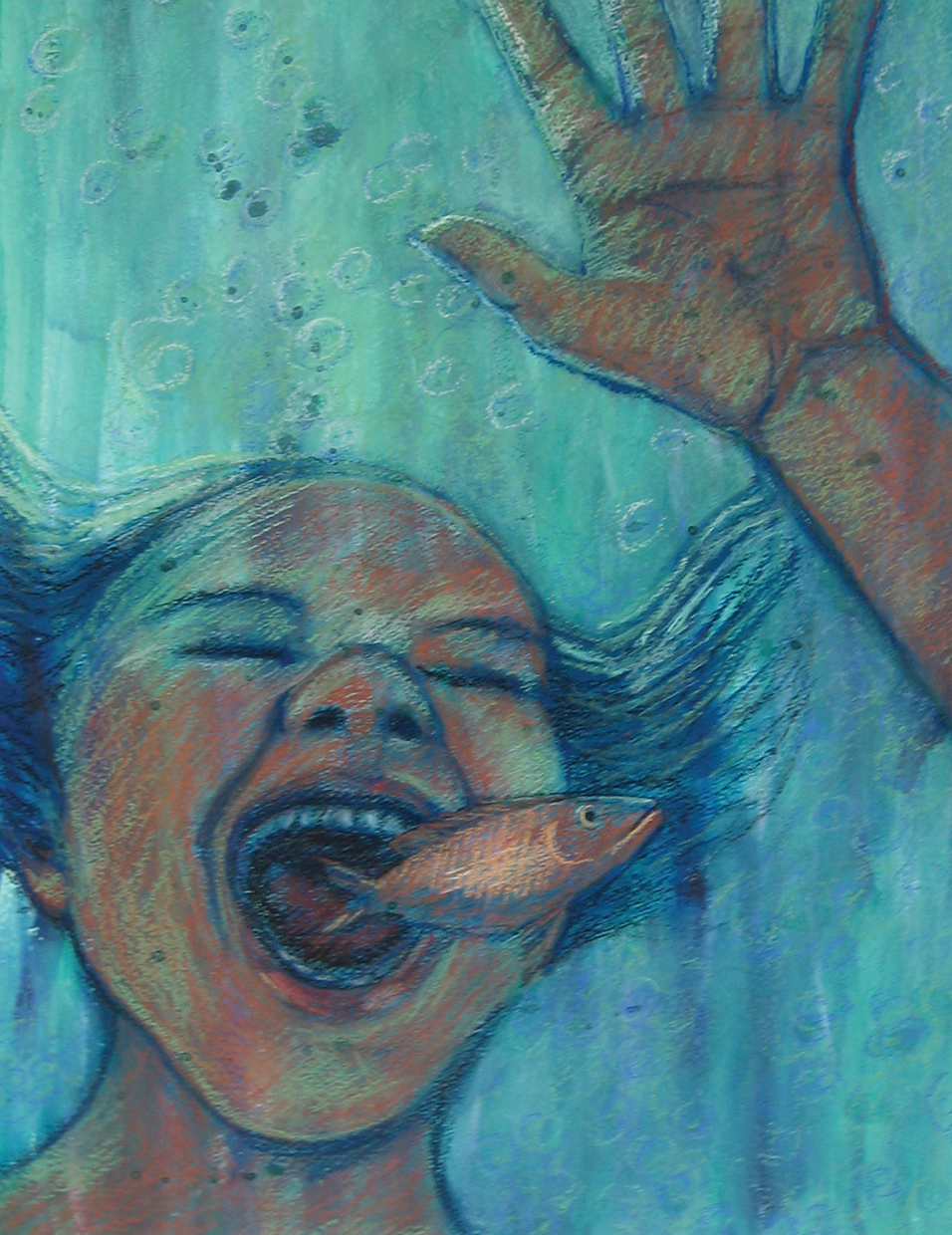
Scream
Scream by Elizabeth Leader

This Is What Happens…

…When lesions are found on your brain: The resident calls you. You’ve given him permission to tell you on the phone. You step out of class. The resident, who’s more nervous each time he talks to you, lets you know the lesions could be evidence of a stroke, a brain infection or an autoimmune disease so there will be more tests. You’ve already done a series of blood tests including an AIDS test even though you told the attending that you’d had one already earlier that year. He orders it anyway, you don’t like him because he never looks you in the eye when you speak and refers to you like some horse on an auction block when talking to his residents. You don’t yet know that you could’ve requested no students in your examinations.

Later you will know a lot more than you ever wanted to know about patients’ rights. You go back to the hospital for more tests. These include a lumbar puncture.

“A spinal tap?!” you ask the resident.

“It’s called ‘lumbar puncture,” he says.

You curl into a ball and the friend you brought with you tells jokes and you laugh.

“Please don’t laugh” the jittery resident says.

You never see how long the needle is but your friend does and for three seconds he looks pale.

You’re back in class preparing to give a presentation on the Tuskeegee Syphilis Study that killed black men in the name of science. You know it’s him calling because you just have a hunch. Again you step out of class. Again you give the resident permission. He does not sound nervous. He sounds tired, resigned.

“It’s MS” he exhales. You don’t think you feel much of a reaction. He tells you a nurse will train you on needle injections and a part of you is a bit excited by the idea of injecting yourself. Is this based on some movie you saw as a kid? You’re not sure. This is because you have no idea what injections are like, but you soon do.

You go back to class, you give your presentation. It goes well. This is your first semester of graduate school. You will write the rest of your final papers in the hospital. You will get all As. You will publish one of these papers. You start the injections, Avonex, and you think they suck and injections are no longer cool. As time passes, years, this will become the only semester you did well academically. You try to find that reaction. You realize, too, that you never cried.


You also keep going..sort of.

You will not fully comprehend what is happening to you for another two years. But this is what you do, anyway or, in the meantime: you stay in school, choosing not to take a leave of absence, because you simply don’t know what that would look like and, more practically, you’d lose your health insurance. Your treatment costs tens of thousands of dollars. You stay in school, you keep your insurance. Your family calls you a lot in the immediate aftermath. No one comes to visit except your father. You’re in the hospital when he comes and you smile when you first see him and then you’re dismayed because his wife follows him as do your siblings. You’re glad to see your siblings but you wish you just had your dad.

Two years later, they divorce after eighteen years and your stepmother never speaks to you again. You keep going. You ace that first semester because you’ve decided this is bullshit. You and your friend enjoy what you call a “man summer” which means you study a lot and screw a lot more and it is fun. You do more admirable things, like go to Italy to teach, Ireland for a writers workshop and to Portugal to present a paper. You teach undergrads for the first time with no prior experience and receive awards for your evaluations. You keep going. You’ve switched from weekly shots to daily shots and you and your boyfriend have contests over who can inject the fastest (note: he can). Your left hand gets weaker so you get that speak-to-text software. The school pays for it and you will misplace it after a year. You drink and smoke more and think nothing of it. Drinking has become a new art form, you have a martini set in your dorm room. You teach four classes per semester and lose 30 pounds and have an awesome boyfriend. This keeps you going.

You now have access to as many drugs as you want because you are chronically ill. You are on anti-depressants, stimulants and drugs to sleep. You look amazing and everyone tells you so, except one friend who voices concern but you will dismiss it. Because you are constantly someplace else. You are in pain all of the time. You keep going. You will soon fall apart.


You find out that…

You are not where you expected to be. The boyfriend is gone. Things were great between you two until they weren’t. He’s now in graduate school getting his MBA, you wrote the essays. You don’t regret that because no one can deny that when you love someone you love deeply and hard without any sense. It’s been almost a year since you last saw each other and you don’t cry anymore over him or the end of the relationship but you still cry over his son, whom you did not expect to still love this hard.

You get drunk and drunker again and again but you seem to be having a blast until you aren’t and you find yourself shuddering on your boyfriend’s kitchen floor. There are two occasions where you will never be sure if what you had was consensual sex. You remind yourself you graduated magna cum laude and wrote more than one A paper completely lit off your ass so there can’t be a problem now. Your mother reminds you of what she told you in high school: “Alcohol will not be a friend to you.” You smoke a ton and take pride in the fact that no one pegs you as a smoker, you don’t even have an odor. You are proud about a lot of things that you can still do. A professor calls your paper “worse than an undergrad’s” and you will hold that above every accomplishment you ever make, to this day. Because he told you that not long after you learned all about MS and cognitive impairment, so now your secret’s out: you’re retarded and everyone will know. And that is how you will live your life: afraid and self-conscious. Slowly but surely, over time, you find yourself opting for flats more than your trademark high heels. Eventually, you stop wearing heels altogether. Accordingly, you stop taking as much time to get dressed when going out — because what is the point?

Neither you nor your boyfriend are willing to admit it’s over, not even after you down a bottle of Klonopin with a glass of wine and Windex. You told him you were going to kill yourself and you meant it, sort of. They give you charcoal at the hospital and you stay there a week. Your father is there again and demands the hospital refer to him as “Doctor” because he’s an attorney. Your uncle calls and says you can’t die because he’d be left to deal with your father. Your mother has lived 3000 miles away for almost ten years because of things that happened that you rarely discuss. Despite being far away she will be your saving grace and keep you from completely drowning. You do not accept this yet.  You leave the hospital and go right back to school because you had the common sense to try and off yourself during winter break so no work was missed. You tell your department that you had an MS exacerbation and you’re a bit amused at the irony of using your chronic illness to hide your mental illness.

You leave Boston for NYC telling yourself that without a car in Boston it’s harder to get around when you’re limping after a half-mile of walking. Within months you learn that NYC is just as terrible when seeking accommodation for the disabled. But you don’t look disabled. This means constantly proving your illness to people. You remain surprised at who does and doesn’t get it, this only furthers your belief that you cannot know anyone truly, ever, and they definitely cannot know you. You admit to yourself and no one else that you really left Boston to get away from your ex.

You get an apartment and a part-time job while completing your dissertation. You do not write. You begin to unravel. In a year you will have alienated the only friend who stands by you, you will have stopped drinking, you will be hauled off from your apartment by the cops and you will be in a mental ward for the second time in two years. This time, it was three bottles and a razor. This time, you can’t keep going, you will have to stop.


This is Now

This is your last chance. This is not your first time in a psych ward but this is the first time you pay attention. You try to sleep a lot. They won’t let you. You try to stay alone. They won’t let you. Your doctors call you a “high-level” patient: highly functioning, capable, intelligent. This is not news to you (you’ve never struggled to figure out your problems, just couldn’t get past them) but this is the first doctor who tells you he won’t be disarmed by your smile (“it’s notably disarming,” he says. This warms you, an older man once said this to you when you were a girl. You don’t tell him this.) nor will he buy your “ ‘I’m fine’ bullshit.” Like a kid, you’re still wide-eyed when an authority figure curses. The friend who you were a complete fuck to visits you more than once. Later, over dinner you both cry over what happened. There will be a handful of things you will never completely resolve and this heartbreak is one of them.

It’ll be six years in the winter since you were first diagnosed with MS. You don’t take shots anymore, the disease has progressed and now you’re on immunotherapy. It has one major side effect: a lethal brain cancer. You have a permanent limp that you hide well. You have problems swallowing and you slur your words. Your hands shake and the fatigue can be unbearable at times. As a recovering alcoholic you have to laugh that you walk funny and slur your words completely sober. You are deathly afraid you’re no longer competent to achieve anything. Sometimes you wonder if it will be depression or MS that kills you but you take comfort in knowing it will most likely be neither. It has not yet been a year since learning you’re bipolar. You thought bipolar people had highs and lows but you only have lows and they tell you this is normal. You learn that it’s normal to never feel joy and to love everyone else but yourself.

You stop saying that you’re fine but the automatic smiling will probably never go away. You wonder if your propensity to smile — and to do so in such a way — comes from growing up with divorced parents who didn’t stop fighting until your twenties. You despise this kind of boo-hoo thinking and remind yourself that everybody’s divorced. You don’t yet allow for the recognition of your story in its own right. Your self-righteousness borders on appalling. Indeed, you realize, it’s fucking killing you. They suggest Lithium and you cringe. You see your mother back when, 100 pounds overweight and miserable. You think your body’s already falling apart and you can’t afford getting fat. But you want to live and when they ask if you mean it and you say yes you surprise yourself because, yes, you want to live, you don’t want to do this, to succumb to the racing thoughts. So you try the lithium. Within days you wish you’d taken it the first time it was suggested years ago. Because this is the first time you can remember where you are calm and you don’t freak out. You’ve never been calm, that’s why you love booze. It bothered you that you’d been three months sober and still attempted suicide. You eventually understand that the removal of alcohol was the removal of your security blanket and it unleashed everything you’d kept at bay. You learn there was a ton of shit you’d been drinking, fucking, smoking, intellectualizing, and super-achieving away.

So you manage this ton of shit. Your dissertation remains unfinished. You will be one year sober this month. You haven’t been to a meeting in months and you think of a drink every other day. You have no job prospects. You are not unraveling. Sometimes your calm freaks you out. When MS allows, you sleep like a fucking baby. You still get angry and you cry now but not as much as others would like. You’ve gained ten pounds and have acne from Lithium and you occasionally hope that the drugs you take for MS will counter any more weight gain. You talk to yourself and make yourself chuckle. Not everyone likes you but you do. You have not lived as a saint but somehow you know that this is a better life. You have a sex life and you find this odd and amusing. You accept that you will not have a family of your own, you’re too selfish. You heard that depression is the inability to envision a future for oneself. So you draw. You learn to treat your emotions as temporary feelings and not demons to avoid. Sometimes you chalk up your deep-seated fear of emotions to some defense mechanism from when an older relative molested you. But you’ve always been the kind of person who shrugs off why shit happens and just keeps going. This is not your last chance but it’s the one that counts.


Linda Chavers, a DC native, lives in Philadelphia where she teaches literature at Temple University. She recently received her Ph.D. in African and African American Studies from Harvard University. When she’s not figuring out how to get her students as excited over Faulkner as she is, she enjoys contemporary fiction and reality television….the trashier, the better.


“Blue-Blue” by Nicole Sadaniantz

Soldiers
Soldiers, 2012, by Elizabeth Leader, collage with found objects

It was Miss Anna, our dear family friend, who taught me to eat the lemon peel. I had already learned to enjoy the pulp, but when I realized that she ate the whole thing, I had to follow suit. A saint and the bees-knees, she had blue-blue eyes and blonde-blonde hair.  She never missed a birthday, her cards illuminated with the most elegant handwriting I had ever seen. Plus, she baked chocolate chip cookies twice the size of those we made at home.

Miss Anna was born in 1950 in Kewaunee, Wisconsin. She spoke often of the farm-life, though with no desire to return. At some point she had made her way up to the Northeast to a new home in Osterville, Massachusetts and a new job in Providence, Rhode Island.  Working at The Miriam Hospital, she met her husband, Alfred. He worked with my father, and as both Miss Anna and my mother were nurses, not more than a few years apart in age, friendship inevitably ensued. Thus Miss Anna entered my life before I had ever been conceived.

Summer was the perfect time to visit her. My father usually working, the expeditions evolved naturally into a female-centric tradition. My mother, my two sisters, and I drove to Cape Cod for the day. Miss Anna had an in-ground pool that she cleaned meticulously, despite her own fear of swimming. We jumped in and eagerly awaited her at the bottom of the waterslide, our arms outstretched with every flotation toy from her shed. Most days she opted to ease her way in via the shallow end steps. Lunch followed. Caesar salad featuring cucumbers and tomatoes from her garden, topped with salmon and freshly grated parmesan. Lemon slices, if you so desired. Bread or chips on the side. Cranberry juice or root beer or chocolate milk; Miss Anna offered whatever she had. Her freezer stored two or three ice cream options for dessert, but the locally beloved “lemon-crisp”—always with blueberries—tended to prevail. A bit more banter, and perhaps a final return to the pool, and then, sometime before sundown, we would hug hug hug and head home.  The turquoise-indigo hydrangeas at the edge of the driveway smiled as brightly as Miss Anna, bidding us farewell.

Come Christmas and Easter, Miss Anna visited us in Rhode Island. Without fail, she arrived bearing gifts. Peef the Christmas Bear, and his accompanying picture book; a sea-glass necklace; a hand-painted Christmas tree ornament; a family of rag doll rabbits. Both my parents were estranged from their siblings, and Miss Anna had no children of her own. So as we sat around the carpet, Miss Anna assumed the role of aunt. But we never called her “Aunt.” She was and could only be, “Miss Anna.” The name had a melody that matched her noble posture and our merry reverence of her being. We were always glad to hear that Miss Anna was coming and sad to hear that Miss Anna was going. The twinkle that danced between her eyes and laughter led us to physically barricade the door, begging her to stay the night.

Towards the end of August 2010, shortly before my senior year of high school began, Miss Anna was diagnosed with cancer. In a telephone call to my mother, she revealed that she had a brain tumor. I had recently finished reading a novel for my English class about a woman with a brain tumor; there must be some strange order to the universe, I thought. My little sister and I took photographs of ourselves—our feet in the shape of a star, grand leaps across the grass, our ponytails transformed into mustaches. We sent the prints to Miss Anna and she hung them on her refrigerator with the other photographs of our family she had gathered over the years.

When we next saw her, she did not complain of a single thing. She told us of the first time she realized something was not quite right and had only kind words for the police officer who pulled her aside to inquire as to why her driving was off kilter. She hadn’t begun chemotherapy yet, but she would soon. Miss Anna was ill, but the terminal part of her terminal illness seemed distant, avoidable. Miss Anna was still Miss Anna.

A few months later, we met up with her for a belated birthday / belated holiday celebration. Her new wig replicated her former blonde bob well. She had always been slim, and she was now puffy—but, if anything, the softening of the angles of her face made her seem even more gentle and loving. Though the change did not surprise me, I wondered if I would remember her as she appeared post-chemotherapy or as she had appeared for all the years prior. We drove to a restaurant nearby, and she explained that she had been alternating between having no appetite and ravenously snacking in the middle of the night. She ordered a small meal, but tasted some of my mother’s food upon my mother’s insistence. Afterwards, back at her home, Miss Anna opened our gift, a scarf, and was awfully pleased—“How did you know that I have been chilled to the bone lately?” She talked about her current set of obstacles as though they were nothing extraordinary. It was a splendid idea to have a dry erase board in her hospital room; the reminders written on it were so helpful when she couldn’t remember where she had left her socks, and shouldn’t they put the boards in all the rooms? And she had this appointment or that appointment coming up, but really, the important thing was that so and so had dropped off those lovely flowers in the vase on the coffee table.

A few months down the line, our father heard through the hospital grapevine that Miss Anna passed away on May 17, 2011, after deciding privately to end treatment. It had not been one year from her initial diagnosis. He called our mother who then relayed the news to my little sister and me after school. My sister burst into tears. I bit my lip to keep myself from laughing nervously. Scuttling up to my room, I retrieved all the stuffed animals Miss Anna had given me. I slept with them for several weeks. I did not think; I simply held onto them—onto her—as tightly as possible.

On May 28th we attended a small white Congregational church near Miss Anna’s home for the memorial service. A box with a bow at the front of the altar held her ashes (or so I presumed). Her best friend discussed how Miss Anna overcame early obstacles to become the full, authentic version of herself whom we all loved. I don’t know what those obstacles were, and my mother, though so close to her, never knew either. But her spark invented words like “tince” (used in place of, for example, a “pinch” of pepper), and that was what mattered most. The pastor, new to the parish, had only recently met Miss Anna, but he had heard the most beautiful things about her. Her husband Alfred described her as an angel who entered his life at his time of greatest need.

I cracked upon the singing of “On Eagle’s Wings.” I wasn’t sure why. I hadn’t cried for Miss Anna at all over the previous weeks, and suddenly there I was, in the middle of so many people, sobbing. Maybe it was something about being one of but a few younger people in the room combined with the fact that I knew the hymn from school. Whatever the case, I was loud, and that bothered me, because this day should have been solely about Miss Anna, and I didn’t want any attention. The woman sitting behind me passed me tissues. Finally the tears diminished, dissolving into hiccups by the time the service was over. I splashed cold water on my face then joined the others at the reception, half expecting Miss Anna to be there.

As I observed the community she had built around her, I realized which Miss Anna I would remember—and it had nothing to do with the altered shape of her face. The two of us were in the car together once, pondering my future, she explaining that her career options as a woman had been limited to secretary, teacher, or nurse.  I do not know how I replied, but I do know how she listened, as though each word I uttered were the crown jewel. She wore a hearing aid; perhaps that is why she listened so closely. But she also delivered her tales with the voice of a butterfly. She felt no need to shout, and thus neither did I. My Miss Anna was the woman whose quiet speech and graceful leadership established a foundation of peace.

She really did eat lemons with the peel included. She did so before she was sick, sitting on the deck in the shade of the umbrella. And she did so while she was sick. She didn’t need to make lemonade. She just ate the lemons and decided they were flawless.


Nicole Sadaniantz is a native of Providence, Rhode Island. Currently a junior a the University of Pennsylvania, she is studying Theatre and English. This is her first published work.

“Relics” by Meg Tuite

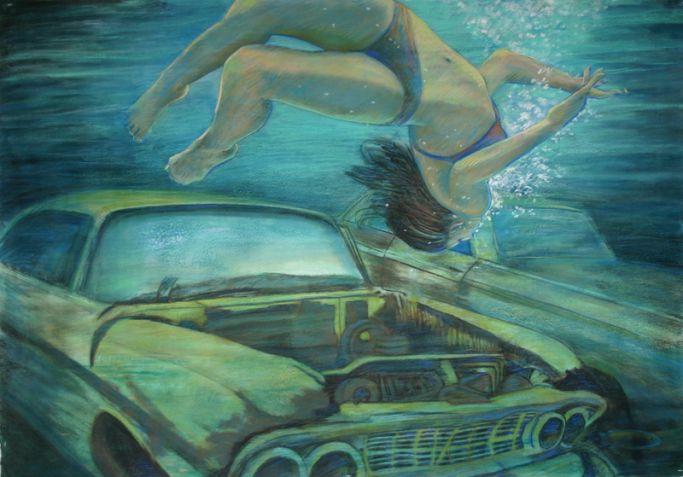
Auto Grave
“Auto Grave” by Elizabeth Leader, mixed media on Fabriano paper

You swallowed the winning rainbow marbles so
slimy Stuart wouldn’t steal what was now stuck
to the gum you didn’t mean to inhale
while you were talking,

sucked like a vacuum
into the shipwreck you wish
you could swim through
revisit all those floating treasures
from the past.

Bottle caps chugged down with beers
on a dare, out of boredom,
cat whiskers stuck in your throat
Maria swore would give you cat eyes

cigarette butts gagged on over and over
from the same goddamn plastic cup used as an ashtray
you kept picking up
instead of your drink next to it
while underwater in a stoned-wash haze,

the bag of hash you mouth-raped
when your train was approaching France from Amsterdam
German shepherds sniffing and straining to locate your interior

the used condom you fished out of the trash
endowed into your gullet
while Crank Campbell was in the bathroom
readjusting his perfection

the bulge of love proclamations you wrote to Patrick Burnett
on scented green post-its that you tore to pieces
slugged back with saliva
before Mr. Riley, your math teacher,
made it down the aisle to confiscate

flies, mosquitoes and at least one moth diving your airways
every sweaty summer you rode your bike

hedged in between the glitter,
hairspray and poppers,
robin’s egg blue eye shadow, lines of coke,
cascades of plum, tangerine and berry lipsticks, angel dust
you licked before and after slathering your eyes, mouth
radiating chemicals bubbling up from your floating internal wreckage

as each boy’s tongues and hands
glided through those tentacles of seaweed
and yesterday’s gems, submerged you in a future
that felt more like an unearthed tomb.


Meg Tuite‘s writing has appeared in numerous journals including Epiphany, JMWW, One, the Journal, Monkeybicycle and Boston Literary Magazine. She has been nominated several times for the Pushcart Prize. She is fiction editor of Santa Fe Literary Review and Connotation Press, author of Domestic Apparition (San Francisco Bay Press, 2011), Disparate Pathos (Monkey Puzzle Press, 2012), Reverberations (Deadly Chaps Press, 2012), Bound By Blue (Sententia Books, 2013), and Her Skin is a Costume (Red Bird Chapbooks, 2013). She won the Twin Antlers Collaborative Poetry award from Artistically Declined Press for her poetry collection, written with Heather Fowler and Michelle Reale, Bare Bulbs Swinging, (2014). She teaches at the Santa Fe Community College.


“In Flight Safety Card” by Lauren Eyler

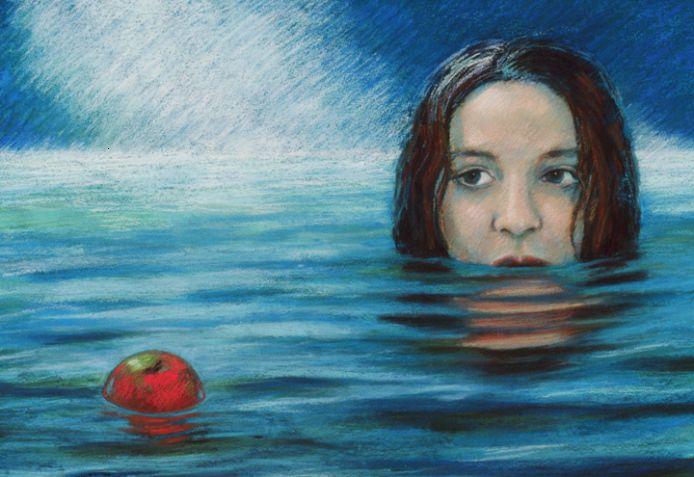
Eve and the apple
“Eve & The Apple” by Elizabeth Leader, pastel on Fabriano paper.
(See also “The Undertow” by Katie Strine.)

While everyone is trying to cram their luggage into the overhead compartments, you take the benzos out of your pocket.  There are six because you are too addicted so less would be a waste of time.  You press your tongue against the roof of your mouth so you can place the pills beneath it. The drug eases through the capillary walls.  The sedative ducks the bile, the acid.  Immediate. Straight. It swims pure into your bloodstream.

As the pills dissolve, you pull on your hoodie.  You’ll be hot.  The air-conditioning doesn’t come on until the plane leaves the ground, but you suck it up.  You run the wires of your earbuds between your T-shirt and the hoodie’s fleece lining.  The benzos are still thawing as you place the buds in your ear and cloak your head.  This is all so the flight attendants won’t see you and tell you to turn off your music until the voice says, “It is now okay to use portable electronic devices.”  You’ve done this a hundred times now and the plane has never crashed.  This is the only rule you break while flying.  You always make sure your seat back and tray table are in their full upright position and you would never, under any circumstances, tamper with the smoke detectors in the restrooms.  It’s a federal law.  You take most federal laws very seriously.  Probably.

Before you shut your eyes, you take the copy of SkyMall from the seat pocket in front of you   and turn the pages until you find the steps you can buy your wiener dog so it won’t break its back jumping on and off the couch.  Once you find it and read the description and see that it still costs seventy dollars, you have a vague feeling of comfort, the kind like an itch has been scratched.

The plane begins to taxi. It means all the doors have been shut and locked, the one that has always been and the one that leads to the cockpit.  The flight attendants are in the aisle asking for your full attention as they demonstrate the safety features of the aircraft.  You can’t hear them because you have the volume all the way up, but your earbud slips and words creep in, “You will find this and all the other safety information in the card located in the seat pocket in front of you.  We strongly suggest you read it before take-off.”

Your finger brushed the laminate as you removed the SkyMall, but that’s as close as you come to taking their suggestion.  As a child you studied the card, saw cartoon people rowing yellow blow up rafts, sliding down inflatable slides.  Even then, you knew those slides weren’t the same as the slides at the park.  Nothing about those yellow slides was fun.  You have the card memorized.  It gave you nightmares.  Now there are other things.

But really that’s not the reason you don’t read it.  You don’t bother because you are in the after.  You never forgot watching the Pentagon burn from a friend’s row house or the planes flying too low over the campus.  And you’re still attempting to solve all the math problems that the too still water, that the too intimate thrumming engendered. What is the derivative of your anxiety in relation to the number of times you place your laptop in an individual container?  Can you determine the upper limit at which you stop visualizing a bomb in each bag without an apparent owner?  Is the square root of “Let’s Role” real or imagined?  Are the answers the fundamental theorem of life as it is now?

The benzos are wrapping tight around your brain.  You will feel lighter in three to four minutes.  The air you breath in will come without the strain of gravity.  And pretty soon the air will be free from the box cutter you used to rip through masking tape when you worked at a bookstore.  This oxygen will silence the image of a slit throat and the gurgling that goes with it.  And all the equations will sleep.

The music is humming to you.  Gentle lyrics speak of places you can go where your high won’t fade away, where the poets write in looser verse, where you can curl into the Olympus Mons.

You inhale.  The words, the drug, have wiped away the cartoons, the math, and the final piece lifts from your skin.  Understand, you don’t believe in God, but you can hear your preacher saying, “You either get where you’re going or you end up at your Father’s door.”  Until the plane touches down, that door is open.


Lauren Eyler is from Cape Hatteras, North Carolina.  She has been published in The Saint Anne’s Review, Bluestem, The Rumpus and other journals. The primary colors are red, yellow, and blue.

Announcing Our October Illustrator: Elizabeth Leader

I’m thrilled to announce that the illustrator for our October “Shipwrecked” issue will be the talented and generous painter and mixed media artist Elizabeth Leader!

Elizabeth grew up in Saugus, an historic town on the north shore of Boston, Massachusetts. After graduating from Massachusetts College of Art, she moved to Upstate New York to attend the Rochester Institute of Technology where she earned an MFA, then worked as an art instructor, graphic designer and artist. Her spread-out family has kept her traveling between Cape Cod, Los Angeles and the Gulf of Mexico. These travels have made her acutely aware of trash and toxins in the ocean. Her home base is Buffalo, New York where she is surrounded by the effects of abandonment and pollution in this post-industrial city. This inspires her to work full-time on her art, using a wide range of materials and techniques to communicate ideas about people, the environment, and the stuff we throw away.

Here are a few teaser images to get you excited about our upcoming issue.

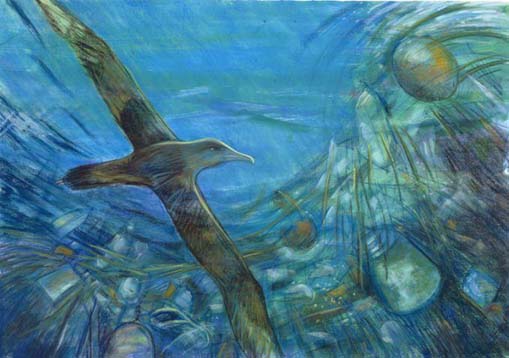
In The Gyre from the TROUBLED WATERS series

Auto Grave from the TROUBLED WATERS series

Elizabeth Leader
Tri-Main Center
Suite 509
2495 Main Street
Buffalo, NY 14214

“A Landmass of Birds” by Kyle Adamson

The North Pacific Gyre (Landmass)
“The North Pacific Gyre” by Elizabet Leader, Pastel on Fabriano paper

We live in a landmass of birds.
This is a poem about grief.
How the brackish water bleeds
into the poisoned orange glow.

How only in a glimpse
when the car whooshes
over a concrete bridge,
I see the island patrolled
by predatory beaks.
So inhospitable
& burning like whiskey
on an arid palette.
This moment lives
in the sour sand
between my tongue & cheek
& deep in my veins
with tidal malice.

It’s shore out of reach;
puddles are crusted, dry,
thirsty with rife.
How the rocks huddled together
like shattered television sets
with frail driftwood antennas.

So many that lay strewn
with vacant eye sockets.

I will only speak of winged cannibals.
How deafening the shrill,
how baron the skeleton trees.

The soil, putrid & foul
with shattered eggshells
like salt on a charred rib,
I wish this were a poem about apologies.
This is where we hail, we are.


Kyle Adamson is an MFA student at Bennington College and earned a BFA in Creative Writing from Hamline University. He is the winner of the 2010 AWP Intro to Journals Award in poetry and has been published in the Artful Dodge and Revolver and forthcoming in the Alaska Quarterly Review, the Water-Stone Review, and the Midway Journal. Kyle served in the Marine Corps infantry and deployed twice to Iraq. Kyle resides in Saint Paul, Minnesota.


“The White Buffalo and the Stone Vine” by Candice Carnes

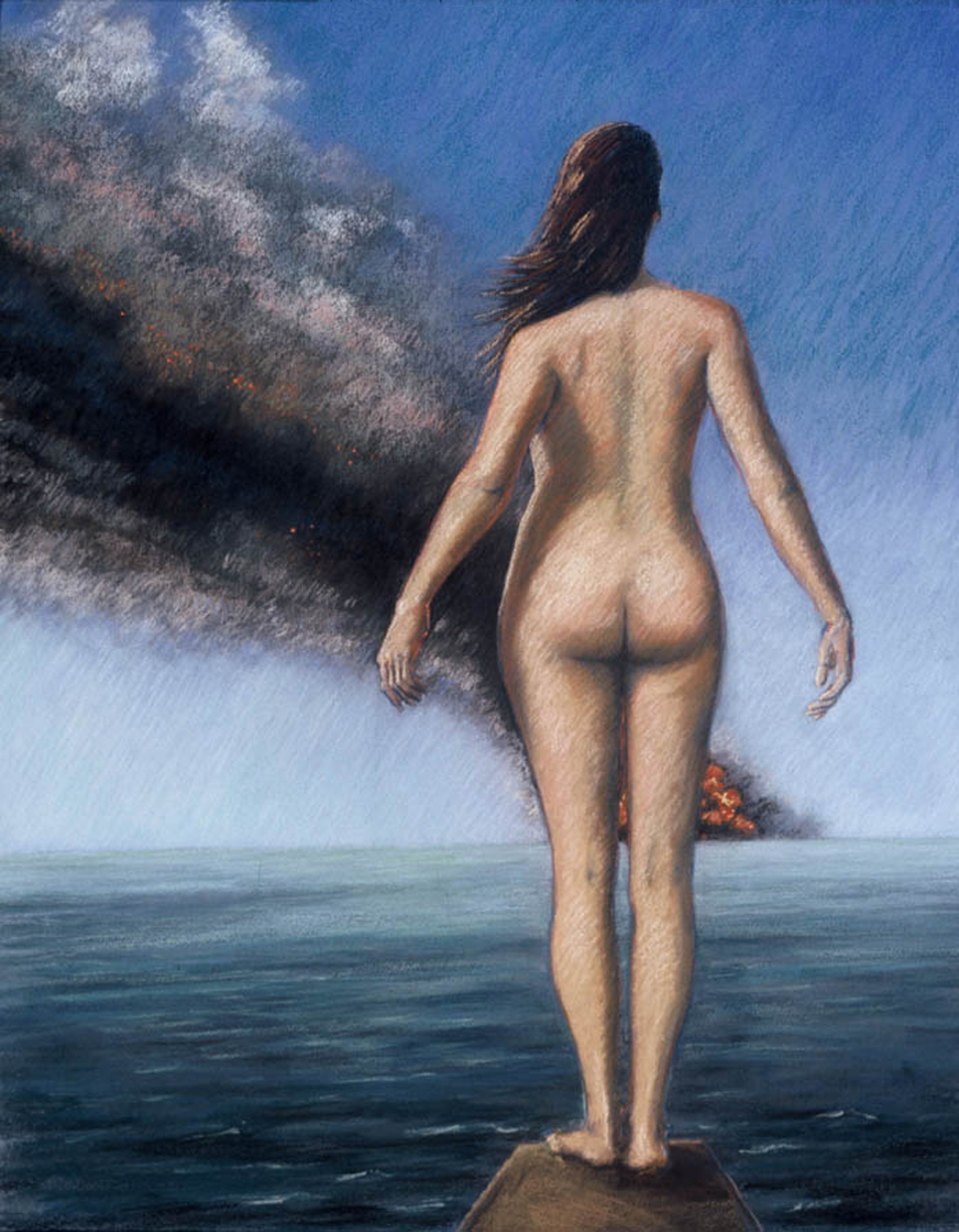
Eve at the edge
“Eve at the Edge” by Elizabeth Leader, Pastel on Fabriano paper

Every woman carries at her core a ball of fire.

Most stories remain solid, a manageable system of change, barely perceptible in time, their experiences like erosion, slowly cutting through stone. But an ill woman’s landscape is full of tsunamis. Her stories, like violent waves so sudden and constant that there is nothing but the meta-memory of their aftershocks.

This is the myth of my own disease.

There was a mass of unknown origin wrapped around my right kidney. It looked like a jellyfish and its tentacles reached as far as my thigh until they squeezed my muscles and I had trouble walking.

Because this mass was gelatinous, no one could find it even with technology, which is expensive, but ordinarily reliable.

The mass gestated in my right side until it became so large that it shoved my kidney into my spine.

And then I couldn’t bend in the middle.

To save my body, my kidney sacrificed itself and grew a stone from the crystallization of calcium that in the beginning was tinier than a single grain of sand. This crystal grew in size,

sharp and jagged-edged, like a knife that cut me open as it reached out, attempting to assassinate the alien mass that had invaded my body.

In my dreams, this stone looked like a bone arrowhead. I saw a white buffalo shot with this arrowhead. The buffalo was bleeding, and then I was bleeding, and then I woke up drenched in sweat, unsure if I was in pain or just imagining that I was in pain. I couldn’t remember which one of us had been shot. Sometimes I thought I was the buffalo and the hunter had pierced me with an arrowhead, and out of fear I had ran away.

The white buffalo lived alone in flatlands that reached out to the North and to the South. Behind her, to the West, was red earth and mountain ranges. She was lonely, but I could never reach her. Sometimes I imagined she dreamed of me and wondered why we both lived in such different kinds of solitude. Sometimes I wondered if the hunter’s arrow was his love, which I had rejected, and that he was the one who ran away.

Sometimes I missed the hunter, but then I remembered how difficult it was to kill with a bow and arrow. If the hunter was anything less than precise, it took a long time to die from such wounds.

I was a wounded animal, dying slowly.

The stone grew from an arrowhead into a scorpion that perched on my kidney. Sometimes I could feel that scorpion reach up and pinch my heart just to make sure I was still alive. He was my child, my son, guarding my life along with his own. My body was a stone jungle— filled with stone beasts— like gargoyles holding back the gates of death.

The scorpion sprouted a leaf. The leaf grew into a stone vine that grew around my spinal cord like bone on bone. The vine grew microscopic buds that hung like poisonous flowers, symbolizing a birth—lily of valley—and I couldn’t tell if I was in the process of dying or being born.

When the surgeons retracted my ribs and removed the mass, my kidney had been shoved so far into my spinal cord that they had merged, like Siamese twins in the stone cage of the vine. Nothing that was embedded in my spinal cord could be removed, without paralyzing me. My side was sewn-up. The cortex of kidney and fragments of stone vine were left inside. The vine became calcified to the bones of my vertebrae, so that sometimes, even now, when I bend it  grates, bone against bone, stone against stone, like the plates of the Earth converging and subducting as they buckle and collide. Forever my movements will be slower, my body a force against its own inertia.

In the grind the jagged edges of broken parts slowly turn to dust.

The dust created by movement is re-absorbed.

But the body is still at risk.

Stone remnants can break away in chunks—like tiny new arrowheads that pierce through the sterile cavity of the human body, causing infection. I am prone to abscesses— a defense of the body— where healthy cells will harden like tiny soldiers, keeping the infection localized where it will grow in a self-contained bubble until it can be drained.

The constant work of erosion has presented itself as scars. My stories burrowed into its valleys. The stone pillar became my spine that grinded in place as movement forced through. It is the work of moving sculptures, of moving stones, of moving walls.

This volatile body,

is my body.

What does this say about me now that my insides have been removed and replaced, invaded and displaced? Where does one seek refuge from her own body when it has been taken over by such mysteries? A menagerie of beasts, vital organs too decayed to function, and the alien mass, which began it all removed by skill of the surgeon’s hand.

As the retractors split my ribs, I dreamt of the hunter and wondered if he was trying to kill the white buffalo or if he meant to save her. Was I that buffalo?

I bled-out.

A vascular surgeon was called.

A central line was inserted into my neck. It was threaded through the jugular vein that ran directly to my heart. Two pints of O-positive were pumped to my right atrium, but I kept bleeding. The surgery took eight hours, but in my mind it lasted much longer.

After months of watching the bleeding white buffalo standing alone, I saw her collapse while drinking water from a stream. She was too hot. The water was not cool enough. Would I ever wake up? Centuries passed while I sat next to the buffalo, stroking her skin with cool rags desperate for her to wake, knowing  my totem might die. The retractors were removed along with two of my ribs.

Confused, I believed I had almost drowned, and washed up on a riverbed where I woke up in the blazing sun.

I remembered the scorpion. How long had he been my guardian? And how was it that the leaf and the vine had invaded my body? What would life be like without them? And how long before this delicate balance would again be disturbed?

It is the strength, beauty, and frailty of the sick body that Frida Kahlo once called, a ribbon around a bomb.

I am none and all of these beasts at once.


Candice Carnes earned her BFA in creative writing from Goddard College. This essay is an excerpt from her book, An Incomplete Case Study of the Petrified Woman, a memoir of a traumatic, nearly fatal illness that cost her (among other things) a kidney at the age of 32. Most of her stories are informed by over a decade of providing hands-on patient care. She is the winner of the 2009 Leo-Love Merit Scholarship in fiction. Her work has appeared in Adobe Walls, Raphael’s Village, Apeiron Review, and in Mused (June 2013).