“I Nearly Lost You There” by Erin McReynolds


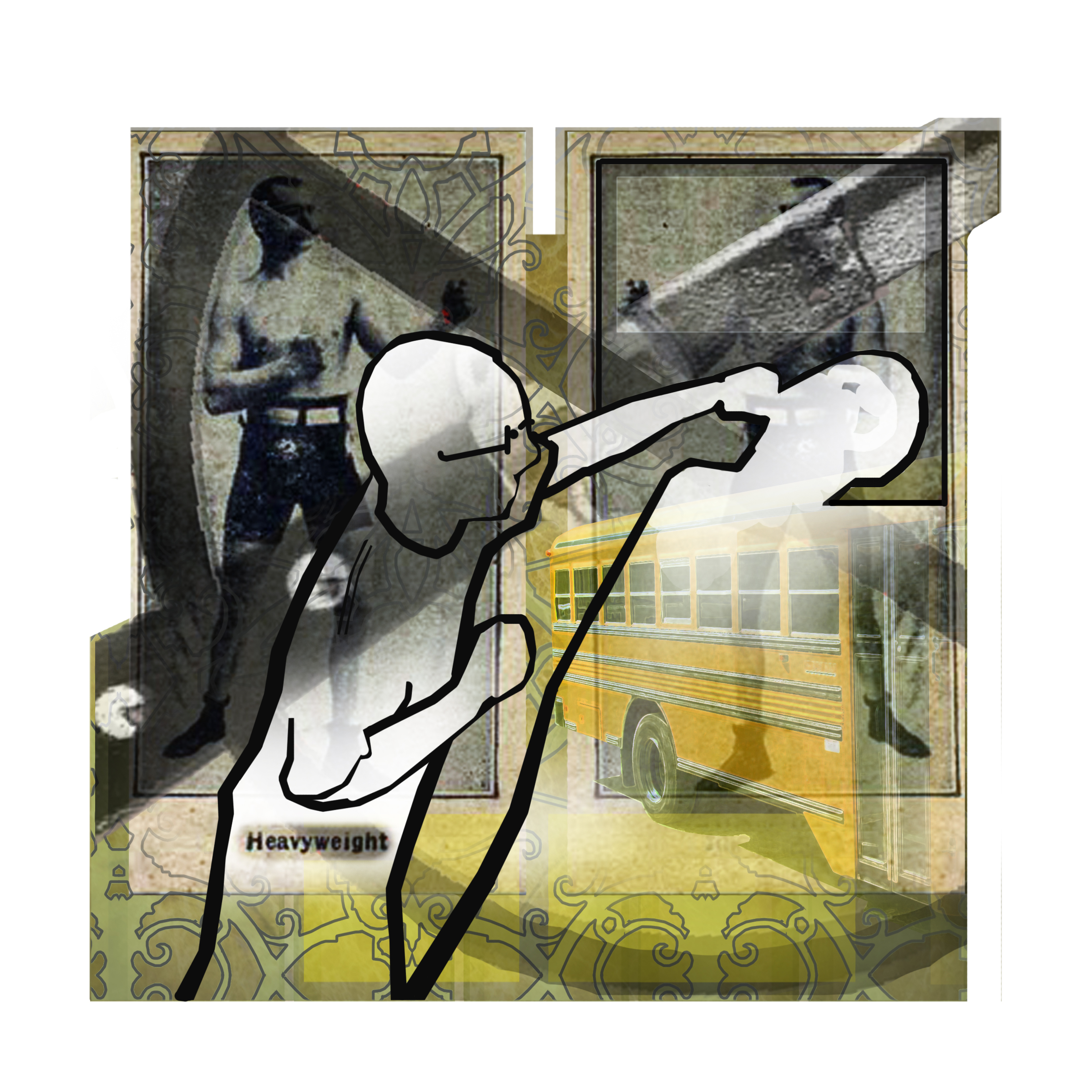
Image by Jenn Rhubright

A Close Call

Twilight, and things gold seconds ago have gone blue and hard to see.

I’m barefoot and running towards the front door of your place. Parked the car in the alley behind your building and ran. No one can get by. The car is still running and I am running to the door. Grandma called me as soon as you hung up with her. She said you and he were fighting and that she could hear Junior in the background, calm, placating. I bought her all this wine! he yelled so that Grandma could hear, over the phone lines that stretch up the interstate, alive and quivering slightly in the pink of the setting sun. On the phone, you told your mother not to worry. But you whispered it. She called me immediately. It doesn’t sound right. I left without shoes, drove fast and prayed for no cops. Then prayed for cops. Here now, the door gives way easily, it’s ajar and the dog doesn’t come to greet me. The living room and kitchen are empty. The only other room in the condo is your bedroom. The door wide is open. I tiptoe to it and his back is to me. The TV is on. I see it in the mirror behind your bed. An action film. Someone screams and a machine gun rapidfires bullets. Junior sees me behind him in the mirror and spins around. He has a steak knife in his hand. He’s a middle-aged boy, a cherubic face gone pale, eyes wide. The TV shrieks with bombs. Get out, I say, but I can’t be sure. I am not speaking but sound is coming through me. He sputters and turns to look at you, on the bed. Your hand is clasped to your ear. My right. Your left. You are coughing and with each convulsion, a thin jet of blood shoots into the air. I’m Sorry, you say, breathless and falling backwards. I shove him out of the way and am by your side, ripping the pillowcase into a strip and tying it around your neck. When your hand falls away, limp, I see a half a dozen small holes, and one big one, a heaving gill in your neck. Just a papercut, but for all this blood. I yank the knot tight against it. In minutes, your brain could die but you will keep your blood. Keep it all inside, I say. Keep it all inside, Mom. My hands flip open the phone, drop it, pick it up. Sirens wail on the television. I push four buttons, swear, hang up, and push three. Concentrate hard on the green button so I don’t miss it again. The time on the screen is still the same as it was on the dashboard clock when I pulled up outside: seven-fifteen. The hospital is at the bottom of the hill. I don’t let the operator finish. Sounds are made and I don’t know what they are. I only know Please and Hurry.


Let’s Do Better

The sun takes its time. A quarter to seven and the ocean and clouds are still sprayed violent pink. The shadows grow longer on the drive up the hill to your house. My boyfriend is with me. We were going to go to the fair. Devo is playing with the Psychedelic Furs. They’re too old to be good anymore, we reasoned as we drove away, even though we had been excited about going. We left because in the parking lot I’d had a feeling. I called you and you didn’t answer. That is, Junior didn’t; you don’t answer the phone anymore, and you confessed why, just last week when you got away from him for a while. He won’t let you answer it. Still, you’re both always home. And I had this feeling. How close we are, every second, to losing everything. We pull into a parking space near your door. Children are shouting from the pool in the courtyard and the stucco condos are pink and getting pinker with the setting sun. As we near the door, Chloe bursts out and stretches her long terrier legs against our thighs, bowing her back in a half stretch, half greeting. You are in the kitchen, chopping onions. I smell burning coals. You are sniffling, and you turn, surprised. Your face is swollen. You drop the knife and throw your arms around me, and I smell oxidized red wine, cigarette smoke, and cilantro. I put my face in your neck. You are an inch shorter than me. I can fold you into me completely. I whisper in your ear, Are you okay? He comes out from the bedroom, where he has been lighting the grill on the patio. Oh, hello there, he says. We’re about to have fajitas, you want to stay? You sniffle into my shoulder. No, I say. Mom’s coming home with me. I tell my boyfriend to get Chloe’s leash. He pats his legs and Chloe goes to him, her tail between her legs. Junior laughs. Why are you going, Deb? I got the grill started. He explains, She’s mad even though I bought her three bottles of wine at Trader Joe’s and I cleaned this whole place, you should have seen it before, and we rented some movies so I don’t know what she said but you know what, if you want to go, Deb, fine, I won’t stop you. Just can you come here a second? Can you come talk to me? But you push off of me and fly at him, jamming your little finger in his chest and saying, No moreyou are controlling and manipulative and I want you out. Now. My boyfriend has the dog on the leash and he says, Let’s just go. The words surprise me, coming from him. They seem to surprise him, too. We four adults look at each other. I tell Junior, We’ll talk tomorrow. I think the best thing now is to just go and get some space for a while. Fine, Deb, he says, still looking at you. You go get some fucking space. He follows us to the car, taunting. You struggle against me, wanting to fight him some more. No, I tell you, wrestling you into the back seat where the dog is shivering, her tail coiled tightly around her legs. She nervously licks your face as I close the door. My boyfriend refuses to get in the car until I do, but I have one more thing left to do before we leave. I turn to face Junior.


Just Missed You

The sun sinks into the ocean while we wait for the locksmith in the parking lot. He shows up with a toolkit and I make some noise about forgetting my key at work and how you’re out of town. I show my driver’s license with this address on it. Satisfied, he jimmies the door. It is dark and cool inside. The blinds are down, which has been driving me nuts for two days. I got a message from Grandma as I was leaving the fair the other night, that she was worried about a fight you and Junior were having while she was on the phone with you. I went down that night but no one answered. Your car was gone—is still gone—and so is the dog. The dog goes everywhere with you. Glen, the drunk next door, told me that night you two often go to San Onofre or the desert to dry out. I’d called all the campgrounds. Where have you gone? The house is clean and still. Unusual. I used to live here, right here in this living room, but I feel like a sneak. A snoop. The door to your bedroom is closed. I pause before opening it. Nothing happens. I send my boyfriend to the bathroom to investigate and I open the vertical blinds that have kept me from seeing in for the last couple of visits, where I stood on the patio with Glen last night, trying to wrest the sliding door off its track. Long shafts of sulfuric streetlight stripe the bed, which is piled with covers and pillows. A duffel bag. Bingo. I pull the duffel bag towards me and there is a hand. Your hand hangs there, dumb and graceful, palm down. Pink. Brown fingers. A thundering boom from somewhere, everywhere, as if something open has been slammed shut. Sudden, awful tenderness follows.

No, I tell the hand. It stays, so I say it again, harder. No. It will not listen.

Louder now.

No.

I bare my teeth. It does not flinch.

Arms are pulling me backwards, away from the hand. I lean forward with all that I’ve got, barking, barking, barking. And then a howl.


Let’s Try Again

I wait outside the front door, which is half open. Inside, in the kitchen, you and he are in an embrace. You drop the phone on the counter and cross your wrists at his back. You are so small inside his arms that I cannot see you. A broken glass is on the floor, red wine spilling out of it, staining the terra cotta tiles. I turn away and let you be.


Erin McReynolds has an MFA in Writing from Queens University of Charlotte, NC. Excerpts from her in-progress memoir have also appeared in The North American Review and Prime Number. She lives in Austin, TX, where she writes and edits for the Fearless Critic restaurant guides, and blogs about food writing, waitressing, wine, and trauma.

Read our interview with Erin here.


“Bearing Down” by Brian Hall

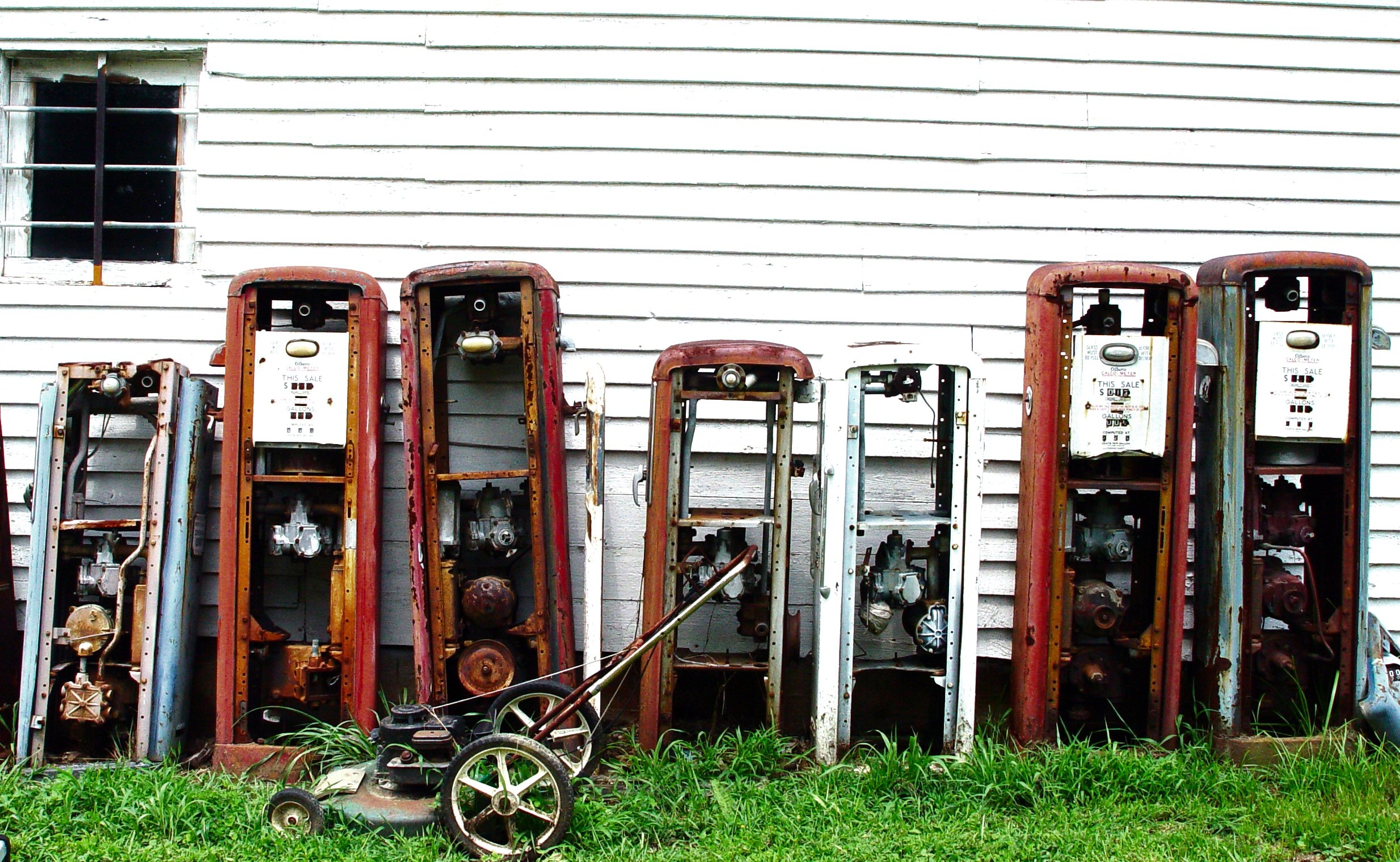
Old gas pumps
Image by Jenn Rhubright

A month before my grandfather committed suicide, I drove him to Russ’ Auto Repair in Canton, Ohio, for his Cadillac to be fitted with a left-foot accelerator.

He couldn’t use his right leg because of a recent hip replacement. A prosthesis was installed to help support the weight of his body, which at 280 was the lightest he had been in a decade. Losing weight was one of the three criteria he had to meet before the operation—along with quitting smoking and drinking—and though he was normally defiant of physicians, this time he had followed doctor’s orders. After watching my grandma slowly die in a hospital room earlier that year, he had made a commitment to stay mobile. He wanted to be able to take care of himself, so he wouldn’t have to move in with anyone, or—his greatest fear—into a nursing home.

My grandfather had planned to be at the auto shop as soon as it opened at nine, so I arrived at his house at 7:50, hoping to be on the road by eight. When I arrived, he was already sitting in the car, and his walker, collapsed on the driveway, lay near the passenger side door. As I approached the car, he rolled down the window, and said, “I’ve been waiting here all morning. Now, close my back door.”

My grandfather had always been an impatient man. Throughout my life, if my grandmother and he were at a family function, he would abruptly stand up at the most inappropriate time, tell my grandmother to get her things, and walk to his car. The grandchildren would have to run to the car and wave as he backed out of the driveway. Once I asked my mother why grandpa always left so fast. She shrugged and said, “I guess when he decides to go, there’s nothing you can do to stop him.”

I caught a glimpse of the wreckage in the house as I reached to close the door. The house, which had been kept immaculate by my grandmother, was lost under dirt and clutter. Stacks of dirty dishes sat in the sink, two dining room chairs leaned against the wall, and magazines, letters, and empty glasses covered the dining room table. In the brown, plush carpet, the feet of the walker left small circular indentations that marked my grandfather’s journey from the living room, through the dining room and kitchen and to the car. Between the walker’s tracks, the carpet was raised like an acrylic wake, a wake left by a dragging leg that still hadn’t adjusted to the artificial hip’s metal ball-and-stem that had been inserted three weeks earlier. As I closed the door, I considered that it probably had taken him much of the morning to shuffle to the back door.

I returned to the car, put his walker in the trunk, opened the driver’s side door and slid behind the wheel.

“Took you long enough,” he said. I could smell mint on his breath, a sure sign he was drinking again. He offered me a cigarette. Since I didn’t have enough nerve to tell him he shouldn’t be smoking, I decided to lead by example. I declined. “Then, what are you waiting for?” he asked. “Let’s go.”

During the first miles of the drive, my grandfather began his critique. He told me when I was going too slow, too fast, and when I didn’t come to a complete stop at stop signs. When he asked questions, they always had two parts. The first part was, “What’s the matter with you?”

The ride became a litany of: “What’s the matter with you? Don’t you know how to drive?” or “What’s the matter with you? Don’t you know how to use a turn signal?” or “What’s the matter with you? Why did it take two weeks to return my phone call?”

I had been avoiding his phone calls because I couldn’t deal with how depressed and reserved he had become after my grandmother died. I lived forty minutes away so it was easy to avoid his calls or, more precisely, him. So I let the rest of my family deal with him. I kept my distance after his first suicide attempt, because I didn’t know what to say to him. My mother finally made me contact him. She told me he needed the accelerator fixed and I was the only one available to drive him. If I would have known it would be my last trip with him, maybe I would have been more enthusiastic instead of focused on not wanting to deal with an old, depressed man for an entire day.

I indulged my grandfather’s orneriness because he seemed to be the grandfather I remembered. The one who decided it was his job to point out any and all flaws. I thought he had turned a corner and was getting better. I considered that maybe the new hip, the alcohol, or the freedom that would come with the accelerator was beginning to bring him out of his depression. I began to feel comfortable around him again, so when we were near Canton, I played along. I told him that he was getting too old to know what he was talking about, and it was best if he just shut up, or, as I said, “Shaddup!” We laughed together, and I continued trying to show that he was wrong to critique my driving. In fact, I became so caught up in proving that I knew where I was going and what I was doing that I missed the exit signs, becoming temporarily lost.

After forty-five minutes at Russ’, the left-foot accelerator was installed: a pedal placed on the left side of the brake and a bar and lever extending to the gas pedal on the right. I drove through Canton, and the car lunged and stopped repeatedly as I tried to find the right amount of pressure with my left foot. Because I wasn’t sure of the exact location of the pedal, sometimes I would hit the break instead of the gas, sending us into our seatbelts. Each time this happened my grandfather said, “Wrong one.”

The most frustrating aspect of the apparatus was that it made me aware that I was driving. That awareness made something so simple, incredibly difficult. Even now, I wonder if that is how my grandfather had felt. Everything became slightly more difficult after my grandmother died: cleaning the house, making dinner, walking, and, until that moment, driving. Perhaps the frustration I had in the car with that damn left-foot accelerator represented a small amount of the frustration my grandfather felt every day with everything he attempted to do.

Outside Canton’s city limits, my grandfather told me that my driving was making him sick, and it was his turn to show me how it was done. I stopped in a supermarket’s parking lot, so we could switch. In no time at all, my grandfather mastered the accelerator.

“What’s the matter with you?” he asked. “The damn thing’s easy.”

A mile away from his house, I had the sensation of moving sideways. The white line marking the road’s shoulder slipped under the car. The tires kicked gravel and dirt as the car approached a drainage ditch. My grandfather was asleep with one hand on the wheel and his head on his shoulder. A month later, a neighbor would see the walker and  my grandfather slumped against the house, his legs buckled under him, and his head, once again, on his shoulder. Thinking that he’d fallen, the neighbor would run to help only to discover the semi-automatic pistol and the half-inch entry wound above his right ear.

“Hey,” I said. My grandfather woke and swerved the car onto the road. “What’s the matter with you?” I asked.

I expected to see his half smile, the one that indicated an insult was coming, but he didn’t smile or have a comeback. He hadn’t even looked at me. He kept his eyes on the road ahead of him, and I watched his cheek twitch as he clenched and unclenched his jaw. I thought about asking him again if something was wrong, but I never had a chance because he pushed the accelerator to the floorboard and turned the corner too quickly. Instead of talking I had to find a way to brace myself.


Brian Hall is an Assistant Professor of English at Cuyahoga Community College in Cleveland, OH. His essays and photographs have appeared in a variety of journals including The Chronicle of Higher Education, The Palo Alto Review, Exquisite Corpse, The Lullwater Review, and The G.W. Review.


“My Moving Cage” by Alice Lowe

My Moving Cage
Image by Jenn Rhubright

If I’d been able to Google it twenty years ago, I would have breathed more easily to know that my malady was real, an identifiable condition. And that I wasn’t alone. Instead, I sheltered my secret in shame, like a drinking problem or a shoplifting mania.

The first episode burst on me like a sudden squall when I was crossing the Coronado Bay Bridge, the span of speed and efficiency that replaced the ferries that used to connect San Diego with Coronado Island. As I drove onto the bridge, I felt a sudden anxiety, growing to panic proportions as I ascended toward the looming mid-point. It was as if there were hands on the steering wheel covering my own, an evil entity who wanted to take the car over the side. I clenched the wheel in a vise-like grip to keep from making a sharp turn to the right, through the restraining wall and into the dark swishing water below. I was sweaty and clammy. Dizzy, hyperventilating. I braked in abrupt jerks. I slowed to about thirty miles an hour; cars veered around me, horns blasting. I couldn’t look beyond my moving cage and its boundaries—the white line on my left, the barrier on my right, the cars directly in front of and behind me.

When I saw the tollgate on the other side, the dam burst inside me; I dissolved into a quivering mass of gasping, shaking, sobbing. I pulled off to the shoulder as soon as I could and turned off the motor. I opened the windows and gulped fresh air until I felt able to continue to the Hotel Del Coronado, where I was attending a conference. The rest of the day was a blur, blotted out by repeating /images of that scary voyage, like a bad dream that haunted me. What happened? Was it a fluke? Was something wrong with me? Would it happen again? How would I get back across the bridge?

~

It has a name—hodophobia. From the Greek “hodos,” meaning “path,” and “phobos,” fear. The label is applied broadly to fear of travel, including flying, but it more specifically relates to road travel. These panic attacks aren’t restricted to bridges: they can be triggered by driving on highways, turning or changing lanes, in traffic or bad weather, over long distances and at high speeds. Mine were the textbook symptoms of a not very remarkable anxiety disorder, but I didn’t know it at the time.

I couldn’t shake the after-shocks and drove under a menacing cloud. I was able to avoid the bridge, but then on a drive down from Los Angeles with a friend, I seized up on the freeway. The same symptoms, not quite as intense as on the bridge, but with the addition of hazy vision—as if a semi-transparent dirty curtain was hanging across the windshield—and a stale, moldy smell. I still wasn’t ready to tell anyone—I said I was feeling a little woozy, maybe feverish, and my friend took the wheel for the rest of the trip. After that I could drive only in the right-hand lane, embracing the shoulder and inching along at perilously slow speeds. My reflexes were shaky, and I knew I was a hazard on the highway, making the imagined risk real, a self-fulfilling prophecy. I learned to get around the entire city of San Diego on surface streets, but the more I shunned the freeways, the more alarming they became.

I didn’t know which I feared more, a brain tumor or losing my mind. I was convinced there was something gravely wrong with me. My primary physician dismissed the former and referred me for a psychiatric examination; the screening consultant diagnosed an anxiety disorder and sent me to a therapist.

Therapy was illuminating at first. I was able to voice my anxiety about the stress I was under—I was preparing to give up a settled and secure life and satisfying work to live outside the country for the better part of a year, during which time I would be, virtually, in physical, emotional and financial dependence on another person. It was a fantastic opportunity but a threat to my risk-averse comfort zone and my zealous independence. The therapist identified my need to have everything under my control as typical of an ACA—adult child of an alcoholic. Well, I thought, maybe so, but so what, and then what? I was no closer to getting back behind the wheel with confidence, the insurance co-pays for my therapy were running out, and my departure was approaching.

~

I learned over time that I was in good company with an elite club of fellow-sufferers, writers whose frank admissions, vivid recollections and dramatic descriptions comforted me and validated my experience. In “The White Album,” Joan Didion drives from her home in the Sacramento Valley to see and report on the student revolutions in Berkeley and San Francisco. The Bay Bridge stood in her path, cold menacing steel. She grits her teeth and inches across. Some years later she told an interviewer that she no longer drives across bridges and only when necessary on freeways. Not one to let an experience go to waste, Didion has captured those feelings of terror in her writing, in the way that Virginia Woolf admonishes herself to observe her own despondency: “By that means it becomes serviceable.”

In Home Before Dark, a biography of her father, Susan Cheever tells of John Cheever’s suffocating fear of driving on bridges. He would be so shaken after an incident that he couldn’t raise a glass to his mouth for hours. She tells of being alone in the car with her father as a child when they crossed a bridge. She noticed the car’s jerking, her father’s foot shaking against the gas pedal, the stress on his face and in his breathing. He said, “Talk to me, about anything,” so she chattered about a book she was reading until they reached the end of the bridge. Cheever translated it to a short story, “The Angel of the Bridge,” in which the narrator has to pull off to the side while crossing a bridge to get his breath and nerves under control. A young woman hops into the car, a hitchhiker who thinks he’s stopped to pick her up. She’s a folk musician and sings him across the span while he enjoys a dream-like euphoria and basks in the beauty and durability of the bridge, the tranquil waters of the Hudson River below.

~

I spent most of my time abroad in a one-church, one-pub village in England’s West Country, where in addition to driving on the wrong side of the road, they careen down narrow country lanes and roar along at whiplash speeds on the motorways. I wasn’t willing to deny myself the second-hand book shops with their dusty finds, like Virginia Woolf first editions, afternoon teas with scones and clotted cream, the sculpted estate gardens and the craggy wildness of the Devon countryside. I would climb into my flimsy little Fiat and drive—nervously, cautiously, slowly—from village to village and around the moors, avoiding the maniacal motorways and the “B” roads, the more treacherous by-ways.

I returned home eight months later with my millstone still tightly shackled to my limbs but with steely determination. I had spent much of my time away planning my future, and there was no room in it for perverse fears that would hinder my mobility. One day I left home for a lunch date in a neighborhood most easily accessed by freeway. I started to take a roundabout route, but with mind over matter as my trusty weapon of choice, I entered the freeway onramp and stepped on the gas. I opened the window and took deep breaths, sucking in as much oxygen as I could and whooshing it out in exaggerated bursts. Breathe, breathe, I said aloud; focus, relax; relax, focus; keep breathing, keep moving—my mantra until I reached my exit. My neck and shoulders ached with tension, my palms and forehead were soaked, but I’d rejoined life as we know it in Southern California—life on the freeway.

Over time it became easier, and a kind of normalcy was restored, though I stayed off bridges. By then I had confided in a few friends, even then downplaying the severity; I tried to put it out of my mind as much as possible, but it still lurked, wraithlike, and would jump out and say “boo” when I wasn’t expecting it. We all live with our ghosts, I figured.

~

For Ruth Reichl, as for Didion, it was the Bay Bridge looming between her home in Berkeley and engagements in San Francisco. In her memoir she tells how she would resort to public transportation, however inconvenient, or cajole friends into driving her (without divulging her secret). The gravity of her situation reached epic proportions when, as an up-and-coming food writer, she almost passed up an opportunity to meet James Beard because she couldn’t cross the bridge.

In Literacy and Longing in L.A., a quintessential “beach read” by Jennifer Kaufman and Karen Mack, we meet Dora, a freelance journalist who has been terrified of driving on Los Angeles freeways since the time she stalled in the fast lane of the Santa Monica freeway. She too learns to negotiate the city without getting on the freeway, willing to spend extra hours doing so, until an out-of-town assignment makes it unavoidable. She takes her place in the twelve lanes of thundering metal on the I-10 but likens her silent hysteria to Edvard Munch’s painting, “The Scream.”

Anne Lamott makes the fear vivid by virtue of its absence, recognizing it as common enough to resonate with readers. The narrator of All New People describes her mother’s bizarre phobias—revolving doors and houseplants—noting that driving across the Golden Gate Bridge was not one of them.

~

We all know people with phobias—they plague millions of people in the U.S. alone. A mix of heredity, genetics and brain chemistry combined with life experiences, hundreds of different phobias have been identified and classified. In one online listing there are upwards of 40 H’s alone, including my hodophobia, which is not to be confused with hobophobia, fear of bums or beggars, hydrophobia, fear of rabies or water, or homophobia, fear of homosexuality. There is hippopotomonstrosesquippedaliophobia, a fear of long words, and hexakosioihexekontahexaphobia, fear of the number 666. Something for everyone.

Phobias are treated with all sorts of remedies—hypnotherapy, Neuro-Linguistic Programming, Cognitive-Behavior Therapy, and exposure therapy (“just do it”). Energy psychology includes acupressure, yoga, tai chi, and qi gong. Tapping, or Emotional Freedom Technique, is an acupressure method that uses meridian energy points across the body to release past emotional trauma. And there are homeopathic remedies, aromatherapy, vitamins and herbs.

Whether good news or a dubious downside, treating phobias is big business, the entrepreneurial spirit in action. If a condition exists, someone will find or fashion tools and techniques to fix it. I searched the web and found driving-fear.com and drivingfear.com (note the differentiating hyphen), fearlessdriving.com, fearofbridges.com, phobia-fear-release.com. There’s a six-step self-hypnosis program ($6 PDF, $20 book); an NLP program with an 85% cure rate ($37 plus a bonus book); an energy therapy program, marked down from $99.90 to $67; a program with no description but with a money-back guarantee ($67 standard, $87 premium). The do-it-yourself remedies on sites like ehow.com (“how to do just about everything”), include positive thinking, deep breathing, distraction (singing or recitation), talking about it.

~

I didn’t have much interest or hold out hope for a hyped cure—I was satisfied with my limited success; my condition was manageable. But when I was presented with an opportunity to experience tapping, I was intrigued. Audrey, a colleague, said she was freed from excessive cravings for French fries by this method, and the practitioner, a psychotherapist and yoga instructor who happened to be her mother, said that it worked well with phobias and anxiety. I resolved to put aside my skepticism. We invited Nancy to our office, where she met individually with three of us. Sara was an intermittent smoker who wanted to give up the habit completely; Irene was a compulsive chocoholic and hoped to be able to enjoy chocolate without binging. Both claimed immediate and complete success when they put the method to the test.

I told my story to Nancy, and, with her coaxing, tried to recall and verbalize the panicky feelings evoked during my crises and to rate my fear on a scale of one to ten. Along with tapping on my arms, she instructed me to sing “Jingle Bells” aloud. Jingle Bells? I suppose it could be anything distracting. But I never gave it a chance—I couldn’t tap away my trepidation. This wasn’t something I could do in the comfort of my living room; I had to drive across a bridge.

A few years later I was having lunch one day near the Coronado Bridge. It beckoned from the restaurant window, it taunted me: Come on, are you going to be a coward forever? I said OK, what the hell. I got in the car and aimed for the bridge. As I approached, panic clutched my gut. How do you tap yourself when both hands are in a death grip on the steering wheel? How do you sing or play mental word games when you’re struggling to breathe? I drove past the bridge onramp. I reasoned that it was a beginning, but it was years before I ventured forth again.

I became friends with a woman who lives in Coronado. Our get-togethers on her side of the bridge are typically foursomes with our husbands, so I tolerate the crossings as a passenger, outwardly composed but still a trifle uneasy. When she and I meet, it’s on the San Diego side. I maintained this status quo until we had to have our house tented for termites, and Eva offered their guest room for the two nights we would be homeless. Their home is large and lovely, and they are gracious hosts. We are parsimonious. How could we refuse? But I would have to drive back and forth to work.

The first afternoon, driving from my office to their house, I chickened out. I drove to Imperial Beach, an extra twenty miles south (and an extra hour in rush-hour traffic), where I could access the Strand, a long narrow spit of land that joins the mainland to Coronado. It would be possible to take this route for the next two days, but I wanted to rise to the challenge. I had observed when in passenger mode that the bridge seems less threatening coming back across—the access is more gradual, not as steep or curving. So the next morning, without giving myself time to reflect, I took the plunge, figuratively of course. My panic came with me, a taunting ogre perched on my shoulder, but I was determined. Terrified but determined. Short of breath, shaking, gasping, sweating, my fingers cramped from clenching the wheel, I took charge. I drove across the bridge.

I did it, I did it, I said to myself, my heart racing and pounding in a kind of hysterical euphoria as I continued on to my office, where I was finally able to stop and reflect on my victory. My exhilaration remained with me throughout the day—I wonder if this how it feels like to wake up after surgery and be told you’re out of danger—I thought I was on my way to full recovery. As much of a struggle as it had been, I convinced myself that I had broken the barrier and that it would get continually easier.

My triumph was short-lived. That afternoon I was eager to prove myself again, this time almost cocky with confidence. But as I entered the span, the full trauma struck, and the fear took over. I lurched and swerved my way across like a drunken snail, and I was in tears when I got to the other side. I knew that I hadn’t conquered the beast, that it would always be hovering, laughing at me, grabbing at the wheel, and I didn’t have the energy to fight it. On the last morning, I drove back down the Strand.


Alice Lowe is a freelance writer in San Diego, California. Her creative nonfiction has appeared this year in Hobart, Eclectica, Foliate Oak and Writing It Real, where her entry won first prize in an essay contest. She has published essays and reviews on the life and work of Virginia Woolf, including the 2010 monograph, “Beyond the Icon: Virginia Woolf in Contemporary Fiction;” Virginia Woolf has a way of popping up in her personal essays as well, including this one.

Read our interview with Alice here.


“Ashes” by Virginia Williams

Ashes
Illustration by Morgan Maurer, 2011

We brought Ben’s ashes home on a sweltering Thursday in July, six and a half months after his sudden death on a bleak midwinter’s day.

As with many days of that year, Simon and I were quiet on the drive to and from the funeral home, lost in grief for our stillborn child. The unspoken question between us—what now?—would remain unanswered for months, long after we placed Ben’s ashes in the room that would have been his, closed the door and tried to leave the pain inside.

The night he died we fought over a small, stupid thing that had been festering for months. I went to bed angry; Simon went to the basement to resolve the problem – a utility sink blocked up with accumulated household detritus. We woke up mad the next day, too proud to apologize or admit how silly we’d been. It was the day before New Year’s Eve, 2003.

Thirty-nine weeks and four days into pregnancy, I was tired, ready to bring my baby home and be done with aching hips and heartburn. I wanted to meet this new little wonder who was coming to change my life. Outside, it was cold and gray, mirroring my exhaustion; inside, Charlotte, our three-year-old, had an ear infection and fever, and, much as we wanted Ben, we were nervous about bringing a second child into our lives.

That last morning, I stewed in the doctor’s office, angry with Simon, annoyed by the doctor’s slight delay, wishing my regular OB weren’t on vacation. I didn’t notice that my boy wasn’t moving. Blind to everything but myself own self-righteous annoyance, I was confident Ben wasn’t going to arrive anytime soon.

When I finally got to the exam room and on the table, Dr. Todd, a doctor new to me and my pregnancy, rolls out the Doppler heartbeat monitor. He smears cold jelly on my stomach and places the microphone on my belly. Static. He tries again, and still, nothing. He asks where we usually hear the heartbeat, and I indicate the right side of my belly. He tries again. Nothing. My heart starts to beat a little faster.

Dr. Todd remains calm and tells me he thinks the Doppler machine has been dropped on the floor a few too many times, and runs off to retrieve another. We try again. We wait. And nothing.

But then, very faint, is a rapid heartbeat. Dr. Todd says he thinks it might be my heartbeat, and checks my pulse. It is, indeed, my heart racing with fear.

I look at him and say, “Please tell me not to panic.”

He says nothing.

Dr. Todd keeps trying with the Doppler, then says, “I’m going to send you over for an ultrasound to see what’s going on.”

I think that’s when I knew that Ben was dead. I don’t let myself believe it; I tell myself I’m going to have an emergency C-section after the ultrasound and start planning a phone call to Simon.

As I walk out of the office, the receptionist calls out, “Have a Happy New Year.” I think, “If you only knew.”

In the ultrasound room, I lie down yet again while a technologist puts gel on my belly and runs her wand over my protruding stomach. I hold my breath and stare at the ultrasound screen, at my perfect little boy, looking desperately for something, anything, to help me decipher what is happening.

Another doctor enters the room; Dr. Baird is young, with long brown hair, about my age. She briefly looks at the screen and reaches out to grasp my hand. “How are you feeling right now?” she asks.

“I’m feeling pretty scared.”

“I’m sorry to tell you,” she says softly, “but he’s gone.”

And this is when my world stopped.

~

Minutes later, someone leads me down the hall to a small room used for moments like this. There is a box of tissues on a coffee table, some pamphlets on grief, a sofa and two standard medical office armchairs, a side table and telephone. One window looks out onto a cloudy December day, traffic moving past, people bundled up against the cold waiting for the bus. I cannot fathom the world that is carrying on outside this place when I need to tell my husband Ben is dead.

I dial our phone number, wipe away my tears and tell Simon, calmly enough, that I have bad news.

But I don’t know how to tell him the next thing I must say. I gulp for air like a fish on dry land and gasp it out: “The baby died,” and burst into tears once more.

Normally unflappable Simon falters. “What should I do? What should I do?” I instruct him to phone our neighbor and ask her to watch Charlotte. I tell him where to find me in the hospital, begging him to get here soon.

Sobbing, collapsed on the floor, I phone my friend Patty. She’s not at work, but doesn’t answer at home. I phone my friend Sandy at her job. No answer. In desperation, I phone Patty again. Miraculously, she answers. She is home with her children and parents-in-law, and after I say hello, my voice breaks again.

“Patty, the baby died.”

And I cry. She insists on coming to me immediately, her composure a brief respite from the agony of unrelenting sorrow.

Unable to make more calls, I wonder why I didn’t know that Ben was dead. Dr. Todd and Dr. Baird come check on me, help me up from the floor and into an armchair. I ask them how I could not have known Ben was gone, but they have no answers. “I don’t care what you think you did or didn’t do,” says Dr. Baird, “Whether you missed a prenatal vitamin once or ate something you shouldn’t have: you did nothing wrong.” It doesn’t help. For now, I am too stunned to be rational; my heart is twisting itself into knots. It was my job to keep Ben safe, and I failed.

Shortly after Simon and Patty arrive, Dr. Baird returns to talk about what happens next. Our options are few: Doing a caesarean on a mother whose baby has died is too risky, she tells us. Labor can be induced, however, and she suggests we go home, get some rest and come back in the morning. There is no way I can go home and sleep while my baby lies dead in my belly, so we arrange to return that evening, after we’ve found someone to look after our daughter. Once our plan is set, we get up to leave.

Walking down the white hallway in the glare of fluorescent lights, in some bit of cosmic cruelty, all we hear are the heartbeats of other women’s babies. There are doors on either side of us, with other pregnant women, unknowing, unconcerned, bathed in the joy of their particular miracles. Patty and Simon, on either side of me, keep me from dropping to my knees and succumbing permanently to my grief.

~

Just before six o’clock that night, Patty drives us to the hospital. I remember strange and ordinary things from that night: I picture Patty in her winter hat and coat, hugging us goodbye, watching her minivan pull away. The night sky is beautiful, deep and dark. Before I turn to go inside, I catch a glimpse of stars and wonder if Ben is up there too.

~

On the building’s second floor we try to remember where to check in. A young resident sees our confusion and points us toward the Labor and Delivery doors. Thankfully, he doesn’t make any of the polite exchanges many might in this situation: “Good luck” or “Congratulations.” Maybe he sees the sadness on our faces, maybe he knows.

Once we are settled in our room, we are assured that we will be given as much privacy as possible for as long as we are there. A nurse asks me an extensive list of questions to help pinpoint why our baby died: do we have a cat, and did I clean out the litterbox while pregnant? Did I eat rare meat or raw seafood? Is there any family history of birth defects? The answer to all is no. We can think of no reason why our son is dead.

Later, the nurse takes twelve vials of blood from me, which will be tested for various disorders. I have an IV of Pitocin, an IV for fluids, an IV of antibiotics to treat a strep B infection. Another needle is inserted into my spine for an epidural, which helps the physical pain, but there is nothing to be done for my mental anguish. The epidural, however, doesn’t completely take, and they kindly give me another narcotic drug, one I would ordinarily have refused. It eases my fear and anxiety, but can’t cut the ache in my heart.

Throughout the night, Simon and I alternately sleep (another blessing of the epidural is that the numbing of the contractions allows me to rest), read, and cry. And I think, maybe, just maybe, Ben isn’t really dead.

Around 5 a.m., someone tells me it’s time to push. The doctor is called, the nurses return to hold my legs and Simon holds my hand. It is quiet in the delivery room, somber. Through the night I’ve heard other women down the hall, shouting as they push their babies into the world. I am scared of what we might find when Ben is born. Is he deformed? What will he look like? Why did he die?

Unlike a regular delivery, no one offers me a mirror to watch the baby arrive. They don’t ask me to hold my legs, nor do they have Simon help. I am positioned so that I cannot see whatever might emerge below. And I am grateful for that.

I push when I am told, and, at 6:01 a.m., Ben is – what? What should I call this process of birthing, his delivery into the world? There is no word for this. How, I will later wonder, can we be given a death certificate for someone never, officially, born?

Minutes after his birth, I push out the placenta and the doctor cries, “Look at that. There’s a knot in his umbilical cord.” Dr. Todd shows us a perfect knot, pulled tight. “He must have wriggled himself around, probably weeks ago, and then last night pulled on his cord and died.”

“Did it hurt him?” I ask.

“No,” he says. “He wouldn’t have felt a thing.”

I burst into tears, and wail out to the room, “I want my son. I want my son.”

Simon pulls me close, and we cry.

~

Sometimes it feels like Ben was just a dream, a shadow that passed across my life, like the shadow of an airplane over my backyard on a bright summer’s afternoon. But the effect of a shadow never lasts as long as the effect of this child in my world. I will spend the rest of my life longing to go back to him, to the day he was born.

My world turned to ash that day seven years ago; all I knew, all that I held on to, flaked away and crumbled into dust. I built that world up again, but the solid core has weakened, the edges are soft. Those ashes I hold in my hand and heart; my son’s ashes, in an urn, sit now in my living room. Neither is palpable, but they hover invisibly, like wisps of smoke after a candle has been extinguished.

My world has not ended, but I have learned how much can be lost, and how quickly. The question—what now?—no longer lingers in the air. The answer was in what we were doing all along: we just go on. Slowly, the pain recedes, changes us, and becomes forever part of who we are.


Virginia Williams’ essay “What No One Tells You” was published in the anthology They Were Still Born: Personal Stories About Stillbirth, in November 2010 by Rowman & Littlefield. She has worked as a columnist for ClubMom.com, an online community with over two million members, contributed articles to the Absolute Write e-newsletter, the web site WeddingChickie.com and worked as a Buzz Blogger for Prevention.com. Williams blogs about parenting after a loss at http://www.landofbrokenhearts.blogspot.com, and is currently at work on her first book.

Read our interview with Virginia here.

“In All Things, Absent” by Ru Freeman

suitcase
Illustration by Morgan Maurer, 2011

In an article titled ‘Estrangement,’ in a summer 2008 issue of AARP, the writer, Jamaica Kinkaid articulates her attempt to come to terms with the fact that she stopped speaking to her mother three years before her death.

Her effort, however, is not full of regret, but incomprehension that she misses her mother, incomprehension that she does not wish to be buried next to her and, also, does not know if she wishes that her own children be buried beside her someday. She ends with the words, “I do not know, I do not know.”

The loss of my mother fills my life with a similar unknowing. My mother was, as her favorite student described her during his heartfelt and perfect eulogy, difficult. And it was her difficulties that my brothers and I, as adults, responded to, not her ease. I learned to dismiss every concern she brought up, about my brothers, their wives, her grandchildren, me, my life, my father, and her health. Her own regrets and sorrow were so deep that I feared that I, too, would fall into that bottomless well and never come up for air, or that my affirmation of those sentiments might seal her forever in that tomb of despair. Had I been listening harder, perhaps, I might have heard the mothering behind what she said, might have assumed, rather, the role that she wanted of me, of a gentle and caring child, of the never-grown-up companion I had once been, of being again the girl whose goal in life had been to wear her clothes and do what she did for a living, teaching literature and Greek & Roman Civilization to armies of devoted boys.

Instead I was the opposite of her. I prided myself in taking no shit from anybody. I was flamboyant where she was conservative, boisterous where she was quiet, and forswore the undying affection of schoolboys and replaced it with the fickle attention of grown men. I frolicked in the man’s world that had circumscribed her life and I laughed when she spoke of devotion, consistency and simplicity, never letting on that in act though not in word, I was all those things. Whereas she had waited, as refined women of her time did, to have her appearance or clothes or work admired by other people, I paid myself compliments. I wrote about politics when all she cared about was the pride felt in seeing her children’s bylines. Somewhere during all those shenanigans I recall seeing both delight and fear in my mother’s eyes.

She seemed to both love the cloak of freedom that I had flung so seemingly easily around myself, and fear for my life. I was not a good woman, I was not a good wife. Somewhere down the line, my husband was bound to leave me. Somewhere down the line, I would need something besides flair and flourish and did I have those other, inner resources? I did, I do, but I was not going to let her see those aspects of myself that were so similar to the strengths she possessed. All I would say in response to her “he might leave you,” was, “and if he does I won’t spend my life running after some man who doesn’t want me.”

In more ways than one, I was trying to define for my mother a life that I wanted her to live. I wanted her to be more like the person I was playing for her. I wanted to rub away the timidity that overcame her whenever she boarded an airplane to America, the kind of thing that would lead airport officials to fling her bags around and deny her compensation for lost luggage and which I could secure on her behalf with no greater skill than a simple steady glare that would leave her full of awe at powers she believed I had; powers she was glad I had, in this strange, unfriendly, place, but whose acquisition she regretted for, as far as she could tell – and she did tell it! – they had exacted the price of tenderness. I wanted to nullify all of her regrets and fears, to drag her into the future where everything was impossibly hard and yet also possible and full of loveliness. I wanted to put make-up on her face, I wanted her to wear the beautiful clothes she owned but never put on, falling back constantly on her worn saris, the old skirt, the tattered nightdress.

But I held that tattered nightdress to my face when I returned home for her funeral, and breathed in not what it showed to the world – its faded, overused fabric – but the sweet perfume it had earned for itself and still held. My mother’s life was full of a doing with which mine could never compare. She had no time for the kind of self-creation with which I had become so adept; she was too busy making a living, staving off hopelessness and, more than everything else, helping the people who came looking for her in a ceaseless stream… People who did not care that she wore no make-up, that she traveled in buses and scooter-taxis in a country where such travel is perilous even for the young and healthy, that she sometimes opened the door to them with a smile, sometimes – quite often – with a scathing, unfiltered criticism, did not care that her home was an uncertain refuge where sometimes the gate was padlocked, and the phone unanswered and nobody could find her, or that she was awash in eccentricities that led her to scream for Brand’s Essence of Chicken as though it was a cure certified by the pantheon of multi-origin Gods whom she worshiped, drive her children out of her house “to go live anywhere,” or hang a sign on one of her precious plants with the following statement: “We are very poor and we have no money for your religious festivities. If you have any money to spare, please leave some here – Happy Vesak, Happy Christmas, Happy Ramazan, Happy Deevali!” That spirit perfumed her clothes, her hair, her life. It did not make everybody admire her, indeed many people – most specially her students – were terrified of incurring her wrath, but it made them love her unabashedly. It made them write to her and come and visit her carrying the cakes and sweets she was not supposed to eat, willing to forgive her moods. That spirit frayed her clothes, splashed them with mud, ripped at their seams.

Over the course of the two days before she died, my mother had hauled a chair to be mended (so the set could be given to my oldest brother), cleaned her house, given her sister money for an operation, called up all her friends, all her relatives, all her favorite students, and all of our friends, and, of course, secured for herself a bottle of Brand’s Essence of Chicken. She had given away much of her wardrobe of beautiful, unspoiled saris and dresses, and most of her vast collection of perfumes. Whatever precious jewelry had not already been given away had been robbed. On the day she died, unbeknownst to any of us, she was so weak she had to ask the woman who worked for her now and again, to boil water for her and bathe her. On that day, after that bath, she used whatever strength she had left to sit down with one of her students to help her with a college application, an application that has since secured a place for her at an Ivy League school. She climbed into a car carrying two saris she wanted to give to the servant of the friend who came to pick her up, and spent most of the journey laughing. She suffered a heart attack right as she was trying to field a telephone call from another student’s tennis coach. She left mid-thought, mid-act, mid-goodness.

I can tell myself a variety of things to stave off the grief that I feel. I can say my brothers were there, their wives were there, she was not alone. I can accept what other people say to me, that a mother does not remember the disappointments, but rather the good times. I can say that she knew, she knew, that though I did not write and did not call, my inner conversations were always with her, that every time I stood before a crowd, or walked down a street or performed some good work or signed a book, or sang to my daughters, what I felt was her presence, her glad acknowledgement that yes, heaven be praised, he had not left me yet, I was still the most beautiful person in the room, the smartest one, the best, in all things the best. In her absence I will never again be that “best” that she saw whenever she looked at me. In a crowd full of women, in my mother’s eyes, I was always more than any of them. On a shelf full of books, mine was better. My words were articulated more clearly, my clothing was more stylish, my deeds were greater, my husband was perfect, my children flawless. I can tell myself stories but they are as useless as my wearing the cardigan that I had bought for her during her last visit, as futile as my attempt to fill it up with her, to feel her around me.

What I remember now is not all the things that I did not affirm in my mother, all the things that I wished she hadn’t done or said, but the things she did do. What I remember is that she brought me music, theater, literature, language, a sense of humor, confidence, strength, joy, and a model of motherhood that runs in my veins as naturally as my blood.

I remember that she found it funny when I placed 38th in a class of 40 students and asked flippantly if I had failed math too, as we walked hand in hand away from the Convent I attended. What I remember is that when I was expelled from that convent for an array of irreverences but subsequently invited back, my mother – though she screamed at me in private and threatened to cut off my hair which, she said, was the source of all my problems – dismissed the offer from the nuns and enrolled me in a “school more suited to (her) daughter’s spirit, intelligence and interests.” What I remember is that she paid for piano lessons when we did not yet own a piano, swallowing her pride and letting us go next door to practice. I remember her voice pouring song after song into all of us, bringing Ireland, England and America to us through lyrics and melodies and that those songs still take the edge off the acts of governments that were also discussed in the house. I remember that she polished the floors of our house on her hands and knees with coconut refuse and kerosene and now and then with polish, that she planted every blade of grass in the garden and pruned her lawn and hedges with hand-held shears that left blisters on her piano-playing fingers and that out of the arid earth that surrounded our city home, she could make flowers bloom. I remember that she gave me a girl-only space in a house that held so many permanent and transient visitors, and that it contained a dressing table, a fan, an almirah, a bed, a table, a bookcase, and the silk bedspreads that had once been gifted to her, and that all of these things made my room magical in a time when magic rarely translated into concrete evidence. I remember that she listened to me read, that when I asked her if she was sleeping, the answer even when it took a while for her to say it was, always, a comforting “no, of course I’m not sleeping!” I remember that she encouraged me to wear my hair short and climb our roof and play French Cricket and run faster than the boys and, also, to steal guavas and skip school to attend cricket matches…

And I remember that she spent a teacher’s salary on buying bolts of fabric that she stored in a suitcase, beautiful cloth waiting to be turned into dresses by the best of seamstresses according to designs I sketched in ballpoint pen. I remember that except for there being no compromising on decency and modesty, she put no restrictions on the clothes I chose to put on, literally and metaphorically. She stood by and let me be everything that she was not. I wish I had done the same for her.

Not long ago, just before I left for a residency where I finished writing my second novel, completing it on the first anniversary of my mother’s death, I went to listen to Jamaica Kinkaid read and speak at Bryn Mawr College. She read from new work, from a story that is told from the perspective of two children who scorn their mother for writing and writing about her own mother, her country of birth. Her answers to the questions posed afterward continued to reflect that conflict. But when I went to introduce myself to her and mentioned that I had used her words to guide me through this new lifetime of grief, she reached out and held my hand. “Oh my dear,” she said, gazing deep into my eyes, “now you are truly an orphan. It doesn’t matter, it doesn’t matter that your father is here with you, when your mother is gone, you are orphaned.”

There are things for which we are never prepared. Childbirth is one of them. The loss of a mother is another. It has been said that, as human beings, there are only three or so significant decisions that we make: whom we marry, whether or not to have children, where we choose to work and live; each of these decisions narrows the world a little further, concentrating our attention on the work involved in succeeding at any of this. But the death of a mother, I have discovered, unravels those decisions and the accompanying work. It has set me adrift in a place where nothing at all makes sense, where there are no anchors or guarantees, where even the statement, “you are going to be taller than me,” uttered to a daughter at the bus stop this morning, comes with a shadow sentence which tells me, even if I don’t say it aloud, that I can make no promises: of the return of the bus, of the greeting at the door, of years in which she might grow into a height that exceeds my own. I can only promise that there will be regret and that the world will, one day, become dislocated for them as it has become for me. But it is a promise I cannot articulate; it waits for them as it did for me.


Ru Freeman was born into a family of writers and many boys in Colombo, Sri Lanka. After a year of informal study at Murdoch University in Perth, Western Australia, she arrived in the United States with a Parker ink pen and a box of Staedler pencils to attend Bates College in Maine. She completed her Masters in Labor Relations at the University of Colombo, and worked in the field of American and international humanitarian assistance and workers’ rights. Her creative work has appeared or is forthcoming in Guernica, Story Quarterly, Crab Orchard Review, Kaduwa, Pebble Lake Review and elsewhere. She has been awarded four consecutive writing scholarships to the Bread Loaf Writers’ Conference and been a fellow at Yaddo. She is a contributing editorial board member of the Asian American Literary Review. Her debut novel, A Disobedient Girl, is published by Atria Books/Simon & Schuster in the USA and Canada, by Viking/Penguin in the UK and territories, and has been translated into Dutch, Italian, Simplified and Complex Chinese, Portuguese, Turkish and Hebrew. She calls both Sri Lanka and America home and writes about the people and countries underneath her skin.

Read our interview with Ru here.

“The Pugilist” by Kevin Jones

The Pugilist
Illustration by Morgan Maurer, 2011

The grass I’m lying on is wet and hasn’t been cut in several weeks judging by its length. There’s a small bug slowly crawling across one long, flat blade and I watch, fascinated by the fact that something could move so carefully, so unaware of the chaos all around it.

This insect lives contently in a universe of its own. I am vaguely aware of movement behind me. I sense, rather than hear, people shouting from above me. I pay no attention; I am happy to watch the bug make its way through its little world. Everything is quiet. Still. Like the world is holding its breath for one small moment.

Behind the bug the background is a blur; my glasses were knocked clean off of my face with the first hit Marco landed.  I can only focus a few feet in front of me. Now, lying on my stomach in the grass beside the bus stop, the morning dew seeping through my coat, I am content to lie here in this sudden and surprising silence for the rest of my life. No more teasing. No more going to the bus stop and waiting in fear to see if Marco is going to walk to school or ambush me near the oleander bushes at the intersection where the other kids wait for the bus. A small gallery of children that has become a loyal audience for my daily hazing.

Last week Marco was sick and didn’t come to school and the other kids were actually disappointed that I was left alone. I made a joke about it, the first step on a long journey toward a sarcastic and self-deprecating sense of humor. “Sorry guys,” I said. “No show today.” I smiled at them like we were all buddies.

Buddies.

These kids who had never once helped me out while I was pushed around the street like a rag doll. Never ran and got an adult from the neighborhood when this bully, this giant kid who was old enough to be a sophomore in high school but had failed so many grades he was still in middle school, pounded me day after day.

They are bored.

And I am the show.

And this is the way of my world.

And today I have had enough. Today, I am finally tired of sneaking back into my house without my mother seeing another black eye, split lip, or random abrasion that I try to explain away as a playground injury.

A particularly rough game of touch football at PE.

A bathroom door that swung open at an inopportune moment.

But never a bully.

My mother will not know what to do about a bully.

Her idea of how to handle things will be to report it to the school. To call the sheriff’s department and file a complaint. Worst of all, to go to the bully’s house and talk to his parents in an attempt to “sort things out.”

Things that will only make my life worse. My teasing more intense. The image of my mother holding my hand and standing next to me at the bus stop with the other kids, this image, it’s beyond horrible.

And she’ll do it too.

I secretly confided in my stepfather, a career military man who, although not a great thinker by any stretch of the imagination, had a certain masculine philosophy that seemed appropriate at a time like this.

“You’ve got to fight this asshole,” he told me one night after I admitted that my cut lip was not from getting hit in kickball.

I blinked in astonished surprise.

“Red,” I said (He was Red to everyone who knew him. I didn’t find out his real name for years. I’m not even sure my mother knew it when she married him). “This guy is huge. He’s fifteen or something.”

“Get a stick,” he said.

I just blinked again.

“Or a rock, or a brick, whatever,” he said. “What I’m saying is, get an equalizer. If the guy is bigger than you, get something to take away that size advantage. It doesn’t matter how big a guy is, if you bash his head in with a stick, he’s gonna go down.”

“Something like a knife?”

“No. Never ever use a knife.” He was adamant, and I remember thinking that this was odd. What could be a greater equalizer than a knife?

He went on. “And if he tries to use a knife, just tell him you’re going to take it away from him.”

The idea of me and my skinny body telling anyone that I was going to take a knife away from them seemed absolutely ludicrous, but I didn’t mention this to my stepfather.

“What I’m trying to tell you is, even if you get beat up, it’s better than being afraid to go to school. It’s better to fight your enemies than to run away. Don’t ever run away from trouble. Be a man and fight for yourself, or you’ll never be able to look yourself in the face.”

This was not only the longest piece of advice Red ever gave me, it was also one of the most profound.

It’s also how I ended up on my belly on the side of the road.

Another Northern California weekday. Forty degrees or so, light fog, and a pack of twelve year olds waiting for the bus in their Lacoste polo shirts and Levi’s Jeans. I arrived in a pair of blue, threadbare corduroy trousers (one of four I owned) with very visible hem marks from where my mother lowered them at the start of the school year. This was her way of saving money. Buy pants that were several inches too long for me and then just “let them out” as the year went on. As a child my body grew up, not out, and I was able to wear my clothes for as long as my mother was willing to patch up the knees and elbows of my middle school wardrobe.

I made my way to the bus stop each morning, the corduroy zip-zipping as I walked down the hill towards the intersection below my house. No one else wore pants like mine. The other kids had designer labels and shopped at the mall for their clothing, and they weren’t hesitant to let me know it.

Marco began picking on me at the beginning of the school year and I never found out why. I was a small, skinny kid, but that was hardly unusual at my school. I wore glasses, but this too was not unique. I was poor, but so was he. If I was going to psychoanalyze the situation I’d say that he was beating up on me in order to fit in with the other, more affluent kids in the neighborhood, only he wasn’t. Marco treated me like shit everyday he was there, but made no effort to talk to the other children at the bus stop.

Even at school, he hung out by himself. Occasionally, someone would report that he was “smoking weed” with some older kids from the high school out behind the large dirt circle that served as the school’s track and field course. But never was it apparent that his punishment of me led to any sort of social advancement.

Marco was huge for seventh grade. Not only had his parents started him late in an attempt to “make him bigger for sports” a not entirely uncommon event in my neighborhood, somewhere along the way he had seen fit to fail a grade or two. Thus, at fifteen years old he towered over the rest of the kids waiting for the bus like an ogre. He couldn’t have looked more intimidating if he tried. He was the perfect bully; straight from central casting. His hair was cut, if it could be called that, into a shaggy, jet black mullet that perpetually hung in his eyes. He wore an olive drab fatigue jacket year round, beat up and dirty with US Army tapes still above the pocket, blue jeans stained with motor oil, and black motorcycle boots that he stuffed his enormous feet into. He looked like a cross between a heavy-set Joey Ramone and a Mexican wrestler and he scared the shit out of me.

But today I have had enough.

Today, when Marco pushed me at the bus stop, I turned around and hit him in his eye as hard as I can. I had to stand on my toes to do it, or maybe I just jumped up when the time came, it’s not really clear anymore. I’m not sure what I thought would happen. In all of the movies that I’d seen, the bully went down like a stone when the victim finally stood up to him. I imagined Marco clutching his eye, collapsing on the ground in pain. Perhaps, in my more dramatic pugilistic fantasies (and there were, admittedly, several of these) blood spurted forth and my attacker permanently lost the use of his eye.

Of course, none of these things happened in real life.

In real life, Marco took a small step back and gave me a surprised look.

Then he threw me to the ground like a rag doll and began kicking the shit out of me.

Somewhere during the journey from standing erect to huddling in a fetal position on the ground my glasses had flown off. I could feel kicks hitting my ribs and shoulders as I lay there, but also something else.

Relief.

I had stood up to Marco, and now, in my seventh grade logic, he would see that I wasn’t going to take it anymore and leave me alone. He wouldn’t have any choice; bullies don’t pick on kids who stand up for themselves. This was the irrefutable law of every television After School Special.

Faintly, in the distance and between the kicks, I can hear a low rumbling noise.

Salvation.

Delivery from pain.

The School Bus, hallowed be thy name.

The one rule held amongst all suburban children, regardless of their social status, was that all mayhem stopped when grown-ups arrived. Especially teachers or other school employees. The bus was no exception.

The blows stop and I hesitantly get to my feet. I can see a big green Marco-blur moving towards the intersection where the other children are forming an orderly line. I can feel hot salty tears covering my face that I don’t remember crying. I am waiting for my face to swell up, my legs to give out. For someone to tell me that my nose is covered in blood.

None of this happens.

The show is over.

It’s time to go to school.

Someone touches my arm.

A girl that I’ve never seen before is handing me my glasses. They’re wet, and one of the arms is bent, but they are otherwise unharmed. I stammer out a thank you but when I look up she is gone. I carefully straighten them out and place the gold rimmed teardrop shaped lenses on my face. My mother suggested these frames when I started wearing glasses a year earlier because they “looked like something a motorcycle rider would wear.” My guy who lives across the street from me is a motorcycle rider. He spends all day working on his bike in the front yard, shirtless in faded jeans. Old, blurry blue-green tattoos cover his arms like a disease, their original shapes lost to time. Sometimes I wonder what they mean, and how this skinny, weather-beaten man ended up in our moderately safe suburban neighborhood of used American cars and weekend Nerf football games.

My stepfather says he’s a dirtbag.

I wipe water from my face and blink a few times to clear my eyes. My world is a bit clearer, my body starting to ache. My head still buzzes with what has just happened. The rest of the world moves on, but something in me has changed. Slight, imperceptible right now, but growing.

I walk over and stand behind Marco who is last in line for the bus. We shuffle forward, inching towards the open door of my savior, big yellow #31. I can hear the offbeat tic-tic sound of the windshield wipers, like an irregular heartbeat, as it starts to sprinkle. My jacket is already soaked from the damp ground where I was tossed. There is dirt on my sleeve, and my trusty blue cords have a rip in one knee.

In what seems like a dream, I grab Marco by the sleeve and lean in close so that only he can hear me. I don’t know why I do this, only that I have an intense need to confirm what I feel here, now, at this moment. That things have changed. Things are different. I can feel him tense up, but I know that he won’t do anything with the bus right here.

I say, “We’re done now.”

I say, “This is over.”

I have no idea where this is coming from, I only know that it’s true.

Marco turns and looks down at me, and I notice that his left eye is red where I hit him.

“Nothing’s over,” he says. He points a finger at his hurt eye. “If this turns black, I’m going to kill you.”

“We’re done Marco. It’s over.”

My body is shaking and I want to cry but I’m too young to understand that this is adrenaline and it’s normal. I’m twelve years old and I think that I’m weak because my voice is shaking so hard that it sounds like I’m freezing to death while I stand here.

Marco faces away from me and we get on the bus. I used to worry about him picking on me during the ride to school, but not anymore. My worst fear was getting into a fight with him, and now I have. I am concerned that his eye might turn black, and that he will get mad again, but part of me also hopes that it does. A kid can say that nothing happened at the bus stop, that he didn’t lose the fight, but every child knows that the kid with the black eye is the one who got his ass kicked. If people at school think that I kicked Marco’s ass, that won’t be such a bad thing.

I would like to say that all of the kids on the bus are looking at me differently now. I would like to say that they all have a new respect for me that wasn’t there before, but I can’t. I am still the poor kid who shops at Woolco for his school clothes and has patches on the knees of his corduroy pants. I am the one who wears polo shirts with a tiger on the pocket instead of an alligator or a man riding a horse. I am the one whose mother trims his bangs once a month and calls it a haircut.

I am the one who hit Marco in the face and gave him a (possible) black eye.

The bus driver (who also looks like he might be a motorcycle rider) gives Marco and me the once over and then shuts the door.

“You want to sit up front behind me kid?” he says.

There is a long moment where the only sound in the world is my breathing and the Steve Miller band singing “Abracadabra” from the driver’s radio bungee corded to the dashboard. Marco has already sat down and stares at me from a few rows back. He sits by himself, like he does everyday. He looks angry, but that’s the way he looks all the time, and I’m through being afraid every day.

I look back at the driver, slouched in his chair, smoothing out his whispy blonde moustache. I can see a pack of cigarettes poking out of the pocket on the olive drab fatigue shirt he is wearing. There are military unit insignia and name tapes on the shirt in all of their proper places. Army units. I wonder briefly if our driver was in Vietnam but he looks too young. I am only twelve and a boy and war is still something romantic and misunderstood to me, something I will later learn is fought by boys not much older than I am now.

“No thanks,” I say. “I’m okay.”

I make my way back to an open seat near the emergency exit, my ribs starting to throb and my glasses crooked, a stupid grin on my face.


Kevin Jones’ work has been featured in The New York Times, Ink Pot, and the anthologies Home of the Brave: Stories in Uniform and Boomtown: Explosive Writing from Ten  Years of the Queens University of Charlotte MFA Program. He lives on Florida’s Gulf Coast where he teaches writing and literature.

Read our interview with Kevin here.

“Beadwork” by Anjali Enjeti

stained glass window
Image by Kristin Beeler

My mother is perched on the edge of the couch with string woven between her fingers. When she shifts her legs, the tiny little beads in her lap sound like grains of rice pouring into a pot.

The hollow capsules are small, delicate, and light, clinging to the edge of my coffee table. My mom feels me watching her and says, “These are for the soldiers in Iraq. They want them all black.”

She pauses to consider their uniqueness, then continues. “It makes them seem more masculine, I suppose. And they look quite sharp, too.”

I try to picture American soldiers combing the desert with dog tags hanging around their necks, M16s secured to their chests, and black rosaries stuffed in their pockets.

My mother is surrounded by several pastel-colored tin buckets left over from past Easters, each filled to the rim with beads. Every few seconds, her unpainted fingernails sift through and select one. She then squints her eyes slightly in order to thread it.

I wonder why she just didn’t take up sewing.

When she does this, she is in a quiet, contemplative place. Somehow I find that the repetitious rhythm of beading resembles chanting — refrains of solace. I’ve never seen her so meditative. When my stomach growls I want to ask her what we should make for dinner. But I hold my tongue in order to avoid the awkward interruption.

I don’t know the prayers of the rosary. I attend Mass sporadically, and have never been confirmed as a Catholic. Though I feel a sense of peace when I sit in the pews of the church, there is a rift that will never be bridged between my feminist beliefs and Catholic ideology. I find it infuriating that women can’t be priests, that priests can’t marry, and that the pro-life platform has become the helm of the Church’s teachings. I question, probably too often, whether there even is a God.

And then there are my father’s Hindu beliefs to consider, sandwiching me between two faiths. So I remain at a distance, my relationship to Catholicism tenuous at best. I am hanging on by a thread, though I never tell my mother this.

In September 2006, soon after entering the second trimester, I called my mother while supine in a darkened ultrasound room. My hands were shaking so badly I could barely press the numbers on the phone.

“Hi Mom,” I said with a breathy, high-pitched voice. “The baby died.”

My mother normally remembers the exact day and time of every pregnancy appointment I have ever had. With my first two pregnancies, which resulted in two healthy girls, she was often calling me before I got off the examining table. “Did you hear the baby’s heartbeat?” she would shout into the phone, loud enough for the nurse scheduling my next appointment to overhear her.

On this particular day, because my mother had forgotten about my appointment, the news took some time to register. In the deafening silence that followed, I could almost hear her morbid thought process: Anjali is pregnant. Her appointment was today. But, how can it be? How can the baby be dead?

When my words finally made sense, she echoed my sobbing into the phone. The next day she flew up for my D & C, staying on a week to help me recover.

Soon thereafter, for the first time since becoming a church member twenty-five years earlier, my mother joined a ministry. Every Thursday night, she meets up with a group of women who make rosaries for people around the world.

I received the first one. It was blue — for the son we lost.

At first I found my mother’s new camaraderie irritating. I was hurt when she abruptly ended our phone conversations on Thursday evenings because she needed to dash out the door to a rosary-making meeting. I was jealous that she had established a nurturing collective — a means to work through her grief, whereas I still felt incredibly isolated despite a miscarriage support group and countless hours talking with mother-friends who had endured similar losses.

On the Friday mornings after her meetings with the Rosary Ladies, my mother would call to report the run-down of prayers and well wishes being sent my way. “Angela also had a miscarriage,” she’d say. “She prays for you every day.”

Or, “Lana’s niece just had a miscarriage, too.”

Some days, though, I didn’t really give a shit about these third-party condolences. What did they – these silly women with bead buckets – know about me?

While still in the throes of grief, I became pregnant again, and miscarried again. This time, the Rosary Ladies had a lot to pray about. There was a month of repeated hemorrhaging episodes, frequent trips to the ER, follow-up ultrasounds, powerful medications to expunge the “products of conception,” and then eventually, a second D & C. The Rosary Ladies prayed for my safety during the surgery. They Hail Mary’ed for a quick physical recovery. They Our Fathered for strength. They Glory Be’ed my scarred and depleted womb and Signed the Cross for my ability to bear a healthy child again.

Time passed. The Rosary Ladies, including my mother, kept beading.

Now, as I watch her delicately link prayers, I shift to relieve the pressure from the small head currently wedged up under my left rib cage.

We await the arrival of my third baby.

My mother seems serene, but her reflexive, repetitive fingers belie her easy-going facade. She is worried sick about this baby. To feign relaxation, we pass the day with superficial indulgences and vapid conversation. The verdict of every OB appointment and every ultrasound is a highly anxious ordeal. My mother can’t seem to stop making rosaries. She blames her dedication to the task on the group’s self-imposed goal of ten completed rosaries per week.

But my mother is really just afraid.

And so are the Rosary Ladies. They are saying extra prayers for me. Their beads surround me. I have one rosary hanging off the review mirror of my car, one folded in my backpack, two shoved in my nightstand, and one in the junk drawer of my kitchen, tangled with a spool of thread.

The other day, while picking up scattered remains of a puzzle, I found another in a toy box.

Even though I’ve never met them, the Rosary Ladies are now intimately connected to this lapsed Catholic’s pregnancy. I no longer shrug off their urgent messages of hope sent through my mother. Although I am still not much of a believer in religion, I have become a believer in the healing power of the beads. I listen closely to the rhythm of their sifting and pouring — I see the threading and knotting as an emblem of apology, an acknowledgment of pain, a ceremony of love and forgiveness. They provide me with a means to understand the fragility of life.

I realize, too, that the beads are my mother’s way of showing me that she continues to grieve deeply for my miscarriages. That her soft, warm embrace still holds me tight, and will never let me go.

My mother makes the final knots in her latest creation, hangs the cross, and delicately folds a green and blue rosary into my open palm. I would have never paired those two colors in a single strand. But when the rosary is complete, their union makes perfect sense.

I leave her work space and lug myself upstairs. I am heavy now, far along in my third trimester of pregnancy.

I enter the nursery unsure of where to place it. But when I see the sunlight shining through the blinds, illuminating the crib against the far wall, I follow the rays and position the rosary in the center of the newly laundered crib sheet.

It eagerly awaits, as do I, the soft dough skin of a newborn.


Anjali Enjeti is a graduate of Duke University and Washington University School of Law. She is a regular contributor to skirt.com. Her essay “Fade to Brown” is included in the anthology Call Me Okaasan: Adventures in Mothering Across Cultures (Wyatt-Mackenzie Press 2009) and was quoted in The Japan Times. Her essay “In the Dark” appears in the anthology, Other Tongues: Mixed Race Women Speak Out (Inanna Press 2010), and she has a forthcoming piece in an anthology by Catalyst Press. She has also written for Mothering, Catholic Parent, Hip Mama, and MotherVerse. She lives in Atlanta.

Read our interview with Anjali here.

“Saint Jerry Wants a Medium Pizza with Half Pepperoni” by Sonya Huber

hearts entwined
Image by Kristin Beeler

My first call to a domestic violence shelter started with a bumbling request: “I don’t really even know what I’m asking for. . . He never hit me,” I said.

The legal advocate reeled off a spiel that sounded routine: Emotional, verbal, and sexual abuse are categories of domestic violence. That triptych list seemed as real to her as the specials at Pizza Hut.

I knew that list. I knew it for others and did not know it for myself.

In my pizza mind, the fragments of knowledge layered like pepperoni and olives on a tomato sauce sea, its crust barely containing the splattered chaos of ingredients. Like my high school days as a Pizza Hut waitress, the knowledge of feminist theory and women’s lives rested alongside and yet strangely separate from other pockets of knowledge.

St. Jerry Springer clocked in as kitchen supervisor at this Pizza Hut in my mind. He didn’t want to work there either, but he staffed the shifts and only paid “smart women,” the ones who did not tell secrets. The other ones, the talkers, were just looking for attention. Smart women earned degrees and wrote books. Smart women never got themselves into these kinds of situations. Smart women and smart men at smart conferences and schools invoked St. Jerry so consistently that he barely got a chance to rest and eat a slice.

I couldn’t get that Jerry-Springer-Invocation off my skin. It clung to me like incense, like the smell of Pizza Hut Meat Lover’s Pizza would adhere to my skin after each evening shift.

I still remember how to slice green peppers to stock the salad bar, twenty years after turning in my polyester apron.

Other women were smart were myself were stupid were somehow here.

I had told a man I loved him a thousand times. Those tiny curled sentences did nothing to stop waves of text messages, emails, phone calls, tricks, lies, mutterings, threats, and blunt words. St. Jerry hovered in the corner with little practical advice. I didn’t mind him. He actually understood; I lit candles maybe half to him and half to remind myself of warmth.

One night I put my son to bed and deleted a hate-filled voicemail. I curled into the couch like a ball of Kleenex, used up and frayed.

I can’t do this anymore. I’d do anything to make this end.

The thought faded, but the poison aftertaste made me stop. I raised my torso upright in the silent living room, sensing a new level of danger: the temptation to give up.

I reached for the phone book and flipped through tissue-thin pages. I found the number for the hotline and the shelter, circled it on the page, and then forced myself to write it in a notebook.

I didn’t want to do lots of things but I did them anyway. I cleaned up puke from the Men’s Room at Pizza Hut when I was sixteen. At thirty-nine, I could make a phone call. After writing down the numbers, following a string of digits to the decision, I could sleep.

I still dream of Pizza Hut. Twenty years later I have tables of squinting customers I cannot satisfy, nonsensical orders and buzzers and ticking clocks.

We talked. I got a case file. Jerry rode shotgun.

Months later I pressed the button on the call box and was buzzed in through the heavy metal door. I sat down in the advocate’s office and replayed the latest confrontation, looking for wedges in which to insert sanity, choices I could have made, pivot points for change.

I asked her what to do the next time, hoping for a threaded retreat through a mountain pass or a secret map.

“Call 911,” she said. “That’s what people do. If someone is bothering them and they don’t feel safe, they call for help.”

My mouth and eyes widened in a blank what?

“You’re probably thinking about all the times in the past when you could have called and didn’t,” she said.

After my appointment, I sat under the oval leaves of a large magnolia tree. “I’m a smart woman,” I said in quiet wonder. The words escaped my lips and traveled the mercifully short distance to my ears.

When all else fails, do the worksheets. I filled out the blanks in the safety plan and followed the directions. I stocked my car with identification and emergency supplies in case I needed to leave. And, finally, I keyed 911 into my phone. No drama, no failure, no Jerry.

I sat on my meditation cushion, lost for a moment in the orange flames that wavered above a cluster of votive candles. In front of me, a small print of a green-skinned Buddha sat in a frame I’d found at a garage sale. I did what I had learned to do in Buddhist classes: I felt my breath gently expand in my ribcage. I felt the air around my body against my skin. I tried to be here in this moment.

Behind me, a drum solo exploded. The drum set only fit in my meditation room. My four-year-old wanted to follow me, so when I meditated he played drums. The crashing waves of sound created a force field to repel my fears like a barrage of gongs ringing in a temple.

“Ma, can you fix the cymbals?” rang a high, sweet voice. I turned to see my son with wild blonde hair and a drumstick in each hand. I leaned over to adjust the brass-colored high-hat dinged with a thousand dents, each a record of a dissipated smash.

My son had arranged smooth rocks and a small set of sky-blue barbells in careful bunches around the metal feel of the drums. He had strung gold plastic Mardi Gras beads around the bass.

“Some people put this one there, but I put it over here,” he explained in a singsong as he touched the tall high-hat cymbal. “You can have it how you like it.”

I gave up on meditation and blew out the candles, but my son’s words looped in my head.

We can have it how we like it: such a hard-earned sentence. I release it as an invocation to St. Jerry, an aspiration to compare my longings to the color and texture and taste of my life as I live it, this exact darting day.


Sonya Huber is the author of two books of creative nonfiction, Opa Nobody (2008) and Cover Me: A Health Insurance Memoir (2010), and a textbook, The Backwards Research Guide for Writers (forthcoming in 2011). She teaches in the Department of Writing and Linguistics at Georgia Southern University and in the Low-Residency MFA Program at Ashland University. More info is available at www.sonyahuber.com.

Read our interview with Sonya here.

“Forgiving the Darkness” by Eric G. Wilson


Image by Kristin Beeler

When I was thirty-five years old, not long after I had witnessed my first and only child born into the world, I closed myself into the room where I wrote books and imagined sliding my father’s old shotgun into my mouth and pulling the trigger.

This happened in April, the month of my birthday, harsh always in reminding me, through its thousand pregnant buds, of what I have not become. I was sitting at my desk staring straight ahead, and I could feel that hot pressure behind my eyes, there in the worst moments, like I needed terribly to cry but could not. The sun had gone down but the blinds were still closed. I did not want light, not even the day’s ghostly afterglow falling on the silver fountain pen or the mirror over the mantle. Utter darkness I desired, the complete negation of things. I didn’t close my eyes, though; this was a blackness I sought, strangely, to perceive, as though I might get the truth of it all before leaving the earth, undergo an apocalypse of the cold uncaring shadow that blots out the peony and the cardinal and all the poets.

I knew the gun was in the basement, leaning alone behind the furnace. All I had to do was descend the stairs. But I couldn’t lift myself from the chair. I heard my baby cry in a distant room. She was hungry, and I knew I should go help my wife feed her, but I was indifferent, like the dark air. I lacked the volition to cause my own death, and the love required to give my girl life. This was worse than hell. It was limbo’s listlessness. I was apathetic and apathetic about being apathetic. What restoration for me then, what path back to light and love and purpose? What mercy?

There was more than one night like this during that bleak period eight years ago, only weeks after my daughter’s birth. During a time when most people are vital, anxious but hopeful as they ponder new life, I was worse than dead. I was neither dead nor alive. I hovered somewhere in between, a ghost. I had fallen into my profoundest depression yet, despair so deep that I could scarcely move from a chair in my sunless study, much less take up the call to care for my little girl.

I was at an age when many suffer a crisis of faith. They find themselves, like Dante the Pilgrim, lost in a gloomy wood. But most who struggle in this wilderness at least ache for an innocence past or look hopefully toward a providential future, and these desires offer solace, a conviction that there is light close by and love that endures through the loneliness. I had no such yearnings.

My depression was no worse than that of others who struggle with mental illness. I was not special. In fact, I probably had an easier time than many who have suffered terrible traumas—dead children or wives, horrific crimes, near-fatal diseases. But still I was one of millions who forget what it’s like to live, for whom hell would be a relief.

Hell torments its inmates into escapist cravings. Deep depression is different. It is not an infernal pit where one burns and thirsts. It is the empty place where feeling dies.

My form of depression was (and is) bipolar disorder, that condition that pulls the soul asunder between meaningless malaise and a manic busyness. The one side, the despairing one, says: why bother with anything, with writing or taking an April walk? Nothing matters. The other side, febrile and frenetic, howls: wrench every single second into purposeful striving, a heroic quest in the void. These combatants cancel each other. Concocted meanings are blotted out in the ponderous gloom, and reconciliation with nothingness, potentially serene, never comes.

This condition, hounding me most of my life, flared violently in the years following the birth of my daughter Una.  The new responsibilities of fatherhood threatened the coping habits I had constructed over the years. Until my daughter came into the world, I had tried to solace myself, perversely, by holding to an obsessive, exhausting work schedule that imbued my life with significance while numbing me against desolation.

I woke every morning at four, wrote for three hours, took a one-hour run, and then rushed to my office at school—I’m a university English professor—where I wrote, conducted research, or taught until six in the evening. When I returned home, I slammed the booze, five drinks a night, or more.  The anesthesia of alcohol tranquilized my perturbed nerves and eased my guilt in the face of my wife’s pleas for an intimacy I couldn’t provide.

By the time I reached my mid-thirties, I had published three books with two more under contract. I had published numerous articles in scholarly journals,. I had spoken at conferences. I had been invited to lecture at good universities. I had received awards—from my own university but also from the National Humanities Center. I was granted early tenure and promoted early to full professor and received an endowed professorship.

I was addicted to success. It suggested to the world that I was mentally healthy and thus gave me an excuse not to address those dark moods and sleepless fevers that alienated me from those who might love me and whom I might love. What I didn’t realize, was that this desperate hunger for accolades was a symptom of my disorder, the mania manifesting itself. And my separation from those with affection for me was not a mark of my character, my ability to shut off emotion in the name of my vocational calling. My aloofness was a result of my malady: depression’s indifference to blood.

Thus was my state when my daughter was born. I was a machine but thought I was human. I was afraid and alone but had convinced myself I was brave, self-reliant. Then this little creature came screaming into my life and her very survival required that I work less, that I disrupt my habits. My carapace cracked and fell away, and I was forced to face all the feelings that I had been repressing. I wasn’t a noble quester for truth, above vulnerability and the need for love. I was an extremely sad man, hopeless, but pitifully trying to convince himself, through obsessive bustle, that he wasn’t sorrowful and thus that he didn’t need affection’s solace.

Exposed, I suffered the worthlessness I had tried to avoid. For the first time in my life, I seriously considered suicide. I started making death plans, and told myself that my daughter would be better off without me, that I, in my despair, would traumatize her.

My wife Sandi was painfully attuned to my deadness. She was married to a zombie, and knew it, and had endured this numbness for years, and, regardless of my being the father of her child, wanted, understandably, out. She loved me, she said, and it would break her heart, but she was determined to leave, for her sake and our daughter’s, if I didn’t seek help. She made psychotherapy the condition of her staying.

Life without Sandi and Una, with me alone and alcoholic and a stranger: this blunt reality struck me. I reluctantly agreed to seek counseling.

I had seen psychiatrists before. Each time, I received a quick (and erroneous) diagnosis— situational depression or unipolar depression—and a prescription for an SSRI like Paxil, Zoloft, or Celexa. These meds made my symptoms worse, rendering me more morose or manic, and each time I stopped taking them.

This time, at my wife’s urgent request, I forewent one-on-one therapy and entered a group. Her assumption was that I would most benefit from being pulled out of my narcissistic contemplations and forced to respond to others.

The idea behind group therapy is that we exist in groups and our psychological problems are best addressed in communal settings. Ideally, group members become substitutes for those close to us. When such simulations occur, we can work on problems with our loved ones in a safe environment.

This form of therapy requires stark honesty that often foments heated exchanges. Wishing to avoid conflict—and not really wanting to face my own problems—I remained mostly silent during the first few weeks. When anyone criticized my reticence, I said something blandly agreeable, and that usually appeased.

Then I was exposed and broken.

On this night, I was catatonically depressed. I sat in the session glumly, saying nothing and staring at the floor. Finally, with only about ten minutes to go, one of the female members, during an awkward period of silence, blurted out: “It’s Eric I worry about the most. I wouldn’t be a bit surprised to read about him in the papers one morning. He’s the kind who stays quiet, puts on the fake grin, does his work, is successful, but then one night blows his head off. I worry about you, Eric.”

No one is ready for it.

Adam slept when an invisible hand ripped out his rib and turned it into a woman. A young woman on the verge of birthing fades away into the ether’s pinkish hills, when a scalpel gashes her side and out flows her ruddy child.

Causality seems shattered. To predict is impossible. There is something new under the sun.

An outburst from a woman I barely knew did what my wife’s beseeching and my baby’s crying could not. It found the hidden dark box in which I imprisoned my monstrous grief and cracked it open, releasing all the ferocious howling sorrow I been afraid to face—sorrow over my failure to love and my loneliness and my slow cruelties.

I wailed. Salty water burned my cheeks. Snot oozed into my mouth. I might’ve wept for ten seconds or an hour; I might have been in the room or Jerusalem.

When I returned to an awareness of my surroundings, I considered bolting for the door. But the woman who had expressed her concern gently handed me a nearby box of Kleenex. I cleaned my face. I looked around. Everyone was waiting.

I confessed, desperate to be absolved. I said I was selfish and arrogant, a terrible father and husband, and, worst of all, suicidal.

I expected support and affirmation. What I got was an angry look from one of the younger women in the group. With her eyes hard, enraged, staring at me, she told how her father had neglected her. He was an alcoholic and always either too drunk to give a damn about anything other than his own pleasure or too hung over to care about anything but the next drink to ease his pain. He never told her he loved her. He sometimes forgot her name. He died of liver failure and left the family destitute.

Her father’s neglect, she concluded, had deeply damaged her. She had been in therapy for years but remained depressed. She had nothing good in her life.

This woman continued to glower. She leaned forward. She spoke directly to me: “Do you want your daughter to turn out like me? She will, I promise you that, if you don’t change your ways right now. Every second you’re not showing her all the love you have, you’re not doing right by her. Every second is precious but you’re living like you’ve got twenty lives and a million chances. You get one chance, and it’s now, and you’re fucking it up.”

The therapist said that time was up. The women rushed from the room. I followed. I wanted to say something. But she was gone before I could catch her.

I stood alone on the dim sidewalk bearing the weight of the unforgiving night and afraid to take one wrong step. Everything counted; every single instant. And I had been living as though there were numberless opportunities for sharing affection and I would live forever and have infinity to get it right. But now I knew: each fraction of a second I did not love my child with all I had was fatal. I was killing my baby.

That disturbing night was a rarity: a true turning point. As I walked home alone after the session, I could sense my very innards shifting, creating new sight. I saw that I had granted my illness lordship over me. I had done so because I got a pay-off, albeit a perverse one. In viewing my depression as a demonic despot subjecting me to its savage fancies, I was able to escape responsibility—the sickness, after all, was running things—and thus to indulge fully my selfish desire to let my ego flourish unfettered, not obliged to anyone or anything. But this liberation was illusory. In reality, I was confining myself in a narcissistic prison and divorcing myself from the earth’s multitudinous possibilities for nourishing connections.

The scales fell from my eyes. Whatever the depression’s origin—be it genetic or environmental or a series of bad choices—it had, through its debilitating fluctuations between torpor and anxiety, hindered my ability to reach imaginatively beyond myself to sympathize or empathize with others and thus kept me isolated, divided from those with whom I might otherwise enjoy mutually inspiriting relationships. This insight, blatantly obvious now, ridiculously so, had eluded me. Kierkegaard is right: “What characterizes despair is just this — that it is ignorant of being despair.”

Enkindled with my vision, I pledged to myself, with an urgency I’d never known before, to cherish my daughter, no matter how, and to recover, somehow, adoration for my wife, and, perhaps, though this was more far-fetched, achieve at least a regard, unselfish, for others—people, of course, but also other living creatures, in the fields or the sky.

Though I’d made such vows before, I did so tepidly, and I’d failed to keep them. The spirit is willing but the flesh is weak. This time, however, I began to make good. First, I found a good psychiatrist who gave me my current diagnosis (bipolar II, mixed) and prescribed appropriate medications. He recommended a skilled psychotherapist who convinced me of the importance of taking responsibility for my mental state.

As I adapted to the medications and struggled to implement the lessons of my therapist, I rather fortuitously, one winter morning, came across a passage from William Blake. This was in 2006, when my daughter was three. The lines were as follows: “Mutual Forgiveness of Each vice, / Such are the Gates of Paradise.”

I understood that forgiveness need not be simply the letting go of anger; it can also be a way of seeing that opens us to bliss, that cleanses the “doors of perception,” as Blake puts it elsewhere, and perceives the world as it is: infinite in its exquisite intricacies. I concluded that forgiving requires that we put aside our egocentric concerns—our desires to preserve our comforts and senses of rightness—and attempt to witness and embrace the real, a fertile chiaroscuro, now luminous and now crepuscular, and not as we want it to be.

To trade the narcissistic “ought” for the generous “is”: this is forgiveness, and it can be proffered toward humans and nonhumans alike, toward those who might be our enemies and those maladies that sometimes lay us low.

From that day onward—buoyed by effective drugs and supported by excellent psychotherapy and continually catalyzed by the possible consequences of failed fatherhood—I have labored to forgive my manic depression, to relinquish my negative judgments toward it, to cease viewing it as a tyrannical taskmaster ruining my life, as a depraved warden of my solipsistic prison. This effort has liberated my bipolar to be what it irreducibly and mysteriously is: not a curse but a part of me no different in kind from my hands or auricles or larynx, an element of my constitution, something there, no more and no less. With the depression emancipated, I have been freed myself—no longer a mere puppet pulled by my disease’s whims but a proper creature, a flexible gathering of varied elements and possibilities, with the depression forming a most potent measure.

Stripped of its dark powers, my condition has emerged as more than an affliction. It also has arisen as an indispensable force in the shaping of my identity, of my flaws, yes, but also of my promising sensibilities. Although the depression continues to seduce me into narcissism, indifference, and suicidal fantasies, it persists in revealing to me, through its negative example, what I most need to become human—the vulnerability that comes with the giving and receiving of affection. Doing so, it, the mania and the despair, discloses to me the requirements of fatherhood and the beauties of my daughter.

Una is now eight years old and growing. She has become a good swimmer, and she has recently started singing lessons. When the year turns to fall, she plays soccer. This past winter, she started reading the strange books of Roald Dahl. Her favorite game is to act out characters she has created, usually orphans on journeys. She enjoys all animals and likes to watch our gray cat jump. Her jokes are funny. She is always laughing. When she calls me from my study, I now answer and get up and walk through the door.


Eric G. Wilson is the Thomas H. Pritchard Professor of English at Wake Forest University.  This essay is adapted from his most recent book, The Mercy of Eternity: A Memoir of Depression and Grace (Northwestern University Press).  His earlier books include Against Happiness: In Praise of Melancholy (Farrar, Straus, and Giroux) and Secret Cinema: Gnostic Vision in Film (Continuum).

Read more about Eric’s work here.

“Hungry” by Jessica Handler

ladles and cherry tree
Image by Dawn Estrin

There are sleepwalkers who tread the dark rooms of their homes, speaking the dialogue of their dreams, moving through two worlds at once.

My father was one. His heavy footfalls in the hallway woke me before dawn. Eyes closed, I waited for the suction pop and creak of the refrigerator door, the signal that he’d reached his destination. While I drifted back to sleep, Dad ate in his sleep, mining yogurt cups and scooping out curls of sour, slippery white foam. He ate handfuls of sliced hard salami from the meat drawer, a cluster of celery from the hydrator. Dreaming, he drank orange juice, Hi-C, and iced tea from their containers, leaving sticky crayon-colored splashes on the linoleum.

In the morning, I scowled into my yogurt cup. A furrow had been dug across the top, my breakfast violated. I was thirteen. Nothing was ever right.

“How can you eat that stuff?” Dad complained. “It has no flavor.”

“You’re supposed to stick your spoon down into it,” I told him. Somnambulist, he didn’t see the promise of apricot or strawberry.

Only once in his sleep-eating years did my father not return to bed. He lay down instead on the cold floor in front of the open refrigerator. In the morning, Mom almost tripped over him there, curled on his side in the dark, surrounded by carrot tops and Roman Meal bread bags. She poked him with her toe. She was disappointed when he roused.

“I thought he’d had a heart attack,” she told me when I was grown.

I WROTE MY FATHER’S EULOGY on an airplane, my notepad on the tray table. The words came easily, although I’d never written a eulogy, had never imagined writing one. Even though my father had been actively dying for several years, this concluding task had suddenly, surprisingly, fallen to me.

In the years I was small, my father wanted out, to eat a hole to the door, to dig to China with a spoon. When I was nineteen, he got his chance. A job overseas, and a year later, a move to Los Angeles. My mother divorced him. He landed in rural Massachusetts, where he settled into a new life, on a country road with an old car and a new wife. My father lost half a dozen jobs and his first marriage during my teens and twenties. He lost his two youngest children to cancer. He lost me to a truculence that equally matched his.

HIS EULOGY BEGAN LIKE THIS. Good afternoon. Some of you know me; I’m Jack’s daughter, Jessica. The fact that we are today only a few weeks from Father’s Day does not escape me. I rarely sent my father cards on Father’s Day – we had a ‘hit or miss’ relationship for much of our lives.

“I want to hold your gla-a-a-a-ands,” Dad sang along with the Beatles’ first album. That they wanted to hold my hand was clear, but my father, a rock-and-roll fan, seemed to think that they wanted to hold something else, something less sunny and cheerful that I, a first-grader, couldn’t put my finger on.

In fourth grade, I fell for his other favorite joke.

“I’m going to Panama City to speak at a conference about hemorrhoids,” Dad said over dinner. “Want to come along?”

Eager to be his companion, I said yes, not questioning why a lawyer would give a speech about medicine.

“That’s great,” Dad said, “because I will need to show those guys an example of one perfect asshole.”

My mother said, “For Christ’s sake, Jack.” She leaned over to my sister Sarah and helped her cut her food. Sarah was four. Our sister Susie, who would have been nine, had been dead a year.

Eager to perform, seeking the spotlight like a moth seeks flame, Dad heard only his joke, not my silence.

MY FATHER’S LUNG CANCER had been eating at him longer than he knew. It’s likely he suspected cancer growing in him, and kept his eyes closed. Maybe he thought he was willing to die. Dad liked jokes, but he loved drama.

For more than a year, specks the color of dried chili flakes had dotted the corners of his mouth. Red-streaked handkerchiefs dried in the pockets of his khakis. He had been a four-pack-a-day smoker since his teens. Lori, his second wife, saw the omens, heard his lungs groan like a harmonium. Maybe she kept her mouth closed, making cup after cup of chamomile tea for him, making soup, and fudge cookies. Or she urged him to go to the doctor, insisting for months until he made the appointment. He left the house cursing, I’m certain, gunning the engine of his battered black Oldsmobile. I imagine that sparks skittered from the slack tail pipe as he backed over the curb.

My father lived for two years after he learned he would die.

“People die,” my mother said, when I phoned to tell her he had inoperable cancer. She hadn’t known he was sick, and I knew she wouldn’t care. They hadn’t spoken for a decade, and then only terse exchanges at my wedding, an event for which she broke her long silence toward him to write him, call him, cajole him to come and celebrate. “This is not,” she reminded him, “about you.”

In the months before he died, I dug through boxes of family memorabilia looking for items that would entertain him. Among the detritus of other lost parts of life, I found my little lock and key child’s diary.

STANDING SOLO AT THE PODIUM, I watch my father’s friends. Row after row of metal folding chairs, each cradling a respectful, sorrowful, aging adult. I don’t know most of them. A few small children cling to parents or run to play on the lawn. Early summer in Massachusetts smells green, like fresh cut grass and cool breeze. Something hot and oily bullies through: the hint of a cookout down the street. Here, beside my father’s house in the shadow of October Mountain, the words I pieced together on the plane flow easily.

Giving speeches was my father’s skill before it was mine. When I was nine, he expected me to hold up my half of conversations that were part parry, part dazzle, and all lush, labyrinthine language. Dad introduced me to people well known in the news. I curtsied to the widow of a martyred Civil Rights leader, unsure how to greet her. Black netting hung from her hat. The fact that I could not see her face made me want to look away.

A gaping hole spreads between there and here, this stage from which I have been asked to explain my father, to love my father publicly.

MY FATHER DIED AT HOME, in the minutes when Lori left his side for what she thought would be an insignificant errand. The living room, with its rented hospital bed and oxygen tank, had become his dying room. Lori went to press the repeat button on the CD player, which my father called the hi-fi. Jessye Norman singing Amazing Grace lifted my father into the next world.

That autumn, Dad had announced that he wanted to be cremated. So much more efficient than a plain pine coffin, he said.

“Dad, we’re Jewish,” I said. “Can you even do that?”

We were not even slightly observant Jews. Every Passover, my father intoned “they tried to kill us, we won, let’s eat,” before passing loaded dinner plates to my mother, my sisters, and me.

The funeral home carried my father’s body out of his front door in the dead of winter.

Days later, they delivered his body to the cemetery in a brown cardboard box. Lori and I trailed behind in my father’s car. We made small talk—good thing the snow was gone, because she had never gotten around to having chains put on the tires. Glad that Dad had a chance to see this friend or that before, well, you know. She parked at the cemetery and got out. She sat on the hood. I felt crazy-brave, the kind where you’ll do almost anything because for that moment, all the rules are suspended. We were in the country, not far from where my father and I had once pulled over to watch a red fox lope across a field.

Look and see, I told myself.

I peered into the tinted window of the van.

Human Remains, the box read, stamped in black type. This End Up.

My father had been six foot one: the box was narrow and long.

Cardboard boxes that ride a conveyor belt into a fire resemble the cardboard boxes used for shipping refrigerators.

In my diary were breathless comments like ‘Dad chased me with a water gun!’ In these notes is a Dad I had forgotten, who made up bedtime stories, taught me poems, and watched the Beatles at Shea with me on television when I was six.

While I speak, I remember not cardboard, but wood. I had gotten a splinter during one of my visits to my dying father. Seeing me gnaw at my fingertip, Dad asked what was wrong. “Splinter,” I told him, picking at the spot. “Let me try,” he said. My father’s hands shook, from medication or anxiety I didn’t know. I doubted his ability to extract the wood fragment, but I held out my hand. I couldn’t remember the last time my father had held my hand, and the pain in that thought made me look away. I stared at a potted plant while Dad dug at my finger with a tweezers, delivering a thin, dark shred of foreign matter. A spot of blood rose from the tiny hole in my skin.

LORI CALLED Dad’s memorial service a “planting party.” She planted a weeping cherry tree outside her dining room window, and left an open furrow around the roots to receive my father’s ashes. Dad had been delivered back to her in a clear plastic bag, the kind that might have held half a dozen oranges at the Price Chopper market. Lori put the bag away, and waited until spring for the ground to thaw.

On the morning of the planting party, I slipped into the hallway outside the living room. The rented bed was long gone, but the shelves still sagged under my father’s books and music. Lori had put his ashes inside a clay tureen.

I lifted the tureen’s lid.It formed a shape like a gaping mouth.

The voice of Señor Wences and his hand-shaped puppet Pedro emerged from the memory of the black and white television screen of my youth. The tureen’s interior was dark and smooth, the plastic bag stuffed inside, along with, inexplicably, a partially used box of Chanukah candles.

“T’saright?” I thought.

“T’saright,” I heard my father agree.

I unrolled the black twist-tie and pressed the pads of my fingers against the basest form of my father, powder gray as cigarette ash. I bent my fingertips against what had been his bones. They felt gritty, studded with hard, star-shaped flecks. My father’s bones looked like the calcified shards I had picked out of sand dollars at Panama City Beach in the fourth grade.

With fragments of my father under my fingernails, I said the Sh’ma for him, the most basic prayer in Judaism, the only one I knew by heart.

Sh’ma Israel, Adonai Elohaynu, Adonai Echad.

“Hear, O Israel, the Lord is God, the Lord is one.”

My father believed that all Jews know the sh’ma, even those who were never formally taught the prayer.

There is a concept in Judaism called l’dor v’dor, meaning “from one generation to the next.” I am not religious. When I spoke the word “one,” my fingers rubbing something like sand, what I thought of was my father, my sisters, my mother, and myself.

WOMEN WEARING EMBROIDERED BLOUSES carried pots of flowers to the planting party, setting them on picnic tables before taking seats under the tent. They brought chili, lasagna, homemade three-bean salad. Men with hair like squirrel tails brought poetry and cookies. After the planting, we would eat and make toasts to my father. We would sing “We Shall Overcome” and “When I’m Sixty-Four.” A videotape of Dad’s last birthday before he got sick would roll along in the VCR.

Lori emerged from the kitchen, cradling the tureen. My father’s black dog ran behind her. The screen door banged. Lori drifted barefoot across the lawn. Arriving at the tree, she ladled a scoop of ashes over the upturned earth.

The tureen and ladle made their way around the circle of Dad’s friends. A warm breeze puffed the hem of my dress. A bird flew over. A motorcycle thrummed past on the road. When my turn came, I did what the others had done; dipped the ladle into the gritty ash and upended the contents over the roots. I was embarrassed. This felt like a made-up ceremony from summer camp, not a real funeral.

What I left out of Dad’s eulogy were the three funerals in my life before his. The first was my sister Susie’s, she eight to my ten, on a brittle cold day after her blindingly fast spin with cancer. The second, less shocking only because he was not a child, was the funeral of our father’s father. It was my hand that sprinkled the dirt over his casket. Dad was away, couldn’t be reached, did not come. My father’s ritual task fell to me. And the last funeral, my youngest sister Sarah, dead after twenty-seven years with an unconquerable illness, the lights from the medical examiner’s car and the ambulance spilling into her driveway.

This was our story, the father made empty.

WHEN THE LADLE TRAVELED full circle, we returned to the house to eat. Dad’s friends chuckled at the videotape, filled plates with food, and piled beer bottles on top of the TV set. They were comfortable in this house I couldn’t look at closely, where the ceilings were spotted tobacco-brown from leaking pipes, and chairs were piled deep with unopened mail and unwashed clothes.

In the kitchen, I took a beer from the picnic cooler. The kitchen was empty – just the drip of the faucet, the clunk and whine of the greasy yellow refrigerator, and a long view of the empty road outside.

I wanted that silence, and I wanted something to eat. I picked a wedge of tomato from a puddle of salad oil in the bottom of a wooden bowl. A heel of homemade bread sopped up the oil. I lifted the ladle from a pot of chili.

I knew what I saw. I wanted to look away.

The ladle was familiar, the kind of memory you feel in your muscles before your mind can identify why. This ladle had dispensed my father’s ashes into the earth.

I held it toward the daylight coming from the window. Chili streaked the spoon and the handle. A gray, grainy crust outlined the sauce along the dull metal shoulders of the spoon. The ladle that had served my father’s ashes to the earth had served the chili.

The things my father believed in life—justice, human rights, marvelous language—he gave to me. And the last earthly sign of my father I have is a streak of his ashes on a serving spoon. I remember my mother’s mornings, wondering if she would have to sweep him up from our kitchen floor. You are not, I thought, going to believe what I’m left to clean up now.

A BURST OF LAUGHTER flared from the other room. The phone rang somewhere in the house. I was alone in the kitchen with remnants of my father—he and I, and our horrible secret. I considered throwing the spoon on the counter and running out to my rental car, hitting the door-lock button and rolling up the windows: damsel in a horror movie. Then I imagined holding the spoon close and pressing it to my chest in a belated embrace for my father.

I watched the spoon as if it were an oracle. Do I wash it and return the ladle, clean and dry, to the drawer? Should I stuff it into the trashcan by the back door? That seemed wrong: I would be throwing my father in the garbage. Should I stick the ladle back in the bowl, return to the party, and avert my eyes from every plate? My father has returned from the dead stuck to a spoon.

Dad would laugh. I heard him in my memory, loud and jittery. He would relish the idea that his friends were at that moment pressing specks of him against their palates, assuming, perhaps, that the grit they felt in their mouths was merely roadside gravel, blown into their chili by the wind.

Sounds from the party grew louder; the chipmunk squeaks of the videotape rewinding, the swell and fall of conversation, some Bob Dylan or the Beatles from the hi-fi. These were the sounds of the parties my parents gave when I was a child, when I hung back from the crowd and picked black olives from the hors d’oeuvres tray. The pitted olives fit neatly on my fingertips. My habit was to take one for each finger. Nibbling ten olives, I watched and hungered to be an adult.

What do children believe adults can see that they cannot? Can adults see where the edge lies, the horizon starts, where the answers are found? What fills the holes in their hearts? Children believe that adults know what happens next.  Adults know that they can’t.

I am here to respect my father. Go ahead and look.

I set the ladle in the sink beside coffee cups and a wine cork. The grit of my father circled in eddies of water, finally settling in the dark.


Jessica Handler’s first book, Invisible Sisters: A Memoir (Public Affairs, 2009) is one of the Atlanta Journal-Constitution’s “Eight Great Southern Books in 2009” and Atlanta Magazine’s “Best Memoir of 2009,” as well as one of the “Twenty Five Books All Georgians Should Read” for 2010. Her nonfiction has appeared in Tin House, Brevity, More Magazine, Southern Arts Journal, and Ars Medica, and is forthcoming in New South and Defunct Magazine. She received the 2009 Peter Taylor Nonfiction Fellowship for the Kenyon Review Writers’ Workshop, and a special mention for a 2008 Pushcart Prize. Handler teaches creative writing in Atlanta, Georgia.