“The Prison Diaries of Arthur Longworth” by Arthur Longworth

one:  where I am

Sunday, July 27th
(first day of diary)


I suppose I should start by telling you where I am. This is an
old prison (well over a hundred years old) and it would be better
suited as a historical site, than a place to keep prisoners. It’s
falling apart. The state wanted to close it years ago because it
cost too much to operate, but they can’t, Even though they are
constantly building new prisons and adding to the ones they
already have, there are too many of us.

They have nowhere else to put us.

The massive Romanesque architecture of the prison’s
buildings, gun towers, and the thirty foot wall that surrounds us
is composed of worn red brick. Millions of them. The mortar that
has for so long held them together is falling out. In places, the
bricks have separated in distinct fault lines. Weeds have taken
root between them and sprout directly from the sides of buildings
and the wall. It’s a funny sight.

There is a contrast in the wall between the uppermost
section—which was replaced after it broke apart and toppled into
the big yard ten years ago during an earthquake—and the rest of
it which is covered with a dark, crusty type of moss. The contrast
is becoming less apparent though. Long streaks of rust from the
razor wire that crowns the top of the wall have stained the new
section and the moss is beginning to encroach.

I’m not as old as the prison (43 now) but there are times I
feel like it because prison is all that I know. I have been in since I
was eighteen. That is, if you don’t count the juvenile institutions I
spent my childhood in. Longer, if you do. Looking back it seems
like a long time. I’m conscious that I’m swiftly approaching the
limit of a prisoner’s life expectancy—which isn’t the same as that
of a free person’s.

two: proximity
Monday, July 28th

My celly, Bucky, began vomiting a few days ago. He’s in the
infirmary now with some kind of food poisoning. He isn’t the only
one who got it, so he has company.

I wouldn’t wish a sickness like that on anyone but, I have to
admit, his absence from the small place that is our cell is a bit of a
relief. I am less distracted, able to write more, and can get off my
bunk whenever I want, instead of the way we have to do it when
there are two of us…taking turns.

It isn’t that I don’t like Bucky, or care what happens to him. I
do. He came highly recommended (my friend Jimmy vouched for
him). After my last celly was transferred, the cell house sergeant
told me I would have to find another, or he would find one for
me. I had Bucky move in later that day.

Bucky came to prison as a juvenile with a four year sentence,
but in the few years he has been here six more have been added
to it because of his behavior (and I suspect he will stretch it to
more than that before he is through). He gets into trouble
because he’s afflicted with what used to be called in my time
“hyperactivity”, now ADHD. They give him Ritalin in an attempt to
control it, but he sells the pills. He has no other source of money
–no parents, he was raised by the state.

You may wonder why I choose to live with a prisoner like
Bucky, afflicted as he is and only nineteen years old. But, the
truth is, I am more comfortable around him than I would be
around someone who wasn’t sent to prison until he was older. I
have patience for Bucky because I understand him…at least the
circumstances that brought him to prison, because they are not
much different from the ones that brought me here when I was
his age.

I have to yell at Bucky sometimes to take a shower because
he forgets, or to wash his socks. But, besides that, he isn’t a
problem. He’s trustworthy and his word is good. What more
could I ask?

The problem isn’t my celly, it’s that this prison has the
smallest cells in the system—we literally live on top of each other
here. State officials know they aren’t supposed to put more than
one prisoner into a cell this small. An injunction was issued by a
Federal Court years ago that kept them from doing it—until the
state got it lifted by telling the court that prisoners were
volunteering to be crammed in together. Bastards.

I’ve pondered writing to the court to tell them the truth, but I
know it wouldn’t be wise. Others have tried it and everyone
knows what happened to them. Because of the overcrowding,
more than a thousand of our state’s prisoners are housed in
other states (long distances away), and I would quickly find
myself with them if I were to write the court.

Bucky is a decent celly, but I am going to enjoy this time while
he is gone. I don’t miss being forced into such close proximity
with anyone.

three: birds of a feather
Wednesday, July 30th

We were allowed out into the Big Yard this morning and I went
with the hope of catching sight of the young osprey that has been
hanging around the prison recently. Last week he landed on one
of the lights above the wall and I was able to get a good look at
him. He at me, as well.

No sight of the osprey today though. It was warm early and the
only birds to see were starlings, a small group in the grass on the
far side of the yard. They are always here because they don’t
migrate, the prison is their home. I have watched enough
generations of them live out their lives here, go from chicks to
death, to be able to tell you with certainty that they don’t go
anywhere.

I like to watch birds—which is strange when you consider that I
have spent many years of my life in IMU (maximum-security)
where I was unable to see them. There you are confined only to a
small cell, you don’t get to see outside. Then again, maybe it is
because of that experience that I have gained this appreciation for
them. I don’t think I had it before they put me in that place.

The starlings in the yard this morning were parents with their
offspring. Although the young ones were no smaller than the
adults, they were easy to pick out because of their coloring and
the way they behaved. While the adults search the grass for
food—thrusting their heads down into it and looking around, then
taking a few steps and repeating the process—their fledglings
follow them raising a ruckus, squawking and shaking their wings.
The only time the youngsters were quiet was when one of their
parents stuffed a bug in their throats. As soon as they got it
down, they would begin squawking again.

Sometimes when I am watching birds, thoughts come to me—
like the one I had this morning. As I watched the starlings, I
couldn’t’t help but recognize a correlation between them and a
certain kind of prisoner—those who were raised by the state in its
institutions. They, too, were brought up to be where they are.
Free people, I suspect, would think it ridiculous to say that, but
that is only because they don’t know what it is like—what growing
up in those places teaches you, and what it doesn’t. It doesn’t
prepare you for a life in civilized society. The only thing a young
person raised by the state is fit for is this right here. I’ve been in
long enough to see that cycle play itself out too, generation after
generation—I’m thinking of Bucky now, one of the most recent
generation.

Is it fair to write this? To believe it? My own generation comes
to mind now, those who grew up with me in those places. Yes, I
think it is fair…because I can’t think of a single instance where it
wasn’t true.

four: home
Thursday, July 31st

It is raining today. When we’re locked in our cells we can’t see
outside, but I know it is raining because water is running in
rivulets down the inner wall of the cell house, being absorbed into
state-issue blankets that have been laid out for this purpose. The
blankets must be changed frequently by the tier porters. Water
drips from cracks in the ceiling, the drops fall into large plastic
garbage barrels placed strategically on the cell house floor four
stories below.

It isn’t raining hard, if it was, more water would be coming
through the cracks. It’s funny to see streams of water pouring
from the ceiling (funny in the same way it is to see errant weeds
growing from the sides of old brick buildings here and on the wall).

I wonder how much longer this place is going to last. What if it
fell down? Wouldn’t that be funny? What would they do? Tell us
to go home? When you have lived your entire life in prison, where
is home?

five: fight
Saturday, August 2nd

There was a fight tonight during the last movement period.
(Movement periods are times during the day when we’re allowed
to move from one area of the prison to another.) Fights are
hardly unusual here, they happen all the time. I wouldn’t bother
mentioning it if there wasn’t more to it.

The fight broke out in the main corridor leading to our
cellhouse between two prisoners of different races and quickly
swelled to include more prisoners of those same races—six of one
and eight of the other. This kind of fight is more serious than
usual because it affects everyone in the prison, tautens the
already threaded line of tension that runs through everything
here, and carries with it the very real possibility that the entire
place will erupt into violence.

Alarms sounded, and the gates inside the prison that control
movement on its sidewalks and through its corridors slammed
shut, cutting off other prisoners’ ability to get to the disturbance.
Guards converged from every section of the prison.

I saw the fight from behind a wall of bars that separates one
end of the corridor from the other, part of a large crowd that was
caught there when the gates slammed. All of us watched as the
drama played out. One of the race groups involved in the fight
was my own and I was immediately conscious that there were
members of the other race in the crowd around me. I tallied the
numbers in my mind—theirs, ours— and shifted in the crowd,
moving closer to the others of my own race. I watched myself
doing this and realized what I was doing was automatic—having
done it so many times in the past, I didn’t have to think about it.
And I wasn’t alone, everyone in that crowd did what I did. The
races separated. I wonder at what point in a prison sentence that
a person becomes like this. Reaching into my memory as far as I
can…I can’t remember. I’ll have to ask someone newer.

We are in our cells now, locked in for the night. The cell block is
quiet, that’s  how you can tell something is going on. All it would
take is for someone to say something, to direct it out through the
bars of their cell into the quiet bock. Maybe not even that. It may
be already going to happen anyway. We’ll see what tomorrow
brings, when the cell doors are racked in the morning.

six: search
Monday, August 4th

I found my cell destroyed when I returned from the Big Yard this
morning. It was impossible to take it in all at once, so I stood at the
bars for some time looking in, trying to make sense of the mess,
assess the damage.

Everything was on the floor. The sheets and blankets that cover the
thin foam pads we call mattresses, stripped off and thrown there—
Bucky’s and mine. The cardboard boxes that I keep my property in had
been turned upside down and dumped there too. My heart froze at the
sight of my writing tablets in a twisted pile, loose pages scattered.

Anger came over me and I entered the cell. The door racked shut
behind me. Bucky’s property was dumped in the corner and his meager
collection of possessions were pushed under the toilet. The cover of my
favorite writing book was torn and I realized that it is as good as gone,
its useful life ended—not because the damage had destroyed it, but
because it is the reason guards will use to take it in the next cell search.
According to prison policy, it is now “altered.” No matter that they did it.

When I picked up the writing tablets, I noticed that my photos were
under everything, strewn across the concrete floor face down. I
dropped the tablets and hurried to pick them up. Some lay in water and
there was no way I could salvage them.

It would have been easy at that point to tell myself it was the last
straw, to self-destruct. It was what I wanted more than anything to do.

The photos were of Kriss—of Kriss and me together. Kriss, who has
visited me for the last fifteen years, who sacrificed so much in her life in
order to befriend me, then more in order to marry me. She has been
with me through the hardest times and is the only family I have ever
known. Do they not know that I love this woman more than life itself?
My anger turned red-hot; my hatred of them, implacable.

I reminded myself that the photos aren’t her, they’re just photos.
She doesn’t want me to self-destruct and end up in the hole. I tried to
imagine her here, what she would say. A shadow passed in front of the
cell and I looked up to see a guard standing there. He looked young and
a bit nervous. I stared at him with the blank cast of my prison face, not
saying anything. I didn’t know why he had come to my cell (to witness
firsthand the misery he had caused and revel in it?) I remember exactly
what I thought at that moment, “It’s too soon…I haven’t composed
myself yet…I’m not ready to hear what you have to say…get out of here
and leave me alone!”

The guard smiled in an attempt to appear friendly, to bridge the
gulf. He offered an offhand apology for the mess and informed me that
it wasn’t their fault (he and the others guards who did it), the order to
search the cell had been handed down “from above.” He looked at me
as though he expected me to say something.

I held on to my deadpan expression—as much a part of me as it is, I
had difficulty maintaining it. I told him quietly to leave.

The guard began to say something, but I didn’t give him the chance.
I yelled, ”LEAVE!” imbuing the word with all of the anger that I felt, no
longer interested in concealing it. It was as civil a tone as I could
manage, His expression turned angry instantly, his lips compressed into
a tight resentful line and he moved off.

For a moment, I tried to look at things from the young guard’s
point of view, but it was useless. There is no way I could understand a
guard like that, how he and his buddies could possibly think that it was
okay to do this, and that he would be able to come by the cell afterward
and explain away what they had done, that I would be okay with it and
everything would be all right—or, at least, no different than before they
did it.

I sat down heavily atop the wreckage of my property, no longer
interested in trying to sort through them or pick things up, the photos
of Kriss still in my hands. I counseled myself—as I have done countless
times in the past—that I don’t really own anything…photos or anything
else. No one does here. What you have in regard to property, you only
have through good fortune, and only for the time being, there is no
guarantee you will be able to retain it. If you lash yourself to it—what
you think is yours—prison will break you. Anything you have in here can
be taken or destroyed on the whim of those who keep you, and the
more you cling to it, the more likely it is to happen.

Breathing deep, I allowed my thoughts to settle and reminded
myself of the source of my strength, My strength lies in the knowledge
that guards can take everything from me, strip me naked and throw me
into a concrete and steel cell with nothing, leave me there an indefinite
period of time (months or years) and I will find a way to survive, to
come out of it sane and still a functional human being with the ability to
start anew. I know this because they have done it, and I have made it
through…many times. It is these times that are my greatest victories.

The only thing we truly own in prison is what we possess when we
are naked…locked inside of a cell with nothing. If a person can figure out
what that is and cultivate it, abide in it, what they take from him
materially means nothing, that is when he is doing time right. If you’re
unaware of what you have to fall back on when you’ve been stripped of
everything…then you truly are poor.

I feel better now. I realize I only get upset because I forget, lose
touch with what I already know, the source of my strength. When I’m in
touch, none of this is able to bother me…and I don’t feel the need to hate anymore.

seven: fat jack
Tuesday, August 5th

They transferred Fat Jack to the infirmary today. I was glad I got the
chance to see him before he left, but it was difficult watching him go. I
have known him a long time and he really is a decent person.

It’s funny that I still call him Fat Jack even though he isn’t fat
anymore and hasn’t been for some time. His belly protrudes, but that is
only because his organs are distended, painfully bloated with the toxins
his liver is unable to filter from his blood. The rest of him is skeleton-
like, the flesh that remains hangs loosely from his bones. He is in the
latter stages of Hepatitis C infection.

Jack’s transfer isn’t a surprise, he knew it was coming. It’s inevitable
when you lose touch with who and where you are—when you ask
guards questions that don’t make sense and wander unconsciously into
sections of the prison you aren’t supposed to go. We have both seen it
before (infirmary staff say that the prison HVC infection rate is over
seventy percent), most recently with some of Jack’s closest friends:
Chuck, Leo, Speedy…Bill.

Jack took Bill’s death the hardest. Bill, who spoke of being betrayed
before his transfer to the infirmary. He passed most of his sentence
working as a clerk in the chapel, certain that Jesus would get him out of
prison one day. “Faith” he called it. As it turned out, it was nothing
more than overconfidence in Jesus’ ability to influence the affairs of the
Department of Corrections. Bill died within days of his move out of the
cell house and Jack has made a point of declaring his own position on
Jesus ever since. Even when he is in one of his delusional states, his
position doesn’t change—there is no Jesus.

For me, what the state is doing to Fat Jack throws into question
their assertion that their prisons only house those who are too
dangerous to allow into society. After all, Jack can hardly get around
anymore—he was sent to prison for drug offenses. What would it hurt
to cut his sentence and let him die outside these walls? Wouldn’t that
be the right thing to do? Every terminally ill prisoner I have known
asked for this, but I’ve never seen it granted.

It was hard to watch Jack make that walk today. I tried to lighten his
mood by telling him that Bucky (my celly) is in the infirmary…that he will
see him there…but my words sounded phony because they didn’t match
what was in my heart. I wish that I could have thought of something
more meaningful to say. Jack seemed unusually clearheaded. Watching
him trudge off down the walk in the direction of Medical, I believe he
knew this would be the last time he was going to make that trip.

eight: about education
Thursday, August 7th

Everything stopped while I was reading a newspaper in
the library today—the article said that Alexander
Solzhenitsyn passed away in his home in Moscow. The rest
of the world continued on, I suppose, but everything
stopped inside of me. I retreated to my cell and remain here
in order to contemplate his life, and the connection I have
for so long felt with him. I realize you may not understand—
why Mr. Solzhenitsyn meant anything to me, why the news
of his death affects me. Let me try to explain.

When I was sent to prison many years ago as a very
young man, I had only a seventh grade education and didn’t
read or write very well. I had never heard of Mr.
Solzhenitsyn. I wanted to go to school and get an
education, which was something that was not available to
me before I came to prison, but I soon discovered I wasn’t
allowed to attend school inside either. Prison officials said it
would be a waste of their time and resources to educate me
because I had a life sentence. They told me I would only be
allowed to take barber or janitor classes—two vocations that
would make me a useful prisoner.

At this point, I didn’t even know if it was possible for me
to learn—if I had the same abilities as others—but I had
made up my mind to try, so I set out to educate myself. I
went to the prison library and began to check out books. It
was a small library and poorly stocked, but I read everything
I could…biography, history, philosophy, language. Then I
made tests and gave them to myself in order to be sure I
had retained all that I was pouring into my mind.

On the back shelf of the library one day I came across a
treasure—a three volume set of Mr. Solzhenitsyn’s Gulag
Archipelago
. When I got it back to my cell, it held me
entranced long after I finished it.

I went on to read all of Mr. Solzhenitsyn’s published
works. My favorite is a small book entitled One Day in the
Life of Ivan
Denisovich—the story of a day in the life of a
prisoner in the Soviet Union. I love that book, not only
because it reflects the strength and perseverance of the
human spirit in the face of seeming hopelessness but,
because it could have only been written by a prisoner…only a
prisoner can know of so many of the things he wrote. In
fact the book startled me when I read it because I knew it
was written about prisoners in another country, during a
different time, under different circumstances, yet I felt as if I
was reading about prisoners and guards I know, what goes
on here, and what goes through many of our minds while
we’re experiencing it. There were so many parallels, I couldn’t
help but feel close to them. Of course, I am conscious that
Ivan and many of those in prison around him were political
prisoners, and I and those around me are criminals, but
there is still a connection…and that connection is that we are
human beings.

The experience of prison as it exists in our country today
is no less damaging to the individual or society than the
experience of it that Mr. Solzhenitsyn wrote about. There
are many differences, but it is no less harmful and those
who would believe otherwise are deluding themselves;
certainly they have never been prisoners. The only argument
to be made is whether or not (because of the harm many of
us have caused others) we deserve it, and if the price of
doing this to so many of us is worth the toll it takes upon
society. I’ve often wondered what Mr. Solzhenitsyn would
think (write) if he were able to experience what it is like to
be a long-term prisoner in this country today where prison
has become an industry into which human beings are fed,
and out of which is spat a product that is much less capable
of functioning in society than the one that went in.

Being in prison in this country is different now than it ever
has been before. There are more people inside—many times
more. Never has there been anywhere close to this number.

And sentences are longer and harsher than ever. Is that
because people are worse today than they were in the past?
Worth less? Less able to redeem themselves, or less
deserving of the opportunity to do so?

And young people—the ones with the greatest potential
to reform themselves—are given those sentences. We have
prisoners in this state who were given mandatory Life
without the Possibility of Parole sentences when they were
thirteen, fourteen, and fifteen years old. We have prisoners
struck-out as career criminals when they were nineteen,
twenty, and twenty-one. They too have mandatory Life
without Parole sentences. “Mandatory” means that a judge
didn’t have a choice in the matter, the sentence was
mandated by legislators (lawmakers who decided without
ever meeting these young people or considering their
circumstances, that there is nothing in them worth
salvaging, that they can never change, and that they
deserve nothing ever other than unremitting punishment.

Maybe I am deluding myself, but I have always felt that
Mr. Solzhenitsyn would be able to relate to what is going on
here with many prisoners…feel as close to us as I have
always felt to him. Getting a sentence of Life without Parole
when you are young is hopelessness. Continuing on after
that, learning to survive in an American prison and proceed
forward as decades stack one atop another, and you have
long since forgotten what is on the other side of these
walls, is perseverance of human spirit.

Mr. Solzhenitsyn’s writing inspired me as a young prisoner
to continue my efforts to educate myself and, eventually, led
me to write a book modeled after his One Day in the Life of
Ivan Denisovich
. It’s a manuscript that is passed from
convict to convict; the story of one day in the life of a
prisoner inside the prison in which I grew into adulthood and
have spent most of my life—the prison in Walla Walla. When
officials there discovered a copy and read it, they threw me
in the hole and revoked my medium-custody classification.
But the manuscript still makes its rounds. Prisoners read it
because it puts words to what they are unable to, relates
the truth about prison, and what it does to those who are
in it. I have always felt that Mr. Solzhenitsyn is as
responsible for the existence of this convict manuscript as I
am.

I wonder if Mr. Solzhenitsyn ever dreamed while he was in
prison that his life would turn out as it has…that he would
live outlive the system that imprisoned him… that he would
one day live free…that he would own a home (in Moscow)
and that he would be able to die there. Perseverance of
spirit. Thank you Mr. Solzhenitsyn for showing us what that
is. No better example could have been given, no better life
lived.

nine: crowded
Friday, August 8th

Bucky was released from the infirmary today around noon. He
surprised me when he showed up at the cell haggard and pale,
hunched over because his stomach still hurt. He said that he had
seen Fat Jack.

Part of me is glad that he is back. Tomorrow, if he is up to it, we
will play chess. He likes getting beat.

I am trying to suppress the other part of me—the part that
doesn’t like to be crowded.

ten: a river of faces
Tuesday, August 12th

My friend, Kenny, got out of prison yesterday. He felt bad
about leaving, I could tell. Not bad that he was getting out, but
that I’m not.

It’s a kind of guilt that I don’t understand. He wanted me to
say something, I know, to allay what he was feeling. But I didn’t.
It’s not my fault what he feels.

Kenny is a decent person, but he cannot fathom the endless
line of people I have seen get out in the last twenty-five years, a
river of faces almost as large the one I have watched flow in. And
he is only one ripple in that river. I didn’t want to try and explain
that to him. Better that he just went…thinking what he thought,
feeling what he felt.

Never do I mouth the same tired platitudes I hear from
others—“Good luck…” “I hope you make it…” “It’s been good to
know you…” etc. I can’t bring myself to do it. Only in the last few
years have I become aware of what I say—“See you later…” Maybe
that is what I am hoping for. And…why not. The odds are it’s
true. Am I supposed to feel bad when they come back? You think
I want to be alone in here? Or surrounded only by those I don’t
like?

I realize it’s a fucked up way to think. I’m working on it.

Eleven: The Sting
Thursday, August 14th<

An unusual sight on the Big Yard today—two gold finches. I
heard them and looked up in time to see them flit over. That was
it, only a second or two worth of sighting, but enough to be sure
of what they were.

The young starlings were more independent than last time I
observed them—they have ceased to bother their parents so
much. All that differentiates them from adults now is their
coloring.

I’m not sure what made me think of it, but as I watched the
birds it occurred to me that prison is harder on people who were
sent here when they are older. At least, those who are older than
twenty-one. When you’re sent to prison younger than that, there
comes a point when it loses its sting, you lose touch with the fact
that you are being punished. This is true especially if you have a
life sentence because when you live your entire adult life in prison,
no matter how bad it gets in here, your situation is only what
you, as an adult, have ever known it to be. You go about life the
best you can without the handicap of memories of a better time
or place (unless it’s memories of a better prison you were in
once, compared to the one you are in now).

After living so long here I’m conscious that prison is
punishment only because of what I see on the faces of those not
yet accustomed to it. Watching the newly arrived, it’s obvious
that what they find in here isn’t what they are used to, not what
is considered normal outside these walls…undoubtedly a long way
from it. Their reaction infuses itself on their faces, a dawning look
of horror; realization that they now have to live like this, will have
to find a way to do it…or knot a sheet around their neck. They
don’t know the half of it yet.

Even as I write this I’m aware that it isn’t completely true, I’m
not entirely unbothered by prison, the experience of life here isn’t
bereft of punishment for me. That is because I’m not blameless. I
am responsible for the death of an innocent person, that is why I
am here. And it eats at me…always has. What bothers me is that
I don’t feel like I’ve ever been able to pay anything back, in any
way make up for the crime I as an ignorant young person
committed—no matter what happens in here, no matter how bad
or intolerable it gets, prison has never made me feel like I am
doing that.


Arthur Longworth has been incarcerated since age 18. His youth was spent in a variety of foster homes – usually for only two or three months at a time. He was separated from his sister at an early age and, in his teens, he lived in a series of youth facilities. At sixteen he was released to the streets with no means of support. He had only a seventh-grade education and began life in Seattle breaking into cars and doing petty criminal activity. At age 18 he escalated to armed robbery and in one holdup a victim was killed. Arthur was convicted of first-degree murder and sentenced to life without parole.  After Longworth arrived in prison he asked to go to school to get an education. He was told that as a “lifer” he wouldn’t need an education. Eventually he visited the library and educated himself.


“Loves Me Loves Me Not” (Author Unknown)

Ray climbed the stairs and walked down the hallway toward our bedroom. He opened one side of the French doors and sat next to me on the bed.

“What are you doing, Hon?” he asked, trying to sound cheerful.

“Nothing,” I said, looking up at his thick six-foot frame. “Just sitting.”

He gently placed his hand on my leg. I must have winced, because he asked, “Are you okay?”

“Yeah, I’m okay,” I said, thinking, no, no, no, I’m not okay.

There was something shocking about Ray’s hand on my thigh, muscular from his hands-on management style at a fiberglass manufacturing plant.  Tonight it was swollen and bruised.  I put my hand over his, tenderly.  I was going to ask what had happened, how he’d injured himself when it hit me.  The impact of his fist on my leg injured him too. It looked painful. A wave of sympathy washed over me.

“Oh, Ray,” I said and started to cry. The memory of the night before was too fresh.

He put his arm around me. “I’m sorry, honey,” he said. “I’m so sorry.” Then, quietly, “I won’t
do it again. I promise. I don’t know why I do it.”

“I know,” I said. “I know.” And, like so many times before, I comforted him. And once again I
believed him.

*        *        *

Five years passed between that night and New Year’s Eve of 1976.  We’d argued about
something too small to remember but large enough to ignite Ray’s anger.

In the dining room, he pushed me from behind before knocking my feet out from under me
with his leg. I tucked into a fetal position, steeling myself for the blows I knew would come.

“Please, Ray,” I pleaded.  “Please don’t.” He kicked the small of my back over and over again before bending over to put his hand over my face.  And punching it. This was a “technique” he’d explained to me once as we saw it demonstrated in a movie by the actors.  It was supposed to prevent telltale face bruising.

He screamed, “You’ll never be anything without me. You’re nothing! Nothing. I don’t need
you.” I covered by head with my arms, waiting for it to end.

His yelling awakened our son who stood, frightened, in the entrance to the living room, crying and stomping his feet, “Mommy, Mommy!” Then to his father. “No, Daddy, no! You’re hurting her.” And to me again, “Mom-meee!!” He looked so helpless, like the “Little Ray” everybody called him. I wasn’t able to go to him. I lay on the floor as still as possible, waiting for the beating to end. I knew from experience that if I tried to get up, Ray would throw me against the furniture. Or against a wall.

Gritting his teeth, Ray kicked my back one last time, then yelled at Raymond to “Get in your room. Now!”

Raymond, looking much younger than twelve, ran crying down the hallway and closed his
door. He was tall for his age, slim, and he hadn’t yet entered puberty.  When we moved from our townhouse into a new home in Diamond Bar, California, I made sure we transformed his room from a child’s to a boy’s. We picked up two wood-framed twin beds, and we replaced his colorful plastic toy boxes with a book case.  Raymond himself picked out a dark plaid bedspread to replace his car-motif bed cover.  He was growing up. But this night, he looked like a little boy once again. It isn’t right he has to see this, I thought. This isn’t fair. Nothing was right or fair.

Ray stomped away to the back of the house, toward our bedroom. When I couldn’t hear him anymore, I slowly got up, assessing the damage. Every part of me hurt, so it was difficult to tell how bad it was this time. I was exhausted and emotionally spent.

I walked through the living room and down the hallway. I quietly opened Raymond’s door to
peak in. He was lying awake in his bed. I kissed him on the forehead and told him good night. He wrapped his arms tightly around my neck and didn’t let go. “It’s okay, sweetie,” I told him. “It’s okay.” As I walked out of Raymond’s room and into the hallway, Ray appeared before me, as if materializing out of thin air.

“Where do you think you’re going?” he asked.

“To the bathroom,” I said quietly.

“No, you’re not!” With that, he grabbed my hair and dragged me to the entryway. What I
remember most is that I moaned, not because my hair – long at the time — was being pulled, but because my body ached. He opened the front door and shoved me outside, all 120 pounds of me. “Leave!” he yelled as he slammed the door behind him. Then I heard him turn the lock.

I sat down, gingerly, on the concrete step, then whispered, more into the night than anything else, “Happy New Year.” Raymond was in his bedroom, frightened by what he’d just witnessed, his dad inside with him, full of anger, and me locked outside, not knowing what to do.

I don’t know how long I sat out there. It could have been an hour. Or two. Or it could have
been ten minutes. The brand-new neighborhood of mostly large houses was quiet. I was
barefoot, wearing slacks and a light sweater Ray had given me for Christmas. Across the
street, I looked past the houses to the golf course greens behind them. It was a sea of
darkness. The calmness helped me think. I knew the abuse was getting worse with each
instance. It was almost 1977, before there were women’s centers, before there was an
understanding about battered spouses, before I understood it myself.

I put my hand on the wall of our house, braced myself, and pulled myself up. I walked to the front door and knocked. After about thirty seconds, Ray opened the door, he didn’t say
anything, and then he turned and walked away.

It was at that moment that something inside me clicked. It had taken me years to reach that point, but I finally got it. I knew there wasn’t anything I could do or say to change it. I knew he couldn’t help himself, because he didn’t accept that something wasn’t quite right with him. Instead, he blamed me.

At the same time, I knew that no matter how contorted and red with rage his normally
handsome face was, he didn’t mean to hurt me. I knew he couldn’t will away his anger. It was borne years earlier, from a childhood of hurt, of dejection, rejection, and neglect, from a too-busy mother and her cruel boyfriends and multiple husbands, and a father who gave him up, at age five, with his four-year-old sister, to a Colorado orphanage for a year, telling him his mother was dead. That manifested into an out-of-control anger that was unpredictable. Ray was damaged.

It was at that moment when I finally knew what I had to do. The more time that passed, the
worse it had gotten. When Ray lost control, there was no stopping him, no reasoning with
him. I had a sinking feeling that one day he would go too far, hit or kick me too hard, or throw me one too many times.

In the front bathroom, I rinsed off my face. My nose was swollen. The skin on my back tingled, as if from a bad sunburn. But that was it. Nothing is broken, I reassured myself. But I knew at a deeper level that everything was broken. In the past, Ray had given me cracked ribs, a blood clot, and black eyes so severe that my eyes were swollen shut for a week. Tonight, I thought, I was lucky. This time. But I was also sad.

I knew what I had to do. With that new-found realization, the tears began to flow, almost
uncontrollably. I cried for our son for him having to see the violence, but more profoundly, for having to live it, and for his future for having to overcome it. I cried for Ray for whatever was broken inside him. I cried because I couldn’t fix what was wrong with him and with us. I cried for the love that could no longer be and could no longer grow. I cried for every bad thing that ever happened to me, to him and to Raymond. I cried for what was about to happen to our marriage, for the future I knew we wouldn’t have together. I wept for the us that was no more.

Within a week, a moving van was at the house and I was gone.  I’ve never looked back.


Author Unknown. If you are the author of this piece or know who is, please let us know at r.kv.r.y.editor(at)gmail(dot)com. We lost records when the old website imploded, and would like to fully credit all authors who have generously shared their work with us. Thank you.

“Goat Men” by Jesse Scaccia


Image result for wellingtons

‘It’s time, Jesse,’ he says, and I know just what he means.

Wellingtons. Blue bucket red bucket bottles. The metal
contraption that holds four bottles at once because lord
knows we can’t very well ask the goats to form an orderly
line. The Lassie dogs look up with hope, see the equipment,
and bow their heads. We climb the hill. The herd charges
the gates.

The oldest one’s tats hang heavy, one shorter than the
other, the nub done in by a case of gangrene that nearly
killed her last year. The five kids, all white as clouds, nuzzle
together by the latch. They learn quickly, these. The one
spotted like a brown cow watches us with one eye. The
farmer swears- no, he thinks- that the brown one can
watch the hill with the one eye and us with the other.

‘They get mad when we’re late,’ he grumbles at me.

Over coffee at the restaurant in the hippie town on the way
to the farm I told him that I like goats. ‘They’re ornery,
have a real mind of their own, and I like that,’ I said.

‘We’ll get along just fine then,’ he returned, earnestly.

We do the high knee dance through the gates to keep the
girls from barging through to the two boys next door.

‘What will happen if we let them through?’

‘They’ll fuck, and it’s not time for that.’ It’s not season and
plus, they haven’t consumed enough of the apple cider
vinegar the farmer has been mixing into their feed to
produce more (profitable) female offspring. Apparently, the
Y sperm hate acid, they shudder from the taste of it.

But now: it’s time. The farmer drags the old one into the
barn by the ears. They hate having their ears pulled. The
young ones don’t like it when you mess with  the
pubescent pile of bones spilling out between their eyes.

‘What’s a rookie mistake?’ I ask as the farmer settles down
for the evening milking.

‘Pulling.’

The goat’s neck is strapped with a leather dog collar to the
post. The farmer squeezes and I’m shocked by the force
with which the milk shoots out. Tsssssss! It is foamy and
warm. Thick grey cobwebs that look as strong as uneven
bars hang between the rafters. I dip the plastic cup I snuck
out from the kitchen into the blue bucket. It tastes good.
Goat milk is the healthiest for babies, country doctors say.
Both to get babies to grow and to get them to sleep. Milk
just like this: unpasteurized, unfiltered, not from an animal
to a tank to a truck to a refrigerator to a back seat to a
smaller refrigerator to a bottle.

Like this: Tsssssssss! From pink flesh to pink lips.

Parker and I feed the kids first. They bully and fight. We
keep the bottles waist high to emulate their mothers’ tats. I
swear that Number 26 looks at me with genuine longing as
I feed him.

Later. It’s so dark I can’t see the road and for reasons
uncrystallized, ungraspable at the moment I want to cry.

I am running and something of the darkness overtakes me.
Thoughts spill out ungoverned. Most pass. One sticks:
eternal sunshine of my spotty mind.

My lungs beat their desperate cadence against my ribs. Still
here, motherfucker. We’re not going to let you die,
motherfucker.

I still dream about my dad every night and I want to cry.

I had to leave my boys in Cape Town before I was ready.
Days after my best friend told me he was Positive and I
promised I would be there for him but my sister, when I
told her I was going to miss the funeral she wouldn’t stop
crying, she could barely get the words out:

‘Dad needs you,’ she said. Even though dad was dead she
said it again in the thin space between heaves.

‘Dad needs you.’

We don’t talk anymore, my sister and I, and I don’t know
why.

I speak more to my dad, in my dreams, than I did the six
months before he died. In my dreams I hold him every
chance I get. I hold his hands, I rest my head on his
shoulder. I tell him I’m sorry so many times and I grip him
so hard that I wake myself up.

I’m on a ship on the lake that spills from the North Sea. I’m
on a train past the sheep fields with my mouth wide open.
I’m in Amsterdam on the floor of a hotel, tucked between
the bed and the wall, stoned and shaking. I am nowhere. I
am in bed with a Hungarian whose boyfriend is in Barcelona.
I fall asleep next to a Swede and she snores against my
neck and she must be lonely, she’s holding me so.

I am nowhere and he is everywhere.

I like the second one better and I believe the second one.

‘Where should I run?’ I asked the farmer.

‘Run the lights,’ he said.

So I do. Down the dark dirt road. Past the grocery store
that has no blueberries and the bar next door and the
bridge that is the end of the farmer’s world. I run until
there are no more lights and it is no longer safe.

Finally- and if I said this before I was lying- but I am finally
falling. The buried me is rising from eggshells and compost
and fresh dirt and is meeting the me to whom the gift of
gravity has been returned. The zombie me, the version
you’ve known of me since February (or long before? since
we met? since the beginning?) cannot fight both fronts. I
am forced to love myself and I do.

While the farmer was still milking I dropped to my knees on
the flakes of red sandstone. One-two-threefourfive the kids
formed a semi-circle around me. I lifted my hood and I
butted their heads. I could feel their back legs straining as
they pressed. None of us moved- the balance of opposing
forces- and I knew that, some day, I would be a goat man
too.


Jesse Scaccia is a columnist for the Norfolk Compass. He also is the editor of AltDaily.com. This essay is excerpted from a book in progress, All That Will Remain We Shall Tear From The Ground With Our Fists. The writer can be reached at jessescaccia@gmail.com.

“Life and Breath” by Corinne Loveland

In my yoga practice, I’ve been told, time and time again, that unexpressed emotions are stored in our bodies. My emotion is concentrated in my hips and jaw, which, I’ve also learned, are directly connected.

This makes sense. Most nights I clench my jaw so tightly it wakes me from
sleep. I open my eyes in a dark, still house with an aching jaw and sore teeth and I
know something is going on, swirling beneath the surface. During yoga, when I sit
cross-legged and stack my ankle over my knee in double-pigeon pose to stretch my
outer hips, I feel more than taut muscles stretching. I feel resistance, and I feel
fear. In my hips and in my jaw, I sense a past I struggle to make sense of.

∼∼∼

On the evening of November 3, 1992, Gail Shollar, my aunt, was raped and
murdered. She was loading bags into her minivan after grocery shopping with her
youngest daughter, Andrea, near their home in Piscataway, New Jersey. At that
point, Scott Johnson, a man she never before saw, forced her into the van at knife
point.

Andrea was found early the next morning on the lawn of a nearby daycare center,
cold and crying, but alive. Gail, who must have pleaded with her captor to release
her young daughter, did not have a fate as fortunate.

∼∼∼

I know exactly what I was doing while my aunt was being killed. I’ve never been
able to shake that. It was Election Day, the day Clinton was elected for his first
term. My sixth grade teacher had handed out U.S. maps and asked my class to
color in the states as the electoral votes were decided: red for George Bush, blue
for Bill Clinton, and yellow for Ross Perot. I remember staying up until almost
midnight, sprawled on the floor in front of the TV, coloring nonchalantly. When I
put my crayons away and fell asleep that evening, I had no idea that my aunt had
been raped and then stabbed to death. I didn’t know that my Uncle Bob would wake
up in the middle of the night to find his wife and daughter gone, that he would panic,
call my mother, and that chaos would officially erupt.

∼∼∼

We waited. For four endless days and four endless nights, we, a family united in
fear, fidgeted, waiting to find out what happened to Gail. We waited for her to be
found. My mother needed to be there, she explained, couldn’t be anywhere but at
her sister’s house, in the middle of the madness. My mother further explained that
she needed my brother, Prescott, and me to be there with her.

Those were the hardest four days of my life.

When we arrived, the van wasn’t in the driveway, like I knew it wouldn’t be. And
though the house looked the same, it wasn’t. I knew this as soon as I stepped
inside. The couches, of course, were in the same place and long white curtains
framed the windows as usual and the caged parakeet was chirping. The school
photos of my smiling cousins still hung on the walls. The house still looked like a
home. But I felt it in the air, and I felt it in my body, it wouldn’t be the home I knew,
not ever again.

∼∼∼

I stationed myself at the kitchen table, away from where everyone else sat,
stood, paced, and cried. I was incapable of feeling anything besides emptiness.

I approached my cousin Sherri, then eleven years old, Gail’s oldest child, and
tapped her on the shoulder. “May I borrow your crayons and some construction
paper,” I asked. I knew it was an unreasonable request to ask of someone whose
mother had been kidnapped. It seemed like nothing was appropriate to say, nothing
at all. That’s why I didn’t look at her when I asked. But Sherri didn’t hesitate. She
went straight to her bedroom. Maybe she was relieved by being able to handle a
simple task, a task less draining than surviving a missing mother.

I returned to my seat at the kitchen table and propped my chin in my hands.
Sherri returned with a handful of construction paper and a box of crayons. I hoped
she would stay in the kitchen with me, but she didn’t. I slid a piece of paper from
the pile, pink, because pink was Gail’s favorite color. I chose a green crayon because
green was my favorite color. Carefully, I drew two stick figures, both with long
squiggly lines indicating curly hair. My aunt and I shared, among other features, long
brown curls. In the drawing, we held hands. We were safe. I put smiles on our
faces and flowers at our feet. Then, in big sloppy script, I wrote “Hurry Home, Aunt
Gail, I Love You.”

∼∼∼

“I embrace all of life’s sorrows boldly, with my whole self,” my yoga teacher said,
weaving between myself and the other practitioners in the studio. Heat blasted from
the vents, sweat dripped from my hairline to my mat as I flowed through a vinyasa, a
set series of postures that lead into one another, linking movement to breath. I
moved with grace and determination, wanting, aching for what my teacher said to
resonate in my mind and body.

∼∼∼

If we ate, or slept, or did anything ordinary while we waited, I don’t remember.

I only remember the worry, the fear, and the pain.

They found the minivan first, parked near a patch of woods a few miles from
where Gail had been shopping. There was a bloody palm print on the inside of one
of the windows, and from this, or from a piece of hair, or from something I can’t
remember, police knew who did it. They just didn’t know yet what he had done.

They found the knife next, the following day. It was a kitchen knife, covered in
my aunt’s blood, found in the backyard of the killer’s girlfriend.

∼∼∼

At the house, the house my aunt would never see again, the doorbell, like the
phone, sounded constantly. Family members, friends, neighbors, news crews, police,
strangers, they called and stopped by continuously, wanting to know what it was
that we felt. Cameramen from NBC, ABC, FOX, CBS zoomed in on the front door of
my childhood, trying hard to expose the faces behind the horror.

Another day passed. My Uncle Bob agreed to a TV interview. Bright lights and
microphones and cameras were all in place. Bob was on the couch, surrounded by
his three children. “We want her back,” he said, his big brown eyes swollen with
sadness. “Please, who ever you are that has her, let her go safely,” he pleaded,
gasping between sobs. “Let her come back to her family. We need her.” He wiped
his tears with his fist.

I did need her. My mother left us at Gail’s house all the time. I knew with Aunt
Gail everything would be stable, safe. I knew nothing crazy would happen and now
that she was missing, craziness was here.

Four days of waiting, four days of rain. In the sturdy house of my childhood, I
sat, listening to the rain pound on the roof. Enough was enough. An army of
rescuers, nearly one hundred men and women from the community, formed on the
fourth day. They promised to find my aunt. From the house that had become a
prison, I saw them on the news, saying they were determined to find her, to get to
the bottom of this waiting game. They were going to find her body, they said. Not
her, her body. I think that’s when I began to understand that my aunt would never
see the construction paper card I made her.

∼∼∼

To look around the studio and survey the practice of others is considered
improper yogic behavior. It’s an ego thing, comparing yourself to someone else,
striving to hold a headstand for as long as the person on the mat next to you or
taking pride in your ability to outstretch another. Yoga isn’t about flexibility. Yoga is
about steady, controlled breath. Yoga is learning to understand the nuances of your
body, finding inner awareness, and acknowledging the sensations that emerge
through the physical postures and breathwork.

During hips stretches, I need to keep my eyes closed, clamped shut in fact, to
avoid being elsewhere. My urge is to scan the room, to watch my fellow yogis
effortlessly stretch their lithe hips. I don’t mean to, but I envy them, not for their
loose hips but for what they must not be storing there.

∼∼∼

My cousins, my brother and I were in the basement when the detective came.
We hadn’t thought anything of the doorbell. Sherri sat in a rocking chair, her face
worn from what was nearing a week of crying. Bobby, Gail’s middle child, and
Prescott, climbed on the pool table and smashed pool balls together. I sat on the
floor, my knees pressed into my chest.

It was my mother’s piercing scream that we heard. All motion stopped as I
slowly lifted my head and turned toward the staircase I did not want to climb.

I knew.

Gail’s dead body, naked and mutilated, had been found, submerged in a drainage
ditch, covered by a pile of fallen, soggy autumn leaves.

∼∼∼

Often, before beginning my practice, I bow in dedication to a person, a cause, or
a feeling. I vow to breathe through the upcoming physical challenges, to look inward
and send my breath to the areas of my body that ask for it. Sometimes I think of
my aunt and I dedicate my work on the mat to her struggle, her pain, and her love.
Sometimes, I can’t help but imagine her as she died: her face an expression of
terror, pleading not to be killed. Breathing deeply and with control, I remember her
voice and I hear it cry as she is led deep into the woods. I envision my aunt to the
backdrop of a cold dark autumn night, her final night, and I feel the silence that must
have followed the slaying. I see her killer walking away from a bloody body that
means nothing to him but everything to me, a body that is no longer her. With a
knife in his hand and a smirk on his face, he leaves. He leaves permanent damage.
Sometimes, while I move, I wonder what she thought as she was penetrated, as he
came toward her with that kitchen knife to slash her throat, as she was stabbed
again and again. And again. I wonder if she put up a fight or if she surrendered. I
wonder if she thought of her family, and selfishly, if she thought of me, if she had
any idea what she meant to me.

And I breathe.


Corinne Loveland writes nonfiction because she believes in the power of the everyday. Regardless of what happens to us—be it shocking or simple—life as it occurs is artistically worthwhile. As a writer and as a photographer, Corinne aims to capture the
nuances of life and portray them as art. Originally from the New Jersey Shore, Corinne now lives in Santa Cruz, California – a less crowded Jersey Shore with easy access to San Francisco, her favorite city.

“Breaking Trees” by Eliza Kelley

forest, hawaii, nature

“Us sing and dance, make faces and give flower bouquets, trying to be loved.  You ever notice that trees do everything to git attention we do, except walk?”  ~Alice Walker, The Color Purple

Thick rim lenses magnify Mary’s eyes to alien size but crossed, each one stuck to its own stubborn tear duct. Mary tells the same stories she has told over and over again since I can remember, which always gave me plenty excuse to stare at her affliction.  I can’t figure out how it is that ugly-old-Mary could manage to drive the Blue and Gray Highway from Fredericksburg to our house in Virginia where the breakfast nook parquet floor pattern was all but invisible to her.  I know this to be fact because whenever Aunt Mary cackled near the end of her favorite retelling-that day barefooted Memaw and Willie Pearl, prim and pinafored like proper little southern girls, climb a split rail fence and hop on a spit-tempered sway-back plow horse that don’t move no matter how hard you kick him-I always looked down at the floor before Mary finished her good laugh and tried to get me to talk, asking that question, “What in the world are you looking at child?”

I see the pattern even now, but never understood exactly how parquet basket weave fits together.  And I never got too far counting the number of wood tiles in that room without landing on Mary’s black tie-up shoes slipped off, the knee-high stockings fallen around lumpy ankles, looped above gnarled black edge toenails wiggling through those nylon holes just outside her open shoes’ dry gag-that’s where I always ended up getting lost and having to start counting floor tiles over again.  So I never figured out the answer to Mary’s question and couldn’t have spoken it out loud in any case.

All the Lee women had in common a hatred of shoes and a craving for cigarette chat, which maybe explained why I never could abide showstopper myself, and definitely became the reason I stored a wad of bubble gum on the arch of my right foot when I went to bed each night or when I went down to the river to fish or sneaked away to wherever I might find time alone since chewing gum was hard to come by and I found it a safe guard against being expected to talk or smoke.  If I kept the gum anywhere else, there was always the chance someone might take it and throw it away.  Once I accumulated a huge glob from several weeks’ little league games.  The kids with parents only wanted the baseball cards and tossed the paper and gum to the trash barrel, the dugout dust, or the first base-line fence. That’s
where I stood to wait for gum and to watch my brother’s friend Jackie Nichols pitch.

Jackie was a beautiful starling-haired boy who collected baseball cards but chewed the tobacco Michael pocketed for him in the 7-11.  Whenever Jackie bent down to tighten his cleats, the blue stripes over his thigh muscles stretched into wide waves.  The last time I saw Jackie, he selected as always two heavy bats instead of one to warm up his swing. Jackie tossed aside his packet of unwanted gum and watched me reach through the fence. He always hit a homerun and always cracked the bat and Jackie had never struck out before that day, so I said afterwards it was just more bad luck, the wild pitch he threw that struck directly where I leaned my forehad against the fence. He was the first boy I ever loved, and I cried when I wasn’t allowed to go to the baseball field again. Two weeks later Jackie shot his mama point blank and a couple years after that I heard he got himself beat to death in Pawtuxent.  Everyone said it was a damn shame.  He was the best pitcher we ever had.  But nobody, not even Aunt Mary who knew everything about anybody, ever found out what happened to Michael.

But I can’t talk about that yet.  I was thinking about shoes when the storm began that flooded the basement with four feet of sewage, tipping over and soaking the contents of a very few boxes that stored what we found left for us two addresses ago at that house on the lake where John and his sister loaded up trucks filled with everything from beds to silverware and clothes, all of which they sold at the Avon flea market the day I took the kids to their yearly physical and called a friend from the Henrietta WalMart after the engine in our van blew up and we climbed the rock erosion wall from the highway up to the shopping center lot.

As the storm set in, I carried the oldest box upstairs for safekeeping.  Inside I found stray black and white photos I remembered snatching up from the basement floor of the lake house.  No one smiles for the camera.  Mary and Mama with new permanent waved hair, red painted nails on my mother’s hand swirled around a glass held up for a cheers at Bettie’s Christmas Eve party.  A girl dressed in a flannel nightgown, her hair wrapped into bobby pin-curls tight against her scalp. Two boys:  one crouched low, wearing a catcher’s mask, chest and knee pads, holding out a mitt, and the other standing next to him, double bats perched across the back of his neck with his arms dangled over the bat ends.  There’s a beagle puppy asleep in a blanket.  Michael named the puppy Happy.  I remember the day Michael stood next to me stiff-backed against a cinder block wall, watching our Master Sergeant father beat the puppy silent with the butt of his sniper rifle.  That day at the lake house, on the picture window sill, I sorted and set out the photos and pairs-sizes zero to six boy and girl swaddling, walking and t-ball shoes.  I guess no one thought the contents of this left behind box to be worth anything.

So I should have seen this last storm coming.   It was far too warm to be October.  One week before I brought up the box on the night that heaviest snow in a century would fall on trees still in leaf, I sat braked at a green light and watched through my windshield as a woman wearing a quilted winter jacket over a white slip stopped traffic, darted between cars, stumbled at the curb, and ran bloody-kneed back and forth across the Albright-Knox Art Museum lawn.  I pulled over and got out of the car.  When I reached her she had fallen hard on a walkway but her legs were still moving. “They won’t let me stop,” she said, trying to catch hold of either the mismatched yellow golash or the fake fur boot. The forearm she lifted bent awkward, broken at its center.  Wide uniform shoulders pushed in front of me, rolled the woman on her side and clipped her wrists together with what looked like a plastic trash bag tie.  The officer didn’t seem to notice the fractured arm.  Police lights colored the woman’s bleach-orange hair and black roots into dark and light shades of flashing blue and the woman started to wail in a pitch akin to the cry of an infant, so I walked quietly to my car and drove home to make dinner, either tuna fish or egg salad sandwiches.  I couldn’t decide.  She looked an awful lot like my mother.

Then there were those empty desert boots.  I had saved just enough money that
week to buy a decent pair of shoes.   The ones I wore were at least four years old and the
right shoe had holes not just on the sole but wearing through the toe, which didn’t bother me at all but embarrassed my son.  Store after store window inside the shopping mall I couldn’t spot any shoes I might like and my daughter wasn’t there to tie them even if I could find a pair.  I never was good at that, and usually settled for knots.  For a while I stood outside a boutique window filled with fancy high heels hooked into a net strung with starfish and glass prisms that hung sparkled and zirconia clear like the wedding shoes mama left in the back of her closet.  After an hour or so, I made my way back to the escalator that led to the entrance marked on the mall map pamphlet I tucked into my back pocket when I arrived.  The desert boots stood alone at the top of the escalator, well worn and unlaced but neatly placed together just to the left of where people step off.  I sat down on a concrete bench and tried to reason why no one else stopped or even gave the boots a second glance.  Michael wore his boots with such pride.  I wondered if on the night Michael gave up asking for help from the Tampa V.A. hospital, he had placed his own Desert Storm pair neatly aside the same way these boots rested at ease, before he pillowed his head on a cement curb on that street somewhere in Florida along the early morning postal route.  I don’t know where they buried the body.

I understand now that the snow sneaked up on us but the trees I’m sure were not
surprised.  When the power went off, we stepped outside bundled in our two blankets apiece.  Limbs cracked and fell, drumming asphalt block to block.  Some branches arrowed shrubs and windows.  The ones that began life as sibling saplings and had grown together through two world wars into gigantic oaks-split apart, their weight yanking telephone wire and cable loose or altogether torn from the poles.  The sky lit sudden neon gas and electric blue.  Two houses down, street transformers blew glass sparks into stars.  We stood unmoving.  They are old enough now, I thought, looking to each side and up at the beautiful profiles silhouetted on white-out wind, each one of my children grown to a height that measured at least a head taller than me.

Some time in the night the oldest tree on Garrison Road sent spears through the roof above where we slept by the fire, right through the sound.  In the morning we found our house starkly cold and our street a shipwreck.  I borrowed a neighbor’s phone.  Most of the people here are elderly so we dug them out first and cleared away what trees we could lift and carry to the boulevard.  It was a good thing I did not buy shoes but I knew we were in more trouble than that small amount of money could fix, and I suffered a terrible ache when I came inside to sit by the fireplace my son lit and I peeled away wet socks to find my feet lifeless pale.  I remembered the memorial for my mother when Aunt Mary told me that one story I had never heard before.

She confessed that Christmas was a bad day for her ever since before she and
mama were old enough to go to bible school, where there was always soup.  Memaw made their Sunday dresses from flour sacks stitched together in diamond patches Mary thought looked pretty until she got glasses from preacher.  One December, Memaw had set aside enough coins to buy a baby doll with wooden feet and hands and head, its hair eyes and lips painted on.  It was meant for the six sisters to share, maybe to help acquaint them with the idea of another new baby, since they were all a bit older by then and the last three in line were called to be angels just after they were born.  A month before Christmas, Willie Pearl sent a letter and newspaper clip of their mother in a silk lined coffin.  Memaw was never welcome home even for her own mother’s funeral ever since she had married one of them Cherokee Joneses.  Mary said Memaw showed her the old woman picture and told her you know when something is dead if it has that newspaper color skin. On Christmas Eve, Mary sneaked into the bed between Memaw and Papaw so she could touch the new baby.  He was cold.  Mary’s crying woke Memaw, who quietly stripped the new doll and put its white dress on the infant while Papaw went out to the shed to saw floorboards into a box he nailed together.  They wrote his name in script with a brush dipped in navy blue porch paint-Ezekial-Mary finally remembered, on the inside of the lid. That was the last story Aunt Mary ever told me.  She calls sometimes, but I never pick up the phone.  I can’t say why, exactly.  But mostly, I don’t think she has a right to call.  Aunt Mary wasn’t blind.  She could see far off things better than most.  Michael was rough and heavy.  Mary could have done something on one of her Sunday visits all those years ago.  She must have known.  There is always a choice within whatever befalls.

When my feet warmed up past numb, I knew we were trapped in our own house, and it was several days before help arrived.  The Red Cross finally answered my call from the borrowed phone, delivering emergency food and supplies door to door.  I was glad to hear they helped some people clear trees and tarp roofs.  They probably skipped my house because there was no way clear from the road to the door and the kids were not looking out but sleeping, exhausted from helping the day before.  I was dumping water from the last box dragged up the basement stairs when I saw the disaster relief truck move away from the end of our street.  I had never heard a siren like that.  I sat down on the box and the cardboard collapsed into water and muck atop three feet of snow.

All around me trees silently began planning either death or amputated persistence.
Few remained whole.  I suppose there are parts of ourselves we must give up in order to make room for the young, embracing loss with whatever is left of our reach, refusing to pass down what is already half pest and half fungi eaten.  Maybe that unwanted wisdom turned my own mama into a flat broken thing short-sheeted on a detox ward bed.  First cold and pale, then ashes inside an urn I never laid eyes on since I couldn’t go to her funeral.

Mama and Michael, wherever they are, would have made better angels.

They never have to count or wear shoes or break.  They don’t have to wade through basement sewage or pretend they are not hungry.

Angels don’t have to choose.


Eliza Kelley teaches Poetry, Fiction, Memoir, Nature Writing, American Indian Literatures, Human Rights Discourse and American Minority Literature at Buffalo State College in New York. Her work has appeared in literary magazines and anthologies such as Common Sense 2, Absinthe Literary Review, Facets, Literary Potpourri, Antietam Review, Square Lake, Pedestal Magazine, “The Kali Guide,” Icarus International, “The Anthology of New England Writers,” and “Red White and Blues: Poetic Vistas on the Promise of America.”

“Trap” by Mary Ellen Sanger

animal, animal photography, nature

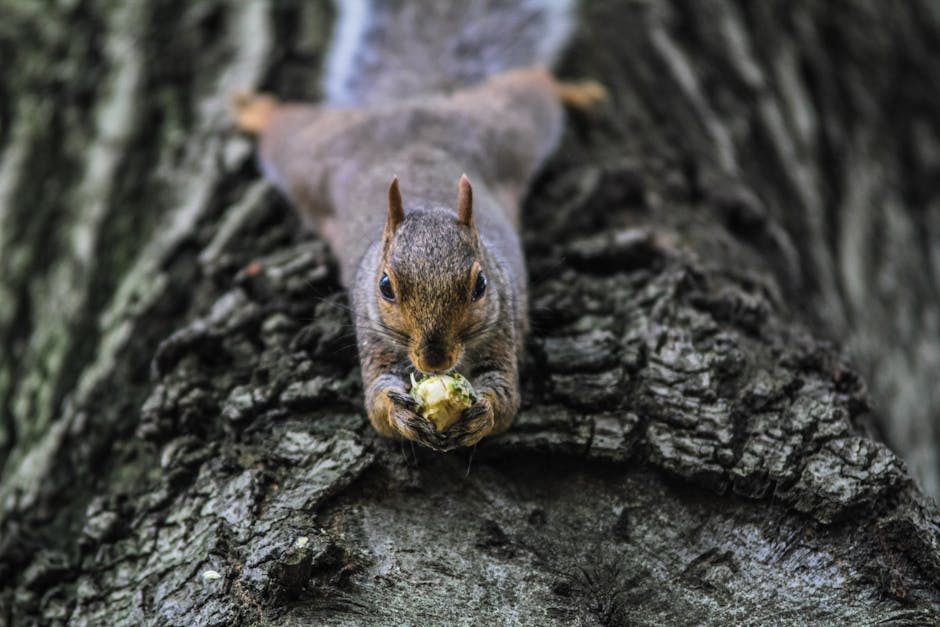
The tiny gap between his prominent front teeth and his curiously alliterative name seemed to indicate that Earl’s squirrel trapping profession might have been pre-ordained. His detailed description of a humane removal plan for the squirrels that were tearing holes through my ceiling further convinced me that he had found his niche, or vice versa. The idea of humanely catching the squirrels appealed to me. I like squirrels. But when they became squatters and inhabited my nighttime silence with scratching and mating sounds and eventually poked their groping paws through to my bedroom, I needed Earl.

His plan was to set traps throughout the yard, and over a period of a week to catch the five or six squirrels he imagined were nesting in that corner of the old Victorian home where I lived in the Bronx. As part of his professional inventory, Earl brought cases of chunky Peter Pan from a bodega in Queens, claiming the generic brands didn’t hold the squirrels’ interest. His Havahart cages had long ago lost their factory sheen, so there was no need for camouflage. Earl assured me that they worked best when they were a little ragged and rusty.

“They might be ugly,” he said, “but they are disinfected with Clorox after every catch. To stop the spread of diseases.”

Earl placed two old and ugly but germ-free traps around my yard and left a Peter Pan trail that led to the sensitive triggers. He hoped that in the chill and hungry New York winter, my emboldened squirrels would run headlong into their Havaharts, nibbling contentedly on the chunks of nut not found in generic brand bait.

“You got some fine cats there. Better keep ‘em inside during the trapping period. Catch me lotsa cats when I set traps for possums, ‘cause then I use smoked fish. But a hungry cat might like peanut butter just as good — and every cat stuck in that cage is another squirrel I have to reset for. Caught the same gray tabby four times at a house in Yonkers. A stray. And they say cats are smart? I guess there’s no accountin’ for hunger. But the guy wouldn’t pay me for removing a stray cat, even if it was a nuisance to ‘im. And I don’t give no free rides to Westchester.”

Earl took his catch up to a few different wooded areas in Westchester County, and let them go into the relative wilds. I asked him if he thought of leaving squirrels at other homes and sticking his business card in the mailbox. He flashed his gapped grin and snapped his fingers.

“If I ever need an agent I know where to come!”

Westchester County’s squirrel population must be growing at a good clip. Earl caught seven at my house in a week.

Sometimes it’s the smallest things that stir the memory.

I suppose I should have been happy that Earl’s plan was working. On the first day, just as I was leaving for work, I checked the two traps. I saw one black squirrel with nut-brown eyes, quiet and tensed inside. Another gray-brown one was wild with desperation. In both, I saw deception, accusation and fury aimed at that steel door that blocked their return to my ceiling or wherever they had once called home. Little paws gripped the metal bars of the cage as they sniffed the air for any sign of change.

I stood very still and watched. I remembered prison, looking through barbed wires at the mountains around me, knowing there was music out there. And I couldn’t get to it. I remembered the scent of my wool blankets. My bed. From the floor of the Mexican prison where I slept fitfully for 33 nights, I recalled sunlight making lacy patterns on the ground under my jacaranda tree. Like these squirrels, I was uncertain of how that steel door had snapped closed behind me, and more uncertain of when or how it would open again. With great effort I distilled myself to essentials, trying to save the delicate parts of me from the harsh realities of imprisonment. I tried to make myself small and hard, so I could slip through unnoticed. I remembered the other women’s nut-brown eyes, sometimes wild, other times wide and calm. I remembered the women in prison and the many traps that had caught them by the leg, not so humanely as Earl’s. I thought of the metamorphosis of captivity. How a cage, austere and corroded, is the entire world for a moment. And then it opens to Westchester. And it might as well be Jupiter. And you might as well be a squirrel, for all the familiarity you feel with the way you look now. With the way you react to the new freedom around you. With the way to find home. You sniff the air for any sign of familiarity, but there is none.The new freedom I found on release was dotted with prisons I hadn’t noticed before. Dependence, insecurity, doubt. “There’s no accountin’ for hunger,” Earl would have said. I followed dozens of nut-studded trails to dead ends while picking my way home.

That morning, I don’t remember if it was cold, or if I was breathing. All I could see were the traps. Sometimes it’s the smallest things that stir the memory. And sometimes nothing has to stir it – it is just there. I see their faces still. Full lipped, heavy lidded, high cheeked, drawn, vibrant, painted, wan, changeable faces. I see them on the streets of New York. There is Bertha reading The Wall Street Journal balancing on the A train. And Maritza gave up crack and is selling chocolates wrapped in colorful foil, shaped like bunnies for Easter. That woman walking her baby in Central Park looks like Fátima, but her baby would be bigger now. These are not the women I knew in prison. I want to ask these women: “Can you possibly imagine what it’s like not to have a choice? To wake each day and know exactly what is waiting for you? To feel minuscule and helpless against something you cannot control?” But I am afraid. I am afraid they will say “Yes. I know.”

There are so many prisons. Some we just wander into unaware.

I can tell you about a prison I knew once. About a woman who slept underneath a bed and a woman who stomped a rat to death with her foot. About a drug runner turned playwright and a Zapotec woman who could teach God about dignity. About women so hungry for crack they would sell a half-eaten sandwich for a dime, and women hungry for a choice, for retribution, for a voice. I could tell you about this prison and these women and their walls and the wisp of their lives that curled around my own. I would tell their stories to cut a hole in the mesh, to help them escape… or to help me escape.

The black squirrel made a scolding noise. My reverie broke and I walked to the station to take the one train downtown to my ragged office where I spent my day chewing on chunks of nut.

On the last day of Earl’s trapping schedule, a Havahart cage was sprung, shut tight but empty. I asked him about it. He said it could have been a bird. They are often small enough to fit through the holes in the wire.

“Their little bird eyes don’t see that wire around ‘em. They walk right out as if nothing has happened. You can’t keep a bird in one of these cages. They got freedom in their genes. It’s not a choice for them. They just go.”

Many of the women I knew in prison will be finding their own new freedoms by the time you hear my voice.

Many will be left behind to listen to the reminder of birdsong from the trees outside the barbed wire. The squirrels will adjust to the taller trees of Westchester, and I will unfurl again, closer to home with every step.


Mary Ellen Sanger lived for 17 years in Mexico, and has published in several Mexican journals, including Luna Zeta and Zocalo. Her essay “A Grammar of Place” was anthologized in Mexico, a Love Story, published in 2006 by Seal Press. She was a finalist for the Room of Her Own Foundation “Gift of Freedom” in 2007, and was awarded a writers’ grant from the Barbara Deming Memorial Fund for Women. She is currently writing a collection of stories inspired by the women of Ixcotel State Penitentiary in Oaxaca, Mexico where she spent 33 days and nights falsely imprisoned in the fall of 2003. Mary Ellen leads a creative writing workshop for adults through New York Writers Coalition at the New York Public Library.

“Out of the Blue” by Mary Ann Cain

Blue Skies

Twenty-six years ago, he called from Paris, from a phone booth he’d hot-wired
for long distance at no charge. Last summer, it was an email bearing the
heading, “Out of the Blue.” It had been almost as long as that stolen phone
call since I’d last heard from him.

I never saw him again once he left for Paris. But he did call—twice—until the
French phone company cut him off. And he did write, a letter or two, one
about wanting to make love to me on his windowsill with the amazing rooftop
view.

The email comes to my campus address, the one that anyone even remotely
curious could Google with ease. The tone is friendly, even polite, like that of a
distant friend with whom one has lost touch, not by design but by default. He
offers some details about himself, says he heard from a former teacher of ours
that I am teaching creative writing. He’s married to a kindergarten teacher
(which I knew), has a teenaged daughter (which I didn’t know but am not
surprised to learn), lives in Evanston in an old red brick house with a white
dog.

I check out his website. It’s the same face, only without the wild expression of
the one in my high school yearbook, that crazed-looking face that, a few years
later took Indiana reservoir curves at high speeds and dove into its dark
waters during a full moon. It’s a mellower, more peaceful face, the kind of face
that won’t scare off business for his freelance writing work. Age has been kind
to him. I notice, though, that in a separate photo his white dog still mugs a
salacious grin.

I’d heard he’d published a novel, though I never saw it on the shelves. But at
the bottom of his email is a website for downloading an e-version of his book.

He’d written in my yearbook the year I graduated and he left for graduate
school, “You’ll probably end up a better writer than I. At least I can say I knew
you when.”

I am just curious enough to write him back. I respond in kind about the big,
brown-shingled house from 1929 that I share with my poet husband and my
beagle with the soulful eyes.

*

High school graduation is a month away when I tag along with some of the stage
crew guys to visit him in Lombard, where he lives in his grandfather’s house. He
shows our entourage inside the house, dark and gloomy, solidly wooden in the
Germanic style of my cabinet maker forebears.

“Whipping Post” is blasting on a stereo with seriously large speakers. The stage
crew guys are duly impressed by the sound equipment while I am stirred by Gregg
Allman’s larger-than-life vocals. The guys pass the album cover back and forth,
noting the tribute to the band’s roadies on the album’s flip side. They are like his
roadies, having traveled an hour west just to return sound equipment they had
previously hauled for one of his theater productions.

Walking back down the gravel drive to the car, he and I chit chat about our next
moves as the stage crew guys pile inside an old Falcon. He is going to graduate
school in southern Indiana to study creative writing. The gravel under my feet, the
grape leaves trellised against the wide hips of his grandfather’s house, the
flowering bushes and generous front porch transport me to a familiar place, a deja-
vu that is also prescient of what is to come. I reach out for one of the grape
leaves, twirl its sturdy stem, and risk a small smile back over my shoulder. Maybe
I’ll see you there, I say. Knowing, with that gesture, in that place we’ve both
known before, that we will, of course, meet again, and again, and again. The leaf,
the twirl, the knowing smile. On the way home, one of the stage crew guys sitting
in the back seat kisses me, but I am still twirling that leaf, smiling that smile, as if
I have already lived the life that is yet to come.

*

I met him in high school, creative writing class. It wasn’t my first class in that
subject, but it was the first one where I could imagine writing as my life’s work.
In that class, we wrote journals. We watched surrealist movies such as Un
Chien andalou, replete with a razor-slashed eyeball and ants like sinister armies
stalking from an open palm. We did writing exercises; we read out loud. He
turned me on to Anais Nin and Henry Miller. He said he taped words that he
liked to his wall, unusual words like fritillary. He was also an actor and director,
in charge of stage crew for school productions but also director of his own
shows.

Word had it that he was dating the leading lady in his fall show, a cheerleader
who aspired to be the next Melissa Manchester. “Dating” wasn’t the word for
it, though. Two students was dating. A teacher and a student was something
else.

He read my journals for class and made brief notes in the margins, encouraging
me to keep writing. After he’d read a few weeks’ entries, he asked me to stay
after class one day, then offered to tutor me privately. Together, we would
read Nin and Miller, Durrell, Artaud, and all the other writers mingling in that pre-
Hilter Parisian café scene.

When I stopped by his classroom one afternoon, the cheerleader was there,
and they were laughing, leaning into each other, like they shared some secret.
Later, when he asked me why I had left, I said I felt like I was inside a
boudoir. He laughed, that crazy howl that was his trademark. I always
wondered if that was his real laugh or if he was acting; it seemed too big to be
real. After I turned him down, claiming I was too busy with speech team and
the school newspaper and my AP English class to take the time for tutoring,
and after he tried to persuade me to rethink my priorities, I started to fantasize
about him, about him and the cheerleader, about him and me and an
opportunity that I could not put into words.

The rumors about him and the cheerleader continued into the spring. She
played Lola in the annual musical, “Damn Yankees.” I shared the role of
reporter Gloria Thorpe with another girl until the cheerleader came down with
inflamed vocal chords two weeks before the show, and I was asked to take
over her role. I’d never sung in front of anyone before, and although I had
done bit parts in other shows, I’d never played a lead. She wrote me a
handwritten note, encouraging me to act like a cat onstage, to help me get into
Lola. I hated her for writing me. It was the kind of advice he’d have given, had
I let him. I never answered her. I was furious with him but instead turned my
scorn on her.

He, on the other hand, was all the more attractive for being so outrageously,
intensely, and inappropriately involved with a high school student (if the rumors
were, in fact, correct—I never did ask him). I wanted what she wanted. I
wanted to be noticed, admired, talented, a star. Other girls in school were
rumored to have done the same as her, slept with male teachers for reasons I
was only just beginning to understand.

I never acted again. I never sang again. But I kept writing–in my journal,
stories and poems. I read the writers he wanted me to read, and the writing
of their friends and lovers, reading my way into other worlds more passionate
and stormy than anything I alone had ever imagined.

I haven’t spoken to him in nearly three years when he comes into the small café
where I work as a cook, across town from the university. Only this afternoon I’m
also waiting tables, covering for an absent server. I greet him to take his order.
He’s with a friend. They laugh and joke. I push at the bandanna that holds back
my hair and tug at my cut-off shorts, feeling sweaty and unattractive.

I tell him I thought he’d left town, graduated. He says he’s visiting before he leaves
for Paris.

Even though fall classes have started, the steamy southern Indiana air lulls me
into believing it is still summer, and I have all the time in the world. Three years
collapse into three days. We joke and laugh and say nothing about the years of
silence between us. I bring them German beer in brown bottles and bratwurst I
spear from a pot of boiling beer and wedge into steamed seeded buns. I am a
vegetarian, yet bratwurst envy seizes me as they take huge bites from their
sausages and guzzle beer from the chilled mugs I chiseled from the freezer.

The friend is watchful of me when I return with more beers, and again with the
check. It’s late afternoon, and few people are around except the café owner, who is
preparing to roast a whole pig on the patio, part of a special weekend event that
includes belly dancers and a band. I feel the friend’s eyes staring at me, at my Ball
U t-shirt that I first bought back in high school but still wear when I don’t really
care how I look. Those eyes are dark and wolf-like, and in hindsight, a little scary. I
look past his eyes at the pig on the spit, the owner cursing as he struggles to
mount it on the barbeque rack, readying it for the fire to come.

He asks me to go to a party tonight. I touch the loose tendrils of hair reaching out
from under my red bandanna. I feel the tug of my t-shirt across bare nipples
underneath, the rub of my cut-offs in the crease of my thighs. Those wolf eyes are
devouring me. I turn back to him, whose eyes are light and whose red lips remind
me of a beautiful girl’s.

Can you pick me up? I ask him. The wolf eyes look away, out of shyness, or envy,
or simply lured by some other sight, I can only guess. But after that they stop
watching me and turn to him alone.

*

The first time we made love, he picked me up and brought me to his apartment
on a side of town I’d not yet been to, too far from my dorm to easily walk. It
was a two-story place, with doors on the outside like a cheap motel. By the
calendar, it was still summer, but I shivered uncontrollably while sitting on his
sofa. I didn’t think of our meeting as a date, as in pizza and a movie, or a party
with friends. We were both new to town, and so still had time to kill. I think he
cooked dinner, but I don’t remember what we ate. I tucked my hands into my
armpits, and my stocking feet between the sofa cushions for warmth. We
smoked a joint, and I shivered even more.

“I’m freezing,” I said, in hopes of drawing him closer. But instead of covering
me with himself like a blanket, he touched me lightly, kissed me delicately,
feeling his way. I buried my hands in his hair, rubbed my feet against his.
Eventually he must have noticed my shaking because he took me by the hand
and to his bed, where a plush satin comforter folded me into its softness, and
finally, I could relax and feel my warmth return.

Later, he asked me gently if this was my first time. “No,” I replied, somewhat
defiantly. I did not want him to think I had been shivering out of fear. The
apartment was dark and cold, and I was sensitive to the lack of heat. I
wanted, needed more. But when it finally arrived, I was too exhausted and
stressed to feel much more than relief that my shivering was over.

*

The party, as it turns out, is him and his friend, and two six-packs of cheap beer.
They have both been getting high, but when they offer me a joint, I shake my
head. I will be the sober one on this wild ride. He steers his Pinto tight around fast
curves hugging the reservoir, serious as a race car driver yet laughing all the way. I
sit in back, minding the beer, gripping the top of the bucket seats for balance while
he and his wolf friend pass the joint back and forth. He starts to drive off a ledge
then stops at the very last minute, laughing, his friend laughing, me unable to
crack even a lame smile. If I bail out now, I’ll be stuck out in the woods, on a road
few drive, with no sense of direction and only Chinese velvet flip flops on my feet to
get me home.

He parks at the edge of another bank high over the water, and they are both
running down, flinging off shirts, pausing at the shore to push down jeans and
shorts, then diving headlong into moonlit water. At first, I am determined to wait
in the car, keep myself apart, but the heat, and the light, and the sound of the
water pull me down the rocks and onto the narrow beach, testing the temperature
of the reservoir with my bare toes.

I know they are watching even though I can’t see them. I can feel their eyes on
my skin, the color of the moon, and just as light. Between their laughter, I feel
them ripple through the dark water as I enter, slowly, carefully, deliberately. I am
apart and distant, yet intimate as moonlight.

Just before his email came, I had been back in southern Indiana for a
university conference. For some reason, I had felt drawn to retrace my
steps around the town, around campus, daydreaming, sweating in the
mid-May heat, letting random memories flow in and out. Despite the
unlikelihood, I searched for familiar names on the mailboxes of a white
four square where I’d lived with a friend my senior year. I cut north
through the student ghettos and around the pampered Victorians with
their gingerbread and high-pitched roofs, following the shade of old
sycamores and poplars. I searched for the Oriental grocery where,
one summer when I was laid off for six weeks, I bought almond
cookies for ten cents apiece to stretch my meager unemployment, but
found no signs of the store. Then I headed uphill towards campus, on
the way sizing up the sports-bar inhabitants of what had once been a
vegetarian restaurant run by a local ashram. The varnished picnic
tables and mirrored Rajasthani embroidery that had decorated the
walls was replaced by big-screen TVs and table tents touting draft
beers.

I returned to the dorm where I’d spent my first two years, a huge
limestone building in the shape of an H. Inside and upstairs, WPA-era
murals depicted different decades of student life on the cafeteria
walls. Sturdy, brass-edged tables still filled the huge room. I started
to count the chairs but gave up after a few hundred. The dish room
where I’d worked my first year and the serving line my second year,
my hair held back by old lady-style hairnets, had been replaced by a
food court that looked straight out of a mall. Downstairs, the snack
bar had been upgraded and the small grocery expanded, along with
internet terminals scattered around the lobby. The brass wall of
student mailboxes, however, had not changed. The granite floor,
brass stair rails, and imposing limestone walls transmitted a comforting
sense of permanence, yet at the same time sparked strange fears of
its weight.

Inside that building that had housed generations of students, my
weightless wandering took on a heaviness and deliberation. What
had started as simple nostalgia and a desire to wander became a
more conscious circumambulation of a place that was sacred for all it
had given. Yet that same place also bound me to old desires that had
disappeared from view but, like the cicadas that trilled without pause
as I continued to walk, were still very much present even after I no
longer listened. I searched for words similarly sacred, similarly
powerful, words of gratitude but also words of release.

As I walked, I breathed in gratitude for all I had experienced. I
breathed out my wish for freedom from desires unmet, from what I’d
lost, from whom I’d known that continued to haunt my present-day
life. I stood in the courtyard outside, where students in cutoffs and
bandanas had once thrown Frisbees and blasted Kansas from dorm
windows, and breathed in my dorm window where I’d perched big
speakers until they had crashed to the floor in the middle of a Steely
Dan song, then breathed out the memory of that sickening thud. I
breathed in the grassy courtyard, now empty but for birds and cicadas,
and breathed out the window of a guy I’d once loved, how I’d watched
for his light to come on and wondered if he had done the same for
mine.

I followed a shallow stream that cut through the heart of campus,
paused on the plain wooden bridges, and breathed in the honeysuckle
around the President’s house. I breathed in the tall, modern building
where I’d taken all my writing classes and attended readings, and
breathed out the memory of preachers who’d stood outside each
spring and warned of hellfire soon to come. Back in town, I breathed
in the deliciously bitter espresso of a coffeehouse that was a second
home when I lived down the street, and visited the goldfish that still
lived in the bathtub, then breathed out the red brick apartment of
another guy I thought I could love but never got a chance to. I
breathed in the second floor of a house sheltered by shady poplars
where a friend and former writing teacher had invited a few of her
students over to form a writing group, and breathed out the memory
of her suicide years later in the desert West. Heading back to the
courthouse square to the import shop where I once splurged and
bought a flowered kimono, I breathed in the memory of a pizza joint
with all-you-can-eat spaghetti that had given way to a much more
expensive continental café. I breathed out as I passed the café on the
way to an Afghani restaurant where I was to meet my friend from the
white four square to talk about, among other things, her son who had
signed up for war time Reserves.

When I came home, and saw his email, Out of the Blue, I realized
immediately that his apartment was, inexplicably, the one place I had
neither breathed in nor breathed out and the one I most needed to let
go of for good.

*

The last time we make love, it is hot, height-of-summer hot. But the
reservoir has bathed and rocked us, and the breeze from the Pinto’s open
windows has ruffled us dry. Inside, I feel cool and clean as a hit man.

The awkwardness and expectations, the hope and the helplessness of
nearly three years ago have given way to a more calculated set of desires.
He will say he’ll write, and I’ll pretend to want him to. I will send him off
to Paris, and out of my life, proving to myself that I, too, can act as well as
he, and enjoy playing the part.

*

He emails that he is starting a theater troupe that will perform plays as
living rituals. In leaving him out of my own ritual, I realize I’ve left
something undone. Somewhere in the dreams that housed our desires,
we still meet, we still act as if there is no end.

Breathing in, I say silently, release me from those dreams. I breathe out
the ruins of my desire.

*

I have dreamed this house before, the kind my grandfather grew up in on
the south side of Chicago, solid, gloomy, and full of dark-stained wood. I’
ve never lived in such a house, but I still know it as a familiar place: safe,
substantial, meant to last. The house I was raised in was new, bright,
and modern. I long for the mystery of my grandfather’s house. It’s that
house and its surrounding property I fall in love with before I ever fall in
love with him: the big trees, the vines on the walls, their roots large and
deep. I have been here in my dreams and beyond. I want to fall asleep
on its wide porch in a warm breeze scented by snowball and lilac bushes,
bridal veil and honeysuckle, trumpet vines and roses. Sleep and sleep,
and never wake again.

*

We email a few times more. I don’t say much about his new theater; I
expect he is working up to ask for a donation. Instead I ask about a
mutual friend and my former writing teacher, the graduate student
who had started a writing group with her students and who, a few
years later, had killed herself in the desert West. Did he know what
had happened? I’d tried to find out and gave up, but never stopped
hurting for the loss of her. He emailed me the novel he wrote about
her, which included excerpts from her journals that he had taken after
she’d died. I read the whole thing in two days, stayed up through a
fierce storm until four a.m. just to finish, stunned to find out she may
have been sexually abused as a child. Only in the novel, the abuse
occurs in a “past life.” When I ask him why he did not make the abuse
real, he writes back that he didn’t want to make her a victim. Of
course, this doesn’t stop her character from killing herself.

I decide not to offer comments on the novel. He has just revised the
manuscript and may have a publisher, so I tell myself there is no
point. I thank him for showing me the manuscript and the insight it
gave me into her.

But then he asks what I think. So I decide to tell him the truth, that
his use of my friend’s journals to tell her story is more about him and
his own need for redemption than about any redemption of her. He
doesn’t respond for two months, when another email arrives, this time
very brief, asking for my snail mail address. No comments about my
comments on his novel.

Just as I expect, a brochure arrives, asking me for support for his new
theater. It amazes me that he would ask, yet it doesn’t surprise me,
either. I have always supported his shows, played parts that were
written long before I was born. I have lived his dreams as if they
were mine. Why would he think anything has changed?

At the bottom of the brochure is a brief note, thanking me for my
comments on his novel. I continue my ritual, breathing out as I throw
away his brochures when they arrive in the mail and delete his emails
of solicitation without reading them. I don’t have to; I know his lines
well. I breathe in, still twirling that leaf, smiling that smile. I breathe
out the red-lipped girl who wanted so much to be noticed, admired,
talented, a star. Breathing in, I am grateful for having survived.


Mary Ann Cain has received grants from the Indiana Arts Commission and Indiana University Purdue University Fort Wayne for her fiction, as well as residency fellowships at Hill House Writers’ retreat and the Mary Hambidge Center for the Arts. She received Special Merit for Abiko Quarterly’s International Fiction award (Japan), was nominated for General Electric’s Award for Younger Writers, and was a finalist for the Schweitzer Fellowship (under the direction of Toni Morrison) at SUNY Albany, where she earned a Doctor of Arts in English in 1990. Her outside interests include West African drumming, movement, meditation, cooking, and hiking. She lives with her husband, poet George Kalamaras, and their beagle, Barney, in Fort Wayne, Indiana.

“Breathing Rock: An Alternate Illness Narrative” by Katharyn Sinelli


I don’t much care for the idiom “overcoming obstacles.”  There are a few things
that bother me about this image.  First, the saying assumes we all follow some
kind of path, a sort of straight path, and that as we march along this clearly
marked trail invariably we reach a section that has been blocked off; an obstacle
lay across the way preventing further forward movement.  The size of the
obstacle can differ.  A fallen tree, a pothole, a boulder, and there is always
some debate as to who placed the obstacle in your path.  Was it God, or
Karma, or the random calculations of chaos theory?  Whatever the reason, the
result is always the same.  You have to stop.  You have to break the rhythm
that carried you forward and you have to figure out what to do next.

There are not many acceptable courses of action in this situation, at least not
many you would tell people about.  You’re unlikely to admit that when you first
encountered the obstacle you did an about face and ran screaming back down
the path to wherever it was you were before.  Nor would you tell someone that
when faced with the obstacle you climbed under the kitchen table, cried, and
decided to stay there until someone came along to clear the road.  No, your
only real choice is to find a way over.  You cannot go around or under, and just
standing still is not an option.  If you really want people to respect you, if you
really want to, say, write a book about the experience, you have to overcome
your obstacle.

My deepest objection to this image lies in the depiction of our movement.  The
linear forward trajectory, and the vertical lift, still forward reaching, that propels
us over each barrier we encounter.  We have little contact with the obstacle and
once we land on the other side, the trouble is behind us.  It does not follow
and the only way to remember the ascent is to look back. But we don’t really
do that, not for long.

This description does not match my experience with life’s obstacles, and I ran
quite a little steeplechase in college.  Freshman year I had cancer, sophomore
year I was held up at gunpoint, junior year I had a nervous breakdown, and
senior year my cancer came back.  I know I’m supposed to talk about how I
conquered these issues to become a healthy, content, productive, member of
society.  And Lord knows, at 32, I should be able to leave the events in the
past.  Now that there’s been a ten year stretch of road between me and that
rough patch.  But I find I cannot tell this story.  I don’t think I overcame
anything.  To say that I did hides the truth of the situation as I experienced it.

I was not particularly brave or heroic.  I did not hurl myself over the wall like a
pole vaulter without a pole, catapulted instead by the stiff strength of my
character.  There was no beautiful jump that left me suspended in the air in a
pose of forceful grace—one fist pumping forward, one back, one leg
outstretched, mouth set in an expression of grim but gorgeous determination.
Nor did I scramble up the rock wall, muscles stretching and straining as I pulled
myself higher.

If I had to stick with the obstacle metaphor, I wouldn’t say I went over at all; it
was more like I went through.  I think about David Copperfield walking through
the Great Wall of China, one of the yearly televised stunts he did in the
eighties.  He stood backlit behind a sheet as we watched his shadow merge
with the wall.  Chinese women in white jump suits pointed large white disks at
the wall to monitor his heart rate as he moved through.  At one point he was
stuck and his heart rate stopped.  The Chinese women didn’t seem too
concerned.  They just set up the sheet and the back light on the other side and
a moment later we saw Copperfield’s shadow pull back away from the wall.   He
ripped the sheet down with a flourish, and there he stood in his tight black
pants and black shirt unbuttoned to his navel.  He didn’t even look out of
breath.

I like that idea—merging with the obstacle.  Then, in my progression through,
there would at least be one moment where I was not visible, being entirely
consumed by the mass, before I emerged out the other side.   I would be
caught for a while in the middle of the obstacle.  The real drama would come
from wondering if I’d ever make it out.  I like the idea of becoming the wall, of
fitting the solidness of my body into the solidness rock.

Even though David Copperfield looked fine after he emerged, he couldn’t have
been quite the same.  How can you merge with something and still be you when
you come out the other side?  I wasn’t.  I think I carry some of the obstacle’s
molecules inside of me, and that I left some of my own inside of it.  I don’t have
the same chemical composition.  I am elementally different.  This is an image I
like.  This is an image that accurately describes what I saw and what I felt.

I don’t always picture my movement as slow and deliberate.   I was carried
through the transition from adolescence to adulthood by the force of inertia.  I
built up a full head of steam in high school and sped towards a “good college”
and the “better job opportunities” that came with it.

When cancer got thrown at me the month before I started college, this
momentum drove me right through it with a smash and the splintering of
wood.  While this image smacks of liberation and the “breaking of barriers,”
that’s not quite how it felt.  When you hit a solid object at that speed –full
force—full body contact—blood vessels burst.  I spent years picking the
splinters out from underneath my skin.

I like the idea of velocity presented by this image.  At eighteen, I was launched
from the sling shot of expectation.  I was driven by an external force; I had no
internal combustion.  Each barrier in my path stole some of my borrowed
energy until eventually I ran out.  The forward motion ended. I toppled over on
one side.

These are the metaphors I would use to describe my experience of a diseased
body and a disordered mind.  They fit.  But I find I can’t use them in  ordinary
conversation about my illness.  Not with most people. Especially not now that I’
m well.  Even when I talk about writing against the grain of the common cancer
story.  Even when I say I think the power of positive thinking is a load of crap,
and I actually use those words, “load of crap,” people still only hear the
overcoming obstacle story.  They picture in their minds my great, graceful leap.
And really there is no recognizable trope for moving through an obstacle, or
being stuck in the middle.  I’m not sure how I would begin to explain it.  What
would I say?  “Remember those David Copperfield specials?” or “Imagine what it’
s like to breathe rock.”  Or maybe I could start with “Bodies in motion tend to
stay in motion unless acted on by an outside force.”

It’s not that I’m pessimistic or unhappy. I’ve been cancer free for ten years and
while I still worry about a recurrence,I’ve managed to piece together a pretty
nice life.  I’m married and pursuing the career of my choice. I was even able to
get pregnant, and am now overwhelmed by the tremendous possibility of new
life.

I would, however, like to be able to tell my story the way I saw it, the way I see
it now.  I am different and not only in nice ways.  People want to hear about the
strength and the inspiration, but they don’t want to hear about the hardness
that develops around the scars.  I would like to be able to tell a more complete
story.  But I’ve learned that people want to hear two things: how brave I was,
and how it’s over now.


Katharyn Sinelli was awarded a Master’s Degree in Creative Writing from Cal State Northridge. This piece is the epilogue from her thesis. Katharyn’s scholarly work is focused on Disability Studies, particularly the stories we tell about disease in literature and popular culture.

“David” by Joe Lynch

When the afflicted man
called out, the Lord
heard/And from his distress
he saved him.
Psalm 34 Verse 7
A psalm of David

It was a hot August day and this was our fourth call in a week for an overdose.  Bad heroin had descended on the neighborhood and the junkies had no choice but to take the chance. I shut off the siren as Tommy parked the truck in front of a small brick apartment building. Brian, Stan and I hurried to the second floor. Tommy stayed with the truck.

A shirtless kid in about his mid-twenties met us at an open door. He kept blubbering about his friend. The shirtless kid was tall and thin. He carried himself hunched-over. I don’t know if that was his natural stature if he hunched to keep the large silver chain and cross he wore from flailing about.

“He’s dead.” He choked out between sobs. “I told him not to do that shit no more and now he’s dead.” The kid couldn’t stay still.  He started into the apartment and then came back to us.

“Oh God, Oh God,” he kept repeating, brushing at the tears on his face.

We’re just firefighters. It used to be we only ran into burning buildings. Now we do medical emergencies too. The medics are overworked. We get to the emergency quicker and hopefully keep the patient alive long enough for the medics to arrive.

“Calm down,” I commanded the boy.  “Where’s your buddy?”

“He’s in the bathroom.  I threw him in the shower to try to bring him back but he ain’t breathing.”

Brian had our medical bag and brushed past me and the kid and looked around. “Where’s the bathroom?” He asked.

“It’s straight back.” The boy sobbed. The apartment was one large room with the kitchen area to the rear. Brian and Stan headed in that direction. The skinny kid tried to follow them.  I grabbed his arm. I wanted him with me in case things went south.  “You stay with me.” I said. “You’re not going to do anything but get in the way. My guys will do whatever they can for your buddy.” I kept my voice soft, trying to calm him.

Brian and Stan disappear into a door on the left.  The kid threw himself to the floor with a wail and sat with his back against the wall with his elbows on his knees, and his face in his large hands.

The apartment was cheap, but not dirty, at least not yet. They must have just moved in.  It appeared to have just been refurbished and our footsteps gave a little echo as we moved around.  A new off-white paint covered the ceilings and bare walls. The only furniture was a medium sized light brown wood table sitting in the middle of the floor.

The empty apartment was a pleasant change for us. The usual when dealing with junkies was squalor.  No doubt over time, this apartment would become an odorous roach infested hole. The big silver cross and chain would be gone too, sold or hocked. I’m not casting judgment. My son’s an addict. It’s just what drugs do to people.

The kid staggered to his feet and was crying again. He started to make a rush towards the back. “Let me see him.” he cried trying to bull past me. I got in front of the boy and put my hand on his chest. “Calm down son. You can’t help.”

I felt sorry for him but I’ve learned to stay unaffected. My guys claim nothing ever bothers me. They say ice water runs through my veins.  It’s not true. I feel things as much as anybody but I’ve learned to keep it on the surface. After twenty-eight years of dealing with trauma, I don’t let it go to my core.

“What’s your name?” I kept my voice calm and comforting. I try to treat everyone with kindness. Its good business and I guess it’s my nature.

“Adam”

“What’s your buddy’s name, Adam?” Just then Stan’s blonde head popped out of the bathroom.

“He’s alive, Lieutenant,” Stan yelled, “but he’s in deep. We need help getting him out of the tub to work him.”

I joined them in the tiny bathroom. Stan and Brian were in front of me but I got a glimpse of a short muscular kid stretched on his back in a pool of water. The small bathroom made the move difficult. Brian hoisted the boy’s shoulders and head from the tub and then handed him to me.  I cradled his upper body in my arms. Stan grabbed under his knees and I backed out of the bathroom. We stretched him out on the kitchen floor and I got my first good look at him.

I looked at his face and my legs started to go on me. I can’t ever remember that happening to me before. I willed myself not to fall. It was David.

At least I thought it was David. I took a longer look. The boy had the same short muscular body, the same sandy brown hair and even the same not quite round face. I scrutinized his face and breathed deeper. This boy’s face was just ever so slightly dissimilar. I hadn’t seen David in weeks but I was certain that this wasn’t him. I took a deep breath and tried to calm myself.

This boy was in bad shape, though. His breathing was down to about three or four respirations a minute. Brian hooked the bag valve mask to the oxygen cylinder and placed it over the kid’s mouth. Brian started working the bag. Using his hand to squeeze the air in the bag and push it into the boy’s lungs. I watched his chest rise and with it a blue vein protruded on his forehead.

The blue vein caused me to look again. My son has a vein in his forehead that bulges much the same way. I had watched it rise in anger the day I threw him out. He had been to rehab four times. Each time he stayed clean for awhile but ended up worse than the time before. Finally, I made him leave. He was angry, Maggie, my wife and his mother, was hysterical but I managed to keep it all on the surface. I knew was being overly scrupulous
but I had to convince myself once more that this wasn’t my son. I studied his body and face until I convinced myself again.

I remembered the first time I saw I saw that blue vein. David came out of the womb screaming and when he cried a blue vein protruded angrily from his forehead.  He was the fourth child for Maggie and me and the only time I had been in the delivery room. I had been at the bar for the others.

The nurse handed me the baby. I cradled him in my arms and my eyes filled with tears, back then everything went to my core. I handed the baby back to the nurse and went to Maggie.  Her face flush from the delivery smiled at me. She looked as content as an infant herself.

“I’m so glad you’re here.” She sighed.

“I’m so sorry for everything.” I said. Our hands were entwined and I had my cheek against hers drawing strength from her.

“I know,” is all she said.

“I can’t tell you I’ll never drink again but I can tell you I never want to drink again. They say you can only do it one day at a time.” Fresh tears filled my eyes.

“I know what they say but I really think everything is going to be okay now.” The baby let out a wail and we looked over at his red face and the vein straining like it would burst and we both laughed.

“I think he has your temperament.” She joked.

“Is he going to be alright?” Adam’s voice brought me back to the here and now. I turned my head away and wiped at my eyes before turning back to answer.

“Well, he’s still alive but he’s not out of the woods.” Adam seemed to be in a little more control and I decided to press him a little. “What were you guys doing?”  I was sure it was heroin but it was good to get confirmation for the medics and the hospital.

“I don’t know. I wasn’t here.  He was like this when I found him” Adam’s pinpointed eyes told me otherwise.

“Hey man,” I said. “I don’t give a fuck what you guys were doing. You’re not in trouble with me and the cops ain’t going to follow up on this little bullshit. I’m just trying to help your buddy. Was it heroin?”

“Yeah,” he dropped his head and mumbled.

“Didn’t you guys hear about the bad stuff going around?”

“No, it wasn’t like that. He went crazy. He just kept shooting up. His supposed to go to detox tomorrow and wanted to get really wasted one last time.”

Brian continued to work the bag. Heroin takes you so deep you just stop breathing and soon after go into cardiac arrest. As long as Brian assisted his breathing, the boy should come out of this okay. When the medics arrived they would shoot him up with Narcan. It’s a drug that gets into the cells and blocks the opiate. Narcan can be amazing. It usually brings the patient back from being next to dead in a minute or two. I’ve seen them sit right up and become furious because you ruined their high.

But this kid had us a little worried. We didn’t say it. We could read it on each other. He wasn’t responding like he should and it seemed like it was taking the medics forever. Stan was shaking him and calling to him as Brian worked the bag.

“Hey buddy, wake up.” Stan rubbed his knuckle hard across the guy’s sternum trying to bring him around.

“What’s your buddy’s name?” Stan called to Adam.

“David,” Adam answered.

“David, wake up!  David, wake up, David, David!” Stan kept hollering into the boy’s face. I shuddered each time he called David’s name.

Everything about this run had been strange including my own behavior. I found myself standing directly over David scrutinizing him for the third time. My guys gave me concerned sidelong glances. I didn’t care what they thought. I needed to convince myself anew.

This boy had the same short cropped hair cut my David wore. He had the same thick eyebrows and he had that damned blue vein straining with each squeeze of the bag. I stood and stared at the boy long after I knew he wasn’t my son.

My concentration waned and my mind drifted back again, this time to before David’s birth. For a long time I had been sick with the booze. I went through countless car accidents, fights and overnights at the local precinct. These were small inconveniences but the depression ate me up. After a suicide attempt, I stopped. I just detoxed and stopped—no rehab.

The A.A. meetings helped. I stayed out of trouble but I stayed wounded for a long time. In some ways I was sicker without a drink than I had been with one. The depression wouldn’t lift and the mania for a drink drove me mad. I laid awake at night and it seemed as if I had four or five thoughts running through my head at the same time. On the rare occasions I did sleep, I awoke from nightmares in a cold sweat and an overwhelming compulsion to drink.

It was only a matter of time before I drank and suicide would follow. I chose to do it on my terms. I bought a gun. The feel of it in my hand gave me butterflies. I’d get a motel room so Maggie wouldn’t find the body and of course I’d get a bottle.

I’m not sure why I went to a meeting that night maybe a part of me didn’t want to die. I hadn’t told anyone about the gun or my plan but a friend at the meeting recognized my depression. He told me about how he had been depressed early on and how meditation helped him. He told me to read the Psalms and reflect on the words.

I didn’t have much faith in God and didn’t think anything could save me from myself but I had nothing to lose. I decided to give meditation a week because like I said I had nothing to lose. When the craving came that night I began to read the Psalms. I read them without hope or belief. I read them aloud because it seemed to be the right thing to do. The sound of my own voice consoled me. It soothed like a parent rocking a sick child.

The first week passed and I put my appointment with the gun off and tried it for another week and then another. The obsession lifted a little at a time. I sold the gun and never drank again. We named the baby David, after the killer of the giant and the author of the Psalms.

“Yo Lieutenant,” Brian’s voice brought me back. “Shouldn’t the squad be here by now?”

“They were coming all the way from across town. I’ll radio them and get an ETA.”  But before I keyed up my mike, I heard the distant wail of a siren.

“I hear them now.” Stan confirmed.

Two female medics came in, Erin and Grace. We had worked with them many times before.  It didn’t take long before Erin started a line and was giving him Narcan. “Keep working the bag,” she told Brian. “He’ll be up in a minute cursing us.”

I took over for Brian bagging the patient. It isn’t a hard task but Brian had been at it a long time and you get uncomfortable. Besides I wanted to do something to try to keep myself focused. I repositioned David’s head to be sure that his airway was open and squeezed the bag at regular intervals.

The bag was connected to our oxygen tank. With each squeeze pure oxygen pushed into his lungs. The cylinder then refilled the bag making it ready to be pushed into his lungs again.

I squeezed the bag. Let it refill and squeezed again. My full concentration was on working the bag and I found myself breathing in the same deep rhythm, squeeze. I watched David’s face as I breathed with him, squeeze, the blue vein on his forehead bulging and straining with each inhalation, squeeze. My eyes became wet with tears, squeeze.

Many minutes passed and David’s complexion went from gray to pale but there was little other improvement. The deep breathing had me in a kind of trance and I was only vaguely aware of Erin shooting David up with more medicine. I heard a voice screaming behind me. It seemed to come from another land.

“He’s not waking up! You guys said it would wake him up!” It was Adam.

“You have to calm the fuck down. You’re not helping,” Stan yelled back. It was really my job to keep order but I just kept breathing with young David while the madness went on around me. I kept my gaze on his forehead watching the vein pop each time I squeezed the bag. At some level I knew I should give the task to someone else and take command of the scene but I felt safe in the rhythm of breath like being in a rocker with an infant.

I heard Grace’s voice coming from that other land, sounding worried.

“We’ve done all we can here.  Let’s get him out.”  She bent down next to me.

“I’ll get the bag, Lieutenant.” It was her job but I couldn’t let go.

“C’mon Lieutenant, I got it.” She insisted. Her voice was firm but gentle and she looked at me with a compassionate gaze that I had seen her use on only the very ill. I relented and Grace took the bag as they carried David down the stairs.

I stayed in the apartment to pull myself together while they took David down the stairs and placed him in the ambulance.

I had forgotten about Adam. He was back against the wall with his hands in his face. “Oh, my God, Oh my God.” I put my hand on the back of his head.

“C’mon Son, I’ll get you a ride with the medics to the hospital”

Adam got up but was little unsteady on his feet. I grabbed his arm as we made our way down the steps.  “You said. He was going to wake up.” His voice cracked with emotion.

“Sometimes it just takes a little longer for some people. His color was coming back. I think he’ll come around.” Then I added, “Besides, he’s beloved by God.” I don’t know why I said it. It just came out.

Adam looked at me like I was the one on drugs, “What do you mean?” He put his long fingers around his silver cross, clinging to it.

“David, the name means beloved by God. I think God will get him through this.”

I thought about the Psalms. I thought about my son. “Yeah, God’s going to get him through this.” I spoke to comfort Adam but he had already climbed into the ambulance. I spoke only to myself and it soothed me.


Joe Lynch is a retired Fire Captain from Philadelphia with an MFA from Rosemont College. He continues to live and write from the “City of Brotherly Love”. He writes because he claims that it is the closest thing to running into burning buildings.  His prose has appeared in numerous publications. Most recently, The View From Here and Sunken Lines. He has a story due out in Morpheus Tales in October 2009.

“Pears” by Reamy Jansen


Today I bought pears here in Wadena to begin my residence as a visiting writer. My host, Kent Sheer, had driven me to the Wadena True Value, where he had tried to entice me to buy “our” (a.k.a., Central Minnesota’s) turkey and wild rice sausage, but I would have none of gizzards and grain. Instead, I headed off for the fruit section. Coming from a tree whose genus is Pyrus communis, a pear or two was what I, a new arrival, had to have. I don’t know the many varieties of this fruit and can only conjure a few names: Anjou, Bartlett, Seckel; that’s pretty much it. The three I bought were a speckled yellow brown, silting into a fading green, a muted blend that I hoped was carrying my pear closer toward ripeness.

I’m not a good judge of a pear’s freshness; they’re hardly as simple as apples, which if they’re firm, you pick one up and bite in. The solidity and shape of pears, though, don’t give
them the lightness and evenly distributed weight of apples. Pears are compact and hard, hard as rocks, actually, dense and grave with specific gravity. I tried to pick up some that
gave a bit of give, but this supposed tenderness was likely my imagination, for when I tentatively bit into one at home, it was…hard as rocks. I let the second selection sleep on its side undisturbed for two more days and then sliced into it the way my father did—part of his politesse with fruit, cutting, not biting. He’d bring me six even sections on a plate when I was a teen in the living room reading. This one was excellent.

My dad loved a bit of fruit, savored the juices, the entire activity of preparing, serving, and eating, offices hinting at the sensuousness behind his solid, upstanding Republican affect,
one fundamentally jolly and good-natured, and which I seem to have largely inherited, along with a jigger’s worth of my mother’s madness. Pears, cherries, red grapes, and peaches, the runny fruits were his favorites; and was it this physicality my mother desired to avoid by going to bed later than he? Perhaps the juniper in gin may be considered fruit, for, as Spenser tells us, “Sweet is the Iunipere.” My mother would stay on in the living room reading, as my father would head upstairs, his hand lightly gracing the polished mahogany
banister. Certainly I possess his taste-in-touch.

When he was in his seventies and living alone in too large a house, I would bring him cherries, Bings, and I would always laugh at his standing joke about Crosby not fitting into the bag. And when we would shop together, he would buy pears, which he could hardly see but knew well by hand through his delicate, tapering papery fingers.

I buy a few pears whenever I’m away somewhere writing, like now, where my studio is in the town’s assisted living center, The Pines, and which is filled with a number of widowers like my dad once was. I have a shyness about buying them and linger before their open baskets, never quite able to remember what I succeeded with last time. Since I like both
the idea of pear-ness and something of the thing itself, too, I just choose a color, usually red or yellow, the color of maple leaves in the fall. I handle each one carefully, though I learn  little from doing this. Each day here, I’ll check them with my right hand, which directs my most responsive fingers, and gently test the taut middle, one pear always lost in the trial for ripeness. The second is usually perfection a day or two later, desire finally grafted onto that Ding-an-sich. Its swelling side makes way for my father’s pen knife, his still-sharp blade easing through the slightly grainy flesh, making thin, even slices, leaving a square core behind. I eat those gleaming pieces slowly, wetting my fingers.

At home, my wife, Leslie, who wants to give me all things, will sometimes buy me pears knowing that they mean something–what some people, perhaps the French, like to call the
presence of absence. Knowing the nurturing lore of her grandparents’ Maryland farm, she puts them in a paper bag, sure that this is how they will ripen. And they do.


Reamy Jansen‘s essays and poetry have been in 32 Poems, Gihon River Review, Hamilton Stone Review, Innisfree Poetry Journal, and Alitmentum, where this piece first appeared.