“Seeds” by Matt Thompson

Seeds (Matt Thompson)

The old man doesn’t work in the store, but that doesn’t stop him from suggesting the watermelon. He could be an older employee. In hard times a job at a grocery store doesn’t seem so bad. But that isn’t the case. He doesn’t work at the store. The state of his fingernails is what gives him away, yellowed and bitten to the nub. He doesn’t wear the red vest of the other employees but that could be written off as a minor error. Maybe he forgot to put it on this morning. The fingernails do it though, they give him away. No one would employ someone with such negligence for basic hygiene. Still, he pursues customers with gusto, his gray combover flopping up as he trots after them. It doesn’t look like his combover has been combed over in quite some time, but the evidence remains. They don’t want the watermelon. They scurry away from him as if from a dog with rabies. The old man falls down chasing after them and a look of sheer terror crosses his face. He is concerned about the watermelon. He inspects it from the gray-speckled tile floor and is relieved to find it intact. He stands up and is smiling. He’ll find someone else to take it.

My own father never really cared for me. That’s not my phrasing. He said that to me at one point in time, which made his diagnosis difficult in an untraditional way. When the doctor said, “I know this is difficult,” he wasn’t referring to the fact that my father and I never got along, and that his condition was going to force us to spend time together. He was talking about the disease. As I am a man, the doctor most likely didn’t question the lack of tears on my part, but he didn’t know. I didn’t have any tears. The man had made it clear to me that he wasn’t interested in being a part of my life, and now he needed me to be. He needed me to be a part of his life, or his life would be over sooner than preferred.

I did have tears the first time a boy broke my heart, but dad wasn’t interested then.

“Will you hand me my jar?” he said. He meant his beer glass. It was the collector’s type that restaurants sell. I never saw him with another one so I guess his collection ended at one. The restaurant label had long since worn off. He didn’t even use it to drink out of; he used it as a spit cup for his chewing tobacco. It was a disgusting habit and I hated it. I handed him the glass.

“Did you hear me? Louis said he wants to see other people. What does that even mean?”

“That’s just how your type are,” he said, and spit a large glob of brown juice. He was not a caring man.


The old man has caring eyes. It’s clear to everyone that his mission means everything to him. He has nothing on his mind but making sure this watermelon gets eaten. It’s too perfect not to be. Every once in a while he puts it up to his ear and taps it with his knuckles. The look on his face afterwards is one of pure contentedness. He worries from time to time that the fruit might be getting overripe, but each time he finds that it isn’t is a little bit sweeter than the last. Some part of him must be aware that if he doesn’t get someone to take the watermelon it will eventually be overripe. I’m in the frozen foods section when my turn comes. I can see him casing me from near the lima beans. He holds it in his arms and buffs out a perceived spot with his shirt. I notice it has a mustard stain on it near the collar. He’s looking to see if I’ll take good care of it, if I’ll slice it properly. A poorly sliced watermelon can be ruined. I’ve got to be the right candidate. He doesn’t speak to me when he approaches, but holds it out to me.

“No thank you,” I say, but he doesn’t understand. He holds it out but I keep pushing my cart towards frozen pizzas. “It does look good,” I admit. “But I don’t really eat watermelon. I don’t need one.” He nods but his face doesn’t change. He doesn’t understand. He hangs back but I can see that he is still following me. Apparently I have been chosen as the rightful buyer. Or maybe I’m just the first person who hasn’t run away from him or told him to leave me alone.


Bittersweet. I was ashamed to admit it, but it was true. My father’s condition was bittersweet. He was no longer the same man, but it was difficult for me to mourn the death of my father’s lifelong personality. This new man who had appeared—he liked me. He needed me, and he appreciated that I put his jacket on for him before we went to the park. It was amazing how fast it happened. It wasn’t fast strictly speaking, about average the doctor had said, but the change didn’t seem gradual. At first he forgot a few things here and there, but he was still the same man. When Marv came with me to check on him, he would ignore him completely and have a terse conversation with me. The funny thing was that had Marv not been there, we probably wouldn’t have had any conversation at all. I don’t know what he got out of it. Maybe he thought he was proving something to Marv by ignoring him. Those were the days before Marv and I moved into his huge old house. He still resented us checking up on him. He only cursorily acknowledged that it was a safety issue and permitted to me coming by once a day in the afternoon. He always pretended like he had been doing something so important that it couldn’t possibly be interrupted for very long. He had to fix this, or he had a program coming on in five minutes, or he was reading a particularly good piece in the paper. Anything to make my visits as short as possible.

“You read this one?” he said to me one afternoon a few years ago. He was holding up a newspaper that I recognized. I set my bag down on his kitchen floor. “Jesus, don’t put that there,” he said. “You’ll scratch up the floor— put it on the damn hook.” I did as he asked.

“What is that dad?”

“New zoning law. Bullshit if you ask me. Gonna knock down my Arby’s.”

“What day is it, dad?”

I had a set of questions the doctor told me to ask if dad ever got confused. They weren’t exactly scientific but they could give me a pretty good idea of his state of mind. The first test was how dad reacted to the question. He gave me a suspicious look. He was angry but cooperative.

“Monday.” I didn’t respond. I waited for him to elaborate. “The fifth.”

“What day is on the paper?”

He looked down at the paper in his hands and it was painful to see the look on his face as he realized that he was holding a paper from three days before. He had already complained to me about the knocking down of his Arby’s. This was the first wake up call. He yelled at me and told me to leave. He was fine and wouldn’t be needing my services for the rest of the day. That evening was the first time Marv and I had a conversation about dad’s future. It was the first time the possibility of us moving into his house had come up. At that point in time Marv and I didn’t even live together.

“Okay dad. I’ll go. I’ll see you tomorrow.”

“Pick up your feet. Your queer shoes are scratching up my floor.”


He tails me through soups, both canned and boxed. I prefer the boxed kind. He doesn’t pretend to be shopping. He doesn’t have that kind of tact. He mutely follows me wherever I go, waiting for me to show him some sign maybe—a sign that I’m accept the watermelon, that I’m worthy of it. It’s clearly the best one of the bunch. When he gets close enough I can tell that he needs a shower, but that’s only for small moments. He mostly hangs back. That is until I get to coffee. I stare at the coffee every week, like I’m going to change my mind, but I never do. I always get the same kind of coffee, but the staring at the selection of coffee is a vital part of the shopping experience for me. He gets closer as I marvel at the different varieties of beans. It seems that there’s a new kind of coffee every week. The coffees are like my news. I don’t watch the news and I don’t read the news, but I’m very up to date on the coffee world. You mean you haven’t heard about the strife in Guatemala? No but their coffee beans have doubled in price in the last month. Now I know why.

The coffee aisle is always the last I visit. Maybe he can intuit that, or maybe he’s seen me here before. Either way he can tell that I’m about to leave, and he doesn’t want to lose another one. He comes directly up to me, avoids eye contact entirely and places the watermelon in my cart. I don’t get mad. I don’t yell at him. It is a good watermelon. And he was careful not to damage any of my other groceries. He placed it down gently next to my bread, making sure not to damage any corners.

“Thank you,” I say. “It looks like a winner.” I rap my knuckles on the fruit and am greeted with a satisfying hollow noise. “You picked out a good one.” He walks away without saying anything to me.

“Thanks,” I call after him. I hear him mumbling to himself as he slides out of view and back towards produce.


“It won’t be a problem. Trust me.” I tried to reassure Marv. It was his first time going back to my dad’s. The first and last time he had come along hadn’t gone well. “He’s not the same. If he had the capacity to realize who you were, he probably would still hate you, but he doesn’t. His disease has lessened his prejudice because he can’t really distinguish people apart enough to discriminate against them.” My easy way about dad’s disease made Marv uncomfortable. We were going over to look at the space more than to see dad. I’d basically been living with him for a while. I left him with a neighbor I’ve known since childhood to get Marv. My pile of blankets were folded on the couch, and my reading glasses on the arm. Evidence of my living there were everywhere, greeting us.

“Doesn’t seem right,” Marv says as we approach the front door. “Appraising the livability of his house.”

“I can assure you that it won’t bother him. He’s mellowed a lot. Depending entirely on other people will do that to you I guess. I think he might have even forgot that I’m gay.” That gets a chuckle out of Marv and we enter my father’s house.

Marv is a contractor and took notes in his pad about the problems the house had. Over the past few years it had seriously declined. With dad no longer being able to make repairs (I took away all his tools for safety) and me being incapable of doing them in the first place, a lot had gone unrepaired. There was a leak in the attic. That was to be number one on the list. There were bugs in the basement, and the garage was full of old newspapers. Dad never threw away newspapers.

“I use ‘em to start the fires in the fireplace,” he used to say, as if he needed a thousand pounds of old newspapers for the three fires he lit each winter. Countless light fixtures were missing pieces that had fallen off or been knocked off years ago by a still angry, ashtray throwing dad. He loved the Phillies. But like me, they were a constant disappointment to him. I still put the games on for him, but he got frustrated when he asked me the names of the players and I couldn’t tell him. It was actually nice, his quiet frustration. He crossed his arms like a child and pouted. It was endlessly more pleasant than him berating me for never taking an interest in sports.

The guilt was hard at first, but wore off. What did I have to feel guilty about? I was taking care of a man that had never liked me—had told me so to my face, had not attended my college graduation, and publicly condemned my “lifestyle” when it was his turn to speak up in church. But still I felt guilty.  I liked dementia dad better than regular dad. That’s not how it was supposed to be. I was supposed to feel sad when my father succumbed to a degenerative disease, and no longer consistently remembered who I was, outside of the person who took care of him. I often wondered who he thought I was when he would ramble on about the Phillies to me while I changed his diaper.

“My son never went to a Phillies game with me,” he said one time. That was the first time I really understood that he didn’t even know me. But what confused me the most was why he didn’t question it. He had reverted to childlike status, and children don’t question authority. I told him to do things and therefore I was in charge. He yielded to that instinctively. So he didn’t question the middle aged man changing his diapers and cooking his meals. I was just there.


I’m standing in the checkout line behind an obese woman who has at least twenty items, twice the limit of this line, when I see him again. He has picked out another watermelon, and is offering it to an old woman. She is hunched over and clearly frightened by him. She is motioning for him to leave her alone, but he doesn’t understand. He has chosen another perfect specimen and she should buy it. I don’t know why I just watch and do nothing. I can predict in that moment everything that is about to unfold. As sure as I know that Yuban columbian is six cents more an ounce than my preferred Master Chef medium roast—I know how this is going to end. She yells and pushes her cart at him. They both fall down. Another shopper rushes to help the old woman up. The cop standing by the front doors takes action. He runs to the produce section, holding his belt buckle. The watermelon is smashed on the floor and is all over the old man’s shirt, obscuring the mustard stain in a sea of red. The man stares down at his broken baby and bursts into tears. He tries to wipe his face on his shirt but only makes matters worse. His tears run red with watermelon juice and the cop hauls him to his feet. I should say something but I don’t. The cop turns the man around and cuffs him. For some reason this cop can’t see that this man doesn’t belong in prison. He doesn’t know because he was standing by the automatic doors reading his newspaper, bitching about zoning laws. How they’re making his Cracker Barrel move to a different location, farther from his apartment. The building’s going to be a dance studio. He leads the old man out of the store, pushing him from behind. The old man stumbles and we make brief eye contact. I grab the watermelon out of my cart to hold it up for him—to show him that I’m buying it, but it’s too late. The Cracker Barrel cop has already pushed him out the door. I’m left holding up a watermelon in the air in front of confused shoppers. One man claps, but quickly stops when he realizes that this isn’t one of those types of moments. The janitors have already been called and they’re pushing their cart towards the split-open watermelon on the floor. The janitor’s cart has a radio, and it’s tuned to local news. A newscaster tells of how a new school is being built. Zoning laws had to be changed, he says, and a local video store will be forced to move. At least it’s for the children. The janitor reaches down and takes a little bit of watermelon from the middle. It truly is perfectly ripe. He eats some of the melon from his palm, and spits out the seed, no respect for the dead.

Marv was shocked by the change in dad, like I had been at first. I tried to explain that it only felt like it happened quickly. He didn’t see him every day so the change was more drastic. Because I was with him every day I could chart his changes: the first day with the newspaper, the first Phillies game entirely watched and completely forgotten, the first time he forgot my name. I had a mental checklist.

“How do you deal with it?” he asked me, while taking a sip of lemonade. He and my dad were painting the living room together. Dad had been calling him “Marty” all day, but seemed to be loving the painting. He wasn’t very good at it, but Marv mostly covered up his work.

“I’ve come to terms,” I said, because I couldn’t admit it. Marv felt the appropriate emotions and he wasn’t even the son. I couldn’t say to him, “You remember the man, he hated me,” because that wasn’t the correct response to have. I couldn’t say the truth. He was better now. Marv would have said, ‘That guy was always in there. He was just emotionally closed off. He’s always loved you,” or something like that, but I don’t know if I could believe it or not.

“Eventually he will forget everything. Even who he is,” the doctor had told me in private, a year or so earlier. He hadn’t said he would revert to what he was feeling inside—that he would finally love me, in his cluelessness. That’s not what the doctor said. The doctor said he would forget. And he had forgotten. He forgot how much he disliked me. And I had a hard time letting that distinction go.


I pay in cash and the pockmarked kid does a terrible job bagging my groceries. The cashier makes no comment about me holding a watermelon above my head. I could have forgiven her for doing so. I drive slowly through the neighborhood and look at the Arby’s as I drive by. It still has the appearance of being new. It was a good remodeling job. Marv and I took dad there for lunch on a few occasions. He loved it. Dad died about three months ago. We live alone in his house now.

“What’d you get?” Marv asks me reflexively when I come in the door. He knows I buy the same items every time I go to the grocery store.

“I got a watermelon.”

“What?”

“We’re having watermelon tonight.”


Matt Thompson is a graduate of Georgia College & State University. He lives and works in Milledgeville, GA. He has written two novels: X. And Oleanders in Alaska, both available via Amazon. His previous short fiction has been featured in apt. He lives with his chihuahua Bruiser, and is seeking his MA in literature.

Read an interview with Matt here.

“Thanksgiving” by Cezarija Abartis

Thanksgiving (Abartis)1

Twilight and wind: changing weather, autumn moving in, leaves dropping, Andrea’s throat hurting when she swallowed, cold and feverish. She shivered. She sipped at the water. She should have put a lemon in it and honey, but she didn’t have either.

She should’ve asked Jeff to buy lemons and honey on his way home from work. Her friend Caroline believed that Echinacea worked; her friend Paula said there was no evidence that it helped at all.

Andrea’s chest hurt when she breathed: hot, cutting, ripping. The twilight flowed down on her, heavy and metallic. It was hard to raise her head against the clanging light. When she was little and sick, her mother would hug her, cover her in quilts, bring her hot chicken soup, let her watch Mr. Rogers’ Neighborhood  and cowboy movies until she fell asleep to the television. She wanted to float away on those good feelings now, but her mother had died four years ago.

“Here are my smiles to wrap you in,” her mother would say.

Andrea swallowed; her throat hurt. She wrapped her fleece bathrobe more tightly around herself. She shivered. She got one of her mother’s afghans to drape on herself. She wound a scarf around her neck. She was sure she looked like a grotesque character out of a Dickens novel.

She called her sister, but she wasn’t home. Dear, darling Ellen, who moved to Seattle and fell in love with Sam and then got a divorce a couple years ago. Andrea had never approved of Sam, because of his pompous pronouncements about health and nutrition. And then he left Ellen for an older woman. “I’m fine,” Ellen said, an edge in her voice, when they talked on the telephone last week. Andrea pictured her as biting the inside of her lip. “I’m trying these dating services. You’d think it was the nineteenth century.” She barked a laugh. “Only they didn’t live so long back then.”

“Some did.” Andrea knew she was being oppositional, but her finger hurt. What kind of stupid excuse was that?

“You’re an expert on demographics now?”

“More than you.” Andrea immediately regretted it.

Ellen clicked the phone off. When Andrea, self-chastened, tried to call her and explain her day and swollen finger, the line was busy because they both were trying to call each other. When they did talk,  they both behaved better and forgave one another. Today, when Andrea called Ellen for sympathy about her cold, Ellen wasn’t home. She was probably at the office.

On the radio the news was about the death of a ninety-year-old Congressman due to complications from pneumonia. Andrea allowed herself a book to read, a mystery, and a glass of Merlot. Poor baby, she was sick. The wind blew around the leaves outside. They shivered too.

Her father had been dead six years.

Her mother used to speak to Andrea: Stand up straight, Eat your vegetables, Play in the sun. Love is what you need. Love will get you through.

They both believed in love. Her mother remained a romantic even into her fifties after the divorce. Stories about Cinderella, about Jackie Kennedy and the disappointment when she married Onassis. Well, everybody had to survive, continue, move forward. Even princesses.

The very leaves outside believed in love. They crackled stories to each other about leaf-love, leaf-salvation. Never leaf-mold and leaf-death but leaf-health and leaf-happiness and leaf-eternal. Andrea coughed and shook her head at her own foolish whimsy. She was leaf-mad, leaf-crazy, leaf-sick, she knew that, maybe leaf-dying. No, it was just a cold. She should quit being melodramatic. A miserable, aching, fevered cold. Not her father’s heart attack, not her mother’s cancer. She had those things to look forward to, she supposed, but not yet.

Neither of her parents remarried, and at the end they tolerated one another, were polite. After he died,  her mother’s life went on, separately, with books and a few friends and occasional outbursts and judgments. She said she was glad to avoid Alzheimer’s–that at least was a blessing of cancer, and she laughed wryly. “You’re taking care of yourself, aren’t you? Getting your exercise? Your mammograms?” Andrea put her book on the end table.

If she could summon her mother, how would Andrea imagine her? Her mother, strong and young, would materialize in front of her. “How are you, baby? Are you taking care of yourself? I see you’re sick. I wish I could hug you, but I’m a spirit and you would feel only a breeze. I’m going to do it anyway. Oh, your warmth feels good.”

“I have a fever.”

“That’s not what I meant. Me holding your body, that’s good. You smell like earth. Robert Frost said, ‘Earth’s the right place for love.’ I still read poetry in the beyond, you know. Funny to call it the beyond. It’s really in your mind.” She tapped the side of her forehead.

“So you’re not really here?”

“I’m in your mind. What’s more real than your mind?” Her mother laughed, and it sounded like water boiling and spilling over. Then the laughter stopped. “Something’s troubling you, Andrea?”

“I’m afraid of every little thing. I have a cut on my finger and an infection, My finger is swollen.” She raised the offending digit, which was pink and puffy.

“Go to the doctor. What’s the real problem?”

“I don’t like the world–that it’s not perfect, that it will end.”

“Well, if it’s not perfect, don’t you want it to end?” Her mother raised a logical finger. “So it can start something better?”

“There is nothing better.”

“There you go! Lesson learned!”

“I don’t want any lessons.”

“You always were self-tutored. Quite a handful. Your sister was easier.”

“You loved her more!”

“No, dear. I loved both of you,” her mother said, her voice even and knowing. “I counted myself lucky to have both of you in my life.”

“I’m afraid of your cancer.”

“Oh.”

“Aren’t you going to say something? Dismiss my fears?”

“Fears are real.” Her mother pushed her fingers together helplessly and looked around the room anxiously.

When Andrea was little and got a bruise, she was frightened at what was happening to her. Her mother kissed the owie, applied an antibiotic and a bandage. “All better,” she said. Once, Andrea was afraid that she would grow a mustache and hair on her chest. Only boys did that, her mother said. Now Andrea wheezed and coughed and gurgled. Things were happening inside of her. The last light flowed across the carpet toward the couch as if to submerge her. She pulled the afghan higher, to her chin.

Her friend Paula lived alone, preferred that. What did she do when she got sick, had a chest cold and an infected finger? Who gave her sympathy? Who brought her warm blankets and hot tea? Who cared that her finger throbbed? That she couldn’t lift the full coffee cup with three fingers, that she didn’t want to type emails because her finger hurt, that signing her name was hard?

“It won’t happen to you, dear,” her mother said. “You and Jeff are fine.”

“How do you know?”

“The prefrontal cortex knows things.” Her mother tapped her forehead and laughed. “Your father used to call me ‘Sweet smart Baby Louise’ when we were young and dating. There was a time when he loved me extravagantly.” She stretched her hands in front of her, fluttered her fingers and made them into a book. “He said I had beautiful hands. Those were good times.” Then her eyes filmed over, she wavered in the dimness, and she was old again.

There was nobody else for either of her parents. They had their lives, their family, their work, and then they ceased. They dispersed into the cosmos, their shreds and dust never to come together in the same way. The first coming together was a wonder: it resulted in an engineer who enjoyed Shakespeare and in her mother who had beautiful hands and taught poetry to tenth graders. Louise and Eric would not laugh again.

“But we did once,” her mother said and floated to the door and came back. “So many mistakes,” her mother said. “I’m sorry.” She shook her head regretfully. “I should have let you go to the private college. But we couldn’t afford it. I thought we couldn’t afford it. I should’ve tried harder, worked summers, you wanted it so much.”

“I wanted it because Paula was going to that school.”

“She loved the school.”

“I would not have met Jeff, not have married him. It worked out fine, better than fine, perfect.”

“Next week is Thanksgiving. We had some happy holidays.” Her mother sighed. “I wish we’d had more, but that would be greedy. Do you miss me on the holidays?”

“Always.”

“That will suffice for me.” She was next to the door. She put her fingers to her lips and blew her a kiss. She shimmered, became grainy, and dissolved into the shadows. Then she stepped out of the shadows. “I forgot to say, I love you.”

“Me too.”

“And our fights, do you miss those?” Her mother turned and disappeared into the shadows.

“Even those.” Andrea looked down, squeezed and released the fabric of the afghan. She patted it until her swollen finger caught on a thread. She remembered a time when she shouted at her father that he didn’t know anything because he wouldn’t lend her the car, that he specialized in designing one kind of gear nobody cared about. Her mother walked up to her, eyes furious, and raised her hand but did not slap Andrea.

Prospero trotted in, tail perpendicular, alert and happy. He fixed her with his eyes and meowed. Then he sneezed. Probably it was some dust in the air, not a cold. She pulled off her afghan, went into the kitchen, and opened a can of cat food. “Happy pre-Thanksgiving to you,” she said. He relished it. She went back into the living room and burrowed under her afghan. Her father had rescued Prospero, who wandered up to their porch, skinny and emphatically meowing. Now Prospero probably did not remember his hungry days. Her father continued to rescue strays until the year he died.

Andrea closed her eyes and remembered her young, handsome father bringing her hot cocoa, with melting marshmallows oozing on top. Wisps of air floated by her, containing children’s happy shrieks from decades ago and smells of crisp leaves that she kicked through on her way to first grade.

There had been an older boy at school, several grades ahead of them, Denny, who wore a brace on his leg because he’d had polio.

She’d been going to her best friend Taffy’s house, when the car tires shrieked around the corner and hit a tricycle. Denny was not on it. It had rolled out of the driveway. In that instant, Andrea imagined that Denny was on it and was flipped up into the air.

She was now married and feared what it would be like when she was old and widowed. To be flipped up in the air without Jeff. She shivered. She was morbid. Or would it be Jeff who was flipped up and she who was on the ground standing, watching, horrified, with her hands on her cheeks, eyes round, mouth round, emitting a silent scream.

Jeff was late. Was he in a car accident? Had he been hurt? He had forgotten his cell phone on the table; she couldn’t call him.


She heard steps outside the apartment, a key in the lock, the door creaking open, a bag crinkling. It was Jeff. “Hey, baby,” he shouted. “I stopped by the deli to get you some chicken soup.” He walked into the living room, leaned over, and kissed her forehead. “How’re you feeling?”


Cezarija Abartis’ Nice Girls and Other Stories was published by New Rivers Press. Her stories have appeared in Per Contra, r.kv.r.y., Waccamaw, and New York Tyrant, among others. Her flash, “The Writer,” was selected by Dan Chaon for Wigleaf’s Top 50 online Fictions of 2012. Recently she completed a novel, a thriller. She teaches at St. Cloud State University. Her website is http://magicmasterminds.com/cezarija/

“The Tuesday Evening Meditation Group Breaks to Pee” by Richard Bader

Rinpoche (Meditation Group)
Detail from Vision of Yeshe Tsogyal by Chögyam Trungpa Rinpoche

The five members of the Tuesday Evening Meditation Group are flat on their backs in the upstairs classroom of the Unitarian church where they meet. The room is warm, its temperature set for people who don’t move around much. Eyes closed, they are tuned in to Conrad’s voice: “Feel the pressure on your pelvis as you relax into any tension there. Feel your shoulders where they sink into the carpet.” He is bringing them back from twenty minutes of acute body awareness visualization, horizontal variation. The thin gray carpet is stained and smells faintly of the collective dross of many years of church potlucks, and visualizing your shoulders sinking into it is not an altogether pleasant image, so they are grateful to be nearing the end of this exercise. This brings to a close an hour of marginally successful work to empty minds—earlier twenty-minute installments included simple sitting meditation and sensory breath-awareness meditation—and now another part of their anatomy needs emptying.

“And… back,” Conrad says, working the segment to a close. He tries to be soft and soothing, but his voice is naturally nasal and off-putting to some, and he speaks with an awkward cadence. “Now [pause] open your eyes [pause] slowly [pause] and come back into the space [pause] with everyone else.” He inhales deeply and loudly, then exhales with a whoosh. “Good. Let’s take a ten-minute break.”

Jennifer wishes he would have said slowly open your eyes instead of open your eyes slowly, because she’s suggestive by nature, and when he said open your eyes she just went ahead and opened them, quickly, and then when he said slowly it was too late to go back and do it that way, so the effect was jarring. The last thing Jennifer needs in her life right now is jarring. She is a short, stylish, forty-something human resources director with short, soccer mom-ish auburn hair who is fond of tight turtlenecks, and during lying-down meditation Conrad likes to watch her chest rise and fall as she breathes. Having peeked, Jennifer is aware of this, and even though she isn’t attracted to Conrad, it makes her wistful. She has a well of resilient good humor that she draws on as a defense against the torrent of personal misfortune she is undergoing: the recently fired husband who spends his days looking at Internet porn instead of searching for a job. The 93-pound teenage daughter in an inpatient program for anorexics. And the very recent news that the tiny lump she discovered in the shower a month ago is a big enough deal that her left breast will have to be removed. How interested would Conrad be if he knew that? Just yesterday, after her husband forgot to clear the search history on his laptop, Jennifer found a link to a website of women with mastectomies who had gotten tattoos to cover their breast scars. Some of them were quite beautiful.

It was Jennifer who several weeks ago suggested that they refer to their mid-session bathroom break as “achieving flow,” and everybody had laughed. Everybody except Conrad, who thought her glibness bordered on sacrilege, but said nothing. Conrad is tall and gaunt and has a braided black ponytail flecked with gray. He majored in Tibetan poetics and culture at a quirky but accredited college out west and wants the class to call him “rinpoche,” but as none of them are familiar with that term and Conrad himself seldom speaks unless he’s directing a meditation exercise, it’s unlikely that this will happen all by itself. Conrad has prostate cancer, but he doesn’t know it yet. This explains the pain he sometimes feels during sitting meditation. He has started to sit on a cushion, and this helps some. The cancer is the rarer, fast-moving kind. His reliance on homeopathic remedies won’t help him much, and in eleven months he will be dead.

Willow and Alex roll up in unison like it’s some kind of dance move they’ve practiced and then take turns massaging each other’s shoulders before they stand and stretch. They are young lesbian lovers from the college who are there because they saw a flyer outside their Religions of the Eastern World classroom. They are also there because they read on a blog that Sting meditates, and who doesn’t think Sting is cool, even if he is sixty. They hold hands when they meditate, aiming for a shared mystical union. This is kind of lovebird cute, but it also royally pisses George off, because while Willow is dark and scrawny and heavily pierced, Alex is an Amazon, lithe and bronze from time outdoors with the college soccer team, so when George sees her holding hands with Willow all he can think is, What a waste.

Ron has a crush on Jennifer but he hasn’t done anything about it. He is a single forty-seven-year-old librarian with a blondish comb-over. One Tuesday during a break Jennifer asked him what he did for a living and the top of his head went crimson as he tried to explain his job, where he wasn’t the head librarian, but after a recent promotion was number two. Jennifer, who asked Ron this question on a night when her husband was entrenched in front of the computer and her daughter was in the hospital and she herself ended up staying at a friend’s, found his shyness kind of charming. But since then Ron has avoided her. It was as if that one brief conversation succeeded in making him think that Jennifer might actually like him back, and breathing the rare air of that possibility was enough.

Ron also has a sort of crush on George, who joined the group just a few weeks ago. Not a romantic crush, but a man-crush, the kind of crush men felt about Sean Connery during his peak Bond years, a wanting-to-be-like-him crush. Not that George was anything like Sean Connery, to say nothing of James Bond, but he did exude a robust masculinity that Ron himself lacked. George was short and solid where Ron was tall and wispy. George was loud and boisterous where Ron was shy and nervous. George bellowed when he laughed and Ron did this sniffly thing that came out his nose. George has farted loudly and unapologetically during sessions, while Ron has endured stomach cramps. George arrives from work on Tuesdays in wrinkled grey suits from his job selling something—kitchen appliances, Ron thinks—his tie pulled loose at the collar. George smokes cigars and has high cholesterol. Ron is a near-vegan on a gluten-free diet. George is also, Ron thinks, the last person in the world you would expect to find in a meditation group.

George is at a urinal, so Ron steps to the single toilet stall. George pees like a Clydesdale, and Ron is envious of this, too. “Whatever inspired you to start meditating?” Ron asks, to relieve the awkwardness of just listening to pee.

George uncorks a bellow laugh as he tucks himself back in. “Shhhh,” he says, looking at Ron with a broad smile on his face and a thick index finger on his lips. “I’m not doing meditation.” Ron gives him a puzzled look. George winks, then explains. His wife thinks he has a drinking problem and has said she will leave him if he doesn’t get help. George did some research and found an AA group that met Tuesdays at the church. He went once and hated it. No one was any fun, and their stories were depressing. On his second visit, he discovered the meditation class meeting at the same time. “So,” he says to Ron, “here I am.”

Ron flushes and fixes George with an admiring grin. “You’re kidding,” he says.

“No, seriously. Tell you the truth, I like it. Worst-case scenario, I get a little nap.”

“And your wife thinks you’re at AA.”

“Yeah. But I don’t need AA. I’m not…” His voice trails off and he does a gesture of helplessness with his hands. His wife says that whenever he says he’s not an alcoholic it just proves he is, but is in denial. She learned this from something she Googled. He finds the logic absurd. “It’s perfect, right?”

“Amazing.”

“And you know the best part?  She’s thrilled by how well it’s working. Says she’s so glad I’m so committed to it. Can’t believe the progress I’m making.” Then with a stroke of ironic self-awareness, George reaches into his jacket pocket and withdraws a slim silver flask. He unscrews the top and extends it toward Ron, who laughs a real laugh, not his usual sniffly laugh.

“No thanks.”

“Jack Daniels,” George says by way of persuasion, but Ron shakes his head. “Suit yourself,” George says, and takes a swig.

“Oh, what the hell,” Ron concedes. As he feels the burn in his throat, Ron wonders what George will think of single-nostril breathing when Conrad gets to it.

Jennifer is standing at one of the sinks in the women’s room. There are two toilet stalls, which is more than sufficient given the church’s flagging membership. A flush comes from one and Willow emerges and goes to the sink next to Jennifer’s to wash her hands. Their eyes meet in the mirror, where Jennifer is drawn to the tiny silver stud in Willow’s right nostril.

“How many do you have?” Jennifer asks, touching the side of her own nose to indicate to Willow that she means piercings. Between the nose stud and the eyebrow hoop and the assortment in Willow’s ears, Jennifer counts nine.  She herself sports a very conventional two, one per earlobe, and she’s partial to gold dangly things.

Willow thinks for a few seconds, her head bobbing slightly as she counts to herself. “Fourteen. I think.” Three more head bobs, left-right-left. “Yeah. Fourteen.”

“Wow,” Jennifer says, reaching for a paper towel to dry her hands. Then, risking a level of intimacy she has no right to risk with this young girl, but newly intrigued by the concept of unconventional body ornamentation, she asks, “Where?”

Willow pauses for a second, then grins into the mirror and sticks out her tongue, displaying a round silver stud the size of a BB. Jennifer laughs. Then Willow lifts her black T-shirt at the waist to show Jennifer the tiny silver hoop in her belly button. The second toilet flushes, and it startles Jennifer, who turns to see Alex. Alex glances at her, expressionless, then locks eyes with Willow in the mirror. Her eyebrows arch questioningly. Jennifer feels her face redden. She looks down at the sink, then back at the mirror, missing the slight nods that Alex and Willow have exchanged. Then Willow lifts her shirt higher, then higher still, and pulls up her sports-bra with it. Her breasts are small and round and taut. Two silver hoops pierce her left nipple. The right nipple is un-pierced. Willow is grinning, though with the shirt lifted up Jennifer can’t tell.

Jennifer’s eyes fill with tears and she starts to cry.

Willow quickly covers herself back up. “What’s wrong?”

Jennifer waves her hand as if to say, nothing. Alex puts an arm around her. “You OK?” she asks.

“I have cancer,” Jennifer manages, then musters a brave smile and goes on to explain.

“Oh my God.” Willow sounds stricken. “I am so sorry. I didn’t mean…”

“No,” Jennifer says. “It’s OK. Really. I asked, didn’t I?” She looks carefully at Willow, who is only a few years older than her own daughter. She feels a rush of desire to comfort the girl, and starts to reach up to touch Willow’s face but pulls back. “I’m grateful. Really. Thank you.” She wipes her eyes with a Kleenex, then smiles and says, “You’re beautiful.”

“Do you want to just hang out down here for a while?” Alex asks. “We can stay with you.”

The generosity of these two girls moves Jennifer. She hopes her daughter will be like Willow when she is her age, then realizes that she has just wished for her daughter to become a heavily perforated lesbian and laughs. Willow and Alex laugh with her. Jennifer wants her daughter to meet them, thinking that maybe that would help, though from the look of Willow, Jennifer can’t rule out the possibility that she has food issues too.

“I’m fine,” Jennifer says. “Let’s go back up.” They are halfway up the stairs when Jennifer stops and grabs Willow’s arm. “Wait,” she says. “That’s only thirteen. Where’s the last one?” Willow and Alex exchange glances and burst out laughing, and Jennifer delights in joining them.

Conrad is sitting cross-legged on his cushion as they reassemble. He hears rain on the roof, and decides that tonight they will skip walking the labyrinth in the yard behind the church. Ron twists himself into a full lotus that will go from mildly uncomfortable to full-on knee pain in about two more minutes. The meniscus in his right knee is torn—an orthopedist has confirmed this—but neither that knowledge nor the pain will motivate him to abandon his lotus. Emboldened by George’s whiskey, he plans to talk to Jennifer after tonight’s class, and decides to use this final meditation exercise to think about what he will say. George, as always, pulls up a chair, and Conrad silently judges him for not trying harder. Alex and Willow sit with Jennifer between them. The sight of Jennifer giggling with the two lesbians produces in Conrad an emotion he might call rage if not for the fact that he has worked so hard to eliminate rage from his emotional vocabulary. He worries that they are mocking him. He has troubling thoughts about what might have gone on in the women’s room. “What’s funny?” he says with cool nasality, and Jennifer half-expects him to do the admonishing third-grade-teacher thing and add, Is it something you’d like to share with the group? But he doesn’t.

“It’s nothing,” Jennifer says, struggling for composure.

“Humble apologies, sensei,” Willow says, head-bowing with prayer hands, and the three women fall into each other, laughing hysterically.


Richard Bader‘s fiction has been (or is about to be) published by the Burningword Literary Journal, SN Review, and National Public Radio. This is his second story for r.kv.ry. He lives and writes in Towson, Maryland.

“Meditations on My Brother’s Winter Coat” by Fran Wolf

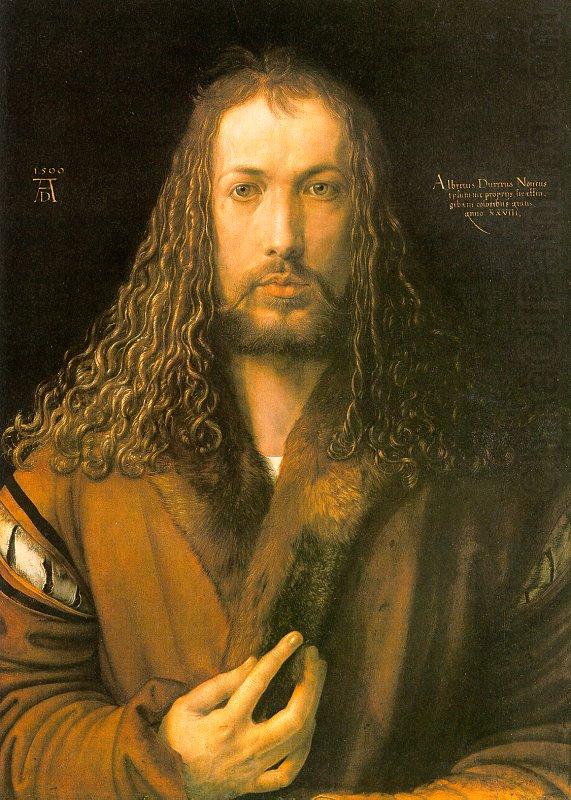
Albrecht Durer (My Brother's Winter Coar)
Self-Portrait at Twenty-Eight Years Old Wearing a Coat with Fur Collar by Albrecht Durer circa 1500

I bought my brother Davey a winter coat when he was sober, finishing his long interrupted college degree, and staying on his anti-psychotic medications.  David, I mean. He’s forty-five, not a kid any longer.  He stayed sober and sane for the past six years.  Something changed. A hormone shifted. One of his pills worked too little. Or it worked too much. Some hand of fate loosened its grip, or, grabbed tight, and he was drinking again, calling at 3 a.m., telling me what the feral cats were telling him, fighting with his psychiatrist, fighting with our mother, filling his credit cards with purchases and returns and re-purchases and re-returns of iPads, laptops, and the Oxford English Dictionary, twenty volumes, delivered who knows where. He gave away or threw away or somehow lost his winter coat.

After a stay at detox and then a psychiatric hospital, Davey is living with our mother and reading the copy of Marcus Aurelius’ Meditations that he asked me to get him for Christmas. Written nearly two thousand years ago, Meditations is the thoughts of a Roman Emperor on accepting duty, service and other things, like fate, that I don’t worry about given that I’m busy in the world of law, intellectual property, and money.  Davey’s resigned to circumstances; I make my own life.

“Bad job on the translation,” he says over cheese omelets our mother cooked. He wears a white wool sweater and jeans that are Christmas presents from our mother—from me, since I gave mom the money. Davey’s voice sounds as if he borrowed it from a stranger. He looks unfamiliar; but it’s been three years since I’ve seen him, and I’m tired from the cross-country flight. Davey and I still have the red hair and freckles of my mother’s side of the family. We’re both thin, but at 5’7” I’m taller. He still has that scar from when he was beaten up and too drunk to fight back, but his meds are user-friendly these days, no dead-eyed staring and jerky motions as from the Stelazine and Thorazine. We have my father’s blue eyes, but David’s are sad, as if he’d fallen down a rabbit hole and emerged when he was thirty-nine, not knowing what his life was or where it had been. We had such hopes during these past six years when he finished his B. A. in classical literature and applied for graduate school in education. Hope rose like ghosts from our childhood’s grave.

Optimism comes from my father’s side of the family. So does schizophrenia. Although mom thinks Davey’s bipolar, too.

“All right, I appreciate the gift, it’s just very modern…” Davey says, tapping his index finger on the table.

“That’s bad?” I ask. “Making an obscure book accessible? Maybe you would have preferred it in Latin?”

“Can you go shopping with David for a coat?” Mom intervenes, frowning. Her once crimson hair has faded to cinnamon and grey. Her brown eyes are tired. She butters the orange-currant scones she baked for breakfast. Some patent work on a web-based media, and I had the cash to buy her this two-bedroom condo with its kitchen overlooking the marina. My money can’t resurrect her dream of starting her own restaurant; that died with decades of Davey’s arrests, hospitalizations, medication changes, disappearances, and returns to her doorstep.

Now it’s the morning after Christmas. January promises snow. Davey needs a winter coat to replace the one he lost.

“Sure, I can drive him to the Mall.”

“Can you go shopping with him?” Mom taps her finger on the table as if she and Davey are sharing a bongo drum.

I know what she won’t say while he’s here: you’re his sister; sooner or later, he’ll be your responsibility.

~

Davey holds the North Valley Mall doors open for a white-haired grandmother hauled by yowling kids.

“After you,” he says and heads for the Mountain Sports’ Menswear section.

He scans the racks of North Face parkas, Columbia rain gear, Coleman all-weather coats, assorted down jackets. He rubs hood ruffs. He tugs at zippers. His hands drop. His nose wrinkles. Wrong color. Seams aren’t tight. Down isn’t waterproof. Too short. Too long.  A raincoat, not a winter coat. A parka, not a snorkel coat.

“Just what kind of coat are we looking for?”

“I’ll know it when I see it.”

We cross the mall to Burton’s Fine Clothes.

“Not here,” he says after a jet-fast scan of the coat racks.

We walk past screaming children and arguing spouses to reach Macy’s.

“No,” says Davey. Half-off signs hang over Women, Petites, Children, and Shoes. Menswear is a full-price wasteland.

“Trust me. Cost is not a worry. Get a coat and if you don’t like it, we can get you another coat.”

I don’t tell Davey of the client who called me at 9:30 a.m. on December 23rd desperate for a three-hour job for some minor software package that couldn’t wait until the 27th. It was four hours before my flight. “That will be $5,000,“ I had said, folding silk shirts and black jeans into my suitcase. He screamed; he cursed; he paid. I went online in the departure terminal, finished the job as the plane cruised over the Rockies, and emailed it to my client during the layover.

Davey scans the racks but stops to pull out a neon orange coat.

“Wrong color,” he mutters. He shoves his hand into the pockets. He checks the lining. He rolls his eyes at the price tag.

A sales clerk rushes over and says, “Happy holidays, how can I be of service?”

“Hello. How are you?” asks David. His words are a second late as if he’s translating from a private language; he waits for a reply. The clerk blinks and looks to me.

“I need this in a different color…” I start to say.

“Alright Joan, thank you, but…” Davey cuts in.

“Our post-holiday stock is on display,” the clerk explains, “We could order it for you.”

Davey puts the coat on the rack. I pull it off.

“Joan, alright, wait a minute!” My brother protests.

“I’m handling this Davey…”

“Call me David…”

The clerk blinks. Out of the corner of my eye I see Davey tapping his finger on the coat rack.

“Can you do a rush order? And do you have tailoring?” I continue.

Davey grabs the coat, shoves it onto the rack, pushes other coats around it, and turns to the clerk, saying,  “Thank you for your help, have a nice day.”

The clerk blinks and walks off.

“Davey, we could have finished this…”

“It’s David…”

“Whatever…”

“No, it’s David.  That’s my name… not that kid’s name, like I wasn’t…just say David, all right?”

“The coat is what’s important! What were you thinking?”

“C’mon, that guy would’ve wanted shipping, tailoring fees, extra charges for special orders…”

I almost say: that’s how normal people buy coats. Instead, I count to ten. I never believed Mom’s stories of giving Davey $10 for yard sales and having him come home with a Bill Blass robe and The Collected Poems of Emily Dickinson. Mom said he once found a leather-bound edition of all of Shakespeare’s plays and talked the owner down to $4.50 and The Hunt for Red October thrown in for good measure. (“He knows I love the thrillers,” Mom said.) Mom said that after Davey’s last binge —after he had been missing from the halfway house; after his photograph had been sent to emergency rooms, morgues and police stations; after he was found by the river — he was vomiting blood and booze onto an Armani jacket, a Goodwill tag stapled to the sleeve, a copy of Gilgamesh in his pocket.

“I’ll cover that.”

“But where’s the deal?”

“David, how many stores do we have to go to? There are other things I could be doing. There are even other things you could be doing. And there’s no better deal than a free coat. So let’s just get a coat, okay?”

Davey stares, as if he’s going to say something, but walks off. Maybe he counts to ten, too. We return to our car. We drive to the Woodland Mall. We are silent. We park, pass a labyrinth of cars to reach the elevator, and go to Mervyn’s on the 4th floor, Target on the 3rd floor, T.J. Maxx on the main floor, and the Men’s Warehouse in the annex. We find trench coats, Jefferson coats, snorkel coats, and leather coats. We find parkas and intricate poly-pro layering systems that fit under all-weather shells. We find coats that are tan or black, not navy blue, or that have fake fur ruffs not real rabbit fur, or that don’t reach past the hips, or that reach the knees, or that have no drawstring to cinch the waist.

We drive to the Central Valley Mall, Davey staring out the window, his nicotine-stained fingers on Meditations. We have a fight at REI.

“Did you take your meds this morning?”

“All right, what are you, my caseworker?”

“It’s been eight stores, Davey, maybe that’s who you should have gone shopping with…”

“All right, I appreciate the help, your driving and all, but call me David!”

“Well, thank God for my help,” I yell. Shoppers stare. I lower my voice. “We’ve only been driving all day…”

“All right, we need boundaries, this is my coat not yours, ” my brother declares.

“Do you always sound like you’re in therapy?”

He winces. I wince. Of course he always sounds like he’s in therapy. That’s where he is when he’s sober. Therapy. AA. College classes. That’s his life.

~

“Do you need me at Bargain Coats & More?”

“No. Why don’t you get some coffee?”

When all is lost, you can always find a Starbucks, and we do.

“It’s on me,” he says.

“I can get it.”

“Yeah, you told me, but I have money too. Cuppa joe,” he calls to the barrista.

He rummages through his jeans, pulls out a wad of dollars in a money clip, closes his eyes and says: “He does only what is his to do, and considers constantly what the world has in store for him—doing his best, and trusting that all is for the best. For we carry our fate with us—and it carries us.

“Davey —David,” I say, holding up my hand. “Your meds, you did take them, right?“

“Relax, it’s from the Meditations. Duty and opportunity. Marcus Aurelius is famous for that.”

“Sounds like a fun guy.”

“He’s expressing the Stoic philosophy. Life is rational, nature acts for the best, and the worst can be endured for the better. You should read it,” my brother says, handing over my coffee. “Just my way of saying, all right, I’m not teaching like I wanted, but I get man-around-the-house, fix-it jobs from mom’s friends.”

After David leaves, I get a double tall Americano. There was no need to embarrass him by correcting his order. Sitting at a tiny table, scanning my Kindle, I can’t remember many times when I was nice to David. It’s hard to think of that now when I remember his courtesy to store clerks and grandmothers. I don’t like remembering how we had read the Wrinkle In Time series together, and the Lord of the Rings, and how David had written to J.R.R. Tolkien for a dictionary to learn the Elf language. I don’t like remembering the summer Saturday nights we’d haul our beaten up kid’s telescope onto the back porch, David telling me the myths of Lyra and Orion and Cassiopeia, me searching for new meteors, new comets, new stars, mom chasing us back indoors right at midnight. I don’t like remembering just before I was sixteen, and David was seventeen.  The year it began.  When David would laugh and shriek through the night. When, for him, a chair became an oracle, and a can of beef barley soup became filled with worms.

I found my calico cat with her blood soaking into the back yard’s dirt, her skull smashed in, bits of her brain stuck to a red brick. I screamed for my mother.

“An accident,” she said. She was crying. “What else could it be?”

I knew then how it was going to be. I gave away my gerbils. I didn’t ask for permission before finding a new home for Mr. Charles Ames, our schnauzer. Meanwhile, Mom kept a steady stream of psychiatrists, therapists, faith healers, naturopaths, and acupuncturists flowing through our home.

I remember when I first saw David in the hospital.

“He didn’t mean it,” my mother kept saying.

David was sweat-soaked and turned away from the other patients: those without belts in their pants or laces in their shoes. My parents accompanied me, but I was alone—alone with the memories of the police arriving, of the ball-peen hammer David had used to pound demons out of my sleeping mother—didn’t that prove David loved us, and we loved him, he was trying to save my mother from demons—of my father throwing David to the ground, of my mother shaking and crying, of bruises on her arms and blood on her face, of screams. The neighbors said the screams were mine.

At the hospital, I remember David sat staring at a wall.

“Speak, friend, and enter,” I had said saying the words used to open the dwarves’ lair in The Fellowship of the Ring.

“Go away,” David told the wall.

I did. I asked David’s psychiatrists if I’d become like him. Back then, the psychiatrists were Freudians , so they blamed the mother, or Laingians, so they blamed the mother, the father, the sisters, and brothers. Then they said it was genetic, so they blamed the parents’ families.  Now they say it’s genetic with an environmental trigger, like drug use or trauma, nothing I could do anything about. So I did what I could. I worked as a library aide after school and a babysitter on weekends. I had dinner at friends’ houses where no one screamed, no one talked about medications, and it was safe to have knives at the table. I studied, earned scholarships, went across the country to college, found summer jobs away from home, and only came back at Christmas. I accompanied my mother as she brought coffee, sandwiches, and books to David when he lived at the halfway house, the treatment center, the hospital. I went to law school and became rich. David came of age and lived on the street.

Now our father is dead. Our mother is old. What will happen when I’m the only one to look after David?

~

David taps me on the shoulder. “No luck at the so-called bargain store.”

I tap my watch. Time’s gone; all I’ve done is remember things I can’t change.

We walk to the car. David hunches in the back seat sending plumes of smoke into the twilight air. David loved holding my gerbils in his now gnarled hands. He loved petting Mr. Charles Ames until the dog licked his nose in a frenzy of gratitude. He loved being my big brother, the one who kept my secrets, the one I trusted.

“Still reading Aurelius?”

“Yeah,” he is quick to respond, “listen to this: Does what’s happened keep you from acting with justice, generosity, self-control, sanity…”

“That’s quite a list,” I laugh.

“… prudence, honesty, humility, straightforwardness, and all the other qualities that allow a person’s nature to fulfill itself?”

“You believe that?”

“On my better days, yeah,” he replies. “At least, I hope so.”

I cannot love David. Perhaps something else is possible. I don’t know what.

“That’s not the way to Mom’s,” David calls out.

“I’m taking an alternate route,” I say. “Humor me.”

~

We see a strip mall where we stop, walk into Martin’s Menswear, and David sees his coat.

“All right. There it is. And in my size.”

I grab the coat off the hanger.

David grabs it back. He stuffs it between two other coats, saying  “I saw a 20% off coupon in the Bay Guardian.”

I count to twenty. I imagine ripping the coat to threads. I count to ten. This is all David has. The delusions, the hallucinations, maybe even the drinking are held in a delicate biochemical balance he can’t control. Finding the deal is still his.

“All right,” I sigh. “We’ll do it your way.”

We traverse the mall in search of a Starbucks with a Bay Guardian. We drive to the next strip mall, find a shoppers’ kiosk with a Bay Guardian, drive back to Martins Menswear, get our feet in the door and the coat off the rack and past the cashier with ten minutes to closing. David wears the coat as we walk out of the store.

Stars beam in the blue-purple night. I’ve seen that color in crocus bursting above ground in an offbeat blast of January sunlight. They can’t last. But there they are. Like the hope I had during the past six years of David’s sane, sober life. I want the hope. I want the hope because I want my brother back.

David beams. He stretches his arms. The navy blue coat seems to merge with the darkness. Cuffed sleeves notch over his wrists. A fur hood surrounds his face. The pockets are deep enough for books, a sandwich, a thermos of coffee, a bottle of rum. The coat is a den of warmth for a college student waiting for buses. The coat is a home a homeless man could carry on his back should David return to the streets. Perhaps not for months. Or years. Perhaps never. Perhaps tomorrow.


Fran Wolf writes stories she’s learned from living life as a paralegal, waitress, library aide, community organizer, phone solicitor for charities, and all too many other jobs. “Meditations on My Brother’s Winter Coat” is her first published story. You can reach her at: franwolf1117@gmail.com

“Junie the Tree” by Rasmenia Massoud

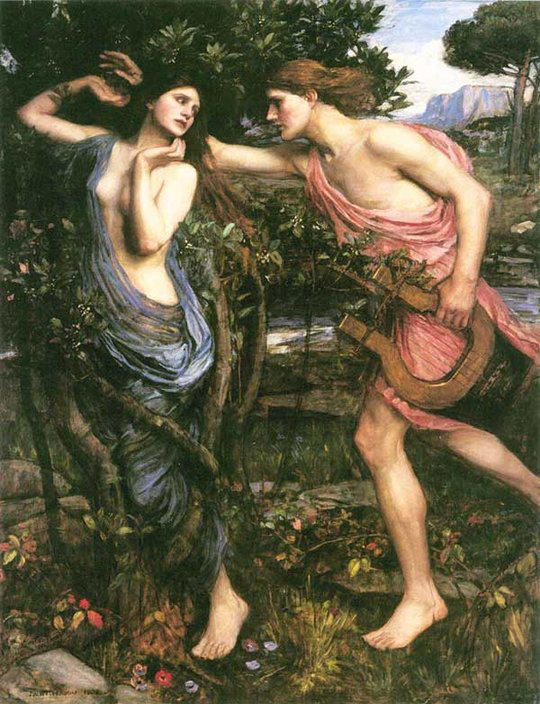
apollo_and_daphne (Junie the Tree)
Apollo and Daphne by John William Waterhouse, circa 1908

Junie the Tree started the game because the rest of us are cowards. That’s what she said, anyway, and no one was going to fight with her about it.

If Junie says you’re a chickenshit, all you can do is accept it. Then change it.

I stick my hand into the can and swirl the little scraps of paper around. This is one of those big novelty cans you find at the grocery store, filled with three different kinds of popcorn, the outsides decorated with holiday themes or whatever cartoon characters are popular right now.

Tiny echoes of rustling paper bits bounce off the sides of the can. Ghost scents of chemical caramel and cheddar powder drift up to my face.

“Just pick one, Ellie,” says Amelia. She’s got a cigarette in one hand. She nibbles on the thumbnail of the other.

“No shit,” says Brady. “You’re taking for fucking ever.”

All five of us are getting antsy. The anticipation, the nerves, this happens every time.

“Okay,” I say, “Get up off me, already.” I extract a folded piece of paper. I open it and read it to everyone. “Sucked off a stranger in the men’s room at Hardee’s.”

We all look at each other and shrug. “Not bad.”

“Well, it’s sorta gross.”

“Meh. Not super gross. There’s grosser.”

Codie takes her turn, pulls out a scrap of cheesy-smelling paper. “Ate two dozen tacos. Stuck my finger down my throat.”

Junie the Tree rolls her eyes, but we only see the normal eye. The lazy eye is concealed beneath her eye patch. “Is this amateur hour? Try harder.”

Frizzy blond hair sticks out in all directions on her head. Hair so blond it’s almost white; so fine you can see Junie’s angry pink scalp. Her shoes look like they belong to two different people. On her left, a blue, adult-sized knock-off of a Converse All-Star. On the right, a small, child’s size in the same style. Junie never had toes on her right foot. Instead of toes, it’s smooth, thick flesh.

She reaches into the can and pulls out an anonymous confession. She unfolds the paper, then starts laughing. After a moment of giggling, she reads it to the group.

“Shit myself at a party. Took off my crappy pants and hid them in my ex-girlfriend’s purse.” Junie folds the paper, still laughing and says, “Hilarious, but not enough.”

Brady reaches in, he eyes each one of us as he takes his time, feeling the bits of paper, looking serious and concentrated, as though reading them with his fingertips. He clears his throat, like he’s about to make a grand speech to a room full of people wearing suits and ties. “Fucked my brother.”

Junie the Tree leans forward on the couch. The way she smiles, it’s the same smile you see on the faces of mothers looking down on their ailing child. Soothing. Empathetic. A healing smile that says how much she wants to take the pain from you; that makes you feel like everything is going to be okay. “That’s better,” she says.

~

The last time I saw Junie cry was the same day she decided to be a tree.

Every morning, when I went across the street to Junie’s house to walk to school, there was an event. Screaming. Hurled objects. Rage-red, tear-streaked cheeks. I’d enter the house, following the sounds of her mother’s shrieks, yelling at Junie to eat her goddamn oatmeal, to comb that awful hair, to stop wearing that stupid eye patch to school.

“That thing is for your eye exercises. It’s not a fashion accessory. You’re in the sixth grade, not a fucking pirate ship.” She grabbed the eye patch and snapped it. Junie screamed and knocked her bowl of goddamn oatmeal on to the floor.

Me, I’d just stand there like an idiot with my hands in my coat pockets, wishing I wasn’t a dumb kid. Wishing I was someone brave, or at least a little older and taller.

I’d been there when Junie’s parents forced her to endure her eye exercises. They’d cover her good eye with the eye patch, then empty a pill bottle of tiny plastic beads out on to the coffee table.

Scattered all over the table, hundreds of colored specks. Those same plastic beads that some girls put on safety pins. Friendship pins. Those little girls, they loved those beads. For Junie, they were symbols of aggravation and forced normalcy.

Junie’s father would hand her a pair of tweezers and sit her down on the floor. One by one, Junie tried to pinch one of those tiny symbol specks to put them back in the bottle. Her lazy eye off in another direction, unable to focus. Her head tilted at an odd angle, trying to point her eye toward those tiny dots of color. Her lip started quivering, fighting to keep all the angry tears trapped in her head.

The tears and screaming came long before the bottle was halfway full.

The day Junie decided to be a tree, I opened the front door of her house and found her sitting on the brown shag carpet of their tiny living room. She had one foot in the air, trying to duct tape a sandal to her toeless baby foot.

“Help me with this,” she said. “Quick. Before my mom gets out of the shower.”

I squatted down and held the sandal to her foot while she wrapped tape around it.

“How come you don’t just wear your tennies?”

“I’m sick of tennies. I want to wear sandals.” She cut the tape and stood up. “How’s it look?”

I took a step back. Her right foot was mostly duct tape. All around the back of her heel and over the arch was silvery gray. Only the toe of the sandal was visible, looking like an empty shoe. “It looks good. Where’d you get sandals, anyway?”

She had her hands on her hips, holding her two feet together, admiring her handiwork. “Got ’em at a garage sale for a quarter.”

That’s how Junie’s mom found us when she came out of the bathroom.

“What the hell are you two doing? Why aren’t you on your way to school yet?”

“I had to finish getting ready.”

“Well, you can’t wear that. And what is that shit on your foot?”

“Sandal.”

Me. Idiot. Hands in my pockets. Silent and wishing. A useless coward.

Junie’s mom shook her head. “Go change. You can’t go to school in a green t-shirt and ratty brown corduroys.”

“I’m a tree.” Junie dropped her arms down at her sides and stood up straight. “See? Tree.”

“Stop being ridiculous.” Her mom’s hair was still wrapped up in her post-shower turban. “Get changed and get to school. You’re making Ellie late by pulling this shit.”

“It’s okay,” I said. “I don’t care if I’m late.”

Junie’s mom rolled her eyes and shook her head. “You’re just as bad as she is.”

That’s when Junie made a break for it and dashed out the front door. I ran out after her, finding her already in tears.

“She’s so stupid,” she said, in between little sobs. “I don’t get why she wants me to wear a bunch of stupid outfits that don’t look like anything. At least now I look like something. I look like a tree instead of a boring person in a boring outfit.”

“I like it,” I said. Junie didn’t seem to hear me.

“And she always wants me hide my foot. I don’t care about my foot. If someone else feels weird because of my stump, it’s their problem.”

“Yeah it is.”

“She’s ashamed of me, but she should be ashamed of herself. She’s the reason I’m not like everyone else.”

Before I could respond to her, Harlan Strunk caught up to us, riding his skateboard.

“What’s up, Goony Junie?”

“Shut up, Harlan,” I said.

He ignored me. “What’s wrong with little Goony Junie? Why you bein’ a crybaby, Goony?”

“I’m not a crybaby. I’m a tree,” she said.

“What? You’re a freak is what you are, Goony.”

“I’m… a… TREE!” Junie lunged at Harlan, throwing her whole body at him, knocking him off his skateboard. He landed hard and Junie landed on top of him. He cried out and the skateboard rolled underneath an ugly brown station wagon that was parked in the street. I heard the grinding stone scrape of Harlan’s body against the gravel on the road.

Junie jumped up off of him, unhurt. “I am a fucking tree.”

Harlan sat up, the right side of his face scraped up, with a few tiny bits of gravel stuck to his cheek. He cradled his right elbow, rubbed his face and narrowed his eyes at us, but remained silent.

Junie straightened her eye patch. Brushed off her brown corduroy pants. By the end of the school day, everyone at Daleview Middle School knew that Junie was whatever she wanted to be. And no one was going to fight with her about it.

~

Junie says that the worst thing about shame is the way it chains you down. The way it holds your mind hostage and won’t let you go, gnawing from the inside out, feeding on you like a parasite.

Getting rid of it, she says, is really just a matter of purging. Puking out the parasite.

After she got kicked out of college, Junie abandoned her plans to be a psychiatrist.

“I can help just as many people without that bullshit psych degree,” she’d said. “And now I can start earlier.”

A few weeks later, Junie told me about the game.

“The thing about shame,” she said, “is that it’s easier if someone else pulls it out of you. You write it down, no one knows who writes what. When someone else reads it, when you hear your shame talking back to you, it’s out there. It’s in front of you.”

People are too afraid to speak their own shame, she says, so they need to hear it spoken from someone else. They need someone there when they hear it. The more, the better.

We started out small. First, with tiny, petty shame. Then, we worked our way up. The more people who came to play, the deeper the confessions became. Some people only came once. Others, like me and Codie, we came almost every night.

After the game caught on, my boyfriend Derek, he started freaking out. The first time I brought him to a game was the last time. He ran out of there before we’d even finished drawing confessions.

“Everyone in there needs help, Ellie,” he said. “Especially your friend Junie. This kind of shit is how cults get started.”

Derek, he was just one of those people who feel better when shame isn’t spoken out loud.

Junie says that boyfriends and shame bind with the same chains.

~

Junie slides off the couch and joins the rest of us on the floor. She puts her arms around Amelia, who starts sobbing. Not gentle tears; the anguished, hyperventilating flow of tears that come from suffering.

I look at Brady, his eyes wide and befuddled. Codie is all slack-jawed surprise. I can’t see my face, but I know the expression is the same. We’re all mirrors of one another.

Somehow, Junie is reading all of us.

“I didn’t want to,” Amelia says through her sniffs and choking sobs. “I didn’t want to, but he… he… he was hurting me, and… I DIDN’T WANT TO!”

“I know, I know.” Junie the Tree, she smoothes Amelia’s hair. Her good eye and bad eye both rimmed with tears. “Now we can start making it better,” she says.

The rest of us, we help Junie. We sit there on the floor of Junie’s little trailer, holding one another in a big knot of arms and tears. Junie the Tree in our center, holding us up.


Rasmenia Massoud is from Colorado, but after several weird turns, she ended up somewhere in France. She is the author of the short story collections HUMAN DETRITUS and BROKEN ABROAD. Some of her other work has appeared in various anthologies and online at places like The Foundling Review, The Lowestoft Chronicle, Literary Orphans, Metazen, Full of Crow, Flash Fiction Offensive and Underground Voices. You can visit her at: http://www.rasmenia.com/

“Attachments” by Jodi Paloni

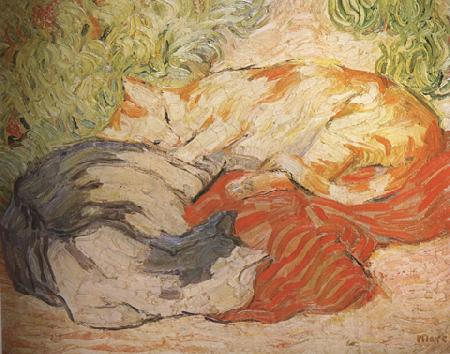
Franz Marc- (Attachments)
“Cats” by Franz Marc, circa 1909

After her third dog passed, Lorelei adopted an overweight calico. The couple that had brought him in wrote on the form 12 yrs old, heart problems. The cat dealt with enough heft to make it impossible for him to clean his own back, so had dreadlocks down the spine and dandruff, too.

“Are you sure you want grumpy old Murray?” asked the boy at the desk.

“I want to help,” she said. “I can’t get attached to a cat.”

~

The cat was renown for hissing at the volunteers in the shelter, but when Lorelei let him out of the carrier in her living room, he sidled up against her legs and rubbed, weaving around her calves in fat figure eights as if he missed her. When he rolled on his back on the carpet, he looked like a seal. He slept on the end of her bed. Trapped her feet under the covers. Wheezed. Strangely, the sound helped her fall asleep.

After a few nights, she loved the cat as if he were a dog. She told him, “You’re going on a diet.” She put Special Recipe for indoor adult cats into his dish by the refrigerator. “Let’s slim you down. You’ll live longer.”

She cut out his dreads. She brushed him until his fur shined. He purred.

Lorelei’s next-door neighbor, Joe, came to eat dinner and watch East Enders on the BBC every Tuesday night. They had gone to school together as kids. In high school, Joe tried to date her, but she preferred the closeness they shared as friends. Both inherited their parents’ houses. Both moved home after their busted marriages. Neither had kids.

With Joe there, Murray hissed and hid beneath the couch, but he couldn’t fit all the way, so they laughed to see the cat’s doughy haunches and his thick tail whipping and slapping the rug.

“How do you like the new old cat?” Joe asked as he ate beef stew at her kitchen table.

“It’s working out pretty well,” she said. “Better than I thought.”

Joe nodded and chewed.

“He’s good company. He sleeps on the bed.”

“Really.” Joe wiped his mouth. He leaned back in his chair and called out in the direction of the living room, “Hey, Murray, what’s your secret, buddy?”

Lorelei laughed, covering her mouth with her fingers.

“Lori, you know I’d be happy to join you in bed anytime you’d let me.”

“I’m happy as we are.” She looked down at her stew. “You know that.” She looked up.

“I’m going to keep reminding you that we could be happier,” he said and winked.

“Let’s not mess with it.”

But she liked that he had called her by her childhood name.

~

Joe sat next to Lorelei on the couch to watch TV. She felt Murray’s tail thwack against her foot. She worried about Joe’s weight on the cat. Joe wasn’t fat, but he was a large man. In that way, he took after his father, but only in size. Joe could handle his alcohol. As long as she could feel the switch of Murray’s tail, she felt the cat was probably fine.

When the show ended, he helped her with the dishes. She walked him outside to the path through the hedge between their houses.

“Can I kiss you?” he asked.

“Next time,” she answered.

It was always the same, from when they were teenagers, their little joke.

In the living room, Lorelei propped a corner of the couch up with the dictionary and spoke sweetly to Murray. She used a treat to finally get him to spin around and crawl out. At bedtime, Murray did his seal-flop in the middle of the rug. He didn’t follow her to the stairs.

“You’re punishing me cause you think I have a new boyfriend, aren’t you?”

Murray switched his tail.

“But you’re my new boyfriend, Murray. You’re the guy for me.”

~

In the bathroom, Lorelei looked out the window to Joe’s house while she brushed her teeth. His kitchen was all lit up. She slipped into the guestroom, her old childhood room, where she could spy more easily in the dark. She saw him sitting at his kitchen table, one leg crossed over the other. He wore only denim-blue boxers and white socks as he talked on the phone. It was past eleven. He laughed, looked happy.

She remembered his body differently, young, hairless, playing Marco Polo at the public pool, always jerking around. She recalled thin tight muscles bulging from his soccer uniform. Now he looked soft and comfortable. Relaxed.

Who would he be talking to at this hour? Joe had friends and maybe someone special, more than just a friend, but she didn’t know.

Murray howled from the hallway. Lorelei fixed the curtains and headed for bed.

She passed Murray in the hall. “So, big guy, I guess I’m forgiven.”

He waited for her while she brushed her teeth.

~

The following Monday, Lorelei had an e-mail from Joe telling her he couldn’t make it on Tuesday. Something had come up at his crew club. There was a special meeting for the board.

She ate leftovers and watched East Enders with Murray curled on the cushion where Joe usually sat. She felt a tightening around her heart. She realized she missed Joe. In the kitchen, she made herself a cup of lemon ginger tea and sat down at the table.

After fourteen years of marriage drama, she longed for peace, some solitude. Joe didn’t push or cloy. They shared the one night a week. She imagined that sometime in the future they’d have sex, but she didn’t want to rush.

She startled when he rapped on a glass pane of the kitchen door.

“Oh.” She pressed one hand on her chest and beckoned with the other for him to come in.

He carried a paper bag. “Am I too late for dessert? I brought ice cream.”

“Murray and I thought we weren’t going to see you tonight.” Her voice was pitched and sounded giddy.

“I saw your light.”

Murray hunkered down on the threshold in the archway between the living room and the kitchen, ears back, scowling, his tail going.

“You’re all threats, Mister.” Joe teased the cat as he scooped ice cream into coffee mugs. “I dare you to do something about it.”

“Let’s eat at the table.” Lorelei worried about Murray hiding under the couch. “At least he’s not hissing.”

Joe told her all about the crew club meeting. Someone had spray-painted the boathouse.

“Apparently it’s not graffiti. Now it’s called Street Art.” He laughed. “Some of it is quite beautiful.”

“Remember in tenth grade when we painted the Civil Rights mural on the new gym wall?”

“Remember the senior trip to Mexico?” Joe wagged his eyebrows up and down.

“Let’s not go there.” It was the one time they’d made out and groped each other a little after they played Quarters for shots of tequila. She got up to rinse their mugs. “Let’s walk. I’d like to see it.”

“See what?”

“The Street Art.”

On the riverfront, Joe shined a flashlight, illuminating a painting of three women, larger-than-life, with over-exaggerated fleshy parts squishing out of red, white, and blue vintage swimsuits. The women lounged by a pool. They held up fancy martini glasses that were as wide as their heads. Cocktail stirrers in the shape of thin pink penises protruded out of the glasses. Gold fireworks exploded on the black sky background.

“Whoa, weird.” Lorelei stepped back to try to understand it better.

“It’s wild, isn’t it? It has this three-dimensional look,” said Joe, standing up close, gesturing at the picture with the weakening beam. “Inviting. Couldn’t you could step right into the party.”

She shook her head. The light on the painting made the women look clownish. The river chilled and dampened the air. She wanted to go home.

“I’m kind of freezing all of a sudden.”

Joe turned to her and shined the flashlight on her midriff, forming a circle of dull luminescence that enveloped them both. “Lori,” he said. “Can’t I kiss you?”

“Next time,” she said playing along.

“No, now.” He stepped closer and paused.

The kiss was warm, just long enough to show them both that now could be the right time.

She caught his free hand. “Come on, let’s go back.”

They’d left the lights on in the kitchen. Murray stretched horizontally on the linoleum floor just inside the door. He had not assumed his usual seal-flop position. Lorelei said his name, but his tail remained still.

“Jesus Christ, Joe, I think he’s dead.” Her fingers on one hand covered her mouth. She pressed the other to her chest.

Joe squatted and placed a flat hand on the cat’s torso. “He’s warm still. But I think you’re right. I don’t feel any up and down.”

“Okay, that’s it.” Lorelei sank into a kitchen chair. “This is my last pet.”

Joe petted the cat’s smooth back as if the cat were alive. She thought of the dandruff Murray had when she had first brought him home. The kitchen clock ticked.

The phone rang over in Joe’s house. She glanced at the clock. It was after eleven.

He stood. “I have to run over and grab that call.” He pumped his hands up and down as if to calm her, but she had not shown any agitation. She felt discouraged and cold. “But I’ll be right back,” Joe said. “Really, Lori, I wouldn’t leave you now if it wasn’t important.”

She shut the kitchen door behind him and locked it.

“Odd. Another eleven o’clock call,” she said aloud, but of course, Murray couldn’t hear; he was dead.

She grabbed a bath towel from the dryer in the laundry room, smoothed it flat on the floor, and rolled Murray onto the makeshift shroud. She swaddled him, leaving his head uncovered, and carried all twenty-three pounds of dead weight up the stairs to the guestroom. She set him in the middle of the bed and stood next to him in the dark.

Joe had surprised her, leaving when she had a dead cat on her hands. Now she couldn’t stop herself from peering at his house through the curtains. He stood in the kitchen wearing all of his clothes and seemed to be looking at her house, but he was still on the phone and he appeared to be laughing.

~

Standing there in the dark, she thought about a night when she was sixteen. First, she heard Joe’s drunken father singing outside. Then, through this same window, she watched him crash into the redwood bird feeder and fall on his back. He stayed in that position, unmoving, for what seemed like forever. Lori’s parents were out, and no one from next-door came to investigate, so she’d gone over to see if he was dead. He wasn’t. He was staring up at the moon, eyes wide, smiling. When she leaned over him, asked if he was okay, he grabbed her wrist and pulled her to the ground. He rolled on top of her. He called her baby girl. She yelled for him to stop. He shushed her. She couldn’t move. Lorelei felt knuckles press into her hipbone. When she heard the clinking sound of his buckle, fear clogged her throat. She could hardly breathe from the man’s weight.

Then Joe appeared. He kicked the side of his dad’s gut and yelled, “Get up you fucking bastard! Jesus! Lorelei!” As soon as she was free, Lorelei ran home and locked all of the doors. She showered and put on fresh pajamas. She sat on the toilet seat in the bathroom until she heard her parents’ car in the driveway then she went to bed. The next morning, when Joe came to walk her to work, he tried to smooth it over. “He doesn’t remember anything, Lori. Not a thing. I’m sure of it. He never remembers.”

She had held up her hand. “Stop! I don’t want to talk about it.”

“What were you doing out there?”

“I said stop it, Joe. You dealt with it. We’re all just fine.”

Though Lorelei did not think of that event very often, she had thought about it last spring, when Joe pulled up the parched cedar ground creeper that had pricked her through her lightweight pajamas that night. He replaced it with waxy-smooth periwinkle that bloomed a deep purple in the summer. The bird feeder out front at Joe’s was new, too.

Now she adjusted the curtain at the guestroom window. She leaned over the bed. “Our time was short and sweet, old guy.” She patted the mass of Murray’s body through the towel. “Great while it lasted.”

She shut the door behind her, closing the dead cat inside. She brushed her teeth, and went to bed. She missed Murray’s weight against her feet.

Twenty-minutes later, the telephone rang. Seven rings. She had expected as much. She turned to face the wall and drew her knees to her chest under the quilts.

Seven more rings. Then, silence. Then, seven rings. Then, silence.

Tomorrow before work, Lorelei would bury Murray next to her three shelter dogs in the back yard. She imagined Joe would see her digging a hole and come to help.

They’d start all over.

Again.

They’d start all over.


Jodi Paloni lives and writes in the foothills of southern Vermont. Her stories appear in Green Mountains Review, Carve Magazine, The Atticus Review, Whitefish Review, upstreet, Spartan, and others. She is the 2013 winner of The Short Story America Prize for Short Fiction and placed second in the 2012 Raymond Carver Short Story Contest. Jodi reviews fiction for Contrary Magazine and New Pages. She has an MFA in Writing from Vermont College of Fine Arts.

Read an interview with Jodi here.

“American Epiphany, Part II” by Robert Boswell

American Epiphany Part II
Jade-Bratz from the TOYOLOGY series, by Elizabeth Leader, 2011, Mixed Media Assemblage

Continued from Part I

The freckled boy locked the door behind them. He was sweating. “It’s amazing you’re even alive,” he said. “We saw a whole cow fly by. A whole entire cow.”

“This is my husband,” she said to the fat boy. To her husband, she said, “This is the boy that put Coke in my iced tea.”

They shook hands.

“It wasn’t dead,” the boy said. “Its hooves were stomping the air.” He demonstrated with his puffy fists.

“Thanks for that, Skippy,” she said.

Dmitry made a beeline for Kenny, throwing his arms around him. Tera supposed that it was odd of her to call Kenny for help, but she had known he would come. Men want to rescue you. And sometimes you want to be rescued.

“The phone lines are down or I would have called you,” Kenny said after they’d settled in a booth. He gave a nod in the direction of his quivering vehicle. “I’d have told you to stay at the facility. The reports say this one is a monster.” He nodded his head in a different direction. “Julio has a radio. We got an update before the batteries gave out.”

“Tornadoes are mercurial storms,” Dmitry said. “They may destroy a single house in a neighborhood and leave all the others untouched.”

“There’s a bottle of whiskey in my car,” Tera said. “Do you suppose Skippy would be willing to fetch it?”

“We’ve missed you,” Kenny said to Dmitry. “The whole department. Students ask about you daily.”

“Students,” Dmitry replied. “There’re so many of them. Aren’t there? Generation after generation of students. We should probably all gather in the bathroom, don’t you think?”

Kenny sent her an S.O.S. but she was making sense of hubby by this time.

“The safest place in a storm,” she said, “is the bathroom.”

“Of course,” Kenny said, relieved. “Why is that I wonder?”

“Small size,” Dmitry said, “wall strength, the fixtures.” After a moment, he added, “Interiority.”

It was then that the immense funnel showed itself in the windows of the Hardee’s, a great undulate of white rope. Some bored god with a lariat the size of the Sears Tower.

Skippy and his gang claimed the Guys, which left them with the Gals. A small, translucent window covered with chicken wire let in smeared dollops of light. Dmitry sat on a toilet in the handicapped stall, and Tera sat on his lap. Kenny was in the adjacent stall. If she ducked her head low, she could see his sneakers. The bathroom tile and metal stalls turned their voices hard and made them bounce like rubber balls about the room.

Her men talked for a while about changes in the department, how one of Dmitry’s enemies had made a push to usurp the planned hire. The sociology department was divided along theoretical lines, much like Europe in the first half of the twentieth century, and battles periodically erupted. Dmitry and Kenny tossed volleys back and forth over the metal wall about internecine hostilities. Tera had studied in the department for three years, but she was content to listen, recalling the afternoon in his office that she told him she was quitting the program, and how he took her into his arms (they were lovers by this time) and she curled into his lap, smelling the leather of his chair. The toilet wasn’t quite so comfy, but she felt finally at ease. He sounded so much more himself talking about an assistant professor who did arbitrary interviews with the poor and published them as research, validity and reliability be damned, and how another colleague, who collected and analyzed monkey sperm, hated the assistant professor so much that he hired undergraduates to answer her ad and pose as the homeless. Universities were home to the most extreme kinds of idiocy.

Dmitry said to Kenny, “I’m aware, of course, that you and my wife had intercourse.”

She kept her head bent against his chest. The other stall fell silent. They could hear things outside bumping against the shabby building. Girders squealed, as the wind tried to rip the lid from the box.

“Sexual intercourse,” Dmitry clarified.

“I understand you,” Kenny said. “What do you want me to say?”

The next silence was even longer, but the world happily stepped into the gap, and it occurred to Tera to say that the wind was the sky’s way of complaining. She had confessed to Dmitry some weeks ago, during one of her visits to the farm. He hadn’t responded, and she hadn’t been sure that he was tracking the conversation.

Finally, she said, “I’m sorry.”

“Yes,” Dmitry said. “You told me that.”

“Something’s happening underneath,” Kenny said. “The water’s rocking.”

“Don’t you lose your mind, too,” she said, an inconsiderate remark, considering.

“The water in the toilet is full of waves,” Kenny insisted.

They stood, lifted the lid, and looked.

“It seems to be rising,” she said.

“It’s attempting to communicate,” Dmitry said. “It’s weary of its life. We only think of the sewer when we have something foul we wish for it to take away.” He leaned lower. “Forgive us,” he spoke this directly into the open mouth of the toilet.

Strange spears of light entered the stall, and Kenny stepped in, joining them, latching the door behind him. He pointed upward, but stared at them. “We should hold each other,” he said.

The ceiling was rattling, and a peculiar, strained light leapt in the gaps. Wires, electrical coils as thick as Tera’s arms, held the hovering ceiling, kept it from continuing its levitation. Everywhere beneath them, chained to them like the famous cannon ball, was the betrayal, in which Tera and Kenny did terrible and wonderful things behind Dmitry’s back while he continued to do nice things for them.

And that second betrayal, when she refused to continue loving Kenny despite Dmitry having removed himself from the picture; that was there, too, in the darkness beneath their forked bodies.

“It may be a septic system out here,” Dmitry said, clutching her tightly. “Not a sewer system, per se.” His face was lit by an unholy flash of light, as if by divine touch, and then it went dark. Her men crowded around her, holding her tight.

The howling was suddenly fierce, and Tera yelled out that she loved him, without saying which him, and held tight to them both.

Skippy was unconscious, and the place was a certifiable mess. Much of what had been the top of the building was now in the parking lot and on the highway, and rain fell through the gaps. All the loose furniture—the freestanding chairs and tables, the newspaper rack, and the March of Dimes candy dispenser—were gone, erased, still whirling over the Midwest somewhere beyond their ability to see. The booths were missing their tables. The seats and backs had inflated with water, and damp stuffing burst from the seams like sea creatures emerging from primordial caves. A great blossom of grime was laid over every item that remained in the room. There was no litter on the floor, only puddles, streams, tributaries, and poor fat Skippy, lying on his back, Dmitry and Julio kneeling over him, while Kenny and a spare Hardee Boy used mops and towels (the storage room was undamaged) to keep the growing flood away from his great, beached body. Tera’s cell phone no longer worked and the landline didn’t even offer static.

The men pumped furiously on Skippy’s chest, as if he were deflating. During the height of the storm, he had inexplicably left the Men’s and darted out into the chaos.

“He didn’t say nothing,” Julio offered, apologetically. “It was no way we could go after him.”

After a long while, they gave up their efforts.

Tera had expected death to lend them a sense of wonder, to provide a spectacle, or at least a profound moment or two, but he merely looked cheapened, like a toy the day after Christmas.

“He’s peed himself,” Julio said, backing away.

The storm had been kind enough to bring Tera her car and nudge it up against the flagpole. Unfortunately, it was parked upside down. The passenger door was gone, but the glove box was intact and shut, and when she popped it open, the fifth of whiskey plopped into her waiting palm.

Dmitry took too many swigs of it. The liquor emitted a mixed set of signals to his brain, some of them sane but unkind (he punched Kenny in the chest) and some of them insane but helpful (when the rain abated, he filled his shoes with grease from the kitchen spill and built a fire in the parking lot, where they roasted frozen meat patties). His conversation rambled from sharp-edged replies to meaningless, idiosyncratic comments. When his mind had been clear, his intellectual passion was a fearsome thing to behold, a deep well of icy water, frigid to the skin and almost too cold to drink, but as clear as snowmelt and as quick as death.

At some point, Julio took each of them out to the road to see: the tabletops from the booths were laid out on the highway in a row, like the keys to a piano.

It was the smell of flaming meat, they would later speculate, that brought Skippy back from the dead.

“God, that smells good,” he said, stumbling out of the ruined Hardee’s and into the parking lot, sopping wet and walking funny but undeniably alive. The fire provided the only light, and in that grease-fed blaze, he looked pale and otherworldly, and Tera knew she wasn’t the only one who thought he had taken a journey and returned.

“Jesus shit,” Julio said. “You all right?”

“My chest hurts is all.”

“We thought you were dead,” Tera told him. “Dead dead. Not like, dead for a while.”

“Holy cow,” he said. “Dead.” He made an awful face. “You just left my body in there?”

She shrugged. “We were sort of hungry.”

“Kinda sucks that nobody even, you know, sat with the body.”

“We’ll do better next time.” She crossed her heart.

Stars emerged, pricking the dark, but there were too many of them. “The constellations are gone,” Dmitry said, pointing. “They’ve been cut loose. They’re all on their own.”

“What’s it like to be dead?” Tera asked.

Skippy shrugged. “I didn’t feel any difference.”

“Why you run out into that shit?” Julio demanded.

Skippy pondered that for awhile. “Something I’d forgotten,” he said and then snapped his fingers. “My umbrella. It was under the counter, and I thought I ought to get it.” He smiled and shook his head in something like wonder. “All other thoughts left my brain, and I just ran out after it.” He looked up at the nameless stars for several seconds. “It has a silver tip,” he clarified. “That umbrella does.”

Tera was young enough and she had extended her education long enough that she could still say that she had been a student for most of her life. Unless she went back to school, though, that would change, and how would she think of herself then? Sometimes she seemed like a sheet of music on which someone had typed prose, and so, on fresh blank paper, she worked to create a narrative, but what came out was a set of lyrics. It seemed likely that her tombstone would be covered with finger-paint.

In the days to come, she would find that her husband was both eager and apprehensive to return to his old life, where he was exceptional and treated with deference, where the possibility of being undone by a foolish girl he had taken into his home was as unlikely as the presence of thieves who break into your house to leave gifts. Eventually, he would become himself again, the revered professor of sociology, loved by students and admired by his peers. Except he would no longer care for research. He would give up his great theories, the beautiful speculations on the causes of heartache and suffering among the masses. He would quit opening the journals that arrived in the mail, never ripping off their transparent covers. He would even give up the newspaper. He’d had such a specific and specialized view of the world, and yet he ditched it without so much as a whimper. Tera could only imagine the outlook he had abandoned, where events of the world conformed to reasonable inquiry. While most saw chaos and irrational grief, he had seen reasons, a hidden order, and irrational grief.

One night, years after the storm, Tera and Dmitry would go to a revolving restaurant in a high rise, and beyond the window radiant droplets streamed in unison on the distant freeway, and she realized this was how she thought of his research, the view it gave him, things boiled down to their essences and moving in a pattern. He had this view while the rest of them had to walk the streets. It seemed like a lot to abandon.

“It wasn’t dark,” Skippy said suddenly. “Being dead. It was real colorful, like magazine pictures tossed ever which way. And I wasn’t fat, so much. But it was real loud. Lots of voices saying things in two million languages, and there was construction going on. I knew if I hung around I’d have to pitch in.”

“So you came back alive instead,” Julio said. “Being a lazy bastard finally paid off.”

Skippy had this way of shrugging that made his neck disappear. “It was more like there was a spring, a coiled metal spring, with like a steering wheel on the end of it—is my car out here at all?” He glanced about for only a second. “I clung to that steering wheel, and the spring was, you know, thrusting me out, but I didn’t let go and it sprung back, and that’s when I smelled burgers and opened my eyes.”

The night air had been softened by the parade of large objects flying through it, and a mist settled about their faces and skin and clothing, and an owl started in with a lonesome hoot that was almost mechanical in its alteration of pitch.

“That must be the cops,” Julio said.

“That’s a siren?” Tera asked.

Dmitry said, “I thought it was an owl.” He laughed at himself.

She didn’t tell him that she had made the same ridiculous mistake, but it pleased her that they shared that error and made her optimistic that they might make a go of it after all. There appeared then little moons of lights, to go with the siren, twin moons, as if they really were on a foreign world. And then twirling blue beacons took over the sky.

Kenny would finish his PhD that May and go on the market. Dmitry would write an enthusiastic letter of recommendation, and Kenny would take a job out West. They would hear about his marriage to a blandly attractive woman and the fact of their children, but he did not send cards or email photographs. He and Dmitry would occasionally run into each other at professional conferences, but Tera has not seen Kenny and has not heard from him in all these years, and while she had worried that she might be tempted to cheat on her marriage again, it never happened. She can say for sure that it will never happen, as her husband lies in the next room dying, and she works on these pages between visits. This is a new hospital, and she can see the river from the waiting room, a curling blackness that winds through the city. But it’s not Dmitry’s dying that she wishes to write about, and not the past several years, which have been like any couple’s years—a song with a good chorus but mixed verses. They never had children and that is both a relief and a regret, and Dmitry never wrote another professional word, which is unquestionably Tera’s fault but she has made her peace with it. She doesn’t care to write about any of these things, just that night, all those years ago.

The woman’s nose has been reconstructed to look like a pennywhistle, her ears unnaturally flat against her head, like cloth flaps. She no longer looks like a koala. She looks like gecko. Tera goes online to find a phone number for the Hardee’s, which she has passed maybe fifty times since that night without ever making a return visit, a brand new and equally hideous building having replaced the old one. No one at the new Hardee’s was employed fifteen years ago, but the manager is interested in her quest and willing to go through the employment files. “That storm,” he says while perusing the records, “I was in college at the time, but my mother witnessed the funnel. As tall as skyscraper, she said.”

Julio’s number belongs to his parents, who reveal to Tera that he has moved to Los Angeles. They provide the number.

“There wasn’t no Skippy,” Julio says.

“The freckled boy,” she explains. “Overweight? He died and came back to life?”

“Oh, him,” Julio says. “He died again a couple weeks later. Went in his sleep.” He sighs and adds, “That’s how I want to go.”

Dmitry will almost certainly go in his sleep. He rarely opens his eyes. Yet she believes he can hear her, and she recognizes his attempts to respond, though they are the smallest of diminished movements. She will try to be beside Dmitry when he dies.

“Poor Skippy,” she says.

“It wasn’t Skippy,” Julio says. “It was like Larry or Lance or something.”

“Lazarus?”

“You got a bad memory on you.”

She wants to know why he died.

“The doctors said internal injuries. That was some storm, all right. What I remember most is the tabletops on the highway, just like stair steps, only not going up.”

She thanks Julio and says goodbye. In another moment, after she has composed herself, she’ll go in and read to her husband what she has written, but she is not quite finished writing.

Out there in the Hardee’s parking lot, she had felt drowsy and sluggish, as if she had been living another person’s life. The dark was returning everything to its proper shape, erasing the magic, the stars settling again in their familiar patterns—though there were more stars than she had ever seen. Even the shyest of the celestial eyes had stepped forward to look.

Without any of the human forms of illumination, save for the fire, the bandage of night was complete, and Tera and her men stopped bleeding. They stood near the heat with their hands to the flames in the gesture of stop, as if they wished to hold back, to limit the influence of light a little while longer. She imagined them as the first humans, walking upright but communicating by crude gestures and guttural noises. The margins between the past and present had been blown away, and they huddled together as several forms of themselves. Tera was at least a dozen women standing before the fire, and some versions of Dmitry loved her and some hated her, and some had not noticed that she was there. And the Kennys and Julios and Skippys and those other working stiffs all gathered at the flames, a bundle of humanity. They had become a crowd, a crown, a vast recollection of life, which was what Dmitry studied, what he had used that precious mind of his to investigate and analyze. Bodies of people.

Her epiphany in the Hardee’s parking lot, a half-dreamt vision. Write about that night, she would say to Dmitry in the years to come. He would just smile and rock his head to one side, content in his textual silence. You write about it, he would say.

“What I’d like to do next,” Skippy told her, “now that I’ve been dead and all…” He paused to bite the burger in his hand. They had no buns, and his patty was hot. Grease on his jowls glistened in the firelight. “What I’d like to do next…”

But the sirens grew suddenly louder and the gaudy light show ended the adventure. They were packed off into cars, and Tera fell asleep in the back of a police cruiser, nestled between Kenny and Dmitry, the bodies of people she loved.


Robert Boswell has a new novel, Tumbledown, from Graywolf Press. He has published three story collections, seven novels, and two books of nonfiction. More than 70 stories and essays have appeared in the New Yorker, Best American Short Stories, O. Henry Prize Stories, Pushcart Prize Stories, Esquire, Colorado Review, Epoch, Ploughshares, and more. He shares the Cullen Endowed Chair in Creative Writing with his wife, Antonya Nelson. They live in Houston, Texas; Las Cruces, New Mexico; and Telluride, Colorado. They also spend time in a ghost town high in the Rockies.

Read our interview with Robert here.

“As Time Goes By” by Orlaith O’Sullivan

Who Will Build
“Who Will Build the City Up Each Time?” by Elizabeth Leader, Acrylic & spray paint with recycled wood

Please, folks. Please, if you’ll only grant me a moment, I can straighten this whole mess out.

The man in Room 12 is my grandfather. I’m Terry’s youngest grandson, Donal Bradley. I live over in London. I came in Tuesday, and since visiting hours finish by—what time is it now? 2am—seriously? That’s… that’s later than I thought. My point is this: I’m a daytime visitor, so you wouldn’t necessarily know me.

Terry practically raised us after Dad died. When we were kids, I was his favourite. Kick the ball around on Sunday mornings; down to Cork Con after mass; drive back through Cobh, cast off from the pier. Terry’s boy, I was. But I grew, and the years passed, and we stretched far apart. Stretched thin. Finola gave him great-grandchildren, and of course, Susan took the teaching job here. And what was I? An investment banker with JP Morgan won’t hold a candle to the Headmistress of Castlegyleen Primary School.

It took me a while to come back. Susan told me what was happening, but sure, what could I do? It’s not like I could unfrazzle his brain.


By the time I arrived at the nursing home, Terry had suffered seventeen strokes. I brought Mayan gold chocolates and a Get Well Soon Granddad! card—a musical fancy that chimed Louis Armstrong’s What a Wonderful World. Susan warned that he might not know me, but he seemed alright.

‘There you are!’ he boomed. ‘Donal, come in—excellent! I trust the cats haven’t been too noisy?’

‘What’s that, Granddad?’

‘The cats. They’ve not been causing a nuisance?’

He kept tigers. That’s what he said. Had four of them, out the back of the car park. Was minding them for the Maharajah, someone he’d worked with in the past. And then he winked, as though I should understand.

‘The Maharajah, right… Is he from the Central Statistics Office?’

A deep belly-laugh shook his frame. ‘Ah, that was a good cover—lasted me years! The Maharajah is moving palaces at the minute, and the elephants are his prime concern—fierce sensitive creatures. At least I’m not stuck with the white peacocks—can you imagine fifty of those feckers running around here!’

I replayed Susan’s words in my mind. She’d not mentioned Terry had gone stone-mad.

‘Gold’s a devilish sort of a thing,’ Terry declared, eyeing me. ‘Gold-greed rots the soul like a cancer. Not the Maharajah: that man treats gold with respect; uses it with wisdom; dispenses it with kindness. Thus has it ever been.’

I opened the chocolates and listened to his tales of the tigers. The kitchen porters of Castlegyleen Lodge Nursing & Residential Home sneaked out food for the cats. I was made lean out the window to the left, to Car Park B. Could I glimpse a striped tail between the Volvos and the hatchbacks? Only last week, one of the consultants discovered a scratch down the length of his Saab. The ex-wife was blamed, but Terry knew better. ‘Those cats have been through an ordeal to get here. Sure, they’re bound to act up some.’

When the nurse came in to change his drip, I peeked at the clipboard on the end of the bed. Not one of the medications was familiar to me.

Terry’s IV drip talks to him—did you know that? The thing is American. Broadcasts news reports about his food: ‘Good afternoon, this is CNN Special News. We’re going now live to Nutrition Inc., where Head Chef Bob Billywig will take us through the dish for the day. Bob…?’ Granddad hears background sounds: a busy kitchen, with things sizzling on hot grills. Then Bob Billywig speaks: ‘Well folks, Terry Bradley has a treat in store today! Elmer’s cooking up a quarter-pound sirloin burger with spicy fries, and there’s a slice of Martha’s key lime pie to follow—sheer heaven!’

‘It was blueberry pie yesterday,’ Granddad says, worry darkening his eyes. ‘I don’t know that I like key lime…’

The absurdity of it! That instant, my fears broke open and fell away from me. ‘You’ll love it, Granddad,’ I said. ‘Key lime pie is delicious.’

Terry looked at me, nodded. ‘You know that Bogart only played Sam Spade once?’ I relaxed back into the chair, taking a moment to trace the connection: key lime… Key Largo. ‘Just that once. The same with Philip Marlowe: played him one time and pow! The part was his forever. Once was all it took for Bogie. Indelible, that man was. Indelible.’

We chatted all afternoon, making our way through half the chocolates. Granddad might have been sitting up at the bar in Con. Easygoing, confident, affable. And I loved him this way—loved him—even if he was talking unadulterated shite.

The nurse finally came and ousted me. As I went to leave, Terry told me his Admission Form needed updating. He spoke four languages now: they should add Urdu, and Luxembourgian.

I grinned. ‘Isn’t this place fantastic?’

Granddad leaned back, his thin head sinking into the pillow. ‘They need to keep me safe. I’m important to them, to the Tribunal.’

That evening I stopped by Susan’s, where Granddad stayed until he was beyond her help. The caring had taken its toll: there was neither fondness nor pleasure in her voice. ‘Spent his days looking out to sea. Kept remarking how many dolphins were around. He thought every white horse was a dolphin; thought the sea was chock-full of them! I told him, but he wouldn’t hear it! Like that with everything, he was. Insisted the evening swallows were giant bats. Over from East Africa, he said. Wanted to point it out on a map! To me!’


On Wednesday, I brought yellow balloons and a copy of The African Queen. Thought I could read aloud, if Granddad didn’t feel like talking.

But he did: about how he worked with a secret government department; how his testimony would be crucial to the Tribunal. ‘Gold diggers and back stabbers, the lot of them! What gold does to a man’s soul, Donal, and he only falls the harder for it. A dangerous game…’ I suspected he was conflating the Tribunal with The Treasure of the Sierra Madre, but maybe not. I’ve been out of Ireland a long time. ‘Do you know, in all my years I’ve never heard the saxophone played live?’

I jumped over to the new conversation. Some Sundays, I brunched in Camden, at the Jazz Café.

‘Do you know that the man who invented the saxophone survived multiple assassination attempts? Even shootings,’ said Terry. ‘That man had enemies. His whole life, he was a victim of crooks and slanderers and jealous men. But that music…’ he shook his head slowly against the pillow. ‘Those notes. Haunting. Like starlight in a lonely place. And all those feathers…’

I stayed until he drifted off, mumbling the words that were coming from the IV drip, Bob Billywig describing the late-night snack that Elmer was fixing for Terry: a cup of Wisconsin Blue Ribbon chilli and golden sweet cornbread.

That night, Susan wept. She just wanted things back the way they were before.

Funny thing was, I almost felt they were.


When I opened his door on Thursday, Terry’s bony frame cowered under the covers. ‘Help me, Donal!’ he begged, tears streaming down his face. ‘For God’s sake, close the blinds!’

There was a sniper outside, waiting to take his shot. It was because of the Tribunal: Granddad had been tracked down. ‘I’m too big a threat,’ he said. ‘They sent me a warning, took out the white tiger with the blue eyes. Bang bang goodnight.’ The other cats remained in danger. Their food could no longer be trusted; the porters had been bribed.

I said I’d take care of the cats, but he turned on me. ‘And how will you feed three Bengal tigers? With your fancy investment accounts and your City of London. You’ve no local connections!’ Granddad turned his face from me. ‘What am I going to say to the Maharajah!’

I watched my grandfather weep.

Later, he was easier. He described his magical stay at Susan’s house: how the dolphins careered through the waves like a scene from a Grecian vase; how the bats swooshed through the twilight realm. Closing his eyes, he murmured. ‘I wish I’d heard the saxophone live. Wish I’d spoken to your mother before she died. Wish I’d sailed to Tangiers when I had the chance, traveled by caravan over to Casablanca. I could have gone to Luxembourg; to Lyme Regis. But the cards are dealt the other way now, dealt for the last time. There’ll be no more shuffling.’

I couldn’t tell what desires were real or imagined. What did it matter? I asked about the saxophone, the feathers. ‘Have you never seen, Donal? The notes transform into feathers, drifting across the air, soaring, swooping… And bullets can’t get through them, not saxophone feathers! The inventor saw to that. Survived multiple assassination attempts, he did.’

That evening, the IV drip came to life as Terry nodded off. It said men were coming for him. They would never let him testify, it promised. Soon he’d be sleeping the big sleep.

I watched him, remembering the pride welling as I walked into Cork Con beside that man. Terry’s boy, I was.


I started making calls on the way back to the hotel. It still took me a full day to organise everything. I practically hijacked Caroline and Soweto. We didn’t make it back from Dublin until after 11pm. The three of us sneaked in, with two rolling suitcases and the saxophone case. And the bin-bag stuffed with feathers.

Caroline went first. She explained that the Tribunal’s judge took a call last night—from the Maharajah. He explained Terry’s special circumstances. She would take his statement in Urdu—to keep it on the QT. She’d bring it straight to Dublin to be entered into evidence.

Granddad nodded, like he’d expected it all along. ‘That’s friendship for you! Half a world away, Donal, and it’s as if he’s in this room with me! We were no angels, back in the day. I got him out of a tight spot, helped him through a dark passage. And he’s not forgotten me!’

He started to speak, low and serious. Soweto put in his mute and warmed up. I unpacked: laid out the cake box; let out the goat and the rabbits—they were all I could get my hands on at short notice. I thought they’d reassure Granddad that the tigers would be cared for. I settled the animals as best I could, then blue-tacked up the pictures of Tangiers and Luxembourg and Lyme Regis.

The testimony brought Granddad some relief, I think. He checked over Caroline’s work, said she’d done a fine job. I witnessed his statement, along with Soweto here—on alto sax.

Then Soweto played. From the first sonorous note, Granddad was enthralled. I used four pillows’ worth of duck down, following the music rising and falling and whirling around the room. Long ostrich feathers did for the sliding glissandos and soaring crescendos. The whole time, Granddad stayed fixated on that golden swirl, big watery tears blurring his pale blue eyes.

I’m… I’m so sorry for all the inconvenience, especially the feathers, and the goat—I’d have been in and out if it weren’t for him. Caroline and Soweto came to understand my motives, but there was no winning over that feckin’ goat. The commotion started when he made a bolt for the cake box. The poor rabbits took fright, tripping up Caroline, who fell back on poor Soweto. Listen, I know I’ve a cheek to ask, but could someone see that Granddad gets to taste the key lime pie? It’s on his locker, a bit battered now…

I can go in myself? How’s that? You remember me from Con—a young lad sitting up beside his grandfather?

Ah go on. I’ve changed a bit, surely?


Orlaith O’Sullivan is an award-winning writer with a PhD in Renaissance literature. Her short story Gilt won joint first prize in the inaugural Fish-Knife Award (2006). Louisa and the Sea was short-listed for the 2007 William Trevor International Short Story Competition. Her short story A Tall Tale won The Stinging Fly prize 2008. She currently lives is Dublin, and is editing her first novel.

Read our interview with Orlaith here.

“Hope Like Blue Skies” by Erica Jamieson

Trucks
“We Repair Trucks,” by Elizabeth Leader, from the Toyology Series, Mixed media assemblage

Netta dipped inside the case with her metal scooper, fearing she’d perspire right into the barrel of chocolate chip mint. She wiped at the drop of sweat making its way down her nose with the back of her hand. What with the humming and heating of the freezers, she was already dizzy red hot in early June. Only thing cool about her was that one strip of belly that leaned right up against the freezer when she bent in to scoop. It was the coolness right there, where so much hurt and wanting had seared into a congealed mass of love, that made her remember the old truck sitting idle out back.

“You got to get that truck fixed,” she said to Rex, looking so fresh with his hot coffee of all things on such a day. That steam coming up over the rim of his cup just about made Netta swoon. “How you sitting so cool over there, Rex, honey? I’m burning up to hell here.”

“It’s too early for summer fever,” Rex said to her. Netta looked out through the Waratah Homemade Ice Cream sign etched onto the glass of the big plate window. Sky outside was nothing but a suffocating haze of Lake Michigan air, wet and heavy, waiting on something to break.

“You come on over to my side of the counter and try scooping with these condensers heating me up so.”

“I’m reading the want ads, Netta-bird.”

“What you ought to be reading, Rex, honey, is the how-to on getting that truck out there up and running. It’s time.” She turned to the boy, the youngest of the Van Dwek kids, waiting on his cone. “It was the Waratah fortune, that truck was,” she said. “Ain’t that so, Rex? Your granddaddy brought it home spanking new, shining white with blue trim. I saw some pictures. Boy, that was a proud day, wasn’t it, Rex? You want sprinkles, honey?”

“Never was much of a Waratah fortune. My papa should have sold it for scrap.”

“I remember the truck at Pink Lake last summer,” the Van Dwek boy said.

Netta caught Rex glancing up at the boy. He had his palm resting on the paper, a finger extended on the page as if it were the only thing keeping him upright. “You go on down to Mitchell’s garage,” she said to Rex, “see about that refurbished engine we talked about and those spare parts. See if they come in yet. What else you got to do today?”

Smiling at the boy, she said, “Why, you look so like your daddy.”

“There’s a rain coming, Netta-bird. Let me wait it out in peace,” Rex said.

The boy dug into his pockets for loose change. Netta waited. “Skies like blue hope, now, ain’t that what follows a summer rainstorm? Nothing more hopeful than that. Blue skies after a storm. You go, Rex, right after this weather blows through, you’ll get on that truck, go over to Mitchell’s? Get that truck working again.” She winked at the boy. “Maybe put in some working air-conditioning? Now won’t that be something nice.”

“I got a quarter and ten dimes,” the boy said, looking at the change in his hand.

“You sure you don’t have another quarter?”

“Last summer you let me have it for whatever I had in my pocket!”

“Now that doesn’t sound like me. Does that, Rex? Giving away ice cream at bargain basement prices.”

“I was with my brother William, and it was the last time you came out to the lake with that truck, the one you was just talking about. I remember because you dropped William’s cone.”

Netta could see the vein at the corner of Rex’ forehead, on the left side just above his eye, pumping blood fast like he was trying to heat up something that had just about froze over.

“It was near on to ninety that day. Rex remembers. I was sitting on a whole lot of heat. Stepping out of that truck on to the swelter of asphalt did nothing to cool me. Rex had gone off for water—that damn radiator couldn’t hold more than a one way out to the lake—and I was working the truck.”

“And you scooped William out another and said you can scoop quicker than the one on the ground would melt. That’s what you said to me and William, and you took what I had in my pocket for the $1.50 sized cone. And nothing for William’s second.”

Netta had been half in half out of the side door on that truck pulling on the strawberry ice cream when she felt a sigh from deep within her. She dropped the cone and touched the widening side of her belly where her hand measured the seven months of baby.

The Van Dwek boy was holding out all he had to give to Netta, still short a quarter.

“Now, does your papa give his blueberries and peaches away, and your momma her pies, for a smile, now do they?”

“She’s not baking on account of the new baby. When my middle brother was born, we didn’t have one of her pies until his first birthday. That’s why I came down here. You can’t take a baby to a hot beach, that’s what Delia said when I was looking for your truck yesterday at the lake.”

Rex stood up, cracking his chair against the wall, giving flight to those circled want ads. When Rex had returned to the truck that day with water to quench the radiator, they started toward home. Netta told him to take the Gas Junction Exit and head on straight to the hospital. More than anything she was surprised at the work it took to birth that dead baby, just as much as she imagined it would be one that was kicking and screaming and looking for her breast.

Netta gave the boy his cone. “I’ll take your $1.25 for a $1.50 cone today, young Mr. Van Dwek. You tell your momma and that new baby hey from me, okay? Maybe I’ll make you all a pie and bring it over for church picnic some Sunday. Your family still goes every Sunday, ain’t that so?”

“I knew you’d remember!”

“Now get on going home before the rain starts.” Netta watched Rex watching the boy. The boy opened the door just as a shot of wind came thrusting through. “Here it comes!” the boy shouted as he went running into the beginning rain, the wind slamming at the door. Another gust came just then, and the door got so caught up by that wind it flew back open. The bells on the window over top jangled and the screen rattled. The wind whipped back, doubling in with a blackening sky. Rex jumped to grab the door, but Netta had come alongside him and stood in the opening. Her skirt and apron caught the coiling air and flapped into twists around her legs. Her hair had come loose. She inhaled and felt cool even before she stepped out into the rain.

“I’m not ready for church, Netta,” Rex said.

“You didn’t hear me make any promises, now did you, Rex?”

A shuddering of thunder sounded, and a flash of lightning followed far off in the distance.

“I should have fixed that truck last year, when it was just the radiator. Would have been nothing. Now, it’s the whole damn engine,” Rex said.

“Nothing that can’t be fixed, or replaced.”

“Them doctors didn’t sound too hopeful.” It was at the hospital the truck wheezed its last, and the engine cracked right there in the parking lot. They had to hitch it up and tow it back to the ice cream shop. Took what little money they had saved for a crib and stroller, some cotton tees and diapers, and used it instead for a solid birch box. Netta’s people came, walked with her through the black iron gates of the cemetery so she’d have someone to lean on in the late summer heat when the little box, that little box, was lowered deep into the ground.

“Look out there, Rex, you can see blue sky coming right in behind the storm, just like I said.”

“I wish I could feel it, Netta-bird, I wish I could feel that blue sky coming.”

Netta took Rex’s hand and placed it just south of her belly. His hand stretched out over the flatness of her belly, but just in the center where she had placed his palm, ever so slight, there was a quickening that made her heart race the wind.

“You telling me something, Netta-bird?”

“You’ve got to get that truck up and running. That’s all I’ve been saying. What’re we gonna do, Rex? Let it sit and rot?” They stood in the rain, his hand on her belly, waiting on that blue sky. Netta never took her face from out of the wind. She swayed on her feet, humming with her body, and felt Rex stirring with the heat of something lost between them.


Erica Jamieson writes fiction and creative non-fiction. Her work has appeared in print and online at various journals including Lilith, Spittoon and Self Magazine. She lives in Los Angeles with her family and mentors at risk teen girls through creative writing with the non-profit WriteGirl. She can be reached at ericawjamieson.com

Read an interview with Erica here.

“American Epiphany, Part I” by Robert Boswell

she-drove-(American-Epiphan
“She Drove” by Peter Groesbeck

The hegemony of the domestic epiphany is unchallenged by the irrefutably frequent but characteristically flimsy foreign epiphany (rigorous epiphanies, like automotive mishaps, occur most commonly within twenty miles of the epiphanee’s domicile); however, for Americans in thrall, it is rare for the physical venue of the catharsis to be commensurate to the experiential phenomenon.

Tera is a failed academic and knows how to Latinate-up a sentence, how to wield the unwieldy phrase, how to turn tango into partnered bidirectional ambulation.

The weightiest secular kenotic incidents of American existence habitually transpire in strip malls (augmented by muzak soundtracks), at sporting matches (while seated beside adults adorned in giant spongy caps), or in garish hospital waiting rooms where, while the beloved is expiring in an adjacent room, Extreme Makeover cannot be shut off or turned down no matter with whom one pleads.

Tera is in that waiting room right now, witness to a forty-something woman at the Makeover Mansion saying she wants to flatten her jug-handle ears and de-flatten her pugilist’s nose. The woman looks a lot like a koala bear, and Tera cannot help but root for a successful metamorphosis. On the other side of the thin wall against which her vaguely purple chair rests, her husband breathes by means of mechanical pump. Electrodes taped to his chest translate the fragile rhythms of his heart into a language only an M.D. can decipher. The doctor will use cartilage removed from Koala’s ears to prop up her blunt nose. Tera’s husband will not live into next week. He may not make it to the morning.

Tera tries to concentrate on her laptop despite the insistent televised distraction. Her task is to explain the unexplainable, and there’s not much time.

Does the democratization of the American epiphany minimize its efficacy by systematically situating it in culturally debased locales, including, but not limited to, corporately franchised refectories?

She decides to revise the sentence.

I had a vision, she writes, in a fucking Hardee’s.

~

The toll road was direct and unwavering, without curve, detour, or intersection—so elegant in its ugliness that the Hardee’s island seemed a betrayal, like finding a caged animal in the wilderness. Tera entered the cage and ordered a slab of meat on a bun, a barrel of iced tea, a boat of fries. “I’m not that bad,” she was saying, talking on her cell from a plastic booth. This was the early days of cell phones, and it was roughly the size of her foot. “Just the front fender on the passenger side, but I can’t drive it, and I certainly can’t pick up Dmitry.”

That’s where you’re going?” The speaker warped Kenny’s voice, erasing the highs and lows, and yet she could have identified him after only a couple of words. Here was a new skill for the dying century, she thought, the instant recognition of vastly distorted things. Kenny continued: “You used to be a good driver.”

“I used to be a lot of things.” A list formed in her head: safe driver, faithful wife, honest friend. “What I used to be is beside the point.”

“Why are you calling me?” he asked. “There are a few billion people in the world who aren’t me.”

“I dialed everyone else in my book.” This was a lie, but he knew her tendency to exaggerate. It felt more like an offering. “You’re the only one who answered.”

Springtime in Kansas is brief, like the expanse of days a baby crawls: amazing when it finally arrives and over before you know it, summer vaunting in upright, sweat running down its pale thighs. This day, though, belonged to no season. The afternoon sky was the brown of upturned earth, as if the heavens had been recently plowed. Tera had pulled off the highway to answer her cell phone, but a boulder hiding in the grass bent the fender against the tire. The call was from Dmitry’s sister. Tera had let it go to voicemail and hiked to the Hardee’s.

“I’m the last person your husband will want to see,” Kenny said.

“He doesn’t know it’s you. He just knows it’s somebody, or it was somebody.”

“Buy you said—”

“I didn’t provide a name. I didn’t want him to hate you. Look, I’m already late. If you can’t do it…”

“You know I’ll do it.”

“I’m at that Hardee’s on the toll road. You know that Hardee’s?”

“Everyone knows that Hardee’s. Where’s your car?”

“It’s not in a ditch, exactly. You’ll see it.”

“You should have called me from your car. That’s the point of cell phones.”

“Just get here before I’m tempted to buy horrible food.” She let the phone clunk against the table and stirred her shot glass of ketchup with a wilting fry. The building stank of grease and despair and miles to go before anyone might sleep, as if the cushions in the stalls had absorbed the loneliness of the travelers who had cursed the greasy food as they stuffed it down.

The accident—if it was significant enough to be called an accident—had taken place an hour earlier. Tera’s first thought: perhaps it was a way to avoid the remainder of the trip. Dmitry’s sister could pick him up. But there were papers to sign, and she wasn’t sure they would release him to anyone but his wife. She had obligations to keep.

“You want a refill?” The boy’s face was freckled, chubby, and round. His colorful shirt held a narrow rectangular grease stain like a tiny grave. He scooped up the burger wrapper in a furtive gesture that conveyed nothing but shame—his or perhaps his recognition of hers.

“Sure,” she said, and he grabbed her sloshing tub of iced tea. Three months had passed since the night she officially drove her husband crazy. Dmitry had insisted that she was seeing someone else, no matter how expertly she denied the accusations. Earlier in the day she had taken the dog and walked to the park where Kenny waited in his car. By the time she got home, it was dark and she reeked of sex, and the dog was not only frisky but almost frenetic, and Dmitry said, “Tell me the truth or I’ll hang myself.” It might have sounded silly if not for the noose swinging from a ceiling beam.

“It’s a man from work,” she said, sticking to her strategy, which was deny, deny, deny, and failing that, lie, lie, lie. She worked in the mayor’s office, an organizer for the so-called great man. “You don’t know him,” she added. “He was only here for the election.”

“Tell me who it is,” Dmitry insisted.

She named a man she hardly knew, a consultant who had returned to Topeka, a person Dmitry would never see again. “Now take that down.” She indicated the noose.

He obeyed but didn’t sleep that night or the next. After four nights without sleep, he didn’t know who Tera was. He couldn’t dress himself. He wept in the tub. With the stay at the funny farm, Dmitry had officially climbed aboard the psychobabble express, a nonstop local with connections that could take you anywhere, including a much funnier farm where the gates were always shut. After the farm spat him out, he would be suspect. His colleagues who were now in agreement about holding his position for him, would shake their heads and speculate cruelly if a student complained or class went poorly. A trip to the funny farm to get well was like bathing in ink to get yourself clean.

The freckled boy plopped the cup before her. The specks on his face were allotted unfairly, with twice the density around his eyes, as if they were geysers. He had filled her plastic cask with Coke: half-tea, half-soda, an unholy mixture that tasted of sweetened mud. Before she could say anything, he swept past her, joining the others of his tribe—four portly souls in hideous Hardee’s uniforms standing at the window and staring at the sky: The Hardee’s Boys.

Tera realized she was the only customer in the place.

“If that’s not a twister,” said one of the Boys, “then I’m the next president of the United States.”

He didn’t look like White House material. You work a few campaigns, and you know.

~

Tera’s former lover flashed his lights, and she ran out into the parking lot. The wind was blowing and she let it lift her skirt, pushing it down a second too late and laughing. She was thirty-three and could get away with such things for only a few more years. Her advantages were on the wane. Of this, she was painfully aware.

She slammed the car door on the wind, smiling at him, her hand on her head as if it might fly away.

“This is crazy.” He wheezed out the sentence as if there were an arrow in his chest. “What am I doing here?”

“I asked you.” She gave him a lingering kiss. His cheek was as dry as the skin of a lemon.

“I suppose it’s efficient,” he said, rubbing his cheek and eyeing the fingers. “You can torture both of us with one stupid act.”

“Did you see my car?” she demanded. “It’s not like I was aiming for that rock.”

“I don’t see how else you could have hit it.”

“We should go. The wind is picking up.”

“Tornado warning,” he said. “Heard on the way over. Would’ve been nice to know before I drove into the middle of it.”

“You didn’t use to be such a whiner.”

The Hardee’s Boys turned their attention to her lover’s earth-brown sedan. How could they possibly be more interesting than a tornado?

“Don’t wreck my car,” he said, unbuckling, “and don’t leave me here.”

“Oh, come on,” she said. “He has no idea it was you.”

“No hurry.” He raised a thick novel. “I’ve always meant to read Proust.”

“You have not.”

“Three months of nothing,” he said, pushing the door open an inch, “and when you finally call, it’s to pick up your husband.”

The wind caught the door and yanked it open. He hunched against the torrent and bent low to walk. The Hardee’s heads followed his serpentine approach.

Tera slid over and started the car. Hanging from the rear-view mirror was a disco ball that might have been a road hazard, refracting light everywhere, if there had been any noticeable sun. She had never driven the car, but she’d had sex in the back seat, parked on the street in front her house—Dmitry’s house, really, his before they married—and Dmitry was inside, asleep, she’d thought, but when she went into the bathroom to tidy up, he was there, shaving. She slipped out and went to the guest bath. She hid her clothes in the bottom of the hamper, in case he decided to come in and smell them.

All the lovers she’d ever had in this weird plot she called her life—teenage delinquents, twenty-something narcissists, a couple of college girls, men in their golden years, and Kenny—would never appear in the same police line-up. Each was a bup to her kiss, but her kiss had gone through a lot of changes. Which suggested her essential problem with marriage: the woman she was when Dmitry married her and the woman she had become were related, but only in a half-cocked manner, like the relationship between a cow and a burger.

Within the first mile, she realized she had a problem. The car was shifting on the road. Making it to the funny farm would depend largely on luck. But she was used to that and didn’t turn around. The sky turned a shade of green reminiscent of a baseball park—a too perfect green that really really really did not belong in the sky. She had put herself in mortal danger for spite. Three months earlier, she had broken up with Kenny for no reason but the sudden onset of shame. As soon as her husband was hospitalized, she cut her lover off. With Dmitry in the funny farm, Kenny’s tongue in her mouth carried a residue of vinegar. She wouldn’t have called him today but she needed a ride.

Or so she told herself.

The drive to the funny farm is something that she has carried around like a wristwatch, a little ticking reminder that she was once fearless and stupid and incomprehensibly vain, and that two men had loved her enough to ruin their lives. It mortifies her and she treasures it.

She punched buttons and her cell played the voicemail from Dmitry’s sister: If you take my brother out into a tornado, I’ll have you arrested. You hear me? His sister had never been what you might call welcoming. She was like a child who did not want to see her mother replaced by some mere person, only Tera was just a sister-in-law. Dmitry’s first wife had been the kind of stand-up gal to drink scotch on a bar stool, wearing a dress that was fashionable without being desperate, in smart heels that reminded you she was still a sexual being no matter her age. She had been a reporter for decades, and then she wrote restaurant, theater, and movie reviews. Dmitry had loved her in a manner Tera could not fully imagine, and his love for Tera did not approach it. Oh, he doted on her, but the dead woman had been his equal, his partner, his match. Tera was the pretty face and pliant body, the easy patch of road after the glorious, dangerous switchbacks.

The sky made a human sound, part moan and part sigh, and vaguely condescending. She kept driving.

~

Dmitry sat alone in the waiting room, his hands in his lap making a church with a steeple. The storm evidently had the staff hiding, yet Tera had made it easily enough. The only traffic had been the occasional tree limb, scuttling along. It had almost been amusing.

“I thought perhaps the weather had convinced you not to come,” Dmitry said, standing, gathering his bag. He had lost weight, which emphasized his tendency toward primness. His head was meticulously groomed but his skin was softening. When he pecked the cheek she offered, it was like the touch of wood. He kissed her again, experimenting at some length with her lips, a kiss with a persistent but uncertain agenda, like a bird pulling at gear from a rusty watch. No one burst through the doors to meet her.

There were papers to sign and forms to fill out, and it was absurd to drive in this wind, but it seemed like a fair trade: you may skip the humiliating, hateful paperwork if you’re willing to drive in a life-threatening gale.

Deal.

Besides, if he left without checking out, his sister could sue the funny farm and not Tera.

“I made potholders in a crafts class,” Dmitry said, eyeing a door to the interior, as if he might run back to get them. “Do you imagine they’ll mail them to us?”

She hooked her arm in his and they headed for the door. “You never showed me any pot holders.”

“They say things,” he told her. “Funny things.”

The wind lifted their hair and widened their eyes. They huddled and pushed their way through a dense invisible wall to Kenny’s car.

“This isn’t a car I know,” Dmitry said.

“I had a storm-related accident on the way over,” she said. “I called everyone in my book to get a lift. Kenny came and got me.”

“Kenny Giles?” he asked. “Reliable old Kenny?”

“The one and only,” she said. Kenny worked with Dmitry at the University. He had once been Dmitry’s student. Tera had been Dmitry’s student, as well, a graduate student in Sociology. She had thought she would write an important book about the economic whatsit driving the world market and the international incest and boo-hoo it engenders. But she discovered that her book had already been written, maybe a hundred times. Dmitry set the pile of books on his desk, saying, “Read these. These represent the barrier your dissertation has to surmount.”

It made a big pile, and instead of scrutinizing them, she seduced him, which was a lot less work. She pretty much had him when she started crying—not an act, and yet they were not wholly innocent tears, either. She could still feel that first embrace viscerally, the way clothing holds the smell of the body that has inhabited it. From the first time she saw him, she understood he was a lovely man. He had a way of introducing material in the classroom that was like setting a table. He would prepare an intellectual meal and have you describe the taste. The lessons, ultimately, were never about what you had consumed but the premises that led to your consumption. He was twenty-three years older than she, and his wife had died of cancer the previous summer. “This is in the first-person,” he said when he saw a draft of her first chapter. “Science is not written in the first-person.”

Kenny started the PhD program a couple of years later, a thin, thoughtful boy who moved his hips when he walked as if astride some great animal. He had been small and baby-faced through high school and was not yet accustomed to being attractive to women. They had the same birthday, Kenny and Tera, twelve months apart.

The car rocked in the wind. She and Dmitry were still in the parking lot, facing the funny farm. The place had a huge parking lot, striped by grassy islands, whose saplings knelt before the storm, their bushy heads rattling against the ground like repentant sinners. The storm-light cast no shadows and was hardly light at all, just a dim celestial reminder that darkness was coming.

“They said I could go home,” Dmitry replied. “I would like to go home.”

She turned the ignition, and the wind gave out, as if the gale had been the product of their hesitation. All around them, the tree limbs, mostly denuded now, settled in their familiar poses. A rolling white something tumbled to a stop, becoming a dumpster as it came to rest in a parking place, completely within the lines, as if there were a cosmic plan after all. Tera steered around it.

“We have to pick up Kenny at the Hardee’s,” she said.

“Housework is exploitation,” Dmitry replied.

“What are we starting here?” she asked. “A seminar?”

“That’s on one side of the pot holder—the first one I made.”

She pulled out onto the street that led to the highway. “I thought you said they were funny.”

“That is funny.”

~

The toll road was as wide and empty as the future. The wind had not left them, only fooled them. The storm moved indifferently about them, coiling them in its mad upheaval but leaving the car untouched. They were the last unopened box under the tree, and wrapped in the most salacious porn, but untouched because the box seemed to be empty; which is to say, she was afraid and her mind was racing.

And then every feature of the landscape distorted, as if the wind had made the light crooked, and a gate swing open in her head, a searing snap in the space between her ears, and they were witness to something as elemental as birth, something that defied any human name, a world where trees stood on their branches and walked like men, where a rusty farm implement—a giant thing like bedsprings armed with vicious blades—won the lottery and got to dance weightlessly and gracefully in the trembling sky. With the unlit Hardee’s sign in view, the car took to the air, spun around once, a lateral swirl, as if they were being stirred, and dropped to the asphalt, aimed approximately in the same direction they’d been traveling.

“Be careful!” Dmitry said, roused from some reverie. The whirling car had caused the seat cover to slip free and bunch under their legs like wrinkled skin, as if the storm had aged the car and she half expected to see the paint on the hood turn gray.

“The fucking wind picked up the whole car,” she said. “It wasn’t my driving.”

“The mistake I made…” He paused and she got the car going again, her heart beating in her throat, and she wished the wind would lift them again, shake them like a jigger of gin—anything but hear how she had betrayed him and cost him some share of his mind. “You have to think about sides,” he said. “That there are two sides to every issue.”

“I’m sorry,” she said. “I’m so sorry.”

“But one side obscures the other.”

“I thought I didn’t love you, that I’d never loved you,” she told him. “I was so disappointed in myself for giving up my studies, and I became convinced that I’d perpetrated this enormous ruse on myself by falling for you. I tricked myself into thinking I’d tricked myself. But when you became ill, I understood that I do love you and that has not wavered since.” Until I was on my way to pick you up from the funny farm and bonked my car against a rock and just had to see my old lover.

At the entrance to the Hardee’s, they could see Kenny and the Hardee’s Boys standing beyond the darkened windows, watching their approach.

“Home ownership is slavery,” Dmitry said, and Tera had a moment to think that he was utterly insane, gone. “That’s on the other side of the pot holder,” he explained, “but the words on one side show backwards on the other, and both sides became illegible.” He showed her a brief, wan smile. “Just like life.”

Whenever she thinks about being in that car, that crappy grad-student car, and watching the sky turn colors meant for the ground—brown and green and the black of topsoil—she pictures the hurled objects and recalls how, for a moment, they were lifted, she and Dmitry and that old Pontiac, and they became objects. They became the hurled. That moment is one that endures—what it means to be thrown forward into the future. To have that much direction is to be powerless.


“American Epiphany, Part II” concludes in the October issue of r.kv.r.y..


Robert Boswell‘s new novel is Tumbledown, forthcoming August 6th from Graywolf. He has published seven novels, three story collections, and two books of nonfiction. He has had one play produced. His work has earned him two National Endowment for the Arts Fellowships, a Guggenheim Fellowship, the Iowa School of Letters Award for Fiction, a Lila Wallace/Woodrow Wilson Fellowship, the PEN West Award for Fiction, the John Gassner Prize for Playwriting, and the Evil Companions Award. The Heyday of the Insensitive Bastards was a finalist for the 2010 PEN USA Award in Fiction. What Men Call Treasure was a finalist for the Western Writers of America Nonfiction Spur Award. Boswell has published more than 70 stories and essays that have appeared in the New Yorker, Best American Short Stories, O. Henry Prize Stories, Pushcart Prize Stories, Esquire, Colorado Review, Epoch, Ploughshares, and more. He shares the Cullen Endowed Chair in Creative Writing with his wife, Antonya Nelson. They live in Houston, Texas; Las Cruces, New Mexico; and Telluride, Colorado. They also spend time in a ghost town high in the Rockies.

Read an interview with Robert here.