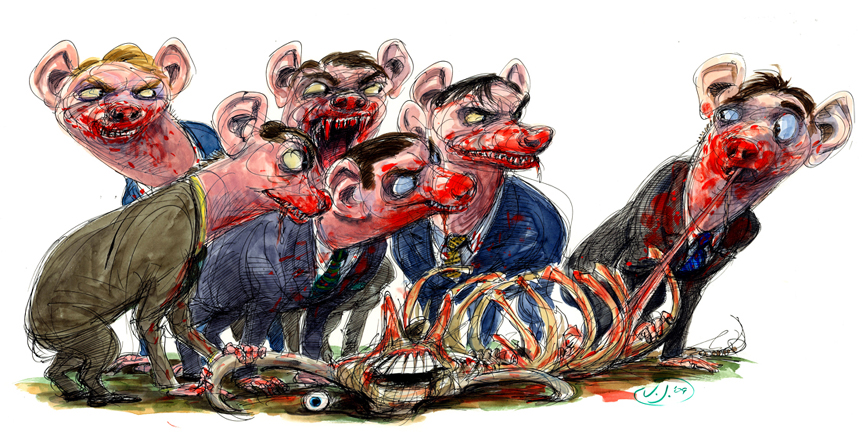
“I Can’t Help You” by Millicent Accardi

I Can't Help You
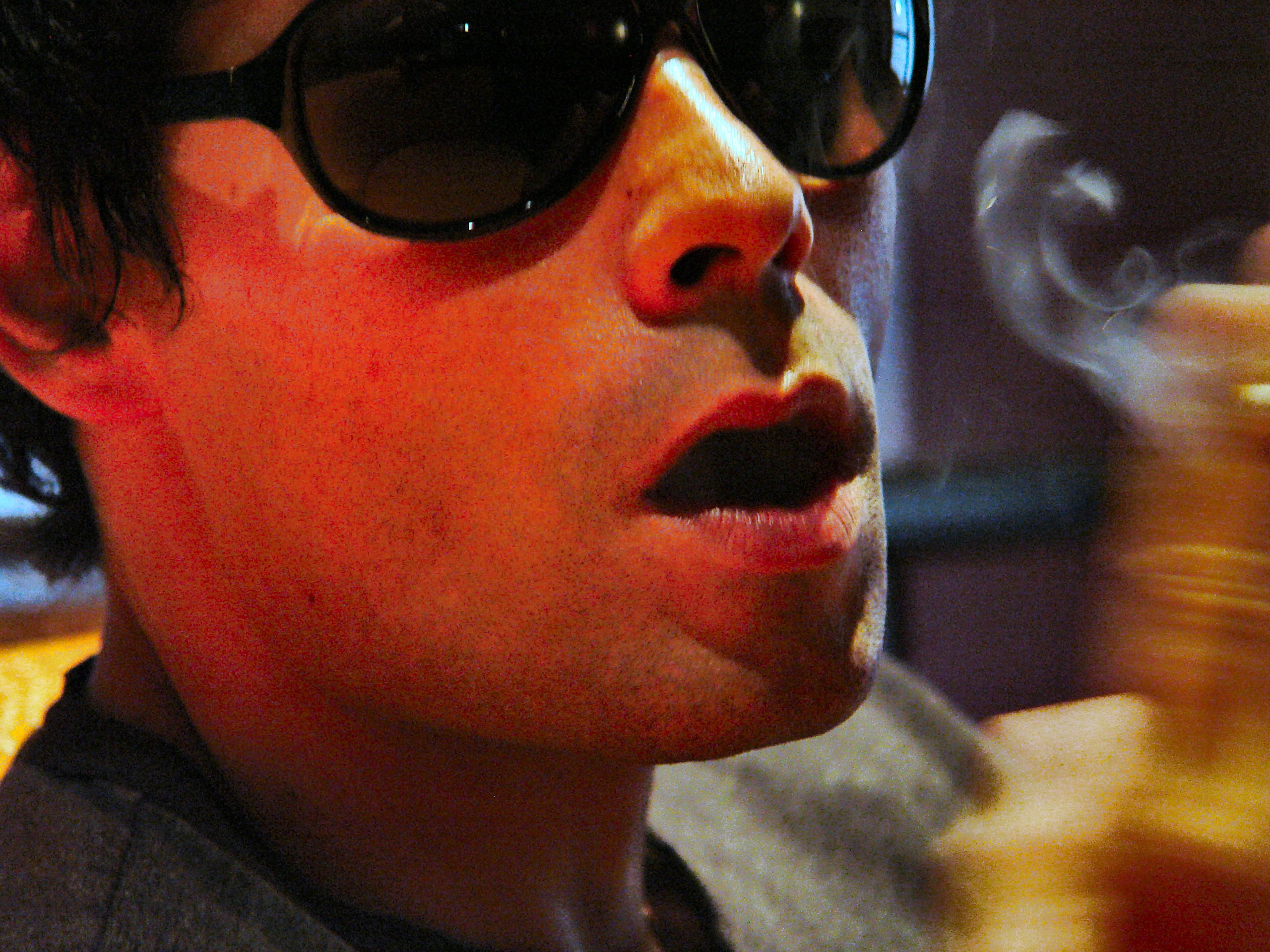
Image first published in Rolling Stone, appears here courtesy of Victor Juhasz

I can’t help you kick
The drug you call pancakes,
Or the replacement
You call syrup.
Your life has been
One long sweet taste
Of drama. You came nearly
Close to finishing
In many ways:
The swig of strong
Medicine. The twists
And burns
Of what and why
You thought
You were and are.
I remember
The night you screamed
At Dad saying
You were dancing
On his grave and to mom
You wished her
Back on the floor
Near the empty
Aspirin bottle the day
Other sister found her.
As a family, we have
Been through the recommended
Books, the last minute doctors
You gave up on moments
Before the truth was revealed.
We have been close
To finding the border,
Crossing over into sanity.
We have sucked it up
And loved you while
The trail of white water
You left behind churned
Up in our wake. At once
We were glad angels
Loaning you money.
At next, we were worse
Than the yellow devils
Of your irises, reflected
Upon us as you stared
Us down into oblivion
When we asked about
The missing tablets.
This is what it is like to live
Inside a struggle,
Just a kiss beyond
A fairy tale destination.
For which there is no middle
Ground, no training wheels,
No prince, no magic potion,
No deep red apple, no sugar
Plum house, no clever mice,
No breadcrumbs, no red hood,
No glass slippers, no pumpkin,
No wild wishing brook,
No monster or glass coffin
In your woods.
There is no gate to hold onto
As you swing back and forth.


Millicent Accardi is the author of two poetry books: Injuring Eternity and Woman on a Shaky Bridge. She received fellowships from the NEA, California Arts Council, Barbara Demming Foundation and Canto Mundo. A second full-length poetry collection Only More So is forthcoming from Salmon Press, Ireland in 2012.

Read an interview with Millicent Accardi here.
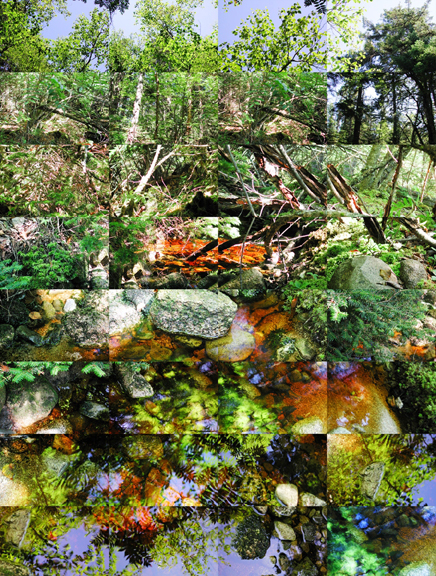
 

“Garnet” by Anne Colwell

Garnet
Photo Collage by Matthew Chase-Daniel, 2010.
(See also “Mei Lei” by Alena Dillon.)

Square-cut as a weight lifter’s jaw
And the hard red of congealed blood,
My grandmother’s garnet has nothing of glint,
Of sparkle.  It’s a stone of will.

Her hands in batter, bathwater,
Scrubbed down the spattered apron,
Hauling boxes of ketchup
To restaurants on her route, lifting
Children into beds, lifted in prayer
Behind two husbands’ coffins.
She willed the red ring
To my sister, whose birthstone is garnet,
Whose birthright’s this red.

The night I came to sleep on my sister’s couch,
Anemic, thin, after days of mornings
When I couldn’t lift even my small self
Out of bed, my sister slipped
The garnet on my hand.  Wear this, she said.


Anne Colwell has published a full-length collection of poetry, Believing Their Shadows (Word Press). Her chapbook, Father’s Occupation, Mother’s Maiden Name, won the National Women’s Press Association Prize for best book of verse published in 2007. She has published short stories in Octavo Magazine and The Delmarva Review. The University of Alabama Press published her book on the poems of Elizabeth Bishop, entitled “Inscrutable Houses: Metaphors of the Body in the Poems of Elizabeth Bishop.” An online chapbook of her poems appears in “The Poets” section of The Alsop Review. She has published individual poems and articles in a number of journals and quarterlies, including: Midwest Quarterly Review, Octavo, Southern Poetry Review, Eclectic Literary Forum, The California Quarterly and Dominion Review.

Read an interview with Anne here.


“My Mother’s Optimism” by John Guzlowski

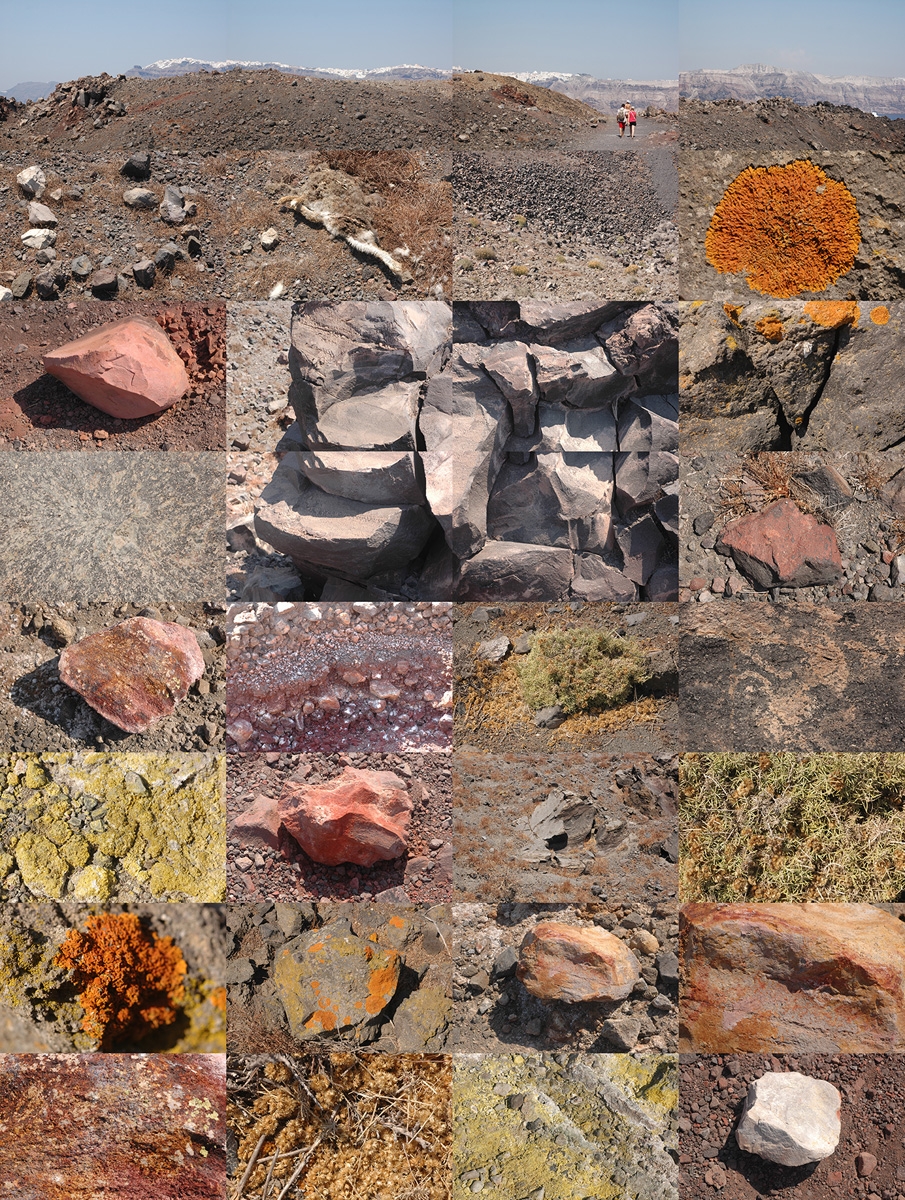
Nea Kameni, Santorini, Greece, 2010
Nea Kameni, Santorini, Greese, 2010

When she was seventy-eight years old
and the angel of death called to her
and told her the vaginal bleeding
that had been starting and stopping
like a crazy menopausal  period
was ovarian cancer, she said to him,
“Listen Doctor, I don’t have to tell you
your job.  If it’s cancer it’s cancer.
If you got to cut it out, you got to.”

After surgery, in the convalescent home
among the old men crying for their mothers,
and the silent roommates waiting for death,
she called me over to see her wound,
stapled and stitched, fourteen raw inches
from below her breasts to below her navel.
And when I said, “Mom, I don’t want to see it,”

She said, “Johnny, don’t be such a baby.”
Eight months later, at the end of her chemo,
my mother knows why the old men cry.
A few wiry strands of hair on her head,
her hands so weak she can’t hold a cup,
her legs swollen and blotched with blue lesions,
she says, “I’ll get better.  After his chemo,
Pauline’s second husband had ten more years.
He was golfing and breaking down doors
when he died of a heart attack at ninety.”

Then my mom’s eyes lock on mine, and she says,
“You know, optimism is a crazy man’s mother.”
And she laughs.


John Guzlowski’s fiction and poetry has been published in The Ontario Review, Atlanta Review, Exquisite Corpse and other print and online journals. His poems about his parents’ experiences in Nazi concentration camps appear in his book Lightning and Ashes. Regarding the Polish edition of these poems, Nobel Laureate Czeslaw Milosz says the poems are “astonishing.” Guzlowski blogs about his parents and their experiences here.

Read an interview with John here.

“Veal” by Christina Salme Ruiz Grantham

Veal
Cattle, Novato, California, 2004

¿Adonde voy? Where am I
And where am I meant to be? Nowhere,
at home, all day, trapped in my
mother-built mind-house,
closet-sized box, still.

¿Adonde estoy?
Some days she walked me to my room, slid
the closet door, helped me climb
into the ever-empty shelf.
She told me “stay” in the closet of
her discontent, like a dog worth beating.
“A storm,” she said, “stay quiet,” she’d say,
“not one peep,” checking and
rechecking through the slit—
open, close, open, peek.
Her palpable nerves ensuring I’d stay
still, quiet, more scared she’d find me
gone, of what might happen if
I touched the door, if I fingered
the unpainted inner wood
found a grasp, a toe hold
reopened my closet from the inside, clambered
to bed. Less frightened she’d forget me
than a splinter in my hand would betray me.
I stayed quiet for hours like days, day after
infinite day, listening to her moaning fright through
the plasterboard separating their thin room from mine.
How lonely she spent the storm, how
she must be aching. Yes I’d be still
but for the shaking of those walls,
Yes but
for the metallic rumble of my shelf.
Quiet
except for the storm, my ally.

¿Adonde fuí? At five, the moving box in
an unfurnished room—room in a different country—
where we’d play hide and seek, mother,
daughters, but mostly hide
at her insistence, hide from an elder
sister, try to win any game
by being more than silent—cardboard—win
against a greater force,
a sister, a mother like a child herself,
who never came looking for me until
I’d fallen asleep
in a box too tall to crawl out of,
too narrow in which to lie down.


Christina Salme Ruiz Grantham obtained her MFA from the University of Maryland, College Park in 1998. In 1999, she received an Individual Artist Grant from the Maryland State Arts Council, and Governor’s Citation for Artistic Merit. More recently, she attended the 2004 Bread Loaf Writers’ Conference, and was a scholarship winner in 2005. Also in 2005, she won an Individual Artist’s Grant from Prince George’s County, Maryland where she lives with her husband and twin sons. Mrs. Grantham has been previously published in Earthwise Review, Mobius, The Allegheny Review, and Borderlands.


“Walking” by Allan Johnston

Sarcobatus Falt, Nevada
Sarcobus Flat, Nevada, 2007 photocollage by Matthew Chase-Daniel

One starts by leaving the present,
because, as always with shoes,
it’s tied to hold the pieces in.
Funny to think of a foot

as a whole, yet when it’s rendered
in marble or schist
it only plants us further in.
There is every reason

to walk carefully
but whatever you might step in
is not one of them.
Some unavoidable things need blessings.

One possibility is to talk
about days, for every one of them
bears a mandate of light.

Walk in air, walk on water.
Some things are tougher.  Walk in and out.
Crawl into life. Fall out of life.
Pick it up.  Keep on walking.


Allan Johnston earned his M.A. in Creative Writing and his Ph.D. in English from the University of California, Davis. His poems have appeared in over sixty journals, including Poetry, Poetry East, Rattle, and Rhino. He is the author of one full-length poetry collection (Tasks of Survival, 1996) and a chapbook (Northport, 2010), and has received an Illinois Arts Council Fellowship, a Pushcart Prize nomination (2009), and First Prize in Poetry in the Outrider Press Literary Anthology competition (2010). Originally from California, he now teaches writing and literature at Columbia College and DePaul University in Chicago. He serves as a reader for Word River and for the Illinois Emerging Poets competition, and is the editor of the Journal for the Philosophical Study of Education. His scholarly articles have appeared in Twentieth Century Literature, College Literature, and several other journals.

Read an interview with Allan here.


“The Autobiography of Miss Jane Doe” by Jude Marr


Image by Jenn Rhubright

Archaeology rescued J. Doe’s remains
from a re-zoned potter’s field, before the backhoes
flattened clods into the basis for a co-ed dorm—

dirt-rain muck-churned mud-red on midwife’s boot sheet-reek and mama dyed at my
first wake

Pathology measured Doe at fifty-seven inches,
and an estimated twenty years. Her diseased joints,
her skull’s deformity, screamed tertiary syphilis—

my Rory my beau lost at sea Rory raw and bonny rest his soul Rory made May maid
no more

History judged, from the situation of the grave
and the condition of the bones, that Jane Doe must have lived
a whore, before post-Reconstruction’s Gilded Age—

pa traded me for meat plucked fowl blood sausage mutton rare sweet not spoiled not like pa’s wee May

Women’s Studies gave Ms Doe more shape: urban-slum child,
further pauperized by gender; tender cherry-
flesh broken/sold/assaulted by misogyny; a face made hideous by pox—

nor bairn’s nor women’s sickness dosed with mercury I shrink from sticks and staines from stink from me

Art played with Jane. Art digitized her skull, repaired
the syphilitic parts, layered virtual clay. Maybe J’s
reconstructed face, her blunt unwholesomeness, failed to inspire;
still, Art clicked SAVE—

tenement bed-wretched breath blood coughed consumption they say can’t wake May

Meanwhile, Buildings and Grounds scheduled another hole
(fifty-seven inches—four-foot-nine) and re-buried
Unidentified Human Remains, Female #63.

dirt-rain muck-churned mud-red on digger’s boot who says amen wakes me wakes May

Moral Philosophy may plant a cherry tree at her feet.


Jude Marr was born in Scotland and has lived for many years in England, but always with the United States on her mind and in her work. In the last two years, she has traveled to workshops and residencies in New England, New York and Florida. Right now, she is folding up her old life and putting it in a drawer with her winter clothes, getting ready for the new school year as an MFA candidate at Georgia College in Milledgeville. Her poems have also appeared in The Cortland Review, and she recently completed a novel she hopes may see the light someday. She is fifty-two years old and feels like her life just got started. Dreams can come true.

Read an interview with Jude here.


“Untitled” by Sarah Voss

untitled
Image by Jenn Rhubright

Old man futility is hovering
over my shoulder again. My third eye
catches him fiddling with my inner ear.

As always he looks strong, invincible
but hides his face. Let me in, he pleads.
It’ll feel familiar, comfortable.

My mother housed him most of her life.
Then he discovered me and I lugged him
around for years as if I had no choice.

One day I found my daughter holding him
tight, like a lover. I watched, weeping,
while he tried to wreck her self esteem,

mangle her mind. An old soul though, she
prevailed. I call her to let her know
he’s back. I share what he’s whispering.

She’s quicker than I, this daughter. Tell him
he’s lying, Mother. Familiar maybe, but
comfortable? Tell him he’s lying, Mom.

My voice gains power as I practice. Liar,
I yell. Liar. Liar. I spit on his feet, a first
for me, and he slinks off, skunked.


Sarah Voss’s poetry has appeared in literary journals including Writers’ Journal, The Mid-America Poetry Review, Thema, Earth’s Daughters, Ellipsis, Porcelain Toad, Plainsongs, and Whole Notes, and in several anthologies including Nebraska Presence: An Anthology of Poetry; Times of Sorrow, Times of Grace: Writing by Women of the Great Plains/High Plains. Her three published books, including What Number Is God?, all contain a smidgen of her poetry. She is a past contributor to r.k.v.r.y. (“Backbone” Spring 2008)

Read our interview with Sarah here.


“Torn” by C. Dale Young

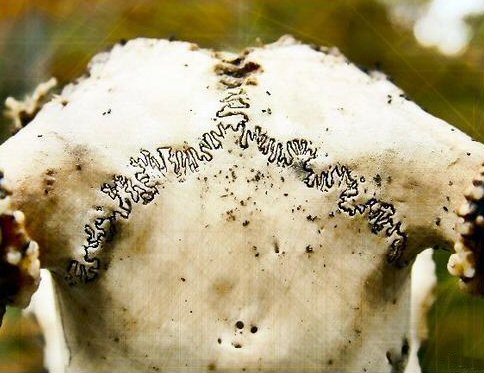
cow skull
“Cow Skull,” Image by Jenn Rhubright

There was the knife and the broken syringe
then the needle in my hand, the Tru-Cut
followed by the night-blue suture.

The wall behind registration listed a man
with his face open. Through the glass doors,
I saw the sky going blue to black as it had

24 hours earlier when I last stood there gazing off
into space, into the nothingness of that town.
Bat to the head. Knife to the face. They tore

down the boy in an alleyway, the broken syringe
skittering across the sidewalk. No concussion.
But the face torn open, the blood congealed

and crusted along his cheek. Stitch up the faggot
in bed 6
is all the ER doctor had said.
Queasy from the lack of sleep, I steadied

my hands as best I could after cleaning up
the dried blood. There was the needle
and the night-blue suture trailing behind it.

There was the flesh torn and the skin open.
I sat there and threw stitch after stitch
trying to put him back together again.

When the tears ran down his face,
I prayed it was a result of my work
and not the work of the men in the alley.

Even though I knew there were others to be seen,
I sat there and slowly threw each stitch.
There were always others to be seen. There was

always the bat and the knife. I said nothing,
and the tears kept welling in his eyes.
And even though I was told to be “quick and dirty,”

told to spend less than 20 minutes, I sat there
for over an hour closing the wound so that each edge
met its opposing match. I wanted him

to be beautiful again. Stitch up the faggot in bed 6.
Each suture thrown reminded me I would never be safe
in that town. There would always be the bat

and the knife, always a fool willing to tear me open
to see the dirty faggot inside. And when they
came in drunk or high with their own wounds,

when they bragged about their scuffles with the knife
and that other world of men, I sat there and sutured.
I sat there like an old woman and sewed them up.

Stitch after stitch, the slender exactness of my fingers
attempted perfection. I sat there and sewed them up.


C. Dale Young practices medicine full-time, serves as Poetry Editor of the New England Review, and teaches in the Warren Wilson College MFA Program for Writers. He is the author of The Day Underneath the Day (TriQuarterlyBooks, 2001), The Second Person (Four Way Books, 2007), and Torn (Four Way Books, 2011). He is a previous winner of the Grolier Prize, the Tennessee Williams Scholarship in Poetry from the Sewanee Writers’ Conference, both the Stanley P. Young Fellowship and Amanda Davis Fellowship from the Bread Loaf Writers’ Conference, and a creative writing fellowship from the National Endowment for the Arts. His poems have appeared in The Best American Poetry, Asian American Poetry: The Next Generation, Legitimate Dangers: American Poets of the New Century, American Poetry Review, The Paris Review, Ploughshares, and Poetry. He lives in San Francisco with his spouse the biologist and composer, Jacob Bertrand.

“Torn” from TORN (c) 2011 by C. Dale Young. Reprinted by permission of Four Way Books. All rights reserved. Read our review of TORN here.


“Sepsis” by C. Dale Young

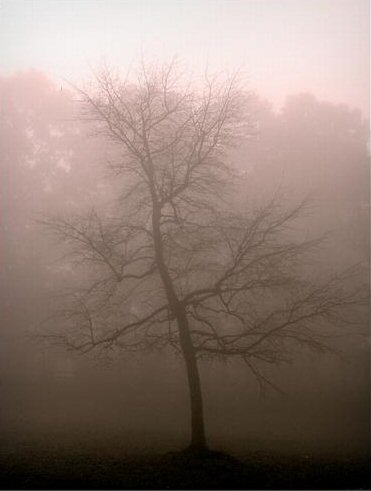
Tree in mist
Image by Jenn Rhubright

The fog has yet to lift, God, and still the bustle
of buses and garbage trucks. God, I have coveted
sleep. I have wished to find an empty bed

in the hospital while on call. I have placed
my bodily needs first, left nurses to do
what I should have done. And so, the antibiotics

sat on the counter. They sat on the counter
under incandescent lights. No needle was placed
in the woman’s arm. No IV was started. It sat there

on the counter waiting. I have coveted sleep, God,
and the toxins I studied in Bacteriology took hold
of Your servant. When the blood flowered

beneath her skin, I shocked her, placed the paddles
on her chest, her dying body convulsing each time.
The antibiotics sat on the counter, and shame

colored my face, the blood pooling in my cheeks
like heat. And outside, the stars continued falling
into place. And the owl kept talking without listening.

And the wind kept sweeping the streets clean.
And the heart in my chest stayed silent.
How could I have known that I would never forget,

that early some mornings, in the waking time,
the fog still filling the avenues, that the image
of her body clothed in sweat would find me?

I have disobeyed my Oath. I have caused harm.
I have failed the preacher from the Baptist Church.
Dear God, how does a sinner outlast the sin?


C. Dale Young practices medicine full-time, serves as Poetry Editor of the New England Review, and teaches in the Warren Wilson College MFA Program for Writers. He is the author of The Day Underneath the Day (TriQuarterlyBooks, 2001), The Second Person (Four Way Books, 2007), and Torn (Four Way Books, 2011). He is a previous winner of the Grolier Prize, the Tennessee Williams Scholarship in Poetry from the Sewanee Writers’ Conference, both the Stanley P. Young Fellowship and Amanda Davis Fellowship from the Bread Loaf Writers’ Conference, and a creative writing fellowship from the National Endowment for the Arts. His poems have appeared in The Best American Poetry, Asian American Poetry: The Next Generation, Legitimate Dangers: American Poets of the New Century, American Poetry Review, The Paris Review, Ploughshares, and Poetry. He lives in San Francisco with his spouse the biologist and composer, Jacob Bertrand.

“Sepsis” from TORN (c) 2011 by C. Dale Young. Reprinted by permission of Four Way Books. All rights reserved. Read our review of TORN here.


Review of TORN by C. Dale Young

TORN
by C. Dale Young
Four Way Books
March 2011
85 pages

In TORN, C. Dale Young’s most recent book of poetry, he continues to explore the themes of human frailty, both physical and spiritual, of love and passion, and of tenderness and cruelty.

The poems in this collection beautifully express the irony of the human craving for precision and accuracy—particularly in the field of medicine and in the realm of love—and the unfortunate and inherent fallibility of both. Often Young employs repetition of a word or a phrase, guiding the reader toward understanding by modifying the context each time the word or phrase appears. This repetition also serves to deliver a sense of urgency to the cadence of the poem and the meaning of the whole.

In fact, the very organization of the collection pulls the reader forward through the book, as if moving through a life. Its sections call to mind Blake’s Songs of  Innocence and Experience.

Section I opens the book, delivering the reader into a world of heady innocence, of childhood desire on the edge of understanding, of love just beginning. Consider these exuberant lines from the poem “The Bridge”:

“And I love fountain pens. I mean
I just love them. Cleaning them,
filling them with ink, fills me
with a kind of joy, even if joy

is so 1950. I know, no one talks about
joy anymore. It is even more taboo
than love. And so, of course, I love joy.
I love the way joy sounds as it exits

your mouth. You know, the word joy.
How joyous is that. It makes me think
of bubbles, chandeliers, dandelions.” (25, 26)

By the time the reader reaches Section II, the perils of Knowledge (with a capital K) come to the fore as Young explores the human tendency toward doubt and sin. The poem “The Seventh Circle” expresses it thusly:

“Did Michelangelo dream of hell
while he manipulated shadows
in an attempt to show us heaven?
Did he betray himself with his hands

that admired the strength of other men’s hands?
If he did, we have forgotten.
Yes. Here we see the luxuries of heaven,
the bodies clothed only in light
languishing above painted shadows
that separate these glories from hell.

There will be no Cerberus in our circle of hell,
we are told, only hundreds of swaying hands
reaching up from even darker shadows.” (46, 47)

And finally, section III brings the reader forward, into a world of post-experience, of regret, judgment, and fallibility, and even a weary sort of forgiveness. Consider the following lines from “Self-Portrait at 4 AM”:

“…The mirror

is of no use. It lies, dirty and spattered
with toothpaste and beard stubble and crud.
It lies. That man staring at me is not my friend.

That man wants to hurt me. He has
hurt me before. I have hurt myself.” (72, 73)

In TORN, his third collection of diverse and beautiful poems, C. Dale Young has given his readers a celebration, a gorgeous lamentation, and an attempt, as the surgeon in the title poem tells us with despair, at perfection. And here, Young has come as close to that ideal as fallible words and human hands can.