Interview with Helen Branch

Mary Akers: Hi, Helen. Thanks for agreeing to speak with me about your writing process. One of the things that struck me right away in your marvelous short story “Mermaid Rock” was your use of sensory details. I love it when a story takes me there in terms of touch, taste, sounds, smells, and of course /images. You do this so well. Is this a conscious act of yours as you write? Or does it come naturally out of how you interact with your world?

Helen Branch: The initial idea for the story came out of a writing workshop I attended. The workshop energized my writing and as a result I started a word sketchbook. I wrote what came to mind, and for the story that became “Mermaid Rock” I had an image of a woman backing down the steps of a dock into a lake. I thought, how does that feel and how do I communicate it? It’s a common enough experience. We’ve all braced ourselves to go into the cold water. We anticipate the feeling, but it’s still a shock to feel the water move up your legs. I tried to capture the experience by breaking down all the sensory details. Then, my description sat in my sketchbook for about six months. When I found it again, I wondered, who is the woman backing down the steps, and why is she there at that particular moment?


MA: Wonderful. What a great way into a story. And it strikes me that the structure of your story is very unusual. It is definitely not a linear story, but I think it works quite well to get at Adele’s memories and her thoughts. Could you say a little bit about why you chose to structure it the way you did? And how much do you think a story’s structure influences the reader’s experience of the story?

HB: I couldn’t really use a conventional, linear structure with this story. Except for the ending, when she goes for a swim, Adele’s action is recalling events from her past. Of course, the act of remembering can be hard work. I tried to imitate that dynamic, and build tension as her memories culminate in the realization that her marriage failed her. When we remember the past we try to make sense of it and find the pattern. With Adele, I wanted to present a character that was reviewing her past, and her relationship, and coming to terms. And, I wanted the story to feel immediate and intimate and to mimic how we replay the past.


MA: When we were working together on revising the ending of your piece, we talked about the final image the reader is left with and the importance of “resonance,” by which I mean something like a tuning fork that once struck keeps on reverberating. I felt like you did a wonderful job with that in the revision, especially invoking the ripples on the water moving outward from her perch on the rock. How do you find your endings? Do you plan them out and then write toward them? Or forge ahead and find the ending in the writing?

HB: Endings are tricky. In an ideal world an ending would appear like a rabbit pulled out of a hat, but, instead, I’m frequently chasing it around the room. My first draft is just a narrative outline complete with where I think I’ll end. Then, the real writing begins. I try things on. I cut and paste. I reorder events, change names, add and delete characters. Sometimes I am surprised where the writing takes me. I hope, though, that the ending is an organic result of the story’s action. I want the reader to feel that, of course, this is how the story should end. Not that the ending was predictable, but just right, appropriate. I want to understand the ending too. I hate it when I am captivated by a story until the very end, and then left wondering, what just happened? And, of course, it’s always great to have an extra set of eyes look it over.


MA: Water plays an important role in myths, in our belief systems, even in the practice of faith. It’s cleansing, rejuvenating, life-sustaining and always changing but always staying the same. It can also drown us. How important was the lake to Adele’s transformation? How important was it to you as the writer, in accomplishing what you wanted to in the story?

HB: Water is central to the story. I use the characters’ interaction with the lake to reveal key aspects of their personality. The first time Tim sees the lake he strips off his clothes and jumps in. Adele is, at first, passive and sits high on the cabin’s deck watching the water. The reader knows she has a relationship with the lake. She learned to swim there and the rock jutting out of the water is ‘hers’. And the water here does perform an important, almost baptismal, function. The act of taking a midnight swim reunites the split Adele; the woman who recognizes the failure of her marriage and the woman who accepts the essential right to be herself.

When I was thinking about your question, I realized that water also plays a critical role in the novel I’m writing. The novel, “The Pebble Collection,” is about a woman who finds mason jars filled with pebbles in her aunt’s pantry. The pebbles were taken from a river on the property and they have a magical effect on the person handling them, allowing the person to believe in what they most desire. But, the river wants the pebbles returned. So, in this case, in the novel, water is a malevolent force. Like you said, water can both heal and hurt.

Mermaid Rock

MA: Your novel sounds fascinating.

Our guest illustrator, Kristin Beeler, designed a unique piece of artwork for each story, poem, or essay. It’s a great gift to have an artist adopt each issue. To me, it brings the written work to life in new and exciting ways. The first image that she submitted for your story felt menacing to me, with the figure of a man in shadow, over a woman on the ground. It was interesting, but since we had revised the ending to be more hopeful, I went back to Kristin and asked if she wouldn’t mind changing the image. She did, and I was very intrigued by the one she came up with. What did you think of it? How would you describe it as relating to your essay?

HB: When I was ten or eleven I spent several weeks at a cabin on a lake like the one I describe in the story. There were seats hanging from chains under the porch roof and cushions made out of a course fabric like the webbing on a lawn chair. The cushions had a green plaid design. When I saw the picture Kristin had taken, I had a flash of recognition. I thought of those cushions. Of course, when I looked more closely I saw that it was parallel lines of rail road tracks. Good photography can do that. Like Edward Weston’s “Pepper #30”, it can represent more than just the literal image. The photograph ties in with the memory Adele has when she and Tim hike out to the train tracks. But the image with its repeating pattern of parallel lines is suggestive too of the patterns in her life that Adele is reviewing.


MA: I love that! How fabulous that your own experiences made it exactly what you wanted it to be on first viewing. Just like good writing can conform to the reader’s needs. Which leads us to my favorite question of all: what does “recovery” mean to you?

HB: I think we humans are fundamentally hardwired to tell ourselves and others stories. We are always trying to put ourselves into a larger context. We are finding patterns, revising, projecting where the storyline will go. And, we can get caught up in the wrong story. I believe that recovery requires us to step aside, to consider the story we’re telling. And, then rewrite it. Sounds simple, right? Of course, it’s not, but recovery lies in the process of rewriting. That’s why I was so excited to be published in r.kv.r.y. I thought “Mermaid Rock” fit with a vision of reclaiming, or recovering one’s story.


MA: Wonderful, Helen. We’re excited to have you in r.kv.r.y., too. And thanks so much for the discussion. It’s been great.

Interview with Sonya Huber

Sonya Huber

Mary Akers: Your essay (Saint Jerry Wants a Medium Pizza with Half Pepperoni) really spoke to me, Sonya. Particularly the beginning, where you say that when you heard the list of what qualifies as abuse, you realized that you knew it already, but only for others, not for yourself. I’ve been there, and it’s a shocking moment when we realize that what we’ve been putting up with ourselves, we would call something very different if we saw someone else being subjected to it. Could you speak a little bit about that moment of realization and the perspective that it gave you?

Sonya Huber: I appreciate you saying that you’ve been there. I found it so difficult to get my bearings, and I had many moments in which I made notes to myself, trying to collect enough internal evidence to add up to clarity. It was like a version of the movie Memento, where the main character loses both his memory and sense of chronology and covers himself with tattoos and notes to retrace his own steps. I was just cleaning out some files today and found yet more notes and a pamphlet about domestic violence from a time before I thought I had concerns. I was trying to persuade myself that what I was experiencing was real. There were several small moments that each connected to the next realization; one powerful insight wasn’t enough. I had to fight every day to get back to the reality in which my opinion mattered. I made a numbered list with black marker of things I needed to do to take care of myself, and I hung it on my fridge. One of them was “Don’t keep secrets.” I had it hanging up for about a year.

I have always taken pride in my resilience. For me, that led to a sort of pride in being “tough” or “strong.” I told myself that I could handle anything, that the measure of my freedom was how much I could take without blinking. I thought that was peace. I thought that I could withdraw deep into myself like a snail or a hermit crab, and that at some point in the future, I could just come back out. But humans are not mollusks; I’ve seen the limits of my resilience. I know that there are many things I can’t handle. It took a long time to admit that, but it also led me to understand that I shouldn’t have to handle those things and that I should run from them. Certain experiences are truly dangerous, and they have lasting negative effects. Being exposed to cruelty changes a person. I guess I should have picked that up somewhere along the way, but at least I know it now.


MA: When you and I were working together on revising your piece early on, you said something like, “Well, that idea sort of took over the piece.” (It was the idea of tying into the Pizza Hut specials.)  Clearly, revisions can take our work into unexpected areas. Do you find that exciting? Or burdensome?

SH: I love it. That’s the whole of writing, to me—that’s my experience every day when I sit down at the computer. I always start out with a clear idea of what I want to happen, and it never works out the way I imagined. It’s a great reminder for me in the rest of my life: my idea of “finished” and “happy” and “perfect” is never as good as what happens when I get feedback from other people, when my work collides with the rest of the world, and when I get another viewpoint. It happens in revision, too–I get to have conversations with different versions of myself on the page, and the Wednesday version of myself is usually more than willing to delete Tuesday’s paragraphs.


MA: This is one of my very favorite lines from your essay: “Other women were smart were myself were stupid were somehow here.” I just love that more than I can express. It says so much to me about how we get here, who gets here, our aloneness once we arrive and yet the universal ties we share. I realize I’m bringing my own experience to your words and creating something meaningful to me, but really, that’s what readers do, isn’t it? I’m fascinated by the idea that readers can take our words and imbue them with their own meaning. Can you tell me if what I took from that line is what you meant? And if not, does that bother you?

SH: Thank you! That’s one of those weird sentences that revision sometimes provides. I think I was in the midst of deleting a phrase and had too many verbs. The semi-nonsense pattern with all the passives made a loop that felt true to my experience. That’s exactly what I meant—that moment of each woman being alone between these verbs, just stuck. It seemed to reflect the surprising truth that I was no better or worse than anyone else in that situation—and then the shock that being stuck also meant I was part of something bigger than myself, that my experience might therefore have meaning.

Saint Jerry

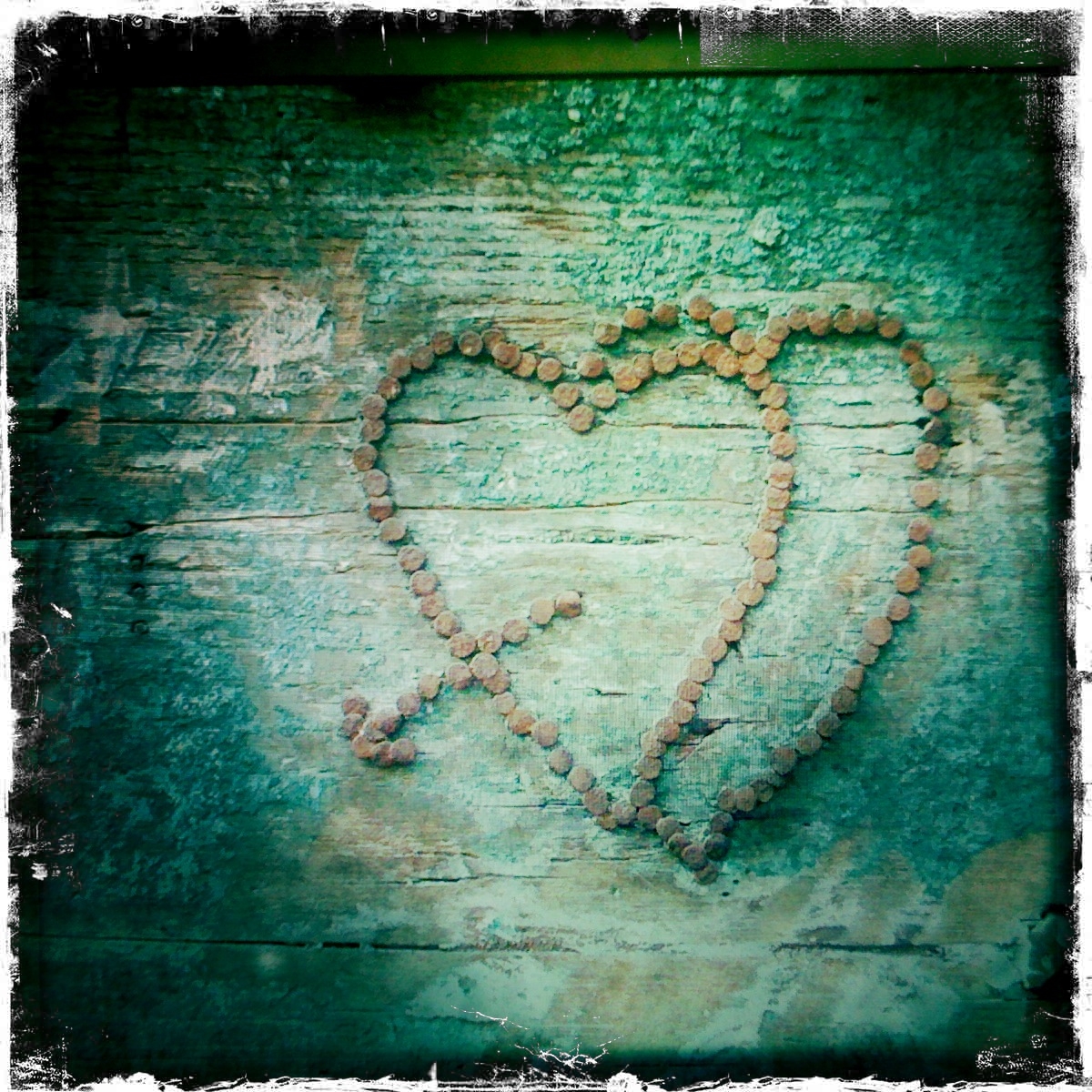
MA: Ah, yes, the accidental creativity that we simply have to be open to. Isn’t that the best? Speaking of creativity, our guest illustrator, Kristin Beeler, read each piece of writing for this issue and designed a unique image for each. It’s really such a gift that an artist is willing to do that for us each issue. To me, it brings the written work to life in a new and exciting way. Her image for your essay was a very simple one, but sometimes simplicity can be the most powerful approach. What did you think of the image she chose for yours? How would you describe it as relating to your essay?

SH: That image is heartbreaking to me, the more I look at it. At first glance I thought the many small circles were pennies or pieces of pepperoni–but then I looked close and realized the hearts are formed from hammered nails. The weathered look of the metal and wood reminded me of how carefully we can compose a situation and yet how desperately we hold on to what looks like love. Those careful hearts–they remind me that nothing is simple. I’ve been in difficult situations with people who I loved and who truly loved me, and the experiences were so hard to figure out because they were mixes of care and cruelty, and neither of us knew which was which. And I’m reading about the history of Christianity right now, so it evokes the image of crucifixion. And a third set of associations is very personal, but I will say that the image itself is eerily connected to elements of my life story. Yes, the image is utterly appropriate.


MA: And finally, a question I especially love to read the answers to: what does “recovery” mean to you?

SH: Recovery evokes many beautiful /images for me: the space to breathe, to have contact with the spiritual side of my life, a chance to understand how my head works, and to learn from other people’s experiences.

For me, recovery is the opposite of the misleading term “self-help,” because I would not have glimpsed sanity without other people in intentional, structured communities. I have spent years sitting in rooms with mismatched chairs and strangers in the well-known organization for friends and family members of alcoholics and addicts. That’s my second family. So I have to go back to the basics: for me, recovery will always mean that free network where the clarity makes you laugh, the coffee is usually pretty bad, and the love helps you redefine what love means.


MA: Beautiful. Thanks for your time and insightful answers, Sonya. I really enjoyed your responses, and I think our readers will, too.

Here are links to more of Sonya’s excellent work:

Her newest book, Cover Me: A Health Insurance Memoir

Sonya’s website

A photo essay about the writing process called “How Do I Write?” that originally appeared in The Oxford Magazine

The Amazon link for Cover Me

and for her first book, Opa Nobody 

An interview with Anjali Enjeti


Mary Akers: I really love your essay “Beadwork.” Lately I’ve been thinking a lot about how art and recovery are often inextricably linked. A song can help us heal, a piece of writing, even a beautiful painting can speak to whatever is weighing heavy on our minds. And your mother’s beading of rosaries strikes me as a creative act, too–the hand-making of something beautiful and meaningful designed to share with others. Would you care to comment on that?

Anjali Enjeti: Perhaps there’s a sort of yin yang thing going on when it comes to recovery. I think after tragedy, the soul needs creation to balance out the destruction.  Or maybe the mind just needs distraction to comprehend grief. Regardless, I think there’s something particularly therapeutic about creating something physical, something tangible, to hand to someone who is hurting. The creative energy my loved ones poured into beading a rosary, baking cookies, handwriting a note, knitting a pair of socks— sustained me through my darkest times. Creation, just like recovery, is a necessary process of life.


MA: I agree–creation to balance out the destruction. That’s a nice way to look at it. Light to balance tha dark. Do you feel that writing about painful experiences actually helps us to recover from them? And do you have any thoughts on how or why that process works?

AE: Absolutely.

There are very few socially acceptable ways to react to pain. I couldn’t scream in the middle of a park, have in a massive meltdown in the aisle of a grocery store. I couldn’t crawl into a deep dark hole and stay there until I felt better. I couldn’t quit life or stop time.

The only thing I could do was write.

Writing was a means for me to relive my pain over and over and over again until I could somehow grasp its depth and complexity. Once I compartmentalized my emotions into metaphors, italics, paragraphs or ellipses– once I committed my silent voice to a narrative form– I began to heal.


MA: Yes. A friend of mine survived banishment to Siberia during Stalin’s brutal regime and he swears that retelling the story for 70 years now has taken out all the sting of it in a very healthy way. (And he’s a psychologist, so he ought to know!) One image from your essay that really sticks with me is found in the line: “I try to picture American soldiers combing the desert with dog tags hanging around their necks, M16s secured to their chests, and black rosaries stuffed in their pockets.” As soon as I read that, I try to picture it, too, and I think it’s important that we do. It also links you and your struggles, and your mother and her rosary group to men halfway around the world, fighting for their lives and also fighting to recover from their own traumas. Did you feel that connection, too?

AE: Recovery is a battle, isn’t? A war zone with no boundaries. When we hurt, we are bruised and battered soldiers, trying to find meaning in senseless violence. We are stunned by the assault on our senses. The harder the fight, the more aggressive we have to be to find a way out.

When I held the rosaries for the soldiers my mother made, I felt stronger, more ready, to face the remainder of what I hoped would be a successful pregnancy. But the black rosaries were also a sobering reminder for me that what others faced in the world was far worse than my own individual pain. This perspective was crucial to my recovery.

Beadwork

MA: You also talk about faith in terms of Catholicism, and Hinduism, and an unusual melding of the two. I’m not convinced that the word “faith” has to be a stand-in for organized religion, despite what so many politicians would have us believe. I think faith can exist on its own. Do you believe that the act of recovering requires faith in some form?

AE: Ultimately, the type of faith that got me through a very stressful pregnancy did not originate from organized religion or a particular philosophy. It was my mother’s faith in me.

I will say this—the older I get, the less I understand faith. But if faith is the belief that the tide will eventually turn, that the storm will blow over, that the fire will burn out, then yes, I think recovery requires faith. What kept me going on my very worst days was faith in the words of friends with similar losses: You won’t always hurt this badly.


MA: And finally, what does “recovery” mean to you?

AE: Recovery to me is self-forgiveness. It’s the freeing of oneself from any blame that may or may not have contributed to the trauma. It’s the shelving of infinite “what-ifs,” the relinquishment of 20/20 hindsight.

I knew I started on my road to recovery when, instead of going in circles, I took a step in a new direction, toward a new normal. Though I knew I would never, ever be the same person again, I also knew that it was OK that I’d never be the same person again.


MA: Yes, a new direction. I like that. Thank you for participating, Anjali. I’ve really enjoyed it. And for our readers, here is more to enjoy–a few links to additional essays:

Carousel

Fade to Brown

Am I Raising Feminists?

A Different World

An Interview with Craig Boyer


MA: Hi, Craig. Thanks for agreeing to answer a few questions about the creative process in general and your work in particular. I like the narrative voice in your story 1984. One of the things that sticks with me is your narrator’s feeling of being invisible. He’s in a crowd of people, dripping wet from his frozen clothes thawing, and no one notices. This strikes me as an apt description of modern life. Would you care to comment on that?

CB: While writing 1984, I tried to create a dissociative voice. I think that dissociation—both in a social and a personal sense—provides an interesting parallel. The narrator is not only a cipher to the people around him, he is simultaneously a stranger in his own body. He does not experience sensations of discomfort or pain, but merely becomes aware of them as they occur to the body he inhabits. He experiences the people around him in much the same way.


MA: Yes, I see that. He’s sort of an observer of his own life. I love the image that our guest illustrator, Kristin Beeler, designed to accompany your piece. I’m interested to hear what you think of it. What did you make of the spider and the drain?

CB: I also loved Kristen Beeler’s piece and found it incredibly appropriate for 1984. The colors of decay, the implied silence, and the ominous presence of the spider perfectly echoed the mood and foreshadowed the ending. The drain, for me, illustrated the waste of addiction while the spider invoked the threat of destruction.

1984
MA: Yes, “implied silence.” What a great descriptor. There is a lot of silence in both the image and your story. And at the end, your narrator clearly still feels voiceless and invisible, even as he writes an inflammatory phrase on the wall in his own blood. What events do you think could occur that would make him feel seen/visible?

CB: The question I struggled with while writing 1984 is a question I encounter everyday in my work: Is it the responsibility of the sufferer to appropriately cry for help or is it the responsibility of those who can help to be more aware? In a clinical setting we become almost hyper-aware; in the real world, that level of awareness is much more difficult.


MA: I agree. I struggle with that in my life, too. And I would say that even when we are aware, it can be tough to gauge when it’s time to step in and when to simply stand by. You’ve depicted your narrator in a way that makes me care what happens to him. I think that’s really important in a story of any kind. In this case, I want him to recover from his addiction, to turn his back on the numbing effects of alcohol. Given that you have created something that is artistic and also speaks to addiction, I’m wondering what role you think art or “The Arts” plays in recovery?

CB: The Arts provide an outlet for deep honesty, beyond the mere reporting of events. Honesty can become, through storytelling, a shared experience. For me, that honesty has been the foundation for recovery.


MA: And finally, what does “recovery” mean to you?

CB: For me, as someone who was diagnosed with obsessive-compulsive disorder at the age of 31, insight was the beginning of recovery. The next and most difficult step was asking for help. The final step is my daily awareness that every morning I must choose to continue recovering.


MA: Insight, yes. We could all use more of that. Thanks so much for this discussion, Craig, and for sharing your fine work with our readers.

Showcasing the work of Kim Chinquee

Kim Chinquee


I have been a fan of the work of Kim Chinquee (Salsa) for a long time. Her flash fictions feel so real to me–gritty and unflinching and honest–and yes, even sexy. And all written with such wonderful economy of word. Can you tell I’m a fan?


And it occurs to me, that rather than blather on about how great her work is, how fabulously she writes, how cool she is in person, and on and on, the quickest way to make you a fan, too, is to point you to some more of her excellent work. So, without further ado, please take a moment to check out:


It Wasn’t Supposed to Be Permanent
Two Stories: I Wanted to Believe This Was My Life & Lockbox

Some Days He Could See

Physics
Please Just Come to the Door

And if those have whetted your appetite and you are craving more, here are links to her two marvelous (and very attractive) books:


OH BABY


Pretty

An Interview with Debbie Ann Ice


Mary Akers: I loved your SOS piece “Betty” and the way your narrator watches and describes the scene for us then re-imagines it from another angle. God, I feel like poor Betty most days. Wandering, searching, naked. It’s such a great allegory, really. And then the interactions between the other women, efficient Ann, who also covets the lavender shirt. This story is so rich. Can you tell me a little about what inspired it?

Debbie Ann Ice: I work out at that YMCA regularly, and one afternoon I noticed these older women  wandering around looking into lockers. I had seen them before. I think they were in a swim aerobics class certain days at the same time. One was very much like the Betty in the story, and yes she did lose her locker, so the others were helping out. I just loved them– their way of accepting the situation, how they all worked together. No one made a big deal about losing one’s clothes. No one teased Betty. No one rolled their eyes.  No one acted like they were in a hurry. “This is who we are,” their way of being said to me. “We are old and we lose things. And we are managing just fine, thank you!” So, of course, I couldn’t get enough of them, I soaked them into my bone marrow. Do you do that sometimes? Soak up people you notice and think are terrific? If I didn’t pause to write, I think I’d follow people around. I would be on TV, handcuffed, some older woman telling the reporter, “She seemed nice at the gym, but then I noticed her car behind me, then in my driveway.”

I did peek into lockers and help. But the rest of the story was simply inspired by observing them and trying to figure out Betty, her loss, her lostness. I can imagine losing a loved one feels like wandering around naked and being unable to find your clothes.  And who cannot relate to that?

By the way, I lose things all the time, and I do forget where I parked my car in big parking lots.


MA: Betty learning to “place” herself speaks to me. Like Ann in the story says, aren’t we all placing ourselves all the time? And after a monumental loss like Betty’s it strikes me that she would not only be placing herself, but REplacing herself in her changed landscape. Do you think Betty will find her new place without Gene?

DAI:Of course she will! Betty owns herself.  She’s just temporarily lost and naked. There are always these Anns and Andreas hanging around to guide people. Everybody wants to help a Betty because we admire those who own themselves, who strive to survive, not linger. Besides, we are all Bettys wondering around naked at some point in our life.  Don’t you think?


MA: Yes, I do. Which brings me to one of my favorite questions to ask of contributors: What does “recovery” mean to you?

DAI:I think everyone has a different definition. My definition of recovery is the time it takes to move from defining yourself by the impact of the world upon you to defining yourself  as your impact upon the world. Severe stress, trauma, loss, addiction are huge pains that require lots of work. But every day holds little pains for everyone, small hiccups, we all have to recover from. A bad phone conversation, a rejection of some sort, your kid talking back to you, you and your husband fighting etc. If you let these pains define you, you risk giving yourself permission to act horribly, because you see yourself as a product, not a mover.Dickens described people in one of his books (Tale of Two Cities I think) as houses that hold great mysteries inside, mysteries we can only guess at. A little light escapes the windows, we see shadowy movement, we notice the paint on the outside, we notice the roof that needs repair, we see the driveway with a few potholes. But we can only imagine what is taking place inside.  Sometimes what happens inside is horrifying, so horrifying the outside of the house starts looking worn down–the  paint peels, the roof falls apart, the driveway potholes sit there. Recovery is handling whatever has to be handled in such a way that the house returns to a good condition. It starts to look OK again, holds up well during the seasons and fits nicely into the neighborhood.

This is why it’s best to refrain from concluding anything about anyone based upon outside appearances, or mistakes, or a bad day. Judgment blinds one to the fact that inside the house is a mystery.


MA: Maybe you’ve already answered this, but since it was my next question, I’ll go ahead and ask. This past week I had a chance to promote r.kv.r.y. and I would tell people that we are a themed journal, with the notion of recovery at its core. Then I would add, when the person looked doubtful, that “After all, we’re all recovering from something.” Do you think this is a true statement?

DAI:Everybody has something they are dealing with. Even the most perfect person (and in my town there are a ton of perfect people! They frighten me!) has something they are trying to deal with. How they deal with it defines them. And everyone has their own plan unique to them.

Some people have to recover from their recovery! I read this terrific essay in New York Times magazine by a writer who had been seeing therapists for 40 years. 40 YEARS!! And what she could not get over was something most all of us would consider, well, minor. She simply didn’t think her parents paid enough attention to her.Anyway, years and years, talking about the parents, then everyone else in her life and how they made her feel. blah blah blah. Totally cocooned in her past, her victimhood. She was a great writer, very honest about this, very funny. Anyway, finally, a therapist mentioned it may be time for her to try life without therapy. So she had to see a therapist who specialized in determining if she could live without therapy. Then, when those therapy results suggested that, yes, indeed she could live without therapy, she had to find a therapist who specialized in weaning her off therapy. She is now being treated– I kid you not!– for past addiction to therapy.


MA: That’s a great story. I think I know that person. And I may have to use that sometime–may I? I’ll pay you a dollar. (One of my writing mentors says if you use someone’s idea, pay them a dollar–that way it’s not stealing and you don’t have to feel bad about it.) On a more personal note, I know that you have two lovely canine daughters and that they often appear in your work. Here’s your chance to speak to the loveliness of the breed. Would you tell us all something that you’d like us to know about bulldogs?

DAI:Bulldogs have wrinkles that have to be cleaned.

Bulldogs have little bellies that sometimes drag through mud and puddles and leave their muddy imprint upon furniture.

Bulldogs wobble when they run. And they love to play, like toddlers.

Bulldogs have lots of health problems and require constant care.

Bulldogs are the most stubborn animals created.  Once, on a walk, my two bulldogs decided “OK, no more walking. We’re tired and that’s it.” And there I was in a neighborhood, quite a distance from home,  with two fat things blobbed out on the side of the road. I sat in the grass and waved at cars until Dora (the oldest and fattest) decided she would rather sleep on the couch, so slowly stood and started movement. I had to carry Daisy, who was younger at the time, half the way back. Everyone who passed in a car was laughing hysterically.

Bulldogs are misunderstood at dog parks. The average typical, non-bulldog dog has 100 different facial expressions and thus have amazing social skills. The bulldog can only make 10 distinct facial expressions due to excessive wrinkles. Thus dogs don’t get them right away. But when they do get them, they love them. This understanding has to be helped along by the caretaker.

Bulldogs sometimes put their heads and little cheeks on your shoulder. They  crawl onto your lap like a

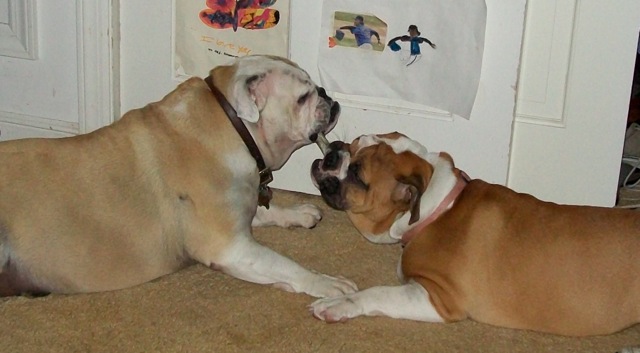
And here is a picture of my bulldogs sharing a bone. One chews on one end, the other on the other end.

Bulldogs sharing a bone

An Interview with T.J. Forrester

Mary Akers: Hi, TJ. Thanks so much for agreeing to talk with me about your newly released novel, Miracles, Inc (official release date Feb 1st, but available for order today!), which I very much enjoyed. (The ending took hold of me and would not let go!) First off, congratulations! I understand this is your first novel–your first published book–and your acknowledgments section has quite an interesting “hook” of its own. Would you care to say anything about that?

T.J. Forrester: Thank you, Mary. I’m excited about the opportunity to share my thoughts with you and your readers. Yes, this is my first novel, and I’ve walked around in a daze since Kerri Kolen at Simon & Schuster offered acceptance. I prefer to allow the acknowledgment to stand on its own, but will say I owe a debt to one of the kindest people I’ve ever met.


MA: Your main character, Vernon Oliver, really fascinates me. For one thing, he is totally, brutally honest with himself, he’s honest as a narrator when speaking to his readers, but he is profoundly, unashamedly dishonest in his professional life. I don’t know that I even have a question formed, but would you care to comment on that observation?

TJ: That’s an astute observation and one I had not considered. Vernon won’t steal so much as a nickle from his employer, he comes to work mostly on time, he loved his little sister, he pressures his employer to give his actors a raise, he visits his parents, and he’s devoted to his lover. These attributes, when taken together, describe a fairly decent human being. Why then, is he capable of such dishonesty in his professional life? One reason, I think. His hatred for God allows him to compartmentalize his morals.


MA: Ah, that makes sense. I also found that inability to keep his promise to his terminally ill little sister Lucy to be so ironic and resonant in his later life as a famous faith healer. How do you think that unfulfilled promise affected his relationships with the others in his life, particularly with his partner Rickie?

TJ: One of the things I admire about Vernon is he is capable of love after the death of his sister. I’ve been through that kind of loss at a young age, and the bricks I stacked around my heart to protect myself from the pain took years to dismantle. Vernon is able to form a relationship a year after Lucy’s death, but there is a desperation to the love that I doubt he would have had without the tragedy. (Having failed one love, he is determined not to fail another.) Rickie, abandoned at birth, demands a fierce loyalty in her lover, so she and Vernon are a perfect match.


MA: Yes, they are. I enjoyed seeing their relationship change and grow throughout the book. Speaking of changes, this story took a number of twists and turns that surprised me (in a good way), and then other events that I kept thinking would come back to haunt Vernon never did (but they kept me guessing right up to the end). Could you speak to how you plot when writing a novel? I know there are many techniques–time lines, outlines, color-coded sticky notes, and even random napkin scrawls. Could you give us a peek into your unique process?

TJ: I’m one of those writers who can’t plot in advance. That’s not exactly correct. I can plot in advance but when I try it the story comes out piecemeal, as though I’ve stuffed it into little jars, lined them up, and said that’s a novel.

I began Miracles, Inc. knowing Vernon was on death row and that was pretty much it. I wrote scene by scene, chapter by chapter, gave the characters some rein, and the plot revealed itself a little at a time. This type of process wastes a lot of time because the characters sometimes lead me on unproductive tangents, but trusting my intuition is the only way I can create a seamless and organic story.


MA: And on a final, conceptual note, Carly’s role in the story really intrigued me. I understand her purpose in terms of making the plot take a serious turn, but to me, she seemed to stand for all the unrealistic hopes we harbor in our lives. What role do you see her playing in Vernon’s life? If you had to assign her a purpose in this story, what would it be?

TJ: Carly appeared because I wanted to spice up the prison scenes. I wish I could say I intentionally created a symbolic character, but that part of the story just turned out that way. Perhaps this is an instance of the whole being greater than the sum of its parts. I’m sorry I can’t offer more insight. For me, the act of producing the story is a mystical experience and there is a whole lot I don’t understand about the process.

What role does she play? She offers him hope where there is none, an ironic circumstance, given he made a living on preying on the hopes of others. What purpose does she have? After this discussion it appears she takes on another dimension for the reader. A symbol of unrealistic hope works for me.


MA: Excellent, T.J.. Thanks so much for sharing your time with us. And congratulations again on the release of Miracles, Inc.. I hope lots of readers pick it up! (Great cover, too!)

An interview with Hobie Anthony

Hobie


Today, I’m speaking with Hobie Anthony about his fine story The Last Man to Ever Let You Down.

Mary Akers: Hi, Hobie. Thanks for agreeing to be interviewed. I’d like to talk about your main character, Jefferson. He seems to be an intriguing but not particularly likable fellow. Do you think the writer always has to love his or her characters, no matter how prickly they may be?


Hobie Anthony: As a matter of fact, I think it’s important to find those elements which aren’t likeable in even the most conventional character. As writers and artists I think it’s important for us to look squarely at the ugly side of things. Purely likable characters, characters who seem to have no flaws, are the most boring characters I could imagine.


I find it interesting that you didn’t find Jefferson likable. He is a roughneck sort of guy, but I found him completely likable. But, I like your reaction to him, it means that readers find different elements in the story which I might not have consciously intended. I think the best stories come from outside of us, leading us down the page, not the ones we drag, kicking and screaming, to contrived conclusions.


In fact, I’ve had other friendly, surprising disagreements with people over this story. I think this has to do with my experience with, and perspective on, drunks and junkies – and the recovery process in general. It’s not an easily described phenomenon and is rather personal and subjective. It’s also a baffling phenomenon with no easy answers or clear formulas for success.


Where I find Last Man to be a hopeful story, others see Jefferson as doomed. He may be, I’m not sure any more. At the end, it’s all up to him. I think this ambiguity is 100% valid and part of the great fun of literature.


MA: I agree. Ambiguity allows the reader to make his or her conclusion about the story. But, actually, I didn’t phrase part of the previous question quite right. I did find Jefferson likable (I’m a fan of roughneck characters) but as readers, we had internal access to his thoughts and feelings, which I think makes us soften towards him. What I meant when I wrote “not particularly likable” was that the other characters in the story didn’t seem to like him much. His boss, Francie, the bartender, the hotel manager, even the guy at the end who is dumpster diving. I felt like they never quite understood Jefferson and the end result of their interactions with him left me feeling as if he was still all alone (physically and emotionally). Would you like a chance to respond to that?


HA: Yes, Jefferson is very much alone in the end. He does have the opportunity to return to work and I hope he shows up. But, it’s all his choice. He can do his duty to himself and return to a life of good work or he can rejoin his comrades in the gutter. In the end we all must make these sorts of choices, but rarely do we have them laid out so plainly. Jefferson has to actually choose to live, it’s not a given for him. Much as cancer survivors speak of choosing to live and fight, Jefferson has the same sort of choice.


So, I see the other characters as putting Jefferson in a situation where he must take action. Though his boss is rather prickly, he shows Jefferson a modicum of grace in offering him his job back. Even the bartender helps Jefferson to see that maybe drinking isn’t for him – he won’t let Jefferson get away with only a few drinks, playing with his alcoholic condition. Rather, the bartender sends Jefferson straight to what drunks call a “bottom.” That is, rather than allow Jefferson to tinker with his disease, taking a slow, painful trip to the end, the bartender ups the ante, forcing Jefferson to face the reality of his disease head-on with no bull – straight, no chaser.


I hope Jefferson will return to work and perhaps start to find a group of friends, etc. But the choice to take that path is his to make alone.


MA: Agreed. Do you find yourself providing some sort of redemption for your troubled characters when you write about them? And if so, what form does that redemption take? If not, why do you think you keep redemption out of their reach? (By “redemption”, I simply mean something that “redeems them” either in their own minds or in the eyes of others.)


HA: I don’t often think in that term, but I suppose I do try to illustrate the full spectrum of my characters so that we see the good and bad of them. It’s my aim to show a character like Jefferson in such a way that he can illustrate something to a high-class executive or a middle class school teacher, as he is just as human as they are. They may spend their lives trying to rise above the rest, but at the end of the day, it’s Jefferson who lets them down. It is our shared humanity which, once acknowledged, can help us redeem ourselves. Through literature, writers can embed that message inside the reader so that perhaps change can begin to occur.


MA:
Yes, I agree that readers can see themselves in characters if we write them well, and the resulting empathy can alter and even transform a belief system. I always find a little bit of myself in my characters, and character is almost always my starting point. How about you? Do you start with character when you write a story? Or does the character evolve out of the story?


HA: I always start with character. I often have little idea of what they are going to be doing in their story or even who they truly are. They may have a job which helps, as in the case of Jefferson, or some other fact of their lives may influence the action or help to bring them into relief – such as a physical deformity or mental twist.


Ultimately, it comes down to language and finding the right temp for that character. Often I can carry a character around for weeks or years before finding the perfect rhythms to bring them out onto the page.


MA: What does the term “recovery” mean to you?


HA: Recovery is a process of shedding difficulty and suffering in our lives. We try to recover what is true inside of us – what lies past the conceits, the selfish fears, which cause much of the suffering. It’s a process of change and transformation which must come from within – no matter how the suffering is manifested.


I think the best we can achieve on a day-to-day basis is a semblance of authenticity, accepting the flaws in ourselves and others. This applies to all people, not merely addicts,cancer patients, or other “known patients.”


MA: Wow. I really love that description. Thank you, Hobie, for sharing your work and your insights. It’s been great.

Showcasing the work of Eric G. Wilson

Eric’s very personal essay (Forgiving the Darkness) was one of those pieces that I really didn’t have to think about accepting. In fact, as soon as I finished reading it I immediately passed it along to my non-fiction editor (Joan Hana) with a note that read something along the lines of, “I want this!” Most of the time I try hard not to take such a biased stand when I pass work along, preferring to let the r.kv.r.y. genre editors respond to a piece without knowing what my feelings about the work are, but occasionally I can’t contain my enthusiasm and want to be sure we get back to the author and ask for the work as quickly as possible. I needn’t have worried. Eric’s essay has moved everyone I’ve talked to who has read it. It’s honest, kind, unflinching, and universal in its search for meaning in sadness.

Which brings me to his most recent book (from which his r.kv.r.y. essay was excerpted): The Mercy of Eternity: A Memoir of Depression and Grace

(Evanston, IL: Northwestern University Press, 2010)

I haven’t had the opportunity to read this yet (it was released last fall) but I hope to soon. The Minneapolis Star Tribune had this to say about the book: “Brilliant, transcendent . . . In this raw, beautiful memoir, Wilson personalizes the themes he explored in his critically acclaimed 2008 book Against Happiness: In Praise of Melancholy [see below], exploring not only his own mental illness but the intellectual, emotional and spiritual journey he embarked on that saved his life, even infused it with meaning and beauty.”

Eric is also the author of Against Happiness: In Praise of Melancholy (New York: Farrar, Straus, and Giroux/ Sarah Crichton Books, 2008) which Publisher’s Weekly described this way: “This slender, powerful salvo offers a sure-to-be controversial alternative to the recent cottage industry of high-brow happiness books. Wilson, chair of Wake Forest University’s English Department, claims that Americans today are too interested in being happy. (He points to the widespread use of antidepressants as exhibit A.) It is inauthentic and shallow, charges Wilson, to relentlessly seek happiness in a world full of tragedy. Wilson argues forcefully that melancholia is a necessary ingredient of any culture that wishes to be innovative or inventive. In particular, we need melancholy if we want to make true, beautiful art. Wilson calls for Americans to recognize and embrace melancholia, and he praises as bold radicals those who already live with the truth of melancholy.”

And here is an excellent NPR interview with Eric, discussing Against Happiness.

Introducing Morgan Maurer

Morgan Maurer

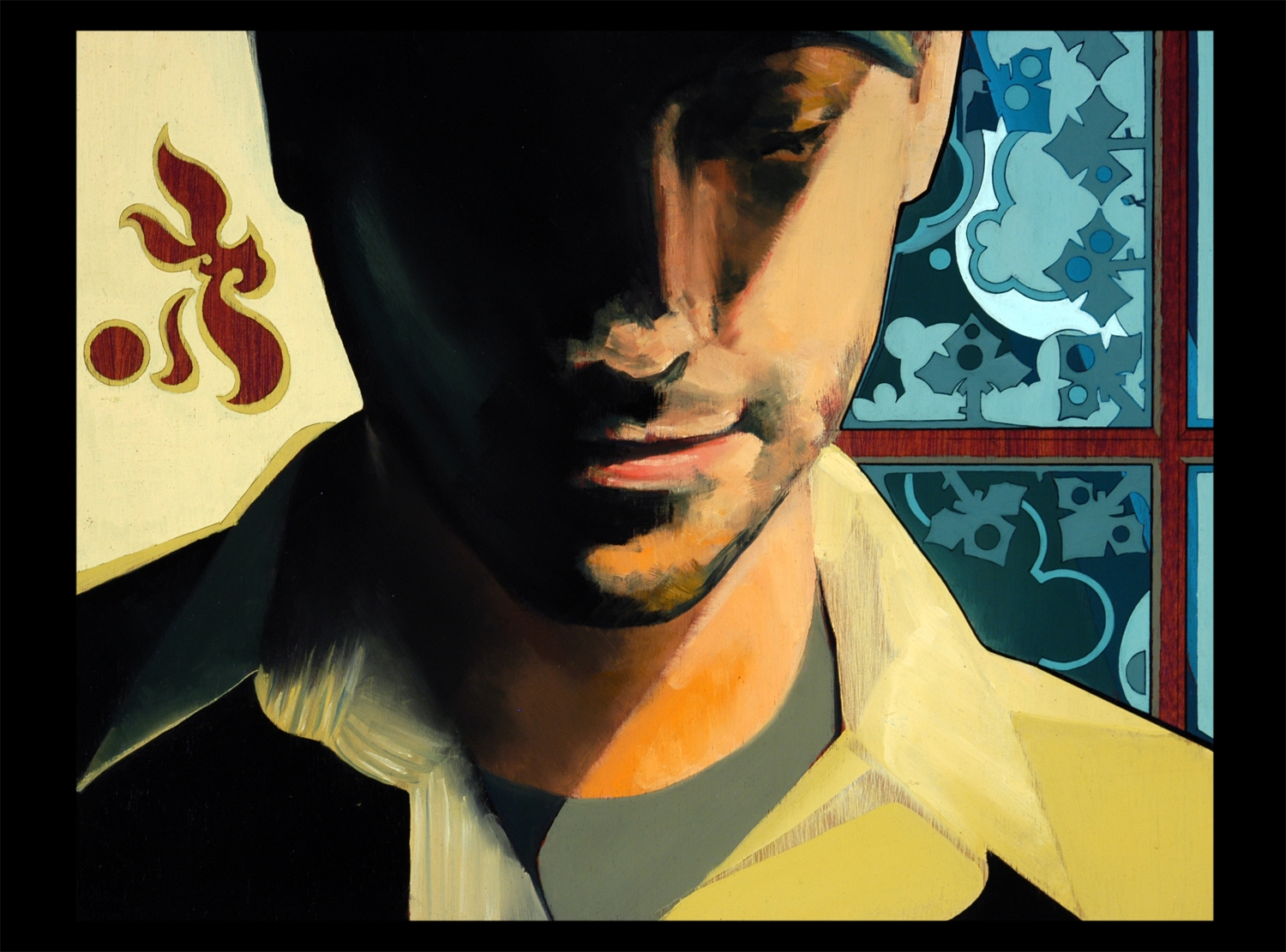
Self-portrait, oil on panel


We are thrilled to announce the guest illustrator for our upcoming April spring/summer issue: Morgan Maurer! Morgan graciously agreed to adopt the next issue and has already begun reading the work we have accepted. I’m really excited to see the issue start to come together. Here’s a snippet about his work:


Morgan Kirkland Maurer is a painter currently residing in Portland, Maine. A 2002 graduate of The Maine College Of Art, Morgan’s work synthesizes his love for the representation of landscape and portraiture with more abstract compositional choices such as the interplay between differing pictorial depths and how surface, material and mark-making interact. Examples of his work can be viewed online at www.morgankirklandmaurer.com


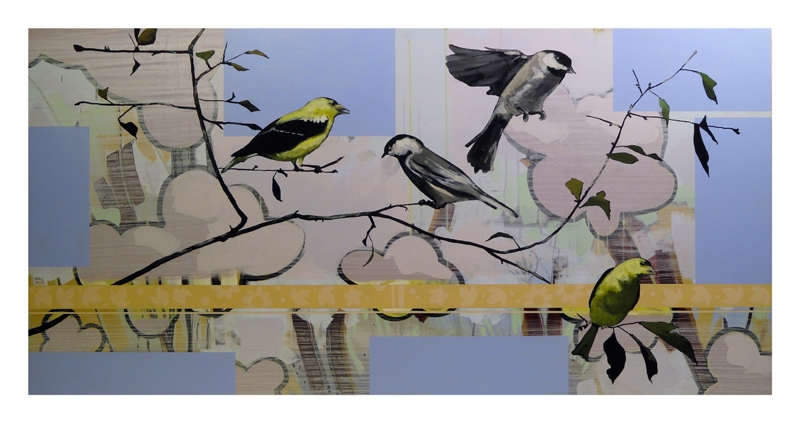
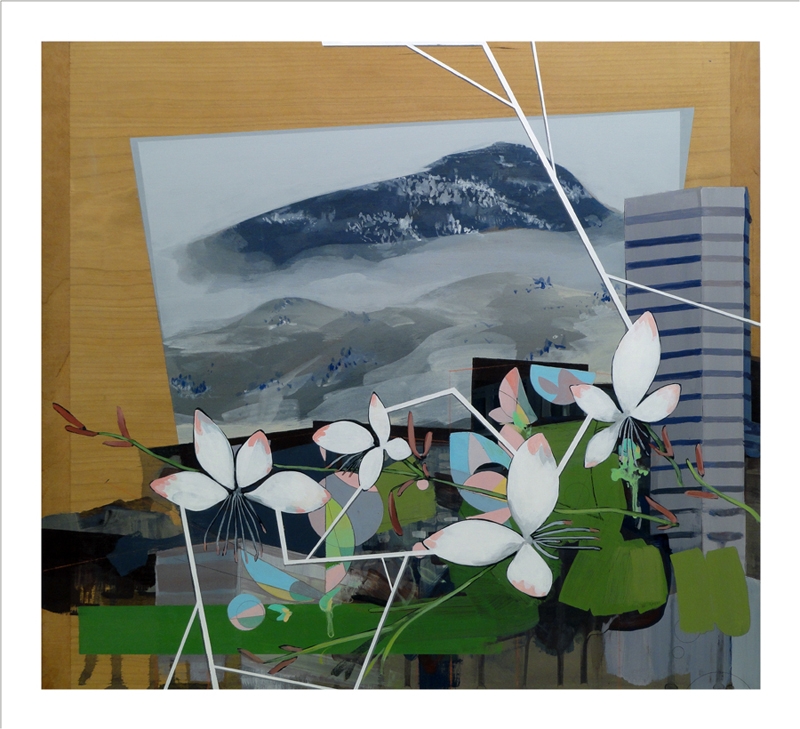
And here are a few samples to get you as excited as we are:

The Four Songbirds of the Apocolypse

The Four Songbirds of the Apocalypse, acrylic on panel

A Breeze off the Bay

A Breeze Off the Bay, oil on panel

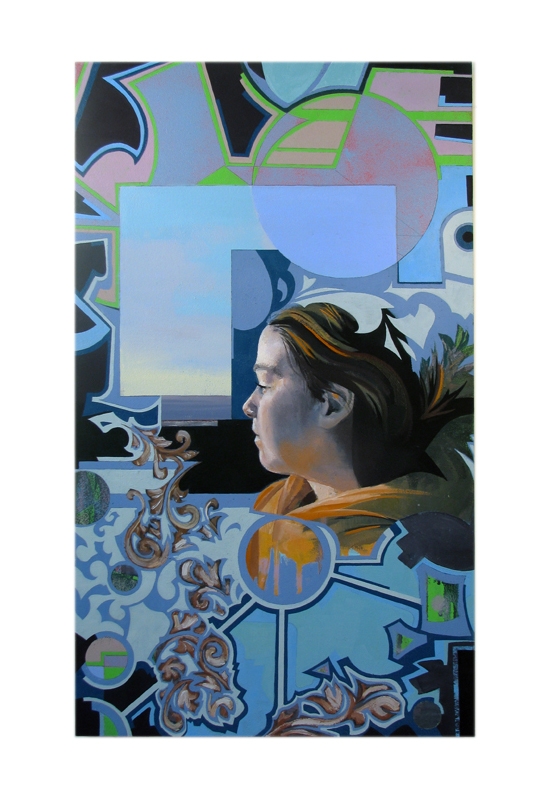
Amalgamation

Amalgamation, acrylic on panel


Welcome, Morgan! We are so excited to have you illustrating this issue!