“Beadwork” by Anjali Enjeti

stained glass window
Image by Kristin Beeler

My mother is perched on the edge of the couch with string woven between her fingers. When she shifts her legs, the tiny little beads in her lap sound like grains of rice pouring into a pot.

The hollow capsules are small, delicate, and light, clinging to the edge of my coffee table. My mom feels me watching her and says, “These are for the soldiers in Iraq. They want them all black.”

She pauses to consider their uniqueness, then continues. “It makes them seem more masculine, I suppose. And they look quite sharp, too.”

I try to picture American soldiers combing the desert with dog tags hanging around their necks, M16s secured to their chests, and black rosaries stuffed in their pockets.

My mother is surrounded by several pastel-colored tin buckets left over from past Easters, each filled to the rim with beads. Every few seconds, her unpainted fingernails sift through and select one. She then squints her eyes slightly in order to thread it.

I wonder why she just didn’t take up sewing.

When she does this, she is in a quiet, contemplative place. Somehow I find that the repetitious rhythm of beading resembles chanting — refrains of solace. I’ve never seen her so meditative. When my stomach growls I want to ask her what we should make for dinner. But I hold my tongue in order to avoid the awkward interruption.

I don’t know the prayers of the rosary. I attend Mass sporadically, and have never been confirmed as a Catholic. Though I feel a sense of peace when I sit in the pews of the church, there is a rift that will never be bridged between my feminist beliefs and Catholic ideology. I find it infuriating that women can’t be priests, that priests can’t marry, and that the pro-life platform has become the helm of the Church’s teachings. I question, probably too often, whether there even is a God.

And then there are my father’s Hindu beliefs to consider, sandwiching me between two faiths. So I remain at a distance, my relationship to Catholicism tenuous at best. I am hanging on by a thread, though I never tell my mother this.

In September 2006, soon after entering the second trimester, I called my mother while supine in a darkened ultrasound room. My hands were shaking so badly I could barely press the numbers on the phone.

“Hi Mom,” I said with a breathy, high-pitched voice. “The baby died.”

My mother normally remembers the exact day and time of every pregnancy appointment I have ever had. With my first two pregnancies, which resulted in two healthy girls, she was often calling me before I got off the examining table. “Did you hear the baby’s heartbeat?” she would shout into the phone, loud enough for the nurse scheduling my next appointment to overhear her.

On this particular day, because my mother had forgotten about my appointment, the news took some time to register. In the deafening silence that followed, I could almost hear her morbid thought process: Anjali is pregnant. Her appointment was today. But, how can it be? How can the baby be dead?

When my words finally made sense, she echoed my sobbing into the phone. The next day she flew up for my D & C, staying on a week to help me recover.

Soon thereafter, for the first time since becoming a church member twenty-five years earlier, my mother joined a ministry. Every Thursday night, she meets up with a group of women who make rosaries for people around the world.

I received the first one. It was blue — for the son we lost.

At first I found my mother’s new camaraderie irritating. I was hurt when she abruptly ended our phone conversations on Thursday evenings because she needed to dash out the door to a rosary-making meeting. I was jealous that she had established a nurturing collective — a means to work through her grief, whereas I still felt incredibly isolated despite a miscarriage support group and countless hours talking with mother-friends who had endured similar losses.

On the Friday mornings after her meetings with the Rosary Ladies, my mother would call to report the run-down of prayers and well wishes being sent my way. “Angela also had a miscarriage,” she’d say. “She prays for you every day.”

Or, “Lana’s niece just had a miscarriage, too.”

Some days, though, I didn’t really give a shit about these third-party condolences. What did they – these silly women with bead buckets – know about me?

While still in the throes of grief, I became pregnant again, and miscarried again. This time, the Rosary Ladies had a lot to pray about. There was a month of repeated hemorrhaging episodes, frequent trips to the ER, follow-up ultrasounds, powerful medications to expunge the “products of conception,” and then eventually, a second D & C. The Rosary Ladies prayed for my safety during the surgery. They Hail Mary’ed for a quick physical recovery. They Our Fathered for strength. They Glory Be’ed my scarred and depleted womb and Signed the Cross for my ability to bear a healthy child again.

Time passed. The Rosary Ladies, including my mother, kept beading.

Now, as I watch her delicately link prayers, I shift to relieve the pressure from the small head currently wedged up under my left rib cage.

We await the arrival of my third baby.

My mother seems serene, but her reflexive, repetitive fingers belie her easy-going facade. She is worried sick about this baby. To feign relaxation, we pass the day with superficial indulgences and vapid conversation. The verdict of every OB appointment and every ultrasound is a highly anxious ordeal. My mother can’t seem to stop making rosaries. She blames her dedication to the task on the group’s self-imposed goal of ten completed rosaries per week.

But my mother is really just afraid.

And so are the Rosary Ladies. They are saying extra prayers for me. Their beads surround me. I have one rosary hanging off the review mirror of my car, one folded in my backpack, two shoved in my nightstand, and one in the junk drawer of my kitchen, tangled with a spool of thread.

The other day, while picking up scattered remains of a puzzle, I found another in a toy box.

Even though I’ve never met them, the Rosary Ladies are now intimately connected to this lapsed Catholic’s pregnancy. I no longer shrug off their urgent messages of hope sent through my mother. Although I am still not much of a believer in religion, I have become a believer in the healing power of the beads. I listen closely to the rhythm of their sifting and pouring — I see the threading and knotting as an emblem of apology, an acknowledgment of pain, a ceremony of love and forgiveness. They provide me with a means to understand the fragility of life.

I realize, too, that the beads are my mother’s way of showing me that she continues to grieve deeply for my miscarriages. That her soft, warm embrace still holds me tight, and will never let me go.

My mother makes the final knots in her latest creation, hangs the cross, and delicately folds a green and blue rosary into my open palm. I would have never paired those two colors in a single strand. But when the rosary is complete, their union makes perfect sense.

I leave her work space and lug myself upstairs. I am heavy now, far along in my third trimester of pregnancy.

I enter the nursery unsure of where to place it. But when I see the sunlight shining through the blinds, illuminating the crib against the far wall, I follow the rays and position the rosary in the center of the newly laundered crib sheet.

It eagerly awaits, as do I, the soft dough skin of a newborn.


Anjali Enjeti is a graduate of Duke University and Washington University School of Law. She is a regular contributor to skirt.com. Her essay “Fade to Brown” is included in the anthology Call Me Okaasan: Adventures in Mothering Across Cultures (Wyatt-Mackenzie Press 2009) and was quoted in The Japan Times. Her essay “In the Dark” appears in the anthology, Other Tongues: Mixed Race Women Speak Out (Inanna Press 2010), and she has a forthcoming piece in an anthology by Catalyst Press. She has also written for Mothering, Catholic Parent, Hip Mama, and MotherVerse. She lives in Atlanta.

Read our interview with Anjali here.

“Race Change Operation” by Thomas Sayers Ellis


Image by Kristin Beeler

When I awake I will be white, the color of law.
I will be new, clean, good; and as pure as snow.
I will remember “being black” the way one
experiences deja vu, as shadow-memory-feeling.
Race will return to its original association with running
and winning, though I will never have to do either
(ever again) to prove myself Olympic, human or equal.
My English, by fault of gaze (theirs), will upgrade.
I will call my Mama, Mother and my Bruh, Brother
and, as cultural-life-insurance, the gatekeepers will
amputate my verbal nouns and double-descriptives.
When I grow my hair long I will favor Walt Whitman
more than Wole Soyinka. My pale, red neck will scare me,
a frightening irony of freedom. The Literary Party in power
will adopt me, saying “TSE is proof of our commitment
to (verse) diversity….” I am. Narrative poets will use me
as long as they can trust me, and Elliptical women
will want me in their anthologies but not as a colleague.
What will I do with myself other than prove myself,
my whiteness, and that blackness is behind me?
The poetry in my walk will become prose.
I will be a white fiction full of black-ish progression,
the first human bestseller, a Jigga Book Spook.
It will be like having tenure, my value will be done.
This is crazy, this lose-a-world way to whiteness.
What happened to “smiling,” to “playing the game,”
to being one of their favorites, to interracial marriage?
As a black, I won a Mrs. Giles Whiting Writer’s Award,
so imagine what I will win when I become one of them.
I can see it now, my MacArthur. Jungle eyes, a Guggenheim.
This might be the most racist decision I’ve ever made
but these lines, unlike the color line, were written to break.
I am tired of lines, of waiting, of lies, my bio full of prizes.
I want my own whiteness, to own then free (someone like) me
even if it means reintegrating another sinking ship.
I’ll be that Shine, defiant and drowned, dream alive.


Thomas Sayers Ellis co-founded The Dark Room Collective (in Cambridge, Massachusetts); and received his M.F.A. from Brown University. He is the author of The Maverick Room (2005), which won the John C. Zacharis First Book Award, and a recipient of a Mrs. Giles Whiting Writers’ Award. His poems and photographs have appeared in numerous journals and anthologies, including Callaloo, Best American Poetry (1997, 2001 and 2010), Grand Street, The Baffler, Jubilat, Tin House, Poetry, and The Nation. He is also an Assistant Professor of Writing at Sarah Lawrence College, a faculty member of the Lesley University low-residency M.F.A Program and a Caven Canem faculty member. He lives in Brooklyn, NY and is currently working on The Go-Go Book: People in the Pocket in Washington, D.C. A new collection of poetry, Skin, Inc., has just appeared from Graywolf Press.


“Learning How to Pray” by Cathy Smith Bowers

ghostly flowers
Image by Kristin Beeler

When I heard my brother
was dying         youngest
of the six of us            our
lovely boy         I who in matters
of the spirit
had been always suspect
who even as a child
snubbed Mama’s mealtime ritual
began finally to
pray          and fearing
I would offend
or miss completely
the rightful target of my pleas
went knocking everywhere
the Buddha’s huge
and starry churning        Shiva
Vishnu       Isis    the worn
and ragged god of Ishmael
I bowed to the Druid reverence
of trees       to water     fire
and wind          prayed to weather
to carbon          that sole link
to all things
this and other worldly
our carbon who art in heaven
prayed to rake and plow
the sweet acid stench of dung
to fly        to the fly’s soiled
wing        and to the soil
I could not stop
myself               I like a nymphomaniac
the dark promiscuity
of my spirit       there
for the taking       whore
of my breaking heart     willing
to lie down       with anything.


Cathy Smith Bowers was born and reared, one of six children, in the small mill town of Lancaster, South Carolina. Her poems have appeared widely in publications such as The Atlantic Monthly, The Georgia Review, Poetry, The Southern Review, and The Kenyon Review. She served for many years as poet-in-residence at Queens University of Charlotte where she received the 2002 JB Fuqua Distinguished Educator Award. She now teaches in the Queens low-residency MFA program and at Wofford. She is the author of four collections of poetry: The Love That Ended Yesterday in Texas, Texas Tech University Press, 1992; Traveling in Time of Danger, Iris Press, 1999; A Book of Minutes, Iris Press, 2004; The Candle I Hold Up To See You, Iris Press, 2009. Smith Bowers is the current Poet Laureate of the state of North Carolina.

Read a review of Like Shining from Shook Foil here.


“Groceries” by Cathy Smith Bowers

gnome, ginger root
Image by Kristin Beeler, 2011.
(See also “The Brussels Sprout Rule” by Ali J. Shaw.)

I had a boyfriend once, after my mother
and brothers and sisters and I
fled my father’s house, who worked
at the Piggly Wiggly where he stocked
shelves on Fridays until midnight
then drove to my house to sneak me out,
take me down to the tracks by the cotton mill
where he lifted me and the quilt I’d brought
into an empty boxcar. All night
the wild thunder of looms. The roar of trains
passing on adjacent tracks, hauling
their difficult cargo, cotton bales
or rolls of muslin on their way
to the bleachery to be whitened, patterned
into stripes and checks, into still-life gardens
of wisteria and rose. And when the whistle
signaled third shift free, he would lift me
down again onto the gravel and take me home.
If my mother ever knew, she didn’t say, so glad
in her new freedom, so grateful for the bags
of damaged goods stolen from the stockroom
and left on our kitchen table. Slashed
bags of rice and beans he had bandaged
with masking tape, the labelless cans,
the cereals and detergents in varying
stages of destruction. Plenty
to get us through the week, and even some plums
and cherries, tender and delicious,
still whole inside the mutilated cans
and floating in their own sweet juice.


Cathy Smith Bowers was born and reared, one of six children, in the small mill town of Lancaster, South Carolina. Her poems have appeared widely in publications such as The Atlantic Monthly, The Georgia Review, Poetry, The Southern Review, and The Kenyon Review. She served for many years as poet-in-residence at Queens University of Charlotte where she received the 2002 JB Fuqua Distinguished Educator Award. She now teaches in the Queens low-residency MFA program and at Wofford. She is the author of four collections of poetry: The Love That Ended Yesterday in Texas, Texas Tech University Press, 1992; Traveling in Time of Danger, Iris Press, 1999; A Book of Minutes, Iris Press, 2004; The Candle I Hold Up To See You, Iris Press, 2009. Smith Bowers is the current Poet Laureate of the state of North Carolina.

Read a review of Like Shining from Shook Foil here.


Review of Like Shining from Shook Foil

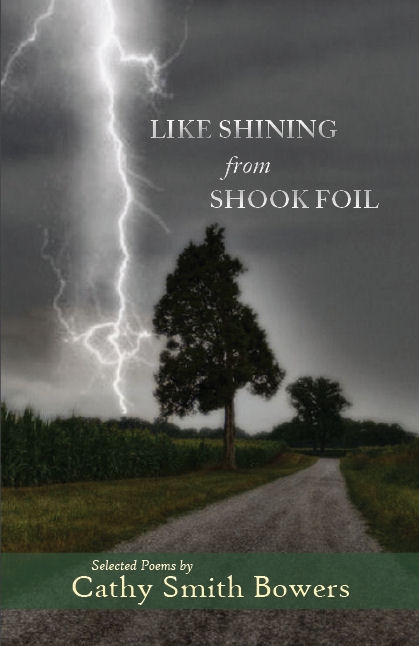
book cover, tree with lightning

Like Shining from Shook Foil
Selected Poems by Cathy Smith Bowers
Press 53 Winston-Salem, North Carolina
142 pages
www.press53.com

When I was still a novice poet, an acquaintance introduced me to The Love That Ended Yesterday in Texas by Cathy Smith Bowers. Almost instantly I said to myself, “I want to write poems like these.”

More than a dozen years later, I feel the same way. Smith Bowers (what an apt name for a poet whose poems provide so much shelter for people who have known sorrow) writes in a voice that begs to be read aloud:

“Desert moved into town
and made itself at home.
Houses glowed like skulls.
Banisters lined the stoops
like rows of teeth.”

(“One Hundred and Ten Degrees”)

Readers of Like Shining from Shook Foil will not have to struggle with esoteric words or awkward syntax. Lines follow each other smoothly, most often by unfolding a clear narrative, but also by following a logic that, at least on the surface, seems predictable and trustworthy.

Stepping into one of Smith Bowers’ poems is like getting on a train. You’re off and running within the first few lines: “When I heard the sudden / thunder of my husband’s truck,” (“You can’t drive the Same Truck Twice”) or, “It’s not my brother’s dying / that I fear, that perfect healing” (“Pacific Time”). However, for all these elements that make her poems easy to get into and stay with, what is going on in them is by no means simple. One of my favorites of her early poems, “Wanting Them Back,” gets at the ambivalence many of us feel as we live between seasons by using the simile of a wood-carver who has fashioned a little boy out of a piece of pine. To the carver’s surprise, the boy comes to life and starts running away. Of the boy, Smith Bowers writes that he, too, is “astonished at the ruckus in his chest, / at the strange old man at his back / who kept crying Be wood! Be wood!”

Among her most compelling poems are those that deal with her relationships with her father, her brother, and her second husband, all now dead. These poems give voice to the anger, longing, bafflement, gratitude, and sadness that many of her readers know about firsthand, and many more will recognize as part of the human condition. None moves me more than “Learning How To Pray,” in which the writer, who has heretofore disavowed religion, becomes willing to pray to any god, goddess or substance, if it will help her brother:

I like a nymphomaniac
the dark promiscuity
of my spirit     there
for the taking         whore
of my breaking heart   willing
to lie down      with anything

As to the balance of the selections in the collection as a whole, there are generous portions from The Love That Ended Yesterday in Texas (Iris Books 1992) and Traveling in Time of Danger (Iris Books 1999). I wish the current editor, Tom Lombardo, had selected more poems from her Book of Minutes (Iris Books 2004), as I believe this brief form (an eight syllable first line followed by three four syllable lines, with this stanza pattern repeated three times) might well offer American poets our own distinctive short poem serving the same purpose as that of the Haiku. Although there are compelling poems from The Candle I Hold Up to See You (Iris Books 2009) such as “Questions for Pluto,” “Solace,” and “Pear Moonshine,” I am not sure that these poems convey the multi-layered complexity of her other collections. Happily, the section of uncollected published poems is loaded with wonders, most notably “River” and “Watching for Meteors.”

Like Shining from Shook Foil will bring new pleasures to all but the most inveterate readers of her poetry. For those not familiar with her work, this collection gathers the best of Smith Bowers’ poems, allowing readers a sense of their remarkable depth and breadth.

Like Shining From Shook Foil Selected Poems by Cathy Smith Bowers
Press 53
http://www.press53.com/bioCathySmithBowers.html

J. Stephen Rhodes‘ poems have appeared in Shenandoah, Tar River Poetry, and The International Poetry Review, among others. His poetry collection, The Time I Didn’t Know What to Do Next, was recently published by Wind Publications. He is a Presbyterian minister and a retired theological educator. His website is: http://www.jstephenrhodes.com

“Salsa” by Kim Chinquee

pink clouds
Image by Kristin Beeler

My mom, my son, and I went to dinner at a place called Margarita’s. My mom ordered herself a peach one.

I agreed to share until I remembered once waking to see who I’d called the night before, through the history of my cell phone, seeing a new picture, the screen saver. I thought it was my son in the picture. You couldn’t really tell who it was, laying face down in the kitchen. But then I looked in his room and he was sleeping. I looked in the mirror, looked again at the picture. It started to dawn on me, how things progressed, but it was mostly black out.  I still remembered the smell, my hair stuck from the vomit. My son said if I did that again, he’d never see me again, ever. That was just last year. Now, he’d just flown in, his first visit here from college.

We sat there, under the umbrella, eating chips and salsa. My son jumped over the rail, going to smoke in the lot. Two ladies said he must be an athlete.

My mom sipped her drink, and said maybe later we could take a drive to see her brother’s campsite. It would take an hour to get there. I asked her what we’d do. My uncle was completely pleasant. I told my mom I wasn’t sure. I remembered my son and me when he was little. We’d rent these silly movies. We’d drive to find a sunset. We’d color with our noses. We’d make a pie and put it on a doorstep. We’d turn up the tape and dance like hoodlums.

By the time the food came, my mom was on her second happy hour special. I got a seafood salad, skipping all the stuff like sour cream and the big fried shell. My mom got a steak meal, which looked better than mine. I don’t remember what my son got. It started to rain, and then my mom said the campsite was out of the question.

Finally, we all ran to the car, saying the last one there is a raincoat.


Kim Chinquee is the author of the collections Oh Baby and Pretty. She lives in Buffalo, New York.

Showcasing the work of Susan Meyers

Susan Meyers


(Read Susan’s wonderful poem That Year in our archives.)


I have long admired the poetry of Susan Meyers. Its beauty, and grace and gentle honesty speak to me in a way that is calming, satisfying, and somehow “right.” Even her most intensely personal poems manage to seem more universal than confessional. Most of all, I love the simple elegance of Susan’s poetry. It sneaks up on the reader–at least this reader. I so often read her work and think, “of course.” Wise is the poet who can get out of the way and let the words give the reader the experience, thought, image, epiphany that the verse offers up. Susan does this in a way that is not only satisfying, but that seems natural and effortless. (I know just enough about poetry to know that it isn’t.)


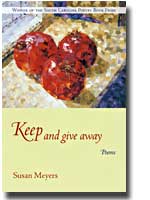
I highly recommend her marvelous first book Keep and Give Away, which won the SC Poetry Book Prize, the Brockman-Campbell Book Award and the SIBA (Southern Independent Booksellers Alliance) Book Award for Poetry. A great review of Keep and Give Away can be read here. She has also had her fine poem Hat of Many Goldfinches featured on Verse Daily and you can visit her poetry blog here.


Here is the lovely title poem from that collection:


Keep and Give Away

What do I know of man’s destiny?
I could tell you more about radishes.

— Samuel Beckett

With a bushel basket in hand
he’s the tally of my ripest desires,

more than the sum of his summer
crops, perfect and plentiful as they are—

even counting Early Contenders
and Silver Queen. Burpless

cucumbers, Kentucky Wonders, too.
Throw in the fruit to sweeten

the numbers: blackberries and figs
piled in pyramids or weighed

in pecks. And don’t forget
the peppers (red, yellow, green),

divided into keep and give away.
Dinner plates—heaped with leafiness,

tubers, and pods—heavy
with the haul and roots of his labor.

Now he’s shelling peas in his lap
and I sit across the room, listening

to the ping, ping. He’s more
than the sum, I cannot count the ways,

and despite a constant reckoning
of work and luck, numbers fail me

in this long, hot growing season.


–Susan Meyers

An Interview with Claudine Guertin

Claudine Guertin


MA: Hi, Claudine. Thanks for agreeing to talk with me today. I’d like to talk a little bit about writing in general and your writing process in particular, if I might. I’ve had the pleasure of reading some of your fine work and I’m always struck by your use of strong detail and striking /images. Can you tell me a little bit about what moves you as a writer?

CG: Thanks for saying that because I often feel like I write so deeply from inside characters’ heads that the 3D world around them is underdeveloped. I always have to go back through and add concrete imagery and details to anchor scenes. What usually moves me the most are the emotional experiences of my characters, and that’s the journey I ride when I write. So the /images that emerge tend to be born out of those emotions.


MA: I can see how that would work, especially if your characters have vivid imaginations, which I know they do. And I do believe that the internal world can be at least as vivid as the external–sometimes more so. You know, I would also say that there are some fabulist elements to your work…that may not be quite the word I want. But by “fabulist” I mean something that is universal and striking and hits the subconscious as much as the conscious. Like a fairy tale or a fable would. Does what I’m saying make any sense to you when thinking of your work?

CG: Wow, I’ve never consciously thought of my work that way, but I think you’re right. I’m always thinking about the layers of meanings as I write. I often think about how these individual character experiences spin outward to something more universal. All of my stories feel somewhat mythic and fabulist as they’re percolating inside me. But translating that to the page is sort of an act of faith. You never know how much of that is really coming together in the final product.


MA: Well, as one reader/fan, I can say with authority that it’s working for me. This leads me to another question. As you know, my co-author for the non-fiction book was from Poland and his family believed very strongly in dreams and the power of mythic stories. I think Europeans tend to be more tuned in (than Americans) to such things. I know you have connections to eastern Europe. What are those and how do you feel they have influenced your writing?

CG: Yes, my boyfriend is from Bosnia. We met eleven years ago, and even before that, I was very drawn by Russia, which is part of my heritage. I studied Russian in college, and I now study Bosnian-Croatian-Serbian with a University of Chicago professor. We’re working on translating a short-story collection by a popular Bosnian Serb writer. So a lot of circumstances in my life seem to bear echoes from that area of the world.

MA: I think that influence is part of what makes your work so interesting and exciting to read. A novel can be such a vast landscape. How do you find your way in? Do you wait for a voice to emerge? A Character? A plot?

CG: I believe, if a story is coming from the deepest place, that the novel calls to the writer, and not the other way around. At first, there’s always something there haunting me, and I sit with that until the characters begin to speak to me. That can take months or even years. For instance, I recently completed my first novel and began writing what I’d planned for two years to be my second novel. In the back of my mind, I always thought I’d write a novel about Bosnia and the war, but I didn’t think I had the literary chops for it yet, so it was on the back burner until my writing could mature more. But then, this past summer after I was thirty pages into Novel Number Two, my boyfriend and I went to visit his family. What I saw in Bosnia, which, by the way, is one of the most gorgeous countries I’ve ever visited, was a lot of war devastation, ethnic separatism and tension, corruption and also, so it doesn’t all sound dire, some rebuilding and positivity. It was profound to hear people’s stories. Many of them are not “past” the war, and it’s easy to see why not. Everyone knows someone who died, whose house was bombed or burned, who was in a concentration camp, who lost their savings, etc. The entire fabric of life was destroyed for people on every side. How do you get past a war in a city that’s been ethnically cleansed and repopulated with different people, as my boyfriend’s city is? How do you move forward when your daily commute includes bombed-out buildings and bullet-riddled street signs, like in downtown Mostar? So on that trip, the main character of this Bosnian novel started speaking to me, and I could feel the weight of the story in my throat, if that makes any sense. Or maybe I should say I could feel all the emotions of the story in my throat. So I’ve shifted tracks and am now working on this new, intimidating project, for better or for worse. I still have a lot to research and discover, so I’ll be underwater here for quite some time.

MA: Sounds fascinating and very “deep.” I can’t wait to read it. What do you think gives a story depth?

CG: To me, a deep story works like a prism that the reader can turn over to find unexpected facets of meaning, either by leading to new territory or by turning old territory on its ear. That happens, I think, when the writer plumbs the emotional landscape of her characters and their situations to the very bottom. Then she can reassemble all those elements into something altogether different, honest and complete. Or maybe that’s a neat and tidy crap answer. I think we’re always learning, and I, for one, usually enter into a story never knowing much at all. What comes out on the other side is always a bit of a surprise.

MA: Yes, hurray for the surprises. Where would we be without them? Thanks for the great answers, Claudine, and the great conversation. You’ve given me a lot to think about.  Good luck taming the new novel. I know you will make something wonderful.

Interview with Lu Livingston

This week, I’m thrilled to introduce you to Lu Livingston, the author of Macaroni & Cheese, a Shorts On Survival piece from the current issue. And Lu had the great idea to mix up the format of the blog this time and instead of talking about herself (she’s very modest), she preferred to talk more about the writing process. So I happily conducted a little mini-interview that I’m pleased to include below.

Mary Akers: Thanks for the great interview suggestion, Lu. I’m interested to hear your answers. I’ll start with a very basic but important question: What does “story” mean to you?

Lu Livingston: Sorry, but I’m a traditionalist when it comes to what “story” means. X wants Y, but Z is in the way. Tell me a story with a beginning, a middle, and an end (the same thing Aristotle wanted); give me an imperfect protagonist who wants something hard to get and is capable of change. I like a ground situation with plenty of potential for screwing-up and a monumental barrier to attaining the goal. Whether X gets Y isn’t as important as realizing the potential for change, even if it’s small. This may come from my instructor David Payne brow-beating into me “What’s cranking this story?” Or maybe from parents who read to me every day. I’m sick to death of postmodern and ready for literary gears to shift.


MA: I’m with you on that score. In terms of inspiration, do you find that you mostly read the kind of work that you write? Or do you mix it up?

LL: Do I read the kind of work I write? I try to always read very much better, don’t you? There’s too much really good stuff out there to waste on consumer fiction (although [don’t tell a soul] I was mad about The Girl Who—trilogy). Lately I’m reading all the Icelandic sagas and reread Seamus Heaney’s translation of Beowulf.  I’m trying to read all the Man-Booker award winners, too. I get on one writer and try to read everything I can get hold of, like Eric Linklater, James Robertson, or Neil Gunn, or currently, George Mackay Brown. Interesting now that I look at it—those are all European or Scottish writers. To make me think I (try to) read the theorists. Of course that makes writing fiction nearly impossible, but the literary theories are fascinating. Theory is integrated into the college English curriculum very early now, so to teach it, I always have to think it.


MA: I know you like to travel. How have your travels influenced your writing and/or your career?

LL: Yes, I love to travel, and it certainly does influence my writing. I’m studying the notion of “narrative” time and place right now in the poetry of Meg Bateman (from Skye) and Robert Alan Jamieson (from Shetland), and I am astounded at how complicated a concept “place” can be. My sister and I go to Scotland about every other year for a month in the summer, and even though I can get around and have friends and haunts there, I will always be an incomer, and even though that’s an uncomfortable “place” to be when you’d love not to be ridiculed for the East Tennessee accent, it’s exactly where you want to be as a writer in order to see place from the edge. I want to master “place” as not just setting, but as time/space interaction of people with the potential for relationships materializing, disintegrating, or just brushing elbows in the crowd on a train platform. When I travel, I’m quicker to sense potential. Now, that makes no sense whatsoever, does it?


MA: Oh, I don’t know. It seemed to make pretty darn good sense to me. But the idea of the mutability of place fascinates me, too.

LL: Well, Mary, it has been delightful chatting with you. Must go feed the horses now!


MA: Thank you, Lu! It was a pleasure to talk with you. And to the r.kv.r.y. readers, thanks for checking in. Keep Lu Livingston on your radar screen–she’s a name to watch!

Featuring Andrew Tibbetts


This week at r.kv.r.y., I’m pleased to showcase the work of Andrew Tibbetts! I met Andrew virtually at least five years ago, and have been a great admirer of his work ever since. Then late last year I had the excellent opportunity to meet Andrew in person in Toronto when we met at the launch of Margaret Atwood’s novel Year of the Flood. We are both slavering fans of the divine Ms. Atwood, so it was a special treat to share that experience with Andrew. And I’m happy to report that Andrew is just as delightful in person as he is on-line.


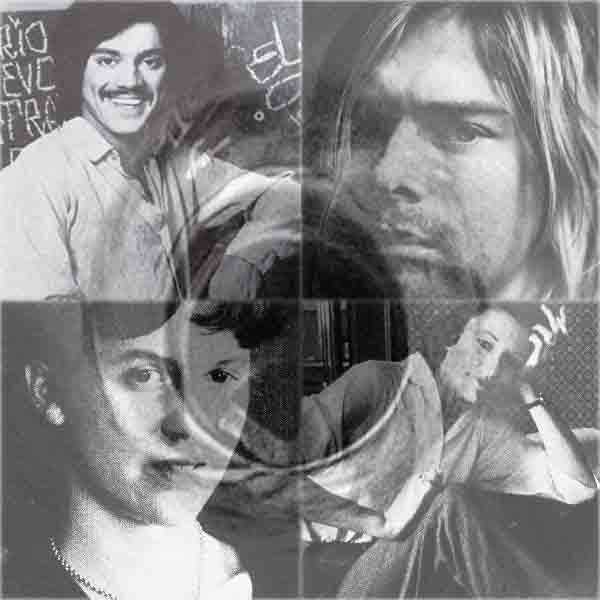
Then, earlier this year I had the opportunity to read his essay I, Suicide in a private on-line office for writers. He wasn’t looking to get the micro-essay published, just to share hsi work and discuss ways to improve it. But when I read it and recognized its power, I knew it would be perfect for r.kv.r.y. I promptly contacted him and plied him with all manner of flattery in an attempt to convince him to let me have this moving personal essay. Gentleman that he is, he gave it to me. And our illustrator did a fine job of illustrating it, connecting the /images of four creative lives sucked down the drain, lured by the seductive side of suicide.


Andrew writes with a brutal honesty and slicing self-reflection. He “goes there” when others shy away. He won the 2008 Malahat Review Novella Prize for his excellent story Dead Man’s Wedding. You can read an excerpt from that story here. I value his work and I value him and we’re pleased to have him in this issue of r.kv.r.y.


And, for your additional reading pleasure, here are a few links to more of Andrew’s fine work:


Gifted at PANK Magazine


201 Feet at Smokelong Quarterly